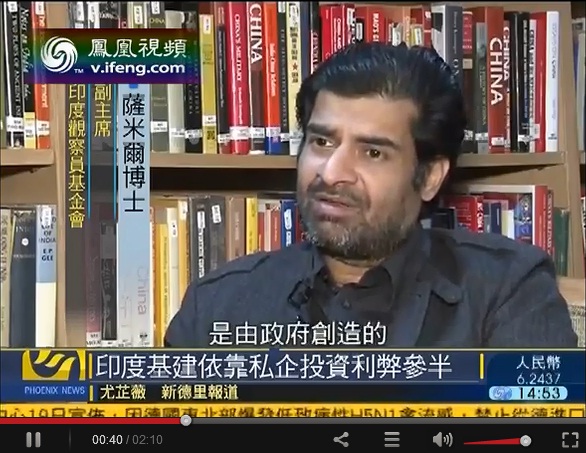
The news link of the story about India BOT is here
The news link of the story about India BOT is here
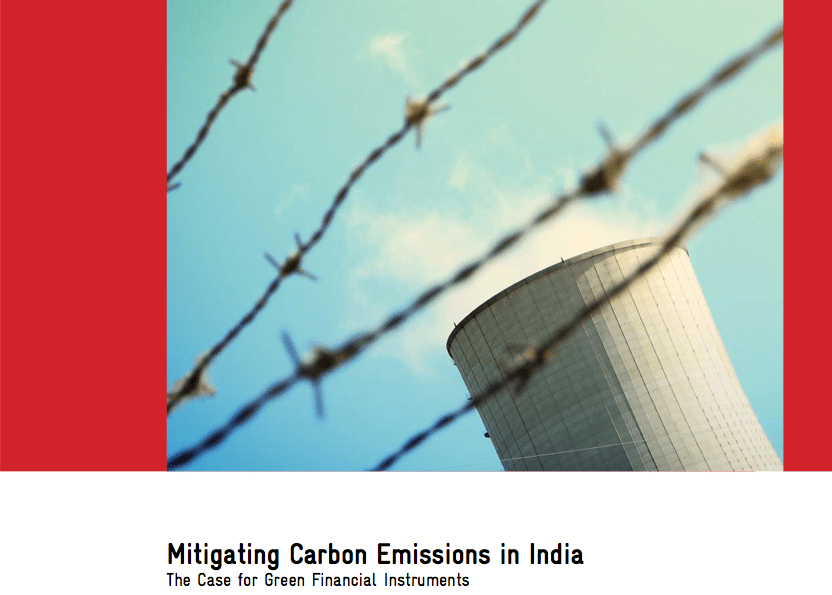
New Delhi, 18th of February 2013
Please find here the link to download the report.
Executive Summary
With the sun gradually setting on the Kyoto Protocol (Phase One), it has become quite apparent that the global response to resource scarcity and climate change is going to be variable and disaggregated. Increasingly, countries and businesses across the globe are adopting various financial mechanisms and policies in order to manage such challenges. However, many such responses are restricted to advanced, developed countries, whereas the effects of climate change and the increasing cost of resources such as fossil fuels are likely to be more severe for developing countries. This dichotomy in response measures needs to be urgently addressed, and this report is an attempt to highlight the benefits of an inclusive growth oriented financial response mechanism with particular focus on India.
In its first chapter the report briefly outlines the relevance of GHG emissions mitigation through in- clusive market based mechanisms in India. With shifting patterns of economic growth and increased global demand volatility companies and investors in emerging economies, such as India, need to rec- ognise the value created through the supply chain of business deliverables by mitigating emissions. Mechanisms which exclude companies that do not meet global benchmarks, whether by way of share- holder advocacy and investment exclusion, or regulatory policies, will have a significant impact on the way that these companies choose to grow.
Low carbon strategies can only be implemented if the emissions landscape and its effects on sustainable growth are clearly defined and understood. The second chapter outlines emissions trends in India in order to map the carbon landscape and set the context for the rest of the discourse. Chapter 3 examines the trends of energy consumption and emissions at a sector specific and firm specific level (within the assessed sector). It is found that firms in the assessed sector (cement) are operating in sub optimal con- ditions, along with a lack of policy frameworks and market based emissions reduction incentives – there are no indigenous market based mechanisms to incentivise and stimulate change.
A firm level case study of one of the bigger private players in the Indian cement sector has revealed that the firm’s financial performance could have been better. At the same time, capacity additions and increased output have caused the total emissions of the company to increase, which is not sufficiently offset by the revenue gains. As a result, the firm’s emissions intensity has been rising consistently for clinker production. However, enhanced use of additives has kept the overall GHG intensity of cement based revenue lower. The average emissions intensity of the company was higher for three years than the sector average for the same period. The high correlation between the firm’s environmental perfor- mance and its financial performance has been highlighted.
The results of chapter 3 are aligned with the philosophy that environmental performance must not be excluded from the range of parameters that are used by investors while choosing a stock, especially a long term investment. This is true since the two concepts are inherently interlinked under the overall aegis of sustainable growth. It highlights the need for developing market based mechanisms to signal investment opportunities based upon carbon efficiency and financial performance, as both tend to complement each other in the medium to long term.
Chapter four concludes that; companies preparing for risk are not risk averse, but rather are risk prepared. The difference is subtle but important. Market based mechanisms which incentivise good performance by channelling investments to firms that respond to risk better than their competitors in a given environment, help investors realise this distinction clearly. For “green” market mechanisms and investment vehicles to be viable and effective, they must efficiently ensure that the transmission mecha- nism works and only performance based, credible signals are relayed to the open markets. This becomes even more important in the context of a developing country due to the nascent capital markets, and urgent need for scaling up sustainability initiatives – both at the firm and policy levels.
Capital generation should not be looked at as the problem. Rather, redirecting existing and planned capital flows from traditional high-carbon to low-emission; resilient investment is the key challenge of financing transition to a low-emission economy. In order to facilitate such transitions, a universally replicable model will be used – a multipronged approach to achieve the above objectives. This would involve creation of innovative financial products based on purely quantitative data, create and publish sector wise and cross sectoral market reports, and facilitate progressive policy advocacy in order to en- able market realisation for its products. It will further seek to replicate the model in other developing countries through a hub and spoke approach to expansion.

Samir wrote one chapter in the new ORF publication “The Global Economic Meltdown”. 
Please find here the original link
Please find here the full document (PDF version): Deconstructing India’s Inclusive Development Agenda
The Global Financial Crisis (GFC) of 2008 is widely recognized across the globe as the most severe economic downturn since the Great Depression. The prolonged global economic slowdown has stymied the US economy, brought the Eurozone to the precipice, and continues to retard growth momentum throughout the world. Even developing economies that were previously thought to be crisis-averse are now experiencing the rough waters after an economic tsunami.
The writers in this compendium address the many complexities of the GFC and present a holistic overview of its background, how it unfolded and how many nations sought to respond to it. This publication is unique in its approach of the crisis from a global perspective, with pieces focusing on India, Europe and the United States. Furthermore, the book provides a thorough examination of the economic, political, environmental and social implications of the crisis and offers glimpses of the road ahead, replete with policy recommendations for a more stable and prosperous future.
by Samir Saran and Vivan Sharan
Please find here the link to the original article.
New Delhi: There have been heated discussions over the role of BRICS recently. Ian Bremmer, President of the Eurasia Group, a political risk consulting firm, wrote an eye-catching article in the New York Times in late November, proclaiming that BRICS is nothing more than a catchy acronym. The BRICS nations represent over 43 percent of the global population that is likely to account for over 50 percent of global consumption by the middle class – those earning between $16 and $50 per day – by 2050. On the other hand, they also collectively account for around half of global poverty calculated at the World Bank’s $1.25 a day poverty line. What, then, is the mortar that unites these BRICS?
First, unlike NATO, BRICS is not posturing as a global security group; unlike ASEAN or MERCOSUR, BRICS is not an archetypal regional trading bloc; and unlike the G7, BRICS is not a conglomerate of Western economies laying bets at the global governance high table. BRICS is, instead, a 21st-century arrangement for the global managers of tomorrow.
At the end of World War II, the Atlantic countries rallied around ideological constructs in an attempt to create a peaceful global order. Now, with the shifts in economic weights, adherence to ideologies no longer determines interactions among nations.
BRICS members are aware that they must collaborate on issues of common interest rather than common ideologies in what is now a near “G-0 world,” to borrow Bremmer’s own terminology. Second, size does not matter and it never has. Interests do and they always will. Intriguingly, Bremmer expresses his concern over China being a dominant member within BRICS. Clearly, Bremmer has chosen to ignore the fact that the US accounts for about 70 percent of the total defense expenditure of NATO countries or that it contributes nearly 45 percent of the G7’s collective GDP.
Third, BRICS is a flexible group in which cooperation is based on consensus. Issues of common concern include creating more efficient markets and generating sustained growth; generating employment; facilitating access to resources and services; addressing healthcare concerns and urbanization pressures; and seeking a stable external environment not periodically punctuated with violence arising out of a whim of a country with means.
Fourth, it is useful to remember that the world is still in the middle of a serious recession emanating from the West. As Bremmer himself points out, systemic dependence on Western demand is a critical challenge for BRICS nations. Indeed, it is no surprise that they have begun to create hedges. The proposal to institute a BRICS-led Development Bank, instruments to incentivize trade and investments, as well as mechanisms to integrate financial markets and stock exchanges are a few examples.
Fifth, through the war on Iraq, some countries undermined the UN framework. The interventions in Libya reaffirmed that sovereignty is neither sacrosanct nor a universal right. While imposing significant economic costs on the world, they failed to produce the desired political outcome. By maintaining the centrality of the UN framework in international relations, BRICS is attempting to pose a counter-narrative.
Sixth, in the post-Washington Consensus era, financial institutions such as the IMF and the World Bank are struggling to articulate a coherent development discourse. BRICS nations are at a stage where they can collectively craft a viable alternative development agenda.
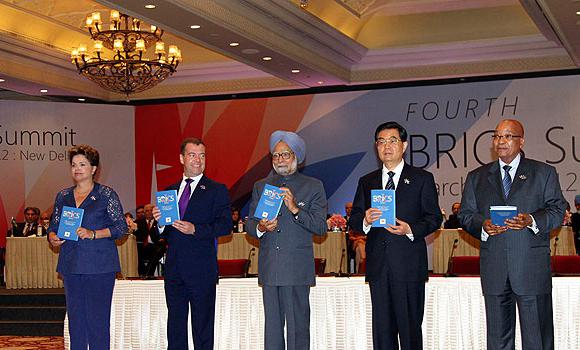
In the Fourth BRICS Summit in New Delhi in March 2012, there was clear emphasis on sharing development knowledge and further democratizing institutions of global financial governance within the cooperative framework. BRICS is a transcontinental grouping that seeks to shape the environment within which the member countries exist. While countries across the globe share a number of common interests, the order of priorities differs. Today, BRICS nations find that their order of priorities on a number of external and internal issues which affect their domestic environments is relatively similar.
BRICS is pursuing an evolving and well thought out agenda based on this premise. And unlike Bremmer, we are not convinced that they are destined to fail.
* Samir Saran is vice president and Vivan Sharan an associate fellow at the Observer Research Foundation, New Delhi.

by Samir Saran and Vivan Sharan
Please find here the link to the original article.
There have been heated discussions over the role of BRICS recently. Ian Bremmer, President of the Eurasia Group, a political risk consulting firm, wrote an eye-catching article in the New York Times in late November, proclaiming that BRICS is nothing more than a catchy acronym.
The BRICS nations represent over 43 percent of the global population that is likely to account for over 50 percent of global consumption by the middle class – those earning between $16 and $50 per day – by 2050. On the other hand, they also collectively account for around half of global poverty calculated at the World Bank’s $1.25 a day poverty line.
What, then, is the mortar that unites these BRICS?
First, unlike NATO, BRICS is not posturing as a global security group; unlike ASEAN or MERCOSUR, BRICS is not an archetypal regional trading bloc; and unlike the G7, BRICS is not a conglomerate of Western economies laying bets at the global governance high table. BRICS is, instead, a 21st-century arrangement for the global managers of tomorrow.
At the end of World War II, the Atlantic countries rallied around ideological constructs in an attempt to create a peaceful global order. Now, with the shifts in economic weights, adherence to ideologies no longer determines interactions among nations.
BRICS members are aware that they must collaborate on issues of common interest rather than common ideologies in what is now a near “G-0 world,” to borrow Bremmer’s own terminology.
Second, size does not matter and it never has. Interests do and they always will. Intriguingly, Bremmer expresses his concern over China being a dominant member within BRICS.
Clearly, Bremmer has chosen to ignore the fact that the US accounts for about 70 percent of the total defense expenditure of NATO countries or that it contributes nearly 45 percent of the G7’s collective GDP.
Third, BRICS is a flexible group in which cooperation is based on consensus. Issues of common concern include creating more efficient markets and generating sustained growth; generating employment; facilitating access to resources and services; addressing healthcare concerns and urbanization pressures; and seeking a stable external environment not periodically punctuated with violence arising out of a whim of a country with means.
Fourth, it is useful to remember that the world is still in the middle of a serious recession emanating from the West. As Bremmer himself points out, systemic dependence on Western demand is a critical challenge for BRICS nations. Indeed, it is no surprise that they have begun to create hedges. The proposal to institute a BRICS-led Development Bank, instruments to incentivize trade and investments, as well as mechanisms to integrate financial markets and stock exchanges are a few examples.
Fifth, through the war on Iraq, some countries undermined the UN framework. The interventions in Libya reaffirmed that sovereignty is neither sacrosanct nor a universal right. While imposing significant economic costs on the world, they failed to produce the desired political outcome. By maintaining the centrality of the UN framework in international relations, BRICS is attempting to pose a counter-narrative.
Sixth, in the post-Washington Consensus era, financial institutions such as the IMF and the World Bank are struggling to articulate a coherent development discourse. BRICS nations are at a stage where they can collectively craft a viable alternative development agenda.
In the Fourth BRICS Summit in New Delhi in March 2012, there was clear emphasis on sharing development knowledge and further democratizing institutions of global financial governance within the cooperative framework.
BRICS is a transcontinental grouping that seeks to shape the environment within which the member countries exist.
While countries across the globe share a number of common interests, the order of priorities differs. Today, BRICS nations find that their order of priorities on a number of external and internal issues which affect their domestic environments is relatively similar.
BRICS is pursuing an evolving and well thought out agenda based on this premise. And unlike Bremmer, we are not convinced that they are destined to fail.
Samir Saran is vice president and Vivan Sharan an associate fellow at the Observer Research Foundation, New Delhi. opinion@globaltimes.com.cn

New Delhi, 2nd of January 2013
Please find here the original link.
For South Africa and India, 2013 promises to be a year of “Chinese interesting times” in navigating the IBSA-BRICS equation at a pivotal juncture for both groupings. The BRICS forum convenes in Africa in March with South Africa hosting the 5th Leaders’ Meeting in Durban. Later in the year, in October, India will host the 6th IBSA summit marking the 10th anniversary of the Brasilia Declaration which launched this troika. Meanwhile, the fact that South Africa’s hosting of BRICS will reflect a special Afrocentric twist in its thematic emphasis on ‘BRICS and Africa’ has drawn a sharp reaction from one of India’s leading civil society BRICS intellectuals, Samir Saran. And this is a good thing.
More often than not the coterie of academics and intellectuals networking the BRICS and IBSA confabs skirt around contradictions amongst ourselves which might upset individual and collective apple carts known as ‘polite company.’ This is by avoiding candidly expressing some of what is eating us.
In as much as this reticence tends to be at the expense of genuinely edifying intellectual discourse advancing mutual understanding, Samir Saran has done a much needed service in raising ‘The Africa Question’ in Indian media. And SAFPI has done a great service in disseminating this ‘question’ throughout its African network.
Saran, senior fellow and Vice-President of the Observer Research Foundation (ORF), the think-tank that did the initial spade work on BRICS for its founding summit in Russia in 2009, penned an op-ed in the December 12th edition of The Indian Express voicing exception with South Africa taking upon itself the “onerous task of discovering and representing a unified African voice.”
In the process of arguing this point, Saran demonstrates why it is critical that intellectual as well as governing elites of the five countries really make an effort to get to know one another in more depth, where we are all respectively coming from – and really get a handle on what BRICS is all about apart from, as seems to be suggested, simply a collectivity of national interests converging on reforming global governance generally, global economic governance in particular.
From Saran’s vantage point there are several flaws in South Africa’s approach to BRICS:
* Presumptuously taking it upon itself to speak on behalf of all of Africa;
* Misunderstands why it has been included in BRICS which is not to be a ‘proxy’ for Africa but, as an emerging power with a unique perspective, to add value to BRICS by itself;
* It’s misunderstanding reflects a lack of appreciation for the objective of BRICS which is to convey a counter-narrative on global governance to that of the West and to collectively leverage their individual weights in engaging western incumbents at “the global high table.”
Now presumptuous as it might seem for SA to take it upon itself to speak on behalf of Africa, the same question could be posed about who anointed BRICS countries to engage the West at this hierarchical ‘ global high table’ and on whose behalf? Their own individual behalf separately and collectively without regard for the interests of other emerging and developing economies?
And to what purpose if global governance is not about how various and sundry national interests are to be coordinated and if possible harmonized in a manner acknowledging how global economic integration has eroded the prerogatives of national sovereignty? No country is an island in today’s world, least of all in its own region.
Some countries are more capacitated than others within their regions to articulate aspirations that are transnational even though there may be (indeed are) national jealousies about the capacity of given regional powers to convey a regional agenda which, in concert with other regional agendas, may add up to a continental agenda. It is not for nothing that, in southern Africa there is a SADC to which South Africa belongs or a Mercosur to which Brazil belongs which, in turn, feed into the respective continental agendas of the African Union and the Union of South American Nations. The same might apply to India within the South Asian Association of Regional Cooperation though it is often pointed out that India aspires to escape its region in ascending to ‘the high table.’
No, no one anoints these members of IBSA as well as BRICS to represent them at the ‘global high table.’ Yet there is an unspoken if often grudging understanding that by default, South Africa, Brazil and India are better placed than their neighbors to engage at a global governance level which includes other emerging powers within the G20: Indonesia, Turkey, South Korea, Saudi Arabia, Mexico, Argentina.
Now honing in specifically on South Africa, what pray tell informs this “unique perspective” for adding value to BRICS if this uniqueness is not informed by an African identity on a continent saddled by history with a unique set of problems at a time when all of the BRICS countries are scrambling to avail themselves of Africa’s resources? This question strikes at the very heart of what constitutes ‘The Africa Question’ in a manner in which South Asia cannot compare, saddled by history as India and South Asia are with their own unique challenges which, again, ought to inform a South Asian regional sensibility underpinning efforts to come to terms with those challenges.
Now perhaps India is so big, constituting a subcontinental region in itself that some of its sons and daughters may not be able to appreciate a transnational vocation to the same degree that applies to South Africa within Africa. Be that as it may, the national sovereignty that Indians are so attached to simply does not work for South Africa in its relations within a fragmented Africa where national sovereignty is the essence of the continent’s weakness; a weakness that South Africa along with other AU members must work to overcome.
This is a contemporary and historical circumstance compelling a pan-Africanist perspective and agenda for any country on the continent that aspires to continental leadership as does South Africa. This what SA brings to BRICS which is widely understood if not appreciated by some.
South Africa, within its African context, therefore stands apart from other BRICS whose perspectives are informed by what might be termed ‘big country sovereignty’ which is tantamount to continental sovereignty. This is what Africa aspires to and informs South Africa’s African and BRICS agendas. This is a perspective informed by the realities of global economic integration which dictates a pan-African future as the only scenario that makes sense for South Africa and Africa – which by the way does not mandate a ‘united African voice’ as such.
Unless BRICS as individual countries and as a collective begin to more consciously approach global governance from the vantagepoint of making economic integration work within their respective continents and regions, its long-term role as a revisionist actor in the politics of the global economy may be limited. Indeed, this is a challenge facing the IBSA countries within BRICS as it relates to their trilateral relations as the Brasilia Declaration approaches its 10 anniversary in 2013. Thus, whereas Saran asks if BRICS should not also concern itself with South Asian “tensions and imperatives” and those exercising China regarding the South China Sea, as South Africa wants to do regarding Africa, in a qualified sense, the answer is ‘yes.’
BRICS should concern itself with these and other regions in which its members are embedded where issues of transnational economic governance arise having a direct bearing on regional and continental integration. This is what South Africa’s African agenda relating to its hosting of BRICS is intended to address and Tshwane-Pretoria would open itself to major criticism from elsewhere on the continent if this was not its intent. Other BRICS members may not share the urgency of this imperative regarding their regions and continents as does South Africa regarding Africa.
The urgent need for Africa to overcome its fragmentation through advancing an integrationist agenda cannot be contested and if other members of BRICS cannot be sensitive to this special predicament facing the continent and South Africa’s need to address it within the context of BRICS then this raises serious questions about the raison d’etre of South Africa’s membership in this grouping if pure ‘national interest’ narrowly defined is the be all and end all of BRICS. BRICS’ relevance for Africa and the individual agendas of BRICS members in Africa would consequently come under question.
Regional and continental integration and, indeed, inter-regional cooperation are even more explicit in IBSA given the geostrategic architecture of this grouping in two respects: the economic potential of the Mercosur-SACU-India preferential trade talks, difficult as they are; and the added dimension of security community-building in the Indian and South Atlantic oceans.
If New Delhi fails to hone in on strengthening this southern sea lanes comparative strategic advantage in its hosting of the IBSA summit later in 2013 (while also chairing the Indian Ocean Rim-Association for Regional Cooperation) this trilateral grouping could face declining multilateral utility. This would be in spite of India’s strongly held position, with China hovering in the background, of IBSA maintaining its autonomy and identity viz-a-viz BRICS.
2013 therefore should tell a lot about how important IBSA is in New Delhi’s strategic calculus regarding BRICS as it cannot avoid the demand of showing leadership on the occasion of the 10th anniversary of the Brasilia Declaration. Will it show the vision and political will to jointly take IBSA to another level with South Africa and Brazil?
As central as its building on IBSAMAR is to a re-energizing of IBSA, Indian Ocean-South Atlantic maritime cooperation is by no means the only challenge facing India in its hosting of the troika’s summit.
Here are few other considerations for the three governments:
* Given the elaborate sectoral working group agenda of IBSA and its uneven achievement together with its business, parliamentary and academic forums plus the geostrategic maritime cooperation potential of IBSAMAR, should not this troika contemplate a more formalized structure in the form of a secretariat, perhaps situated in Brasilia? Otherwise, there is a certain superficiality to IBSA and its initiatives which, compared to BRICS, may more and more take on little more than purely symbolic imaging with the real substance of India, Brazil and South Africa residing in BRICS where the leadership edge significantly resides with Sino-Russia.
* Can the three governments continue their south-south tokenism via the IBSA Development Fund run by UNDP’s South-South Joint Cooperation Unit with the prospect of the BRICS development bank coming on stream? Could they not negotiate some complementary synergy between the development fund under IBSA and the development bank under BRICS and up the funding level? Additionally, given the pressing developmental needs in all three countries, could not the development fund house a grassroots development ‘window’ or facility for small-scale income-generating community-level projects in the three countries?
* Why did India and Brazil reportedly shoot down a South African proposal that IBSA establish a working group on women/gender instead of addressing gender and status of women’s issues at a purely forum level? Given the epidemic of violence against women in South Africa as well as India and how the matrix of issues surrounding law enforcement, the judiciary and general vulnerability and brutalizing of women were exposed in India at the end of 2012, will New Delhi revisit the more substantive working group versus the superficiality of a forum for gender and women when it hosts the summit in 2013?
Finally, the structure of the parliamentary forum in particular deviates from the original concept of such an IBSA structure tied as it is under the ministerial focal points of all three governments. The original intent was that it would operate more autonomously like the SADC Parliamentary Forum as one step removed from an actual legislative body. Given the 10th anniversary crossroad challenges facing an IBSA in need of reinvigorating, should not the status of the parliamentary forum be revisited as well and how it would interact with the various sectoral working groups?
All said, as some in India ponder South Africa’s commitment to interrogating the BRICS-Africa connection while reflecting on what New Delhi will make of its own hosting of IBSA, there are a raft of issues on the table for the IBSA-BRICS civil society and academic constituencies to grapple with as they try to influence the direction in which these two groupings will develop.
The question we should ask ourselves is whether we are up to it, whether we are able to move from being arm chair theorists into the agenda-setting real world of action!
* This rejoinder to Samir Saran’s analysis, ‘The Africa question’, was commissioned from Dr Kornegay by SAFPI.

Please find here the link to the original publication
By Samir Saran
It will be counterproductive for BRICS if South Africa’s chairmanship ends up representing the continent.
With the impending handover of the chairmanship of BRICS by India to South Africa, there is a flurry of activities in BRICS capitals, including a visit of a high-powered South African delegation to New Delhi. While there would be discussions on the modalities of the handover, the central focus must remain on the BRICS agenda.
If recent conversations with South African scholars are any indication, the country’s chairmanship of BRICS may be conditioned by a strong impulse to represent Africa. In two recent conferences in China, interventions by South African delegates on BRICS matters introduced a heavy dose of Africa, issues that currently engage the African Union and the state of the continent generally. In the run up to the 2013 BRICS summit, the country seems to be placing upon itself the onerous task of discovering and representing a unified African voice. While this has drawn criticism, it is also flawed in more ways than one and has the potential of undermining the progress so far.
The first problem is the inherent moral hazard. South Africa must not see its role as the voice of Africa at BRICS. It would be presumptuous and a number of African countries may take strong exception. And is it anyone’s case that it is only Africa that somehow needs a special relationship with BRICS? Home to half of the world’s poverty and any number of development and social challenges, South Asia may deserve such attention as well. Should India then be the voice of South Asia and represent the subcontinent? Surely, some South Asian countries would have a reason to challenge this. This can also be argued in the case of Brazil and South America, Russia and Eurasia, China and East Asia. Such ambassadorial roleplay for larger regions is dangerous and can weigh down the lithe and nimble platform that BRICS seeks to be.
On the other hand, almost every BRICS member has robust bilateral engagements with the continent. While the Chinese may be more recent partners to many African nations, India has both civilisational and contemporary ties. Many Indians are settled in Africa; India has maintained among the largest peacekeeping forces; and of course Indian businesses, much like their Chinese counterparts, are taking increasing interest in the continent. Brazil also has a fair constituency in Lusophone Africa. Africa’s immense resource wealth, and underdeveloped infrastructure, have attracted a large amount of commercial interest from Brazil. Hence, can the premise that South Africa represents Africa and is best positioned to serve its interests pass muster?
The second flaw with the “South Africa for Africa” formulation is that it misunderstands the reason for South Africa’s inclusion in the group. Only a rather naive (and linear) rationale will attach the responsibility for Africa to South Africa. While it is undeniable that one of the key reasons for the inclusion was to have a voice from the continent, the voice was meant to speak for itself alone. South Africa is an emerging economy that offers a unique perspective and adds value to BRICS by itself. It is counterproductive and self-defeating for a small club to allow proxy memberships.
The third and central weakness of this proposition is its lack of appreciation of the core BRICS objectives. It is indisputable that the purpose of this group is to offer a counter-narrative on global governance to the one scripted by the incumbents in the Western hemisphere. BRICS is not and must not become another “trade union” or voice of the “global opposition”. It is a club that allows these five nations to pitch their collective weight behind efforts to shape and change rules for the road, old and new, at the global high table. There is a lot at stake. The world is in flux and governance is being re-imagined, redefined and indeed renegotiated. BRICS allows each country an exponentially weightier presence while parleying with the incumbents. That must remain the group’s salience.
It is time for BRICS to ask themselves some blunt questions. Should the resources and time devoted by each country at this forum be invested in regional issues such as those important to Africa? Should the tensions and imperatives of South Asia find centrestage? Will it be in the interests of BRICS to be engaged with the problems of the South China Sea? Or should BRICS remain that unique proposition, where a group of emerging economies, with critical stake in the global future, create a platform for meaningfully engaging with the developed and developing countries on key issues?
There is no denying that South Africa will remain the continent’s economic powerhouse for the foreseeable future. It is also a veritable geographic fulcrum, which is viewed by some as a strategic node between Latin America and Asia. This gives South Africa a weight far greater than its military might or economic numbers. South Africa by itself completes BRICS. As the next summit draws closer, it must urgently conduct a strategic and realist re-evaluation of what it wants from BRICS against what is on offer.
The writer is senior fellow and vice president, Observer Research Foundation, Delhi
As published in The Indian Express.

by Samir Saran and Seema Sirohi
New Delhi, 29th of September 2012
Please find here the link to the original article.
The relationship between India and the U.S. is emerging as one of the three that will shape Asia and global politics in the decades ahead, the other two being U.S.-China and India-China
It is rare for the ideas people to be behind the curve but those who say the India-US relationship has been reduced to merely “feel good” meetings and junkets are exactly that — a little behind the curve. Critics in both Washington and New Delhi complain about the preponderance of grand rhetoric which remains unmatched by delivery. Yes, India has signed some significant defence deals with the U.S. but where’s the real beef or the strategic content, they ask.
This reductive description is more a function of the traits typical of people in the two countries — if some Americans are driven by “instant gratification,” their Indian counterparts see “melodrama” as a virtue. But beyond these personality quirks, clues point to a maturing partnership that no longer needs the adrenalin rush of big-ticket developments such as the Indo-U.S. civil nuclear agreement of 2008.
The language
It is apparent that India and the U.S. have made a long-term bet on each other even though the language reflects a cautious discretion bred in political realities. In India it is still not kosher for many to call America a good friend, a useful partner. It is ever so easy to point to the long history of Washington’s coddling of Pakistan and its disregard of Indian concerns as exhibit A. Their counterparts in Washington complain: what has India done for the U.S. lately? Remember the promise of commercial dividends from the nuclear deal?
Fortunately, those who make decisions are largely unfettered by this narrative. They don’t want the present to be completely hostage to the past. They are already moving ahead, pushed by new geographies and challenges. The India-U.S. relationship is emerging as one of the three bilateral relationships that will shape Asia and perhaps define global politics in the decades ahead. The other two being U.S.-China and India-China.
Four trends
The new India-U.S. partnership has four broad trends, which were apparent during recent discussions between Indian parliamentarians and scholars with senior officials in the departments of State and Defence, and at the National Security Council as part of a delegation organised by the Naval Post-graduate School, Monterey Bay and the Observer Research Foundation.
The relationship has moved beyond “parallel actions” where both countries despite a congruence of interests moved separately, whether in Myanmar, the Middle East or Afghanistan. The old distrust has been replaced by a new respect for this kind of independent parallelism, which now seems to be converging. This has opened up the field to a wide variety of issues for frank discussion and an exchange of ideas between the two. From Pakistan to cyber security to space, no subject is taboo.
The two main drivers for American consolidation of thought: an externality called China on the one hand, and internal doubts about the merits of unilateralism, on the other. American people have no appetite for new, expensive engagements. They imagine themselves better off “leading from behind” despite the hawkish clamour from conservative talking heads.
The second noticeable trend is the understanding between the political leadership in both countries, stressed and repeated at very senior levels. In the U.S., bipartisan support for India is public and enthusiastic, putting New Delhi in the sanguine position of not having to fret about a change of administration in Washington this November. In India, the support is pledged quietly and firmly and repeated through itinerant former foreign secretaries and retired generals. The challenge here is to overcome the inertia of the mid-level bureaucracy on both sides which can puncture their political masters’ biggest dreams with pinpricks born of residual institutional memories.
Also apparent is a new appreciation at high levels that the bet on India cannot and should not be purely for its large market. India’s emergence is good in itself because of strategic convergences. Short-term transactional expectations around that odd contract or defence deal gone awry will continue to disappoint, but policymakers understand the need for “patience” — a word that has become part of official U.S. speak on India. The understanding has opened the door to Washington looking at India in the medium-term instead of just for short-term gains. A growing number of thinkers in Washington believe the strengthening of India will be one of the main features of the U.S. presence in Asia this century.
The last and perhaps the most interesting development is the real entry of the U.S. Defense Department to try to “own and guide” the India relationship in ways that were unimaginable a few years ago. Defense Secretary Leon Panetta and Deputy Secretary Ashton Carter have taken a decision to act on some of India’s perennial complaints about tech and weapons transfer to put real meat on the bones. Almost all key U.S. relationships are driven by the Department of Defense (DoD) because of the high element of the strategic content. The trajectory from the early 1990s when the DoD hardly had any interest in India to reach a point where it wants to be the main driver is significant.
Regional issues
This has important benefits. Plain talk is one. Senior U.S. officials have apparently conveyed to the Pakistani generals that India’s strategic interests in Afghanistan far outweigh theirs because India has greater capacity, reach and ultimately more robust goals in the region. So they had better get used to the idea. The de-hyphenation is complete. This attitudinal change is a far cry from even two years ago when the Americans were hedging their bets between the two countries. But today there is greater appreciation of India’s pain. The Americans are equally perplexed about how to deal with a country that has allowed its own slow radicalisation and despite opportunities, has failed to stem the tide.
Where will the new trends lead? There could be a mismatch of expectations and capacity. For instance, the U.S. may now be willing to see India as a key balancer in the region and in Afghanistan. New Delhi, however, may be more comfortable with a far modest role. India is unlikely to agree to be a net provider of security and its strategic outlook may be limited to ensuring that anti-India forces don’t dominate Kabul. The green-on-blue attacks against U.S. troops may have already given the Indian political class jitters about training Afghan forces.
Then there is the brute reality of India itself, which can alienate the strongest ally. The Democrats and the Republicans are united in their support for India but what about the political climate in a country with narrow horizons and where short-term obsessions manifest in “tactical” moves that can derail the country’s larger strategic goals?
Seema Sirohi is a columnist based in Washington DC. Samir Saran, Vice-President at the Observer Research Foundation, was a part of the recent Track-2 interactions with the U.S. establishment.

New Delhi: Ravi Narain, managing director and chief executive of National Stock Exchange of India Ltd; Rajat Kathuria, economist and in-coming director, Icrier; Sivasubramanian Ramann, executive director of Securities and Exchange Board of India (Sebi); Seema Arora, executive director at CII-ITC Centre of Excellence for Sustainable Development; and Samir Saran, vice-president at Observer Research Foundation, were the panellists who took part in a Mint debate on sustainable development. The panellists discussed the ways to promote sustainability in business. Mint’s deputy managing editor Anil Padmanabhan moderated the discussion. Edited excerpts:
Padmanabhan: Sustainability is not possible without inclusion. Environment has to be seen holistically. Is there a business case for sustainability?

(Left) Ravi Narain, Managing director and CEO, NSE and Seema Arora, Executive director, CIIITC Centre of Excellence. Photos: Pradeep Gaur/Mint
Arora: There is certainly a case for sustainability. As the minister (M. Veerappa Moily) said, it is not that business has to do it for anyone else. Business has to do it for its own survival. And that’s how we advocate it. That’s why mainstreaming sustainability into corporate decision-making. Sustainability here includes social and governance issues. Corporates need to look at it from this lens as well as from long-term perspective. Typically businesses look at it from short-term lens because they are driven by certain rewards they get. For this movement to actually succeed, that reward mechanism has to have a long-term lens. This is what we are trying to do with different stakeholders. Coming back to your question, there is certainly a business case, that is why we see many corporates already doing it. They are creating value for themselves and their stakeholders.
Saran: I am not sure about there being a business case for sustainability because there is no agreement on how we define sustainability. You saw Rio +20, there was no agreement among various nations on what sustainability is. But governance is something that can be measured. We have tried to create a method where we measure energy and emissions. We see these two as a proxy for governance. Any company with good governance will be efficient with its fuel consumption.
Padmanabhan: If we look at the guidelines laid by the (ministry of corporate affairs) ministry, they are more holistic.
Saran: Here again, we have to separate sustainability from social enterprise. If you were to tag your social ventures as corporate social responsibility, CSR, then I think you are confusing the cost of employee with CSR and that’s not right. That’s what most of the companies do. They try to project workforce infrastructure development as giving back to larger society. I think, these two have to be segregated. Up to the 90s, companies were hiding that they were making profit. Because the companies were projecting themselves as not profitable, they didn’t have to do much for others. Post 90s, profit became the mantra and then inclusion didn’t matter. And until 2007-08, it was the mantra. Only in 2009, social inclusion was introduced in the budget by UPA (United Progressive Alliance). The issue is, social transformation and growth are not linked.

From Left to Right: Samir Saran, VP, Observer Research Foundation; Rajat Kathuria, Economist, Icrier and Sivasubramanian Ramann, Executive director, Sebi
Narain: There is a very clear business case, but it is not explicit enough. The so called enlightened businesses see it as a business case, but it is not out there in all our faces. We need to help bring out the cases of successful businesses who managed to see it as a business case and that has the ability to move it forward. There is empirical and anecdotal evidence that companies can get a premium if they are able to demonstrate good governance. It gets fuzzier when you come to non-governance part of sustainability. That’s about markets and investors. The other half is funders. I think the banks need to do a lot more to align their interests with corporates in making a business case.
Padmanabhan: As a regulator, how do you see it?
Ramann: I agree there is a business case in this whole move towards sustainability. If inputs are costed correctly, that is where a company is going to go forward, and make the best of whatever inputs are available and discard the expensive one and take on what is cheaper. We should bring that out more clearly.
Padmanabhan: You mean include the environment and social cost in the price?
Ramann: We are talking about moving ahead, looking clearly ahead at cost, which is real. One good thing that happened was the BSE green index. So, why not put out a simple number on which companies could be graded. That would certainly be good step forward.
Kathuria: One of the classic reasons for market failure has been that the externalities. It is not the inability but the complete dissociation from firms’ point of view to include those costs, those externalities into cost of production, which gives rise to market failure issue. The question is how to get firms to do that. There are two ways, one is voluntarily, or force companies to include those costs and therefore get the desirable results. The world is experimenting with carbon credits and standard for environmental sustainability and jury is still out there. But the problem is market failure and addressing that market failure, culture is also important. Do we have the culture of compliance in our country or not. So getting the firms to do it is a long road ahead. One of the ways in which compliance happens is through a strong institutional structure. Nor are we that sanguine about market any more, that the market is going to lead to the outcomes that are desirable, neither is the world. The way, to get the market to achieve the desirable outcome, is the institution structure that has sound enforcement and the right market incentives.
Padmanabhan: Samir you said growth and social inclusion are delinked at this point of time. Do you think these incentives can be a bridge?
Saran: I am not a believer in carrots. I think sometimes sticks are needed too. Now, I am not saying that should be done. The Greenex is a good way of doing it, you are listing good performers. Then, like Ravi (Narain) mentioned, hopefully we can ensure that funds flow to these performers. What is not happening today is that you are creating institutions and standards, but funds are not necessarily being driven to those performers in that framework. I completely agree with Ravi, unless bankers start backing good performers, good governance and social practices, you are not going to see companies either hurt enough or incentivize enough to change.
Padmanabhan: It is clear that we need incentive structure. Now the big debate is whether you follow stick approach or a carrot approach.
Arora: In our country pressures and dilemmas are completely different at the moment. I don’t think we can say that this is the only route by which we will get the results we really want. Also, culture has to play a major role here in a way we change the behaviour and the way industry responds to certain things. There is certainly a case in providing some kind of incentives for good performances. They could be different types of incentives, market-based incentives, financial incentives or recognitional incentives, we can start and experiment with. The important point is the entire ecosystem at this moment is rewarding corporate performance on quarterly performance. If that is going to be the main metrics, then obviously the ecosystem is not rewarding anything else the corporates do in terms of value creation on sustainability. So, the system has to work together to make that happen. We need to bring consumers on to the table. We need to have mix of incentives and gradually move to disincentives. But we are not mature enough to start immediately with it.
Ravi: Can we ask every institutional investors to put out in public domain what their assessment is for each corporate they have invested in, on their ESG (Environment, Social and Corporate) view, ESG action and sustainability.
Padmanabhan: Raman, as a regulator, can the disclosure be expanded to include these?
Raman: Most certainly. The facts is the initiative of ministry of corporate affairs has given the way forward for regulators like us. And it is something that is probably going to come out soon on how to get companies to make better disclosures. It is active work in progress, be it a listing agreement or any other form, the companies will be bound legally to bring out disclosure with regards to ESG.
Padmanabhan: What can be the collaborative mechanism that can be put in place, which will incentivise whether through carrot or stick, or its combination.
Rajat: It can’t be either carrot or stick approach. It has to be both. What works better is a carrot approach. A stick approach would work well in trying to establish culture of compliance if you have credible enforcement. Unless you are going to be able to enforce standards on whether environment or carbon, the stick approach is going to be difficult. But it can’t be either-or approach. Some good case studies show that carrot approach is a good approach, but a stick, enforcement and penalizing the non compliers is going to create compliance culture in the future.
moulishree.s@livemint.com

 Samir Saran