In the News

Samir featured in Hindustan Times article “Business and Barbs”, 2009

by Gaurav Choudhury
September 11, 2009, New Delhi
Link to original website

Here they are in the heart of Delhi, a maze of narrow corridors and shops where clones of the world’s sophisticated inventions can be bought after a good haggle: palm-sized iPods, sleek touch-mobiles, glitzy wristwatches. Don’t let the image mislead you. It’s a theatre of war. The 900-odd shops in the Old Lajpat Rai market are filled with cheap unbranded Chinese goods, as are thousands of markets across India, part of the same onslaught of consumer goods that China made across the world, and is now threatening millions of Indian craftsmen, businessmen and traders.

“The audio clarity in a Chinese mobile handset is even better than a Nokia phone,” said Narender Kumar, who runs a retail outlet of mobile handsets at the crowded market in Old Delhi. “About 90 per cent of the phones we keep are made in China,” he said, pulling out a Sycee Tong mobile phone that resembles a Nokia 6300 in shape and features. “While the Nokia set would cost Rs 7,000, the Chinese is priced at Rs 2,000.”

All that has made China — which fought a war with India in 1962 — its largest trading partner and the single largest source of imports, with a share of over 10 per cent of India’s total imports of $287.75 billion in 2008-09. From Barmer to Bangalore, thousands of Chinese engineers, computer hardware professionals and even unskilled workers are also working in India. And Indian companies like NIIT and Infosys are swiftly becoming the backbone of China’s computer software ambitions, with dozens of centres sprawling the nation.

It is an economic relationship that is soaring. One is the world’s factory, the other the global back-office. The two neighbours, housing nearly 37 per cent of world’s people, are also the hottest growth economies. If China sizzled with a 9 per cent growth in 2008, India grew at 6.7 per cent — at a time when the US, EU and Japan were reeling under recession. And yet, it is a relationship fraught with disputes, some niggling, some serious.

India is trying to crack down on the flood of counterfeits and cheap products using globally agreed-upon laws to prevent dumping, a manufacturer in one country exporting a product to another at a price below what it charges in its home market. China has accused India of adopting anti-trade measures, allegations New Delhi denies. In turn, it has blamed Beijing of imposing non-tariff barriers to prevent access to its market. There have also been instances of Chinese firms selling medicines under the “Made in India” label in Africa.

In June, the Nigerian Government Drug Regulatory Authority seized a large consignment of fake anti-malarial generic drugs labelled “Made in India” but allegedly produced in China, said an Indian commerce ministry official who declined to be named as he is not authorised to talk to the media.  The tablets could have affected some 6,42,000 customers.

China remains out of bounds for Indian basmati rice exporters. India also believes that the Chinese government is blocking entry of fruits and vegetables on grounds not necessarily economic. New Delhi had sought market access for 17 fruits and vegetables including mango, guava and pomegranates. Only three have been allowed. This year, India has so far launched 38 anti-dumping investigations over goods as varied as sodium nitrite, sodium carbonates, tyres and even the seemingly innocuous Vitamin C drug. As many as 22 of these pertain to products originating in China.

India has also put quality restrictions on mobile phones, dairy products and toys in a measure primarily aimed at blocking the flood of cheap imports from China. India’s Directorate-General of Foreign Trade said mobile handsets without the International Mobile Equipment Identity number, which helps authorities track the sale and use of the phones, can’t be imported. While no official estimates are available, industry sources estimate that close to one million such phones enter India every month from China. China’s Ministry of Commerce (MoC) has expressed “serious concerns” over India’s intensive trade probes. “China hoped that India could show prudence and restraint in using trade remedies… it could pose a threat to bilateral trade,” MoC said in its web site. India shrugs off the criticism.

“Anti-dumping duties are imposed after a process of thorough investigation,” Commerce Secretary Rahul Khullar told HT. “Initiating the process of inquiry does not hinder imports.” He said even after final anti-dumping duties were imposed, they ended up affecting less than 1 per cent of the total trade. But in the big picture, as China-India relations go, all’s good, analysts say. In October last, the commerce departments of both the countries set up an expert group to promote cooperation. “Any nuance in India-China relations should be looked through the nuance of security and history,” said Samir Saran, vice president of the Delhi-based think-tank Observer Research Foundation.

Standard
BRICS, In the News

Institute for Applied Economic Research, Brazil reports on BRIC Summit of Think Tanks

April 14-15, 2010
Link to original website
Link to IPEA

Consumption dream based on the American way is unsustainable 
Participants in the BRIC Summit of Think Tanks demand radical change in the productive sector and new global governance 

The researchers who participated in the BRIC Summit of Think Tanks agreed unanimously that the citizens of their countries have consumption dreams based on the American way of life. For many, this is a dream that the planet will not stand. The debates led to the conclusion that the way out entails new global governance and a radical change in the productive sector, with lower production of private automotive vehicles and more investments in public transportation. Who will volunteer to try to lead a new world order?

The Indian researcher Samir Saran, from the Observer Research Foundation, noted that U.S. president Barack Obama has demonstrated political will to lead the transition to clean energy in the world. He quoted part of a speech delivered by the U.S. president: “We know that the leaders in the new energy matrix may lead the 21st century economy”.

According to Chinese researcher Zhang Yuyan, from the Institute of World Economics & Politics, Chinese Academy of Social Sciences, BRIC nations must unite to take the lead and “avoid that tariffs on carbon emissions be used as protectionist measures by developed countries”. The researcher believes that relations between the BRIC countries and other emerging nations should safeguard the right to quality of life to all citizens.


Standard
In the News, Water / Climate

Bangladesh Online Research Network report on ORF’s water security report, 2011

Bangladesh, 2011
Link to original website

Water Security in South Asia: Issues and Policy Recommendations
This brief is largely based on several discussions organised at Observer Research Foundation over a period of time. These discussions were enriched by the presence of some of the well-known experts on water issues in the country, like former Union Minister for Water Resources, Dr. Suresh Prabhu, current High Commissioner of Bangladesh, Tariq Ahmad Karim, Mr. Sunjoy Joshi, Director, Observer Research Foundation, Ms. Clare Shakya, Senior Regional Climate Change and Water Adviser, DFID*, India, Mr. Samir Saran, Vice President, ORF and Dr. Dinesh Kumar, Executive Director, Institute for Resource Analysis and Policy, Hyderabad.

It is estimated that by 2030, only 60 per cent of the world’s population will have access to fresh water 1 supplies . This would mean that about 40 per cent of the world population or about 3 billion-people would be without a reliable source of water and most of them would live in impoverished, conflictprone and water-stressed areas like South Asia.

Water is already an extremely contentious, and volatile, issue in South Asia. There are more people in the region than ever before and their dependence on water for various needs continues to multiply by leaps and bounds. The quantum of water available, for the present as well as future, has reduced dramatically, particularly in the last half-acentury. This is due to water-fertiliser intensive farming, overexploitation of groundwater for drinking, industrial and agricultural purposes, large scale contamination of water sources, total inertia in controlling and channelising waste water, indifferent approach to water conservation programmes and populist policies on water consumption. SOURCE: Observer Research Foundation

Standard
BRICS, In the News

Sri Lanka’s TOPS.lk covers BRIC discussion on climate change

April 16, 2010
Link to website  

BRAZIL: Representatives from think tanks of the BRIC countries(Brazil, Russia, India and China) discussed ways to fight climate change at a seminar here Wednesday. The seminar, called BRIC Think-Tank Summit, gathered members of think tanks from the BRIC countries to examine the global economic situation and the role of BRIC countries in the post-crisis global transformation.

World countries need to take joint action to fight climate change, said Indian representative Samir Saran from the Observer Research Foundation. Chinese representative Wu Enyuan, with the Institute of Russian, Eastern European and Central Asian Studies, Chinese Academy of Social Sciences, said the developed countries had a bigger responsibility on carbon emission reduction as the current climate change is a result of some 150 years of industrialization process of the developed nations.

But he said the developing countries, including the BRIC nations, should take their fair share of responsibility as well, and adopt measures to fight global warming. “China has fulfilled its responsibility by taking practical actions in either energy conservation or environmental protection,” he said, adding that other BRIC countries have also committed themselves to carbon emission reduction. Brazil’s representative Eduardo Viola said that implementing these measures is more important than holding discussions.

Russian representative Nikolai Mikhailov said climate change unveiled the notion that human beings can treat nature as they want without caring about the consequences.Only a radical change in their attitude could make a difference, he said.

The two-day seminar was held on the eve of the second BRIC summit scheduled for Friday in the Brazilian capital.

Standard
BRICS, In the News

Philippine News cover BRIC countries’ think-tanks discussion on climate change

April 15, 2010
Brasilia, Brazil
Link to original website

Representatives from think tanks of the BRIC countries (Brazil, Russia, India and China) discussed ways to fight climate change at a seminar here Wednesday. The seminar, called BRIC Think-Tank Summit, gathered members of think tanks from the BRIC countries to examine the global economic situation and the role of BRIC countries in the post-crisis global transformation

World countries need to take joint action to fight climate change, said Indian representative Samir Saran from the Observer Research Foundation. Chinese representative Wu Enyuan, with the Institute of Russian, Eastern European and Central Asian Studies, Chinese Academy of Social Sciences, said the developed countries had a bigger responsibility on carbon emission reduction as the current climate change is a result of some 150 years of industrialization process of the developed nations. But he said the developing countries, including the BRIC nations, should take their fair share of responsibility as well, and adopt measures to fight global warming.

“China has fulfilled its responsibility by taking practical actions in either energy conservation or environmental protection,” he said, adding that other BRIC countries have also committed themselves to carbon emission reduction. Brazil’s representative Eduardo Viola said that implementing these measures is more important than holding discussions. Russian representative Nikolai Mikhailov said climate change unveiled the notion that human beings can treat nature as they want without caring about the consequences. Only a radical change in their attitude could make a difference, he said.

The two-day seminar was held on the eve of the second BRIC summit scheduled for Friday in the Brazilian capital.

Standard
BRICS, In the News

Daily News covers BRIC meeting in Brasilia on climate change, 2010

April 16, 2010
Link to original website 

BRAZIL: Representatives from think tanks of the BRIC countries (Brazil, Russia, India and China) discussed ways to fight climate change at a seminar here Wednesday. The seminar, called BRIC Think-Tank Summit, gathered members of think tanks from the BRIC countries to examine the global economic situation and the role of BRIC countries in the post-crisis global transformation.

World countries need to take joint action to fight climate change, said Indian representative Samir Saran from the Observer Research Foundation. Chinese representative Wu Enyuan, with the Institute of Russian, Eastern European and Central Asian Studies, Chinese Academy of Social Sciences, said the developed countries had a bigger responsibility on carbon emission reduction as the current climate change is a result of some 150 years of industrialization process of the developed nations.

But he said the developing countries, including the BRIC nations, should take their fair share of responsibility as well, and adopt measures to fight global warming. “China has fulfilled its responsibility by taking practical actions in either energy conservation or environmental protection,” he said, adding that other BRIC countries have also committed themselves to carbon emission reduction. Brazil’s representative Eduardo Viola said that implementing these measures is more important than holding discussions.

Russian representative Nikolai Mikhailov said climate change unveiled the notion that human beings can treat nature as they want without caring about the consequences. Only a radical change in their attitude could make a difference, he said.

The two-day seminar was held on the eve of the second BRIC summit scheduled for Friday in the Brazilian capital.

Standard
In the News

IAS-Fudan and ORF signed Agreement on Joint Research Project, 2010

July 28, 2010
Link to Fudan University website 

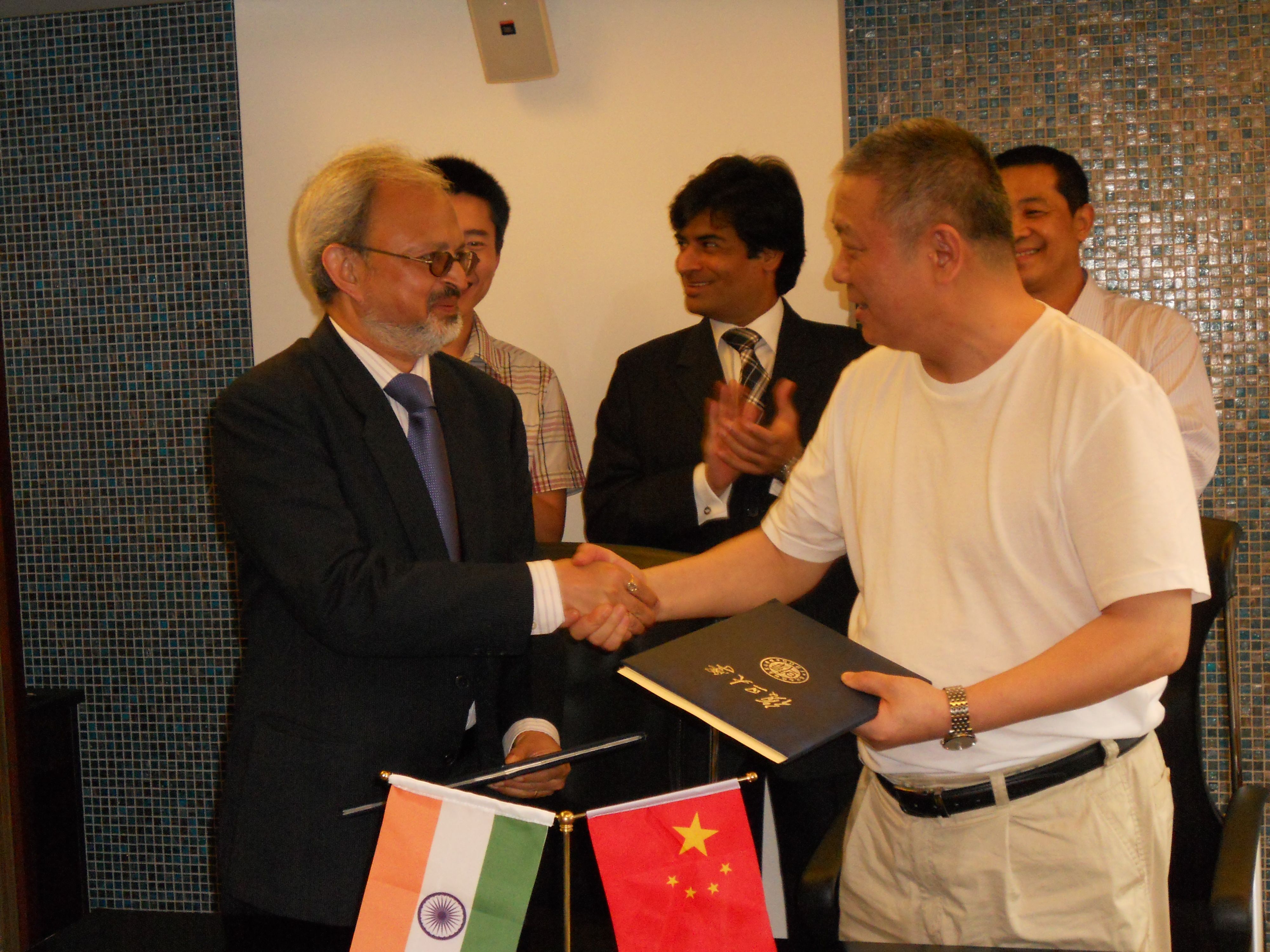
After heated discussions on academic exchanges and cooperation, Fudan Institute for Advanced Study in Social Sciences (IAS-Fudan) and Observer Research Foundation (ORF) reached an agreement on July 28, 2010, to undertake a two-year joint research project on rural political economies and governance practices in both China and India. Professor Deng Zhenglai, Dean of IAS-Fudan, and Sunjoy Joshi, Head of ORF, signed the agreement at Holiday Inn Shanghai Vista in Shanghai. Professor Guo Sujian, Associate Dean of IAS-Fudan, Dr. Lin Xi, Research Fellow in IAS-Fudan, and Samir Saran, Vice President of ORF as well as other delegation members attended the signing ceremony.

The project named “Innovation and Entrepreneurship in China and India in relation with Grassroots Democracy and Governance” is the first project to be conducted between the two institutions. It attempts to understand how local governance practices in both China and India have helped or hindered innovation and economic development at the grassroots level. It will examine case studies of rural political economies in both the countries and their influence on innovation and local entrepreneurship in India and China, which have different political and governance structures. A case study approach will be used to illustrate how both India and China, two countries with world’s two largest populations, rapidly growing economies and increasing global ambitions, have witnessed challenges of internal development and local governance on one hand and experienced successful instances of micro enterprises, entrepreneurship and innovation on the other within the same landscape.

The two sides also made discussions on potential academic cooperation in other fields and both expressed their hopes to have brighter prospects in future cooperation.

More news reports on this cooperation:
http://www.newstrackindia.com/newsdetails/172030
http://www.newdelhinews.net/story/666782
http://www.daylife.com/article/0gfx6DbgfB3Uq
http://www.anhourago.in/show.aspx?l=5318549&d=502
http://www.newkerala.com/news2/fullnews-11554.html
http://news.oneindia.in/orffudan-university-to-study-rural-economies-andgovernanc.html
 

Standard
In the News, Politics / Globalisation

Samir speaks at India Policy Foundation on Think Tanks in India, 2011

August 11, 2011
New Delhi, India
Link to IPF website 

The brainstorming session on ‘Think Tanks in India: Public Policy and Challenges’ organised byIndia Policy Foundation (IPF) and India Centre for Public Policy (ICPP) of Birla Institute of Management Technology (BIMTECH) at India International Centre (IIC), concluded with a note that Think Tank should critically articulate people’s aspiration and should play vital role in Policy discourse.

The primary objective of the session was to  exchange views and ideas among the leaders of Indian Think Tanks and their members. Besides this,  meet was also meant to know the problems and challenges before Indian Think Tank. It received overwhelming response from the capital’s  prominent  Research organisations,scholars and Think Tanks. The discussion was attended by thought leaders and representatives of various academic institutions, media, as well as former bureaucrats, fellows from the international bodies, and the representative of Think Tanks, like Observer Research Foundation(ORF), Institute of Dalit Studies etc.

The session was chaired by Prof. Rakesh Sinha Hon Director IPF and Prof. Shettigar, Chairperson ICPP and the discussion has started with the welcome note of Dr. Chaturvedi Director, BIMTECH. Highlighting the need of a a higher purpose debate on the existence of Think Tanks in India and their roles and influence, Prof. Sinha and Dr. Chaturvedi invited a debate on definition of Indian Think Tanks, evaluating the impact of Think tanks on public policy, defining future trajectory and likely role of these institutions, and identifying challenges faced by the think tanks for attaining growth and excellence.
Following questions were posed before the particiapnats:
1. How to define the contours of Think Tank in India ?
2. How does it differ from its counterparts in the West?
3. What are the challenges before it?
4. What are the basic problems before it?
5. How does and much the source of resources influence policy articulation ?
In his welcome note he expressed his gratitude to all the dignitaries, and specified that there is not as such any platform in India which could bridge the gap between the India’s think tank and the policy makers, therefore BIMTECH in its joint imitative with IPF is working in that direction to create a platform.
Opening the discussion, Prof. Shettigar expressed his concern for the ineffectiveness of think tank in India to contribute to policy level debate however also underlined the challenges and domain knowledge. Some of the experts recognized that absence of financial independence may be a prime cause for their ineffectiveness. Nonetheless over the period there has been an increasing role of think tank in policy making therefore the intellectuals should free from biases and they should give their advice independently.
Discussion was initiated by Chapal Mehra, Global Health Strategies presented his views and identified definition, structural issues, funding and research influence as some of the major issues. The entity is still not much effective as the policy used as a tool for creating popular acceptance of or giving legitimacy to regimes, both at the central and state levels. Policy formation is also highly centralized, dictated by the concerns of political agendas which leaves very less space for Think Tanks in India. Dr. AbuSaleh Shariff, Chief Economist of NCAER raised issues of credibility of the organisations and also the issues of funding and providing the appropriate space to do independent research. Baldevbhai Sharma , Editor of Panchjanya, discussed about the dominance of elite class in think tanks and asked for a real field work by the Think Tanks in India and raise the voice of common man.

particiapnts were of the view that the inputs of Think Tanks have been about the capacity of human resources in the domains, funding on the researches by national and international organisations, influence by other methods of researches or presentations to policy makers, creating credibility which can be disassociated with funding, and the larger issues like absence of a defined mechanism of making the public policy. The critical instances of Nuclear Policy, reservation Policy, Education Policy and associated Economic Policies were offered as examples during the discussion; by Dr Rajendra Mamgain Indian Institute of Dalit Studies, Ms P N Vasanti, CMS; Dr P K Chaube, IIPA; Mr Samir Saran and Mr Nandan Unnikrishnan, ORF; Milind Chakravorty, SHarda University, Avanish Kumar, MDI, Harsh Singh, Writer, Dr Rajiv Nayan, IDSA, Sh Gopal Agarawal , Economic analyst, Milind Oak, social activist and thinker, Dr A K Roy, economist , Dr Karl Grischow, AmericanFoundation and many other dignitaries.

The initiative by IPF and ICPP was appreciated as there has not been such debate in such a diverse group. Prof N N Sharma and Prof Rahul Singh presented the background of the research project on Think Tank and informed two more such brainstorming wouold be organised in Banglore and Patna.

Standard
In the News, Politics / Globalisation

Samir in The Times of India: Home Alone in the Neighbourhood, 2010

by Arati R Jerath, TOI Crest
August 7, 2010
in: The Times of India

India was once the undisputed big power in the south Asian region, wielding substantial influence over its smaller neighbours. But, over the years, New Delhi’s strategic and diplomatic clout in its own backyard has weakened.

In April this year, a high-pitched anti-India campaign by the Maoists in Nepal forced President Ram Baran Yadav’s government to cancel a passport deal that had important security implications for us. The deal was a contract with India’s government press to print four million machinereadable passports for Nepal to stop misuse and forgery by suspected terror agents. New Delhi was perturbed enough by the cancellation of the deal to lodge a formal protest with the Nepalese government through its ambassador in Kathmandu. The contract has now gone to a French firm, Oberthur Technologies.

Maldives turned not to India but to the United States and Sri Lanka for help when a political crisis this month plunged the Indian Ocean island nation into turmoil with angry street protests and a constitutional impasse that saw the entire cabinet resign. Where once upon a time India used to rush special envoys at the first sign of trouble, this time it was Sri Lanka’s president, Mahinda Rajapakse, who played mediator along with the US ambassador to Colombo, Patricia Butenis, and US assistant secretary of state Robert Blake. Sri Lanka and Bangladesh have no qualms about using China as an outside balancer to India’s dominance in South Asia. Both buy arms from Beijing and are recipients of whopping sums of money from China for the development of infrastructure like ports, roads and airports in their countries. Bangladesh prime minister,Sheikh Hasina, candidly admitted during her New Delhi visit in January this year that there is an anti-India mindset in her country and she cannot change it.

Last year, Myanmar decided to divert to China gas that India had been eyeing. Although ONGC and GAIL helped to develop the gas fields, located in the resource-rich Arakan province of that country, and own equity in some blocks, India couldn’t get its act together on transportation issues. Tired of New Delhi’s shuffling, Myanmar offered the gas to China, which accepted it with alacrity and has already started constructing a pipeline from Arakan to feed its booming, energy-hungry western provinces of Yunan and Guizhou.

Despite receiving a reconstruction and rehabilitation package worth over $800 million from India, Afghan president Hamid Karzai has decided to ignore New Delhi’s objections and do business with Pakistan and the Taliban. He has received Pakistan’s avowedly anti-India army chief, General Ashfaq Parvez Kayani, twice inKabul this year and also visited Islamabad to seek assistance in building bridges with the Taliban.

All of these developments point to the fact that over the years, India’s ability to win friends and influence people in its neighbourhood has taken a massive hit. Call it benign neglect. Or put it down to thrills from the first flush of romance with the United States and the tantalising prospect of joining the international high table. Despite a rapidly growing economy, a flourishing democracy, the unrivalled soft power of its popular culture and an army that boasts of being the third largest in the world, India’s geopolitical influence acrosssouth Asia falls sadly short of expectations. As a rising China, with an economy poised to become the world’s largest by 2025, casts its giant shadow over Asia and as Beijing eagerly fills the gaps New Delhi has unthinkingly left in its backyard, the question being asked in strategic and diplomatic circles is this: is India dealing itself out in south Asia?

“Yes,” is the emphatic response from Observer Research Foundation analyst Sameer Saran. “Clearly, we are. We should be creating more robust integration with our neighbourhood. But are we devoting enough time to this? I don’t believe we are.” Says a retired senior diplomat who wished to remain unidentified, “The concepts are all there and they are bandied around regularly. It’s important for our security and economic growth that we manage our periphery. But to do this, we need to be continuously engaged with our neighbours. The trouble is we keep taking our eyes off the ball.”

Today, with the exception of Bhutan, India cannot count a single all-weather friend in the region. From tiny Maldives in the west to Bangladesh and Myanmar in the east to Sri Lanka in the south, national interest need not converge with Indian interests and a little bit of China on the side adds heft to smaller nations when dealing with big brother India. As for Pakistan and China, former national security advisor Brajesh Mishra believes that both are jointly following a containment policy designed to keep India embroiled in tensions with all its neighbours.

“China’s presence has grown all around us. It shows the paucity of India’s influence in her neighbourhood,” Mishra says.

Analysts are perplexed and concerned by the apparent disinterest of successive governments in developing and nurturing an intense engagement with the neighbourhood, especially the south Asian nations that comprise SAARC. Consider these facts: Prime Minister Manmohan Singh has not paid a bilateral visit to a single SAARC country during his six years in office. Nor did his predecessor Atal Behari Vajpayee, save for one famous trip to Lahore when the India-Pakistan bus link opened in February 1999.

A secret note prepared by the external affairs ministry four years ago lists countries in order of strategic importance to India. The US tops the list, followed by the United Kingdom, France, Japan and Russia, in that order. Surprisingly, China, a budding superpower and a neighbour with which we share a disputed border, ranks sixth, while Bangladesh, Nepal, Pakistan and Sri Lanka round off the top ten. Despite Bhutan being India’s closest ally in the immediate neighbourhood, the ministry put it way down on the list along with countries like Belgium and Australia. Bewildering?

It’s inexplicable, certainly. Just as India’s Pakistan’s policy is, with its diminishing returns. This is the one neighbour in which every prime minister since Independence has invested personal time and energy. And ironically, it has proved to be our most troublesome, with sections of the Pakistani establishment pursuing a policy that is downright hostile. “Somehow, we always seem to forget that the first task should be to secure our neighbourhood. This is an imperative if we want to play a global role,” says Mishra.

Analysts believe that India’s neighbourhood conundrum is largely self-created, thanks to our fatal fascination for the West, particularly the United States. While they acknowledge that it was necessary to mend fences with Washington to remain relevant in the new world order that emerged with the end of the Cold War, they feel that policy-makers in New Delhi lost sight of priorities in the chase for a seat at the high table. The last five years were a turning point, as the Manmohan Singh government locked up all its capital in pushing the Indo-US nuclear deal through.

“In our excitement at being feted by Western powers and joining the G-20, the East Asia Summit and so on, we’ve ended up ignoring our traditional constituencies. We seem to see our neighbours as pesky countries rather than important strategic partners in our growth trajectory,” said a former diplomat who did not want his name disclosed.

A senior official in the Prime Minister’s Office downplayed warning notes about the hiatus that has crept into relations with neighbouring countries. He also pooh-poohed the China factor in south Asia, pointing out that Beijing is very cautious about its activities in India’s neighbourhood. For instance, although it built the Gwadar port in Pakistan, a Singapore company is running the facility, he said, adding that the US put pressure on Pakistan to take the port out of the Chinese ambit. “So, you see, there are natural balancers in every country,” he insisted.

Explaining the dip in engagement levels, he said that virtually all the neighbouring countries have been in political turmoil for the past several years, making it difficult for India to build longterm assets in the region. While Nepal is still in crisis, Sri Lanka and Bangladesh have stabilised and the Manmohan Singh government is trying to repair ties with both by loosening its purse strings. Economic assistance to the two countries has been stepped up several times. Rajpakse returned to Colombo after a state visit to India in June with an assistance package amounting to $1 billion.

But the elephant moves slowly. Although India-friendly Sheikh Hasina’s victory in the Bangladesh elections last year presents New Delhi with just the opportunity it needs, signs of strain are already there. A recent article in a leading Bangladesh newspaper carried a report that blamed India for non-implementation of trade agreements concluded during Hasina’s January visit to India. In a goodwill gesture to Hasina, India had conceded a long-standing demand from Dhaka on the removal of tariff and non-tariff barriers on Bangladeshi goods. The newspaper report said that bureaucrats on both sides were holding things up.

“It’s unfortunate,” says former diplomat G Parthasarathi. “If India doesn’t deliver to Bangladesh in the next five years, it will weaken Hasina and the price will be paid by us. I don’t know why we can’t be more generous with our neighbours. China sees all its neighbouring countries as an extension of its market and places no restrictions on the movement of goods. We demand reciprocity with every neighbour instead of adopting a larger philosophical approach like China.”

Saran puts this niggardly attitude down to an inability to shake off old mindsets. “We worked in poverty mode for so long that we haven’t come out of it yet, although our economy is growing at 8-9 per cent every year. We need to realise that not only has the world changed, so have we,” he says. Mishra warns, however, that economics alone cannot give India the clout it should have as an emerging power. It is equally important to develop military muscle. “We must be able to defend our borders by building up our military strength. There is an impression that India can be taken for granted because it’s a soft state. We’ve neglected our military for too long,” he says. He acknowledged that the Vajpayee government was as much to blame as the Manmohan Singh government for going slow on the much-touted fighter aircraft deal under which the Indian Air Force is slated to acquire 126 war planes as part of its modernisation plans.

While agreeing with Mishra, Parthasarathi laments that emotions get in the way of India’s dealings with its neighbours. “We make a mistake when we ask them to love us. No big country can have a comfortable relationship with smaller neighbours. We will have to learn to be realistic and ignore anti-India sentiments around us. Our neighbours should respect us. We need to create long-term assets everywhere to give them a stake in maintaining good ties with us, everywhere, that is, except Pakistan. That needs to be put in a different basket,” he declares.

PLAYING CATCH-UP
Since last year, India has tried to correct the imbalance in its neighbourhood diplomacy by welcoming almost all the heads of south Asian governments. And in an uncharacteristic show of generosity, it has also loosened its purse strings by offering unprecedented assistance packages

SRI LANKA
Sri Lankan president Mahinda Rajapakse returned home from his June visit to India with promises of approximately $1 billion in credit lines for various projects. This almost equals China’s $1.2 billion worth of loans to Sri Lanka for development projects across the island nation. Most of the Indian-aided projects are in Tamilpopulated northern Sri Lanka. They include: Construction of 50,000 houses in the northern and eastern provinces for Tamil refugees displaced during the war against the LTTE Reconstruction of at least four railway lines Construction of a new signalling and telecommunication network Rehabilitation of Palaly airport and Kankesanthurai harbour Renovation of the Duraiappah stadium Construction of a cultural centre in Jaffna Construction of a coal-fired power plant in Trincomalee.

BANGLADESH
A range of assistance measures were announced during Bangladesh president Sheikh Hasina’s Delhi visit in January this year. They include: A $1 billion credit line for infrastructure development such as construction and upgradation of railway lines and supply of BG locomotives, passenger coaches and buses Removal of tariff and non-tariff barriers and port restrictions on Bangladeshi goods and reduction of items on India’s negative list Supply of 250 MW of electricity from India.

MYANMAR
While India’s assistance to Myanmar does not in any way match China’s , the country’s military leader, General Than Shwe, found New Delhi more responsive when he visited in July this year. The agreements include: Assistance totalling around $200 million for construction of roads, electricity transmission lines and a microwave link as well as procurement of railway and agriculture equipment from India New impetus to stalled power projects on the Chindwin river basin in Myanmar Numerous HRD projects such as setting up centres for English language training, entrepreneurship development and industrial training Restoration of the historic Ananda temple in Bagan by the Archeological Survey of India.

NEPAL
With the political crisis in Nepal continuing amid Maoist allegations of Indian interference, New Delhi has been reluctant to be generous with Kathmandu despite hosting Nepalese president Ram Baran Yadav in February this year. It did, however, promise $250 million in credit for the following: Setting up a railway link Building a polytechnic institute Construction of a new convention hall near the India-Nepal border Supply of 80,000 tonnes of food grains.

AFGHANISTAN
Although there were no announcements of assistance during Afghan president Hamid Karzai’s April visit to New Delhi, India has pledged over $800 million in reconstruction and rehabilitation projects. The projects are almost in every part of Afghanistan and include the following: Construction of a new parliament building in Kabul Construction of transmission lines to bring power from neighbouring countries to Kabul Construction of roads Supply of high protein biscuits for school feeding programmes Reconstruction of a dam project in Herat province Building a national TV network Skill development and training programmes in a variety of sectors including civil services and medical missions in at least five cities.


Standard
In the News, Politics / Globalisation

Samir in The Times of India: A billion people, 710 diplomats, 2010

by TOI Crest
August 7, 2010
in: Times of India 

One of the reasons for India’s stop and go response to the multi-dimensional diplomatic challenges it faces is a severe shortage of human resources for simultaneous deployment. Given its size and the quantum leap in its engagement with the world, India’s diplomatic strength falls woefully short of its requirements and compares unfavourably even with countries like Japan and Brazil.

A headcount in 2008 revealed that India had 710 diplomats. Compare this with Japan’s 5,400 and Brazil’s 1,200 and we get a sense of how hard-pressed the foreign office is. Big global players like the US and China invest even more in manpower. The US has a regular diplomatic strength of 6,500 officers plus it draws in some 5,000 experts on short-term contracts. China’s foreign office has 6,000 diplomats.The government’s response has been typically slow and smallminded. It started discussing the problem some time in 2005. In 2006, the then foreign secretary, Shiv Shankar Menon, was tasked with preparing an expansion plan. But it was not till 2008 that the union cabinet approved the plan.

But look at what it approved. It sanctioned an increase of 310 Grade-I officers over a period of ten years. This means that by 2018, India will still have just 1,020 diplomats. Ministry of External Affairs (MEA) officials agree that this number will fall far short of requirements if India’s international profile continues to grow at the current pace.

Ironically, even this slow rate of expansion is going nowhere. New recruits will take at least 15 years to grow into responsible, decisionmaking positions. In the meantime, MEA is searching for middle-rung officials from other ministries who can come on short-term deputation to fill the gaps. In the past two years, the ministry has managed to rope in only half a dozen such officers because all other departments are equally short-staffed at this level.

“These small numbers cannot take care of the large deficit we have if we want to play a bigger role globally ,” said a senior MEA official. Unfortunately, expert consultants are also proving elusive. Observer Research Foundation analyst Samir Saran says that although India boasts of around 150 think tanks, most of them are “retirement homes” and have few original ideas to offer the government. “Even our universities don’t have departments for modern Indian studies. How can we develop a sense of what India’s place is in the emerging world?” he asks.

Standard