In the News, Non-Traditional Security

NewKerala.com covers ORF report launch on non-traditional security

Latin American countries keen to strengthen relations with India 
April 16, 2011
Link to website  

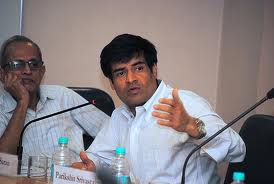
Participating in an interaction at Observer Research Foundation, envoys from 17 countries from Latin America said their countries are keen to strengthen economic relations with India. “We want better, mutually beneficial relations with India. We have got lots of natural resources, especially oil and other energy resources. But we don’t want to be just provider of resources. We want you to cooperate in our development also,” said Columbian Ambassador Juan Alfredo Pinto Saavedra.

Saavedra, the coordinator of the group of Ambassadors of the Latin American countries, said the US and the Europe used resources from their countries for their development, but did not help them in the development. “While they used our resources, we remained poor,” he said. He wanted India and China to be different in their approach to Latin American countries.

Besides the Columbian Ambassador, Ambassadors from Paraguay, Uruguay, Panama, Costo Rica, Mexico, Peru, Cuba, Dominican Republic attended the interaction. The other countries were represented by high level diplomats like Deputy Chief the Missions and Charge d’ Affaires.

The Ambassadors were given a presentation on the ORF Report on India’s non-traditional security threats, titled “Navigating the Near” by Samir Saran, Vice President, Observer Research Foundation. This study was done by ORF for the Integrated Defence Staff, the Ministry of Defence.

Chairing the meeting, M. Rasgotra, a former Foreign Secretary and now President of the ORF Centre for International Relations, said Latin American countries enjoyed good sentiments in India. He said India would be keen to have mutually beneficial cooperation with them. Former Foreign Secretary K. Raghunath and ORF Director Sunjoy Joshi also took part in the meeting.

Standard
BRICS, In the News

Sri Lanka’s TOPS.lk covers BRIC discussion on climate change

April 16, 2010
Link to website  

BRAZIL: Representatives from think tanks of the BRIC countries(Brazil, Russia, India and China) discussed ways to fight climate change at a seminar here Wednesday. The seminar, called BRIC Think-Tank Summit, gathered members of think tanks from the BRIC countries to examine the global economic situation and the role of BRIC countries in the post-crisis global transformation.

World countries need to take joint action to fight climate change, said Indian representative Samir Saran from the Observer Research Foundation. Chinese representative Wu Enyuan, with the Institute of Russian, Eastern European and Central Asian Studies, Chinese Academy of Social Sciences, said the developed countries had a bigger responsibility on carbon emission reduction as the current climate change is a result of some 150 years of industrialization process of the developed nations.

But he said the developing countries, including the BRIC nations, should take their fair share of responsibility as well, and adopt measures to fight global warming. “China has fulfilled its responsibility by taking practical actions in either energy conservation or environmental protection,” he said, adding that other BRIC countries have also committed themselves to carbon emission reduction. Brazil’s representative Eduardo Viola said that implementing these measures is more important than holding discussions.

Russian representative Nikolai Mikhailov said climate change unveiled the notion that human beings can treat nature as they want without caring about the consequences.Only a radical change in their attitude could make a difference, he said.

The two-day seminar was held on the eve of the second BRIC summit scheduled for Friday in the Brazilian capital.

Standard
In the News, Water / Climate

Samir at: “Technology transfer, policy and climate change: Goal 2020 for India”

21 April 2010, Delhi
Download here the entire agenda

A roundtable was held on April 20, 2010, Tuesday, on “Goal 2020: Identifying issues, options, opportunities and frameworks towards demand side mainstreaming of climate friendly technologies through Technology Diffusion Centers”, at the ORF New Delhi campus. The roundtable saw participation from trade commissions, multilateral investors and corporates.

This roundtable was convened by the ORF in association with the India Carbon Outlook,  an independent information marketplace tracking actions related to the carbon economy as well as their impact, and the cKinetics, a venture accelerator catalyzing rapid adoption of low carbon sustainable growth practices in emerging economies through technology transfer, capital access and adaptation interventions.

The roundtable was held to identify steps that can be taken in the coming years so as to be able to achieve the impact of technology/application available to be transferred for mitigation and adaptation in India by 2020. The roundtable had the four sessions. The first and the second session were based on the discussion on climate friendly prototypes and discussion on global experiences. The third session was divided into two parallel working group discussions- Technology Transfer framework, Designing Technology Diffusion and Innovation Hub Ecosystem and Prototype Rollouts and Mass Adoption.

In his opening remarks Mr. Sunjoy Joshi, ORF Distinguished Fellow, said that pace of adoption & innovation was critical for mainstreaming climate friendly technologies and identified solar thermal technology as the most promising one for mass adoption.

The first session started with Mr. Upendra Bhatt, Managing Director, cKinetics, laying out the goals for the roundtable: facilitate technology diffusion and technology transfer; document best practices; identify prototype technology for next two years; come up with concrete suggestions. He also presented highlights from the pre-meeting questionnaire which essentially represented contrarian views on clean technology transfer.

In the second session, Mr. V. Raghuraman, Principal Advisor, Jaguar Overseas Ltd., stressed upon the need to adopt Electric Power Research Institute model in diffusing renewable technology for India. He was of the view that LED lighting technology is one of the means to provide lighting to 400 million inhabitants having no electricity. He also said that for mass adoption the technology should be user friendly. Mr. Samir Saran, ORF Vice President, said that energy efficiency is “the low hanging fruit” in achieving carbon intensity targets. Mr. Poul Jensen, Head, European Business and Technology Centre (EBTC) in India, said that India had the potential to make clean technologies mature. He also shared the EBTC experience of being a facilitator for EU clean technology. Mr. Takeshi Yoshida, chief representatives, NEDO, shared Japanese experiences in the field of energy efficiency and mentioned the “Top Runner Programme” mandated by the Japanese government through which all equipment manufacturers in Japan have to attain benchmark efficiency of the most energy efficient manufacturer.

Ms. Lydia Powell, Senior Fellow, ORF, identified property rights and persistence of unorganized sector as some of the problems for mass adoption of technologies. Dr. Ramesh Jalan, Head, Solution Exchange stressed upon the necessity to improve the service support system for mass adoption renewable technologies. Mr. Kunal Upadhyay from IIM Ahemdabad conveyed the view that levelised cost of electricity was critical in determining economic viability of distributed generation. Dr. J. V. Rao, Director, NITRA, said that there was no representative baseline data at the SMEs level which was required for implementing carbon intensity reduction programmes. Prof. Rakesh Basant, IIM Ahemdabad, was of the view that choice of prototype technology was not independent choice and that inventory of prototype technologies must be created to meet diverse needs. Mr. Vishal Thapa, Director, ICF India, said that as India was extremely segmented, we should not pick winners in technology and that we must create a portfolio of solutions.

The key point that emerged from the deliberations of the parallel working groups in the afternoon session was that cost, user friendliness and durability were critical for both technology transfer from developed countries and for mass adoption of those technologies in India.

Programme details available here

Standard
BRICS, In the News

Philippine News cover BRIC countries’ think-tanks discussion on climate change

April 15, 2010
Brasilia, Brazil
Link to original website

Representatives from think tanks of the BRIC countries (Brazil, Russia, India and China) discussed ways to fight climate change at a seminar here Wednesday. The seminar, called BRIC Think-Tank Summit, gathered members of think tanks from the BRIC countries to examine the global economic situation and the role of BRIC countries in the post-crisis global transformation

World countries need to take joint action to fight climate change, said Indian representative Samir Saran from the Observer Research Foundation. Chinese representative Wu Enyuan, with the Institute of Russian, Eastern European and Central Asian Studies, Chinese Academy of Social Sciences, said the developed countries had a bigger responsibility on carbon emission reduction as the current climate change is a result of some 150 years of industrialization process of the developed nations. But he said the developing countries, including the BRIC nations, should take their fair share of responsibility as well, and adopt measures to fight global warming.

“China has fulfilled its responsibility by taking practical actions in either energy conservation or environmental protection,” he said, adding that other BRIC countries have also committed themselves to carbon emission reduction. Brazil’s representative Eduardo Viola said that implementing these measures is more important than holding discussions. Russian representative Nikolai Mikhailov said climate change unveiled the notion that human beings can treat nature as they want without caring about the consequences. Only a radical change in their attitude could make a difference, he said.

The two-day seminar was held on the eve of the second BRIC summit scheduled for Friday in the Brazilian capital.

Standard
BRICS, In the News

Daily News covers BRIC meeting in Brasilia on climate change, 2010

April 16, 2010
Link to original website 

BRAZIL: Representatives from think tanks of the BRIC countries (Brazil, Russia, India and China) discussed ways to fight climate change at a seminar here Wednesday. The seminar, called BRIC Think-Tank Summit, gathered members of think tanks from the BRIC countries to examine the global economic situation and the role of BRIC countries in the post-crisis global transformation.

World countries need to take joint action to fight climate change, said Indian representative Samir Saran from the Observer Research Foundation. Chinese representative Wu Enyuan, with the Institute of Russian, Eastern European and Central Asian Studies, Chinese Academy of Social Sciences, said the developed countries had a bigger responsibility on carbon emission reduction as the current climate change is a result of some 150 years of industrialization process of the developed nations.

But he said the developing countries, including the BRIC nations, should take their fair share of responsibility as well, and adopt measures to fight global warming. “China has fulfilled its responsibility by taking practical actions in either energy conservation or environmental protection,” he said, adding that other BRIC countries have also committed themselves to carbon emission reduction. Brazil’s representative Eduardo Viola said that implementing these measures is more important than holding discussions.

Russian representative Nikolai Mikhailov said climate change unveiled the notion that human beings can treat nature as they want without caring about the consequences. Only a radical change in their attitude could make a difference, he said.

The two-day seminar was held on the eve of the second BRIC summit scheduled for Friday in the Brazilian capital.

Standard
In the News, Politics / Globalisation

Samir speaks at Open Source Radio, Brown University, US on ‘Obama as Gorbachev: a Regime in Crisis’, 2009


March 19, 2009
Link to original website (from minute 19.00 onwards), with Christopher Lydon

1. Unless the West suddenly gets a new act together, China wins the global crisis — because it has cash, a production machine, an orderly, top-down system co-designed by Milton Friedman and Stalin, and a domestic market of customers if and when export demand collapses.

2. The turmoil in finance capital has also the dimensions of a “civilizational” crisis (what do we stand for after greed and consumption… of such things as a new Paris Hilton line of apparel, for dogs?) and an advancing crisis of the human habitat, our lifeline with nature.

3. One way to see Barack Obama in this situation is as “our Gorbachev”: the designated captain whose assignment is to save the crumbling pillar on our side of the old Cold War, or surrender the regime.

By the old rule that the trick in life is to locate three main points (in anything), there’s my free translation of a fascinating Watson Institute conference last weekend. Between the lines, most of it, but clear enough.

Standard
In the News

IAS-Fudan and ORF signed Agreement on Joint Research Project, 2010

July 28, 2010
Link to Fudan University website 

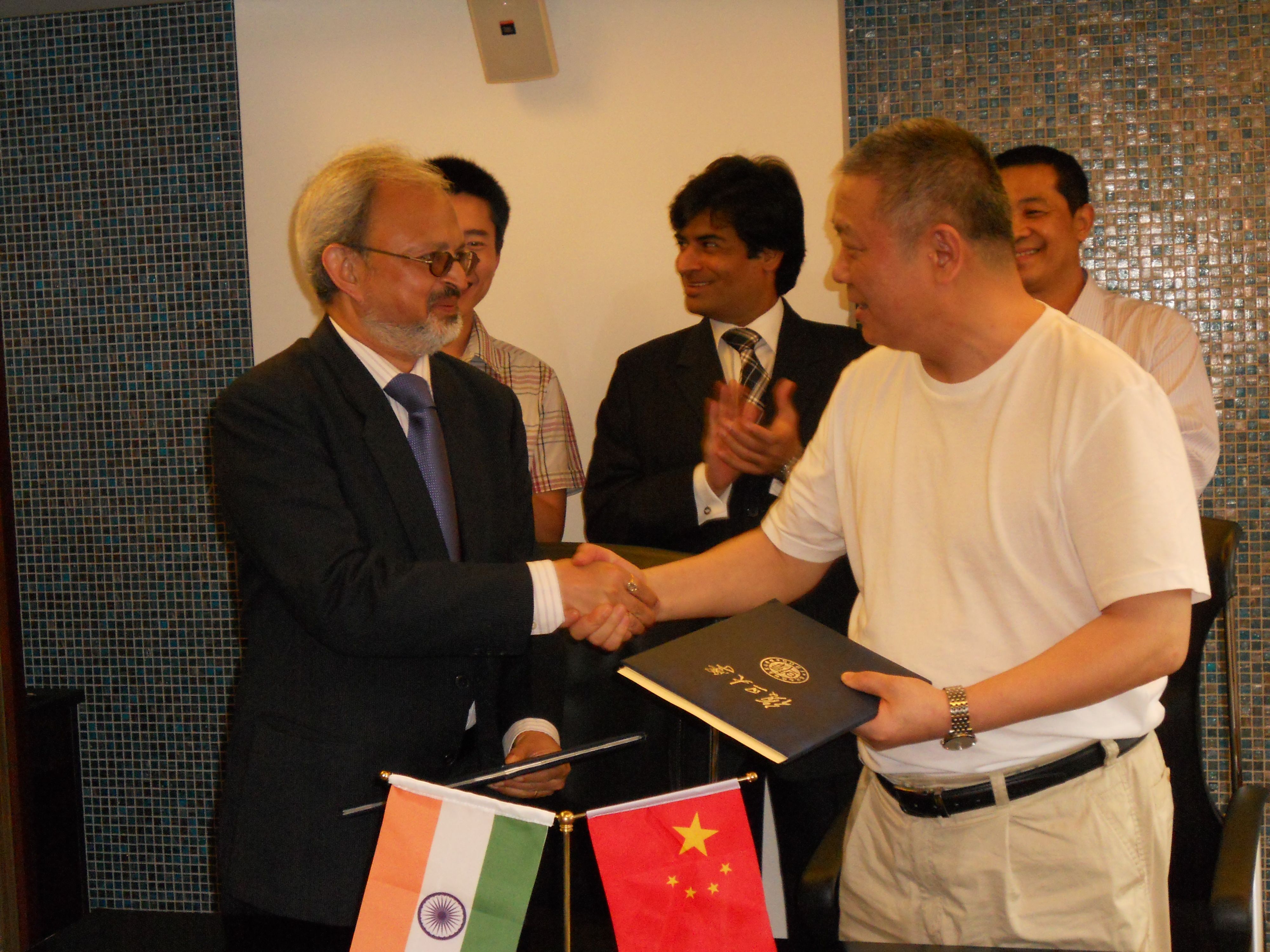
After heated discussions on academic exchanges and cooperation, Fudan Institute for Advanced Study in Social Sciences (IAS-Fudan) and Observer Research Foundation (ORF) reached an agreement on July 28, 2010, to undertake a two-year joint research project on rural political economies and governance practices in both China and India. Professor Deng Zhenglai, Dean of IAS-Fudan, and Sunjoy Joshi, Head of ORF, signed the agreement at Holiday Inn Shanghai Vista in Shanghai. Professor Guo Sujian, Associate Dean of IAS-Fudan, Dr. Lin Xi, Research Fellow in IAS-Fudan, and Samir Saran, Vice President of ORF as well as other delegation members attended the signing ceremony.

The project named “Innovation and Entrepreneurship in China and India in relation with Grassroots Democracy and Governance” is the first project to be conducted between the two institutions. It attempts to understand how local governance practices in both China and India have helped or hindered innovation and economic development at the grassroots level. It will examine case studies of rural political economies in both the countries and their influence on innovation and local entrepreneurship in India and China, which have different political and governance structures. A case study approach will be used to illustrate how both India and China, two countries with world’s two largest populations, rapidly growing economies and increasing global ambitions, have witnessed challenges of internal development and local governance on one hand and experienced successful instances of micro enterprises, entrepreneurship and innovation on the other within the same landscape.

The two sides also made discussions on potential academic cooperation in other fields and both expressed their hopes to have brighter prospects in future cooperation.

More news reports on this cooperation:
http://www.newstrackindia.com/newsdetails/172030
http://www.newdelhinews.net/story/666782
http://www.daylife.com/article/0gfx6DbgfB3Uq
http://www.anhourago.in/show.aspx?l=5318549&d=502
http://www.newkerala.com/news2/fullnews-11554.html
http://news.oneindia.in/orffudan-university-to-study-rural-economies-andgovernanc.html
 

Standard
In the News, Politics / Globalisation

Samir speaks at India Policy Foundation on Think Tanks in India, 2011

August 11, 2011
New Delhi, India
Link to IPF website 

The brainstorming session on ‘Think Tanks in India: Public Policy and Challenges’ organised byIndia Policy Foundation (IPF) and India Centre for Public Policy (ICPP) of Birla Institute of Management Technology (BIMTECH) at India International Centre (IIC), concluded with a note that Think Tank should critically articulate people’s aspiration and should play vital role in Policy discourse.

The primary objective of the session was to  exchange views and ideas among the leaders of Indian Think Tanks and their members. Besides this,  meet was also meant to know the problems and challenges before Indian Think Tank. It received overwhelming response from the capital’s  prominent  Research organisations,scholars and Think Tanks. The discussion was attended by thought leaders and representatives of various academic institutions, media, as well as former bureaucrats, fellows from the international bodies, and the representative of Think Tanks, like Observer Research Foundation(ORF), Institute of Dalit Studies etc.

The session was chaired by Prof. Rakesh Sinha Hon Director IPF and Prof. Shettigar, Chairperson ICPP and the discussion has started with the welcome note of Dr. Chaturvedi Director, BIMTECH. Highlighting the need of a a higher purpose debate on the existence of Think Tanks in India and their roles and influence, Prof. Sinha and Dr. Chaturvedi invited a debate on definition of Indian Think Tanks, evaluating the impact of Think tanks on public policy, defining future trajectory and likely role of these institutions, and identifying challenges faced by the think tanks for attaining growth and excellence.
Following questions were posed before the particiapnats:
1. How to define the contours of Think Tank in India ?
2. How does it differ from its counterparts in the West?
3. What are the challenges before it?
4. What are the basic problems before it?
5. How does and much the source of resources influence policy articulation ?
In his welcome note he expressed his gratitude to all the dignitaries, and specified that there is not as such any platform in India which could bridge the gap between the India’s think tank and the policy makers, therefore BIMTECH in its joint imitative with IPF is working in that direction to create a platform.
Opening the discussion, Prof. Shettigar expressed his concern for the ineffectiveness of think tank in India to contribute to policy level debate however also underlined the challenges and domain knowledge. Some of the experts recognized that absence of financial independence may be a prime cause for their ineffectiveness. Nonetheless over the period there has been an increasing role of think tank in policy making therefore the intellectuals should free from biases and they should give their advice independently.
Discussion was initiated by Chapal Mehra, Global Health Strategies presented his views and identified definition, structural issues, funding and research influence as some of the major issues. The entity is still not much effective as the policy used as a tool for creating popular acceptance of or giving legitimacy to regimes, both at the central and state levels. Policy formation is also highly centralized, dictated by the concerns of political agendas which leaves very less space for Think Tanks in India. Dr. AbuSaleh Shariff, Chief Economist of NCAER raised issues of credibility of the organisations and also the issues of funding and providing the appropriate space to do independent research. Baldevbhai Sharma , Editor of Panchjanya, discussed about the dominance of elite class in think tanks and asked for a real field work by the Think Tanks in India and raise the voice of common man.

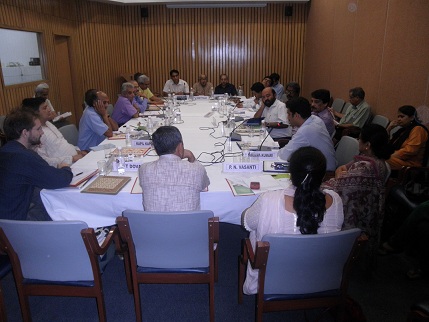
particiapnts were of the view that the inputs of Think Tanks have been about the capacity of human resources in the domains, funding on the researches by national and international organisations, influence by other methods of researches or presentations to policy makers, creating credibility which can be disassociated with funding, and the larger issues like absence of a defined mechanism of making the public policy. The critical instances of Nuclear Policy, reservation Policy, Education Policy and associated Economic Policies were offered as examples during the discussion; by Dr Rajendra Mamgain Indian Institute of Dalit Studies, Ms P N Vasanti, CMS; Dr P K Chaube, IIPA; Mr Samir Saran and Mr Nandan Unnikrishnan, ORF; Milind Chakravorty, SHarda University, Avanish Kumar, MDI, Harsh Singh, Writer, Dr Rajiv Nayan, IDSA, Sh Gopal Agarawal , Economic analyst, Milind Oak, social activist and thinker, Dr A K Roy, economist , Dr Karl Grischow, AmericanFoundation and many other dignitaries.

The initiative by IPF and ICPP was appreciated as there has not been such debate in such a diverse group. Prof N N Sharma and Prof Rahul Singh presented the background of the research project on Think Tank and informed two more such brainstorming wouold be organised in Banglore and Patna.

Standard
BRICS, In the News

Book Launch / Conference: Joining The New World Order: Perspectives From The BRICs – Lessons For South Africa – Details

March 1, 2011
Link to SAIIA-website 

Samir speaks at the roundtable on JOINING THE NEW WORLD ORDER: PERSPECTIVES FROM THE BRICs – LESSONS FOR SOUTH AFRICA and a book launch of “BRIC in the New World Order: Perspectives from Brazil, China, India and Russia” by Nandan Unnikrishnan and Samir Saran, organized by  South African Institute of International Affairs (SAIIA) in Pretoria.

Program:
9:30-10:15 Welcome and opening
Ms Elizabeth Sidiropoulos, National Director, SAIIA
Keynote Address
BRIC and IBSA: Convergence and Divergence
His Excellency Mr V Gupta, High Commissioner of India to South Africa (tbc)

10:15-11:30 Session One: The South African Perspective – Preparing for the BRICS
Key questions for the discussion: What does SA hope to bring to BRIC? What does SA want to get out of BRIC? What do SA businesses want to get out of it? How are they preparing for BRIC membership? What are the implications for South Africa’s role in Africa?
Iaan Basson, Chief Director Asia, Department of International Relations and Cooperation
Simon Freemantle, Analyst, Standard Bank
Amb Dr Kaire Mbuende, SAIIA Distinguished African Fellow

Discussion

11:30-11:45 Break

11:45-13:00 Session Two: The Indian, Brazilian, Russian and Chinese perspectives
Key questions for the discussion: What value do India, Brazil, Russia and Brazil see in their BRIC involvement thus far? What are the current debates around BRICS in these member countries? How do various stakeholders in India (and Brazil) see the future of IBSA vs BRICS? How are their business communities taking advantage of BRIC membership?
Samir Saran, Vice President, Observer Research Foundation, India
Amb HHS Viswanathan, Distinguished Fellow, Observer Research Foundation
Srinath Sridharan, Senior Vice President & Head Strategic Alliances, Wadhahan Holdings

Discussion

13:00 Concluding remarks and lunch

SAIIA’s Emerging Powers and Africa Programme is funded by the Swedish International Development Cooperation Agency (SIDA) and the Danish International Development Agency (DANIDA)

Standard
Water / Climate

Samir speaks at Fudan University, China, on Sustainable Future Technology, 2009

December 18, 2010
Original link (chinese)
Link Google translation (english)

Samir Saran speaks on Sustainable Future Technology at the Institute for Advanced Social Science, Fudan University, China.


At 7:00 p.m., December 18, 2009, Professor Govindan Parayil’s lecture began. Currently Vice-Rector of the United Nations University (UNU) and Director of the United Nations University Institute of Advanced Studies (UNU-IAS), he has held academic positions at the Faculty of Social Sciences of the University of Oslo, the National University of Singapore, the Hong Kong University of Science and Technology, the Illinois Institute of Technology and Virginia Polytechnic Institute and State University. With a number of publications, he is editing for several international journals and serving on advisory councils of international research institutes.


Guo Sujian, Distinguished Professor of Fudan University and Associate Dean of IAS-Fudan, was the guest commentator; President Sunjoy Joshi and Vice President Samir Saran of the Observer Research Foundation of India were also invited as guests of honor to attend the forum.


Professor Govindan Parayil’s lecture centered on the following main points. First, he pointed out that in today’s polarized world, science and technology is the main driving force behind opulence and advancement. On this basis, Professor Govindan Parayil introduced the aim and strategy of “driving sustainable development through science and technology” which the United Nations University and its Institute of Advanced Studies had been unswervingly promoting. He said that free sharing and circulating of science and technology, especially its communication and circulation between poor and rich countries, was of great importance in dealing with the three major challenges (including issues of poverty, climate change and decrease of biological diversity) confronted in the present society’s sustainable development.


In view of that, he expounded on the far-reaching influence and necessity of sharing and circulation of science and technology from a historic perspective, noting that one important implication of globalization was fair sharing and circulation of science and technology and that the United Nations University and its affiliated Institute of Advanced Studies were committed to promoting coordinated efforts between governments or social areas to achieve free and fair circulation of science and technology and accelerate the realization of a society of sustainable development.


Commentator Professor Guo Sujian pointed out that the negative effects caused by science and technology must not be ignored. To him, science and technology was not an elixir and many other factors, such as social values, life style, institutional arrangement, cultural traditions, historic factors and market mechanism and so on, were playing an important role in a society’s sustainable development.


Finally, Professor Deng Zhenglai, Chair of the lecture, made a brief yet thought-provoking summary of this lecture. He said that though people were promoting sustainable development because of the current unsustainable development largely caused by advancement of science and technology, man still had to resort to science and technology to solve tricky issues of unsustainability and realize sustainable development. He put forward two questions: What’s the difference between the former and latter kinds of scientific and technological knowledge? Are they both manipulated by “views of progress” and trying to control the knowledge of the human world?


Standard