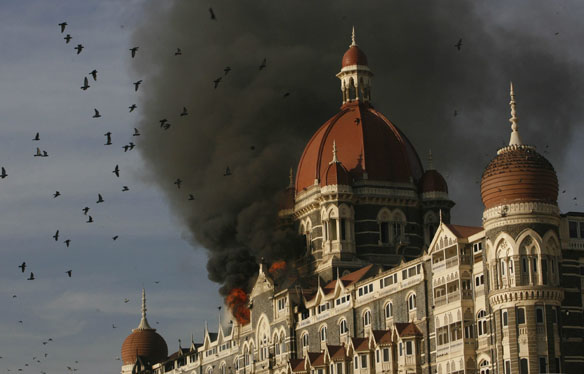
 Over the past two decades India has demonstrated remarkable consistency in the irrational and incoherent response of its policy makers, people and sections of its mass media to dramatic and outrageous terrorist violence inflicted on the country. The most recent episode, witnessed in Mumbai on November 26 has also been followed by a typical though distinctly more pronounced response from all quarters. Much of the public debate following these terrorist attack has focussed on internal security systems (or the lack thereof) and the effort to punish the perpetrators. The public sphere including the media and academic dialogue seem to be preoccupied with ways to bring in line the truant Pakistan.
This approach has failed consistently and the outcome is unlikely to be any different this time around too. The major flaw with placing the blame entirely on Pakistan is the premise that Pakistan or its proxy warriors could have executed any of these outrageous acts in the absence of serious internal vulnerabilities. Though some of these vulnerabilities are acknowledged by many after the Mumbai attacks, they remain limited to the domain dealing with foreign policy, internal security and intelligence gathering.
Even now there is complete silence on a most crucial aspect that we must recognise; Indian Nationals collaborated with the Pakistani perpetrators in planning and executing this barbaric incident. The law enforcement agencies and the politicians are yet to provide us any clue on the identity of the perpetrators who were killed and on the countless others who helped in the various stages of this act. India, its media and its polity have not even attempted to articulate this dimension in their prescription for preventing these events from occurring again. The increasing presence of radicals in India, in this case those who justify violence in the name of Islam, is a clear and present danger and must be halted if any degree of success is to be achieved in India’s endeavour to tackle the menace of terrorism. It is imperative that Islamic radicalism be recognised as such and then efforts be made to prevent its spread. It is equally important to enact policies that resolve conditions that aid the spread of this violent radicalism.
This reluctance to look within, it may be argued, is due to the inherent predisposition of nations and societies to externalise such incidents. The US and much of the western world has frequently treated terrorist violence as a distant third world phenomenon attributing its cause and origin to the ‘impoverished and backward regions’ of Afghanistan, Pakistan and the Middle-East. This propensity of the western world is a legacy of the colonial/orientalist discourse. It also prevents societies from looking within and engaging with shortcomings in their own socio-political landscape. This is evident from the alacrity with which the West categorises its Muslim citizenry as ‘Moderate and Progressive’ while denouncing the Muslim perpetrators (even when they are from their own populace) as ‘Islamic Terrorists’ motivated and created in alien societies devoid of freedom and liberty. To admit to the existence of discontent and outrage amongst its own Muslim population would be to admit to shortcomings within their own brand of liberal pluralism.
India, its government and people, have responded to the Mumbai attacks and other terrorist action in the past in much the same manner. The origin of these violent incidents have been distanced from within and located entirely in the ‘fundamentalist and undemocratic’ Pakistan. This is simplistic and dangerous. The sophistication, planning and increasing frequency of terror violence in India demonstrates strong local support for this radical Islamist ideology that propagates violence. Irrespective of the existence, contours and construct of a global Jihadi network, it is irrefutable that social conditions do exist within India that create disaffection and hopelessness and allow this population within the Indian Muslim community to be lured to the ideology that many today term ‘Radical Islam’. The existence of SIMI and their violent brand of political agitation confirm to this growth of radicalism in the local Muslim community. The participation of home grown terrorists from educated and middle class backgrounds points to the presence of this radicalism in all strata of society and within the urban mainstream of India.
Radical Islam is not a primeval phenomenon, nor is it unsophisticated. It is now a post-modern ideology able to attract a diverse demography. It also makes use of modern media and communication platforms and positions itself effectively as an alternative and preferred form of habitation for persons seeking an outlet and release from their existing social reality. This presence of Radical Islam demands two specific investigations that India must undertake if it is to effectively respond to its dangerous proliferation. The first must involve an honest study of political, economic and sociological factors that shape anxieties of the Indian Muslim today. This would help in identifying vulnerable sections and vulnerabilities in our systems that may be exploited. The second investigation must construct how Radical Islam offers its ideology to the Indian Muslims as a relief from their current anxieties. It should understand the substantive messages that are communicated by the supporters of this ideology that address the current day issues of the Indian Muslims across the social spectrum.
An understanding of these vulnerabilities and the messages may offer a point of departure for the policy makers and civil society and help to develop a response comprising of both, security and socio-economic dimensions. This would aid policies and processes that would not only make India safer but also enhance its democratic depth.
January 2009.
Link to ORF website.



 Samir Saran