by Samir Saran
April 2011
’Climate and security’ is a narrative with multiple layers and irresolvable complexities. At the very core, it continues to remain a western narrative on a looming and enduring eastern reality. This very comprehension of climate and security lends to discussions an externality that both hemispheres find hard to reconcile. But before we discuss this inherent paradox within ’climate security’-a term used to broadly describe situations, discussions, and elements that constitute security within and resulting from climate discourse and global climate action (modest at best), it may be useful to shape the boundaries of what be the core tendencies, trends, and impulses that define it.
The use of the terms ’climate’ and ’security’ in popular literature conjures up images of apocalyptic storms, landslides, extreme weather conditions, deluge, rising sea levels, melting glaciers, droughts, floods, cyclones, and similar weather phenomena that will ravage countrysides, inflict loss of life and property on an unimaginable scale, and result in mass exodus of populations. Be it the Hadley Centre Report that feeds this imagery through a more scientific and nuanced approach (Department of Energy and Climate Change) or the Stern Review that deploys this description to urge action by the developed and developing worlds (Stern 2007), the correlation between climate and such threats is unmistakable. This continues to be the defining imagination of security within the climate debate-hotly contested in terms of scale, size, and timelines. Images of death and destruction remain the central argument in the arsenal of a section of the political class, both in the West and East, who are vociferously urging action, incentives, and commitments around green technology, carbon trade, and innovation.
The success of the approach of linking climate action to impending apocalypse is debatable. Also at doubt is its ability to elicit appropriate response from policymakers and institutions. Deploying images of death and destruction within the climate debate, some argue, is ’climate pornography.’ It is forcefully stating the obvious, and as some would argue, also the inevitable (Ereaut, Gill, and Segnit 2006).The semantics of this argument are clearly built on the ’fear for life’ and ’fear of the future’, and seek to compel political action on this basis by gaining support in the larger public sphere.
This approach seemed to have helped create a surge in the constituency of those seeking climate action, particularly in the Western countries. This has also resonated among a specific constituency in the emerging nations, prior to the Conference of Parties at Copenhagen last year. However, it has been unable to stem the disenchantment of the larger public from matters of climate, and ’climate fatigue’ is setting in. As per a 26-country survey conducted by GlobeScan, concern for climate change is dwindling both in Europe and North America (GlobeScan 2010).
According to the survey, support to climate efforts in the UK fell from 59% to 43%, and in Germany from 61% to 47%. This narrative was also unsuccessful in appealing to large constituencies in emerging countries and the developing world. This was a result of poor communication, hypocrisy, and inherent dichotomy in the construction of the debate. This predominantly western narrative on climate security describes the outcomes (floods, cyclones, and so on) through a matrix of predictive dates and probabilistic scenarios. This was an instance of science attempting to steer policy that, as some argue, failed. Science is comfortable with probability and percentages, but people are not.
Communications on the matter often sounded weak and convoluted and the messages lacked clarity. They also lacked a central appeal, but more importantly, they failed to offer a response to the challenge. This was perhaps the biggest failure in the communication of the imminent dangers of global inaction. The articulation lacked considered and feasible global responses without which communications were read as scare mongering or where there were indications of certain action (read technology as the saviour) it was read as lobbying by vested interests. Global inattentiveness to ’climate and security’, in some sense, is as much about a failure to communicate, as it is about political differences and high economic stakes.
However, the hypocrisy within the narrative surfaces when this debate seeks placing the occurrence of extreme climate events and disasters into the future and when action is urged for the benefit of future generations (such as the US President Barack Obama’s exhortation to act on climate change or risk ’… consigning future generations to an irreversible catastrophe’).1 If, as climate science suggests, man-made emissions are able to subvert some of earth’s natural systems, then why are the current extreme events also not a result of the last two centuries of industrialization and rampant mercantile capitalist production? To many, the answer is simple yet hypocritical. The rich would have to foot the bill today for having squatted and ravaged the limited carbon space available as a common resource for global citizenry.
The impact and solemnity of the climate and security argument would have far greater weight if developed nations were obligated to make good the costs of life and property that are lost in the poorer regions today due to floods, cyclones, hurricanes. Yet while we hear a call for action on pricing carbon (which allows the rich to usurp more carbon space), incentives for technology and securing intellectual property rights, a determined and unequivocal call for damages of past action is missing. Ensuring that the countries with the means to respond to the suffering caused by such climate-related disruptions in poor and emerging countries, are allowed to absolve themselves of any responsibilityy, adds to skepticism, and weakens the most important argument-that of security-for global action.
Calls for global action sound hollow for another reason-the quantum of commitment made by the affluent nations. While the rhetoric of preserving the planet and human life is pitched high, what we see in terms of response is tokenism. To save the planet, the mightiest nations in the world got together at Copenhagen last year and then at Cancun recently, and committed to a paltry $100 billion each year by the year 2020.2 Let us now place this pledged amount against another recent response by the world community.
It is estimated that over $3 trillion was committed by the US, China, EU, and other countries to help the world economy or as some suggest, to ’save a few banks and large corporations’ (Barbier 2010). Three trillion to save the financial system and a 100 billion to save the planet-a fact that will undermine any security discourse within the climate narrative.
The other extremity of the climate-security narrative is less popular, but fast shaping as a significant line of thought. It focuses on elements of human security outside of the ’life and property’ paradigm. This debate places the human right to develop, grow, and aspire for a better life as a primary objective of climate action (Saran 2010). Here, too, the western narrative seeks to focus the discourse on poverty reduction within the objectives of climate action, thereby reducing the aspirations of billions in the emerging world to that of survival and poverty-line existence.
The fact that the industrial economies of the OECD and their high income populations were assisted and subsidized by carbon-intensive fossil fuels is cast aside as an act of ignorance, and the importance of the use of coal and gas in determining the pace at which India and other emerging countries develop is undermined by real but superficial arguments on ethics and shared responsibility. Poverty and growing aspirations are the two imperatives for any political system in emerging economies, and there would be political unrest if the leadership in these nations were to compromise on these.
However, the climate narrative is beginning to exert itself in the development processes of poor countries. Last year, we saw the US EXIM Bank deny a loan to a coal project in South Africa, and dither on a similar proposal for India citing potential emissions as the reason.
If climate positions were to become barriers to trade and finance flows, we could perhaps be discussing the most significant and impending security paradigm for the emerging world. The impact of climate negotiations, and green capitalism that is rearing its head, are some elements that will define climate and security for India and other developing countries.
Let me conclude by posing some queries that policymakers in India and other developing countries will need to respond to. Can we ignore the real threat to life and property from extreme climate events? Can the actions of India reduce this threat? How can we compel the West to vacate carbon space, and cap and reduce lifestyle emissions? How will we be able to allow billions in India and the developing world to aspire and, seek homes, cars, holidays and infrastructure? Should we? Why should the first-time users of electricity in India (nearly 500 million) have to make do with token solar lamps that work for only a few hours? Why should the poorer 80% of the world’s population be made to bear responsibility for expensive climate action going forward? How do we ensure continued access to critical finance and technology required to develop infrastructure, and afford prosperity to millions? How do we carve out a global regime that removes carbon squatters and makes them pay for their historical retention of carbon space? Why should the emerging world support or incubate new technologies, when all major economies seek to place green technologies at the centre of their plans of re-industrialization and manufacturing competitiveness?
Lastly, can we ignore the ’green economy,’ and does it really provide India an opportunity to take a position of leadership in this new world?
These are some of the competing dynamics of the ’climate security’ narrative that we will need to navigate if we are to develop a robust framework that realizes the gravity of the climate and security narrative, and articulates the differentiated needs of the diversely developed regions of the world.
References:
Barbier E B. 2010. A Global Green New Deal: Rethinking the Economic Recovery. Cambridge University Press. 171 pp.
Ereaut, Gill, and Segnit. 2006. Warm Words: How are we telling the climate story and can we tell it better? London: Institute for Public Policy Research.
Department of Energy and Climate. Avoiding Dangerous Climate Change. Met Office, Hadley Centre. Available at http://www.metoffice.gov.uk/publications/brochures/cop14.pdf
GlobeScan. 2010. ’Climate Concerns Decline since Copenhagen Summit: Global Summit.’ [Press Release 2 December 2010]. Available at: http://www.globescan.com/news_archives/cancun_radar/Cancun_climate_release.pdf.
Saran S. 2010. The Globalisation and Climate Change Paradox: Implications for South Asian Security. In South and Southeast Asia: Responding to Changing Geo-Political and Security Challenges, edited by K V Kesavan and D Singh. New Delhi: ORF-Knowledge World. 141-161 pp.
Stern N. 2007. The Economics of Climate Change: The Stern Review. Cambridge, UK: Cambridge University Press.
Notes:
1Barack Obama’s Speech at the United Nations. 22 September 2009. The Sunday Times. Available at http://www.timesonline.co.uk/to1/news/environment/article6844525.ece
2See report on Outcome of the work of the ad hoc working group on further commitments for Annex I parties under the Kyoto Protocol at its fiftieth session. Available at http://unfccc.int/files/meetings/cop_16/application/pdf/cop16_lca.pdf
Original link to Observer Research Foundation website.
 by TOI Crest


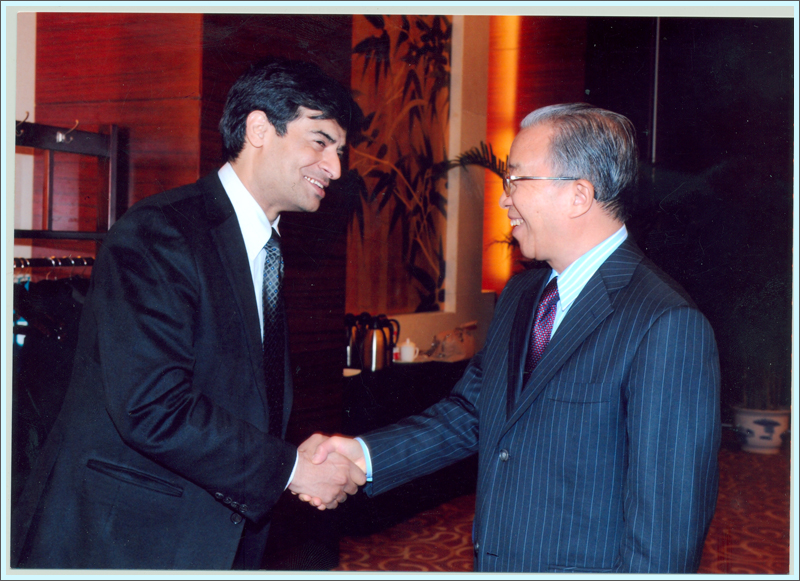



 India’s global economic orientation and strategic outlook are important to U.S. economic and security policy and interests. An increasingly global strategic outlook from India will impact U.S. foreign policy in significant ways. A conference co-hosted by Observer Research Foundation and the Heritage Foundation at Washington D.C. on 8 December 2010 examined the issues involved and the interplay between India’s economic path and its global strategic outlook to gain insight into the future of US-India relations.
 ndian Ambassador Meera Shankar, in her keynote address, said that globalisation and the liberalisation of India’s economy have altered the way India interacts with the world and the transformation of its engagement with the US is part of this process. She said India and the US have agreed to work together to promote an open, balanced and inclusive architecture of cooperation in the Asia-Pacific region. India sees the US as a valuable partner in meeting its development aspirations, in building peace and security in its neighbourhood and in the wider Asian region and in addressing shared global challenges. She spoke on a wide range of issues in Indo-US relations, including the security situation in Asia, Afghanistan, cooperation in counter-terrorism, the new Indo-US dialogue on homeland security and nuclear disarmament among others. She stressed on the need for the two countries to work together on these issues.
 The first session, ’The Health of the Globalisation Model and Rise of Alternatives’, looked at the disagreements between the US and India at the WTO, particularly on issues like outsourcing. The session focussed on how and when the two countries could cooperate in global trade and finance. It also looked at how and when the two countries could cooperate in dealing with the rise in prices of energy and food, in the backdrop of more warnings about global resource scarcity. The speakers at this session were Ambassador Susan Esserman, Partner, Steptoe & Johnson LLP, and former Deputy U.S. Trade Representative, Sunjoy Joshi, Director, Observer Research Foundation and Ashish Chauhan, Deputy Managing Director, Bombay Stock Exchange. The session was moderated by Ambassador Terry Miller, Director, Center for International Trade and Economics, The Heritage Foundation.
 The second session ’India’s Globalisation Experience/Future’ examined potential Indian paths of economic globalisation, including trade in goods and services, movement of capital, information and people. It focussed on the opportunities for cooperation between India and the U.S. created by those paths. The speakers at this session, moderated by Walter Lohman, Director, Asian Studies Center of The Heritage Foundation, were Kapil Sharma, General Manager, North America, Tata Sons, Ltd., Dr. Derek Scissors,
  Research Fellow, Asian Studies Center, The Heritage Foundation and Samir Saran, Vice President, Observer Research Foundation. The key messages emanating from this session included how India needed to transform significantly in terms of regulation, markets access and social inclusion as these would inhibit or aid development of the bilateral relations. India is also a global player with its global MNCs and more discussions were needed on the interaction of companies like the Tata Group and Reliance with the world.
 In his luncheon address, Robert Blake, Assistant Secretary of State for South and Central Asia Affairs, touched on the need for India and the USA to work together in dealing with the challenge of nuclear proliferation. He highlighted the US’ commitment to support full membership for India in multilateral export control regimes. He said that the two countries have decided to take mutual steps to expand India-US cooperation in defence, civil space and other high-technology sectors. Another area of cooperation that he focussed on was cooperation in the energy field, particularly in clean energy and the bilateral Partnership to Advance Clean Energy (PACE). He argued that enhancing India’s food security is vital for continuing India’s globalising trends and sustaining the burgeoning strategic economic partnership between India and the US and said that the two have agreed to collaborate in agriculture for an ’evergreen revolution’ in India. Other issues that he focussed on were bilateral health cooperation, joint development projects in Afghanistan and cooperation in higher education.
 In the final session, ’How Globalisation Will Impact India’s Strategic Outlook’, the focus was on how globalisation has impacted India’s global strategic outlook. It looked at convergences and divergences in U.S. and Indian perceptions of India’s expanding global role. Another issue that was examined was how Indian globalisation would impact specifically on its military modernisation efforts and the US-India defence relationship in the future. U
 S and Indian priorities for expanding bilateral cooperation in the unfolding global strategic setting were also examined. The speakers at this session were Vikram Sood, former Director of India’s Research and Analysis Wing and now Vice President of Observer Research Foundation, Lisa Curtis, Senior Research Fellow, Asian Studies Center, The Heritage Foundation, Dr. Evan Feigenbaum, Director, Eurasia Group, Dr. Harinder Sekhon, Senior Fellow, Observer Research Foundation. The session was moderated by Nandan Unnikrishnan, Vice President, Observer Research Foundation.
 Scholars and experts from BRICS (Brazil, Russia, India, China and South Africa) countries have said that the current crisis in the Middle East and North Africa (MENA) regions should be resolved expeditiously in the interest of regional stability and in conformity with the aspirations of the peoples of MENA and said that the current crisis demonstrated that the global governance system needed to be more responsive.



 Samir Saran