Commentaries, foreign policy, Great Power Dynamics, India, India-Russia, international affairs, Strategic Studies, USA and Canada

Modern Geopolitics: A Race Through Chaos to Stability

Originally published in The Valdai Club. Co-authored with Aarshi Tirkey.

The third decade of the twenty-first century has compelled the world to face its most intractable challenge yet—offering a coherent, collective and equitable response to the COVID-19 pandemic. This has tested the faith of the most ardent internationalists, and is part of a deeper churn in the global order that was underway even before the first COVID-19 case was reported in Wuhan in 2019.

US hegemony has all but come to an end and the rise of a multipolar world has effected a redistribution of power at the global stage. American leadership, that would have been essential to catalysing collective action against the pandemic, bordered on wanting to island itself from the rest of the world much before former US President Trump launched the “America First” campaign. The utopian vision of interdependence and global cooperation had already taken a beating in Europe when Brexit demolished the ideological and institutional underpinnings of the European Union. And China, the other great power, was engaged in its project ‘Pax Sinica’, determined to make globalisation beneficial for its Communist party.

Global institutions had weakened, and the benefits of investing political will into their mechanisms had greatly receded. The coronavirus further exacerbated this: While nations scrambled to respond to this fast-spreading disease, their immediate reaction was to look inwards, go at it alone or with trusted partners, and engage with the international community only for self-serving purposes. At the end of the day, all were ‘Darwinian’ and privileged their own survival without consideration and care for others. This is typified by the perverse ‘Vaccine Access’ world map.

Global institutions had weakened, and the benefits of investing political will into their mechanisms had greatly receded. The coronavirus further exacerbated this: While nations scrambled to respond to this fast-spreading disease, their immediate reaction was to look inwards, go at it alone or with trusted partners, and engage with the international community only for self-serving purposes. At the end of the day, all were ‘Darwinian’ and privileged their own survival without consideration and care for others. This is typified by the perverse ‘Vaccine Access’ world map.

As such, the postwar liberal international order—underwritten by the West under US leadership—had been facing an existential crisis since the turn of the century, with wars in South and West Asia and the Financial Crisis all challenging the old arrangements and aiding the rise of `China as a new revisionist power. And then the Virus from Wuhan exploded on the world stage, accelerating the processes that were already influencing modern geopolitics, a few of which are discussed here.

The 3 R’s of Modern Geopolitics

The first is readjustment, as countries are grappling with the impact of the rise of new regional and global actors. The American century has waned, and the rise of the Asian century—home to the growing economies in the world—is well on its way. The biggest challenge to the global balance of power comes from China, which is set to be the first major economy to rebound after the pandemic With the launch of the Belt and Road Initiative (BRI), China’s close integration with global supply chains, and its advancements in civilian and military technologies—Beijing’s rise appears to be an inevitable reality, howsoever much its international behaviour instills distrust among many, particularly the US and some of its allies.

A contest is, therefore, inevitable. In President Biden’s interim National Security Strategy Guidance, the rise of both China and Russia is treated as a challenge to a stable and open international system. President Xi Jinping—for his part—recently declared that Beijing will never allow any foreign forces to bully, oppress or enslave China and the focus of the party would be “the great rejuvenation of the Chinese nation”. Will the two global powers head for a confrontation or choose to opt for a peaceful coexistence with limited and contained disagreements? The outcome of the US-China rivalry remains to be seen, and countries caught at the intersection of this evolving dynamic must take into account how they readjust their approach to this new age of geopolitics. Russia too will be asked some tough questions and will have to make some difficult choices. Can a positive Biden-Putin engagement play a stabilising role in the 21st Century? Or is a China-Russia nexus inevitable?

The outcome of the US-China rivalry remains to be seen, and countries caught at the intersection of this evolving dynamic must take into account how they readjust their approach to this new age of geopolitics. Russia too will be asked some tough questions and will have to make some difficult choices

Second, the hard-won consensus on the frameworks underpinning multilateralism and globalisation is undergoing a dramatic restructuring. The 2008 global financial crisis, followed by the COVID-19 pandemic, have exposed the fragility of global economic interdependence. The growth of hyper-nationalism and populist politics assess globalisation and multilateralism as arrangements that impinge on the sovereign choices of a state. As such, there is potential for the creation of a ‘gated globalisation’—a globalisation that is less free and less open than before. Economic policies are no longer solely dictated by economic principles; they are now guided by strategic considerations, political trust, climate, health and technological threats. Countries, such as the UK, US and India have introduced trade restrictions, investment screening mechanisms, sanctions and monetary policies to reflect these new considerations. China had already perfected their own model of perverse global integration.

The disillusionment with multilateralism can be directly attributed to institutional inertia, lack of reforms and capture by vested interests, which continue to hamper decision making before these organisations. Countries are, therefore, leaning towards smaller groupings to forge fluid, issue-specific partnerships, which can expedite cooperation between like-minded countries. While this can be one way to overcome the malaise of multilaterals, they may hamper the development of broader and cohesive international strategies for ‘global bads’—from COVID-19 to climate change—which require the participation and commitment of all. The pandemic is not over till all are vaccinated and secured and the threat of climate change is not going to recede by unilateral actions of any single state. The ongoing restructuring calls for the need for new arrangements that can redress the inefficiencies of multilateralism and globalisation, without diminishing their larger benefits. Can a ‘consortium of plurilaterals groupings’ agree to a common minimum framework to address the challenges that confront us all even as they engage within their own clubs to maximise their economy and security?

In the midst of this churn, geopolitics has been reoriented to accommodate new actors, and emerging factors and considerations. Modern geopolitics is increasingly influenced by geoeconomics and geo-technology. Important works, such as War by Other Means, talk of the systemic use of economic instruments to achieve geopolitical objectives—a form of statecraft that was present during the Marshall plan, and is present today as well through China’s ‘chequebook diplomacy’ and more generally the BRI.

Modern geopolitics is increasingly influenced by geoeconomics and geo-technology. Important works, such as War by Other Means, talk of the systemic use of economic instruments to achieve geopolitical objectives—a form of statecraft that was present during the Marshall plan, and is present today as well through China’s ‘chequebook diplomacy’ and more generally the BRI

If the medium is the message, then technology is the future of our politics. The advent of the Fourth Industrial Revolution (4IR) has resulted in the development of technologies that can be both a boon and a bane for humankind. While America was at the forefront of technological leadership in the recent past, this is being challenged by China as it invests heavily in emerging and dual-use technologies such as Artificial Intelligence, Quantum Computing, and biotechnology. First movers may not only take the mantle of technological leadership, but will also become the providers for other countries, creating asymmetric dependencies. ‘GeoTech’ opens a new realm of interstate competition, where concerns of national security and strategic autonomy implicate technology choices and arrangements. In an increasingly digital world, the capture of data—and not territory—and the compromise of critical information infrastructure—and not state borders—are the new security challenges for nations. As an individual’s attention, eyeballs and personal data become the coveted political prize, will the next domain of conflict be the human form and how we will protect it?

New Actors, New Geographies

While the above factors remain at the heart of this churn, new actors and geographies are influencing the conduct of geopolitics. Though the coronavirus hearkened the return of the ‘nation-state’, communities across borders represent a robust challenge to this primary unit of Westphalian sovereignty. The concentration of economic resources and power in global technology companies, from Twitter to Tencent, has driven home the fact that states are no longer the primary actors in the world. Hate, tribalism and irrational ideologies have returned with new vigour, riding on the reach and amplification of digital technologies. Technology giants are now the arbiters of economic and political choices and are challenging the writ of the older political systems.

The emergence of new geographies, such as the Indo-Pacific, Eurasia and the Arctic—in which all regional and global powers have stakes—demand the genesis of new norms, institutions and partnerships. In a universally parochial world, there is limited appetite or leadership to shape and create these. In sum, the pandemic confirmed the decline of the US as a superpower and sharpened questions on Beijing’s moral and political capability to step into the void. Even with its attendant equity and efficiency losses, the importance of‘multi-polarity’—first ideated by Primakov through the Russia, India and China trilateral mechanism—received a resolute confirmation. It has urged that we appreciate this shifting nature of global and domestic affairs to be able to adapt to an increasingly complex world, that is no longer tethered to a conventional understanding of geopolitics.

While the ability to project power globally resides with the US, the world is steadily moving towards political, economic, technological and normative multipolarity. The evolving contours of modern geopolitics is still in a state of flux, and there is wisdom in accepting the notion that the end result is perhaps indeterminable. The age of disruption is here, countries that thrive on disorder may do well in the short term, while nations who invest in stability may well define the future of globalisation and, indeed, the new world order.
Standard
Cyber and Technology, India, international affairs, media and internet, tech and media

Just deserts? Western reportage of the second wave in India exposes deep schisms in relations with the East

Co-authored with Mr. Jaibal Naduvath

This article is a continuation of a previous article written by the authors, Revisiting Orientalism: Pandemic, politics, and the perceptions industry

In Lord Byron’s poemChilde Harold’s Pilgrimage (1812), the protagonist Harold, contemplating the grandness of the Colosseum, imagines the condemned gladiator, dignified yet forlorn, butchered for the entertainment of a boisterous, blood lusty Roman crowd out on a holiday.

Public spectacles of suffering are integral to the discourse of power. The perverse imagery and messaging surrounding the suffering seeks to intimidate and suppress the subaltern’s agency to perpetuate ethnic dominance and social control. It pivots around an elevated moral sense of the ‘self’. In his seminal work, When Bad Things Happen to Other People, John Portmann argues that it is not unusual to derive gratification over the suffering of the ‘other’, particularly when the native feels that the suffering or humiliation of the ‘other’ is deserved. The suffering then becomes fair recompense for transgressions real and imagined, and the accompanying sense of justice and closure brings forth feelings of gratification.

India is reeling in the aftermath of the second wave of COVID-19. As death reaps rich dividends cutting across class and covenant, the country is engaged in a determined fightback. The developments have made global headlines, and, in equal measure, triggered global concern. Apocalyptic images of mass pyres and victims in their death throes, replete with tales of ineptitudeprofiteering and callous attitudes, have made front page news and have become television primetime in much of the trans-Atlantic press, conforming to reductive stereotypes that have informed three centuries of relations with the Orient. The ‘self-inflicted’ suffering is then ‘fair recompense’.

Continue reading
Standard
European Union, foreign policy, Great Power Dynamics, India, international affairs

India: Too strategic to fail

Co-authored with Akshay Mathur

Since the second wave of COVID-19 engulfed India, there has been an outpouring of support from nations around the world. Help came from all directions. Rich nations including the US, UK, Germany, and Australia; developing and emerging markets like Mexico, Indonesia, and Bangladesh; and even smaller nations like Mauritius, Kuwait and Bahrain have rushed emergency supplies to India. Partner countries have responded to India’s humanitarian need with whatever they could muster, from oxygen concentrators and liquid oxygen to Remdesivir.

An embattled India sought help and gratefully accepted what it got. This assistance came with a sense of camaraderie—with confidence, eagerness, and without prejudice. The tone and tenor of aid being offered is markedly different from ‘north to south’, ‘rich to poor’, ‘developed to developing’, or ‘conditions-based’ grants of the past. It is also qualitatively different from the all-round aid India received in the 1960s or 1970s. This time, India was short of only essentially two commodities—oxygen and specific medicines like Remdesivir. As such, its requests were focused and purposeful.

India’s strategic position in international relations

Why did the world respond so expeditiously? One reason is India’s emerging salience in global affairs. India today is a strategic partner to many nations. It is a dependable stakeholder in the Indo-Pacific, a dynamic market-based emerging economy with a direct bearing on geoeconomics, and a core member of the club of democracies. How India responds and recovers will be a test for emerging arrangements on economic interdependence, regional security, artificial intelligence, reforming multilateralism, and trade negotiations. India, despite its low per capita income is too strategic to fail—or even to be put out of action for too long.

As Australia sent support, it spoke of India as a key partner in the Quad in vaccine production. The Australian government emphasised the criticality of helping India recover quickly, for its production capacity is important for the world to fight COVID. The United States’ move to waive IP protection for COVID-19 vaccines, its willingness to negotiate at the WTO, and its delivery of raw materials required for India to make millions of vaccine doses showed that shoring up India’s domestic manufacturing capacity is a key motivation for external assistance. A similar perspective came from the India-EU Summit. It highlighted cooperation on “resilient medical supply chains, vaccines, and the Active Pharmaceutical Ingredients (APIs)” as central to the joint fight against COVID.

India’s significance in global politics cannot be gauged from data alone. It is still a developing country by any economic measure. Yet, when seen as a member of the G20, a founding member of the Quad, an invitee to the G7, a member of the alliance of 10 ‘like-minded’ democracies (D10), a member of the Global Partnership on Artificial Intelligence, the chair of BRICS in 2021, an elected member of the United Nations Security Council for 2021-22—India’s aggregate strategic, geopolitical, and geoeconomic weight and influence matters.

There is also recognition and gratitude for the 66.3 million vaccines India shipped as bilateral aid, contracts, and through the WHO-led COVAX to other nations, before the second wave hit India. True, this approach is being questioned by some today. But if we step away from the polemics of the moment, it is important to recognise this as a sign of India’s commitment to good global citizenship. This will offer little solace for those who have lost loved ones or are currently suffering because of the devastating second wave; there are understandable questions about the way in which the second wave has been handled, and illustrations of where the state (and society) could have done better. Even so, that does not mean we start interrogating the very basis of global citizenship and solidarity—the same sense of unity that has come to India’s assistance today. Without friends abroad, our situation would surely be worse.

The speed and scale of global support could very well be attributed to India’s active and effective foreign engagements. It demonstrates how Indian diplomacy punches above its weight on the international stage and can mobilise help when needed. India today is understood more comprehensively around the world. Its actions and policy positions on global affairs are more pronounced and appreciated.

To be sure, India is not the only nation to which aid is being provided. The total assistance to India by the US is worth nearly US $100 million, of more than a billion dollars in contributions made so far including to GAVI. But support to India is one of the largest. Similarly, the EU has pledged €2.47 billion for supporting vaccines to developing and low-income nations. Global civil society has raised its voice in support of India in unison. The fact that even progressive critics of India in the US polity have rallied to India’s cause—and discovered common ground with it on issues of vaccine IP and access—is an acknowledgment of the uniqueness of the pandemic moment, the goodwill for India in its entirety, and the contribution of India to global causes.

A developing side story in this journey of Indian diplomacy has been paradiplomacy. Take, for instance, the role of business chambers. The Federation of Indian Chambers of Commerce & Industry (FICCI) is working with its German counterpart, Bundesverband mittelständische Wirtschaft (BVMW)—an association of the German Mittelstand—on oxygen concentrators. The US industry-led Global Task Force is working with the US-India Business Council and the US-India Strategic Partnership Forum on ventilators and concentrators. Danish companies such as Maersk have directly supported India with oxygen concentrators and medicines.

Similarly, California sent oxygen generation units and the German state of Baden-Wuttermberg sent oxygen equipment to Maharashtra, with which it has sister-city agreements. This demonstrates that paradiplomacy by subnational governments in India has come of age. Japan specifically directed its aid to India’s Northeast, aligning COVID support with existing regional interests. Bhutan sent oxygen to India through neighbouring Assam. Gujarat, Kerala, Karnataka, and Andhra Pradesh, among others, have all put global economic and diaspora networks to use. Indian businesses, professionals, and students remain the best roving ambassadors for their mother country and, in some cases, their home states. The Indian diaspora in Qatar for instance, has sent direct support. Indian business corporations have stepped in and sourced key equipment from foreign countries where they have operations. For the first time, perhaps, India’s aggregate calling abroad is larger than the piecemeal efforts that have been deployed by it in the past.

The way forward: Continuing with good global citizenship

All this is comforting for an India in whose wellbeing nations around the world are invested. What we need now is for India to fulfil the goals it must embrace. The pharmacy of the world has to live up to its promise as a vaccine source for not just itself, but also its neighbours and the Global South. Without India being vaccinated and without Indian vaccine capacity being widely available, the world will not be able to defeat COVID-19. As many have repeated over the past year, “No one is safe until everyone is.”

The international community has done what it can for India. It is time for us to return the favour—jab-by-jab. For that we need to heal as a country, build capacity to cater to each Indian, and plan for the needs of many outside who count on us. Even if the natural impulse is to look inwards and only provide for one’s own, the way forward is continuing with good global citizenship, not curtailing it. The Prime Minister has often spoken of the potential of India’s scale, speed, and size. In the coming six months, one-sixth of humanity has to put these attributes to use. There is no scope for failure and the outcomes will be scrutinised by many.

As the Health Ministry prepares its plan to vaccinate the entire adult population by December, this is the also the time to plan how much we can deliver to the world. The numbers, in terms of vaccine doses being produced, need to be rethought to take into account the imperative of assisting those countries who require India’s manufacturing capabilities to safeguard them from the devastating impact of the pandemic. Research indicates that COVID-19 is likely to become a seasonal phenomenon like the common flu, in which case, India must invest in the production of booster shots that may be administered regularly. As the treacherous virus mutates, experts are of the opinion that it might potentially mutate into a form that evades existing vaccine immunity. To prepare for such a scenario should it arise, research and development efforts should also be directed towards responding to potentially more lethal variants. As we race towards the immunisation of the world against the novel coronavirus, vaccines will be the most important global products, servicing the world’s needs.

For India to continue being a responsible global actor that plays a central and vital role in the mission to vaccinate the world against COVID-19, India needs to build the capability and capacity at home first. The intensity of the second wave may not have entirely been within our control; but what we do next will be. So, we must ramp up production, vaccinate our population, and then embark on the essential task of making the world safe for all, and not just the rich. The success of India in saving lives—at home and abroad—in the coming months and years,  will rest on its vaccine capability that needs greater heft and rapid investments.

The views expressed above belong to the author

Standard

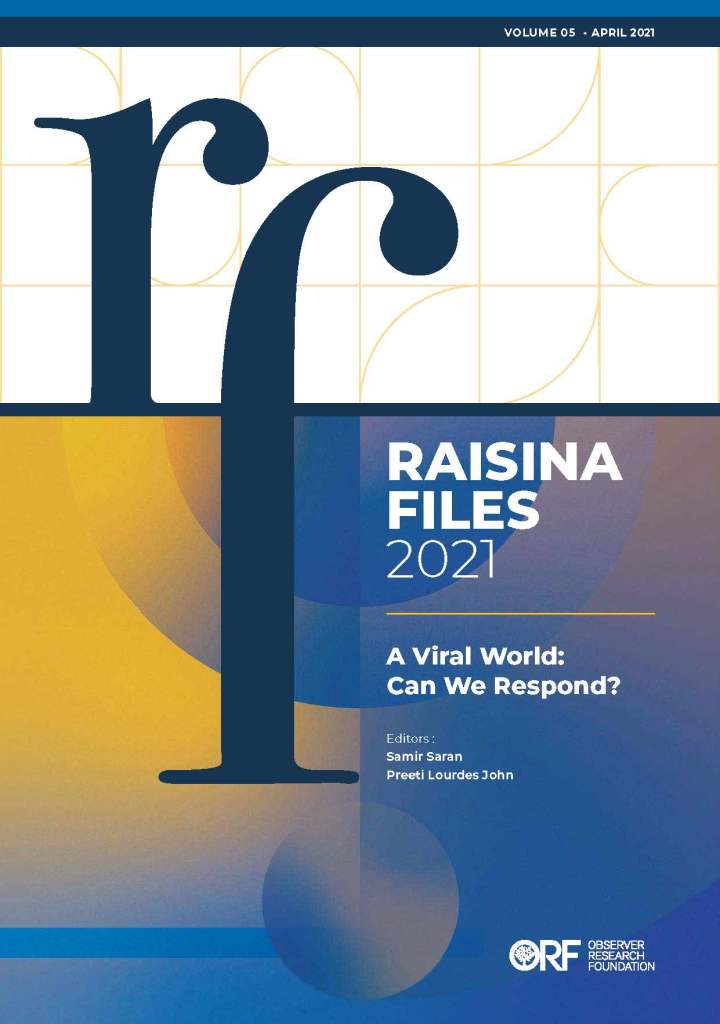
Raisina Files 2021 aims to engage with the leitmotifs of this past pandemic year, mirroring the theme of the Raisina Dialogue 2021, “#ViralWorld: Outbreaks, Outliers and Out of Control”. Within this overarching theme, we have identified five pillars and areas of discussion to critically engage with—WHOse Multilateralism? Reconstructing the UN and Beyond; Securing and Diversifying Supply Chains; Global ‘Public Bads’: Holding Actors and Nations to Account; Infodemic: Navigating a ‘No-Truth’ World in the Age of Big Brother; and, finally, the Green Stimulus: Investing in Gender, Growth and Development. Together, these five pillars of the Raisina Dialogue capture the multitude of conversations and anxieties countries are engaging and grappling with.

Raisina Files is an annual ORF publication that brings together emerging and established voices in a collection of essays on key, contemporary questions that are implicating the world and India.

In this volume

Editors: Samir Saran, Preeti Lourdes John

  • Emerging Narratives and the Future of Multilateralism | Amrita Narlikar
  • Diplomacy in a Divided World | Melissa Conley Tyler
  • Is A Cold War 2.0 Inevitable? | Velina Tchakarova
  • Trust But Verify: A Narrative Analysis Of “Trusted” Tech Supply Chains | Trisha Ray
  • Can The World Collaborate Amid Vaccine Nationalism | Shamika Ravi
  • A Nuclear Insecurity: How Can We Tame The Proliferators | Rajeswari Pillai Rajagopalan
  • De Facto Shared Sovereignty And The Rise Of Non-State Statecraft: Imperatives For Nation-States | Lydia Kostopoulus
  • Digital Biases: The Chimera Of Equality And Access | Nanjira Sambuli
  • The Infodemic: Regulating The New Public Square | Kara Frederick
  • How Finance Can Deliver Real Environmental And Climate Impact | Geraldine Ang
  • Unlocking Capital For Climate Response In The Emerging World | Kanika Chawla
  • Putting Women Front And Centre Of India’s Green Recovery Process | Shloka Nath, Isha Chawla, Shailja Mehta
  • Investing In Material Innovation Is Investing In India’s Future | Nisha Holla

Read here – https://www.orfonline.org/research/raisina-files-2021/

Books, Raisina Dialogue, Writing

Raisina Files 2021

Image

The BRIC countries are today an increasingly cohesive group of nations with a common vision and shared commitment to collaborate and shape a more equitable and prosperous world order. All four nations are leading economies, large markets and emerging knowledge creators; their interactions within the grouping and with other nations hold promise for their own people and for other developing countries.

This Edited Volume, the outcome of an event hosted by Observer Research Foundation, assesses the potential for cooperation between the BRIC countries on finance, energy, trade, technology and multi-lateral pluralism.

Read here – https://www.orfonline.org/research/bric-in-the-new-world-order-perspectives-from-brazil-china-india-and-russia/

Books, BRICS, Research, Writing

BRIC IN THE NEW WORLD ORDER – Perspectives from Brazil, China, India and Russia

Image