The simultaneous rise of India and China will define the 21st century.

At a book launch event in Delhi, Samir Saran and EAM Subrahmanyam Jaishankar discuss this new moment that will undoubtedly redefine the tenants and principles of the international order.

In their book, Pax Sinica: Implications for the Indian Dawn, Samir Saran and Akhil Deo analyse the key events and policies that have shaped the Asian Century since the elevation of General Secretary Xi Jinping. From the launch of the Asian Infrastructure and Investment Bank to the unveiling of the Belt and Road Initiative, China’s proposition presents a contested model of cooperation that is rearranging regional and sub-regional political alignments. India, amongst others, is responding to these developments to safeguard its own room to maneuver.

Uncategorized

CONTRA VIEW: Financial inclusion is the key

|

Original link is here

For the last two decades India has not only accepted but actually revelled in being labelled an “emerging market”. India felt pleased and privileged by this tag, which seemed to signify that it had somehow ‘arrived’.

Strangely enough, the country’s sense of pride came not from being an industrial powerhouse, financial centre, or innovation capital. It was perversely derived from being seen as a ‘market’.

The problem is that markets fluctuate and can be a haven for merely temporary investments. As just a ‘market’, India was consigned to remain the chosen destination for everything the rest of the world produced in excess. Therein lay a deep disconnect — consumption can only go hand in hand with production. Surely India could not have hoped to emerge as a global power on the back of being a mere market, one that ran a trade deficit with over 100 countries!

PM’s ‘Make in India’ initiative will transform the nation

Aspirations 

Clearly, India’s self-image needed a re-boot. This rebooting of India’s 1.3 billion aspirations was conducted by the Prime Minister on the 15th of August last year. He did it with characteristic simplicity, by a simple call for “Make in India”. A call he hoped, would catalyse a seismic shift in India’s image of itself.

The world has changed since the Financial Crisis. Economic growth cannot be taken for granted. According to the IMF, global growth will continue to be under four per cent for some years. Even this nominal growth will not come without innovation to increase productivity, enhance quality and cut costs. And importantly, the race to be at the forefront of global innovation has intensified. India’s economy and enterprises must be prepared to face increasing global competition. “Make in India” must therefore attempt pushing Indian industry through global competition into a tsunami of innovation. It must not be misappropriated for primitive protectionism or misunderstood to imply insular industrialisation.

The “Make in India” initiative is at its core a ‘call to arms’ so that we as a country invest in our most precious resource- our demography. In a few years India will have the world’s largest workforce. It perhaps already is the world’s youngest workforce. Why must our youth be productive and innovative in Silicon Valley alone or help create financial instruments in only London and New York? To rectify this, we must build the eco-systems and conditions that can create the most productive, the most innovative army assembled in human memory; a peaceful army of wealth creators for the society and country.

Skill 

“Make in India” is therefore a rallying cry for “Made by India”. Its purpose is to arm close to quarter of a billion youth, between 15-24 years of age, with the tools to be productive. The rallying cry is also immediate. It is to skill around 500 million workers to innovate, create and add value to the global economy. We have in a limited way shown this can indeed be done. We have shown it in the automotive sector, which has rapidly become the seventh largest in the world. We have shown it in refining and petro chemicals where we use the worst quality raw materials and transform them into top-end products intended for the most discerning markets. We have shown it in telecom, where we are constantly innovating to empower millions through technology — a transformation which will soon touch the lives of a billion telephone subscribers in ways not imagined elsewhere.

But in all these areas we have shown it as an exception—an exception that only proves the rule. What has been the rule for India? The rule for India so far has been Jugaad. “Make in India” is not Jugaad. Moving beyond frugal innovation, it means delivering value to the consumer at the bottom of the pyramid, the 800 million or so who live at less than two dollars a day. The bottom of the pyramid also needs value, and it increasingly demands value—not just in manufactured products but in services, in transportation and in financial services. They demand the same value that high net worth consumers of the Atlantic countries demand of their manufacturers and service providers. “Make in India” is a proposition to “Make for this India.” And what is made for this India is relevant to many communities in Africa, Asia and elsewhere too.

Simultaneously, the “Digital India” initiative offers unforeseen opportunities to small producers, farmers, artisans and solution providers. It has the potential to ensure that we find an Indian fingerprint in every mosaic, a little bit of India in everything produced and consumed globally. It offers India the opportunity to leapfrog generations of industrial evolution and become part of global value chains. It offers the chance to make the informal sector—employing more than 90 per cent of the workforce—as productive as the formal sector. There is an unprecedented opportunity to integrate with the global market place, virtually. The “Digital India” initiative can transform “Make in India” to “Make with India.”

Initiative 

The “Digital India” initiative is complemented by the Prime Minister’s Jan Dhan Yojana, which has far greater power than any similar initiative to transform the lives of the excluded. Fifteen million bank accounts were opened in one day, and potential remains immense. Jan Dhan Yojana can be a basis for providing access to rural credit, crop insurance, loans to scale MSMEs, and for families and individuals to respond to special events and calamities. Financial inclusion is the building block for unleashing the creative capabilities of this country.

When these three initiatives can be synchronised and skilling the workforce made central to each of them, the prospect for India becomes truly transformational. It becomes a promise that it is now “Time to Make India.”

The writer is vice presdent, Observer Research Foundation. His Twitter handle is @samirsaran

Standard
Uncategorized

Reimagining Indian economic planning: Planning Commission 2.0

16 December 2014, Observer Research Foundation, Analysis

Original link is here
This summer, Prime Minister Modi proposed a radical change to Government of India’s economic bureaucracy by announcing the decision to close down the Planning Commission as it existed. Any new organization of Indian economic leadership, however, must learn from the failures and successes of the erstwhile Planning Commission, continuing its best aspects while reforming all that is irrelevant. There are at least five changes that should be considered vital to the new ’avatar’ that the Prime Minister seeks to fashion.

The Planning Commission was a key part of Indian Centre-State fiscal relations, disbursing ’planned’ funds from the ’Centre’ to ’State’ governments. It once served a valuable role in keeping economic policy coordinated in the nation’s early years. Yet this important aspect of federalism had been overwhelmed by developments (the Indian economic liberalisation that made the distinction between ’planned’ and ’unplanned’ expenditure increasingly anachronistic) and political machinations (the tendency of ruling parties at New Delhi to view Planning Commission expenditure as a political tool to influence the State(s)). The new government must recognize the value of national coordination, while leveraging its constitutionally guaranteed pole position within federal processes that empower the provinces. Changing the Planning Commission should entail neither the continued rigid centralisation nor chaotic and wholesale devolution, but a nuanced combination that respects divided economic responsibilities, with the intention of shaping a system where those best placed to deliver results are entrusted with the responsibility — communities, states, the Centre or the private sector.

India’s economic growth has been hampered by excessive governmental management of resources and assets; the new government should use Planning Commission reorganisation as an opportunity for economic reform that will replace inefficient central planning with better arbitration from the market. Prime examples of the problems with the current system is manifested in gas pricing, coal and telecom spectrum allocation among other resources. Audits by the Auditor General and verdicts from the Supreme Court have indicted the systems of government allocation of coal blocks as well as telecom spectrum as being flawed. Government control in many sectors has led to mismanagement, corruption, rent-seeking, and missed opportunities for private investment. A renewed push for reform is needed to overcome the political barriers encountered in relinquishing government control over resources. A key job for the new ’Commission’ should be designing workable market-based solutions for coal, telecom, and other resources.

The Planning Commission at its best was composed of domain experts and academics that provided pertinent advice and economic leadership to the Prime Minister’s Office; at its worst, it was filled with non-specialist bureaucrats and political appointees. Any new body must not only reform this duality of participation, but expand it to include inputs from all relevant economic stakeholders—professionals from the private sector and civil society can give shape and form to pragmatic recommendations for the economy. Of course, any such involvement from stakeholders invested in various sectors of the economy comes with the danger of conflicts of interest, and preventing this remains important. Care should also be taken to have a creative and flexible salary and renumeration structure that can attract private sector experts, so the Indian government receives the best competitive economic advice and is not simply choosing from those unable to succeed at the highest levels of the private sector economy. The private sector is not the enemy of economic development and in fact it is the engine; with the proper incentives and protection against rent-seeking, private sector expertise can be an ally of government policy.

Under the old system, the Planning Commission’s mandate was restricted solely to domestic concerns and some of the more prominent multi-lateral issues. Indeed, it could not take overseas economic interests into account, even as the Indian Diaspora grew and globalisation became a major driver of economic growth. Today, when remittances are the second largest sector in the Indian economy, and Indian corporations are invested globally, Indian economic policy will be suboptimal without strategic thinking on utilisation of international resources. The Centre’s role in ameliorating inter-state and regional disparities will also be hindered without accounting for the differential levels of international access available to different States, for instance Kerala and Madhya Pradesh. In a globalising world with an increasingly internationally engaged India, the government’s economic planning must take into account the world as well as the nation.

Finally, the Planning Commission has had another, perhaps even larger blind spot that if solved could revolutionise governance. The promise of big data analytics, collating information from across India into easily accessible data at the Centre, could allow an unprecedented level of evidence-based policymaking. With the reform of the Planning Commission, bureaucratic opposition to the use of data analytics can now be overcome. Knowledge of how economies actually behave in real time and in granular detail brings governmental planning from earlier eras of often wishful thinking to pragmatic, adjustable action. Government’s own household surveys could be recalibrated and reviewed and then used for policy purposes. These could be triangulated with other data sources including from the public and private sector and used for developing precise policy formulations.

Despite its challenges, federal governmental economic planning remains necessary. The importance of State autonomy should not obscure that this is particularly true for a largely ’unitary’ India , where the ’centre’ draws the big picture by encompassing state-level interests and others beyond national borders. Though the Planning Commission in its old form may have made itself progressively more irrelevant, it is certainly not redundant to have a body of this kind. Should it adopt nuanced federalism, relinquish control of resources to the market, expand its talent pool to the private sector and civil society, acknowledge India’s international economy, and use data analytics for evidence-based policy, Indian economic planning can serve the cause of delivering prosperity to all citizens more effectively.

(The writer is vice president at Observer Research Foundation)

Standard
Politics / Globalisation

US wants stable, durable relation with India: Experts

India Today, New York Global Roundtable , September 26, 2014

Original link is here 

Mr. Saran

Samir Saran, Lisa Curtis and Bruce Jones


The United States is looking for a stable and durable relation with India but a lot will depend on how both sides will align themselves on various global issues be it Ukraine, climate change or terrorism, experts said at the India Today Global Roundtable in New York on Friday.

India has the financial and diplomatic resources today to take forward its interests but Washington will want a stable relation with New Delhi, Bruce Jones, the director of Project on International Order and Strategy, Brookings Institution, said.

The US will like to see how India contributes on global issues. The nuances are tricky but a lot will depend on how New Delhi responds to Washington’s aspirations, he said.

Referring to the BRICS grouping, he said there is a lot of positivity in that initiative, for instance, the BRICS Bank project is a good move but Russia has also created problems in Ukraine and India cannot afford to overlook these issues which will cost its ties with the US.

The World Bank certainly needs a competitor; the Western model of development is pretty poor, he said, adding India’s penchant to ignore Russia’s excesses may hinder its ties with the US.

Lisa Curtis, senior research fellow at Heritage Foundation, said India being a multi-religious multi-ethnic democracy there is a lot of converging interests between India and the US.

The recent trade agreement between India and Japan is quite significant. Japan has committed $35 billion to India. Chinese President Xi Jinping’s visit, however, did not go so well due to the border tensions. The US, however, would never commit such huge sums of money. It is for the private sector to do so, she said.

Standard
Columns/Op-Eds, Politics / Globalisation

Ignore the Benaam Aadmi, there are middle class nightmares to fix

PUBLISHED:22:35 GMT, 14 January 2014| UPDATED:00:38 GMT, 15 January 2014

Original link is here

Through much of the Nineties and the Naughties (2000s), the Indian Middle class was the toast of the world.

They were imagined as educated, liberal, modern millions and celebrated as the ambassadors of a ‘new’ India.

This imagery has faded at the end of the first decade of the 21st century. Corruption, brutal gender abuse, policy lethargy and ill-liberalisms of various kinds are redefining the India story.

Pic 1

The Indian “middle class” has been subsumed within a negative portrayal of the nation, and therefore seeks to reinvent and recreate its brand to offer a new appeal.

Two avatars have begun to dominate contemporary discourse in the public space; the Aam Aadmi (ordinary man) and the Khaas Aadmi (special man).

Khaas

A would-be Income Tax Commissioner, a Supreme Court lawyer, a TV anchor and India’s foremost psephologist, among others, have defined themselves as the Aam Aadmi.

In doing so, they have raised the income bracket of the Indian middle class to the standards of developed countries.

It seems this same middle class is set to jump into an even higher income bracket as the former India CEO of the Royal Bank of Scotland, a board member of Infosys, and the founder of India’s first budget airline also join the ranks of the ordinary man.

For a few years now the Khaas Aadmis have been self-categorising into three typologies; the foreign-educated Indian, the Indian who has lived abroad and returned home, and lastly the Indians settled abroad who are still engaged in writing the country’s script.

The first category, the foreign-educated Indians, bear the burden of being smarter. They, after all, got through the excruciating process of getting a student visa and of convincing the outside world that their intelligence was outstanding enough for the finest institutions to nurture them.

These Indians get rewarded with posts in the Prime Minister’s Office, Planning Commission, and various ministries, usually in advisory or consultative roles commensurate with their intelligence and institutional affiliation.

The second kind, Indians who lived abroad and came back to build and improve their country, have the burden of being better. They have all the virtues of a foreign education – an education they acquired without resorting to affirmative action.

They, after all, proved themselves (and India) in a highly competitive, cut-throat work environment. They triumphed in truly meritocratic set-ups and in addition to taught knowledge, they are the repositories of the kind of work ethic and ‘professionalism’ we in India must aspire to.

Lastly, there are the Indians who have emigrated abroad and project the loudest voice. These Indians have to be even shriller than those they give their advice to.

They lead a life of contemporary ethicality, and have moved beyond their colonial past. Invariably these are the Indians that the West sees as their own since they have no attachment to the antagonism of the past, and take Western normative discourse at face value. The truly perfect Indians.

Now going by the English press, we can arrive at this very simple mathematical formula; INDIA’S SALVATION = AAM AADMI + KHAAS AADMI. In effect these are India’s new age messiahs. In the optimal world the “Aam Aadmi” should be running the country based on surveys conducted exclusively of the “Khaas Aadmi”.

Arvind Kejriwal should have Khaas Aadmi categories 1, 2 and 3 pre-programmed into his mobile phone and should conduct SMS polls of them before every major decision.

Why indeed should our parliament function given that these three categories of Indians have the answers to everything? How dare Parliament abrogate to itself the right to pass a nuclear liability law, when these categories of grandees have opposed this awkward legislation?

Why in the world cannot the Ministry of External Affairs (MEA) understand the subtle nuances of the American legal processes which these three Indians have been trying to hammer into our backward consciousness?

Why does the government not see how paying an Indian maid a wage in the US that most PhD holders cannot get in India constitutes grave abuse?

Why can’t India just go along with the narratives of the “moral majority” constituted by the three categories of Indians? Since they are our voice abroad, why do we even need the MEA – it’s superfluous – let’s shut it down!

Nowhere in this new narrative should we consider those left out. There are after all, a billion of them from whom sociological space has been appropriated by the middle class. These real ‘Aam Aadmi’ are now the ‘Benaam Aadmi’ (the nameless Indian).

Problems

The Benaam Aadmi is worried about unsophisticated problems, like access to food, water, electricity and shelter. These 800 million footnotes of demographic excess, living below 2 dollars a day, crowd our public spaces, dirty our landscape, and make our beautiful cities ugly.

They must never occupy Lutyens Delhi, nor indeed ride the Delhi metro built by the Aam Aadmi and designed by the Khaas Aadmi. It is because of these Benaam Aadmi(s) that ridiculous legislations like the Food Security Bill have been enacted.

Our negotiating positions in the WTO and on international climate change discussions are dictated by these same villains and have made us the butt of derision in all major newspapers.

Justly they are not and should not be welcome in the public discourse, now dominated by the Aam Aadmi and the Khaas Aadmi. It is they after all, who chose to emigrate to the Gulf, to blue collar jobs, under allegedly racist, allegedly exploitative and abusive conditions.

Indeed these allegations must be doubted since they chose to send US$20-25 billion back home every year – especially in the aftermath of the global financial crisis.

They certainly do not have the education, the refined world view, or indeed the legitimacy of the Aam and Khaas Aadmi(s) to understand or appreciate the nuances of the Khobragade imbroglio.

Indeed how would the country run if instead of discussing the ‘Maid in Manhattan’ travesty of human rights at the dinner table, we were to start discussing the revolting existence of the Benaam Aadmi?

Such conversations would truly be a characteristic of a country in decline.
Standard
Uncategorized

Finding a middle way : The Cyber Debate in India

The Security Times, November 2013, Berlin, Germany

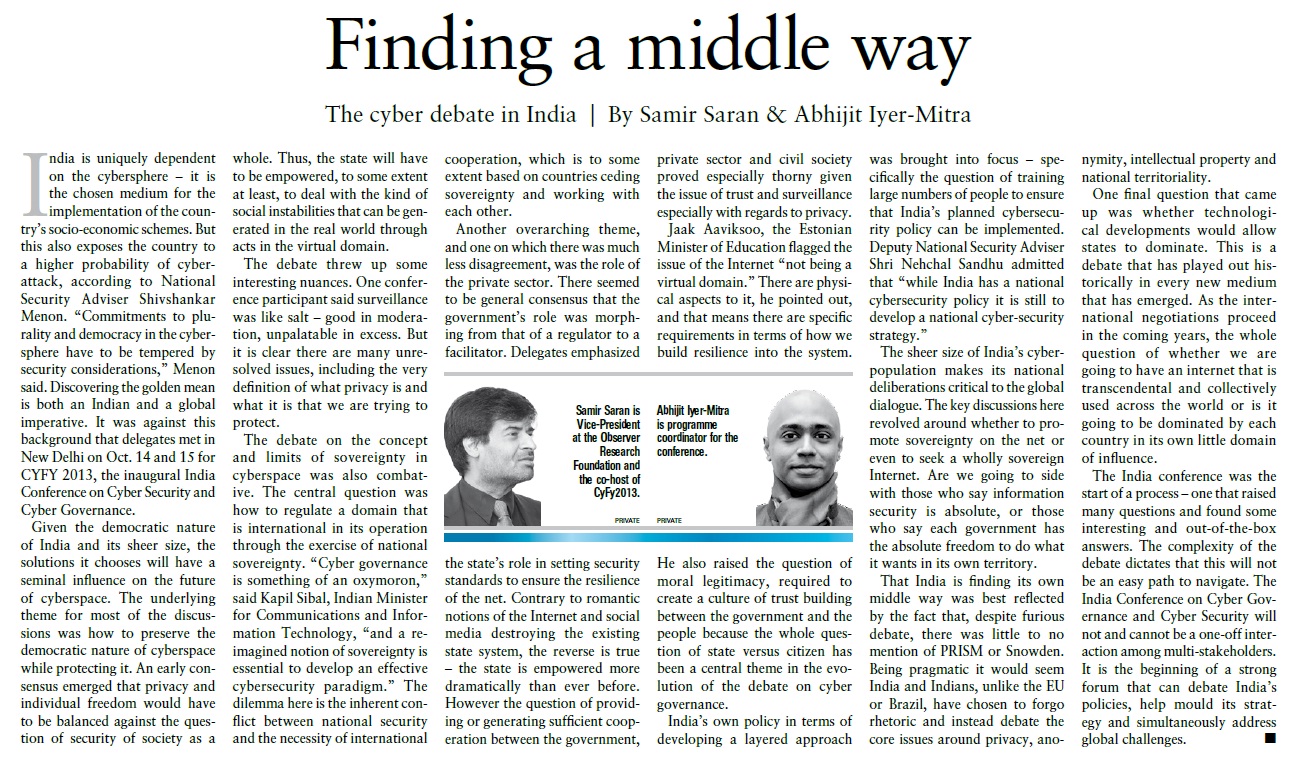
India is uniquely dependent on the cybersphere – it being the chosen medium for the implementation of the country’s socio-economic schemes. But this also exposes the country to a higher probability of cyber- attack, according to National Security Adviser Shivshankar Menon.“Commitments to plurality and democracy in the cybersphere have to be tempered by security considerations,”. Discovering the golden mean is both an Indian and a global imperative. It was against this background that delegates met in New Delhi on Oct. 14 and 15 for CyFy 2013, the inaugural India Conference on Cyber Security and Cyber Governance.

Given the democratic nature of India and its sheer size, the solutions it chooses will have a seminal influence on the future of cyberspace. The underlying theme for most of the discussions was how to preserve the democratic nature of cyberspace while protecting it. An early consensus emerged that privacy and individual freedoms would have to be balanced against the question of security of society as a whole. Thus, the state will have to be empowered to some extent at least, to deal with the kind of social instabilities that can be generated in the real world through acts in the virtual domain.

The debate threw up some interesting nuances. Once conference participant said surveillance was like salt – good in moderation, unpalatable in excess. But it is clear there are many unre-solved issues, including the very definition of what privacy is, and what it is that we are trying to protect.
The debate on the concept and limits of sovereignty in cyberspace was also combative. The central question was how to regulate a domain that is international in its operation through the exercise of national sovereignty.“Cyber governance is something of an oxymoron” said Kapil Sibal, Indian Minister for Communications and Information Technology, “and a re-imagined notion of sovereignty is essential to develop an effective cybersecurity paradigm. The dilemma here is the inherent conflict between national security and the necessity of international cooperation, which is to some extend based on countries ceding sovereignty and working with each other.

Another overarching theme, and one on which there was much less disagreement, was the role of the private sector. There seemed to be general consensus that the government’s role was morphing from that of a regulator to a facilitator. Delegates emphasized the state’s role in setting security standards to ensure the resilience of the net. Contrary to romantic notions of the internet and social media destroying the existing state system, the reverse is true the state is empowered more dramatically than ever before. However the question of providing or generating sufficient cooperation between the government, private sector and civil society proved especially thorny given the issue of trust and surveillance especially with regards to privacy.

Jaak Avaiksoo, the Estonian Minister of Education flagged the issue of the Internet “not being a virtual domain.” There as physical aspects to it, he pointed out, and that means there are specific requirements in terms of how we build resilience into the system. He also raised the question of moral legitimacy required to create a culture of trust building between the government and the people because the whole question of state versus citizen has been a central theme in the evolution of the debate on cyber governance.

India’s own policy in terms of developing a layered approach was brought into focus – specifically the question of training large numbers of people to ensure that India’s planned cybersecurity policy can be implemented. Deputy National Security Adviser Shri Nehchal Sandhu admitted that “while India has a national cybersecurity policy it is still to develop a national cyber-security strategy.”

The sheer size of India’s cyber population makes its national deliberations critical to the global dialogue. They key discussions here revolved around whether to promote sovereignty on the net or even to seek a wholly sovereign internet. Are we doing to side with those who say information security is absolute, or those who say each government has the absolute freedom to do what it wants in its own territory?

That India is finding its own middle way was best reflected by the fact that, despite furious debate, there was little to no mention of PRISM or Snowden. Being pragmatic it would seem India and Indians, unlike the EU or Brazil, have chosen to forgo rhetoric and instead debate the core issues around privacy, anonymity, intellectual property and national territoriality.

One final question that came up was whether technological developments would allow states to dominate. This is a debate that has played out historically in every new medium that has emerged. As the international negotiations proceed in the coming years, the whole question of whether we are going to have an internet that is transcendental and collectively used across the world or is it going to be dominated by each country in its own little domain of influence.

The India conference was the start of a process – one that raised many questions and found some interesting and out-of-the-box answers. The complexity of the debate dictates that this will not be any easy path to navigate. The India Conference on Cyber Governance and Cyber Security will not and cannot be a one-off interaction among multi –stakeholders. It is the beginning of a strong forum that can debate India’s policies, help mould its strategy and simultaneously address global challenges.

Security times

Standard
Columns/Op-Eds, In the News, Politics / Globalisation

A toast to the silly season: Why India’s election process is bringing out the absurd in us all

PUBLISHED:01:16 GMT, 6 November 2013| UPDATED:01:16 GMT, 6 November 2013

Original link is here

It seems that the greatest celebration of India – its democracy and the much-feted elections – also bring out the absurd in us all.

As the five states of Delhi, Madhya Pradesh, Chhattisgarh, Rajasthan and Mizoram go to the polls in the coming weeks, it seems the ‘silly season’ is upon us. We are being saturated with inanities masquerading as “political discourse”.

The problem, however, is that as these samples of ludicrousness tumble out in a disturbingly steady stream, we actually engage with them in earnestness.

article-2487973-1936880A00000578-816_634x394

BJP workers wear masks of the party’s PM candidate Narendra Modi, who is presently spoken of in the manner of a superhero.

Let us therefore first propose a toast to the Indian National Congress and its brilliant and original idea of banning opinion polls on the grounds that these are unfair and influence voters.

Now, in any normal society – leave alone democracy – this would be considered a misguided attempt at humour by a geriatric who has crossed the threshold from dotage to anecdotage. But evidently in India it is taken seriously enough to merit furious (and serious) discussion on talk shows and much scholarly debate on the subject in the online, visual and print media.

Heck! Why stop at opinion polls? The logic that these polls unfairly influence voters can equally be extended to op-eds, reporting, and indeed to the very application of one’s mind. So why not go ahead and ban people from thinking for the next 6 months?

After all, it can be stated with a great deal of medical and sociological certainty that the application of one’s mind creates a capacity within the individual to actually decide his or her fate, as opposed to being a force-fed farm animal that gets shepherded into an abattoir.

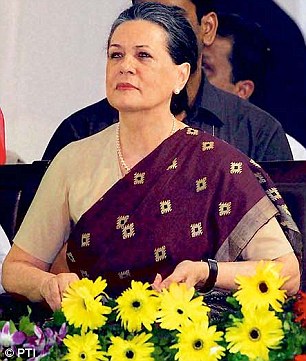
Would Sonia Gandhi’s Congress prefer voters to go to the polls blind-folded, lest their genuine opinions affect the vote?

article-2487973-190B89A400000578-399_306x361

In fact, in order to extend wholehearted support to the Congress’ proposals we should take the logical next step of blindfolding the Indian voter before they press the EVM button – so that the voting process can become a lucky draw – truly free of undue influence and bias.

Of course there is the danger that our hallowed Electoral Commission – the so-called protector of India’s freedom and democracy – might actually embrace this fruit-loop scheme.

So let us raise the second toast to the monumental silliness of the Election Commission of India, now rapidly on its way to becoming a much-loved and celebrated ‘law unto itself’.

In its notification dated the 25th of October – “Instructions with respect to the use of Social Media in Election Campaigning” – the EC has made the terminal mistake of assuming that social media is like every other media that has come before it, claiming “since social media websites are also electronic media by definition…”.

While this betrays a deeply flawed, almost astoundingly naive view of the dynamic and deeply democratic cyber-sphere, at a more serious level this has dangerous overtones of the Sippenhaft laws from Nazi Germany.

What this notification means is that the election code of conduct will now apply to mediums of individual output like Twitter, YouTube and Facebook.

Basically any candidate can lodge a complaint against any individual Tweet or Facebook comment based on the fact that they can be “reasonably connected with the election campaigning of political parties and candidates”.

This is guilt by association of the worst possible kind, because now any sympathiser, relative or associate of any candidate effectively has his or her freedom of expression curtailed on the basis of specious reasoning that this can be traced back or connected with a political party.

So much for the Election Commission being the guarantor of India’s democracy! It is sad that this body, overwhelmed by this deluge of election-season silliness, has become the epitome of silliness itself.

Indeed, if the EC is so serious about this regulatory order, it should assume charge of the Ministry of Communications and Information Technology as well as the Ministry of Information and Broadcasting, to avoid any hint of bias on the part of the two wings of the government.

The third toast in this autumn of silliness is reserved for the BJP, its Prime Ministerial aspirant and their rather “unique” take on Indian history.

I am yet to find where Alexander ever set his eyes on the Ganges, I am yet to find anyone named Chandragupta Maurya belonging to the Gupta Dynasty, and Taxila – as far as my maps show me – is part of Pakistan not Bihar – though presumably in some warped version of ‘Akhand Bharat’, northern Punjab may in fact be annexed to the penurious ruin that is Bihar.

Of course logic would have demanded that the head of a speechwriter roll, or the entire research team be put out to pasture. What we see instead is a bunch of experts finding ways to somehow discover coincidence between history and the recent remarks of the BJP’s PM-in-waiting. But perhaps the victor does script history – and let us toast to that possibility.

Despite what they all say; despite the INC’s moral indignation, the EC’s delusions of infallibility and the BJP’s historical certitude, they all think of us – the Indian people – as livestock, incapable of discerning chaff from wheat and deciding for ourselves.

If India chooses to take these people seriously, we really do need to ban any outlets of independent expression and go back to the happy days of black-and-white Doordarshan with programming restricted to Krishidarshan and Zara Sochiye (as relevant today as they were then), because as it turns out the greatest fools are the people who tolerate – nay celebrate, revel in and vote for – such silliness. It is to them the fourth and last toast should be raised.

I say, this season let us all get sillier still, and put our finger on ‘NOTA’.

Standard
Columns/Op-Eds, In the News

Time to rethink differences between neighbors across Himalayas

Global Times | 2013-10-30 19:53:01

Original link is here

The recently concluded India-China summit meeting may have, at the very least, established a new tone and tenor in the relationship between the two Himalayan neighbors.

The Border Defence Cooperation Agreement, the new communication mechanism on water, the thrust on exchanging experiences and expertise on road and highways, and cooperation on an “Asian knowledge system” through the Nalanda University project are all important and substantial steps to take this partnership forward.

There was some useful progress on economic cooperation as well, although more was expected from the two leaders to facilitate greater two-way trade, business exchanges and Chinese investments in India’s infrastructure projects. And there was disappointment in some quarters when bilateral rigidity ensured lack of movement in liberalizing the visa regime.

But for those who see the India-China relationship as one of the key partnerships of this century, what is most disappointing is the lack of ambition in the agenda for the conversations. The two countries now need to be bold and creative in what they do together.

The two must seek to finalize a civil nuclear cooperation agreement. This gives China a credible financial stake in the Indian civil nuclear sector and the motivation to reject its dogma of “capping and rolling back” India’s nuclear program. This would also potentially facilitate India’s entry into the global nuclear order.

India is concerned about the opacity of China’s interests in the Indian Ocean. The two need to proactively engage instead of producing alarmist literature. Their naval and strategic leaderships need to commence frank discussions on common approaches and discover synergies in protecting the sea lines of communication.

India and China have piggybacked on US capabilities in the past, and may have to soon develop and deploy their own capacities.

Be it in anti-piracy operations or humanitarian evacuation, there is ample scope for coordination and cooperation.

Both nations have large diasporas in Africa and West Asia. In Libya, for example, both countries sent their ships to evacuate their citizens. Such coincidence of interests and needs must be mapped, and actions synchronised.

The two countries need to thrash out a common understanding on cyber governance. China seeks to be a stakeholder in India’s communication sector, for which the level of trust between the two countries needs to be enhanced.

A significant share of the world’s commerce has become dependent on the digital realm. This commerce is the key to prosperity of both countries, and yet much of the discourse on cyber management emanates from, and key infrastructure resides in, the Atlantic countries.

Bilateral cooperation on the ongoing international dialogue on Internet governance and on issues relating to development of related infrastructure and connectivity is essential.

China and India must realize that a strong and stable Afghanistan and Pakistan are in their interest and vital for the stability of the region.

For far too long, India and China have allowed the situation to drift out of strategic or other considerations. A dialogue on aiding the development and growth of these countries must commence between the Asian giants.

China, as a trusted ally of Pakistan, and India, as a friend of the Afghan people, can together help in rebuilding and reintegrating these parts into the Asian economic mainstream.

Both countries also have similar interests and stakes in outer space and ocean governance. They are handicapped by the fact that they are new voices in the normative debates on these subjects.

This is the moment to evolve a common position before entering larger negotiations with an individual weak hand.

The two countries need to come up with tangible alternatives in what is today a one-way norm setting exercise in these new arenas of governance, with the opposition too divided to have any impact.

Ultimately, we may find that our converging interests bind us more closely than we would have imagined or, for some, liked.

Dealing with this will require bold political leadership on both sides and a pragmatic desire to integrate our largely coincident aspirations.

Standard