In the News, Politics / Globalisation

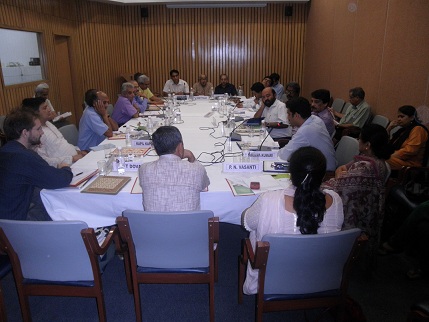
Samir speaks at India Policy Foundation on Think Tanks in India, 2011

August 11, 2011
New Delhi, India
Link to IPF website 
The brainstorming session on ‘Think Tanks in India: Public Policy and Challenges’ organised byIndia Policy Foundation (IPF) and India Centre for Public Policy (ICPP) of Birla Institute of Management Technology (BIMTECH) at India International Centre (IIC), concluded with a note that Think Tank should critically articulate people’s aspiration and should play vital role in Policy discourse.

The primary objective of the session was to  exchange views and ideas among the leaders of Indian Think Tanks and their members. Besides this,  meet was also meant to know the problems and challenges before Indian Think Tank. It received overwhelming response from the capital’s  prominent  Research organisations,scholars and Think Tanks. The discussion was attended by thought leaders and representatives of various academic institutions, media, as well as former bureaucrats, fellows from the international bodies, and the representative of Think Tanks, like Observer Research Foundation(ORF), Institute of Dalit Studies etc.

The session was chaired by Prof. Rakesh Sinha Hon Director IPF and Prof. Shettigar, Chairperson ICPP and the discussion has started with the welcome note of Dr. Chaturvedi Director, BIMTECH. Highlighting the need of a a higher purpose debate on the existence of Think Tanks in India and their roles and influence, Prof. Sinha and Dr. Chaturvedi invited a debate on definition of Indian Think Tanks, evaluating the impact of Think tanks on public policy, defining future trajectory and likely role of these institutions, and identifying challenges faced by the think tanks for attaining growth and excellence.
Following questions were posed before the particiapnats:
1. How to define the contours of Think Tank in India ?
2. How does it differ from its counterparts in the West?
3. What are the challenges before it?
4. What are the basic problems before it?
5. How does and much the source of resources influence policy articulation ?
In his welcome note he expressed his gratitude to all the dignitaries, and specified that there is not as such any platform in India which could bridge the gap between the India’s think tank and the policy makers, therefore BIMTECH in its joint imitative with IPF is working in that direction to create a platform.
Opening the discussion, Prof. Shettigar expressed his concern for the ineffectiveness of think tank in India to contribute to policy level debate however also underlined the challenges and domain knowledge. Some of the experts recognized that absence of financial independence may be a prime cause for their ineffectiveness. Nonetheless over the period there has been an increasing role of think tank in policy making therefore the intellectuals should free from biases and they should give their advice independently.
Discussion was initiated by Chapal Mehra, Global Health Strategies presented his views and identified definition, structural issues, funding and research influence as some of the major issues. The entity is still not much effective as the policy used as a tool for creating popular acceptance of or giving legitimacy to regimes, both at the central and state levels. Policy formation is also highly centralized, dictated by the concerns of political agendas which leaves very less space for Think Tanks in India. Dr. AbuSaleh Shariff, Chief Economist of NCAER raised issues of credibility of the organisations and also the issues of funding and providing the appropriate space to do independent research. Baldevbhai Sharma , Editor of Panchjanya, discussed about the dominance of elite class in think tanks and asked for a real field work by the Think Tanks in India and raise the voice of common man.

particiapnts were of the view that the inputs of Think Tanks have been about the capacity of human resources in the domains, funding on the researches by national and international organisations, influence by other methods of researches or presentations to policy makers, creating credibility which can be disassociated with funding, and the larger issues like absence of a defined mechanism of making the public policy. The critical instances of Nuclear Policy, reservation Policy, Education Policy and associated Economic Policies were offered as examples during the discussion; by Dr Rajendra Mamgain Indian Institute of Dalit Studies, Ms P N Vasanti, CMS; Dr P K Chaube, IIPA; Mr Samir Saran and Mr Nandan Unnikrishnan, ORF; Milind Chakravorty, SHarda University, Avanish Kumar, MDI, Harsh Singh, Writer, Dr Rajiv Nayan, IDSA, Sh Gopal Agarawal , Economic analyst, Milind Oak, social activist and thinker, Dr A K Roy, economist , Dr Karl Grischow, AmericanFoundation and many other dignitaries.

The initiative by IPF and ICPP was appreciated as there has not been such debate in such a diverse group. Prof N N Sharma and Prof Rahul Singh presented the background of the research project on Think Tank and informed two more such brainstorming wouold be organised in Banglore and Patna.

Standard
BRICS, In the News, Politics / Globalisation

In Economic Crisis, Conference Points to New Needs in Global Governance and Redistribution of Wealth

March 15, 2009
Brown University, RI, USA

Link of the video of Samir Saran speaking at the event (video II, 4.09 min onwards)

In the runup to the economic crisis meeting of the Group of 20 nations in April, a major international conference at the Watson Institute last week looked into global governance issues hindering the search for solutions, as well as ways in which a fundamental restructuring of the world system may in fact occur. The event, “Regional Powers, New Developmental States, and Global Governance: BRICSA in the New World Order,” was co-sponsored with the University of Wisconsin Law School. It focused on the role of the newly emergent regional and continental powers of Brazil, Russia, India, China and South Africa in this time of economic crisis, highlighting the risks and opportunities they face.

In addition to global governance reform, themes emerging from the two-day meeting also included a move toward redistribution of wealth – with a new emphasis in such countries as China and India on solving internal inequalities while refocusing on domestic growth. On governance, Nehru University Professor Bhupinder Chimni, a visiting professor at the Institute, said: “The way forward is for countries like India, in alliance with the BRICSA countries, to frame and articulate an alternative discourse on the future of global governance relying on its own experiences – pre-colonial, colonial, and post colonial. It should not simply react to Western proposals.” On the redistribution of wealth, Former Austrian Chancellor and Institute Visiting Professor Alfred Gusenbauer said: “If you want to have a recovery of the world economy, it only can work if there is a redistribution of wealth.”

Short videos below expand capture these two themes. Speakers in the videos include:
• “Conference Report I: Global Governance in an Economic Crisis”: Nehru University Professor Bhupinder Chimni, a visiting professor at the Institute; South African High Court Judge Dennis Martin Davis, a visiting professor at the Institute; and Watson Institute Professors David Kennedy ’75 and Barbara Stallings.
• “Conference Report II: Risks and Solutions in an Economic Crisis”: Universidade de São Paulo Professor Glauco Arbix; Former Austrian Chancellor and Institute Visiting Professor Alfred Gusenbauer; Indiana University Assistant Professor Ho-fung Hung; Observer Research Foundation Vice President Samir Saran; and attorney Leopold Specht, a visiting fellow at the Institute.

A summer institute at Watson on “Law, Social Thought and Global Governance,” organized under the new Brown International Advanced Research Institutes (BIARI) program, will explore these issues further as it convenes scholars from around the world for two weeks in June.

An in-depth report and video of the BRICSA conference will be posted in coming weeks.

Standard
Books / Papers

BRIC – in the new world order: Perspectives from Brazil, China, India and Russia.

by Nandan Unnikrishnan and Samir Saran
Macmillan Publishers India, 2010

Summary
The BRIC countries are today an increasingly cohesive group of nations with a common vision and shared commitment to collaborate and shape a more equitable and prosperous world order. All four nations are leading economies, large markets and emerging knowledge creators; their interactions within the grouping, and with other nations, hold promise for their own people and for other developing countries. The BRIC country coordination at multilateral fora, such as the G-20, is helping to reorient the existing market economy framework, by stressing the need for greater transparency and accountability of the global financial systems. BRIC’s greater role in the IMF and World Bank is likely to ensure more support and assistance for developing nations, as well as keep surveillance of Western financial practices. While the four are yet to evolve a common position on Climate Change and WTO (Russia is still not a member), BRIC countries will certainly be crucial to any agreement on these vital issues. While there are expectations from this grouping on geo-political matters and international disputes, for the moment, these countries have decided to focus on finance, energy, trade, technology and multilateral pluralism.

This edited volume is the outcome of an event hosted by the Observer Research Foundation (ORF) with the support of the Ministry of External Affairs, as a pre-summit discussion to assist in developing the framework for dialogue among BRIC leaders at Yekaterineburg, in June 2009 and consists of interesting thoughts on these subjects by experts from the four countries. ORF, on its part, is the coordinating think-tank and academic efforts among the BRIC countries and has an extensive partner network in China, Russia and Brazil in both government and private channels.

We are richly endowed collectively in terms of natural resources and other factors of production, and are today in a position to sustain our higher growth rates. Combined with our growing middle classes, and the young populations that most of us enjoy, BRIC can hope to be a factor of growth and stability in the world economy for decades to come.

ISBN : 9780230330665,
Rs. 810.00
To purchase the book, please visit Vedamsbook.in

Further material:
Please find here the link to the “New Edition to Parliament Library”, April 2011 (book # 110).
Book review in ‘Security Index: A Russian Journal on International Security’, Volume 17, Issue 3, 2011. “BRICS – Dawn of a new era or business as usual?”

Standard