Uncategorized

Indian leadership on climate change: Punching above its weight

|

Original link is here 

Indian Prime Minister Narendra Modi and others at the highest political level have outlined in recent statements India’s commitment to constructive engagement with the global effort to combat climate change. Taken at face value, these statements indicate that India wants to take a leadership role in addressing climate change. However, in the global discourse on climate change, India often gets singled out for resisting mitigation action and for its reliance on fossil fuels such as coal. In this paper we argue that in addition to the efforts directed toward coping with and adapting to climate impacts (e.g., recent floods in Kashmir and monsoon failure in 2014), India is also “punching above its weight” on mitigation.

India ratified the United Nations Framework Convention on Climate Change (UNFCCC) in November, 1993 and is a Non Annex 1 Party to the Convention. As a Non Annex 1 Party, India is not bound to mandatory commitments under the Convention. This is a central to the notion of “Common but Differentiated Responsibilities and Respective Capabilities” as enshrined in Article 3 of the Convention. [i]

Overall development of any nation is directly linked to its energy use and access: energy poverty is a good indicator of low levels of overall development. The United Nations Development Program’s Human Development Reports have established that energy access and development are interlinked. Energy poverty is defined as a lack of adequate access to “modern energy services.” Modern energy services include the access of households to electricity and clean cooking facilities­—fuels and stoves that do not cause indoor air pollution. The poor in India are spending more than the rich in the developed countries on energy generally and clean energy specifically. Around 306.2 million people in India lack access to electricity (Table 1), perhaps the largest energy access challenge anywhere in the world. At around 705 million, India also has the highest number of people without access to non-solid fuels.[ii]

Table 1: Access to Energy (Electricity and Non Solid Fuels)

ACCESS TO ELECTRICITY (% OF POPULATION) ACCESS TO NON-SOLID FUEL (% OF POPULATION)
COUNTRY Total Rural Urban Total Rural Urban
1990 2000 2010 2010 2010 1990 2000 2010 2010 2010
BRAZIL 92 97 99 94 100 81 89 94 64 > 95
CHINA 94 98 100 98 100 36 47 54 19 70
GERMANY 100 100 100 100 100 > 95 > 95 > 95 > 95 > 95
INDIA 51 62 75 67 93 13 29 42 14 77
JAPAN 100 100 100 100 100 > 95 > 95 > 95 > 95 > 95
U.S.A. 100 100 100 100 100 > 95 > 95 > 95 > 95 > 95

Source: Global Tracking Framework, IEA

Carbon dioxide (CO2) emissions from energy use account for the majority of greenhouse gas emissions. According to the International Energy Agency (IEA), “meeting the emission goals pledged by countries under the United Nations Framework Convention on Climate Change (UNFCCC) would still leave the world 13.7 billion tons of CO2—or 60%—above the level needed to remain on track for just 2ºC warming by 2035.”[iii] There are at least two ways to tackle this problem. The first is to scale up clean energy efforts, whether in the form of fuel switching from coal to gas or installation of renewable energy capacities. The second option is perhaps harder: lowering energy consumption dramatically by altering lifestyles in developed countries.

For India, the viable solution to address the global climate change challenge is clear. Given its low base, India’s demand for energy will increase manifold in the decades ahead (energy consumption will increase by 128 percent by 2035 according to BP[iv]). India will have to scale up efforts on the clean energy front: an enabling global agreement and domestic investment environment are critical for this.

Renewable Energy Framework

Development of renewable energy has been one of the pillars of the Indian Government’s strategy to improve energy access to tackle energy poverty. India’s Integrated Energy Policy, formulated in 2006, lays down a roadmap for harnessing renewable energy sources. [v] The extant policy framework for promoting renewable energy follows from this, with a target of adding 30 gigawatts (GW) by 2017 as per the 12th Five Year Plan. The sector specific developments are:

  1. Solar Energy: The National Solar Mission, being implemented by the Ministry of New and Renewable Energy, increases utilization of solar energy for power generation and direct thermal energy applications. The long-term goal is to generate 20 gigawatts (GW) of grid connected solar power by 2022. The government has recently announced its intentions to increase the target for installed solar capacity to 100 GW.
  2. Wind Energy: Wind energy is the largest source of renewable energy in the country.. According to the meso-scale Wind Atlas (yet to be validated through field measurements), India has a potential of generating around 102 GW of wind power at 80 meters above sea level. Around 22 GW of wind power capacity had been installed by November 2014. Fiscal incentives in the form of a Generation Based Incentives (GBIs) on a per unit generated basis and Accelerated Depreciation (AD) that allow greater tax deductions early on in the project cycle have been reinstated recently. In the latest Union Budget, the Government has specified a 2022 target of 60,000 MW on wind energy capacity.
  3. Biomass: The government has been supporting grid-interactive biomass power and bagasse co- generation in sugar mills in India, with a target of 400 megawatts (MW) between 2012 and 2017. Central financial assistance is provided for this. A 2022 target of 10,000 MW of installed biomass capacity has been announced recently.
  4. Waste to Energy: The Indian government, through the “Swachh Bharat Mission,” under the Ministry of Urban Development, has provided support for up to 20 percent of project costs linked ‘Viability Gap Funding[vi]’ for waste processing technologies.
  5. Small Hydropower: Hydropower units of less than 25 MW are classified as “Small Hydropower” projects by the government. As of December 2014, a total capacity of around 3,946 MW was available from such projects in India. Section 7 of the Electricity Act of 2003 stipulates that “any generating company may establish, operate and maintain a generating station without obtaining a license/permission if it complies with the technical standards relating to connectivity with the grid.”[vii] The government is targeting an installed capacity of 5000 MW by 2022.

At the end of the fiscal year in March 2014, the total cumulative installed capacity for renewable energy in India was around 13 percent of the total electricity share at 31,707 MW. The average per capita electricity consumption in India for the year 2013-14 was 957 kWh[viii]: around seven per cent of the per capita consumption of the United States between 2010 and 2014 (13,246 KWh).[ix]  This is a stark reflection of India’s energy poverty challenge. Despite a very low base of per capita electricity consumption, the scope and ambition of India’s renewable energy initiatives is remarkable.

Assuming a solar energy capacity addition of 100 GW by 2022 as per the government’s plan, India’s per capita renewable energy installed capacity, not accounting for any capacity growth in wind, biomass, and waste to energy, will be around 92.6 watts per person, well over today’s global average of around 80 watts per person.[x] This is a conservative estimate since currently wind power accounts for the largest share of renewable energy, at around 67 percent of total installed capacity, whereas solar accounts for only around 8 percent.

We should also note here that the large hydro (25 MW and above) potential and installed capacity is also significant and is not counted in the renewable energy estimates above. Large hydro potential in the country is around 145,320 MW of which 36,080 MW has been commissioned as of December 2014. [xi] This is more than the entire renewable energy installed capacity in the country. Power from large hydro can also provide base load power to mitigate intermittency challenges of renewable energy.

Per Capita Spend on Renewable Energy

At the Conference of Parties (COP) to the UNFCCC in Paris (COP-21) in 2015, global leaders will decide if an international renewable energy and energy efficiency bond facility will be established.[xii]  Securing financing for mitigation and adaptation efforts is key to any meaningful attempts to address climate change. Promoting renewable energy offers a clear pathway for reducing greenhouse gas emission from the energy sector.

The key constraint to the development of renewable energy has been the historically higher costs associated with it. There are wide divergences in the Levelised Cost of Electricity (LCOE), as defined by the International Renewable Energy Agency (IRENA), depending on location. The cost of generation in non-OECD countries for both wind and solar power tends to be lower than for OECD countries owing to various structural factors such as cheap labor rates that lower project costs. For illustration purposes, the range of LCOE as assessed by IRENA in 2012 has been used.[xiii] In the case of Solar Photovoltaic systems without batteries the estimated LCOE is between 0.25 to 0.65 KWh. For onshore wind energy (projects larger than 5 MW), the costs are between 0.08 and 0.12 KWh.[xiv]

Assuming a weightage of 94 percent wind power and 6 percent solar power generation in India, the costs per KWh of electricity generated through renewable energy is between 0.09 and 0.135 (Table 2). Costs in USA, Germany, China, and Japan have also been estimated and summarized in the Table 2.

Table 2: Cost of Renewable Energy (USD) per KWh, 2012

  INDIA USA GERMANY CHINA JAPAN
Lower End 0.09 0.09 0.11 0.09 0.08
Upper End 0.1356 0.1356 0.185 0.1356 0.224
Weightage in Renewables Mix 94% (W), 6%(S) 94% (W). 6% (S) 75% (W), 25% (S) 94% (W), 6% (S) 60% W, 40% (S)

*Rough estimations (assuming that renewable energy is largely a combination of wind and solar, particularly given the relatively negligible growth in other sources over 2012-2040) following from electricity generation shares specified in the World Energy Outlook 2014, for countries (EU figures used as a proxy for Germany) in 2012

100 GW of installed solar energy capacity by 2022, run at a plant load factor of 13 percent,[xv]will produce around 113,880 GWh or 113,880,000,000 KWh of electricity annually. Under this scenario India would be spending between USD 28.4 billion and USD 74billion on its LCOE for solar power based generation (using solar photovoltaics). The Indian government estimates that the additional overall investments required to facilitate this would be to the tune of USD 100 billion.[xvi] To further put this into perspective, 100 billion USD is around a third of the total budgeted expenditure of India’s Union Government in 2015-16 (INR 17.77 lakh crores). Based on the lower end estimates in Table 2, the LCOE will be over a tenth of the total amount of 100 billion USD that the Green Climate Fund is to make available by 2020.

Given the fiscal challenges, India punches well above its weight in terms of its expenditure on renewable energy (Solar Photovoltaic and Wind Energy). Using verifiable approximations for 2012, the average Indian spent about one and a half times what the average Chinese spent, between 2.2 and 4.3 times what the average Japanese spent, and around 2 times what the average American spent. Indians spent between two thirds and half of what average Germans spent.

Table 3: Per Capita Income Spent on Renewable Energy (in % of Daily Income) in 2012*

INDIA USA GERMANY CHINA JAPAN
Per Capita Renewable Energy Consumed (KWh per day) 0.1080 1.95 4.146 0.3007 0.776
Lower End (% of daily income spent) 0.26 0.12 0.40 0.17 0.06
Upper End (% of daily income spent) 0.44 0.21 0.82 0.29 0.20

*Calculated on the basis of per capita incomes and country populations in 2012 as specified by the World Bank; renewable energy consumption as available in the BP Statistical Review of World Energy 2014 for the category ‘other renewables’ (2012) which is based on gross generation from renewable sources including, wind, geothermal, solar, biomass and waste, and not accounting for cross-border electricity supply and converted on the basis of thermal equivalence assuming 38 per cent conversion efficiency in a modern thermal power station; and the estimates in Table 2

Over the next 7 years until 2022, India has a target of renewable energy capacity of 175 GW and most of this capacity addition is to come from solar and wind energy. [xvii]As India ramps up its solar capacity to 100 GW and wind to 60 GW, which is close to the total wind and solar installed capacity in the EU in 2012,[xviii] the average Indian per capita spending on renewable energy as a percentage of daily income should positively compare with average EU levels.

Energy in the Paris Agreement

The future of global energy and the climate change challenge is contingent on a number of political and economic factors. This last year has been proof that even well-formed trends, such as in the case of the global price of oil, can change drastically. Current estimates suggest that coal, oil, and gas will contribute around 81 percent of primary energy consumption until 2035.[xix]However, these estimates are based on benchmark prices of commodities and current technologies.

Changes in both prices and technologies associated with oil, coal, and gas are essentially unpredictable. However, the cost of renewable energy will certainly continue to decrease consistently in the coming years. The cost competitiveness of renewable energy in the form of onshore wind is already at par with fossil fuel based systems for generating electricity, and the LCOE for solar has halved between 2010 and 2014.[xx]The costs of utility scale solar energy are likely to become competitive with fossil fuels in the future. Indeed this competitiveness narrative of renewable energy remains highly nuanced, and depends on a variety of factors such as existing grid infrastructure and labor costs. For instance, since the penetration of renewable energy in India is high, a substantial grid infrastructure cost will be involved in scaling up electricity generation through renewable energy.

As part of the domestic financing framework, recent measures have helped transition Indian policies from a carbon subsidization regime to a carbon taxation regime.  From October 2014, a de facto carbon tax equivalent of USD 60 per ton of carbon dioxide equivalent in the case of unbranded petrol and around USD 42 per ton in the case of unbranded diesel has been introduced. In addition the clean energy cess[xxi] on coal has been doubled and is now equivalent to a carbon tax of around USD 1 per ton.[xxii]

However the fiscal space to maneuver is limited given that the proportionate per capita spend on renewable energy in India is already much higher than developed and developing countries and does divert resources from necessary social and infrastructure spending.

The main barrier for increasing renewable energy penetration will be a lack of financial and technological flows; India’s achievements in renewable energy have occurred in spite of such flows. For instance, Clean Development Mechanism-linked flows, which could potentially subsidize renewable energy development dried up a few years ago owing to the oversupply of Carbon Emission Reduction certificates which are now trading at near zero levels.[xxiii]Similarly, transfer of cutting edge clean energy technologies has been limited by international trade law and protectionist policies of innovating countries. Capital flows can be unlocked by a new global agreement and robust bilateral cooperation on clean energy could potentially prove to be the most effective medium for government—government technology transfer.

In an important 1991 report on global warming, Anil Agarwal and Sunita Narain made a compelling case that “those who talk about global warming should concentrate on what ought to be done at home.”[xxiv] It seems that the conversation at the UNFCCC has inevitably evolved to reflect this discouraging reality. The centrality of the Intended Nationally Determined Contributions in the draft negotiating text of the Lima Call for Climate Action is indicative of the renewed focus on domestic action.[xxv]

Gauging by the renewable energy thrust alone, India’s response at home has been more than commensurate with its economic weight. It must, at the very least, demand similar levels of per capita renewable energy spending by way of commitments from OECD countries. India is already among the countries leading the clean energy transition and must demand that much of the developed world catch up when the Conference of Parties meets at Paris.


[ii] Common solid fuels used in India include dung cakes and firewood

[vi] Viability Gap Funding is a grant to support infrastructure projects become financially viable

[viii] As per the provisional figures of the Central Electricity Authority: http://164.100.47.132/lssnew/psearch/QResult16.aspx?qref=8212

[x] Population in 2022 = 1.42 billion assuming a 17.64 per cent growth rate as seen in the decade 2001-2011 as per the Census of India

[xii] As per the draft negotiating text for COP 21: http://unfccc.int/resource/docs/2014/cop20/eng/10a01.pdf#page=2

[xiv] Concentrated solar power systems generate solar power by using mirrors or lenses to concentrate a large area of sunlight, or solar thermal energy, onto a small area;

[xvi] Economic Survey of India, 2014-15, Available at: http://indiabudget.nic.in/es2014-15/echapter-vol1.pdf

[xix] BP Energy Outlook

[xxi] A cess is a form of an indirect tax

  • Samir Saran

    Senior Fellow and Vice President, Observer Research Foundation

  • Vivan Sharan

    Consultant, Observer Research Foundation
Standard
Uncategorized

A meeting in Paris

April 9, 2015, The Hindu

Original link is here

SamirSaran_2367561f

If India & France move beyond Rafale deal stalemate, they could achieve a lot in areas of nuclear technology, regional cooperation, climate talks.

There is quite an air of anticipation around the Indian Prime Minister’s visit to France. The government’s foreign policy pace has been enviable, and Narendra Modi has demonstrated a remarkable aptitude in gauging the mood and the space to manoeuvre with various partners. He has revitalised old relationships and lent them his energy. He has also achieved some real strategic gains,such as the one in Seychelles. The visit to France is pregnant with possibilities that are rooted in a historic context and which now need to be leveraged on a broader plane.

France has always been a critical partner to India in high technology areas. Its bid to aid India in the diversification of its defence sector began as early as 1953, when the Dassault-Ouragan fighters were supplied to the India Air Force and played a leading role in the 1961 liberation of Goa. Significantly, when India-U.K. defence relations soured in the 1970s, France emerged as the only western power willing to supply India with state-of-the-art weaponry and support its space programme and nuclear development. The importance of France as a key partner was accentuated in 1998 when, following India’s nuclear tests, France actively thwarted United Nations Security Council sanctions and forced a toning down of the final language even as the Russians dithered. During that period, India’s agreement to launch satellites from French Guinea stayed intact despite the sanctions imposed by other European Union countries across a range of technological sectors, especially space. In 1999, during the Kargil war, the French maintained a supply of spares to the IAF, which allowed it to operate without worrying about expending smart weapon reserves.

France was arguably the first western country to de-hyphenate its relations with Pakistan from those with India, deciding that the artificial “balance of power” equation between the two was passé. Today, France is at the forefront of India’s ambitions of modernising its sub-surface fleet. Scorpène class submarines are being built at Mazagaon docks and Dassault’s Rafale has won the Medium Multi-Role Combat Aircraft (MMRCA) tender. India’s only dedicated military satellite, the GSAT-7, was launched from Ariane 5, from Kourou.

Despite all this, it seems as if the tenor of the Indo-French engagement is being determined only by the progress on the Rafale deal. Much like the U.S. and India relationship, which had to find a way past the Civil Nuclear Agreement that hung heavy like the proverbial albatross, the India-France partnership must move beyond the circular meanderings that the negotiations look like to outsiders. One way or another, we must strive for an early conclusion, as this is not just about one set of aircraft but about investment in a host of current and future possibilities presented by India’s growing economic and geo-strategic strength. The Rafale deal must be placed in a broader framework of association. This framework could include three key elements, among others.

Nuclear cooperation

The first is for France to translate into action its previously expressed acceptance of India’s stance of nuclear exceptionalism and for the two countries to enter into full-spectrum collaboration. Such a partnership should be aimed at reducing the incubation time of Indian nuclear technologies and would cover the full nuclear cycle, including reactors, enrichment and reprocessing. This nuclear cooperation would logically extend into the sphere of military nuclear propulsion. The upcoming French Barracuda class SSN, for example, is optimally suited to the Indian Navy’s needs. If India buying the Rafale is the truest sign of India’s commitment to the relationship, then the nuclear submarine may well be the litmus test of French reciprocity.

But, again, it is important not to get fixated only on the big-ticket items but to use the other opportunities that signature government initiatives like “Skilling” and “Make in India” offer alongside these big deals. The French could, for example, help develop the defence sector eco-system in India, especially in the small and medium segments, investing in skills and capacity building here. This is where the real value addition takes place in the defence business and this could be the differentiator between France and other countries.

The second element must be regional cooperation. Increasingly, the interests of the two countries have intersected and their views tend to be similar even if their positions are not. Much of this is because Indian and French foreign policies share the same fundamental view of strategic autonomy and refuse to cede security primacy to one or two actors. It was because of this that India had, in 2013, co-sponsored a UN resolution that paved the way for French intervention in Mali. This is why it needs to cooperate in the Indian Ocean, West Asia and North Africa. India and France have significant interests here and it is perhaps time to build a robust platform for dialogue that will allow the two nations to cooperate meaningfully.

West Asia and North Africa are in the midst of a turbulent period of dramatic change. India’s chief task is to secure its energy source, the safety of its diaspora, and the stability of its extended neighbourhood. France will continue to play a significant role in the region.

As for the Indian Ocean area, France is a major power here and has demonstrated some degree of interest in cooperating with India. A focussed engagement would also be a natural extension of the collaboration envisaged here between the U.S. and India earlier this year. Co-investing with France in a ‘research’ facility located in Mauritius may serve as the point of convergence for such a regional play. This could form the basis for intensified cooperation on maritime domain awareness, building capacity in Indian Ocean Rim countries, and in honing synergistic strategies to deal with humanitarian assistance and disaster relief.

Accord on climate

Finally, France is set to host the most important of climate conventions at the end of this year, one that will determine the successor to the Kyoto Protocol. This makes for an important area where the two countries can cooperate. The climate agreement can impact energy access and energy options for most countries, including India. The French are familiar with the Indian effort to eliminate poverty and the principal role that low-cost energy could play in meeting this goal.

The Paris climate meet will be an optimal moment for India to stop being defensive about the issue. It must unhesitatingly showcase all that it has already undertaken and achieved in responding to the challenge of climate change. It must clearly signal what it seeks from the outcome to protect its development space. And France, with its agenda-setting capacity and consensus-building role, must strive to ensure a climate deal that is fair and equitable and allows India critical room to manoeuvre.

(Samir Saran is vice-president and senior fellow at the Observer Research Foundation.)


Standard
Uncategorized

An ‘India exception’ for climate talks

By Samir Saran and Bruce Jones, The Hindu, January 23, 2015

Original link is here 

SOLAR POWER: “Narendra Modi’s victory has created the opportunity for India to benefit from the renewable energy-friendly policies he pursued as Chief Minister of Gujarat.” Picture shows him during the inauguration of India’s first 1MW canal-top solar power plant at Chandrasan village, Mehsana district, Gujarat.

SOLAR POWER: “Narendra Modi’s victory has created the opportunity for India to benefit from the renewable energy-friendly policies he pursued as Chief Minister of Gujarat.” Picture shows him during the inauguration of India’s first 1MW canal-top solar power plant at Chandrasan village, Mehsana district, Gujarat.


If the U.S. partners with India for more efficient industrialisation, it could be the kind of investment that cements ties between the two countries

As India and the U.S. build closer ties, they should pursue a win-win agreement on climate. It is in the U.S.’s strategic interest that India grows into a regional power, which can only be accomplished if India is given sufficient development space to grow its economy and eliminate poverty. It is in India’s interest to diversify its energy portfolio — a prospect that can be strengthened with the U.S.’s assistance. The way to achieve these objectives is to forge an “India exception” at the global climate talks in Paris; doing so is the only realistic pathway to a global climate deal and will cement the growing ties between the two critical actors in an evolving international order.

A unique dilemma

India faces a predicament which previous countries that used energy to grow their economies did not face. It stands on the cusp of industrialisation just as the world may finally be willing to take multilateral action to reduce carbon emissions. As it possesses vulnerable coastlines and is reliant on the monsoon and glacial melt, India is as susceptible as any other country to the consequences of collective action failure on climate. But for India, the tradeoffs between environment and growth (and poverty elimination) are harsher than perhaps anywhere else. India’s overall size of both population and emissions makes it the most critical low-income country at the Paris climate talks.

Despite India’s importance to the climate debate, it continues to pollute below its weight. Though India’s emission intensity would be expected to rise in the coming decades, it has committed to reducing emission intensity by 20 to 25 per cent by 2020 (from 2007 levels). Prime Minister Narendra Modi’s victory has created the opportunity for all of India to benefit from the renewable energy-friendly policies he pursued as Chief Minister of Gujarat and has opened up the possibility for it to become a leader in cost-competitive renewables. India is already the world’s largest biomass, third largest solar and fourth largest wind energy producer.

“If India chooses to grow through the traditional carbon-intensive pathway, there will be no credible prospect for global carbon reduction”

There is a strong strategic imperative for the U.S. in supporting India’s role in Asia. A successful India can play a major role in stabilising Asia during an otherwise turbulent transition, and can be a vital partner to the U.S. India could act on climate change on its own by reprioritising spending away from its planned naval expansion or other defence expenditures, but as China’s defence budget soars, nations around the region are becoming more invested in a balance of power that includes India. It is profoundly in the U.S.’s interest that there be a strong India — an India that is prosperous and contributing to a stable Asia and Indian Ocean.

The U.S. could reapportion part of its international development budget towards India’s green modernisation, create a way for U.S. cities that have successfully used clean building techniques to work with Indian cities, and invest in Indian efforts on energy-efficient urbanisation. It can help ensure that the Green Climate Fund and the World Bank support and crowd in private sector and other investments towards this end.

There would have to be a generational partnership between the U.S. and India. Challenges in aligning the private incentives of U.S. financiers with public incentives in India can be solved by a high-level agreement between President Obama and Prime Minister Modi on public monies through bilateral or multilateral tools.

India as an exception

India’s unique circumstances necessitate specific exceptions. Any climate agreement must exclude India from obligations that do not befit a country in an earlier stage of development. It must be allowed lifeline energy at affordable prices. India cannot agree to a peaking date; Indian poverty cannot be frozen by a dateline. A global peaking date will depend on other nations taking on mitigation commitments to account for India’s exceptional challenge. However, certain pathways could be pursued that would allow a U.S.-India partnership to contribute to the global effort. These could include: continuing and supporting India’s voluntary emission intensity reduction goals that move its economy from a ‘business as usual’ trajectory; focussing the spending of the Green Carbon Fund and similar instruments, including technology transfer, on Indian energy options; following common but differentiated responsibility within India, requiring rich states and cities to develop further mitigation methods; initiating a universal agreement on corporate emissions mitigation that would involve large Indian companies on equal footing with developed country corporations and mandating sectoral efficiency goals for these large corporations; and a decadal review of India’s development status, as no exception should outlive its rationale.

Such a deal is the only way to maintain climate progress. If India chooses to grow through the traditional carbon-intensive pathway, there will be no credible prospect for global carbon reduction and India will soon add another European Union to the world’s carbon emissions budget. India has a veto on a global climate agreement — both in the room, and more importantly in how any deal is implemented. India has walked away from global deals like the World Trade Organization, when they are perceived to be counter to its core interests.

If the U.S. partners with India for more efficient industrialisation and supports an “India exception” in global climate talks — using bilateral ties and the Major Economies Forum on Energy and Climate to help build a clean energy ladder for India — it could be the kind of investment that cements ties between these two countries. From the perspective of a stable international order, it would be a big deal; from the perspective of global climate talks, it is the only realistic path forward.

(Samir Saran is a senior fellow and vice president at the Observer Research Foundation and Bruce Jones is deputy director of the Foreign Policy Program at the Brookings Institution. This is an adaptation of an article published by the authors for Brookings and ORF earlier this month.)

Standard
Uncategorized

An ‘India Exception’ and India-U.S. Partnership on Climate Change

|

Original link is here

A Unique Dilemma 

yamuna_river001_16x9

Climate change has become the major global challenge of this young century. For years, the search for solutions has run up against a sharp North-South divide over the historical emissions of developed countries and the parameters of what is termed, in the climate world, “common but differentiated responsibility” for developing nations. A common appreciation of climate and economic equity between disparate countries and regions remains both critical and challenging for the global climate negotiations process if it is to culminate in a major deal in Paris in 2015, and for implementation beyond that date. The authors believe that the only way to remove this roadblock is to forge an “India exception” in global climate talks; doing so is the only realistic pathway to a global climate deal, and could be a key tool in cementing stronger ties between India and the United States, two critical actors in the evolving international order.

The Lima Conference of Parties (COP) in some ways breached the North-South firewall as it sought details of climate action from a larger set of stakeholders, but at another level it reinforced the historic differences between nations on the question of “equity” and “responsibility.” Perhaps more important, the 2014 U.S.-China bilateral agreement on carbon emissions constitutes an important breakthrough in the North-South dynamic—as well as showing that great power agreements on climate change can be forged. In the November 2014 agreement reached between Presidents Xi Jinping and Barack Obama, three important things happened:

  1. China accepted that there was a specific timeline wherein its emissions had to peak.
  2. Both countries accepted that they had greater responsibility than other countries for an effective global climate arrangement, given their outsized contributions to global emissions.
  3. The United States accepted that China has the right to energy-intensive industrialisation, as every major developed nation has had before it.

China is in a very specific place. Its growth over the past two decades means that while it is still treated as a developing country in climate negotiations, its economic position and influence far surpass that of any other developing country; for example, its emissions and gross domestic product (GDP) per capita remain four times that of India, the only other relatively significant developing economy. To get from a U.S.-China deal to a global one, the next challenge is to find the critical path for other major developing states. Of these, India by far remains the largest, although it is at a far earlier stage on its trajectory of industrial development.

In the spectrum of common but differentiated responsibility, India finds itself uniquely situated between nations that industrialized long ago and can now afford expensive renewable energy production and climate adaptation, and those who largely gain their livelihoods from traditional subsistence practices that continue to follow preindustrial low-carbon practices. India is confronted with the dilemma of being between an identity as an emerging power and as one of the least developed countries. It exhibits the economic weight of an emerging power while still containing many hallmarks of a least developed country in its villages and communities.

Furthermore, the sheer size of its population means that India’s choices about development and climate/energy carry global consequences to a degree that is far greater than any other developing country.

After two decades of economic development that have begun to lift sections of its population out of poverty, India cannot and will not let its development wait for the eventuality of commercially deployable and cost-competitive renewable energy. More than 300 million Indians still have little or no access to modern energy sources―India’s dilemma is that several generations of Indians are on the cusp of prosperity if growth is powered by cheaper energy.

The most accessible option is often carbon-polluting coal. In this, India is similar to all previous industrializing nations, from Britain, Germany and the United States in the 19th and 20th centuries to China in the recent past; all powered their industrialization, rural-urban transition and rise in per capita incomes with fossil fuels.

But India faces a predicament all previous countries that used energy to reduce poverty did not. It stands on the verge of industrialization just as the world may finally be willing to take multilateral action to reduce carbon emissions. Possessing vulnerable coastlines and reliant on the monsoon and glacial melt, India is as vulnerable as any to the consequences of collective action failure on climate. But for India, the tradeoffs between environment and growth are harsher than perhaps anywhere else. India’s overall size in both population and emissions accords it unique attention for a low-income country in the global climate debate; yet its relative poverty and low per-capita energy use compared to every other large emitter creates what Indians view as a justified overriding imperative for poverty elimination.

Figure 1: Climate Inequity

Country/bloc GDP per capita (US$, 2013)  Carbon emissions (metric tons per capita, 2010-2013) Carbon Intensity (kg per kg of oil equivalent energy use, 2010-2013) 
European Union  $34,290  7.4  2.2
United States  $53,143  17.6  2.5
China  $6,807  6.2  3.3
India  $1,499  1.7  2.8

Source: World Bank

Polluting Below Its Weight

How can India thread the needle between climate disaster and premature economic stagnation? Though the challenge is great, India will be an important enough partner at the upcoming climate talks to articulate a set of red and green lines—what it can and cannot do. India will find it difficult to accede to any deal that will make its ongoing industrialization the first industrial revolution in history to be nipped in the bud by international restrictions. From the Indian perspective, the Chinese must not be the last ones allowed to become a middle-income nation. Given the uncertain prospect of maintaining a steady double digit growth rate in a post-Lehman Brothers world, Indian poverty cannot be frozen by a dateline. At the same time, India needs action from already-industrialized and wealthier nations—including China, which has leveraged 50 percent of the world’s coal consumption to catapult itself to prosperity—to prevent scientists’ dire predictions on a ‘business as usual’ approach to carbon emissions.[1] This would negatively affect India’s poorest along with its economic growth.

India also has a set of green lines outlining its contributions to the climate change fight. Even though under the logic of industrialization India’s emission intensity would be expected to rise in the coming decades (see Figure 1), in the last decade the United Progressive Alliance government committed to reducing emission intensity by 20 to 25 percent by 2020 (from 2007 levels). As India moves from a service- and agriculture-based economy towards greater reliance on manufacturing, rapid urbanization, more intensive infrastructure development and growth of the transportation sector, meeting this carbon intensity target will be a de facto climate mitigation measure and a mark of India’s commitment to climate action. The recent election of Prime Minister Narendra Modi has created the opportunity for all of India to benefit from the renewable energy-friendly policies he pursued as chief minister of Gujarat and has opened up the possibility that India become a leader in cost-competitive renewable energy. India is already the world’s largest biomass, third-largest solar and fourth-largest wind energy producer. India would be open to reducing its relative dependence on coal if a climate framework created meaningful funding and technology transfer to accelerate such efforts.

Figure 2: India’s Climate Actions

Economy-wide pledges and targets Submitted to UNFCCC: Pledge to reduce emissions intensity by 20 percent to 25 percent by 2020 submitted to the UNFCCC.
Outside UNFCCC: Eight national missions have been introduced under the National Action Plan on Climate Change in 2008 and include mitigation measures focused on promoting solar energy, improving the forest cover of the country and market based mechanisms such as Performance-Achieve-Trade (PAT), which are focused on improving cost effectiveness and energy efficiency in large, energy-intensive industries.
Sectoral/programmatic mitigation actions Submitted to UNFCCC: Agriculture would not be a part of the 20 percent to 25 percent reduction target.
Outside UNFCCC: Sectoral actions include emission reductions and low-carbon strategies across important sectors such as power, energy and construction. Strategies include policy instruments/measures such as coal tax, feed-in tariffs and energy codes for commercial buildings.
Project-level mitigation actions Submitted to UNFCCC: Clean Development Mechanisms (CDMs) that allow developed countries to promote climate mitigation projects in developing countries. India hosts a total of 2,295 CDM projects.

Sources: Fifth IPCC Report; India’s National Adaptation Programmes of Action (NAPA) Profile

India’s growth dichotomy is particularly acute. On the one hand, the price competitiveness of coal makes it the preferred choice given India’s imperative to eliminate poverty and deliver energy to all. Yet at the same time, India’s adoption of renewable energy and low-carbon technology positions it among the global leaders in sustainable growth. Even more significantly, India has a structural frugality to its energy consumption. India’s peaking per-capita emissions are unlikely to ever cross the threshold of five to six tons per capita that still marks the climate action aspirations of developed carbon-intensive economies. In contrast, China is projected to peak at 12 tons per capita.[2]  Even without this continued Chinese emissions growth, India would need four times China’s population—and 10 times that of the United States—to achieve total emissions comparable to either country. Therefore, Indian industrialization, even with its coal component, will be greener than many that have come before.

Given the vagaries of growth, its inescapable linkage to poverty reduction and the compelling need to grow to provide jobs for a youthful demography, India will have difficulty accommodating international demands for a national emissions peaking date. As a pluralistic democracy in the midst of vast anti-poverty and electrification efforts often uncoordinated between states, the Centre and the private sector, a peak date cannot be imposed on a decentralized governance structure by a fiat emanating from a competitively elected and therefore precariously changeable authority of the Centre.

India as an Exception

India’s combination of dilemmas and promise on climate change demonstrates the folly of expecting comparable mitigation from India as from China, or from emerging economies as a vaguely defined category. India is the country that most uniquely combines large size, low starting point and high potential over the next few decades. China has moved on and is likely to be a developed country by 2030. Many other countries embody one or even two of these factors, but none combine all three—thus making India the most important prospect for mass poverty elimination in the coming decades, and the defining challenge and opportunity for sustainable development.

This unique position is borne out in the data. When compared to the other largest emitters—China, the United States and the European Union (EU)—India has vastly lower per-capita GDP and per-capita emissions; even on emission intensity it is closer to the United States than China (see Figure 1). But there are many less developed countries in a similar category; what makes India’s position different? First, the sheer size of population and scale of the poverty eradication challenge. More profoundly, India’s claim to uniqueness comes from the fact that its growth and concomitant industrial revolution is happening now. It is expected to grow more rapidly than any other region of the world in the next few decades to 2040 (see Figure 3). This growth, thus far largely powered by fossil fuels, is the best opportunity to continue the mass upliftment of citizens from poverty that began in China—and an important tool to maintain Asia’s regional security balance. India’s robust economic growth is itself a compelling contribution to the future, and the world must work together to lift one-sixth of its people out of poverty while also maintaining their environment. India may be one of the countries that is most vulnerable to the effects of climate change, but it is also the country most in danger of losing out on mass poverty elimination and great power status because of a forced transition from fossil fuels.

Figure 3: Relative Economic Growth, 2010-2040

Country/region  Project Real GDP Growth Rates (average annual percent change)
India 6.1%
China 5.7%
Africa 4.6%
Non-OECD Europe/Eurasia 4.4%
Other Asia 4.3%
Mexico/Chile 3.7%
Brazil 3.4%
South Korea 3.3%
Other Central/South America 3.2%
Russia 2.8%
United States 2.5%
Middle East 2.2%
Australia/New Zealand 2.2%
Canada 2.2%
OECD Europe 1.8%
Japan 0.6%

Source: US EIA International Energy Outlook 2013 With Projections to 2040, pp. 17-18

In short, there are two conflicting imperatives here. On the one hand, if India chooses to grow through the same carbon-intensive pathway that has characterized every other major country’s growth, there will be no credible prospect for maintaining progress on global carbon reductions. On ‘business as usual’ projections, India would add another EU to the world’s carbon emissions budget within a few decades. On the other hand, denying India the right to grow and confining hundreds of millions to continued poverty is an untenable proposition.

Within any global climate framework, therefore, the authors believe that India should be accorded exceptional status in light of its mass poverty challenge and imminent growth opportunity. Such an exception should be predicated on a rational and pragmatic framework. The first principle must be to support and sustain the poverty elimination efforts of the country, and in this direction, the goal must be that lifeline energy is available to all at affordable prices. This would necessarily imply ensuring development space (and corresponding carbon space) to India and accepting that a peaking date may not be forthcoming anytime soon. The second principle must be for India’s affluent to participate in mitigation efforts globally. And finally, there must be support from countries and communities to equitably share the burden of climate change, based on their current capabilities within and across borders.

Such an exception would have five elements:

  • Continuing and supporting India’s voluntary emission intensity reduction goals that moves its economy from a ‘business as usual’ trajectory;
  • Focusing the spending of the Green Carbon Fund and similar instruments, including technology transfer, on Indian energy options;
  • Following collective but differentiated responsibility within India, requiring rich states and cities to develop innovative mitigation methods, including through “Green Building” Initiatives, improvement in public transport infrastructure and adoption of energy efficiency schemes by the affluent, each of which is already at various stages of implementation at the central and state level;
  • Initiating a universal agreement on corporate emissions mitigation that would involve large Indian companies on equal footing with developed country corporations and mandating sectoral efficiency goals for these large corporations; and
  • A decadal review of India’s development status, as no exception should outlive its rationale.

Any agreement must ensure India’s rich do not hide behind its poor, while also excluding India from Chinese-level obligations that do not befit a country in an earlier stage of its development trajectory. Given India’s place in its, and the world’s, history, a global peaking date will depend on other nations taking on mitigation to account for India’s exceptional challenge.

An economically invigorated India in several decades can be imagined, one that is powered by broad-based prosperity and a changing energy mix, leading global efforts in environmental adaptation and low-cost renewable energy. But such leadership is only affordable if India’s industrial revolution is made possible. India’s experience in the years ahead could be a valuable pathway to share with other developing countries as they start grappling with a similar dilemma.

The Washington Angle

India can carry its own water in global climate negotiations, and it can drive its own industrialization. However, the likelihood of squaring the circle between an effective global climate regime and India’s need to develop will increase if the United States plays an active role in helping to forge these arrangements.

There will be predictable opposition. For those motivated primarily by climate change itself, the idea of granting an exceptional status to the world’s most populous country will seem injurious to the prospects of mitigating the more disastrous climate scenarios. The rebuttal is to simply point to the reality that for all intents and purposes, India has a veto on a global climate agreement—both in the room, and more importantly in how any deal is implemented. India has already shown that it is willing to walk away from global negotiations if these threaten its core economic interests. And when it comes to implementation, there is no prospect of any deal that holds out meaningful and enforceable costs for “cheating”. The only source of pressure for compliance will be information flows about behavior and mutual pressure between the top powers. That will be outweighed, in India’s case, by the imperative of poverty elimination.

Moreover, there is a strong strategic imperative for the United States here, which has to do with India’s role in Asia. An India confronted by internationally-imposed restrictions on growth will face serious internal political and democratic challenges. A successful India, in contrast, can play a critical role in stabilizing Asia during an otherwise turbulent transition, and can be a critical partner to the United States.

With the U.S.-China deal, and its $3 billion pledge to the Green Climate Fund, the United States has begun to stake out what it gave away in the late 1990s—namely a leadership position on global climate issues. It has also adopted a realistic stance, recognizing that when it comes to climate, the most practical thing is to pursue a back-to-basics approach, which combines a focus on natural gas (which emits carbon at roughly half the intensity of oil), efficiency and joint investment in renewables. In diplomatic terms, it has adopted a “concentric circles” approach to making progress. Here, the concentric circles start with the United States and China, where these two largest emitters will lead the way by reducing carbon emissions. The next obvious focus is India. Helping India navigate a pathway to a more efficient industrialization is a win-win in terms of climate, international order and U.S. foreign policy.

The United States could also make a critical difference in terms of financing more efficient technologies. The math is simple and compelling. India has, as noted, 800 million poor people, out of which 300 million have no access to modern energy―and India’s population is set to keep rising.[3]  Politicians in India thus feel that they have no choice but to continue to pursue every source of energy, clean or not. India will simply continue trying to grow, and that inevitably means greater energy use in the near-term. If India succeeds in doing what China did before, and pulls 300 million people out of poverty, it means adding a population the size of Europe to the overall carbon emissions mix. They are certainly justified in doing this—what possible ethical or moral precepts could justify the OECD countries and some others continuing to emit carbon while 800 million Indians languish in poverty? But this approach will crater any credible efforts to stabilize the climate.

India is, of course, fully open to adopting a more energy-efficient form of industrialization and urbanization if the developed countries provide meaningful financing and access to technologies. A rough estimate of what would be needed for India to adopt more efficient energy pathways during its industrialization is investment of between $50 billion and $100 billion over the next 10 years—in natural gas infrastructure, renewables and clean building technologies. Even this sum does not capture the scale of resources necessary when considering what needs to be done at more local levels. As India’s rural poor increasingly move to cities, its cities will require new infrastructure; 70 percent of its buildings of 2050 have yet to be built. If these are built with existing building technologies, massive carbon emissions will be built in. The new buildings can be constructed with green technology, but India by itself does not have the resources—financial or technological—to do so.

Granted, India could reprioritize its spending and cut down drastically on its planned naval expansion or other defense spending, but the United States and the world may not want it to. As long as China increases its defense budget, the United States wants India to do so too. As long as China is investing in its blue-water navy, the United States wants India to do so too. It is profoundly in U.S. interests that there be a strong and growing India, an India that is domestically stable and contributing to a stable Asia and Indian Ocean.

The United States can make a critical difference. It could reapportion part of its international development budget toward India’s effort and push for greater allocations by the World Bank and other international institutions. It could create a way for U.S. cities that have successfully used clean building techniques to work with Indian cities. It could invest in Indian education in urban development that is informed by the latest science. As mentioned before, the United States recently pledged $3 billion for the Green Climate Fund—it could work within that Fund, and within the World Bank, to ensure that a large proportion of that funding goes to India (the most critical case), and use that financing to leverage private sector and city-based contributions.

Of course, there has already been some U.S. investment in renewable technologies in India. The results have been mixed. U.S. investors complain that the returns are inadequate and that Indian policies are not ready for investment at scale. This is in part because of India’s decentralized decision-making and uncertainty about the ways in which a global climate framework will limit specific pathways. For Prime Minister Modi, this represents a significant challenge. However, if backed by a U.S.-India deal, and against the backdrop of a global climate framework that accepts an exception for India, the timing would be ideal to intensify efforts at policy implementation and to launch a new phase of what would have to be understood as a generational partnership between the United States and India on efficient urbanization. There are challenges to aligning private incentives of U.S. financiers with public incentives in India, but if this effort is initiated by high-level agreement between Obama and Modi, and public monies are available either through bilateral or multilateral tools, the path can be discovered.

An obvious place to start is clean building technologies, something that President Obama has pinpointed as a central goal for U.S. efficiency efforts. The United States and India could form the key building blocks of a global goal on clean buildings and efficient urbanization, which would be critical for locking in energy-efficient development for India.

If the United States partners with India in navigating towards more efficient industrialization and supports an “India exception” in global climate talks—not using climate negotiations to pull up the carbon ladder behind it, but using bilateral ties and the Major Economies Forum on Energy and Climate Change to offer to help build a clean energy ladder for India—it could be the kind of investment that cements ties between these two countries. From the perspective of a stable international order, it would be a big deal; from the perspective of global climate talks, it is the only realistic pathway forward.


[1] Fifth IPCC Report.

[2] Global Carbon Project.

[3] According to latest National Sample Survey data, around 800 million Indians subsist on less than $2 a day, and around 300 million lack access to electricity.


About the Authors

Samir Saran is a senior fellow and vice president at the Observer Research Foundation, India. He is currently working on a research project that maps the impact of various Indian identities on its position at international negotiations on climate change.

Bruce Jones is deputy director of the Foreign Policy Program at the Brookings Institution. He recently published the book The Risk Pivot: Great powers, International Security and the Energy Revolution co-authored with David Steven.

Standard
Uncategorized

India’s climate change strategy: Expanding differentiated responsibility

Samir Saran and Will Poff-Webster
07 October 2014

Original link is here 

Link of Global Policy Journal

Introduction

As the world prepares for the upcoming climate change negotiations in Lima in 2014 and Paris in 2015, there is an expectation that the talks be more decisive than previous attempts at consensus from Kyoto to Copenhagen. Yet the assumption that the undeniable science of climate change will by itself compel action on an issue that has thus far proved the mother of all collective action problems ignores the failures of past conferences. For Lima and Paris to succeed in achieving consensus, the issue of equitable response to the climate crisis must be creatively reimagined. Equity has been a challenge for climate consensus since the 1992 Rio Earth Summit first articulated that, “In view of the different contributions to global environmental degradation, States have common but differentiated responsibilities.”1

In meeting this challenge of articulating responsibilities for a climate that all share but only some have impacted substantially, India’s challenge is increasingly the world’s challenge. How can India acknowledge and respond to existing trends—the increasing urgency of confronting climate change, the energy-intensive process of achieving a semblance of development, and widening wealth gaps between rich and poor—while maintaining its focus on bringing its hundreds of millions of citizens out of poverty? In a larger sense, how can the world prevent climate degradation amid existing inequality and the aspiration of billions to rise out of poverty?

Maintaining equity between India and earlier developers

For India, the actualisation of differentiated responsibility remains central to any climate agreement. Developed countries and China have already undergone energy-intensive industrial development (and largely coal-fired electrification) to bring their people out of poverty, consuming much of the world’s carbon budget in the process. From Britain’s use of the steam engine in the early nineteenth century to China’s exponentially increasing coal capacity over the last decade, carbon-polluting energy has been essential to providing jobs for the millions who seek them in each successive industrial revolution.2 India’s coming industrial revolution and necessary shift to manufacturing, with twelve million new workers entering the workforce each year, cannot be avoided lest those millions lose the possibility of a better life.3 India’s economic transition, coming at a time when the world is finally moving toward a collective response to climate change, represents a great challenge to maintaining economic equity between India and previously industrializing powers. After all, the cost of access to prosperity must not be the highest for latecomers to industrialization. In other words, poverty cannot be frozen by a dateline.

India has acted to engage these contrasting priorities, by committing to a 20-25 percent reduction in carbon intensity by 2020—a natural consequence of increasing efficiency in the energy sector, but also a step to ensure the government’s promise that India’s per capita emissions will not go above those of wealthy countries.4 But equity suggests that India resist any effort to tie its energy intensity reduction to China’s, as the two countries have vastly different existing energy consumption and generation footprints. India starts from a lower polluting baseline compared to China and even to developed economies that have shed manufacturing—India’s use of energy per purchasing power parity dollar of economic output is 0.33 kg CO2, compared to China at 0.60 and developed countries like the United States at 0.48.5 The tendency to see China and India in hyphenated terms as large economies with growing emissions ignores the fundamental differences in their current contribution to climate change and to their vastly different economic and development landscapes.

Toward an Indian strategy

The need for global action against climate change has prompted diplomats in the developed world to speak of “win- win” situations—that transitioning to renewable energy will allow economies to reap the benefits of green jobs growth while reducing emissions. At least in India, this rhetoric rings false. Barring as-yet-insufficient technology, stuttering monetary transfer, or commercial funding from the developed world, coal will remain significantly cheaper than all other sources of energy through 2030 and perhaps beyond.6Renewables suffer from high variability in supply and base load restrictions on Indian power grids. Renewable energy development, which would be appealing from a simplistic “first, do no harm” perspective, collapses upon closer scrutiny: how should India assess the harm of more of its citizens remaining in poverty for every increase in marginal energy cost? The ethical aspect has a political dimension as well: India’s parliament will not countenance ratifying the Paris proposal unless it allows maximal focus on poverty alleviation. And even if it does, democracies have other ways to negate bad agreements, federalism being chief among them. While this is a matter for another study in itself, it must be noted that in the Indian context, the country must be viewed as a collection of thirty nations in a union. The Paris proposal must work for Indian states, or it will fail the ultimate test of implementation.

To negotiate action on climate change despite these challenges, India should promote a more fine-tuned form of differentiated responsibility — not just between countries, but within them as well. International debate thus far has been dominated by equity between countries, yet recent globalisation has caused increasing intra-national inequality as global inequality decreases.7 Even proposals for differentiated responsibility within federal systems, whether EU members, Chinese provinces, or American or Indian states, suffer from inadequate consideration of the far greater inequality within each of these smaller entities.8 India should solve this problem by introducing international emissions standards for large corporations. For instance, all corporations valued above $1 billion (or another suitable cut-off) should be subject to internationally binding efficiency standards, regardless of national origin. By decoupling protection of the poor from protection of wealthy corporations that reside within the same borders, India will focus its negotiating power on protecting its most vulnerable citizens, while also addressing large multinational corporations often unconstrained by state power. Allegations that India’s wealthy corporations hide behind its government’s focus on poverty would be allayed, and the world would be able to address climate change with differentiation and therefore equity—targeting those able to pay rather than the global poor. This would also compel the “rich” countries to act against the “carbon gaming” of their transnational corporations.

Market-oriented change

Such a negotiation strategy would enshrine an expanded differentiated responsibility, helping to solve equity concerns. Corporate emissions standards would nonetheless face several practical obstacles—balancing mandatory and transparent compliance with national sovereignty; preventing economic distortions that might inefficiently incentivize corporations to remain below $1 billion valuation or break into subsidiaries; and solving the larger challenge of corporate tax havens that would be ripe for exploitation under any international standards. As these are important issues for global governance to solve regardless, an equitable response to climate change can provide the impetus.

India can supplement this new proposal with more traditional methods of reducing emissions. India is leading the way in developing countries’ efforts on energy efficiency, a key opportunity for the eventual low-carbon transition—and one that remains truly “win-win” because energy saved from low-cost sources further reduces cost. In the latter part of the last decade alone, India’s Bureau of Energy Efficiency (BEE) doubled its energy savings in avoided generation capacity each year.9 New economic instruments like demand-side management hold the potential to reduce energy use by up to 25 percent, and the Bombay Stock Exchange’s GREENEX Index on energy-efficient stocks shows that the private sector is already taking action through market mechanisms to improve its energy efficiency.10 Lima and Paris can capitalize on such early beginnings to turn India’s ideas and experimentation into global systemic change.

Summing up

India’s challenge at the upcoming global climate talks is twofold. First, it is now time to look beyond the India-China hyphenation; it is unhelpful to India’s cause and situation. It is time to walk alone and seek specific exemptions or exceptions for India’s scale and diversity of realities.

Second, India needs to take leadership and identify constructive ways to move forward on climate change mitigation while not sacrificing the imperative of poverty alleviation. By the same token, the world’s challenge is to develop a holistic global framework that can manage the climate change threat in a world of differentiated responsibility.

By introducing intra-national differentiation between wealthy corporations and impoverished populations, Indian negotiators can help move the upcoming talks beyond past failures. These big corporations also account for a large carbon treasury and can be a low hanging fruit for both emissions reduction imperatives and to fashion a new sustainable business paradigm. Through leadership on this and other issues like energy efficiency, India can ensure its commitment both to the development of its citizens and the maintenance of the ecosystem.


1.   “Rio Declaration on Climate and Environment,” The United Nations Conference on Environment and Development,http://www.unep.org/Documents.Multilingual/Default.asp?documentid=78&articleid=1163.

2.   “China Approves Massive New Coal Capacity Despite Pollution Fears,” Reuters, http://uk.reuters.com/article/2014/01/07/china-coal-idUKL3N0K90H720140107.

3.   “Why India Must Revive Its Manufacturing Sector,” The Diplomat, http://thediplomat.com/2014/02/why-india-must-revive-its-

4.   “India Vows 20-25% Carbon Intensity Cuts,” The Times of India, http://timesofindia.indiatimes.com/india/India-vows-20-25- carbon-intensity-cuts/articleshow/5298030.cms; “India to Reduce Carbon Intensity by 24% by 2020,” The Guardian,http://www.theguardian.com/environment/2009/dec/02/india-carbon-intensity-target.

5.   “An Assessment of India’s 2020 Carbon Intensity Target,” Grantham Institute for Climate Change,https://workspace.imperial.ac.uk/climatechange/Public/pdfs/Grantham%20Report/India_2020_Grantham%20Report%20GR4. pdf.

6.   “Energy in India: The Future is Black,” The Economist, http://www.economist.com/node/21543138.

7.   “Global Income Distribution: From the Fall of the Berlin Wall to the Great Recession,” Centre for Economic Policy Research,http://www.voxeu.org/article/global-income-distribution-1988.

8.   “New Players on the World Stage: Chinese Provinces and Indian States,” The Brookings Institute,http://www.brookings.edu/research/essays/2013/new-players-on-the-world-stage.

9.   “Verified Energy Savings with the Activities of Bureau of Energy Efficiency for the year 2009-10,” National Productivity Council,http://220.156.189.23/miscellaneous/documents/energy_saving_achieved/document/Verified%20Savings%20Report%20for%202009-10.doc.

10.   “BSE S&P-Greenex,” Bombay Stock Exchange, http://www.bseindia.com/indices/DispIndex.aspx?iname=GREENX&index_Code=75&page=19D7C1A5 -BE2B-43EC-AD77- CE539070D72F; “Calibrating India’s Climate Change Response,” Courier, http://www.stanleyfoundation.org/articles.cfm?id=797.

(The writers are with Observer Research Foundation, Delhi. This paper was presented at the Council of Councils Sixth Regional Conference, September 28-30, 2014)

Courtesy : Council of Councils Sixth Regional Conference (Conference Papers: Council of Councils Ottawa Regional Conference)http://www.cfr.org/councilofcouncils/events/p33386

Standard
Books / Papers, Water / Climate

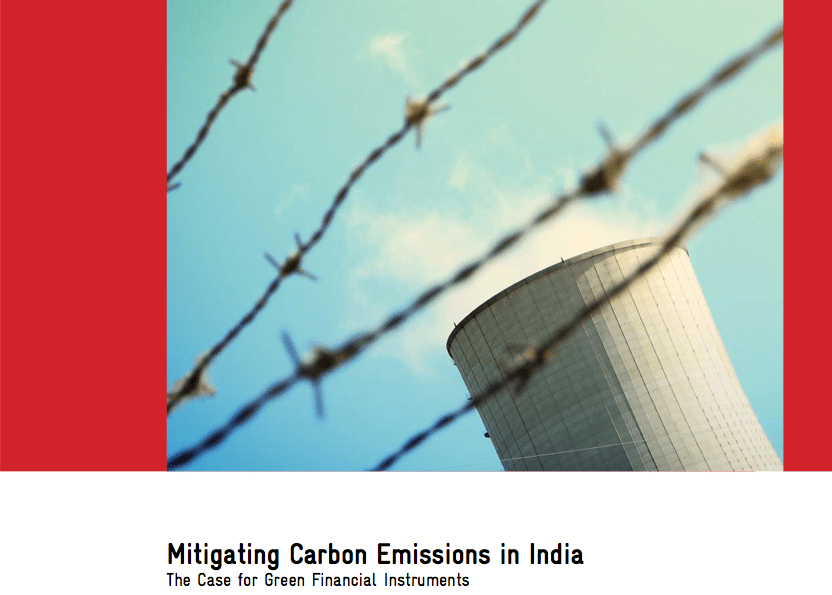
“Mitigating Carbon Emissions in India: The Case for Green Financial Instruments”

New Delhi, 18th of February 2013
Please find here the link to download the report.

Executive Summary
With the sun gradually setting on the Kyoto Protocol (Phase One), it has become quite apparent that the global response to resource scarcity and climate change is going to be variable and disaggregated. Increasingly, countries and businesses across the globe are adopting various financial mechanisms and policies in order to manage such challenges. However, many such responses are restricted to advanced, developed countries, whereas the effects of climate change and the increasing cost of resources such as fossil fuels are likely to be more severe for developing countries. This dichotomy in response measures needs to be urgently addressed, and this report is an attempt to highlight the benefits of an inclusive growth oriented financial response mechanism with particular focus on India.

In its first chapter the report briefly outlines the relevance of GHG emissions mitigation through in- clusive market based mechanisms in India. With shifting patterns of economic growth and increased global demand volatility companies and investors in emerging economies, such as India, need to rec- ognise the value created through the supply chain of business deliverables by mitigating emissions. Mechanisms which exclude companies that do not meet global benchmarks, whether by way of share- holder advocacy and investment exclusion, or regulatory policies, will have a significant impact on the way that these companies choose to grow.

Low carbon strategies can only be implemented if the emissions landscape and its effects on sustainable growth are clearly defined and understood. The second chapter outlines emissions trends in India in order to map the carbon landscape and set the context for the rest of the discourse. Chapter 3 examines the trends of energy consumption and emissions at a sector specific and firm specific level (within the assessed sector). It is found that firms in the assessed sector (cement) are operating in sub optimal con- ditions, along with a lack of policy frameworks and market based emissions reduction incentives – there are no indigenous market based mechanisms to incentivise and stimulate change.
A firm level case study of one of the bigger private players in the Indian cement sector has revealed that the firm’s financial performance could have been better. At the same time, capacity additions and increased output have caused the total emissions of the company to increase, which is not sufficiently offset by the revenue gains. As a result, the firm’s emissions intensity has been rising consistently for clinker production. However, enhanced use of additives has kept the overall GHG intensity of cement based revenue lower. The average emissions intensity of the company was higher for three years than the sector average for the same period. The high correlation between the firm’s environmental perfor- mance and its financial performance has been highlighted.
The results of chapter 3 are aligned with the philosophy that environmental performance must not be excluded from the range of parameters that are used by investors while choosing a stock, especially a long term investment. This is true since the two concepts are inherently interlinked under the overall aegis of sustainable growth. It highlights the need for developing market based mechanisms to signal investment opportunities based upon carbon efficiency and financial performance, as both tend to complement each other in the medium to long term.

Chapter four concludes that; companies preparing for risk are not risk averse, but rather are risk prepared. The difference is subtle but important. Market based mechanisms which incentivise good performance by channelling investments to firms that respond to risk better than their competitors in a given environment, help investors realise this distinction clearly. For “green” market mechanisms and investment vehicles to be viable and effective, they must efficiently ensure that the transmission mecha- nism works and only performance based, credible signals are relayed to the open markets. This becomes even more important in the context of a developing country due to the nascent capital markets, and urgent need for scaling up sustainability initiatives – both at the firm and policy levels.

Capital generation should not be looked at as the problem. Rather, redirecting existing and planned capital flows from traditional high-carbon to low-emission; resilient investment is the key challenge of financing transition to a low-emission economy. In order to facilitate such transitions, a universally replicable model will be used – a multipronged approach to achieve the above objectives. This would involve creation of innovative financial products based on purely quantitative data, create and publish sector wise and cross sectoral market reports, and facilitate progressive policy advocacy in order to en- able market realisation for its products. It will further seek to replicate the model in other developing countries through a hub and spoke approach to expansion.

Standard
BRICS, Columns/Op-Eds

Article in ‘Global Times’: More than just a catchy acronym – six reasons why BRICS matters

by Samir Saran and Vivan Sharan
Please find here the link to the original article. 

There have been heated discussions over the role of BRICS recently. Ian Bremmer, President of the Eurasia Group, a political risk consulting firm, wrote an eye-catching article in the New York Times in late November, proclaiming that BRICS is nothing more than a catchy acronym. 


The BRICS nations represent over 43 percent of the global population that is likely to account for over 50 percent of global consumption by the middle class – those earning between $16 and $50 per day – by 2050. On the other hand, they also collectively account for around half of global poverty calculated at the World Bank’s $1.25 a day poverty line. 

What, then, is the mortar that unites these BRICS? 

First, unlike NATO, BRICS is not posturing as a global security group; unlike ASEAN or MERCOSUR, BRICS is not an archetypal regional trading bloc; and unlike the G7, BRICS is not a conglomerate of Western economies laying bets at the global governance high table. BRICS is, instead, a 21st-century arrangement for the global managers of tomorrow.   

At the end of World War II, the Atlantic countries rallied around ideological constructs in an attempt to create a peaceful global order. Now, with the shifts in economic weights, adherence to ideologies no longer determines interactions among nations. 

BRICS members are aware that they must collaborate on issues of common interest rather than common ideologies in what is now a near “G-0 world,” to borrow Bremmer’s own terminology.

Second, size does not matter and it never has. Interests do and they always will. Intriguingly, Bremmer expresses his concern over China being a dominant member within BRICS. 

Clearly, Bremmer has chosen to ignore the fact that the US accounts for about 70 percent of the total defense expenditure of NATO countries or that it contributes nearly 45 percent of the G7’s collective GDP.

Third, BRICS is a flexible group in which cooperation is based on consensus. Issues of common concern include creating more efficient markets and generating sustained growth; generating employment; facilitating access to resources and services; addressing healthcare concerns and urbanization pressures; and seeking a stable external environment not periodically punctuated with violence arising out of a whim of a country with means.

Fourth, it is useful to remember that the world is still in the middle of a serious recession emanating from the West. As Bremmer himself points out, systemic dependence on Western demand is a critical challenge for BRICS nations. Indeed, it is no surprise that they have begun to create hedges. The proposal to institute a BRICS-led Development Bank, instruments to incentivize trade and investments, as well as mechanisms to integrate financial markets and stock exchanges are a few examples. 

Fifth, through the war on Iraq, some countries undermined the UN framework. The interventions in Libya reaffirmed that sovereignty is neither sacrosanct nor a universal right. While imposing significant economic costs on the world, they failed to produce the desired political outcome. By maintaining the centrality of the UN framework in international relations, BRICS is attempting to pose a counter-narrative.

Sixth, in the post-Washington Consensus era, financial institutions such as the IMF and the World Bank are struggling to articulate a coherent development discourse. BRICS nations are at a stage where they can collectively craft a viable alternative development agenda. 

In the Fourth BRICS Summit in New Delhi in March 2012, there was clear emphasis on sharing development knowledge and further democratizing institutions of global financial governance within the cooperative framework. 

BRICS is a transcontinental grouping that seeks to shape the environment within which the member countries exist. 

While countries across the globe share a number of common interests, the order of priorities differs. Today, BRICS nations find that their order of priorities on a number of external and internal issues which affect their domestic environments is relatively similar. 

BRICS is pursuing an evolving and well thought out agenda based on this premise. And unlike Bremmer, we are not convinced that they are destined to fail.

Samir Saran is vice president and Vivan Sharan an associate fellow at the Observer Research Foundation, New Delhi. opinion@globaltimes.com.cn


Standard
Columns/Op-Eds, Water / Climate

Column in DNA INDIA: “Climate change meets global hypocrisy”

by Samir Saran and Vivan Sharan
Mumbai, 2nd of July 2012
Please find here the link to the original article

And so the saga concludes. A tired, weather-beaten group of States have retreated from Rio de Janeiro after a half-hearted attempt to rescue the world from a host of unsolved problems including climate change and unsustainable development. What unfolded was largely predictable. The Rio+20 declaration, ‘The Future We Want,’ is punctuated with old rhetoric around action and responsibility, laden with sweet murmurings on change, some affectionate recognition of imminent apocalypse and defined by absence of commitment.

The highly contested Kyoto Protocol remains the last substantial effort at the global level on environment. With developed countries lacking resolve to agree and/or act to achieve the set of common goals at the recent Durban Summit, and now, at Rio+20, it is becoming clear that global action is illusory, utopian and certainly less efficient.

It is ironic that at the same time as we dither on committing finance and technology to save the Earth, nations have, with great alacrity and commitment, pumped in trillions of dollars in concert to save wanton banks and financial entities that have failed to meet even basic regulatory and supervisory norms. The US alone has doled out $1.5 trillion to save its financial institutions following the financial crisis created by the same entities, while the developed world collectively put forth around $3 trillion for the same.

In stark contrast, the mightiest leaders of the world gathered at Copenhagen nearly three years ago and pledged, very proudly, a meagre $100 billion a year from 2020 as a collective financial response to climate change. A commitment to provide ‘new and additional’ resources approaching $30 billion for 2010-2012 was also made as part of a ‘fast start’ process. As of now, the fund has still not been capitalised and even the physical location where the fund will be hosted remains uncertain.

The message for Joe the plumber and the aam admi is unambiguous. Saving the banks is a multi-trillion dollar effort requiring action today. Saving the planet will cost only a fraction and can wait for 10 years. So it is hardly surprising when surveys reveal significant decline in interest on matters climate.

And the hypocrisy continues. Most recently, at the G20 Summit at Mexico, BRICS nations, including India, collectively pledged $75 billion through the IMF, to save the failing Eurozone economy from imminent collapse. That developing nations’ policymakers and economists rely on the unsustainable consumption of the western economies for their own obsession with perverse growth makes us willing accomplices. India, Russia, Brazil, South Africa, China are no victims, they just seem eager to sustain the lifestyles of the rich. Lifestyle emissions today account for nearly two thirds of total emissions.

According to the seminal Stern Review on ‘The Economics of Climate Change,’ global atmospheric levels of carbon dioxide equivalent gases must stabilise in the range 450-550 parts per million (ppm) by 2050. Anything higher would ‘substantially increase risks of very harmful impacts.’ Arctic monitoring stations reported this year that the concentration of these gases has already reached 400 ppm and the global average is predicted to reach this level in a few years (2016).

Developed countries currently occupy approximately 80% of the greenhouse gas (carbon) stocks. Developing countries like India need room to grow and per capita energy consumption will have to rise to enable this economic growth and development. Even to rise above the energy poverty level prescribed by the UN, India and Africa will need to increase their energy production by at least three times.

Carbon space will be a natural requirement. This space is now being denied. Hypocrisy becomes malafide now.
The alchemists of capitalism have turned the sparse carbon into ‘carbon real estate,’ available for sale to the highest bidder. The weak and poor have been priced out. And at the G20, we have just offered to subsidise the rich to buy more.
The core issue of equity still eludes all debates and was missing at Rio+20 as well. Mitigation commitments being discussed are just not enough; they are deceitful as they undermine the sovereign rights of other nations. Developed countries will need to vacate their holding of carbon stocks.

One sixth of humanity cannot continue to hold 80% of the total carbon space that is available if western science is to be believed. This is what needs to be negotiated. The time lines and specific action by which these countries have carbon negative footprints must be sought.

It is unfortunate at the very least, if not downright conspiratorial, that countries like China and India have not been able to see through the haze created by the multilateral discourse and identify the real priority: to evict the developed countries who are squatting on carbon real estate that does not belong to them rather than negotiating the partaking of what is left.

Samir Saran is a vice president and Vivan Sharan an associate fellow at the Observer Research Foundation, New Delhi.

Standard
Water / Climate

India Market and Environment Report (IMER)

Please find here the original link to the g-trade-website. 

Volume 1 of the IMER captures the financial performance and energy use efficiency of the top 100 Indian and Global companies for FY 2011. The report also details in brief, the market and environment performance metrics of 9 sectors of the Indian economy – Financial, Automotive, Machinery and Capital Goods, Pharmaceutical and Biotechnology, Textiles, Apparels and Accessories, Steel, Utilities, Cement and Oil and Gas. Volume 1 is the first in a series and a context setting precursor to sector specific corporate carbon performance reports by gTrade, which will aim to build greater ethical and sustainable investment sensibility in India, to steer businesses and investors towards an efficient market based framework which prices carbon risk appropriately.

gTrade is delighted to announce the launch of Volume 1 of the IMER. To purchase a hard copy now, click here

(Discounted rates are available for bulk orders/institutional buyers)

For the detailed Table of Contents, click here

For a snippet from Volume 1 of the IMER, click here

For institutional/bulk buying, email: reports@g-trade.in

Why you should purchase a copy:

  • Cutting edge business specific energy analytics developed at India’s premier research labs
  • Provides information on the carbon offset potential among the largest corporations in India for CDM and other substitution projects.
  • Provides data points and analyses outlining scope for renewable energy generation.
  • Ideal for businesses interested in profiting from increasing efficiency of operations, production or governance
  • A great tool for investors to immediately identify potentially undervalued stocks relative to sustainability performance
  • An instrument of verification of investment decisions for large institutional investors – both foreign and local,
  • A benchmarking and knowledge building tool – for entities involved in the business of carbon – through global carbon schemes such as CDM
  • An unparalleled learning tool for those looking to understand sectoral efficiency performance landscapes in India, for investment, research, capacity building, energy management and policymaking
Standard
BRICS, In the News

Discussion with Open Magazine on BRICS: “Not just a talk shop”

29th of March, 2012
Please find here the link to the original article.

It may be an idiosyncratic club, but should it therefore be written off? As leaders of BRICS—Brazil, Russia, India, China and South Africa—gather in New Delhi for a summit to prove that their five-member group is something ‘solid’ (a word Indian PM Manmohan Singh has used in an Indo-Pak context), rather than just another talk shop, critics across the world have not been able to hide their derision. The interests of these countries are far too divergent, they mutter, to result in anything that could matter.

For exponents of the idea, however, the five represent not just a fifth of global output, but also a dynamic geo-economic bloc on the ascendant. It owes its name to a 2001 Goldman Sachs report that projected a world economy under BRIC domination (South Africa was admitted only in 2010) within half a century. Today, it is a club more than a clever acronym, and one with an agenda too. “[The group] seeks political dialogue towards a more democratic multipolar order,” says senior Indian bureaucrat Sudhir Vyas, adding that the global power shift currently underway calls for “corresponding transformations in global governance”.

The buzzword at the Delhi summit is cooperation. Says Bipul Chatterjee of Consumer Unity & Trust Society: “These leaders are likely to float the idea of a development bank to be capitalised by BRICS, or perhaps all developing nations, to fund the development aspirations of the poor world.” This aim has its origin in Manmohan Singh’s 2010 suggestion that the world’s surplus savings be funnelled into emerging economies short of capital for investment in infrastructure and other public utility projects. Says Samir Saran, a BRICS expert with the Observer Research Foundation: “The proposed bank could tap these savings by creating sovereign guaranteed debt instruments to leverage more money for these economies.”

The other area of mutual interest is trade. As a booster, of help would be an agreement among the five countries’ central banks to grant one another access to loans in local currencies. Saran says the BRICS platform would “offer the five ‘R’s: rupee, rouble, renminbi, rand and real” for trade payments as part of a test settlement mechanism, “before internationalising these currencies”. The goal here is to reduce dependence on the US dollar as an international means of exchange.

Sceptics do not see much coming of it. Yet, it is worth noting that the five have managed to get this far as a club without letting bilateral bickering get in the way. This in itself is commendable. Perhaps BRICS bashers should wait a while before writing it off.

Standard