
From 8 minutes onwards.
Tag Archives: BRICS
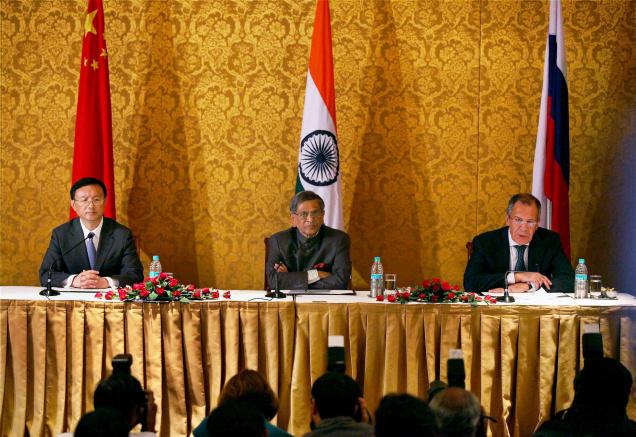
Samir writes in Russia & India Report on ‘Evolving an Asian Trading Region’

September 26, 2011.
by Samir Saran and Nandan Unnikrishnan. Both are Vice President(s) at the Observer Research Foundation, New Delhi.
Find here the original article.
It’s time economics replaced politics as the key driving force of the Russia-China-India (RIC) trilateral. The Big 3 of Asia has a major opportunity to create and drive an Asian Trading Region.
At a recent interaction in Moscow with scholars and editors, there was an interesting discussion on finding ways to significantly increase the economic interaction between Russia and India and, more specifically, change the nature of the G2G-driven bilateral trade. Our suggestion was spontaneous and to some outlandish. We suggested that for a paradigm shift in our trade volumes (less than $ 10 bn dollars currently) the two countries would need to work for an Asian Trading Region shaped and steered by Russia, India and China. Until then we (Russia and India) would remain prisoners of perceptions and perceived geographical distance.
It was apparent that this idea did not resonate well with many experts in the room. However, it did spark an interesting round of debate and many have subsequently written in with their own ideas on a trading zone or region in Asia. We still argue that the only sensible architecture would need to be fundamentally driven by and emerge out of the RIC arrangement. Even though the RIC was conceptualized as a club of the Big 3 in Asia and had more political overtones than economic reality, the vocabulary of cooperation emanating from previous RIC forum allows enough leeway to work towards the formation of an Asian Economic Zone beginning with an Asian Trading Region largely driven by Russia, India and China.
The then Russian Prime Minister Evgeny Primakov first voiced the idea of a Russia-India-China (RIC) Trilateral Forum publicly in December 1998 during a trip to India.The motivation was generally believed to be a desire to create a countervailing influence to the US, which at the time had unprecedented dominance in the international system. The fact that Russia, India and China saw the US as their primary interlocutor at the bilateral level did not appear to be an impediment at the time. However, despite regular Track II interactions between the three countries, it took four years for the first official interaction between the three – a meeting between Foreign Ministers on the sidelines of the United Nations General Assembly (UNGA) in 2002. The first RIC standalone meeting of the foreign ministers took place only in June 2005. Thereafter, on the sidelines of the G8 meeting in St Petersburg in July 2006, President Valadimir Putin, President Hu Jintao and Prime Minister Manmohan Singh had a tripartite meeting. From 2007 onwards, the foreign ministers are conducting regular annual meetings.
During this period, the motivations driving the three countries in the RIC underwent a change. If Primakov’s fear in 1998 was a hegemonic U.S., by 2005 Russia was more concerned about China and its possible duopoly with the U.S. – the G2 scenario. Therefore, Russia was keen to support multilateral initiatives, which involved China, but kept the US out. RIC fitted the bill perfectly. China also appeared to be keen on such a formation as it realized its increasing influence and envisioned RIC as a group dominated by China. India’s motivation perhaps was not to upset the Russians. It was also the age of clublateralism and therefore the RIC was an opportunity to get into an influential circle. Some hesitation, if any, was probably because these were the heady days of Indo-U.S. friendship.
Today the situation has changed again. The uni-polar moment of the U.S.A. is evidently over. A multi-polar or polycentric world is emerging. China has emerged as an alternate power centre and no longer requires props like the RIC. It is following an assertive foreign policy that relies more on promoting bilateral relations with the established and emerging powers. Similarly, Russia is now less nervous about the emergence of a G-2. It is enjoying the “reset” in its relations with the US and has become a little more wary about China’s spectacular rise in stature. Moscow, like New Delhi, also realises that its efforts to restructure and modernise its economy will succeed only if it able to convince the West to buy into this effort. While China-India trade is at historic highs (at over $ 60 billion), India is also focusing on developing its ties with the US and the 27-nation European Union. RIC appears stymied by the proliferation of groupings like the SCO, BRIC, and BASIC and does not as yet offer a unique ‘agenda’ to differentiate it. And most importantly, the three countries consider the US much more important than any other bilateral or multilateral relationship. Therefore, the “glue” that held the RIC together is drying up.
This inevitably affects prospects for RIC. The lack of interest and expectation from this format has led to little of any substance emerging from the interactions, despite identifying early on a vast arena for mutual cooperation such as terrorism, drug trafficking, climate change, agriculture, disaster management and relief, health and medicine, information technologies, pharmaceuticals, infrastructure and energy. Given this backdrop, is RIC now irrelevant? Is it time to bury this body? The answer has to be an unequivocal “NO”. So can regional trade and economics be that ‘glue’. Russia and India, through their own recent policy announcements, have recognized the arrival of the yuan as a global currency and it is likely that in the coming months India also decided to denominate some of its reserves in the currency of our Northern neighbour. Russia is already engaged in yuan based trade and maintains a stock of this currency. That over $ 130 billion of trade takes place between India and China, China and Russia and Russia in India also places weight of volume behind the grouping. Irrespective of political ambitions and differences there is no denying the growth of economic interactions and the only limit to the economic story is politics. Can RIC be the political response to an economic arrangement?
RIC appears to be the only format which can help to create a truly Asian Trading Region, an idea that must be pursued based on the remarkable shift of global trade to within the region. The contiguous land mass, the size of the three economies and the growing levels of consumption, each provide a basis to make this trading region viable and worth investing in. The energy and transport corridors may be the place to start. While China’s rapid advances in the energy landscape in Asia can appear intimidating, it can also be seen as an opportunity to respond to the Chinese dynamism and be a part of the project. Would India consider providing access to the Indian Ocean to China? And through China for Russia? Would this create a dependency that could serve India’s interests? Would it be beneficial to open land and pipeline routes to Central Asia and Russia through China? Would these not create mutual dependencies between the two countries that would offset some of the key imbalances that exist today? India helps de-risk China its current hydrocarbon and trade flows through the Indian Ocean, while China offers alternatives to routes that would require India to traverse Afghanistan and Pakistan. At the opportune time can Russia and China be a part of the IPI and TAPI? Can China extend pipelines from Central Asia and Russia to India? With increased volumes of trade, the pipelines become viable in spite of the distance. The participation of all the three countries in these pan-continent pipelines also reduces the political risk that these large trans-national project invariably face.
The biggest gainer would, however, be Russia. They would have a market for their resources outside of the EU and China. As the demand in West Asia is released in the next 10 years due to growing commercialization of green technologies and production of shale and frontier gas in US and East Europe, Russia would increasingly depend on the growing demand from China and India. Without a cooperative arrangement or transport infrastructure, large volumes of Russian resources may have only one buyer – China.
Russia and China have already established significant cooperation in the area of energy. It is time that India becomes part of this equation and the three countries start the process of developing an Asian Gas Grid. The first steps could be modest. Russia could ship some of its piped gas landing in China through the Chinese eastern board to India, a step both symbolic and political and a harbinger of Asian tri-lateral trade. Over the years it could result in the grid that a former Indian petroleum minister strongly advocated and a gas market in the region that could evolve its own price and commercial dynamics. The next stage could involve jointly owned SEZs in Russia’s Far East with each of the countries within the SEZ enjoying privileges of home country. This could also be the experiment to test the free movement of men, material and ideas across Asia.
Summary of BRICS Think Tanks Symposium, March 2011
March 2011
Link to original website
Scholars and experts from BRICS (Brazil, Russia, India, China and South Africa) countries have said that the current crisis in the Middle East and North Africa (MENA) regions should be resolved expeditiously in the interest of regional stability and in conformity with the aspirations of the peoples of MENA and said that the current crisis demonstrated that the global governance system needed to be more responsive.
This formed part of a recommendation document prepared for the Third Leaders Summit to be held at Sanya, China in April this year. At a meeting of 60 scholars of think tanks from the five BRICS countries, held in Beijing on March 24 and 25, 2011. A seven-member delegation of Indian experts, led by Observer Research Foundation, took part in the meeting of the BRICS Think Tank Symposium, hosted by the China Centre for Contemporary World Studies (CCCWS) and the China Foundation for Peace and Development (CFPD). It comprised of former Indian ambassadors Mr. HHS Viswanathan (Distinguished Fellow, ORF) and Mr. T.C.A. Rangachary, Mr. Samir Saran, Vice President and Senior Fellow, ORF, Dr. Ravni Thakur Banan, Associate Professor, Delhi University, Dr. Saroj Kumar Mohanty, Professor and Senior Fellow, Research and Information Systems for Developing Countries, Dr. Jyotirmoy Bhattacharya, Fellow, Indian council for Research on International Economic Relations and Sriparna Pathak, Junior Fellow, ORF.
In the recommendations proposed for the consideration of the Third BRICS Leaders Meeting to be held in April in China, the scholars said that the leaders should give attention to the changing international context, sluggish economic recovery, governance issues, reform of the international economic and financial architecture, Sustainable Development and Climate Change.
In the opening speech, Mr. Sun Jiazheng, Vice Chairman of the National Committee of the Chinese People’s Political Consultative Conference and President of CFPD, made three suggestions regarding cooperation among BRICS: (1) Undertaking intensive studies, and recommendations on issues that concern BRICS. (2) Focusing on major areas of international finance, international order, world peace and stability (3) Strengthening exchanges between think tanks of BRICS.
At the opening session, delegates from the five countries spoke on the need for reforming the global financial institutions, democratising global governance system, avoiding unilateralism, increasing discussions within the grouping on issues of wages, poverty, energy, health and education, defining a BRICS identity and mission and widening the BRICS’ agenda.
The first session discussed “Challenges and Opportunities- Environment and Background for the Development of BRICS Countries”. The presentations focused on the opportunities and challenges for BRICS post the financial crisis and the way ahead on issues of development and global governance Delegates from BRICS countries also spoke on issues of technological innovations, moving away from reliance on OECD countries, and greater engagement with other developing countries to enable sustainable growth.
On the topic of ‘Changes and Responsibilities: Agenda and Items for BRICS Countries in Advancing Global Economic Governance’, participants elaborated the need to realise inclusive growth and emphasised on stability, peace, shared prosperity, and development, South- South cooperation, open markets and mutual trade and investment among BRICS.
The theme of the third session was ‘Unity and Cooperation- Practical Cooperation and Institutional Building of BRICS Countries’. This panel discussed how BRICS can be a bridge for North- South cooperation, and the need within the BRICS grouping to resolve differences and seek common goals. Presenters also spoke on strengthening trade among BRICS, strengthening framework for polycentric world, promoting cooperation and engaging private sector actors in agriculture and other sectors among BRICS.
‘Exchanges and Mutual Trust- Cooperation Among Think Tanks of BRICS Countries’ was the final theme of the symposium. The discussions delved into ways to deepen BRICS interactions and the need to convene international seminars on areas of bilateral and multilateral areas interests. There was a strong emphasis on the need to establish a BRICS institutional framework at the governmental and non governmental level and to create working groups on select projects. It was also agreed to create a BRICS Think Tanks website for scholars to contribute to.
The interactions were free and friendly and there were no contentious issues. It was obvious that the delegates were trying to find the relevance, mandate and evolution of the Group.
One high level political interaction was organised for the delegates to meet Mr. Dai Bingguo, a State Councillor, where he praised the work of the delegates in coming up with new ideas. He also cautioned that the leaders may not have the same ideas. He spoke of “broadening” the Organisation, a concept not liked by the Russians.
Some divergences on issues like trade and currencies notwithstanding, there was a general feeling that BRICS is here to stay and contribute to a change in global governance. How this will be achieved is the question to which nobody seemed to have a clear answer. There were references to the need for an alternative model of development in which BRICS countries do not repeat the same mistakes committed by the developed world. There were also statements that BRICS should act as a bridge between the developing and the developed countries. But would the other developing countries (particularly potential aspirants to the Group like Indonesia, Turkey and Mexico) like BRICS to play this role?
One theme that came up constantly was the lack of intra-BRICS cooperation in comparison to the potential that exists. For example, BRICS contributes to about 20% of global GDP. Further, 60% of the global Foreign Exchange Reserves today are held by BRICS. But these are parked mainly in Western countries when BRICS themselves desperately need capital for development.
Apart from some general references to the need for reforms of global financial institutions and replacement of dollar by SDR as the global currency, no in-depth discussions took place on these issues. However, the increase in the voting shares of China, Brazil and India was referred to as a beginning of a change in the mind-set of the developed world. One theme that was very evident was the need to coordinate BRICS positions in G-20 so as to have a greater voice.
China.org.cn reports on BRICS Think Tank meeting, 2011
April 15, 2011
Xinhua, China
Link to original website
Representatives from think tanks of the BRIC countries (Brazil, Russia, India and China) discussed ways to fight climate change at a seminar here Wednesday. The seminar, called BRIC Think-Tank Summit, gathered members of think tanks from the BRIC countries to examine the global economic situation and the role of BRIC countries in the post-crisis global transformation.
World countries need to take joint action to fight climate change, said Indian representative Samir Saran from the Observer Research Foundation. Chinese representative Wu Enyuan, with the Institute of Russian, Eastern European and Central Asian Studies, Chinese Academy of Social Sciences, said the developed countries had a bigger responsibility on carbon emission reduction as the current climate change is a result of some 150 years of industrialization process of the developed nations.
But he said the developing countries, including the BRIC nations, should take their fair share of responsibility as well, and adopt measures to fight global warming. “China has fulfilled its responsibility by taking practical actions in either energy conservation or environmental protection,” he said, adding that other BRIC countries have also committed themselves to carbon emission reduction.
Brazil’s representative Eduardo Viola said that implementing these measures is more important than holding discussions. Russian representative Nikolai Mikhailov said climate change unveiled the notion that human beings can treat nature as they want without caring about the consequences. Only a radical change in their attitude could make a difference, he said.
The two-day seminar was held on the eve of the second BRIC summit scheduled for Friday in the Brazilian capital.
Chinese Crienglish.com reports on BRICS Think Tank meeting, 2011
March 26, 2o11
Link to original website
BRICS think-tanks call for closer economic ties
Think-tanks from five major developing economies are now calling for closer economic ties among the BRICS countries, just ahead of the group’s summit in Hainan, China next month. BRICS countries include China, Brazil, India, Russia and South Africa.
International relations expert Jin Canrong from China’s Renming University says, despite booming economies, the five countries still do not have enough say in global economic dialogues.
“The top agenda of the next summit is still the economy, and especially the top ten topics talked about at this year’s G20 summit in France. For instance, the fluctuating raw material prices, and the possibility of giving an index for economic imbalance – those are all important.” Samir Saran, senior researcher with India’s Observer Foundation, says the BRICS countries could find more shared interests economy-wise. “For the BRICS countries, there is still enough room to enhance their cooperation in energy, electricity, food security, agriculture and technology. Also, the five countries could learn from each other regarding eliminating poverty, improving healthcare and education.”
Institute for Applied Economic Research, Brazil reports on BRIC Summit of Think Tanks
April 14-15, 2010
Link to original website
Link to IPEA
Consumption dream based on the American way is unsustainable
Participants in the BRIC Summit of Think Tanks demand radical change in the productive sector and new global governance
The researchers who participated in the BRIC Summit of Think Tanks agreed unanimously that the citizens of their countries have consumption dreams based on the American way of life. For many, this is a dream that the planet will not stand. The debates led to the conclusion that the way out entails new global governance and a radical change in the productive sector, with lower production of private automotive vehicles and more investments in public transportation. Who will volunteer to try to lead a new world order?
The Indian researcher Samir Saran, from the Observer Research Foundation, noted that U.S. president Barack Obama has demonstrated political will to lead the transition to clean energy in the world. He quoted part of a speech delivered by the U.S. president: “We know that the leaders in the new energy matrix may lead the 21st century economy”.
According to Chinese researcher Zhang Yuyan, from the Institute of World Economics & Politics, Chinese Academy of Social Sciences, BRIC nations must unite to take the lead and “avoid that tariffs on carbon emissions be used as protectionist measures by developed countries”. The researcher believes that relations between the BRIC countries and other emerging nations should safeguard the right to quality of life to all citizens.
Sri Lanka’s TOPS.lk covers BRIC discussion on climate change
April 16, 2010
Link to website 
BRAZIL: Representatives from think tanks of the BRIC countries(Brazil, Russia, India and China) discussed ways to fight climate change at a seminar here Wednesday. The seminar, called BRIC Think-Tank Summit, gathered members of think tanks from the BRIC countries to examine the global economic situation and the role of BRIC countries in the post-crisis global transformation.
World countries need to take joint action to fight climate change, said Indian representative Samir Saran from the Observer Research Foundation. Chinese representative Wu Enyuan, with the Institute of Russian, Eastern European and Central Asian Studies, Chinese Academy of Social Sciences, said the developed countries had a bigger responsibility on carbon emission reduction as the current climate change is a result of some 150 years of industrialization process of the developed nations.
But he said the developing countries, including the BRIC nations, should take their fair share of responsibility as well, and adopt measures to fight global warming. “China has fulfilled its responsibility by taking practical actions in either energy conservation or environmental protection,” he said, adding that other BRIC countries have also committed themselves to carbon emission reduction. Brazil’s representative Eduardo Viola said that implementing these measures is more important than holding discussions.
Russian representative Nikolai Mikhailov said climate change unveiled the notion that human beings can treat nature as they want without caring about the consequences.Only a radical change in their attitude could make a difference, he said.
The two-day seminar was held on the eve of the second BRIC summit scheduled for Friday in the Brazilian capital.
Philippine News cover BRIC countries’ think-tanks discussion on climate change
April 15, 2010
Brasilia, Brazil
Link to original website
Representatives from think tanks of the BRIC countries (Brazil, Russia, India and China) discussed ways to fight climate change at a seminar here Wednesday. The seminar, called BRIC Think-Tank Summit, gathered members of think tanks from the BRIC countries to examine the global economic situation and the role of BRIC countries in the post-crisis global transformation
World countries need to take joint action to fight climate change, said Indian representative Samir Saran from the Observer Research Foundation. Chinese representative Wu Enyuan, with the Institute of Russian, Eastern European and Central Asian Studies, Chinese Academy of Social Sciences, said the developed countries had a bigger responsibility on carbon emission reduction as the current climate change is a result of some 150 years of industrialization process of the developed nations. But he said the developing countries, including the BRIC nations, should take their fair share of responsibility as well, and adopt measures to fight global warming.
“China has fulfilled its responsibility by taking practical actions in either energy conservation or environmental protection,” he said, adding that other BRIC countries have also committed themselves to carbon emission reduction. Brazil’s representative Eduardo Viola said that implementing these measures is more important than holding discussions. Russian representative Nikolai Mikhailov said climate change unveiled the notion that human beings can treat nature as they want without caring about the consequences. Only a radical change in their attitude could make a difference, he said.
The two-day seminar was held on the eve of the second BRIC summit scheduled for Friday in the Brazilian capital.
Daily News covers BRIC meeting in Brasilia on climate change, 2010
April 16, 2010
Link to original website 
BRAZIL: Representatives from think tanks of the BRIC countries (Brazil, Russia, India and China) discussed ways to fight climate change at a seminar here Wednesday. The seminar, called BRIC Think-Tank Summit, gathered members of think tanks from the BRIC countries to examine the global economic situation and the role of BRIC countries in the post-crisis global transformation.
World countries need to take joint action to fight climate change, said Indian representative Samir Saran from the Observer Research Foundation. Chinese representative Wu Enyuan, with the Institute of Russian, Eastern European and Central Asian Studies, Chinese Academy of Social Sciences, said the developed countries had a bigger responsibility on carbon emission reduction as the current climate change is a result of some 150 years of industrialization process of the developed nations.
But he said the developing countries, including the BRIC nations, should take their fair share of responsibility as well, and adopt measures to fight global warming. “China has fulfilled its responsibility by taking practical actions in either energy conservation or environmental protection,” he said, adding that other BRIC countries have also committed themselves to carbon emission reduction. Brazil’s representative Eduardo Viola said that implementing these measures is more important than holding discussions.
Russian representative Nikolai Mikhailov said climate change unveiled the notion that human beings can treat nature as they want without caring about the consequences. Only a radical change in their attitude could make a difference, he said.
The two-day seminar was held on the eve of the second BRIC summit scheduled for Friday in the Brazilian capital.
Book Launch / Conference: Joining The New World Order: Perspectives From The BRICs – Lessons For South Africa – Details
March 1, 2011
Link to SAIIA-website 
Samir speaks at the roundtable on JOINING THE NEW WORLD ORDER: PERSPECTIVES FROM THE BRICs – LESSONS FOR SOUTH AFRICA and a book launch of “BRIC in the New World Order: Perspectives from Brazil, China, India and Russia” by Nandan Unnikrishnan and Samir Saran, organized by South African Institute of International Affairs (SAIIA) in Pretoria.
Program:
9:30-10:15 Welcome and opening
Ms Elizabeth Sidiropoulos, National Director, SAIIA
Keynote Address
BRIC and IBSA: Convergence and Divergence
His Excellency Mr V Gupta, High Commissioner of India to South Africa (tbc)
10:15-11:30 Session One: The South African Perspective – Preparing for the BRICS
Key questions for the discussion: What does SA hope to bring to BRIC? What does SA want to get out of BRIC? What do SA businesses want to get out of it? How are they preparing for BRIC membership? What are the implications for South Africa’s role in Africa?
Iaan Basson, Chief Director Asia, Department of International Relations and Cooperation
Simon Freemantle, Analyst, Standard Bank
Amb Dr Kaire Mbuende, SAIIA Distinguished African Fellow
Discussion
11:30-11:45 Break
11:45-13:00 Session Two: The Indian, Brazilian, Russian and Chinese perspectives
Key questions for the discussion: What value do India, Brazil, Russia and Brazil see in their BRIC involvement thus far? What are the current debates around BRICS in these member countries? How do various stakeholders in India (and Brazil) see the future of IBSA vs BRICS? How are their business communities taking advantage of BRIC membership?
Samir Saran, Vice President, Observer Research Foundation, India
Amb HHS Viswanathan, Distinguished Fellow, Observer Research Foundation
Srinath Sridharan, Senior Vice President & Head Strategic Alliances, Wadhahan Holdings
Discussion
13:00 Concluding remarks and lunch
SAIIA’s Emerging Powers and Africa Programme is funded by the Swedish International Development Cooperation Agency (SIDA) and the Danish International Development Agency (DANIDA)
 Samir Saran