Content Modernisation, Cyber and Technology, Free Speech, Freedom and Expression, India, media and internet, tech and media

Social media platforms can’t be a law unto themselves

Social Media Platforms, Communities, safety, societies, debates, politics, US Election, monitoring, safety, sovereign, boards, superfluous

The US elections are witnessing heated, contested, loud and aggressive debates, with media (new and old) donning visibly partisan robes. One such media report has sought to pull India and Indians into the middle of the Trump Vs Biden campaign battle.

First, there is a simple fact that often eludes social media platforms like Twitter and Facebook as well as the easily outraged proponents of the newly-minted ‘cancel culture’. Social media platforms may have their own terms and rules of engagement and content monitoring; it is their prerogative. But those terms and rules cannot—and, more importantly, must not—be allowed to supersede the law as framed by sovereign states, especially democracies, where these platforms operate.

Social media platforms may have their own terms and rules of engagement and content monitoring; it is their prerogative. But those terms and rules cannot—and, more importantly, must not—be allowed to supersede the law as framed by sovereign states, especially democracies, where these platforms operate

For example, the law as it exists in India, based on its constitutional and penal provisions, overrides terms and rules framed by social media companies based anywhere in the world, operating within its territory. After all, if these companies ensure compliance with Indian law in order to conduct business, equal compliance would be in order for content monitoring and management. There cannot be two separate arrangements.

It is necessary to underscore this point to unclutter the debate triggered by an article in the Wall Street Journal, which imputed that Facebook has shown extraordinary preference for the BJP on account of the political bias of some of its employees. Facts do not bear out the newspaper’s contention, which is of a piece with what is termed as ‘cancel culture’, where only those views that are endorsed by a ‘select few’ may be allowed a public platform. The ensuing shouting match needs to be contested with a tempered view on the more substantial issue of a platform’s self-assumed supreme right and absolute authority to decide what can and cannot be allowed to be said.

It is quite obvious that the upcoming US presidential election and the attempt to coerce platforms into becoming an extension of the campaign for or against the incumbent Administration—which is no secret within and outside social media corporate offices—instigated the outrage against Facebook’s alleged political bias in India. It is a proxy that prepares the ground for what lies ahead.

It is quite obvious that the upcoming US presidential election and the attempt to coerce platforms into becoming an extension of the campaign for or against the incumbent Administration—which is no secret within and outside social media corporate offices

But since it involves India, and Indian users of Facebook and all other platforms, let us locate this debate within the Indian context and focus on three crucial questions surrounding platform accountability and compliance.

First, what is the Indian consensus on what constitutes freedom of expression online? It certainly must not be what Facebook, Twitter, et al deem fit. The Constitution of India guarantees its citizens certain fundamental rights that cannot be encroached upon except under special circumstances and that too only by the state, not an external agency. Article 19 (2) qualifies freedom of speech and expression with “reasonable restrictions … in the interests of the sovereignty and integrity of India, the security of the state, friendly relations with foreign states, public order, decency or morality or in relation to contempt of court, defamation or incitement to an offence.” More often than not, these restrictions are followed in the breach, unless there is a specific complaint.

India’s judiciary has intervened to either uphold or strike down these restrictions depending on their application. In other words, there are no specific, watertight definitions guiding Article 19 (2). By and large, all speech, unless it violates India’s penal code, is held to be free. Perceptions and legal positions have changed over time. For instance, DH Lawrence, once held to be ‘obscene’ by the courts, is now a part of university curricula. Barring the early years of the Republic, the restriction on speech that may harm relations with ‘friendly countries’ has never been imposed. The Supreme Court’s Hindutva judgement has elasticised political speech. ‘Hate speech’ is broadly defined as speech that promotes enmity between communities while ‘violent speech’ is understood to be speech that calls for or poses an imminent threat of violence. There are separate laws to deal with both and judgements to guide their application.

Now, for some recent examples of free speech, social media responses and the consequences. Last week, P Naveen, a relative of Congress MLA Akhanda Srinivasa Murthy in Karnataka, posted content—in response to another post—which was deemed to be “anti-Islam” by a mob that ran riot, burning down the legislator’s house and ransacking two police stations. The police opened fire; four people lost their lives. It could be argued that had Facebook been alert and ‘unbiased’ in its content monitoring, then it would have pulled down the provocative post that prompted the response by Naveen, thus, nipping all mischief in the bud. But since the first post remained untouched, could that be imputed to Facebook’s bias towards a specific community and against another? At which point does accountability come in?

Also last week, Twitter locked the account of JNU professor and well-known public figure Anand Ranganathan for posting a verse from the Quran that called for “punishment” of those who “abuse Allah and his messenger” in the context of the Bengaluru riots. Twitter has said that Anand Ranganathan’s account has been locked because his tweet violated the platform’s rules that explicitly state, “You may not promote violence against, threaten, or harass other people on the basis of race, ethnicity, national origin, sexual orientation, gender, gender identity, religious affiliation, age, disability, or serious disease.” How can something that can be freely stated, either in writing or verbally—in Indian media because there is no legal bar on it—be out of bounds on Twitter? Do Twitter rules supersede Indian laws?

Which brings us to the second question: What should be the operating law for social media platforms? Is it the law of India or is it the law of the country where the parent company is based? Or, more ominously, is it the ‘law’ as framed by the company, regardless of the law(s) of either the parent or the host country. With respect to the brouhaha over Facebook and its alleged bias, were company officials pushing back against Indian law or were they pushing back against a presumptive ‘law’ to (selectively) govern speech globally? It is this grey area in which social media platforms operate that creates fertile ground for mischief and indeed for political capture and gaming. It is imperative that there be no ambiguity in this regard, especially because it concerns the rights of citizens.

The third big question that arises is: What recourse do we have when someone – an individual, an institution, or the state – seems to be erring on the side of hate speech? Will the errant entity or individual be held to account by law or by dissent? As of now, it is unclear as to exactly which authority we are appealing. Without a framework to approach and remedy cases like these, Indian social media users will remain subject to the whims and fancies of content platforms, who will arbitrarily decide for themselves what is the ‘common good’, often with scant regard for the law of the land. For instance, if Twitter were to ban the account of an Opposition leader, it would prompt cries of censorship. On the other hand, if a ruling party leader were to be banned, should it be seen as acting under pressure?

It is for the state, a sovereign entity, to respond (in keeping with its extant laws) if there is a speech violation, intentionally or otherwise. Platforms like Facebook and Twitter cannot be allowed to arrogate to themselves this role and render the sovereign power of the state meaningless. As mentioned earlier, the Constitution allows only for the State to restrict citizens’ rights in extraordinary situations, and even that is open to judicial scrutiny. If we were to allow Facebook, Twitter and other social media platforms to have the executive power to infringe upon our freedoms, it would create space and scope for them to be used as political tools by those in power or out of power. That would be against all canons of national sovereignty and fly in the face of freedom.

Therefore, social media platforms cannot, and must not, interfere in the domestic debates and political processes of a sovereign country. If cause and effect (to a social media post) are limited to a local jurisdiction, content platforms cannot, and must not, get involved, except for providing evidence to aid law enforcement, if called upon by the courts. If the effect of social media content is transnational, then international agreements between the countries concerned may be used for law-enforcement application.

Social media platforms cannot, and must not, interfere in the domestic debates and political processes of a sovereign country

The noise over Facebook’s alleged bias aside, we are talking about the sanctity, integrity and safety of societies, communities and countries. Sovereign states, more so in democracies, are responsible for these areas of public life and are accountable to national institutions as well as citizens. Social media and content platforms, however, are accountable to nobody but their boards. They are far removed from the concerns of the user whose time and patronage they actively solicit.

Corporate governance cannot be restricted to the non-digital world; it must now extend to digital platforms. Platforms should be held both answerable and actionable for their decisions, which cannot be unfettered from the law of the land where they operate. Everything else is superfluous.

Standard
Commentaries, foreign policy, India, international affairs, Maritime Security, Strategic Studies

Britain should shed its China obsession to seize the moment in the Indo-Pacific

Post-Brexit Britain needs to move away from its China-centric policy and step up trade engagements in the region, which offers potential for win-win economic gains. London should also look to join its allies, including the US, India, Australia in the support of regional security to manage the risks posed by Beijing

 Britain, Indo-Pacific, Singapore, China-centric, Engagements, region, Australia, regional security

We are living through the Indo-Pacific Century – a moment of great opportunity in world history when the balance of power and wealth is shifting eastward for the first time in hundreds of years.

But 2020 has offered proof that this century will also be a challenging one.

First, the coronavirus pandemic has been the biggest shock to the global economy for decades. Even countries that have avoided the worst of the public health crisis have seen significant negative economic effects. The disease has served to underline how globalisation has connected all of us, for better and for worse.

Second, the pandemic has been accompanied by a more assertive China. In recent months, Chinese troops have had a bloody face-off with India along the border between the two countries in the Himalayas, while Beijing continues to aggressively press its claims in the South China Sea – all this amid its extension of control over Hong Kong through the controversial national security law.

These factors may have contributed to Britain’s decision to ban Huawei from its 5G network, as Australia did earlier. Telecommunications will play an increasingly central role in developing closer security partnerships, and Britain’s choice is a clear indication of the country’s willingness to continue to work shoulder to shoulder with the United States and its other partners. The UK is not alone in this realisation. India, the US and Japan have also banned, or are considering banning, Chinese apps.

This context prompts a vitally important question. How can Britain better partner and work with countries in a region spanning an area extending from India to Japan and reaching down to Australia and the South Pacific, to partake in the growth-led opportunities and manage the risks posed by a prosperous and expansive China?
A London think-tank, Policy Exchange, has announced an Indo-Pacific Commission that we are part of, to examine these issues. Together with other experienced policymakers from around the world, we will discuss and recommend new approaches Britain and its allies can take to further the rules-based order across this strategically important region. Naturally, for the UK, this interest also reflects a new post-Brexit awareness of the importance and potential of the Indo-Pacific, as London looks beyond the European Union to strengthen alliances and explore new markets.
Our advice to Britain, though it applies to other countries, would start with two basic ideas. First, avoid being too China-centric. As the commission’s chairman, former Canadian prime minister Stephen Harper, has observed, a focus on China alone – both its positives and negatives – would be to overlook the myriad opportunities for trade and other cooperation on political, defence and diplomatic issues with countries including Japan, India, South Korea, Australia, Indonesia and Singapore in the Indo-Pacific region. Think, for example, of the opportunities that the City of London could explore in South and Southeast Asia in financial innovation, in which it is a world leader.
Second, Britain should reimagine its place in the world order. It might have retreated from “East of Suez” more than half a century ago but this is the time to step up. As the world’s fifth-largest economy, there are potential win-win economic gains to be made in the Indo-Pacific; for example, in entering existing multilateral trade agreements, as well as bilateral agreements with Australia, India, Japan and other growing Asian economies.
Britain also remains a leader in innovation and technology, as shown by the phenomenal global success of entrepreneurs like James Dyson, whose company is now headquartered in Singapore and whose technology and products are considered a global standard for future-oriented innovation. More recently, the leadership role of the UK can be seen by the strides Oxford and Astra-Zeneca are making on a Covid-19 vaccine. Astra-Zeneca has partnered with the Pune-based Serum Institute of India, which is the largest vaccine maker in the world by volume, to manufacture 1 billion doses of this vaccine.
Britain also remains a leader in innovation and technology, as shown by the phenomenal global success of entrepreneurs like James Dyson, whose company is now headquartered in Singapore and whose technology and products are considered a global standard for future-oriented innovation
This is a precursor to the potential of partnership between Britain and the Indo-Pacific countries. This leadership – bolstered by the fact the UK is home to no fewer than six of the top 50 universities in the world – means that the country has the potential to be the knowledge lab for the Indo-Pacific economies, where many young people still see the UK as their key destination for education and business.
Just as the UK should build on existing multilateral trade agreements in the Indo-Pacific, it should also look to join its allies in the support of regional security and defence. What are the most effective ways for London to join partners and allies – notably India, Australia and Japan – to strengthen regional security through defence engagement and presence? One answer can be found in the recent news that British officials are debating whether to base one of the UK’s new aircraft carriers in the Far East, where it would conduct military activities with allies including the US and Japan.

Just as the UK should build on existing multilateral trade agreements in the Indo-Pacific, it should also look to join its allies in the support of regional security and defence

This, of course, builds on what is already happening, with Japan’s Maritime Self-Defence Force conducting trilateral exercises recently in the Philippine Sea with the Australian Defence Force and the USS Ronald Reagan Carrier Strike Group. Britain, as a permanent member of the UN Security Council – and a country with existing defence arrangements with Singapore, India, Malaysia, Australia, New Zealand and Japan – can play a role here, not least in the context of the contested South China Sea. Britain has an opportunity in the Indian Ocean as well. It should seize this new geopolitical moment and participate in the shaping of a new coalition along with India and the US.
Standard
China, India, Indian Defence, Internal Security, Strategic Studies

Celebrating Rafale, rethinking India’s national security

Indian Air Force, Media Wars

As five Dassault Rafale fighter jets – the first of 36 India agreed to purchase from France four years ago – landed at Ambala Air Force base, there was understandable celebration among civilians and those who don the military uniform in India. After all, this is the first high profile defence acquisition, barring the American assault helicopters, in decades.

The celebratory mood, however, must not hide the dark reality of India’s inept defence procurement process. The Indian Air Force, hobbled by fleet depletion and aircraft well past their fly-by-date, first communicated its desire to procure 126 Medium Multi-Role Combat Aircraft (MMRCA) to the Ministry of Defence in 2000.  After two decades, three prime ministers, four Governments, and a dizzying number of flip-flops and somersaults, the first five Rafale fighter jets finally landed in India on 29th July.

Opportunistic media hype apart, the arrival of these jets should be a moment of sombre national introspection. A nation that set out to procure 126 aircraft is able to obtain just five after two decades, that too by having to throw away piles of files that prevented any progress. This is a saga of a nation with an incompetent ‘system’.

The arrival of these jets should be a moment of sombre national introspection. A nation that set out to procure 126 aircraft is able to obtain just five after two decades, that too by having to throw away piles of files that prevented any progress

India is unprepared for the ensuing decade that will witness a world in upheaval and where national security will demand a significant share of resources and human capital. The Biblical ‘Four Horsemen’ have long symbolised the end of times. An honest enquiry into India’s national security preparedness will be defined by the four horsemen whose arrival portend the coming of the Apocalypse.

First, as the MMRCA saga shows, is India’s institutional inability to quickly arrive at a decision, which is invariably followed by inadequacy when it comes to swift execution of that decision.

The Rafale story serves as a demonstrator of the Indian state’s woeful (in)capacity – of its severe budgetary constraints; its inept (and self-serving) bureaucracy; its crusty defence establishment riddled with turf wars, ego battles and a vaulting sense of entitlement; and its incompetent political class that has spectacularly failed to rise to the defence of India by putting national security above party politics.

These stakeholders must be reminded of history’s abiding lesson: No nation has achieved its full potential without first establishing a strong national security industrial base. In recent times, India has set itself on the path to realising this goal with an overwhelming dependence on foreign powers. Even then, it has repeatedly stumbled due to procrastination by the ‘babu-neta’ combine.

Second, the inability to be honest with oneself. This is marked by the inability to read history correctly and to recognise India’s real enemy. Despite the obvious lessons New Delhi should have drawn from its defeat in 1962, it has largely privileged placating Beijing only to further fuel China’s untenable ambitions. As part of this perverse posture, India’s custodians of discourse have downplayed the bloody nose India has given China on at least two occasions last century and even the significant battlefield losses inflicted on China this summer.

India’s many dalliances with China, be it at BRICS or over the AIIB (Asian Infrastructure Investment Bank), were shaped by the romanticism of co-creating an ‘Asian Century’. That should have ended with Doklam in 2017. It was a promise China never meant to keep or maybe never even made at all.

India’s many dalliances with China, be it at BRICS or over the AIIB (Asian Infrastructure Investment Bank), were shaped by the romanticism of co-creating an ‘Asian Century’. That should have ended with Doklam in 2017.

We have hidden facts from 1962 onwards from all, and we continue to hide facts about Chinese behaviour and action even today. Since 2013, Chairman Xi has made abundantly clear his absence of interest in Asian multi-polarity. In Doklam, he shouted it through a megaphone for all the world to hear. China apologists do not hear and do not care.

They fail to assess China as an implacable neighbour and Xi as afflicted with an insatiable lust for power and territory. They ignore the China that views India as a civilisational foe and the Communist Party that seeks to undermine its neighbour’s political, economic and social architecture. Instead, these ‘experts’ crowd out other views from powerful pages, explaining Beijing’s malfeasance as a consequence of India’s sovereign decisions, internal politics and enhanced partnership with America.

What will it take for India to admit, unambiguously, that its neighbour is a long-term geopolitical rival and an existential threat? The tangential elements of this outlook are in place: India’s rejection of China’s Belt and Road Initiative and, more recently, its digital avatar. But the question is: Will such tactical moves serve as the cornerstone of a long-term strategy? Or, since the elephant in the room can no longer be ignored, is the template for Wuhan 2.0 being drafted by the blind men (and women) who have over the decades led India to its China conundrum?

Third, the inability to sense and seize an opportunity. Many countries have realized, or are beginning to, that they hedged their bets in Asia incorrectly. Their misplaced mission to socialise China into a rules-based international order having totally failed, they are now confronted by the reality of an imperial Beijing. Can New Delhi leverage this opportunity?

In 1972, China sensed America’s need to counterbalance the USSR and used that moment to sneak past the Iron Curtain. The Great Thaw was less a Henry Kissinger masterstroke and more a Mao success. The historic photograph in The Washington Post of a grinning President Richard Nixon with an inscrutable Paramount Leader Mao Zedong told the story best.

Beijing thought ahead and seized the moment, letting Washington foolishly believe it had stolen a march over China. Neither Nixon nor Kissinger could look beyond their immediate political imperative; China looked into the future, almost into the next century.

The lesson from that singular act of China was, and remains, that shadows of the past should not be allowed to precede India’s foray into a new world order. In 1971, Nixon ordered the US Seventh Fleet’s Task Force 74 into the Bay of Bengal as a nod to America’s ‘tilt’ towards Pakistan and to signal opposition to the Indo-Soviet Treaty.

But history moves in unpredictable cycles. The contrast between then and now is striking: The US has sent a carrier battle group into the region at a time when India and China are locked in a border confrontation. This time round, the group is exercising with Indian naval forces, bolstering a US-India partnership dedicated to resisting China’s coercive tactics and ensuring that the Indo-Pacific remains free and open. Clearly, 2020 is not 1971.

Asia has come a long way since the 1970s. In the retail market of the region’s geopolitics, India still commands a premium. As prospects of a two-front war become increasingly probable, can India shed its coy reluctance and operationalise arrangements that will welcome American naval presence in the Arabian Sea and the Bay of Bengal? A US frigate or two would send the signal to Rawalpindi to behave if India and China do engage militarily in the Himalayas. It would, in the medium term, also allow India and the US to manage the inevitable increase of Chinese presence in the Indian Ocean.

The first step towards this would be operationalising, even if for optical purposes, the Logistics Exchange Memorandum of Agreement by inviting US ships exercising in the region to use Indian facilities. This should further expand into the Indian Ocean with India facilitating an agreement on the Chagos Islands by leveraging its bilateral relations with Mauritius. A US presence at Diego Garcia is in India’s interest. It always was; now more than ever before.

Simultaneously, and before it’s too late, India must militarise its southern tip, the Andaman and Nicobar Islands: An air base and a naval docking facility are passé; India needs its very own Diego Garcia in its own national waters. If India does not do it now, very soon a rising crimson tide will leave it with no political room to have any choice. Far from matching China on the seas, if the Rafale saga is a pointer, Indian boats may need Chinese permission to leave the lagoons as our hardware would be weak and partnerships non-existent.

Although there is bi-partisan consensus in the US on Washington’s China policy, it is worth recalling that Joe Biden was part of an Administration that once harboured imaginations of a ‘G-2’ world. Drawing the US into the Indian Ocean and India’s seas will stymie such inclinations as well as get rid of the shadows of 1971 that lurk in some minds.

Although there is bi-partisan consensus in the US on Washington’s China policy, it is worth recalling that Joe Biden was part of an Administration that once harboured imaginations of a ‘G-2’ world

From the seas to the mountains, India must use the response to China’s hostility to its advantage – boldly, robustly and openly. For instance, the Quad can be taken beyond maritime security if India were to invite its partners for mountain exercises in the Himalayas next summer. China has militarised the Line of Actual Control (LAC). India militarising its Himalayan zone and creating special multilateral training and collaboration programmes would be an apt sovereign response.

The ongoing confrontation in Ladakh reminds us that claims over territory have to be backed up by connectivity, military presence and control. We may need to prepare for a highly militarised and un-tranquil LAC in the coming years.

As always, our commentariat will be pleading and pushing for ‘inaction’ as a policy option, in the mountains and in the seas. The underlying argument will be consistent with the ones deployed in the past – our actions must not provoke the dragon. The fact remains that China’s belligerence is not predicated on India’s actions, it flows from Beijing’s hostile and expansionist worldview.

Last, though not least, the inability to take its citizens into confidence. India is the only nation with great power ambition that has not adopted a formal and declared national security strategy. What passes for one is the frail doctrine of ‘strategic autonomy’, open to multiple subjective interpretations. Like ‘Panchsheel’, ‘Non-Alignment’ and ‘South-South Cooperation’, it is just another convenient phrase. It serves as a shield for indecisiveness, not as a lighthouse for agile decision-making.

Beyond the shrill prime time media wars that shape the foreign policy outlook of India’s voters, they largely have no metrics through which to judge the actions of their elected Government. India’s 1.3 billion citizens deserve far better. But since that awareness is denied to them, they applaud the landing of five fighter jets while awaiting another 31 on some unknown date, even as the country faces off Xi’s forces in the north and a ‘terror factory’ to its west.

Beyond the shrill prime time media wars that shape the foreign policy outlook of India’s voters, they largely have no metrics through which to judge the actions of their elected Government

The question is, should we ignore the four horsemen and continue marching straight into a geopolitical Apocalypse?

Standard
China, Commentaries, foreign policy, India, Strategic Studies, tech and media

Resisting Chinese encroachment

India must not contribute to the digital and economic rise of the same power that harms it

 Chinese encroachment, China Tech, apps, Hegemony, Xi Jinping, Huawei, Samir Saran

On June 29, the minister for electronics and information technology and law and justice, Ravi Shankar Prasad, tweeted that “For safety, security, defence, sovereignty & integrity of India and to protect data & privacy of people of India the government has banned 59 mobile apps.” After the usual partisan bluster surrounding this move subsides, India must operationalise and strengthen this momentous decision. India, its people, and its territory that are now increasingly digital, must be protected from China’s encroachment and influence.

This long-term response has to be shaped by three ideas. First, India must not contribute to the success, proliferation and performance of digital weapons that will be ranged against it. China’s tech must be recognised as one. Second, it must wean itself away from an iniquitous trade relationship that makes it dependent on a country that seeks to harm it. And, third, India needs to step out of the shadow that stunts its own economic growth, diminishes its political clout and limits its digital ambitions.

The presence of China’s hardware and platforms in India’s digital ecosystem constitutes a long-term security threat. Arriving at this conclusion requires no strenuous leap of logic. A level-headed assessment of China’s stated intentions and observable actions is enough. China has manipulated democratic means to transmit its propaganda and advertised its way to ensure suitable reportage and headlines. It has leveraged WeChat to interfere in Canadian politics, and to intercept content beyond its jurisdiction, and adopted western social media platforms to target dissidents abroad, exacerbate racial tensions in the United States (US), interfere in Taiwan’s political processes and spread disinformation about the coronavirus. China has entrenched the influence of its tech platforms in key global institutions such as the United Nations in an attempt to redraw the rules of information flows and the ethical applications of emerging technologies like facial recognition systems.

China has entrenched the influence of its tech platforms in key global institutions such as the United Nations in an attempt to redraw the rules of information flows and the ethical applications of emerging technologies like facial recognition systems.

These are fundamental to China’s great power ambitions — they assist Beijing to expand its “discourse power”, develop indigenous technologies, create lock-ins through standards and infrastructure, weaponise its economic and technological interdependence, and emerge as a technology superpower. Relations with India are inconsequential to Beijing’s imagination of the world. India has to look out for itself. This new mindset to review engagement with China tech is a vital first step to protect itself.

China will continue to gather information on Indians. More worrisome is the insidious ability of the Communist Party of China (CPC) to interfere in or influence India’s political and social spheres. During the Doklam stand-off, the security establishment discovered that the Chinese-owned UC Browser was filtering certain news on Android handsets in India to shape perceptions and outcomes — classic information warfare in the digital age. Recently, we have seen content critical of China being taken down on one of the banned apps and moderation of other incidents and images as well.

This is not unique to Chinese platforms. But far-reaching national security legislations, and subservience to a one man-led party that is inimical to India, make their continuance untenable. Indian democracy, howsoever flawed, must steer clear of the digital “tea rooms” owned by the CPC.

Will this Indian decision cause economic harm to Chinese platforms? In terms of revenues, clearly it will not. In terms of value, tremendously so. Platforms rely on network effects to scale — every additional user drives up valuations and the aggregate data that they produce feeds into other commercial and research and development activities and product development. Indian eyeballs and data should not fuel Chinese malfeasance directed against them.

Similarly, India must bar China’s telecommunications infrastructure from its 5G networks. It is time to say “No way Huawei”. Countries such as Singapore, the US, Australia and others have already signalled different degrees of intent to manage the Dragon. New Delhi’s decision should strengthen this trend and encourage others. Political trust is increasingly going to shape the direction of technology flows. India must work with its allies and partners through new initiatives such as the Global Partnership on Artificial Intelligence to compete with and contain China.

India must bar China’s telecommunications infrastructure from its 5G networks. It is time to say “No way Huawei”

India’s actions will invite consequences. China will respond using other aspects of the economic relationship. India’s dependence on electronics, pharmaceuticals and other industrial inputs are well-documented and easy pickings. China’s response could manifest itself along the Line of Actual Control or through cyber intrusions. China’s ability to impose costs must serve to motivate India.

Bilateral trade is healthy when there is a balance. With China, it is a doubled-barrelled shotgun trained between India’s eyes. It is important that we fix this now as a three trillion dollar economy. Otherwise, all our future growth will only serve to strengthen the entity which seeks to weaken us.

India’s decision has come at a time when economic activity is already under siege from the Wuhan virus and when major economies are also questioning their dependence on China. A reconfiguration of value chains is inevitable. Public opinion favours this and the short-term pain will be acceptable to many. As India restarts its pandemic-stalled economy, let us create value chains that are not of dubious origin.

Standard
China, foreign policy, India, Indian Defence, Strategic Studies

Emperor Xi reinvents Chinese Checkers: Only CPC Wins

The current violent confrontation between India and China in east Ladakh along the Line of Actual Control should come as a surprise to none. This was inevitable. An inexorable chain of events was set in motion in 2017 when New Delhi rejected Beijing’s imperial invitation to the Belt and Road Initiative (BRI) event presided over by President Xi Jinping. A second rude rebuff followed later in the summer of that year when India stood up to China’s efforts to reorganise  Himalayan political geography on the Doklam plateau. India must be prepared to strongly repel the backlash from Beijing on our mountains, in our waters and through our digital platforms.

The Indian commentariat is needlessly agonising over the drivers of the latest Chinese actions. Let us stop theorising and be bold enough to accept that China is just being itself. India has made decisions like independent nations do as an exercise of their sovereignty. To argue otherwise would be tantamount to ignoring the sum total of Beijing’s behaviour during the ‘Made in China’ pandemic: The acceleration of territorial revisionism in the South China Sea; the subjugation of Hong Kong through the stoutly contested national security law; repeated violations of Taiwanese airspace; heightened naval aggression around Japan’s Senkaku Islands; and its most recent encroachment in Nepal.

There is a pattern to this madness; a reason for this seemingly inexplicable restlessness.

In Jiang Zemin’s 2002 report to the 16th Party Congress, the Communist Party of China (CPC) presciently foresaw a 20-year “period of strategic opportunity” for China – linked to its entry into the WTO and America’s misguided interventions in the Middle East that enabled Beijing to play a deft game of Chinese Checkers — and build national power. Emperor Xi, anointed to office for life with a heavenly mandate, is now exercising that power as a counterpoise to the diminishing clout of American influence, and the weakening resolve of a wavering EU and unsure Europe. This is the moment for the Xi Dynasty (like the Mao Gang in another era) to take charge of the wheel and steer China to its centennial objective of world domination by 2049.

The new version of Chinese exceptionalism shaped and directed under Xi’s tutelage is linked to China’s past identity, largely a product of myth-making. It has willed itself into believing that it does not need to work within the matrix of international laws, rules and norms. It has decided that the time when China would “hide and bide” its motivations and capabilities is past.

The new version of Chinese exceptionalism shaped and directed under Xi’s tutelage is linked to China’s past identity, largely a product of myth-making. It has willed itself into believing that it does not need to work within the matrix of international laws, rules and norms

The CPC is now externalising the authoritarian idiosyncrasies it wields at home. Medievalism is the hallmark of Chinese external assessments. This is evident from its insatiable urge to redraw boundaries as an adventure sport and from its estimation of its population (as well as others) as mere fodder. This behaviour is exemplified in China’s ‘hostage diplomacy’ with Canada. Chen Weihua, the European Union bureau chief of the China Daily, offered an unsympathetic glimpse into how China views the issue: “People often fail to note that Meng is worth 10 Kovrig and Spavor, if not more.”

Supplementing this behaviour are two critical tools: an expansionist military and modern methods of engagement. Xi has overseen what is arguably the most wide-ranging modernisation of the People’s Liberation Army: purging it of corrupt or disloyal officials, ensuring its transition to a capable and expeditionary naval force; undertaking crucial administrative and organisational reforms; and reaffirming its absolute loyalty to the CPC and its ideology. In parallel, Xi has presided over China’s long-term efforts to securitise and weaponise global supply chains, flows of technology, finance and data, and institutions of global governance. The all-pervasive Chinese state is but an instrument for the benefit of the CPC.

Time and again India has confronted these realities at 14,000 feet above sea level and soon it may have to defend its blue waters against the rising crimson tides. At one level, Beijing is merely attempting to ‘remind’ India of Asia’s geopolitical hierarchy—that failure to kow-tow to the Middle Kingdom carries consequences. More worryingly, Beijing may have concluded from India’s history that heightened aggression along the LAC will invariably bring India to the negotiating table—that India will grant China greater political concessions, market access or economic bargains as the price for “peace and tranquillity”. The Indian state will have to dispel and disprove this Chinese assumption.

China is also using this moment to send a message to its other neighbours in the East and South China Sea. While a similar escalation in those waters by China carries the risk of drawing in American military response, the attempt to reorganise boundaries  on the Himalayas conveys the same intent. China is demonstrating to the world the limitations of decaying American power without having to actually confront it. In its neo-Confucian assessment an Indian capitulation may signal the final rites of Pax Americana. Beijing may be in for a surprise on both counts, provided countries are able to correctly assess the deeper import of recent Chinese actions.

China is also using this moment to send a message to its other neighbours in the East and South China Sea. While a similar escalation in those waters by China carries the risk of drawing in American military response, the attempt to reorganise boundaries  on the Himalayas conveys the same intent

India must begin with the daunting acknowledgement that the world’s second largest economy is its primary long-term geopolitical and geoeconomic rival. It must also internalise that it will not be able to negotiate its way into any favourable outcomes with China. While nations must talk and unofficial summits like Wuhan and Mamallapuram are important, India must have the singular purpose of investing in and developing robust political, economic, digital and military tools that should, for the short to medium-term, be able to protect territory and rebuff the northern marauders.

For too long, Delhi has been hesitant to impose costs for China’s military adventurism, preferring instead to settle matters diplomatically. In doing so, India has failed to realise that while Xi’s China is irrational, it is not an entirely unpredictable actor. It sees capitulation and a preference for negotiation as a sign of weakness. Delhi must be creative about how it imposes costs for this behaviour—creating unconventional and asymmetric options that help in ‘area denial’ operations in the Himalayas. Accelerating roads and infrastructure is one part, building emplacements is the second. The politics of ‘sharp’ presence (physical) is the only vocabulary understood in those terrains.

For too long, Delhi has been hesitant to impose costs for China’s military adventurism, preferring instead to settle matters diplomatically. In doing so, India has failed to realise that while Xi’s China is irrational, it is not an entirely unpredictable actor

The adage ‘it is the economy stupid’ has never been more relevant. Obsession with building India’s economic heft must override all other considerations. China’s rise was underwritten by its strategic co-option of globalisation. In an era where global flows of data are outstripping trade in goods, and where technology supply chains are being jealously guarded, India’s goal should be to emerge as one of the centres of the topography of digital globalisation. India did well to reject the BRI; it must now ensure that it rejects BRI’s digital avatar as well.`

The banning of Chinese goods may be important signalling but will have little impact on the northern neighbour due to the asymmetry in trade. Zealous protection of India’s digital backbone and networks (5G) and billion people plus digital platforms from Chinese encroachment and intrusion, either openly or by stealth, must be the clear-eyed strategic objective. But India cannot do this alone. And here is where its own period of strategic opportunity begins. In a powerful dissent against the Xi regime, Tsinghua University professor Xu Zhangrun laments the consequences of Beijing’s global assertiveness: “Instead of embracing a [global] community,” he writes, “China is increasingly isolating itself from it.” The challenge for India is to capture this moment – to shed (self) righteous theories of foreign policy in favour of pragmatic, even cynical, partnerships that bolster its economy, provide it with technology, arm its military and support its global ambitions.

That India is still debating Non-Alignment as a choice is a sad reflection of its inability to grasp the reality that stares it in the face, its failure to read the writing on the wall, its myopic disregard for what the future holds. When Non-Alignment was conceived it was an attempt by the leadership of the day to carve out a space for India in a world dominated by two superpowers. Does its propagation allow similar space to India now? Or does a string of strategic partnerships (not of the variety that exists in the dozens) serve India’s interests better?

That India is still debating Non-Alignment as a choice is a sad reflection of its inability to grasp the reality that stares it in the face, its failure to read the writing on the wall, its myopic disregard for what the future holds

Indeed, the time for hiding behind ‘strategic ambiguity’ is over. This stands true for New Delhi’s involvement with international institutions as well. How will India take advantage of its seat in the UN Security Council, its upcoming presidency of the G-20, its chairmanship of the WHO, its position in the Global AI Alliance, or its leadership of the International Solar Alliance? India now increasingly finds a place on the high table of global governance. Question is, can it make the most of these arenas? Can Delhi marshal its diplomatic resources to convince the international community that events in the Himalayas carry global consequences, and that silence now, only emboldens China’s perverse great power ambitions in other geographies and domains? Will New Delhi develop the appetite to call out China on Taiwan, Tibet, Xinjiang and Hong Kong in international forums? And can it incubate a discursive space that will challenge ‘wolf warrior’ propaganda?

Standard
climate change, foreign policy, India, Strategic Studies, Sustainable Development, USA and Canada

US-India Partnership for a Green Future

Climate change is one of the most formidable challenges for this young century. As the World Economic Forum’s The Global Risks Report 2020 makes clear, failure to mitigate and adapt to climate change is the single most impactful and second-most likely risk facing the international community over the next 10 years. How effectively governments, businesses and societies can work together to make a tangible impact on this global challenge will determine the future of our planet.

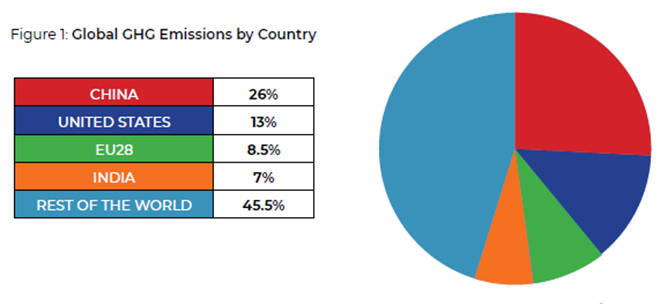
As shown in Figure 1, the United States (US) and India contribute almost 20 percent of global greenhouse gas (GHG) emissions. Although the two countries differ markedly in both per capita emissions and incomes, India and the US must take concrete action according to their capabilities to develop solutions that can boost economic growth and mitigate the catastrophic consequences of climate change. The best way to achieve these twin goals is to invest in infrastructure for a resilient and low-carbon future; cooperate in key areas that produce relevant knowledge; foster innovation exchange; strengthen technical assistance bilaterally and for others; and catalyse capital investments for energy access, energy efficiecy, and renewable technologies.

Source: 2019 Emissions Gap Report, United Nations Environment Programme

Both the US and India have taken important strides together to advance their strategic partnership in the domain of climate action and policy. However, existing efforts continue to rely mainly on an incremental approach to tackling climate change. Such measures are welcome but insufficient. As the world grapples with the COVID-19 pandemic, we are reminded of the human and economic costs associated with weak international cooperation, delayed action, and the lack of investments in important infrastructure and capabilities. Climate-induced disasters may make the current pandemic look meek, and the world could ignore this risk at its own peril. Thus, it is vital for India and the US to double down on efforts to drive structural change, hurdle institutional barriers, and overcome the inertia inhibiting green growth and development.

In line with these goals, the Observer Research Foundation (ORF) and The Asia Group (TAG) convened a joint roundtable in October 2019 to advance recommendations to strengthen the US–India partnership for a green future with a special focus on climate mitigation, renewable energy, and climate financing. Across these topics, it is clear that both countries face a number of complex and overlapping challenges and opportunities. Even as recent policy efforts have strengthened each country’s capacity to tackle these challenges, this report seeks to identify policy recommendations to support this progress.

Standard
Commentaries, Economic Reforms, economy, Economy and Growth, India

By the global ball and value chain

While MNCs are choosing well-established regional supply chain in East and Southeast Asia for now, India must look to the futu

Of the many ways the post-Covid world will look different, the rapid confluence of trade, technology and national security will rank high among them. The US’s assertion in the 2017 National Security Strategy (NSS) that ‘economic security is national security,’ EU Commission President Ursula von der Leyen’s call this February for ‘tech sovereignty’, and China’s focus on ‘self-reliance’ in strategic technologies portend a new age for geo-economics. All three areas have acquired a sharper edge in the middle of the pandemic.

India must signal to its citizens, businesses and the international community how it plans to respond to this moment being shaped by three developments. First, the weaponisation of economics and trade, a trend prevalent among partners and rivals alike. Second, the measurement of national power will now be based on the ability to control global digital flows comprising technology, information, human capital and finance. Can India be an influential actor?

The decoupling of supply chains due to the sharpening US-China trade war makes this an imperative. GoI seems to have sensed this moment and is attempting to seize it.

And third, old industrial tools like import substitution and market restrictions will need radical repurposing for these times. Can India devise a new mantra compatible with the latest version of globalisation? All of this translates into one layered question: How can India first attract large investments, then grow and develop its technology sector, and finally share and export ‘Digital India’ to other geographies?

This will be based on India’s ability to manufacture for, and service, the growing digital markets, as well as shape the norms, rules, standards and topography of global physical and digital supply chains. The decoupling of supply chains due to the sharpening US-China trade war makes this an imperative. GoI seems to have sensed this moment and is attempting to seize it.

Dislocations in trade and technology are an opportunity to attract global investors. India has done poorly in the past. A September 2019 Nomura report suggested that of the 56 companies relocating out of China, only three have opted for India. Nevertheless, decoupling is a long-term process. While MNCs are choosing well-established regional supply chain in East and Southeast Asia for now, India must look to the future.

Beijing’s economic statecraft underpins its efforts to shape the world in its own image through territorial aggression, debt-trap diplomacy and institutional capture.

In this regard, India’s decision to announce three interrelated schemes on production-linked incentive (PLI) for manufacturing of components and semiconductors, and electronics manufacturing clusters, is important. These replace the earlier ‘merchant export from India’ scheme, and align India’s support for its nascent electronics industry with WTO rules. This new regime for manufacturing and export is designed specifically to draw in large global manufacturers like Apple and Samsung, facilitating the relocation of a part of their production base and downstream suppliers to India.

The ability of just a few global investors to help India integrate into global supply chains (GSCs) should not be underestimated. For example, the market value of the hardware Apple produces in China was nearly $220 billion in FY2019, of which it exported $185 billion, dwarfing India’s total electronics exports of $8.8 billion in the same year. Apple has over 800 production facilities globally, over 300 of which are based in China. Even minor relocations of these value chains to India will be beneficial. The reported relocation of certain processes to India by Apple contractors Wistron and Foxconn, among the largest and most sophisticated Taiwanese electronics manufacturers, will bring with them their own secondary supply chains.

Such opportunities will multiply for India — such as the Britain-proposed ‘D10 alliance’ (a club of 10 democracies) on 5G and emerging technologies — begin to reorganise patterns of trade to favour nations ‘politically trustworthy’. The logic driving disengagement with China on crucial supply chains is obvious. Beijing’s economic statecraft underpins its efforts to shape the world in its own image through territorial aggression, debt-trap diplomacy and institutional capture. Part of India’s response to this reality will be political muscularity along the border and in the oceans. The other, more durable, response will be an obsessive nurturing and growth of the economy.

These ventures are also a litmus test for GoI’s resolve for reform.

This must be dictated by a strategy that enhances India’s ability to integrate into the production and manufacturing of strategic technologies, to secure value from global data flows, and to grow Indian platforms and digital propositions for the world. Growing and new investments from US blue-chip tech giants like Apple and Facebook into India’s manufacturing base and digital platforms augur well.

But these ventures are also a litmus test for GoI’s resolve for reform. In 1982, GoI’s integration of Suzuki into the domestic market for automobiles spawned a new wave of investments into this sector making it one of the world’s most competitive. As the realignment of supply chains accelerates post-Covid-19, investors from around the world will be closely watching the performance of these major global corporations in India before making their own decision.

Standard
Cyber and Technology, Health care, India, media and internet, tech and media

Digital Epiphany? COVID19 and our Tech Futures

Processes that were once subject to national jurisdictions – be it political conversations, trade and commerce, or national security considerations – are increasingly migrating to ungoverned digital spaces, creating what I have earlier called a “platform planet”. It is clear that the coronavirus will accelerate this process and more permanently fuse our technological and
social systems while encoding inequities and cleavages therein.

Most pertinent to this is the issue of access to digital technologies. Think of the pressure on governments today to deliver governance and services in the age of social distancing, the clamour from parents whose children cannot access educational opportunities, or demands from historically marginalized groups who may not be able to work remotely. Life, protection, and livelihood will all need to be guaranteed virtually and most capitals around the world will struggle to provide these.

Some positive transformations will be driven by technology companies looking to break new ground and compete for consumers among the millions of social and commercial interactions that will now be permanently online. Videoconferencing platforms, for instance, have emerged as the go-to technology keeping governments and businesses running even as social distancing is being practised. And still more change will be driven by governments adopting digital tools to carry out health surveillance measures or to enforce quarantines. Evolving debates and assumptions on user agency, privacy and data protection may be significantly altered in the year ahead.

Undoubtedly, the most important structural change will be in the form and format of the relationship between technology and society. Over the past two decades, there have been two fundamental notions that have shaped this ever-evolving relationship. The first, roughly corresponding to the first decade of the 21st century, was a near universal belief in the emancipatory potential of emerging technologies and a social willingness to accept new technologically induced disruptions. The second perspective, corresponding to the second decade, was the antithesis of the first – a “tech-lash” or scepticism about the role of emerging technologies in our social lives and a growing degree of suspicion about the intent and actions of “big tech” and “strong states”.

The coronavirus outbreak will demand a synthesis of these, and other, perspectives under extraordinarily compressed timelines. The many decisions that will be made over the coming year will either become entrenched or will reinforce certain pathways in the decade ahead. Technologies that society would have once expected greater regulatory scrutiny around –such as the use of artificial intelligence (AI) in healthcare – will likely be fasttracked and deployed. Meanwhile, consumer technologies that are scaling rapidly, such as videoconferencing and fintech platforms, will face additional scrutiny from consumers and states as they become more utility-like in their deployment.

Technologies that society would have once expected greater regulatory scrutiny around –such as the use of artificial intelligence (AI) in healthcare – will likely be fast-tracked and deployed.

As this process of synthesis unfolds over the coming year, the international community will be confronted with a new set of opportunities as well as risks. Perhaps the first and most visible risk emanates from a largely ungoverned digital public sphere. Indeed, this pandemic has also been accompanied by an “infodemic”, with misinformation and disinformation flooding most social media platforms, which for all practical purposes play the role of both traditional media and discussions rooms of yore that shaped public opinion.

Fake news alone, however, is not the only dimension of this risk. The response to it may be equally dangerous. The COVID-19 outbreak may end up creating stronger censorship regimes in an attempt to curb the spread of disinformation. Equally worrying is the power of technology platforms to mediate these spaces during times of crisis and the dangerous collaboration or confrontation brewing between technology companies and governments. For instance, certain technology platforms took down content by President Jair Bolsonaro of Brazil because they deemed it spread disinformation. But should platforms have the ability to censor the content of a head of state? On the other hand, should they partner with governments and dilute freedom of expression through new measures that may outlast this pandemic?

second related risk is the data-sharing  practices that technology companies, health institutions and governments are adopting – with little oversight or accountability – to combat COVID-19. This trend will not only be about the data generated today. Instead, the COVID-19 pandemic will likely create a new battlefield, one that will be defined by the datasets generated by the fusion of our biological and digital worlds. Indeed, one set of technologies that were already being deployed rapidly before the virus outbreak were those related to genomics. The practices around genetic privacy – and the institutions that manage them – in the year ahead may well create new and unexpected risks to our fundamental rights as unique living beings.

third risk likely to challenge our technological futures are efforts to undermine the integrity of the cyber realm. While most nations remain worried about threats to critical infrastructure (the United Nations has already called for a digital ceasefire) the COVID-19 outbreak will also exacerbate “petty” cyber-crimes. These are minor cyber incidences; those that may not pose systemic national security threats but will affect the financial and social lives of individuals dramatically. The sudden uptick in COVID-related phishing scams, telemedicine scams and attacks on medical institutions all point in this direction. Trust in technology will be undermined at a time when the digital is the ether for globalization to survive.

The fourth risk is of individuals being permanently left behind as the process of digitalization continues to accelerate. Inequality has been the defining political zeitgeist of our generation – one that digital technologies have often accentuated. In countries without full or robust access to the internet, citizens are suffering from multidimensional socio-economic challenges as the pandemic snatches away their access to essential public goods.

But the challenge goes beyond this. Just as individuals are beginning to learn that not all work requires formal office spaces, businesses may well realize that not all operations require humans. The rapid adoption of AI and robotics energized amid the pandemic could accelerate a process that governments and policy-makers have been concerned about for years – technology-induced unemployment.

The final risk could end up being a product of how states actually respond to these various challenges amid a rapidly digitizing global society. No two societies are the same – they are defined by different political values, social practices and economic priorities. With COVID-19 forcing more of our social lives, business operations and governance online, the race to infuse the global digital world with a particular set of values and technological standards will only accelerate. Digital “code wars” may well be this century’s ideological confrontation that may partition the world in the end.

Think of the UN, the centrepiece of the liberal international order, partnering with Tencent, the digital champion of a vast surveillance state, to conduct its remote work operations. This has become a cause for concern for many countries. Reports indicate that the UN is already backtracking from its decision under pressure from human rights groups and democratic nations. Indeed, the varied digital societies that are emerging may fuel loud “geotechnological” competition.

That said, policy-makers may also see in the COVID-19 crisis an opportunity to reform political and administrative practices that were earlier hobbled by legacy institutional constraints. The most obvious, perhaps, is the accelerated adoption of what the UN calls “digital public goods”. These are the common digital “railroads”, which act as force multipliers for a range of business and governance operations.

For instance, India’s Digital ID system has helped the country navigate the pandemic by ensuring cash transfers and digital payments for a range of essential goods. The demand for similar architectures has been growing around the world. Singapore had already signed an MoU with the Indian government, even before the virus outbreak, to develop such a system. Similarly, Google has cited India’s digital payments infrastructure to call on the Federal Reserve to enable similar innovations in the US. These trends could see universal strengthening at this time.

This moment offers an opportunity for states to respond to the needs of a growing global informal workforce. The informal labour force and the “gig economy” workforce need new systems of social protection. The absence of this has placed them at great risk and at the frontline of this pandemic. These political reforms may not be ignored much longer. The idea of a universal basic income – a measure that is supported both by the Pope and The Financial Times – could also find favour and catalyse a new dimension for the future of work.

Perhaps the most significant opportunity will be for states and individuals to realize the potential of a truly global digital society. Responding to COVID-19 has compelled governments and communities to share sporadic information, some best practices and critical technologies rapidly. Consider for, instance, a rapidly growing community of entrepreneurs sharing opensource 3D printing designs for ventilators. Perhaps civil society organizations and policymakers can use the COVID-19 moment to push for new pipelines that will enable the transfer of technologies and innovations and encourage them to rethink rigid intellectual property regimes, which hindered this earlier.

Perhaps the most significant opportunity will be for states and individuals to realize the potential of a truly global digital society. Responding to COVID-19 has compelled governments and communities to share sporadic information, some best practices and critical technologies rapidly

Over a century ago, when individuals were isolating themselves amidst a far deadlier Spanish Flu, many (primarily Americans) turned to the telephone to stay in touch with friends, family and colleagues. Of course, it was a nascent technology at the time and services promptly broke down because of the rapid rise in demand. But rather than crippling the industry and the technology forever, the Spanish Flu only served to underscore how essential it was to modern society. Over a century later, it is clear that the telephone was instrumental in shaping our global village.

We are at a similar junction today. And decades later, historians may well scrutinize the decisions made in the year ahead when studying how the digital shaped individuals, communities, nations and the world they inherited.


This essay originally appeared in World Economic Forum.

Standard
climate change, Commentaries, Health care, India, Sustainable Development

In the lockdown, a breath of fresh air

One of the few positive spin-offs of the ongoing nationwide lockdown to combat Covid-19 has been a dramatic reduction in air pollution. Recent Nasa data reveals that air pollution in north India has dropped to a 20-year low. In Delhi, the levels of harmful microscopic particulate matter, PM 2.5, plunged after the lockdown began — falling from 91 mg per cubic metre (mg/m3) on March 20, to 26 mg/m3on March 27.

Nitrogen dioxide (NO2) released by vehicles and power plants also saw a significant fall of 71% during the period. The air in Delhi is now clear, the skies are blue, and we can hear birdsong again on the boulevards.

Unfortunately, these are but temporary gains, and should not distract us from the dangers of air pollution.

An urgent warning comes from a Harvard University study (bit.ly/3dthqiv), which establishes a correlation between long-term exposure to air pollution and Covid-19 mortality. The study finds that people living in polluted cities are more likely to have compromised respiratory, cardiac and other systems — and, therefore, are more vulnerable to Covid-19.

We should be very worried because India has 21of the 30 most polluted cities in the world. Air quality in some of our cities is 10 times over the safe limits recommended by the World Health Organisation (WHO) and, as per some estimates, air pollution claims more than one million lives each year.

Therefore, even as India flattens the infection curve, addressing the air pollution problem should continue to be a high priority for all policymakers. Today’s cerulean skies remind us that clean air and the right to breathe must be available to all citizens. And if India were to achieve this, there will be huge collateral benefits. We would not only become much more globally competitive, but we could also be well on our way to exceeding our climate ambitions outlined in the 2015 Paris Agreement.

There are many ways in which an economic revival package can get India to this Green Frontier. For instance, new investments could be directed towards renewable energy, with larger allocations and subsidies to initiatives like the National Solar Mission. We could adhere to deadlines for the Bharat Stage 4 standards and accelerate timelines and infrastructure investments for electric vehicle (EV) adoption.

Large electric battery factories could be established to enable localised energy storage solutions. Bailouts and incentives to the auto, aviation and construction sectors could encourage green transitions and clean air ambitions. The Energy Conservation Building Code (ECBC) in the residential sector could be enforced and a 2011policy relating to energy efficiency in MSME clusters could be integrated with the fiscal support to this sector.

Global experience suggests that crises create political opportunities for embracing change. After the 2008 global financial crisis, China spent nearly a third of its $568 billion stimulus towards projects that addressed environmental goals. China has since become a global leader in solar, wind and hydropower markets.

Britain and Germany also undertook green transformations post 2008 crisis. Similarly, India could use this Covid-19 crisis to undertake a far-reaching green revival.

We will find support. After the Covid-19 pandemic, there is a renewed focus on mega black and white swan shocks that can lead to immense loss of lives and destroy trillions of dollars of economic output. It is now much easier to convince policymakers, bankers and investors that awarming climate may well be the single-biggest macro shock the world will have to face. Green revival packages are bound to emerge around the world and global finance will inevitably align to this endeavour.

India is already the third-largest emitter of greenhouse gases (GHGs). Even optimistic predictions suggest that our emissions will nearly double in the next decade or so. A green revival package could be designed to ensure that India’s post-Covid economic resurgence becomes a key contributor in mitigating global emissions. It must be branded as the single-most important initiative for the world to meet and exceed Paris Agreement goals.

This will also give India more leverage in influencing the global financial community, and compel them to more pragmatically price risk, transparently rate creditworthiness, and bring down regulatory barriers that restrict the flow of capital to green projects in the developing world.

The battle for clean air requires structural reforms across multiple sectors, institutions and processes.

Public and private funds need to be redirected to green investments.

While temporary reductions in noxious emissions are certainly a huge relief, they are not the panacea for a country that has the onerous task of becoming the first $5 trillion economy in a carbon-constrained world. And, we must do this without gasping for breath.

Standard
Elections, India, Modi 2.0, Political Economy, Verdict 2019

Narendra Modi and his soaring popularity

Prime Minister Modi contested the recent parliamentary election with at least half-a-dozen prime ministerial aspirants representing the opposition vying for his chair. That he swept the polls with the entire opposition ranged against him clearly demonstrates his credibility among the masses across regions. In sharp contrast, his opponents lacked credibility and came across as unreliable, if not unfit, for the Prime Minister’s office.

Modi, BJP, Mandate 2019, Elections 2019, Verdict 2019

Q: Did Narendra Modi become more credible? How did his party manage to stay in power?

A: Prime Minister Modi contested the recent parliamentary election with at least half-a-dozen prime ministerial aspirants representing the opposition vying for his chair. That he swept the polls with the entire opposition ranged against him clearly demonstrates his credibility among the masses across regions. In sharp contrast, his opponents lacked credibility and came across as unreliable, if not unfit, for the Prime Minister’s office.

The BJP alone has won 303 of the 542 seats. Its allies in the NDA won another 50, pushing the total tally to 353 seats. The Congress, the principal challenger to PM Modi and BJP, failed to win even 10 per cent of the total seats required to be designated as the main opposition party. The size and scale of ‘Mandate Modi’ can be imagined from the fact that over 67% of India’s 900 million eligible voters participated in this election.

Although BJP is the winner in this election, Modi is the victor: it is his soaring popularity, reminiscent of the popularity of Jawaharlal Nehru and Indira Gandhi, that unleashed a massive wave of support. The BJP rode that wave to retain power. It was a single issue election. That issue was Modi. Nothing else mattered. Performance and promises of his government, including on key issues like the economy, were brushed aside along with identity politics which the Opposition had heavily relied upon to stage a comeback to the political centre-stage.

Q: Why did the recent conflict with Pakistan not affect the popularity of the Prime Minister?

A: The terrorist attack at Pulwama in Jammu & Kashmir in which a large number of security forces personnel were killed, and the subsequent retaliatory airstrikes on targets inside Pakistani territory by India, actually worked to Modi’s advantage. It arguably stoked nationalist and patriotic fervour on a significant scale. Modi was seen as a leader who would not hesitate to strike back at Pakistan, unlike his predecessors who sought accommodation over anger. Usual election issues like jobs and the state of the economy were buried in the fervour of nationalism across classes and among the masses.

What was significant in PM Modi’s decision to strike Pakistan was to call the extremist state’s bluff that allowed it to believe it enjoyed immunity from conventional strikes due to its nuclear weapons. The Modi decision has opened up the conventional space to respond to terror emanating from across the border.

Q: How will Modi’s victory affect the position of the Muslim minority?

A: India’s Muslims will remain secure and an integral part of what constitutes India, as will all other minority communities. In his first term Modi’s government has ensured a quantum leap in the allocation of funds for minority welfare schemes that directly impact their lives, more so the millennials. By proactively seeking to protect Muslim women from discriminatory practices like “triple talaq’ Modi may have also struck a chord among them. Most of India’s Muslims are integral to India’s aspirational middle classes. For them, bettering their lives is most important.

PM Modi’s recent speech top his party colleagues would also have sent the message that his government is seeking to work for all Indians.

Q: How will the Russia-India relations develop?

A: The state of the relationship is robust and my assessment is that it will only get better. There will be no disruptive change in Modi’s foreign policy agenda which evolved between 2014 and 2019. One of the hallmarks of this period were the deepening of ties between the two nations and the growing personal chemistry between President Putin and Prime Minister Modi.

Standard