Columns/Op-Eds, In the News

China’s aggression towards Japan is a global threat

Original link is here

PUBLISHED:23:03 GMT, 4 December 2013| UPDATED:23:03 GMT, 4 December 2013

On the 23rd of November China escalated its tensions with Japan significantly by declaring an Air Defence Identification Zone (ADIZ).

While this zone may be a geographic span encompassing most of the East China Sea, its strategic shadow falls on the Himalayas.

The responses to this episode will shape the history of the 21st century.

Though more than three thousand kilometres away, this new Chinese posture may be well be India’s security frontline.

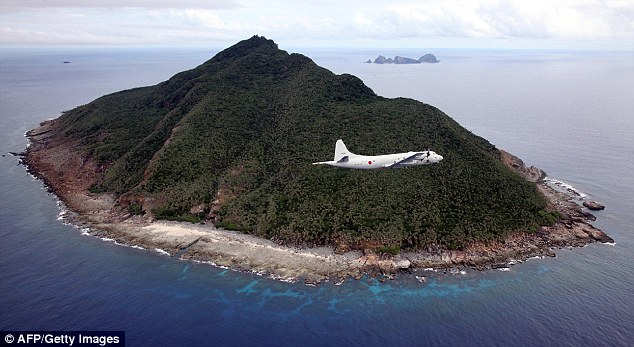
Pic 1

Dispute: This 2011 photo shows a P-3C patrol plane of the Japanese Maritime Self-Defense Force flying over the disputed islets known as the Senkaku islands

Dispute

The ADIZ claims almost the entire area of the East China Sea – a quadrangle comprising China, Korea, Japan and Taiwan – as an extension of Chinese airspace.

The way an ADIZ works is that it extends a sort of sovereignty, a type of territoriality to airspace beyond ones geographic territory. An aircraft that intends to fly through, though technically in international airspace has to notify the claimant.

Most countries have used the declaration of ADIZs to consolidate sovereignty, as both the US and Japan have contiguous to their own territories for defence purposes.

China’s claim, though, doesn’t follow the contours of its coastline but rather juts out – a prominent salient into the sea. In this day and age land grabs are completely unacceptable, sea grabs are becoming unacceptable, and China has jumped the normative gun challenging air norms to possibly buttress its maritime and territorial claims.

There are some interesting dimensions to this episode. The first is the reality that China is the big man on campus in Asia, the U.S. pivot notwithstanding.

Pic 2

Admission: Joe Biden admitted America is ‘deeply concerned ‘ about Beijing’s exclusion zone in the East China Sea

Two; China’s continental outlook is now turning to the maritime domain and its early 20th century Wilhelmine notions of territoriality are being unleashed at sea.

Third; China’s actions do not come from any public discourse or consultation process, internally or externally. China has established therefore, that it is fundamentally a unilateralist, acting through stealth.

And above all, China only respects strength. Japan demonstrated enormous gumption and fortitude during the Senkaku crisis, but President Obama’s vacillations undermined this response. Questioning alliance responsibilities at that crucial moment may have indeed emboldened China in its current gambit.

In the words of Chinese Foreign Minister Qing Gang, “The U.S. should keep its word of not taking sides on the issue concerning the sovereignty of the Diaoyu Islands and stop making improper comments”.

Threat

America’s deliberate violation of the ADIZ by two B-52 bombers was a first step that saw a steady escalation, by Japanese and Korean jets. A day later China’s first aircraft carrier, the Liaoning, sailed into the region and fighter jets have been deployed.

But yet again contradictory messages are coming out of DC. While using the air force to challenge the ADIZ, Washington has advised commercial airlines to respect the rules, all but throwing in the towel. The message from Beijing seems unequivocal “China will wait you out”.

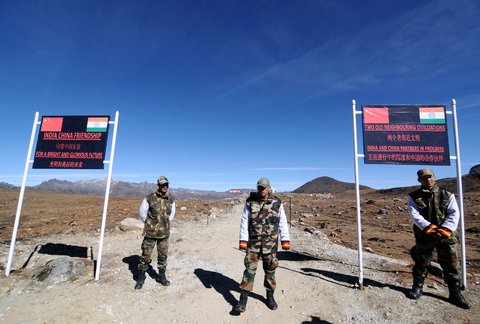
China has an abundance of patience and resolve – and in its own view, it is on the right side of history. This portends trouble for India. If China declares an ADIZ in the east today, what prevents it from declaring the same over Arunachal, Sikkim or Ladakh? If that happens, Indian helicopters will require Chinese permission to land in Indian Territory. India cannot afford to allow this to pass.

The big question is, who will fly a challenging B-52 patrol for India over Arunachal, given that we do not even provide the United States with berthing rights? Given how supine India was at Dempsang, and the lack of public support for its position in the international community, India may find itself having to grapple with a far more ominous ADIZ with greater bite.

Options

India must urgently explore a variety of options to restore deterrence vis-à-vis China. This first thing is to back Japan. The Emperor’s visit last week could have presented India with a moment of expressing solidarity and the impending visit of Prime Minister Abe in the coming month would be a useful time to do some plain speaking and strategic positioning.

But words alone are not enough. India has to work on a range of options including economic and hard options. These must include rationalisation and augmentation of its air force to ensure air superiority in each of its fragile border zones. It must also take a fresh look at reinvigorating its ties with Vietnam, Japan, Australia, Singapore and the littoral states.

Passive diplomacy is now not an option. It must engage with Taiwan, actively,across the board and especially on security issues.

As a last resort, the option of revoking recognition of Tibet’s accession to China, and the status of the Dalai Lama must not be discarded. Changing positions on geopolitical affairs should be a lesson we must learn from the wise mandarins in Beijing.

Ultimately this is a moment of truth for Japan: will the US take its alliance commitments to their logical conclusion or does an insecure and newly militarised Japan loom on the horizon?

This is also a moment of truth for India – where its increasing economic engagement with China must be located within a robust, security architecture – strength being the only currency China respects and it is the only currency of engagement with them.

Lastly it is a moment of truth for the United States; that alliances are absolute and need to be defended in deed and word.

While this analysis could be wrong, nothing is about to change till the Obama-Kerry duo play out the change they keep talking about, because whatever the U.S. has done so far, clearly, is not working. Emperor Akihito’s arrival in Delhi may have been an exercise in pomp and ceremony, but embedded deep within that visit was a menacing message from Beijing.

Standard
In the News, Politics / Globalisation

Biting the ballot

Business Standard

Indulekha Aravind November 16, 2013 Last Updated at 20:50 IST

It’s costly, requires minute planning and engages thousands of workers. But for political parties a mega rally is the only way to attract voters

Original link is here

1384614256-1252

With an anticipated crowd of seven lakh, prime ministerial hopeful Narendra Modi’s rally in Bangalore today is being touted by the Bharatiya Janata Party as one of the biggest the state has seen and, if the numbers back it, Modi’s third biggest so far. Modi had already visited Karnataka earlier this year, before the assembly poll but this rally would be the first in the state after he was “anointed” prime ministerial candidate, which is why the party is pulling out all stops, says MLA and party spokesperson Suresh Kumar. “It may become the mother of all rallies in Karnataka,” he adds.

Cutouts, banners and hoardings of Modi have been put up in different parts of the city, announcing the date, time and venue and exhorting people to turn up in large numbers. In the basement of the party’s four-storey saffron-and-white headquarters in Malleswaram, the traditional, conservative heart of Bangalore, T-shirts with Modi’s photo and accompanying enthusiastic slogans are on sale. These will also be available at Palace Grounds, the sprawling ground where the rally is to be held. Upstairs, various discussions are under way, including one about deploying unmanned aerial vehicles during the rally. This rally, says Kumar, would be the first in the state where people have been asked to buy coupons of Rs 10 each to attend, though it is not compulsory. “This is to counter the allegation that a lot of people who come for political rallies have been hired, or given incentives,” he says. By Wednesday evening, they had sold nearly 400,000 coupons, he claims. People can also register online through the state party unit’s website – log on and a smaller window pops up, with Modi’s face and the slogan “Bharatha Gellisi”, roughly translated as “Make India the victor”.

Though there are at least six months to go before the great battle of 2014, rally season has started in full swing, aided by the fact that Assembly polls are currently under way in four states. Each party tries to outdo the other in terms of scale, size and speeches and Modi’s Bangalore rally will be no different. Last Sunday, Haryana Chief Minister Bhupinder Hooda held a massive rally at Gohana which, according to a party spokesperson, attracted a crowd of over 14 million. “This was our biggest show of strength to date,” says Shiv Bhatia, media advisor to Hooda. The rally was described as “a sea of pink”, a reference to the pink turbans worn by supporters, and as an attempt to cast Modi’s own rallies into the shade.

* * *

Organising a rally is a complex task, and the most important factor for a successful one is the party cadres, whose job it is to spread awareness and ultimately, convince people to show up. The person close to Hooda quoted above underlines that while charisma of the speaker is also critical, cadres play the most crucial role, along with other arrangements such as transport and logistics. Apart from booking the venue, other preparations usually begin 15 to 20 days ahead of the actual date of the rally.

Preparations for the Modi rally, Kumar says, began three weeks ago when the date of the rally was finalised, with workers visiting homes in their constituencies as part of a mass public contact programme. “We expect at least a few representatives from each of the 44,000 polling areas in the state to be present at the rally,” he says. About 35 committees have been formed to look into various arrangements – from publicity, decoration, traffic and parking to food, lighting and sound.

Usually, the people who come for rallies are from in and around the venue, or at the most, within a 50-kilometre radius, and transport is arranged by local party leaders or supporters who are responsible for ferrying people to and from the rally, rather than the party itself. A rally thus becomes an opportunity for local party heads to showcase their prowess through the number of people they are able to bring to the venue, says a person close to the Hooda government, who does not want to be named. At the Hooda rally, for example, Bhatia says all the vehicles were private, and arranged by the workers themselves. “The party was not involved.”

For Modi’s rally on Sunday, too, about 60-70 per cent of the transport is being taken care of by local leaders, says Kumar. “Fifteen trains have been booked to bring people from areas like Gulbarga (in north Karnataka) and about 2,500 buses have been hired. In Bangalore, we have sought permission to use 3,000 buses, which has been granted,” he says. This is in addition to smaller vehicles like Sumos, and 1,000 sympathisers who are supposed to arrive from Mysore on foot. The cost for the remaining 30 per cent will be borne by the party. Eleven choultries near the railway station have been booked and a mutt near Ramnagar has offered its premises to those who are attending. Elaborate arrangements have also been made for refreshments. “We have constructed six mega kitchens, each of which can cater to 60,000 people. There are 100 counters in each block, with each headed by a separate team. The menu, however, will be common,” says Kumar.

Of course, none of this comes cheap. Kumar himself says a conservative estimate for the rally’s outlay would be Rs 7 crore though other reports quote the actual figure to be closer to Rs 20 crore considering the expenses involved, which will include a helicopter to ferry Modi from the Hindustan Aeronautics airport to Palace Grounds. The expenses are met by donors, party workers and well-wishers. Some of the donations were in kind, such as grain and vegetable. Donors also lease out a choultry without charging for it, says Kumar. Another aide of Hooda estimated that his mega rally in Haryana would have cost around Rs 4 crore, even though it was a “basic” rally, without a shamiana, or other trimmings. Once the electoral code of conduct kicks in, each Lok Sabha candidate has an expenditure ceiling of Rs 40 lakh though the Election Commission is contemplating raising this to Rs 50 lakh, according to a recent report in The Economic Times.

* * *

But setting aside the question of the numbers that turn up, whether 400,000 or 1,400,000, does it translate into votes? “Political rallies represent a number of realities, the first being the efficiency of the political machinery and motivation levels of the cadres. This is a fairly important aspect and an indicator. It does reflect the novelty of the speaker or charisma, and certainly this does in this sense reflect momentum. But while it is hard to create a causal relationship between vote share and strength of rallies, these do reflect the state of the current mood and also the capacity of the party,” says Samir Saran, senior fellow and vice-president of Observer Research Foundation. Speaking about Hooda’s rally last Sunday, Bhatia says the turnout was naturally a reflection of the party’s and the leader’s popularity, considering they had come to see the leader of a government that had been in power for nine years.

Commenting on the tactic of selling coupons of Rs 10 to those attending, Saran termed it a clever tactic. “They are making stakeholders out of the portion of the attendees who are not converts already and for the others, it creates a sense of ownership as well. But this is a novel proposition and the outcome is yet to be seen.” The BJP had introduced the coupon strategy first at its rally in Hyderabad, where they were sold at Rs 5. This was increased to Rs 10 at their rally in Trichy in Tamil Nadu, a state where the party strength is negligible. The Congress has so far refrained from going down the same path.

This is, of course, just the beginning of election season. There are eight more Narendra Modi rallies planned in Karnataka alone, before the 2014 polls, and the party is targeting 100 all over the country. And with good reason. “In a country where TV homes and Internet are still fairly sparse – political mobilisation and messaging is still delivered and achieved through such direct campaigning like house calls and rallies,” says Saran.

Standard
Columns/Op-Eds, In the News, Non-Traditional Security

Internet architecture can’t be left solely in hands of developed world

Global Times | 2013-11-7 19:58:01

Original link is here

According to World Bank estimates, India and China together account for more than 700 million Internet users. Citizens in both countries have embraced the digital sphere enthusiastically, and mobile phones and the Internet are the preferred platforms for anything and everything, from expressing opinions to conducting business.

Indian and Chinese stakes in cyber governance are already significant, and are only likely to increase as both continue connecting even the most rural hinterlands, which still suffer from lack of efficient physical connectivity.

Much future global wealth generation will be deeply integrated with the online sphere on account of access to new markets, online supply chains, services and Internet-based financial flows. Hence, India and China, as they seek to raise the incomes of their citizens, will need to transform into sustainable and secure digital economies. Digital governance, norms and rules, and International conventions must see India and China as rule-makers and not rule-takers.

The West, in the wake of the Edward Snowden revelations, is witnessing a new wave of support for discussing and negotiating a certain “code of conduct” for this global commons.

Although the current discussion is more on privacy and surveillance, there are other aspects that must also be vigorously debated.

New Delhi and Beijing must take the lead and articulate their positions and core interests on these issues, and see to it that they are addressed adequately. It is in no one’s interest to see a “virtual gridlock” and the World Wide Web becoming a “World Divide Web.”

The region’s success and prosperity are so closely linked to its successful integration that a divided digital domain may be detrimental to the region.

In fact, both India and China must learn from their predicament of dealing with the border legacy, and should ensure that discussions on cyberspace are not held prisoner to old notions of boundaries and rigid ideals of statehood.

The common prosperity of the two nations is linked to the digital future, and even lifeline provisions such as social security schemes, health and education among others are likely to be delivered through virtual means. Therefore, it is important for India and China to ensure that the world does not witness the birth of “digital sovereignty” where states contest, or of “digital capitalism” where commercial interests prevent this medium from being a global commons.

There are certain historic biases already. Technology, services and access reside with Western corporations and in Western capitals. The Internet must remain technology and geography-agnostic. Any global architecture for both hardware and software must ensure this.

Despite these converging objectives, the conversations between India and China on this subject, much like in other sectors, have been limited and impeded by suspicions and historic security concerns. It is time that the two nations go beyond these.

China seeks to be an influential player in telecommunications and the digital economy in India. And Indian IT companies are looking for a more hospitable environment.

A positive atmosphere and confidence building are a must for realizing these ambitions. In fact, Indian and Chinese companies can jointly lead the way in providing hardware and software solutions to developed and developing economies across the value chain.

To create an environment conducive to business and in order to shape an Asian discourse on cyber governance and cyber security, the two governments must seriously consider the following ideas.

One possibility is to create “cyber hot lines” between nodal agencies, such as between the Computer Emergency Response Teams in the two countries. They should also establish mechanisms for threats and vulnerability reporting and sharing information on gateways and access codes where required.

The two sides can also discuss responses and solutions to counter hacking and malware that threaten economic operations and businesses between and among parties in the two countries. Experiences on protecting critical infrastructure should also be shared. And, finally, they need to undertake joint development of low-cost digital access to, and affordable technologies for, the underprivileged segments of society.

Standard
Columns/Op-Eds, In the News, Politics / Globalisation

A toast to the silly season: Why India’s election process is bringing out the absurd in us all

PUBLISHED:01:16 GMT, 6 November 2013| UPDATED:01:16 GMT, 6 November 2013

Original link is here

It seems that the greatest celebration of India – its democracy and the much-feted elections – also bring out the absurd in us all.

As the five states of Delhi, Madhya Pradesh, Chhattisgarh, Rajasthan and Mizoram go to the polls in the coming weeks, it seems the ‘silly season’ is upon us. We are being saturated with inanities masquerading as “political discourse”.

The problem, however, is that as these samples of ludicrousness tumble out in a disturbingly steady stream, we actually engage with them in earnestness.

article-2487973-1936880A00000578-816_634x394

BJP workers wear masks of the party’s PM candidate Narendra Modi, who is presently spoken of in the manner of a superhero.

Let us therefore first propose a toast to the Indian National Congress and its brilliant and original idea of banning opinion polls on the grounds that these are unfair and influence voters.

Now, in any normal society – leave alone democracy – this would be considered a misguided attempt at humour by a geriatric who has crossed the threshold from dotage to anecdotage. But evidently in India it is taken seriously enough to merit furious (and serious) discussion on talk shows and much scholarly debate on the subject in the online, visual and print media.

Heck! Why stop at opinion polls? The logic that these polls unfairly influence voters can equally be extended to op-eds, reporting, and indeed to the very application of one’s mind. So why not go ahead and ban people from thinking for the next 6 months?

After all, it can be stated with a great deal of medical and sociological certainty that the application of one’s mind creates a capacity within the individual to actually decide his or her fate, as opposed to being a force-fed farm animal that gets shepherded into an abattoir.

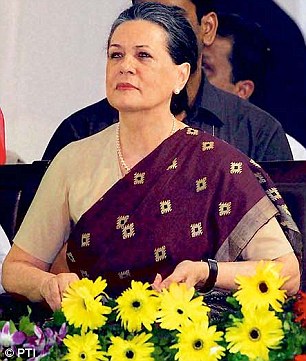
Would Sonia Gandhi’s Congress prefer voters to go to the polls blind-folded, lest their genuine opinions affect the vote?

article-2487973-190B89A400000578-399_306x361

In fact, in order to extend wholehearted support to the Congress’ proposals we should take the logical next step of blindfolding the Indian voter before they press the EVM button – so that the voting process can become a lucky draw – truly free of undue influence and bias.

Of course there is the danger that our hallowed Electoral Commission – the so-called protector of India’s freedom and democracy – might actually embrace this fruit-loop scheme.

So let us raise the second toast to the monumental silliness of the Election Commission of India, now rapidly on its way to becoming a much-loved and celebrated ‘law unto itself’.

In its notification dated the 25th of October – “Instructions with respect to the use of Social Media in Election Campaigning” – the EC has made the terminal mistake of assuming that social media is like every other media that has come before it, claiming “since social media websites are also electronic media by definition…”.

While this betrays a deeply flawed, almost astoundingly naive view of the dynamic and deeply democratic cyber-sphere, at a more serious level this has dangerous overtones of the Sippenhaft laws from Nazi Germany.

What this notification means is that the election code of conduct will now apply to mediums of individual output like Twitter, YouTube and Facebook.

Basically any candidate can lodge a complaint against any individual Tweet or Facebook comment based on the fact that they can be “reasonably connected with the election campaigning of political parties and candidates”.

This is guilt by association of the worst possible kind, because now any sympathiser, relative or associate of any candidate effectively has his or her freedom of expression curtailed on the basis of specious reasoning that this can be traced back or connected with a political party.

So much for the Election Commission being the guarantor of India’s democracy! It is sad that this body, overwhelmed by this deluge of election-season silliness, has become the epitome of silliness itself.

Indeed, if the EC is so serious about this regulatory order, it should assume charge of the Ministry of Communications and Information Technology as well as the Ministry of Information and Broadcasting, to avoid any hint of bias on the part of the two wings of the government.

The third toast in this autumn of silliness is reserved for the BJP, its Prime Ministerial aspirant and their rather “unique” take on Indian history.

I am yet to find where Alexander ever set his eyes on the Ganges, I am yet to find anyone named Chandragupta Maurya belonging to the Gupta Dynasty, and Taxila – as far as my maps show me – is part of Pakistan not Bihar – though presumably in some warped version of ‘Akhand Bharat’, northern Punjab may in fact be annexed to the penurious ruin that is Bihar.

Of course logic would have demanded that the head of a speechwriter roll, or the entire research team be put out to pasture. What we see instead is a bunch of experts finding ways to somehow discover coincidence between history and the recent remarks of the BJP’s PM-in-waiting. But perhaps the victor does script history – and let us toast to that possibility.

Despite what they all say; despite the INC’s moral indignation, the EC’s delusions of infallibility and the BJP’s historical certitude, they all think of us – the Indian people – as livestock, incapable of discerning chaff from wheat and deciding for ourselves.

If India chooses to take these people seriously, we really do need to ban any outlets of independent expression and go back to the happy days of black-and-white Doordarshan with programming restricted to Krishidarshan and Zara Sochiye (as relevant today as they were then), because as it turns out the greatest fools are the people who tolerate – nay celebrate, revel in and vote for – such silliness. It is to them the fourth and last toast should be raised.

I say, this season let us all get sillier still, and put our finger on ‘NOTA’.

Standard
Columns/Op-Eds, In the News

Time to rethink differences between neighbors across Himalayas

Global Times | 2013-10-30 19:53:01

Original link is here

The recently concluded India-China summit meeting may have, at the very least, established a new tone and tenor in the relationship between the two Himalayan neighbors.

The Border Defence Cooperation Agreement, the new communication mechanism on water, the thrust on exchanging experiences and expertise on road and highways, and cooperation on an “Asian knowledge system” through the Nalanda University project are all important and substantial steps to take this partnership forward.

There was some useful progress on economic cooperation as well, although more was expected from the two leaders to facilitate greater two-way trade, business exchanges and Chinese investments in India’s infrastructure projects. And there was disappointment in some quarters when bilateral rigidity ensured lack of movement in liberalizing the visa regime.

But for those who see the India-China relationship as one of the key partnerships of this century, what is most disappointing is the lack of ambition in the agenda for the conversations. The two countries now need to be bold and creative in what they do together.

The two must seek to finalize a civil nuclear cooperation agreement. This gives China a credible financial stake in the Indian civil nuclear sector and the motivation to reject its dogma of “capping and rolling back” India’s nuclear program. This would also potentially facilitate India’s entry into the global nuclear order.

India is concerned about the opacity of China’s interests in the Indian Ocean. The two need to proactively engage instead of producing alarmist literature. Their naval and strategic leaderships need to commence frank discussions on common approaches and discover synergies in protecting the sea lines of communication.

India and China have piggybacked on US capabilities in the past, and may have to soon develop and deploy their own capacities.

Be it in anti-piracy operations or humanitarian evacuation, there is ample scope for coordination and cooperation.

Both nations have large diasporas in Africa and West Asia. In Libya, for example, both countries sent their ships to evacuate their citizens. Such coincidence of interests and needs must be mapped, and actions synchronised.

The two countries need to thrash out a common understanding on cyber governance. China seeks to be a stakeholder in India’s communication sector, for which the level of trust between the two countries needs to be enhanced.

A significant share of the world’s commerce has become dependent on the digital realm. This commerce is the key to prosperity of both countries, and yet much of the discourse on cyber management emanates from, and key infrastructure resides in, the Atlantic countries.

Bilateral cooperation on the ongoing international dialogue on Internet governance and on issues relating to development of related infrastructure and connectivity is essential.

China and India must realize that a strong and stable Afghanistan and Pakistan are in their interest and vital for the stability of the region.

For far too long, India and China have allowed the situation to drift out of strategic or other considerations. A dialogue on aiding the development and growth of these countries must commence between the Asian giants.

China, as a trusted ally of Pakistan, and India, as a friend of the Afghan people, can together help in rebuilding and reintegrating these parts into the Asian economic mainstream.

Both countries also have similar interests and stakes in outer space and ocean governance. They are handicapped by the fact that they are new voices in the normative debates on these subjects.

This is the moment to evolve a common position before entering larger negotiations with an individual weak hand.

The two countries need to come up with tangible alternatives in what is today a one-way norm setting exercise in these new arenas of governance, with the opposition too divided to have any impact.

Ultimately, we may find that our converging interests bind us more closely than we would have imagined or, for some, liked.

Dealing with this will require bold political leadership on both sides and a pragmatic desire to integrate our largely coincident aspirations.

Standard
Columns/Op-Eds, In the News

India and Russia: Moving towards a 21st century compact

Original link is here

The recent summit between President Putin and Prime Minister Singh may have heralded a new inflexion point in the bilateral.

Pic 1

Russian President Vladimir Putin and Indian Prime Minister Manmohan Singh during the press statement following Russian-Indian talks in the Kremlin on October 21, 2013. Source: Alexey Nikolsky/RIA Novosti

It would seem that India-Russia relations might have bucked the season of gloom. For years now, since Prime Minister Yevgeny Primakov’s reorientation of Russia’s foreign policy eastwards, we’ve largely seen two governments making positive statements, not matched by actions on the ground and compounded by a general sense of drift. Adding to this has been a waning interest in India of all things Russian and vice-versa. Two close friends gradually drifting apart, a contemporary tale of the engagement between Moscow and New Delhi.

The recent summit between President Putin and Prime Minister Singh may have heralded a new inflexion point in the bilateral. On a cursory comparison of their joint statement issued on October 22 with the previous four summit statements, there seems very little change on the surface and if anything, these statements continue to remain an exercise in blandness. But connecting the dots we get three game changers, which while mentioned, have not been described under the strategic rubric that they perhaps should have.

Indo-Russian cooperation

Pic 2

The first is trade which stood at $7.46 billion in 2009, $8.53 billion in 2010, and $8.87 billion in 2011, and has suddenly spurted to $11.04 billion in 2012, registering a 24.5 percent growth year on year. This was the best performance of Russia’s top 25 trade partners. This is particularly surprising given the present world economic situation, the lack of growth of India’s world trade in 2012 and a marginal growth of 1.8 percent growth in Russia’s world trade.

Does this mean that India today has firmly established itself as a partner in more than just the fields of defence and energy to Russia? Are there initial signs of diversification visible? And how the two countries cement this increase in quantity, quality and diversity of trade will be crucial for the strategic partnership going forward.

The second is Russia’s determination to push through a free trade agreement with India – the comprehensive economic cooperation agreement (CECA). Given that most of this increase in bilateral trade has been in-spite of the two governments (outside of the defence sector), this is of particular significance. This will give the Indian private sector critical access to such landlocked markets like Belarus and Kazakhstan, which are part of a customs union with Russia. Not only does this give a fillip to India-Russia ties, it leverages the growing volume of India-Russia trade, to give the northern access to Central Asia, benefit of new economies of scale.

The former Soviet countries have for long sought a stronger Indian presence, be it economic or political in their efforts to balance China. But thus far, Indian attempts have been frustrated by Pakistan’s refusal to allow transit and the complicated international situation with respect to Iran. What the Russia route means is that India and Russia can now piggyback on each other and create serious strategic congruence and bring synergies into play like never before. But this development could additionally play another critical function. By creating a strong market in Central Asia that is integrated with India, it helps create regional pressure to bear on Pakistan to allow India transit with substantial economic benefits to itself.

In effect, Russia, if this game plays out well, may just end up becoming the ‘x factor’ that normalised trade between India and Pakistan. This is advantageous for Russia, since it would give it a pivotal geo-economic and strategic role on the world stage that it hasn’t played in a very long time with relation to big countries.

14th annual summit: Singh, Putin focus on trade, energy and defence
Pic 3

Lastly, the transactional listing of defence deals in the joint statements is symptomatic of India’s fear that it simply cannot compete with China vis-à-vis Russia when it comes to economic stakes. However, the trade figures should boost India’s confidence in its dealings with Russia. It now needs to take the bull by the horns and insist on a quality-quantity matrix that regulates future Russian arms sales to China. By formally affirming a commitment to maintaining India’s qualitative edge over China, Russia can do much to overcome the almost consistently negative press in India in this regard and bypass other minor irritants in the relationship.

It has never been a better time and never before has India come with this much strength to the negotiating table. In the end, reaffirmation and recalibration of Russia’ role in India’s future was prominent and the short and successful summit was capped by perhaps another nuclear submarine for India and a doctorate for Prime Minister Singh.

Standard
In the News

The Curious Case of India and China

October 28, 2013, 9:36 am Comment

Original link is here

28-indochina-IndiaInk-blog480

Kyodo News-Pool/Getty ImagesManmohan Singh, left, prime minister of India, holding talks with Xi Jinping, president of China, sitting right opposite Mr. Singh, in Beijing, China, on Wednesday.

During his recent visit to China, Prime Minister Manmohan Singh of India said that when the two Asian giants shake hands, the world takes notice. Although the statement stands true, the real question to ask is whether the media and the security and diplomatic community in the two countries make much of this handshake. It can be argued India-China relations comprise a slew of missed opportunities, and these two have added yet another chapter to this narrative.

In recent years, India and China have engaged in a strategic dialogue, the term “strategic” being used loosely. The fifth edition of the dialogue was hosted by New Delhi in August. The leaders have been able to have uninterrupted annual summit-level talks, interact at annual meetings of the so-called BRICS countries and meet on the sidelines of Group of 20 and other global forums. India and China have had abundant high-level engagement.

Yet the conversation has not evolved. A 20th century grammar continues to define what surely must be the most important 21st century partnership. The only visible sign of deepening engagement remain the trade ties between the two countries that both governments use liberally to demonstrate the imagined “closer relations” and “successful” conduct of diplomacy.

It can be no one’s case that the growth of India-China trade relations has been facilitated by government actions. The relationship has grown despite the unwillingness of the two governments to go beyond contentious issues that are a carryover of the past. Two phases have defined this trade relationship: the Karol Bagh-Guangzhou phase, where the New Delhi shopping district among others in India saw a flood of cheap goods from Chinese manufacturing hubs, and the Mumbai-Shanghai phase, in which bigger enterprises in each country began to engage in trade.

Small business owners and traders in both India and China saw an opportunity and initiated a process of economic engagement that led to the flooding of Indian markets with affordable Chinese products, including mobile phones, firecrackers and even idols of Indian gods and goddesses. The entrepreneurs working at the bottom of the business pyramid crafted the first wave of Sino-Indian economic engagement, often taking huge risks and working under regimes unfavorable to conduct of business.

Increasingly these small traders have had company. Large industrial houses in Mumbai and Shanghai and other business centers have seen value in the relationship. Indian companies have been procuring high-value equipment in power, telecom and manufacturing sectors at competitive prices, and are now even raising commercial loans at favorable rates in China. Chinese businesses are showing an interest to invest in India’s infrastructure sector and are seeking increasing share in the growing consumer markets. The business communities have created this economic relationship based on opportunity and needs.

On the other hand, the governments in New Delhi and Beijing have shown remarkable consistency. Pedantic and unwilling to display leadership in resolving or nullifying the political hurdles, both governments have been guilty of holding back the economic integration of the two Asian giants.

The diplomatic and security establishments have undermined attempts to move the conversation beyond borders, visas and historic suspicions. Now anything and everything in the bilateral relationship is a security discourse. Basin level conversations amongst water experts and river communities are increasingly treated as a ‘security narrative’. China’s interest in the growing ports and roads and highways sector is limited by an imagined ‘security threat’ and India’s development of its northeast, instead of being viewed as an investment avenue for Chinese firms, is perceived to challenge the historic sovereign claims of China.

The Beijing and New Delhi relationship is prisoner to such conversations around security, and in many instances these originate out of Washington, London and Canberra and are not necessarily organic Indian and Chinese debates. The idea of a contest in the ‘Indo-Pacific’ and growing ‘Chinese Hegemony’ are now finding space in bi-lateral conversations. As a result, India and China are nowhere close to integrating land, water, men, material, markets and resources – imperatives in realizing the immense potential of the relationship. Every engagement has an inflexion point and what some in the Indian research community wonder is whether the current summit is that point for the two countries. The question to be asked, therefore, is whether the current visit has injected new life in the path toward sustainable reconciliation.

28-border-IndiaInk-blog480

Biju Boro/Agence France-Presse — Getty ImagesIndian army personnel at the India-China border at Bumla pass in Arunachal Pradesh, on Oct. 21, 2010.

Some aspects of the India-China relationship must be examined if we seek to address this. The first aspect must be the border. While the imprecise Line of Actual Control has been a source of occasional tensions between India and China, it has to be acknowledged that confrontations along the border have not taken a violent turn. Nonetheless, the frequency of such face-offs and the increasing military capabilities in the backdrop of rising nationalism on both sides amplify the possibility of such incidents spiraling out of control.

In this regard, the Border Defense Cooperation Agreement signed by India and China is a significant step that takes forward initiatives agreed upon by both parties to maintain peace and tranquillity along the border since 1993. Steps under the agreement, like the exchange of information regarding military exercises, the possibility of setting up of hotlines and an agreement to not follow or trail each other’s military patrols, are important, albeit incremental gains.

Naysayers continue to push pessimistic views. One school of thought represented by analysts like Brahma Chellany, argued that China used the Depsang incident in April 2013 to arm-twist India into agreeing to Chinese terms on border management. In the spring this year, Chinese troops had crossed deep into Indian territory and set up camp in Depsang Valley, Ladakh.

On the other hand, those (mostly the business community as of now) who see value in engagement want to move beyond the border issues and make it less significant to propelling economic relations. For them, the border agreement is a way to achieving this. Pessimists, however, abound, and instead of seeing the situation for what it is — full of opportunities, if one chooses to recognize them — they push a “status quo” line. The traction that this group is able to generate in the media and public sphere, which feeds off Sinophobia, completely overwhelms any counterview. Hence, a lasting border solution must be what the countries should seek, and the current arrangement can only be a temporary dressing for the festering wound that will hold the relationship back.

Both sides, sadly, have been petulant on the issue of liberalizing visa policies. The recent episode in which the Chinese Embassy issued stapled visas (signifying a refusal to recognize their state as part of India) for sportspersons from Arunachal Pradesh, and the resultant uproar from the Indian side killed the possibility of opening up the visa regimes. All that was required was some bureaucratic flexibility and magnanimity on China’s part and some creativity on India’s part – linking a liberalized visa regime to agreeing with India’s position on the Arunachal Pradesh issue (for visa purposes), without prejudice to historic territorial claims. Yet again, China maneuvered itself into a position from where retreat would mean a loss of face, and yet again India failed to grab the opportunity when it presented itself.

The trade imbalance of almost $20 billion with China continues to be a prickly issue, and the two missed another chance to address this when the visit failed to create pathways for increased Chinese investments in India. Although Mr. Singh articulated his interest in attracting Chinese investment to India before he embarked on his visit, concrete steps in this direction remain elusive. Chinese investment in setting up industrial parks and other infrastructure projects is one obvious hedge against the trade deficit.

Enabling the establishment of service centers by Chinese power companies in India is certainly a big step forward and a positive emerging from the current talks. This would allay concerns raised by some in the Indian security establishment on the proliferation of Chinese equipment in the power sector. These alarmist concerns related to the possibility that India, were it to purchase such equipment from China, could be stranded with the proverbial white elephants because of a lack of supply of spares and services.

Water made it to the laundry list this time and must be viewed as a significant positive as this must certainly be a first when China has agreed to such a conversation with a lower riparian. The two have agreed to share hydrological data on transborder rivers and exchange views on associated topics of mutual interest. This gives India the window to approach China with regard to the construction of dams on the Brahmaputra. Similarly, the memorandum of understanding on roadways and transportation identifies several areas for cooperation, including sharing knowledge in transportation technology, road construction standards, road safety plans, joint research and sharing experience related to public-private partnership models. This can be seen as laying the foundation for creating infrastructure to connect Asia.

Economics has proved to be a major factor in political reconciliation elsewhere. However, in the case of India and China, economic engagement is hitting a political wall. Only a political thrust can help realize what should otherwise seem inevitable: India and China becoming the world’s largest bilateral trade partnership.

India has to learn from others. The United States is implementing its pivot strategy in Asia in an attempt to create partnerships to balance a rising China, yet Washington has reached the $500 billion mark in its trade with Beijing. Japan, which had the most unfavorable image among Chinese according to a local opinion poll, manages a $300 billion trade engagement. Despite political differences and contests, there is pragmatism at work here.

Today, India requires $1 trillion of infrastructure investment every five years for at least the next two decades. China has the potential to be the largest stakeholder in this effort. Investments by China will also automatically create security hedges favoring India and help offset the trade deficit. In return, India offers China the opportunity to continue its impressive economic growth. Its capacities in steel, cement, power and industry can now be deployed in the transformation of India, and in return such economic ventures will boost China’s gross domestic product by some basis points. We are at that political moment when Asia could be integrated like never before.

Unfortunately, the two pillars of the dawning Asian century are still prisoners to their perceived insecurities and imagined magnificence. They seem condemned to “never miss an opportunity to miss an opportunity,” as one wise man had once remarked.

Standard
Columns/Op-Eds, In the News, Non-Traditional Security

Privacy, property and sovereignty in the cyber age

Privacy, property and sovereignty in the cyber age
Seminar 650, October, 2013

L’affaire Snowden did not tell us anything we did not already know – that
governments spy on us. What is new, however, is how heightened perceptions
of national security and sophisticated technology are combining to
allow these activities by the ‘state’ to go unnoticed and unchallenged. This
paper first examines the three categories of national attitudes that become
apparent from the Snowden affair –specifically with regards to privacy
and, thereafter, attempts to explain how these attitudes and lack of public
awareness are leading to far more dangerous and insidious undercurrents
that challenge the foundations of civil liberties, notions of property and definitions
of sovereignty as we know them.

All indications are that certain checks and balances were/are being
observed – if only on paper – by the United States government in the surveillance
of its citizens. No such checks, however, seem to have been
applied to foreigners, be they resident in America or their respective countries.
What is pertinent, however, is how far America has strayed from its
founding principles governing personal freedom and political liberty. It appears
that the pendulum has swung so far that the debate is no longer about
whether the government should have any right to monitor citizens but rather
what the standards and procedures for extraordinary intrusive surveillance
should be. The debate in the public sphere has become so securitized that
‘national security’ is now an open ticket to trample on every right and
freedom the US once held sacred. If former President George W. Bush Jr.
jeopardized individual liberty with the Patriot Act, President Barack Obama
has bestowed on his government the right to be a virtual presence in the lives
and bedrooms of billions of people around the world – without care,
remorse or debate.

Another disappointment – indicative of this attitudinal shift
in America on the subject of privacy – is the stand of the American press on
the issue. Far from Snowden’s revelations igniting a debate on privacy versus
security, the media seems to have bought the security narrative lock, stock
and barrel. Evidently the memory of 1971, when Daniel Ellsberg was feted
as a hero of liberty by the US media for his leaks exposing ‘Vietnam Lies’
and forcing a policy reversal on the part of the US government, has long since
faded. Every US media outlet has gone to great length to explain the legality
and due process of the PRISM spying apparatus and has, almost uniformly,
painted Snowden in a poor light.

The second ‘state attitude’ is that of the EU, where several governments,
unlike the US government, led their citizens to believe that they were
in fact protected. The EU released its cyber security doctrine earlier this year.

* This essay draws on two previously published op-ed articles, Samir Saran and
Abhijit Iyer-Mitra, ‘No to Peeping Sams’, The Hindu, 18 July 2013 and Samir Saran,
‘Keep Cyberspace Free’, Times of India, 12 September 2013.

71

It repeatedly referred to the EU’s core values of freedom of expression
and privacy. The document was ostensibly developed around these ‘core
values’.1 But this now sounds like a hollow claim, because even as the
document was being released, many EU countries were actively colluding
with the US and prying into the private lives of their citizens. Unlike the US
government which ostensibly protected its own citizens by some form
of due process, the European governments allowed blatant violation of
their own citizens’ privacy. However, most European press outlets, unlike
the American media have been savage in their criticism of their own governments;
perhaps a more sensitive media ensures the balance of narrative
in the EU.

India, however, represents a curious case, unable to secure its citizens
either through legislation or by the vigilance of its fourth estate. The country
released its National Cyber security Doctrine around the same time that the
Snowden issue came into public focus – paying mere lip service to privacy.
The word ‘privacy’ found mention twice in the whole document,2 appearing
as an afterthought. India ostensibly already has a privacy regime that
is built into the outsourcing bill, not to protect Indians but to keep the outsourcing
industry viable and competitive by promising protection to foreigners
and their data. Barely a few weeks after the release of the document,
CCTV footage from the Delhi metro of couples getting intimate were found
on a pornographic website. No one was held to account, no heads rolled
and no apology was forthcoming from any quarter. This episode summarizes
India’s casual approach to its citizens’ privacy – little concern about privacy,
on the one hand, and a complete lack of enforcement, on the other.

On the Snowden issue as well, the Indian foreign minister played down
reports of US surveillance on Indian citizens, calling it ‘cyber-scrutiny’,
while other members of the government nonchalantly chirped in that ‘we
too have similar systems in place’, as if two wrongs make a right. The Indian
media is another story altogether. Far from being a balancer, a competitive
hunt for eyeballs has ensured that broadcast and other media are themselves
guilty of infringing on private spaces of citizens. Some high profile
court cases are in progress and perhaps their outcomes may decide the
future of boundaries that the press and media may need to adhere to. The citizen
in India in the mean while has no respite.

This analysis invariably will lead us to another set of discussions, three
among which are perhaps most vital today. The first is that governments,
everywhere, snoop and pry on the lives on their own citizens. This is equally
true of authoritarian governments like Russia or China, of new democracies
like India, securitized democracies like the US, and the ‘so called’ liberal transparent
democracies of Europe that ostensibly do not prioritize security
over liberty. Privacy certainly is not a universal or timeless quality.3 It is
defined by who one is talking to, or by the expectations of the larger society
in a given context. And, privacy is not the same as security or anonymity.

It is the ability to have control over one’s definition within an environment
that is fully understood. Something, arguably, no one has any more. As
Danah Boyd, senior researcher at Microsoft research says, ‘Defaults
around how we interact have changed.A conversation in the hallway is private by default, public by effort. Online, our interactions become public by default, private by effort.’

The issue is largely one of societal norms complicated by the fact
that most personal use is marked by low levels of computational, data and
media literacy contributing to heightened fears. This is best exemplified by
how different governments and societies reacted to the Snowden revelations.
Somehow, there is a misplaced notion that private data and information
stored on the cyber cloud is less private than in files in a locker. Possibly
this is why breach of privacy in the digital sphere seems more acceptable.

The second issue is that the lack of public (cyber)awareness and literacy
is allowing governments to get away with a whole host of actions that would
have been unimaginable a decade ago. It is not just dangerous that governments
want to police or spy on us; that is something governments have
always done. However, until recently such action was more often than not
visible; there was a policeman on the road, a camera on the kerb, and so on.
But now what is scary is not just the stealth, but that the lack of avenues to
challenge and question such surveillance has created a new asymmetry
between the government and its subjects. This asymmetry is now
redefining privacy norms, property and sovereignty.

The third is that people tend to trust private companies with personal
information – usually in blocks – but not governments.

1. ‘Cybersecurity Strategy of the European Union: An Open Safe and Secure Cyberspace’,
European Union, Brussels, 7 February
2013.
2. ‘National Cybersecurity Policy’, Ministry
of Communications and Information Technology
– Department of Electronics and Information
Technology, 2 July 2013.
3. Parts of this paragraph have been paraphrased
from Q. Hardy, ‘Rethinking Privacy
in an Era of Big Data’, The New York Times,
4 June 2012.

72

Yet, the government, with the collusion of private companies,
is easily able to triangulate such information to build up a comprehensive
picture of individuals. For example ones’ Facebook, Twitter and LinkedIn
personalities can all be different based on the target audience. Yet the government,
with the active collusion of each of these platforms, can build these
disparate packets into a comprehensive whole.

In many ways the history of datamining and the public’s acceptance of such data mining for advertising purposes
presaged this acceptance of data-mining for security purposes. Data-mining is a complex interdisciplinary
operation that involves computers processing vast amounts of information, matching them against preset algorithms, and finding intersections, what are euphemistically referred to as ‘points of interest’.4 In
the marketing industry, data-mining helps businesses target individuals for
the sale of specific products that they might be interested in. In the domain
of security, this becomes the basis for a warrant to allow, for example, a
human agent to start scanning personal correspondence. It was in effect the
public’s acceptance of this in marketing and the private sector that has now
exposed them, both practically and normatively, to unprecedented personal
surveillance by the government. The private sector has turned out to be the governments’ Trojan Horse.

Perhaps the most dangerous outcome of public laxity over data-mining
is how legal standards for intrusion have been diluted. Up to a decade back,
law enforcement agencies had to painstakingly construct a case of probable
cause and present it to the judge.

Probable cause is defined as ‘information sufficient to warrant a prudent
person’s belief that the wanted individual had committed a crime (for an
arrest warrant) or that evidence of a crime or contraband would be found
in a search (for a search warrant).’5 This then resulted in warrants for
further surveillance to acquire information. Today, given that the information available without the warrant is
already so vast, that it is not a legal process that is required to gauge intent,
but rather a computer code or programme. We are well and truly entering
a stage of ‘Minority Report’ style pre-crime,6 where mere intent –whether actioned or not, is prosecutable
and even worse punishable.

For instance, a husband telling a wife over a casual conversation that ‘the
president should be shot’ would first of all not have been picked up, and second,
it would not have been a crime. However, if this same exchange happens
over email – not only is it intercepted,but it also falls under a class D
felony under United States Code Title 18, Section 871 ‘Threatening the
President of the United States’. So what exactly has changed to merit this
conversation to (a) being overheard and (b) treated as a crime? The latest
example of this slippery slope to precrime and intent is of the Massachusetts
teenager and wannabe rap artist Cameron D’Ambrosio facing 20 years
for intent.7

This ‘intent’ is decided again by the data modelling devised by marketing
agencies where they targeted a particular customer for a particular
product the customer would in fact buy or be very interested in acquiring.
While this probabilistic determination is good for ‘sales’, it cannot be an
acceptable basis for conviction and punishment without a date in court.
For example – drone strikes can be ordered based on intercepted cyber
chatter that determines the so called malafide intent. Such drone strikes
effectively blur the line between legally sanctioned pre-emptive actions8 as
opposed to illegal preventative action.9

The second Trojan horse is how people’s behaviour in the cybersphere
has been changing accepted notions of property. The ease of use, and the
reach of cyber media, have fundamentally changed both consumer behaviour
and created an asymmetric balance of power in favour of the vendor. For
example a decade ago, it was possible to buy a book, lend it to friends, photocopy
sections of it and more under the fair use exceptions to the copyright act.
However, publishing and content houses are today actively underpricing
hard copy versions to make soft copies seem attractive, but with overriding
controls. For example, most commercial e-books cannot be printed,
or even lent to friends. In effect, fair use has been completely removed
from the scope without so much as a discussion. The notion of property
and right to the property has altered dramatically.

What is happening is the enforcement of commerciality through
legislation to force just one kind of transaction which favours the vendor.

4. U. Fayyad, G. Piatetsky-Shapiro and
P. Smyth, ‘From Data Mining to Knowledge
Discovery in Databases’, Artificial Intelligence
Magazine, Fall 1996.
5. Oxford Companion to American Law,
Oxford University Press, 2002.
6. ‘Minority Report’ is 2002 blockbuster
movie starring Tom Cruise in a future where a
special police unit is able to arrest murderers
before they commit their crimes.
7. ‘Bail denied to Massachusetts teen accused
of Facebook terror post’, Reuters, 25 May
2013.
8. D. Shue and H. Shue, Preemption: Military
Action and Moral Justification. Oxford
University Press, New York, 2007.
9. For an in-depth exploration of the legality
of preemption and the illegality of prevention
see M. Doyle, Striking First: Preemption
and Prevention in International Conflict,
Princeton University Press, 2008.

73

Legislation though is not meant to support a commercial transaction, as
law has to be neutral between contracting parties. Even the option of differential
pricing – where different usages can be bought for different rates – is
limited. For example, on the iTunes store, very few songs – priced higher
– give one the authority to transfer to another device. Most songs are restricted
to the one playback device.

In effect, while benefiting from the unprecedented mass reach of cyber
media, content producers are preventing consumers from benefiting similarly
from the same. One does not tame the oceans just because one wishes to use
the oceans for transport. Rather, the risks are recognized and suitable maritime
insurance is procured. Yet, in the cybersphere, instead of dealing with
the risks and devising the concept of cyber-insurance, companies are
effectively trying to mould this dynamic environment to suit their commercial
interests. Our last mile, our user behaviour and our infrastructure is
now sought to be regulated, monitored and controlled so as to create ‘safe
cyber oceans’ for the ‘virtual ships’ to sail on. Private property is now global
commons.

This raises several debates about what constitutes property in
cyberspace? Contrast the free use exception to copyright laws on hard
copies of books described earlier with the case of Megaupload, where the
US government insists that since it owns much of the cyber-infrastructure
of the world, companies operating outside the US must follow US law.
Effectively this is a restating of the ‘possession is nine tenths of the law’
cliché. On the other hand, it has through legislation stemming from the Trojan
horses described earlier, been progressively disenfranchising consumers
from claiming similar rights. In fact, not only is property being redescribed, territory
and by implication sovereignty itself has acquired a new meaning.

The US has been using cyclic logic to in its attempts at strong-arming to
itself cyberspace ownership by mingling civil and criminal complaints
and using one to justify the other without proving either. A recent example
of such an action by a state on a foreign company is the United States
Department of Justice’s takedown of the website Megaupload. The site’s
owner, the now-famous Kim Dotcom, is a resident of New Zealand and a
German citizen. Megaupload itself is run out of Hong Kong. So far there
does not seem to be any connection to the US. The justification used to go
after Megaupload was that the company had leased several servers which
were located in Virginia, and was allegedly storing and distributing
copyright-infringing files. It has not been proven that any files infringing
copyright were being held on the servers in Virginia. Furthermore,
Megaupload’s users are located throughout the globe, not solely in the
United States.

As of now, the rules, which govern the process by which the US serves
criminal complaints (the Federal Rules of Criminal Procedure) require an
address in the United States where the complaint can be delivered. Despite
the fact that the company in question did not have any such address (being
registered and run out of Hong Kong), the US was able to proceed. The Justice
Department is now recommending that the rules be amended to
remove the clause, allowing them to serve complaints on companies
with no physical presence in the US. Megaupload’s case, United States v
Dotcom.

So on one hand while the government is forcing its jurisdiction on
cyberspace through claims of physical ownership it, at the behest of the private
sector, is denying the same freedom to consumers on their home
computers and other media devices. In fact, never before in human history
has a corporation enjoyed this much intrusive influence in human lives as
the internet has today enabled. And yet, it is the corporation that is sought
to be protected.

However, just as private sector datamining proved to be a Trojan horse to
intrusive surveillance, there are signs that such assertion of property laws
will at some point undermine the Westphalian concept of a nation state
and of sovereignty. Sovereignty has further implications of extra-territoriality
which are bound to raise serious hackles in the developing world. For
example, in the Megaupload case, US courts are seen demanding that companies
which operate in the US must follow US law in their international
operations. The argument then is for national sovereignty to be absolute
over such infrastructure, where the placing of virtual property in the physical
domain of another country necessitates the author of such information
to follows the laws of said country. Worryingly, this is a modern example of what European imperial powers
did in the 19th and early 20th centuries, imposing their laws, often through
coercion, on other nations.

Europe has traditionally been comfortable with notions of extraterritoriality
and takes a liberal view of sovereignty. This is evident in its
response to the Snowden episode.The European Union (EU) is after all
formed on the basis of a slow surrender of sovereignty and most EU states
are also members of the North Atlantic Treaty Organization (NATO), allowing
US troops stationed there to be governed by US laws. Extra-territoriality,

74

therefore, is perfectly legal when it happens with the acquiescence of
the host government. What is surprising though is India’s subdued reaction. This is a
country that gets riled up by interference in its internal affairs or insults
to its sovereignty, perceived or real, owing to its colonial past. Accounts of
how the East India Company ended up controlling most of India by acquiring
properties through crook and stealth rankle. Yet, in the case of the Snowden
revelations, where a foreign government has used stealthy/crooked means
to violate Indian laws and penetrate deep into the lives of its citizens, the
Indian government has brushed it off. This sets a precedent because, for
better or worse, what India has tacitly accepted is US extraterritoriality.

Thoughtless transposition of laws is, however, a recipe for all kinds of
disasters. For example, several strategists have argued that much of the tension
in the South China Sea is caused by the People’s Republic of China
extending its understanding of territorial laws based on it being a continental
power out to sea. The maritime domain though is a very different beast,
requiring very different laws. No analogy is perfect, but this one helps illustrate
how concepts imbibed from customary laws in the pre-Internet era
are bound to cause significant governance blunders. Now take the accepted
paradigm for cyber-sovereignty.

For example, the currently accepted definition is: ‘When those
infrastructure elements are emplaced within the terrestrial boundaries, territorial
waters, or exclusive airspace of a nation-state, it can exert its sovereign
authority over them.’10 However, in light of the Megaupload case, this
now seems a patently hollow assertion. This reinforces the position that old
paradigms that were relevant to the nation state are no longer relevant in
cyberspace and as such the issue needs to be dealt with sui generis.
There is no room for any retrofitting here. And people, communities, states
and institutions must begin a new conversation to address these new
age posers.

Cyberspace is a free-wheeling mindspace at the cutting edge of innovation
precisely because of the absence of sovereignty and artificial barriers.
Declaring sovereignty here is as absurd as extending one’s jurisdiction
deep into the minds of others. One reason for the phenomenal growth of
the Internet has been the easy flow of information. In many ways it brings
the proven scientific synergies of physical megacities into the virtual
world, allowing seamless interaction and massive increases in productivity.
If the property and sovereignty debate is not resolved soon, it will result in a
fracturing of the cyber-whole, destroying much of what has made the
Internet a dynamic force.

There are no solutions that present themselves but certain parting
questions are in order: First, can we agree on a common definition of
privacy and defaults assumptions on what is private? Can we create private
bedrooms and modes for private conversations in the virtual rooms? Second,
should commercial interests allow the idea of property to be redefined?
Why should the exploitation of the web for business and commerce allow
privacy, freedom of expression and property rights to be compromised?
And, third, is cyber a ‘zero-sum game’ and will nations indulge once again in
establishing, capturing and redefining sovereign spaces? Or, will this digital
age bring an end to the over two centuries of Westphalian existence

10. A. Casesse, International Law 81 (2nd edition), 2005.
Standard
Columns/Op-Eds, In the News, Uncategorized

Navigating e-commerce: What Alibaba can teach Indian businesses

PUBLISHED:22:18 GMT, 3  October 2013| UPDATED:22:18 GMT, 3 October 2013

 Original link is here


Adam Smith once wrote that “to widen the  market and to narrow the competition is always the interest of the dealers,” and  that therefore any proposal for a regulation or policy that flows within this  order, must be “carefully examined”. Adam Smith lived in simpler times.

As the Prime Minister Manmohan Singh  concludes his trip to Washington DC, there is palpable pressure on the Indian  government to open up the e-commerce space to foreign players.

Large American e-commerce companies are  already knocking on the door and reports suggest that one of the senior-most  functionaries reporting to the Prime Minister has been given the task of  shepherding this process and is seeking response from the DIPP on the underlying  issues.

 
What Alibaba can teach Indian businesses


E-commerce

There are three popular narratives on the  opening up of the Indian e-commerce sector to FDI and all of them are somewhat  simplified, facetious and misleading. One perspective is that the opening up of  the sector will be an Indian payback, a veritable payout, for US support in the  civil nuclear mainstreaming of India.

Another is that delay in allowing FDI in  e-commerce is part of the policy clutter created by this government, an  unintended situation, to which the only suitable response is unencumbered  liberalisation.

And the third is that FDI in online space is  a matter of national priority, and sovereignty over the e-commerce space must  not be ceded to multi-nationals.

The narrative on paying back the Americans is  easily refuted. India must be sure enough to bargain for only what is in  consonance with its core self-interests. Surely, stable and resilient growth of  domestic manufacturing and industry is a core interest.

India is as at a crossroads. Policy decisions  taken now are likely to determine whether the country is able to harness the  transformative power of SME’s using the access and reach of e-commerce, or  whether a haphazard and hurried policy framework is going to hinder the organic  growth for the largest employer in the country.

The narrative on the policy clutter can be  cross-examined through the growth story of the Chinese e-commerce giant, the  Alibaba Group. Alibaba was established in China in 1999, initially funded  through a Venture Capital infusion of $5 million by Goldman Sachs.

Prior to China’s WTO ascension, FDI in the  sector was not allowed and even now, a local partner is a prerequisite to  entering the e-commerce space. However, this has not limited Alibaba’s growth,  which has been predicated on a larger state-run economic strategy centred on the  SME sector and domestic industrial competitiveness.

China has over 40 million SMEs, many of  which are sellers and buyers on the Alibaba platform. The company’s innovative  products have created shared value, supporting the SME ecosystem. Through its  finance arm, the company has deployed loans to over 10 million Chinese SMEs,  therefore facilitating core policy objectives of the Chinese state such as  financial inclusion and timely credit provision.

In all of this, of course, the consumer  benefits, with lower transaction costs both in terms of average time spent in  sourcing products and cost competitiveness. Sales through Alibaba’s online  marketplace are expected to surpass those of the total e-commerce market in the  United States by the end of the year. Last year, two of its portals handled  around $170 billion in sales.

Alibaba’s much publicised and imminent IPO is  now likely to be in New York. The company is likely to be valued at around $70  billion. This is significant value creation given its modest beginnings – and  indeed value creation must be the strategic objective of any enabling industrial  policy; a lesson for India.

In the outlined context, the third narrative  on sovereignty over the e-commerce space also appears to be a conflation of hazy  opinions. There is no doubt that as India integrates into the global economy  with its incumbent need for long term capital formation, opening up various  growth sectors to FDI is not an inevitable option.

Regulation

This does not change the fact that there are  a number of technical operational issues that require careful examination, not  just by the bureaucrats at DIPP, but also by the legal fraternity, the tax  collector, SME sector stakeholders and representatives from allied sectors  including telecommunications and banking.

Indeed, an inclusive consultative process is  an unfulfilled prerequisite. This must be steered by organisations such as the  Competition Commission of India, a body which is supposed to function on a  proactive mandate in order to obviate the need for a convoluted or retrospective  regulatory ring-fence.

Growth

India represents a nascent e-commerce  market, which is certain to grow exponentially as internet penetration rates  improve and consumption patterns evolve. Estimated revenues from online  retailing in India are expected to be at $15 billion by 2015 and $125-160  billion by 2025.

While many home-grown Alibabas can be  created, in the absence of a robust legal framework, particularly around  warranty, fraud and data protection issues, the consumer, is left vulnerable to  the metaphorical ’40 thieves’ as the industry expands.

The IT Act is certainly insufficient and  clarifications are required in the Competition Act, on among other things,  unfair trade practices or restrictive trade practices, before the FDI question  is resolved.

To sequence Indian priorities on the FDI  question is fairly simple. Consumer-centrism is paramount. Competitive SME  sector growth, which will lead to job creation as well as value addition, is a  strategic economic priority, which in turn can be aided by a strong e-commerce  industry as has been witnessed in China. While e-commerce must eventually  resemble a highway without speed limits, the lanes leading up to the highway  must be strengthened to allow for unfettered access.

The writer  is senior fellow, Observor Research Foundation

Standard
BRICS, In the News

A Long Term Vision for BRICS released

21 September 2013
Original link of report in detail is here

“A Long Term Vision for BRICS”, produced by Observer Research Foundation, was released on Friday (20 September) by the Secretary (Economic Relations) in the Ministry of External Affairs and India’s Sherpa to BRICS, Mr Pinak Ranjan Chakravarty.

This Report, which had incorporated the first round of feedback received from within the Track II network, was submitted to the 5th BRICS Academic Forum this year in South Africa.

ORF is a member of the BRICS Think Tanks Council set up by the leaders at the BRICS Summit in Durban in March this year.

The BRICS long term vision report includes five prominent agendas of cooperation and collaboration which are integral to the very idea of long term engagement between the BRICS nations and provide a framework for accelerating momentum and increasing significance over the long term.

Reform of global, political and economic governance institutions is the centrepiece of the BRICS agenda. Multilateral leverage, furthering market integration, intra-BRICS development platform and sharing of indigenous and development knowledge and innovation experiences across key sectors are the other thrust areas envisioned in the report. Releasing the Report, Mr. Chakravarty said the five countries may follow some of the recommendations to share indigenous and development knowledge and innovation experiences across key sectors.

“There is a lot to learn from each other and develop a high level of cooperation in select areas in BRICS as well as contribute collective capabilities to the global discourse,” Mr Chakravarty said.

He said while it is true that the international governance architecture requires a significant overhaul, there is a lot of work to be done domestically and among BRICS members as well.

Mr Dinesh Bhatia, Joint Secretary, MEA, noted that even Mr Jim O Neill of Goldman Sachs fame and credited with first deploying the BRIC acronym, has also commented on the report. Mr Neill has also emphasised that global governance must become more plural, with the BRICS playing a commensurately larger role.

Mr. Samir Saran, lead author and Vice President, ORF, said there is an urgent need for the five BRICS countries, which constitute around 40 percent of the world population and responsible for about half of the global growth, “need to sit on the same table and discuss and frame rules for the new road”.

Besides Samir Saran, the Report is authored by Mr Ashok Kumar Singh, Senior Fellow, and Mr Vivan Sharan, Associate Fellow, Observer Research Foundation, with lots of inputs and cooperation from the Ministry of External Affairs.

Standard