Columns/Op-Eds, In the News, Politics / Globalisation

Why Kejriwal is now India’s Mr 5%

Published: 21:51 GMT, 16 April 2014 , Mail Online India, Mail Today

Original link is here

article-2606258-1D26451200000578-217_306x423
AAP convener Arvind Kejriwal cannot succeed in politics if India thrives

Borrowing the term for former Pakistani President Asif Ali Zardari, India now has its own 5% man – Arvind Kejriwal.

While both are products of abysmal government failure, this is where the similarity ends. Zardari was nicknamed Mr 10% for the percentage of (alleged) kickbacks he received on government deals. In that sense he was a mirror who reflected the reality of the failure of governance in Pakistan.

Kejriwal is Mr 5% for completely different reasons. He is the intersection of hysteria and despair, born of a less than 5% Indian GDP growth rate in recent times.

If the irresponsible economics he so loves is the cause of India’s failures, his popularity and agitprop politics is the effect of that failure. He is the cause and effect – the ultimate symbol of the patriarchy that permeates existing models of development, and the concomitant despair that epitomises the failure of the social contract between India’s citizens and their government.

Discontent

India’s economic growth rate over the last year and more has dipped sharply. With a fast-growing and largely poor population, growth below 5% is punishing. It means that job creation cannot match demand. It means government revenues dry up and even basic public services become difficult to deliver.

Indeed the effects of each percentage point decline in India’s growth are felt the most by those who are at the bottom of the socio-economic pyramid, an effect of two decades of highly skewed growth.

Over the last decade, revenue spending based initiatives of the UPA such as the MNREGA kept the aspirations of those at the bottom of the pyramid on hold. However, such schemes have not delivered real jobs, real skills, real productivity or even a robust form of social security that enhances livelihood prospects.

A burgeoning fiscal deficit has necessitated spending cuts across various arms of the Government, and has resulted in even slower capital creation within the Indian economy. The net effect is now hopelessness of a new kind, one that stems from being denied all that was within reach.

More…
Kejriwal asks people not to call him ‘Bhagauda’… but admits quitting as Delhi CM was ‘a mistake’
Kejriwal and Rajnath court Muslim clerics in UP
WHIPLASH: Kejriwal’s poll campaign is pure theatrics

Fuelled by this sense of loss and vulnerability, high levels of social discontent have given rise to Arvind Kejriwal and his motley crew of social engineers, lawyers, journalists, bankers and others, each a product of the times of 8% plus GDP growth rate, who have capitalised on the anger and restlessness of the masses to create a political platform.

Mr 5% and his party are products of the misrule rather than any organic political impulse. While the failures of the Congress-led UPA, has allowed Kejriwal to find numbers for his rallies, the lack of political leadership and understanding of the cross-cutting social ferment, has become his party’s Achilles heel.

The UPA Government’s falling back upon small, non-executive bodies and individuals that controlled the actions of the Prime Minister’s Office and other functionaries should have provided Kejriwal with a good lesson on the effects of a dissipated leadership.

The National Advisory Council (NAC), set up in 2004 to implement the National Common Minimum Program became the rather nebulous command and control centre of the Government of India.

Failure

The NAC failed miserably on two counts – first it was fiscally irresponsible and did not create sustainable programmes, instead depending on perpetual handouts by the government.

On the other hand, its rights-based agenda, completely ignored the acute enforcement and delivery deficit that plagues India.

Is it any surprise then that fringes of the same cast, who pushed 10 years of failed policies, completely divorced from fiscal responsibility or pragmatism, have now migrated to a political movement that brooks no criticism, stifles any opposition, provides no solutions except blaming everybody else and refuses to take responsibility for its own actions?

While some of Kejriwal’s former mentors are left sulking – Anna Hazare, Aruna Roy and Harsh Mander – others like Yogendra Yadav have found a new lease of life.

Riding on a wave of failure and despair, the Aam Aadmi Party (AAP) has found support without ever feeling the need to articulate an agenda beyond fighting corruption and running a movement where conspiracy theories, slander and an acute persecution complex substitute for any meaningful governance agenda.

Volatility

Riding failure however comes at a price. If the BJP riding the religion wave has to target minorities, the BSP riding the Dalit wave has to target other castes. Riding the failure wave means you have to target success in its entirety, any manifestation of prosperity and wellbeing have to be brought in the crosshairs and shot down – after all misery loves company.

Here Mr 5% plays identity politics of a particularly insidious kind, pitting the ‘haves’ and ‘have nots.’ One need not be a great proponent of psephology or sociology to know that in such stark circumstances, anger and restiveness can very easily be targeted against those who are part of the mainstream economic growth.

If the economic right talks of expanding the “pie”, socialists talk of distributing the “pie” equitably. The response of Kejriwal and his aides is to do neither – they attack ‘pie’ expansion and refuse to give any practical solutions for ‘pie’ distribution. They state the obvious but offer no practical solutions.

How can they? After all AAP and failure have a deeply symbiotic relationship. That Kerjiwal’s 5% revolution is structurally weak, is evident from the weekly swings in its (perceived) popular support. These swings also reflect the current volatility of the Indian economy. All he has done is link his political fortunes inversely to India’s fortunes.

For Kejriwal to succeed, India must fail, for India to succeed, Kejriwal must fail. Should India achieve a 7% growth rate Kejriwal becomes a paragraph, at 8% a footnote and at 9% not even a comma in a history book.

The writer is Senior Fellow at the Observer Research Foundation.

Standard
Columns/Op-Eds, In the News, Uncategorized

Slander, abuse and hypocrisy: India has all democracy’s gifts now

PUBLISHED: 23:09 GMT, 5 March 2014 | UPDATED: 23:09 GMT, 5 March 2014, DailyMail

Original link is here

I have never been happier being an Indian, and never have I wanted to celebrate my Indian-ness more.

As democracy deepens, it liberates deeply. I can slander, I can abuse, I can defile and I can defame; no court system will catch me, no editor will moderate me, no news media will deny me space.

I am carefree in my abuse; I am careless in my accusations. I live in the gutter and I look down on the world. I love being an Indian.

India
“Being poor is my calling card, and poverty is my vote bank” (File picture, Kolkata)

Abuse

I can abuse the republic, I can abuse my currency, and I can abuse the founding fathers that built this nation. I can murder, plunder, kill and slaughter in broad daylight. The courts will forgive me, the executive will release me, and the country will probably celebrate me. I love being an Indian.

I don’t have to watch debates. In fact I don’t even need to allow debates. Debates are overrated. And if by chance there is some instance of a debate that overtakes me, I can either switch off the television or even better, stop the broadcast of the TV channel. I have a powerful remote control. I love being an Indian.

I embrace all religions. I use the Muslims for the votes they give me. I use the Christians for the schools they offer me. I use the Sikhs for fields of wheat they till. Minorities are manageable. Even my symbolism is selective as my incentives are effective. I love being a Hindu, a secularist, part of the overwhelming majority. I love being an Indian.

It is that thrilling season for bashing up billionaires, wealth creators and innovators. Entrepreneurs are indeed evil, corporates are the devil’s workshop and profits are the preserve of Sodom and Gomorrah. Let’s get rid of 20 years of development; let’s go back to the ’70s. I love being an Indian.

I am sympathetic to gender issues. On television, I argue for greater sensitivity, but in dark alleys, lounges and bazaars, I grope and feel my way around. In elevators I may even assault, and blame it on a right-wing conspiracy. I am thoughtful to the extent that I proscribe how the women dress and decide what they wear. I am the modern caring Indian man. I love being an Indian.

I am a global citizen. I understand the black man and the white man like no one else, and being brown allows me to be fair to both. Hence, I can describe the black man as a drug peddler and the white woman as lacking in virtue. The rule of law does not apply, as long as my bigotry is in the majority – at least within the lynch mob that always seems to follow me. I love being an Indian.

I am honest in my appraisal of diversity. I appreciate people by describing them as “chinky” or “kaaley” or “madraasi,” knowing all about their congenital group vices. I even allow them freedom and space, but outside my locality. I can thump my chest knowing that I am part of a tolerant diverse society. The world loves me and I love being an Indian.

India 2
Congress party activists celebrate the launch of the Mars Orbiter Mission (file picture)

Poverty

Being poor is my calling card and poverty is my vote bank. I love policies that make everyone poor – bringing down economic growth and raising cost of commodities has added large numbers to this tribe. Spreading misery gets me votes, and I’ve been so successful at it over these last ten years that I believe I am in contention for another ten years. I love being an Indian.

I am the new age Casanova. I can love like no one else and even romance without any need for a response from her. I can use the state apparatus to woo her. Deploy public cameras to keep her safe, request the police to track her phone and then even to drive her home. I am the new age Lothario and I love being an Indian.

I have the world’s longest written constitution. I can legislate sexuality, allow pulping of books I dislike, and the burning of paintings I find offensive. These after all, are pursuits of a bunch of small deviants. Even the courts concur with me that these handful of outliers cannot seek to be part of the grand Indian civilisation. I love being an Indian.

I show great consistency on International law. I expect other nations to respect my interpretation of global conventions in their territory, when my diplomats and citizens are under investigation. Likewise I also demand the jurisdiction of my law, when I investigate officials of other countries in my territory …and also the high seas. I am fair and predictable. I love being an Indian.

I am the world’s largest inclusive democracy and I embrace everyone – murderers, thugs and bandits – and give them a second chance at life at the temple of democracy, where the work is mostly notional. I am in attendance for 60 days out of 265 at best, and when I do sit down to work, I have a whale of a time screaming, shouting and pepper spraying.

I love my celebrity status without the indignity of a screen test. The press loves to engage with me and when I don’t know what to say – TV anchors fill in the blanks for me. I love being an Indian.

Failure

I can be a mediocre bureaucrat, a banal banker, a tired general who just couldn’t get a service extension, or the unsuccessful captain of an extinct airline, an unknown anchor or a pedantic advocate. My failings are celebrated and I can even generate a political movement fuelled by the power of failure.

I can then propagate the madness of the ‘mohallas’, prejudices of the ‘khaps’ and biases within each of us. I strike a chord, as I am generous with all that isn’t mine, and for that I am loved.

I love being an Indian.

The writer is Senior Fellow at Observer Research Foundation

Standard
Columns/Op-Eds, In the News, Non-Traditional Security

Internet realpolitik

Samir Saran | February 11, 2014 10:35 am, Opinion

Internet
The stakes are too high for India to adopt self-aggrandising idealism. Reuters.

Issues of multilateral internet governance must be kept separate from cybersecurity and espionage.

In his article ‘In strategic interest, and for self-respect’ (IE, January 30), Hardeep S. Puri has underscored why we need to discuss internet governance, cybersecurity and related issues threadbare, and among a much larger set of stakeholders. This intrinsically democratic and most accessible medium has witnessed a disappointingly muted debate within India on its governance and regulation. Some key aspects highlighted in Puri’s article must be discussed further.

First, it must be understood that from a practice and policy perspective, surveillance, cybersecurity and internet governance are immiscible. Espionage is unlikely to cease irrespective of who governs the internet, who allocates domain names and who assigns addresses. The existence of PRISM and other such programmes is not a reflection of the state of global internet governance, but rather demonstrates the political intent, technological capability and institutional capacity of nations to interlope, acquire and illegally monitor information and data.

India’s subdued opposition to the revelation of PRISM was because, as the external affairs minister put it, “we have similar systems in place” called NETRA and the Central Monitoring System. All countries with means and capacity will keep tabs on adversaries and on activities they perceive as threats. No international agreement or legislation will change that. When such attempts to spy are exposed, as by Snowden, there will be a degree of furore and then it will be business-as-usual. Therefore, even as India rightly seeks greater voice and weight in institutions that manage the internet, it must be very careful not to conflate internet governance with either cybersecurity or cyberespionage.

Second, on internet governance, the Tunis Declaration of 2005 is indeed important. We must strive for “multilateral, transparent and democratic” systems of governance as against ceding disproportionate weight and voice to one nation. Unilateralism, or even plurilateralism, is unacceptable, and countries like India and Brazil must ensure the digital world does not get carved up among a group of US-led Western nations on the one hand and the Chinese and Russians on the other. India, in a manner of speaking, is a “swing state” and how it acts now may influence the narrative decisively. India needs to do more. It will be the most digitally engaged actor among the liberal and democratic nations that seek a free and fluid internet. There must be no governance veto for the US, Russia or China and any framework must have India at the high table. At the same time, there must be no G-77 for the digital world with India at its helm. The stakes are too high for India to adopt self-aggrandising idealism. We need to engage on realistic terms with the key stakeholders.

Alongside this realism, we also need to accept another fact. This is no longer just a debate on unilateralism, plurilateralism and multilateralism; it is as much a debate on multistakeholderism and multilateralism. The Tunis Declaration, when first written in 2005, had a very different context. There were less than a billion internet users compared to 2.7 billion today, and there were less than two billion mobile users as against seven billion today. In 2005, Google was in its early years, Facebook had not moved out of the college campus, and Twitter had not even been conceived. Today, these and other corporations and civil society collaborations are arguably weightier than nation states and may arguably have a greater impact on the future of the digital medium. How India engages with this new landscape is the most relevant question. Does India see the internet as an aid to emancipate its people or a means to control them? Does it see this medium as an opportunity to create wealth and reach prosperity and services to its people, or should we imagine it as another 20th century security discourse? Does it see its private sector as offering the country greater agency, or does it view the private sector in contention with the state?

If the answer is the former to each of the posers, then any governance framework must accommodate the voice of consumers, private-sector companies and other stakeholders. It also implies India help shift the discourse towards multistakeholderism. Telecom companies and IT enterprises have been India’s interlocutors in these sectors at a time when government was ill-equipped to be the voice. These corporations created jobs, ensured growth and connected India to the world under governance regimes emanating from Western centres that were also their markets. They must be co-opted as India engages on these issues today. The consumers/ users must also have a significant voice. This is logical and achievable, as long as we do not mix our approaches to espionage, security and governance of the internet.

Our “strategic interest” will be served when we acknowledge where our current and future interests lie, in terms of economy and politics. Thereafter, we must negotiate India’s role at institutions that govern the internet, be it ICANN, IANA or any other body. Our “self-respect” will be enhanced when we negotiate this role from a position of strength, a factor of our economic weight, which in turn is a factor of our private-sector successes, entrepreneurship and large consumer base. The government, like some other smart nations, must let its enterprises and people speak for it, as it will lend it greater credibility.

Standard

Seema Chishti | January 29, 2014 2:25 am

In political campaigns in India, the people,the second and third words respectively in the preamble of the Constitution, have been the centre of an energetic tussle

In political campaigns in India, the people,the second and third words respectively in the preamble of the Constitution, have been the centre of an energetic tussle. (PTI)

The Congress loses its aam aadmi, the BJP can’t see beyond one khaas aadmi.

It’s 2014 and with about a hundred days to go for polling, campaign season is upon us. However, we are still some distance from clarity on what either of the two largest parties has to offer. Perhaps it is because both sides are trying to cater to a homogenised, media-savvy “voter-consumer” that the contest so far sounds too much like an ad war. There are “war rooms”, banal, flashcard references to the “young vote” and a bitter battle of words that is supposed to stand in for a clear articulation of policy.

The face of the Congress, which has been in power for a decade, and the BJP’s prime ministerial candidate, who has ruled his state for 13 years, are both trying to project themselves as outsiders. Both claims sound hollow, to be polite about it.

The Congress is struggling to recover from the loss of its aam aadmi slogan, which had helped it so far in putting forward its Manmohanomics-meets-welfare-economics positions. The “aam aadmi”, a term loose enough and yet specific enough for a wide range of persons to identify with it, had come to signify a utilitarian test for whatever works. With the AAP now part of the discourse, the Congress clearly has an aam aadmi problem.

The BJP, ever since 1980, has resisted calls to turn itself over to the regular Western idea of a rightwing party — free-market, nationalist, Thatcherite. Now, it finds itself very much under RSS control and freighted with the latter’s ideological baggage. So it is difficult for the BJP to model itself on Western rightwing parties like the Tories or the Christian Democrats. It has chosen, instead, to invest in the “khaas aadmi”. One might say it has a khaas aadmi problem.

In political campaigns in India, “the people”, the second and third words respectively in the preamble of the Constitution, have been the centre of an energetic tussle. The past several decades have seen the need for a moniker that justifies actions and around which ideas can be built, whether its “the people”, “makkal” (Tamil), “jana”, “gana” or “lok”. With the invasion of politics by the management-walas, especially in the Eighties and Nineties, it became even more important for parties to brand such terms more forcefully. So the “garibi hatao” slogan had to find and directly address its subject.

The Congress, which had initially had the garib aadmi at the heart of discussions, moved on to the well-branded aam aadmi. With “aam aadmi”, a thought-out departure from “garib aadmi”, the Congress set its sights on a broader demographic. And with citizens anxious to come out of the garib classification, this new term found a wider response and helped the Congress regain ground. Meanwhile, the BJP, especially in its NDA avatar, reworked the antyodaya idea, which meant reaching out to those at the end of the line. This also served it well, especially in the states.

Damaged deeply by the AAP in its showpiece state, the Congress is looking for a new phrase to articulate whom it wants to draw in and focus on for its campaign. Rahul Gandhi, in his speech at the AICC, hinted at a version of the not-quite or the neo-aam aadmi — the “70 crore” who are not part of the middle class and not poor — as the new target. But that phrase is yet to find a proper home in the Congress’s campaign lexicon.

Unlike the Congress, the BJP is not beset by the problem of someone walking off with its best campaign pitch. But how does it provide more wind in the sails of the khaas aadmi it has appointed as leader? It will now be watched closely for how skillfully it uses Narendra Modi so that he does not lose his core base and yet succeeds in winning over a sizeable section of the Hindu vote that doesn’t yet respond to his image or attempts at a makeover. In short, how does someone like Modi appear true to his Hindutva allegiance while also appearing committed to just building bridges, drains or toilets. The party’s central challenge is to forge a cohesion in the Hindu vote, while ensuring that the “rest of India” does not get spooked into parking all its votes with the Congress.

The BJP had said recently that it would articulate its “solutions”. But it turned out to be a laundry list, throwing no light on what the party’s position is on some very obvious contemporary policy questions. Modi’s silence on the AAP, economic policy and even the Supreme Court order to immediately disqualify sitting MPs and MLAs who have been convicted cannot go on for ever. Though Modi is still loath to making himself available to the press or for questions, never mind the Muslim question, the BJP will eventually have to spell out what its idea of India is.

Perhaps it is the “benaam aadmi”, a term coined by Delhi-based commentator Samir Saran recently, that should get more attention now from the aam aadmi-free Congress as well as the khaas aadmi-ridden BJP. Saran’s contention is that, in the race to sort out the nightmares of the middle class, whether it is gas, water or electricity bills, several basic questions that assail India today, concerning the truly dispossessed, or the benaam aadmi, have been completely ignored.

In the weeks ahead, it will be important to observe if the two very similar ad campaigns eventually give way to honest and cogent ideas. So we are still waiting to see what the BJP commits itself to and what it has to offer beyond its khaas aadmi. It would have to establish that its vision of Hindutva Plus is what the doctor has prescribed for India in 2014. And the Congress will have to effectively communicate that it stands for cohesion in an astoundingly diverse country, in a way that is different from imposing a oneness on it. It would have to convey that personal wellbeing is eventually dependent on the welfare of all — the benaam and the aam. A pitch for “hum sab”, anybody ?

seema.chishti@expressindia.com

Seema-Chisti

Columns/Op-Eds, In the News, Politics / Globalisation

2014, the branding battle

Image
Columns/Op-Eds, Politics / Globalisation

Ignore the Benaam Aadmi, there are middle class nightmares to fix

PUBLISHED:22:35 GMT, 14 January 2014| UPDATED:00:38 GMT, 15 January 2014

Original link is here

Through much of the Nineties and the Naughties (2000s), the Indian Middle class was the toast of the world.

They were imagined as educated, liberal, modern millions and celebrated as the ambassadors of a ‘new’ India.

This imagery has faded at the end of the first decade of the 21st century. Corruption, brutal gender abuse, policy lethargy and ill-liberalisms of various kinds are redefining the India story.

Pic 1

The Indian “middle class” has been subsumed within a negative portrayal of the nation, and therefore seeks to reinvent and recreate its brand to offer a new appeal.

Two avatars have begun to dominate contemporary discourse in the public space; the Aam Aadmi (ordinary man) and the Khaas Aadmi (special man).

Khaas

A would-be Income Tax Commissioner, a Supreme Court lawyer, a TV anchor and India’s foremost psephologist, among others, have defined themselves as the Aam Aadmi.

In doing so, they have raised the income bracket of the Indian middle class to the standards of developed countries.

It seems this same middle class is set to jump into an even higher income bracket as the former India CEO of the Royal Bank of Scotland, a board member of Infosys, and the founder of India’s first budget airline also join the ranks of the ordinary man.

For a few years now the Khaas Aadmis have been self-categorising into three typologies; the foreign-educated Indian, the Indian who has lived abroad and returned home, and lastly the Indians settled abroad who are still engaged in writing the country’s script.

The first category, the foreign-educated Indians, bear the burden of being smarter. They, after all, got through the excruciating process of getting a student visa and of convincing the outside world that their intelligence was outstanding enough for the finest institutions to nurture them.

These Indians get rewarded with posts in the Prime Minister’s Office, Planning Commission, and various ministries, usually in advisory or consultative roles commensurate with their intelligence and institutional affiliation.

The second kind, Indians who lived abroad and came back to build and improve their country, have the burden of being better. They have all the virtues of a foreign education – an education they acquired without resorting to affirmative action.

They, after all, proved themselves (and India) in a highly competitive, cut-throat work environment. They triumphed in truly meritocratic set-ups and in addition to taught knowledge, they are the repositories of the kind of work ethic and ‘professionalism’ we in India must aspire to.

Lastly, there are the Indians who have emigrated abroad and project the loudest voice. These Indians have to be even shriller than those they give their advice to.

They lead a life of contemporary ethicality, and have moved beyond their colonial past. Invariably these are the Indians that the West sees as their own since they have no attachment to the antagonism of the past, and take Western normative discourse at face value. The truly perfect Indians.

Now going by the English press, we can arrive at this very simple mathematical formula; INDIA’S SALVATION = AAM AADMI + KHAAS AADMI. In effect these are India’s new age messiahs. In the optimal world the “Aam Aadmi” should be running the country based on surveys conducted exclusively of the “Khaas Aadmi”.

Arvind Kejriwal should have Khaas Aadmi categories 1, 2 and 3 pre-programmed into his mobile phone and should conduct SMS polls of them before every major decision.

Why indeed should our parliament function given that these three categories of Indians have the answers to everything? How dare Parliament abrogate to itself the right to pass a nuclear liability law, when these categories of grandees have opposed this awkward legislation?

Why in the world cannot the Ministry of External Affairs (MEA) understand the subtle nuances of the American legal processes which these three Indians have been trying to hammer into our backward consciousness?

Why does the government not see how paying an Indian maid a wage in the US that most PhD holders cannot get in India constitutes grave abuse?

Why can’t India just go along with the narratives of the “moral majority” constituted by the three categories of Indians? Since they are our voice abroad, why do we even need the MEA – it’s superfluous – let’s shut it down!

Nowhere in this new narrative should we consider those left out. There are after all, a billion of them from whom sociological space has been appropriated by the middle class. These real ‘Aam Aadmi’ are now the ‘Benaam Aadmi’ (the nameless Indian).

Problems

The Benaam Aadmi is worried about unsophisticated problems, like access to food, water, electricity and shelter. These 800 million footnotes of demographic excess, living below 2 dollars a day, crowd our public spaces, dirty our landscape, and make our beautiful cities ugly.

They must never occupy Lutyens Delhi, nor indeed ride the Delhi metro built by the Aam Aadmi and designed by the Khaas Aadmi. It is because of these Benaam Aadmi(s) that ridiculous legislations like the Food Security Bill have been enacted.

Our negotiating positions in the WTO and on international climate change discussions are dictated by these same villains and have made us the butt of derision in all major newspapers.

Justly they are not and should not be welcome in the public discourse, now dominated by the Aam Aadmi and the Khaas Aadmi. It is they after all, who chose to emigrate to the Gulf, to blue collar jobs, under allegedly racist, allegedly exploitative and abusive conditions.

Indeed these allegations must be doubted since they chose to send US$20-25 billion back home every year – especially in the aftermath of the global financial crisis.

They certainly do not have the education, the refined world view, or indeed the legitimacy of the Aam and Khaas Aadmi(s) to understand or appreciate the nuances of the Khobragade imbroglio.

Indeed how would the country run if instead of discussing the ‘Maid in Manhattan’ travesty of human rights at the dinner table, we were to start discussing the revolting existence of the Benaam Aadmi?

Such conversations would truly be a characteristic of a country in decline.

Standard
Columns/Op-Eds, In the News, Politics / Globalisation

“The Karzai Caper: What India Must Do With Afghanistan”

MAIL TODAY ePaper
Sunday, December 15, 2013

Original link is here

HAMID Karzai is playing his final hand, or so it seems. Against the backdrop of his dithering over the Bilateral Security Agreement, President Karzai has embarked on another visit to India. This is not only an opportunity for Karzai to shore up support for his country post- 2014, but also for India to step up its engagement with Afghanistan, take steps to safeguard its interests and seek clarity on a number of dilemmas confronting it.

There are two posers in particular that India should be seeking to address. The first is the future of the US militarys role in the region. New Delhi is conscious of the fact that the larger Afghan polity should be comfortable with the contours of any future US role. Although currently there seems to be huge support for a US role post- 2014, Karzais obstinacy has led to an impasse.

Can India with its strong ties with the Karzai government and goodwill in Afghanistan play a constructive role to break this stalemate in a way that does not provide disproportionate space and influence to Pakistan or cause further Iranian disenchantment with the situation? Irrespective of an Afghan- US security pact, India should prepare itself for a scenario where it may have to look after its interests by itself. Kabul and New Delhi should also be looking at developing an understanding through which India can directly and independently engage with Pashtun tribal elders, provincial governors and even regional warlords to protect its investments.

India must also seek more security cover by the Afghan Public Protection Force ( APPF) for its projects. Obviously, given the security situation, India cannot demand without giving. It is imperative that India bear the costs for further development and training of this force which is currently largely borne by NATO. Therefore the second dilemma for India is to reach an understanding with the current Afghanistan government and yet ensure that this arrangement is sustainable beyond Karzais reign.

Maintaining the high level of engagement with Afghanistan with its obvious benefits for Afghanistan is likely to create a vested interest for whoever is in power in Kabul to continue the thriving bilateral ties with India.

Stepping up its support for the Afghan National Security Forces ( ANSF) is another way of ensuring that continued engagement with India becomes indispensable for any Afghan government. This assistance must not just be material, but rather one that builds local managerial and organisational capacity to enable Afghanistan to sustain such a force.

As the situation in Afghanistan continues to change and is likely to change even more dramatically in the future, India is faced with the choice of being a proactive game- changer itself or continuing to watch from the sidelines as it has for the last 12 years. Now is the time to shed its strategic ambiguity and to commit to an ever larger constructive role in the post- 2014 Afghanistan.

Standard
Columns/Op-Eds, In the News

China’s aggression towards Japan is a global threat

Original link is here

PUBLISHED:23:03 GMT, 4 December 2013| UPDATED:23:03 GMT, 4 December 2013

On the 23rd of November China escalated its tensions with Japan significantly by declaring an Air Defence Identification Zone (ADIZ).

While this zone may be a geographic span encompassing most of the East China Sea, its strategic shadow falls on the Himalayas.

The responses to this episode will shape the history of the 21st century.

Though more than three thousand kilometres away, this new Chinese posture may be well be India’s security frontline.

Pic 1

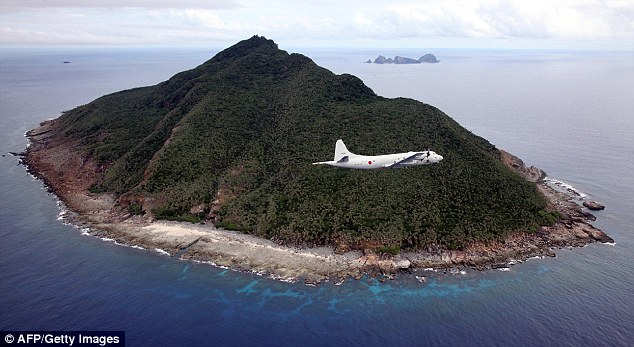
Dispute: This 2011 photo shows a P-3C patrol plane of the Japanese Maritime Self-Defense Force flying over the disputed islets known as the Senkaku islands

Dispute

The ADIZ claims almost the entire area of the East China Sea – a quadrangle comprising China, Korea, Japan and Taiwan – as an extension of Chinese airspace.

The way an ADIZ works is that it extends a sort of sovereignty, a type of territoriality to airspace beyond ones geographic territory. An aircraft that intends to fly through, though technically in international airspace has to notify the claimant.

Most countries have used the declaration of ADIZs to consolidate sovereignty, as both the US and Japan have contiguous to their own territories for defence purposes.

China’s claim, though, doesn’t follow the contours of its coastline but rather juts out – a prominent salient into the sea. In this day and age land grabs are completely unacceptable, sea grabs are becoming unacceptable, and China has jumped the normative gun challenging air norms to possibly buttress its maritime and territorial claims.

There are some interesting dimensions to this episode. The first is the reality that China is the big man on campus in Asia, the U.S. pivot notwithstanding.

Pic 2

Admission: Joe Biden admitted America is ‘deeply concerned ‘ about Beijing’s exclusion zone in the East China Sea

Two; China’s continental outlook is now turning to the maritime domain and its early 20th century Wilhelmine notions of territoriality are being unleashed at sea.

Third; China’s actions do not come from any public discourse or consultation process, internally or externally. China has established therefore, that it is fundamentally a unilateralist, acting through stealth.

And above all, China only respects strength. Japan demonstrated enormous gumption and fortitude during the Senkaku crisis, but President Obama’s vacillations undermined this response. Questioning alliance responsibilities at that crucial moment may have indeed emboldened China in its current gambit.

In the words of Chinese Foreign Minister Qing Gang, “The U.S. should keep its word of not taking sides on the issue concerning the sovereignty of the Diaoyu Islands and stop making improper comments”.

Threat

America’s deliberate violation of the ADIZ by two B-52 bombers was a first step that saw a steady escalation, by Japanese and Korean jets. A day later China’s first aircraft carrier, the Liaoning, sailed into the region and fighter jets have been deployed.

But yet again contradictory messages are coming out of DC. While using the air force to challenge the ADIZ, Washington has advised commercial airlines to respect the rules, all but throwing in the towel. The message from Beijing seems unequivocal “China will wait you out”.

China has an abundance of patience and resolve – and in its own view, it is on the right side of history. This portends trouble for India. If China declares an ADIZ in the east today, what prevents it from declaring the same over Arunachal, Sikkim or Ladakh? If that happens, Indian helicopters will require Chinese permission to land in Indian Territory. India cannot afford to allow this to pass.

The big question is, who will fly a challenging B-52 patrol for India over Arunachal, given that we do not even provide the United States with berthing rights? Given how supine India was at Dempsang, and the lack of public support for its position in the international community, India may find itself having to grapple with a far more ominous ADIZ with greater bite.

Options

India must urgently explore a variety of options to restore deterrence vis-à-vis China. This first thing is to back Japan. The Emperor’s visit last week could have presented India with a moment of expressing solidarity and the impending visit of Prime Minister Abe in the coming month would be a useful time to do some plain speaking and strategic positioning.

But words alone are not enough. India has to work on a range of options including economic and hard options. These must include rationalisation and augmentation of its air force to ensure air superiority in each of its fragile border zones. It must also take a fresh look at reinvigorating its ties with Vietnam, Japan, Australia, Singapore and the littoral states.

Passive diplomacy is now not an option. It must engage with Taiwan, actively,across the board and especially on security issues.

As a last resort, the option of revoking recognition of Tibet’s accession to China, and the status of the Dalai Lama must not be discarded. Changing positions on geopolitical affairs should be a lesson we must learn from the wise mandarins in Beijing.

Ultimately this is a moment of truth for Japan: will the US take its alliance commitments to their logical conclusion or does an insecure and newly militarised Japan loom on the horizon?

This is also a moment of truth for India – where its increasing economic engagement with China must be located within a robust, security architecture – strength being the only currency China respects and it is the only currency of engagement with them.

Lastly it is a moment of truth for the United States; that alliances are absolute and need to be defended in deed and word.

While this analysis could be wrong, nothing is about to change till the Obama-Kerry duo play out the change they keep talking about, because whatever the U.S. has done so far, clearly, is not working. Emperor Akihito’s arrival in Delhi may have been an exercise in pomp and ceremony, but embedded deep within that visit was a menacing message from Beijing.

Standard
Columns/Op-Eds, In the News, Non-Traditional Security

Internet architecture can’t be left solely in hands of developed world

Global Times | 2013-11-7 19:58:01

Original link is here

According to World Bank estimates, India and China together account for more than 700 million Internet users. Citizens in both countries have embraced the digital sphere enthusiastically, and mobile phones and the Internet are the preferred platforms for anything and everything, from expressing opinions to conducting business.

Indian and Chinese stakes in cyber governance are already significant, and are only likely to increase as both continue connecting even the most rural hinterlands, which still suffer from lack of efficient physical connectivity.

Much future global wealth generation will be deeply integrated with the online sphere on account of access to new markets, online supply chains, services and Internet-based financial flows. Hence, India and China, as they seek to raise the incomes of their citizens, will need to transform into sustainable and secure digital economies. Digital governance, norms and rules, and International conventions must see India and China as rule-makers and not rule-takers.

The West, in the wake of the Edward Snowden revelations, is witnessing a new wave of support for discussing and negotiating a certain “code of conduct” for this global commons.

Although the current discussion is more on privacy and surveillance, there are other aspects that must also be vigorously debated.

New Delhi and Beijing must take the lead and articulate their positions and core interests on these issues, and see to it that they are addressed adequately. It is in no one’s interest to see a “virtual gridlock” and the World Wide Web becoming a “World Divide Web.”

The region’s success and prosperity are so closely linked to its successful integration that a divided digital domain may be detrimental to the region.

In fact, both India and China must learn from their predicament of dealing with the border legacy, and should ensure that discussions on cyberspace are not held prisoner to old notions of boundaries and rigid ideals of statehood.

The common prosperity of the two nations is linked to the digital future, and even lifeline provisions such as social security schemes, health and education among others are likely to be delivered through virtual means. Therefore, it is important for India and China to ensure that the world does not witness the birth of “digital sovereignty” where states contest, or of “digital capitalism” where commercial interests prevent this medium from being a global commons.

There are certain historic biases already. Technology, services and access reside with Western corporations and in Western capitals. The Internet must remain technology and geography-agnostic. Any global architecture for both hardware and software must ensure this.

Despite these converging objectives, the conversations between India and China on this subject, much like in other sectors, have been limited and impeded by suspicions and historic security concerns. It is time that the two nations go beyond these.

China seeks to be an influential player in telecommunications and the digital economy in India. And Indian IT companies are looking for a more hospitable environment.

A positive atmosphere and confidence building are a must for realizing these ambitions. In fact, Indian and Chinese companies can jointly lead the way in providing hardware and software solutions to developed and developing economies across the value chain.

To create an environment conducive to business and in order to shape an Asian discourse on cyber governance and cyber security, the two governments must seriously consider the following ideas.

One possibility is to create “cyber hot lines” between nodal agencies, such as between the Computer Emergency Response Teams in the two countries. They should also establish mechanisms for threats and vulnerability reporting and sharing information on gateways and access codes where required.

The two sides can also discuss responses and solutions to counter hacking and malware that threaten economic operations and businesses between and among parties in the two countries. Experiences on protecting critical infrastructure should also be shared. And, finally, they need to undertake joint development of low-cost digital access to, and affordable technologies for, the underprivileged segments of society.

Standard
Columns/Op-Eds, In the News, Politics / Globalisation

A toast to the silly season: Why India’s election process is bringing out the absurd in us all

PUBLISHED:01:16 GMT, 6 November 2013| UPDATED:01:16 GMT, 6 November 2013

Original link is here

It seems that the greatest celebration of India – its democracy and the much-feted elections – also bring out the absurd in us all.

As the five states of Delhi, Madhya Pradesh, Chhattisgarh, Rajasthan and Mizoram go to the polls in the coming weeks, it seems the ‘silly season’ is upon us. We are being saturated with inanities masquerading as “political discourse”.

The problem, however, is that as these samples of ludicrousness tumble out in a disturbingly steady stream, we actually engage with them in earnestness.

article-2487973-1936880A00000578-816_634x394

BJP workers wear masks of the party’s PM candidate Narendra Modi, who is presently spoken of in the manner of a superhero.

Let us therefore first propose a toast to the Indian National Congress and its brilliant and original idea of banning opinion polls on the grounds that these are unfair and influence voters.

Now, in any normal society – leave alone democracy – this would be considered a misguided attempt at humour by a geriatric who has crossed the threshold from dotage to anecdotage. But evidently in India it is taken seriously enough to merit furious (and serious) discussion on talk shows and much scholarly debate on the subject in the online, visual and print media.

Heck! Why stop at opinion polls? The logic that these polls unfairly influence voters can equally be extended to op-eds, reporting, and indeed to the very application of one’s mind. So why not go ahead and ban people from thinking for the next 6 months?

After all, it can be stated with a great deal of medical and sociological certainty that the application of one’s mind creates a capacity within the individual to actually decide his or her fate, as opposed to being a force-fed farm animal that gets shepherded into an abattoir.

Would Sonia Gandhi’s Congress prefer voters to go to the polls blind-folded, lest their genuine opinions affect the vote?

article-2487973-190B89A400000578-399_306x361

In fact, in order to extend wholehearted support to the Congress’ proposals we should take the logical next step of blindfolding the Indian voter before they press the EVM button – so that the voting process can become a lucky draw – truly free of undue influence and bias.

Of course there is the danger that our hallowed Electoral Commission – the so-called protector of India’s freedom and democracy – might actually embrace this fruit-loop scheme.

So let us raise the second toast to the monumental silliness of the Election Commission of India, now rapidly on its way to becoming a much-loved and celebrated ‘law unto itself’.

In its notification dated the 25th of October – “Instructions with respect to the use of Social Media in Election Campaigning” – the EC has made the terminal mistake of assuming that social media is like every other media that has come before it, claiming “since social media websites are also electronic media by definition…”.

While this betrays a deeply flawed, almost astoundingly naive view of the dynamic and deeply democratic cyber-sphere, at a more serious level this has dangerous overtones of the Sippenhaft laws from Nazi Germany.

What this notification means is that the election code of conduct will now apply to mediums of individual output like Twitter, YouTube and Facebook.

Basically any candidate can lodge a complaint against any individual Tweet or Facebook comment based on the fact that they can be “reasonably connected with the election campaigning of political parties and candidates”.

This is guilt by association of the worst possible kind, because now any sympathiser, relative or associate of any candidate effectively has his or her freedom of expression curtailed on the basis of specious reasoning that this can be traced back or connected with a political party.

So much for the Election Commission being the guarantor of India’s democracy! It is sad that this body, overwhelmed by this deluge of election-season silliness, has become the epitome of silliness itself.

Indeed, if the EC is so serious about this regulatory order, it should assume charge of the Ministry of Communications and Information Technology as well as the Ministry of Information and Broadcasting, to avoid any hint of bias on the part of the two wings of the government.

The third toast in this autumn of silliness is reserved for the BJP, its Prime Ministerial aspirant and their rather “unique” take on Indian history.

I am yet to find where Alexander ever set his eyes on the Ganges, I am yet to find anyone named Chandragupta Maurya belonging to the Gupta Dynasty, and Taxila – as far as my maps show me – is part of Pakistan not Bihar – though presumably in some warped version of ‘Akhand Bharat’, northern Punjab may in fact be annexed to the penurious ruin that is Bihar.

Of course logic would have demanded that the head of a speechwriter roll, or the entire research team be put out to pasture. What we see instead is a bunch of experts finding ways to somehow discover coincidence between history and the recent remarks of the BJP’s PM-in-waiting. But perhaps the victor does script history – and let us toast to that possibility.

Despite what they all say; despite the INC’s moral indignation, the EC’s delusions of infallibility and the BJP’s historical certitude, they all think of us – the Indian people – as livestock, incapable of discerning chaff from wheat and deciding for ourselves.

If India chooses to take these people seriously, we really do need to ban any outlets of independent expression and go back to the happy days of black-and-white Doordarshan with programming restricted to Krishidarshan and Zara Sochiye (as relevant today as they were then), because as it turns out the greatest fools are the people who tolerate – nay celebrate, revel in and vote for – such silliness. It is to them the fourth and last toast should be raised.

I say, this season let us all get sillier still, and put our finger on ‘NOTA’.

Standard
Columns/Op-Eds, In the News

Time to rethink differences between neighbors across Himalayas

Global Times | 2013-10-30 19:53:01

Original link is here

The recently concluded India-China summit meeting may have, at the very least, established a new tone and tenor in the relationship between the two Himalayan neighbors.

The Border Defence Cooperation Agreement, the new communication mechanism on water, the thrust on exchanging experiences and expertise on road and highways, and cooperation on an “Asian knowledge system” through the Nalanda University project are all important and substantial steps to take this partnership forward.

There was some useful progress on economic cooperation as well, although more was expected from the two leaders to facilitate greater two-way trade, business exchanges and Chinese investments in India’s infrastructure projects. And there was disappointment in some quarters when bilateral rigidity ensured lack of movement in liberalizing the visa regime.

But for those who see the India-China relationship as one of the key partnerships of this century, what is most disappointing is the lack of ambition in the agenda for the conversations. The two countries now need to be bold and creative in what they do together.

The two must seek to finalize a civil nuclear cooperation agreement. This gives China a credible financial stake in the Indian civil nuclear sector and the motivation to reject its dogma of “capping and rolling back” India’s nuclear program. This would also potentially facilitate India’s entry into the global nuclear order.

India is concerned about the opacity of China’s interests in the Indian Ocean. The two need to proactively engage instead of producing alarmist literature. Their naval and strategic leaderships need to commence frank discussions on common approaches and discover synergies in protecting the sea lines of communication.

India and China have piggybacked on US capabilities in the past, and may have to soon develop and deploy their own capacities.

Be it in anti-piracy operations or humanitarian evacuation, there is ample scope for coordination and cooperation.

Both nations have large diasporas in Africa and West Asia. In Libya, for example, both countries sent their ships to evacuate their citizens. Such coincidence of interests and needs must be mapped, and actions synchronised.

The two countries need to thrash out a common understanding on cyber governance. China seeks to be a stakeholder in India’s communication sector, for which the level of trust between the two countries needs to be enhanced.

A significant share of the world’s commerce has become dependent on the digital realm. This commerce is the key to prosperity of both countries, and yet much of the discourse on cyber management emanates from, and key infrastructure resides in, the Atlantic countries.

Bilateral cooperation on the ongoing international dialogue on Internet governance and on issues relating to development of related infrastructure and connectivity is essential.

China and India must realize that a strong and stable Afghanistan and Pakistan are in their interest and vital for the stability of the region.

For far too long, India and China have allowed the situation to drift out of strategic or other considerations. A dialogue on aiding the development and growth of these countries must commence between the Asian giants.

China, as a trusted ally of Pakistan, and India, as a friend of the Afghan people, can together help in rebuilding and reintegrating these parts into the Asian economic mainstream.

Both countries also have similar interests and stakes in outer space and ocean governance. They are handicapped by the fact that they are new voices in the normative debates on these subjects.

This is the moment to evolve a common position before entering larger negotiations with an individual weak hand.

The two countries need to come up with tangible alternatives in what is today a one-way norm setting exercise in these new arenas of governance, with the opposition too divided to have any impact.

Ultimately, we may find that our converging interests bind us more closely than we would have imagined or, for some, liked.

Dealing with this will require bold political leadership on both sides and a pragmatic desire to integrate our largely coincident aspirations.

Standard