BRICS, India, India-Russia, international affairs, world order, Writing

5 ways in which India-Russia relationship will shape the world in 2025

The ability to partner with nations that are deeply divided by geopolitics has been a feature of Indian diplomacy since Independence. The India-Russia relationship serves not just the two countries in question, but the world

Foreign policy trends in 2025 will be shaped by shifts in great power relationships. A new administration in the US could upend its relations with old allies in Europe and intensify rivalry with China. In an uncertain world, India plays a leading role in maintaining balance. The global community is watching New Delhi’s efforts to restore stability to its troubled relationship with China, and wonders whether the Indo-US dynamic will recapture the energy that characterised it in Donald Trump’s first term. In spite of all this, the most consequential bilateral relationship in 2025 will be between India and Russia.

The strength of ties between New Delhi and Moscow matters to both countries. It touches core mutual areas: Trade in energy, technological co-development, and strategic interests. Russia remains India’s most accommodating partner when it comes to high-tech supplies. While the West — France and the US in particular — are relaxing rules for trade with India in dual-use tech, there is still a long way to go before New Delhi’s undersea and long-range requirements are satisfied by the West. This is where Moscow steps in.

The global community is watching New Delhi’s efforts to restore stability to its troubled relationship with China, and wonders whether the Indo-US dynamic will recapture the energy that characterised it in Donald Trump’s first term.

What some overheated commentary on the India-Russia relationship misses is that it is of deep importance for the West as well. The BrahMos missile, co-developed by India and Russia, has been given to the Philippines to fend off the Chinese. In other words, it is only through India that Russian technology can be used to preserve the rules-based order. And it is only because it is India that no Chinese veto is permitted by Moscow on such sales.

This is but one example of the unique nature of the relationship between India and Russia. Their closeness will have deeper implications in 2025, a year in which it will be recognised as a global public good. Here are five ways in which this relationship is vital for the preservation of global order.

First, it serves as a bridge between the rest of the world and a Russian polity that has been alienated by, and has set out to further alienate, the Western ecosystem. India’s commitment to multilateralism and the global order anchors Russia, its close partner, to a system that it otherwise seeks to disrupt. India can do this because it is not seen as agitating for any one political or geopolitical position. It is a boundary nation that transcends systems, and provides an ability to connect — even integrate — separate universes.

Second, the India-Russia relationship prevents the Russian bear from totally entering the dragon’s den. A Russia locked into servitude to Beijing’s interests would be profoundly inimical for the world order, the West in particular. India’s outstretched hand grants Russia the ability to manoeuvre and allows it to avoid capitulating completely to China’s demands. It has become increasingly clear — at BRICS and elsewhere — that avoiding becoming a junior partner to its giant neighbour is a priority for Moscow. Russia expects a partnership of equals. India provides one, China does not. Europe must realise that when peace eventually returns to the continent, it will be with Russia as an equal of the European Union, and not subordinate to it.

India’s outstretched hand grants Russia the ability to manoeuvre and allows it to avoid capitulating completely to China’s demands.

Third, trade between India and Russia in fossil fuels is designed to be compliant with sanctions meant to limit Russian profits. This too provides broader benefits to the world. It brings valuable price stability and predictability to energy markets, which is vital for the West and for Europe in particular. It is no exaggeration to say that the energy trade component of the Indo-Russian relationship prevents Europe from slipping further into political disorder.

Fourth, the relationship allows for new possibilities in the crucial Arctic region. Without India’s increasing strategic presence in the Arctic, in partnership not just with Russia but also with European and Nordic friends, a new Russia-China axis would have shaped the region’s future. This would have spelt disaster for the ecology and security of global supply chains. India’s growing role instead opens better options. A Chennai-Vladivostok corridor, co-owned by Russia and India, might be a first step towards a more effective and inclusive connectivity and governance architecture for the region.

Finally, India’s presence in groupings with growing power and influence like BRICS and the Shanghai Cooperation Organisation ensures that these are not weaponised against the West. As External Affairs Minister S Jaishankar has put it, India is non-Western, it is not anti-Western. This moderate and reasonable attitude shapes the actions and positions of such groupings. The entry of New Delhi’s candidates — and Western friends — such as the UAE, Egypt and Vietnam into BRICS as either members or partners has further moderated that grouping. The presence of these countries, and India’s leadership, ensures BRICS serves more as a complement to legacy, Western-led multilateral groupings than as a challenge.

India’s presence in groupings with growing power and influence like BRICS and the Shanghai Cooperation Organisation ensures that these are not weaponised against the West.

The ability to partner with nations that are deeply divided by geopolitics has been a feature of Indian diplomacy since Independence. It is only now, however, that this ability will be revealed as essential to prevent the fracturing of a stressed global order. The India-Russia relationship serves not just the two countries in question, but the world. The policy community in both India and the West is keenly aware of this relationship’s pivotal importance. Scepticism in the West’s Russophobic media and think tank ecosystem does not change that reality.

Source : The Indian Express, December 20, 2024

Standard
Africa, BRICS, China, India, international affairs, Russia Civil War, USA and Canada, Writing

The United Nations Security Council is constituted to further the colonisation project

We can all agree today that this has been a very long decade; and it’s only just begun. The fabric of internationalism has been ripped in the last three years, and the ability to forge consensus on many vital questions that can enrich peace and strengthen security is at its lowest in nearly a century. There is a clear need to reform and reshape key institutions of global governance. Certainly, the United Nations Security Council (UNSC), in particular, needs an urgent overhaul.

Yet, we are all aware that the United Nations (UN) process as well the UNSC reform process are going nowhere. It is a fact that only once in the nearly eight decades of the UN’s existence has there been some semblance of reform—when the non-permanent seats of the UNSC were increased from six to 10. Since then, all efforts have largely been exercised in hollow statement-making. Tragically, these statements come with no timelines and are, of course, devoid of any content. Perhaps, this is the right time for this debate. Hence, the idea of bringing in new voices and opening this issue up for debate and discussion to the larger public—to the research community and to academia—must be lauded. We hope that the curious mix of practitioners and thinkers from the Global South can produce some breakthrough solutions that can take this debate forward.

The fabric of internationalism has been ripped in the last three years, and the ability to forge consensus on many vital questions that can enrich peace and strengthen security is at its lowest in nearly a century.

Decades of inaction have also resulted in the prevention of reforms becoming an ideal and an objective in itself. We have seen obstructive tactics, the emergence of a number of clubs and groups on this topic, and a myriad ways of stalling, delaying, and preventing progress. This, now, has become an end goal, and, perhaps, even a key responsibility area for diplomats posted to the hallowed institution that is the UN. That must change. We need to talk about progress in real terms. What should be the new format for engagement? There can be many answers to this question. What diplomats like Ambassador Ruchira Kamboj and academics like Matais Spektor say may not be the only solution. The solution may, in fact, lie in very different viewpoints and voices, and it is imperative that we hear them. Most importantly, we must all agree that status quo is not an answer.

The UN is facing a crisis of credibility as a global institution; and the lack of progress in the reform of the UNSC is going to create complete disenchantment. The future of the UN and its role is intimately linked to the progress made on this subject. Therefore, we must recalibrate our efforts as a global community and make sure that discussions on the reforms are infused with fresh voices and perspectives from geographies that are likely to contribute significantly to a stable and prosperous future. These are also the same nations that are likely to be most affected by a dysfunctional international institution.

Perspectives from the G20 and BRICS

Two recent debates we in India have been engaged in are of relevance to the conversation on institutional reform. One, of course, is courtesy the G20 presidency and its engagement groups that are working on various aspects of multilateral cooperation. Multilateral reforms is one of the most important debates happening in these groups. We are all apprised of the fact that the UNSC, the UN itself, the multilateral development banks, and the financial institutions need a complete overhaul. These institutions are no longer serving us in this particular century. The second is the aspirations of the BRICS. Under South Africa’s Presidency, there is an eagerness for and anticipation of institutions accommodating the aspirations of the African continent—a continent that is rising dramatically and rapidly.

The war is history, and so are the influence and capabilities of some of the members of this erstwhile group of victors.

We can see that different groupings are also beginning to understand and agitate this very important issue. Why is this important? Why mention the G20 and BRICS? The answer is: because we live in a deeply heterogeneous world. Some people also call it a multipolar world. It is untenable that a group of victors of a war from another century should be in charge of managing the world of today. The war is history, and so are the influence and capabilities of some of the members of this erstwhile group of victors. It is time to strengthen the A-Team and bring in voices who can serve all of us better. But beyond this particular aspect, there are three reasons for why we should be thinking about reform.

Why UNSC reform in particular

First, the current structure of the UNSC is perverse and immoral. For many in the Global South, it is a perpetuation of the colonisation project. The burden of the two World Wars was borne by the colonies, while the privileges of peace benefited the colonisers and their allies. Today, that is something that is being questioned by many; and it is increasingly going to become an important aspect of future debates as the world gets impatient with lack of progress in institutional reform.

Second, the reform is important because, currently, the UNSC is inefficient and does not serve the purpose it was installed for. In the past decades, we have seen how the will of the comity of nations has been negated by one or more of the permanent members. More recently, the crisis in Ukraine presents a classic example of the Security Council’s failure to deliver, and it is a stark reminder of why status quo is untenable. The voting patterns and the abstentions on the Ukraine conflict clearly point to the need to bring in others who can contribute to the global efforts around peace and stability.

We are struggling to reform the UNSC due to the nature of the inter-governmental negotiation (IGN) process itself.

Finally, the UNSC is undemocratic and non-representative. How can we accept a structure that shuts out Africa, Latin America, and democratic Asia, including the world’s largest democracy? The Permanent Five (P5) was configured to disproportionately include three European nations. Even having three nations in the P5 could not keep peace in the Old Continent. Clearly, here, three is a crowd. We need to reconfigure how we have structured the P5.

But this may not be the only viewpoint that is valid. There are others as well, and we must respond to and engage with them. For example, Uniting for Consensus argues that there cannot be any permanent membership of the UNSC for new members. This is a viewpoint against permanency and it must be put on the table. But, we must ask, if there is no permanency, why is it not applicable to the P5 as well? Why is it that all UN member states who want to be sitting as credible actors in the UNSC should not gain favour of 129 votes and assume a permanent role? These debates must not be cast aside or shut off. In fact, different groups and different viewpoints must be brought into the same room. And we hope that through this academic track, we can actually bring these varied perspectives together and come up with a mosaic of ideas and, thereafter, a symphony of solution.

To conclude, two points must be highlighted. First, we are struggling to reform the UNSC due to the nature of the inter-governmental negotiation (IGN) process itself. The fact that the IGN process, unlike any other in the UN, needs consensus for both process and outcomes makes it a nonstarter. In no UN negotiation is consensus a precondition for commencement. This is a fatal flaw in the way the process has been stitched together and no progress is possible unless we revisit this core element. Second, what is imperative is a concrete timeline as well. The 2024 Summit of the Future is being touted as a platform where productive discussions about UNSC reforms may finally take place. But the 2024 Summit cannot be regarded as a cure all and a one-stop-shop for everything. We must agree to a two-year timeframe, or a timeframe that others may suggest to be more viable, and we must rigorously adhere to it.

By the time the UN turns 80 in 2025, UNSC reforms must be well underway. Let us make this target a common agenda for all of us, with all our different viewpoints. Let us unite our energies to transform the UN into a multilateral institution that truly recognises the sovereign equality of all member states, and undertakes an operating systems upgrade that will bring it—with the rest of us—into the third decade of 21st century.


This article formed part of the Framing Remarks given by Samir Saran, President, ORF at the Roundtable on, “Shifting the Balance: Perspectives on the United Nations and UN Security Council Reforms from Global South Think Tanks”. 

The roundtable also saw the participation of Ruchira Kamboj, Permanent Representative of India to the United Nations; Matias Spektor, Professor of International Relations, FGV, Brazil and Visiting Scholar, Princeton University; and Gustavo de Carvalho, Senior Researcher, South Africa Institute of International Affairs, South Africa.

Standard
BRICS, China, Speaking

BRICS Academic Forum 2022 | Opening Plenary

BRICS,consensus,Consolidation,Continuity,Digitalisation

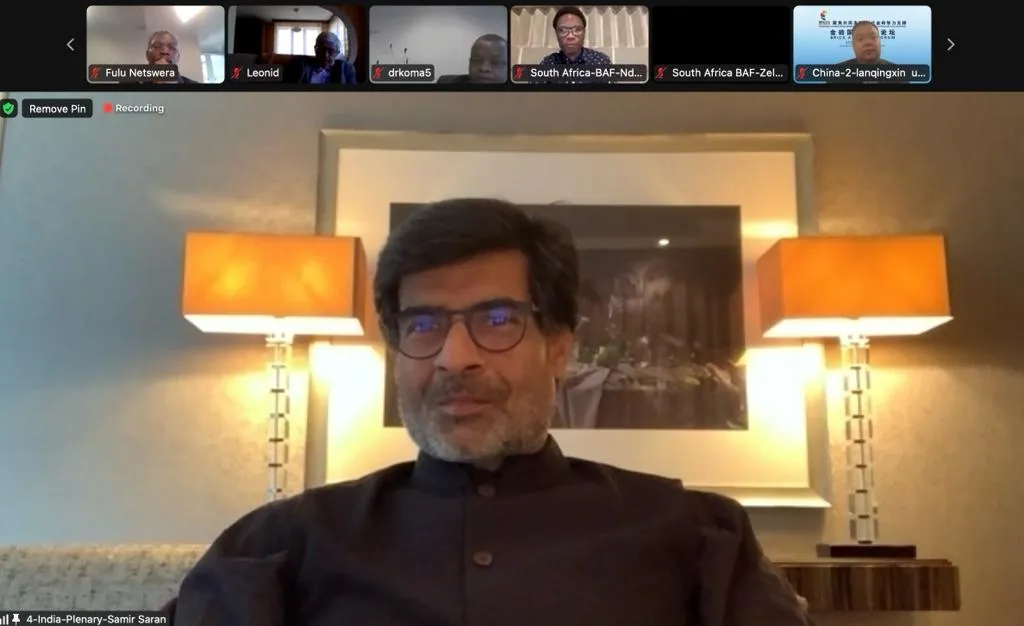
Remarks by Dr Samir Saran at the Opening Plenary session of the BRICS Academic Forum 2022

It is a pleasure to be back again and be a part of the academic forum that has continued to raise important issues for intra BRICS cooperation and indeed, for the challenges that confront our world.

We are meeting today at an important moment—a moment that will be recorded and studied by future generations. It is important that all of us rise to the challenges that confront us and be creative in discovering solutions. Three major trends are seeking our attention and indeed, resolution.

First, global politics has been upended by the political actions in Asia and Europe. Conflicts, contests, and careless power projection have jeopardised stability, peace, and prosperity for all. Can we discover a new geostrategic balance and what role can BRICS play?

As we emerge from the pandemic—or at least begin to learn to live with it—what are the lessons that we have learnt? Will new development and growth models emerge, and will BRICS and other actors invest in what is most important for humankind?

And finally, we are experiencing the digitalisation of everything. Technology is having an impact on our economy, our politics, our societies, and indeed our individual behaviours, choices, and assessments of the world we live in.

New Politics, Green and Inclusive Growth, and our Common Digital Future beckons us. At the Indian presidency of the BRICS last year, we coined three words—Continuity, Consolidation, and Consensus. These remain relevant even as China steers the group and must continue to define the BRICS agenda.

We have to work together to overcome the contested politics of today. We must be contributors to stability in world affairs. We should reject actions as a group and as individual nations that can create further instability or exacerbate current tensions.

BRICS was always meant to be a grouping that would offer an alternative path to one prescribed by the Atlantic Order. We must continue to strive to do this. Unipolarity must give way to multipolarity. Bipolarity is not an option.

Three key elements will shape the path that BRICS and others must pave.

First, as the political assumptions of the 20th century may no longer be sufficient or valid for a more complex world, we must work together to script a multilateralism that is fit for purpose. It must reflect current realities, the aspirations of different geographies, and a governance structure that is plural, transparent, and accessible. The old hegemony of the Atlantic Order must not be replaced by a new hegemony from another region.

BRICS must continue—individually and collectively—to remain inclusive in shaping the multilateral system. This system must deliver on economic and trade growth. It must find new ways of catalysing financial flows for infrastructure and aspirational needs of multiple geographies. Multilateralism for this century will require new anchors and champions. BRICS can play that role, provided all members are committed to it.

Second, future growth and our economic needs will have to cater to our planetary responsibility. Green transitions must not simply be a buzzword, but the policy design for all. BRICS must work—both within and with others—to put together a template to invest toward a green planet. We have to rethink mobility, urban spaces, consumption, and our lifestyles. We must also work to protect those who are already being burdened by the deleterious consequences of global warming, rising sea levels, and harsh weather conditions.

Thirdly, we have to embrace technology and not allow it to become the new arena for zero-sum politics. The world must see technology as a digital public good and it must serve all of humanity equitably. The rules for this digital future are yet to be written. These rules must not be written only by the western hemisphere. In the absence of such agreed rules, sovereign arrangements must prevail over those written by the boardrooms. BRICS can share experiences and learnings from our individual journeys and offer to the world examples and methods of managing our common digital future. We must ensure that countries, within and outside, do not weaponise technology or game the digital public square.

It is impossible for BRICS to attain its full potential and contribute to global affairs unless each member is committed to the BRICS project and the thinking that led to its creation—peaceful co-existence, within the group and with others, being the primary ethos.

Standard
Books / Papers, BRICS, China, COVID-19, Research

Stocktaking and Recommendations for Consolidation: Joint Academic Paper by ORF and RIS

As the BRICS passes through a crucial milestone of its existence, celebrating 15 years of its formation, this report examines the initiatives launched since inception and makes recommendations for consolidating and streamlining the agenda.

The BRICS remains a prominent grouping in the global governance architecture due to the individual influence of each member-state and the collective size of their economies. The confidence in BRICS from within and the perceptions outside the grouping are shaped by its successes in institution-building and resource mobilisation. The highlight of BRICS’s success is its strong focus on issues of financial stability and global governance reforms, particularly in areas related to macroeconomic stability. These are supplemented by attention to sustainable development issues backed by finance and technology.

The BRICS agenda has witnessed a steady expansion of its scope ever since its inception. During the initial years, the agenda was focused on responding to the trans-Atlantic financial crisis with a special focus on multilateralism, particularly the need to reform the international monetary and financial architecture. Subsequently, the BRICS established the New Development Bank and the Contingent Reserve Arrangement, two flagship financial initiatives that remain the biggest success stories of the plurilateral to date. Notably, with the outbreak of Covid19 in 2020, there has been a special focus on responding to the pandemic and coordinating recovery.

Given the expanding scope, there is a need for consolidation and streamlining of the BRICS agenda. This will help address structural deficiencies and facilitate the smooth coordination for building consensus on key issues. To realise these goals, a thorough review of the BRICS cooperation mechanisms is necessary. This joint academic study presents an assessment of the various tracks under the BRICS framework, such that the grouping can better pursue the collective agenda of economic cooperation and sustainable development.

The year 2021 has been significant, with the Indian presidency underscoring ‘BRICS@15: Intra-BRICS Cooperation for Continuity, Consolidation and Consensus’ as the theme. The aspect of ‘consolidation’ received special attention. The Indian presidency also helped in concretising several action areas that had remained dormant. A case in point is the Agriculture Research Platform proposed by India at the 2015 Ufa Summit with a memorandum of understanding signed during the Indian presidency in 2016. This was launched in the virtual format in 2021, again during India’s presidency.

India’s presidency of BRICS in 2021 has set a definite example for streamlining of the BRICS agenda. As the agenda consolidates, future presidencies will find room for emerging themes that require urgent attention. Consolidation does not always only mean weeding out weaker sprouts, but to have comprehensive approaches towards setting common goals so that even relatively weaker initiatives can be scaled with resources. A preliminary assessment of the initiatives launched by BRICS is presented in this report.

Standard
BRICS, Columns/Op-Eds, Uncategorized

After Doklam, India and China must begin anew at the Xiamen BRICS meet

India will have to learn the fine art of staring down the dragon to preserve its political space, while embracing China for some important economic opportunities. At Doklam, it did the former; will a different India turn up at BRICS?

Hindustan Times, September 3, 2017, Opinion

Original link is here

pm-modi_32f6a540-8f0f-11e7-a11b-07a9009e9c44.jpg

PM Modi with Russian President Vladimir Putin, Brazilian President Dilma Rousseff, Chinese President Xi Jinping and South African President Jacob Zuma after the welcome ceremony at the 7th BRICS Summit in Ufa.(PTI)


Leaders of Brazil, Russia, India, China and South Africa (BRICS) have gathered this past weekend for the ninth annual BRICS summit in Xiamen, China. The prolonged Himalayan standoff between India and China will cast its shadows on this meet and will certainly add a new dimension to discussions on the future of this plurilateral.

The BRICS emerged out of a global order dominated and managed by the United States (US) post the break of the Soviet Union. The US led institutions catalysed global trade and financial flows, which in turn also helped in the organic growth of most of the BRICS economies. Despite their growth, their marginal role in management of key global institutions created an undesirable asymmetry in world affairs. BRICS came about as a vehicle to respond to this, and together they hoped, they would be able to loosen the vice-like grip the Atlantic system had on existing governance institutions.

There were two unstated principles that shaped the ethics of the BRICS formation. First, each nation placed a premium on sovereignty and its importance in the conduct of world affairs, and second, each state sought greater pluralism and equity in decision-making processes in a multipolar world.

The China and India standoff at Doklam compels us to revisit these organising principles. The Doklam incident was a contest around sovereign concerns. These concerns are rooted in history and muddied by China’s determination to implement a political and economic arrangement across Asia that is insensitive to the territorial rights of India. The Belt and Road Initiative (BRI) and the associated China Pakistan Economic Corridor (CPEC) are but thinly veiled attempts to shape an Asian order that plays by the Chinese rulebook alone. While BRICS symbolises a multipolar world, BRI and CPEC are the harsh face of an undesirable and unipolar Asia.

Further, China’s latest attempt at creating a ‘BRICS Plus’ platform, comprised of states who happen to be key actors in the BRI, makes it clear that it sees BRICS as an adjunct of the BRI and merely as a vehicle to catalyse its larger ambitions.

These events make it clear that we must shed the romantic notion that ideological convergence is possible within BRICS. Each member must see the group for what it is—a twenty first century ‘limited purpose partnership’ among states to achieve specific sets of outcomes. There is nothing inherently improper about such an alliance, however, if progress is to be made, it will be predicated on creating effectively designed institutions.

The most successful BRICS endeavour has been the creation of the New Development Bank. The time has come to build on this initiative and focus on creating more institutions for greater cooperation in issues such as finance, urbanisation, sustainable development and the digital space. This could include setting up a BRICS credit ratings agency, a BRICS research institution and institutionalising the process of managing the global commons such as the oceans and outer space.

It is obvious that each of the BRICS members will have their own reasons for being at Xiamen. Russia continues to see it as a geopolitical bulwark against the US, all the while tacitly acquiescing to Chinese leadership. South Africa will present itself as the leading voice of the African world and will raise issues of peace and development for the continent at the summit, while Brazil, which is undergoing a period of domestic turmoil, is unlikely to be too innovative or demanding. China is far more certain of what it seeks.

For India, this year’s summit becomes important. India will have to learn the fine art of staring down the dragon to preserve its political space, while embracing China for some important economic opportunities. At Doklam, it did the former; will a different India turn up at BRICS? Forums like Xiamen allow India and China the chance to begin anew.

As we enter the second decade of BRICS, Xiamen would have to be the arena where the members recommit to upholding the founding principles of the BRICS. Thereafter, they must chart a new roadmap for greater institutionalisation of the group’s interests.

Samir Saran is vice president at the Observer Research Foundation and tweets at @samirsaran

The views expressed are personal


Standard
BRICS, Development Goals

Economic diplomacy and development partnerships: Rethinking India’s role and relevance

Samir Saran  and Urvashi Aneja, ORF Website, Oct 28, 2016

Original link is here

There are two prisms through which India’s role as a provider of global public goods and as a contributor to the evolving global growth and development agenda can be assessed. The first is a continuum starting from the independence of the erstwhile colonies, the Bandung conference and the Non Aligned Movement, to a more recent focus on south–south cooperation. This continuum is located within the narrative of solidarity, justice, economic reparations, development rights, and more recently, around the texture of assistance forthcoming from the emerging economies willing to share their growing available surpluses with their G–77 compatriots. India and its development sector analysts have, for the most part, framed its development partnerships through this prism. The recent BIMSTEC–BRICS meet in Goa, followed this course.

The second view of India’s role could be understood through the phenomenon of ’emergence’, one that breaks away from the above continuum and instead positions India (and some other nations) at a juncture where, beyond solidarity and rights, it is the responsibility of being a global power (and attendant benefits that flow from being one) that compels a certain development partnership agenda. In this view, India has new opportunities that necessitate new responsibilities driven by its expanding global interests, both of which shape the country’s development partnership initiatives. This assessment replaces romanticism with realism and is less frequently voiced for this very reason. India must be careful that this hesitation does not reduce the scope and ambition of its development partnership agenda to one limited to the vocabulary of south–south cooperation.

India has new opportunities that necessitate new responsibilities driven by its expanding global interests, both of which shape the country’s development partnership initiatives. This assessment replaces romanticism with realism and is less frequently voiced for this very reason.

This is not to suggest that south–south cooperation is not important and has not influenced contemporary conversations on development and growth. It certainly has redefined ‘aid’ by introducing new financial and technical ethics and cemented the concepts of ‘partnership’ and ‘national ownership’ as normative benchmarks. Even more importantly, new southern partnerships for development finance and international economic support have shaken up the institutions of the OECD from their ambivalent slumber characterised by a prescriptive development policy agenda and conditional financing. It has made the traditional donors more reflective and considerate in their economic engagements.

But, taken too far, the south–south cooperation framework can reduce the role and ambition of a country like India in global development to a mere extension or function of southern solidarity, one proscribed by the limits to south–south cooperation reflected in its description; one by the ‘south’ for the ‘south’. The global south must be the core constituency and ethical mooring of India’s development partnerships but not its ambition or the philosophical anchor of its economic diplomacy responsibility.

Taken too far, the south–south cooperation framework can reduce the role and ambition of a country like India in global development to a mere extension or function of southern solidarity.

It is too limited a world view for a country of 1.3 billion people that has set itself a goal of becoming a USD 8 trillion dollar economy in the next decade and half. It is inevitably poised to become a net provider of global public goods. It is perhaps destined to inherit the task of managing global institutions that exist and building new institutions that this century will demand. These likely eventualities must steer policy formulation and implementation of India’s economic diplomacy objectives, even as it indulges in the grammar of historic solidarity.

India’s role for itself must be redefined through the prism of its ’emergence’, as an actor with agency already far above its economic weight, and likely to increase significantly over time. This is due to a number of factors. First, the largest incremental capital for global development and infrastructure beyond what exists today will be contributed by India, its institutions and corporations in the next fifteen years or so. Even if this incremental capital only comprises a modest proportion of the total development finance pie, the fact that India will make the largest new contribution will augment its global agenda–setting power in the age of climate change and renewed commitment to sustainable development. In absolute terms as well, back–of–the–envelope calculations suggest that the current $2.35 billion earmarked for overseas grants, concessional loans, and technical training will rise to approximately $10 billion by 2030 if deployment follows GDP growth. To put this in perspective, the UK Department for International Development’s (DfID) annual budget for 2015–16 is $12 billion, a figure likely to come under stress in the days ahead. Other agencies like the German GIZ will also at best be able to maintain their level of contributions.

normative benchmarks, development finance, policy agenda, conditional financing, solidarity, responsibility, emergence, finance pie, climate change, sustainable development, DfID, budget, development narrative, low-income, mid-income, fossil fuel, policy assumptions, human rights

Second, beyond the numbers, India may also have a new path to offer, a new development narrative to share. In all likelihood it will be the first country to move from low–income existence to a mid–income economy in a fossil fuel constrained and climate aware world. It will have to make this transition discarding the key economic choices and policy assumptions that aided Europe and America, Japan and China. Cheap labour, bulk manufacturing, cheap energy, exploitative economic policies with scant regards for human rights and even perhaps the liberal and open trade regimes that have defined the past decades of growth. The India story, if and when mature, will resemble none; it could be a unique and contemporary blueprint for other developing countries attempting similar transitions. While it is impossible to predict the details of India’s transition, some aspects can be anticipated. The economic change will ride on frugal innovation helping a frugal service economy. It will be buttressed by the capacity to at the same time offer high–quality low–cost services to domestic and global markets. It would have also created a new framework to provide skilling, education, employment and security to not only the half a billion population added in the past three decades, but also to the burgeoning senior citizenry growing each year.

The India story, if and when mature, will resemble none; it could be a unique and contemporary blueprint for other developing countries attempting similar transitions.

And finally, India may also lead the way in crafting a new trade architecture in South Asia and with partners in the developing and emerging world. The current global trade regime is under strain as restrictive agreements amongst the OECD countries and some others are undermining the WTO, and the benefits to developing countries are dwindling. The current trading system is also based on an incomplete globalisation. It is biased towards the movement of capital and goods, but much less towards the movement of services and peoples. For developing countries compelled to respond to 21st century challenges through the acceleration of a service economy, this partial globalisation poses clear challenges. For India, its South Asian neighbours, Africa and some others herein lies an opportunity to re–craft their trading arrangements to support their 21st century development trajectories.

Looking through an emergence prism, India’s development partnerships and economic diplomacy must be built around three concentric circles of interest and influence. The first must encompass India’s immediate neighbourhood and the big powers; the second, would cover its extended neighbourhood extending across Asia and the Indian Ocean littoral with some localities important for what they offer; and the third may include some distant geographies, all global commons and vital global issues and institutions to manage them. Development partnerships and economic diplomacy in each should be driven by a specific set of interests, capabilities and priorities.

Development partnerships built around these three concentric circles will allow India to build direction, specificity, and flexibility into its initiatives; to create a differentiated approach across various geographies; to build alliances and institutions that cut across the north and south; to find a balance between its immediate economic and strategic interests and its global responsibilities; and to manage and respond to the complex and multifarious requirements of a global development provider.

To be clear though, to argue for an emergence prism over a south–south narrative does not imply that India’s economic diplomacy should reject the importance of communities and collective norms for a singularly realpolitik logic; on the contrary, sustaining the role of a leading development provider will require India to be a normative power more than ever before and build communities, create opportunities and discover growth across the binary North–South and East–West divides. As a leading power it must cross this bridge first.


Standard
BRICS, Columns/Op-Eds, Politics / Globalisation

Brics Summit in Goa: Ahead of 8th conference, the bloc must focus on institution-building

Original link is here

When India hosts the 8th Brics Summit in Goa next month, it will need to be the ‘B’ along with the ‘I” in Brics. The ‘bright spot’ that infuses direction, ideas and momentum into a collective whose individual members have certainly seen better days. With a relatively strong economic performance and a vigorous and imaginative foreign policy (on most counts), India has the capacity to help the Brics plurilateral discover a new ethos that will channel cooperative sentiments into concrete objectives, durable institutions and constructive internationalism.

For the Indian Brics presidency to achieve this, it would need to get all members to agree on the need for creating new and agile institutions that can help the group and others respond to the current economic and political realities, and the visceral gridlock that plagues multilateralism and global governance generally.

In a recent article penned by the authors, two organising principles had been proposed as being fundamental to the Brics regimes even as they seek to reform, reshape and steer the contemporary geopolitical and geo-economic environment. The first was the principle of ‘sovereign preponderance’ and the second the principle of ‘democratic equity’. As per the former principle, the state remains the primary and inviolable unit in the international system and its imperatives override all other concerns in setting the international agenda. Intra-state cooperation is possible insofar as such cooperation leads to greater state agency. This higher agency is then channelled to meet the unique developmental needs of each country and, through it, the global community.

(from left)  Michel Temer, Narendra Modi, Xi Jinping, Vladimir Putin and Jacob Zuma ahead of the 8th Brics Summit. Twitter @BRICS2016

The principle of democratic equity holds that the international order, in the economic, political or security spheres, should be shaped equitably after taking due cognisance of the increasing heft and aspirations of emerging powers and economies. These two principles do indeed shape various Brics regimes that contexualise developmental and economic goals, both within the member-states and in the international system at large. They also motivate the stated ambition of this group to redress unfairness (perceived and real), intrinsic to the extant global political and economic governance architectures. With these organising principles as the basis, it becomes apparent that ‘institutions’and ‘institutionalisation’ are imperative for the collective-action plans of the Brics.

The very act of institutionalisation within Brics gives the Brics regimes lives of their own, even while there is contest and conflict on some issues among member states. Institutionalist literature and studies have recognised this aspect. This literature suggests that institutions persist, since the costs of setting up new institutions are often much higher than the benefits that would accrue by dissolving them. Sunk costs (into building institutions) also lock institutions into a path of dependence that leads to increasing (as opposed to decreasing) returns over time.

Institutions codify cooperation and convergence of expectations. They also specify limits to cooperation by delineating formal agreements on some instances and looser norms of cooperative behaviour on others. The former is, by definition, binding while the latter allows wider sovereign leeway.

Taking a leaf from this body of work, the Brics must seek to further their agenda through the creation of four new institutions and institutional arrangements with varying degrees of formalisation.

The first such formal institution must be the New Development Bank Institute (NDBI), the ideational arm of the NDB and perhaps of the wider Brics project itself. The notion of the NDBI was proposed by Prime Minister Narendra Modi last year who described it as “a bank of ideas, a storehouse of experience and a knowledge powerhouse”. The NDBI must become the institution that defines the pathway for the bank but more expansively becomes the laboratory where Brics produces new narratives, discovers new ideas and develops new solutions for the political and economic future. It must seek to become an OECD-like think-tank of and for the emerging world, where issues of economy, currency, credit rating, political risk, industrial models and development options are agitated and sought to be responded to.

A second key arrangement must be developed for trade and commerce. It is apparent that the Brics, more than any other significant group, is invested in the open and democratic trading system led by the WTO, even as the progenitors of the WTO are seeking to subvert the system with mega free trade agreements involving group of similarly placed economies and some others with little choice or agency. One area within this rubric would be the setting up a body that would develop and set Brics-wide standards and benchmarks. While a Brics free trade agreement appears far-fetched, a body that sets benchmarks and standards is in everyone’s interest. It allows Brics to engage on an aspect that decisively shapes global trade and would contribute to strengthening the multilateral trading regime, even as it furthers intra-Brics trade without a formal FTA.

The very act of institutionalisation within Brics gives the Brics regimes lives of their own, even while there is contest and conflict on some issues among member states.

A third key Brics institutional framework that must be created, is for the digital economy where Brics members are already key stakeholders. Currently, the Atlantic powers are embarking on a major programme to shape the norms that will govern the digital space. The proposed ‘Digital 2 Dozen’ principles of the Trans-Pacific Partnership, and the digital regulation initiatives of the European Union are examples of this. As leading consumers as well as creators of digital technologies, products and solutions, Brics needs to be influential voices in the norms-making space. They must act to shape the discursive space around the digital world and inform debates around contentious issues such as encryption, supply chain integrity, data management and data flows and appropriate stakeholder models to manage these aspects.

Finally, Brics must formalise institutional collaborations that explore the unique opportunities and challenges lying at the intersection of the twin imperatives of economic growth and sustainable development. The Brics development agenda should be one that promotes the latter without sacrificing the former. This could be tasked to a standing conference on development partnership, an initiative to discover and promote a Brics development agenda. It would also catalogue experiences of member states and others, diffuse lessons learned to those who seek it, and track progress unobtrusively within a voluntary and democratic framework.

It will follow and measure Brics’ implementation of the ambitious multilateral agreements pertaining to sustainability and climate action, but in a way that does not constrain imperatives of states as they chart their unique developmental trajectories. This new ethos of managing development and assisting others in their own endeavors correspond to both the organising principles of sovereign preponderance and democratic equity.

Samir Saran is vice-president and Abhijnan Rej is a fellow at the Observer Research Foundation. This article is drawn from a forthcoming monograph by the authors titled Thinking BRICS: A Theoretical Inquiry Into Emerging-Powers Plurilateralism

Standard
BRICS

BRICS, globalisms, and the return of the state

Samir Saran and Abhijnan Rej

Original link is here

As New Delhi gets ready to host the 8th BRICS Summit in Goa in October, both the sceptics and believers are tentative in their support or criticism of the BRICS project. Commentators are also unable to comprehend or explain the nature of the grouping and the regimes it seeks to promote. In order to understand the means-ends logic of BRICS, we must situate it within the longer arc of contemporary history while seeking a better explication of the evolving relationship between liberalism, multilateralism and multipolarity.

This is crucial if we are to make sense of this unlikely grouping and its role in a world that now resembles 19th century Europe, post the Congress of Vienna in 1815. The order that emerged then was starkly driven by national interests of a constellation of powers, and arranged according to balance-of-power principles. As such, it was one of the earliest historical examples of how great powers could “cooperate under anarchy,” to riff a term from late 20th century institutionalist literature. What we are witnessing now is a similar reassertion by states and return to balance-of-power politics at a time when multipolarity and multilateralism are in an uneasy relationship.

Without doubt this European analogy is imperfect. After all, the re-emergence of the ‘sovereign imperative’ in the 21st century, under contemporary conditions of interdependence, is unlike the 19th century. It has more to do with the excesses of the unipolar moment that began with the fall of the Berlin Wall in 1989 and ended with the global financial crisis of 2008. What transpired then is crucial to understanding the beginnings and relevance of the BRICS.

Recent Western engagement in the Middle East tells part of the story. The first Gulf War of 1991 saw the US intervene to secure its energy interests by leveraging the UNSC. By the second Gulf War in 2003, the US saw the UNSC as an impediment. Thereafter, American, French and British interventions in Libya, Syria and elsewhere institutionalised subversion of the UN led multilateral order under the garb of ‘Responsibility to Protect’. State assertiveness was not limited to the politico-military sphere alone. Germany rode out of the global financial crisis with a new zeal for geoeconomic statecraft, raking up huge surpluses often at the expense of EU partners. The German idea of “Gestaltungsmacht” (a shaping power) is predicated not on a principled adherence to liberalism but on the fungibility of economic power. Witness the German willingness to let Greece leave the Eurozone in 2015 (and risk a Eurozone-wide crisis) but unwillingness to write off some of the Greek liability.

BRICS 2016, Multilateralism, Multipolarity, Geoeconomics, Geopolitics, Gulf War
Protests against the Gulf War, Bristol, 1991 | Courtesy: Christopher Bulle/CC BY 2.0

BRICS is a child of this era — when liberal democracies subverted multilateralism and the economic order was reduced to serving interests of a few. It was indeed a moment ripe for sovereign reassertion. It should be no surprise then that BRICS puts a premium on Westphalian sovereignty as an organising principle for the international order, and seeks new norms that would make that order more representative. Put differently, the regime-complex around BRICS is built on two principles: that of ‘sovereign preponderance’ and of a ‘democratic equity’.

The principle of sovereign preponderance holds the state is paramount, independent and inviolable, and inter-state cooperation is possible where trade-offs between autonomy and cooperation result in greater ‘state’ agency. Indeed it is this principle that allows China and Russia to come together in a forum with three democracies. For each of them, the ideology of global capitalism is not an end in itself, but only a means to meet developmental objectives of the state. Their objections to interventions in regions that are outside their own core interests and neighbourhoods must also be seen in this light.

By promoting norms around democratic equity in the international architecture, BRICS seeks to find space in structures and institutions that are increasingly seen as subservient to Atlantic powers. These powers have subverted multilateral institutions whenever they saw these institutions as impediments to furthering their agenda. A case-in-point is the multilateral trading regime with the World Trade Organization (WTO) at its center. The United States, by promoting new and exclusive mega-regional trade regimes like the Trans-Pacific Partnership as well as the Trans-Atlantic Trade and Investment Partnership, has dealt a serious blow to the WTO’s raison d’être. By persistently objecting to the WTO grant of “market economy status” to China, the United States has shown that the multilateral trading architecture — at its core — remains bound to the hegemon’s perception of fair practices. Norm-setting remains a predominantly western exercise.

It is here that BRICS differs from the democratic and equitable order that was sought to be promoted by the Non-Aligned Movement or the G77. Instead, this current impulse stems from varying degrees of disaffection of each BRICS member with the global marketplace of norms. BRICS strives to restore balance-of-power in the agenda-setting space. And as it attempts to do this, it is indeed ironic that the task of democratisation of the international system has become a central endeavour of a group that has two large authoritarian countries as members.

Herein lies the central paradox at the heart of contemporary geopolitics and geoeconomics. Liberal democracies are undermining multilateralism whereas ‘illiberal states’ are rallying behind it, and both are doing so out of self-interest. Individually BRICS states realise they need the multilateral architecture since the pursuit of other arrangements requires both political and economic heft, which all BRICS members lack. As a collective, BRICS seeks to leverage each of its member-states’ significant geopolitical and geoeconomic strengths to preserve the multilateral system, albeit in a way that recognises the significant stakes of emerging powers. In other words, plurilateralism becomes a pathway to the preservation of multilateralism. At the end of the day, this is what unifies BRICS.

This post is part of a forthcoming monograph by the authors. A short version appeared in the Economic Times.


Standard
BRICS, Columns/Op-Eds

What the Moscow Communique on Internet Governance Says About India’s Role in the Global Order

BY ON 19/04/2016

Original links are here

Samir Saran article with Arun Mohan Sukumar on Moscow Communique on Net Governance & India’s Role in the Global Order – priyaverma@orfonline.org – Observer Research Foundation Mail

The communique is testament to India’s role as the bridge between the liberal international regime and its counter-construct.

The Heart of the Internet: Fiber optic switches that can each handle up to 60GBs. Photo: Shawn HarquailThe Heart of the Internet: Fiber optic switches that can each handle up to 60GBs. Photo: Shawn Harquail


The joint communique from the recently concluded Russia-India-China (RIC) Foreign Ministers meeting in Moscow, as it relates to internet governance, reflects the unique role New Delhi plays within BRICS. The operative paragraph of the Moscow communique reads:

The Ministers advocate a peaceful, open and secure Internet space. Considering the Internet a global resource, they are convinced that all states should participate in its evolution and functioning on an equal footing. In particular, the Ministers underlined the primary role of the States in promoting security, stability, and economic cooperation in the use of ICTs. The Ministers emphasised the need to ensure Internet governance based on multilateralism, democracy, transparency with multi-stakeholders in their respective roles and responsibilities.

The reference to “multi-stakeholder” internet governance in the communique is significant for two reasons and possibly unprecedented. First, the suggestion to include this came from India, which in 2015 unequivocally endorsed ‘multi-stakeholderism’. Chinese and Russian interlocutors — plainly aware that India’s multistakeholder line is uniform and has no BRICS variant — agreed to this inclusion, reflecting India’s ability to inject a “Western” norm in a decidedly different setting. Second, the RIC communique was drafted in Moscow, with Russia holding the pen. Russian Foreign Minister Sergei Lavrov is one of the sharpest minds in the business, and Moscow and Beijing agreeing to India’s input on “multi-stakeholder” governance indicates that New Delhi is no longer a pushover at the joint meetings.

That said, give-and-takes are part of multilateral diplomacy. The Moscow communique also emphasises the “need to internationalize Internet governance and to enhance in this regard the role of International Telecommunication Union.” The role of the International Telecommunication Union (ITU) in Internet governance is contested, given that it is an inter-governmental platform. Its inclusion in the document is a concession from the Indian side, but also an acknowledgement of the role that states play in addressing security related concerns in cyberspace. The BRICS declaration signed at Ufa last year tipped its hat to the UN’s “facilitating role” in Internet policy making. The Moscow communique arguably goes a step further with its pointed reference to the ITU. New Delhi is actively engaged both at the ITU and in multi-stakeholder venues like the Internet Corporation for Assigned Names and Numbers (ICANN), so the communique does not change any negotiating stance. Information Technology Minister Ravi Shankar Prasad’s call at ICANN 53 in Buenos Aires for “multi-stakeholder, multi-layered” Internet governance still animates the Indian line.

The larger lesson here is India’s ability to carry its own distinct preferences with the RIC group, which is at the core of BRICS. Consider the international context: China, under President Xi Jinping’s leadership, has supported a state-led “duobian” (multilateral) model of Internet governance. Russia has unwaveringly opposed multi-stakeholderism and it would be remiss to forget the larger, Cold War-levels of antagonism between Moscow and Washington, D.C. today.

The Moscow communique on Internet governance, therefore, is testament to India’s role as the bridge between the liberal international regime and its counter-construct. New Delhi has engaged agnostically with multilateral and plurilateral forums, allowing for its own global orientation to be independent of bigger and dominant players. The RIC meeting suggested it can not only absorb norms but also transmit them, while conditioning their application to the context at hand. Therein lies the value of BRICS for India. The group, especially in light of the political and economic challenges that many of its members face, has long invited criticism for being a talk shop or a forum for solidarity. But it is patently in India’s interests to support a bloc that presents a formidable political challenge to the global order. For one, it helps New Delhi — whose own strategic interests are clear — to influence evolving norms at BRICS. If G20 meetings under the presidency of China this year lead to a confrontation between the great powers — there are many indicators that it may — there are few countries better positioned than India to act as an honest interlocutor. Conversely, its diplomatic “legroom” to manoeuvre multilateral rights-based forums is a strategic lever that India must deploy to assist neighbours and partners like Maldives and Sri Lanka.

Inhabiting these two political universes is not an easy task and the Indian establishment must consider its autonomy before making diplomatic moves, be it with the US, Russia or China. “Alignment” with norms, ideologies or regimes is first and foremost a political act — South Block has realised it is time to harvest them for strategic consequences. Just as India seeks to move political outcomes in its direction, its actions will attract a greater degree of visibility and criticism, for which New Delhi should be diplomatically prepared.

Arun Mohan Sukumar heads the Cyber Initiative and Samir Saran is Vice President at the Observer Research Foundation, New Delhi.


Standard