Author Archives: Dr. Samir Saran
The supply of COVID-19 vaccines has improved, but has demand for it saturated in India?
This article was co-authored with Oommen C. Kurian
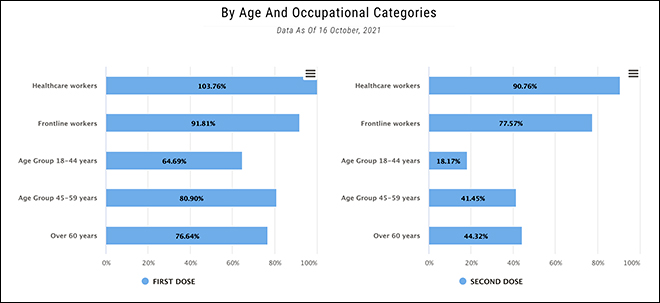
Latest available data indicates that India has administered 699.6 million first doses and 286.3 million second doses of COVID-19 vaccines to its adult population. The coverage is markedly higher amongst the 45+ population (Graph 1), with about 80 percent within the age group having received at least one dose, and more than 40 percent fully vaccinated. The Government of India’s goal is to vaccinate all adults against COVID-19 by 31 December 2021, and therefore, the pace of vaccination in the last quarter is of importance.
Graph 1: Vaccination Coverage Across Age and Occupational Categories
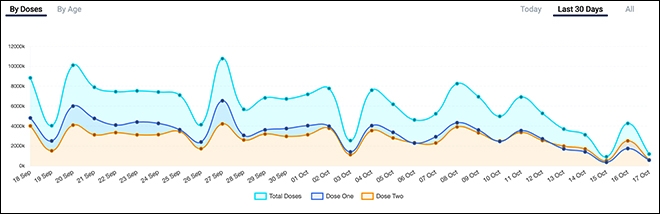
The numbers in the recent weeks have been disappointing. Instead of accelerating to the required average daily vaccination rate of more than 11 million per day (required on October 1), the number of daily vaccine doses administered has shown a stagnation and, indeed, a decline. From 8.2 million doses on 8 October, the daily numbers have declined considerably, taking down the seven-day moving average from 6 million per day to 3.9 million per day on 18 October. While the festivities across the country may be part of the explanation, there are clearly other factors at play, which may undermine the 31 December target that the Government of India has set for itself. This, therefore, needs to be explored in-depth; the possible reasons behind such a surprising slowdown in the vaccine uptake uncovered and remedial measures instituted need to be examined.
Graph 2: Number of Vaccine Doses Administered per Day
Is the decline in numbers due to supply constraints?
While it is a legitimate question to ask, given the history of delays in capacity ramp up for different vaccines in India, this does not seem to be the driver of the slowdown. A look at the unutilised vaccine doses still available within the vaccine cold-chain—the difference between doses supplied to the states and those administered—strongly points to this. A weekly analysis of the available doses with the states (Graph 3) shows that there is substantial build-up of vaccine inventory at the state level. During a month between 15 September and 14 October, the doses available with states almost doubled from 46.3 million to 88.9 million. The data made available on 18 October indicates that there are currently 107.2 million doses awaiting to be administered at the states and union territories. This trend indicates one possibility: There is a strong tapering off of demand for COVID-19 vaccines.
Earlier this year, at the beginning of the vaccination drive, when both number of cases and deaths were low, there was a distinct lack of demand for vaccines, which shot up only with the surge in cases. However, with more than 70 percent adult Indians already vaccinated with one dose, this may not be the major contributor. Demand may be flagging as many Indian states may have already reached almost all of the “willing” adults with one dose at least. Perhaps the undecided and the ‘vaccine hesitants’ are now the ones left and the tapering of numbers could be an outcome of this.
Graph 3: Weekly Analysis of Doses Available in the State-level Cold Chains

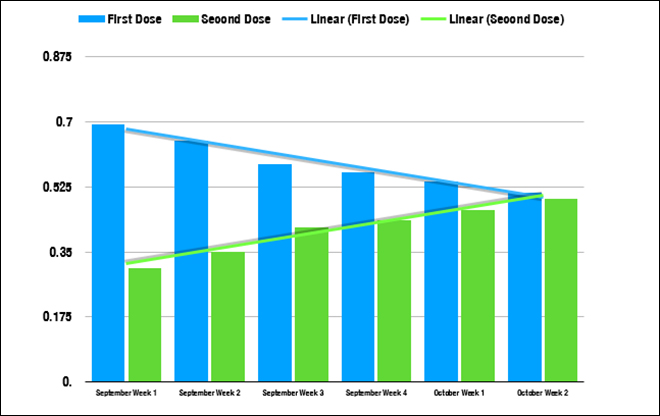
Weekly vaccination data disaggregated by doses from the 1st of September onwards (Graph 4) underlines this possibility. As a proportion of the weekly doses, first doses are on a clear decline over the last six weeks. In the first week of September, first doses constituted almost 70 percent of total vaccinations, but in the second week of October, it was just over 50 percent. This could only mean that the vaccination drive in many parts of the country may have already reached the easy-to-reach population. Vaccinating all of the remaining 30 percent or so of adult Indians will require additional efforts from the government, local leaders, and civil society.
Graph 4: Proportion of Weekly First and Second Doses
Towards herd immunity: the last mile will be the hardest
In the third week of October so far, second doses have outstripped first doses by a big margin. Between 14th and 18th October, of the total 14.8 million doses administered in India, only 6.3 million were (42 percent) first doses, showing clearly that the second doses are now driving the overall numbers. With the offer of free vaccine for all adult citizens, the Government of India has removed financial access barriers from the picture. However, for many sub-populations, physical access to vaccination centres may be difficult for a range of reasons. Vaccine hesitancy will also be a problem in a small but significant proportion of the population. To overcome these, the government must run the vaccination drive in surgical mode, focusing on communication, community engagement and hard-to-reach populations. Many states are already deploying mobile vaccination teams to take vaccines to the people in the margins, with success.
At the same time, the centre and state governments must now focus on district-level champions to win the battle of perception, and to take vaccines to the constituency that is the most difficult to reach—those hesitant to take vaccines. That many of them may be highly vulnerable to COVID-19 due to age or comorbidities makes such an initiative an ethical imperative. In short, first doses are drying up across the country, which could be either due to access-related issues or vaccine hesitancy. India needs district level mop-up operations. The vaccination drive’s initial phases leveraged technology in a big way, but the last mile needs to leverage communities and personalities alongside technology. Many countries are finding ways to nudge and even push the citizenry towards COVID-19 vaccination, focusing on employers and travellers. Canada, for example, is planning to place unvaccinated government employees on unpaid leave and has also made COVID-19 shots mandatory for air, train, and ship passengers.
The vaccination drive’s initial phases leveraged technology in a big way, but the last mile needs to leverage communities and personalities alongside technology. Many countries are finding ways to nudge and even push the citizenry towards COVID-19 vaccination, focusing on employers and travellers. Canada, for example, is planning to place unvaccinated government employees on unpaid leave and has also made COVID-19 shots mandatory for air, train, and ship passengers.
Throughout the pandemic, India has had one of the highest proportions of population willing to be vaccinated when compared with other countries. For the same reason, a smart communication campaign should do in India what vaccine mandates are failing to do in many other countries. With almost 100 crore vaccine doses administered, and a robust information backbone tracking tests, vaccinations and cases, it should not be difficult to convince those still doubtful about the efficacy or the safety of vaccines. Popular personalities, political and religious leaders, and civil society organisations should be engaged actively to take evidence-based messaging to the district level, particularly in those areas where vaccine uptake remains low. Given the deceleration in vaccination we observed over the last few days, it is easy for India to be in a situation where vaccine doses to meet the 31 December target are available but demand becomes the binding constraint.
The next 90 days: India’s ambitious attempt to vaccinate all adults
This article was co-authored by Oommen C. Kurian
Prime Minister Narendra Modi’s ambitious decision and the Government’s announcement to vaccinate all adults against COVID-19 by 31 December 2021 is now within reach. At the time of its announcement, the vaccination plan was seen to be both implausible and impossible by many who doubted India’s capacity and capability in dealing with this gigantic task. Some were also skeptical of the Indian State’s capacity to deliver the doses to a very diverse demography across the country. With the quick evolution of the CoWin platform, India has surmounted the challenge of having a reliable vaccination management solution at scale with the capability of working online and offline while providing a verifiable database. With the vaccine run rate of September where India delivered over 230 million doses, and assuming a modest increase in vaccine availability for the remainder of the year—relative to the significant buildup in the past five months—India has shown that it may just be able to dispense close to 1900 million doses by the end of this year.
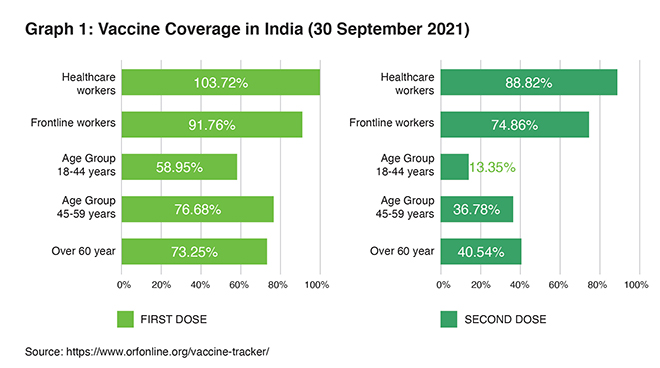
Almost three-fourths of the elderly population in India has already gotten at least one dose, and the coverage in the 45-59 age group was even higher. Overall, more than one-third of the 45+ aged citizens in India are fully vaccinated.
It is now widely acknowledged among experts that the national vaccination drive is doing well when compared with other lower middle-income countries, and even some middle-income countries. At the end of September, India had managed to administer around 890 million doses among adult citizens. According to government communication at the end of September, more than 45.7 million vaccine doses are still available in stocks with States/UTs, with under 8.4 million doses in the pipeline. Almost three-fourths of the elderly population in India has already gotten at least one dose, and the coverage in the 45-59 age group was even higher. Overall, more than one-third of the 45+ aged citizens in India are fully vaccinated (Graph 1).
Graph 1: Vaccine Coverage in India (30 September 2021)
This is an admirable and astonishing achievement by a lower middle-income country and a feat that, for obvious reasons of scale and size, will have no parallel in the free world. Even as we are within a whisker of meeting the (self-imposed) deadline in terms of number of vaccine doses that we need for the task, some policy posers stare back at us and need to be addressed now to complete the job. And this must be an imperative.
In the recent past, we have witnessed that countries confronted with new waves of the pandemic have had two distinct characteristics; the relatively richer countries are seeing waves that are moderate while the poorer countries in general are experiencing their peak surges. This also typifies the global “Vaccine Divide”. The US represents a starkly unique geography where we have seen both play out simultaneously. The vaccine divide in the US is shaped more by political and ideological factors with deleterious consequences.
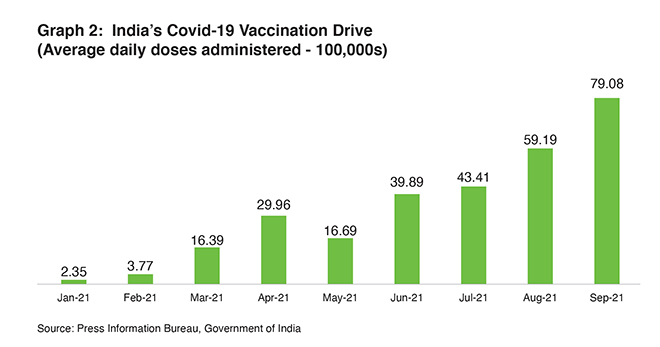
From the early days of the Liberalised Pricing and Accelerated National COVID-19 Vaccination Strategy in May, when the daily vaccine doses administered were around 2 million, India’s vaccination drive has come a long way with the month of September witnessing an average of over 7.5 million doses a day.
Experts have observed a general “decoupling” within the pandemic landscape, where countries and communities with access to vaccines are able to separate the intensity of transmission (case numbers) and the adverse outcomes such as severe disease, hospitalisation and death. Many nations with a high number of vaccinated people are now beginning to approach SARS-CoV-2 like an endemic virus. However, while there has been a general lowering of cases and adverse outcomes these past days, it would be dangerous to believe that we are at the tail of the pandemic. Mutations and large swathes of unvaccinated people offer the virus a chance to continue to be lethal and for the pandemic to take a dangerous turn. Vaccinating all adults and teenagers still has to be a national priority.
From the early days of the Liberalised Pricing and Accelerated National COVID-19 Vaccination Strategy in May, when the daily vaccine doses administered were around 2 million, India’s vaccination drive has come a long way with the month of September witnessing an average of over 7.5 million doses a day. An analysis of monthly vaccination numbers from the start of the vaccination drive (Graph 2) reveals a substantial scale up. While 61 million doses were administered in May, September saw over 230 million doses being administered, indicating an impressive quantum of capacity buildup of nearly 400 percent.
Graph 2: India’s Covid-19 Vaccination Drive (Average daily doses administered – 100,000s)
India set itself an ambitious aim of inoculating all its adult population by the end of 2021. That means, in real terms, giving two doses of vaccines to around 950 million people—delivering, in all, 1.9 billion doses. As on the end of September, India had managed to administer a total of 889 million of those doses, with 650 million being first doses and 239 being second doses.
Over the remaining days in this year, India needs to deliver over a billion doses and deliver them as per the dosage cycles of the two main vaccines—Covishield and Covaxin—currently dominating the vaccination drive. This would mean India now has to achieve the next quantum leap and achieve more than 11 million doses a day on average, which is a ramp up of 46.5 percent in the last three months.[1] With more vaccine manufacturing facilities coming online and given the substantial scale-up already achieved by the vaccination drive, it just may be possible, judging from past experience.
COVID vaccine(s) used and its impact on the speed of the vaccination drive
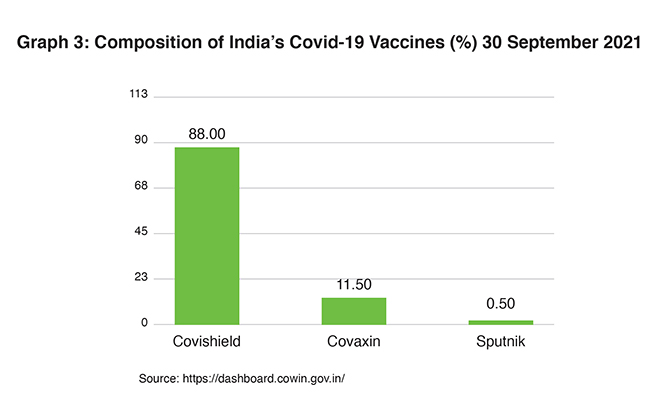
But the rub lies elsewhere, the mainstay of the Indian vaccine effort is the Serum Institute’s Covishield, which accounts for approximately 88 percent of all doses delivered as of now and has a dosage cycle of 12 weeks (Graph 3). As of October 1st, there were nearly 300 million adults who were yet to receive the first dose. Some of them can be vaccinated with Covaxin or Sputnik-V (both have a dosage cycle of one month or below) while a substantial number of them will have to spill over into January if the Covishield dosage cycle of 12 weeks is to be followed.
The policy poser, therefore, may not just be about a vaccine capacity ramp up of about 47 percent, which is eminently doable, but the composition of the vaccine candidates given the dosage gap.
India needs to deliver over a billion doses and deliver them as per the dosage cycles of the two main vaccines—Covishield and Covaxin—currently dominating the vaccination drive. This would mean India now has to achieve the next quantum leap and achieve more than 11 million doses a day on average, which is a ramp up of 46.5 percent in the last three months.
There are three hypothetical responses that can be considered by the health ministry. First, is there a genuine possibility of Covaxin finally ramping up its production and stepping up to the plate? Even if they were able to double their production, we will still have a large, uncovered population unless Sputnik V exponentially increases its production. The second option is to reduce the gap between two doses of Covishield. This will allow the bulk of the vaccine capacity to be used for second doses in much of November and all of December. And the third, of course, is that a new vaccine with large capacity (doses) and shorter dose gap enters the scenario latest by October end.
In a situation of major delays in the scale-up of all the other candidates, it is Serum Institute’s “over performance” in Covishield production, going beyond even the most optimistic projection five months back, that has helped India’s vaccination drive.
Of the other major vaccines that will be available in India soon, application for emergency use authorisation of Covovax is likely to be made only by the end of 2021, according to Serum Institute and, thus, it is unlikely to make a big difference in the timeline we analyse here. Similarly, reports indicate that a surge in cases in Russia will affect Sputnik-V’s plans in India, although the vaccine with a short 21-day dosage gap would be ideal, given the tight timelines. Biological-E’s production of Johnson & Johnson’s vaccine will likely take off only by the end of the year, and no information on timelines is currently available. Zyduc Cadila’s three dose vaccine is also bound to start production at a modest rate of 10 million doses a month; and as the first vaccine approved in India for use in children, it may not make a difference in the adult vaccination numbers at least in 2021. Although Zydus Cadila’s doses can be available for the adult vaccination drive, as the only vaccine yet approved for children, the initial doses should go to children with co-morbidities.
Covaxin is reportedly expanding production from 35 to 55 million doses from October onwards. The Government of India has also clarified that, for now, there is no plan to reduce the mandatory three-month wait for second shots of Covishield. However, with more doses being available for the national vaccination drive, this may be revisited.
Possible pathways for India’s vaccination drive
The following exercise discusses two possible scenarios among a cluster of pathways that are likely to emerge in the coming months that would allow India to fully vaccinate its adult population
(Table 1). Available information till date suggests that there are three factors influencing the December deadline of the immunisation drive, namely, manufacturing capacity which is fast improving; the three-month gap between Covishield doses; as well as the need to have an exportable surplus. Scenario 1 assumes that the availability of vaccines will remain at the September 2021 levels, which is around 230 million per month. In such a scenario, it will be possible to vaccinate all adults in India only by February 2022 and at the end of December, India will be 321 million doses short (Table 1).
Scenario 2 assumes an average 46.5 percent increase in the vaccine doses compared to the September 2021 levels. Given that between May and September, daily vaccine doses administered increased by 400 percent, such an increase is not impossible. After Covishield recently announced that its production capacity has been ramped up from 160 million doses a month to 200 million doses, reports already suggest that that the company will be delivering 220 million doses in October, indicating an accelerated scale-up like in the previous months. In Scenario 2, India will vaccinate every adult with one dose in December 2021, and with both doses in January 2022, with 251 million second doses of Covishield spilling over to January 2022.
These scenarios ignore Sputnik-V as the surge in cases in Russia is holding up imports of vaccine components. Indeed, India has not made vaccination mandatory, and a considerable proportion of the adult population will be reluctant to take the jab voluntarily, for a range of reasons. Our analysis assumes that any Indian citizen above 18 years of age should be able to demand and receive two vaccine shots within the timeline. Thus, it does not discount for vaccine hesitancy and considers every eligible individual in the analysis. This analysis also does not consider possible innovations in the future like fractionation of COVID-19 vaccine doses among the relatively less vulnerable population or mixing of vaccines (something we already do within other disease control programmes in India), which can extend limited supplies, reduce mortality and also accelerate the journey towards universal vaccine coverage.
Table 1: India’s Journey towards Vaccinating all Adults by December 2021: Two Scenarios
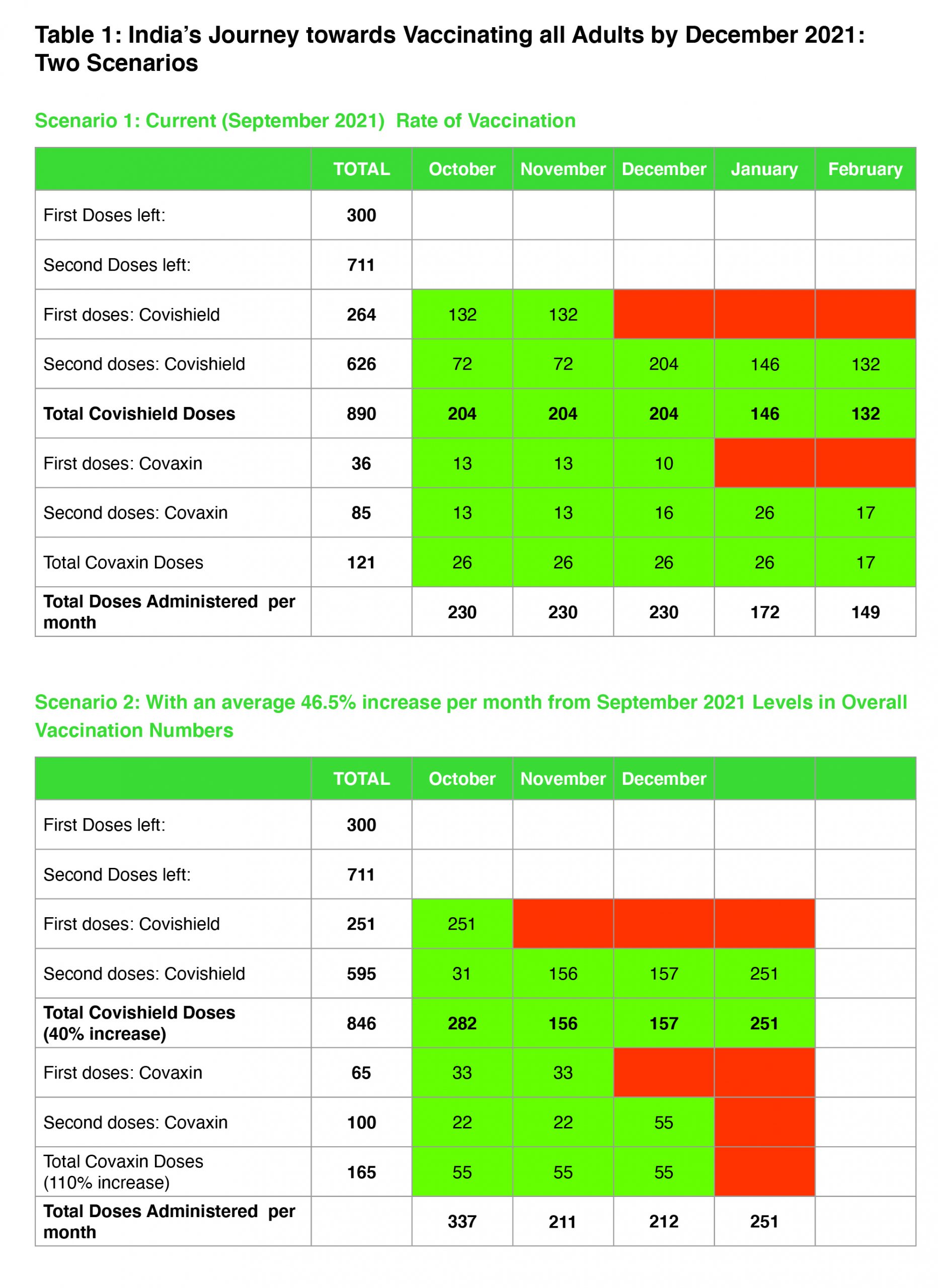
As is clear from the numbers, in light of the global context, scenario 2 seems feasible, whereby all adults are covered with at least one vaccine dose by the end of November 2021, and their respective second doses spill over into 2022. For a country of 950 million people over 18 years, securing universal coverage of a single dose in 11 months will itself be a commendable achievement. Scenario 2 also accounts for considerable exportable surplus of vaccine doses from November 2021.
Even as India accelerates its vaccination process among adults, unfortunately, there is no such thing as herd immunity threshold exclusively for the adult population. Herd immunity for COVID-19 will have to be achieved at the overall population level, and for a very young India, this means a need for a substantial number of its under-18 population to be vaccinated. Even if India manages to inoculate all its willing adult population by December 2021 or even January 2022, unless its hundreds of millions of children are vaccinated, the country cannot reach anywhere close to herd immunity levels. Achieving that, while respecting renewed commitments to export vaccines to the rest of the world, will be the next ambitious goal for India as the country tries to turn COVID-19 into a manageable risk, controlled by access to vaccination and responsible behaviour.
This exercise proves that the goal of vaccinating all adults by 31st December 2021 is not as unrealistic as it may have seemed earlier. As India continues to steadily ramp up Covishield and Covaxin production as it has in the past, it can achieve the ambitious tasks of vaccinating all adults by January 2022, sharing doses with the world, and to also consider provision of booster doses to severely immunocompromised citizens.
[1] Based on calculations done by the authors using the statistic that between May and September, daily vaccine doses administered increased by 400 percent
Undermining institutions, underwriting OBOR: Beijing and the crisis of global governance
This article was co-authored with Mihir Swarup Sharma.
This article is part of the series The Beijing Heist: Making Global Institutions Serve the CPC Agenda
All good things must come to an end, and so must illusions of the promised common future. A fundamental assumption long held by many in the West is that the multilateral institutions instated over the six post-War decades would serve to constrain and direct the “peaceful rise” of the People’s Republic of China (PRC). It was believed that a Beijing that was given the position it thought justified within the multilateral architecture would end up being a responsible steward of these institutions and of the global commons more broadly. The scandal at the World Bank that led to the end of the Doing Business report and index is the third time that this assumption has been proved as naïve, and, indeed, delusional.
The World Bank scandal is directly linked to the Xi Jinping regime’s growing sense of entitlement. An independent report commissioned by the Bank has revealed that its leadership— including a former senior official, Kristalina Georgieva, who is now head of the International Monetary Fund (IMF)—apparently manipulated the supposedly independent report to placate PRC officials worried about their ranking. The immediate context? Ownership shares at the Bank were going to be “re-calculated”; in other words, the PRC was going to see a big boost in its control of the institution. (Eventually, 52 countries had to reduce their voting share in the Bank to increase China’s.) It was the anticipation of Beijing’s increased power over the institution that led to this episode; it appears a careerist international bureaucracy was all too eager to please the new ownership. Many will now want to more closely examine Beijing’s position on the acrimonious selection in 2019 of a new IMF Chief from within the European bloc.
The World Bank scandal is directly linked to the Xi Jinping regime’s growing sense of entitlement. An independent report commissioned by the Bank has revealed that its leadership apparently manipulated the supposedly independent report to placate PRC officials worried about their ranking
Two other institutional pillars of global governance have already been left powerless and have faced global ridicule as a consequence of Beijing’s actions. The World Trade Organisation (WTO) has lost the trust of the world in the two decades since the PRC’s accession; many of its members, developed and developing alike, feel that the PRC has not conducted the reforms that it had promised in order to join. As a result, it has retained an advantage in global trade that the WTO has been unable to rectify, leading to the institution itself being considered worthless. And then there is the World Health Organisation (WHO), which has been seen during this pandemic as prioritising Beijing’s sensitivities over warning the world about a deadly contagion—or even properly investigating its origins. The tight control of information by the Communist Party of China (CPC) means that questions remain unanswered about the virus’ origin, yet what is certain is that the pandemic’s initial spread is in no small part due to the CPC’s machinations and missteps, and the WHO leadership’s complicity with Beijing.
It is time to accept that ceding Beijing the control of the levers of global power leads to disastrous consequences. Liberal democracies such as India and those that designed the post-War multilateral structure understand the need for independent institutions. They may chafe at the pressure such independence brings to bear on their own domestic and geopolitical actions, but appreciation of the importance of institutional strength and independence is in their DNA. This is, of course, not true for the Communist Party of China. Why should anyone expect that a system that permits no independence domestically will not consider it necessary to seize control of global institutions as well? For them, those institutions are useful that perpetuate and further the party line.
Liberal democracies such as India and those that designed the post-War multilateral structure understand the need for independent institutions.
The Ease of Doing Business report and it’s deserved demise should not worry us. Concern about what will follow next should be more widespread. That Georgieva’s name has appeared in this investigation is worrying given that the IMF, in particular, is under siege. Its previous head, Christine Lagarde, explicitly made the point that Beijing’s “One Belt, One Road” initiative risked leading to a debt explosion in the developing world that would become the IMF’s problem. Under Georgieva, the pandemic did, in fact, cause an emerging-economy debt crisis in 2020. Other state-run lenders wanted to grant some measure of relief to those countries most under pressure. The PRC’s financial institutions refused to play along, demanding that they be treated like private-sector bond-holders instead. Georgieva seemed to excuse this behaviour, saying in October 2020, “What we are also hearing from China is a recognition that they are a relatively new creditor, but they are very large creditor, and they need to mature domestically in terms of how they handle their own lenders, the coordination among them.” The problem with the PRC’s external lending is not a lack of maturity or of co-ordination. If anything, the problem is the opposite: Too much co-ordination and political control. Will future bailouts spend IMF money to save Beijing’s bad Belt-and-Road loans? In a closed-door meeting in New Delhi some summers back, an American diplomat who had just finished meeting his counterparts in Colombo explained to Indian analysts that its Chinese debt that has ravaged Sri Lanka’s balance sheet and that a IMF bailout was inevitable—as, indeed, it turned out to be.
Unless all of us recognise the danger Beijing poses to global institutions, we will wind up paying for the expansion of Chinese ownership and political control over vast geographies.
An IMF that fears Beijing’s wrath is one that will not protect its shareholders or global private capital. Lending related to the Belt and Road initiative will cause more and more crises going forward, perhaps sooner rather than later, given the effect the pandemic has had on emerging economies’ balance sheets. An IMF intimidated by one activist minority shareholder might well direct the world’s savings into bailing out the PRC’s lending.
Unless all of us recognise the danger Beijing poses to global institutions, we will wind up paying for the expansion of Chinese ownership and political control over vast geographies. This is the global equivalent of the privatisation of profits and socialisation of loss—badly designed projects will create profits, power and growth for the benefit of the CPC, and their adverse economic outcomes will be left to the world to underwrite. The US has mishandled the World Bank already; does the European Union have it in them to save the IMF?
The fourth technological revolution has begun. No domain remains untouched. How should we view technological competition with our adversaries from the unfree world, especially China?
India’s security choices during the COVID-19 pandemic
At the start of the 2020s, India has been confronted with a massive viral spread and a relentless People’s Liberation Army (PLA) on its borders. Last year, even as India was responding to the pandemic that originated in Wuhan, it had to mobilise its forces to counter Beijing’s invasion on the Himalayan heights. Both resulted in loss of lives and both show no signs of going away. While the virus is threatening to rise again in a ‘third wave,’ China has literally dug in at high altitudes in its quest to secure real estate and territory that it believes is crucial for its Belt and Road Initiative (BRI), that provides access to a warm water port in the Arabian Sea, and that is critical to a larger project that seeks to reshape the geopolitical map of Asia. While the two nations have taken modest steps to disengage, military and diplomatic negotiations have not yielded substantive results.
In June 2021, reports emerged that China had been ramping up infrastructure along the Tibetan border. Following this, around 200,000 Indian soldiers have been deployed on the frontier, an increase of over 40 percent from 2020. For India, China poses a clear and present danger. To respond to an expansive and belligerent northern neighbour, it has to reorient its conception of its security as well as deployment of its political and diplomatic resources. This was not the case until very recently.
For India, China poses a clear and present danger. To respond to an expansive and belligerent northern neighbour, it has to reorient its conception of its security as well as deployment of its political and diplomatic resources.
Pakistan had been the major preoccupation since Independence in 1947. Its occupation of parts of the Indian state of Jammu and Kashmir, its export of terror to India as a means of waging an asymmetric war, and its nuclear proliferation had positioned it as the main threat to India’s national security. For long, China had escaped critical scrutiny despite provocative actions. The Indian security establishment was not very vocal when China tested an atomic device during President R. Venkataraman’s state visit in May 1992 — clearly intended to send a message to India. Indian Defence Minister George Fernandes’ prophetic assertion at the turn of the century that China, not Pakistan, was India’s “potential threat No. 1” was not universally shared in the strategic community in New Delhi.
In their public speeches, Chinese leaders declared their preoccupation with the welfare of their people. They took great pains to position China as a responsible power that avoided international confrontation. In hindsight, they clearly succeeded. From the ‘returns seeking’ investors in the United States to the political leaders in Europe and Asia who wanted a piece of the Chinese economic pie, all bought into this masterly conduct of statecraft. For India, the urge to keep China in good humour was also implicated by the border conflict of 1962. Relations had thawed only a quarter-century later. Prime Minister Rajiv Gandhi’s visit to Beijing in 1988 paved the way for the Sino-Indian Bilateral Peace and Tranquility Accords inked in 1993 and 1996 to stabilise the Line of Actual Control (LAC).
From the ‘returns seeking’ investors in the United States to the political leaders in Europe and Asia who wanted a piece of the Chinese economic pie, all bought into this masterly conduct of statecraft.
With stability along the boundary, trade and cultural ties between the two nations began to flourish. The boundary pacts mandated that large numbers of troops would not be amassed along the border, and that there would be no attempts to alter the status quo unilaterally. The Indian establishment believed that the border accords would be “peace for our time.” This search for fool’s gold would lead to India curtailing its multilateral naval exercises and slowing down infrastructure development in critical sectors of the India-China border. Influential voices in the Manmohan Singh government (2004-2014) believed India’s security interests would be served if it did not upset China.
Pushback came only in 2013, when transgressions by Chinese forces in Depsang were diplomatically and militarily countered. Yet, here too there was much discussion and debate in the upper echelons of government. Greater clarity was to emerge in 2014 when India, under the newly elected Prime Minister Narendra Modi, was at the receiving end of Chinese incursions in Ladakh even as a summit was under way with the visiting Xi Jinping. With two episodes in close succession, it would be fair to say that a change in India’s approach to its northern neighbour was thrust upon it.
The Indian establishment believed that the border accords would be “peace for our time.” This search for fool’s gold would lead to India curtailing its multilateral naval exercises and slowing down infrastructure development in critical sectors of the India-China border.
In recent years, India has been able to recalibrate its approach towards the Middle Kingdom even as the world order is changing. The US-India partnership has evolved rapidly. Washington has helped thwart moves by China to internationalise the issue of Jammu and Kashmir, enabled India’s entry into the international nuclear order and brought pressure on Pakistan to crack down on terrorism. The Quad grouping, where Japan and Australia join the duo to keep the Indo-Pacific region inclusive and open to all, is working on providing alternatives to the BRI and is seeking a number of resilient arrangements, including on technology supply chains. A Quad vaccine for all is on the anvil and other countries are looking to partner with the Quad on important global issues.
The ‘La Pérouse’ maritime exercises in the Bay of Bengal, with France joining the Quad members, and the Australia-France-India ministerial dialogue demonstrate that the idea and the ideals of ‘Quad Plus’ are gathering steam. The UK has floated the ‘Democracy 10,’ which includes the Quad countries, to tackle issues related to 5G and emerging technologies that may have a bearing on collective security. Whitehall’s recent assessment of its economic, security and diplomatic interests may see it engage more deeply with India in the Indo-Pacific. Old Europe is certainly finding a place at the core of India’s security calculations.
A testament to India’s recalibration is NATO Secretary General Jens Stoltenberg’s pitch, at the Raisina Dialogue 2021, to broaden cooperation. NATO views the rise of China as having huge security implications and assesses India as its partner. PM Modi’s historic Porto Summit with leaders of the EU and 27 EU member-states helped boost cooperation on terrorism and maritime security. The ‘connectivity partnership’ between the EU and India seeks to finance projects in other nations, offering an alternative to China’s BRI.
NATO views the rise of China as having huge security implications and assesses India as its partner.
Even as India strengthens and redirects its relationship with the old world, Russia remains the X factor. New Delhi’s strategic ties with Washington have become a sore point for the Kremlin. If two new poles emerge — the US and its partners and allies, and the Beijing-Moscow ‘axis ’ — India’s room for manoeuvre may be affected. India is alive to this possibility and is redoubling its efforts to work with Russia, its largest weapons supplier over the past decades. India has to convince President Putin that the bilateral relationship allows him greater latitude while dealing with his southern neighbour. Through back channels, India also has to work towards a reset between the US and Russia and to convince the EU that pushing Putin into Xi’s corner is dangerous and counterproductive. The recent Biden-Putin summit may have gone some way in making this a possibility.
A resurgent China, with its plan to establish regional hegemony in Asia even as it tries to split and dominate Europe, is Delhi’s biggest security challenge. The Indo-Pacific will define the future of the Asian Century. India has been astute in ensuring that its partners and fellow stakeholders from the Atlantic order work closely with it to navigate the choppy waters of the Indo-Pacific.
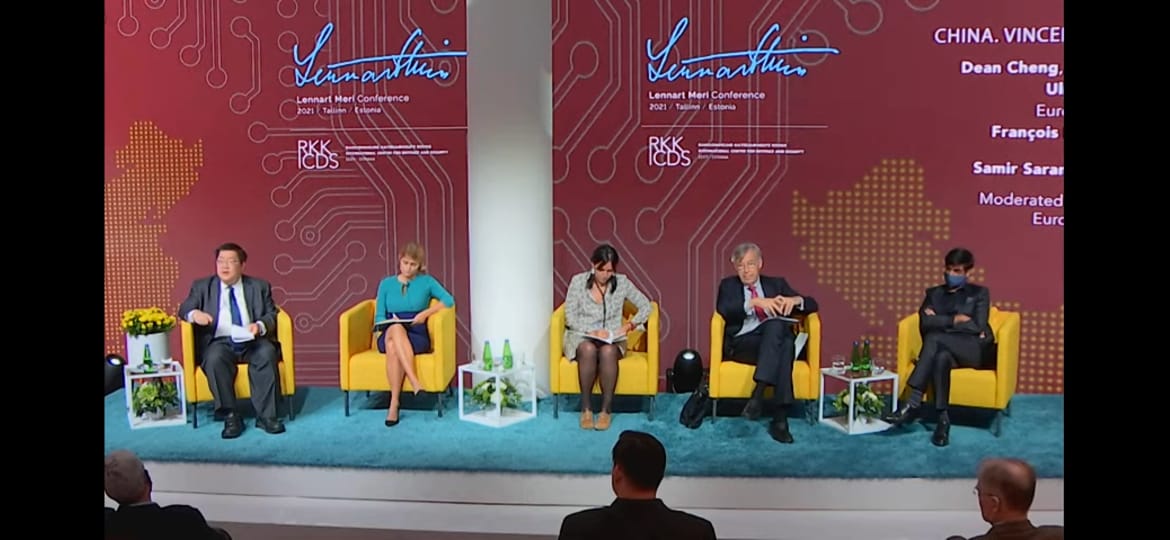
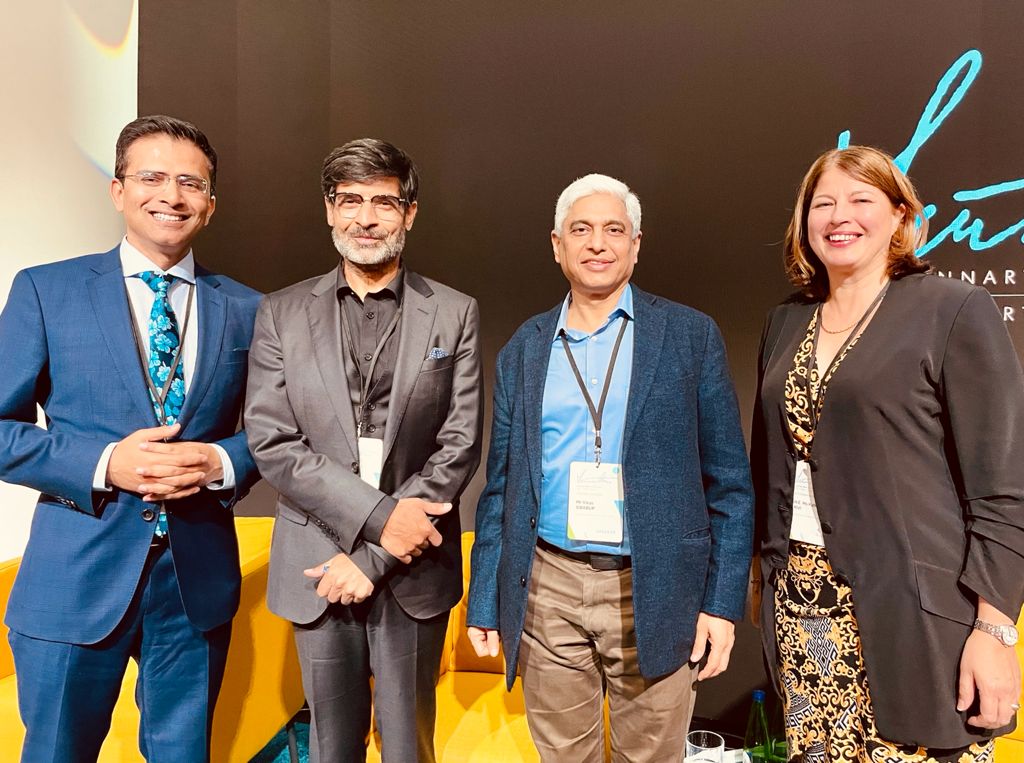
An abridged version of the above was published for the Lennart Meri Conference.
 Samir Saran