Tag Archives: Russia Civil War
BRICS Academic Forum 2022 | Opening Plenary
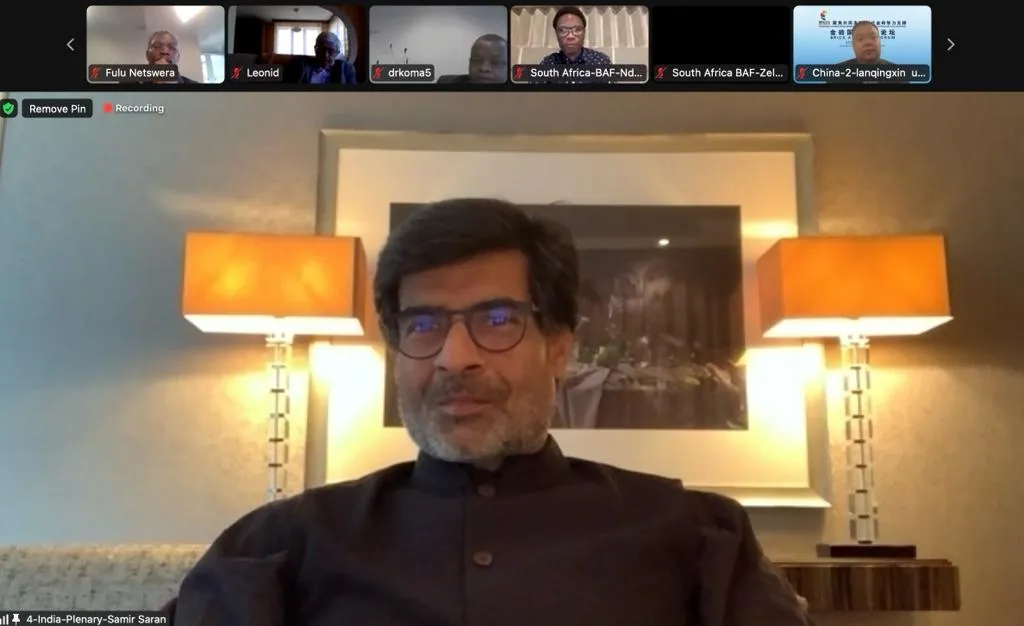
Remarks by Dr Samir Saran at the Opening Plenary session of the BRICS Academic Forum 2022
It is a pleasure to be back again and be a part of the academic forum that has continued to raise important issues for intra BRICS cooperation and indeed, for the challenges that confront our world.
We are meeting today at an important moment—a moment that will be recorded and studied by future generations. It is important that all of us rise to the challenges that confront us and be creative in discovering solutions. Three major trends are seeking our attention and indeed, resolution.
First, global politics has been upended by the political actions in Asia and Europe. Conflicts, contests, and careless power projection have jeopardised stability, peace, and prosperity for all. Can we discover a new geostrategic balance and what role can BRICS play?
As we emerge from the pandemic—or at least begin to learn to live with it—what are the lessons that we have learnt? Will new development and growth models emerge, and will BRICS and other actors invest in what is most important for humankind?
And finally, we are experiencing the digitalisation of everything. Technology is having an impact on our economy, our politics, our societies, and indeed our individual behaviours, choices, and assessments of the world we live in.
New Politics, Green and Inclusive Growth, and our Common Digital Future beckons us. At the Indian presidency of the BRICS last year, we coined three words—Continuity, Consolidation, and Consensus. These remain relevant even as China steers the group and must continue to define the BRICS agenda.
We have to work together to overcome the contested politics of today. We must be contributors to stability in world affairs. We should reject actions as a group and as individual nations that can create further instability or exacerbate current tensions.
BRICS was always meant to be a grouping that would offer an alternative path to one prescribed by the Atlantic Order. We must continue to strive to do this. Unipolarity must give way to multipolarity. Bipolarity is not an option.
Three key elements will shape the path that BRICS and others must pave.
First, as the political assumptions of the 20th century may no longer be sufficient or valid for a more complex world, we must work together to script a multilateralism that is fit for purpose. It must reflect current realities, the aspirations of different geographies, and a governance structure that is plural, transparent, and accessible. The old hegemony of the Atlantic Order must not be replaced by a new hegemony from another region.
BRICS must continue—individually and collectively—to remain inclusive in shaping the multilateral system. This system must deliver on economic and trade growth. It must find new ways of catalysing financial flows for infrastructure and aspirational needs of multiple geographies. Multilateralism for this century will require new anchors and champions. BRICS can play that role, provided all members are committed to it.
Second, future growth and our economic needs will have to cater to our planetary responsibility. Green transitions must not simply be a buzzword, but the policy design for all. BRICS must work—both within and with others—to put together a template to invest toward a green planet. We have to rethink mobility, urban spaces, consumption, and our lifestyles. We must also work to protect those who are already being burdened by the deleterious consequences of global warming, rising sea levels, and harsh weather conditions.
Thirdly, we have to embrace technology and not allow it to become the new arena for zero-sum politics. The world must see technology as a digital public good and it must serve all of humanity equitably. The rules for this digital future are yet to be written. These rules must not be written only by the western hemisphere. In the absence of such agreed rules, sovereign arrangements must prevail over those written by the boardrooms. BRICS can share experiences and learnings from our individual journeys and offer to the world examples and methods of managing our common digital future. We must ensure that countries, within and outside, do not weaponise technology or game the digital public square.
It is impossible for BRICS to attain its full potential and contribute to global affairs unless each member is committed to the BRICS project and the thinking that led to its creation—peaceful co-existence, within the group and with others, being the primary ethos.
India and Russia: Moving towards a 21st century compact
Original link is here
The recent summit between President Putin and Prime Minister Singh may have heralded a new inflexion point in the bilateral.

Russian President Vladimir Putin and Indian Prime Minister Manmohan Singh during the press statement following Russian-Indian talks in the Kremlin on October 21, 2013. Source: Alexey Nikolsky/RIA Novosti
It would seem that India-Russia relations might have bucked the season of gloom. For years now, since Prime Minister Yevgeny Primakov’s reorientation of Russia’s foreign policy eastwards, we’ve largely seen two governments making positive statements, not matched by actions on the ground and compounded by a general sense of drift. Adding to this has been a waning interest in India of all things Russian and vice-versa. Two close friends gradually drifting apart, a contemporary tale of the engagement between Moscow and New Delhi.
The recent summit between President Putin and Prime Minister Singh may have heralded a new inflexion point in the bilateral. On a cursory comparison of their joint statement issued on October 22 with the previous four summit statements, there seems very little change on the surface and if anything, these statements continue to remain an exercise in blandness. But connecting the dots we get three game changers, which while mentioned, have not been described under the strategic rubric that they perhaps should have.
Indo-Russian cooperation

The first is trade which stood at $7.46 billion in 2009, $8.53 billion in 2010, and $8.87 billion in 2011, and has suddenly spurted to $11.04 billion in 2012, registering a 24.5 percent growth year on year. This was the best performance of Russia’s top 25 trade partners. This is particularly surprising given the present world economic situation, the lack of growth of India’s world trade in 2012 and a marginal growth of 1.8 percent growth in Russia’s world trade.
Does this mean that India today has firmly established itself as a partner in more than just the fields of defence and energy to Russia? Are there initial signs of diversification visible? And how the two countries cement this increase in quantity, quality and diversity of trade will be crucial for the strategic partnership going forward.
The second is Russia’s determination to push through a free trade agreement with India – the comprehensive economic cooperation agreement (CECA). Given that most of this increase in bilateral trade has been in-spite of the two governments (outside of the defence sector), this is of particular significance. This will give the Indian private sector critical access to such landlocked markets like Belarus and Kazakhstan, which are part of a customs union with Russia. Not only does this give a fillip to India-Russia ties, it leverages the growing volume of India-Russia trade, to give the northern access to Central Asia, benefit of new economies of scale.
The former Soviet countries have for long sought a stronger Indian presence, be it economic or political in their efforts to balance China. But thus far, Indian attempts have been frustrated by Pakistan’s refusal to allow transit and the complicated international situation with respect to Iran. What the Russia route means is that India and Russia can now piggyback on each other and create serious strategic congruence and bring synergies into play like never before. But this development could additionally play another critical function. By creating a strong market in Central Asia that is integrated with India, it helps create regional pressure to bear on Pakistan to allow India transit with substantial economic benefits to itself.
In effect, Russia, if this game plays out well, may just end up becoming the ‘x factor’ that normalised trade between India and Pakistan. This is advantageous for Russia, since it would give it a pivotal geo-economic and strategic role on the world stage that it hasn’t played in a very long time with relation to big countries.
14th annual summit: Singh, Putin focus on trade, energy and defence

Lastly, the transactional listing of defence deals in the joint statements is symptomatic of India’s fear that it simply cannot compete with China vis-à-vis Russia when it comes to economic stakes. However, the trade figures should boost India’s confidence in its dealings with Russia. It now needs to take the bull by the horns and insist on a quality-quantity matrix that regulates future Russian arms sales to China. By formally affirming a commitment to maintaining India’s qualitative edge over China, Russia can do much to overcome the almost consistently negative press in India in this regard and bypass other minor irritants in the relationship.
It has never been a better time and never before has India come with this much strength to the negotiating table. In the end, reaffirmation and recalibration of Russia’ role in India’s future was prominent and the short and successful summit was capped by perhaps another nuclear submarine for India and a doctorate for Prime Minister Singh.
 Samir Saran