BRICS, Columns/Op-Eds

Article in “Russia & India Report”: BRICS and eurozone crisis


by Samir Saran and Vivan Sharan
November 2nd, 2011
Please find here the original article

The rise of the BRICS nations as new epicentres of economic activity in the rapidly evolving world order has been simultaneously accompanied by a steady decline in the relative economic strength of many of the member countries of the eurozone.

The single currency union has become essentially a two-faced beast. A North–South divide in economic fortunes is clearly visible within Europe (and the irony of this is probably lost on most Europeans). It is time for the leaders of this grouping to recognise the fact that the major rebalancing and recalibrating actions that are urgently needed within the economic and monetary union must also address the concerns of external creditor nations such as those within the BRICS grouping.

After much introspection and procrastination, the European leaders managed to pass a controversial but necessary deal on Greek debt. The deal, which calls for a “voluntary” cut on a nominal 50 percent of private sector investments of over 450 financial firms to reduce total debt burden in the economy by 100 billion euros, is a desperate attempt by policymakers to stymie the relentless bouts of selling pressures on Greek debt.  Although given the circumstances, it was extremely important for the eurozone to signal some form of cohesive multi-stakeholder action to the financial markets, the deal is built upon ambiguous foundations.

The private sector has voluntarily decided to take these ‘haircuts’ and at the same time banks have agreed to increase capital reserves to 9% to shield against an imminent market collapse in Greece. This translates into tremendous pressures on banking institutions, without much positive effect on the bond markets, with Greek bonds still yielding unprecedented rates of interest. It is clear that the projected reduction of Greek debt to GDP ratio from 160% now to 120% in 2020 is not impressing bond traders.

The European leaders have announced that they seek to increase the size of the European Financial Stability Fund (EFSF) from its current capacity of 440 billion euros to over a trillion euros.  It is not clear how they intend to do this, and whether a trillion euros (approx.) is the amount they consider to be sufficient to counter the effects of possible contagious sovereign debt defaults and banking crises in member countries. While these leaders attempt to keep kicking the can down the road with respect to how they manage the myriad financial crises that are evolving in southern Europe, it has become increasingly clear that the problem is too big to be handled without outside help.

The Chief Financial Officer of the EFSF recently told a Brazilian newspaper that his colleagues are “pleased” to see BRICS countries starting to invest in the EFSF. The composition of the investments into the EFSF is not public, and therefore there is no real way of knowing how much each of the BRICS nations have contributed to the fund so far. The EFSF was originally set up to raise money for the Portuguese and Irish bailout packages through the disbursal of loans. Although the Fund has nearly risk-free credit ratings by all the major rating agencies (AAA by Standards and Poor’s and Fitch, and Aaa by Moody’s), it can be argued that investing in Greece’s sovereign debt is a far riskier proposition for creditors to the Fund.

Many of the BRICS nations are already heavily invested in the euro. The central banks of China and India hold approximately 25% and 20% in eurozone bonds respectively and are therefore not likely to spend much more of their international reserves buying into a now suspect currency. However, much like Brazil, which is allegedly considering investing into euro debt via its Sovereign Wealth Fund (which allows greater risk taking) rather than purchasing debt through its international reserves, the economies of China, India and Russia could soon follow suit.

Given the volumes of trade between the euro zone members and each of the aforementioned nations (China surpassed the U.S as E.U’s largest trade partner in July) along with hefty direct investment flowing both ways, it is certainly not in the interest of any of the stakeholders – to let the euro collapse. The involvement of countries like China, with immense amounts of liquidity, does not fail to inspire market confidence as was seen last year in July, when China announced that it would purchase a billion euros in Spanish debt. The bond auction was oversubscribed and lead to a turnaround in market confidence in Spanish debt even though China only committed 400 million euros.

Keeping in mind their leveraged bargaining position in current circumstances, the BRICS nations should coordinate their positions and assert themselves while negotiating investments in eurozone debt. Although the BRICS nations have a diverse set of agendas and priorities, it is not hard to see a future where there is greater coordination within the nations in the grouping, especially between geographical neighbours Russia, China and India, in order to deepen global financial integration and reverse the Western narratives that have dominated the larger economic realm for the past century.

At the Sanya BRICS summit in April, the leaders put on record that the “international financial crisis has exposed the inadequacies and deficiencies of the existing monetary and financial system” and that the BRICS nations support “the reform and improvement” of this system. In order to support the troubled European economies, the BRICS countries need to devise a formal set of pre-conditions for granting bilateral loans and investing in various bailout funds. Perhaps these could be centred on some basic premises such as further trade liberalization, increased access to intellectual property and perhaps they can even be self-righteous enough to demand more friendly immigration laws.

The Europeans will no doubt be faced with some hard choices. They have to be careful to juggle two contradictory imperatives – that of enlarging existing regulatory capacities in order to strengthen and deepen European fiscal, monetary and political integration, while at the same time accepting the inevitable growing interdependence with external nations.

If the evolving debt crisis in the eurozone is viewed through a deterministic prism, it becomes immediately apparent that panaceas such as debt write downs only offer short term relief to the markets as long as structural imbalances persist. In light of this, the Europeans will be hard pressed to look for a multipronged approach to dealing with the existing problems of their southern peripheral nations.

The glory days of Western credit and forced fiscal reforms in Asia and other ‘south’ countries are far behind us, with hegemonic Bretton Woods era relics such as the International Monetary Fund struggling to find its ‘traditional’ relevance within the new political and economic realities. Although it is in no way certain that the balance of power will completely shift towards the emerging or recently emerged nations such as those in the BRICS, as they are grappling with internal problems of their own, one can be relatively certain that the growing degrees of independence – both from Western policies and from Western demand —  will provide the perfect platform for increasing economic leverage through investments in equity and debt as well as direct investments. Europe has few options left but to align economic expectations with those of the BRICS. The question that still looms large is whether there is enough political unity and substance in the grouping (BRICS and other emerging nations) to make the right kind of bargains.

Standard
In the News, Politics / Globalisation

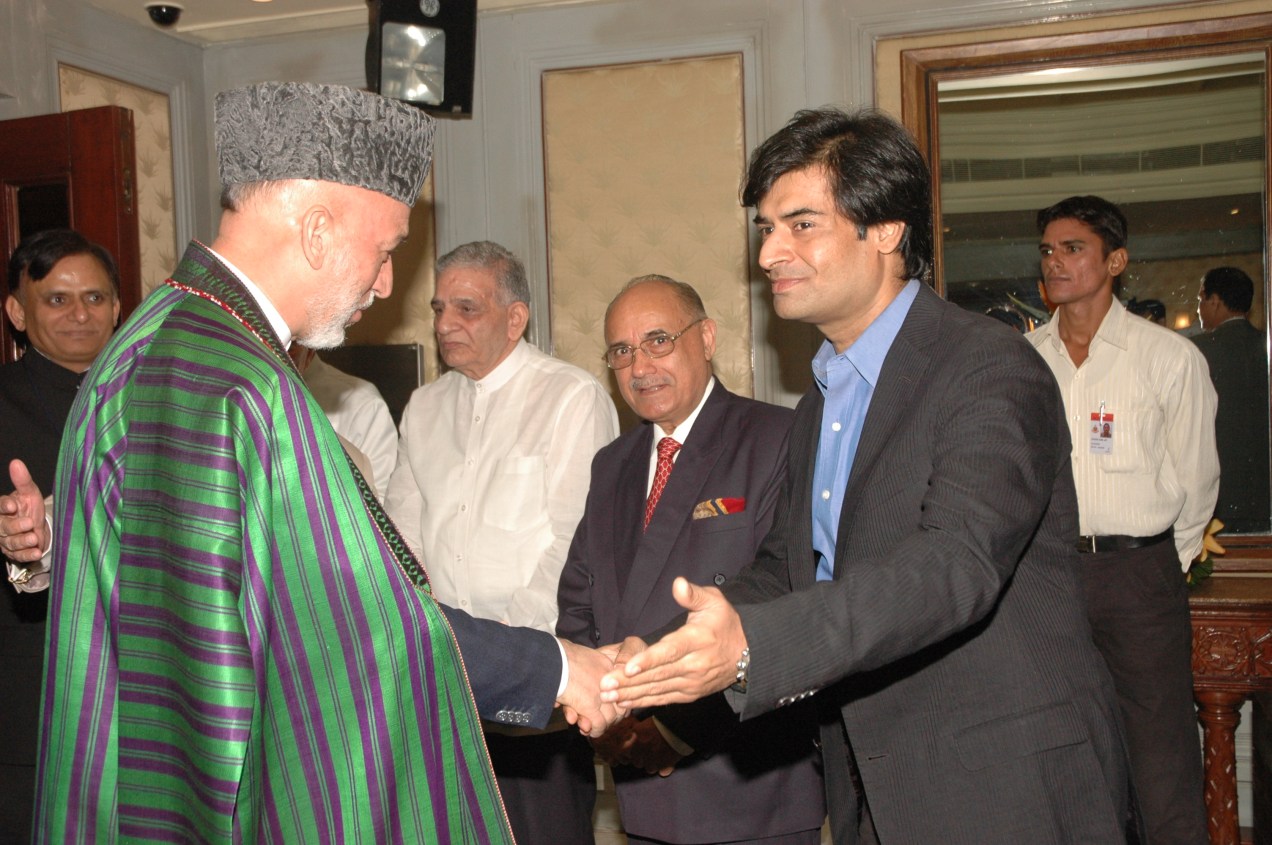
Afghanistan’s president Hamid Karzai at ORF, October 2011.

The National, October 6, 2011, New Delhi.
Link to original website.
Watch here all speeches of the event online.

NEW DELHI // Afghanistan’s president Hamid Karzai sought to reassure Pakistan yesterday after signing a series of agreements to boost trade and security cooperation with India. “Pakistan is a twin brother, India is a great friend. The agreement that we signed with our friend will not affect our brother,” said Mr Karzai in a speech in New Delhi yesterday.

Mr Karzai is on his second visit to India, and is widely seen to be building ties with the Indians out of frustration with Pakistan. Afghan officials claimed that the killing of Burhanuddin Rabbani, the former Afghan president and head of the peace council that conducted talks with the Taliban, was planned by Pakistan-supported Taliban militants in the Pakistani city of Quetta. Pakistan denies being involved in Rabbani’s death.

During his speech, Mr Karzai laid out his vision for Afghanistan’s future after a decade of war and emphasised that the strategic partnership deals were “not directed against any country” but done to “support Afghanistan”. On Tuesday, Mr Karzai and Manmohan Singh, the Indian prime minister, signed a number of agreements including one under which India will offer more military and police training to the Afghan forces ahead of the US troop withdrawal, scheduled to take place in 2014.

India is already one of the biggest aid providers to Afghanistan, having pledged up to US$2 billion (Dh7.35bn) since 2001 and promised spending on infrastructure, such as the construction of highways. Yesterday, the Afghan national security adviser, Rangin Dadfar Spanta, reiterated Afghan accusations that Pakistan’s Inter-Services Intelligence agency was supporting pro-Taliban militants.

“The Haqqani network and the ISI are one and the same. It is a group managed, trained and led by the ISI,” he said. After the September 20 assassination of Rabbani, Mr Karzai announced that negotiating with the Taliban was “futile,” a statement he repeated in his speech yesterday. “We have decided not to talk to the Taliban because we do not know their address. We do not know where to find them … therefore we have decided to talk to our brothers, our neighbours in Pakistan,” he said. If the growing rapprochement with New Delhi has ruffled feathers in Islamabad, Pakistani officials have not let it show.

“Both are sovereign countries, they have the right to do whatever they want to,” the Pakistani prime minister Yusuf Raza Gilani said yesterday. Nitin Pai, a fellow at the Takshashila Institution, a think tank in Chennai, believes Mr Karzai’s visit to India provides Afghanistan with leverage in future negotiations with Pakistan.

How deep the relationship between India and Afghanistan can develop remains a matter of debate. “The question is not what Karzai said, but what the Indian prime minister left unsaid: is India capable and willing to play the role of a guarantor of stability in Afghanistan?” said Mr Pai. He said that India was politically unwilling to take on responsibility for security in Afghanistan, which might rile Pakistan, its nuclear-armed rival.

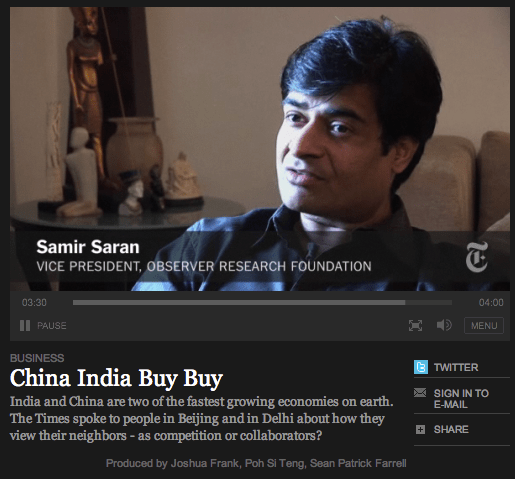
Samir Saran, the vice president of the Observer Research Foundation, which hosted Mr Karzai’s address yesterday, said the Afghan leader had a serious message in his speech, directed at Pakistan and America, about how he planned to approach security issues in the future.

“By 2015, Afghanistan will be entirely responsible for its security. Afghanistan will be looking to its affairs on its own in cooperation with India, the United States, Iran, Saudi Arabia and our neighbours,” Mr Karzai said in his speech. Mr Saran said Mr Karzai was diversifying his options for peace and stability. “The invocation of Iran is a serious message that anything is better than the current situation. He knows he will have to create new partnerships, even if they are with countries like India and Iran.”

Standard
BRICS, Columns/Op-Eds

Samir writes in Russia & India Report on ‘Evolving an Asian Trading Region’

September 26, 2011.
by Samir Saran and Nandan Unnikrishnan. Both are Vice President(s) at the Observer Research Foundation, New Delhi.
Find here the original article.

It’s time economics replaced politics as the key driving force of the Russia-China-India (RIC) trilateral. The Big 3 of Asia has a major opportunity to create and drive an Asian Trading Region.

At a recent interaction in Moscow with scholars and editors, there was an interesting discussion on finding ways to significantly increase the economic interaction between Russia and India and, more specifically, change the nature of the G2G-driven bilateral trade. Our suggestion was spontaneous and to some outlandish. We suggested that for a paradigm shift in our trade volumes (less than $ 10 bn dollars currently) the two countries would need to work for an Asian Trading Region shaped and steered by Russia, India and China. Until then we (Russia and India) would remain prisoners of perceptions and perceived geographical distance.

It was apparent that this idea did not resonate well with many experts in the room. However, it did spark an interesting round of debate and many have subsequently written in with their own ideas on a trading zone or region in Asia. We still argue that the only sensible architecture would need to be fundamentally driven by and emerge out of the RIC arrangement. Even though the RIC was conceptualized as a club of the Big 3 in Asia and had more political overtones than economic reality, the vocabulary of cooperation emanating from previous RIC forum allows enough leeway to work towards the formation of an Asian Economic Zone beginning with an Asian Trading Region largely driven by Russia, India and China.

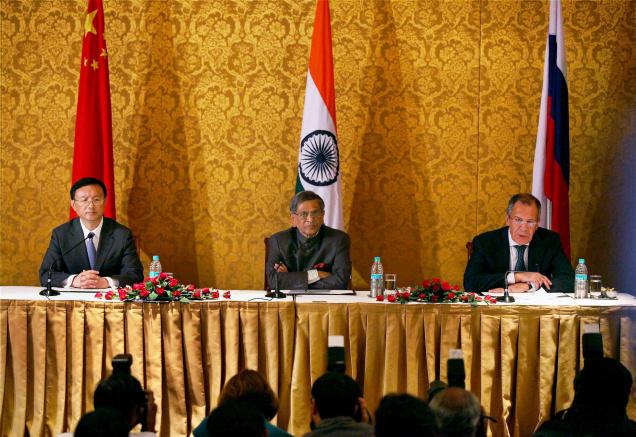
The then Russian Prime Minister Evgeny Primakov first voiced the idea of a Russia-India-China (RIC) Trilateral Forum publicly in December 1998 during a trip to India.The motivation was generally believed to be a desire to create a countervailing influence to the US, which at the time had unprecedented dominance in the international system. The fact that Russia, India and China saw the US as their primary interlocutor at the bilateral level did not appear to be an impediment at the time. However, despite regular Track II interactions between the three countries, it took four years for the first official interaction between the three – a meeting between Foreign Ministers on the sidelines of the United Nations General Assembly (UNGA) in 2002. The first RIC standalone meeting of the foreign ministers took place only in June 2005. Thereafter, on the sidelines of the G8 meeting in St Petersburg in July 2006, President Valadimir Putin, President Hu Jintao and Prime Minister Manmohan Singh had a tripartite meeting. From 2007 onwards, the foreign ministers are conducting regular annual meetings.

During this period, the motivations driving the three countries in the RIC underwent a change. If Primakov’s fear in 1998 was a hegemonic U.S., by 2005 Russia was more concerned about China and its possible duopoly with the U.S. – the G2 scenario. Therefore, Russia was keen to support multilateral initiatives, which involved China, but kept the US out. RIC fitted the bill perfectly. China also appeared to be keen on such a formation as it realized its increasing influence and envisioned RIC as a group dominated by China. India’s motivation perhaps was not to upset the Russians. It was also the age of clublateralism and therefore the RIC was an opportunity to get into an influential circle. Some hesitation, if any, was probably because these were the heady days of Indo-U.S. friendship.

Today the situation has changed again. The uni-polar moment of the U.S.A. is evidently over. A multi-polar or polycentric world is emerging. China has emerged as an alternate power centre and no longer requires props like the RIC. It is following an assertive foreign policy that relies more on promoting bilateral relations with the established and emerging powers. Similarly, Russia is now less nervous about the emergence of a G-2. It is enjoying the “reset” in its relations with the US and has become a little more wary about China’s spectacular rise in stature. Moscow, like New Delhi, also realises that its efforts to restructure and modernise its economy will succeed only if it able to convince the West to buy into this effort. While China-India trade is at historic highs (at over $ 60 billion), India is also focusing on developing its ties with the US and the 27-nation European Union. RIC appears stymied by the proliferation of groupings like the SCO, BRIC, and BASIC and does not as yet offer a unique ‘agenda’ to differentiate it. And most importantly, the three countries consider the US much more important than any other bilateral or multilateral relationship. Therefore, the “glue” that held the RIC together is drying up.

This inevitably affects prospects for RIC. The lack of interest and expectation from this format has led to little of any substance emerging from the interactions, despite identifying early on a vast arena for mutual cooperation such as terrorism, drug trafficking, climate change, agriculture, disaster management and relief, health and medicine, information technologies, pharmaceuticals, infrastructure and energy. Given this backdrop, is RIC now irrelevant? Is it time to bury this body? The answer has to be an unequivocal “NO”. So can regional trade and economics be that ‘glue’. Russia and India, through their own recent policy announcements, have recognized the arrival of the yuan as a global currency and it is likely that in the coming months India also decided to denominate some of its reserves in the currency of our Northern neighbour. Russia is already engaged in yuan based trade and maintains a stock of this currency. That over $ 130 billion of trade takes place between India and China, China and Russia and Russia in India also places weight of volume behind the grouping.  Irrespective of political ambitions and differences there is no denying the growth of economic interactions and the only limit to the economic story is politics. Can RIC be the political response to an economic arrangement?

RIC appears to be the only format which can help to create a truly Asian Trading Region, an idea that must be pursued based on the remarkable shift of global trade to within the region. The contiguous land mass, the size of the three economies and the growing levels of consumption, each provide a basis to make this trading region viable and worth investing in. The energy and transport corridors may be the place to start. While China’s rapid advances in the energy landscape in Asia can appear intimidating, it can also be seen as an opportunity to respond to the Chinese dynamism and be a part of the project. Would India consider providing access to the Indian Ocean to China? And through China for Russia? Would this create a dependency that could serve India’s interests? Would it be beneficial to open land and pipeline routes to Central Asia and Russia through China? Would these not create mutual dependencies between the two countries that would offset some of the key imbalances that exist today? India helps de-risk China its current hydrocarbon and trade flows through the Indian Ocean, while China offers alternatives to routes that would require India to traverse Afghanistan and Pakistan. At the opportune time can Russia and China be a part of the IPI and TAPI? Can China extend pipelines from Central Asia and Russia to India? With increased volumes of trade, the pipelines become viable in spite of the distance. The participation of all the three countries in these pan-continent pipelines also reduces the political risk that these large trans-national project invariably face.

The biggest gainer would, however, be Russia. They would have a market for their resources outside of the EU and China. As the demand in West Asia is released in the next 10 years due to growing commercialization of green technologies and production of shale and frontier gas in US and East Europe, Russia would increasingly depend on the growing demand from China and India. Without a cooperative arrangement or transport infrastructure, large volumes of Russian resources may have only one buyer – China.

Russia and China have already established significant cooperation in the area of energy. It is time that India becomes part of this equation and the three countries start the process of developing an Asian Gas Grid. The first steps could be modest. Russia could ship some of its piped gas landing in China through the Chinese eastern board to India, a step both symbolic and political and a harbinger of Asian tri-lateral trade. Over the years it could result in the grid that a former Indian petroleum minister strongly advocated and a gas market in the region that could evolve its own price and commercial dynamics. The next stage could involve jointly owned SEZs in Russia’s Far East with each of the countries within the SEZ enjoying privileges of home country. This could also be the experiment to test the free movement of men, material and ideas across Asia.

Standard
Non-Traditional Security, Politics / Globalisation

Samir chaired the ORF event ‘How should India meet the Maoist challenge?’, 2010

May 15, 2010
New Delhi   

There is an urgent need to re-examine the current strategies of the government towards the Maoist challenge. This was noted during a roundtable discussion on “Meeting the Maoist Challenge: A Re-look at Current Strategy” on Friday, 14 May, 2010 organized by ORF. Focusing the discussion on how to tackle the Maoist challenge, it was noted that bad governance, misplaced development models, incorrect security measures, and perceptions of justice have all played a significant role in the growth of Maoism in India’s heartland.    

Two issues came out prominently during the discussion. First, the current discourse on the Maoist challenge has been dominated by one view – the “paranoid view.” A consequence of this has been the complete absence of alternative views in the current strategies of the government. Second, contrary to the popular understanding and strategies, the discussion noted that the issue was not development but the sense of being denied justice and/or access to justice. Again, in contrast to the popular notion that the Maoist-Naxal problem was a law and order problem, it was noted that the issue is rather a problem of the obliteration of the politico-social structures of the tribal people.

Assessing the current strategies adopted by the Centre and various affected State Governments to counter the spread of the left wing extremist in more than 200 districts of India, a participant pointed out that the Salva Judum strategy of the government has been one of the main causes of the growth of Naxalism. It was pointed out that no rehabilitation and compensation has been made by the government of Chattisgarh to the people who had lost everything.

A participant pointed out that there is a general contempt among people towards the tribals which also was one of the reasons for the current state of affairs in the tribal areas. Another participant noted that there is a difference between cause and phenomenon. Commenting on the role of media, a participant noted that both print and electronic media have become indifferent to the Maoist issue. Further, the media has been fed by only one side – the police view – and reports often lacked balance.

The discussion questioned the “elitist development model” in tribal areas. It was noted that the current development model measured only by GDP growth and encourages corporate interests has destroyed the livelihood of the tribal people as most of their land were taken away for mining and other industrial projects. Both government and corporate had gone and uproot the tribals in their own land without showing any respect for the tribal people, their culture, their traditional knowledge, their civilisational strengths and their land.

The discussion suggested a multi-pronged strategy for the government. An admixture social, judicial, economic, political and security approaches have been suggested. Though the discussion also got trapped in the debate on what come first – security or development, it brought in other elements that go beyond the mere debate on security vs development.

It was noted that there was a need to broaden the medium of discussion on the Maoist challenge. It was felt that to develop a proper approach to tackle the issue, alternative voices need to be included while formulating strategies and policies. It was also noted that IB or police view alone is not enough but also one sided and that there was a need to include rights-based perspectives in government’s policies. It was noted that the issue was not pure economics but one of delivering rights.

On the political front, it was suggested that there was a need to re-look at the current governmental structures at the district and block levels. A participant suggested that the first priority of the government has to be to restore civil administration in the affected states and districts. A participant noted that change in government structures at the block level could be an effective way to ensure better representation of local people who are better placed to understand local issues and problems. Also, such as gesture could also give a sense of justice to the people. It was also suggested some autonomous areas could be created for the tribal people through that a sense of local control over its own people and resources could be ensured.

It was noted that there an urgent need for the government agencies to address the basic needs of the people. Education has been stressed in the tribal areas. It was suggested that the “elitist development model” in tribal areas need to be re-assessed. This mode of development has not created wealth but transferred wealth an there was a need for an alternative model of development where the local benefit.

The discussion has urged the government to deliver rights to the people. A participant has suggested that a judicial commission needs to be set up to address the issue of injustice that has been meted out on the people.

A participant noted that there was a need to re-look at the Salva Judum policy. Another participant pointed out that the traditional police force cannot deal with the Maoist challenge and there was a need for special training. A participant felt that there was a need for appropriate security force to deal with the Maoist problem to minimize collateral damage. Most of the participants felt the army should not be used also against the Maoists.
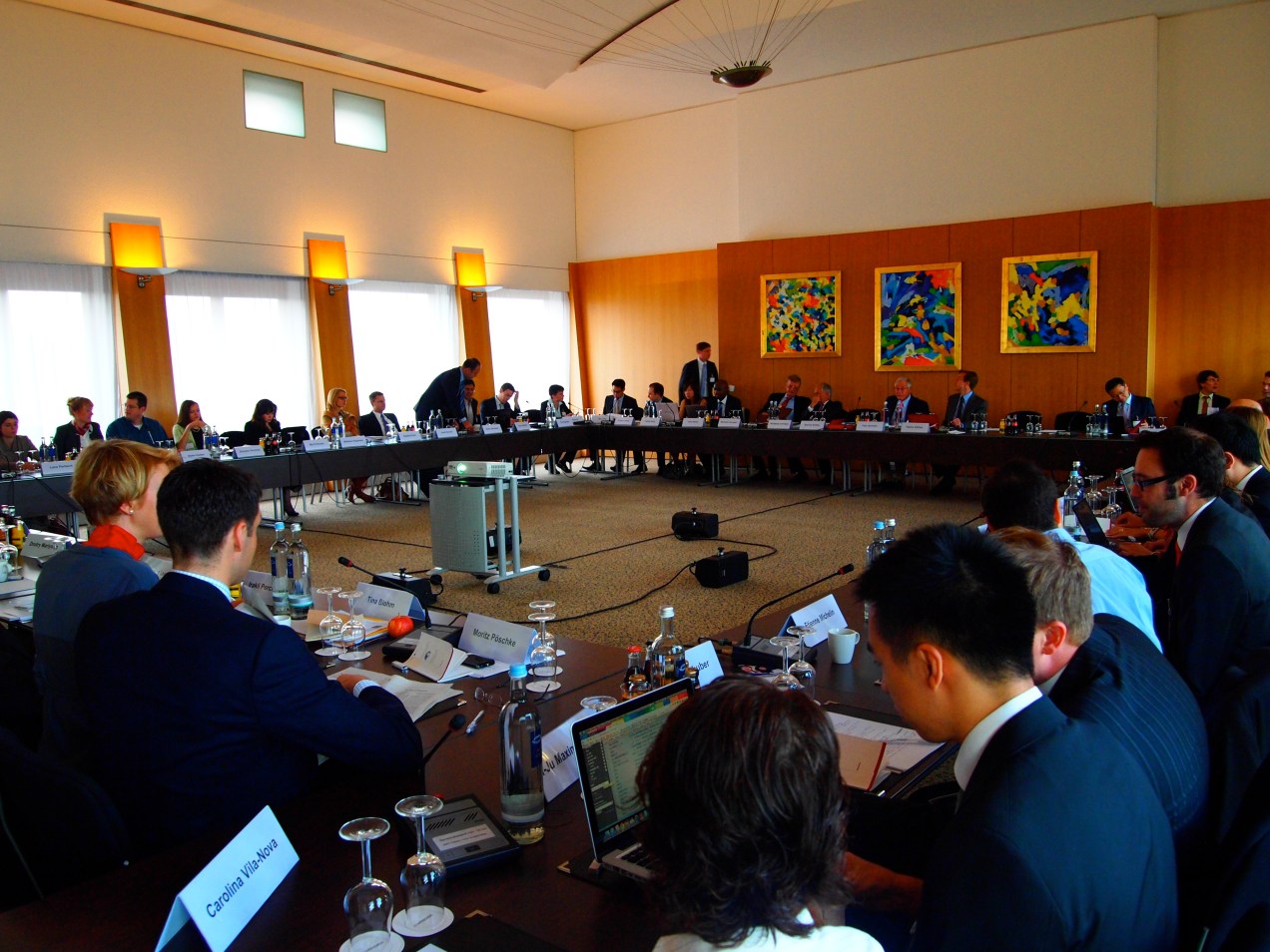

The discussion, presided by former Special Secretary Ministry of Home Affairs Mahendra Kumawat, ended with the note that development and security approaches need to include right-based approach in dealing with the Maoist challenge.

Participants included Mr. D.M. Mitra, Mr. Mohan Guruswamy, Dr. Nandini Sundar, Mr. Dilip Kumar, Mr. Arvind Kaul, Mr. Ashol Rastogi, Mr. K Subramaniam, Mr. Rajiv Sharma, Mr Saibal Dutta, Dr. Satish Misra, Mr. Samir Saran, Dr. Niranjan Sahoo and others.

Standard
In the News, Politics / Globalisation

ORF and ZEIT-Stiftung launch the Asian Forum on Global Governance, October 2011, New Delhi

The Asian Forum on Global Governance is an annual workshop jointly organized by the ZEIT-Stiftung Ebelin und Gerd Bucerius, and the Observer Research Foundation.

The inaugural forum is scheduled to take place from October 16 – 25, 2011 in New Delhi, India. Dr. Shashi Tharoor is the Dean of this policy school for young leaders.

The Asian Forum on Global Governance will take a close look at the Asian region and at the challenges facing the global community. The primary objective of this forum is to provide an instructional and networking platform for young professional leaders to discuss, debate and challenge conventional interpretations of the existing complex realities confronting communities and leaders. The program provides a unique opportunity for them to confer with high-ranking figures from the political, business and academic communities from around the globe, and especially from Asia.

Though the emphasis is on Asia, there will be a fair mix of young leaders from Europe, Americas, Africa, Asia and Australia. The participants will be drawn from diverse sectors and streams of study. Each of these participants will, at the outset, be nominated by senior figures – Heads of Governments, Ministries and Government Departments, the CEO’s of major National and Multinational Companies, Heads of Universities and of Non-Profit Organizations – and thereafter carefully selected by an eminent jury of experts.

The participants will be between 28 and 35 years of age. They would have acquired significant professional experience and would already exhibit promise at work.

For more information please visit the official website

Standard
In the News, Water / Climate

Human Security Report Project features ORF report on ‘Water Security in South Asia’

May 20, 2011
Linkto original websiteThis brief is largely based on several discussions organised at Observer Research Foundation over a period of time. These discussions were enriched by the presence of some of the well-known experts on water issues in the country, like former Union Minister for Water Resources, Dr. Suresh Prabhu, current High Commissioner of Bangladesh, Tariq Ahmad Karim, Mr. Sunjoy Joshi, Director, Observer Research Foundation, Ms. Clare Shakya, Senior Regional Climate Change and Water Adviser, DFID*, India, Mr. Samir Saran, Vice President, ORF and Dr. Dinesh Kumar, Executive Director, Institute for Resource Analysis and Policy, Hyderabad.

It is estimated that by 2030, only 60 per cent of the world’s population will have access to fresh water 1 supplies . This would mean that about 40 per cent of the world population or about 3 billion-people would be without a reliable source of water and most of them would live in impoverished, conflictprone and water-stressed areas like South Asia.

Water is already an extremely contentious, and volatile, issue in South Asia. There are more people in the region than ever before and their dependence on water for various needs continues to multiply by leaps and bounds. The quantum of water available, for the present as well as future, has reduced dramatically, particularly in the last half-acentury. This is due to water-fertiliser intensive farming, overexploitation of groundwater for drinking, industrial and agricultural purposes, large scale contamination of water sources, total inertia in controlling and channelising waste water, indifferent approach to water conservation programmes and populist policies on water consumption. SOURCE: Observer Research Foundation

Standard
BRICS, In the News, Politics / Globalisation

Samir speaks at the China-South Asia Dialogues on ‘Shaping India’s Foreign Policy: Domestic Drivers in Policy and Practice’

March 23, 2011
Bejing, China
Link to original website

India is often described as an emerging economy, yet rarely are adequate linkages made between the domestic and foreign drivers of its growth. In the fifth installment of its “China-South Asia Dialogues” series, the Carnegie-Tsinghua Center for Global Policy invited Samir Saran, vice president and senior fellow at the Observer Research Foundation (ORF) in New Delhi, to discuss the domestic forces that shape India’s foreign policy. He was joined by ORF distinguished fellow, Ambassador H.H.S. Viswanathan, who offered a targeted analysis of these policies in practice, discussing India’s engagement of African countries. Carnegie’s Lora Saalman moderated.

India’s Economic Transformation

After twenty years of economic reform, nearly half of India’s Gross Domestic Product is linked to the global economy. Yet, while India is an important and sizeable market, it is still not a large economy in terms of per-capita income and the depth and range of its economic activity, Saran said. With the bottom 80 percent of the population contributing over 60 percent of Indian consumption, India remains sensitive to the rise and fall of prices for both goods and infrastructure. Saran suggested that India’s designation as an “emerged economy” needs to be re-assessed.

    • Wealth Disparity: Saran spoke of the vast wealth disparity in India between the extremely wealthy—including approximately 600 millionaires and billionaires—and the 800 million people who subsist on less than $2 per day. India possesses nearly half of the world’s poor, which strains its ability to deal with issues such as healthcare, education, energy, and water supplies.
    • Population Bulge: With the growing number of teenagers set to enter the domestic job market, India also faces some daunting challenges in creating adequate employment. One of the Chinese participants asked whether India’s youthful population was a source of instability for the country. Saran agreed that the country’s large young population exacerbates some of the threats that India already faces, such as left wing religious and political extremism, Islamic radicalism and an unstable neighborhood that at times leaks its impulses and intentions across its border.
  • IT Not a Panacea: Saran argued that while India is known for its booming information technology industry, this sector has only been able to provide 15 million jobs in the past decade-and-a-half, in a country with a population exceeding 1.1 billion. He estimated that India will need to add 10-15 million new jobs each year to fully employ to its youth. Saalman asked whether in the wake of China’s shift from a labor-intensive to a capital-intensive economic base, India might be able to absorb some of China’s manufacturing jobs. Saran doubted that this would occur on a large scale given the inability of India to devote the tracts of land necessary for major industry to thrive.

India and the Global Community

    • Diaspora and Outsourced Governance: One Chinese participant asked about the role of the Indian Diaspora in meeting India’s development goals. Saran noted that, with the exception of the United States and parts of the European Union, much of India’s Diaspora in other parts of the world remains at the lower rungs of the local society, such as those working in the Middle East. This group often exerts an indirect rather than direct political influence.
  • The China Dream: Saran explained that Chinese corporations are now entering Indian economic sectors like power, telecom, and infrastructure, sometimes replacing Western countries in key projects. They have even started offering commercial loans and finance. While India does not want to be overly dependent on China, the price sensitivity of the Indian market and the reality of the global economy may compel greater Sino-Indian cooperation. Yet, China offers India a more realistic goal than the “American Dream,” Saran contended. While India will have to stand up to a more demanding China in a geo-political context, he argued a segment of Indian industry already views China as an economic opportunity.

India’s Transformation in Practice in Africa

The international perception of Africa is changing, with the traditional view of its colonial past and lack of strong institutions giving way to economic revitalization, impressive growth rates, increased consumption levels, and expanded resource extraction and exports. The political resurgence in Africa has made African leaders more responsive to good governance, argued Viswanathan. As part of this process, India and China are engaging the newly resurgent Africa and creating new paradigms.

    • Beijing and Delhi Consensus:  India, much like China, has taken a much more business-oriented and less politically driven approach to Africa, Viswanathan said. Both countries anticipate a shift in global institutions, where the traditional Western dominated power structure will be faced with alternatives from the developing world.
    • China and India Into Africa: Viswanathan spoke of the need for India to make greater investments in agriculture, infrastructure, health, and human resource development, alongside cooperative measures in combating terrorism, drug smuggling, and human trafficking within Africa. Noting the Western media’s strong focus on China’s role in Africa and India’s lengthy history on the continent, Saalman asked for a comparison of the role the two countries can play in the continent’s economic renaissance. Viswanathan answered that while China has had a varied level of engagement with Africa since the 1950s, India has maintained a consistent presence and strong level of integration in Africa. Many Indians immigrated to Africa and often hold citizenship in African nations, placing India in an advantageous position to boost Africa’s growth from within the continent.
    • Dispelling the Colonial Mindset: China and India are not out to dominate or control Africa, asserted Viswanathan. While both countries are engaged in the extraction of resources from Africa, they have also made strides toward helping Africa develop its infrastructure and human resources. For example, India has also brought some of its telecommunication savvy to bear in Africa, through business ventures to provide lower cost connectivity to Africa.
  • Between Hard and Soft Power: Viswanathan emphasized that much of India’s military aid has been non-lethal, such as providing uniforms and supplies. There had been some small arms trade with some countries but the greater concentration has been on defense training and the sharing of military personnel. Ultimately, Viswanathan argued that for both India and China, the soft power element of having their citizens on the ground and establishing cultural institutions like the Confucius Institutes has been more effective at penetrating Africa than hard power mechanisms.
Standard
In the News, Politics / Globalisation

Samir featured in NDTV blog on ‘Voters ignore the bait’, 2009

by Mayur Shekhar Jha 
April 23, 2009
Link to original website

We want development, not hollow promises, says a sleepy town in Jharkhand. The promise of a steel plant is not good enough. People’s will or steel – that is how I can sum up the mood of Godda, in Jharkhand, which borders the state of Bihar. The promise of development seems to be the bone of contention between the Congress and BJP.

In my previous report, ‘In the name of Development’, I had found that in the tribal dominated areas around Ranchi, the capital of the newly formed state of Jharkhand, voters are apprehensive that they will lose land and other means of livelihood in the garb of development. Resistance to industrialisation, I found, was more than evident. On the other hand, in the areas around Godda, north of Ranchi, and other bordering districts of Bihar, it is the development promise that is the core poll plank. Both the main candidates in Godda, Nishikant Dubey of BJP and Furqan Ansari of Congress, have promised a world of development to voters in the area.

The Godda parliamentary constituency has ample coal and iron ore mining, the key raw materials for steel production. In fact, Lalmatia Collieries, situated in Godda, is the country’s second largest coal hub, next only to the mines in Dhanbad, another district in Jharkhand. BJP’s candidate Dubey has a known affiliation with Essar Steel.

Some top leaders who are part of Dubey’s campaign management say that a large number of young voters in the constituency have been attracted to him, with the promise that if he wins, he will strive to set up a huge steel facility in the constituency. And here comes the bait – the promise to generate employment for more than 10,000 youngsters in the area. Dubey was not available for comment, as he was busy campaigning ahead of the voting on April 23.

On the other hand, his Congress rival Ansari is also focussing on a development based communication. “It will be a Congress-led government at the centre. Why only one steel factory, I will strive for all round economic prosperity in the area. At the same time, I will ensure that no one gets displaced from his roots. Our focus is, and will always remain on inclusive growth,” Ansari told me, hoping that voters will give him the mandate for a second term. At the same time, Ansari is taking a dig at the prospects Godda might meet, in the eventuality of electing a ‘corporate person.’

“He is more interested in representing interests of his company, and not that of people of Godda. He wants to win, he can facilitate his company to make use of the rich coal reserves of Godda,” he said. For once, it appeared to me as I drive through the constituency, there were enough believers for his charge.

Poll watchers say that issues in Godda are bound to be different from those in areas around Ranchi. “Godda does not have much arrable land, and mining is the main source of the economy. Promise of industrial development is bound to attract more youth in Godda,” says Samir Saran, vice-president, Observer Research Foundation. Saran is working on a study on urbanisation in Bihar and Jharkhand.

The socio-economic profile of Godda is also significantly different from that of areas such as neighbouring Torpa and Khunti, on the outskirts of Ranchi. While tribals constitute majority population in these areas, Godda has a substantial chunk of Brahmin and Muslim voters. Of a total of about 12.5  lakh voters in the constituency, there are about 3.25 lakh Brahmins and about 2.8 lakh Muslims. There are also large number of Thakurs and OBCs. Tribal population in the constituency is estimated at just about 1 lakh.

(Mayur Shekhar Jha was travelling in Jharkhand last week, ahead of the day of voting on April 23)

Standard