BRICS, Columns/Op-Eds

Article in “Russia and India Report”: Navigating the trust deficit

by Samir Saran and Jaibal Naduvath
February 17th, 2012

Please find here the original article

At the 17th round of the Indo-Russian Inter-governmental Commission on Trade, Economic, Technological, Scientific and Cultural Cooperation (IRIGC-TEC) held in November last year, the two governments agreed to set up an investment fund with public-private partnership to finance projects in the two countries. Barely a month later, after almost 18 years of negotiations, Russia was formally invited to join the World Trade Organization (WTO), and, has until June of this year to ratify the accession agreement. Beyond reducing tariff barriers and eliminating non-tariff barriers, accession to WTO is also expected to reduce government interference in business, a key pre-condition for free enterprise. Russia’s evolving economy has been witness and victim to continued government interventions.

Nevertheless, given the impending WTO accession, the India-Russia joint investment fund has managed to get its timing right. Current India-Russia bilateral trade, estimated at around USD 9 billion, is admittedly far below its potential. Trade promotion initiatives such as this investment fund, a possible Comprehensive Economic Cooperation Agreement (CECA) with the Russia, Belarus, Kazakhstan Customs Union combined with the business confidence the WTO accession would inspire, is expected to double bilateral trade to USD 20 billion by 2015, an ambitious, though very achievable feat. With a Price to Earning (P/E) ratio of 6, compared to India’s 14, China’s 15 and Brazil’s 8.5, Russia’s market is attractively priced amongst the emerging markets with traditional industries such as oil and gas, metals and minerals remaining hugely undervalued.

Despite warm bilateral ties, and close political engagement and co-operation extending well over 55 years, India-Russia trade has rarely managed to go beyond the legacy confines of defense equipment, space, energy, metals and minerals, and, commodities, even while, ironically, both countries have independently managed to very successfully leverage new vistas of opportunity in economies they stood together against for a better part of the 20th century. Russia-European Union (EU) trade in 2010, for instance, stood at around USD 191 billion, with the bloc accounting for over 47% of Russia’s total trade turnover, representing a three-fold increase in just ten years. On the other hand, India-EU trade has grown to USD 107 billion this year and is expected to double in two years on the back of a Free Trade Agreement (FTA) currently being negotiated. Compared to this, India-Russia bilateral trade of around USD 9 billion today pales in significance even though it represents a quantum leap from about USD 3 billion in 2006-07.

Russia-India two-way trade and investment has rarely ventured beyond government-controlled domains, which are also accompanied with government-backed guarantees of some kind. Russia’s active participation in several military, aerospace and nuclear projects in India and Indian investment in Russia’s energy sector and preferred trade in controlled commodities are part of this broader trend. But, the true test of any meaningful business relationship lies in the unmitigated ability of private enterprise on either side to confidently engage, invest and gain from each other’s economies, outside the security of sovereign assurance, even if notional. This is not so in the case of Indo-Russian trade.

Russia, of course, dominates the Indian defense sector and is comfortable navigating through Indian officialdom, which still retains much of its controlled economy character from the 70s and 80s. However, this may not remain the case for long. Under greater media scrutiny and public glare, the defense relationship will need to become far more efficient in terms of reliability, time lines and price points, else Russian dominance in the sector could be potentially challenged. Further, as the offset policy starts playing out and thereafter as the Indian private sector becomes engaged in defense production and R&D, Russia may no longer be a competitive player in this segment. To really be a beneficiary of India’s transformation over the coming 2 decades, Russia needs to expand its portfolio by diversifying into the arenas of industry and infrastructure in India. In doing so, its ability to confront India’s dynamic and loud democracy, and an increasingly uncompromising civil society will be as severely tested as its ability to navigate the country’s highly regulated business terrain arising from complex land use norms, environment clearances, and fiscal regimes, all of which have shown to evolve over time.

On the other hand, Russia offers India minerals and land, besides a huge market for software, services, value added goods and consumables. The resource sector in Russia, though, continues to be dominated and overwhelmed by its government with significant self-interest. Agriculture and land based activities too would be prone to similar dynamics and one can expect Indian private sector’s trepidations to be strong on investing in either. Apart from large Public Sector Companies and select large Indian Multi National Corporations, it is unlikely that Indian private sector will invest in Russia, despite undervaluation and potential for attractive return. Indian businesses’ traditional risk aversion is demonstrated by flight of capital to low return economies of the Atlantic that have corresponding low risk political ecosystems as well.

When Indian businesses consider making investments in Russia, they still seem daunted by perceptions constructed by imagery of the powerful and manipulative oligarchy, political nepotism and uncertainty, and seemingly poor judicial and legal recourse frameworks. Fears to do business in Russia have been hyped by experiences of companies such as ExxonMobil, Total and Shell in Russian Oil Sector, which were divested of their interests by Russian political class in a manner that was viewed as ad-hoc, if not vindictive. This imagination has often resulted in investments by Indian entrepreneurs being channeled into markets such as UK, EU and US, which are far more taut than Russia in terms of economic opportunity.

Ironically, Russian investors feel the same way towards India, drawing from a regular narrative of chaotic democracy, policy inconsistency, political fickleness, and civil instability with commitment cycles perceived to not exceed the life of the dispensation in power. One of the collaterals of the 2G verdict of the Supreme Court, which saw the revocation of 21 of Sistema Shyam Telecom’s (SSTL) 22 telecommunications licenses, could be the flickering and faint Russian Interest in Indian business opportunity. Russia’s USD 28 billion telecom to tourism conglomerate, Sistema JSFC, operating in India through its subsidiary MTS, had invested USD $2.5 billion over the past three years into the project, in arguably, the largest private sector intervention by a Russian company in India’s new economy to date. Further, Russian state owned Federal Agency for State Property Management acquired a 17.4% stake in SSTL by investing a hefty $600 million just last year. Fortunately, there is a growing business constituency, which views such re-calibrations as an inevitable part of polity evolution, but nonetheless the experience of Sistema, which may see itself as a victim of judicial overreach as some argue, could well define Russia’s appetite for India’s growth story.

Russia’s accession to WTO this summer and the consequent abolishment of tariff and non-tariff barriers will heighten global interest in Russia. Pro-investment initiatives such as the proposed joint public–private investment fund combined with demonstrable political and economic will on both sides should result in heightened interest in private enterprise on both sides to explore and invest in each other. Multi-billion dollar National Minerals Development Corporation – Severstal Joint Venture steel project in Odisha or Indian companies negotiating long-term agreements for supply of diamonds from Russia are positive signs for medium to long term economic engagement between the two countries.

Standard
BRICS, Columns/Op-Eds

Article in “The Hindu”: Giving BRICS a non-western vision.

by Samir Saran and Vivan Sharan
New Delhi, February 14, 2012

Please find here the link to the original article.

India is all set to host the Fourth BRICS Summit in March this year. The journey from Yekaterinburg to New Delhi has demonstrated that the political will amongst member nations to sustain this contemporary multilateral process is strong. Along the way South Africa has been welcomed into the original “group of four.” Yet, the challenge for BRICS has always been, and continues to be, the articulation of a common vision. After all, the member nations are at different stages of political and socio-economic development. While some have evolved economically and militarily they are yet to succeed in enabling plural governance structures, while others who represent modern democratic societies are being challenged domestically by inequalities and faultlines created by caste, colour, religion and history. The BRICS nations do have a historic opportunity — post the global financial crisis and the recent upheavals in various parts of the world — to create or rebuild a new sustainable and relevant multilateral platform, one that seeks to serve the interests of the emerging world as well as manage the great shift from the west to the east.

Way forward

Indeed, two out of the five economies in BRICS, China and Russia, have already emerged, and are veritable heavyweights in any relevant global political and economic discourse. Why then should BRICS depend on sluggish multilateral channels such as the World Trade Organisation (WTO), or try to imbibe didactic, non-pragmatic western perspectives on issues purely of common interest? It is amusing to be offered solutions to poverty and inequality, bottom of the pyramid health models, low cost housing options, education delivery, energy and water provision, et al by the wise men from organisations and institutions of the Atlantic countries. When was the last time they experienced poverty of this scale, had energy deficiency at this level and suffered from health challenges that are as enormous? The responses to the challenges faced by the developing world reside in solutions that have been fashioned organically.

BRICS could systematically create frameworks offering policy and development options for the emerging and developing world and assume the role of a veritable policy think tank for such nations, very similar to the role played by the Organisation for Economic Co-operation and Development (OECD) in the 20th-century world. Thus BRICS must create its own research and policy secretariat (for want of a better term) for addressing specific issues such as trade and market reforms, urbanisation challenges, regional crises responses, universal healthcare, food security and sustainable development (many of these issues are being discussed year at the BRICS Academic Forum in March).

Non-traditional security

The OECD’s stated mission is to “promote policies that will improve the economic and social well-being of people around the world.” Although the BRICS nations account for a fourth of global GDP and represent over 40 per cent of the total global population, none of them are OECD members as yet; instead what they have is “enhanced engagement” with the OECD. The BRICS nations have already created a viable platform for “enhanced engagement” with each other through the institutionalisation of the annual Leader’s summit, preceded by an Academic Forum of BRICS research institutions and a Financial Forum of development banks (and this year, a newly instituted Economic Research Group will focus on specific economic issues). The dominant discourses within each of the BRICS nations today are centred on non-traditional security, which can be efficiently addressed through collective market based response mechanisms.

Despite intra-BRICS trade volumes rising exponentially over the past decade, there are few instances of actual financial integration within the consortium (aside from the case of Russia and China starting bilateral currency trading last year). A useful first step to enable this would be to institute a code of liberalisation of capital movements across the five countries, as a modern day parallel to the 1961 OECD code with an equivalent mandate. In the current environment of global economic uncertainty, multinational corporations are perhaps the most adaptable and profitable drivers of economic growth. Therefore, at the outset, the creation of favourable policies for multinationals to conduct business across BRICS would be well justified. Moreover, just as the OECD has a comprehensive set of guidelines that set benchmarks for various economic activities, from testing standards for agricultural goods to corporate governance of state owned enterprises, the BRICS nations could create their own guidelines on the best practices and standards within the consortium.

Finally, within the BRICS nations, there are both import and export centric economies. This provides an excellent template for a realistic multilateral negotiating platform where obdurate self serving bargaining positions are natural starting points. The stalled discussions at the Doha Round of the WTO are an example of the difficulties of consensus building. Since the BRICS nations are already addressing a plethora of issues covered by the Doha Round, they are well placed to move ahead of it, and resolve mutual positions and common concerns.

What started as an investment pitch by Goldman Sachs (BRIC) has evolved into a useful multilateral instrument, for the BRICS nations. BRICS must now move on from being a grouping of individual nations, discussing agendas, to becoming a “go-to” institution for setting regional and global agendas. The essence and ethos of such an institution must in turn, flow from the inorganic prism of stability, security and growth for all. Stability from business cycles and financial governance failures, security from traditional and non-traditional threats posed to humans and the environment, and unbiased growth and prosperity are common aspirations for all BRICS nations, and they must be achieved and delivered from within. The Fourth BRICS Academic Forum will attempt to address these imperatives.

Samir Saran is Vice-President and Vivan Sharan an Associate Fellow at the Observer Research Foundation. The foundation is the Indian coordinator for the Fourth BRICS Academic Forum on March 5-6, in New Delhi.


Standard
Books / Papers, Water / Climate

ORF Report “Re-imagining the Indus”

Please find here the link http://orfonline.org/cms/export/orfonline/documents/other/indus.PDF to our comprehensive report on the “Indus”, the associated treaty, the emergent rhetoric and the reality of people whose lives are inseparable from the river and their traditional and contemporary water management practices.

It is perhaps the most comprehensive effort that captures essential narratives and historical evidence from both sides of the border, that is unable to divide the organic and indivisible river basin.

Co-produced with the LUMS, Lahore with the support of the DFID, this research led by ORF scholar Lydia Powell is certain to offer a pragmatic insight on the debate and the way ahead for the two countries and more importantly for the one people of the river Indus.

I had the pleasure of writing one section of this report.


Standard
In the News

Samir Saran featured in “The National”

India PM under pressure to resign as court withdraws telecoms licences

Eric Randolph, Feb 3, 2012

Please find here the link to the original article.

NEW DELHI // The Supreme Court’s decision to scrap 122 mobile phone licences, which it says were illegally awarded by the telecoms ministry, is another blow to the beleaguered Indian government. In its judgement yesterday, the court ruled that telecoms officials had “virtually gifted away” the licences to preferred companies, costing the public billions of rupees in lost revenue. The verdict places the blame squarely on former telecoms minister Andimuthu Raja, saying he arbitrarily fiddled the application process to favour certain companies, including real estate firms that had no prior experience in the telecoms business, and quickly sold on their allotted spectrum for huge profits. The court criticised the decision in 2001 to “arbitrarily” fix prices at that year’s levels – a decision that cost the exchequer US$36 billion (Dh132.2bn), according to an audit by the Central Bureau of Investigation in 2010.

Mr Raja was arrested and charged with corruption last year along with several officials and corporate executives, and a separate trial will determine whether any bribes were paid to fix the process. A separate petition, seeking to investigate the role of the home minister, P Chidambaram, who was the finance minister at the time, was sent back to a lower court. It has two weeks to take a decision.

The Congress-led government has tried to shift the blame on to the previous National Democratic Alliance (NDA) administration, saying it set the rules for spectrum allocation in 2003. “The policy was initiated by the NDA government,” said Kapil Sibal, the current telecoms minister, at a press conference yesterday. “The prime minister was in no way responsible, nor was the finance minister.” But the opposition says this ignores the charge that the policy was illegally subverted by Mr Raja. It says the government of prime minister Manmohan Singh must have been aware of the fraud going on at the telecoms ministry.

“The entire policy of the government and its implementation has been held to be illegal and completely fraudulent,” Arun Jaitley, the parliamentary leader of the opposition Bharatiya Janata Party, told reporters yesterday. “For the government to say it has not been indicted shows a sense of shamelessness.” There is likely to be political fallout for the government, which has spent the last two years mired in scandals and unable to pass a single major economic reform.

“The opposition will use this verdict to demand the resignation of Chidambaram and the prime minister and it will be almost impossible to pass a single bill in the next session of parliament – perhaps even the budget,” said Samir Saran, the vice-president of the Observer Research Foundation, a New Delhi-based think tank. Much may depend on the results of state elections being held across five states, including Uttar Pradesh, India’s most populous state, which begins polling next week. The results, to be announced on March 6, would give an indication of how much the recent scandals have influenced voters outside the capital. “The government will try to buy time and pin its hopes on a favourable performance in the provinces,” said Mr Saran. “If they get that, they won’t need to be so apologetic. “They will see it as a chance to turn a fresh page, perhaps induct new faces into cabinet and draw a line under all this mess.”

A major reshuffle of the cabinet could even touch the prime minister. Though he is renowned for his personal probity, he has faced mounting criticism for his ineffectual leadership and failure to tackle corruption in his government. “He has lost his credibility with everyone,” said Ashok Malik, a well-known political columnist based in Delhi. “A wiser person would have resigned by now.” Some feel that yesterday’s verdict may at least reassure the international community that there are limits to India’s graft-ridden politics. Over the years, the Supreme Court has consistently shown itself to be a bulwark against the worst excesses of officials.

Subramaniam Swamy, one of the petitioners in the case and leader of the Janata Party, said the verdict went beyond his expectations. “It will have a very good impact for the future – it says that if you commit a crime, you cannot make a fait accompli of it,” he told reporters outside the court. But others fear it only confirms the view that India is plagued by corruption. “India’s reputation as a place of crony capitalists and opaque bureaucracy has been strengthened today,” said Mr Malik. For Anil Bairwal, the director of the Association for Democratic Reform in New Delhi, the test will be how the government responds. “The Supreme Court has consistently passed these types of judgements,” he said. “What has been wis that the politicians – and indeed the entire political class – don’t pay attention.”

foreign.desk@thenational.ae

Standard
Columns/Op-Eds, Politics / Globalisation

Column in Russia & India Report: Return of Putin? India hedges bets

Published on February 1st, 2012
by Samir Saran & Jaibal Naduvath
specially for RIR 
Please find here the link to the original article.
The mass protests in Moscow last December have had little resonance in India due to a limited media obsessed with defence and energy aspects of the India-Russia relationship. However, India will be watching closely the agenda of the new team that Putin, if he is elected, puts together as it will impact the trajectory of what could be a crucial partnership of the 21st century, say Samir Saran and Jaibal Naduvath. 

For over six decades, India’s relations with Russia and its predecessor, the erstwhile Soviet Union, have remained very cordial. From the heady heights of being “near allies” during the Cold War era to a brief pause in the 1990s as both countries recalibrated their own identities during a period of dramatic political transformation in each country, the Russia-India relations have endured dramatic shifts in global politics. Over the past 20 years though, there has been a pragmatic remoulding of the content of this engagement alongside an assured continuity on crucial areas of traditional cooperation like the defence sector. The non-continuance of the Indo-Soviet Peace and Friendship Treaty of 1971, seen by many as India’s security insurance during the cold war years, the subsequent Declaration of Strategic Partnership signed by the two countries in 2000, and renewed co-operation and strategic engagement at multilateral fora such as BRICS, Shanghai Cooperation Organisation (SCO) and the UN reflects diplomatic maturity and political realism in equal measure. However, despite the long-standing bonhomie, close trade ties and multiple cultural and political exchanges, Russia has not managed to emotionally engage the Indian psyche as much as it should have, even though the very mention of Russia evokes feelings of great warmth among most Indians. However, meaningful interest in Russia remains confined to the foreign policy elite, emancipated urban dwellers and business and trade communities with interests in the opportunities that Russia offers. In the larger public discourse Russia continues to be viewed through the prisms of defence and strategic relationship and the ‘energy narrative,’ with media and polity both guilty of selectively amplifying developments that impact these aspects. As a result, the response on the Indian street often tends to be binary and simplistic to what is transpiring in contemporary Russia. Media reportage and public discourse in India on the upcoming presidential elections in Russia is prey to this myopic syndrome. Indeed, Russia accounts for a majority of all Indian military imports and the reliability of such defence sales is vital for India. A stable Russia and more importantly a political dispensation in Kremlin that supports this defence sector engagement is crucial. There is, however, an urgent need to widen the discussions and media narrative on Russia, if there is to be meaningful and contemporary appreciation of this most significant ally in India.

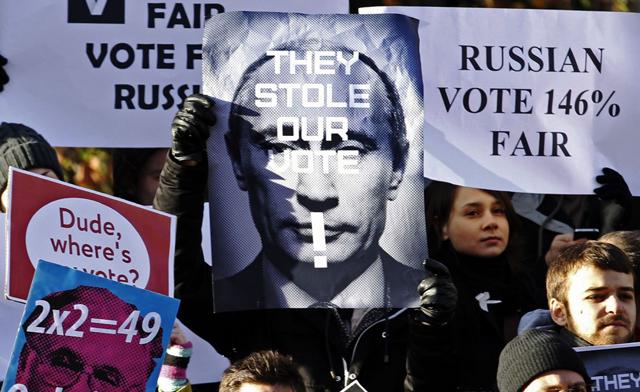
As things stand, very little is known of presidential candidates other than Valdimir Putin, who has visited India several times, and is considered sensitive to this country’s interests. However, there is also a tacit realisation that sweeping political changes globally and reverberations in Russia which culminated in highly publicised street protests in Moscow (albeit modest in size and scale) against allegations of vote rigging in the parliamentary elections have led to a decline in Putin’s standing, rendering him more vulnerable than before. There is also a feeling that Putin losing his aura of invincibility, and the possible devolution and decentralization of power in Kremlin, could actually usher in greater pragmatism into the Russian political ecosystem making it a lot more dynamic and democratic, and, easier for others to empathise with. Despite being challenged by sections of Russian civil society, Putin may not have lost much of his personal brand appeal in India yet, for two reasons. First, very little is known of the opposition within Russia and even less so is available in Indian media. Secondly, dissent, discord, rebellion are all part of the political landscape in India and the leadership is indeed defined by the ability of the leader to resolve and navigate such challenging terrain. India itself has been ruled by coalition governments intermittently for over two decades with arguably, reasonable success. From their own experience, Indians could relate better to Putin if he is able to manage and share political space and carve out a consensus. Putin, slightly vulnerable and in the need for reaching out, makes him more attractive to the Indian people and its enterprises than Putin the steely and authoritarian figure.

The feeling is that under his potential future presidency, Putin may have to cede at least some ground to factions within his United Russia Party. Who the factions are and what their dispositions and agendas would be are unknown. In the coming days, prior to the March elections and certainly, if voted to power, in the period after Putin’s election, the main interest in policy circles in India, would be the sort of ‘arrangement’ Putin may need to put in place to manage dissent and preserve his influence.

Who (all) he devolves power to and how that impacts Russia’s external engagement will be important to India. As a global military power, Russia affords great counterbalance for India vis-à-vis China. If a pro-China faction emerges at the Kremlin, it will have the potential to further fuel China’s own ambitions in Asia and may drive India to develop a deeper partnership with the United States and other Asian powers to offset it. On the other hand, if the new power structure allows greater Russian outreach to the US and the European Union, it would not only balance the rise of China, but also help India and Russia develop a partnership beyond defence sales, elevating their engagement to a wider set of issues including, on managing the global commons.

From an establishment standpoint, India has always accepted organic development of national political systems and hence is unlikely to be either unduly concerned or patronising as long as its core strategic concerns are not jeopardised. Muted media interest and public response to the Moscow street demonstrations, dramatic developments in a system with little tolerance for political dissent, needs to be seen in this light. Also, after having witnessed the upheavals in the West Asia and North Africa (WANA) region, the media coverage of the Occupy Wall Street agitation and the highs and lows of the civil society movement against corruption at home, the larger Indian public is unlikely to be very taken in by the limited protests in Moscow.

The Indian public sphere is unlikely to engage comprehensively with the happenings in the run up to the Russian elections. On the other hand, the Indian establishment will keenly follow political developments in Russia as the importance of the election outcome and its impact on both the Asian strategic architecture and bilateral relations is not lost on them. The two countries have enormous potential for greater strategic convergence and a favourable political dispensation in Moscow could well catapult the India-Russia relationship into one of the defining global partnerships of this century.

Samir Saran is Vice President at the Observer Research Foundation, a leading Indian policy think tank and Jaibal Naduvath is a communications professional in the private sector in India

Standard
Books / Papers, Water / Climate

Carbon markets and low-carbon investment in emerging economies: A synthesis of parallel workshops in Brazil and India

Abstract

While policy experiments targeted at energy and innovation transitions have not been deployed consistently across all countries, market mechanisms such as carbon pricing have been tested over the past decade in disparate development contexts, and therefore provide some opportunities for analysis. This brief communication reports on two parallel workshops recently held in Sao Paulo, Brazil and New Delhi, India to address questions of how well these carbon pricing policies have worked in affecting corporate decisions to invest in low-carbon technology. Convening practitioners and scholars from multiple countries, the workshops elicited participants’ perspectives on business investment decisions under international carbon markets in emerging economies across multiple energy-intensive sectors. We review the resulting perspectives on low-carbon policies and present guidance on a research agenda that could clarify how international and national policies could help encourage both energy transitions and energy innovations in emerging economies.

Read the entire article here: Full article (PDF-version).

Standard
Columns/Op-Eds, Politics / Globalisation

Article in Financial Express: Identity and Access in Uttar Pradesh

by Samir Saran and Vivan Sharan
January 30th, 2012
Please find here the original article

Uttar Pradesh (UP) is home to a population similar in size to Brazil and is spread out over a vast area, ranging from the fertile Gangetic Plains to the arid Vindhya Hills. It has traditionally also been the state that shaped national politics and the caste, class and religion based political landscape is representative of the complexities of democracy in India. It is also today a state that defines the challenges that lie ahead in the coming decade and more. Be it physical or social infrastructure, employment or environment, industry or agriculture, multiple narratives within the state need to be reconciled. However, the causal relationship of caste with opportunity continues to be most vexed. There are significant divergences in access to the basic necessities – water, electricity and modern cooking fuel (two out of Mayawati’s election rally cry trio of ‘bijli, sadak and paani’) across this geography. Once rich in economic growth potential, driven by the gains achieved by the agriculture sector through the Green Revolution, the state is now the primary contributor (21.3%) to the overall poverty in the country as per the Multi Dimensional Poverty Index of the UNDP with close to 70 percent poor households.

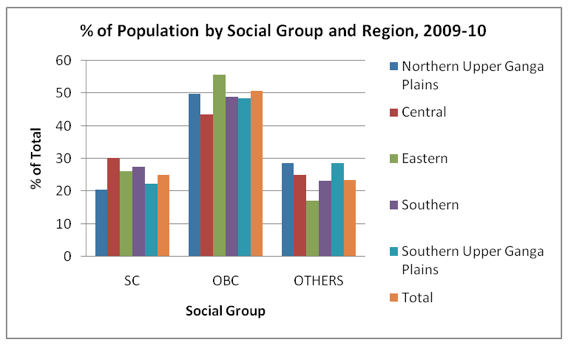
Over the years, the state has seen increasing political emphasis and rhetoric directed at the marginalized social groups that exist within the state, as a strategic ploy to secure voting constituencies. This specifically includes people categorised as Scheduled Castes (SCs) and Other Backward Classes (OBCs) who represent majority proportions in relation to the total population of the state (Figure 1). It is ironic then, that the average income of SCs and OBCs in UP, is over 18 percent and 20 percent lower respectively, than the all India average, according to the latest NSS data compiled at the India Data Labs at the Observer Research Foundation.

India DataLabs @ ORF: NSSO Consumption Expenditure 2009/10

In terms of access to drinking water (within dwelling) the SCs are the worst off amongst the 3 groups, followed by the OBCs. The Central, Eastern and Southern regions (the NSS divides the State into 5 regions found in Figure 1) fare poorly; a combined average of around 35% of SCs and OBCs have access within their dwellings in these regions, compared to close to 60% in the relatively prosperous Northern Upper Ganga Plains. This average diminishes to an appalling 14 percent in the Central, Eastern and Southern regions if only SCs are considered.

Inherent barriers to social and economic mobility have compounded the inequities created by lack of basic infrastructure provision, and political apathy towards development in the state.  These worrying realities are exacerbated by the fact, that there has been negative growth in access to electricity (an average of -15.23%), over the five year period 2004-05 till 2009-10,  in the Central region and negligible growth in Eastern region, amongst all of the aforementioned social groups (Figure 2).  This negative growth is primarily driven by the sharp decline of access in urban areas. A nearly 22% decline over the 5 year period, in access to electricity in the case of OBCs  living in urban areas located in the Central region, is instructive of the fact that despite representing the largest political constituency in the region, they have been unable to secure commensurate development entitlement.

India DataLabs @ ORF: NSSO Consumption Expenditure 2004/05 & 2009/10

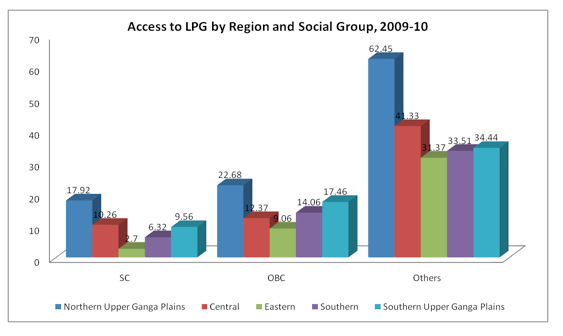
A recent World Bank Report on “The Role of Liquefied Petroleum Gas in Reducing Energy Poverty” suggests that everything else being equal, a higher level of LPG access is positively correlated with higher education levels in households in developing countries such as India. Unfortunately, there are large inequities in access to the modern cooking fuel across social groups (Figure 3). While affordability is a key concern, and according to the report, high costs are the most important determinant preventing consumption shifts across households; from less efficient primary sources of cooking fuels such as firewood, there are few justifications that help resolve facts such as – OBC urban households in the Central region have shown a 30 percent decrease in access to LPG over 2004-05 to 2009-10 (while access has remained nearly stagnant in rural areas).

India DataLabs @ ORF: NSSO Consumption Expenditure 2009/10

Indeed income class has a bearing on the levels of access to drinking water, electricity and LPG, and this is particularly true in developing societies, where lack of access reinforces income groups and in turn sharpens particularities of social groups. Low income poverty traps are dominant since the poor have no means to improve existence, owing to mediocre infrastructure, poor education and skills attained, lack of health services and poor productivity levels perpetuated by inequitable access to these essentials. The overall lack of access to specific social groups across regions, as visible in the case of UP, only adds to the sustained and absolute poverty levels of the state.

The higher levels of development seen in the Northern and Southern Gangetic Plains, serves to highlight that, successive governments have been unable to leverage the agricultural productivity of the region and enhance basic infrastructure throughout the state. The logical conclusion is then, that the bulk of the development in the state has resulted from proximity to water and fertile soil and the development of industry, rather than policy or administrative interventions, affirmative action or otherwise. Over the past decade, in the aggressive battle for votes, political parties have emphasised an inclusive development agenda and rallied support through promises for social mobility across castes and classes. The statistics while telling a part of the tale do suggest such promises to be mere rhetoric. Even in regions where some groups have telling political weight, ‘Bijli’ and ‘Paani’  eludes them. This is certainly a dangerous’sadak’ for the most populous state of the country, to keep treading on.

*Samir Saran is Sr. Fellow & Vice President and Vivan Sharan is Associate Fellow at the Observer Research Foundation, New Delhi.

Standard
Books / Papers, In the News

REIL roundtable demands worldwide low-carbon policy framework.

This article was first published in the Global Energy Review online news, 12th July 2011
http://www.globalenergyreview.co.uk

Download the PDF-File here: Global Energy Reil-12-6-11.

Participants at the first Renewable Energy and International Law (REIL) roundtable in Cambridge argued that the UN must provide a worldwide common policy framework for low-carbon energy to get the renewables sector off the ground. Aled Jones, director of the Global Sustainability Institute at Anglia Ruskin University, and Samir Saran, vice president of India’s Observer Research Foundation, present the rountable’s key findings Renewable energy remains a policy challenge for many political leaders around the world. It is a topic many probably wish was not there.

Climate change and energy security create a complex political challenge that must not only be considered in the context of well-entrenched existing energy markets and their incumbents, but also with a host of other issues such as international security, international trade, financial stability, inequity, debt, health care, pensions and poverty (in all its guises). It is not helped by increasing divisions within countries, which means passing any sort of national legislation is incredibly difficult, if not impossible – never mind signing up to bold international treaties.

However, it is interesting to note that the world can look for insights from another industry that represents a significant percentage of global GDP, which did not really exist 20 years ago – namely telecoms and IT. The telecoms industry grew up with no real oversight and no drive from policymakers. The need to selfregulate by creating common standards became very clear early on, otherwise global growth would have always been limited by competing technology platforms failing to integrate and support each other. The standards and protocols that were developed allowed the industry to grow exponentially. It is quite likely that if the early entrepreneurs had had to deal with those issues when they set out on their quest for innovation, or were faced by demands from policymakers early on, we would not have the industry that we do today.

In addition, this entrepreneurial approach allowed the industry to meet market demand at a price the market could bear. For example, in India the telecoms industry was able to tap into the billion customers at the ‘bottom of the pyramid’ by offering a price they could afford. There are of course several current issues within the telecoms and IT sector – not least privacy laws and differences in freedom of expression and freedom of information around the world. However, the industry can now tackle these issues from a strong base.

While regulation and policy in the renewable energy area exists, it is often uncoordinated, is marked by uncertainty, delivers unintended consequences and is subject to change. So is the absence of coordinated, long-term, well thought out regulation and coordinated action a good thing for the renewable energy sector? While it may be a good thing in the short term, allowing some early entrepreneurs to build substantial enterprises, it is unlikely to achieve anywhere near the same transformation that was seen in the telecoms and IT sector – especially when the cost of renewable energy must compete with more traditional sources of power that do not incorporate a cost for carbon.

Two key reasons why renewable energy is unlikely to have the same impact as the telecoms and IT sector: land and the fact that we can see it coming. Energy, in particular renewable energy, needs a lot of land (or a lot of ocean). This land is always owned by someone and is usually being used for something else, or is difficult to aggregate up to large-scale generation capacity in the case of rooftop installations on individual homes.

Within telecoms, the footprint of a mast is tiny and you only need one person in a large district to agree to have something installed on their land to open up a large customer base. For energy, you need to unlock a large portion of land ownership to get to a scale that attracts investment and allows significant generation capacity to be installed.

Aggregation of land needs rules usually framed by governments, overseen by authorities or regulators and adjudicated by courts in case of disputes. All of which creates regulatory and policy uncertainty, which could be a challenge for first-time innovators and could lead the sector to be dominated more by those able to manage the policy rubric rather than those with solutions and technologies.

When the telecoms industry started to grow no one knew what we would use this new technology for and there were many predictions about the global market for computers being small, the global market for mobile handsets being niche – and who would ever want to send a short message to someone when you can phone them? If the post office, pager companies or print photography industry had seen the impact that email, messaging and electronic photographs on mobiles could have on them, they may have put up a little bit of a fight, but there wasn’t really an industry that was being displaced by the new enterprises being set up.

However, in energy there are many vested interests and a range of assets that are potentially redundant if the renewable energy industry meets its full potential. How to transition across from a carbon-driven economy to a ‘green’ economy in a smooth and orderly way is the biggest challenge. And this challenge is only made greater because we can see it coming.

Those vested interests and owners of assets need a much greater level of confidence in this transition before it can happen. This applies not just to the large energy companies but also the employees of those companies, the governments that rely on the taxes from their employment and resource use, the pension funds that rely on their steady return and the consumers that rely on the cheap energy that they produce. Convincing all of these stakeholders to support the move to a ‘green’ economy is no small task.

While there is some scope for the deployment of exciting technologies over the short term, sometimes supported by government policies such as feed-in-tariffs in countries such as China and Germany, to achieve the scale of deployment envisaged under international political negotiations such as the United Nations Framework Convention on Climate Change (UNFCCC), requires much more political backing and legislative support.

In addition, domestic subsidies and other types of support programmes for renewable energy are increasingly being referred to the World Trade Organization (WTO). For example, the US’s complaint against China’s subsidies for wind turbines, which appeared to favour domestic manufacturing, has resulted in China revoking those subsidies. WTO GATT Article XX(g) refers to environmentally related trade measures and could be used to allow subsidies of this nature if domestic and international solutions are subject to the same restrictions. A price on carbon, delivered through a cap-and-trade scheme or a new tax, is often seen as the basis from which other policies can be built. For a business, being able to have a globally consistent price on a commodity makes strategy development much easier.

Achieving a price on carbon has, however, proved challenging in many national jurisdictions and the international process under the UNFCCC is unlikely to be able to agree on an international framework that gets to the level of detail that sets a price on carbon in the next few years. A price on carbon delivered through schemes such as cap-and-trade needs to support other policies that may be introduced such as renewable energy obligations, rather than be undermined by them. Even when implemented a price on carbon is not always a panacea. If an international agreement is achieved then it should set the basis for future partnerships around the world to tackle some of the biggest problems associated with climate change.

The UNFCCC process will not be able to set a mandate for national governments to push through energy bills and policies that they have not been able to agree within their own legislature. In addition, the legality of international environmental law, or at least its enforcement, also causes uncertainty. If a country fails to meet an international pledge to achieve an emissions reduction target, then what is the outcome?

Even if there is some legal framework to measure and report, policing this will be very difficult. A truly robust UNFCCC agreement should be able to provide a framework that allows countries to develop national policies that are at least consistent, allowing global solutions to get to scale quickly. In addition, a UNFCCC agreement can create international markets where they are needed to do particular jobs – for example, reducing deforestation – as well as providing a mechanism or common standards around the use of public sector finance to underpin the development of green economies in emerging and developing economies.

For example, the Indian approach to the UNFCCC is led by the national government, but many of the energy policies, and in particular land policies, are developed at state level. So while the Indian national government could sign up to an international framework and commit India to a ‘green’ pathway, to actually implement this requires internal buy-in and implementation, which is not guaranteed and is rarely driven from the federal level.

So the real challenge now is how to move renewable energy and the interrelated challenges into the ‘action’ pile within national, state and local governments. This is a bold challenge and it needs bold leadership to tackle it. It is about risk management and economic growth, however it does need a wholesale change in the economic supply chain, which unfortunately is very difficult to achieve piece-meal. This is why the UNFCCC process needs to agree a framework for common approaches to policy development as soon as possible. This process will be supported by domestic action – but domestic action is not a substitute for it, even with the recent change in attitudes towards nuclear power in key markets such as Japan and Germany possibly resulting in significant investments into renewable energy and major growth for the sector if their low carbon targets are to be met.

Kick-starting a new industrial revolution is no small task, but neither is spreading democracy across the Middle East – and access to information and visionary leaders created the ‘Arab Spring’. Maybe we need a ‘Green Winter’ to galvanise action to tackle climate change. With the Arctic ice melting at unprecedented rates we may achieve a ‘Green Winter’ sooner than we think.

***

The REIL network is an initiative of the non-profit Renewable Energy & Energy Efficiency Partnership, which aims to develop markets for renewable energy. Members of the network usually meet once a year at Yale University. The Global Sustainability Institute at Anglia Ruskin University hosted the first Cambridge Roundtable of the REIL network on 20 and 21 June.

In addition to Jones and Saran, participants included Bob Simon, chief of staff of the US Senate Energy news Committee; Brad Gentry, director of the Yale Centre for Business and the Environment; Melinda Kimble, senior vice president of the United Nations Foundation; Eomon Ryan, leader of the Green Party in Ireland; Mark Fulton, managing director and global head of climate change investment research & strategy at Deutsche Bank and Martijn Wilder, head of Baker & McKenzie’s global climate change and environmental markets practice.

Standard
Books / Papers, Water / Climate

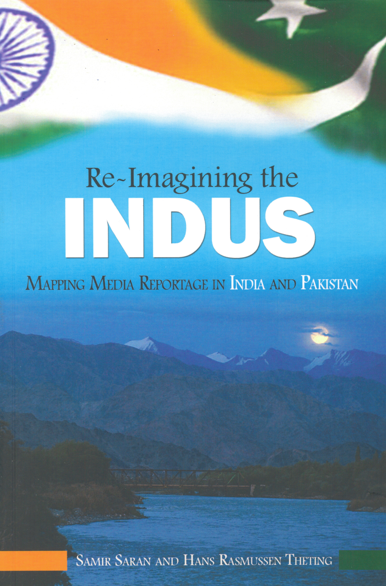
Re-imagining the Indus: Mapping Media Reportage in India and Pakistan

Published 2012, Observer Research Foundation, New Delhi

Overview
Water shortage has become a subject of intense public debate in the present political narrative on resource management and riparian rights. In an attempt to discern the divergence on core issues and mainstream media reporting, Re-imagining the Indus is a methodological study based on Media Content Analysis of the reporting on water issues related to the Indus, in the leading dailies of both India and Pakistan. This monograph seeks to capture the existing discourse and stimulate policy dialogue on the subject.

In Detail
What is the general discourse on water scarcity and related crises in the Indian and Pakistani media? The study conducted by Samir Saran (ORF) and Hans Rasmussen Theting, scrutinised the media coverage on water on three specific themes – the political discourse, water governance and people, practice and environment.

Titled ‘Reimagining the INDUS: Mapping media reportage in India and Pakistan’, the study found that the Indus Water Treaty (IWT) does not dominate the reportage in Pakistan, indicating a low level of discontentment or critique.

It also found that it is only in the months of winter, when the water flow is low, that inter-country dispute between India and Pakistan, and significant negative sentiment against India, gets attention in Pakistan. But in the Indian media, Pakistan only appears during spring months.

The study, now published in the form of a book, found that agricultural concerns and inter-provincial disputes dominate media reportage in Pakistan while in India media lays greater emphasis on urban water concerns and interventions, including ground water and domestic consumption.

The study also showed that media reports in both the countries, Pakistan more than India, recognise the need for the two countries to cooperate on water issues. From the study, it was also clear that in both India and Pakistan, there is equal emphasis on the aspects of water governance and infrastructure.

Standard