Columns/Op-Eds, In the News

India and Russia: Moving towards a 21st century compact

Original link is here

The recent summit between President Putin and Prime Minister Singh may have heralded a new inflexion point in the bilateral.

Pic 1

Russian President Vladimir Putin and Indian Prime Minister Manmohan Singh during the press statement following Russian-Indian talks in the Kremlin on October 21, 2013. Source: Alexey Nikolsky/RIA Novosti

It would seem that India-Russia relations might have bucked the season of gloom. For years now, since Prime Minister Yevgeny Primakov’s reorientation of Russia’s foreign policy eastwards, we’ve largely seen two governments making positive statements, not matched by actions on the ground and compounded by a general sense of drift. Adding to this has been a waning interest in India of all things Russian and vice-versa. Two close friends gradually drifting apart, a contemporary tale of the engagement between Moscow and New Delhi.

The recent summit between President Putin and Prime Minister Singh may have heralded a new inflexion point in the bilateral. On a cursory comparison of their joint statement issued on October 22 with the previous four summit statements, there seems very little change on the surface and if anything, these statements continue to remain an exercise in blandness. But connecting the dots we get three game changers, which while mentioned, have not been described under the strategic rubric that they perhaps should have.

Indo-Russian cooperation

Pic 2

The first is trade which stood at $7.46 billion in 2009, $8.53 billion in 2010, and $8.87 billion in 2011, and has suddenly spurted to $11.04 billion in 2012, registering a 24.5 percent growth year on year. This was the best performance of Russia’s top 25 trade partners. This is particularly surprising given the present world economic situation, the lack of growth of India’s world trade in 2012 and a marginal growth of 1.8 percent growth in Russia’s world trade.

Does this mean that India today has firmly established itself as a partner in more than just the fields of defence and energy to Russia? Are there initial signs of diversification visible? And how the two countries cement this increase in quantity, quality and diversity of trade will be crucial for the strategic partnership going forward.

The second is Russia’s determination to push through a free trade agreement with India – the comprehensive economic cooperation agreement (CECA). Given that most of this increase in bilateral trade has been in-spite of the two governments (outside of the defence sector), this is of particular significance. This will give the Indian private sector critical access to such landlocked markets like Belarus and Kazakhstan, which are part of a customs union with Russia. Not only does this give a fillip to India-Russia ties, it leverages the growing volume of India-Russia trade, to give the northern access to Central Asia, benefit of new economies of scale.

The former Soviet countries have for long sought a stronger Indian presence, be it economic or political in their efforts to balance China. But thus far, Indian attempts have been frustrated by Pakistan’s refusal to allow transit and the complicated international situation with respect to Iran. What the Russia route means is that India and Russia can now piggyback on each other and create serious strategic congruence and bring synergies into play like never before. But this development could additionally play another critical function. By creating a strong market in Central Asia that is integrated with India, it helps create regional pressure to bear on Pakistan to allow India transit with substantial economic benefits to itself.

In effect, Russia, if this game plays out well, may just end up becoming the ‘x factor’ that normalised trade between India and Pakistan. This is advantageous for Russia, since it would give it a pivotal geo-economic and strategic role on the world stage that it hasn’t played in a very long time with relation to big countries.

14th annual summit: Singh, Putin focus on trade, energy and defence
Pic 3

Lastly, the transactional listing of defence deals in the joint statements is symptomatic of India’s fear that it simply cannot compete with China vis-à-vis Russia when it comes to economic stakes. However, the trade figures should boost India’s confidence in its dealings with Russia. It now needs to take the bull by the horns and insist on a quality-quantity matrix that regulates future Russian arms sales to China. By formally affirming a commitment to maintaining India’s qualitative edge over China, Russia can do much to overcome the almost consistently negative press in India in this regard and bypass other minor irritants in the relationship.

It has never been a better time and never before has India come with this much strength to the negotiating table. In the end, reaffirmation and recalibration of Russia’ role in India’s future was prominent and the short and successful summit was capped by perhaps another nuclear submarine for India and a doctorate for Prime Minister Singh.

Standard
In the News

The Curious Case of India and China

October 28, 2013, 9:36 am Comment

Original link is here
28-indochina-IndiaInk-blog480

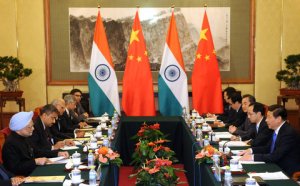
Kyodo News-Pool/Getty ImagesManmohan Singh, left, prime minister of India, holding talks with Xi Jinping, president of China, sitting right opposite Mr. Singh, in Beijing, China, on Wednesday.

During his recent visit to China, Prime Minister Manmohan Singh of India said that when the two Asian giants shake hands, the world takes notice. Although the statement stands true, the real question to ask is whether the media and the security and diplomatic community in the two countries make much of this handshake. It can be argued India-China relations comprise a slew of missed opportunities, and these two have added yet another chapter to this narrative.

In recent years, India and China have engaged in a strategic dialogue, the term “strategic” being used loosely. The fifth edition of the dialogue was hosted by New Delhi in August. The leaders have been able to have uninterrupted annual summit-level talks, interact at annual meetings of the so-called BRICS countries and meet on the sidelines of Group of 20 and other global forums. India and China have had abundant high-level engagement.

Yet the conversation has not evolved. A 20th century grammar continues to define what surely must be the most important 21st century partnership. The only visible sign of deepening engagement remain the trade ties between the two countries that both governments use liberally to demonstrate the imagined “closer relations” and “successful” conduct of diplomacy.

It can be no one’s case that the growth of India-China trade relations has been facilitated by government actions. The relationship has grown despite the unwillingness of the two governments to go beyond contentious issues that are a carryover of the past. Two phases have defined this trade relationship: the Karol Bagh-Guangzhou phase, where the New Delhi shopping district among others in India saw a flood of cheap goods from Chinese manufacturing hubs, and the Mumbai-Shanghai phase, in which bigger enterprises in each country began to engage in trade.

Small business owners and traders in both India and China saw an opportunity and initiated a process of economic engagement that led to the flooding of Indian markets with affordable Chinese products, including mobile phones, firecrackers and even idols of Indian gods and goddesses. The entrepreneurs working at the bottom of the business pyramid crafted the first wave of Sino-Indian economic engagement, often taking huge risks and working under regimes unfavorable to conduct of business.

Increasingly these small traders have had company. Large industrial houses in Mumbai and Shanghai and other business centers have seen value in the relationship. Indian companies have been procuring high-value equipment in power, telecom and manufacturing sectors at competitive prices, and are now even raising commercial loans at favorable rates in China. Chinese businesses are showing an interest to invest in India’s infrastructure sector and are seeking increasing share in the growing consumer markets. The business communities have created this economic relationship based on opportunity and needs.

On the other hand, the governments in New Delhi and Beijing have shown remarkable consistency. Pedantic and unwilling to display leadership in resolving or nullifying the political hurdles, both governments have been guilty of holding back the economic integration of the two Asian giants.

The diplomatic and security establishments have undermined attempts to move the conversation beyond borders, visas and historic suspicions. Now anything and everything in the bilateral relationship is a security discourse. Basin level conversations amongst water experts and river communities are increasingly treated as a ‘security narrative’. China’s interest in the growing ports and roads and highways sector is limited by an imagined ‘security threat’ and India’s development of its northeast, instead of being viewed as an investment avenue for Chinese firms, is perceived to challenge the historic sovereign claims of China.

The Beijing and New Delhi relationship is prisoner to such conversations around security, and in many instances these originate out of Washington, London and Canberra and are not necessarily organic Indian and Chinese debates. The idea of a contest in the ‘Indo-Pacific’ and growing ‘Chinese Hegemony’ are now finding space in bi-lateral conversations. As a result, India and China are nowhere close to integrating land, water, men, material, markets and resources – imperatives in realizing the immense potential of the relationship. Every engagement has an inflexion point and what some in the Indian research community wonder is whether the current summit is that point for the two countries. The question to be asked, therefore, is whether the current visit has injected new life in the path toward sustainable reconciliation.

28-border-IndiaInk-blog480

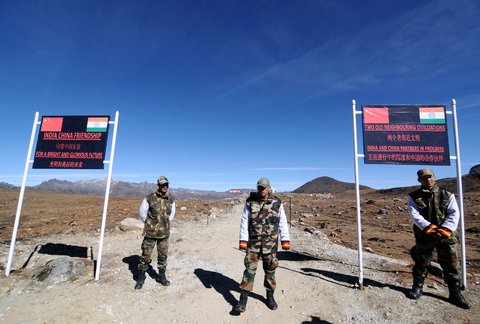
Biju Boro/Agence France-Presse — Getty ImagesIndian army personnel at the India-China border at Bumla pass in Arunachal Pradesh, on Oct. 21, 2010.

Some aspects of the India-China relationship must be examined if we seek to address this. The first aspect must be the border. While the imprecise Line of Actual Control has been a source of occasional tensions between India and China, it has to be acknowledged that confrontations along the border have not taken a violent turn. Nonetheless, the frequency of such face-offs and the increasing military capabilities in the backdrop of rising nationalism on both sides amplify the possibility of such incidents spiraling out of control.

In this regard, the Border Defense Cooperation Agreement signed by India and China is a significant step that takes forward initiatives agreed upon by both parties to maintain peace and tranquillity along the border since 1993. Steps under the agreement, like the exchange of information regarding military exercises, the possibility of setting up of hotlines and an agreement to not follow or trail each other’s military patrols, are important, albeit incremental gains.

Naysayers continue to push pessimistic views. One school of thought represented by analysts like Brahma Chellany, argued that China used the Depsang incident in April 2013 to arm-twist India into agreeing to Chinese terms on border management. In the spring this year, Chinese troops had crossed deep into Indian territory and set up camp in Depsang Valley, Ladakh.

On the other hand, those (mostly the business community as of now) who see value in engagement want to move beyond the border issues and make it less significant to propelling economic relations. For them, the border agreement is a way to achieving this. Pessimists, however, abound, and instead of seeing the situation for what it is — full of opportunities, if one chooses to recognize them — they push a “status quo” line. The traction that this group is able to generate in the media and public sphere, which feeds off Sinophobia, completely overwhelms any counterview. Hence, a lasting border solution must be what the countries should seek, and the current arrangement can only be a temporary dressing for the festering wound that will hold the relationship back.

Both sides, sadly, have been petulant on the issue of liberalizing visa policies. The recent episode in which the Chinese Embassy issued stapled visas (signifying a refusal to recognize their state as part of India) for sportspersons from Arunachal Pradesh, and the resultant uproar from the Indian side killed the possibility of opening up the visa regimes. All that was required was some bureaucratic flexibility and magnanimity on China’s part and some creativity on India’s part – linking a liberalized visa regime to agreeing with India’s position on the Arunachal Pradesh issue (for visa purposes), without prejudice to historic territorial claims. Yet again, China maneuvered itself into a position from where retreat would mean a loss of face, and yet again India failed to grab the opportunity when it presented itself.

The trade imbalance of almost $20 billion with China continues to be a prickly issue, and the two missed another chance to address this when the visit failed to create pathways for increased Chinese investments in India. Although Mr. Singh articulated his interest in attracting Chinese investment to India before he embarked on his visit, concrete steps in this direction remain elusive. Chinese investment in setting up industrial parks and other infrastructure projects is one obvious hedge against the trade deficit.

Enabling the establishment of service centers by Chinese power companies in India is certainly a big step forward and a positive emerging from the current talks. This would allay concerns raised by some in the Indian security establishment on the proliferation of Chinese equipment in the power sector. These alarmist concerns related to the possibility that India, were it to purchase such equipment from China, could be stranded with the proverbial white elephants because of a lack of supply of spares and services.

Water made it to the laundry list this time and must be viewed as a significant positive as this must certainly be a first when China has agreed to such a conversation with a lower riparian. The two have agreed to share hydrological data on transborder rivers and exchange views on associated topics of mutual interest. This gives India the window to approach China with regard to the construction of dams on the Brahmaputra. Similarly, the memorandum of understanding on roadways and transportation identifies several areas for cooperation, including sharing knowledge in transportation technology, road construction standards, road safety plans, joint research and sharing experience related to public-private partnership models. This can be seen as laying the foundation for creating infrastructure to connect Asia.

Economics has proved to be a major factor in political reconciliation elsewhere. However, in the case of India and China, economic engagement is hitting a political wall. Only a political thrust can help realize what should otherwise seem inevitable: India and China becoming the world’s largest bilateral trade partnership.

India has to learn from others. The United States is implementing its pivot strategy in Asia in an attempt to create partnerships to balance a rising China, yet Washington has reached the $500 billion mark in its trade with Beijing. Japan, which had the most unfavorable image among Chinese according to a local opinion poll, manages a $300 billion trade engagement. Despite political differences and contests, there is pragmatism at work here.

Today, India requires $1 trillion of infrastructure investment every five years for at least the next two decades. China has the potential to be the largest stakeholder in this effort. Investments by China will also automatically create security hedges favoring India and help offset the trade deficit. In return, India offers China the opportunity to continue its impressive economic growth. Its capacities in steel, cement, power and industry can now be deployed in the transformation of India, and in return such economic ventures will boost China’s gross domestic product by some basis points. We are at that political moment when Asia could be integrated like never before.

Unfortunately, the two pillars of the dawning Asian century are still prisoners to their perceived insecurities and imagined magnificence. They seem condemned to “never miss an opportunity to miss an opportunity,” as one wise man had once remarked.

Standard
Columns/Op-Eds, In the News, Uncategorized

Navigating e-commerce: What Alibaba can teach Indian businesses

PUBLISHED:22:18 GMT, 3  October 2013| UPDATED:22:18 GMT, 3 October 2013

 Original link is here


Adam Smith once wrote that “to widen the  market and to narrow the competition is always the interest of the dealers,” and  that therefore any proposal for a regulation or policy that flows within this  order, must be “carefully examined”. Adam Smith lived in simpler times.

As the Prime Minister Manmohan Singh  concludes his trip to Washington DC, there is palpable pressure on the Indian  government to open up the e-commerce space to foreign players.

Large American e-commerce companies are  already knocking on the door and reports suggest that one of the senior-most  functionaries reporting to the Prime Minister has been given the task of  shepherding this process and is seeking response from the DIPP on the underlying  issues.

 
What Alibaba can teach Indian businesses


E-commerce

There are three popular narratives on the  opening up of the Indian e-commerce sector to FDI and all of them are somewhat  simplified, facetious and misleading. One perspective is that the opening up of  the sector will be an Indian payback, a veritable payout, for US support in the  civil nuclear mainstreaming of India.

Another is that delay in allowing FDI in  e-commerce is part of the policy clutter created by this government, an  unintended situation, to which the only suitable response is unencumbered  liberalisation.

And the third is that FDI in online space is  a matter of national priority, and sovereignty over the e-commerce space must  not be ceded to multi-nationals.

The narrative on paying back the Americans is  easily refuted. India must be sure enough to bargain for only what is in  consonance with its core self-interests. Surely, stable and resilient growth of  domestic manufacturing and industry is a core interest.

India is as at a crossroads. Policy decisions  taken now are likely to determine whether the country is able to harness the  transformative power of SME’s using the access and reach of e-commerce, or  whether a haphazard and hurried policy framework is going to hinder the organic  growth for the largest employer in the country.

The narrative on the policy clutter can be  cross-examined through the growth story of the Chinese e-commerce giant, the  Alibaba Group. Alibaba was established in China in 1999, initially funded  through a Venture Capital infusion of $5 million by Goldman Sachs.

Prior to China’s WTO ascension, FDI in the  sector was not allowed and even now, a local partner is a prerequisite to  entering the e-commerce space. However, this has not limited Alibaba’s growth,  which has been predicated on a larger state-run economic strategy centred on the  SME sector and domestic industrial competitiveness.

China has over 40 million SMEs, many of  which are sellers and buyers on the Alibaba platform. The company’s innovative  products have created shared value, supporting the SME ecosystem. Through its  finance arm, the company has deployed loans to over 10 million Chinese SMEs,  therefore facilitating core policy objectives of the Chinese state such as  financial inclusion and timely credit provision.

In all of this, of course, the consumer  benefits, with lower transaction costs both in terms of average time spent in  sourcing products and cost competitiveness. Sales through Alibaba’s online  marketplace are expected to surpass those of the total e-commerce market in the  United States by the end of the year. Last year, two of its portals handled  around $170 billion in sales.

Alibaba’s much publicised and imminent IPO is  now likely to be in New York. The company is likely to be valued at around $70  billion. This is significant value creation given its modest beginnings – and  indeed value creation must be the strategic objective of any enabling industrial  policy; a lesson for India.

In the outlined context, the third narrative  on sovereignty over the e-commerce space also appears to be a conflation of hazy  opinions. There is no doubt that as India integrates into the global economy  with its incumbent need for long term capital formation, opening up various  growth sectors to FDI is not an inevitable option.

Regulation

This does not change the fact that there are  a number of technical operational issues that require careful examination, not  just by the bureaucrats at DIPP, but also by the legal fraternity, the tax  collector, SME sector stakeholders and representatives from allied sectors  including telecommunications and banking.

Indeed, an inclusive consultative process is  an unfulfilled prerequisite. This must be steered by organisations such as the  Competition Commission of India, a body which is supposed to function on a  proactive mandate in order to obviate the need for a convoluted or retrospective  regulatory ring-fence.

Growth

India represents a nascent e-commerce  market, which is certain to grow exponentially as internet penetration rates  improve and consumption patterns evolve. Estimated revenues from online  retailing in India are expected to be at $15 billion by 2015 and $125-160  billion by 2025.

While many home-grown Alibabas can be  created, in the absence of a robust legal framework, particularly around  warranty, fraud and data protection issues, the consumer, is left vulnerable to  the metaphorical ’40 thieves’ as the industry expands.

The IT Act is certainly insufficient and  clarifications are required in the Competition Act, on among other things,  unfair trade practices or restrictive trade practices, before the FDI question  is resolved.

To sequence Indian priorities on the FDI  question is fairly simple. Consumer-centrism is paramount. Competitive SME  sector growth, which will lead to job creation as well as value addition, is a  strategic economic priority, which in turn can be aided by a strong e-commerce  industry as has been witnessed in China. While e-commerce must eventually  resemble a highway without speed limits, the lanes leading up to the highway  must be strengthened to allow for unfettered access.

The writer  is senior fellow, Observor Research Foundation

Standard
Columns/Op-Eds, In the News, Politics / Globalisation, Uncategorized

Less corporate, more social

Published: August 10, 2013 01:08 IST | Updated: August 10, 2013 16:55 IST

New Pic.jpeg

CSR principles enshrined in the Companies Bill 2012 offer businesses a chance to transform their poor record in community participation and development

Original link is here

Finally we are seeing some signs of life in the business of legislation. Not surprisingly, one of the early beneficiaries is the Companies Bill (2012) which shall replace a six decade-old antiquated law after Presidential assent. The Bill, which was passed in the Upper House this week, was earlier approved by the Lok Sabha in December 2012 and reflects a number of amendments to the Companies Bill, 2011, based on the recommendations of the Parliamentary Standing Committee on Finance. It encompasses important areas for the effective governance of companies including clauses on mergers, audit and auditors, appointment of company directors, aside from providing for constitution of a National Company Law Tribunal and a National Company Law Appellate Tribunal to fast-track company law cases and corporate structuring.
Crucial
Perhaps, the most important new element introduced in Clause 135 of the Bill is the notion of mandatory Corporate Social Responsibility (CSR). Colloquially referred to as the “2 per cent clause,” it has the potential to transform the landscape of CSR in India. Indian businesses have been loath to go beyond the “glorified worker towns” syndrome or providing employee services and benefits passed off as social interventions. Indeed, “Corporate India” has fared rather poorly when it comes to affirmative action in employment, environmental responsibility and in resource efficiency and revitalisation over the years. Therefore, a scheme that potentially transfers profits towards social causes, environmental management and inclusive development could be the much needed medicine for a nation with such deep socio-economic cleavages. This provision in the new bill must be welcomed and its efficient implementation must be ensured.
It is important that Clause 135 is complemented and supplemented with regulatory and institutional mechanisms to ensure that it actually results in a new paradigm of “stakeholder responsibility” and does not become another scheme where a paternalistic government is able to create another framework of patronage that the politician-businessperson nexus finds favourable for its dealings. This hypothesis needs to be carefully examined, particularly in the context of the upcoming general election, when political masters are at once beholden to corporates for election funding, and where constituency-level CSR commitments could be politically useful.
However, beyond the “profit for patronage” issue, there are some other aspects that must be discussed. The new law will make it incumbent for companies having a net worth of Rs.500 crore or more, or a turnover of Rs.1,000 crore or more or a net profit of Rs.5 crore or more, during any financial year, to spend at least two per cent of net profits towards CSR activities. While this seems uncomplicated, the efficacy in implementation may be in doubt for more than one reason.
The whole concept of CSR must, by its very definition, be a product of the fundamental need to price services, infrastructure and resources that societies provide businesses located in their proximity. By mandating a plain vanilla formula for allocation of two per cent of net profits towards CSR, the law will create a locational distortion, delinking CSR from community responsibility. Businesses must be responsible for proximate communities first, rather than being able to choose the destination of this commitment to society.
There is also a temporal distortion in the construct of CSR as spelt out by the Bill. Paragraph 5 of Clause 135 states that two per cent of the average net profit over three immediately preceding years must be allocated for CSR activities. In the case of most large companies of the sort that would be mandated to allocate net profits, business operations would have had a run-off effect on societies and would have fed off communities for more than three years. Therefore, must not the commitment to these communities and geographies reflect the impact of these businesses over their operation periods? And is there not a case for ensuring sustained “plough back” by the company in these geographies before diverting their commitments elsewhere?
Implementation
Even as we begin to debate how best to address these “time-place” distortions, it is certain that the CSR mandate must be made more robust, ensuring that at the very least it stands up to some simple tests of reasonableness and fairness. There are a number of ways to achieve this baseline objective.
First, voluntary policies that ensure a stakeholder approach to CSR is followed by corporates already exist and must be strengthened. The National Voluntary Guidelines on Social, Environmental and Economic Responsibilities of Business (NVGs) suggest nine core principles which businesses should follow. Principle 8 for instance, directly alludes to coherent, social impact measures and assuring “appropriate resettlement and rehabilitation of communities who have been displaced owing to their business operations.” Integration of NVGs, initiated by the Ministry of Corporate Affairs, in the form of more constructive guidelines for deploying corporate CSR policies, is a viable option.
Second, CSR policies must be determined organically, through demand-driven consensus. Instead of being the mandate of high-level committees, company specific CSR policies should flow from a transparent interface between community stakeholders and corporates. The process must be devolved below the level of the corporation, to the level of the business unit. Corporate leaders and civil servants in the national capital must not determine community engagement strategies. Community stakeholders and the business units concerned must. Allocations must also be made on the basis of how much different stakeholders can absorb.
Employee benefits
Concomitantly, employee benefits must not be passed off as CSR. Such tricks are already used by the banking sector, wherein mandated priority sector lending targets are often met through incredibly convoluted means, including issuance of no-frills/general credit cards for their own contracted workers. A “tick-the-box” approach is simply not legitimate.
The third suggestion also follows from this. A demand-driven process for articulating company specific CSR policies must be instituted at the district level. Consultations can be steered by public officials such as district magistrates, involving village and town leaders and representatives. Decisions could be made through majority outcomes, and the process must be recorded and filed. This sort of a process has the potential to create a public accountability framework for delivery of CSR far superior to legal provisions that we fail to enforce.
Audit
Fourth, as this culture evolves over time, CSR allocations must not remain consigned to bottom line (profits) commitments. Obligations to community stakeholders must be placed alongside the top line (receivables and debt) and must be considered seriously as the next step as CSR must not be an afterthought to profit accumulation. It must be embedded within the very fabric of large businesses.
Finally, there are multiple concerns around the audit of CSR and a discomfort with the lack of audit and oversight required for CSR activities. “Comply or explain” simply has not worked in the case of other existing regulatory frameworks that deal with corporate governance issues. It is time to realise that in India, only a few are in a position to ask, while nobody is in any hurry to explain.

(Samir Saran is vice-president and Vivan Sharan, an associate fellow at the Observer Research Foundation, a New Delhi-based public policy think tank.)

Standard
Columns/Op-Eds, In the News, Politics / Globalisation

The IBSA Moment

Globaltimes.cn | 2013-7-22 19:00:36
By Samir Saran and Vivan Sharan

Original link is here

June 6, 2013 was the 10th year anniversary of the seminal Brasilia Declaration by the foreign ministers of India, Brazil and South Africa, formalizing the cooperative mechanism better known as India-Brazil-South Africa Dialogue Forum (IBSA).

India, currently the chair of IBSA, is responsible for steering the agenda for trilateral collaboration.

In its capacity as chair, it is incumbent upon India to revitalize the geopolitical group, which has been so central to the construct of “South-South Cooperation” that engages most political thinkers today.

Developing countries with converging interests have a lot to gain from coordinating positions on a wide spectrum of issues. And indeed India is also uniquely placed to establish its own global identity and brand through the group.

At the end of the Durban summit earlier this year, BRICS resembled a schizophrenic milieu; a strange mix of countries from the Group of 77 and Russia. Under South Africa’s chairmanship, there was a visible failure to shed the identity of reactionary “trade unionists.”

Moreover, consumed by regional aspirations of one member, instead of being representative of a fast moving lithe club of five, BRICS appeared to be burdened with carrying the divergent and diverse aspirations of an additional continent on its shoulders.

The IBSA countries must not let ownership of the South-South agenda slip away. This, we feel, would require at least three conceptual underpinnings.

First, the format for engagement must remain unburdened and the core values undiluted. That is, the dialogue must continue to follow the format already instituted. Proxy memberships of other countries through regional institutions, must not constrain the nimble grouping. Regional issues must be represented, without members themselves becoming stubborn regional representatives.

Second, a common thread which ties all three IBSA members is their robust democratic institutions and frameworks. Democratic values must be kept at the forefront. The legitimacy that such a governance ethos can bring is perhaps unmatched. The cries for reform of the existing global governance architecture converge with the imperative of ensuring legitimacy through democratic transparency.

IBSA offers member countries an audible voice on the global governance high table, and democracy is an undervalued and underutilized trump card that they each possess.

Finally, for each of the IBSA members, the next few decades need to be centred on inclusive growth. Each is an emerging “middle power,” and each needs to harness growth to craft sustainable trajectories, unleashing drivers of socio-economic progress including productivity, innovation and social welfare.

IBSA offers its members a moment for cooperating on this incumbent need. IBSA must focus on itself even as it reaches out.

A lot has already been discussed under the IBSA umbrella. Conversations on reform of Bretton Woods institutions, regional issues (particularly the Arab-Israeli imbroglio), sectoral cooperation ranging from tax administration to higher education, people-to-people linkages, free trade agreements, to name a few prominent areas, have taken place.

Additionally, we suggest that IBSA members must explore collaborating on three specific agenda items.

The first is that IBSA must reach out to other democracies, perhaps initially by according observer status to similarly placed countries. Replicating the format followed by the Shanghai Cooperation Organisation could be a viable alternative, and serve as a suitable whetting process for new members.

Second, IBSA must shed its reluctance to share its own deep reservoir of democratic experiences. Clearly, Atlantic countries cannot and do not offer the only appropriate models of development for democracies. In this post-Washington Consensus era, IBSA members possess a number of experiences which provide a template for the developing world. These must be mapped, shared and discussed.

The third concrete action item must be to move towards a new format for ocean governance. India-Brazil-South Africa Maritime, a naval exercise conducted between the three navies (an element of IBSA’s regional cooperation), is an ideal point of departure.

IBSA members can also begin to address issues dealt under the United Nations Convention on Law of the Sea, to develop a robust international framework for governing the oceans and seas. A new framework articulated by the South would have a compelling weight.

The conceptual underpinnings and agenda discussed here can prove to be levers of IBSA’s transformation. The decade old cooperative mechanism has endured, and now it is time for it to mature and deliver.

Samir Saran is Vice President and Vivan Sharan an Associate Fellow at Observer Research Foundation, Delhi.

Standard
Columns/Op-Eds, In the News, Politics / Globalisation

Kerry’s Indian visit and Afghanistan

Original link is here

This column is about US Secretary of State John Kerry’s recent visit to India and the new peace initiative for Afghanistan. Kerry visited India to participate in the fourth round of the India-US strategic dialogue. The dialogue was held soon after the opening of US-Taliban peace talks in Doha. The Indians were not too happy at this development, as they found themselves sidelined. The US Secretary of State had to do some explaining to them and seek to dispel their apprehensions. There would be no compromises, he said, with the “red lines” meaning certain conditions, which the Taliban must adhere to, viz Taliban’s break with al-Qaeda, renouncing violence and accepting Afghanistan’s constitution. Kerry was not quite right as after an earlier exchange, it was agreed by the State Department that these would not be “preconditions” but “outcomes”.
During his stay in India, Kerry called upon New Delhi to play a vital role in the next Afghan elections and help “improve its electoral system and create a credible and independent framework for resolving disputes.”
Mention may he made of a video message to the Indians sent on the eve of the Secretary’s visit, in which he assured of US backing of Indian’s inclusion as a “permanent member of a reformed and expanded Security Council.” “The US,” he declared, “welcomes India as a rising power,” adding that, “a strong India is in American’s national interest.”
More from the message: “The friendship between our two nations is one of the defining partnerships of the 21stcentury. Today, the US and India collaborate closely in almost every field of human endeavour. Together, we are tackling shared challenges and making the most of new opportunities. From higher education to clean energy, from counter-terrorism to space science, we are seizing new opportunities to work together, and in doing so, we are increasing the prosperity and security of both of our peoples. The US and India share a strong and enduring commitment to Afghanistan’s peace and prosperity. And we also welcome India’s leadership in the Asia-Pacific region.”
Despite the various agreements and partnerships inclusive of nuclear status and supplies, space, health, clean energy, defence, counter-terrorism, etc, New Delhi has not been too keen to acknowledge the favours done to it by Washington.
Just read how an Indian columnist, Indrani Bagchi, assesses Kerry’s visit to India in Economic Times/Times of India: What did one make of John Kerry’s whirlwind run-through of the India-US strategic dialogue? ‘Well, we didn’t expect much, so we were not disappointed’ runs the dominant response in this city.
On paper, the bilateral relationship is almost universal in its reach. Innovation, space, health, clean energy, defence, counter-terrorism. The US too has moved from the extensive vision of the Bush years to becoming a transactional power under Obama.
Possibly, the only worthwhile conversation at this point is the dialogue on defence technology that NSA Shivshankar Menon is holding with Ash Carter. Menon has to steer the defence-strategic relationship from a buyer-seller one to one that is more equitable……In their haste to turn off the lights in Afghanistan, the US will find another way to talk to the Taliban to bring them on board in Kabul, with a “ruinous deal” with Pakistan. Look closer home. India should push an investment treaty with the US, using it to straighten out its internal investment strategies and launch the next round of economic reforms. Strategically, let’s look at the Indo-Pacific as the theatre for the next big deal. Notwithstanding China’s categorisation of the Xi-Obama meeting at a ‘New Type of Great Power Relationship’, India and the US have the greatest strategic alignments there. Let’s not get spooked by G-2 either – the bald truth is ‘rebalancing’ is a China-hedge strategy.
As for Afghanistan, the Indian view has been, thus, well-expressed by Samir Saran and Abhijit Mittra in Economic Times/Times of India: “While John Kerry lauded India’s role in his June 23 speech in New Delhi, events of the last 90 days tell a very different story; one in which the US disregards the concerns of both India and the Afghan government and continues to woo the Pakistani military establishment. The US actions have allowed the Taliban to formally open an office in Qatar for direct negotiations, which the Taliban see as the first step towards a new emirate.
“The victory of Nawaz Sharif in Pakistan, in collusion with fundamentalists, allows radicals in that country certain influence over the civilian government and the military’s shadow over foreign policy looms larger and stronger as the US consolidates General Kayani’s pivotal role, established by a hurried and reckless K-3 meeting (Kerry, Kayani, Karzai).
“India’s Afghanistan policy has historically always been long-term and more than capable of absorbing reverses in the short to medium term. It cannot be coy in providing soft and hard military support to its friends, and it must not be seen as an unreliable and indecisive partner. India has in the past succeeded in maintaining Afghanistan as a viable partner for over 60 of 67 years of bilateral history.
“After 1997, India continued to support the Northern Alliance in the hope of better times. That time came in 2001, when, following the US invasion, a government whose core elements had been supported by India, were installed in power. India in 2014 is not the economic cripple it was in 1991; a $290 billion reserve buys more loyalty and battle resilience than 15-day currency reserves.
“Over the last 12 years, India has worked exceptionally hard to win over significant pockets of support among the Pashtuns. Unlike the 1990s when India’s support base was the ethnic minorities, support for India is now deeper and wider. Afghanistan post-2014 must not by default become a neutralised backyard of Rawalpindi and its proxies.”
So, while framing an Afghanistan policy, Pakistan has to keep the following factors in view:
1. After the return of the combat forces in 2014, the US will continue to keep a certain number of well equipped troops in Afghanistan. And the Taliban will continue creating difficult conditions for them.
2. The post-American exit scenario looks murky and uncertain. Pakistan must devise well thought out policies in regard to different emerging situation.
3. The initiative to forge an understanding with the Northern Alliance must continue with a view to securing positive results.
4. India has invested billions of rupees in Afghanistan. Both Kabul and Washington want it to play a significant role in the post-2014 Afghanistan. Karzai has already sealed a strategic partnership with India and Afghan army personnel are being trained by Indian military experts. India’s interests just cannot be ignored. These, to some extent, may have to be accommodated with Islamabad safeguarding its own interests.
5. It is time that a settlement with the Pakistani Taliban is negotiated jointly by the civil government and the military.
6. A competent retired diplomat should be immediately appointed as a special envoy for Afghanistan. He may pilot Pakistan’s case and look after its interests in the US-Afghanistan-Taliban negotiations.
The writer is an ex-federal secretary and ambassador, and a political and international relations analyst

Standard
Columns/Op-Eds, In the News, Politics / Globalisation

As the US exits, New Delhi must adopt a gutsy Afghanistan policy to safeguard its interests

Original link is here

SAMIR SARAN & Abhijit Iyer Mittra Jun 27, 2013, 12.00AM IST

While John Kerry lauded India’s role in his June 23 speech in Delhi, events of the last 90 days tell a very different story; one in which the US disregards the concerns of both India and the Afghan government and continues to woo the Pakistani military establishment in search of its elusive salvation.

The US actions have allowed the Taliban to formally open an office in Qatar for direct negotiations, which the Taliban sees as the first step towards a new emirate. The victory of Nawaz Sharif in Pakistan, in collusion with fundamentalists, allows radicals in that country certain influence over the civilian government and the military’s shadow over foreign policy looms larger and stronger as the US consolidates General Parvez Kayani’s pivotal role, established by a hurried and reckless K-3 meeting (Kerry, Kayani, Karzai).

Consequently, India has nowhere to hide. Three eventualities have to be prepared for in Afghanistan, possibly unfolding concurrently. The first is a Karzai government under severe pressure from a heavily armed Taliban backed by the new mandate available to the civilian and military leadership in Pakistan. The second is a Taliban takeover of Kabul. The third is some form of dismemberment of the country again. Each of these eventualities leads to India having to shoulder a greater share of the blowback, than the western countries that seek to drive the current agenda.

India’s exclusion is symptomatic of the short-termism that has plagued western policy that has sought to create a closed information loop to filter out inconvenient truths. The problem is, as history repeatedly shows, an unstable Afghanistan destabilises the region. Importantly, as 9/11 showed, it also has the potential to threaten western power centres. Yet it would seem nothing has been learnt and India would need to very quickly write its own script again.

India’s Afghanistan policy has historically always been cold, calculating, uncompromising, long-term and more than capable of absorbing significant reverses in the short to medium term. Its response today must also support those who it does business with in Afghanistan. It cannot be coy in providing soft and hard military support to its friends and it must not be seen as an unreliable and indecisive partner.

India has in the past succeeded in maintaining Afghanistan as a viable partner for over 60 of 67 years of bilateral history. Wading through the precarious years starting 1989 and through the economic crisis of 1991, India still managed to support one dispensation or another that held inimical forces at bay till 1997. After 1997, India continued to support the Northern Alliance in the hope of better times. That time came in 2001, when, following the US invasion, a government whose core elements had been supported by India, were installed in power.

Pakistan, in spite of its advantageous geography, had succeeded in pacifying Afghanistan for just four to six years at best. Anybody with a cursory knowledge of the region will know that it takes a lot more than common borders to manage bilateral relations.

Going into a winning war is easy but wading into uncertain waters to safeguard vital interests is the true test of realpolitik. That is why India’s Afghan gambit must be gutsy and counterintuitive. Given the high stakes and high probability of failure, too much talk is counterproductive and blueprints for the post-2014 chaos that will be Afghanistan are urgently needed.

India in 2014 is not the economic cripple it was in 1991; a $290-billion reserve buys more loyalty and battle resilience than 15-day currency reserves. Over the last 12 years India has worked exceptionally hard to win over significant pockets of support among the Pashtuns. Unlike the 1990s when India’s support base was the ethnic minorities, support for India is now deeper and wider.

Taliban 2.0, therefore, will find a house divided, facing the enemy without and also within. India has four consulates in addition to the embassy in Kabul. These are the prime nodes of aid dispersal, which is counted as the most effective of any country’s efforts there.

The nearly $2 billion dispersed so far have gone to infrastructure, agriculture and education, especially self-sustaining schemes at the village and micro levels in Pashtun areas. It is precisely these schemes that connect India directly to the Pashtun’s day-to-day life and make India a friend in their view. It will be Pakistan’s inability to deliver — systemically and financially — on this score that will make Pakistan the outsider.

Afghanistan post-2014 must not by default become a neutra-lised backyard of Rawalpindi and its proxies. Any interference must necessarily require significant injections of Pakistani treasure and blood. India could lay for Pakistan the same trap that the US laid for the Soviets in Afghanistan.

If Pakistan marches in directly or by proxy it gets bogged down and alienates any residual western sympathy. If Pakistan does not, it loses the prize. Win or lose by default Pakistan loses and win or lose by default India is likely to succeed.

The writers are vice-president and programme coordinator, respectively, at the Observer Research Foundation.

Standard

NEW
Global Times | Samir Saran and Abhijit Iyer-Mitra
Published on May 20, 2013 22:18

Original Link is here

In a significant act of political signaling and foresight, Chinese Premier Li Keqiang chose India as his first ever overseas destination after taking charge of the premiership.

He arrived in New Delhi on Sunday evening and held meetings with Indian Prime Minister Manmohan Singh first. He also met Singh’s cabinet colleagues and flew to Mumbai and met with Indian industrial leaders.

This visit is important in more ways than one. At the purely bilateral level, an excruciating border episode was just recently brought to a close.

On a global level, the two countries are dealing with a once-in-a-century churning in the architecture of global governance, while at the same time trying to shake of the lethargy that both economies have fallen prey to.

For the first time in many centuries, this continent has the wherewithal to define itself on its own terms. Capitals in Asia will lead the process of shaping the Asian project.

China and India must be partners in this effort, and to get there they need to deal with the hard questions, as the time for sweet talk is now over.

We need to start having brutally frank conversations on our legacy problems and on the more recent challenges.

The parroting of old staid positions and whispering of diplomatic sweet nothings will yield little and allow others to intervene and impose.

It is time for the two countries to grow up and resolve the disputed border. And even as this resolution is discovered, progress on the bilateral relationship must be insulated from this process.

For this to happen, political leadership in both countries will have to demonstrate courage to make their respective security establishments toe the line.

Economic integration is not and will never be the answer to this political poser alone. It can provide the motivation for seeking a resolution, but it is not the answer by itself.

In fact, it can now be argued that the political discord and public perception in both countries are limiting greater economic integration.

Trade shows signs of plateauing, with Chinese firms struggling for access to all projects in India, be they shipyards, roads or telecommunications, despite some early and spectacular inroads.

The two countries now need to realize that they are confronted with the political moment that has been deferred and delayed but cannot be denied. Strong and purposeful measures must be crafted.

There must be a bold statement on the border issue that no matter what the differences, incidents like that in Ladakh recently will not happen again.

While the border management pact recently offered by China may not be the answer, an equitable arrangement that prevents any troop movements remotely close to each other’s claimed territory must be worked upon.

This conversation cannot be delayed. And the process of arriving at this accord needs to be a lot more transparent. Opaque political discussions lead nowhere, and public opinion must be built and sought.

China’s engagement with India must transform from one that is largely seen as transactional, such as the selling and buying of goods and commodities, and more recently functioning as a lender, to one of being a long-term investor and stakeholder in the Indian economy.

Chinese money, businesses and investments must bet on India and be located in this country.

This cannot happen however until businesses and people in China begin to perceive India as a friendly destination, an outcome equally determined by Indian attitudes to China.

India for its part must seriously consider identifying special industrial zones that Chinese firms can develop as centers of large manufacturing and R&D.

There must be a complete, honest and meaningful revamp of the current visa regime. The level of visits is abysmal, and security considerations cannot determine the level of engagement between the two countries destined to be the largest trading partners in a decade or so.

Finally, the two must bilaterally develop a substantial conversation on the cutting edge of global governance issues, including issues of the global commons like climate change, water, health and medicine, and Asian security architecture, as well as issues of space and proliferation, of rules and mechanisms of economic governance, and on new arenas of maritime and ocean governance.

This dialogue must help discover common ground that the two countries can articulate and put forth for the consideration of the global community.

Such articulation will be the first step toward an Asian century. Ultimately a political Asia will be born when New Delhi and Beijing can assume parentage of this Asian geography that until now has only seen many guardians.

Samir Saran is a vice president and Abhijit Iyer-Mitra a program coordinator at the Observer Research Foundation, New Delhi. opinion@globaltimes.com.cn

Columns/Op-Eds, In the News, Politics / Globalisation, Uncategorized

Time for hard questions on Sino-Indian relationship’s future

Image

http://carnegietsinghua.org/2013/03/21/u.s.-rebalancing-to-asia-view-from-india/g0upU.S. Rebalancing to Asia: A View From India

Original Link is here

Faced with the limitations of economic relations without political integration, Asian states have begun to reevaluate their prior relations and coalition structures to meet the demands imposed by U.S. rebalancing within Asia. Nowhere is truer than in the nuclear arena, where China, India, and the United States face questions over their ability to redefine their partnerships and the global nuclear order. Samir Saran, vice president and senior researcher at the Observer Research Foundation in New Delhi, spoke in the twentieth session of the “China-South Asia Dialogues” seminar series for senior experts. This was followed by presentations by three Tsinghua University master’s degree students: Mao Keji from China, John McGowan from the United States, and Ece Duygulu from Turkey. The students’ presentations were part of the “China and South Asia’s Future” seminar series for rising scholars. Carnegie’s Lora Saalman moderated.

Rebalancing Within Asia

Saran noted that while the United States is often seen as rebalancing “to” Asia, much of this reorientation has actually occurred “within” Asia. Even as Washington seeks to redefine the role that it will play, regional powers have begun to delineate their own identity, he asserted. In doing so, economic integration has begun to “reach its limits” in the face of unresolved political tensions and obstacles. Without addressing political integration and rebalancing among regional players, Saran suggested that an integration project designed and implemented by Asians themselves would be difficult to achieve.

•U.S. Regional Role:

Saran asserted that one of the driving motives behind U.S. rebalancing within Asia has been China’s reluctance to enter into a G2 construct, under which Washington and Beijing would serve as the primary players. Rather than resulting in comity or competition in a bipolar order, Beijing and Washington are both jockeying for their own national interests, said Saran. However, he added, the United States maintains a strong isolationist streak that could result in significant drawdowns in how it engages the region and guarantees its security. In the face of this uncertainty, Saran maintained that regional players would be best served by coordinated political integration fashioned by capitals in the region.

•India’s and China’s Regional Roles:

The futures of China and India are inextricably linked, Saran said. Chinese refusal to sign onto the bilateral U.S.-China agenda, coupled with the fact that Washington has already made its unsuccessful play for a G2 construct, means that Beijing is in the driver’s seat. As a result, he maintained that the U.S. pivot to Asia will ironically be “made in China.” In looking further afield for energy stores and cooperation, Beijing and New Delhi will also be faced with the need to guarantee passage throughout the Indo-Pacific, Saran added. Beyond the bilateral, he noted that engagement at multilateral forums has proven to be most viable for China and India, since it obviates confronting mutual tensions. Enhancing Cooperation

•India’s Role in Security:

Saran noted that preoccupation with traditional security misses the economic fallout and necessity of integrating political, economic, and military solutions, particularly when faced with new territorial disputes, piracy, drug running, and other asymmetrical threats. To this end, Saran asserted that India has a role to play. However, when it comes to territorial disputes in the East China Sea and South China Sea, he remained reluctant to predict a role for New Delhi. When asked about ties between New Delhi and Tokyo by one of the Chinese participants, Saran responded that Japan and India have similar interests, which become all the more evident in the context of China’s regional rise.

•Identity Crisis:

One of the Chinese participants spoke of allegations of China’s aggressiveness when it comes to its neighbors and suggested that this was tied to internal shifts in how China defines itself. He questioned whether India is undergoing a similar case of self-reevaluation. Saran responded that part of Beijing’s crisis of perception comes from the fact that despite its growth and creation of regional dependencies through donations and economic benevolence to its surrounding countries, it has not changed its behavior towards these countries. Similarly, given New Delhi’s growth, it seeks accommodation on its desire to be a “global manager.” Unlike China, however, he noted that India has global aspirations, but continues to be bogged down by domestic issues. A Chinese expert added that he felt China and India have more in common with each other than with the United States, advocating increased interaction and exchange to build strategic mutual trust.

•Mutual Respect:

A Chinese participant queried what measures would increase China’s respect for and willingness to cooperate with India. Saran responded that people-to-people contact, expanded media interaction, and investments leading to greater integration between Beijing and Delhi on all levels are key. Mao, McGowan, and Duygulu offered their takes on how this dynamic has played out in the nuclear sphere, with India’s pursuit of a nuclear capability to solidify its status and respect from countries such as China. A Chinese expert noted that when it comes to multilaterally binding arms control treaties, India still has a role to play, particularly with the Comprehensive Test-Ban Treaty (CTBT). Saran responded that trust must be mutual; as such, India’s signing of treaties like the CTBT will be dependent upon the actions of China and its decision whether or not to ratify them.

•Demographic Pressures:

Much like “China’s Dream,” Saran cited “India’s Promise,” asserting that Beijing is waking up to New Delhi’s potential over the next ten to fifteen years. However, he cautioned that while demographic windfalls may shore up India’s production capacity in the short term, they are likely to pressure New Delhi to meet the employment demands of a young and disenfranchised population. As these numbers soar, Saran further predicted that the long-term implications of caring for the elderly would threaten the sustainability of India’s economic growth. Despite such pressures and the recent decline in Sino-Indian trade, Saran maintained that the two countries share common aspirations and challenges. More than simply reacting to U.S. rebalancing within Asia, Beijing and New Delhi should conduct their own regional recalibration, Saran concluded.

BRICS, In the News, Politics / Globalisation

U.S. Rebalancing to Asia: A View From India

Image