Books / Papers

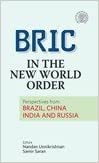
BRIC – in the new world order: Perspectives from Brazil, China, India and Russia.

by Nandan Unnikrishnan and Samir Saran
Macmillan Publishers India, 2010

Summary
The BRIC countries are today an increasingly cohesive group of nations with a common vision and shared commitment to collaborate and shape a more equitable and prosperous world order. All four nations are leading economies, large markets and emerging knowledge creators; their interactions within the grouping, and with other nations, hold promise for their own people and for other developing countries. The BRIC country coordination at multilateral fora, such as the G-20, is helping to reorient the existing market economy framework, by stressing the need for greater transparency and accountability of the global financial systems. BRIC’s greater role in the IMF and World Bank is likely to ensure more support and assistance for developing nations, as well as keep surveillance of Western financial practices. While the four are yet to evolve a common position on Climate Change and WTO (Russia is still not a member), BRIC countries will certainly be crucial to any agreement on these vital issues. While there are expectations from this grouping on geo-political matters and international disputes, for the moment, these countries have decided to focus on finance, energy, trade, technology and multilateral pluralism.

This edited volume is the outcome of an event hosted by the Observer Research Foundation (ORF) with the support of the Ministry of External Affairs, as a pre-summit discussion to assist in developing the framework for dialogue among BRIC leaders at Yekaterineburg, in June 2009 and consists of interesting thoughts on these subjects by experts from the four countries. ORF, on its part, is the coordinating think-tank and academic efforts among the BRIC countries and has an extensive partner network in China, Russia and Brazil in both government and private channels.

We are richly endowed collectively in terms of natural resources and other factors of production, and are today in a position to sustain our higher growth rates. Combined with our growing middle classes, and the young populations that most of us enjoy, BRIC can hope to be a factor of growth and stability in the world economy for decades to come.

ISBN : 9780230330665,
Rs. 810.00
To purchase the book, please visit Vedamsbook.in

Further material:
Please find here the link to the “New Edition to Parliament Library”, April 2011 (book # 110).
Book review in ‘Security Index: A Russian Journal on International Security’, Volume 17, Issue 3, 2011. “BRICS – Dawn of a new era or business as usual?”
Standard

The BRIC countries are today an increasingly cohesive group of nations with a common vision and shared commitment to collaborate and shape a more equitable and prosperous world order. All four nations are leading economies, large markets and emerging knowledge creators; their interactions within the grouping and with other nations hold promise for their own people and for other developing countries.

This Edited Volume, the outcome of an event hosted by Observer Research Foundation, assesses the potential for cooperation between the BRIC countries on finance, energy, trade, technology and multi-lateral pluralism.

Read here – https://www.orfonline.org/research/bric-in-the-new-world-order-perspectives-from-brazil-china-india-and-russia/

Books, BRICS, Research, Writing

BRIC IN THE NEW WORLD ORDER – Perspectives from Brazil, China, India and Russia

Image

The financial crisis across the globe and the ensuing responses by nations and non-state actors has dominated both public consciousness and political debate in the recent past. The discussion on suitable stimulus packages, the causes for the financial disorder and future restructuring of the financial systems has often been dominated by the rhetoric of specific constituencies serving individual interests even as it loses sight of the substantive argument. In India too, the eagerness to commend our regulatory practices has tended to brush the larger debate on the actual economic fallout of the crisis under the carpet.

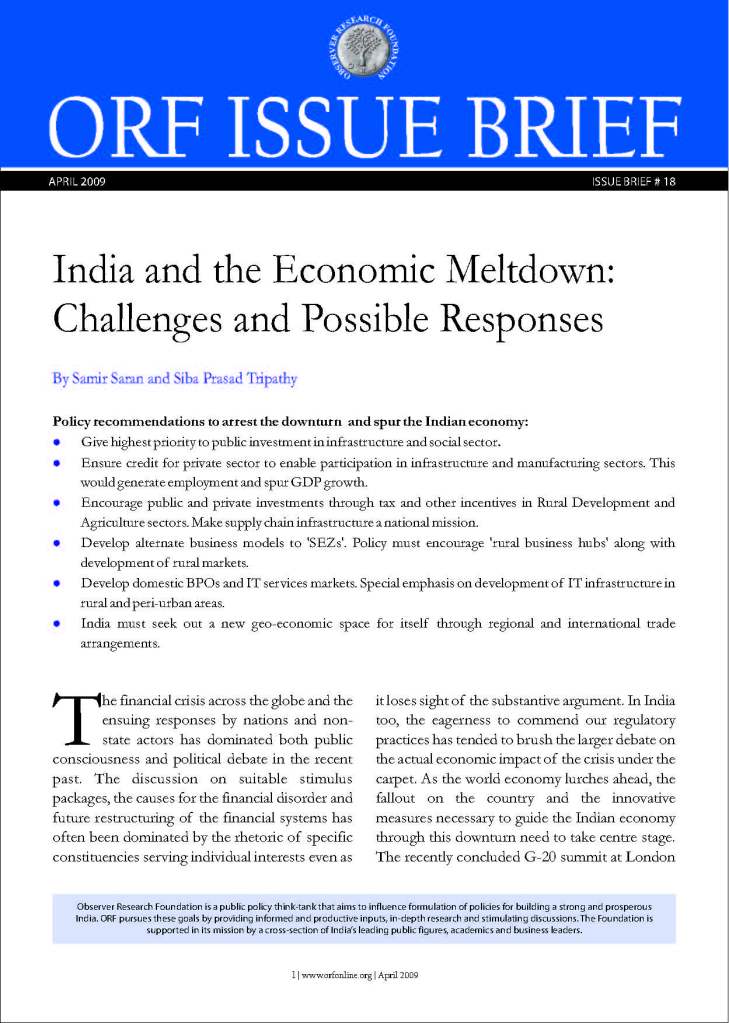
The financial crisis across the globe and the ensuing responses by nations and non-state actors has dominated both public consciousness and political debate in the recent past. The discussion on suitable stimulus packages, the causes for the financial disorder and future restructuring of the financial systems has often been dominated by the rhetoric of specific constituencies serving individual interests even as it loses sight of the substantive argument.

In India too, the eagerness to commend our regulatory practices has tended to brush the larger debate on the actual economic impact of the crisis under the carpet. As the world economy lurches ahead, the fallout on the country and the innovative measures necessary to guide the Indian economy through this downturn need to take centre stage. The recently concluded G-20 summit at London too did not result in any concrete measures and the outcome was a litany of intentions rather than actions.

This paper examines the “conservative and prudent practices” within the Indian financial sector that cushioned the direct impact of the institutional meltdown witnessed in the West and discusses the measures that the country must pursue to regain the growth momentum and help restructure the global financial order. It seeks to highlight some of the priorities that must guide India’s responses on the path to economic recovery.

The main policy recommendations are as follows:

(i) Give highest priority to public investment in infrastructure and social sector;

(ii) Ensure credit for private sector to enable participation in infrastructure and manufacturing sectors. This would generate employment and spur GDP growth;

(iii) Encourage public and private investments through tax and other incentives in Rural Development and Agriculture sectors. Make supply chain infrastructure a national mission;

(iv) Develop alternate business models to ‘SEZs’. Policy must encourage ‘rural business hubs’ along with development of rural markets.

(v) Develop domestic BPOs and IT services markets. Special emphasis on development of IT infrastructure in rural and peri-urban areas;

(vi) India must seek out a new geo-economic space for itself through regional and international trade arrangements.

Read here – https://www.orfonline.org/research/india-and-the-economic-meltdown-challenges-and-possible-responses/

Indian Economy, Research

India and the Economic Meltdown: Challenges and Possible Responses

Image