BRICS, Columns/Op-Eds

Column in SAFPI: More than just a catchy acronym: six reasons why BRICS matters

by Samir Saran and Vivan Sharan
Please find here the link to the original article.

New Delhi: There have been heated discussions over the role of BRICS recently. Ian Bremmer, President of the Eurasia Group, a political risk consulting firm, wrote an eye-catching article in the New York Times in late November, proclaiming that BRICS is nothing more than a catchy acronym. The BRICS nations represent over 43 percent of the global population that is likely to account for over 50 percent of global consumption by the middle class – those earning between $16 and $50 per day – by 2050. On the other hand, they also collectively account for around half of global poverty calculated at the World Bank’s $1.25 a day poverty line. What, then, is the mortar that unites these BRICS?

First, unlike NATO, BRICS is not posturing as a global security group; unlike ASEAN or MERCOSUR, BRICS is not an archetypal regional trading bloc; and unlike the G7, BRICS is not a conglomerate of Western economies laying bets at the global governance high table. BRICS is, instead, a 21st-century arrangement for the global managers of tomorrow.

At the end of World War II, the Atlantic countries rallied around ideological constructs in an attempt to create a peaceful global order. Now, with the shifts in economic weights, adherence to ideologies no longer determines interactions among nations.

BRICS members are aware that they must collaborate on issues of common interest rather than common ideologies in what is now a near “G-0 world,” to borrow Bremmer’s own terminology. Second, size does not matter and it never has. Interests do and they always will. Intriguingly, Bremmer expresses his concern over China being a dominant member within BRICS. Clearly, Bremmer has chosen to ignore the fact that the US accounts for about 70 percent of the total defense expenditure of NATO countries or that it contributes nearly 45 percent of the G7’s collective GDP.

Third, BRICS is a flexible group in which cooperation is based on consensus. Issues of common concern include creating more efficient markets and generating sustained growth; generating employment; facilitating access to resources and services; addressing healthcare concerns and urbanization pressures; and seeking a stable external environment not periodically punctuated with violence arising out of a whim of a country with means.
Fourth, it is useful to remember that the world is still in the middle of a serious recession emanating from the West. As Bremmer himself points out, systemic dependence on Western demand is a critical challenge for BRICS nations. Indeed, it is no surprise that they have begun to create hedges. The proposal to institute a BRICS-led Development Bank, instruments to incentivize trade and investments, as well as mechanisms to integrate financial markets and stock exchanges are a few examples.

Fifth, through the war on Iraq, some countries undermined the UN framework. The interventions in Libya reaffirmed that sovereignty is neither sacrosanct nor a universal right. While imposing significant economic costs on the world, they failed to produce the desired political outcome. By maintaining the centrality of the UN framework in international relations, BRICS is attempting to pose a counter-narrative.
Sixth, in the post-Washington Consensus era, financial institutions such as the IMF and the World Bank are struggling to articulate a coherent development discourse. BRICS nations are at a stage where they can collectively craft a viable alternative development agenda.

In the Fourth BRICS Summit in New Delhi in March 2012, there was clear emphasis on sharing development knowledge and further democratizing institutions of global financial governance within the cooperative framework. BRICS is a transcontinental grouping that seeks to shape the environment within which the member countries exist. While countries across the globe share a number of common interests, the order of priorities differs. Today, BRICS nations find that their order of priorities on a number of external and internal issues which affect their domestic environments is relatively similar.

BRICS is pursuing an evolving and well thought out agenda based on this premise. And unlike Bremmer, we are not convinced that they are destined to fail.

* Samir Saran is vice president and Vivan Sharan an associate fellow at the Observer Research Foundation, New Delhi.

Standard
BRICS, Columns/Op-Eds

Article in ‘Global Times’: More than just a catchy acronym – six reasons why BRICS matters

by Samir Saran and Vivan Sharan
Please find here the link to the original article. 

There have been heated discussions over the role of BRICS recently. Ian Bremmer, President of the Eurasia Group, a political risk consulting firm, wrote an eye-catching article in the New York Times in late November, proclaiming that BRICS is nothing more than a catchy acronym. 


The BRICS nations represent over 43 percent of the global population that is likely to account for over 50 percent of global consumption by the middle class – those earning between $16 and $50 per day – by 2050. On the other hand, they also collectively account for around half of global poverty calculated at the World Bank’s $1.25 a day poverty line. 

What, then, is the mortar that unites these BRICS? 

First, unlike NATO, BRICS is not posturing as a global security group; unlike ASEAN or MERCOSUR, BRICS is not an archetypal regional trading bloc; and unlike the G7, BRICS is not a conglomerate of Western economies laying bets at the global governance high table. BRICS is, instead, a 21st-century arrangement for the global managers of tomorrow.   

At the end of World War II, the Atlantic countries rallied around ideological constructs in an attempt to create a peaceful global order. Now, with the shifts in economic weights, adherence to ideologies no longer determines interactions among nations. 

BRICS members are aware that they must collaborate on issues of common interest rather than common ideologies in what is now a near “G-0 world,” to borrow Bremmer’s own terminology.

Second, size does not matter and it never has. Interests do and they always will. Intriguingly, Bremmer expresses his concern over China being a dominant member within BRICS. 

Clearly, Bremmer has chosen to ignore the fact that the US accounts for about 70 percent of the total defense expenditure of NATO countries or that it contributes nearly 45 percent of the G7’s collective GDP.

Third, BRICS is a flexible group in which cooperation is based on consensus. Issues of common concern include creating more efficient markets and generating sustained growth; generating employment; facilitating access to resources and services; addressing healthcare concerns and urbanization pressures; and seeking a stable external environment not periodically punctuated with violence arising out of a whim of a country with means.

Fourth, it is useful to remember that the world is still in the middle of a serious recession emanating from the West. As Bremmer himself points out, systemic dependence on Western demand is a critical challenge for BRICS nations. Indeed, it is no surprise that they have begun to create hedges. The proposal to institute a BRICS-led Development Bank, instruments to incentivize trade and investments, as well as mechanisms to integrate financial markets and stock exchanges are a few examples. 

Fifth, through the war on Iraq, some countries undermined the UN framework. The interventions in Libya reaffirmed that sovereignty is neither sacrosanct nor a universal right. While imposing significant economic costs on the world, they failed to produce the desired political outcome. By maintaining the centrality of the UN framework in international relations, BRICS is attempting to pose a counter-narrative.

Sixth, in the post-Washington Consensus era, financial institutions such as the IMF and the World Bank are struggling to articulate a coherent development discourse. BRICS nations are at a stage where they can collectively craft a viable alternative development agenda. 

In the Fourth BRICS Summit in New Delhi in March 2012, there was clear emphasis on sharing development knowledge and further democratizing institutions of global financial governance within the cooperative framework. 

BRICS is a transcontinental grouping that seeks to shape the environment within which the member countries exist. 

While countries across the globe share a number of common interests, the order of priorities differs. Today, BRICS nations find that their order of priorities on a number of external and internal issues which affect their domestic environments is relatively similar. 

BRICS is pursuing an evolving and well thought out agenda based on this premise. And unlike Bremmer, we are not convinced that they are destined to fail.

Samir Saran is vice president and Vivan Sharan an associate fellow at the Observer Research Foundation, New Delhi. opinion@globaltimes.com.cn


Standard
Books / Papers, BRICS, Columns/Op-Eds

Leaving the Hotel – The West has to get over its fruitless search for common values and instead negotiate global governance in a realist world

by Dr. John C. Hulsman and Samir Saran
3rd of December 2012
Please find hereFour-Seasons-Hotel the link to the original article

Though in theory they come from many places (particularly in the heretofore ruling West), the vast majority of the international foreign policy elite and its corresponding commentariat really only come from one place: Hegelian Land. Make no mistake about it; they form one quite homogenous group, with an unsurprisingly homogenous worldview. Spending weekends attending endless meetings in five-star hotels across the world (The Four Seasons is an especial favorite), their common views are so ingrained in discussions that they are rarely directly commented upon, let alone debated.

In fact, NGO (Non-Governmental Organization) Man has no need of self-reflection, since everyone they know shares their values, having attended the same prestigious universities, married into the same families, worked in the same think tanks, and spent their jet-set weekends together, talking about such weighty matters as ‘the centrality of the global commons,’ ‘the rise of the south,’ ‘the end of the nationstate’, ‘the multilateral global elite,’ and ‘the advance of the developing world toward universal norms,’ amongst other such self-aggrandizing pipedreams. Their basic analytical mistake (and it is seminal) is that as everyone they know shares these parochial Wilsonian values, such a point of view must be all that matters or really exists. Truly, they all hail from one indivisible Hegelian world. But as Woody Allen put it in Annie Hall, ‘Intellectuals have proven to the world that you can have all this brilliance and still have absolutely no idea of what’s going on.’ Like the possibly apocryphal story (later fiercely denied) about the New York Times film critic Pauline Kael, who was said to be sincerely baffled as to how President Nixon won re-election in 1972 (he carried 49 states) when everyone she knew had voted for the hapless George McGovern, there are distinct intellectual dangers to being so entirely cocooned in a comfortable, if wholly unrepresentative, bubble. Advanced-stage otherworldliness and an ingrained intellectual arrogance make true analysis almost an impossibility.

Sure, NGO Man (and Woman) would placidly reply, there are Neanderthal outliers (such as the two of us who were not properly vetted before being allowed in the inner sanctum) who still believe in the nation state, but the very transnational nature of today’s problems will soon make them appear to all to be the reactionaries that they are (never mind that the rising powers in today’s world such as the BRICS countries (Brazil, Russia, India, China, South Africa) share little in terms of common values except for a strongly nationalistic distrust of the West and the governance frameworks that have been designed for an Atlantic world). The fact that these rising powers are self-evidently nation-states–proving to all not basking in delusion that the new multipolar era demonstrates that the Westphalian state system is above all, alive and well-would never be brought up at The Four Seasons.

However, it is their last, common, wholly wrongheaded assumption that all states inherently share overwhelmingly binding universal values and norms, which is their self-evident truth that is most out of step with reality. Paradoxically, by believing the unbelievable (if the real multipolar world outside the hotel is to be finally taken into account), NGO Man dooms true initiatives at global governance to sure failure, making efforts to endeavor to make the planet a genuinely better place come to naught. Obliviousness in the end isn’t just about harmless self-delusion; intellectually NGO Man gets in the way of solving the very problems he spends so much time purporting to ‘care’ about.

The Common Values Chimera

Especially in Europe (though America is far from immune), one tired conversation dominates most European institutions and forums, threatening to become a fatal liability, distancing the EU from the new capitals that influence global decision making in Asia, Africa and Latin America. It is Europe’s obsession with “Common Values” and the Don Quixote-like quest for “Common Humanity.” Wasting time and intellectual capital looking for this faux Holy Grail is doing nothing less than preventing the global community discovering vital common ground on the key issues that the emerging multipolar world is confronted with. Be the issue of climate change, political intervention in unstable nations, or over broader geopolitical stability, spending time trying to find the fool’s gold of universal values gets in the way of cutting the interest-based deals that will actually make the new multipolar world work.

This European obsession also leads to an analytical failure at the geopolitical level, blurring Western understanding of the new ‘clubs’ such as the BRICS and explains their comforting dismissal of the reality that much has changed, due to the fact that the BRICS themselves seemingly share little in terms of ‘Common Values.’ From Brussels’ point of view how can such an organization (let alone its constituent members) matter if it doesn’t adhere to the Gospel of Monnet? But the BRICS do share common interests, with three among them being the most important. First, all BRICS countries stress there must be a stable external environment that cannot and must not be jeopardized by partisan interventions in Iran and other parts of the Middle East and Africa; in other words, contrary to NGO Man, state sovereignty still matters and non-intervention is also a viable political choice.

The Iranian nuclear crisis is a case in point. The usual, half-cocked Western intervention–in this case an ineffective bombing strike by either Israel or the US that would have to be repeated–would amount to a geostrategic calamity (immeasurably strengthening the mullahs, quite possibly destabilizing broadly pro-Western governments in places like Jordan, Egypt, and Saudi Arabia, and setting back any hopes of stability in the region for a generation). Average Iranians and the Arab street may well hate and distrust the current leadership in Tehran; this does not mean that their distaste translates into obvious support for the West to bomb Iran into a recognition of its errors in ignoring the universal Hegelian virtue of negotiating in good faith.

Instead a realist response-which allows that interests and not values must be paramount if effective agreements are to be arrived at in this new era-impels a different way forward. If states themselves (such as Iran) are threatening the regional balance of power, closer ties between threatened countries within a region as well as between its major players and offshore balancing allies (such as the U.S.) are the chess move needed, rather than violating the offending country’s sovereignty due its less than dogmatic devotion to universal values or its inability to join the conversation in a language that it just does not recognize. Rather, extended deterrence based above all on the truly universal interest of physical survival) is the way forward, an approach seemingly and inexplicably abandoned by the Obama administration.

The second common BRIC interest is that an accountable and stable global financial regime must evolve-with a far greater say for the rising economic powers– the promises for which remain unfulfilled since 2008/09. The unambiguous and ambitious Delhi Declaration by the BRICS Heads of State served as a timely reminder to the Atlantic powers of the strength of the impulses that have brought the BRICS member nations together in the first place.

The message that went out was that the BRICS members will gradually begin to institutionalise an alternative path in terms of financial and economic governance. Be it the BRICS Development Bank initiative, the trade settlement processes, or teaming up on resisting the ‘carbon tax’ unilaterally announced by the EU, these countries are beginning to realize the importance of reframing the rules and perhaps changing the game itself.

In parallel, as this possible transition occurs, they will continue to demand progressive reforms in the existing structures of global financial governance. Their meeting on the sidelines of each G-20 meeting may not have resulted in their putting up a common candidate for the IMF as of yet, but these interactions (this new pattern of standardised consultation) will continue to strength their common ambition to push for reforms of outmoded Bretton Woods Institutions which have failed to even uphold the fundamental tenants of equity and inclusiveness on which they were built (or achieve the still more lofty goal of absolute poverty reduction).

At the recent and much written about Delhi Summit, while Western media and critics were dismissing these interactions as insignificant and unsustainable, the BRICS nations were drawing up a blueprint for a common development bank for the LDCs (Less Developed Countries), local lines of credit for trade, and an alliance of national BRICS stock exchanges. While such developments may not necessarily lead to long-term cooperation on other issues of significance, they will certainly fortify and greatly extend common interests in the areas of trade and finance. Representing nearly half of the global population, and a similar proportion of global growth, BRICS economies are no longer willing to be rule-takers on issues which are inherently crucial to their development trajectories. For the wise, this can be read as a sign of the coming outright rejection of the Washington consensus. That the Atlantic powers will have to accommodate this paradigm shift is certain; how they will respond remains a seminal mystery of the new age.

Finally, the BRICS all agree on a far greater global emphasis (if not commitments) on the development and poverty reduction efforts in Asia, Africa and Latin America and the fact that “green capitalism” or “green values” are new hurdles that BRICS must stand up against. No developing power is likely to commit economic suicide to make over-privileged Western Greens happy. In many ways, the recently concluded Rio+20 Summit seemed to mark the end of climate multilateralism, with countries failing to agree on anything substantial, despite the hype and hoopla preceding it. In an increasingly uncommon world, it is irrational to expect global binding commitments on issues as complicated and contested as climate change or sustainable development. In fact-far from being a shared value–the definition of the term “Sustainable” is contested itself. What implies inclusive growth and poverty alleviation for one, means stifling ‘Green Capitalism’ for the other.

However, this basic schism has been obscured over the many rounds of negotiations and many conferences convened and attended by NGO Man. It should be understood that the emergence of the BRICS on the global economic and political stage does not necessarily signal a default willingness to shoulder responsibility for historical emissions. Moral arguments may get you fair round of applause at The Four Seasons, but if you want a deal, then Atlantic countries need to vacate carbon real estate or pay the rent for squatting on it to accommodate for their ‘lifestyle emissions’.

With the average per capita consumption of primary energy of the BRICS members is still only a fraction of OECD averages, the notion of universal responsibility for the fate of the planet is redundant from the outset. No nation-state can be pinned down by narratives of universal moral accountability and culpability, given the real context. A man barely surviving on a dollar or two a day has no obligation, motivation or reason to preserve this planet the way it is for the next generation. And yes, he disagrees with the President of the United States of America and the Green Evangelists of the EU on this; they simply sit in different structural positions. Giving him a better tomorrow may over time see us strike the deal that the annual climate circuses around the world have failed to achieve.

Acquainting NGO Man With the Realities of our Times

It is well past time for Europe and the West as a whole to wake up to the world they actually live in and now move towards the more workable paradigm of “Shared Interests and Shared Prosperity”, terms that flow from the vocabulary of the “realist” camp, acknowledging that beneath every façade, nations and societies share only one common value, that of self-preservation based on self-interest. Sure, some of these interests do become normative and can be classified as values, but that they remain ‘interests’ above all must be recognized and in an indulgent and modest moment, negotiated as well. ‘Values’ lead to deadlocks and rigidities, ‘interests’ are often tradable, and when primary interests clash, well, at least one knows the score. This approach offers a far greater global potential for great powers old and new to collaborate and cooperate than the parochial, annoyingly moralitic, valuesbased approach that is viewed by most outside of the EU as a not-so-subtle attempt to impose European interests by the back door, despite objectively lacking the power to do so. A man in the gutter and a man in a mansion will share only one common value – self-interest and self-preservation. While the former will seek ways to reach the mansion, the latter will undoubtedly discover rules to remain there. But this fetish with values and the lack of agreement on their universal existence and definition is not the only intellectual challenge that efficient global governance is confronted with today. The concept of sovereignty–and the very different individual experiences of nation-states that compel them to define this critical notion differently–is another potential stumbling block.

For example, the US certainly does not share the diluted notion of sovereignty so common within the EU; as former Defense Secretary Robert Gates made abundantly clear, if Europe continues to free ride on American defense spending in NATO soon it will not be seriously consulted on the strategic issues of the day, common values or no. For America, NATO has always been a means to an end, not Valhalla in itself, as Europeans complacently believe. Rather, the perilous state of the American economy and its increasingly fraught domestic politics are already altering its role as a global policeman and as things get ever harder, a more inward-looking America is inevitable, based on its overriding economic interest to right its fiscal ship.

Similarly, the BRICS and other emerging power centers view this transition period of their relative rise as precisely the time to consolidate their sense of nationhood and to reclaim sovereignty from the formerly Western-dominated world. Again, Europe is the global intellectual outlier. Global governance in the new world we actually live in must be founded on the notion that sovereignty actually matters far more than those in many European capitals so fatuously think. If the BRICS are to be made stakeholders in the new era, alongside the older, western powers, this is the first negotiation and accommodation that must take place.

The third reality of our times is that large economies in the Indo-Pacific region (India, China and some others) with low-income populations will now be the fulcrum for governing the most important regions of the world; if they succeed the new primary engine of global growth will be safeguarded, if not, we will live in a far more hostile planet. Due to their own troubles and relative economic decline, the US and EU will increasingly need to carve out partnerships with India, China and the ASEAN countries to secure the sea lanes, manage the rules of trade, secure property and property rights and ensure peace and stability at this hinge point of multipolarity. This dependence on large emerging economies–which for a long while will remain relatively poor–will change the very ethos of global governance.

Due to this sea change, global priorities are bound to change as well. Growth and not human rights will dictate the agenda. Industrialization will trump environmentalism and poverty alleviation will define sustainable development. The implementation of governance will alter dramatically. Due to the core difference in the understanding of sovereignty, partnerships between the Atlantic countries and countries of the Indo-Pacific will be tested. On the other hand, partnerships could strengthen when instead of patronizing sermons, efforts are made to accommodate the views, interests and needs of all based on the fruitful search for shared interests. So how to make sense of this confusing new world? The primary rule of the road must be the unbreakable link between burden sharing and power (or responsibility) sharing. This basic principle (while easily applied in terms of the voting weights controversy in the IMF and World Bank) must become nothing less than the new mantra for the multipolar age. For it is the only hope for future global governance efforts, based as it is on the only durable political factor in the world….actual power realities.

Of course, this fundamental global change takes place on a continuum; it will take several decades for the transition from a Western-dominated world to a world with many powers (with the BRICS leading the economic way) to be completed. But as the global financial crisis made clear, change may be occurring far more rapidly than anyone could have imagined. Along the way, a fading west and a ‘not-yet-up-toit’ rest could well drop the ball over vital global governance issues, resulting in what Ian Bremmer (somewhat apocalyptically) has referred to as a G-0 world, where nothing much gets done.

It is time for Europe to get over it. Nations will not have common values, because nations themselves are a collection of diverse historical experiences and ambitions. However, there is no need to throw in the towel over global governance, for nations can have a vision for shared prosperity with different approaches to get there. To make all this work, there must be some common macro rules for the road for achieving this shared prosperity (the greatest common interest of all) and these must be negotiated on the realist terms of common interests and not through the fruitless semantics of ethics and morality. It’s time for NGO Man to leave the hotel and xperience the new world that has sprung up while he was inside; the multipolar era needs realism to work.

(Dr. John C. Hulsman is President and Co-Founder of John C. Hulsman Enterprises (www.john-hulsman.com), an international relations consulting fir, and a life member of the Council on Foreign Relations. He is also the author of all or part of 10 books, including Amazon bestsellers Ethical Realism, The Godfather Doctrine, and most recently an acclaimed intellectual biography of Lawrence of Arabia, To Begin the World Over Again. Samir Saran is Vice President at the Observer Research Foundation and Chairman and CEO of ‘g_trade’, the creators of the 3rd dynamic green index, ‘BSE Greenex’ at the Bombay Stock Exchange. He is author/co-author and editor of a number of publications including Re-imagining the Indus, Navigating the Near, Radical Islam and BRIC in the New World Order. This expanded essay flows from an earlier op-ed written for the Times of India, May 11, 2012.)

Standard
Columns/Op-Eds

Obama 2.0: Who will crash the party?

by Samir Saran and Dr. John C. Hulsman
1st of December 2012
Please find here the link to the original article

Second term presidencies, like second marriages, can be seen as the triumph of hope over experience. George W. Bush met with calamity in Iraq, Bill Clinton was impeached over the Lewinsky scandal, Ronald Reagan suffered through Iran-Contra, Richard Nixon perpetrated Watergate and resigned, and LBJ was engulfed and then devoured by the Vietnam War. Given this doleful record, what can realistically be hoped for in a second Obama term? This time around, will chronically dysfunctional West Asia be a slow bleed that will drain the momentum of the new presidency?

Two major over-arching priorities immediately head the to-do list of President Obama; the first a great danger, while the second presents almost unparalleled political opportunity. The fiscal cliff–and insane joint suicide pact agreed to by the outgoing Congress-promises automatic tax increases and spending cuts totaling $600 billion coming to pass on January 1, 2013. The only way to avoid this contraction to the American economy, which it is estimated would amount to a full 4% of American GDP, thereby casting a feebly recovering American back into recession, would be for the Republican House and the President to reach a broader budget deal amounting to around $1.2 trillion in savings over the next 10 years. So, at least on paper, it is hard choices quickly arrived at or…Armageddon.

Given the stakes (and both parties desire to avoid the wrath of the American people at their persistent inability to behave as grown-ups) it is still more than even money that a patched-up compromise will be reached, a temporary deal which kicks the fiscal can down the road, without actually solving America’s long-term deficit and debt crisis. However, failure to reach such a deal (and it is important not to underestimate how politically divided Washington has become) would practically doom the president’s second term from the start.

Obama’s tremendous opportunity, also best done quickly while the Republican Party is still reeling from its electoral defeat, is to, in terms of policy, lock in the gains made by the creation of his new and seemingly enduring Democratic majority. The President’s winning political coalition for the past two presidential election cycles has led to nothing less than the rejuvenation of the Democratic Party itself. Women, African-Americans, the Professional Classes, the Young, and Hispanics are the basis of the evolving power of the Democrats, who have carried the popular vote in five of the last six presidential contests.

Locking in Hispanics, the fastest growing segment of the American electorate, is a particularly tempting prize. Now comprising a full 10% of the voting public, Hispanics gave the president 71% of their votes this November; the main reason for this is the administration’s efforts to offer amnesty and an ultimate path to citizenship for the roughly 11 million undocumented workers now living in America, and the Republicans’ suicidal desire to punish both them and their children.

In his immediate post-election remarks, the president gave the game away by stressing the need for immigration reform, truly a win-win proposition if ever there was one in politics. If Republicans balk at reaching a compromise over immigration, they will have lost the chance to win over the fastest growing segment of the American electorate for at least the next generation. If they go along with Obama’s proposals, there will be civil war in the GOP, and President Obama will get the lion’s share of the credit anyway. Look for moves to introduce such a policy very early in 2013.

If this is what the White House will do, the great White Whale of the next four years is a simple fiscal question: Can America arrest its trajectory of rather steep decline and enact a Bowles-Simpson style compromise that both raises taxes (as the Democrats dream about) while engaging in entitlement reform of Medicare, Medicaid and Social Security (the Republican’s fondest wish).

In the Bowles-Simpson plan–a bipartisan compromise reached by the president’s own appointed committee in the latter days of his first term-there is a durable blueprint to do this. There would be three dollars in spending cuts for every dollar in tax increases, entitlements would be means tested, and benefits would be cut and doled out slightly later in life, taxes would be simplified, with loopholes and deductions would be curtailed. Such a grand plan would stabilize the American debt rate at around 60% of GDP, thus preserving American economic power for the next generation.

There are two fundamental problems in reaching for the Bowles-Simpson Holy Grail. The first is that it presumes that people in both parties are less ideological than they currently are. It is not just the right-wing Tea Party that is the problem here; House Minority Leader Nancy Pelosi and her left-wing followers have also shown no sign of being able to make the significant compromises that would be necessary to make this whole process work. Without the left agreeing to entitlement reform and the right agreeing to tax rises, the deal will never be done. It is an open question as to whether this level of compromise is now possible in a Washington more ideologically divided than at any time in memory.

The final problem in nailing down this ambitious domestic agenda is that it assumes the world will simply not intrude while America tries to sort itself out. History simply does not work like this. While it is highly unlikely there will be simultaneous: War with Iran, tensions between China and Japan over the Senkakus, the euro-crisis going septic, and Syria’s civil war leading to regional instability or even regional war in the Middle East, there is a very good chance that some of this happens. Any foreign distractions could well doom the domestic-only focus the president is banking on.

Given this highly ambitious domestic agenda, Obama the second time around is likely to disappoint both the Wilsonian liberals who seek American intervention in troubled regions around the world to promote liberty and protect human rights (think Libya) and the neoconservative hawks who seek greater U.S. commitment to lead the 21st century world through the preponderance and use of its military might (think Iraq). If the first term is any indication, U.S. foreign policy will to continue to develop in a cautious, limited, pragmatic, yet largely reactive manner. There will be few American efforts to order the new multipolar world, or respond proactively to much of anything.

And therein lies the danger. Reactive agendas may result in hasty interventions and unintended outcomes. For one thing, the hurriedly brokered ceasefire between the Hamas and Israel is one that will surely need a revisit sooner rather than later. And this time around who (if anyone) will script the agenda remains the million-dollar question.

Standard
In the News, Water / Climate

Samir Saran in MINT discussion on “Making sense of sustainability”

Mint conclave on the ways to promote sustainability in business
New Delhi, 16th of July 2012
Please find here the original link to the article

New Delhi: Ravi Narain, managing director and chief executive of National Stock Exchange of India Ltd; Rajat Kathuria, economist and in-coming director, Icrier; Sivasubramanian Ramann, executive director of Securities and Exchange Board of India (Sebi); Seema Arora, executive director at CII-ITC Centre of Excellence for Sustainable Development; and Samir Saran, vice-president at Observer Research Foundation, were the panellists who took part in a Mint debate on sustainable development. The panellists discussed the ways to promote sustainability in business. Mint’s deputy managing editor Anil Padmanabhan moderated the discussion. Edited excerpts:

Padmanabhan: Sustainability is not possible without inclusion. Environment has to be seen holistically. Is there a business case for sustainability?

(Left) Ravi Narain, Managing director and CEO, NSE and Seema Arora, Executive director, CIIITC Centre of Excellence. Photos: Pradeep Gaur/Mint

(Left) Ravi Narain, Managing director and CEO, NSE and Seema Arora, Executive director, CIIITC Centre of Excellence. Photos: Pradeep Gaur/Mint

Arora: There is certainly a case for sustainability. As the minister (M. Veerappa Moily) said, it is not that business has to do it for anyone else. Business has to do it for its own survival. And that’s how we advocate it. That’s why mainstreaming sustainability into corporate decision-making. Sustainability here includes social and governance issues. Corporates need to look at it from this lens as well as from long-term perspective. Typically businesses look at it from short-term lens because they are driven by certain rewards they get. For this movement to actually succeed, that reward mechanism has to have a long-term lens. This is what we are trying to do with different stakeholders. Coming back to your question, there is certainly a business case, that is why we see many corporates already doing it. They are creating value for themselves and their stakeholders.

Saran: I am not sure about there being a business case for sustainability because there is no agreement on how we define sustainability. You saw Rio +20, there was no agreement among various nations on what sustainability is. But governance is something that can be measured. We have tried to create a method where we measure energy and emissions. We see these two as a proxy for governance. Any company with good governance will be efficient with its fuel consumption.

Padmanabhan: If we look at the guidelines laid by the (ministry of corporate affairs) ministry, they are more holistic.

Saran: Here again, we have to separate sustainability from social enterprise. If you were to tag your social ventures as corporate social responsibility, CSR, then I think you are confusing the cost of employee with CSR and that’s not right. That’s what most of the companies do. They try to project workforce infrastructure development as giving back to larger society. I think, these two have to be segregated. Up to the 90s, companies were hiding that they were making profit. Because the companies were projecting themselves as not profitable, they didn’t have to do much for others. Post 90s, profit became the mantra and then inclusion didn’t matter. And until 2007-08, it was the mantra. Only in 2009, social inclusion was introduced in the budget by UPA (United Progressive Alliance). The issue is, social transformation and growth are not linked.

From Left to Right: Samir Saran, VP, Observer Research Foundation; Rajat Kathuria, Economist, Icrier and Sivasubramanian Ramann, Executive director, Sebi

From Left to Right: Samir Saran, VP, Observer Research Foundation; Rajat Kathuria, Economist, Icrier and Sivasubramanian Ramann, Executive director, Sebi

Narain: There is a very clear business case, but it is not explicit enough. The so called enlightened businesses see it as a business case, but it is not out there in all our faces. We need to help bring out the cases of successful businesses who managed to see it as a business case and that has the ability to move it forward. There is empirical and anecdotal evidence that companies can get a premium if they are able to demonstrate good governance. It gets fuzzier when you come to non-governance part of sustainability. That’s about markets and investors. The other half is funders. I think the banks need to do a lot more to align their interests with corporates in making a business case.

Padmanabhan: As a regulator, how do you see it?

Ramann: I agree there is a business case in this whole move towards sustainability. If inputs are costed correctly, that is where a company is going to go forward, and make the best of whatever inputs are available and discard the expensive one and take on what is cheaper. We should bring that out more clearly.

Padmanabhan: You mean include the environment and social cost in the price?

Ramann: We are talking about moving ahead, looking clearly ahead at cost, which is real. One good thing that happened was the BSE green index. So, why not put out a simple number on which companies could be graded. That would certainly be good step forward.

Kathuria: One of the classic reasons for market failure has been that the externalities. It is not the inability but the complete dissociation from firms’ point of view to include those costs, those externalities into cost of production, which gives rise to market failure issue. The question is how to get firms to do that. There are two ways, one is voluntarily, or force companies to include those costs and therefore get the desirable results. The world is experimenting with carbon credits and standard for environmental sustainability and jury is still out there. But the problem is market failure and addressing that market failure, culture is also important. Do we have the culture of compliance in our country or not. So getting the firms to do it is a long road ahead. One of the ways in which compliance happens is through a strong institutional structure. Nor are we that sanguine about market any more, that the market is going to lead to the outcomes that are desirable, neither is the world. The way, to get the market to achieve the desirable outcome, is the institution structure that has sound enforcement and the right market incentives.

Padmanabhan: Samir you said growth and social inclusion are delinked at this point of time. Do you think these incentives can be a bridge?

Saran: I am not a believer in carrots. I think sometimes sticks are needed too. Now, I am not saying that should be done. The Greenex is a good way of doing it, you are listing good performers. Then, like Ravi (Narain) mentioned, hopefully we can ensure that funds flow to these performers. What is not happening today is that you are creating institutions and standards, but funds are not necessarily being driven to those performers in that framework. I completely agree with Ravi, unless bankers start backing good performers, good governance and social practices, you are not going to see companies either hurt enough or incentivize enough to change.

Padmanabhan: It is clear that we need incentive structure. Now the big debate is whether you follow stick approach or a carrot approach.

Arora: In our country pressures and dilemmas are completely different at the moment. I don’t think we can say that this is the only route by which we will get the results we really want. Also, culture has to play a major role here in a way we change the behaviour and the way industry responds to certain things. There is certainly a case in providing some kind of incentives for good performances. They could be different types of incentives, market-based incentives, financial incentives or recognitional incentives, we can start and experiment with. The important point is the entire ecosystem at this moment is rewarding corporate performance on quarterly performance. If that is going to be the main metrics, then obviously the ecosystem is not rewarding anything else the corporates do in terms of value creation on sustainability. So, the system has to work together to make that happen. We need to bring consumers on to the table. We need to have mix of incentives and gradually move to disincentives. But we are not mature enough to start immediately with it.

Ravi: Can we ask every institutional investors to put out in public domain what their assessment is for each corporate they have invested in, on their ESG (Environment, Social and Corporate) view, ESG action and sustainability.

Padmanabhan: Raman, as a regulator, can the disclosure be expanded to include these?

Raman: Most certainly. The facts is the initiative of ministry of corporate affairs has given the way forward for regulators like us. And it is something that is probably going to come out soon on how to get companies to make better disclosures. It is active work in progress, be it a listing agreement or any other form, the companies will be bound legally to bring out disclosure with regards to ESG.

Padmanabhan: What can be the collaborative mechanism that can be put in place, which will incentivise whether through carrot or stick, or its combination.

Rajat: It can’t be either carrot or stick approach. It has to be both. What works better is a carrot approach. A stick approach would work well in trying to establish culture of compliance if you have credible enforcement. Unless you are going to be able to enforce standards on whether environment or carbon, the stick approach is going to be difficult. But it can’t be either-or approach. Some good case studies show that carrot approach is a good approach, but a stick, enforcement and penalizing the non compliers is going to create compliance culture in the future.

moulishree.s@livemint.com

Standard
BRICS, In the News

Discussion with Open Magazine on BRICS: “Not just a talk shop”

29th of March, 2012
Please find here the link to the original article.

It may be an idiosyncratic club, but should it therefore be written off? As leaders of BRICS—Brazil, Russia, India, China and South Africa—gather in New Delhi for a summit to prove that their five-member group is something ‘solid’ (a word Indian PM Manmohan Singh has used in an Indo-Pak context), rather than just another talk shop, critics across the world have not been able to hide their derision. The interests of these countries are far too divergent, they mutter, to result in anything that could matter.

For exponents of the idea, however, the five represent not just a fifth of global output, but also a dynamic geo-economic bloc on the ascendant. It owes its name to a 2001 Goldman Sachs report that projected a world economy under BRIC domination (South Africa was admitted only in 2010) within half a century. Today, it is a club more than a clever acronym, and one with an agenda too. “[The group] seeks political dialogue towards a more democratic multipolar order,” says senior Indian bureaucrat Sudhir Vyas, adding that the global power shift currently underway calls for “corresponding transformations in global governance”.

The buzzword at the Delhi summit is cooperation. Says Bipul Chatterjee of Consumer Unity & Trust Society: “These leaders are likely to float the idea of a development bank to be capitalised by BRICS, or perhaps all developing nations, to fund the development aspirations of the poor world.” This aim has its origin in Manmohan Singh’s 2010 suggestion that the world’s surplus savings be funnelled into emerging economies short of capital for investment in infrastructure and other public utility projects. Says Samir Saran, a BRICS expert with the Observer Research Foundation: “The proposed bank could tap these savings by creating sovereign guaranteed debt instruments to leverage more money for these economies.”

The other area of mutual interest is trade. As a booster, of help would be an agreement among the five countries’ central banks to grant one another access to loans in local currencies. Saran says the BRICS platform would “offer the five ‘R’s: rupee, rouble, renminbi, rand and real” for trade payments as part of a test settlement mechanism, “before internationalising these currencies”. The goal here is to reduce dependence on the US dollar as an international means of exchange.

Sceptics do not see much coming of it. Yet, it is worth noting that the five have managed to get this far as a club without letting bilateral bickering get in the way. This in itself is commendable. Perhaps BRICS bashers should wait a while before writing it off.

Standard
BRICS, Columns/Op-Eds

BRICS, Steel, Mortar….and Money – Analysis of the 4th BRICS Summit in New Delhi

by Samir Saran and Vivan Sharan
4th of April 2012
Please find here the original link to the article.

With the Delhi Declaration, BRICS nations, which met recently in the Indian capital, have shown that they have the steel to stand up to traditional power structures, a cohesive vision to jointly respond to development challenges through institutionalisation of concrete mechanisms, and the determination to channel monetary power to strengthen markets, businesses and trade. The Declaration indeed gives insight into the gradual transformation of BRICS, from essentially a response mechanism crafted to address the various development challenges posed by the global financial crisis, to a forward looking entity seeking to enact and enable real global transformation.

The Delhi Declaration extends over 50 paragraphs which are all encompassing in some sense and address many relevant themes for BRICS countries and the developing world at large. The Declaration is significantly more impressive and comprehensive than the 16 paragraph Joint Statement of the BRICS Leaders at the first summit held at Yekaterinburg in 2009 and the sketchy and macro statement of purpose at Sanya last year. The Action Plan within the Delhi Declaration consists of 17 steps which will deepen intra-BRICS engagements. There are three prominent narratives that define the Delhi Declaration – reaffirmation of the UN framework for global governance, disappointment with financial regimes shaped in the mid 20th century and a confidence to tap into economic opportunities that exist within BRICS.

The Delhi Declaration has stamped the intent of BRICS nations to coordinate and collectively respond to global security challenges within appropriate frameworks that give precedence to fundamental principles such as international law, transparency and sovereignty. BRICS members have recognised and re-emphasised the centrality of the UN in dealing with regional tensions and they have explicitly outlined this for specific cases including the Arab-Israeli conflict, the Syrian imbroglio and the contentious Iranian nuclear programme.

The Declaration unambiguously states that “plurilateral initiatives” that go against the fundamental principles outlined earlier, will not be supported by BRICS. The Declaration is clearly against actions such as asymmetric trade protectionism, unilaterally imposed sanctions and taxes imposed on businesses. The EU’s Aviation Tax is one such example from contemporary policymaking. In terms of trade, there is strong emphasis on operating within legal instruments such as the WTO and institutions such as the UNCTAD for furthering the inclusive development efforts through consensus and technical cooperation.

The aftershocks from the financial crisis are still a cause of concern to the BRICS nations. The pre-occupation with Europe has distracted attention from the social transformation programmes and poverty alleviation efforts among BRICS members. The Delhi Declaration has spelt out the “immediate priority” of restoring market confidence and getting global growth back on track. The steps to address such concerns will include attempts to rebalance global savings and consumption, furthering of regulatory and supervisory oversight in the financial markets, increasing the voice of developing and emerging nations in global financial governance and the institutionalisation of financial mechanisms to redirect existing capital to tackle development imperatives.

The BRICS members have therefore announced a working group led by the Finance Ministers of the individual nations, in order to examine the “feasibility and viability” of a BRICS Development Bank. When formed, such an institution will likely be able to shift and contextualise the development discourse within and outside BRICS and therefore is one of the most significant actionable outcomes. It is evident that such a multilateral institution is not meant to compete with existing ones, but rather, to enhance lending and investment to create sustainable development trajectories. Contrary to expectations several high ranking Chinese policymakers, including the Assistant Foreign Minister, Ma Zhaoxu, have supported the idea.

The BRICS members have clearly outlined that the purpose and nature of Bretton Woods Institutions such as the World Bank, must shift from being essentially a mediation instrument to enable North-South cooperation, to one which can actually prioritise “development issues” and overcome the “donor-recipient dichotomy”. They have also called upon the World Bank to mobilize greater directed resources and enable development financing at reduced costs through financial innovations and improved lending practices. Indeed for BRICS, the focus on World Bank and IMF reforms has remained constant through the years, yet the Delhi Declaration articulates these concerns more lucidly than ever before.

Given that intra-BRICS trade has been consistently on the rise over the past decade, BRICS Leaders have endorsed the conclusion of the Master Agreement on Extending Credit Facility in Local Currency under the BRICS Interbank Cooperation Mechanism and the Multilateral Letter of Credit Confirmation Facility Agreement between their respective EXIM/Development Banks. Such steps to mitigate market risks and enable local currency transactions will only add to the existing momentum and build resilience in BRICS economies to global business cycle fluctuations and exchange rate volatilities. Notably, BRICS have also endorsed the market led efforts to set up a BRICS Exchange Alliance between the major stock exchanges of BRICS, which will enable investors to efficiently allocate capital across BRICS economies and invest in the BRICS growth story.

The unity and purpose of BRICS has been the target of speculation and scepticism from various quarters. With the Delhi Declaration, BRICS members have been able to assuage such doubts as they have begun to create a credible hedge against traditional global narratives of security and development. They have simultaneously been able to project that there is resolution within the group to deal with issues that are not only of immediate concern but even those that will need attention in the future. The Delhi Declaration paves the way for the institutionalisation of BRICS cooperation, making BRICS a significant transcontinental and politically united force. In Sanya BRICS spread wide to include South Africa; in Delhi they went deep to include substance.

Samir Saran is Vice-President and Vivan Sharan an Associate Fellow at Observer Research Foundation. The Foundation hosted the BRICS Academic Forum in March this year. 

Standard
BRICS

Fourth BRICS Summit – Delhi Declaration / Samir live on BBC World News

Was on BBC this morning….was asked to discuss BRICS….

Ques 1 – China will dominate BRICS because of its money and might?

Ques 2 – How will India counter China at the BRICS?

Ques 3 – How can this group work together without common ideology (or something like that)?

Was at my charming best while basically saying…China will be an important player in any grouping – why only BRICS….the questions are posed incorrectly…BRICS is not a platform for India countering China….it is indeed an opportunity to take the edge of the bilateral …..and some people do not see common ideology as being necessary….(this Euro Centric fetish for “Common Humanity”) and with our individual and rich experiences we can find ways to developing pathways (unique) for an equitable and prosperous future….

Synergy and Complimentarity are the operative words and BRICS are rich with these possibilities.

For some in India as well – it is all a zero sum game….maybe it is …but they need to know the rules of arithmetic are changing and the nation state may not be the unit of measurement any more – The BRICS Stock Exchange is the business thumbs up to BRICS and the 4th Academic Forum was the “experts” support to it….many more to follow….

The skeptics can continue to earn their salaries…while we build a new platform 🙂

The Political will is expressed in the Delhi Declaration and it is positive, decisive and firm on what the BRICS need to do together and how they need to interact with the developed world on many common issues. I am certain that in this instance the BRICS surprised themselves …..in what they were able to agree to ….In Sanya the BRICS went wider and added South Africa….In Delhi the BRICS went deeper and added substance….

Happy BRICS Day

———————————————–

Fourth BRICS Summit – Delhi Declaration
March 29, 2012
Please find here the full version as PDF: Declaration Fourth_BRICS_Summit

1. We, the leaders of the Federative Republic of Brazil, the Russian Federation, the

Republic of India, the People’s Republic of China and the Republic of South Africa,

met in New Delhi, India, on 29 March 2012 at the Fourth BRICS Summit. Our

discussions, under the overarching theme, “BRICS Partnership for Global Stability,

Security and Prosperity”, were conducted in an atmosphere of cordiality and warmth

and inspired by a shared desire to further strengthen our partnership for common

development and take our cooperation forward on the basis of openness, solidarity,

mutual understanding and trust.

2. We met against the backdrop of developments and changes of contemporary global

and regional importance – a faltering global recovery made more complex by the

situation in the euro zone; concerns of sustainable development and climate change

which take on greater relevance as we approach the UN Conference on Sustainable

Development (Rio+20) and the Conference of Parties to the Convention on Biological

Diversity being hosted in Brazil and India respectively later this year; the upcoming

G20 Summit in Mexico and the recent 8th WTO Ministerial Conference in Geneva;

and the developing political scenario in the Middle East and North Africa that we

view with increasing concern. Our deliberations today reflected our consensus to

remain engaged with the world community as we address these challenges to global

well-being and stability in a responsible and constructive manner.

3. BRICS is a platform for dialogue and cooperation amongst countries that represent

43% of the world’s population, for the promotion of peace, security and development

in a multi-polar, inter-dependent and increasingly complex, globalizing world.

Coming, as we do, from Asia, Africa, Europe and Latin America, the transcontinental

dimension of our interaction adds to its value and significance.

4. We envision a future marked by global peace, economic and social progress and

enlightened scientific temper. We stand ready to work with others, developed and

developing countries together, on the basis of universally recognized norms of

international law and multilateral decision making, to deal with the challenges and the

opportunities before the world today. Strengthened representation of emerging and

developing countries in the institutions of global governance will enhance their

effectiveness in achieving this objective.

5. We are concerned over the current global economic situation. While the BRICS

recovered relatively quickly from the global crisis, growth prospects worldwide have

again got dampened by market instability especially in the euro zone. The build-up of

sovereign debt and concerns over medium to long-term fiscal adjustment in advanced

countries are creating an uncertain environment for global growth. Further, excessive

liquidity from the aggressive policy actions taken by central banks to stabilize their

domestic economies have been spilling over into emerging market economies,

fostering excessive volatility in capital flows and commodity prices. The immediate

priority at hand is to restore market confidence and get global growth back on track.

We will work with the international community to ensure international policy

coordination to maintain macroeconomic stability conducive to the healthy recovery

of the global economy.

6. We believe that it is critical for advanced economies to adopt responsible

macroeconomic and financial policies, avoid creating excessive global liquidity and

undertake structural reforms to lift growth that create jobs. We draw attention to the

risks of large and volatile cross-border capital flows being faced by the emerging

economies. We call for further international financial regulatory oversight and reform,

strengthening policy coordination and financial regulation and supervision

cooperation, and promoting the sound development of global financial markets and

banking systems.

7. In this context, we believe that the primary role of the G20 as premier forum for

international economic cooperation at this juncture is to facilitate enhanced

macroeconomic policy coordination, to enable global economic recovery and secure

financial stability, including through an improved international monetary and

financial architecture. We approach the next G20 Summit in Mexico with a

commitment to work with the Presidency, all members and the international

community to achieve positive results, consistent with national policy frameworks, to

ensure strong, sustainable and balanced growth.

8. We recognize the importance of the global financial architecture in maintaining the

stability and integrity of the global monetary and financial system. We therefore call

for a more representative international financial architecture, with an increase in the

voice and representation of developing countries and the establishment and

improvement of a just international monetary system that can serve the interests of all

countries and support the development of emerging and developing economies.

Moreover, these economies having experienced broad-based growth are now

significant contributors to global recovery.

9. We are however concerned at the slow pace of quota and governance reforms in the

IMF. We see an urgent need to implement, as agreed, the 2010 Governance and Quota

Reform before the 2012 IMF/World Bank Annual Meeting, as well as the

comprehensive review of the quota formula to better reflect economic weights and

enhance the voice and representation of emerging market and developing countries by

January 2013, followed by the completion of the next general quota review by

January 2014. This dynamic process of reform is necessary to ensure the legitimacy

and effectiveness of the Fund. We stress that the ongoing effort to increase the

lending capacity of the IMF will only be successful if there is confidence that the

entire membership of the institution is truly committed to implement the 2010 Reform

faithfully. We will work with the international community to ensure that sufficient

resources can be mobilized to the IMF in a timely manner as the Fund continues its

transition to improve governance and legitimacy. We reiterate our support for

measures to protect the voice and representation of the IMF’s poorest members.

10. We call upon the IMF to make its surveillance framework more integrated and

even-handed, noting that IMF proposals for a new integrated decision on surveillance

would be considered before the IMF Spring Meeting.

11. In the current global economic environment, we recognise that there is a pressing

need for enhancing the flow of development finance to emerging and developing

countries. We therefore call upon the World Bank to give greater priority to

mobilising resources and meeting the needs of development finance while reducing

lending costs and adopting innovative lending tools.

12. We welcome the candidatures from developing world for the position of the

President of the World Bank. We reiterate that the Heads of IMF and World Bank be

selected through an open and merit-based process. Furthermore, the new World Bank

leadership must commit to transform the Bank into a multilateral institution that truly

reflects the vision of all its members, including the governance structure that reflects

current economic and political reality. Moreover, the nature of the Bank must shift

from an institution that essentially mediates North-South cooperation to an institution

that promotes equal partnership with all countries as a way to deal with development

issues and to overcome an outdated donor- recipient dichotomy.

13. We have considered the possibility of setting up a new Development Bank for

mobilizing resources for infrastructure and sustainable development projects in

BRICS and other emerging economies and developing countries, to supplement the

existing efforts of multilateral and regional financial institutions for global growth and

development. We direct our Finance Ministers to examine the feasibility and viability

of such an initiative, set up a joint working group for further study, and report back to

us by the next Summit.

14. Brazil, India, China and South Africa look forward to the Russian Presidency of

G20 in 2013 and extend their cooperation.

15. Brazil, India, China and South Africa congratulate the Russian Federation on its

accession to the WTO. This makes the WTO more representative and strengthens the

rule-based multilateral trading system. We commit to working together to safeguard

this system and urge other countries to resist all forms of trade protectionism and

disguised restrictions on trade.

16. We will continue our efforts for the successful conclusion of the Doha Round,

based on the progress made and in keeping with its mandate. Towards this end, we

will explore outcomes in specific areas where progress is possible while preserving

the centrality of development and within the overall framework of the single

undertaking. We do not support plurilateral initiatives that go against the fundamental

principles of transparency, inclusiveness and multilateralism. We believe that such

initiatives not only distract members from striving for a collective outcome but also

fail to address the development deficit inherited from previous negotiating rounds.

Once the ratification process is completed, Russia intends to participate in an active

and constructive manner for a balanced outcome of the Doha Round that will help

strengthen and develop the multilateral trade system.

17. Considering UNCTAD to be the focal point in the UN system for the treatment of

trade and development issues, we intend to invest in improving its traditional

activities of consensus-building, technical cooperation and research on issues of

economic development and trade. We reiterate our willingness to actively contribute

to the achievement of a successful UNCTAD XIII, in April 2012.

18. We agree to build upon our synergies and to work together to intensify trade and

investment flows among our countries to advance our respective industrial

development and employment objectives.We welcome the outcomes of the second

Meeting of BRICS Trade Ministers held in New Delhi on 28 March 2012. We support

the regular consultations amongst our Trade Ministers and consider taking suitable

measures to facilitate further consolidation of our trade and economic ties. We

welcome the conclusion of the Master Agreement on Extending Credit Facility in

Local Currency under BRICS Interbank Cooperation Mechanism and the Multilateral

Letter of Credit Confirmation Facility Agreement between our EXIM/Development

Banks. We believe that these Agreements will serve as useful enabling instruments

for enhancing intra-BRICS trade in coming years.

19. We recognize the vital importance that stability, peace and security of the Middle

East and North Africa holds for all of us, for the international community, and above

all for the countries and their citizens themselves whose lives have been affected by

the turbulence that has erupted in the region. We wish to see these countries living in

peace and regain stability and prosperity as respected members of the global

community.

20. We agree that the period of transformation taking place in the Middle East and

North Africa should not be used as a pretext to delay resolution of lasting conflicts but

rather it should serve as an incentive to settle them, in particular the Arab-Israeli

conflict. Resolution of this and other long-standing regional issues would generally

improve the situation in the Middle East and North Africa. Thus we confirm our

commitment to achieving comprehensive, just and lasting settlement of the Arab-

Israeli conflict on the basis of the universally recognized international legal

framework including the relevant UN resolutions, the Madrid principles and the Arab

Peace Initiative. We encourage the Quartet to intensify its efforts and call for greater

involvement of the UN Security Council in search for a resolution of the Israeli-

Palestinian conflict. We also underscore the importance of direct negotiations

between the parties to reach final settlement. We call upon Palestinians and Israelis to

take constructive measures, rebuild mutual trust and create the right conditions for

restarting negotiations, while avoiding unilateral steps, in particular settlement

activity in the Occupied Palestinian Territories.

21. We express our deep concern at the current situation in Syria and call for an

immediate end to all violence and violations of human rights in that country. Global

interests would best be served by dealing with the crisis through peaceful means that

encourage broad national dialogues that reflect the legitimate aspirations of all

sections of Syrian society and respect Syrian independence, territorial integrity and

sovereignty. Our objective is to facilitate a Syrian-led inclusive political process, and

we welcome the joint efforts of the United Nations and the Arab League to this end.

We encourage the Syrian government and all sections of Syrian society to

demonstrate the political will to initiate such a process, which alone can create a new

environment for peace. We welcome the appointment of Mr. Kofi Annan as the Joint

Special Envoy on the Syrian crisis and the progress made so far, and support him in

continuing to play a constructive role in bringing about the political resolution of the

crisis.

22. The situation concerning Iran cannot be allowed to escalate into conflict, the

disastrous consequences of which will be in no one’s interest. Iran has a crucial role to

play for the peaceful development and prosperity of a region of high political and

economic relevance, and we look to it to play its part as a responsible member of the

global community. We are concerned about the situation that is emerging around

Iran’s nuclear issue. We recognize Iran’s right to peaceful uses of nuclear energy

consistent with its international obligations, and support resolution of the issues

involved through political and diplomatic means and dialogue between the parties

concerned, including between the IAEA and Iran and in accordance with the

provisions of the relevant UN Security Council Resolutions.

23. Afghanistan needs time, development assistance and cooperation, preferential

access to world markets, foreign investment and a clear end-state strategy to attain

lasting peace and stability. We support the global community’s commitment to

Afghanistan, enunciated at the Bonn International Conference in December 2011, to

remain engaged over the transformation decade from 2015-2024. We affirm our

commitment to support Afghanistan’s emergence as a peaceful, stable and democratic

state, free of terrorism and extremism, and underscore the need for more effective

regional and international cooperation for the stabilisation of Afghanistan, including

by combating terrorism.

24. We extend support to the efforts aimed at combating illicit traffic in opiates

originating in Afghanistan within the framework of the Paris Pact.

25. We reiterate that there can be no justification, whatsoever, for any act of terrorism

in any form or manifestation. We reaffirm our determination to strengthen

cooperation in countering this menace and believe that the United Nations has a

central role in coordinating international action against terrorism, within the

framework of the UN Charter and in accordance with principles and norms of

international law. We emphasize the need for an early finalization of the draft of the

Comprehensive Convention on International Terrorism in the UN General Assembly

and its adoption by all Member States to provide a comprehensive legal framework to

address this global scourge.

26. We express our strong commitment to multilateral diplomacy with the United

Nations playing a central role in dealing with global challenges and threats. In this

regard, we reaffirm the need for a comprehensive reform of the UN, including its

Security Council, with a view to making it more effective, efficient and representative

so that it can deal with today’s global challenges more successfully. China and Russia

reiterate the importance they attach to the status of Brazil, India and South Africa in

international affairs and support their aspiration to play a greater role in the UN.

27. We recall our close coordination in the Security Council during the year 2011, and

underscore our commitment to work together in the UN to continue our cooperation

and strengthen multilateral approaches on issues pertaining to global peace and

security in the years to come.

28. Accelerating growth and sustainable development, along with food, and energy

security, are amongst the most important challenges facing the world today, and

central to addressing economic development, eradicating poverty, combating hunger

and malnutrition in many developing countries. Creating jobs needed to improve

people’s living standards worldwide is critical. Sustainable development is also a key

element of our agenda for global recovery and investment for future growth. We owe

this responsibility to our future generations.

29. We congratulate South Africa on the successful hosting of the 17th Conference of

Parties to the United Nations Framework Convention on Climate Change and the 7th

Conference of the Parties serving as the meeting of the Parties to the Kyoto Protocol

(COP17/CMP7) in December 2011. We welcome the significant outcomes of the

Conference and are ready to work with the international community to implement its

decisions in accordance with the principles of equity and common but differentiated

responsibilities and respective capabilities.

30. We are fully committed to playing our part in the global fight against climate

change and will contribute to the global effort in dealing with climate change issues

through sustainable and inclusive growth and not by capping development. We

emphasize that developed country Parties to the UNFCCC shall provide enhanced

financial, technology and capacity building support for the preparation and

implementation of nationally appropriate mitigation actions of developing countries.

31. We believe that the UN Conference on Sustainable Development (Rio+20) is a

unique opportunity for the international community to renew its high-level political

commitment to supporting the overarching sustainable development framework

encompassing inclusive economic growth and development, social progress and

environment protection in accordance with the principles and provisions of the Rio

Declaration on Environment and Development, including the principle of common

but differentiated responsibilities, Agenda 21 and the Johannesburg Plan of

Implementation.

32. We consider that sustainable development should be the main paradigm in

environmental issues, as well as for economic and social strategies. We acknowledge

the relevance and focus of the main themes for the Conference namely, Green

Economy in the context of Sustainable Development and Poverty Eradication

(GESDPE) as well as Institutional Framework for Sustainable Development (IFSD).

33. China, Russia, India and South Africa look forward to working with Brazil as the

host of this important Conference in June, for a successful and practical outcome.

Brazil, Russia, China and South Africa also pledge their support to working with

India as it hosts the 11th meeting of the Conference of Parties to the Convention on

Biological Diversity in October 2012 and look forward to a positive outcome. We will

continue our efforts for the implementation of the Convention and its Protocols, with

special attention to the Nagoya Protocol on Access to Genetic Resources and the Fair

and Equitable Sharing of Benefits Arising from their Utilization, Biodiversity

Strategic Plan 2011-2020 and the Resource Mobilization Strategy.

34. We affirm that the concept of a ‘green economy’, still to be defined at Rio+20,

must be understood in the larger framework of sustainable development and poverty

eradication and is a means to achieve these fundamental and overriding priorities, not

an end in itself. National authorities must be given the flexibility and policy space to

make their own choices out of a broad menu of options and define their paths towards

sustainable development based on the country’s stage of development, national

strategies, circumstances and priorities. We resist the introduction of trade and

investment barriers in any form on the grounds of developing green economy.

35. The Millennium Development Goals remain a fundamental milestone in the

development agenda. To enable developing countries to obtain maximal results in

attaining their Millennium Development Goals by the agreed time-line of 2015, we

must ensure that growth in these countries is not affected. Any slowdown would have

serious consequences for the world economy. Attainment of the MDGs is

fundamental to ensuring inclusive, equitable and sustainable global growth and would

require continued focus on these goals even beyond 2015, entailing enhanced

financing support.

36. We attach the highest importance to economic growth that supports development

and stability in Africa, as many of these countries have not yet realised their full

economic potential. We will take our cooperation forward to support their efforts to

accelerate the diversification and modernisation of their economies. This will be

through infrastructure development, knowledge exchange and support for increased

access to technology, enhanced capacity building, and investment in human capital,

including within the framework of the New Partnership for Africa’s Development

(NEPAD).

37. We express our commitment to the alleviation of the humanitarian crisis that still

affects millions of people in the Horn of Africa and support international efforts to

this end.

38. Excessive volatility in commodity prices, particularly those for food and energy,

poses additional risks for the recovery of the world economy. Improved regulation of

the derivatives market for commodities is essential to avoid destabilizing impacts on

food and energy supplies. We believe that increased energy production capacities and

strengthened producer-consumer dialogue are important initiatives that would help in

arresting such price volatility.

39. Energy based on fossil fuels will continue to dominate the energy mix for the

foreseeable future. We will expand sourcing of clean and renewable energy, and use

of energy efficient and alternative technologies, to meet the increasing demand of our

economies and our people, and respond to climate concerns as well. In this context,

we emphasise that international cooperation in the development of safe nuclear

energy for peaceful purposes should proceed under conditions of strict observance of

relevant safety standards and requirements concerning design, construction and

operation of nuclear power plants. We stress IAEA’s essential role in the joint efforts

of the international community towards enhancing nuclear safety standards with a

view to increasing public confidence in nuclear energy as a clean, affordable, safe and

secure source of energy, vital to meeting global energy demands.

40. We have taken note of the substantive efforts made in taking intra-BRICS

cooperation forward in a number of sectors so far. We are convinced that there is a

storehouse of knowledge, know-how, capacities and best practices available in our

countries that we can share and on which we can build meaningful cooperation for the

benefit of our peoples. We have endorsed an Action Plan for the coming year with

this objective.

41. We appreciate the outcomes of the Second Meeting of BRICS Ministers of

Agriculture and Agrarian Development at Chengdu, China in October 2011. We

direct our Ministers to take this process forward with particular focus on the potential

of cooperation amongst the BRICS to contribute effectively to global food security

and nutrition through improved agriculture production and productivity, transparency

in markets and reducing excessive volatility in commodity prices, thereby making a

difference in the quality of lives of the people particularly in the developing world.

42. Most of BRICS countries face a number of similar public health challenges,

including universal access to health services, access to health technologies, including

medicines, increasing costs and the growing burden of both communicable and noncommunicable

diseases. We direct that the BRICS Health Ministers meetings, of

which the first was held in Beijing in July 2011, should henceforth be institutionalized

in order to address these common challenges in the most cost-effective, equitable and

sustainable manner.

43. We have taken note of the meeting of S&T Senior Officials in Dalian, China in

September 2011, and, in particular, the growing capacities for research and

development and innovation in our countries. We encourage this process both in

priority areas of food, pharma, health and energy as well as basic research in the

emerging inter-disciplinary fields of nanotechnology, biotechnology, advanced

materials science, etc. We encourage flow of knowledge amongst our research

institutions through joint projects, workshops and exchanges of young scientists.

44. The challenges of rapid urbanization, faced by all developing societies including

our own, are multi-dimensional in nature covering a diversity of inter-linked issues.

We direct our respective authorities to coordinate efforts and learn from best practices

and technologies available that can make a meaningful difference to our societies. We

note with appreciation the first meeting of BRICS Friendship Cities held in Sanya in

December 2011 and will take this process forward with an Urbanization and Urban

Infrastructure Forum along with the Second BRICS Friendship Cities and Local

Governments Cooperation Forum.

45. Given our growing needs for renewable energy resources as well as on energy

efficient and environmentally friendly technologies, and our complementary strengths

in these areas, we agree to exchange knowledge, know-how, technology and best

practices in these areas.

46. It gives us pleasure to release the first ever BRICS Report, coordinated by India,

with its special focus on the synergies and complementarities in our economies. We

welcome the outcomes of the cooperation among the National Statistical Institutions

of BRICS and take note that the updated edition of the BRICS Statistical Publication,

released today, serves as a useful reference on BRICS countries.

47. We express our satisfaction at the convening of the III BRICS Business Forum

and the II Financial Forum and acknowledge their role in stimulating trade relations

among our countries. In this context, we welcome the setting up of BRICS Exchange

Alliance, a joint initiative by related BRICS securities exchanges.

48. We encourage expanding the channels of communication, exchanges and peopleto-

people contact amongst the BRICS, including in the areas of youth, education,

culture, tourism and sports.

49. Brazil, Russia, China and South Africa extend their warm appreciation and sincere

gratitude to the Government and the people of India for hosting the Fourth BRICS

Summit in New Delhi.

50. Brazil, Russia, India and China thank South Africa for its offer to host the Fifth

BRICS Summit in 2013 and pledge their full support.

Delhi Action Plan

1. Meeting of BRICS Foreign Ministers on sidelines of UNGA.

2. Meetings of Finance Ministers and Central Bank Governors on sidelines of G20

meetings/other multilateral (WB/IMF) meetings.

3. Meeting of financial and fiscal authorities on the sidelines of WB/IMF meetings as

well as stand-alone meetings, as required.

4. Meetings of BRICS Trade Ministers on the margins of multilateral events, or standalone

meetings, as required.

5. The Third Meeting of BRICS Ministers of Agriculture, preceded by a preparatory

meeting of experts on agro-products and food security issues and the second Meeting

of Agriculture Expert Working Group.

6. Meeting of BRICS High Representatives responsible for national security.

7. The Second BRICS Senior Officials’ Meeting on S&T.

8. The First meeting of the BRICS Urbanisation Forum and the second BRICS

Friendship Cities and Local Governments Cooperation Forum in 2012 in India.

9. The Second Meeting of BRICS Health Ministers.

10. Mid-term meeting of Sous-Sherpas and Sherpas.

11. Mid-term meeting of CGETI (Contact Group on Economic and Trade Issues).

12. The Third Meeting of BRICS Competition Authorities in 2013.

13. Meeting of experts on a new Development Bank.

14. Meeting of financial authorities to follow up on the findings of the BRICS Report.

15. Consultations amongst BRICS Permanent Missions in New York, Vienna and

Geneva, as required.

16. Consultative meeting of BRICS Senior Officials on the margins of relevant

environment and climate related international fora, as necessary.

17. New Areas of Cooperation to explore:

(i) Multilateral energy cooperation within BRICS framework.

(ii) A general academic evaluation and future long-term strategy for BRICS.

(iii) BRICS Youth Policy Dialogue.

(iv) Cooperation in Population related issues.

New Delhi

March 29, 2012
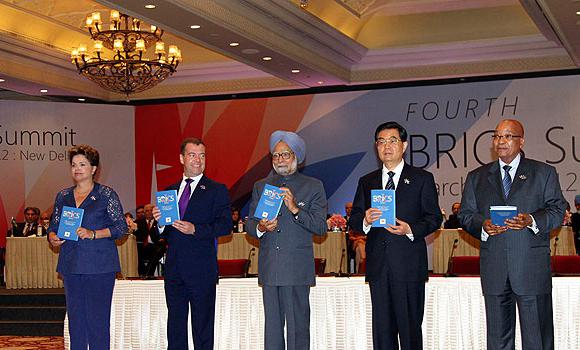
Standard
BRICS, Columns/Op-Eds

Column in The Hindu: “Banking on BRICS to deliver”

New Delhi, 27th of March 2012
Please find here the link to the original article

If conceptualised carefully, the Bank can help rebalance the global economy leading to equitable and resilient growth.

Even as New Delhi prepares for the arrival of BRICS Heads of States towards the later part of the week, media and experts across the world continue to debate the relevance, capacity and cohesiveness of the grouping. The common refrain in the western press is that it is a ‘motley crew’ with little in common and therefore with little capability to create institutions and multilateral platforms of substance. Well, they may be in for a surprise. In fact, BRICS may also surprise itself.

Besides the usual declarations on cooperation on political matters, social challenges, climate and energy, food and water, health and education, industry and trade, BRICS is likely to make two significant announcements this time, which will, in many ways, mark its coming of age. First — the formal launch of the “BRICS Exchange Alliance” in which the major stock exchanges of BRICS countries will offer investors index-based derivatives trading options of exchanges in domestic currency. This will allow investors within BRICS to invest in each other’s progress, expand the offerings of the individual exchanges, facilitate greater liquidity, while simultaneously strengthening efforts to deepen financial integration through market-determined mechanisms. From talking to people in the know, this alliance is good to go, and the operational modalities around currency, settlement cycles and inter-exchange regulatory coordination are all issues that have been thought through and resolved.

‘South-South bank’

The second announcement that has people most interested is on the much discussed “BRICS Bank” or the “South-South Bank” that many consider to be an Indian proposal for creating an institution that can serve the development needs and aspirations of the emerging and developing world. This proposal saw much debate (some heated) at the recent BRICS Academic Forum and surely was a key issue for deliberations at the recently concluded BRICS Finance Ministers Meeting. There are many complex and some contested issues that need to be discussed and thought through, but due to the growing support for such an institution among BRICS it is almost certain that the leaders will, at the very least, announce a working group to study the feasibility and operational modalities of such a multilateral bank. Whether they are bold enough to suggest a time line for its establishment remains to be seen but in the opinion of many, it is an idea whose time has come.

Foremost amongst the reasons for the creation of the institution is the need for BRICS to assume pole position in global financial governance. BRICS nations represent nearly half the world’s population. Two of them are already among the top five economies in purchasing power parity terms, and four are in the top 10. If conceptualised carefully, such an institution will have the potential to reshape and realign the global development agenda positively. It can also help to efficiently redistribute and redirect savings available with the emerging economies to infrastructure and social development in the same regions and, therefore, contribute to the rebalancing of the global economy.

Several multilateral banks already exist, that serve as templates for creating a new institution. The World Bank, which is deeply embedded in the global development narratives, serves as a particularly relevant example. If a multilateral BRICS bank is instituted, its functions would not supplant the role of existing multilateral banks that support development, but rather, supplement them. And this supplementary instrument is needed as multilateral banks such as the World Bank, ADB, etc., have not been growing significantly in terms of the total amount of loans disbursed. While there was a jump in disbursals following the financial crisis, the normalisation process is already under way. On the other hand, demand for funds for infrastructure and social transformation grows unabated in BRICS and the developing world.

But how would the BRICS Bank work? There are doubts expressed in some quarters on the process of capitalisation itself. The Bank would have to raise capital from open market operations; floating debt to finance lending operations. While the reliance on markets for raising capital would make the fiscal asymmetries within BRICS nations irrelevant, the sovereign ratings of some of the members, who will collectively be the shareholders of a BRICS Bank, are barely investment grade. This would limit the amount of capital that could be raised from the financial markets and also affect the cost of capital and therefore the cost of lending. One suggested solution is the sequestration of a proportion of foreign reserves of BRICS members into a trust fund that would back-stop the borrowed capital. In the case of the World Bank, the total paid-up capital is around 10 per cent while the rest is AAA rated ‘callable capital’, which has never been requisitioned. To enhance the creditworthiness further, existing multilateral banks, and other western countries could also be given minority stakes.

China’s role

The second element that is always embedded in the discussions around the bank is the role of China. An impression is sought to be created that with its massive monetary reserves and political clout, China may exert undue influence in this bank. This is unlikely. Such a bank will not require too much paid-up capital (relative to the average size of respective sovereign reserves) if intelligent financial engineering can help sequester foreign reserves. This would mean that the smallest BRICS economy, South Africa, could easily commit an amount similar to that of China in the capital structure. Such doubts could be further allayed with the institution of a rotating Presidency of, say, a two-year term that could initially be restricted to the BRICS countries alone. In any case, the charter of any modern day banking institution with sovereign stakeholders would need to include the mandates of transparency and independence, which would make the institution as viable as any.

The third aspect that remains central to the viability of such a bank is the currency of business. There would be expectations that such a bank would transact in local currencies where possible and in international currency when needed. The bank would need to work with the right currency mix to mitigate credit risk while simultaneously balancing intricate political dynamics within BRICS. For instance, being a current account deficit country, India would not be averse to the U.S. dollar being the currency of disbursal while Brazil with its appreciating “Real’ may prefer local currency. The Chinese may see this bank as a platform for promoting the Renminbi as the currency of choice, especially among the emerging and developing countries. Ultimately, the right mix would need to take into account monetary policy and exchange rate imperatives of each of the primary sovereign stakeholders and in a manner that makes this venture uncomplicated and attractive to other stakeholders as well.

The fourth aspect is the business mandate of such a bank. An effective development bank would have to integrate the multiple economic priorities. Key areas such as infrastructure and the medium and small scale enterprises sector could be natural starting points. The Brazilian Development Bank (BNDES) could be considered an exemplar. The BNDES disbursed close to $140 billion in 2011, with around 30 per cent going to the medium to small enterprises sector (MSME) and about 40 per cent going to large infrastructure projects. The BNDES also played a crucial role in stabilising the Brazilian economy after the financial crisis by stepping up development assistance. Similarly, a BRICS Bank could also assume the role of a financial support mechanism which appropriately responds to the variabilities in the global economy.

Corporations are the primary growth drivers of BRICS economies. They create economic momentum, new business opportunities and, most importantly, in the context of BRICS, employment. The creation of SPVs to cater to the investment and insurance needs of corporations would therefore complement the development agenda. The World Bank’s International Finance Corporation (IFC) and Multilateral Investment Guarantee Agency (MIGA) provide readymade frameworks. The IFC provides investment solutions for the private sector through services such as equity finance and structured finance, while the MIGA provides non commercial risk insurance guarantees. Guarantees against political risk — which is a significant investment constraint in emerging markets — could facilitate a spurt of new business activity within BRICS, and lest we imagine this instrument to be risk-laden, MIGA has paid only six insurance claims since it was set up in 1988 and needs no counter guarantees.

Need for consensus

BRICS is in transition and cannot afford to lose growth momentum. Multilateral institutions such as a BRICS Bank can aid in sustaining directed, equitable and resilient growth. A consensus on the creation of such an institution would be a very real expression of intent by BRICS to craft alternative development trajectories to those passed down by the OECD countries. And it is also time to Bank with BRICS.

Samir Saran is Vice-President and Vivan Sharan an Associate Fellow at the Observer Research Foundation. The foundation hosted the BRICS Academic Forum in March this year.

Standard
BRICS, Columns/Op-Eds

Article in “Russia and India Report”: Navigating the trust deficit

by Samir Saran and Jaibal Naduvath
February 17th, 2012

Please find here the original article

At the 17th round of the Indo-Russian Inter-governmental Commission on Trade, Economic, Technological, Scientific and Cultural Cooperation (IRIGC-TEC) held in November last year, the two governments agreed to set up an investment fund with public-private partnership to finance projects in the two countries. Barely a month later, after almost 18 years of negotiations, Russia was formally invited to join the World Trade Organization (WTO), and, has until June of this year to ratify the accession agreement. Beyond reducing tariff barriers and eliminating non-tariff barriers, accession to WTO is also expected to reduce government interference in business, a key pre-condition for free enterprise. Russia’s evolving economy has been witness and victim to continued government interventions.

Nevertheless, given the impending WTO accession, the India-Russia joint investment fund has managed to get its timing right. Current India-Russia bilateral trade, estimated at around USD 9 billion, is admittedly far below its potential. Trade promotion initiatives such as this investment fund, a possible Comprehensive Economic Cooperation Agreement (CECA) with the Russia, Belarus, Kazakhstan Customs Union combined with the business confidence the WTO accession would inspire, is expected to double bilateral trade to USD 20 billion by 2015, an ambitious, though very achievable feat. With a Price to Earning (P/E) ratio of 6, compared to India’s 14, China’s 15 and Brazil’s 8.5, Russia’s market is attractively priced amongst the emerging markets with traditional industries such as oil and gas, metals and minerals remaining hugely undervalued.

Despite warm bilateral ties, and close political engagement and co-operation extending well over 55 years, India-Russia trade has rarely managed to go beyond the legacy confines of defense equipment, space, energy, metals and minerals, and, commodities, even while, ironically, both countries have independently managed to very successfully leverage new vistas of opportunity in economies they stood together against for a better part of the 20th century. Russia-European Union (EU) trade in 2010, for instance, stood at around USD 191 billion, with the bloc accounting for over 47% of Russia’s total trade turnover, representing a three-fold increase in just ten years. On the other hand, India-EU trade has grown to USD 107 billion this year and is expected to double in two years on the back of a Free Trade Agreement (FTA) currently being negotiated. Compared to this, India-Russia bilateral trade of around USD 9 billion today pales in significance even though it represents a quantum leap from about USD 3 billion in 2006-07.

Russia-India two-way trade and investment has rarely ventured beyond government-controlled domains, which are also accompanied with government-backed guarantees of some kind. Russia’s active participation in several military, aerospace and nuclear projects in India and Indian investment in Russia’s energy sector and preferred trade in controlled commodities are part of this broader trend. But, the true test of any meaningful business relationship lies in the unmitigated ability of private enterprise on either side to confidently engage, invest and gain from each other’s economies, outside the security of sovereign assurance, even if notional. This is not so in the case of Indo-Russian trade.

Russia, of course, dominates the Indian defense sector and is comfortable navigating through Indian officialdom, which still retains much of its controlled economy character from the 70s and 80s. However, this may not remain the case for long. Under greater media scrutiny and public glare, the defense relationship will need to become far more efficient in terms of reliability, time lines and price points, else Russian dominance in the sector could be potentially challenged. Further, as the offset policy starts playing out and thereafter as the Indian private sector becomes engaged in defense production and R&D, Russia may no longer be a competitive player in this segment. To really be a beneficiary of India’s transformation over the coming 2 decades, Russia needs to expand its portfolio by diversifying into the arenas of industry and infrastructure in India. In doing so, its ability to confront India’s dynamic and loud democracy, and an increasingly uncompromising civil society will be as severely tested as its ability to navigate the country’s highly regulated business terrain arising from complex land use norms, environment clearances, and fiscal regimes, all of which have shown to evolve over time.

On the other hand, Russia offers India minerals and land, besides a huge market for software, services, value added goods and consumables. The resource sector in Russia, though, continues to be dominated and overwhelmed by its government with significant self-interest. Agriculture and land based activities too would be prone to similar dynamics and one can expect Indian private sector’s trepidations to be strong on investing in either. Apart from large Public Sector Companies and select large Indian Multi National Corporations, it is unlikely that Indian private sector will invest in Russia, despite undervaluation and potential for attractive return. Indian businesses’ traditional risk aversion is demonstrated by flight of capital to low return economies of the Atlantic that have corresponding low risk political ecosystems as well.

When Indian businesses consider making investments in Russia, they still seem daunted by perceptions constructed by imagery of the powerful and manipulative oligarchy, political nepotism and uncertainty, and seemingly poor judicial and legal recourse frameworks. Fears to do business in Russia have been hyped by experiences of companies such as ExxonMobil, Total and Shell in Russian Oil Sector, which were divested of their interests by Russian political class in a manner that was viewed as ad-hoc, if not vindictive. This imagination has often resulted in investments by Indian entrepreneurs being channeled into markets such as UK, EU and US, which are far more taut than Russia in terms of economic opportunity.

Ironically, Russian investors feel the same way towards India, drawing from a regular narrative of chaotic democracy, policy inconsistency, political fickleness, and civil instability with commitment cycles perceived to not exceed the life of the dispensation in power. One of the collaterals of the 2G verdict of the Supreme Court, which saw the revocation of 21 of Sistema Shyam Telecom’s (SSTL) 22 telecommunications licenses, could be the flickering and faint Russian Interest in Indian business opportunity. Russia’s USD 28 billion telecom to tourism conglomerate, Sistema JSFC, operating in India through its subsidiary MTS, had invested USD $2.5 billion over the past three years into the project, in arguably, the largest private sector intervention by a Russian company in India’s new economy to date. Further, Russian state owned Federal Agency for State Property Management acquired a 17.4% stake in SSTL by investing a hefty $600 million just last year. Fortunately, there is a growing business constituency, which views such re-calibrations as an inevitable part of polity evolution, but nonetheless the experience of Sistema, which may see itself as a victim of judicial overreach as some argue, could well define Russia’s appetite for India’s growth story.

Russia’s accession to WTO this summer and the consequent abolishment of tariff and non-tariff barriers will heighten global interest in Russia. Pro-investment initiatives such as the proposed joint public–private investment fund combined with demonstrable political and economic will on both sides should result in heightened interest in private enterprise on both sides to explore and invest in each other. Multi-billion dollar National Minerals Development Corporation – Severstal Joint Venture steel project in Odisha or Indian companies negotiating long-term agreements for supply of diamonds from Russia are positive signs for medium to long term economic engagement between the two countries.

Standard