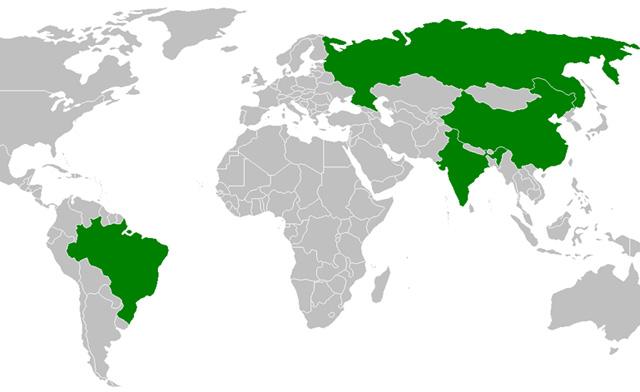
BRICS

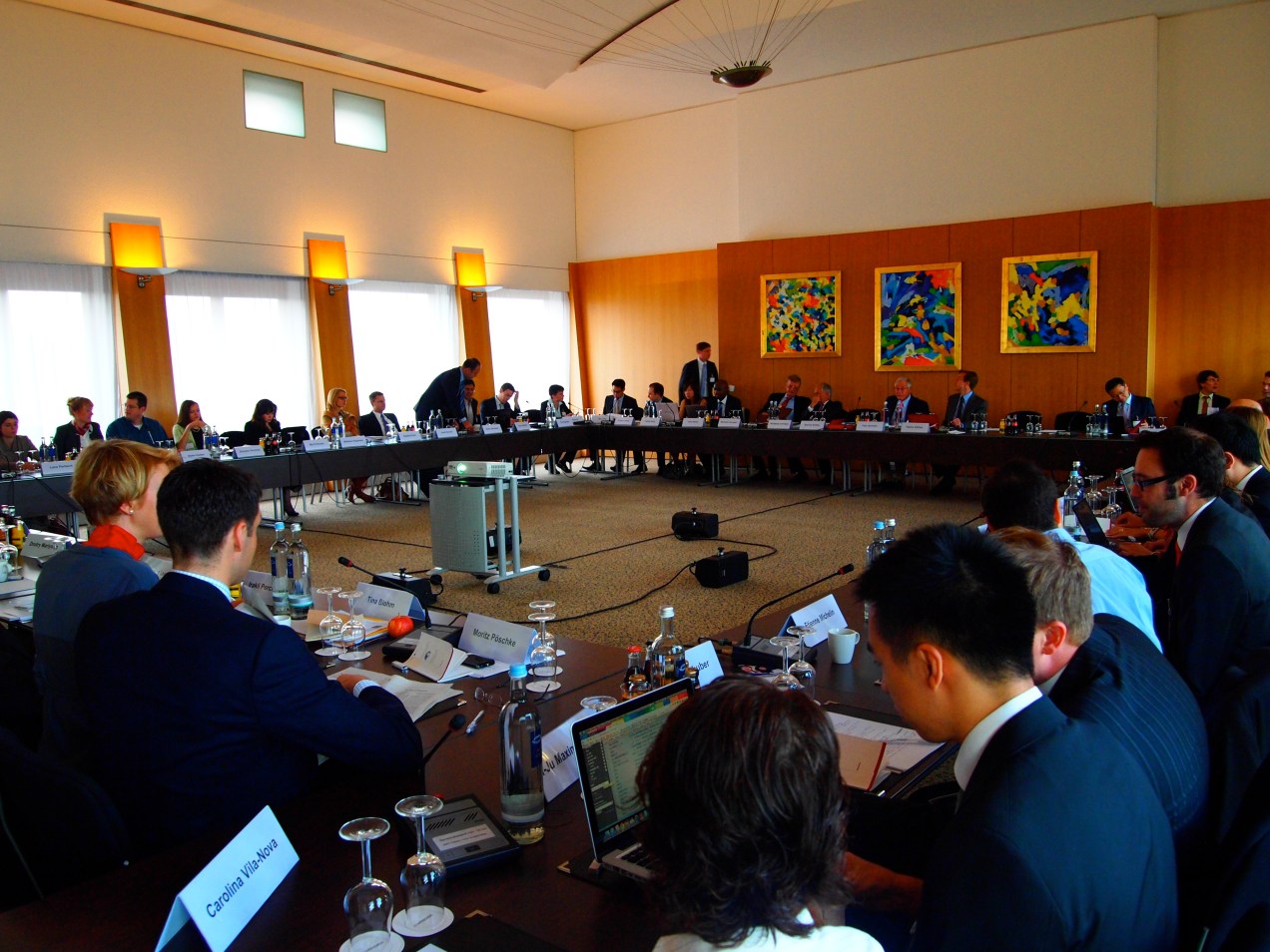
4th BRICS Academic Forum, New Delhi, March 4-6 2012 on “Security, Stability and Growth”

Please download here the entire program of the conference: 4th BRICS Academic Forum_03-03-12
Please download here the official invitation: Inaugural invitation

The BRICS nations are experiencing a unique set of circumstances in their socioeconomic
and political evolution. The debates that dominate the discourse
within each of the BRICS nations today, whether on traditional security or nontraditional
security, are linked to the challenges that confront the global community
today. This offers an interesting opportunity and a matrix with multiple possibilities
to cooperate, share and work together.

While it is always simplistic to attempt to capture the broad and rich arena that
current developments offer the BRICS nations to collaborate on, there are inherent
advantages in viewing the contemporary and evolving challenges and aspirations
of the BRICS nations, through the prism of “Stability, Security and Growth”. Stability
from financial shocks, governance failures within the BRICS and globally, from
erratic demand cycles for exports and resources and from systemic contagious
failures in the global financial markets. Security of access to means of sustenance,
basic infrastructure (health, sanitation, education), availability and equity of
opportunities for individuals across social classes, religions and gender; across
regions, communities and security of development space and the environment.
Growth – through new markets and innovations in appropriate technologies; are
common themes that should be addressed and discussed by the BRICS nations,
each of which is in transition and each of which is committed to advance their
economies, capabilities and the daily lives of their peoples.

In order to effectively work with the “Stability Security and Growth” framework,
BRICS need to address four fundamental issues that will define and shape the
socio-economic and political landscape over the course of this decade. They
include – strengthening institutions and institutional capacities to equip international
frameworks with suitably resilient response mechanisms in this age of uncertainty;
sharing concerns about sustainable development in order to live up to the
collective responsibilities of BRICS nations; sharing practices and experiences to
learn and respond to the immense socio-economic challenges within and outside
BRICS nations; and finally exploring the innovation landscape through promotion
and expansion of new avenues for cooperation and growth to enhance lives and
livelihoods, as well as respond to the ethical and development imperatives that
demand urgent attention. These themes are reflected in the agenda.

Standard
In the News

“Trade Unions do not represent the poor”, says Samir Saran

The National
February 28, 2012
Please find here the link to the original article.

NEW DELHI // Millions of government workers are set to strike today in one of the biggest industrial actions in Indian history. All 11 of India’s central trade unions – each with at least 400,000 members – will take part.

They will be joined by about 5,000 local unions, after last-minute appeals for talks with the government were rejected over the weekend. The strikes will hit every sector of the government, including state-run banks, energy and telecom companies and the civil service, but will not include the railways.

The unions say they are protesting against rising prices, privatisation of state-run companies and the widespread violation of workers’ rights. “The policies of liberalisation over the past 20 years have made workers poorer in real terms and led to extreme disparities of wealth,” said Tapan Sen, general secretary of the Centre of Indian Trade Unions. “The workers are creating all the profit but are treated like beasts. There is a resentment and anger churning at the ground level that has created the atmosphere for these strikes.”

The display of unity among the unions – whose affiliations stretch across the political spectrum – reflects their desire to regain the power they held during the years of militant labour activity in the 1970s and 1980s. “The traditional trade unions in this country came out of the manufacturing sector,” said Bibek Debroy, an economist with the Centre for Policy Research, a New Delhi think tank.

“Their membership is quite old and losing relevance compared with local unions in the services and rural sector. They are looking for a peg to re-establish their identity and influence.” Many question how relevant the unions can be in a country where nine out of 10 workers are in the informal sector, with no job security or possibility of union representation.

“It’s laughable for these unions to say they represent the poor,” said Samir Saran, the vice president of the Observer Research Foundation, another Delhi think tank. “Members of trade unions have formal jobs. They are far better looked after than the majority of workers in this country.

“The reality is they represent a very organised political force from the past that wants to reassert itself.” The strike offers a chance for some of the country’s most oppressed workers to protest very real issues. In a developing state such as Chhattisgarh, for instance, which has seen a huge influx of energy companies, mines and manufacturing plants in recent years, small unions are struggling for the most basic rights.

“Workers here are attacked by thugs or thrown in jail on false charges if they try to set up a union,” said Bansi Sahu, of the Chhattisgarh Engineering Workers Union. “Land is taken from farmers to build a power plant and then the jobs are given to people from other states because the owners don’t want local communities protesting against the low wages and terrible safety conditions.”

In India, desperate levels of poverty often force workers into a grudging acceptance of exploitative labour practices. The one-day stoppage comes at a difficult time for the government, which has been rocked by corruption scandals and has struggled to contain inflation, which was more than 9 per cent for the first 11 months of 2011 and only recently moderated to about 6.5 per cent.

“The danger for the government is not the strike itself, but whether it becomes fashionable,” said Mr Saran. “Like we saw with the anti-corruption movement last year, these agitations can have a spiralling effect. “The unions smell blood. If even one of their demands resonates in one or two of the provinces and gets taken up by opposition parties, then suddenly the government could have a serious problem on its hands.”

Standard
BRICS, Columns/Op-Eds

Article in “Russia and India Report”: Navigating the trust deficit

by Samir Saran and Jaibal Naduvath
February 17th, 2012

Please find here the original article

At the 17th round of the Indo-Russian Inter-governmental Commission on Trade, Economic, Technological, Scientific and Cultural Cooperation (IRIGC-TEC) held in November last year, the two governments agreed to set up an investment fund with public-private partnership to finance projects in the two countries. Barely a month later, after almost 18 years of negotiations, Russia was formally invited to join the World Trade Organization (WTO), and, has until June of this year to ratify the accession agreement. Beyond reducing tariff barriers and eliminating non-tariff barriers, accession to WTO is also expected to reduce government interference in business, a key pre-condition for free enterprise. Russia’s evolving economy has been witness and victim to continued government interventions.

Nevertheless, given the impending WTO accession, the India-Russia joint investment fund has managed to get its timing right. Current India-Russia bilateral trade, estimated at around USD 9 billion, is admittedly far below its potential. Trade promotion initiatives such as this investment fund, a possible Comprehensive Economic Cooperation Agreement (CECA) with the Russia, Belarus, Kazakhstan Customs Union combined with the business confidence the WTO accession would inspire, is expected to double bilateral trade to USD 20 billion by 2015, an ambitious, though very achievable feat. With a Price to Earning (P/E) ratio of 6, compared to India’s 14, China’s 15 and Brazil’s 8.5, Russia’s market is attractively priced amongst the emerging markets with traditional industries such as oil and gas, metals and minerals remaining hugely undervalued.

Despite warm bilateral ties, and close political engagement and co-operation extending well over 55 years, India-Russia trade has rarely managed to go beyond the legacy confines of defense equipment, space, energy, metals and minerals, and, commodities, even while, ironically, both countries have independently managed to very successfully leverage new vistas of opportunity in economies they stood together against for a better part of the 20th century. Russia-European Union (EU) trade in 2010, for instance, stood at around USD 191 billion, with the bloc accounting for over 47% of Russia’s total trade turnover, representing a three-fold increase in just ten years. On the other hand, India-EU trade has grown to USD 107 billion this year and is expected to double in two years on the back of a Free Trade Agreement (FTA) currently being negotiated. Compared to this, India-Russia bilateral trade of around USD 9 billion today pales in significance even though it represents a quantum leap from about USD 3 billion in 2006-07.

Russia-India two-way trade and investment has rarely ventured beyond government-controlled domains, which are also accompanied with government-backed guarantees of some kind. Russia’s active participation in several military, aerospace and nuclear projects in India and Indian investment in Russia’s energy sector and preferred trade in controlled commodities are part of this broader trend. But, the true test of any meaningful business relationship lies in the unmitigated ability of private enterprise on either side to confidently engage, invest and gain from each other’s economies, outside the security of sovereign assurance, even if notional. This is not so in the case of Indo-Russian trade.

Russia, of course, dominates the Indian defense sector and is comfortable navigating through Indian officialdom, which still retains much of its controlled economy character from the 70s and 80s. However, this may not remain the case for long. Under greater media scrutiny and public glare, the defense relationship will need to become far more efficient in terms of reliability, time lines and price points, else Russian dominance in the sector could be potentially challenged. Further, as the offset policy starts playing out and thereafter as the Indian private sector becomes engaged in defense production and R&D, Russia may no longer be a competitive player in this segment. To really be a beneficiary of India’s transformation over the coming 2 decades, Russia needs to expand its portfolio by diversifying into the arenas of industry and infrastructure in India. In doing so, its ability to confront India’s dynamic and loud democracy, and an increasingly uncompromising civil society will be as severely tested as its ability to navigate the country’s highly regulated business terrain arising from complex land use norms, environment clearances, and fiscal regimes, all of which have shown to evolve over time.

On the other hand, Russia offers India minerals and land, besides a huge market for software, services, value added goods and consumables. The resource sector in Russia, though, continues to be dominated and overwhelmed by its government with significant self-interest. Agriculture and land based activities too would be prone to similar dynamics and one can expect Indian private sector’s trepidations to be strong on investing in either. Apart from large Public Sector Companies and select large Indian Multi National Corporations, it is unlikely that Indian private sector will invest in Russia, despite undervaluation and potential for attractive return. Indian businesses’ traditional risk aversion is demonstrated by flight of capital to low return economies of the Atlantic that have corresponding low risk political ecosystems as well.

When Indian businesses consider making investments in Russia, they still seem daunted by perceptions constructed by imagery of the powerful and manipulative oligarchy, political nepotism and uncertainty, and seemingly poor judicial and legal recourse frameworks. Fears to do business in Russia have been hyped by experiences of companies such as ExxonMobil, Total and Shell in Russian Oil Sector, which were divested of their interests by Russian political class in a manner that was viewed as ad-hoc, if not vindictive. This imagination has often resulted in investments by Indian entrepreneurs being channeled into markets such as UK, EU and US, which are far more taut than Russia in terms of economic opportunity.

Ironically, Russian investors feel the same way towards India, drawing from a regular narrative of chaotic democracy, policy inconsistency, political fickleness, and civil instability with commitment cycles perceived to not exceed the life of the dispensation in power. One of the collaterals of the 2G verdict of the Supreme Court, which saw the revocation of 21 of Sistema Shyam Telecom’s (SSTL) 22 telecommunications licenses, could be the flickering and faint Russian Interest in Indian business opportunity. Russia’s USD 28 billion telecom to tourism conglomerate, Sistema JSFC, operating in India through its subsidiary MTS, had invested USD $2.5 billion over the past three years into the project, in arguably, the largest private sector intervention by a Russian company in India’s new economy to date. Further, Russian state owned Federal Agency for State Property Management acquired a 17.4% stake in SSTL by investing a hefty $600 million just last year. Fortunately, there is a growing business constituency, which views such re-calibrations as an inevitable part of polity evolution, but nonetheless the experience of Sistema, which may see itself as a victim of judicial overreach as some argue, could well define Russia’s appetite for India’s growth story.

Russia’s accession to WTO this summer and the consequent abolishment of tariff and non-tariff barriers will heighten global interest in Russia. Pro-investment initiatives such as the proposed joint public–private investment fund combined with demonstrable political and economic will on both sides should result in heightened interest in private enterprise on both sides to explore and invest in each other. Multi-billion dollar National Minerals Development Corporation – Severstal Joint Venture steel project in Odisha or Indian companies negotiating long-term agreements for supply of diamonds from Russia are positive signs for medium to long term economic engagement between the two countries.

Standard
BRICS, Columns/Op-Eds

Article in “The Hindu”: Giving BRICS a non-western vision.

by Samir Saran and Vivan Sharan
New Delhi, February 14, 2012

Please find here the link to the original article.

India is all set to host the Fourth BRICS Summit in March this year. The journey from Yekaterinburg to New Delhi has demonstrated that the political will amongst member nations to sustain this contemporary multilateral process is strong. Along the way South Africa has been welcomed into the original “group of four.” Yet, the challenge for BRICS has always been, and continues to be, the articulation of a common vision. After all, the member nations are at different stages of political and socio-economic development. While some have evolved economically and militarily they are yet to succeed in enabling plural governance structures, while others who represent modern democratic societies are being challenged domestically by inequalities and faultlines created by caste, colour, religion and history. The BRICS nations do have a historic opportunity — post the global financial crisis and the recent upheavals in various parts of the world — to create or rebuild a new sustainable and relevant multilateral platform, one that seeks to serve the interests of the emerging world as well as manage the great shift from the west to the east.

Way forward

Indeed, two out of the five economies in BRICS, China and Russia, have already emerged, and are veritable heavyweights in any relevant global political and economic discourse. Why then should BRICS depend on sluggish multilateral channels such as the World Trade Organisation (WTO), or try to imbibe didactic, non-pragmatic western perspectives on issues purely of common interest? It is amusing to be offered solutions to poverty and inequality, bottom of the pyramid health models, low cost housing options, education delivery, energy and water provision, et al by the wise men from organisations and institutions of the Atlantic countries. When was the last time they experienced poverty of this scale, had energy deficiency at this level and suffered from health challenges that are as enormous? The responses to the challenges faced by the developing world reside in solutions that have been fashioned organically.

BRICS could systematically create frameworks offering policy and development options for the emerging and developing world and assume the role of a veritable policy think tank for such nations, very similar to the role played by the Organisation for Economic Co-operation and Development (OECD) in the 20th-century world. Thus BRICS must create its own research and policy secretariat (for want of a better term) for addressing specific issues such as trade and market reforms, urbanisation challenges, regional crises responses, universal healthcare, food security and sustainable development (many of these issues are being discussed year at the BRICS Academic Forum in March).

Non-traditional security

The OECD’s stated mission is to “promote policies that will improve the economic and social well-being of people around the world.” Although the BRICS nations account for a fourth of global GDP and represent over 40 per cent of the total global population, none of them are OECD members as yet; instead what they have is “enhanced engagement” with the OECD. The BRICS nations have already created a viable platform for “enhanced engagement” with each other through the institutionalisation of the annual Leader’s summit, preceded by an Academic Forum of BRICS research institutions and a Financial Forum of development banks (and this year, a newly instituted Economic Research Group will focus on specific economic issues). The dominant discourses within each of the BRICS nations today are centred on non-traditional security, which can be efficiently addressed through collective market based response mechanisms.

Despite intra-BRICS trade volumes rising exponentially over the past decade, there are few instances of actual financial integration within the consortium (aside from the case of Russia and China starting bilateral currency trading last year). A useful first step to enable this would be to institute a code of liberalisation of capital movements across the five countries, as a modern day parallel to the 1961 OECD code with an equivalent mandate. In the current environment of global economic uncertainty, multinational corporations are perhaps the most adaptable and profitable drivers of economic growth. Therefore, at the outset, the creation of favourable policies for multinationals to conduct business across BRICS would be well justified. Moreover, just as the OECD has a comprehensive set of guidelines that set benchmarks for various economic activities, from testing standards for agricultural goods to corporate governance of state owned enterprises, the BRICS nations could create their own guidelines on the best practices and standards within the consortium.

Finally, within the BRICS nations, there are both import and export centric economies. This provides an excellent template for a realistic multilateral negotiating platform where obdurate self serving bargaining positions are natural starting points. The stalled discussions at the Doha Round of the WTO are an example of the difficulties of consensus building. Since the BRICS nations are already addressing a plethora of issues covered by the Doha Round, they are well placed to move ahead of it, and resolve mutual positions and common concerns.

What started as an investment pitch by Goldman Sachs (BRIC) has evolved into a useful multilateral instrument, for the BRICS nations. BRICS must now move on from being a grouping of individual nations, discussing agendas, to becoming a “go-to” institution for setting regional and global agendas. The essence and ethos of such an institution must in turn, flow from the inorganic prism of stability, security and growth for all. Stability from business cycles and financial governance failures, security from traditional and non-traditional threats posed to humans and the environment, and unbiased growth and prosperity are common aspirations for all BRICS nations, and they must be achieved and delivered from within. The Fourth BRICS Academic Forum will attempt to address these imperatives.

Samir Saran is Vice-President and Vivan Sharan an Associate Fellow at the Observer Research Foundation. The foundation is the Indian coordinator for the Fourth BRICS Academic Forum on March 5-6, in New Delhi.


Standard
Columns/Op-Eds, Politics / Globalisation

Column in Russia & India Report: Return of Putin? India hedges bets

Published on February 1st, 2012
by Samir Saran & Jaibal Naduvath
specially for RIR 
Please find here the link to the original article.
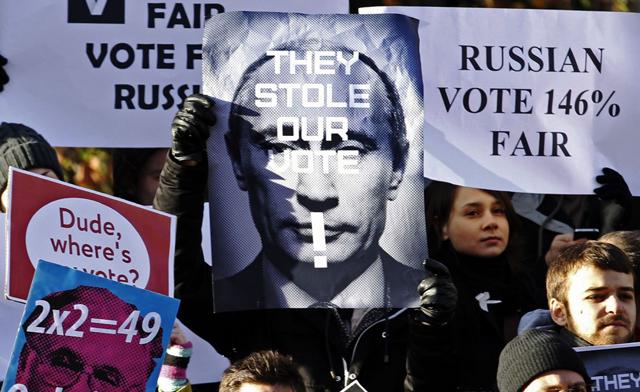
The mass protests in Moscow last December have had little resonance in India due to a limited media obsessed with defence and energy aspects of the India-Russia relationship. However, India will be watching closely the agenda of the new team that Putin, if he is elected, puts together as it will impact the trajectory of what could be a crucial partnership of the 21st century, say Samir Saran and Jaibal Naduvath. 

For over six decades, India’s relations with Russia and its predecessor, the erstwhile Soviet Union, have remained very cordial. From the heady heights of being “near allies” during the Cold War era to a brief pause in the 1990s as both countries recalibrated their own identities during a period of dramatic political transformation in each country, the Russia-India relations have endured dramatic shifts in global politics. Over the past 20 years though, there has been a pragmatic remoulding of the content of this engagement alongside an assured continuity on crucial areas of traditional cooperation like the defence sector. The non-continuance of the Indo-Soviet Peace and Friendship Treaty of 1971, seen by many as India’s security insurance during the cold war years, the subsequent Declaration of Strategic Partnership signed by the two countries in 2000, and renewed co-operation and strategic engagement at multilateral fora such as BRICS, Shanghai Cooperation Organisation (SCO) and the UN reflects diplomatic maturity and political realism in equal measure. However, despite the long-standing bonhomie, close trade ties and multiple cultural and political exchanges, Russia has not managed to emotionally engage the Indian psyche as much as it should have, even though the very mention of Russia evokes feelings of great warmth among most Indians. However, meaningful interest in Russia remains confined to the foreign policy elite, emancipated urban dwellers and business and trade communities with interests in the opportunities that Russia offers. In the larger public discourse Russia continues to be viewed through the prisms of defence and strategic relationship and the ‘energy narrative,’ with media and polity both guilty of selectively amplifying developments that impact these aspects. As a result, the response on the Indian street often tends to be binary and simplistic to what is transpiring in contemporary Russia. Media reportage and public discourse in India on the upcoming presidential elections in Russia is prey to this myopic syndrome. Indeed, Russia accounts for a majority of all Indian military imports and the reliability of such defence sales is vital for India. A stable Russia and more importantly a political dispensation in Kremlin that supports this defence sector engagement is crucial. There is, however, an urgent need to widen the discussions and media narrative on Russia, if there is to be meaningful and contemporary appreciation of this most significant ally in India.

As things stand, very little is known of presidential candidates other than Valdimir Putin, who has visited India several times, and is considered sensitive to this country’s interests. However, there is also a tacit realisation that sweeping political changes globally and reverberations in Russia which culminated in highly publicised street protests in Moscow (albeit modest in size and scale) against allegations of vote rigging in the parliamentary elections have led to a decline in Putin’s standing, rendering him more vulnerable than before. There is also a feeling that Putin losing his aura of invincibility, and the possible devolution and decentralization of power in Kremlin, could actually usher in greater pragmatism into the Russian political ecosystem making it a lot more dynamic and democratic, and, easier for others to empathise with. Despite being challenged by sections of Russian civil society, Putin may not have lost much of his personal brand appeal in India yet, for two reasons. First, very little is known of the opposition within Russia and even less so is available in Indian media. Secondly, dissent, discord, rebellion are all part of the political landscape in India and the leadership is indeed defined by the ability of the leader to resolve and navigate such challenging terrain. India itself has been ruled by coalition governments intermittently for over two decades with arguably, reasonable success. From their own experience, Indians could relate better to Putin if he is able to manage and share political space and carve out a consensus. Putin, slightly vulnerable and in the need for reaching out, makes him more attractive to the Indian people and its enterprises than Putin the steely and authoritarian figure.

The feeling is that under his potential future presidency, Putin may have to cede at least some ground to factions within his United Russia Party. Who the factions are and what their dispositions and agendas would be are unknown. In the coming days, prior to the March elections and certainly, if voted to power, in the period after Putin’s election, the main interest in policy circles in India, would be the sort of ‘arrangement’ Putin may need to put in place to manage dissent and preserve his influence.

Who (all) he devolves power to and how that impacts Russia’s external engagement will be important to India. As a global military power, Russia affords great counterbalance for India vis-à-vis China. If a pro-China faction emerges at the Kremlin, it will have the potential to further fuel China’s own ambitions in Asia and may drive India to develop a deeper partnership with the United States and other Asian powers to offset it. On the other hand, if the new power structure allows greater Russian outreach to the US and the European Union, it would not only balance the rise of China, but also help India and Russia develop a partnership beyond defence sales, elevating their engagement to a wider set of issues including, on managing the global commons.

From an establishment standpoint, India has always accepted organic development of national political systems and hence is unlikely to be either unduly concerned or patronising as long as its core strategic concerns are not jeopardised. Muted media interest and public response to the Moscow street demonstrations, dramatic developments in a system with little tolerance for political dissent, needs to be seen in this light. Also, after having witnessed the upheavals in the West Asia and North Africa (WANA) region, the media coverage of the Occupy Wall Street agitation and the highs and lows of the civil society movement against corruption at home, the larger Indian public is unlikely to be very taken in by the limited protests in Moscow.

The Indian public sphere is unlikely to engage comprehensively with the happenings in the run up to the Russian elections. On the other hand, the Indian establishment will keenly follow political developments in Russia as the importance of the election outcome and its impact on both the Asian strategic architecture and bilateral relations is not lost on them. The two countries have enormous potential for greater strategic convergence and a favourable political dispensation in Moscow could well catapult the India-Russia relationship into one of the defining global partnerships of this century.

Samir Saran is Vice President at the Observer Research Foundation, a leading Indian policy think tank and Jaibal Naduvath is a communications professional in the private sector in India

Standard
Books / Papers, Water / Climate

Carbon markets and low-carbon investment in emerging economies: A synthesis of parallel workshops in Brazil and India

Abstract

While policy experiments targeted at energy and innovation transitions have not been deployed consistently across all countries, market mechanisms such as carbon pricing have been tested over the past decade in disparate development contexts, and therefore provide some opportunities for analysis. This brief communication reports on two parallel workshops recently held in Sao Paulo, Brazil and New Delhi, India to address questions of how well these carbon pricing policies have worked in affecting corporate decisions to invest in low-carbon technology. Convening practitioners and scholars from multiple countries, the workshops elicited participants’ perspectives on business investment decisions under international carbon markets in emerging economies across multiple energy-intensive sectors. We review the resulting perspectives on low-carbon policies and present guidance on a research agenda that could clarify how international and national policies could help encourage both energy transitions and energy innovations in emerging economies.

Read the entire article here: Full article (PDF-version).

Standard
Columns/Op-Eds, Politics / Globalisation

Article in Financial Express: Identity and Access in Uttar Pradesh

by Samir Saran and Vivan Sharan
January 30th, 2012
Please find here the original article

Uttar Pradesh (UP) is home to a population similar in size to Brazil and is spread out over a vast area, ranging from the fertile Gangetic Plains to the arid Vindhya Hills. It has traditionally also been the state that shaped national politics and the caste, class and religion based political landscape is representative of the complexities of democracy in India. It is also today a state that defines the challenges that lie ahead in the coming decade and more. Be it physical or social infrastructure, employment or environment, industry or agriculture, multiple narratives within the state need to be reconciled. However, the causal relationship of caste with opportunity continues to be most vexed. There are significant divergences in access to the basic necessities – water, electricity and modern cooking fuel (two out of Mayawati’s election rally cry trio of ‘bijli, sadak and paani’) across this geography. Once rich in economic growth potential, driven by the gains achieved by the agriculture sector through the Green Revolution, the state is now the primary contributor (21.3%) to the overall poverty in the country as per the Multi Dimensional Poverty Index of the UNDP with close to 70 percent poor households.

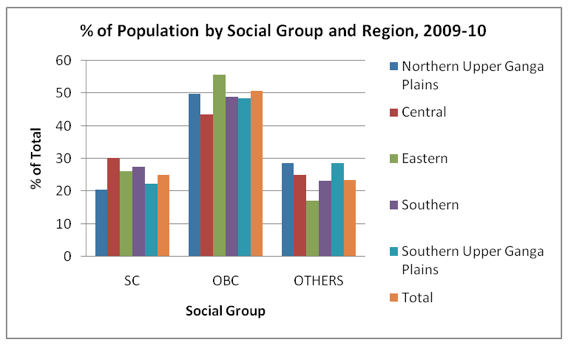
Over the years, the state has seen increasing political emphasis and rhetoric directed at the marginalized social groups that exist within the state, as a strategic ploy to secure voting constituencies. This specifically includes people categorised as Scheduled Castes (SCs) and Other Backward Classes (OBCs) who represent majority proportions in relation to the total population of the state (Figure 1). It is ironic then, that the average income of SCs and OBCs in UP, is over 18 percent and 20 percent lower respectively, than the all India average, according to the latest NSS data compiled at the India Data Labs at the Observer Research Foundation.

India DataLabs @ ORF: NSSO Consumption Expenditure 2009/10

In terms of access to drinking water (within dwelling) the SCs are the worst off amongst the 3 groups, followed by the OBCs. The Central, Eastern and Southern regions (the NSS divides the State into 5 regions found in Figure 1) fare poorly; a combined average of around 35% of SCs and OBCs have access within their dwellings in these regions, compared to close to 60% in the relatively prosperous Northern Upper Ganga Plains. This average diminishes to an appalling 14 percent in the Central, Eastern and Southern regions if only SCs are considered.

Inherent barriers to social and economic mobility have compounded the inequities created by lack of basic infrastructure provision, and political apathy towards development in the state.  These worrying realities are exacerbated by the fact, that there has been negative growth in access to electricity (an average of -15.23%), over the five year period 2004-05 till 2009-10,  in the Central region and negligible growth in Eastern region, amongst all of the aforementioned social groups (Figure 2).  This negative growth is primarily driven by the sharp decline of access in urban areas. A nearly 22% decline over the 5 year period, in access to electricity in the case of OBCs  living in urban areas located in the Central region, is instructive of the fact that despite representing the largest political constituency in the region, they have been unable to secure commensurate development entitlement.

India DataLabs @ ORF: NSSO Consumption Expenditure 2004/05 & 2009/10

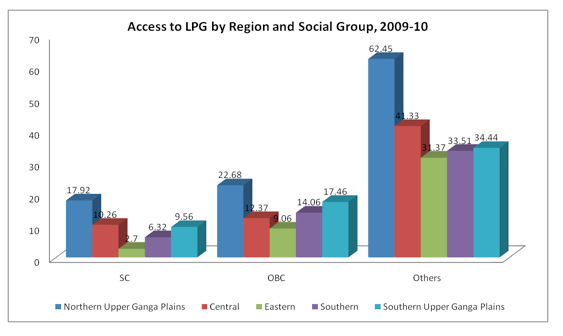
A recent World Bank Report on “The Role of Liquefied Petroleum Gas in Reducing Energy Poverty” suggests that everything else being equal, a higher level of LPG access is positively correlated with higher education levels in households in developing countries such as India. Unfortunately, there are large inequities in access to the modern cooking fuel across social groups (Figure 3). While affordability is a key concern, and according to the report, high costs are the most important determinant preventing consumption shifts across households; from less efficient primary sources of cooking fuels such as firewood, there are few justifications that help resolve facts such as – OBC urban households in the Central region have shown a 30 percent decrease in access to LPG over 2004-05 to 2009-10 (while access has remained nearly stagnant in rural areas).

India DataLabs @ ORF: NSSO Consumption Expenditure 2009/10

Indeed income class has a bearing on the levels of access to drinking water, electricity and LPG, and this is particularly true in developing societies, where lack of access reinforces income groups and in turn sharpens particularities of social groups. Low income poverty traps are dominant since the poor have no means to improve existence, owing to mediocre infrastructure, poor education and skills attained, lack of health services and poor productivity levels perpetuated by inequitable access to these essentials. The overall lack of access to specific social groups across regions, as visible in the case of UP, only adds to the sustained and absolute poverty levels of the state.

The higher levels of development seen in the Northern and Southern Gangetic Plains, serves to highlight that, successive governments have been unable to leverage the agricultural productivity of the region and enhance basic infrastructure throughout the state. The logical conclusion is then, that the bulk of the development in the state has resulted from proximity to water and fertile soil and the development of industry, rather than policy or administrative interventions, affirmative action or otherwise. Over the past decade, in the aggressive battle for votes, political parties have emphasised an inclusive development agenda and rallied support through promises for social mobility across castes and classes. The statistics while telling a part of the tale do suggest such promises to be mere rhetoric. Even in regions where some groups have telling political weight, ‘Bijli’ and ‘Paani’  eludes them. This is certainly a dangerous’sadak’ for the most populous state of the country, to keep treading on.

*Samir Saran is Sr. Fellow & Vice President and Vivan Sharan is Associate Fellow at the Observer Research Foundation, New Delhi.

Standard
Politics / Globalisation

Impressions: ‘Asian Forum on Global Governance’, Delhi, 2011

The Observer Research Foundation in association with the ZEIT-Stiftung Ebelin und Gerd Bucerius of Hamburg, Germany, started an annual ten day policy school for young leaders in October, 2011. The inaugural ‘Asian Forum on Global Governance’ provided an instructional and networking platform for young professionals from around the world, aged between 28 and 35.


This slideshow requires JavaScript.

Standard
In the News, Politics / Globalisation

ORF and ZEIT-Stiftung launch the Asian Forum on Global Governance, October 2011, New Delhi

The Asian Forum on Global Governance is an annual workshop jointly organized by the ZEIT-Stiftung Ebelin und Gerd Bucerius, and the Observer Research Foundation.

The inaugural forum is scheduled to take place from October 16 – 25, 2011 in New Delhi, India. Dr. Shashi Tharoor is the Dean of this policy school for young leaders.

The Asian Forum on Global Governance will take a close look at the Asian region and at the challenges facing the global community. The primary objective of this forum is to provide an instructional and networking platform for young professional leaders to discuss, debate and challenge conventional interpretations of the existing complex realities confronting communities and leaders. The program provides a unique opportunity for them to confer with high-ranking figures from the political, business and academic communities from around the globe, and especially from Asia.

Though the emphasis is on Asia, there will be a fair mix of young leaders from Europe, Americas, Africa, Asia and Australia. The participants will be drawn from diverse sectors and streams of study. Each of these participants will, at the outset, be nominated by senior figures – Heads of Governments, Ministries and Government Departments, the CEO’s of major National and Multinational Companies, Heads of Universities and of Non-Profit Organizations – and thereafter carefully selected by an eminent jury of experts.

The participants will be between 28 and 35 years of age. They would have acquired significant professional experience and would already exhibit promise at work.

For more information please visit the official website

Standard
In the News, Water / Climate

Samir attends the SANSAC Climate and Security Roundtable, 2010

August 6, 2010, New Delhi
Link to original website

Summary of discussion
Chair: Fergus Auld, UK Cross-Government Climate Change and Energy Unit, India

International Alert convened a roundtable meeting, kindly hosted by the British High Commission in New Delhi, with the generous support of the EU, to generate a critical discussion on the inter-linkages between climate change and conflict in South Asia and to identify the institutional and governance level knowledge and capacity gaps to promote effective responses to these risks.

The meeting was an opportunity to take forward discussion in India on the relationship between climate change, resilience and security. Bringing together institutional representatives and civil society experts, the discussion addressed the complexities of responding to climate change in conflict-affected contexts in South Asia and the institutional responses to dealing with such risks. In particular, the group explored:

  1. Where human (and indeed state) security should fit into the climate change policy discussion?
  2. What the link between climate change and violent conflict means for development policy?
  3. The specific issues to be addressed in fragile communities.
  4. The best ways to move the debate with not only the necessary sense of urgency but also awareness of the depth and breadth of the issues and the appropriate policy responses. 

Background:
As more people become aware of and motivated by the links between climate change, conflict, peace and security, both the possibility of and the necessity for clarity about these links increases. Regardless of the scarcity of data, the climate change and security dialogue is moving ahead and shaping thinking and policy as it goes. Alongside this is concern from some quarters about the so-called ‘securitisation’ of climate change. A pragmatic response to this means ensuring the climate change and security dialogue is as informed as it can be by appropriate actors keying into the dialogue to embed sustainable development and peacebuilding priorities into the core of the debate.

Key issues discussed:

  • What is the value of the climate change and security discourse? Is it a distraction from adaptation and mitigation priorities?There are three particular risks in the climate change and security nexus:

i)         Just as security fears can mobilise people and change, sensationalist scenarios demobilise, especially when they turn out not to justified by the evidence.

ii)       Treating conflict and security issues as if they will produce direct threats from one country against another, or even one group against another, which is the language of military security will distort the debate and the policy response; at worst, the response will be inappropriate and wasteful.

iii)      Basing the argument on an over-simplified linkage could generate policies that miss their targets in other ways and simply lead to confusion and uncertainty about what the problem is and why anyone should care.

Yet the discourse exists and will continue to move in some cases with more policy leverage than the adaptation or ‘common but differential responsibility’ for mitigation discourse. As such, the three risks above notwithstanding, engaging in the security discourse is a vehicle for getting critical development and governance concerns to the policy table.

  • What is the nature of the causal link between climate change and security?

Policy cannot and should not be based on a straightforward cause-and-effect relationship between climate change and violent conflict or political instability. There is a lack of research findings on the topic and what there is does not offer robust conclusions. And there are good reasons for this: namely that causality is always complex. Armed conflicts not only have several different causes but several different types of causes. These are often conflated, blurring the differences between background or root causes, the immediate trigger, the role of the external actors etc. The fact is that simple cause-and-effect is rarely if ever enough to explain the origins of a conflict.

Given this lack of clear causal link, the sparse research literature on climate change and security contains some that declares that no link can be proven. But the fact that no link can be proven is not the same as saying none exists. A real limitation of studies so far is that they work by reflection on the past – whereas the key point to understand about climate change is that the future will be different from the past.

Perhaps the largest security risk of climate change is the most preventable one. That is the risk that climate change policy itself will be the most destabilising factor in fragile communities. The reasons are three-fold:

i)         New financing mechanism on climate change strive towards ‘national ownership’, but where the state government is an actor in the conflict and is party to structural exclusion and marginalisation, this essentially provides an additional ‘point resource’ for elite capture and for the perpetuation of existing systems of exclusion and inequity.

ii)       Lack of adequate consideration of the knock-on consequences on interventions to address climate change can have inadvertent negative consequences which could stoke instability. The rapid switch from food to fuel crops in the ill-informed bio-fuels experiment which lead to global riots in 2008 is a case in point. There are many more trip wires of unintended consequences in the path low carbon development which need to be understood from a conflict sensitivity perspective, particularly around REDD and hydro.

iii)      Any action involves a trade-off and creates new winners and losers. A shift in priority to narrow and technical adaptation or mitigation responses will entail others issues – perhaps basic services such as health or education – being pushed down the agenda. In already fragile communities where governance is weak and basic service delivery is poor, such a shift could rupture an already weak social contract between citizens and the state.

  • How to address the lack of empirical evidence?

The evidence base for climate and security interlinkages is necessarily weak; there has been too little time since the effects of climate change began to receive adequate attention for research data to have accumulated of the kind needed for large-scale quantitative studies that can reliably depict trends. Further, the state of knowledge in the natural sciences does not let us attribute specific events such as flood or drought to climate change, nor does it offer any policy relevant predictions of impacts at the regional level. As such, there is a case for turning instead to case studies. While limited in their generalisability, developing a broad geographic spread of case study evidence which drill deep down to understand community level perhaps offers the best solution to the knowledge gap in the interim.

Conclusions:
There was strong consensus that the solution to the risk of climate change policy itself becoming a security threat is linking dialogues. This entails much more local level research into climate change and security links and risk transmission pathways (such as rural-urban migration, food insecurity, service delivery failure), addressing governance capacity constraints to ‘joined-up’ programming, and advocacy to move the debate beyond concerns that the security dialogue will hijack the climate change dialogue, and instead to bring the dialogues together.

Next steps:
Interested parties are to remain part of an ongoing dialogue process in India, and also to link into the regional climate change and security dialogue. Specific aims of this dialogue process would be to bring development and human security concerns, lessons and good practice to the heart of the climate change and security debate. Alert is happy to facilitate the dialogue. ORF have offered to host the next meeting. In the meantime, all participants are welcome to share resources through the South Asia Network on Security and Climate Change web-space (www.sansac.org).


List of participants:
1.       Ranu Sinha, Operations Analyst, Water Resource Management, World Bank

2.       Samir Saran, Senior Fellow and Vice President, Observer Research Foundation

3.       Rob Donkers, Environment Minister Counsellor, EU delegation India

4.       Mansie Kumar, EU Delegation India

5.       Uttam Sinha, IDSA

6.       Gitanjali Nandan, First Secretary, Australian High Commission

7.       L Vijayanathan, Senior Adviser, Environment, Climate and Energy, Norwegian Embassy

8.       Karolina Hedström, Regional Crisis Response Planner – South Asia, EU India

9.       Deepti Mahajan, Research Associate, Resources and Global Security,Teri

10.   Fergus Auld, First Secretary Climate Change and Energy, DfID India/British High Commission

11.   Clare Shakya, Senior Regional Climate Change and Water Adviser – Asia, DfID India

12.   Janani Vivekananda, Climate Change and Security Adviser, International Alert
Standard