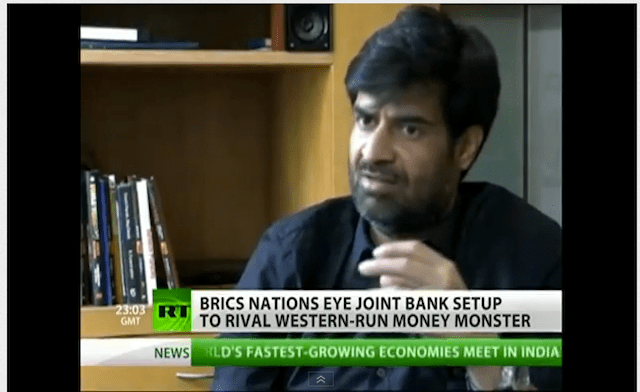
Was on BBC this morning….was asked to discuss BRICS….
Ques 1 – China will dominate BRICS because of its money and might?
Ques 2 – How will India counter China at the BRICS?
Ques 3 – How can this group work together without common ideology (or something like that)?
Was at my charming best while basically saying…China will be an important player in any grouping – why only BRICS….the questions are posed incorrectly…BRICS is not a platform for India countering China….it is indeed an opportunity to take the edge of the bilateral …..and some people do not see common ideology as being necessary….(this Euro Centric fetish for “Common Humanity”) and with our individual and rich experiences we can find ways to developing pathways (unique) for an equitable and prosperous future….
Synergy and Complimentarity are the operative words and BRICS are rich with these possibilities.
For some in India as well – it is all a zero sum game….maybe it is …but they need to know the rules of arithmetic are changing and the nation state may not be the unit of measurement any more – The BRICS Stock Exchange is the business thumbs up to BRICS and the 4th Academic Forum was the “experts” support to it….many more to follow….
The skeptics can continue to earn their salaries…while we build a new platform 🙂
The Political will is expressed in the Delhi Declaration and it is positive, decisive and firm on what the BRICS need to do together and how they need to interact with the developed world on many common issues. I am certain that in this instance the BRICS surprised themselves …..in what they were able to agree to ….In Sanya the BRICS went wider and added South Africa….In Delhi the BRICS went deeper and added substance….
Happy BRICS Day
———————————————–
Fourth BRICS Summit – Delhi Declaration
March 29, 2012
Please find here the full version as PDF: Declaration Fourth_BRICS_Summit
1. We, the leaders of the Federative Republic of Brazil, the Russian Federation, the
Republic of India, the People’s Republic of China and the Republic of South Africa,
met in New Delhi, India, on 29 March 2012 at the Fourth BRICS Summit. Our
discussions, under the overarching theme, “BRICS Partnership for Global Stability,
Security and Prosperity”, were conducted in an atmosphere of cordiality and warmth
and inspired by a shared desire to further strengthen our partnership for common
development and take our cooperation forward on the basis of openness, solidarity,
mutual understanding and trust.
2. We met against the backdrop of developments and changes of contemporary global
and regional importance – a faltering global recovery made more complex by the
situation in the euro zone; concerns of sustainable development and climate change
which take on greater relevance as we approach the UN Conference on Sustainable
Development (Rio+20) and the Conference of Parties to the Convention on Biological
Diversity being hosted in Brazil and India respectively later this year; the upcoming
G20 Summit in Mexico and the recent 8th WTO Ministerial Conference in Geneva;
and the developing political scenario in the Middle East and North Africa that we
view with increasing concern. Our deliberations today reflected our consensus to
remain engaged with the world community as we address these challenges to global
well-being and stability in a responsible and constructive manner.
3. BRICS is a platform for dialogue and cooperation amongst countries that represent
43% of the world’s population, for the promotion of peace, security and development
in a multi-polar, inter-dependent and increasingly complex, globalizing world.
Coming, as we do, from Asia, Africa, Europe and Latin America, the transcontinental
dimension of our interaction adds to its value and significance.
4. We envision a future marked by global peace, economic and social progress and
enlightened scientific temper. We stand ready to work with others, developed and
developing countries together, on the basis of universally recognized norms of
international law and multilateral decision making, to deal with the challenges and the
opportunities before the world today. Strengthened representation of emerging and
developing countries in the institutions of global governance will enhance their
effectiveness in achieving this objective.
5. We are concerned over the current global economic situation. While the BRICS
recovered relatively quickly from the global crisis, growth prospects worldwide have
again got dampened by market instability especially in the euro zone. The build-up of
sovereign debt and concerns over medium to long-term fiscal adjustment in advanced
countries are creating an uncertain environment for global growth. Further, excessive
liquidity from the aggressive policy actions taken by central banks to stabilize their
domestic economies have been spilling over into emerging market economies,
fostering excessive volatility in capital flows and commodity prices. The immediate
priority at hand is to restore market confidence and get global growth back on track.
We will work with the international community to ensure international policy
coordination to maintain macroeconomic stability conducive to the healthy recovery
of the global economy.
6. We believe that it is critical for advanced economies to adopt responsible
macroeconomic and financial policies, avoid creating excessive global liquidity and
undertake structural reforms to lift growth that create jobs. We draw attention to the
risks of large and volatile cross-border capital flows being faced by the emerging
economies. We call for further international financial regulatory oversight and reform,
strengthening policy coordination and financial regulation and supervision
cooperation, and promoting the sound development of global financial markets and
banking systems.
7. In this context, we believe that the primary role of the G20 as premier forum for
international economic cooperation at this juncture is to facilitate enhanced
macroeconomic policy coordination, to enable global economic recovery and secure
financial stability, including through an improved international monetary and
financial architecture. We approach the next G20 Summit in Mexico with a
commitment to work with the Presidency, all members and the international
community to achieve positive results, consistent with national policy frameworks, to
ensure strong, sustainable and balanced growth.
8. We recognize the importance of the global financial architecture in maintaining the
stability and integrity of the global monetary and financial system. We therefore call
for a more representative international financial architecture, with an increase in the
voice and representation of developing countries and the establishment and
improvement of a just international monetary system that can serve the interests of all
countries and support the development of emerging and developing economies.
Moreover, these economies having experienced broad-based growth are now
significant contributors to global recovery.
9. We are however concerned at the slow pace of quota and governance reforms in the
IMF. We see an urgent need to implement, as agreed, the 2010 Governance and Quota
Reform before the 2012 IMF/World Bank Annual Meeting, as well as the
comprehensive review of the quota formula to better reflect economic weights and
enhance the voice and representation of emerging market and developing countries by
January 2013, followed by the completion of the next general quota review by
January 2014. This dynamic process of reform is necessary to ensure the legitimacy
and effectiveness of the Fund. We stress that the ongoing effort to increase the
lending capacity of the IMF will only be successful if there is confidence that the
entire membership of the institution is truly committed to implement the 2010 Reform
faithfully. We will work with the international community to ensure that sufficient
resources can be mobilized to the IMF in a timely manner as the Fund continues its
transition to improve governance and legitimacy. We reiterate our support for
measures to protect the voice and representation of the IMF’s poorest members.
10. We call upon the IMF to make its surveillance framework more integrated and
even-handed, noting that IMF proposals for a new integrated decision on surveillance
would be considered before the IMF Spring Meeting.
11. In the current global economic environment, we recognise that there is a pressing
need for enhancing the flow of development finance to emerging and developing
countries. We therefore call upon the World Bank to give greater priority to
mobilising resources and meeting the needs of development finance while reducing
lending costs and adopting innovative lending tools.
12. We welcome the candidatures from developing world for the position of the
President of the World Bank. We reiterate that the Heads of IMF and World Bank be
selected through an open and merit-based process. Furthermore, the new World Bank
leadership must commit to transform the Bank into a multilateral institution that truly
reflects the vision of all its members, including the governance structure that reflects
current economic and political reality. Moreover, the nature of the Bank must shift
from an institution that essentially mediates North-South cooperation to an institution
that promotes equal partnership with all countries as a way to deal with development
issues and to overcome an outdated donor- recipient dichotomy.
13. We have considered the possibility of setting up a new Development Bank for
mobilizing resources for infrastructure and sustainable development projects in
BRICS and other emerging economies and developing countries, to supplement the
existing efforts of multilateral and regional financial institutions for global growth and
development. We direct our Finance Ministers to examine the feasibility and viability
of such an initiative, set up a joint working group for further study, and report back to
us by the next Summit.
14. Brazil, India, China and South Africa look forward to the Russian Presidency of
G20 in 2013 and extend their cooperation.
15. Brazil, India, China and South Africa congratulate the Russian Federation on its
accession to the WTO. This makes the WTO more representative and strengthens the
rule-based multilateral trading system. We commit to working together to safeguard
this system and urge other countries to resist all forms of trade protectionism and
disguised restrictions on trade.
16. We will continue our efforts for the successful conclusion of the Doha Round,
based on the progress made and in keeping with its mandate. Towards this end, we
will explore outcomes in specific areas where progress is possible while preserving
the centrality of development and within the overall framework of the single
undertaking. We do not support plurilateral initiatives that go against the fundamental
principles of transparency, inclusiveness and multilateralism. We believe that such
initiatives not only distract members from striving for a collective outcome but also
fail to address the development deficit inherited from previous negotiating rounds.
Once the ratification process is completed, Russia intends to participate in an active
and constructive manner for a balanced outcome of the Doha Round that will help
strengthen and develop the multilateral trade system.
17. Considering UNCTAD to be the focal point in the UN system for the treatment of
trade and development issues, we intend to invest in improving its traditional
activities of consensus-building, technical cooperation and research on issues of
economic development and trade. We reiterate our willingness to actively contribute
to the achievement of a successful UNCTAD XIII, in April 2012.
18. We agree to build upon our synergies and to work together to intensify trade and
investment flows among our countries to advance our respective industrial
development and employment objectives.We welcome the outcomes of the second
Meeting of BRICS Trade Ministers held in New Delhi on 28 March 2012. We support
the regular consultations amongst our Trade Ministers and consider taking suitable
measures to facilitate further consolidation of our trade and economic ties. We
welcome the conclusion of the Master Agreement on Extending Credit Facility in
Local Currency under BRICS Interbank Cooperation Mechanism and the Multilateral
Letter of Credit Confirmation Facility Agreement between our EXIM/Development
Banks. We believe that these Agreements will serve as useful enabling instruments
for enhancing intra-BRICS trade in coming years.
19. We recognize the vital importance that stability, peace and security of the Middle
East and North Africa holds for all of us, for the international community, and above
all for the countries and their citizens themselves whose lives have been affected by
the turbulence that has erupted in the region. We wish to see these countries living in
peace and regain stability and prosperity as respected members of the global
community.
20. We agree that the period of transformation taking place in the Middle East and
North Africa should not be used as a pretext to delay resolution of lasting conflicts but
rather it should serve as an incentive to settle them, in particular the Arab-Israeli
conflict. Resolution of this and other long-standing regional issues would generally
improve the situation in the Middle East and North Africa. Thus we confirm our
commitment to achieving comprehensive, just and lasting settlement of the Arab-
Israeli conflict on the basis of the universally recognized international legal
framework including the relevant UN resolutions, the Madrid principles and the Arab
Peace Initiative. We encourage the Quartet to intensify its efforts and call for greater
involvement of the UN Security Council in search for a resolution of the Israeli-
Palestinian conflict. We also underscore the importance of direct negotiations
between the parties to reach final settlement. We call upon Palestinians and Israelis to
take constructive measures, rebuild mutual trust and create the right conditions for
restarting negotiations, while avoiding unilateral steps, in particular settlement
activity in the Occupied Palestinian Territories.
21. We express our deep concern at the current situation in Syria and call for an
immediate end to all violence and violations of human rights in that country. Global
interests would best be served by dealing with the crisis through peaceful means that
encourage broad national dialogues that reflect the legitimate aspirations of all
sections of Syrian society and respect Syrian independence, territorial integrity and
sovereignty. Our objective is to facilitate a Syrian-led inclusive political process, and
we welcome the joint efforts of the United Nations and the Arab League to this end.
We encourage the Syrian government and all sections of Syrian society to
demonstrate the political will to initiate such a process, which alone can create a new
environment for peace. We welcome the appointment of Mr. Kofi Annan as the Joint
Special Envoy on the Syrian crisis and the progress made so far, and support him in
continuing to play a constructive role in bringing about the political resolution of the
crisis.
22. The situation concerning Iran cannot be allowed to escalate into conflict, the
disastrous consequences of which will be in no one’s interest. Iran has a crucial role to
play for the peaceful development and prosperity of a region of high political and
economic relevance, and we look to it to play its part as a responsible member of the
global community. We are concerned about the situation that is emerging around
Iran’s nuclear issue. We recognize Iran’s right to peaceful uses of nuclear energy
consistent with its international obligations, and support resolution of the issues
involved through political and diplomatic means and dialogue between the parties
concerned, including between the IAEA and Iran and in accordance with the
provisions of the relevant UN Security Council Resolutions.
23. Afghanistan needs time, development assistance and cooperation, preferential
access to world markets, foreign investment and a clear end-state strategy to attain
lasting peace and stability. We support the global community’s commitment to
Afghanistan, enunciated at the Bonn International Conference in December 2011, to
remain engaged over the transformation decade from 2015-2024. We affirm our
commitment to support Afghanistan’s emergence as a peaceful, stable and democratic
state, free of terrorism and extremism, and underscore the need for more effective
regional and international cooperation for the stabilisation of Afghanistan, including
by combating terrorism.
24. We extend support to the efforts aimed at combating illicit traffic in opiates
originating in Afghanistan within the framework of the Paris Pact.
25. We reiterate that there can be no justification, whatsoever, for any act of terrorism
in any form or manifestation. We reaffirm our determination to strengthen
cooperation in countering this menace and believe that the United Nations has a
central role in coordinating international action against terrorism, within the
framework of the UN Charter and in accordance with principles and norms of
international law. We emphasize the need for an early finalization of the draft of the
Comprehensive Convention on International Terrorism in the UN General Assembly
and its adoption by all Member States to provide a comprehensive legal framework to
address this global scourge.
26. We express our strong commitment to multilateral diplomacy with the United
Nations playing a central role in dealing with global challenges and threats. In this
regard, we reaffirm the need for a comprehensive reform of the UN, including its
Security Council, with a view to making it more effective, efficient and representative
so that it can deal with today’s global challenges more successfully. China and Russia
reiterate the importance they attach to the status of Brazil, India and South Africa in
international affairs and support their aspiration to play a greater role in the UN.
27. We recall our close coordination in the Security Council during the year 2011, and
underscore our commitment to work together in the UN to continue our cooperation
and strengthen multilateral approaches on issues pertaining to global peace and
security in the years to come.
28. Accelerating growth and sustainable development, along with food, and energy
security, are amongst the most important challenges facing the world today, and
central to addressing economic development, eradicating poverty, combating hunger
and malnutrition in many developing countries. Creating jobs needed to improve
people’s living standards worldwide is critical. Sustainable development is also a key
element of our agenda for global recovery and investment for future growth. We owe
this responsibility to our future generations.
29. We congratulate South Africa on the successful hosting of the 17th Conference of
Parties to the United Nations Framework Convention on Climate Change and the 7th
Conference of the Parties serving as the meeting of the Parties to the Kyoto Protocol
(COP17/CMP7) in December 2011. We welcome the significant outcomes of the
Conference and are ready to work with the international community to implement its
decisions in accordance with the principles of equity and common but differentiated
responsibilities and respective capabilities.
30. We are fully committed to playing our part in the global fight against climate
change and will contribute to the global effort in dealing with climate change issues
through sustainable and inclusive growth and not by capping development. We
emphasize that developed country Parties to the UNFCCC shall provide enhanced
financial, technology and capacity building support for the preparation and
implementation of nationally appropriate mitigation actions of developing countries.
31. We believe that the UN Conference on Sustainable Development (Rio+20) is a
unique opportunity for the international community to renew its high-level political
commitment to supporting the overarching sustainable development framework
encompassing inclusive economic growth and development, social progress and
environment protection in accordance with the principles and provisions of the Rio
Declaration on Environment and Development, including the principle of common
but differentiated responsibilities, Agenda 21 and the Johannesburg Plan of
Implementation.
32. We consider that sustainable development should be the main paradigm in
environmental issues, as well as for economic and social strategies. We acknowledge
the relevance and focus of the main themes for the Conference namely, Green
Economy in the context of Sustainable Development and Poverty Eradication
(GESDPE) as well as Institutional Framework for Sustainable Development (IFSD).
33. China, Russia, India and South Africa look forward to working with Brazil as the
host of this important Conference in June, for a successful and practical outcome.
Brazil, Russia, China and South Africa also pledge their support to working with
India as it hosts the 11th meeting of the Conference of Parties to the Convention on
Biological Diversity in October 2012 and look forward to a positive outcome. We will
continue our efforts for the implementation of the Convention and its Protocols, with
special attention to the Nagoya Protocol on Access to Genetic Resources and the Fair
and Equitable Sharing of Benefits Arising from their Utilization, Biodiversity
Strategic Plan 2011-2020 and the Resource Mobilization Strategy.
34. We affirm that the concept of a ‘green economy’, still to be defined at Rio+20,
must be understood in the larger framework of sustainable development and poverty
eradication and is a means to achieve these fundamental and overriding priorities, not
an end in itself. National authorities must be given the flexibility and policy space to
make their own choices out of a broad menu of options and define their paths towards
sustainable development based on the country’s stage of development, national
strategies, circumstances and priorities. We resist the introduction of trade and
investment barriers in any form on the grounds of developing green economy.
35. The Millennium Development Goals remain a fundamental milestone in the
development agenda. To enable developing countries to obtain maximal results in
attaining their Millennium Development Goals by the agreed time-line of 2015, we
must ensure that growth in these countries is not affected. Any slowdown would have
serious consequences for the world economy. Attainment of the MDGs is
fundamental to ensuring inclusive, equitable and sustainable global growth and would
require continued focus on these goals even beyond 2015, entailing enhanced
financing support.
36. We attach the highest importance to economic growth that supports development
and stability in Africa, as many of these countries have not yet realised their full
economic potential. We will take our cooperation forward to support their efforts to
accelerate the diversification and modernisation of their economies. This will be
through infrastructure development, knowledge exchange and support for increased
access to technology, enhanced capacity building, and investment in human capital,
including within the framework of the New Partnership for Africa’s Development
(NEPAD).
37. We express our commitment to the alleviation of the humanitarian crisis that still
affects millions of people in the Horn of Africa and support international efforts to
this end.
38. Excessive volatility in commodity prices, particularly those for food and energy,
poses additional risks for the recovery of the world economy. Improved regulation of
the derivatives market for commodities is essential to avoid destabilizing impacts on
food and energy supplies. We believe that increased energy production capacities and
strengthened producer-consumer dialogue are important initiatives that would help in
arresting such price volatility.
39. Energy based on fossil fuels will continue to dominate the energy mix for the
foreseeable future. We will expand sourcing of clean and renewable energy, and use
of energy efficient and alternative technologies, to meet the increasing demand of our
economies and our people, and respond to climate concerns as well. In this context,
we emphasise that international cooperation in the development of safe nuclear
energy for peaceful purposes should proceed under conditions of strict observance of
relevant safety standards and requirements concerning design, construction and
operation of nuclear power plants. We stress IAEA’s essential role in the joint efforts
of the international community towards enhancing nuclear safety standards with a
view to increasing public confidence in nuclear energy as a clean, affordable, safe and
secure source of energy, vital to meeting global energy demands.
40. We have taken note of the substantive efforts made in taking intra-BRICS
cooperation forward in a number of sectors so far. We are convinced that there is a
storehouse of knowledge, know-how, capacities and best practices available in our
countries that we can share and on which we can build meaningful cooperation for the
benefit of our peoples. We have endorsed an Action Plan for the coming year with
this objective.
41. We appreciate the outcomes of the Second Meeting of BRICS Ministers of
Agriculture and Agrarian Development at Chengdu, China in October 2011. We
direct our Ministers to take this process forward with particular focus on the potential
of cooperation amongst the BRICS to contribute effectively to global food security
and nutrition through improved agriculture production and productivity, transparency
in markets and reducing excessive volatility in commodity prices, thereby making a
difference in the quality of lives of the people particularly in the developing world.
42. Most of BRICS countries face a number of similar public health challenges,
including universal access to health services, access to health technologies, including
medicines, increasing costs and the growing burden of both communicable and noncommunicable
diseases. We direct that the BRICS Health Ministers meetings, of
which the first was held in Beijing in July 2011, should henceforth be institutionalized
in order to address these common challenges in the most cost-effective, equitable and
sustainable manner.
43. We have taken note of the meeting of S&T Senior Officials in Dalian, China in
September 2011, and, in particular, the growing capacities for research and
development and innovation in our countries. We encourage this process both in
priority areas of food, pharma, health and energy as well as basic research in the
emerging inter-disciplinary fields of nanotechnology, biotechnology, advanced
materials science, etc. We encourage flow of knowledge amongst our research
institutions through joint projects, workshops and exchanges of young scientists.
44. The challenges of rapid urbanization, faced by all developing societies including
our own, are multi-dimensional in nature covering a diversity of inter-linked issues.
We direct our respective authorities to coordinate efforts and learn from best practices
and technologies available that can make a meaningful difference to our societies. We
note with appreciation the first meeting of BRICS Friendship Cities held in Sanya in
December 2011 and will take this process forward with an Urbanization and Urban
Infrastructure Forum along with the Second BRICS Friendship Cities and Local
Governments Cooperation Forum.
45. Given our growing needs for renewable energy resources as well as on energy
efficient and environmentally friendly technologies, and our complementary strengths
in these areas, we agree to exchange knowledge, know-how, technology and best
practices in these areas.
46. It gives us pleasure to release the first ever BRICS Report, coordinated by India,
with its special focus on the synergies and complementarities in our economies. We
welcome the outcomes of the cooperation among the National Statistical Institutions
of BRICS and take note that the updated edition of the BRICS Statistical Publication,
released today, serves as a useful reference on BRICS countries.
47. We express our satisfaction at the convening of the III BRICS Business Forum
and the II Financial Forum and acknowledge their role in stimulating trade relations
among our countries. In this context, we welcome the setting up of BRICS Exchange
Alliance, a joint initiative by related BRICS securities exchanges.
48. We encourage expanding the channels of communication, exchanges and peopleto-
people contact amongst the BRICS, including in the areas of youth, education,
culture, tourism and sports.
49. Brazil, Russia, China and South Africa extend their warm appreciation and sincere
gratitude to the Government and the people of India for hosting the Fourth BRICS
Summit in New Delhi.
50. Brazil, Russia, India and China thank South Africa for its offer to host the Fifth
BRICS Summit in 2013 and pledge their full support.
Delhi Action Plan
1. Meeting of BRICS Foreign Ministers on sidelines of UNGA.
2. Meetings of Finance Ministers and Central Bank Governors on sidelines of G20
meetings/other multilateral (WB/IMF) meetings.
3. Meeting of financial and fiscal authorities on the sidelines of WB/IMF meetings as
well as stand-alone meetings, as required.
4. Meetings of BRICS Trade Ministers on the margins of multilateral events, or standalone
meetings, as required.
5. The Third Meeting of BRICS Ministers of Agriculture, preceded by a preparatory
meeting of experts on agro-products and food security issues and the second Meeting
of Agriculture Expert Working Group.
6. Meeting of BRICS High Representatives responsible for national security.
7. The Second BRICS Senior Officials’ Meeting on S&T.
8. The First meeting of the BRICS Urbanisation Forum and the second BRICS
Friendship Cities and Local Governments Cooperation Forum in 2012 in India.
9. The Second Meeting of BRICS Health Ministers.
10. Mid-term meeting of Sous-Sherpas and Sherpas.
11. Mid-term meeting of CGETI (Contact Group on Economic and Trade Issues).
12. The Third Meeting of BRICS Competition Authorities in 2013.
13. Meeting of experts on a new Development Bank.
14. Meeting of financial authorities to follow up on the findings of the BRICS Report.
15. Consultations amongst BRICS Permanent Missions in New York, Vienna and
Geneva, as required.
16. Consultative meeting of BRICS Senior Officials on the margins of relevant
environment and climate related international fora, as necessary.
17. New Areas of Cooperation to explore:
(i) Multilateral energy cooperation within BRICS framework.
(ii) A general academic evaluation and future long-term strategy for BRICS.
(iii) BRICS Youth Policy Dialogue.
(iv) Cooperation in Population related issues.
New Delhi
March 29, 2012







 Samir Saran