Columns/Op-Eds, In the News, Politics / Globalisation

The IBSA Moment

Globaltimes.cn | 2013-7-22 19:00:36
By Samir Saran and Vivan Sharan

Original link is here

June 6, 2013 was the 10th year anniversary of the seminal Brasilia Declaration by the foreign ministers of India, Brazil and South Africa, formalizing the cooperative mechanism better known as India-Brazil-South Africa Dialogue Forum (IBSA).

India, currently the chair of IBSA, is responsible for steering the agenda for trilateral collaboration.

In its capacity as chair, it is incumbent upon India to revitalize the geopolitical group, which has been so central to the construct of “South-South Cooperation” that engages most political thinkers today.

Developing countries with converging interests have a lot to gain from coordinating positions on a wide spectrum of issues. And indeed India is also uniquely placed to establish its own global identity and brand through the group.

At the end of the Durban summit earlier this year, BRICS resembled a schizophrenic milieu; a strange mix of countries from the Group of 77 and Russia. Under South Africa’s chairmanship, there was a visible failure to shed the identity of reactionary “trade unionists.”

Moreover, consumed by regional aspirations of one member, instead of being representative of a fast moving lithe club of five, BRICS appeared to be burdened with carrying the divergent and diverse aspirations of an additional continent on its shoulders.

The IBSA countries must not let ownership of the South-South agenda slip away. This, we feel, would require at least three conceptual underpinnings.

First, the format for engagement must remain unburdened and the core values undiluted. That is, the dialogue must continue to follow the format already instituted. Proxy memberships of other countries through regional institutions, must not constrain the nimble grouping. Regional issues must be represented, without members themselves becoming stubborn regional representatives.

Second, a common thread which ties all three IBSA members is their robust democratic institutions and frameworks. Democratic values must be kept at the forefront. The legitimacy that such a governance ethos can bring is perhaps unmatched. The cries for reform of the existing global governance architecture converge with the imperative of ensuring legitimacy through democratic transparency.

IBSA offers member countries an audible voice on the global governance high table, and democracy is an undervalued and underutilized trump card that they each possess.

Finally, for each of the IBSA members, the next few decades need to be centred on inclusive growth. Each is an emerging “middle power,” and each needs to harness growth to craft sustainable trajectories, unleashing drivers of socio-economic progress including productivity, innovation and social welfare.

IBSA offers its members a moment for cooperating on this incumbent need. IBSA must focus on itself even as it reaches out.

A lot has already been discussed under the IBSA umbrella. Conversations on reform of Bretton Woods institutions, regional issues (particularly the Arab-Israeli imbroglio), sectoral cooperation ranging from tax administration to higher education, people-to-people linkages, free trade agreements, to name a few prominent areas, have taken place.

Additionally, we suggest that IBSA members must explore collaborating on three specific agenda items.

The first is that IBSA must reach out to other democracies, perhaps initially by according observer status to similarly placed countries. Replicating the format followed by the Shanghai Cooperation Organisation could be a viable alternative, and serve as a suitable whetting process for new members.

Second, IBSA must shed its reluctance to share its own deep reservoir of democratic experiences. Clearly, Atlantic countries cannot and do not offer the only appropriate models of development for democracies. In this post-Washington Consensus era, IBSA members possess a number of experiences which provide a template for the developing world. These must be mapped, shared and discussed.

The third concrete action item must be to move towards a new format for ocean governance. India-Brazil-South Africa Maritime, a naval exercise conducted between the three navies (an element of IBSA’s regional cooperation), is an ideal point of departure.

IBSA members can also begin to address issues dealt under the United Nations Convention on Law of the Sea, to develop a robust international framework for governing the oceans and seas. A new framework articulated by the South would have a compelling weight.

The conceptual underpinnings and agenda discussed here can prove to be levers of IBSA’s transformation. The decade old cooperative mechanism has endured, and now it is time for it to mature and deliver.

Samir Saran is Vice President and Vivan Sharan an Associate Fellow at Observer Research Foundation, Delhi.

Standard
Columns/Op-Eds, In the News

‘No’ to peeping Sams

original link is here

Monkeys in jpeg

The challenge of cybersecurity lies in protecting people without entering their private space or making ‘national security’ an excuse to trample on their freedoms

L’affaire Snowden is the story of three governments. The first is one that claims to protect its own citizens while snooping on everybody else; the second is a government that claims to value personal freedoms above all but actively colludes with the first to violate its citizens’ freedoms and then cover up its footprints. The third is a government that simply does not seem to care about its words or the consequences they bear.

Edward Snowden’s revelations point to certain checks and balances being observed — if only on paper — by the United States government in the surveillance of its citizens. No such checks were applied to foreigners, be they in America or their respective countries. Data-mining is a complex interdisciplinary operation that involves computers looking at vast amounts of information and finding what are euphemistically referred to as “points of interest.” In the marketing industry, data-mining would help businesses target you for the sale of specific products that you might be interested in. In security, this becomes the basis for a warrant to allow a human to start scanning your personal correspondence — if you are a U.S. citizen. If you fall into the non-U.S. citizen category, no warrants are required.

Remorseless America

What is pertinent here is how far America has strayed from its founding principles of personal freedom and political liberty. It seems the pendulum has swung so far that the debate is no longer about whether the government should have any right to monitor citizens but rather about what the standards and procedures for extraordinarily intrusive surveillance should be. Nowhere is this better reflected than in the curious volte face of Harvard law professor Alan Dershowitz on the subject. Once termed “the nation’s most peripatetic civil liberties lawyer,” post-9/11, Mr. Dershowitz was actively advocating torture, including of methods like shoving a sterilised needle under suspects’ fingernails. The debate in the public sphere has become so securitised that ‘national security’ is now a ticket to trample on every right and freedom the U.S. once held sacred. If former President George W. Bush Jr. jeopardised individual liberty with the Patriot Act, President Barack Obama has bestowed on his government the right to be a virtual presence in the lives and bedrooms of billions of people around the world, without care, remorse or even an explanation.

Another disappointment — probably indicative of this societal shift in America on the subject of privacy — is the stand of the American press on the issue. Far from Snowden’s revelations igniting a debate on privacy versus security, the media seems to have bought the security narrative lock, stock and barrel. Evidently, the developments of 1971, when Daniel Ellsberg was feted as a hero of liberty by the U.S. media for his leaks of ‘Vietnam Lies’, forcing a policy reversal on the part of the U.S. government, have been long forgotten. Every U.S. media outlet has gone to great lengths to explain the legality and due process of the PRISM spying apparatus and has almost uniformly shown Snowden in a poor light. The inescapable conclusion is that the U.S. media is probably the most socialised, managed and supine media in existence today — buying into the government’s security narrative instead of challenging it.

The United Kingdom and Europe, on the other hand, have a vibrant media which, for better or worse, challenges both ideas and authority on a daily basis. Since the Snowden leaks were made public, the German and British media in particular have mercilessly pilloried their governments for their subservience to America and their collaboration in the blatantly illegal surveillance of European Union citizens. Their attacks have been so sharp that British Foreign Secretary William Hague had to address criticism in Parliament within hours of the first revelations. Further revelations have since put him on the back foot. The ever idealistic ‘Eurocracy’ has tapped into the public outrage and labelled U.S. surveillance as equivalent to an act by an enemy government.

Governments, though, cannot be run on idealism. It was for this reason that the EU released its cyber security doctrine earlier this year. It repeatedly referred to the EU’s core values of freedom of expression and privacy. The document is ostensibly developed around these “core values.” But this is a vacuous claim, because even as this document was being released, EU countries were actively prying into the private lives of their citizens. Unlike the U.S. government which protected its own citizens by some form of due process, European governments allowed their own citizens’ privacy, enshrined in EU and national law, to be blatantly violated. It is however precisely because of a vigilant and free press that European governments are now trying everything they can to cover up their illegal actions, failing which most European leaders would probably be facing jail sentences and premature retirement.

The last story — and possibly the saddest — is that of India. A few weeks ago, India released its National Cybersecurity Doctrine which merely paid lip service to privacy. Hardly a week later, CCTV footage from the Delhi metro of couples getting intimate were found on a pornographic website. The episode summarises India’s callous approach to its citizens’ privacy — not caring about privacy, on the one hand, and the complete lack of enforcement, on the other. India ostensibly already has a privacy regime that is clubbed with the outsourcing bill, not to protect Indians but to keep the outsourcing industry competitive by guaranteeing protection to foreigners. Theoretically, another standalone privacy bill is on the anvil. However as the Delhi CCTV footage incident shows, enforcement is non-existent, as is the security of gathered data. The implications for internal security here are grave. After all, if voyeurs can get their hands on CCTV footage of public installations for a fee, imagine what kind of secrets terrorists could pry out.

This episode tells another story too; one of public apathy and voyeuristic delight, on the one hand, and lack of government sensitivity, on the other. Why haven’t heads rolled at Delhi Metro? Who has been apprehended for leaking surveillance footage? Which minister ought to resign for this incompetence and negligence? The government has been blasé about the entire Snowden episode as well. Foreign Minister Salman Khurshid played down reports on U.S. surveillance on Indian citizens, calling it “cyber-scrutiny,” while other members of the government chirped in nonchalantly that “we have similar systems in place.” It is frightening to imagine India with U.S. or EU level surveillance capabilities without having either constitutional or procedural capacities to ensure that individuals and society are not harmed.

All is fair

Indeed, our checks and balances against the violation of privacy have failed miserably. The Supreme Court has claimed there was nothing it could do about entities like Google and Yahoo which were implicit in PRISM on the grounds of their lack of local agency. This is a tendentious argument, given that Google has enough ‘local agency’ to send advertising fliers to every business marked on Google maps in India, and advertise on Delhi FM radio channels. The press for its part seldom lets the laws or privacy come in the way of a good story. The competitive impulse to dominate ‘media space’ prevents the separation of true investigative reporting from actions that would intrude and tarnish people by disclosing private details and running media trial(s). Everything and everybody is now fair game in a hyper-‘mediated’ India.

As India evolves its cyber-fibre, it has many lessons to absorb. On the one hand, enforcement is a sine qua non of any law. On the other hand, the government needs to realise that cyberspace is not your normal run-of-the-mill state highway that state agencies can regulate, patrol and police. The cyber-highway runs through our bedrooms and living rooms. The challenge of cybersecurity and governance is how to protect people in their bedrooms and in the conduct of their private lives, without having to enter their private space. This remains the ‘holy grail’ no one seeks, or wants, to discover.

Standard
Columns/Op-Eds, In the News, Politics / Globalisation

Kerry’s Indian visit and Afghanistan

Original link is here

This column is about US Secretary of State John Kerry’s recent visit to India and the new peace initiative for Afghanistan. Kerry visited India to participate in the fourth round of the India-US strategic dialogue. The dialogue was held soon after the opening of US-Taliban peace talks in Doha. The Indians were not too happy at this development, as they found themselves sidelined. The US Secretary of State had to do some explaining to them and seek to dispel their apprehensions. There would be no compromises, he said, with the “red lines” meaning certain conditions, which the Taliban must adhere to, viz Taliban’s break with al-Qaeda, renouncing violence and accepting Afghanistan’s constitution. Kerry was not quite right as after an earlier exchange, it was agreed by the State Department that these would not be “preconditions” but “outcomes”.
During his stay in India, Kerry called upon New Delhi to play a vital role in the next Afghan elections and help “improve its electoral system and create a credible and independent framework for resolving disputes.”
Mention may he made of a video message to the Indians sent on the eve of the Secretary’s visit, in which he assured of US backing of Indian’s inclusion as a “permanent member of a reformed and expanded Security Council.” “The US,” he declared, “welcomes India as a rising power,” adding that, “a strong India is in American’s national interest.”
More from the message: “The friendship between our two nations is one of the defining partnerships of the 21stcentury. Today, the US and India collaborate closely in almost every field of human endeavour. Together, we are tackling shared challenges and making the most of new opportunities. From higher education to clean energy, from counter-terrorism to space science, we are seizing new opportunities to work together, and in doing so, we are increasing the prosperity and security of both of our peoples. The US and India share a strong and enduring commitment to Afghanistan’s peace and prosperity. And we also welcome India’s leadership in the Asia-Pacific region.”
Despite the various agreements and partnerships inclusive of nuclear status and supplies, space, health, clean energy, defence, counter-terrorism, etc, New Delhi has not been too keen to acknowledge the favours done to it by Washington.
Just read how an Indian columnist, Indrani Bagchi, assesses Kerry’s visit to India in Economic Times/Times of India: What did one make of John Kerry’s whirlwind run-through of the India-US strategic dialogue? ‘Well, we didn’t expect much, so we were not disappointed’ runs the dominant response in this city.
On paper, the bilateral relationship is almost universal in its reach. Innovation, space, health, clean energy, defence, counter-terrorism. The US too has moved from the extensive vision of the Bush years to becoming a transactional power under Obama.
Possibly, the only worthwhile conversation at this point is the dialogue on defence technology that NSA Shivshankar Menon is holding with Ash Carter. Menon has to steer the defence-strategic relationship from a buyer-seller one to one that is more equitable……In their haste to turn off the lights in Afghanistan, the US will find another way to talk to the Taliban to bring them on board in Kabul, with a “ruinous deal” with Pakistan. Look closer home. India should push an investment treaty with the US, using it to straighten out its internal investment strategies and launch the next round of economic reforms. Strategically, let’s look at the Indo-Pacific as the theatre for the next big deal. Notwithstanding China’s categorisation of the Xi-Obama meeting at a ‘New Type of Great Power Relationship’, India and the US have the greatest strategic alignments there. Let’s not get spooked by G-2 either – the bald truth is ‘rebalancing’ is a China-hedge strategy.
As for Afghanistan, the Indian view has been, thus, well-expressed by Samir Saran and Abhijit Mittra in Economic Times/Times of India: “While John Kerry lauded India’s role in his June 23 speech in New Delhi, events of the last 90 days tell a very different story; one in which the US disregards the concerns of both India and the Afghan government and continues to woo the Pakistani military establishment. The US actions have allowed the Taliban to formally open an office in Qatar for direct negotiations, which the Taliban see as the first step towards a new emirate.
“The victory of Nawaz Sharif in Pakistan, in collusion with fundamentalists, allows radicals in that country certain influence over the civilian government and the military’s shadow over foreign policy looms larger and stronger as the US consolidates General Kayani’s pivotal role, established by a hurried and reckless K-3 meeting (Kerry, Kayani, Karzai).
“India’s Afghanistan policy has historically always been long-term and more than capable of absorbing reverses in the short to medium term. It cannot be coy in providing soft and hard military support to its friends, and it must not be seen as an unreliable and indecisive partner. India has in the past succeeded in maintaining Afghanistan as a viable partner for over 60 of 67 years of bilateral history.
“After 1997, India continued to support the Northern Alliance in the hope of better times. That time came in 2001, when, following the US invasion, a government whose core elements had been supported by India, were installed in power. India in 2014 is not the economic cripple it was in 1991; a $290 billion reserve buys more loyalty and battle resilience than 15-day currency reserves.
“Over the last 12 years, India has worked exceptionally hard to win over significant pockets of support among the Pashtuns. Unlike the 1990s when India’s support base was the ethnic minorities, support for India is now deeper and wider. Afghanistan post-2014 must not by default become a neutralised backyard of Rawalpindi and its proxies.”
So, while framing an Afghanistan policy, Pakistan has to keep the following factors in view:
1. After the return of the combat forces in 2014, the US will continue to keep a certain number of well equipped troops in Afghanistan. And the Taliban will continue creating difficult conditions for them.
2. The post-American exit scenario looks murky and uncertain. Pakistan must devise well thought out policies in regard to different emerging situation.
3. The initiative to forge an understanding with the Northern Alliance must continue with a view to securing positive results.
4. India has invested billions of rupees in Afghanistan. Both Kabul and Washington want it to play a significant role in the post-2014 Afghanistan. Karzai has already sealed a strategic partnership with India and Afghan army personnel are being trained by Indian military experts. India’s interests just cannot be ignored. These, to some extent, may have to be accommodated with Islamabad safeguarding its own interests.
5. It is time that a settlement with the Pakistani Taliban is negotiated jointly by the civil government and the military.
6. A competent retired diplomat should be immediately appointed as a special envoy for Afghanistan. He may pilot Pakistan’s case and look after its interests in the US-Afghanistan-Taliban negotiations.
The writer is an ex-federal secretary and ambassador, and a political and international relations analyst

Standard

OECD Pic

Original link is here

In the News, Politics / Globalisation

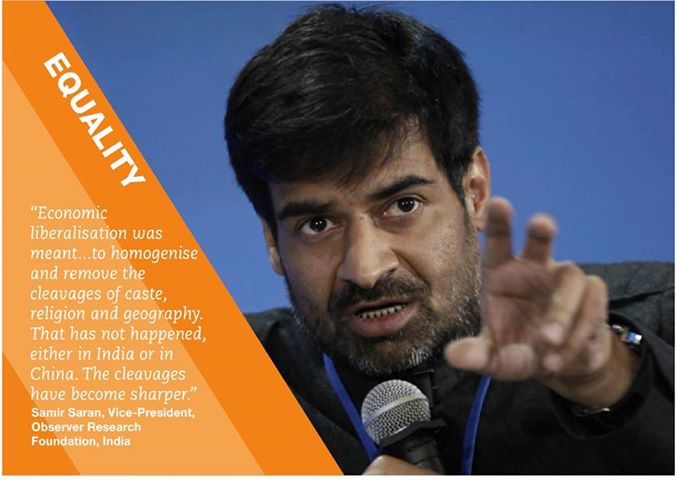
A Panel discussions on Economic Liberalisation and more …. at the OECD Forum 2013 on the Asian Century

Image
Columns/Op-Eds, In the News, Politics / Globalisation

As the US exits, New Delhi must adopt a gutsy Afghanistan policy to safeguard its interests

Original link is here

SAMIR SARAN & Abhijit Iyer Mittra Jun 27, 2013, 12.00AM IST

While John Kerry lauded India’s role in his June 23 speech in Delhi, events of the last 90 days tell a very different story; one in which the US disregards the concerns of both India and the Afghan government and continues to woo the Pakistani military establishment in search of its elusive salvation.

The US actions have allowed the Taliban to formally open an office in Qatar for direct negotiations, which the Taliban sees as the first step towards a new emirate. The victory of Nawaz Sharif in Pakistan, in collusion with fundamentalists, allows radicals in that country certain influence over the civilian government and the military’s shadow over foreign policy looms larger and stronger as the US consolidates General Parvez Kayani’s pivotal role, established by a hurried and reckless K-3 meeting (Kerry, Kayani, Karzai).

Consequently, India has nowhere to hide. Three eventualities have to be prepared for in Afghanistan, possibly unfolding concurrently. The first is a Karzai government under severe pressure from a heavily armed Taliban backed by the new mandate available to the civilian and military leadership in Pakistan. The second is a Taliban takeover of Kabul. The third is some form of dismemberment of the country again. Each of these eventualities leads to India having to shoulder a greater share of the blowback, than the western countries that seek to drive the current agenda.

India’s exclusion is symptomatic of the short-termism that has plagued western policy that has sought to create a closed information loop to filter out inconvenient truths. The problem is, as history repeatedly shows, an unstable Afghanistan destabilises the region. Importantly, as 9/11 showed, it also has the potential to threaten western power centres. Yet it would seem nothing has been learnt and India would need to very quickly write its own script again.

India’s Afghanistan policy has historically always been cold, calculating, uncompromising, long-term and more than capable of absorbing significant reverses in the short to medium term. Its response today must also support those who it does business with in Afghanistan. It cannot be coy in providing soft and hard military support to its friends and it must not be seen as an unreliable and indecisive partner.

India has in the past succeeded in maintaining Afghanistan as a viable partner for over 60 of 67 years of bilateral history. Wading through the precarious years starting 1989 and through the economic crisis of 1991, India still managed to support one dispensation or another that held inimical forces at bay till 1997. After 1997, India continued to support the Northern Alliance in the hope of better times. That time came in 2001, when, following the US invasion, a government whose core elements had been supported by India, were installed in power.

Pakistan, in spite of its advantageous geography, had succeeded in pacifying Afghanistan for just four to six years at best. Anybody with a cursory knowledge of the region will know that it takes a lot more than common borders to manage bilateral relations.

Going into a winning war is easy but wading into uncertain waters to safeguard vital interests is the true test of realpolitik. That is why India’s Afghan gambit must be gutsy and counterintuitive. Given the high stakes and high probability of failure, too much talk is counterproductive and blueprints for the post-2014 chaos that will be Afghanistan are urgently needed.

India in 2014 is not the economic cripple it was in 1991; a $290-billion reserve buys more loyalty and battle resilience than 15-day currency reserves. Over the last 12 years India has worked exceptionally hard to win over significant pockets of support among the Pashtuns. Unlike the 1990s when India’s support base was the ethnic minorities, support for India is now deeper and wider.

Taliban 2.0, therefore, will find a house divided, facing the enemy without and also within. India has four consulates in addition to the embassy in Kabul. These are the prime nodes of aid dispersal, which is counted as the most effective of any country’s efforts there.

The nearly $2 billion dispersed so far have gone to infrastructure, agriculture and education, especially self-sustaining schemes at the village and micro levels in Pashtun areas. It is precisely these schemes that connect India directly to the Pashtun’s day-to-day life and make India a friend in their view. It will be Pakistan’s inability to deliver — systemically and financially — on this score that will make Pakistan the outsider.

Afghanistan post-2014 must not by default become a neutra-lised backyard of Rawalpindi and its proxies. Any interference must necessarily require significant injections of Pakistani treasure and blood. India could lay for Pakistan the same trap that the US laid for the Soviets in Afghanistan.

If Pakistan marches in directly or by proxy it gets bogged down and alienates any residual western sympathy. If Pakistan does not, it loses the prize. Win or lose by default Pakistan loses and win or lose by default India is likely to succeed.

The writers are vice-president and programme coordinator, respectively, at the Observer Research Foundation.

Standard
Uncategorized

India has nowhere to hide

Going into a winning war is easy but wading into uncertain waters to safeguard vital interests is the true test of realpolitik. That is why India’s Afghan gambit must be gutsy and counterintuitive.

While John Kerry lauded India’s role in his June 23 speech in Delhi, events of the last 90 days tell a very different story; one in which the US disregards the concerns of both India and the Afghan government and continues to woo the Pakistani military establishment in search of its elusive salvation.

The US actions have allowed the Taliban to formally open an office in Qatar for direct negotiations, which the Taliban sees as the first step towards a new emirate. The victory of Nawaz Sharif in Pakistan, in collusion with fundamentalists, allows radicals in that country certain influence over the civilian government and the military’s shadow over foreign policy looms larger and stronger as the US consolidates General Parvez Kayani’s pivotal role, established by a hurried and reckless K-3 meeting (Kerry, Kayani, Karzai).

Consequently, India has nowhere to hide. Three eventualities have to be prepared for in Afghanistan, possibly unfolding concurrently. The first is a Karzai government under severe pressure from a heavily armed Taliban backed by the new mandate available to the civilian and military leadership in Pakistan. The second is a Taliban takeover of Kabul. The third is some form of dismemberment of the country again. Each of these eventualities leads to India having to shoulder a greater share of the blowback, than the western countries that seek to drive the current agenda.

India’s exclusion is symptomatic of the short-termism that has plagued western policy that has sought to create a closed information loop to filter out inconvenient truths. The problem is, as history repeatedly shows, an unstable Afghanistan destabilises the region. Importantly, as 9/11 showed, it also has the potential to threaten western power centres. Yet it would seem nothing has been learnt and India would need to very quickly write its own script again.

India’s Afghanistan policy has historically always been cold, calculating, uncompromising, long-term and more than capable of absorbing significant reverses in the short to medium term. Its response today must also support those who it does business with in Afghanistan. It cannot be coy in providing soft and hard military support to its friends and it must not be seen as an unreliable and indecisive partner.

India has in the past succeeded in maintaining Afghanistan as a viable partner for over 60 of 67 years of bilateral history. Wading through the precarious years starting 1989 and through the economic crisis of 1991, India still managed to support one dispensation or another that held inimical forces at bay till 1997. After 1997, India continued to support the Northern Alliance in the hope of better times. That time came in 2001, when, following the US invasion, a government whose core elements had been supported by India, were installed in power.

Pakistan, in spite of its advantageous geography, had succeeded in pacifying Afghanistan for just four to six years at best. Anybody with a cursory knowledge of the region will know that it takes a lot more than common borders to manage bilateral relations.

Going into a winning war is easy but wading into uncertain waters to safeguard vital interests is the true test of realpolitik. That is why India’s Afghan gambit must be gutsy and counterintuitive. Given the high stakes and high probability of failure, too much talk is counterproductive and blueprints for the post-2014 chaos that will be Afghanistan are urgently needed.

India in 2014 is not the economic cripple it was in 1991; a $290-billion reserve buys more loyalty and battle resilience than 15-day currency reserves. Over the last 12 years India has worked exceptionally hard to win over significant pockets of support among the Pashtuns. Unlike the 1990s when India’s support base was the ethnic minorities, support for India is now deeper and wider.

Taliban 2.0, therefore, will find a house divided, facing the enemy without and also within. India has four consulates in addition to the embassy in Kabul. These are the prime nodes of aid dispersal, which is counted as the most effective of any country’s efforts there.

The nearly $2 billion dispersed so far have gone to infrastructure, agriculture and education, especially self-sustaining schemes at the village and micro levels in Pashtun areas. It is precisely these schemes that connect India directly to the Pashtun’s day-to-day life and make India a friend in their view. It will be Pakistan’s inability to deliver – systemically and financially – on this score that will make Pakistan the outsider.

Afghanistan post-2014 must not by default become a neutra-lised backyard of Rawalpindi and its proxies. Any interference must necessarily require significant injections of Pakistani treasure and blood. India could lay for Pakistan the same trap that the US laid for the Soviets in Afghanistan.

If Pakistan marches in directly or by proxy it gets bogged down and alienates any residual western sympathy. If Pakistan does not, it loses the prize. Win or lose by default Pakistan loses and win or lose by default India is likely to succeed.

Courtesy : The Times of India, June 27, 2013

Standard
Books / Papers, Politics / Globalisation

CIVIL 20 RECOMMENDATIONS ON STRONG, SUSTAINABLE, BALANCED AND INCLUSIVE GROWTH

Original link is here..


India


By Samir Saran, Senior Fellow and Vice President, Observer Research Foundation (ORF);

Vivan Sharan, Associate Fellow, Observer Research Foundation (ORF)


India is a study in contrasts. In the post liberalisation era, since 1991, the country has witnessed a rapid GDP growth, secular expansion of its services sector, and a commensurate increase in per capita consumption. As a result, in 2012, the country overtook Japan’s GDP (in purchasing power parity terms), to become the third largest economy in the world. However, at the same time, a recent survey across 100 districts in the country revealed that 42 per cent of India’s children under the age of 5 are underweight and a shocking 59 per cent are stunted in their physical development98. Extrapolating these results to reflect the overall state of socio-economic development, the picture at once becomes stark. This paper will delve into some macro trends

through which it aims to unbundle facets of the country’s distorted growth narrative.


In March 2012, the Planning Commission of the Government of India set the poverty line at INR

28.65 (approximately USD 0.52) for urban areas and INR 22.42 (approximately USD 0.4) for rural areas in terms of per capita expenditure. Using rounded approximations of INR 28 and INR

22 (USD 0.5 and USD 0.4) for urban and rural areas respectively, National Sample Survey data from household surveys conducted in 2009-10 reveal that 22.98 per cent of India’s urban population and 36.58 per cent of its rural population spend less than the approximated poverty line (Table 1). Meanwhile, India’s ‘emerging’ identity, which derives from its significant middle class, is also exposed for what it is. Only about 4 per cent of India’s population earns more than INR 100 a day (approximately USD 1.8 a day in nominal terms). The rural urban divide is also particularly prominent and can be observed throughout this paper.


Table 1. Per Capita Expenditure and Population, 2009-10


All India

Urban

Rural

Expenditure

% of Population

% of Population

% of Population

< Rs. 28 per day

48.92

22.98

36.58

Between   Rs. 28 to 100 per day

47.09

65.54

62.21

More than Rs. 100 per day

3.99

11.49

1.21

Total

100

100

100

Source: NSS, 2009-10 @ ORF India Data Labs


The world is still grappling with the ripples caused by the Global Financial Crisis. While the crisis found its origins in the West, it perhaps has greater absolute implications for the emerging and developing world. India has witnessed a slowdown in growth to around 5 per cent in 2012-

13. The fundamental assumption about GDP growth, echoed by Indian policymakers has been that faster GDP growth is a prerequisite to reducing poverty and concomitantly, enhancing development99. Such views are reflections of a wider international consensus that “there is every reason to believe that economic growth reduces poverty”100. In this case, the converse argument also holds, and every percentage point slowdown in India’s GDP growth impacts the sustenance prospects of millions of rural and urban poor.


There is of course a large volume of academic literature which questions such simplistic correlations. For instance the India Chronic Poverty Report (2011), states that “the issue arising


98 The HUNGaMa Survey Report, Naandi Foundation, 2011

99 http://www.thehindubusinessline.com/industry-and-economy/economy/india-needs-high-gdp-growth-to-reduce- poverty-at-faster-pace/article4153965.ece

100 Roemer, Michael and Gugerty, Mary K., “Does Economic Growth Reduce Poverty?”, Harvard Institute for

International Development, March 1997

74


in some developing economies with large populations is not that there is poverty in spite of moderate to high economic growth, but that this poverty is often created by the very nature of economic growth itself’’101. While this view is open to debate, it is sufficiently clear that there has been a consistent rise in inequity between the rich and the poor in India. This is evidenced from the fact that those at the bottom 10 per cent of per capita wealth account for merely 3.6 per cent of total consumption, while the top 10 per cent account for 31.1 per cent102. Additionally, Pal and Ghosh (2007) have observed that “comparable estimates of the 50th (1993-1994) and

55th (1999-2000) rounds of National Sample Survey data reveal that inequality increased both in

rural and urban India”103.


Perhaps the starting point for any meaningful analysis or explanation of India’s unequal society must be an overview of aggregated expenditure profiles for different social groups. From table 2, it is evident that the traditionally disadvantaged groups (scheduled tribes, scheduled castes, and other backward classes), on average fare worse than those that fall  within the category of “others” in terms of per capita expenditure. On an all India level, less than 2 per cent of the disadvantaged groups spend more than the nominal equivalent of USD 2 a day. A majority (at an all India level) are below the approximated urban poverty line expenditure assumed here. It is

safe therefore, to infer strong causality between income classes and social groups104.


Table 2. Per Capita Expenditure and Social Group, 2009-10


Social Groups


< Rs.   28 per day

Between      Rs.

28 to 100 per day


Greater     than

Rs. 100 per day


Total

Scheduled Tribes

67.35

31.32

1.33

100

Scheduled Castes

61.1

37.69

1.22

100

Other Backward   Classes

50.86

46.65

2.5

100

Others

32.06

59.07

8.87

100

Total

48.91

47.1

3.99

100

Source: NSS, 2009-10 @ ORF India Data Labs


When the multidimensional nature of poverty is taken into account, it is not surprising that self fulfilling spirals can trap millions within a variety of systemic constraints. Table 3 helps to illustrate that while nearly all of those spending more than INR 100 per (approximately USD

1.8) day have access to electricity for domestic consumption, over 35 per cent of those who spend less than INR 28 (USD 0.5) in rural areas, still have no access to electricity.


Table 3. % Population with Electricity for Domestic Use and per Capita Expenditure, 2008-09


Expenditure

All India

Urban

Rural

< Rs. 28 per day

64.61

90.25

86.66

between Rs. 28 to 100 per day

92.32

98.66

97.83

greater than Rs.   100 per day

99.05

99.98

99.98

Total

73.21

96.14

96.14

Source: NSS, 2008-09 @ ORF India Data Labs


101 India Chronic Poverty Report, Indian Institute of Public Administration, 2011

102 Mehta et. al., “India Chronic Poverty Report”, Indian Institute of Public Administration, 20011

103 Pal, Parthapratim and Ghosh, Jayati, “Inequality in India: A Survey of Recent Trends”, Department of Economic and Social Affairs (DESA) Working Papers, United Nation, 2007

104 Expenditure can be used as a substitute for income, using the established economic relationship that savings =

income – expenditure; and assuming negligible savings at the bottom of the pyramid.

75


Peeling through the multiple dimensions of social inequity and concomitant to the above described ‘sociology of the poor’ are issues around access to services and resources. Saran and Sharan (2012) point out that between 30 to 40 per cent of those belonging  to the various disadvantaged  groups still use kerosene for lighting in rural areas105. This is a particularly illustrative statistic on two counts. Firstly, typical kerosene lamps deliver between 1 to 6 lumens

per square metre of useful light compared with typical Western standards of 300 lux for basic tasks such as reading. There is no convergence of living standards for those at the bottom of the pyramid. The second is that those with least access are disadvantaged on multiple fronts.


Access to modern forms of energy is necessary for development. Access to resources such as water is necessary for basics sustenance which underpins development. Wide divergences in the access to drinking water across different income profiles are indicative of a serious structural deficit. This deficit has no doubt helped to perpetuate inter-generational infirmities. Table 3 shows that those with per capita expenditures greater than INR 100 (USD 1.8) a day are around two and a half times as likely to have access to drinking water within their premises as those in the bottom quartile assumed here (expenditure less than INR 28 (approximately USD 0.5) per day). Those at the bottom are much more likely to walk significant distances to access water than those at the top. There are multiple implications of such divergences in access, including on household productivity.


Table  4.  % Population  and  Distance  from  Drinking  Water  Sources  Mapped  to  per  Capita

Expenditure, 2008-09


Expenditure

Within

Dwelling


Outside Dwelling but   within the Premises

Outside Premises


Total

0.2 to

0.5 km

0.5 to

1.0 km

<  Rs.    28    per

day


15.74


22.68


50.47


9.18


1.43

Between      Rs.

28 to 100 per   day


36.24


32.12


26.31


3.86


0.9

More than   Rs.

100 per day


76.57


18.91


3.34


0.69


0.26

Source: NSS, 2008-09 @ ORF India Data Labs


Household productivity is also closely linked to the levels of education attainment. Within a rights-based framework for development, the role of education is increasingly emphasised. Tilak (2005),  notes  that  “poverty  is  seen  as  deprivation  of  opportunities  that  enhance  human capabilities  to  lead  a tolerable life” and  importantly that  “education  is  one such important opportunity, deprivation of which in itself represents poverty”106. While it is up for debate

whether primary, middle and secondary education actually offers productivity gains that are commensurate with the contextual imperatives for human capital formation given the scale and nature of poverty; and whether higher education or vocational education should be prioritised; the statistics in table 5 illustrate that there is a clear causality between income and education levels. Indeed, many studies have argued that this causality runs both ways.


105 Saran, Samir, and Sharan, Vivan, “Identity and Energy Access in India: Setting Contexts for Rio+20”, Energy

Security Insight, TERI, Volume 7 (1), January 2012

106 Tilak, Jandhyala B.G., “Post-Elementary Education, Poverty and Development in India”, Working Paper Series

No. 6, Centre of African Studies, University of Edinburgh

76


Table 5. Education Levels Mapped to % Population sorted by Per Capita Expenditure, 2009 – 10


Education Levels

All India

Expenditure

<   Rs.     28 per   day

between   Rs.     28     to

100 per day

more than Rs. 100 per   day


Total

illiterate

42.93

25.65

9.25

33.45

upto primary

34.89

29.43

15.22

31.54

middle

12.46

15.87

10.48

13.99

secondary

5.96

12.7

14.26

9.47

higher secondary

2.7

8.6

15.53

5.99

diploma & certificate course

0.1

0.91

2.95

0.6

graduate & above

0.96

6.83

32.32

4.98

Total

100

100

100

100

Source: NSS, 2009-10 @ ORF India Data Labs


India is rated as having a moderate inequality relative to several other developing countries, with a Gini coefficient of 36.8 in 2004-05107. While the coefficient has likely worsened since then, India is leagues ahead of several other G20 countries, including the United States and China. However, the Gini coefficient cannot capture the nuanced trends of inequity, and the causal relationships that perpetuate it.


Development is a long term, complex process. It is clear from the socio-economic realities which have been outlined in this paper, that India’s development trajectory is steep, and the challenges, stark. Concomitantly, the public policies which have also been highlighted here, have been formulated by policymakers to bridge inequities between various socio-economic identities and promote inclusive  growth.  They aim  to  provide better  access  to  services,  employment  and information; and are certainly enablers of transformation when implemented right. Even so, they are necessary but not sufficient. A number of systemic initiatives are required to create the momentum and maintain the development gains required for a broad based transition to higher levels of prosperity and equity, particularly for those at the bottom of the pyramid. In this context, we suggest there are two fundamental questions that Indian policymakers must pose to themselves, to tailor effective and efficient interventions that can ensure that development in fact leads to growth:


1.   What is the threshold level of inequality for political and social stability?

2.   How can policy interventions resolve the strategic, but not necessarily binary choice between generating employment and increasing productivity?


Two decades have passed since India embarked on a new growth trajectory underpinned by a neoclassical economic framework. Liberalisation led reform has delivered unequally. With over

1.2 billion people and  an extremely heterogeneous socio-economic profile, any attempts to recalibrate policy prescriptions must be fully cognizant of diverse realities and trends that have become firmly embedded. Whether GDP growth has exacerbated inequities, or served as the template for improving living standards is not the most urgent question in the contemporary context. Rather, policymakers and political leaders must focus their energies on understanding the causal influences that have a bearing on socio-economic trends; and accordingly designing a progressive and contextual framework for development and growth. We suggest that such a framework must include and be complemented by the following crucial elements:


107 World Bank Indicators

77


                           Nearly 12 million people enter the Indian workforce ever year. A majority lack the skills to gain meaningful employment, and face an abject lack of access to decent work. As a result those at the bottom of the socio-economic pyramid are largely employed in the informal sector, without any form of job security or social security. The availability of productive and remunerative employment is central to enabling equitable growth. The Indian economy must employ a larger proportionate share of its workforce. In turn, minimum wages and domestic labour standards must be enforced universally; and the skills gap must be addressed through strategic emphasis on subsidised and targeted vocational education.

   The Indian economy relies asymmetrically on growth of the tertiary sector, particularly capital and skilled labour intensive sectors such as information technology which have not been  able  to  bridge  the  systemic  employment  gap.  Employment  creation  is  a  policy imperative for enabling equitable outcomes; and the revitalisation and reemphasis on the growth of the secondary sector is a necessary prerequisite for achieving broad based socio economic transformation. The industrialisation process requires a number of enablers, including improved infrastructure and service delivery; and the creation of a workforce with skill sets commensurate with a strategic vision for industrial growth.

   The competitive advantage of the  Indian  economy in  the export  sector  remains  largely untapped. With an export to GDP ratio of 16.5 per cent (in 2012), the Indian export economy has a vast potential. In this regard, high productivity, labour intensive sectors in particular demand a sustained policy focus. Greater integration with regional supply chains and increased leverage of regional trade agreements can provide the necessary momentum for secular growth of such sectors. Monetary policy, fiscal management and financial market depth must complement such growth.

   Policy Emphasis must be placed on facilitating access to markets with strong internal drivers demand. This will help the Indian economy to hedge against global demand volatility perpetuated  by disruptive  business  cycles.  The  Southwards  shift  of  Indian  exports  is  a positive sign in this context. According to the Indian Exim bank, the share of Asia, Africa and LAC regions has increased sharply from 47% in 2001-02 to 62.7% in 2011-12; and the share of Asia has risen from 40% to 52% during this period.

   The equitable growth of the Indian economy will to a large extent be determined by the degree   and   nature   of   private   sector   participation.   The   virtual   stagnation   in   the investment/GDP ratio (of which the private sector is a larger contributor than the public sector), which has grown by a mere 5 per cent since 2005-06 to 37.6 per cent in 2011-12, is indicative of inherent challenges. Greater participation of the Indian private sector can be driven by a better environment for doing business. Policy frameworks must address issues around corporate governance and labour reforms without compromising market competitiveness.

   Long term capital formation through increased participation in the financial markets must be prioritised. This will entail a broad based emphasis on imperatives such as financial literacy, financial inclusion, and investor protection. The nominal proportionate retail participation in the domestic capital markets is a cause of concern. Household savings must be productively and efficiently deployed in order to finance the widening current account deficit. Simultaneously, short term speculative participation must be offset by genuine market opportunities for growth. Commensurate emphasis must be placed on channelling global savings into long term asset creation in the Indian economy, with a supportive policy framework. Increased government emphasis on development of micro, small and medium enterprises as well as industrial clusters must be sustained despite political cycles. Policy disruptions can quickly reverse gains achieved over time, and political risk poses the greatest challenge to unleashing the entrepreneurial potential in the country. A coherent, inclusive and long term political vision must complement policy formulation. Robust legal frameworks must be employed to secure long term growth largely devoid of political risk uncertainties.


78


References:

The HUNGaMa Survey Report (2011) Naandi Foundation.

URL:   http://www.thehindubusinessline.com/industry-and-economy/economy/india-needs-high- gdp-growth-to-reduce-poverty-at-faster-pace/article4153965.ece

Roemer, M., Gugerty, M. K. (1997), Does Economic Growth Reduce Poverty?, Harvard Institute for International Development, March.

India Chronic Poverty Report (2011), Indian Institute of Public Administration.

Mehta et. al. (2011), India Chronic Poverty Report, Indian Institute of Public Administration.

Pal,  P.,  Ghosh,  J.  (2007),  Inequality  in  India: A Survey  of  Recent  Trends,  Department  of

Economic and Social Affairs (DESA) Working Papers, United Nation.

Saran, S., .Sharan, V. (2012) Identity and Energy Access in India: Setting Contexts for Rio+20, Energy Security Insight, TERI, Volume 7 (1), January 2012.

Tilak, Jandhyala B.G. (2005), Post-Elementary Education, Poverty and Development in India, Working Paper Series No. 6, Centre of African Studies, University of Edinburgh



Standard

NEW
Global Times | Samir Saran and Abhijit Iyer-Mitra
Published on May 20, 2013 22:18

Original Link is here

In a significant act of political signaling and foresight, Chinese Premier Li Keqiang chose India as his first ever overseas destination after taking charge of the premiership.

He arrived in New Delhi on Sunday evening and held meetings with Indian Prime Minister Manmohan Singh first. He also met Singh’s cabinet colleagues and flew to Mumbai and met with Indian industrial leaders.

This visit is important in more ways than one. At the purely bilateral level, an excruciating border episode was just recently brought to a close.

On a global level, the two countries are dealing with a once-in-a-century churning in the architecture of global governance, while at the same time trying to shake of the lethargy that both economies have fallen prey to.

For the first time in many centuries, this continent has the wherewithal to define itself on its own terms. Capitals in Asia will lead the process of shaping the Asian project.

China and India must be partners in this effort, and to get there they need to deal with the hard questions, as the time for sweet talk is now over.

We need to start having brutally frank conversations on our legacy problems and on the more recent challenges.

The parroting of old staid positions and whispering of diplomatic sweet nothings will yield little and allow others to intervene and impose.

It is time for the two countries to grow up and resolve the disputed border. And even as this resolution is discovered, progress on the bilateral relationship must be insulated from this process.

For this to happen, political leadership in both countries will have to demonstrate courage to make their respective security establishments toe the line.

Economic integration is not and will never be the answer to this political poser alone. It can provide the motivation for seeking a resolution, but it is not the answer by itself.

In fact, it can now be argued that the political discord and public perception in both countries are limiting greater economic integration.

Trade shows signs of plateauing, with Chinese firms struggling for access to all projects in India, be they shipyards, roads or telecommunications, despite some early and spectacular inroads.

The two countries now need to realize that they are confronted with the political moment that has been deferred and delayed but cannot be denied. Strong and purposeful measures must be crafted.

There must be a bold statement on the border issue that no matter what the differences, incidents like that in Ladakh recently will not happen again.

While the border management pact recently offered by China may not be the answer, an equitable arrangement that prevents any troop movements remotely close to each other’s claimed territory must be worked upon.

This conversation cannot be delayed. And the process of arriving at this accord needs to be a lot more transparent. Opaque political discussions lead nowhere, and public opinion must be built and sought.

China’s engagement with India must transform from one that is largely seen as transactional, such as the selling and buying of goods and commodities, and more recently functioning as a lender, to one of being a long-term investor and stakeholder in the Indian economy.

Chinese money, businesses and investments must bet on India and be located in this country.

This cannot happen however until businesses and people in China begin to perceive India as a friendly destination, an outcome equally determined by Indian attitudes to China.

India for its part must seriously consider identifying special industrial zones that Chinese firms can develop as centers of large manufacturing and R&D.

There must be a complete, honest and meaningful revamp of the current visa regime. The level of visits is abysmal, and security considerations cannot determine the level of engagement between the two countries destined to be the largest trading partners in a decade or so.

Finally, the two must bilaterally develop a substantial conversation on the cutting edge of global governance issues, including issues of the global commons like climate change, water, health and medicine, and Asian security architecture, as well as issues of space and proliferation, of rules and mechanisms of economic governance, and on new arenas of maritime and ocean governance.

This dialogue must help discover common ground that the two countries can articulate and put forth for the consideration of the global community.

Such articulation will be the first step toward an Asian century. Ultimately a political Asia will be born when New Delhi and Beijing can assume parentage of this Asian geography that until now has only seen many guardians.

Samir Saran is a vice president and Abhijit Iyer-Mitra a program coordinator at the Observer Research Foundation, New Delhi. opinion@globaltimes.com.cn

Columns/Op-Eds, In the News, Politics / Globalisation, Uncategorized

Time for hard questions on Sino-Indian relationship’s future

Image