Uncategorized

Modi party tightens grip on power with Indian state election wins

Bharatiya Janata party of Indian prime minister expected to form state governments in Maharashtra and Haryana


Original link is here

Agence France-Presse in Mumbai
The Guardian, Sunday 19 October 2014 15.03 BST


Mumbai
BJP celebrations in Mumbai. Photograph: Rafiq Maqbool/AP
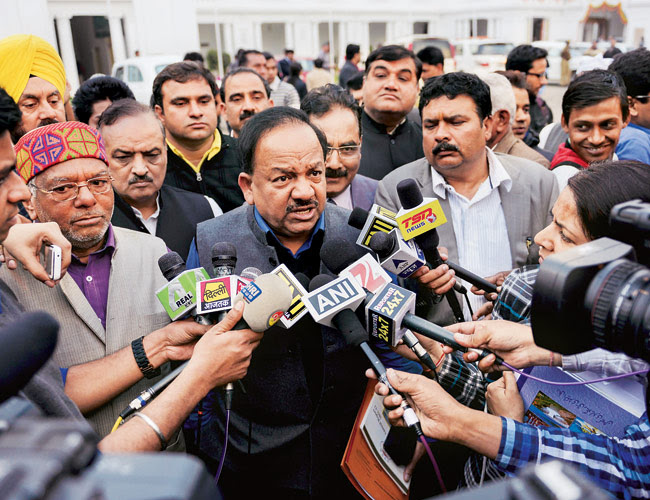
The Indian prime minister Narendra Modi’s rightwing party claimed victory in elections in two key states on Sunday, tightening its grip on power after winning national elections in May.

The Bharatiya Janata party (BJP) was leading in Maharashtra, of which the financial hub Mumbai is the capital, beating its centre-left rival Congress party which has ruled the western state for 15 years.

“BJP will definitely form the government in Maharashtra,” the BJP’s state president, Devendra Fadnavis, told reporters in Mumbai as the vote count continued.

The BJP also won in northern Haryana, which borders New Delhi, after 10 years of Congress rule of the state. The state’s outgoing chief minister, BS Hooda, said: “Like the Congress earlier got the mandate, now the BJP got the mandate and will form the government.”

Modi campaigned doggedly for the elections held last week, and the victories are likely to encourage him to push ahead with promised reforms. He won the general election on pledges to revive the ailing economy and clean up endemic corruption, but many of the reforms have yet to be introduced.

On the eve of the state results, Modi’s government lifted controls on diesel prices, aiming to give market forces greater influence on the economy, attract investment and cut subsidies.

The victories will strengthen the party’s power in the national parliament’s upper house, crucial for the passing of contentious laws. The BJP currently lacks a majority in that chamber, whose composition is based on seats won in regional assemblies.

The Delhi-based political analyst Samir Saran said the victories “allow greater space to Modi to accelerate his reforms agenda. In many ways the results signify the continuing rejection of the brand of politics on offer from the Congress and its allies at the centre and in the states. It also is confirmation of Narendra Modi as the leader with momentum.”

The BJP is expected to fall short of an outright majority in Maharashtra and could need a partner to form government. It is expected to mend ties with its ally of 25 years in Maharashtra, the far-right Shiv Sena, after deciding to campaign alone following an acrimonious split.

“I hope that the old alliance is restored once again in a crucial state like Mahrashtra,” the BJP veteran leader LK Advani said.

The BJP had won or was leading in 120 seats in Maharashtra, in tallies on the election commission’s website, while Congress was trailing with 43 in the 288-seat state assembly. Shiv Sena was leading in 59 seats.

In Haryana, the BJP was ahead in 49 of the 90 seats up for grabs, while Congress was leading in 15.

Standard
Uncategorized

India’s climate change strategy: Expanding differentiated responsibility

Samir Saran and Will Poff-Webster
07 October 2014

Original link is here 

Link of Global Policy Journal

Introduction

As the world prepares for the upcoming climate change negotiations in Lima in 2014 and Paris in 2015, there is an expectation that the talks be more decisive than previous attempts at consensus from Kyoto to Copenhagen. Yet the assumption that the undeniable science of climate change will by itself compel action on an issue that has thus far proved the mother of all collective action problems ignores the failures of past conferences. For Lima and Paris to succeed in achieving consensus, the issue of equitable response to the climate crisis must be creatively reimagined. Equity has been a challenge for climate consensus since the 1992 Rio Earth Summit first articulated that, “In view of the different contributions to global environmental degradation, States have common but differentiated responsibilities.”1

In meeting this challenge of articulating responsibilities for a climate that all share but only some have impacted substantially, India’s challenge is increasingly the world’s challenge. How can India acknowledge and respond to existing trends—the increasing urgency of confronting climate change, the energy-intensive process of achieving a semblance of development, and widening wealth gaps between rich and poor—while maintaining its focus on bringing its hundreds of millions of citizens out of poverty? In a larger sense, how can the world prevent climate degradation amid existing inequality and the aspiration of billions to rise out of poverty?

Maintaining equity between India and earlier developers

For India, the actualisation of differentiated responsibility remains central to any climate agreement. Developed countries and China have already undergone energy-intensive industrial development (and largely coal-fired electrification) to bring their people out of poverty, consuming much of the world’s carbon budget in the process. From Britain’s use of the steam engine in the early nineteenth century to China’s exponentially increasing coal capacity over the last decade, carbon-polluting energy has been essential to providing jobs for the millions who seek them in each successive industrial revolution.2 India’s coming industrial revolution and necessary shift to manufacturing, with twelve million new workers entering the workforce each year, cannot be avoided lest those millions lose the possibility of a better life.3 India’s economic transition, coming at a time when the world is finally moving toward a collective response to climate change, represents a great challenge to maintaining economic equity between India and previously industrializing powers. After all, the cost of access to prosperity must not be the highest for latecomers to industrialization. In other words, poverty cannot be frozen by a dateline.

India has acted to engage these contrasting priorities, by committing to a 20-25 percent reduction in carbon intensity by 2020—a natural consequence of increasing efficiency in the energy sector, but also a step to ensure the government’s promise that India’s per capita emissions will not go above those of wealthy countries.4 But equity suggests that India resist any effort to tie its energy intensity reduction to China’s, as the two countries have vastly different existing energy consumption and generation footprints. India starts from a lower polluting baseline compared to China and even to developed economies that have shed manufacturing—India’s use of energy per purchasing power parity dollar of economic output is 0.33 kg CO2, compared to China at 0.60 and developed countries like the United States at 0.48.5 The tendency to see China and India in hyphenated terms as large economies with growing emissions ignores the fundamental differences in their current contribution to climate change and to their vastly different economic and development landscapes.

Toward an Indian strategy

The need for global action against climate change has prompted diplomats in the developed world to speak of “win- win” situations—that transitioning to renewable energy will allow economies to reap the benefits of green jobs growth while reducing emissions. At least in India, this rhetoric rings false. Barring as-yet-insufficient technology, stuttering monetary transfer, or commercial funding from the developed world, coal will remain significantly cheaper than all other sources of energy through 2030 and perhaps beyond.6Renewables suffer from high variability in supply and base load restrictions on Indian power grids. Renewable energy development, which would be appealing from a simplistic “first, do no harm” perspective, collapses upon closer scrutiny: how should India assess the harm of more of its citizens remaining in poverty for every increase in marginal energy cost? The ethical aspect has a political dimension as well: India’s parliament will not countenance ratifying the Paris proposal unless it allows maximal focus on poverty alleviation. And even if it does, democracies have other ways to negate bad agreements, federalism being chief among them. While this is a matter for another study in itself, it must be noted that in the Indian context, the country must be viewed as a collection of thirty nations in a union. The Paris proposal must work for Indian states, or it will fail the ultimate test of implementation.

To negotiate action on climate change despite these challenges, India should promote a more fine-tuned form of differentiated responsibility — not just between countries, but within them as well. International debate thus far has been dominated by equity between countries, yet recent globalisation has caused increasing intra-national inequality as global inequality decreases.7 Even proposals for differentiated responsibility within federal systems, whether EU members, Chinese provinces, or American or Indian states, suffer from inadequate consideration of the far greater inequality within each of these smaller entities.8 India should solve this problem by introducing international emissions standards for large corporations. For instance, all corporations valued above $1 billion (or another suitable cut-off) should be subject to internationally binding efficiency standards, regardless of national origin. By decoupling protection of the poor from protection of wealthy corporations that reside within the same borders, India will focus its negotiating power on protecting its most vulnerable citizens, while also addressing large multinational corporations often unconstrained by state power. Allegations that India’s wealthy corporations hide behind its government’s focus on poverty would be allayed, and the world would be able to address climate change with differentiation and therefore equity—targeting those able to pay rather than the global poor. This would also compel the “rich” countries to act against the “carbon gaming” of their transnational corporations.

Market-oriented change

Such a negotiation strategy would enshrine an expanded differentiated responsibility, helping to solve equity concerns. Corporate emissions standards would nonetheless face several practical obstacles—balancing mandatory and transparent compliance with national sovereignty; preventing economic distortions that might inefficiently incentivize corporations to remain below $1 billion valuation or break into subsidiaries; and solving the larger challenge of corporate tax havens that would be ripe for exploitation under any international standards. As these are important issues for global governance to solve regardless, an equitable response to climate change can provide the impetus.

India can supplement this new proposal with more traditional methods of reducing emissions. India is leading the way in developing countries’ efforts on energy efficiency, a key opportunity for the eventual low-carbon transition—and one that remains truly “win-win” because energy saved from low-cost sources further reduces cost. In the latter part of the last decade alone, India’s Bureau of Energy Efficiency (BEE) doubled its energy savings in avoided generation capacity each year.9 New economic instruments like demand-side management hold the potential to reduce energy use by up to 25 percent, and the Bombay Stock Exchange’s GREENEX Index on energy-efficient stocks shows that the private sector is already taking action through market mechanisms to improve its energy efficiency.10 Lima and Paris can capitalize on such early beginnings to turn India’s ideas and experimentation into global systemic change.

Summing up

India’s challenge at the upcoming global climate talks is twofold. First, it is now time to look beyond the India-China hyphenation; it is unhelpful to India’s cause and situation. It is time to walk alone and seek specific exemptions or exceptions for India’s scale and diversity of realities.

Second, India needs to take leadership and identify constructive ways to move forward on climate change mitigation while not sacrificing the imperative of poverty alleviation. By the same token, the world’s challenge is to develop a holistic global framework that can manage the climate change threat in a world of differentiated responsibility.

By introducing intra-national differentiation between wealthy corporations and impoverished populations, Indian negotiators can help move the upcoming talks beyond past failures. These big corporations also account for a large carbon treasury and can be a low hanging fruit for both emissions reduction imperatives and to fashion a new sustainable business paradigm. Through leadership on this and other issues like energy efficiency, India can ensure its commitment both to the development of its citizens and the maintenance of the ecosystem.


1.   “Rio Declaration on Climate and Environment,” The United Nations Conference on Environment and Development,http://www.unep.org/Documents.Multilingual/Default.asp?documentid=78&articleid=1163.

2.   “China Approves Massive New Coal Capacity Despite Pollution Fears,” Reuters, http://uk.reuters.com/article/2014/01/07/china-coal-idUKL3N0K90H720140107.

3.   “Why India Must Revive Its Manufacturing Sector,” The Diplomat, http://thediplomat.com/2014/02/why-india-must-revive-its-

4.   “India Vows 20-25% Carbon Intensity Cuts,” The Times of India, http://timesofindia.indiatimes.com/india/India-vows-20-25- carbon-intensity-cuts/articleshow/5298030.cms; “India to Reduce Carbon Intensity by 24% by 2020,” The Guardian,http://www.theguardian.com/environment/2009/dec/02/india-carbon-intensity-target.

5.   “An Assessment of India’s 2020 Carbon Intensity Target,” Grantham Institute for Climate Change,https://workspace.imperial.ac.uk/climatechange/Public/pdfs/Grantham%20Report/India_2020_Grantham%20Report%20GR4. pdf.

6.   “Energy in India: The Future is Black,” The Economist, http://www.economist.com/node/21543138.

7.   “Global Income Distribution: From the Fall of the Berlin Wall to the Great Recession,” Centre for Economic Policy Research,http://www.voxeu.org/article/global-income-distribution-1988.

8.   “New Players on the World Stage: Chinese Provinces and Indian States,” The Brookings Institute,http://www.brookings.edu/research/essays/2013/new-players-on-the-world-stage.

9.   “Verified Energy Savings with the Activities of Bureau of Energy Efficiency for the year 2009-10,” National Productivity Council,http://220.156.189.23/miscellaneous/documents/energy_saving_achieved/document/Verified%20Savings%20Report%20for%202009-10.doc.

10.   “BSE S&P-Greenex,” Bombay Stock Exchange, http://www.bseindia.com/indices/DispIndex.aspx?iname=GREENX&index_Code=75&page=19D7C1A5 -BE2B-43EC-AD77- CE539070D72F; “Calibrating India’s Climate Change Response,” Courier, http://www.stanleyfoundation.org/articles.cfm?id=797.

(The writers are with Observer Research Foundation, Delhi. This paper was presented at the Council of Councils Sixth Regional Conference, September 28-30, 2014)

Courtesy : Council of Councils Sixth Regional Conference (Conference Papers: Council of Councils Ottawa Regional Conference)http://www.cfr.org/councilofcouncils/events/p33386

Standard
Politics / Globalisation

US wants stable, durable relation with India: Experts

India Today, New York Global Roundtable , September 26, 2014

Original link is here 

Mr. Saran

Samir Saran, Lisa Curtis and Bruce Jones


The United States is looking for a stable and durable relation with India but a lot will depend on how both sides will align themselves on various global issues be it Ukraine, climate change or terrorism, experts said at the India Today Global Roundtable in New York on Friday.

India has the financial and diplomatic resources today to take forward its interests but Washington will want a stable relation with New Delhi, Bruce Jones, the director of Project on International Order and Strategy, Brookings Institution, said.

The US will like to see how India contributes on global issues. The nuances are tricky but a lot will depend on how New Delhi responds to Washington’s aspirations, he said.

Referring to the BRICS grouping, he said there is a lot of positivity in that initiative, for instance, the BRICS Bank project is a good move but Russia has also created problems in Ukraine and India cannot afford to overlook these issues which will cost its ties with the US.

The World Bank certainly needs a competitor; the Western model of development is pretty poor, he said, adding India’s penchant to ignore Russia’s excesses may hinder its ties with the US.

Lisa Curtis, senior research fellow at Heritage Foundation, said India being a multi-religious multi-ethnic democracy there is a lot of converging interests between India and the US.

The recent trade agreement between India and Japan is quite significant. Japan has committed $35 billion to India. Chinese President Xi Jinping’s visit, however, did not go so well due to the border tensions. The US, however, would never commit such huge sums of money. It is for the private sector to do so, she said.

Standard
In the News

Embrace of Social Media Aids Flood Victims in Kashmir

Asia Pacific, New York Times

Original link is here

SRINAGAR, Kashmir — Early this week, as the flooding in Kashmir was entering a new and terrifying phase, the Indian Army’s public information office received a call from Raheel Khursheed, a former journalist and digital obsessive who serves as the director of news, politics and government at Twitter India. He had a proposal.

Over the weekend, floodwaters had inundated ground-floor equipment rooms for most of the region’s telecommunications service providers, crashing cellphone networks across the state. Local officials had no way to contact the federal government, or one another, or the army, which had been mobilized as part of a rescue effort. Though the army has satellite phones, they were of little help without knowing where people were waiting for rescue.

There was one place where information was flowing at a nearly unmanageable volume, and that was on social media.


ss1

Distributing relief goods in Srinagar, Kashmir, on Friday. With telecommunications largely knocked out, social media has helped rescuers locate people.


So many messages were surging into Twitter under the hashtag #KashmirFloods that on Tuesday Mr. Khursheed’s colleagues commissioned a piece of code that could winnow out those that identified stranded people. He then called the Indian Army — which has only two officers permanently assigned to monitor social-media postings — to offer the authorities a slimmed-down, organized feed that he described as “a continuously updating stream of ‘save me’s”.

ss2

More than 400 people have died in the disaster in India and Pakistan, while some 130,000 have been rescued from the flood zone, authorities said.


“We are always organizing data at Twitter,” said Mr. Khursheed, 31. “It just seemed to me to be the most obvious thing to do: How is it that we can, as a platform, make it easier for the army to do what it needs to do?”

In this week’s frantic rescue effort, one unexpected development is thearmy’s use of Twitter, WhatsApp, a messaging service, and Facebook to reach families. Twenty years ago, when social media first emerged, India’s government — like its counterparts in Beijing and Moscow — regarded it warily, as a force that could undermine state power. In the restive, majority-Muslim region of Kashmir, in particular, state authorities have been swift to block access to material they considered incendiary.

However, as this week’s rescue efforts suggest, “the government is now seeking to conduct its business through these media,” said Samir Saran, a policy analyst who worked as telecommunications executive in the early 2000s. One driver of this change, he said, is the new prime minister,Narendra Modi, who regards social media as a central link to the public. Mr. Modi’s example has filtered through the system.

“If they see a man at the top embracing this form of communication — when you have someone who is bypassing traditional media and communicating this way — that is a sign,” said Mr. Saran, a senior fellow at the Observer Research Foundation, a policy research group based in New Delhi. “You don’t have to be told more.”

Relief efforts continued on Friday in Srinagar, where rescue workers described watching people tie bodies to trees and electrical poles to keep them from washing away. Facing mounting public anger, Omar Abdullah, the chief minister of Jammu and Kashmir State, told NDTV, an Indian news channel, that during the first days of the crisis, as floodwaters inundated the capital, “I had no government.”


“My secretariat, the police headquarters, the control room, fire services, hospitals, all the infrastructure was underwater,” he said. “I had no cellphone and no connectivity. I am now starting to track down ministers and officers. Today I met ministers who were swept up by the floods.”

The authorities said Friday that 130,000 people had been rescued from the flood zone. More than 400 have died in the disaster in India and Pakistan.

In a near communications vacuum, 3G Internet connections remained usable, and those lucky enough to have them found themselves inundated with distress calls.

Manisha Kaul, 21, who was carried to safety on a raft on Tuesday, discovered that her telephone number had been published on Facebook. She receives five or six text messages a day from strangers, describing their relatives and asking her to let them know if she spotted them. She delivers a daily list to a search-and-rescue headquarters. “Under the circumstances,” she said, “this is the best we can do.”

At Twitter India, the goal was to prune some 400,000 flood-related messages into a “smartfeed,” something that has been done for sports, news and live events, but never for an emergency. The list of distress calls would then be sent in multiple directions, feeding into a “Person Finder” built byGoogle and provided to the army’s public information office, which had previously consulted with Mr. Khursheed about using social media.

Maj. Gen. Shokin Chauhan, who leads the office, said the stream of information was reviewed by “a dedicated team of two young officers who handle the social media,” and who were “working practically around the clock.”

He said the army had assisted about 12,000 people whose cases were reported over social media.

This week, Mr. Saran recalled that some Indian leaders had inveighed against social media as recently as February. The home minister then, Sushil Kumar Shinde, who was upset by reports that the Congress party would perform badly in parliamentary elections, vowed to use state intelligence to “crush such elements in the electronic media, which are indulging in false propaganda.”

But that resistance faded as political parties adopted social-media strategies, again as a result of Mr. Modi’s election.

The number of Internet users in India is expected to surpass that of the United States this year, according to a study released by Google India and A. T. Kearney. It also predicted that the number of mobile-Internet users in India would triple by 2017, to 480 million from 155 million. As a platform, Mr. Saran said, social media is already integrated into India’s often lively public debate.

“We enjoy it, because India loves melodrama,” Mr. Saran said. “Unless we can hear people screaming and shouting and abusing each other, we aren’t happy. We are bitter, we are angry, we are loud, and at the end of the day, everyone in his own way is loving to be an Indian.”

Hari Kumar contributed reporting from New Delhi.


Standard
Columns/Op-Eds, Uncategorized, Water / Climate

As communications infrastructure collapses, social media is saving lives in J&K

20:32 GMT, 9 September 2014, Mail Online India

Original Link is here

Tragedy has struck Kashmir once again.

That it is perhaps the severest since Independence is undeniable.

The human despair, spirit and resolve are all on display, and the entire country (real and virtual) seems affected by nature’s cruel intervention.

The efforts to rescue those stranded are feeble as the institutions, infrastructure and administrative resilience have been found wanting – yet precisely because of this, the courage and heroic efforts of individuals and some organisations stand out in stark contrast.

SS 1
Floods: The entire country (real and virtual) seems affected by nature’s cruel intervention.


Even as the embankments built in the times of the Maharaja have been breached by ravaging waters, the unfolding tragedy and response is also about the ‘angels or demons’, depending on your take on it – Social Media and the Armed Forces.

A recent report in a leading daily had one of the most powerful men in India, its Home Secretary, observe, “I simply cannot speak to anyone in J&K.”

The last 72 hours have seen the near total collapse of the phone network, and power lines have collapsed. This has complicated coordination and rescue, because stranded people have no way of telling rescue centres of their plight.

Worse still, Delhi is cut off from the Government of J&K, while the Government of J&K is cut off from the army, which is coordinating rescue efforts.

The army is the only body there that has managed to maintain some semblance of intra-organisational communications due to satellite phones. However, it has no way of knowing the location where people are stranded, or how many and how critical their situation is, since the normal method – air reconnaissance – is difficult at best given the cloud cover and weather.

And the much-vilified social media is coming to the rescue. Even as large parts of the mobile communication infrastructure have collapsed, some wireless communication and the traditional wire line communication networks have allowed people access to social media and various messenger services, websites, and some agencies.

SS 2

To the rescue: Social media has helped save the stranded


It has also allowed a degree of dissemination of situational reports, videos and distress messages, many of which have reached the army.

Whatsapp, FB messenger, Twitter and others are the most potent tools for the rescue teams in the valley today.

As a result what we have is the army using satellite phones to communicate, but basing its rescue efforts significantly on guidance from Whatsapp, Facebook and Twitter.

In that sense these have effectively replaced the search helicopter, the emergency beacon and the communications network of the valley.

For the governments at the Centre and in the state of J&K, which have frequently demonised social media, this must be a moment of revelation.

In February this year, the then Home Minister, Sushil Kumar Shinde, had vowed to “crush social media” to great applause from within his party and some others.

Yet today the home secretary cut a sorry figure, claiming “there is no means to communicate with anybody” till the 15 wireless systems he has sent to be set up in the valley come online.

Social Media, angel or demon? Let the debate begin.

The second story is that of the ‘men in green, blue and white’. Among the nation’s armed forces, they are reviled by a few liberals and a section of those in Kashmir, at the receiving end of Pakistani venom and terror, and frequently derided by the political class in the state and centre.

Yet had it not been for the army’s rescue teams and its “infrastructure of occupation,” as secessionists would call it, how many more lives would have been lost?

At a time when the democratically-elected government of J&K has failed in its civic duties in buttressing the embankments (which they should have known about anyway) and a home ministry that is fumbling in the dark, it is this supposed villain that has come out as the knight in shining armour.

It is this same “infrastructure of occupation” – helipads built on apple orchards, hospitals built on peach orchards and supply dumps built on farm land – that are now being used so effectively to rescue the stranded, treat the wounded, and provide relief supplies to the displaced.

It is this same infrastructure with its bulldozers that is being used to clear roads, and the army trucks that sustain the “occupation” that are being used to ferry in essential supplies for the “occupied”.

Given the police, local government and central government networks failed within the first few hours of the flood and the Doordarshan system which could be used as an emergency communications system also collapsed in this period, it has been the army’s communication systems that have provided the only link between J&K and the rest of the country.

It is the maligned Armed Forces Special Powers Act used to “suppress” Kashmiris, that the army is using to deliver critical supplies to the “occupied”.

And yet vultures who some in Kashmir refer to as “freedom fighters”, would rather support infiltration even at this time, then help their brethren. The IAF, let this debate end.

This is not to say that social media and the deployment of the Armed Forces are always virtuous. The use of social media for malicious purposes is proven. The use of the medium to incite and radicalise is also rampant.

Yet it is a force for good as we saw this past week.

Challenge and vilify the user, do not condemn the tool.

Similarly, the deployment of armed forces has resulted in actions that are highly avoidable. Some of their heavy-handed interventions have resulted in justifiable anger and resentment.

Here again, challenge the political mandate and policy direction from the government, not the army, which remains a force for good.

The writer is vice president at the Observer Research Foundation. His twitter handle is @samirsaran


Standard
Columns/Op-Eds

I love being an Editor

 Mail Today | New Delhi, August 31, 2014 | UPDATED 10:43 IST
Original link is here 

The editor’s free articulation of his views can ensure voices of public figures can often be drowned out.

I am a noble soul and was a spiritual glint in my parent’s eyes. I am the editor of a newsroom in the mightiest democracy of the developing world. I have immense responsibilities; to my image, to my brand, to my viewers and to my ever growing legion of fans. News is all about perceptions and I am the master conjurer; I love stoking your imagination and I love being an Editor.

For the last twenty-five years I have been part of a great game that I first devised and then played, with the rules always keeping up with my moods. News is, but a reason that brings me and mine closer, our monologue is what defines the nation, my sermons are what weaves together the believers and my outbursts are what keep the nation straight. I answer to a higher calling and carry a spiritual burden. I love being a digital gladiator, I love being an Editor.

I am the toast of the town. I have the best cars, reside in posh parts of town, host the fanciest of parties and am invited to every classy bash. Everyone who is anyone has my mobile number. Those who want to be someone, want my number. The numbers I delete are of those about to be obsolete. My recommendations for minister, for constitutional posts, for everything that means anything under the Indian sun, count for everything. I love being the hub, I love being an Editor.

Edicts

The past two decades or more of political chaos were the cue for me to assume leadership. In the absence of a worthy national leader, every ram, shyam and ghanshyam, in or out of the cabinet,tripped over themselves to give me a scoop -through leaked cabinet papers, or edited taped conversations. I know about government decisions before they happen. My voice on prime time is the national edict of the day. My criticism rolls back domestic policies and my whims lead to or prevent international crisis. I love being responsible. I love having the troubles of the world rest on my broad shoulder, I love being an Editor.

The Clintons talk to me of their plans and Kerry curries favour with me. I discuss the Middle-East with the Sheikh, human rights with The Aga Khan and secularism with the Pope. I know more about climate change, trade, IPR and security than I care to remember. Yet, my humility allows me to invite meek voices on my show. I need them as I need to share my wisdom. It is my adherence to the highest principles of corporate social responsibility that makes me share my studio with lesser beings. I love being humble. I love being an Editor.

What impresses me most about myself is how politically correct I am. I question the morals of politicians and businesses and babus and all the wayward souls. I fight to keep my studio mine alone. It is an endowment from the almighty. I resist any attempt by any political party, ideology or business agenda to capture this sacred space.

I show great accommodation when the nation seeks it. I allow colleagues to promote political agendas for months before finally taking the plunge and joining a political party. This is not space capture by a political unit as some have observed. This is a training programme for becoming spokespersons of political parties. I love grooming leaders. I love being an Editor.

Business

My job requires courage and this is what excites me most. I stand besides booming guns in the Himalayas because this makes for good TV. Yes, the infantry may cop a bit of counter fire – but that is the nature of the beast and brutes. I courageously describe the progress of counter terror operations in Mumbai to our next door neighbour, because you see news is global, information is power and would it be fair to deny me to the rest of the world? I love being valourous, I love being an Editor.

I hate the corporates and everything they stand for. They take credit for creating the business we’re in. Just because they created the platform, the networks and provided the technology and funds? Huh! They’re missing the wood for the trees because ‘I am Content’ and therefore I am the business.

Accountability

I hate their demanding accountability from the newsroom. What do they know about the power of this space? Or, how to exercise it. After all, did I not suppress a coal scam or two or a pharmaceutical fraud with sophistry? Did I not exonerate guilty as hell CEOs in the court of public opinion? Heck! Did I not cover up my virtuous friends land grabs in and around Delhi? I hate transparency, cloak and dagger love is so much fun. I love all the deals in the dark. I love being an Editor.

But the moment seems to be slipping away and a new game is in town. A man elected by the masses is in power, a government with a mandate to govern is on the job. And these accursed ministers appointed without my blessings. Aagh! Journalism through “access”, once a fine art is now dying, much like those dying crafts this nation hates to treasure and preserve. I feature in my sob stories every now and then. Self-pity is my companion, international press my friend. I’ll have to bide my time. Better still, I think I’ll perfect the prototype of a new-age victim. I love being a martyr, I loved being an Editor.

The writer is vice president at the Observer Research Foundation and tweets as @samirsaran

Standard
Columns/Op-Eds, Non-Traditional Security, Politics / Globalisation

The European Union as a Security Actor

View from India

Bundeszentrale für politische Bildung Logo

Original link is here

Das Bild zeigt die Glastüren des Haupteingangs zum Europapalast in Straßburg, Sitz des Europarats. Die Türen sind mit Euro-Sternen verziert.

Euro-Sterne auf den Glastüren des Hauptportals zum Palais de l’Europe, Sitz des Europarats in Straßburg. (© Ulrich Baumgarten/vario images)


What is a security actor and how is it different from being a great or major power? In many ways, this question is central to understanding the lack of appreciation of the European Union (EU) as an actor in the security arena in India and certainly in some other parts of Asia. The use of the word ‘security actor’ by EU agencies and research institutes is itself perhaps a neutralisation of the phrase ‘major power’. This reveals the ambivalence of the EU to power in contemporary times, despite having given the world several great powers in the past. This ambivalence, and the hesitant Asian comprehension of the EU’s role in the security domain shape the current debate.

However, to move beyond this general understanding and to try and understand the Indian perspective on this issue, three key enquiries are essential. First, does the EU have the agency to be a security actor? Second, does it have the capability and capacity to follow through in this role? And, finally, does the EU, or a significant part thereof, see itself as a Security Actor?

Agency: Who do I call?

The EU is a great economic power and is central to the construction of any polycentric order. In spite of this, it is not viewed as a security actor. Perhaps this can in part be explained by what Henry Kissinger once famously said, in an interview with Der Spiegel, ‘Who do I call if I want to call Europe?’. While the EU now has a number of structures that deal with security its security policy has not evolved to the point where it can shape emerging international security scenarios.

The principal issue is that of integration. Collectively, it appears that the EU thinks of itself more as a civil and economic power, viewing military instruments as an option of last resort. Within the EU, France and the United Kingdom have a different approach in which use of force, or the threat of the use of force is a prominent instrument in their toolbox. Some others like Germany tend to take the opposite view and are generally more reluctant to sanction the use of force.

This can have consequences like France declaring that its permanent membership of the United Nations Security Council will remain a French seat and will not be ceded to the EU. France has also rejected the validity of a UN veto when humanitarian crises loom (as was the case in Syria)[1]. These two French positions have led to both disappointment and alarm in other members of the EU. Damagingly for the EU, the latest crisis in Europe, i.e. the occupation and annexation of the Crimean Peninsula by Russia, has only confirmed this apprehension. The lack of a coordinated EU response is disconcerting, as what we have is a set of nations individually condemning Russian actions and others staying silent.

Trade and commerce across the EU is now so integrated that it allows for similar perceptions and ideas on most macro and several micro economic policies. This allows the EU far greater cohesion and therefore, weight in trade talks. On the other hand, political approaches and realities in each member country vary dramatically. This dissonance between a cohesive economic union and a relatively divided political union has a significant impact on the perception of the EU in a continent like Asia where the realist paradigm dominates. The EU is likely to be seen as a ‘hyper-successful’ regional trading and economic arrangement, but not a unified security actor or a ‘great power’. It is also seen to be creating a large political and security bureaucracy, which churns out some strategic and security objectives, without seeking to possess the hard power elements to realise these set of goals.

Capacity: Acute Deficit

Capacity is the key element that will define the EU’s ability in the Asian theatre. In 2012, as per the International Institute of Strategic Studies’ (IISS, London) estimates, Asian defence expenditure exceeded Europe’s. Indeed within the EU, member states are increasingly hesitant to commit towards defence expenditure. Additionally, the focus of current expenditure is on capabilities that are not decisive in the Asia-Pacific theatre or suitable for hard power projection in the classic sense. There is little political and public support for defence expenditure when social spending is deemed a higher priority.

As a result, the EU’s ability to play a role in the international system is going to be far more constrained than ever before. This is perhaps evidenced by the fact that not a single European or EU action has been carried out without US support even when taking on vastly inferior militaries like those of Serbia or Libya.

This acute capacity deficit means that if the EU chooses to act by itself, it comes up against the various perceptions among the EU member states on its role as security actor. On the other hand, if it chooses to act through the agency of NATO to bypass this internal dissonance, it is fundamentally dependant on the US for capacity.

Self-View: “Empire of Norms”

The recent description of the EU being an ’empire of norms’ is another important facet of the view of the EU as a security actor.[2] It connotes a renunciation of the modes and methods of traditional empires in favour of one that leads by example and rules, largely renouncing the use of force and prioritising economic integration. In this, the EU has something to teach the world; the postmodern construction of international relations. But beyond the EU, the post 1989 sense of euphoria, has not translated into political evolution that suggest support for any such new approach to sovereign relations.

The EU firmly believes it has entered a post modern world, whereas in reality much collective action today is directed towards pre-modern situations like Afghanistan, Iraq and Libya. To use an Americanism, ‘when you don’t have dirty work to do you can be dressed in white clothes’. As a result, when the EU piggybacks on US hard power, it can well afford to play the ’empire of norms’ role. This harks back to India in the 1950s and 1960s when India was ‘preachy’[3], telling Europe to peacefully coexist with the USSR, substituting rhetoric, largely to compensate for acute structural weaknesses. Today, India and Europe have traded places and the projection of EU rhetoric is seen as a sign of weakness, borne out by the structural factors discussed earlier.

View from Asia 1: Largely favourable

Immediately after World War II, the main goal was peace and stability and hence there was the need for a specific role for the set of actors who could provide this. But in the 21st century, the narrative has changed. Economic growth and prosperity, in an age of stagnant industrial growth, is the overarching political priority of these times. Even though the world may have moved beyond the post-war quest for peace, to the singular objective of greater economic vibrancy, the EU’s role in securing this objective cannot be denied given its economic agency. However, political stability is a necessary condition for sustainable growth and economic well-being. This stability is to be created and preserved collectively by the old and new powers. Therefore in Asia, in countries such as India, there exists a largely favourable view of the EU’s role in the world. India sees a decisive security role for the EU, albeit as an agent of ‘The Asian Century’.

Following from this, if the EU is a decisive player in the contemporary context, European hard power is not necessarily viewed unfavourably and is a situation that India can negotiate well. A strong EU is good for the balance of power and stability in Eurasia and therefore favourable to India. In fact, a not so uncommon view in India is that if there is a decline in the EU’s hard power, it might contribute to flux in the balance of power in Eurasia, leading to instability. Thus, the EU is still seen as a decisive actor in the security dynamics of Asia. And a real example is the EU’s arms embargo on China, which could be said to contribute to stability in Asia.

However, in India, the EU is also seen as hypocritical in its application and espousal of rules and norms. This is sometimes inimical to the larger objective of stability and prosperity because the EU is perceived to be trying to impose normative frameworks on societies, which are not yet ready to accept them. This is not necessarily an EU-specific flaw. Every country has displayed this hypocrisy where its core interests are at stake. India itself follows a very different set of rules in its own neighbourhood than in the rest of the world. For example, India intervened decisively in 1971 in Bangladesh and for much of the 1980s and 1990s in Sri Lanka. But where its core interests are not at stake, it adopts a very different stance.

While largely hypothetical, India’s main concerns, should the EU decide to play the role of a security actor would be: where and how does the EU want to operate? Does it merely look at its periphery? Or does it seek to project out? If it operates for longer periods of time in Asia, will it be in a continental or a maritime role? Given that the naval dimension and the security dynamics of the Indian Ocean have largely driven much of India’s strategic realignment post 1990, India would almost certainly welcome EU as an offshore balancer. This is evident from the fact that India welcomed the EU-led operation Atalanta aimed at controlling piracy off the coast of East Africa. Similarly, India voiced no concerns at the build up of a formidable projection force off the proximate Myanmar coast following cyclone Nargis, and actively cooperated with US and European navies in the wake of the Boxing Day tsunami in 2004.

View from Asia 2: Geography and Sovereignty Matter

Multiple path dependencies, along with the overarching economic prosperity objective mean that the EU’s cost-benefit analysis of engaging in Asia, for example, is very different from India’s. The EU would have more to lose economically in any prolonged military engagement in Asia and therefore prefers economic tools such as sanctions. Of course geography matters not just to the EU. This is evident in how India perceived Bangladesh in 1971 and how it perceives the situation in Syria today. In the case of the former, the instability in India’s neighbourhood had a direct impact on India’s demography and security and the cost-benefit analysis of action was very different to the likely costs of EU’s action in the region. Syria, on the other hand, was more of a normative issue for India on how it balanced humanitarian intervention against a breach of the Chemical Weapons Convention (CWC); whereas Syria had a more proximate impact on Europe and subsequently on its cost-benefit analysis of action.

Lastly, in a continent like Asia that has a history of being colonised, sovereignty is an important consideration. From this perspective, the EU’s rather relaxed interpretation of sovereignty, partly used in its explanations for humanitarian interventions, can be seen as unsettling. Moreover, the selective use of sovereignty can erode the credibility of the EU as a whole. For example, defence sales such as those of the Rafale, Gripen or Eurofighter are carried out under sovereign flags and these in turn guarantee certain sovereignties to recipient countries. However, when uncomfortable decisions are taken such as the arms embargo on China, the EU is used as the shield, effectively a policy of safety in numbers.[4] This means bilateral brownie points accrue to individual sovereign constituents of the EU, without translating into advantages to the EU as a whole. However, disadvantages and the resultant negative perceptions are spread across the board and impact on the image of the collective.

Conclusion: Going Forward

Going forward, there are four central cleavages between the Indian and European worldviews.

The first has to necessarily be language and the principle source of information that shapes Indian understanding of Europe and EU. Not having a core of experts trained in European languages, a disproportionately small foreign service and a structural incapability to collect primary data[5], much analysis of Europe and the EU rests on secondary source analysis of a euro-sceptic English language press. Consequently, the nature of the EU’s decision making remains even more of a mystery to Indian audiences.

The second is that the EU (for reasons already discussed) is not viewed in India as a credible security actor. In fact, Europe’s recent humanitarian interventions are seen as creating dangerous precedents in Asia, changing the security dynamics in the region and creating fresh security challenges which the EU does not have the capability to deal with. This is where India and the EU are on a collision course. India wants Europe to be more cognisant of its hard security role. In addition, India wants the EU to be responsive to emerging security issues, which will be shaped by new specificities and geographies of conflict. Local understanding and localised responses would be in order and Europe must begin to engage from within and not from outside.

The third is with regard to global governance. European institutes tend to securitise the global commons and global public goods discourse.[6] Every economic and social service provision is being subsumed under a security discourse. This approach may be useful to galvanise public opinion in the Euro-Atlantic community; but in Asia, where societies are still evolving and discovering a balance of narratives between the political and military discourse, it could be dangerous and counterproductive. In countries like Pakistan and Bangladesh, if water, environment and trade become security narratives, discussions within and among these regional countries would essentially become zero sum games. Additionally, the preponderance of the military architecture and defence bureaucracy diminishes the role of democratic institutions and the role of civilian governments. This is counterproductive to the liberal democratic value system that EU espouses. It may appear that in order to compensate for its lack of military heft, the EU seeks to overbalance through the securitisation narratives.

Finally, the central division between the EU and India is the tyranny of grammar. Europe and the EU pursue their interests under the grammar of values, which is sought to be achieved through ideological underpinnings. India has sometimes also couched many of its strategic interests in its own grammar of ethics. Till a new language is discovered where the two can negotiate their individual interests (doing away with ideological sermonising), common ground (based on core interests of prosperity, growth and liberal market framework) will be lost to a rather unnecessary battle of perceived virtues.

Fußnoten

1.
Opinion expressed by French Foreign Minister, Laurent Fabius, 5 October 2013, »ambafrance-in.org«.
2.
Jan Zielonka, »Europe as a Global Actor: Empire by example? (PDF)«, International Affairs, 84(3), 2008.
3.
Bhaskar Roy, ‘Tharoor questions Nehruvian line’, 10 January 2010, »timesofindia.indiatimes.com«
4.
‘Tharoor for overhaul of Foreign Service Recruitment System’, 8 October 2012, »thehindubusinessline.com«
5.
For example, when Finland wishes to raise uncomfortable issues with Turkey, »finnbay.com«.
6.
See, for instance, ‘The securitisation of climate change in the European Union’, »climateandsecurity.org«

Samir Saran is vice president at the Observer Research Foundation, India’s premier public policy think tank. Besides heading the business of the foundation, he writes extensively on and researches issues such as south-south cooperation, role for BRICS, cyber governance, economic and politics of climate change and trans-boundary water governance.


Dieser Text ist unter der Creatie Commons Lizenz veröffentlicht. by-nc-nd/3.0/de/
Der Name des Autors/Rechteinhabers soll wie folgt genannt werden: byc-nd/3.0/de/ Autor: Samir Saran für bpb.de
Standard
BRICS, Columns/Op-Eds, Politics / Globalisation

Waking up to the BRICS

Opinion» Lead 

Original link is here

BRICS members should democratise the New Development Bank’s functioning if new stakeholders are included in the future. If anything, the NDB must be a template for change, not a mirror to the existing hegemony of money

In his 2001 paper titled “Building Better Global Economic BRICs”, economist Jim O’Neill of Goldman Sachs calculated that “if the 2001/2002 outlook were to be extrapolated, over the next decade, China would be “as big as Germany” and Brazil and India “not far behind Italy” on a current GDP basis. Cut to 2013; Jim O’ Neill’s expectations seem modest. Last year, China was the world’s second largest economy, Brazil ahead of Italy and India just one rank behind in terms of current GDP. In purchasing power parity (PPP) terms, all the BRIC countries were within the top 10, with China and India at second and third position respectively. BRIC, in Wall Street lingo, is an “outperformer.”

Despite the crippling financial crisis, BRIC has done better on pure economic terms than most expectations. But the acronym is today representative of much more than an investment narrative alone. With the inclusion of South Africa, BRIC became BRICS, giving a pluralist and inclusive veneer to an economic idea. This group now has a significant political dimension, as is evidenced by the increasing number of converging positions on political issues.

In a follow-up paper in 2003, titled, “Dreaming with BRICs: The Path to 2050,” Goldman Sachs claimed that by 2050, the list of the world’s largest 10 economies would look very different. It is remarkable then, that in 2014 the list already looks radically different, and it is clear that it is time to “wake up” to the BRICS.

NDB versus existing banks

In this context there were at least two concrete arrangements inked at the sixth BRICS Summit in July, which will have a large economic and political impact. These were the Contingent Reserve Arrangement and the New Development Bank (NDB). Conversations and reportage on these two were shrill, coloured and obtuse in the run-up to the Summit. It continues to follow in the same vein. Indeed the NDB is at once the most celebrated and critiqued outcome of the Fortaleza Summit. Now that we are a few weeks away from its public conception, it is time for a reality check on this widely discussed BRICS achievement.

The first reality is the NDB can neither replace nor supplant the role of the existing development banks. The NDB will not be able to compete with the reach and expanse of existing institutions such as the World Bank, which has a subscribed capital of over $223 billion. The bank borrows $30 billion annually by issuing Triple-A rated debt in international bond markets. Such easy access to capital markets on the back of high promoter creditworthiness allows the bank to have a lower cost of funds. Other development finance institutions enjoy similar financial backing. The Asian Development Bank (ADB) too has a large balance sheet, backed by 67 member nations and a subscribed capital of $162 billion.

In contrast, the NDB will require over half a decade before it can accumulate the stated capital base of $50 billion from within BRICS and another $50 billion (approximately) from other countries and institutions. Indeed, in the immediate term, only a modest $150 million has been promised by each of the BRICS countries. A contribution of $1,850 million thereafter, staggered over five to six years, will require some doing as the BRICS countries are grappling with weak balance sheets, fragile current accounts and other domestic imperatives.

Then, there are other questions that will need to be answered in the days ahead. If China is unable to dominate this institution, will it prefer to prioritise investments through its (proposed) Asian Infrastructure Investment Bank? How soon can the central banks of the member countries devise arrangements to act as depository institutions for the NDB? And, how will the NDB raise funds in different countries? What will be the currency or currencies of choice? All important posers which can be addressed if the resolve is unerring.

Development finance

The second reality is, in spite of its modest economic weight in the initial years, the NDB can change the ethos of development finance irreversibly. Rather than replacing or supplanting existing development finance institutions, the NDB will seek to supplement existing resources. In fact, the World Bank President, Jim Yong Kim, has welcomed the idea of the NDB and acknowledged its potential in infrastructure development and the global fight against poverty.

An important difference could be in the way conditions and restrictions are imposed on loan recipients. Bretton Woods Institutions such as the World Bank have been known to impose conditions for lending that create structural mismatches between project funding, demand and supply. As recently as last year, the World Bank Group decided to restrict funding for new coal plants in developing countries, deciding instead to invest greater resources in “cleaner” fuels. Of course, the World Bank would be well advised to reconsider this decision given lifeline energy needs and the energy access realities in developing countries such as India.

The NDB’s mission must be to create a business structure where borrowing countries are given greater agency in prioritising the kinds of projects they would want funded. Over a decade, this could become the demonstrator project through which the relationship between donors and recipients, lenders and borrowers, will be rewritten. Hopefully this will be in favour of developing economies and will enable the reimagining of economic pathways.

Location and ownership

The third reality — perhaps, the most debated — is that the location of the NDB is immaterial when governance and ownership is equally shared. Location has frequently been confused with ownership, skewed by our imagination of existing institutions such as the World Bank. According to its Articles of Agreement, major policy decisions at the World Bank are made through a Super Majority — 85 per cent of votes. Vote shares in turn are determined by the level of a nation’s financial contribution. With around 16 per cent voting share at the World Bank, the U.S. has a de facto veto. Conversely, BRICS, with 40 per cent of the global population and a combined GDP of $24 trillion (PPP), collectively accounts for a mere 13 per cent of the votes at the World Bank.

As such, the concentration of voting power and headquarter location in Washington DC in the case of the World Bank is merely a coincidence. Japan dominates the functioning of the ADB with a 15.7 per cent shareholding, despite the headquarters being located in the Philippines.

It is also useful to note that previous World Bank presidents have been U.S. citizens and the International Monetary Fund’s (IMF) list of managing directors is composed entirely of Europeans. Even the ADB’s presidents have been Japanese citizens, with almost all of them having served in the Finance Ministry in Tokyo. In this regard, the NDB, with its intention of rotating leadership, seeks to overhaul the existing governance framework prevalent in the international development finance institutions. Through equal shares of paid-in capital in the NDB, there is a clear intention of creating an alternative model that focusses on voting-power parity. The smallest country can negotiate at par with the biggest country.

Will BRICS create a framework that is as democratic in sharing governance space with other investors and stakeholders? This will be something to watch for as the systems and structures evolve. The notion that the NDB has been “Shanghai-ed” is perhaps a shallow understanding of this exciting new initiative.

With an equal voting share, all five countries have to be on board to move in a particular direction. Admittedly, this can be hugely inefficient and troublesome. Therefore, it is incumbent upon BRICS members to ensure that this initial at-par equity in governance does not unexpectedly allow for a super majority like gridlock, restricting decision making because of a lack of consensus. The NDB must be dynamic and lithe, much like the BRICS grouping itself. It would be useful for BRICS members to institute a professional management body for steering everyday operations of the NDB as well as all non-policy related decisions, including those dealing with project funding.

And most importantly, as discussed earlier, BRICS members should democratise the bank’s functioning if new stakeholders are included in the future. They must find ways to engage the recipients and beneficiaries in its decision-making apparatus. If anything, the NDB must be a template for change, not a mirror to the existing hegemony of money.

(Samir Saran is vice-president at the Observer Research Foundation and available at @samirsaran on Twitter.)

Standard

Rebalance and Reform Pic

Books / Papers, Columns/Op-Eds, In the News, Politics / Globalisation

Rebalance & Reform : An Agenda for The New Government

Image