Original link is here
10 September 2015 12:00PM, the interpreter
Original link is here

At a discussion in Washington DC this spring, I was quizzed with a degree of annoyance on the multiple messages coming out of New Delhi with respect to India’s position on a global agreement to combat climate change. In the same discussion there was also an exasperated inquisition on why Indian needs and priorities must hold the world to ransom (as if there were a consensus) and why India imagines that it merits a special space, attention or exception in the climate arena.
The response to these two central propositions on India and climate change must of course come from the officialdom at Raisina Hills, home to Delhi’s executive offices. However, as we move down the road to COP 21 in Paris, it is crucial that any response, if formulated and then communicated (a bigger ‘if’), would need to engage with the most important climate proposition put before India by the world, and its interplay with the country’s development/growth imperatives.
Viewed from New Delhi, and after sifting through the chaff, the proposition for India’s climate change response posed by a large section of OECD countries, and certainly from the influential capitals in Europe, is fairly straightforward:
My response to the thesis of ‘Indian exceptionalism’ therefore is that India does not seek to be an exception, but the demands imposed upon it that will require it to be exceptional. This is a truth for others to accept, and the climate reality for which India must discover creative policy. Three distinct narratives among various actors in India have so far shaped its response.
The first set of responses is from a group of people I like to call India’s ‘cold war warriors’. This group believes that no matter the contemporary political, economic and environmental reality, an alternate universe can be constructed through the mandate of the UNFCCC. These persons are the architects of the global intergovernmental processes and have faith in them. They believe that an agreement in Paris this December at COP 21, that is sensitive to Indian needs, will somehow assist in the transition required by India and will ensure that India only needs to make incremental changes to its ‘business as usual’ approach to economic growth and development. This group has ignored the changing economic system, which is increasingly disinvesting from fossil fuels politically, and in terms of financial flows and promoting green energy markets. The ‘green’ economic and market realities that will shape India’s future are seen as something that can be circumvented by creatively crafted text and clauses in a legal (read weak legal agreement) agreement in Paris. Despite 20 years of failure to achieve this ‘world of equity’ with ‘differentiated responsibility’ they continue to believe that a global agreement is the end in itself.
The second set of strategies to the proposition facing India are advanced by a group I refer to as the climate evangelists. They believe that 2050 is already upon us. Commercially viable clean energy solutions are available, and these hold the answer to both our immediate and future energy woes. The opportunities that exist in the creation of a new green economy must be grabbed with both hands. This group wants subsidies and incentives for clean energy technology, and taxes and regulation of fossil fuels. These green pioneers are sanguine that sufficient ‘push’ and ‘pull’ will deliver technology innovation and development on the requisite scale. They reject that fossil fuels are necessary as baseline sources of energy and instead insist that the technological revolution is already here, and that India must get on board or be left behind. Their argument is often a moral one: we have a moral obligation to save the earth for its own sake and for future generations – ignoring the fact that at this level of income disparity, inequality and differential access to the right to life, the planet is in fact being saved for the rich to flourish.
The third set of responses is from the group I call the climate realists. The realists understand that the global climate proposition is inherently unfair, and that India could and probably should push back against such an imposition by the developed world. However, they also recognise that no matter how hard they try to construct a ‘fairer’ agreement in Paris, the combined forces of the market, society and technology are all pointing towards a ‘greener’ transition. The political economy of climate change necessitates a transformation, and it is not necessarily in India’s interests to fight against it. Instead, the realists understand that there is an opportunity to lead in constructing a green economy. They believe that this moment can be used to reshape the tax, financial and global governance systems. They also see no contradiction in also ensuring continued flow of investments and emphasis on lifeline sources of energy for India’s poor.
Analysis shows that India does better then Germany, the United States, China and others on per capita coal dependence, with about a third of the consumption levels of the greenest among these three. It also already commits, as a proportion of its GDP, more towards renewable energy off-take than most (except Germany). It therefore does not need to defend its coal consumption. On the other hand, it must certainly be the champion to encourage ‘greener’ performance from others. The equity that it seeks lies in this. The rich must continue to invest more in renewables. This must be demanded and enforced.
Prime Minister Modi’s recent statements suggest that he may be such a realist as well. He is promoting an aggressive renewable energy thrust, while being uncompromising on the point that lifeline energy will continue to rely on coal for the foreseeable future. When he takes coal off the discursive table, he is not foreclosing the right to use coal; instead he is sharpening the focus on India’s impressive credentials around green growth. He invokes religious texts, civilisational ethos and clever political word-play as he seeks a leadership role for India in global climate policy, and sets the agenda with ambitious plans for transitioning to a new energy paradigm. The ‘house always wins’ is a golden Las Vegas adage with a lesson for global politics too: unless we see strong political leadership of the kind being displayed by Prime Minister Modi and President Obama, the house – in this case national officialdom(s) and global bureaucrats – will prevail again. They will construct a new world order with words, commas and full stops, where nothing, not even the climate, can ever change.
(Photo by Flickr user DFID – UK Department for International Development, used under a Creative Commons licence.)
Prashant Jha, Hindustan Times, New Delhi, Aug 16, 2015 12:30 IST
Original link is here

The US capital is known for its think-tanks. They are often aligned to one of the two parties, the Democrats or the Republicans. Each time, there is a transfer of power after the elections and a new incumbent in White House, there is an exodus and influx in these institutes as sympathisers of the winning side are brought into government and those on the losing side look out for jobs in policy institutions. This lateral movement between governments, think-tanks, and even corporates lends US polity a distinct character.
New Delhi has always been more like London, albeit more closed. With a permanent bureaucracy, UK’s government does not get affected too drastically by a change in who occupies the Prime Ministerial residence at 10 Downing Street. The permanent establishment in India – the officials who belong to the elite all-India services – continue to run the show and influence policy and advise political leadership. Historian Srinath Raghavan says, “In both systems it is more difficult for outsiders to impact policy, which is bureaucracy-driven. This is particularly true in the foreign policy space.”
India is, however, at an interesting, though rather paradoxical, moment. On one hand, power is centralised under this government. The Prime Minister’s Office is driving policy across spheres. Nowhere is this truer than in the realm of security and foreign policy, where a very limited set of powerful individuals is calling the shots. The term of the last National Security Advisory Board (NSAB), which was the only mechanism for interaction between government and experts, ended over six months ago and no one is quite sure whether it will be reconstituted.
On the other hand, the system is indicating that it is more open to outside inputs and engagement. This is reflected through three developments. One, there is the rise of the think-tank with close party affiliations. When PM Narendra Modi took office, he appointed AK Doval as National Security Advisor and Nripendra Misra as Principal Secretary. Both were closely associated with the Vivekananda International Foundation. In the past year, the India Foundation has also gained prominence. IF’s driving force is Ram Madhav, a powerful BJP leader who has been laying the groundwork for the PM’s foreign visits and engaging with foreign interlocutors. Key cabinet ministers are among its members.
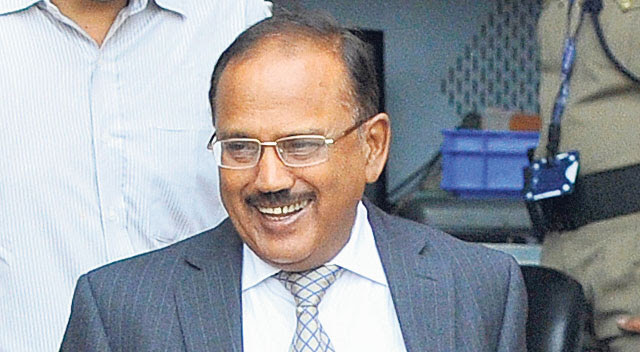
National Security Advisor Ajit Doval. (HT photo/ Vipin Kumar)
Two, Indian businesses have begun investing in creating policy research institutes and think-tanks, and the government has been engaging with such outfits. The Observer Research Foundation is supported by Reliance; the Ananta Aspen Centre has a group of business leaders funding their operations. Foreign think-tanks too have begun setting up their India operations. Brookings now has an India office, which again is supported by wealthy Indian business leaders. And Carnegie Endowment is expected to set up a local office by next year.
Three, when Foreign Secretary S Jaishankar took over office earlier this year, he made it clear that a key priority for him would be reviving the Policy Planning division of the Ministry of External Affairs. He brought in a new Joint Secretary, and indicated that the division would have more resources. It could hire experts from outside the government; and it was tasked to enhance engagement with the city’s think-tanks. The government has also appointed a new head for the MEA-supported think-tank, with a brief to ramp up its operations.
The state in India has historically been more open to outside expertise in the realm of the economy. From Manmohan Singh and Montek Singh Ahluwalia to Arvind Panagriya and Arvind Subramanian, the executive has brought in experts at the highest levels. The Niti Ayog itself has been envisaged as a think-tank.
While this has not extended to the strategic affairs space, things may slowly be changing. In this context, here’s a look at the city’s premier think-tanks, their areas of work, sources of funding, and role in shaping policy and engaging in wider public debates.
IDSA – inside the national-security state
After the debacle of the 1962 war with China, the government felt that it needed outside expertise on defence and security affairs. And thus was born the Institute for Defence Studies and Analysis (IDSA). The eminent strategic guru, K Subrahmanyam, played a key role in structuring the institute’s research. A key moment in its evolution was during the debate on whether India should go nuclear. IDSA came out strongly backing the strategic choice to go nuclear, shaped larger opinion, and conveyed India’s position to the global strategic community through Track 2 dialogues.
IDSA’s president is the Raksha Mantri; its annual report is tabled in parliament; and the funding is entirely by the Ministry of Defence. Serving officers of the armed forces come for a period of two years to gain a wider policy perspective. The institute’s infrastructure is the envy of all other think-tanks in town – its vast structure built on land leased by the government in Delhi’s cantonment area includes office space, housing for scholars and staff and guest accommodation. IDSA’s annual budget is about 14 crore and it has around 60 full-time researchers and scholars on its rolls.
But the direct link with government is also a weakness. It is seen as an extension of the MOD, with little autonomy.
Brigadier Rumel Dahiya, IDSA’s deputy director general, however, counters this perception. “We are not a part of government, and I have never seen anyone impose a government line on IDSA. What happens is the government takes note of our research, which is mostly in the public domain. They may sometimes ask us for more specific papers which we provide. We also get to know the general line of thinking in government but do not have access to confidential papers and documents,” he says.
Countering the criticism that the institute should be doing more given its resources, he said, “If you compare it to foreign think-tanks, our budget is adequate but minimal. We could send a larger number of scholars for field trips for longer duration if it increases.”
IDSA’s last Director General, Arvind Gupta, a former IFS officer, was appointed the Deputy National Security Advisor last year. Since then, there has been a leadership deficit at the institute as the Appointments Committee of the Cabinet has not picked a new DG.
ICWA- the diplomatic den
Set up in 1943, the Indian Council for World Affairs (ICWA) has an illustrious legacy – the Asian Relations Conference was convened here right before independence, which set the tone for Nehru’s policy emphasis on Asian unity.
The ICWA’s budget, according to its website, is around Rs 10 crore annually. Its chair is the Vice President of India and it is often the platform where key visiting dignitaries make their public speeches. Rajiv Bhatia, a retired diplomat, who just finished a three-year term as ICWA’s director, said the council’s activities included research and Track 2 exchanges. He added that, in recent years, they had made a concerted effort to work in Hindi and to reach out to the young.
But its problem, like IDSA’s, is that it is only seen as an extension of the ministry, in this case the MEA.
Bhatia counters this. “The ICWA is not a government think-tank. It is answerable only to the governing body and the direction in which the research happens is academically sound,” he says.
A criticism that ICWA has faced is that it has become a retiring home for diplomats. Some believe that academics should lead it as they would better understand research requirements and be inclined to shape the trajectory of younger academics.
Bhatia, however, feels that as former diplomats know the broad policy framework, they also know which areas need greater research. “It is a policy think-tank and need not be necessarily run by a professor,” he says. He concedes that a serving official running the council could pose credibility issues. “Having a retired ambassador however is a good via media.”
The government has recently appointed Nalin Surie, a well regarded retired diplomat, to ICWA with a brief to restructure the outfit and enhance its output. Whether Surie at ICWA – and the new appointee at IDSA – can walk the tightrope of being government supported yet independent and whether they can shore up quality will be an important test.
ORF – between government and business
If you are on any of New Delhi’s think-tank mailing lists, your inbox would often be flooded with mails from the Observer Research Foundation with an invite to their events – the frequency of which has only increased. This is not surprising given that ORF has grown five times in the last five years, and now has a budget of Rs 25 crore. By annual spending alone, this makes it the biggest think-tank in town.
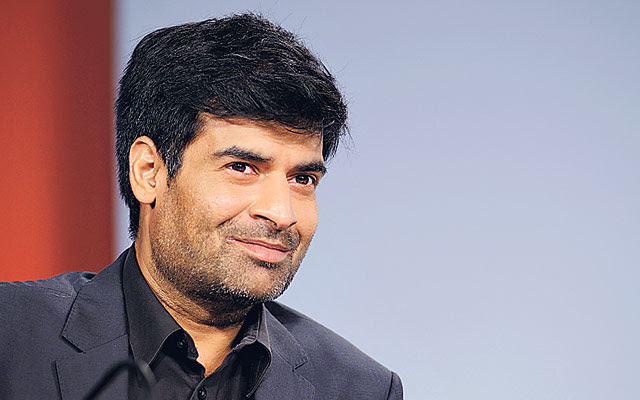
Samir Saran, Vice president ORF.
Conceived in 1991 by Reliance founder Dhirubhai Ambani as a platform for his policymakers, scholars and journalists of different persuasions to devise pragmatic solutions and a liberal regime they were comfortable with, ORF spent its first decade focused on internal issues of economy. Since 2000, the conversation has expanded and now 80% of ORF’s work is centred on engagement with the outside world.
This, says Samir Saran, the man who has driven ORF’s growth in recent years, is natural because of the interconnectedness of internal and external issues. The presence of key thinkers on foreign policy like C Raja Mohan at ORF has added to its intellectual heft.
Reliance continues to support ORF. If, in 2009, 95% of the budget was provided by the company, it is now around 65% with the foundation diversifying its sources to include the government, private corporates, foreign foundations and others. There is also a trust that the ORF reports to, which is, on paper, independent of Reliance.
This relationship with Reliance has led to a key question: is it is appropriate for private corporates to try to influence policy, especially in sectors like energy and defence where they have other commercial interests?
Saran says, “Influence is a misplaced description. It is more investing in policy research institutions. Is it our intention to keep corporate India from investing in research and public policy studies or to keep out one set of actors from the debate? Policy making must not be the monopoly of any one set of actors and in recent times, many corporations and private entities have begun to invest in this space. This is a welcome trend and the more such institutions we have, the more irrelevant this question would be.”
He adds that it is only in India that private sector participation is looked down upon, whereas in the rest of the world, the ability to engage with all actors is appreciated. “Look, be it political think tanks, private think tanks or government think tanks, the more the better. Funding must be transparent; there must be no hidden strings attached; there must be full disclosure; and the research work must be professionally conducted. The consumer of research can then take an informed decision.”
ORF’s engagement with the government has also grown over the years. It now receives project-specific funding from the Ministry of External Affairs for studies on BRICS, Russia, climate and other thematic issues. It hosts a range of Track 2 dialogues with France, Egypt, Saudi Arabia, Australia, BRICS and Track 1.5 dialogues where officials from both sides are present but without a formal agenda and format. It also hosts the Indian Ocean Dialogue and Blue Economies Forum and has other projects lined up with the government.
When asked about the government relationship, and whether this kind of support would compromise its independence, Saran says, “We are acutely aware of the need to balance a proximate relationship with the government that would allow enough distance to be able to conduct research freely and yet be cordial enough so that we would be able to share insights and ideas with institutions that are best placed to make use of them.” He says their approach is different from that of activists. “We believe it is possible to be critical without being adversarial.”
CPR – between academia and policy
Few individuals evoke the kind of respect that Pratap Bhanu Mehta does in India’s public sphere. A political theorist, constitutional scholar, policy analyst and prolific public commentator whose writings are taken seriously by those in power, Mehta has a full time day job – President and CEO of the Centre for Policy Research.
Over lunch at the Malcha Marg market close to the CPR office in Chanakyapuri, Mehta says he sees the role of CPR as being an ‘honest broker in a public argument’. For him, policy impact is not necessarily the hallmark of a successful think-tank. Mehta believes that the democratic public, rather than the state, needs to be the intended audience. “There is also a difference between the government listening to you and the government agreeing exactly with what you suggest. I would not like to carry the presumptive authority that the government in a democracy must agree.”
CPR itself is somewhat distinct as it is a cross between a think-tank and a research institution. “There are people here who would have been happy in universities too but find the independent research space congenial to work.” CPR has, Mehta says, historically been comfortable with people from different sides of the argument being in the same organisation with the operating assumption that it is on good faith. There is no CPR line and scholars are free to pursue their independent interests.
The centre now has an annual budget of Rs16 crore. As an Indian Council of Social Science Research (ICSSR) recognised institution, it receives support from the government. It also gets funding from foreign foundations and private philanthropists.
Commenting on debates around foreign support, Mehta points out that institutions like the Ford Foundation were important in creating an independent, social science intellectual system in India. “From the Law Institute to CSDS to CPR, Ford played a big role. The key is funding should not have any strings attached.”

Pratap Bhanu Mehta, president and CEO of the Centre for Policy Research.
In the realm of foreign and security policy, Mehta, former diplomat Shyam Saran, economist Rajiv Kumar, and historian Srinath Raghavan – all at CPR now – were a part of the team that drafted Non-Alignment 2.0 (2012), an influential policy document on the direction Indian foreign policy should take. Saran was the chair of the National Security Advisory Board, with Raghavan as a member till recently. Brahma Chellaney and Bharat Karnad of the centre are also important voices in foreign policy debates. CPR also has expertise in climate change policy.
India Foundation – the inner chamber
With a board that includes the country’s railway minister Suresh Prabhu, MOS for finance Jayant Sinha, MOS for commerce Nirmala Sitharaman, the BJP’s powerful general secretary Ram Madhav, BJP Rajya Sabha MP MJ Akbar, and the son of the National Security Advisor, Shaurya Doval, there is little doubt that India Foundation is today the country’s most powerful think-tank.
When the IF convenes a meeting, everyone who is invited turns up. Just last week, RN Ravi, the government’s interlocutor for the Naga talks, addressed a closed door IF roundtable. Ravi himself was a part of IF activities till he was appointed interlocutor. Often held on Wednesdays, such meetings are moderated by MJ Akbar and have been addressed by the NSA, Foreign Secretary S Jaishankar, PDP leader Mehbooba Mufti, and Walter Anderson, a scholar specialising on the Sangh.
The IF has four core events every year. The India Ideas Conclave, held in Goa, is an attempt to create a new ‘ecosystem of the intellectual right’; the Counter Terrorism Conference, held in Jaipur, saw the cream of the security establishment and global experts participate; the Indian Economy Convention, organised by Shaurya Doval, was addressed by Modi before the elections and will be held next month in Delhi; and the Dharma-Dhamma conference will bring together ‘oriental religions’, Hinduism and Buddhism, in Indore this year.
Operating out of a small apartment on Hailey Road, the line between the government, party and the think-tank is clearly blurred in IF’s case – with overlapping loyalties of members. Unlike the US, where those who join government leave positions in think-tanks, that has not happened here. IF sources claim that is not necessary as the ministers are not receiving any salaries. This overlap makes it difficult to judge exactly how it influences policy. It happens as much through the informal network – a casual chat and phone conversation – as through any structured dialogue. IF sources are keen to clarify that it is not a party think-tank. The Shyama Prasad Research Foundation is officially linked to the BJP but it is mostly dormant. So the IF is as close to an influential party-affiliated think-tank as India has seen.
For its big events, the IF collaborates with outside institutions including state governments, public bodies and private foundations. Sources claim that it has limited resources, only a few full time staffers and does not engage in primary research. HT could not access the exact annual budget of the outfit. Doval was travelling outside the country when contacted for this story.
VIF – foot in the PMO
With both NSA Doval and the PM’s Principal Secretary Nripendra Misra having been closely associated with the Vivekananda International Foundation, it is no surprise that this became the most talked about think-tank in town when the new government was formed.
Built on land provided by the PV Narasimha Rao government, the vast and spacious VIF office is located in the city’s diplomatic enclave, Chanakyapuri. VIF’s core activities revolve around international relations, defence, economy, governance and historical and civilisational studies. In the last year, among other activities, it has engaged deeply with Chinese and US delegations and had Track 2 exchanges. It hosted the British and French defence ministers, convened meetings with over 20 foreign ambassadors, and hosted many seminars on relations with Pakistan.
General NC Vij, former army chief who took over as VIF director from Doval, believes the USP of the outfit is that it has a large number of senior people who have served in government. “They bring in vast amounts of experience. They are listened to because they are not prone to flights of fancy and provide practical advice.”
When asked if the presence of Doval in the PMO means that the VIF is close to the BJP and now the government, Vij says, “Doval had a strong independent identity even before he actively led the VIF. He was, after all, Director of IB. The government needs good professionals.”
Vij points out that it is a ‘small circle’ and people know each other but categorically asserts that the VIF is ‘independent’ and ‘apolitical’. “We have no links with any party. We don’t really see ourselves as influencing policy. Our role is to throw up ideas, offer opinions, and then it is up to the government to use it or not.”
The engagement with government however takes other forms. Reports of key seminars – with the Chinese ambassador or Pakistani high commissioner – are sent to authorities with relevant recommendations. Next month, the VIF is hosting a Global Hindu Buddhist Conference on Conflict Avoidance and Environmental Protection. This will be inaugurated by PM Modi, who has made the theme of Buddhism an important element of his cultural diplomacy.
The VIF takes no money from the government. “We are funded by the Vivekananda Kendra,” says Vij. The Kendra is headquartered in Kanyakumari and depends on donations. The VIF’s annual budget, according to its annual report, in 2013-14 was a little less than Rs3 crore.
Ananta Aspen Centre – convening dialogues
The first thing that Kiran Pasricha, the executive director of the Ananta Aspen Centre, likes to clarify is that the organisation is not a branch office or an India chapter of the Aspen Institute.
Run out of Thapar House on Janpath, the Centre was initially a result of collaboration between CII and Aspen – but over the years, while it has relationships with both, it has evolved into an autonomous entity. It views itself as being primarily a convening body for discussions on diverse themes with a diverse set of interlocutors, and not as a research-based outfit. Ananta has a good relationship with the government. It convenes over ten strategic dialogues with countries like China, Japan, Singapore, Israel, Turkey, and Bhutan.
Some have become Track 1.5 in nature, because of the presence of a relevant Joint Secretary from the MEA or the Indian ambassador when it is happening outside the country. Visiting delegations also get to meet the local government, including senior ministers. And events hosted by the centre have seen high level government participation including of NSA Doval and cabinet ministers. Its current chair is SK Lambah, a former diplomat who served as the special envoy for Pakistan.
It takes no money from the government but derives its support from members of the Board of Trustees. The board includes top industrialists and business leaders like Gautam Thapar, CK Birla, Sanjiv Goenka, Naina Lal Kidwai, and Anu Aga.
When asked if this means that the centre is a medium for Indian business to push its interests, Pasricha is emphatic. “No. Our funding is not from any one business house but is diversified. Our board also includes MPs and distinguished intellectuals who guide programmes. And none or our events have been used by any delegates to push their business interests,” he says.
Revenues are also raised through a separate organization, the Ananta Centre, which is for profit. Its chair is Jamshyd Godrej. The organisation also runs leadership programmes. The combined budget of both is about Rs 5.5 crore.
August 3, 2015, The Hindu
Original link is here

Out of the 7 billion people that inhabit our planet, around 2 billion, still lack access to essential medicines and 925 million are chronically undernourished. Almost a third of all yearly human deaths are due to poverty-related causes. The richest 14 per cent of the world’s population have a mean life expectancy of 84, while the poorest 34 per cent live for only 36 years on average.
This situation represents a failure in the provision of a basic human right to “standard[s] of living adequate for the health and wellbeing” of an individual and his or her family, “including food, clothing, housing and medical care and [other] social services”, as highlighted in the 1948 Universal Declaration of Human Rights; these also constitute what is commonly referred to as the right to life.
International and multilateral processes continue to obfuscate the centrality of the right to life outlined in the 1948 Charter. The year 2015 is crucial for global agreements that establish the trajectories and paradigms of development. The Millennium Development Goals (MDGs) are set to be replaced with the Sustainable Development Goals (SDGs) at the UN General Assembly in September and negotiations on a new global treaty on climate change will culminate in Paris in December. The narrative of development in the 21 century will be defined by these two agreements. While the pursuit of European styled sustainability is important, the need to secure the right to life of each human should be paramount, unconditional and non-negotiable. The well-being of the planet holds no attraction for those excluded and the ambition to save it for future generations has little appeal unless we mobilise a wider set of ‘invested’ stakeholders.
The fact that the first of the newly delineated SDGs aims to “end poverty in all its forms everywhere” is promising, but the urgency of this objective could be drowned out by the wide proliferation of goals: 17 in total – with 169 targets. More goals will not translate into more funds to meet the goals. There is also concern that such targets could be turned into pre-conditions for flow of aid, whereby poverty alleviation efforts could be shackled by a focus on factors that are coloured by ideological considerations.
Key fault lines were again revealed by the informal substantive sessions leading up to the Financing for Development (FFD) conference in Addis Ababa this year. India and the rest of G77 warned against an overwhelming emphasis on environmental goals at the cost of poverty alleviation, and highlighted the principle of ‘additionality’ — new resources required over and above current Official Development Assistance (ODA) in implementing the SDGs. Contrastingly, the developed nations underscored the importance of sustainable economic practices, domestic resource mobilisation, and new financial instruments such as commodity-based derivatives.
Ultimately, the Addis Ababa Action Agenda adopted at the conference failed to yield concrete new proposals for additional funding that can be swiftly implemented to meet the world’s multiple challenges. Put simply, there was no new money brought to the table. Instead even the previous ambition of the rich countries to commit 0.7 per cent of Gross National Income as ODA remains only a statement of intent .
Worryingly, the Addis conference once again exposed the inequities present in global decision-making processes. The India-led initiative to upgrade the UN tax committee to an intergovernmental tax body yielded only symbolic gains (rallying together of the G-77) after developed countries blocked such efforts and instead argued that the OECD was taking the lead in such efforts. Over 100 developing countries thus continue to be excluded from decision-making processes on global tax standards. It is worth noting that lost tax revenue for development financing purposes in developing countries is estimated at over USD 300 billion annually. This dwarfs the total ODA financing for 2013 which stood at USD 135 billion. The process of building the post-2015 development agenda seems to be struggling to reconcile present needs like the eradication of poverty and hunger, with more value based goals. A worrying divergence in priorities has become apparent, a divergence that threatens to manifest itself in multilateral deals that neglect the need for survival of a large proportion of the world population.The economic and social compulsions faced by the poor must come first, ahead of value frameworks that are driven by first world priorities. When more than a third of the world’s population does not live to see 40 on average, it is clear that securing the right to life for these people should be the only priority of global developmental processes. Can there ever be any shared values, if there is no agreement on the fundamental right to life?
(Samir Saran is vice-president at the Observer Research Foundation and tweets @samirsaran)
As BRICS leaders met in Ufa, Russia, for their annual meeting late last week, there were expectations and anxieties galore. The group met as tensions between Russia and NATO rose, Europe’s circus of the absurd (the Greece crisis) continued, impending global agreements on sustainable development and climate action were being negotiated, and celebrations for the 70th anniversary of the UN approached in New York. All of this at a time when the liberal international order was shown to be inept at managing radicalism, barbarism, parochialism and illiberalism across the world.
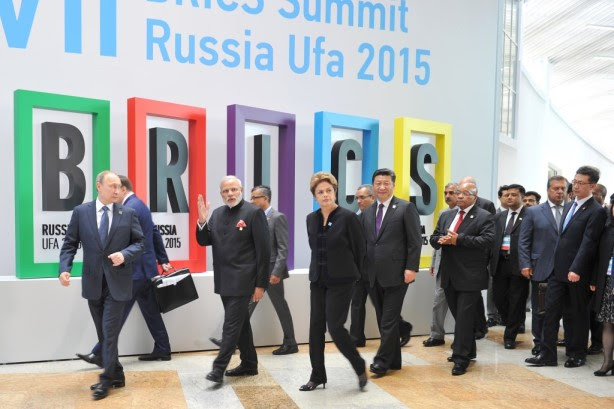
The BRICS member states are also experiencing their own specific political moments. Russia is struggling to cope up with the dynamics of the energy sector economy and is involved in an intractable conflict in its neighborhood. Brazil seems to have lost the ‘Lula mojo’ and is fighting economic and political inner demons. South Africa and its enthusiasm for being the gateway to Africa has suffered a body blow with reports of a series of fatal attacks on African migrants. India is pre-occupied with rewriting its story under the tireless outreach of Prime Minister Modi, who is exclusively focused on reshaping India’s economic trajectory. And then there is China, which is putting together the plans and institutions that might soon constitute the ‘Beijing Consensus’ that could dominate the geo-economic landscape over the next few decades.
The 77-paragraph outcomes statement from the summit was inevitably going to be a list of ideas that would cater to different expectations and aspirations of each of its members.
For Russia, the political takeaways are the key. If one was to go through the list of Russian proposals on BRICS cooperation in the months leading up to the summit (some at the official level others at track II dialogues), you would detect an aspiration to create a political aggregation among the BRICS collective. These proposals included an ambitious agreement on cyber security, cooperation on outer space, peace and conflict treaties, a proposal on planetary defence, a new agreement on non-aggression and peaceful co-existence, non-proliferation arrangements around new technologies and even a new arms control and export control regime.
As Russia’s global legitimacy shrinks, the role of BRICS as a legitimising platform becomes more important for Moscow.
For many Russians, the world has moved on from the Cold War of the last century to the ‘Hot Peace’ of the current one. To them, BRICS must be a force for stability, and one that can counter what they see as the eastward expansion of the Atlantic alliance. That the official statement covers some of these Russian ideas (watered down, no doubt) is Russia’s gain.
The import of BRICS for the Chinese is starkly different. They are in the process of resetting some key rules that have defined postwar geo-politics and geo-economics. To them, BRICS may be another platform that will institutionalise and promote those facets of global engagement that benefit China. While confrontation between Russia and NATO is something from which Beijing would wish to keep a healthy distance, China’s leaders realise that a beleaguered Russia offers them a chance to consolidate their ‘March west’ agenda, through the central Asian and Eurasian landmass and into the heart of the EU.
Still, never in their wildest dreams would China’s leaders have imagined the servility Russia is now demonstrating.
A Russia that once killed the opportunity to integrate with Western Europe because Moscow was unwilling to play anything less than ‘big brother’ now seems willing to play second fiddle to the Chinese dragon. Such was the level of kowtowing to China’s ambitions and agenda that many at the track II meetings over the past couple of months remarked that Russia had officially replaced South Africa as China’s ‘B Team’ within BRICS. One Russian proposition went so far as to suggest that the New Development Bank (NDB; a joint BRICS development bank but one which is strongly influenced by Beijing) must support and lend to the Chinese One Belt One Road initiative. This was reminiscent of the concentration of all financial flows in the past century serving to reinforce US power.
But for Beijing, BRICS could offer three key benefits vital for its national project. First, BRICS offers a truly large economic landscape on which the experiment to internationalise the Renminbi could begin. The NDB, the trade cooperation agreement and the economic cooperation pact among BRICS could facilitate this. The second key advantage has to be diversification of the Chinese product market by moving towards an eventual BRICS Free Trade Zone, seeds for which were planted in Ufa.
The final advantage of BRICS for China is the affirmation it gives to the legitimacy of the Chinese system, something no democratic bloc has accorded Beijing before. Outside the BRICS context, it’s hard to imagine Brazil, South Africa and India discussing, defending and promoting the Beijing Consensus, which is premised on everything these three democracies otherwise abhor. BRICS gives the Chinese dragon the license to drive a wedge in the liberal order.
South Africa is a BRICS anomaly; it is dwarfed in demographic and physical size by the others in the group. Yet it is this anomaly that makes the BRICS gambit so important for South Africa – effectively acting as its ticket into the big league. Pretoria has been promised a regional hub of the BRICS bank, which means South Africa will be the node for BRICS into Africa. This puts a potent tool in South African hands but also saddles it with the responsibility of reconciling its differences with other African economies and polities.
Brazil is struggling to define its role in BRICS, with its attendance reduced to the mundane. Much of this has been due to the Government being bogged down by domestic problems, leading to a loss of the momentum that President Lula had injected. For a country that is still searching for its place in the world, the Lula vision was to move Brazil from being merely ‘that big country on the left of the map’ to becoming a critical partner in the Asian century. BRICS provided it a free ride to undertake this ambitious plan. But it remains to be seen how and when Brazil will overcome its inertia.
Finally we have India, in many ways the proverbial swing state for which BRICS could offer the flexibility it needs and without which the BRICS would not just lose its ‘I’ but also a fair part of its identity. For a country that is slowly but surely exhibiting signs of becoming part of the liberal order it once opposed, BRICS is the rhetorical, normative and tactical vehicle to affect its transition from ‘trade union leader’ to ‘global manager’.
The BRICS rubric also allows for sustained engagement with China, which could build multiple dependencies. It enables India to demonstrate muscularity on its border dispute with China while concurrently embracing it. For example, the New Development Bank and the Asian Infrastructure Investment Bank enable India to participate in Beijing’s ambitions and benefit from it (it needs huge doses of commercial loans and development finance) without being socialised into ‘Pax Sinica’.
BRICS will be beneficial for India if it opts for pragmatism over ideology and sees the Beijing Consensus as means of shaping the discourse of the ‘east’ until it is able to script one of its own. On the other hand, if Delhi chooses to play the ideological card, it will end up on the wrong end of the bargain as it did with the Washington Consensus – staying out and consequently being excluded from the mechanisms and institutions that shape global development and direct global capital.
BRICS is also the last hand India has to play with Russia, given the dwindling interdependence between the two states. India fears continental encirclement, owing to increased Russian engagement with Pakistan (visible in the diluted treatment of counter-terrorism in the BRICS outcomes statement) and what it believes is a Russian slide into China’s orbit. Consequently, it will be through the normative processes as well as the economics of the BRICS grouping that India can maintain a serious balancing play with Moscow.
Finally we must acknowledge that for all the talk of a rising democratic India being welcomed with open arms by the great powers, India’s acceptance into the Western-led global order has been lukewarm. A deeper integration into BRICS, as the outcomes statement promises, will give Delhi far greater bargaining power in negotiating its place within the global political and economic governance institutions currently dominated by the West.
Photo by Flickr user MEAphotography.
Samir Saran|Mahima Kaul
Even as Washington expects India to be a net security provider in the Indo-Pacific region, the country is offering itself as a key partner in managing the cyber oceans. The US must now reciprocate.

When the Snowden revelations brought American control over global communications into sharper relief, the United States threw a curveball at the global Internet community. It proposed and backed a multi-stakeholder framework of governance to manage the critical logic layer of the Internet and offered to replace US oversight of key functions within the Internet Corporation for Assigned Names and Numbers (ICANN) to a body comprising all stakeholders. It was becoming apparent that while the net as we know it may well have been invented and seeded in the US, its continuing and overwhelming control of this common resource was untenable. But the US proposal was clever for two reasons. First, US corporations and US civil society groups (many funded by these corporates) are more than capable of managing core US interests even after Washington cedes control. Second, it was and is still quite improbable for a multi-stakeholder mechanism to replace US control of the functions of the Internet Assigned Numbers Authority ( IANA), failing which the IANA transition process would continue to remain where it was. Indeed, this was precisely the outcome which loomed large as important digital nations such as India remained at a distance from this process.
Things changed dramatically on Monday when the Indian Minister for Communication and Information Technology, Ravi Shankar Prasad, in a video address to the ICANN gathering in Buenos Aires stated that, “the internet must remain plural, must be managed through a multilayered and multistakeholder system.” He added that “its strengths will lie in partnerships between like-minded nations and stakeholders, built on a platform which supports and will sustain a future of equity and innovation and collaboration and inclusion.”
Nuances in India’s stand
Even as this announcement is studied, digested and lauded, some nuances within the text need to be discussed further. First, it is clear that even as India has opted for the multistakeholder system of global governance, it is still pushing for reform of this system to ensure it becomes more plural, equitable, geographically representative and democratic. This is something the minister’s speech clearly highlighted. It is not business as usual for India and it will certainly not be business as usual for those occupying pride of place on the governance high table. This model requires greater plurality and diverse representation that will challenge much of the group thinking that dominates this sector. Prasad was categorical in his pronouncement if the subtext of his speech is properly understood. India was not merely seeking to blindly support a system of Internet governance dominated by the Atlantic countries but was seeking an imminent rebalance towards Asia.
The second message embedded within Prasad’s speech was that India is keen to engage with all forums . The fact that the Indian minister announced the policy shift at ICANN53 is a message in itself. That he is finalising his visit to ICANN in the near future is evidence of deeper engagement with a process that India had hitherto distanced itself from. The minister also alluded to something that has exercised the mind of many Indian stakeholders, that the country must host something that can match and surpass the scale and reach of the NETMundial hosted by the Brazilians. The development agenda and the framework for the digital economy that could change the lives of the ‘next billion’ must be crafted and co-developed by this billion, in their own neighbourhoods. The minister’s assertion that India will host an international conversation that will articulate India’s own motivations and objectives to the world and make the global community a partner in this mission must be understood in this vein.
The next billion
The Indian state has both committed to transforming itself through digital means and at the same time building a global system that can accommodate and allow for such a transformation. Access, Voice and Opportunity must not be more cumbersome for the ‘next billion.’ And, this also means more responsibility for the Indian government. By opting for multistakeholderism it has just signed up for a bag full of new responsibilities. The agency of the sovereign will now have to be secured by a variety of stakeholders who may be more acceptable in certain forums. The government will have to invest in building capacity among them, building greater diversity among those who participate and ensuring greater representation of these stakeholders at key Internet governance debates globally. Without this, for India and many others, the global multistakeholder system will continue to reinforce existing disparities of the real world even in the digital world.
The third significant message within the speech was the quest of India to seek partnerships with key countries and institutions. And it is here that India will be able to carve a space significantly different from others. A space that a country of the size of India needs, the room a diverse and developing democracy must have. The needs of a billion people impose a very different set of responsibilities on a political system which must deliver to remain relevant. This was a call to those on the governance high table, particularly the United States, to respond adequately to the Indian overture. That these two countries, the largest net communities in the democratic world, must cooperate is unexceptionable, essential and inevitable. The details of this cooperation now need to be fleshed out and could be based on three key strands of association.
What the US must do
The US has long considered the free flow of information and commerce a pre-condition to a healthy global economy. India, as it digitally connects, is looking to forge the right partnerships to ensure limitless economic opportunities for its citizens. The first pillar of the India-US cyber relationship should be to ensure that their consumers and producers are able to leverage the largest English-speaking digital markets in the world. For this, they need a digital space free from encumbrances of power politics and petty policy. This would mean rationalising tax regimes, expanding Internet connectivity, settling issues of Internet jurisdiction, developing contemporary approaches to intermediary liability and operation, agreeing on data collection, data ownership and data management, privacy and freedom of expression, as well as developing an eco-system that would allow for investments in technology and infrastructure, crucial for the development of these digital markets.
A strong security partnership is the second aspect of the India-US relationship. Both countries believe strongly in the role of national governments in shepherding their societies through a host of new challenges. For both, strong nation-states lie at the centre of a multistakeholder system and, unlike European countries, neither is seeking to aggregate or dilute sovereignty. Therefore, the bilateral partnership needs to be built on a realist paradigm. From information sharing on crime, to attacks on critical infrastructure to countering terrorism, the India-US relationship can rise to become the backbone on which the Internet stands strong. For the US, this partnership should form the central ‘I’ of the Internet. For India, the US is already its chief digital interlocutor.
There should also be close collaboration on the logic layer of the Internet. Any one who understands the Internet realizes that there is a certain reality of the logic infrastructure that the Internet runs on. This is the dominance of the United States of America. Though the international community may manage ICANN or some other institutions, oversight rests with the US government alone. US courts have jurisdiction over the entities, and disputes between countries and Internet institutions are tried under US law.
Yes, WeCANN
The India-US relationship must deliver space to India on this front. Even as the all-important debate over how best to internationalise these institutions continues, the US must find ways to provide India the comfort that it seeks for its huge digital community. This could be by way of a bilateral deal around digital jurisdiction and territory, more Indian presence in the corporations involved with running the internet – the ‘i’ family – as well as the eventual and desirable location of a root server in India. The argument that “if we give this to India, China will want it too” is disingenuous. The US policy community continuously reminds India that it must not side with a Russia or China, as it is different and democratic. Yet, the very same community is quick to create equivalence of these countries with India when the latter seeks unique treatment.
Carving out a place for India, proportional to its growing weight in the global Internet eco-system is crucial. If this does not happen, the celebrations around India supporting a multistakeholder system may be short-lived. The security and political hawks will strike back and prevail and the Indian state will find comfort in the old methods of the last century. The US must see this message from Ravi Shankar Prasad as an opening, a new opportunity to meaningfully engage India.
Even as Washington expects India to be a net security provider in the Indo-Pacific region, the country is offering itself as a key partner in managing the cyber oceans. This moment must not be lost. India has responded favourably to the post-Snowden Internet governance proposition, The US must now reciprocate.
(Samir Saran is Vice President and Mahima Kaul heads the Cyber and Media intiative at Observer Research Foundation)
Courtesy: http://thewire.in
With the conclusion of his three-nation tour of China, Mongolia and South Korea last month, Prime Minister Narendra Modi capped a frenetic first year of diplomacy. It is becoming apparent that the emphasis on the Asian region will continue to be an imperative for the rest of his term. In this past year alone, the Indian Prime Minister has invested about twice as many days visiting the ‘east’ — Asia, the Indian Ocean Region and the Pacific — as against his ‘westward’ travels.
Is this a reinvigoration of India’s Look East policy? Does it mean relatively less importance to the West? And, what are the drivers of this policy? Barring the notable absence of West Asia from his travel schedule, it is clear that ‘Engage Asia’ has been the predominant mantra of Modi’s early days in office.

This Asian focus is decidedly different from previous efforts by Indian leaders to integrate with the neighbourhood. Those efforts were driven by the idea of demonstrating Indian leadership in a particular geography, or they were manifestations of south-south solidarity, or they were necessitated by security concerns emanating from across the border.
The current effort is something more. It is primarily aimed at completing two specific national projects, while at the same time positioning India at the helm of global affairs.
The first national project is to complete ’20th century India’: future-proofing Indian infrastructure; installing enough energy to power the nation; connecting the country with its periphery and beyond via roads, rail, ports and airports; developing manufacturing bases to employ the millions entering the job market each year; and investing in housing, agrarian and other social infrastructure that most developed economies take for granted.
Modi’s Asian thrust is designed to find partnerships, technology and funds to complete this 20th century project. The Atlantic countries do not have the financial capacity to invest in large infrastructure and energy projects. They do not have the political room to commit to carbon-intensive industrialisation. And they no longer have the wherewithal to offer 20th century inputs (equipment, energy and technology) for an insatiable India.
All of these are readily available to the east of India. Consider this: China, Japan and Korea between them have close to US$5.5 trillion in foreign exchange reserves, funds desperately needed for this 20th century project.
There is a coincidence of needs as well. Each of these economies needs to invest in new geographies. They need to generate wealth out of what are now stagnant reserves. These are countries that have successfully completed their industrialisation projects and need to find outlets for investment in the industrialisation of others. That’s why China has become the biggest provider of energy-generation equipment to India and wants to build high-speed trains here. It is why South Korea wants to build nuclear reactors and ports in India. And it is why the Japanese want to set up industrial corridors in India. Asia is also the source of most of the energy needs that are indispensable to this national project. Be it gas, uranium, coal variously sourced from Australia, Mongolia, Central Asia and the Middle East, this region offers India plenty of energy opportunities.
When Modi travels to these countries, it is tacit recognition that the response to Indian requirements carried forward from the last century reside there.
Then there is India’s ’21st century project’, driven by innovation, based on new technologies, located within digital economies and fueled by enhanced human capacity. This is the service-sector paradigm that India is already experiencing, and for which India needs high end solutions at rock bottom prices. For example, most of the 6 million new internet users India adds each month operate on handheld devices priced around the US$50-100 range on connections priced at a fraction of a dollar. Here too it is Asian countries — China, Taiwan and South Korea — that dominate the market. The expansion of this market, which will happen in tandem with the Digital India, Make in India, Skilling India and Smart Cities initiatives, will only see the market dominance of these Asian countries increase.
However, here is the poser: can India manage this Asian engagement while balancing an increasingly expansive China? This is the second element of the ‘Engage Asia’ mantra that Prime Minister Modi seeks to address.
Most Asian economies have their largest partnership with China and will always be looking over their shoulder as they define new partnerships with others. China’s soft expansionism is being driven by its economic weight and through its pursuit of creating new political and economic governance institutions, like the AIIB, that will offer it a new dimension of power. Its One Belt, One Road project seeks to redefine and recreate Asia’s geography.
In India’s sense of its own role and position in global affairs, such Chinese dominance is unacceptable. New Delhi’s running dispute over the 4000km border with China also complicates the bilateral relationship. India’s existential dilemma for the 21st century, then, is to ‘stare down the dragon while embracing it’.
This is where the US, a predominant Asian power, comes into play. It offers India two playing cards. First, it encourages others in Asia, such as South Korea and Japan, to participate in the India story in all sectors without the fear of China. In fact, this US gambit of midwifing Asian middle-power cooperation from arm’s length is a seminal arrangement for the ‘congagement‘ of China. Second, the unassailable US lead in security, defence and other high technology segments gives India a qualitative edge in its bilateral negotiations with China.
When Prime Minister Modi landed in Mongolia and South Korea on his way back from China, he was signaling that he intends to challenge the narrative of the Asian century as being a Chinese century. He was signaling that he intends to break the Chinese stranglehold in the Asian imagination of its future. He was signaling that here is an India willing to live up to expectations and take its rightful place as a major Asian power. Put simply, he was embracing the dragon while staring it down at the same time.
Photo by Flickr user Narendra Modi.
Samir Saran
With the increasing integration of the internet in all aspects of global life, old tensions and concerns about national security, sovereignty and global governance, among others, are being examined in a new light. To explore these issues, the third volume of the GP-ORF Series features papers from practitioners of cyber security and internet governance across the world, including those in business, academia, civil society and government. It explores the implications of a changing digital world in four key areas of thought: India and the cyberworld, international cooperation, global internet governance, and privacy and security. The CyFy Journal Digital Debates is an integral part of ‘CyFy: The India Conference on Cyber Security and Internet Governance,’ the annual internet policy conference organised by ORF. CyFy 2014 was held from 15-17 October in New Delhi, India.
Editor’s Note
India and the Cyberworld
International Cooperation
Global Internet Governance
Privacy and security
Looking Ahead

 Samir Saran