Uncategorized

The road to universal health coverage

Anjali Nayyar|Dhruv Pahwa|Oommen C. Kurian|Samir Saran

Introduction

In 2005, the Government of India launched the National Rural Health Mission (NRHM), promising to re-imagine primary healthcare and address the under-served needs of rural areas. The thrust of the mission was to establish a fully functional, community owned, decentralised health delivery system with inter-sectoral convergence that ensured parallel improvements in areas that impact health outcomes – such as water, sanitation, education, nutrition, and social and gender equality. It subsequently published the Indian Public Health Standards (IPHS) as a reference point for public healthcare infrastructure planning and upgrade of existing facilities. In May 2013, the Manmohan Singh Cabinet approved the framework, with Rural Health and Urban Health Missions as the two sub-Missions of the over-arching National Health Mission (NHM).[1]

Complementing NHM at the secondary and tertiary level care is the Rashtriya Swasthya Bima Yojana (RSBY) at the national level, and a number of state-level government health insurance initiatives. However, many big states like Uttar Pradesh do not implement RSBY, and the overall budget for such schemes remains limited. They often offer light financial protection and narrow coverage.

By the time the government established the NRHM, it had also made international commitments to achieve the Millennium Development Goals (MDGs). In fact, the 11th Plan laid out goals and targets that were more ambitious than the MDGs.[2] In 2015, the government ratified the Sustainable Development Goals (SDGs), committing itself to the inclusive and universal development of people and planets through cross-sectoral collaboration for equitable prosperity.  Unlike the MDGs, the 17 SDGs and 169 targets announced at the UN General Assembly 2015 were developed by the countries themselves and aim to stimulate action over the next 15 years. Ensuring Universal Health Coverage for all citizens was seen as a critical strategy to achieve the SDGs. The 12th five year plan, Niti Aayog’s Three Year Action Agenda, as well as the National Health Policy 2017 have health targets well in line with the ambitious SDG targets.
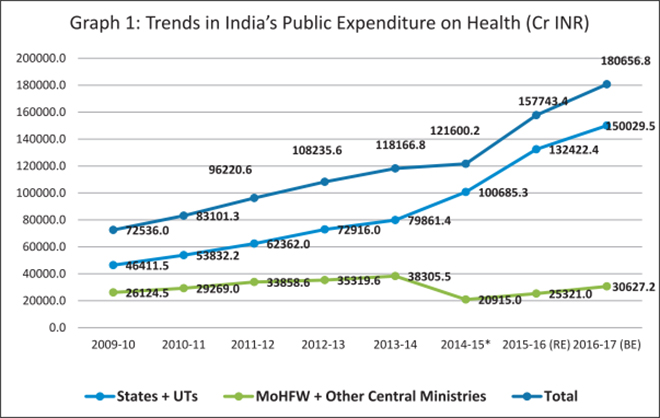
# Expenditure by the centre includes central ministries such as Ministry of Health, Defence, Railways, Labour and Employment, Science and Technology, Mines and Post
Source: https://www.mohfw.nic.in/documents/publications

The Lancet Commission findings for India revealed that a $1-investment in health would yield a $10-increase in gross domestic product (GDP) by 2035.[3] Over the last eight years for which detailed official data are available, India’s health spending has gone up considerably, as Graph 1 shows. The seemingly sudden decline in the Centre’s share in 2014-15 is due to a change in statistical method – from that year, transfers to states through the treasury route were taken as part of state expenditure. The recent devolution and the changes in the structure of fund flows in the health sector (Box 1) have increased the proportion of money spent on health by the states. However, the increase in public spending on health – when considered as a percentage of GDP – remains more conservative, increasing over the last decade from 1.1 percent of GDP to 1.4 percent.[4]

Box 1: Recent Changes in the Structure of Fund Flows in the Health Sector

India has a federal structure of government, wherein a number of schemes in various sectors (including the health sector) are initiated at the national level and implemented at the subnational level. Till March 2014, the bulk of funds for these schemes were released by the central government directly to implementing agencies without involving the treasuries of the state governments. After March 2014, these funds have been released to the treasuries of the state governments, which in turn release them to state-level implementing agencies. The state-level implementing agencies further release funds to district-level, block-level and lower level implementing units. Public funds therefore, have to flow through multiple levels of governments and administrative units before these can be spent on the designated goods and services.

In 2014-15, the first year in which NHM funds were routed through the state treasuries, the utilisation ratio was much lower in ‘high-focus’ states than in ‘non-high focus’ states. This could possibly be a reflection of relatively weak institutions in the ‘high-focus’ states, which hindered easy adaptability to the change in the mode of fund flows. Source:

http://www.nipfp.org.in/media/medialibrary/2017/11/WHO_PFM_Report_ Sep_2017.pdf

Despite the recent successes in disease elimination and the largest ever decadal decrease in neonatal, infant and maternal mortality, a large section of the Indian population still has limited access to quality healthcare. The newly released disease burden estimates underscore the health challenges faced by the Indian people.[5]

Health Challenges for India

Life expectancy at birth improved in India from 59.7 years in 1990 to 70.3 years in 2016 for females, and from 58.3 years to 66.9 years for males.  State statistics however showed inequalities, with a range of 66.8 years in Uttar Pradesh to 78.7 years in Kerala for females, and from 63.6 years in Assam to 73.8 years in Kerala for males in 2016.

While the per person disease burden measured as the disability-adjusted life years (DALYs) rate dropped by 36 percent from 1990 to 2016 in India, there was an almost two-fold difference in this rate between states in 2016. Amongst the states, Assam, Uttar Pradesh and Chhattisgarh had the highest rates, and Kerala and Goa the lowest.

For India as a whole, the DALY rate for diarrhoeal diseases, iron-deficiency anaemia, and tuberculosis was 2.5 to 3.5 times higher than the average for other geographies at a similar level of development, indicating that this burden can be brought down substantially.

Source: India: Health of Nation’s States (2017)

The most important health system issue emerging out of the latest disease burden statistics is the considerable shift from infectious and maternal/child health conditions to non-communicable disease (NCD) conditions across states. India’s public health delivery system is still geared towards infectious diseases as well as maternal/child health conditions. There is very little in the existing structure to address emerging concerns like non-communicable disease conditions or mental health.  If drastic changes are not made followed by sufficient funding, these emerging challenges will soon blindside India’s economic growth story.

Primary health services remain extremely inequitable within the country, both in terms of access and delivery. For example, according to data from 2017 calculated using the prescribed norms on the basis of rural population from Census 2011, Andhra Pradesh has a primary health centre (PHC) shortfall of four percent, Uttar Pradesh of 30 percent, Bihar of 39 percent and Madhya Pradesh of 41 percent.[6]  Overall, the country still has a 19 percent shortfall of sub-centres, 22 percent shortfall of PHCs, and a 30 percent shortfall on community health centres (CHCs).[7]

Access and delivery problems are compounded by severe human resource constraints. Challenges prevail in three aspects of human resources for health: numbers, distribution, and skills. In terms of numbers, the country faces a shortage of physicians and specialists, with a doctor-patient ratio of 0.7 per 1,000. This is significantly lower than the global average of 1.4, as well as that of several other developing countries and emerging economies, including Brazil (1.9), Turkey (1.7) and China (1.5).[8]In March 2017, nearly eight percent of PHCs in India had no doctor and 18 percent were unsupported by pharmacists.[9]

While the National Health Policy (NHP) and its main implementation arm, the NHM, outline an ambitious vision, India’s investment is healthcare remains low. The majority of the population continue to bear the brunt of healthcare costs with limited accessibility to quality health services.

Indeed, despite a rapidly growing economy, government expenditure on health has seen no significant increase for a decade (2005-2014). It hovers between 1.1–1.4 percent of GDP, significantly lower than that of Nepal (2.3 percent), Bhutan (2.6 percent) and Sri Lanka (two percent), and shamefully lower than the global average of six percent. While the NHP talks about an increase to 2.5 percent by 2025, there is no clarity on how much the increase will be on an annual basis. The 2.5 percent allocation is despite the increase to three percent of GDP by 2022 recommended by the High-Level Expert Group (HLEG) on UHC set up in October 2010 under the auspices of the previous Planning Commission,[10]and takes no cognisance of a study conducted by Ernst & Young which estimated that government expenditure on health will need to account for 3.75-4.5 percent of GDP by 2022. As a result of the low priority given to public healthcare spending, Indians on average have a very high burden of out of pocket (OOP) expenditure on health (Graph 2).

Graph 2: Public Health Expenditure and Out-of-pocket Expenditure
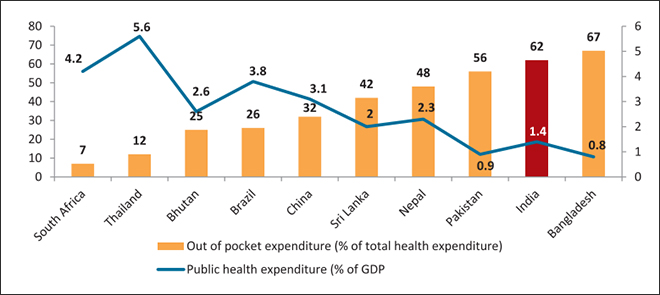
Source: http://globalhealthstrategies.com/wp-content/uploads/2017/11/Financing-UHC-in-India-GHS-Nov-2017.pdf

The poor availability and quality of public health services is forcing people to seek care in the private sector. In India, the private sector provides more than 80 percent of outpatient care and 60 percent of inpatient care. With no widespread financial protection scheme in place, private spending on healthcare negatively impacts the financial stability of millions of Indians every year. Latest research using National Sample Survey Office (NSSO) data from 2014 found that the percentage of Indian households that fell below the poverty line due to OOP health expenditure was seven per cent of the total; this is a massive number.[11]  OOP expenditure remains alarmingly high at 62.4 percent, as already discussed.[12] Based on NSSO 2014 data, of all health expenditure, 72 percent in rural and 68 percent in urban areas was on buying medicines for non-hospitalised treatment.[13]

Against this backdrop, Global Health Strategies (GHS), in partnership with the International Vaccine Access Centre (IVAC), Johns Hopkins Bloomberg School of Public Health, and the IKP Trust, undertook a study to evaluate public financing mechanisms capable of sustainably delivering UHC in India. The key recommendations of the study were that India urgently needs to re-examine both the provisioning and financing of healthcare.[14] In terms of provisioning, the government should aim to universalise free primary healthcare at the point of service. This will ease the load on the secondary and tertiary care centres. To finance this provision, a higher proportion of GDP will need to be allocated from tax revenues. There should be a national social health insurance (SHI) covering secondary and tertiary care for the entire population. Additionally, supplementary taxes such as sector-specific taxes, so-called ‘sin’ taxes, corporate social responsibility (CSR) contributions, tax-free bonds and trust funds could also be explored for specific health interventions over short periods of time.

The GHS study report was drawn up through literature review, interviews with experts and a high-level, national consultative meeting. This Special Report builds on the findings of the study and presents recommendations for a policy audience. 

Why the Public Sector Must be Involved in Healthcare

Nobel laureate Kenneth Arrow had laid down the reasons why healthcare cannot be treated simply like any other commodity, to be sold and bought at prices determined solely by market forces. His argument was that the very unpredictability of health needs and expenses makes people less likely to provide for future health expenses than, say, for future housing or clothing needs—a phenomenon that he called ‘hyperbolic discounting’. A healthy person tends to think that health lasts forever. Access to health information is limited, making the patient dependent on doctors for crucial decisions about treatment and that too at a time when s/he is physically and mentally vulnerable and extremely easy to exploit. Trust is therefore the most important component of the doctor-patient relationship. Unpredictability of health outcomes, and the fact that patients are billed once a non-refundable service has been delivered, means that it is not possible to shop for health services the same way as one would shop for, say, toothpaste. There is also a demand-supply gap: the number of doctors available is limited; years of study and a licence to practice medicine are entry level barriers and justifiably so. That again makes it different from shopping for toothpaste because, in theory at least, there is no limit to the number of companies that can manufacture toothpaste.

International examples bear out Arrow’s argument that governments need to be the actively involved in healthcare, as it is not a standard market good.  In Japan, for example, 82 percent of all health expenditure is publicly funded. The Organisation for Economic Co-operation and Development (OECD) countries’ average is 72 percent. Japan has a mandatory health insurance scheme, with premiums based on the socio-economic status of beneficiaries. Healthcare in Sweden is primarily funded by the government, which raises money through taxes. At 11.9 percent of GDP, the Swedish government’s spending on healthcare is one of the highest in Europe. International precedents show that when public spending on healthcare rises to around six percent of GDP (the global average for UHC systems) OOP payments fall below 20 percent of total health expenditure.

In India, the over-reliance on a largely unregulated private sector is fraught with risks of unnecessary costly interventions being chosen over more cost-effective options. That this is already happening is clear from National Family Health Survey 2015-16 (NFHS-4) data that shows that approximately twice the number of babies are delivered by Caesarean section (C-sec) in the private sector as compared to the public sector.[15] While World Health Organization (WHO) guidelines suggest that C-sec should be prescribed within the range of 10-15 percent of total births, private sector rates range from 87.1 percent of deliveries in urban Tripura (compared to 36.4 percent in the public sector) to 25.3 percent in urban Haryana (compared to 10.7 percent in the public sector). WHO also says that while C-secs can reduce chances of maternal and child mortality, there is no evidence of any extra benefits if the rate rises above 10 percent in a population.

The quality of care in the private sector is not always up to standards prescribed by Indian Public Health Standards (IPHS).  A study in rural Madhya Pradesh found that only 11 percent of the sampled health-care providers had a medical degree, and only 53 percent of providers had completed high school.[16] Thriving quackery, not just in rural areas but also in urban pockets, is an open secret. Recent examples from Delhi private hospitals show that high-end, expensive hospitals can also have uninterested and callous administrations, thus not necessarily providing quality care to paying patients. Big hospitals may not be available near most rural or low-income communities, being concentrated mostly in urban areas where people have the capacity to pay high amounts. However, what keeps the private sector hospitals – which are a highly differentiated set in terms of size, quality and cost – receiving the bulk of the patient load is that they are available round the clock, at close proximity to the community.

This is not to say all private sector hospitals are bad and should be done away with. They have an important role to play in a country with a large population and limited government intervention. The problem is an over-reliance on the largely unregulated private sector where payments are mostly out-of-pocket and high. This can and does result in negative conditions of over-treatment, poor quality, selective care, and cost escalations.

India Needs to Spend More and Spend Better 

Health is a state subject. Yet it is the Centre that is the prime mover behind the National Health Mission, which is a core central scheme. Despite the focus on healthcare in the Budget 2018, the actual allocation for NHM decreased from INR 31,292crore in 2017-18 (revised estimate) crore to INR 30,634 crore (budget estimates) in 2018-19. This is a decline of about two percent from the revised estimates of 2017-18.[17]

In addition to the inadequacy of funds, the inconsistency in the timing of funds released by the Centre to state governments has contributed to inequity in terms of service delivery across the country.[18] On average, there were more unutilised funds at the end of the year in the states that needed them most.  A 2017 study by the influential National Institute of Public Finance and Policy (NIPFP) and WHO India on utilisation, fund flows and public financial management under the NHM found that at the state level, a file with a request for release of funds has to cross a minimum of 32 desks while going up the administrative hierarchy, and 25 desks on the way down. The study recommended streamlining processes to ease the rigidities of the state treasury system.[19]

One of the primary operational hurdles that the NHM faces is the absorption of funds by states because of their erratic periodicity of release. Sometimes this can be a chicken-and-egg situation. In the first quarter of 2015-16, for instance, 57 percent of NHM allocations were released. However, the corresponding figure was 29 percent in 2014-15 and 46 percent in 2013-14. Similarly, analysis by CBGA shows that while the overall central health budget in 2018-19 was increased, allocation for , Reproductive and Child Health (RCH) component in 2018-19 (budget estimate) has in fact declined by 33 percent from 2017-18 (revised estimate). Along with this , the allocation for Pradhan Mantri Matru Vandana Yojana (PMMVY), which was earlier called the Maternity Benefit Scheme, has also decreased by eight percent over 2017-18 (RE)[20]

It is believed that strengthening health systems will increase the states’ capacity to absorb increased allocations, and should be prioritised, particularly in high-burden states and districts.[21] Poor absorption and distribution of funding at the state level leads to an accumulation of unspent resources each year. This lack of absorptive capacity at the state level has been used both as a justification for the Centre’s non-release of funds, as well as an argument for decreasing overall funding for healthcare. 

Primary-Care Network: The Gatekeeper

For India, both generating resources for UHC and designing health systems to implement it are challenges. The best solution to both may be for a comprehensive and quality primary care network to act both as the preventive pillar of the health system and also as a gatekeeper to higher levels of care. Patients need not reach secondary and tertiary care centres without being referred there. This primary care network has to be accessible to all, and free at the point of access so that the OOP expenditure problem can be dealt with. There are international precedents of such an approach. Spain, Thailand, Kyrgyzstan and Colombia have successfully rationalised hospital care through referral management. In Thailand, a gate-keeping system prevents patients from going directly to general or regional hospitals without a referral from district hospitals (except in an emergency or when paying OOP directly). Today 45.3 percent of patient visits are to healthcare centres, 37 percent to district hospitals, and only 17.8 percent to tertiary care centres. The National Health Accounts (2013-14) showed that of the overall expenditure, primary care took up 45.5 percent, secondary care 34.8 percent and tertiary care 16.1 percent. [22]

A study by Harvard University in 2017 on state-level, primary-level expenditure trends found that among the 16 states studied, some poorer states have already started focusing on primary care, and that states like Chhattisgarh, Rajasthan and Assam spend more on it in per-capita terms than better-off states like Kerala or Gujarat.[23] However, the study also found that the primary care expenditure as a percentage of total government health expenditure has either plateaued, or shown a downward trajectory for the last three to four years in 11 out of the 16 states.[24] It is well established that a functioning primary-level care delivery system can take considerable patient load off the secondary and tertiary hospitals. There are yawning gaps in the existing primary care network with some states being far better organised than others. Addressing the infrastructural and human resource gaps in primary care will go a long way in addressing overcrowding in urban hospitals, as well as controlling household costs.

The private sector’s focus on costly tertiary interventions rather than primary prevention has given rise to a situation where the limited number of doctors available crowd these better paying centres while there are few doctors to be found for primary care. This pushes people to seek treatment at the tertiary centres. Investment in primary care therefore has benefits at multiple levels: prevention, gate keeping, and putting an end to the crowding at tertiary care centres whether public or private.

Human Resources

Medical education in India is currently geared towards producing specialists rather than family physicians who are the bedrock of primary care. Every year 60,645 medical graduates qualify to be part of the public health system but opt out of it for a variety of reasons – poor pay, remote locations, and lack of facilities. Across the world, countries have tried to contend with this problem in their own way, but for India, perhaps, the best option could be for the government to train non-physician medical providers like nursing practitioners (with BSc Nursing degrees), Ayurvedic practitioners (with Bachelor of Ayurvedic Medicine and Surgery degrees), and Dentists (with Bachelor of Dental Surgery degrees), all of whom would require additional training and formal certification in allopathic primary care. The Supreme Court, in its ‘Dr. Mukhtiar Chand & Others Versus the State of Punjab’ judgment in 1998, acquiesced in legal feasibility of such an approach, specifically for BAMS doctors, who are in adequate supply.[25]  In this vein, the National Medical Commission Bill, 2017, has suggested a bridge course to enable practitioners of Ayurveda, Yoga and Naturopathy, Unani, Siddha and Homeopathic (AYUSH) systems to practice modern medicine, despite widespread protests from professional associations.[26]  Given the limited MBBS output, the best solution here too may be focused training of MBBS doctors, rather than looking at the long-term option of increasing post-graduate seats in medicine.

CASE STUDY: Immunisation

Every dollar spent on vaccines in low-income countries yields a $16 return in direct costs and a $44 return in indirect costs within a decade. It is one of the most cost-effective options of preventive health. India has its own vaccine success stories. It followed up its 2014 achievement of polio-free certification, with the elimination of maternal and neonatal tetanus in 2015. It owes both these achievements to a concerted immunisation effort. However, children in India continue to die of vaccine-preventable diseases. It has the largest number of under-five deaths in the world, at 1.2 million, comprising 20 percent of the global total. India’s share of pneumococcal, rotavirus and measles deaths is 25.6 percent of the global toll.[27] India’s per capita immunisation spend is just $8.88, far less than Bangladesh ($34.61), Nepal ($29.96), China ($22.09) and Pakistan ($13.14).  It was among the last four countries to approve Haemophilus influenza type B (Hib) vaccine to prevent pneumonia, along with Indonesia, Belarus and South Sudan, and it has only recently introduced the vaccine in its immunisation programme.

Recent data shows that India’s performance in ensuring immunisation coverage has been slow, with worrying reversals in some key states. Research by Observer Research Foundation has shown that prior to the NRHM, full immunisation coverage in India improved at a sluggish pace from 35.4 percent in 1992-93 to 42 percent in 1998-99 and 44 percent in 2005-06. NFHS-4 found that immunisation coverage had increased to 62 percent in 2015-16. Although post-NRHM, the pace of immunisation has accelerated, the improvement is far less than, for instance, in the case of institutional births (births taking place in a medical institution rather than at home) which grew from 39 percent in 2005-06 to 79 percent in 2015-16.[28] The following graph shows the current levels of full immunisation coverage across Indian states and UTs.
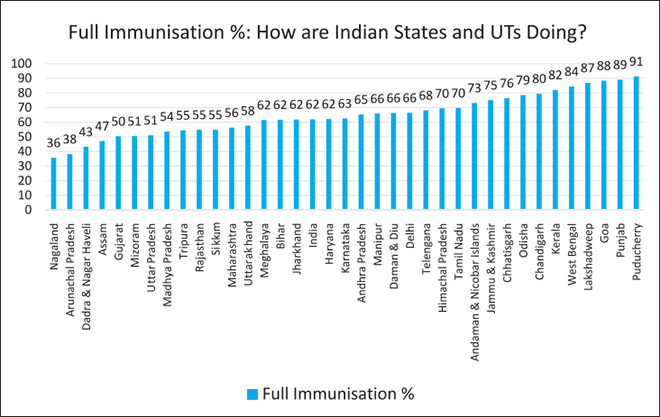
Source: NFHS 4

In the last few years, there have been many additions to the Universal Immunisation Programme (UIP), and Mission Indradhanush – introduced in 2014 – which aims to fully inoculate all children under the age of two with seven essential vaccines by 2020. Pneumococcal Conjugate vaccine (PCV) was introduced in 2017; Inactivated Polio Vaccine (IPV) has been rolled out nationally; rotavirus vaccine is available in nine states, and Japanese Encephalitis (JE) vaccine in all priority districts. However, the projected cost of these vaccines will have to be taken into account as India increases allocation to healthcare as it has committed to do in the NHP. The procurement cost for these life-saving UIP vaccines is expected to go up 6.5 times, from $88 million to $565 million for complete scale-up of Pneumococcal Conjugate Vaccine (PCV), Rotavirus, Measles Rubella (MR), Inactivated polio vaccine (IPV) and Pentavalent vaccines as per the comprehensive multi-year strategic plans (cMYP) costing and financing tool for immunization. With a forecasted budget increase from $694 million to $1.44 billion, the funding gap for UIP is set to rise to 37 percent of total programme costs, or $534 million. For now, the Global Alliance for Vaccines and Immunisation (GAVI) has contributed $500 million but it is targeted only at poor countries; and as India graduates to middle-income country status by 2021, it will no longer be eligible for GAVI support. Sustainable domestic funding options will have to be explored. India has historically never rolled back a vaccine once it was introduced in the UIP.

At a high level national consultative meeting organized by GHS, a panel of experts recognised that maternal and child health have to be seen as an investment rather than expenditure and the most cost-effective intervention, vaccination, is a priority investment for the nation’s future. It should also therefore be classified as capital expenditure rather than revenue expenditure.

Financing Options for UHC

In most countries in the world that have managed to implement UHC, the bulk of the funding comes from general government revenues (tax financing) and public contributions towards a social health insurance programme. In India, general tax revenue is the source of 90 percent of public health funding, but the low tax to GDP ratio (17.7 percent) is the spoiler. However, countries with lower GDP growth and economic potential than India have done it. Mexico moved towards UHC by increasing public spending on health from 1.9 percent in 1996 to 3.25 percent of GDP in 2014. Thailand doubled its public expenditure on healthcare from 1.66 percent in 1995 to 3.2 percent of GDP in 2014. Both countries have a tax to GDP ratio almost identical to India’s, although both are much richer.

While increased allocations from the general tax pool could help finance primary healthcare, supplementary resources will be required to fund secondary and tertiary healthcare. No examples of a universal healthcare system funded purely by general taxation exist anywhere in the world. Even the National Health Service (NHS) in the UK is funded by a combination of general taxation (around 80 percent) and national insurance contributions (close to 20 percent). The UK’s tax to GDP ratio is around double that of India’s but public funding on health is more than five times (as a percentage of GDP). That is why a mandatory social health insurance may be a good option; however the relatively small size of India’s organised sector may prove a roadblock. The effort should be to pool the already large OOP expenditure on health into pre-payment pools and enable users to spread the expenditure over a longer time-frame by pooling of risks.

Statutory health insurance (SHI) schemes function by mandating payroll contributions from workers, pooling the resources collected, and earmarking them for a comprehensive health benefits package for all. Risk pooling is a mechanism by which revenues are aggregated to spread financial risk of health expenditures across individuals and over time. Pooled revenues are used to pay for healthcare needs of individuals, reducing or eliminating the need for OOP expenditure at the point and time of service. It is also essential for a universal care package to be clearly defined and to include outpatient services, cost of medicines and a continuum of care feature.

Mandatory health insurance contribution may have political implications in a cost-sensitive society like India. However, if the resources raised by the government are effectively earmarked for healthcare, the willingness of the middle and higher income-groups to contribute will be higher since their expenses would then amount to an investment with a clear return. There are some existing insurance schemes like the Employees’ State Insurance Scheme (ESIS) for factory workers and the RSBY for the informal sector workers, which are now being planned to serve as blueprints for wider health protection schemes. In the Indian context, a national social health insurance scheme should cover the entire population, where the government pays for the poor and vulnerable, the formal sector pays through mandatory payroll contribution, and innovative mechanisms are explored to charge fees from the informal sector. The current UHC plan of the government seems to be around National Health Protection Scheme (NHPS), which is an enhanced version of the RSBY.

Nearly 22 percent of Indians live below the national poverty line, and the poorest 40 percent have access to only 20 percent of total income. Reaching these sections will involve substantial administrative costs. Community outreach may be an important first step before moving on to more sophisticated tools to decide eligibility. In 2012, both Turkey and Indonesia replaced community targeting based on local expertise, with rigorous registry through a clearly defined methodology, with increased and more equitable enrolment success. The Philippines also initially used community-based targeting where local governments identified beneficiaries, enrolling millions of people identified as poor in a health insurance scheme financed by the central government. But in 2009, the central government imposed a more rigorous methodology through the National Household Targeting System. The new system revealed that only 800,000 of the beneficiaries qualified as poor and were thus eligible for subsidies, and that many households that were poor had not been enrolled in the subsidised health insurance programme. Given such inclusion and exclusion errors, any such mechanism should have the required flexibility and consider the households that fall into poverty every year due to health related expenses.

What kind of money can mandatory payroll contributions generate?  An early estimate based on income-tax collections in 2014-15 of INR 284,266 crore (PPP $160 billion), shows that between INR 14,000 to INR 34,000 crore (PPP $7.7 billion to $18.9 billion) could be raised, with contributions ranging from 5-12 percent. This figure would provide a significant contribution to the NHP target of 2.5 percent of GDP for universal coverage, equivalent to 25 percent of the current shortfall in spending.

Reaching informal sector workers may prove to be the real roadblock for India in rolling out an SHI. The informal sector employs 91 percent of the workforce in India. However, countries like Vietnam (68.2 percent in the informal sector) and Thailand (42.3 percent) can serve as models. Vietnam uses tax funding to reduce the premium for the informal sector by 50 percent, while Turkey employs a sophisticated system to determine appropriate premium payments for informal sector workers through scoring estimated income, property value and car cost. Multiple governments, including those of Colombia, Mexico and Thailand, originally charged the informal sector for participating in health insurance schemes, but have since extended full subsidies to these populations. For India, the platform of Jan Dhan, Aadhaar and extensive use of mobiles could provide the building blocks for identifying and enrolling the target population.

Supplementary Funding

General tax revenues and SHIs can be supplemented by sector specific taxes. The erstwhile education cess, for example, was instituted to fund the government’s Right to Education (RTE) obligations; the National Clean Energy Fund was set up to tax  INR 200 per tonne of coal imported or produced in India. There is also the Central Road Fund since 2000, to improve road infrastructure, which taxes petrol and diesel, and which was increased in 2015 from INR 2 per litre to INR 6. The existing 3 percent education cess on personal income and corporation tax was converted into a 4 percent “health and education cess” by Budget 2018 to fund the initiatives for families in rural areas and those below the poverty line.[29] The increased cess is expected to collect an additional ₹11,000 crores per year, and be a main source of funding for the proposed National Health Protection Scheme (NHPS).  The education cess had increased total allocation for elementary education from INR 5,000 to INR41, 000 crore between 2004 and 2013. Another source of funding could be “sin” taxes, a concept that currently applies to tobacco and alcohol in India, though such taxes are not a sustainable long-term source. .[30]A tax on aerated sugary drinks and junk food can be considered, with the added advantage of thereby reducing their consumption and impacting NCDs in the process.

The CSR contributions of the private sector too could be harnessed for health purposes. Section 135 of the Companies Act 2013 made India the first country in the world to legislate for mandatory CSR contributions. All companies with a net worth above INR500 crore, or a turnover above INR 1000 crore or an annual net profit of above INR 5 crore are required to spend 2 percent of their net profit on CSR related activities. The Act lists a series of legitimate recipients of CSR contributions, including campaigns such as reducing child mortality and improving maternal health.

The scheme stands to raise a significant amount of money for development projects. In the first year of implementation in 2014-15, Indian companies paid out around INR 6,400 crore in CSR payments. Reliance Industries Ltd was the top contributor, funding approximately INR 761 crore of the total collection, followed by the state-run Oil and Natural Gas Corporation Ltd with INR 495.2 crore. However, in 2015, KPMG found that more than half the 100 largest Indian companies had failed to meet their targets. CSR contributions, along with funding by the government, could possibly help strengthen the primary care network. Tax free bonds and trust funds too could generate some funds, though CSR may be the most promising option. 

Budget 2018 as an Ambitious Foundation for the Way Forward

Budget 2018 with the proposed Ayushman Bharat initiative is a landmark moment in India’s healthcare policy. After the launch of NRHM, it is perhaps for the first time that health is getting such attention in the union budget. However, despite the ambitious beginning, NRHM (now NHM) failed to improve the primary healthcare infrastructure in any substantial way. GHS (2018) found that more than 80 percent of the increased service provision under the NHM was attributed to just 20 percent of health facilities. In 2017, only 11 percent sub-centres, 16 percent primary health centres (PHCs), and 16 percent community health centres (CHCs) were found to be functioning as per Indian Public Health Standards (IPHS) norms.[31]

The ambitious National Health Protection Scheme (NHPS), which promises to expand insurance cover from current low levels to a substantial 100 million households is expected to improve access to secondary and tertiary healthcare tremendously. Building on the gains of the past decade, India continues to follow a two-pronged strategy of demand side as well as supply side interventions in healthcare. The Empowered Programme Committee of NHM approved ₹1,200 crore for 2018-19, and ₹1,600 crore for 2019-20 for setting up 1.5 lakh health and wellness centres. This means that the sub-centres, the lowest rung of the NHM structure, will for the first time, move beyond providing antenatal and postnatal care, and immunization services. The Finance minister in his budget speech confirmed this commitment this year.[32] If implemented well, this initiative will take comprehensive primary healthcare services closer to the people who need them the most. It also has the added benefit of taking some burden off the secondary and tertiary care delivery system. However, per sub centre, current year’s allocation translates to only ₹80,000, which may prove to be inadequate given the ambitious objectives.

The Budget 2018 makes it clear that India’s medium-term pathway to UHC is a continuation of the last decade’s strategy of provisioning-insurance mix at an expanded scale. It will be key how the government addresses the severe health workforce shortages in the public hospitals so that part of the huge insurance bonanza (amounting to INR 15000 Crores) flows back into the public healthcare delivery system and rejuvenates it.  It is expected that the proposed merger of three unlisted public sector general insurance companies will help keep the insurance premium within NHPS substantially low compared to RSBY.[33] The rapid expansion of the insurance coverage is also expected to kick in economies of scale and help keep costs low. Yet, offering a substantial health insurance cover of INR 500,000 for 100 million households with the available resources will be a big challenge within the current cost parameters.

Increase in government investment in healthcare is the most preferred option on the road to universal health coverage. This is not just because it has the highest benefit to cost ratio, but also because increased public sector investments would better enable a significant section of the population to access improved healthcare. This would also enable emerging lower middle-class groups that demand better healthcare but find the rates in the private sector unaffordable. However, apart from looking at increasing the spending on health, India also needs to look at more efficient means of spending that money. This can be achieved by prioritising high impact system design changes and interventions like immunisation which give the biggest impact for every rupee spent.

The focus has to be on improved, accessible and quality primary care. To chalk out the implementation blueprint, a committee of diverse stakeholders and policy makers needs to be established to further evaluate these recommendations and use them to develop implementable guidelines. Given the potential of rapid expansion of fiscal space, it should be possible for India to eventually bring in the remaining 150 million households into a truly universal system, which integrates NHPS with the primary healthcare delivery system in the medium run. How a diverse India choses to do it will offer lessons to dozens of other countries who plan to make UHC a national mandate and expand health coverage to yet uncovered population groups.


About the Authors

Anjali Nayyar is Executive Vice President, Global Health Strategies. Dhruv Pahwa is Senior Director, Global Health Strategies. Samir Saran is Vice President, Observer Research Foundation.Oommen C. Kurian is Fellow, Observer Research Foundation.

Standard
OECD, Politics / Globalisation, Raisina Dialogue

India: Inclusive Growth and the Employment Challenge

India’s strong growth in recent years has outstripped job creation and poverty remains a key challenge. But in the face of the changing world of work Terri Chapman and Samir Saran, Social Policy Specialist and Associate Fellow and Vice President at India’s Observer Research Foundation, explain how perceived problems in the economy can become opportunities.

Terri Chapman, Samir Saran, Feb 09, 2018, The Forum Network

Original link is here

India’s sustained average growth rate of 7% over the last decade has not been accompanied by sufficient growth in employment. While half of India’s population is below the age of 26, the increasing demand for jobs is not being met by the creation of sufficient new economic opportunities. The annual demand for new jobs in India is estimated at 12-15 million, leaving India with a shortage of between 4-7 million jobs each year. This is further compounded by the 300 million people of working-age outside of the labour force. India’s official unemployment rate of 3.5% masks the magnitude of the jobs crunch.

The extent and severity of poverty in India provides further impetus for addressing the jobs challenge. One in five people live on less than USD 1.90 per day, and more than half of the population lives on less than USD 3 a day (2011 PPP). High rates of employment in low-skilled, low-wage and low-productivity occupations only exacerbate this condition. India has a working poverty rate of 20%. Increasing both individual and household incomes will need to be at the centre of policies designed to address the employment challenge.

Two characteristics of the Indian economy that have historically constrained growth may actually provide new opportunities in the context of a changing economy. The first is a disproportionate share of microenterprises, with 98% of companies employing fewer than 10 workers; the second is the high rate of informality, with 90% of employment generated in the informal sector. In an increasingly digital- and service-based economy these characteristics could, in fact, create efficiencies. Three strategies should be undertaken to leverage these opportunities: upgrading skills and capabilities; supporting microenterprise and self-employment; and creating new models for social protection.

The service sector is providing immense opportunities for job creation in both traditional and emerging sub-sectors. Currently, this sector accounts for 60% of GDP and 30% of employment. Continued growth in domestic and export services is expected it and will be increasingly important in the face of uncertainty in the manufacturing sector, where employment has stagnated at 22%. Changes in manufacturing processes, especially the potential for increased automation, will limit the benefits of labour-intensive growth. Structural shifts in the economy due to digitalisation are altering the kinds of jobs being created and the skills required for individuals to remain competitive. In order to help workers adapt to changing demand, India must develop an enhanced skills development framework. Such a framework should be accessible, driven by demand, linked to employment opportunities and enable individuals to quickly up-skill and re-skill.

The adoption of digital technologies and emergence of digital platforms, such as in e-commerce and digital financial systems, are improving the business viability of microenterprises in India. Additionally, India’s microfirms create direct employment and should be an essential part of its employment strategy. In order to support inclusive growth among micro and small-sized firms, India must improve financial connectivity and reorient its skills development strategy. Further, in order to take full advantage of the employment potential of the digital economy, it is essential to improve and secure digital infrastructure to enable equal access to digital technologies and reduce the digital divide.

As the digital economy begins to generate new opportunities in India, it will be characterised by increased contract work and self-employment. This should be met with new models of social protection and strategies that mitigate risks of shifting labour relations. Social safety nets and social benefits that are typically linked to employment should be accessible to individuals directly. Potential issues such as depressed wages, low productivity, and economic insecurity need to be managed through new policy frameworks.

© Press Trust of India

A changing global economic environment, structural changes to the Indian economy and digital transformations have the potential to greatly exacerbate the employment challenge. At the same time, a major opportunity for India stems from its existing economic structure that is dominated by the informal sector. New digital technologies will allow India to catalyse growth. Given global trends towards informalisation and self-employment, India is at a strategic advantage to avoid substantial structural adjustments.

India has the opportunity to drive growth from the informal sector, while simultaneously creating stronger linkages between the state and individuals through new, digitally-enabled social protection mechanisms. This opportunity will be accompanied by a major challenge: to effectively skill, up-skill and re-skill India’s workforce. The immensity of this undertaking is compounded by the lack of a quality formal education among large parts of the population. It is imperative that India leverages digital technologies to bring workers into the labour force, connects individuals to social protection systems and finds ways to effectively prepare people for a changing employment landscape.

Go to the profile of Terri Chapman, Samir Saran

Terri Chapman, Samir Saran

Social Policy Specialist and Associate Fellow, Vice President , Observer Research Foundation

Standard
Columns/Op-Eds, Development Goals, Politics / Globalisation

A STRONG CANADA-INDIA RELATIONSHIP HOLDS PROMISE OF PROSPERITY: MAJUMDAR AND SARAN FOR INSIDE POLICY

By Samir Saran and Shuvaloy Majumdar, Feb. 25, 2018, MLI

Original link is here 

Prime Minister Justin Trudeau’s visit to India this past week came at a time when Canadians are particularly preoccupied with two other compelling international relationships facing unprecedented strains born from a changing global order: the United States and China.

The US friendship is inescapable, forged by geographic, economic, and cultural realities. American leadership remains the lynchpin of an international order Canadians cherish, dedicated to free peoples and free markets. Yet as NAFTA undergoes a tough re-examination, Canadians are reminded that even the closest alliances are not immune to diverging interests.

Amid anxieties over America, China is often presented as Canada’s obvious alternative, and the creeping “Sinofication” of Canada’s economy, and Sinophilia of its political class, has increased at a rapid clip. Canadian access to Chinese markets and global influence comes at high cost to Canadian interests. Critical voices have rightly questioned the degree to which Canada can enter into the good graces of a one-party command economy while keeping traditional Canadian business and political ethics intact.

India, more than any other growing power, offers Canada economic and strategic possibilities that are genuine, pragmatic, and achievable.

Canada needs new room to manoeuvre, and the Indian opportunity is an essential corridor to the high growth Indo-Pacific region between these two demanding poles.

India, more than any other growing power, offers Canada economic and strategic possibilities that are genuine, pragmatic, and achievable. It is a common-sense, practical alliance, free from tyranny of geography, grounded in shared values and mutual interests. A stronger Canada-India relationship holds the promise of enhanced prosperity and security for both parties without threatening the character and agency of either.

The rapid modernization of the Indian economy, and with it, the material improvement of the lives of millions, is a remarkable achievement of modern history. Within the next two decades, the Indian economy may be valued at $10 trillion, placing it firmly in the most elite upper tier of nations. The country has established a window for global opportunity through a growing array of modern industries, including technology, energy, urban planning, and agriculture.

The bright future such development portends has not gone unnoticed by Canadian firms hungry for international partners, and Canadian investors eager to diversify their portfolios. Canadian pension investments in India in particular have risen dramatically, from virtually nothing a decade ago to over $14 billion today. With each passing year the evidence becomes clearer: Canadians who fail to appreciate the economic opportunities of India do so at their own risk.

On the security front, New Delhi plays a critical role as the defender of the international order which Canada is so invested in. India’s strategic geographic location, increasingly sophisticated military and security forces, and principled opposition to the hegemonic and regressive ideologies of our time make it an essential ally in an uncertain era. The country has proven itself a willing partner in the fight against violent extremism, including the false prophesies of Khalistan and political Islam, within its borders and beyond. Its proximity and understanding of West Asia, Pakistan and Afghanistan make it an invaluable partner for the West.

On the security front, New Delhi plays a critical role as the defender of the international order which Canada is so invested in.

Perhaps most importantly, India provides an essential counterbalance to China’s rising ambition as Asia’s unquestioned regional superpower. When Beijing threatens the sovereignty of other nations, for example its “Belt and Road Initiative” to construct highways through disputed territories in Asia, or the uninvited presence of Chinese warships and military infrastructure in the Bay of Bengal, Indian Ocean and South China Sea, it is India’s strength, both militarily and diplomatic, that make it the most credible voice of resistance. At a time when many of Canada’s leaders seem oblivious or resistant to the consequences of Chinese power, India’s informed insights demand a Canadian audience.

As we enter the third decade of this century, both countries’ political and opinion leaders need to explain India’s contemporary economic and strategic realities to Canadians. We must make clear the vast opportunities for productive cooperation. In announcing a new era of collaboration between our two organizations while our national leaders meet in New Delhi, the Observer Research Foundation and Macdonald-Laurier Institute intend to serve as leading proponents of this mission from both our capital cities.

Although our two countries share symbolic and cultural bonds born from decades of migration and common political heritage, the true strength of our partnership will ultimately be defined by the ability of Canadians and Indians, in both the private and public realm, to coordinate tangible activities of mutual geopolitical and material interest. It is a testament to the skills and resources of both nations that this objective seems easily within our grasp.

Samir Saran is Vice President of New Delhi’s Observer Research Foundation (@samirsaran). Shuvaloy Majumdar is Munk Senior Fellow for Foreign Policy at Ottawa’s Macdonald Laurier Institute (@shuvmajumdar).


Standard
Columns/Op-Eds, Politics / Globalisation

India sees the Belt and Road Initiative for what it is: evidence of China’s unconcealed ambition for hegemony

The Security Times, Samir Saran, February, 2018

Original link is here

For 73 days between June and August 2017, Indian and Chinese troops were locked eyeball to eyeball over a small strip of land marking the tri-junction between India, Bhutan and China: the Doklam Plateau. The clash was ostensibly triggered by Chinese road construction activities around disputed territories. But military tensions at Doklam are only the symptom, not the cause of conflict. The standoff itself is the naked manifestation of a long simmering conflict over regional primacy. India sees itself as an indispensable actor in influencing the future of the Asian century. China, on the other hand, is intent on shaping a unipolar Asian order that will be defined by deference to the Middle Kingdom and its increasingly imperial rulers.

The Belt and Road Initiative (BRI), officially unveiled in 2013, is perhaps the most visible demonstration of China’s intention. The ambitious connectivity project – straddling two oceans and implicating three continents – seeks to create a cohesive economic and political arrangement across Eurasia and Africa. Within these regions, Beijing has devoted resources towards building ports, energy pipelines and railways, along with investing in close political relationships and military cooperation. For China, the BRI is a shining symbol of its leadership. At a time when Western powers are turning their focus inward, the BRI is billed by China as its commitment towards globalization and integration. Taken at face value, such grand projects are not novel in ambition, nor should they be rejected for their intent.

However, the BRI as it stands today is unique in its opacity. Embedded in its strategy is an agenda that ultimately serves only one actor – Beijing. The 65 nations that have signed up for the BRI are relatively small, low-income and in urgent need of infrastructure finance. By their short-term calculus, the promise of China’s seemingly generous loans and development partnerships outweighs concerns over political independence, economic stability, environmental degradation and sovereignty. When China hosted its BRI summit in May 2017, historians were hard-pressed to miss the symbolism of world leaders stepping up to shake hands with President Xi – a 21st-century vision of the Middle Kingdom’s ancient tributary system. Through debt, political influence and outright coercion, the BRI is a roadmap for structural servility to Beijing.

Countries with agency and regional heft are not likely to succumb to this lure. Yet India sees many of its neighbors straddled with bad loans and white elephant projects, which China uses for strategic leverage. Sri Lanka’s Hambantota Port, over which China now enjoys a 99-year lease, is perhaps the most obvious example of Beijing’s “debt-trap diplomacy.” New Delhi is also acutely aware that states in the region are slipping into China’s orbit, making it difficult for them to criticize Beijing. ASEAN’s inability to develop a cohesive response to China’s maritime aggression in the South China Sea underscores this risk. Further, India views China’s investments in Kashmir as a violation of its sovereignty, while it sees other regional projects as a part of China’s “string of pearls,” which are intended to limit India’s rise as a global power.

For these reasons, aspiring “leading powers” like India see the BRI for what it is: an exercise in hardwiring influence. As the only major country that refused to attend the BRI summit in May, India cogently argued that connectivity in Asia must be consultative, and guided by transparent financial guidelines, principles of good governance, internationally recognized environmental and labor standards, and respect for sovereignty. For a country that has always preferred multipolarity and multilateralism, both globally and regionally, acquiescing to Pax Sinica was never truly an option.

The India-China relationship is thus coming to signify a contest for the future of Asia, as well as the world at large. At issue is whether nation states that exercised their hard-won right to self-determination and democracy will now be forced into a client-satellite relationship with Beijing as its economic dominance continues. Over the past seven decades, the international liberal order – as it is often called – was carefully crafted with the intention of promoting free markets, rule of law and democracy. Leadership with Chinese characteristics, discernable most visibly through the BRI, is ominously lacking in these qualities. China has used its trade relationships to silence political opposition, bribed its way towards closer diplomatic ties and militarily coerced many of its neighbors. In each case the message China sends is clear: Accede to Chinese interests and enjoy good relations, or resist and face fury.

This effort to sabotage the relevance and the principles of the liberal international order has prompted the concept of a “free and open Indo-Pacific.” First made popular by the United States when Secretary of State Rex Tillerson visited India in October 2017, the geographical definition of this space, and the values that must define it, has since caught on in the strategic calculus of several regional powers. The resuscitated Quadrilateral Security Dialogue – a partnership of four maritime powers, including India – has coalesced around this region with the vocal intention of providing a democratic bulwark against China’s unconcealed ambition for hegemony. As a result, the Indo-Pacific, which spans the West Indian Ocean and stretches towards the Eastern Pacific, is now primed to become the battleground for the future of the liberal order.

Three imperatives will guide this contest: norms, connectivity and security. Regional democracies will have to invest considerable resources and synergize their own connectivity initiatives to address the region’s burgeoning infrastructure finance demands. They will also have to develop political and military partnerships to ensure that states in the region are capable of resisting Chinese pressure. However, a democratic alternative by definition cannot be exclusive; it must be capable of accommodating Beijing’s projects and security concerns as long as they abide the well-established principles of international law. Only by doing so will the idea of a free and open Indo-Pacific provide a viable and attractive rules-based alternative to the autocratic strain of the BRI.

The India-China relationship is ultimately defined by the differing worldviews of both actors. From China’s perspective, India – whether through diplomacy, coercion or force – must understand its place in a hierarchical Asian order that pays obeisance to Beijing. However, according to a famous Chinese adage: “One mountain cannot contain two tigers.” Nonetheless, as a confident democratic power, India will increasingly exercise its heft to shape the world around it, without being browbeaten by the dragon. The competition over values, norms, ethics and influence, both within Asia and around the world, will continue to exacerbate tensions between India and China. The standoff between the two countries over the Doklam Plateau – their most serious border conflict since the 1962 – was likely a prologue for what is to come.

SAMIR SARAN
is vice president of the Observer Research Foundation in New Delhi.


Standard

Raisina Files 2018 unpacks disruption and its interaction with global politics. Disruptive forces have been grouped along the lines of actors, processes, and theatres: three major nation-states whose external engagements are seeing shifts; three processes that are re-organising political, economic, and social spaces; and two old and new arenas where geopolitics are having local, regional, and global repercussions.

Raisina Files, an annual ORF publication, is a collection of essays published and disseminated at the time of the Raisina Dialogue. It strives to engage and provoke readers on key contemporary questions and situations that will implicate the world and India in the coming years. Arguments and analyses presented in this collection will be useful in taking discussions forward and enunciating policy suggestions for an evolving Asian and world order.

  • Debating Disruption: Change and Continuity | Ritika Passi and Harsh V. Pant, ORF

ACTORS

  • Is the US a disruptor of world order? | Robert J. Lieber, Georgetown University
  • Russia as a disruptor of the Post-Cold War order: To what effect? | Dmitri Trenin, Carnegie Moscow
  • China as a disruptor of the international order: A Chinese View | Yun Sun, Stimson Center

PROCESSES

  • Globalisation, demography, technology, and new political anxieties | Samir Saran and Akhil Deo, ORF
  • Minority Report, Illiberalism, intolerance, and the threat to international society | Manu Bhagavan, Hunter College
  • Fourth Industrial Revolution: Evolving Impact | Pranjal Sharma, author, Kranti Nation

THEATRES

  • Revolutionary Road: Indo-Pacific in Transition | Abhijnan Rej, ORF
  • Middle East: Cascading Conflict | Tally Helfont, Foreign Policy Research Institute
  • Climate Change, Transitions, and Geopolitics | Karina Barquet, Stockholm Environment Institute

Read here – orfonline.org/research/debating-disruption-world-order/

Books, Raisina Dialogue, Research, Writing

Debating Disruption in the World Order

Image
Uncategorized

World in flux: India’s choices may help manage disruptions

Samir Saran

The political and cultural arrangements states and communities arrive at will be heavily implicated by the one major transition Foreign Secretary S. Jaishankar identified: that a rule based order is no longer limited to the developed world.

India, Foreign Secretary, disruptions, China, United States, global posture, Asia strategy, non-market, economics, terrorism, state policy, nuclear umbrella, sophisticated firepower, global security, morality, geopolitical gain, malicious, dynamic, radicalisation, terror

L to R: Maurice Gourdault-Montagne, Secretary-General, Ministry of Europe and Foreign Affairs, France; General (Retd.) David H. Petraeus, US Army, Retired; S. Jaishankar, Foreign Secretary, India; Samir Saran, Vice President, ORF | Photolabs@ORF

‘Managing Disruptive Transitions’ was the theme this year at the Raisina Dialogue, and while more than a few disruptions were discussed over the past week, India’s Foreign Secretary S. Jaishankar articulated four key ones: the rise of China; the current churning in United States global posture and Asia strategy; “non-market” economics; and terrorism from governed spaces.

While India’s top diplomat exhibited customary refrain, General David Petraeus was more candid in his assessment about the last two trends, “let’s be clear who we’re talking about: China.”


India’s Foreign Secretary articulated four key ones [disruptions]: the rise of China; the current churning in United States global posture and Asia strategy; “non-market” economics; and terrorism from governed spaces.


First, the normalisation of state capitalism and the rise of non-market economies threaten to upend traditional understandings of economic relations. Complete control over industry by the party-state, and utilisation of markets to maximise state power and legitimacy with disregard for corporate independence form the essence of “capitalism with Chinese characteristics.”

For some time now, China has attempted to leverage this model to script a relationship of dependency with smaller nations, while it has used coercive economics with larger ones. 2017 was testament to this new normal: Across Asia, Africa, Latin America and even in parts of Europe, smaller economies are now straddled with high levels of debt payable to Beijing’s state-owned enterprises. Countries like the United States, Germany and Japan, on the other hand, must now contend with China’s targeted and state-led or promoted investments in sensitive high technology sectors.

The advent of non-market economics and the rise of the Beijing Consensus may mark the end of a golden age of entrepreneurship, and the free flow of ideas and technology which flourished under transparent free markets for nearly three decades. Beijing’s opaque and distorted whole-of-government approach to market power will likely have ripple effects as China’s economy makes its way towards nearly US $20 trillion by 2030. Along the way, this transition will undoubtedly influence the economic choices of smaller states that are heavily dependent on Beijing, with destabilising consequences for the world economy.

Second, terrorism emanating from and protected by governed spaces will imperil global peace and security. To some extent, conventional military power and diplomacy can address the threats originating from ungoverned spaces. When states use terrorism as an instrument of state policy, especially under a nuclear umbrella or the protection of sophisticated firepower, a comprehensive approach towards regional and global security becomes arduous.


When states use terrorism as an instrument of state policy, especially under a nuclear umbrella or the protection of sophisticated firepower, a comprehensive approach towards regional and global security becomes arduous.


Again, the fact that China seeks to curry favour with such states — as it has with Pakistan —and intends to build parochial relationships with these actors significantly muddies the waters. More importantly, China believes that through some complex political formulation, it will be able to strike a deal with non-state groups. In fact, where responsible powers see adversity and risk, China sees an opportunity — its connectivity projects pass through some of the most unstable regions in the world.

Without dedicated and targeted policing measures, which Beijing is reluctant to undertake, such projects will ultimately make it easier for terrorists and other criminal groups to expand their outreach, find new avenues for rent-seeking, create insidious partnerships and recruit additional members. China’s subjugation of morality for petty self-serving geopolitical gain will create a new — conceivably malicious — dynamic in the fight against radicalisation and terror.

In these trying and chaotic times, perhaps Israeli Prime Minister Benjamin Netanyahu’s statement at the Raisina Dialogue that states must choose between hard power and soft power was more prophetic than intended. While Netanyahu was clear in his support for the former, many states around the world will struggle to find a suitable balance between the two. At the same time, countries will have to defend another aspect of power that the Prime Minister identified — one that binds India and Israel to each other and their strongest partners: democratic values.


China’s subjugation of morality for petty self-serving geopolitical gain will create a new — conceivably malicious — dynamic in the fight against radicalisation and terror.


The political and cultural arrangements states and communities arrive at will be heavily implicated by the one major transition the Foreign Secretary identified: that a rule based order is no longer limited to the developed world. The shifting balance of power, from the Atlantic system to the Indo-Pacific, will determine the future of the 21st century. “The old order is expressing its limitations through both policy and posture,” said External Affairs Minister Sushma Swaraj, capturing the essence of this evolution. “The new order, however, is far from being clear,” she cautioned.

The Indo-Pacific will be ground zero for the economic, political and cultural disruptions that are shaping a new world order and will determine if it will be defined by democracy or autocracy. By foreign policy design and inadvertent geopolitical trends, India will form the lynchpin of this transition.

This brings us to what is perhaps the most prescient observation the Foreign Secretary articulated: that one part of the answer to many of these disruptions lies with India. A vibrant democracy, a flourishing multicultural society, a rapidly growing economy and increasingly confident on the global high table, the choices India will make implicate the future of our world. The remaining answers will be found in the partnerships it choses, the success of its economic journey and the narrative it ultimately frames around its rise.

Indeed, former Swedish Prime Minister Carl Bildt’s tweet perfectly sums up the ethos of the Raisina Dialogue, organised by the Ministry of External Affairs and Observer Research Foundation: “Bringing the debates of the world to India — and the perspectives of India to the world.” The conversations that take place at this Dialogue play an important role in shaping India’s narrative and, as the Foreign Secretary rightly believes, will ultimately complete the answer to the many predicaments that afflict the world.

Standard
Books / Papers, Development Goals, India - U.S., Politics / Globalisation

The new India-US partnership in the Indo-Pacific: Peace, prosperity and security

Original link is here

Over the years, India earned the epithet of a reluctant power in Asia — exuberant in its aspirations, yet guarded in its strategy. However, as the challenges in its immediate neighbourhood and beyond continue to evolve, India is today gearing up to embrace a larger role in the far wider theatre of the Indo-Pacific.

Forming the core of the ongoing global economic and strategic transitions are a rising and assertive China, an eastward shifting economic locus, and the faltering of Western-led multilateral institutions. These converge with domestic development and national security objectives to demand that India strive to expand its presence, reach, and voice both on land and in the sea in its extended neighbourhood. Today, New Delhi is actively seeking to create opportunities for mutual development in the Indo-Pacific, in the Arabian Sea and in Africa even as it engages like-minded nations in the pursuit and preservation of a rules-based order that promotes transparency, respect for sovereignty and international law, stability, and free and fair trade. In both these endeavours, the United States is an appropriate and willing partner. As Indian Prime Minister Narendra Modi stated in his address to the US Congress in 2016, “[a] strong India-US partnership can anchor peace, prosperity, and stability from Asia to Africa and from the Indian Ocean to the Pacific.”

The US has been a principal architect and the traditional guarantor of a liberal economic and maritime order in the Indo-Pacific. While the commentariat in the US and India might express apprehension at the idea of US President Donald Trump’s ‘America First’ strategy, this moment must be seen as an opportunity to rebalance the Indo-US relationship to reflect a real convergence of strategic interests, as opposed to an abstract engagement based on values alone and one that has disregarded the core interests of both countries.

Even as the phrase ‘free and open Indo-Pacific’ replaces ‘Pivot to Asia’, it is clear that the US will continue to play an important role in the region.

The US is acutely aware that disengagement is not an option when the contests of the region are, in fact, irrevocably moving both westwards and eastwards, and ever closer to its own spheres of influence. Thus, maintaining an influential presence and assets in the region effectively responds to its agenda. The US continues to retain an unequivocally large military presence in the Indo-Pacific. Moreover, Washington appears intent on finding ways to address shortfalls in its defence budget. The most recent defence bill specifically authorises the establishment of the new Indo-Pacific Stability Initiative to increase US military presence and enhance its readiness in the Western Pacific. As it remains an invested actor across the Middle East and in Afghanistan, and as it confronts an unrelenting North Korea, it must seek to empower regional like-minded nations such as India, which it recognises as having an “indispensable role in maintaining stability in the Indian Ocean region.”

US Secretary of State Rex Tillerson’s remarks at the Center for Strategic and International Studies a few days before his visit to India in the fall of 2017 is a testament to the continuity of the relationship: “The increasing convergence of US and Indian interests and values offers the Indo-Pacific the best opportunity to defend the rules-based global system that has benefited so much of humanity over the past several decades.” In a way, the title of his speech, “Defining Our Relationship with India for the Next Century”, should set the tone for the Indo-US relationship; and this new direction must not be influenced even by changes in leadership in the two capitals. It must first be imagined and then crafted as a multi–decade relationship that engages with the disruptions that abound in a multipolar world. This 21st century partnership must take into account each country’s economic trajectory, political values and strategic posture. The Indo-Pacific region will be the theatre in which this partnership will truly be realised. Both President Trump and Prime Minister Modi seem cognizant of this reality, and are intent on creating a new blueprint for this long-term engagement.

The terms of this bilateral cannot be limited to maintaining the regional balance of power. Rather, both countries, in concert with other likeminded powers, have a stake in enabling and incubating a peaceful, prosperous, and free Indo-Pacific. As these countries align in their desire to see a new regional architecture emerge, the following present themselves as the most crucial domains where a strengthened India-US The New India-US relationship can have deep and influential impact in a region that matters to the whole world:

Defence trade and technology

India’s designation as a ‘major defense partner’ of the US, and the Defense Technology and Trade Initiative provide a bilateral platform for defence trade and technology sharing with greater ambitions and at a faster pace. The ‘Make in India’ initiative strengthens scope for coproduction and co-development. The new appetite for business reforms is catalysing the largest volumes of foreign direct investment ever received by the country.

As India undertakes broader defence transformation initiatives, US defence companies can collaborate with New Delhi in its USD 150 billion military modernisation project. They can do this by jointly identifying the gaps and working together to equip Indian forces in the short run. This must be followed by cooperation on advanced technologies to help build up the country’s defence manufacturing base in the longer term.

Continuous progress on these fronts will enhance Indian capabilities, enable greater readiness of Indian forces, and level the playing field. Specifically, priority military hardware, technologies and areas for joint production need to be identified. Pending sales, such as that of the Guardian RPVs, need to be expedited, along with the micro unmanned aerial vehicle project. Further, the matter of quality and subsequent liability of equipment made in India through joint Indian-US ventures needs immediate attention. Additionally, the hesitation of US companies in sharing proprietary and sensitive technology is a concern that will need to be taken up on a case-by-case basis.

Maritime freedom and security

There is a rare moment of clarity in US and Indian policy circles on the importance of each other in this region. This is important if the countries are to act as “anchor of stability” in the Indo-Pacific.

It is time to begin conversations on new arenas of military cooperation, intelligence sharing, and strategic planning, to include advanced platforms like fifth-generation fighters, nuclear submarines, and aircraft carriers. Already, the two countries share a maritime security dialogue, which was instituted in 2016, as well as working groups on aircraft carrier technology and jet engine technology. They should be strengthened further and complemented by new working groups.

The annual Malabar exercise, which now formally includes a third partner, Japan, is another key feature of military cooperation, improving coordination and interoperability. Adding to these efforts are the Logistics Exchange Memorandum of Agreement, which will create maritime logistic links, and a white shipping agreement which promotes regional maritime domain awareness.

India-US maritime security cooperation is critical because it supports efforts that prioritise joint stewardship for ensuring freedom of navigation and unimpeded trade across a maritime common that is a major conduit for commercial and energy supplies, and is rich in natural resources, ecosystems, and biodiversity. Moreover, the Indian Ocean Region is extremely vulnerable to extreme weather events that are likely to increase significantly in the coming years. To address these developments, the US and India can cooperate to provide humanitarian assistance and disaster relief missions in the region.

Further, the two sides are committed to resisting the aggression that China has displayed in the South China Sea and elsewhere in the Indo-Pacific. Indo-US cooperation in the Indo-Pacific must also serve to affirm the principles of freedom of navigation and peaceful settlement of maritime disputes.

An expanded bilateral maritime partnership that involves transfer of technology to build India’s capacity in the Indian Ocean Region will help create a more stable and balanced security architecture there. This same partnership should explore new forms and formats of joint exercises and naval drills, such as anti-submarine warfare and maritime domain awareness missions, and encourage support for Indian leadership as “force for stability” in the IOR.

Blue economy

India and the US must also collaborate to promote a market-driven blue economy as a framework for growth and prosperity in the Indo-Pacific — home to bountiful hydrocarbon, mineral, and food resources, as well as burgeoning coastal populations.

India and the US can further elevate cooperation in marine research and development to create common knowledge hubs and share best practices. They can collaborate to develop mechanisms and foster norms that ensure respect for international law. The US can support regional collaboration in the Indo-Pacific to explore new and environmentally conscious investment opportunities in maritime economic activities and industries, such as food production and coastal tourism. Direct investments in Indian efforts, such as in identified coastal economic zones and the Sagarmala initiative, and participation in regional groupings like the Indian Ocean Rim Association, are two ways in which it can do so.

Effectively, the US can support India in creating a resilient regional architecture in the Indo-Pacific that places an emphasis on stability, economic freedom, growth and maritime security.

Connectivity

Today, states in the Indo-Pacific are in dire need of funds and expertise to improve infrastructure development and regional connectivity. Beijing has introduced its own project — the Belt and Road Initiative — through which it is investing in infrastructure initiatives across Eurasia and the Indo-Pacific. While connectivity is undoubtedly the primary aim of the project, it is increasingly clear that China seeks to expand its political and military influence in the region under the aegis of the BRI. To prevent the emergence of an Asian order inimical to the rules-based order, states must work together to forge a more inclusive approach towards an emerging regional architecture. This framework must be willing to accommodate everyone, including China, in connectivity projects from Ankara to Saigon, or the sea lanes seeking to link ASEAN with Africa.

For this to occur, pragmatic, democratic, and normative powers need to first create a political narrative within which Asia’s connectivity will take place. This narrative must underscore the importance of good governance, transparency, rule of law, and respect for sovereignty and territorial integrity. This can then be posited against strictly bilateral projects such as the BRI, which burden participating countries with debt and environmentally unsound projects. This alternative proposition to China’s BRI can then become the blueprint for connectivity and integration from Palo Alto to Taipei, Bengaluru to Nairobi, and Tel Aviv to Addis Ababa. The possibilities are endless and straddle hard infrastructure, digital connectivity, knowledge clusters, and value chains in the Indo-Pacific space.

The India-US partnership has an important role to play in this respect. The American vision of the Indo-Pacific Economic Corridor supplements India’s Act East policy, and India-US cooperation in physical and soft infrastructure can link cross-border transport corridors; help create regional energy connections; and facilitate people-to-people interactions. Further, India and the US can cooperate as “global partners”, with US investment in Indian projects in Africa. Accordingly, the Asia-Africa Growth Corridor proposed by Japan and India can provide a common platform to all three states. Further, the US can nurture burgeoning regional partnerships between Japan, South Korea, Australia, and India, as these countries work towards building a consultative and collective Asian framework.

Digital connectivity, trade, and technology

Digital connectivity merits particular attention. After all, in the next decade, the largest cohort of internet users will emerge from the Indo-Pacific region. China is working aggressively to ensure that digital platforms in the region will be influenced by its own model for cyberspace premised on sovereignty. A major part of China’s BRI is the new “information silk road”, which facilitates investments by Chinese companies in South Asia’s internet architecture.

Accordingly, the US and India must cooperate to ensure that digital platforms, trade, connectivity and norms are shaped according to the democratic and open nature of the internet. To do so, they must create a framework that responds to developing-country imperatives such as affordable access, local content generation and cybersecurity. Already, Prime Minister Modi’s ‘Digital India’ programme provides a model for other states in the region to use internet-enabled technology to spur economic growth. India’s Aadhaar initiative, a unique digital identity programme, has already generated significant interest amongst South Asian states. American companies have increasingly sought to adopt standards and technologies to leverage this platform and build new markets in India. For example, WhatsApp has integrated with India’s unified payments interface to provide digital payments. Examples of other development initiatives are also abundant. Elsewhere, the Google RailTel initiative aims to provide WiFi at 400 railway stations across India by 2018.

India-US bilateral cooperation in using the digital as a tool for economic development and empowerment can be the template to connect the three billion emerging users in other developing countries in the Indo-Pacific and across Africa. As digital norms are institutionalised — whether pertinent to data flows and e-commerce, or related to critical infrastructure, defence, and public services — there is a real opportunity for India and the US to build and subsequently provide a model working relationship for the digital economy. Effectively, the US and India can propose a set of ‘Digital Norms for the Indo-Pacific’ that can be operationalised under their various dialogues and mechanisms for cooperation in the region.


Standard

Over the years, India earned the epithet of a reluctant power in Asia — exuberant in its aspirations, yet guarded in its strategy. However, as the challenges in its immediate neighbourhood and beyond continue to evolve, India is today gearing up to embrace a larger role in the far wider theatre of the Indo-Pacific.

Forming the core of the ongoing global economic and strategic transitions are a rising and assertive China, an eastward shifting economic locus, and the faltering of Western-led multilateral institutions. These converge with domestic development and national security objectives to demand that India strive to expand its presence, reach, and voice both on land and in the sea in its extended neighbourhood. Today, New Delhi is actively seeking to create opportunities for mutual development in the Indo-Pacific, in the Arabian Sea and in Africa even as it engages like-minded nations in the pursuit and preservation of a rules-based order that promotes transparency, respect for sovereignty and international law, stability, and free and fair trade. In both these endeavours, the United States is an appropriate and willing partner. As Indian Prime Minister Narendra Modi stated in his address to the US Congress in 2016, “[a] strong India-US partnership can anchor peace, prosperity, and stability from Asia to Africa and from the Indian Ocean to the Pacific.”

The US has been a principal architect and the traditional guarantor of a liberal economic and maritime order in the Indo-Pacific. While the commentariat in the US and India might express apprehension at the idea of US President Donald Trump’s ‘America First’ strategy, this moment must be seen as an opportunity to rebalance the Indo-US relationship to reflect a real convergence of strategic interests, as opposed to an abstract engagement based on values alone and one that has disregarded the core interests of both countries.

Even as the phrase ‘free and open Indo-Pacific’ replaces ‘Pivot to Asia’, it is clear that the US will continue to play an important role in the region.

The US is acutely aware that disengagement is not an option when the contests of the region are, in fact, irrevocably moving both westwards and eastwards, and ever closer to its own spheres of influence. Thus, maintaining an influential presence and assets in the region effectively responds to its agenda. The US continues to retain an unequivocally large military presence in the Indo-Pacific. Moreover, Washington appears intent on finding ways to address shortfalls in its defence budget. The most recent defence bill specifically authorises the establishment of the new Indo-Pacific Stability Initiative to increase US military presence and enhance its readiness in the Western Pacific. As it remains an invested actor across the Middle East and in Afghanistan, and as it confronts an unrelenting North Korea, it must seek to empower regional like-minded nations such as India, which it recognises as having an “indispensable role in maintaining stability in the Indian Ocean region.”

US Secretary of State Rex Tillerson’s remarks at the Center for Strategic and International Studies a few days before his visit to India in the fall of 2017 is a testament to the continuity of the relationship: “The increasing convergence of US and Indian interests and values offers the Indo-Pacific the best opportunity to defend the rules-based global system that has benefited so much of humanity over the past several decades.” In a way, the title of his speech, “Defining Our Relationship with India for the Next Century”, should set the tone for the Indo-US relationship; and this new direction must not be influenced even by changes in leadership in the two capitals. It must first be imagined and then crafted as a multi–decade relationship that engages with the disruptions that abound in a multipolar world. This 21st century partnership must take into account each country’s economic trajectory, political values and strategic posture. The Indo-Pacific region will be the theatre in which this partnership will truly be realised. Both President Trump and Prime Minister Modi seem cognizant of this reality, and are intent on creating a new blueprint for this long-term engagement.

The terms of this bilateral cannot be limited to maintaining the regional balance of power. Rather, both countries, in concert with other likeminded powers, have a stake in enabling and incubating a peaceful, prosperous, and free Indo-Pacific. As these countries align in their desire to see a new regional architecture emerge, the following present themselves as the most crucial domains where a strengthened India-US The New India-US relationship can have deep and influential impact in a region that matters to the whole world:

Defence trade and technology

India’s designation as a ‘major defense partner’ of the US, and the Defense Technology and Trade Initiative provide a bilateral platform for defence trade and technology sharing with greater ambitions and at a faster pace. The ‘Make in India’ initiative strengthens scope for coproduction and co-development. The new appetite for business reforms is catalysing the largest volumes of foreign direct investment ever received by the country.

As India undertakes broader defence transformation initiatives, US defence companies can collaborate with New Delhi in its USD 150 billion military modernisation project. They can do this by jointly identifying the gaps and working together to equip Indian forces in the short run. This must be followed by cooperation on advanced technologies to help build up the country’s defence manufacturing base in the longer term.

Continuous progress on these fronts will enhance Indian capabilities, enable greater readiness of Indian forces, and level the playing field. Specifically, priority military hardware, technologies and areas for joint production need to be identified. Pending sales, such as that of the Guardian RPVs, need to be expedited, along with the micro unmanned aerial vehicle project. Further, the matter of quality and subsequent liability of equipment made in India through joint Indian-US ventures needs immediate attention. Additionally, the hesitation of US companies in sharing proprietary and sensitive technology is a concern that will need to be taken up on a case-by-case basis.

Maritime freedom and security

There is a rare moment of clarity in US and Indian policy circles on the importance of each other in this region. This is important if the countries are to act as “anchor of stability” in the Indo-Pacific.

It is time to begin conversations on new arenas of military cooperation, intelligence sharing, and strategic planning, to include advanced platforms like fifth-generation fighters, nuclear submarines, and aircraft carriers. Already, the two countries share a maritime security dialogue, which was instituted in 2016, as well as working groups on aircraft carrier technology and jet engine technology. They should be strengthened further and complemented by new working groups.

The annual Malabar exercise, which now formally includes a third partner, Japan, is another key feature of military cooperation, improving coordination and interoperability. Adding to these efforts are the Logistics Exchange Memorandum of Agreement, which will create maritime logistic links, and a white shipping agreement which promotes regional maritime domain awareness.

India-US maritime security cooperation is critical because it supports efforts that prioritise joint stewardship for ensuring freedom of navigation and unimpeded trade across a maritime common that is a major conduit for commercial and energy supplies, and is rich in natural resources, ecosystems, and biodiversity. Moreover, the Indian Ocean Region is extremely vulnerable to extreme weather events that are likely to increase significantly in the coming years. To address these developments, the US and India can cooperate to provide humanitarian assistance and disaster relief missions in the region.

Further, the two sides are committed to resisting the aggression that China has displayed in the South China Sea and elsewhere in the Indo-Pacific. Indo-US cooperation in the Indo-Pacific must also serve to affirm the principles of freedom of navigation and peaceful settlement of maritime disputes.

An expanded bilateral maritime partnership that involves transfer of technology to build India’s capacity in the Indian Ocean Region will help create a more stable and balanced security architecture there. This same partnership should explore new forms and formats of joint exercises and naval drills, such as anti-submarine warfare and maritime domain awareness missions, and encourage support for Indian leadership as “force for stability” in the IOR.

Blue economy

India and the US must also collaborate to promote a market-driven blue economy as a framework for growth and prosperity in the Indo-Pacific — home to bountiful hydrocarbon, mineral, and food resources, as well as burgeoning coastal populations.

India and the US can further elevate cooperation in marine research and development to create common knowledge hubs and share best practices. They can collaborate to develop mechanisms and foster norms that ensure respect for international law. The US can support regional collaboration in the Indo-Pacific to explore new and environmentally conscious investment opportunities in maritime economic activities and industries, such as food production and coastal tourism. Direct investments in Indian efforts, such as in identified coastal economic zones and the Sagarmala initiative, and participation in regional groupings like the Indian Ocean Rim Association, are two ways in which it can do so.

Effectively, the US can support India in creating a resilient regional architecture in the Indo-Pacific that places an emphasis on stability, economic freedom, growth and maritime security.

Connectivity

Today, states in the Indo-Pacific are in dire need of funds and expertise to improve infrastructure development and regional connectivity. Beijing has introduced its own project — the Belt and Road Initiative — through which it is investing in infrastructure initiatives across Eurasia and the Indo-Pacific. While connectivity is undoubtedly the primary aim of the project, it is increasingly clear that China seeks to expand its political and military influence in the region under the aegis of the BRI. To prevent the emergence of an Asian order inimical to the rules-based order, states must work together to forge a more inclusive approach towards an emerging regional architecture. This framework must be willing to accommodate everyone, including China, in connectivity projects from Ankara to Saigon, or the sea lanes seeking to link ASEAN with Africa.

For this to occur, pragmatic, democratic, and normative powers need to first create a political narrative within which Asia’s connectivity will take place. This narrative must underscore the importance of good governance, transparency, rule of law, and respect for sovereignty and territorial integrity. This can then be posited against strictly bilateral projects such as the BRI, which burden participating countries with debt and environmentally unsound projects. This alternative proposition to China’s BRI can then become the blueprint for connectivity and integration from Palo Alto to Taipei, Bengaluru to Nairobi, and Tel Aviv to Addis Ababa. The possibilities are endless and straddle hard infrastructure, digital connectivity, knowledge clusters, and value chains in
the Indo-Pacific space.

The India-US partnership has an important role to play in this respect. The American vision of the Indo-Pacific Economic Corridor supplements India’s Act East policy, and India-US cooperation in physical and soft infrastructure can link cross-border transport corridors; help create regional energy connections; and facilitate people-to-people interactions. Further, India and the US can cooperate as “global partners”, with US investment in Indian projects in Africa. Accordingly, the Asia-Africa Growth Corridor proposed by Japan and India can provide a common platform to all three states. Further, the US can nurture burgeoning regional partnerships between Japan, South Korea, Australia, and India, as these countries work towards building a consultative and collective Asian framework.

Digital connectivity, trade, and technology

Digital connectivity merits particular attention. After all, in the next decade, the largest cohort of internet users will emerge from the Indo-Pacific region. China is working aggressively to ensure that digital platforms in the region will be influenced by its own model for cyberspace premised on sovereignty. A major part of China’s BRI is the new “information silk road”, which facilitates investments by Chinese companies in South Asia’s internet architecture.

Accordingly, the US and India must cooperate to ensure that digital platforms, trade, connectivity and norms are shaped according to the democratic and open nature of the internet. To do so, they must create a framework that responds to developing-country imperatives such as affordable access, local content generation and cybersecurity. Already, Prime Minister Modi’s ‘Digital India’ programme provides a model for other states in the region to use internet-enabled technology to spur economic growth. India’s Aadhaar initiative, a unique digital identity programme, has already generated significant interest amongst South Asian states. American companies have increasingly sought to adopt standards and technologies to leverage this platform and build new markets in India. For example, WhatsApp has integrated with India’s unified payments interface to provide digital payments. Examples of other development initiatives are also abundant. Elsewhere, the Google RailTel initiative aims to provide WiFi at 400 railway stations across India by 2018.

India-US bilateral cooperation in using the digital as a tool for economic development and empowerment can be the template to connect the three billion emerging users in other developing countries in the Indo-Pacific and across Africa. As digital norms are institutionalised — whether pertinent to data flows and e-commerce, or related to critical infrastructure, defence, and public services — there is a real opportunity for India and the US to build and subsequently provide a model working relationship for the digital economy. Effectively, the US and India can propose a set of ‘Digital Norms for the Indo-Pacific’ that can be operationalised under their various dialogues and mechanisms for cooperation in the region.

Read here – https://www.orfonline.org/wp-content/uploads/2018/01/ORF-Heritage-Hudson.pdf

Books, Defence and Security, Indo-pacific, Non-Traditional Security, Research, Writing

The new India-US partnership in the Indo-Pacific: Peace, prosperity and security

Image
Uncategorized

Circa 2018: Digital dragon and lessons for Digital India

Samir Saran

To ride the next wave of innovation, India needs its own strategy. Its agenda for 2018 should be to leverage the hundreds of millions it brought online in recent years and the 1,500 million GB of monthly data consumption that now powers a Digital India.

India, Digital India, innovation, data transfer, connectivity, globalisation, project, digital protectionism, information, National Development and Reform Commission, data, Washington Consensus, developmental model, China, Samir Saran
Source: Daniel V./CC BY-NC-ND 2.0

China’s National Development and Reform Commission recently announced subsidies to 56 artificial intelligence and robotics companies in line with its goal to become an “innovation nation” by 2020. Over the past three decades, Beijing has sought and aggressively pursued technology-led global dominance.

If high-impact Chinese academic publications formed 1% of the top Scopus citations in 1997, today they are at 20%. Once synonymous with knock-off goods, China now inspires Silicon Valley to mimic even its on-demand bike rental services. But its digital economy is a testament to well-worn 20th century statecraft. Protectionism has meant Chinese payment services like TenPay and AliPay have over 800 million users and a combined market share of nearly 90%. The microblogging site Sina Weibo has 500 million Chinese users — more than Twitter’s global user base. The story repeats itself in search (Baidu), local ecommerce (Alibaba, JD.com), local commutes (Didi Dache, Kaundi Dache) and travel and accommodation (Ctrip, Tujia). Notables at the receiving end include Google, Twitter, Walmart, Amazon, Wiki, Facebook, Netflix, YouTube, Uber and Airbnb.


Data is the new oil; but our aim should be wealth creation beyond mere ancillary benefits of this ‘oil’, such as affordable connectivity.


In 1803, French economist Jean-Baptiste Say said supply creates its own demand. Beijing has vindicated his theories. Tapping into its vast internet user base, China created services that cater to its citizens’ needs, concurrently generating massive data to fuel innovation.

To ride the next wave of innovation, India needs its own strategy. Its agenda for 2018 should be to leverage the hundreds of millions it brought online in recent years and the 1,500 million GB of monthly data consumption that now powers a Digital India.

Data is the new oil; but our aim should be wealth creation beyond mere ancillary benefits of this ‘oil’, such as affordable connectivity. We must reconsider the ecosystem of data extraction from India, not merely figure out how its benefits can trickle down to citizens.

India will enter the ten-trillion-dollar club as the first economy to mature during the Fourth Industrial Revolution (4IR). The first three waves — led by Britain, the US and finally China — featured wealth creation within one’s own geographies, aided by global resources and labour. This focus on local prosperity and capacity won’t change. What will be unique to the Indian story, however, is its regulatory ecosystem around data — the 4IR’s raw material.

Google, Twitter, Walmart, Amazon, Wiki, Facebook, Netflix, YouTube, Uber, Airbnb, Beijing, agenda, connectivity, globalisation, project, digital protectionism, information, data, developmental model, China, Samir Saran

Global trading rules, which China stayed away from till the 21st century, require India to be expansive in its digital integration and in traditional offline trade. But as the Washington Consensus develops fatigue, India must infuse energy into a new globalisation project. India should offer its own developmental model that addresses key concerns on cross-border data transfer — one promoting the free flow of information globally while ensuring local value creation from data.

The Aadhaar database, among the largest global public repositories of information, can jump-start a new wave of startups and services that rely on authentication. The challenge will be in launching Indian innovation into the outside world. WhatsApp’s integration with the Unified Payments Interface this year suggests that the world is indeed ready to welcome first-rate Indian products. WhatsApp integration will drive the creation and adoption of UPI-based applications and similar products based around Aadhaar-enabled systems. Still, the story is only half-complete. UPI may have become the backbone of payments innovation but real success will come when an Indian platform can emerge on the scale of a WhatsApp or Sina Weibo.


As the Washington Consensus develops fatigue, India must infuse energy into a new globalisation project. India should offer its own developmental model that addresses key concerns on cross-border data transfer — one promoting the free flow of information globally while ensuring local value creation from data.


How do we create global Indian technology giants? It isn’t just about access to data, or obsessing over where it’s located. What we need is data refineries, not data wells — an Indian tech ecosystem that doesn’t only create and extract data, but also transforms it into higher-level products with global worth. If we do not do this, others will.

China forced global tech giants to play by their rules or forgo their market. India can’t mimic such heavy-handedness, but must have the same end: that value created by Indians is largely created forIndians and mostly enriches India. China’s provinces took the lead in creating tech giants; Alibaba and the others emerged from provincial capitals like Hangzhou to challenge the world. Ours is a continent-sized economy, and we need to think of our 29 states as 29 different ecosystems now bound together by far-reaching reforms like the GST — and each ecosystem must have a unique strategy to incubate world-beating innovation.

This must form a pivot for both the upcoming budgetary allocations and the data protection Bill that is being developed. The Bill must not just bolster privacy but also redefine India’s trade posture in a world where data fuels economies. If done right, this can foster local innovation – birthing new vernacular-language technologies that are transformative. If done wrong, it can disincentivise innovation and overseas investments.

The moment is now, and we must seize it in 2018: China’s digital protectionism and a US retreat can be analogous to Indian victory in Globalisation 4.0 – if, that is, we discover the regulatory sweet spot that brings home to India the largest chunk of online value creation, and creates a mature Indian platform economy.


An edited version of this article appeared in The Economic Times.

Standard
Politics / Globalisation, Water / Climate

Bridging the gap: Addressing international barriers to climate action projects in the developing world

ORF, Issue Briefs and Special Reports, Dec 12, 2017

Original link is here

this report is part of the Observer Research Foundation’s “Financing Green Transitions” series which aims to find potential linkages between private capital, in all its forms, and climate action projects. The series will primarily examine domestic and international barriers to private capital entry for mitigation oriented climate projects, while also examining potential avenues for private capital flow entry towards adaptation and resilience projects.

Read the series: Financing Green Transitions

Introduction

The fight against climate change is at an inflection point. Despite a myriad of actors attempting to ensure that the world is not left in a ruinous state for future generations, linkages between the release of greenhouse gases and the rise in global temperatures are still ignored by certain stakeholders. The cavalier attitude of these important actors has had a detrimental impact on the state of financial flows towards climate action projects especially in the developing world.

Box 1: The politics of climate finance flows

As discussed in an earlier issue brief in ORF’s Financing Green Transitions series, the industrialised nations of the world made a pledge under the 2015 Paris Accords to provide $100 billion in annual funding for climate action projects in developing countries. The developed world has yet to live up to its commitment, however, with estimates showing current annual flows totalling $50 billion. The apparent lack of commitment towards climate finance flows is not the sole area of concern. The politics behind the calculation and categorisation of this estimate remains a point of contention in the developing world.

While the language pertaining to the $100 billion of funding within the Paris Agreement is vague, what was envisioned at the inception of the funding conversation was a supplementary stream of financial flows. Many developed countries, however, have simply reallocated the funds within their development aid budgets in order to meet their obligations. This has had a significant detrimental effect on the achievement of important sustainable development goals across the world.

In addition to their supplementary nature, the flows were also intended to be unconditional in their original form. A closer examination of the numbers, however, shows that 25 percent of the $50 billion that is being provided, comes in the form of loans from multilateral development banks. Given that loans, by their very nature, must be paid back with interest, certain parties have protested their categorisation as “assistance” for climate action efforts. The feeling amongst some in the third world is that the $50 billion estimate is an exaggeration, bolstered by creative accounting and wilful incongruity.

While a shortfall in the funding pledges made to the developing world through public financing seems inevitable, [i] there remain possible avenues to make up for this deficit through the mobilisation of private capital. Yet, despite repeated demonstrations of the sizeable returns that can be reaped by funding climate action projects, [ii] the institutions overseeing much of the world’s private capital have been wary of making such investments in developing economies.

An examination of certain domestic hurdles preventing private capital investments in the developing world, has been conducted in the first part of this series. It is important, however, to also examine the impediments on a global scale. This issue brief, part of Observer Research Foundation’s Financing Green Transitions series, will examine the main international barriers dissuading private capital investment in climate action projects — namely institutional investor practices, foreign exchange risk, and international financial regulations.

International institutional investor practices

Any conversation pertaining to private capital flows for climate action projects, must begin with institutional investors. Institutional investors (a catch-all term for large asset managers such as pension funds and insurance companies) control close to $100 trillion of the world’s wealth, [iii] and are in many ways the key to unlocking private capital flows for climate action projects.

Given the various stakeholders they must answer to, institutional investors tend to be conservative in their investment approaches, which acts as a deterrent when attempting to steer cash flows towards climate action projects. An example of this can be seen in the cautious approach taken by institutional investors with regards to illiquid investments. [iv]Most of the private capital in the world lies in the hands of pension funds and insurance companies, who are encumbered with large annual liabilities in the form of pension obligations and insurance pay-outs. This limits the amount of exposure that such asset owners are willing to have towards large projects involving heavy capital expenditure in PPE [v] which tend to be largely illiquid as an asset class. Investors prefer to put their funds towards instruments that can be converted into cash quickly, such as bonds and equities.

The cautious nature of institutional investors is further manifested in their project evaluation criteria. Traditionally, institutional investors do not evaluate investments on a case by case basis, preferring to apportion their funds to asset managers who have the capacity and expertise to carry out the necessary analysis and due diligence. In order to invest in climate action projects, institutional investors have to either build up sector-specific expertise internally or divert their funds towards specialists with existing capacity. Building up internal expertise is a time consuming and expensive process, and the global marketplace has a dearth of financial intermediaries who specialise in climate action projects. The evaluation of the performance of financial intermediaries is also problematic, given the absence of extensive track records in the nascent industry [vi].

The conservative risk management practices of institutional investors often act as a barrier against climate action investments, as well. In order to diversify their risk portfolios, pension funds and insurances companies tend to invest across a variety of asset classes, with set limits for the proportion that can be allocated towards each sector [vii]. Climate actions projects, and more specifically renewable energy projects, tend to be classified under the energy or infrastructure sector, and as such are often crowded out by more traditionally accessible investments that institutional investors are familiar with.

This problem is exacerbated by the orthodox perceptions and attitudes of institutional investors with regard to climate action project and developing economies. Pension funds and insurance companies tend to have outdated views with regards to climate action projects especially with regards to technology risks, payment risk, and returns. Institutional investors also rely heavily on risk ratings to inform their investment decisions, which is problematic due to the unreliable metrics and evaluation methodology used to evaluate many climate action projects. Risk ratings are also often constrained by the sovereign debt rating of a country – in many cases a climate action project rating cannot be higher than the rating of the country, regardless of the financial viability of the investment.

Foreign exchange rate

While internal factors play a part in hindering international institutional investor flows, there are also external factors that must be considered. Amongst the largest hurdles for any investor attempting to invest in the developing world is the risk associated with domestic currency fluctuation. Climate action projects can be affected by foreign exchange risk during any stage of the value chain, but are especially vulnerable to risk in the post construction phase. To illustrate how foreign exchange risk can affect investors, it is perhaps best to take the example of a solar plant project.

A solar project starts with the purchase of the land on which the plant will be built. Unfortunately, in many developing nations, the property acquisition procedure is time consuming, with costly delays that can take months or even years to be resolved [viii]. Unexpected upticks in the foreign exchange rate during the land acquisition period can lead to significant variance in investor expense, with cost increases potentially reaching millions.

The acquisition of land is usually followed by the procurement of materials — namely photovoltaic panels. China holds a near monopoly in the manufacturing of solar panels, [ix]which means that investors have to factor in the possibility of fluctuations in the Reminbi, as well as the local currency. Foreign exchange risk associated with the purchase of solar panels is not limited solely to developing nations. Recently, investors in a solar plant in Cambridgeshire County had to account for a $645,000-increase in the cost of Chinese based panels as a result of the unexpected depreciation of the Pound, following the United Kingdom’s vote to leave the European Union. [x]

Putting aside the procurement of land and solar panels, foreign exchange risk continues to exist during other phases of a solar project – payments to local contractors, transport fees, and government levies must all be made in the local currency. The largest exposure to foreign exchange risk for international investors, however, is in the post construction phase. Barring certain exceptions, power purchase agreements delineate payments in local currencies, which leaves investors susceptible to foreign exchange risk for the length of the contract. The possibility of currency fluctuations over a long time frame nullifies one of the key attractive characteristics of a solar energy project — guaranteed, predictable cash flows over a fifteen to twenty year period.

Box 2: Real world example – Brazil’s currency crisis

In late 2014, Brazil awarded nine contracts to developers for the construction of 900 MWs of solar power. A global downturn in oil prices caused the value of the Brazilian Real to drop dramatically over the next two years. As a result of the currency depreciation, the contracts that were signed in 2014 generated 36-percent less revenue for developers by 2016. Eight of the nine investors ended up dropping out of the agreements, citing a lack of continued financial viability for the projects.

The unpredictability of the revenue flows can lead to severe consequences that affect more than just the status of the investment. Given the sizeable capital needed for a solar project, investors often have to borrow up to 70 percent of the start-up costs from banks. If currency fluctuations are dramatic enough, investors can face the possibility of defaulting on loan or interest payments, [xi] which can lead to ripple effects for an investor’s entire portfolio. The starkest example of the consequences of changes in the foreign exchange rate can be illustrated by examining the case of Brazil.

While foreign exchange risk is problematic for investors, it is not a new phenomenon and affects a number of sectors. It is important to note, however, that the electricity sector is more susceptible to the effects of currency fluctuation — they cannot raise prices or renegotiate the rates dictated under the power purchase agreements to cover potential losses. Additionally, financial methods available for the mitigation of foreign exchange risks for other sectors are not necessarily applicable for renewable energy or other climate action projects. One simple solution employed in certain sectors, for example, is to use domestic banks to procure loans in the local currency. As has been pointed out, however, long-term debt for climate action projects is not available in many developing economies. Alternative financial strategies which can hedge against currency risk in other sectors, are also not always viable for developing economy climate action projects. The expenses associated with such instruments can raise the interest rates charged by international banks by six to seven percent, [xii] making previously profitable projects unattractive.

International banking regulations

While internal practices and foreign exchange risk play a role in limiting private capital flows for climate action projects, the largest hurdle for green investments in developing countries comes in the form of international banking regulations. Due to the large capital requirements for climate action projects, up to 70 percent of start-up costs usually originate from bank loans [xiii]. The credit crisis of 2007-2008 has led to stricter controls being imposed on bank loans, making it more difficult for investors to access the funding needed to get a project off the ground. The problems that the norms cause for renewable energy investments can be explained by examining two of the three ratios dictating the amount of cash or near cash assets a bank must keep on hand — the capital requirement ratio and the liquidity coverage ratio.

Box 3: A brief overview of the Basel norms

The Basel norms were initially conceived in 1988, by the Basel Committee on Banking Supervision (BCBS)[1] as a mechanism designed to prevent banks from insolvency issues caused by defaults of risky assets. The norms required banks to keep a certain percent of its overall investment portfolio on hand in order to prevent the bank from going out of business in the case of widespread failure of loans and investments. These requirements proved to be insufficient during the credit crisis in the mid 2000’s to late 2000’s, however, leading to a renewed examination of international banking regulations and the subsequent release of a new version of the Basel norms. The latest iteration of these macro prudential regulations, referred to as Basel III, were introduced in 2011 with subsequent amendments added in 2013 and 2014.

A holdover from the previous version of the Basel norms, the capital requirement ratio dictates the amount of cash that a bank must keep on hand, by factoring in how risky the investment practices of the institution are. Each investment made by the bank is assigned a risk weighted percentage, depending on its characteristics – certain government bonds for example are considered to have almost no risk associated with them and are thus assigned 0 percent. The value of each investment is then multiplied by its risk percentage, after which all the values are collated to produce the bank’s Risk Weighted Average (RWA). According to Basel III, banks must keep between six to ten percent of the value of their RWA on hand [xiv].

The core function of private banks, like any other business, is to make a profit and any cash that they have to keep on hand to meet the capital requirement ratio cannot be invested in revenue related activities. Banks, therefore, have two options — reduce the amount of cash they have to keep on hand by making investments that are considered less “risky” or ensure that the returns they get from the “risky” investments are high enough to justify the increased cash they will have to keep on hand.

While investors view the capital requirement ratio as a hindrance, it is the addition of Liquidity Coverage Ratio (LCR) in the Basel norms that has caused the largest amount of consternation amongst institutional actors. Intended to act as a counter measure against the factors that caused the credit crisis of 2008, the LCR forecasts how a bank’s business operations would be affected by a large scale financial crisis. The projection assumes that the amount of cash received from investments will drop during the “stressed period” while the amount of cash extracted by customers will increase. The extent to which cash receivables are meant to drop and cash withdrawals are expected to increase is dependent on certain characteristics – for example, 10 percent of deposits made by individuals and small businesses are expected to be withdrawn. Large financial institutions, on the other hand, are projected to withdraw 100 percent of their deposits in a stressed scenario [xv]. In order to fulfil the requirements of the liquidity coverage ratio, banks must keep on hand cash or assets that can be easily converted into cash (referred to as High Quality Liquid Assets) to meet all obligations that might occur during a 30 day “stress period.”

The inclusion of the leverage coverage ratio in Basel III has had two major effects on banking lending processes. First, banks have started to show a preference for the types of deposits that are expected to have less of an effect on cash outflows during a financial crisis, such as small businesses. Secondly, banks have moved away from lending to long term projects in favour of more short-term liquid assets in order to meet the requirements of the liquidity coverage ratio.

The capital requirement ratio and the liquidity coverage ratio are problematic for investors attempting to access debt for investments in either climate action projects or developing countries. The high risk profiles assigned to both types of projects by the majority of rating agencies lead to a higher capital requirement burden for banks who pass the cost on by asking for significantly higher interest rates for any debt provided to climate action projects in developing countries.

The long life span and illiquid nature of climate action projects also impacts the liquidity coverage ratios of banks, leading to significantly higher interest payments on loans made to finance said projects. The high cost of international debt financing, combined with the inability to access debt from domestic banks in most developing economies, has had a considerable negative impact on climate action projects with certain analyses showing a 40 percent drop in institutional investor flows as a result of the implementation of Basel III [xvi].

The way forward

The international issues that have been discussed in this brief play a significant role in hindering private capital flows towards developing economies. The conservative investment practices of international institutional investors create restrictive internal barriers that are difficult to overcome but can be done, over time, through capacity building measures. Foreign exchange risk can result in sizeable liabilities for certain types of climate action projects and while the risk cannot be hedged using traditional mechanisms, policies such as dollar denominated tariffs or government backed hedging facilities are possible ways to mitigate it. The restrictive controls that are placed on long tenured, risky projects such as renewable energy make it difficult to access international debt financing, but policies reclassifying the risk associated with such projects could make them more attractive for creditors.

The Observer Research Foundation over the next twelve months will release a set of reports as part of their Financing Green Transition series looking at potential methods to increase the flow of private capital investments for climate action projects in developing countries. The reports will include an examination of the risk perceptions of European Institutional Investors with regards to renewable energy projects; an econometric analysis of the benefits of credit enhancement mechanisms by Multilateral Development Banks; a methods report aimed at creating a transparent and publicly accessible ratings evaluation system; and a feasibility study examining the viability of greening “Basel” through alterations in their risk calculations.


[i] Joe Ryan, “G-20 Poised to Signal Retreat From Climate-Change Funding Pledge,” Bloomberg.com, March 09, 2017, accessed July 01, 2017,

[ii] Renewable Infrastructure Investment Handbook: A guide for Institutional Investors. December 2016. Accessed July 1, 2017.

[iii] “Institutional Investors: The Unfulfilled $100 Trillion Promise” June 18, 2015. Accessed July 01, 2017.

[iv] Nelson, David, and Brendan Pierpoint. The challenge of Institutional Investment in Renewable Energy. March 2013. Accessed July 1, 2017.

[v] Plant, Property and Equipment

[vi] Nelson, David, and Brendan Pierpoint. The challenge of Institutional Investment in Renewable Energy. March 2013. Accessed July 1, 2017.

[vii] Nelson, David, and Brendan Pierpoint. The challenge of Institutional Investment in Renewable Energy. March 2013. Accessed July 1, 2017.

[viii] India: Delays in Construction Projects. January 24, 2017. Accessed July 1, 2017.

[ix] Fialka, John. “Why China Is Dominating the Solar Industry.” Scientific American. December 19, 2016. Accessed July 18, 2017.

[x] “Currency Risk Is the Hidden Solar Project Deal Breaker.” Greentech Media. May 05, 2017. Accessed July 18, 2017.

[xi] Reaching India’s Renewable Energy Targets Cost Effectively: A foreign exchange hedging facility. June 2015. Accessed July 19, 2017.

[xii] Chawla, Kanika. Money Talks? Risks and Responses in India’s Solar Sector. June 2016. Accessed July 1, 2017.

[xiii] Renewable Energy Project Financing. Accessed July 19, 2017.

[xiv] Bank of International Settlements. Basel III: A global regulatory framework for more resilient banks and banking systemsDecember 2010. Accessed July 19, 2017.

[xv] Bank of International Settlements. The Liquidity Coverage Ratio and liquidity risk monitoring toolsJanuary 2013. Accessed July 19, 2017.

[xvi] The empirics of enabling investment and innovation in renewable energy. May 24, 2017. Accessed July 19, 2017.

Standard