Uncategorized

India and Russia share an evergreen relationship of trust and confidence

Indian envoy to Russia, Ambassador D. Bala Venkatesh Varma, discusses Indo-Russia ties and the recently concluded Modi-Putin Summit in Vladivostok. This conversation with ORF President Samir Saran lays special focus on the status of Jammu and Kashmir — after the abrogation of Article 370 — as well as on the Indo-Pacific region. Here is the edited transcript.
Eastern Economic Forum, Russian Far East, India, Russia, Samir Saran, D. Bala. Venkatesh Varma, LEMOA, Article 370, Kashmir, Greater Eurasian Partnership, Valdai Club, International North-South Transport Corridor, INSTC, ROSCOSMOS, ROSOBORONEXPORT

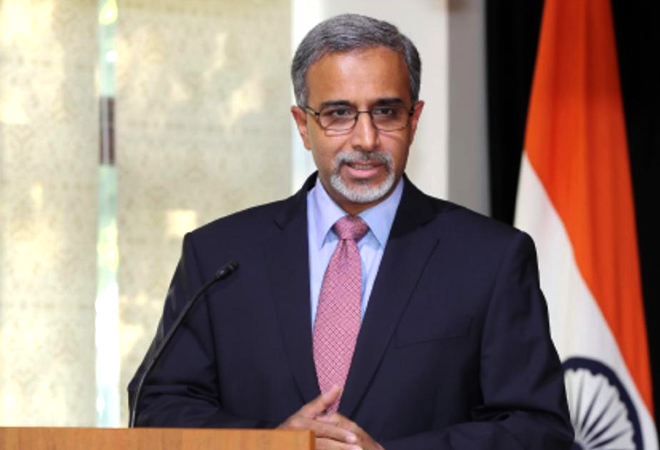
Amb. D. Bala Venkatesh Varma, Indian ambassador to Russia.

Samir Saran: The Joint India-Russia Statement issued at the end of Prime Minister Narendra Modi’s visit to Vladivostok is an extremely comprehensive one. The 81 paragraph statement looks at virtually every aspect of the relationship and reaffirms the commitment of both sides to strengthening ties. What would you consider the most significant aspect of the trip?

Venkatesh Verma: This was Prime Minister Narendra Modi’s first visit to Vladivostok — at the invitation of President Putin to be the chief guest at the 5th Eastern Economic Forum (EEF). The 20th Annual Summit was also held a day prior to the EEF meeting. Since leaders of both countries meet frequently, the most important aspect of the Vladivostok visit was continuation of the conversation between Prime Minister Modi and President Putin on bilateral issues as well as on regional and international affairs. This is a relationship based on trust and confidence and is the guiding spirit of our strategic partnership. The Joint Statement sets out common position for both countries on a range of issues. It also includes key pointers towards an ongoing transformation underway in the India-Russia relationship.

India has historical relations with a number of countries; over time, India has built newer relations with yet more countries. India-Russia relations are unique in terms of a very old relationship, and that is undergoing a fundamental renewal. We are strengthening our roots and at the same time developing new branches. The evergreen nature of India-Russia relations is there for all to see. Prime Minister Modi’s visit to Vladivostok was unlike any other as it combined the strength of history, determined will of our leaders, vision of an economic growth trajectory, and a common determination to grasp emerging geopolitical opportunities. India and Russia are uniquely placed to grasp all these at the same time.

The primary focus of the Eastern Economic Forum, at which Prime Minister Modi was the chief guest, was economic cooperation and opportunities that the Russian Far East offers. Over the last year, both sides have worked towards diversification of this bilateral strategic partnership. PM Modi’s visit to Vladivostok was preceded by the most intensive preparatory phase. In the three months period preceding PM’s visit, two deputy prime ministers from Russia and the Russian Minister of Trade visited New Delhi. So did the director of ROSCOSMOS and the head of ROSOBORONEXPORT. The Indian NSA, External Affairs Minister, Minister of Petroleum & Natural Gas, Minister of State for Defence, Minister of Skill Development visited Russia — joined in by the Chief of Air Staff. Our Commerce & Industry and Railways Minister accompanied by chief ministers of four important States, and 140 strong business delegation, visited Vladivostok in early August to prepare for Prime Minister Modi’s visit in September. It is difficult to find a comparable preparatory exercise in the past.

The primary focus of the Eastern Economic Forum was economic cooperation and opportunities that the Russian Far East offers.

SS: It is repeatedly stressed that the Indo-Russian economic ties are not commensurate with the potentiality of its relationship. The focus of the Joint Statement on economic ties appears to support this contention. How do you think the summit meeting has contributed to giving a qualitative boost to improving the situation?

VV: During the summit, 15 important documents were announced and exchanged at the joint media appearance of Prime Minister Modi and President Putin. In addition, 35 commercial documents were signed by Russian and Indian entities on the sidelines, resulting in 50 documents that are both governmental and commercial in nature. Of these, 12 documents pertain to cooperation in mining, minerals and rare earth, 10 pertain to education, culture, entrepreneurship and innovation and five in the energy sector. We also have cooperation proposals in IT, agriculture, investment funding, timber, healthcare, diamonds, media, chemicals and manpower. If this list is added onto our traditional areas of cooperation with Russia, namely — defence, energy, nuclear and space — the unmistakable emerging picture is one of broad-based diversification.

The Prime Minister announced a credit line of USD 1 billion for Indian businesses to explore and exploit business and commercial opportunities in the Russian Far East. This is a new innovation as per our Lines of Credit policy, as it focuses on one region of a country. In Russia’s case, the Far East, for which this credit line is intended, is two times the size of India. As I mentioned earlier, India has strong historical relationships. We are now evolving new branches that will carry forward our cooperation for the next couple of decades.

SS: An interesting aspect of the Joint Statement is that, for the first time, there is mention of “temporary placement of skilled manpower from India to Far East Russia.” What is the vision behind this? What are the areas in which such a cooperation is likely to take place?

VV: Russia faces a significant manpower shortage. This problem is acute in the Russian Far East. Though Russia generally has a restrictive policy on migration, President Putin responded positively to our Prime Minister’s suggestion that Indian labour, in context of a forward looking migration policy, could contribute positively in developing the Russian Far East, given the excellent examples of how Indian labour has had an impact on other regions of the world. Indian migration will be linked to specific projects of a bilateral nature. There are already good examples with regard to diamond processing in Vladivostok and Yakutia. During EEF, about 10 MoUs were signed in the fields of education and skill development including with India’s National Skill Development Council. Many Indian States are interested in opportunities for skilled youth to find gainful employment in the Russian Far East.

Indian migration will be linked to specific projects of a bilateral nature. There are already good examples with regard to diamond processing in Vladivostok and Yakutia.

SS: The two leaders have devoted considerable time towards cooperation in the energy sector — both hydrocarbon and nuclear. What are the highlights of the agreements in these sectors?

VV: Energy is already a major area of cooperation between India and Russia. Six reactors will be constructed at the Kudankulam nuclear project. Both sides are also in touch with each other regarding a possible second site in the future that will further increase the construction of reactors with Russian assistance. There are other aspects of nuclear fuel cycle, including a ‘third country cooperation’, on which both sides were actively engaged.

In the hydrocarbon sector, there are examples of extremely successful cooperation projects. The 20 year old Sakhalin-1 Investment remains one of the most profitable investments made by India internationally.

During the Vladivostok Summit, there was agreement on a roadmap of cooperation over the next five years in the hydrocarbon sector. It included strengthening LNG exports to India; encouraging Russian companies to participate in gas projects in India; exploring the possibility of Indian companies collaborating in LNG projects, including in Arctic LNG infrastructure projects; cooperation at the university level, among others. Sourcing of coking coal from the Russian Far East is now a major priority.

SS: Connectivity is the new buzzword that carries significant strategic and political significance. How do India and Russia intend to cooperate in this area? For example, how will the two continue with the INSTC in the light of the US sanctions against Iran?

VV: India and Russia remain committed to the International North-South Transport Corridor (INSTC). In March 2019, a coordination meeting held in Tehran agreed on running test run along the corridor to identify bottlenecks between Indian ports and Russian destinations. The next coordination meeting will be held in Azerbaijan in 2020. In terms of connectivity, mention must be made of the Chennai-Vladivostok route which will also be critical to our Act Far East Policy.

Russia plays a very important role with respect to integration processes on the Eurasian landmass in the context of the Greater Eurasian Partnership. We seek integration in the wider region of the Indo-Pacific.

SS: How do these projects contribute to bridging the gap, if any, between Russia’s Eurasian project and India’s Indo-Pacific vision?

VV: We have engaged actively with Russia on our concept of the Indo-Pacific. During his visit to Moscow, External Affairs Minister Dr. Jaishankar spoke at-length at the Valdai Club. Russia plays a very important role with respect to integration processes on the Eurasian landmass in the context of the Greater Eurasian Partnership. We seek integration in the wider region of the Indo-Pacific. As Dr. Jaishankar highlighted, just as India is a strong power in the Indian Ocean with serious interests in the Pacific Ocean, Russia is a strong Pacific power with interests in the Indian Ocean. At the EEF plenary, the Prime Minister highlighted Vladivostok as being the Sangam of Eurasia and the Pacific, opening opportunities for the Arctic and the Northern Sea Route.

If you add the Chennai-Vladivostok route to the overall picture, a natural continuum between Indo-Pacific, the Northern Sea Route and the Eurasian landmass will emerge. Prime Minister’s visit to Vladivostok symbolised India’s determination to be engaged along all points of this geopolitical arch, from Chennai to Yamal, possibly the most significant engagement of this century.

SS: Prior to the summit, there were reports that India and Russia could sign LEMOA type agreement for use of each other’s logistics. But this has not occurred. Is this a sign of some divergence?

VV: Defence ministries of both countries have been discussing a Reciprocal Logistics Agreement, on which considerable progress has been made. We can expect this agreement to be concluded in the near future. It is only a matter of time. This year, the second Tri Service Exercise will be held in India. The IGA on the manufacture of spare parts will be a major boost for the Make in India initiative.

Russia has a policy on Jammu & Kashmir. It views J&K as an integral part of India. It has viewed the abrogation of Article 370 as an integral matter of India — consistent with its constitutional framework.

SS: Have the two leaders been able to bridge the perceived gap in their understandings on Afghanistan?

VV: India and Russia have a long history of consultations on Afghanistan. Both have vital stake for peace and stability of the country. Afghanistan figured in discussions during the visits of the NSA and External Affairs Minister to Moscow, as well as the visit of the Prime Minister to Vladivostok. As in the past, India and Russia are determined to see that their interests are protected with respect to emerging developments in Afghanistan.

SS: Were there discussions on Kashmir and non-state/state sponsored terror?

VV: Russia has a policy on Jammu & Kashmir. It views J&K as an integral part of India. It has viewed the abrogation of Article 370 as an integral matter of India — consistent with its constitutional framework. Russia supports normalisation of relations between India and Pakistan through bilateral dialogue based on the Shimla Agreement and Lahore Declaration. From the visit of EAM to Moscow and the Prime Minister’s visit to Vladivostok, we can say that Russia is beside India on the Kashmir issue.
Standard
Uncategorized

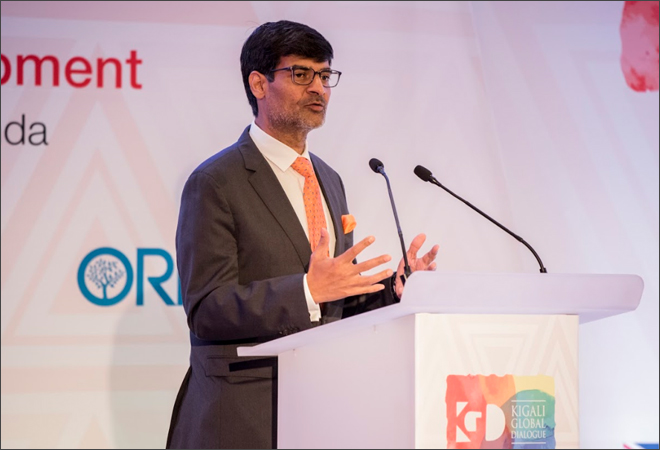
Kigali Global Dialogue only the beginning of Africa-India engagement

The dialogue was intended to highlight the potential of Africa, especially Rwanda, a country that has made significant socioeconomic and technological improvement, leaving behind a bitter and violent past

Rwanda, Rwandan, RCB, CNED, Kigali, Samir Saran, dialogue, sustainable, equitable, architecture, India, Africa, globalisation, investments, sustainability, emerging, economies

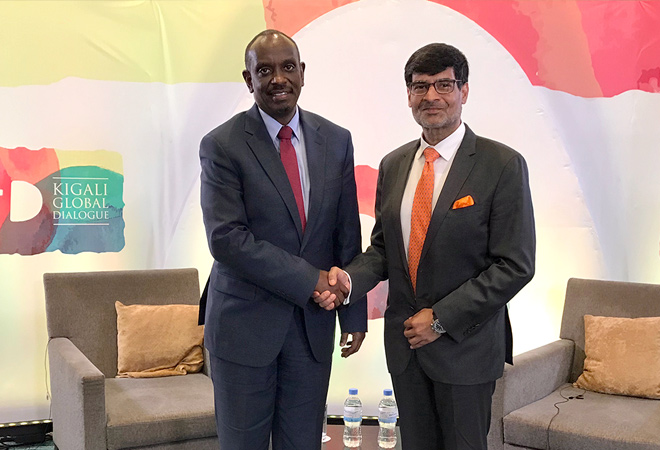
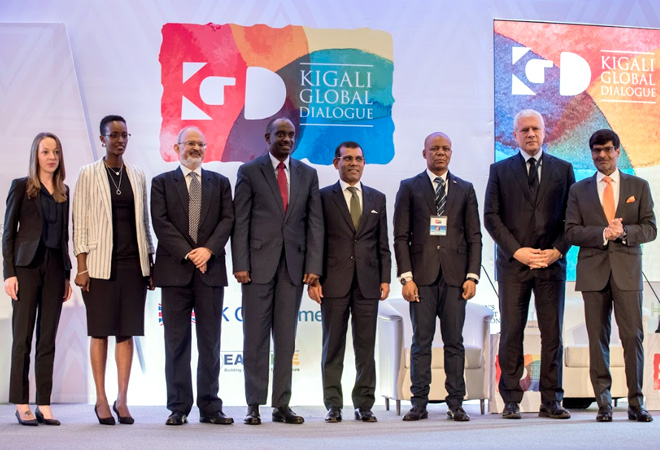
The government of Rwanda, Rwanda Convention Bureau, ORF, and UK-based Centre for New Economic Diplomacy, jointly organized the first Kigali Global Dialogue from July 3 to 5 at a top international hotel in the Rwandan capital.

The ORF played the lead role in holding the first of the dialogues, which will be held in Kigali every year from now on. The dialogue was intended to highlight the potential of Africa, especially Rwanda, a country that has made significant socioeconomic and technological improvement, leaving behind a bitter and violent past.

In an exclusive interview with Dhaka Tribune on the concluding day, ORF President Dr Samir Saran discussed the objectives and achievements of the dialogue.

Now that the dialogue is over, do you think you have achieved what you wanted to achieve? What are the achievements?

Samir Saran: I think this was only the beginning. As I said earlier, the ultimate objective is to create a more sustainable and equitable development architecture—one that is responsive to the interests of emerging economies around the world. This is easier said than done, but I think we have begun to bring together the people and organizations. They can make this happen. We are determined to organise such arenas that give agency to new voices and views around the developing world. It makes conversations richer, plural, and robust.

The agenda of the first ever Kigali Global Dialogue is vast. Could you briefly describe the objectives of the Dialogue?

SS: The agenda was vast because the Kigali Global Dialogue is an ambitious platform that seeks to engage new voices and regions on some of the most important questions of our times. It is an attempt to bring together stakeholders from the developed and developing world, to imagine a new global economic and development architecture shaped by many more stakeholders.

We identified three themes that were central to this: human capital, green energy and sustainability, and technological change and the future of work. These are the processes that will have a disproportionate impact on our development outcomes. We wanted to make sure that our communities are able to shape these trends.

Why did you choose Rwanda to help organize the mega event? What did ORF want to achieve from this dialogue?

SS: Rwanda’s governance propositions are widely hailed as a replicable model for emerging economies around the world. It is recognized as a leader in embracing green energy and technology in its development goals. It has placed people at the core of its political economy, and so it was a natural partner for us. ORF is a curator of conversations—we wanted to provide a platform for new voices, ideas, and solutions, and we are very grateful to our partners in Rwanda, the Government of Rwanda, and the Rwanda Convention Bureau for partnering with us on this important endeavour.

Are India’s engagements and investments in Africa satisfactory? If not, how can things improve? Should India have a long term plan in this regard?

SS: Given the importance of India and Africa to the world, I would say investments are not sufficient. Both need to align actors, investments, and institutions, to strengthen their partnership. More importantly, both should now start seeing each other as natural partners for both economic growth and development of their societies. There needs to be more coordination in shaping economic and development regimes, and the media and think tanks need to engage more deeply with each other. We currently learn of the other from western sources.

There is a perception that India’s growing interest in Africa is to counter China’s formidable presence in the continent. Is there any point to this particular perception?

SS: India and African countries share a history that is as old as modern civilisations. In fact, the first wave of globalisation was sparked by these two regions. More recently, we share solidarity linked to the anti-colonial struggle. China is a new entrant to this old story. I think the Chinese presence in Africa certainly informs the method of India’s engagement, but it is incorrect to think that countering China is the driving factor behind India’s partnership with Africa.

The India-Africa relationship will fundamentally be driven by the search for new economic opportunities and development partnership between their respective communities. It is a unique and privileged partnership.


This interview originally appeared in Dhaka Tribune

Standard
Uncategorized

Seven plus one: India at the G7

 G7, summit, liberal order, climate change, tensions, communique, Macron, Zarif, Johnson, trade deal, EU, reality, Kashmir

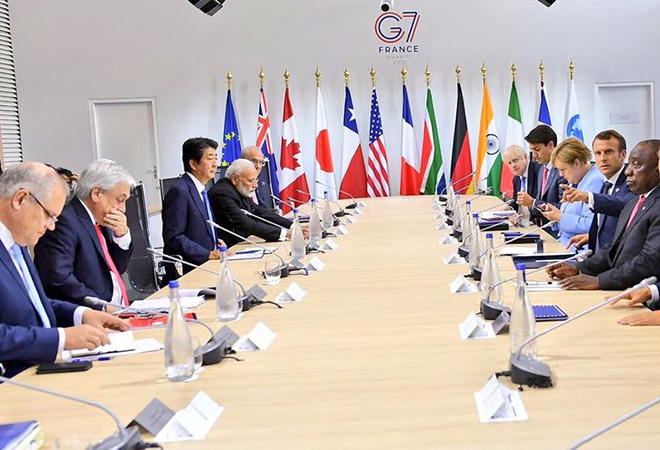
The latest G7 summit is further evidence that the traditional guarantors of the international liberal order no longer possess the vision or will to sustain it. The divisions among the group’s members runs deep, on issues ranging from trade to climate change to tensions with China, Iran, and Russia. That two successive summits have ended without a joint communiqué suggests that while the G7 remains a gathering of similar, economically consequential states, the group’s politics is deeply fragmented.

“The latest G7 summit is further evidence that the traditional guarantors of the international liberal order no longer possess the vision or will to sustain it.”

While many blame U.S. President Donald J. Trump’s idiosyncrasies for the sorry state of affairs at the G7, he merely represents the new political normal. Consider the surprise invitation by French President Emmanuel Macron to Iranian Foreign Minister Mohammed Javad Zarif, the announcement of a new U.S.-Japanese trade deal , and British Prime Minister Boris Johnson’s statement on his plan to “talk tough” to the European Union. Each underscores the new reality with which the West will have to contend—individual whims now shape the agenda and outcomes. And that reality will outlast the Trump administration.

India’s presence at the G7 as an observer state is an acknowledgement of another dimension of this new reality. There is a growing realization that revamping the post-war order for the twenty-first century requires new torchbearers, especially from Asia and Africa. In this context, there are three salient observations about India’s diplomacy at the G7.

First, while India has traditionally found the European Union a difficult jurisdiction to navigate diplomatically, a better relationship between the two is emerging as a policy priority. Over the past year, Indian officials have visited the region to strengthen strategic ties. This is a new coalition in the making and deserves more attention.

Second, India’s ability to safeguard its core sovereign concerns even as it deepens its partnership with the West is growing. Issues such as trade, Kashmir, and India’s relations with Russia and Iran were all discussed with G7 members. A decade ago, it was more likely that the G7 would have censured India’s policies. That India set the agenda of these conversations, and that these discussions did not result in discordant press releases, suggests that India is leveraging its heft in the international order. Its message on Kashmir was clear: that is a sovereign issue and New Delhi is in control.

Third, Indian Prime Minister Narendra Modi participated in two sessions at the summit, on climate change and digitization, signaling India’s growing willingness to lead on issues that are points of contention for the transatlantic actors.

Ultimately, the G7, like many other steering mechanisms developed in the twentieth century, is struggling to find relevance in a parochial world order marked by so-called “coalitions of convenience.” For now, New Delhi’s presence at the G7 will go down as another milestone in its rise as a “leading power.”


This commentary originally appeared in Council of Councils.

Standard
Uncategorized

India and major powers: China

To understand India-China relations during the first term of Prime Minister Narendra Modi, it is important to place the bilateral within the larger rubric of rapidly changing political forces at work in Asia. For the past two decades, the so-called “Asian Century” has been defined by the rise of China, and to a lesser extent, India’s economic growth. It was also characterised by cooperation between the two Asian giants in a number of forums, such as the BRICS, and even more recently at the New Development Bank and Asian Infrastructure Investment Bank (AIIB). And even though the border remained a point of friction, China and India were often found defending similar positions in global arenas on issues such as trade and climate change.

Figure 2: AIIB Loans (in USD Millions)

Source: AIIB.

This quasi-camaraderie ended in 2012, when President Xi Jinping proclaimed that the Middle Kingdom was committed to realising the “China Dream”[1]  by mid-century. Since then, Beijing has attempted to globalise its own “internal arrangement” for organising societies based on a mix of political authoritarianism and state-led capitalism. In 2017, President Xi called this “Socialism with Chinese characteristics for a new Era”[2]  and offered it to the world to embrace.

These developments marked an important point of departure for Asia and India. Beijing was now visibly willing to dictate the political, economic and security architecture of the continent—and it had little respect for existing sub-regional groups and balance of power arrangements such as those in South Asia and South East Asia, and extending right up to the European Union. The Belt and Road Initiative (BRI), which seeks to alter extant political geographies and economic models, is China’s most potent tool in this regard.

This expansive geopolitical ambition has naturally given rise to opposition from others. India, as a self-described “leading power,”[3] was the first to vocalise discontent with the BRI—and set the template for the other critics that have emerged since.[4]  From this global pushback against China’s geopolitical ambitions  emerged  a  new  conceptualisation  for  Asia:  “the  Indo-Pacific.” While it was an American construct, India is undoubtedly the lynchpin of this new geography. The framing of this political geography is different from the imagination of the Asian century; this construct is driven not by cooperation, but by contest, conflict and competition.

The past five years of the India-China bilateral have been defined by this one trend: of vacillation between camaraderie in and of the Asian century, to the contest and acrimony in the Indo-Pacific. Consider, for example, the political dynamics of the China-led AIIB. India is the second largest shareholder in this institution that was widely recognised as a juxtaposition between Asia’s rise and America’s diminished influence over the international economic order.[5]

It was also perhaps the strongest indicator of cooperation between India and China. Contrast this with the BRI. China is coopting states in the Indo-Pacific into its broader BRI network to serve its export and national security interests while disregarding the territorial integrity of India and ignoring India’s priorities and vision for Asia.[6]

Similarly, consider India ascension into the Shanghai Cooperation Organization (SCO). The SCO has developed norms that serve as a direct counterpoint to the extant liberal international order. It is an impressive testament  to  how  multipolarity  has  given  rise  to  new  engagements  and propositions. From cyberspace to multilateral trade, the Beijing-led organisation is developing uniquely Asian solutions to political, economic and security imperatives. In 2019, in fact, India joined other members to criticise the US’ aggressive attitude to trade.[7] On the other hand, India is also invested in a revival of the Quadrilateral initiative. A grouping of democracies in the Indo-Pacific, the Quad seeks to preserve a democratic and rules-based order in the region. Like the SCO, the Quad’s cooperation is multifaceted and encompasses infrastructure investment, cyber norms and maritime security cooperation. Only this time, it is China’s mercantilist trade and investment propositions and its maritime coercion that India seeks to respond to.

Figure 3: India-China Trade

Source: WTO

Clearly there are two contradictory forces that drive the bilateral today: the appeal of an Asian Century that seeks to escape the burdens of colonialism, and a contest in the Indo-Pacific to avoid a new form of subjugation. This dynamic was invariably going to produce new friction and ultimately culminated in a skirmish in the Himalayas. The Doklam Standoff in the summer of 2017 marked the nadir in India-China relations and the sharpest decline in bilateral relations between the two powers in over four decades. Fundamentally, the dispute was a struggle to define and then manage Asia.[8]  The stand-off will likely be remembered as a moment when ‘a’ sovereign finally stood up to China’s aggressive attempts to redraw political maps. Beijing is unlikely to either forget or forgive this. It will be naïve to ignore the acrimony, unease, contest and struggle that has defined the relationship between the two countries ever since.

Politically, China has attempted to choke India’s options. Beijing is not being petty when it refuses to allow Masood Azhar’s listing as a global terrorist, or when it objects to the Dalai Lama’s travels in India or refuses to accept India into the Nuclear Suppliers Group (NSG). With these actions, China is being unrelentingly strategic in undermining India’s capacity to influence global and regional political developments.

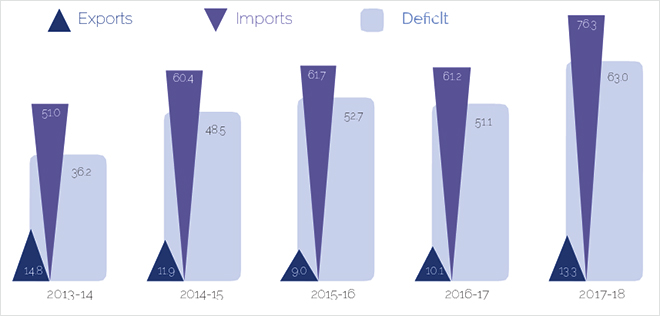
On the  economic and  trade  front,  the  numbers  tell  an  obvious  story about how China views the relationship with India: as a mere market for its manufactured industrial and consumer goods. China’s mercantilism offers no room for partnership; only dependence. Despite multiple negotiations in which India has indicated its displeasure with the negative balance of trade, the difference has only gotten larger.

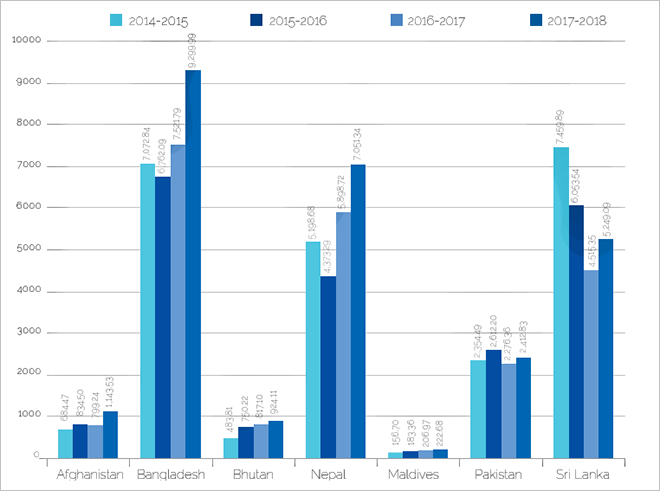
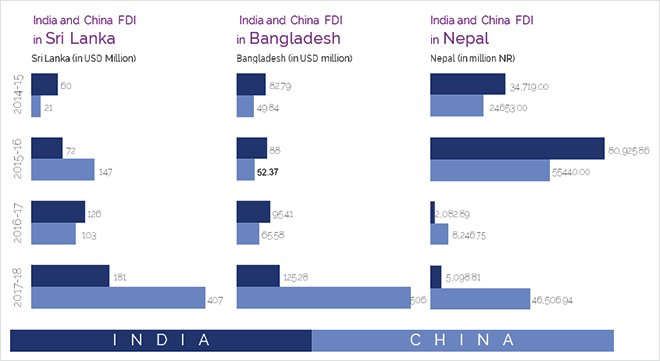
On the security front, Beijing has been completely disregarding India’s sovereign concerns in Kashmir by investing in the China Pakistan Economic Corridor. It has also attempted to undermine India’s economic influence around the neighbourhood, most dramatically in the Maldives, Nepal and Sri Lanka even as it sustains its overtures to Bangladesh (See Figure 4).[9] The Middle Kingdom has also been unrelenting with its pressure around Doklam, with satellite imagery suggesting that it maintains a growing security presence in the region.[10]

By exercising diplomatic, economic and military pressure on India within the sub-region, China is positioning itself to unilaterally design the continent’s

Figure 4: India FDI v. China FDI

Sources: Central Bank of Sri Lanka, Bangladesh Bank, and Nepal Rastra Bank

security and political architecture. This vision is at odds with the original conceptualisation of the “Asian Century,” which was fundamentally a story of the rise of a group of countries in the region. Indeed, 21st-century Asia will not be defined by a solidarity of developing countries led by China and India. Instead, it will be defined by Beijing’s attempt to integrate, on its own terms and for its own interests, the Eurasian landmass.

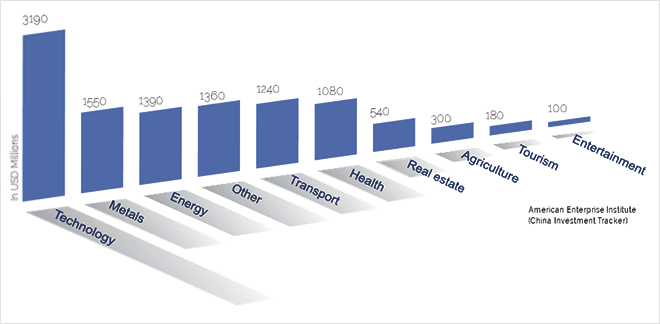
Before India can respond to China with its own propositions, it must acknowledge another set of contradictory forces that drive the relationship: even  while  China  may  apply  tremendous  pressure  on  the  political  and security front, it has also emerged as the largest investor in key areas that are likely to drive India’s economic growth (See Figure 5). As India’s economy moves towards the US$5-trillion mark, both political friction and economic engagement will only increase. In managing this, India will find little help from the North-Atlantic countries—who are themselves struggling to set the terms of engagement with China, both individually and collectively. Italy’s decision to join the BRI and the EU’s inability to decide on the future of 5G infrastructure only drive home the point.[41]

India will have to build its own capacity to resist and counteract China’s political aggression, even as it embraces investments and commercial opportunities. This is certainly easier said than done. However, China in its own emergence has demonstrated the method to do this. For years, it benefited from the American economy and investments even as it pushed back against a US-led world order and its presence in the Western Pacific. This is a template that India must emulate.

Figure 5: Chinese Investments in India (in USD Millions)

Source: China Investment Tracker, American Enterprise Institute.

This will be the government’s most complex task: navigating the disconnect between the opportunities of the Asian Century and the hard realities of the Indo-Pacific. Even as India leverages Chinese investments to fuel its growth, it must offer to Asia and the world an alternative model for development that is based on democracy and a proposition for security based on international rules and institutions. Which conceptualisation eventually characterises Asia will invariably define the contours of the world in the 21st century.

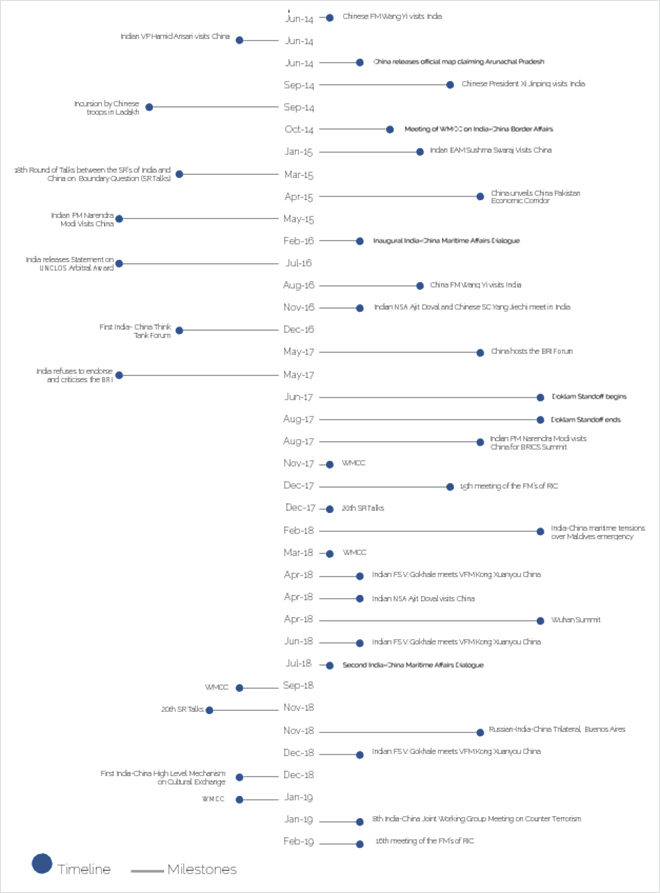
Figure 6: A Timeline of India-China Engagement (2014-’19)

Source: Ministry of External Affairs, India

This article originally appeared in special report Looking Back looking Ahead.


End Notes

[1] “Chinese Dream,” China Daily.

[2] Xiang Bo, “Backgrounder: Xi Jinping Thought on Socialism with Chinese Characteristics for a New Era,” Xinhuanet, 17 March 2018.

[3] “IISS Fullerton Lecture by Dr. S. Jaishankar, Foreign Secretary in Singapore,” Ministry of External Affairs, Government of India, 20 July 2015.

[4] “Official Spokesperson’s Response to a Query on Participation of India in OBOR/BRI Forum,” Ministry of External Affairs, Government of India, 13 March 2017.

[5] ANI, “India Is Second Largest Shareholder Of AIIB: Piyush Goyal,” Business- Standard, 24 June 2018.

[6] Samir Saran and Sushant Sareen, “Battle for South Asia 2.0,” ORF, 27 September 2018.

[7] Dipanjan Chaudhury, “India Likely to Join China-Russia Call for New Trading System on SCO Sidelines,” The Economic Times, 10 June 2019.

[8] Samir Saran, “India Sees the Belt and Road Initiative for What It Is: Evidence of China’s Unconcealed Ambition for Hegemony,” ORF, 19 February 2018.

[9] Ashlyn Anderson and Alyssa Ayres, “Economics of Influence: China and India In South Asia,” Council on Foreign Relations, 3 August 2015.

[10] Vinayak Bhat, “Near Doklam, China Is Again Increasing Forces, Building Roads & Even A Possible Heliport,” The Print, 2 April 2019.

[11] Colin Lecher, “Europe Is Worried About 5G Security, But It Isn’t Banning Huawei Yet,” The Verge, 26 March 2019.

Standard
Uncategorized

The India–US trade dispute and India’s evolving geopolitical role

While the strategic partnership between the United States and India remains robust, some analysts see the relationship as becoming significantly strained if current trade disagreements are not managed properly. To examine the root causes and the potential longer-term consequences of current tensions, and to consider India’s evolving geopolitical strategy, Samir Saran, President, ORF spoke to the World Economic Forum.

Partnership, geopolitical, consequences, Samir Saran, trade tensions, interconnected, transformations, disagreement, digital platforms, localization, e-commerce, contested issues, natural allies, Silicon Valley, WTO, G20, data governance, RCEP, Indo-Pacific, maritime, global system, digital economy, Eurasia

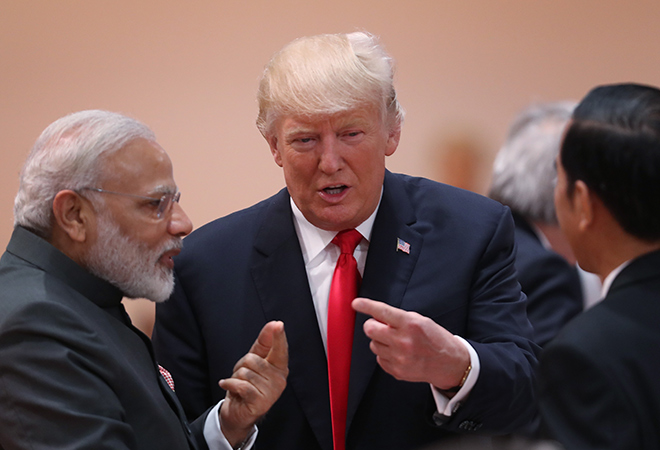
File photo of President Trump And Indian PM Modi at White House

Source: Win McNamee / Getty Images

WEF: How do you see current trade tensions affecting the long-term relationship between the U.S. and India?

Samir Saran: These trade tensions are a manifestation of a bilateral relationship that is maturing in the midst of several interrelated structural transformations in the world order. Two interconnected transformations are particularly relevant to friction in the trade relationship: first, the digitalisation of the global economy and second, the politics of ‘techno-nationalism’.

Around the world, there is disagreement over the governance of data and the role of technology in development and security. Countries are used to conceding sovereign power over the course of decades, through long and hardened negotiations on say, trade and migration.

The explosion of digital platforms has pulled the rug from beneath governments: it has taken away their agency over their populations and businesses overnight

India is no different: one only need look at New Delhi’s gradual embrace of liberal internationalism since 1947. But the explosion of digital platforms has pulled the rug from beneath governments: it has taken away their agency over their populations and businesses overnight.

It would be naive to think that a government of over a billion people will cede the management of its democracy and its all-important services sector to technology companies half way across the world.

This is why data localization, e-commerce, mutual legal assistance, and data protection are the most contested issues between the U.S. and India.

Image: Trade At A Crossroads: A Vision for the US–India Trade Relationship, Atlantic Council

Both countries are routinely termed “natural allies”, but few acknowledge the fact that the maturation of the democratic system in India as well as the expansion of its economy will follow a trajectory different from that of the United States. Rather than viewing ongoing negotiations as part of a process of self-discovery, as it is of self-preservation, the strategic and business communities in the U.S. and India have been talking past each other.

At issue is a fundamental disagreement about how digital technologies will shape our societies. In the United States, there is a firm belief that Silicon Valley can create value in developing economies like India while protecting human rights and cybersecurity.

The Indian perspective is dramatically different. There is a sense that Indian industry and governance propositions must manage the development and deployment of emerging technologies. The assumption that U.S. firms are able to protect the economic rights and civil liberties of Indian users better than its own government has been proven wrong by some recent events and developments.

Image: Trade At A Crossroads: A Vision for the US–India Trade Relationship, Atlantic Council

While both states have done well in keeping these tensions from affecting the broader bilateral relationship, the question of the digital economy will only continue to get larger and more consequential.

It is incumbent on the United States to acknowledge that cross-border data flows cannot be seen as an isolated issue – as they must be discussed in the broader context of national growth and development in the Fourth Industrial Revolution. India, meanwhile, must articulate its policy preferences clearly and quickly – to begin with it must identify sectors and operations in the digital economy where the market can operate without being worried about arbitrary or capricious policies.

There is currently considerable confusion amongst American lawmakers and businesses – as well as stakeholders across the international community – about India’s digital regime. India has dodged the question of data governance at the WTO, at the G20, and at trade negotiations like the Regional Comprehensive Economic Partnership.

The global digital economy will take shape without India if Delhi cannot make up its mind.

WEF: As the United States looks to impose stronger sanctions on Iran, what are the implications for India, Iran’s second-largest consumer of oil?

SS: In failing to exempt India from its sanctions regime, the United States is, unfortunately, pursuing short-term interests over long-term gain. It is essential to understand that energy trade between India and Iran is only one aspect of a far more crucial trend: the gradual merger of the Asian and European continents that is underway and is largely being effected by one player: China. At the moment, Eurasia is being defined primarily by China’s geo-economic thrust through its Belt and Road Initiative and the attendant politics riding on Beijing’s tracks and roads.

The ‘Eurasian’ supercontinent is fast emerging as the second geography influencing the future world order alongside the Indo-Pacific maritime system. Trade, infrastructure, energy, migration and security interests are all at play here and rules and frameworks that emerge will infect the entire global system. India must remain relevant in this emergence and its partnerships with Iran, Russia and others in the region will be crucial.

Different approaches to the digital economy are likely to grow and become more significant.


This interview originally appeared in World Economic Forum

Standard
Uncategorized

New geographies are transcending old divides

In a world buffeted by multiple headwinds, it appears that we have a dearth of progressive leadership. How can individuals and institutions rise above the political divides that are inhibiting a new consensus?

Raisina Dialogue, Samir Saran, climate change, Atlantic Ocean, global economic order, Indo-Pacific, technology and finance, global technology platforms, Pacific Ocean, human capital, polarisation, fourth industrial revolution, governance, new consensus, Raisina Dialogue 2019, population, global high table, democracy, collective security, EU, Mahabharat, progress, science, religion, identities, ideas
Photolabs@ORF

Perhaps the most important driver of change is the certainty that 2019 will herald the arrival of truly global politics. The post-war order contributed immensely to the progress and security of nations; yet its ideas, frameworks, and institutions are no longer sufficient for a new world. The small community of nations that designed and sustained the post-war order must give way to a more diverse constellation of actors. New powers from the East are only one set of stakeholders — increasingly, global governance must allow for distribution of authority and to a more diffused networks of actors, from cities and citizens to corporations and civil society organisations. How we do this will be the key question of our time.

Consequently, we have chosen five themes that are defining a new world order. The first, and perhaps the most consequential of these developments, is the emergence of new strategic geographies that are transcending the old divides of East, West, North and South. Second, we analyse the discontent with today’s globalisation paradigms — and how new trade and technology tensions are threatening the future of connectivity and commerce. Third, we explore how technology is compelling us to search for a new contract between the individual, a business, and the state. Fourth, we ask what ethics will define the development and deployment of new technologies and how they will affect individuals and our societies. Finally, we emphasise the role of leadership — both individual and institutional — in managing the complexities of today’s world.

New powers from the East are only one set of stakeholders — increasingly, global governance must allow for distribution of authority and to a more diffused networks of actors, from cities and citizens to corporations and civil society organisations. How we do this will be the key question of our time.

These are the big ideas that have influenced the design of the Raisina Dialogue 2019. Over the next three days, we have curated over 40 sets of interactions with a global community of leaders and experts, in an attempt to paint a picture of a new world order that is rapidly emerging. A prominent feature of this year’s conversation at Raisina is Europe or more broadly, Eurasia. This supercontinent is without a doubt the most dynamic and unpredictable region in the world, one that continues to surprise itself and others around it. Once considered a benchmark for democracy and collective security, the EU is today increasingly roiled by the politics and economics of populism. Equally significant is that the geographical construct of the larger European continent is dissipating. New flows of finance, labour and information are merging Asia and Europe into a single Eurasian supercontinent. The question for the EU and other European actors, therefore, is whether they can act upon these momentous changes or be subsumed by them. The waters that link this region are undergoing a churn as well. Strategic and economic drivers have brought about seminal changes in the Arctic and the Indo-Pacific. As climate change transforms the geography of the Arctic, its waters will merge the politics of the Pacific and the Atlantic Ocean, even as the regions’ incumbent powers scramble to create new arrangements. The Indo-Pacific, meanwhile, is fast becoming a domain for great power competition. With over 60 percent of the world’s populations residing astride these waters, its potential for scripting new paradigms for globalisation and development is unparalleled. This begs the question of whether these new constructs merely allow us to visualise and manage tensions in the region, or whether they can emerge as a new conduit for development and stability globally.

Strategic and economic drivers have brought about seminal changes in the Arctic and the Indo-Pacific. As climate change transforms the geography of the Arctic, its waters will merge the politics of the Pacific and the Atlantic Ocean, even as the regions’ incumbent powers scramble to create new arrangements.

The broader shift in economic power will certainly not be free of friction. Indeed, it has already given rise to tensions amongst the great powers of the West and the East, and technology is the flashpoint that may inject a new urgency and ferocity to this contest. This dispute is only one facet of the broader dissatisfaction buffeting the global economic order. The rise of non-market economies and the domestic compulsions of populism and nativist economics are threatening the very foundations of free markets and free trade. How will the economic order that has enabled much prosperity over the past seven decades adapt? More consequentially, what happens if it cannot?

Even as the very foundations of the global order stand on shaky ground, the world is still attempting to address the imperatives of sustainable development. Emerging economies are struggling to access and raise sufficient finances to fuel their sustainable development pathways. This hints at a deeper issue: that 20th-century development paradigms continue to privilege a small set of actors and reflect their biases, preventing flows of technology and finance where they are most needed. Indeed, we must continue to ask how the global development agenda can be made more diverse by accommodating new voices. Engendering conversations on globalisation and development is one solution; and it must form part of the template that includes underrepresented communities from around the world. It is time that voices from the dynamic African continent contribute to the deliberations on the future of growth and development; and Latin American perspectives add a new dimension to the voice of the Americas.

.. 20th-century development paradigms continue to privilege a small set of actors and reflect their biases, preventing flows of technology and finance where they are most needed. Indeed, we must continue to ask how the global development agenda can be made more diverse by accommodating new voices.

For many years, the world remained optimistic that new technologies would provide a voice to these communities and create new pathways for progress. Events in 2018 have compelled us to revisit this consensus. Balancing the imperatives of economic growth, national security, and privacy seems harder than ever before. Democracies, it appears, are hard pressed to achieve this, given that open societies are most vulnerable to manipulation and influence in their political processes. Worryingly, however, despite their outsized influence in our lives, global technology platforms have proven immune to calls for accountability and reform. This year, therefore, the Raisina Dialogue will ask how powerful technology companies can be held more accountable to the constituencies that drive their growth and profit. Perhaps we must rethink regulation which curtails their influence and reach?

There is, however, little doubt that technology will continue to transform our societies. The fourth industrial revolution will spur new breakthrough innovations and progress, even as it makes redundant extant arrangements for social mobility and economic growth. It will also compel us to reimagine the value of human capital. Our education, healthcare and labour frameworks must shed their 20th-century formats and reflect the realities of today’s knowledge-based information economy. Further, societies will have to grapple with creating ethical frameworks for new technologies as they increasingly become essential to our politics, economics and military postures. In today’s polarised times, these tasks will not be easy.

The fourth industrial revolution will spur new breakthrough innovations and progress, even as it makes redundant extant arrangements for social mobility and economic growth. It will also compel us to reimagine the value of human capital.

This year at Raisina, we also explore an often-ignored aspect of governance — one that will be increasingly relevant in today’s world — leadership. In a world buffeted by multiple headwinds, it appears that we have a dearth of progressive leadership. How can individuals and institutions rise above the political divides that are inhibiting a new consensus?

Finally, we explore the role of India on the global high table. The opening lines of the Mahabharat, one of India’s oldest epics, boldly states that knowledge that eludes its pages may not be found elsewhere. It is fair to aver that India shares a similar relationship with the world. Its billion-plus population is an embodiment of all that is right with the world as well as all that needs resolution. The challenges that it confronts are those that constrain all of us today. It is inexorably destined to be the steward of the liberal order with which it has had significant differences in the past. It is still emerging even as it leads, it raises hopes even as it disappoints. Indeed, India is a “boundary” nation. It is a living experiment where science, religion, identities, and ideas intermingle to script a unique narrative of progress.

India is therefore an ideal location to dissect the most important issues that engage us all. It is on these boundaries that durable pathways for a world reorder will be discovered. This year, we have convened over 40 conversations to assess, analyse and argue these emerging realities. With 1,800 participants including 600 delegates and speakers from over 92 countries converging in New Delhi, there will be ample diversity and plurality of opinion. And our concerted efforts towards achieving gender parity have ensured that women account for over 40 percent of our delegates this year. We hope that the Raisina Dialogue can be an incubator that generates new ideas for a shared planet and our common future; provide a space where contesting ideas can flow freely; and a platform where we may just tease out an elusive consensus. As always, we look forward to hosting you here in New Delhi.


This originally appeared in the Raisina Dialogue 2019 Report.

Standard
Uncategorized

Is Indo-Pacific a viable geostrategic project?

The Belt and Road Initiative and the “free and open” Indo-Pacific are competing initiatives. However, the real choice will be made by developing states, who are currently leveraging both initiatives to obtain better deals. It’s not inconceivable that in the long term, some multilateral arrangement will accommodate both initiatives.

Indo-Pacific, Chinese, Eurasia, Pacific, unilateral, mechanisms, Quad, BRI, bilateral, multipolar, synergy, commercial, security
Source: White House

Q: The concept of Indo-Pacific is increasingly often positioned as an alternative to the Chinese projects of improving connectivity in Eurasia. How viable is this idea?

A: The Indo-Pacific and Eurasia are not isolated geographical constructs. There is great interdependence between the markets, communities and security concerns of both. A plethora of actors seek to influence the political, economic and security frameworks that will govern these regions. China is undoubtedly chief amongst them.

However, China’s rise has also created new coalitions of states with alternative propositions. Where Beijing wants to globalize its own model of political authoritarianism and state capitalism, countries like the US, EU member states, India, Japan and Australia seek to advance norms based on democracy, multilateralism, good governance and rules-based security.

The “viability” of these competing propositions will depend on which resonates more with the development and security needs of developing states in Eurasia and the Indo-Pacific. In the short term, both will co-exist and compete.

Q: What economic, political and strategic goals are pursued by the United States and its regional partners, first of all, India and Japan? Where are they aligned and where do they diverge?

A:

The US seeks to protect its extant influence in Asia. This implies that the US will support initiatives that improve political freedoms, create free market rules for commerce and adhere to international security norms. Towards this end, it has clearly adopted state postures to compete with China.

Japan, meanwhile shares similar interests. However, it is more inclined to cooperate with China on the BRI to advance its own commercial interests. Japan will instead compete with China on the normsrelating to infrastructure connectivity—promoting good governance and financial sustainability in the projects it signs onto.

India shares a far more complex relationship with both China and the US. Delhi will not participate in the BRI considering that the initiative undermines its sovereignty and broader ability to exert its own interests. On the other hand, China will rank amongst the largest investors in the Indian economy. Delhi will have to be firm with the political relationship while facilitating integration with China’s economy.

India is partnering with the US in part because there is a convergence of interest in balancing China’s rise and in part because it is a partnership underpinned by shared values. However, both states share different perceptions of the Indo-Pacific. While the US’ mental map ends at West India, India’s stretches from the Western Pacific to East Africa. Both also share different attitudes to Eurasian countries like Iran and Russia.

Q: Should the Belt and Road Initiative and Indo-Pacifica be seen in zero-sum game terms?

A: Currently the BRI and the “free and open” Indo-Pacific are competing initiatives. However, the real choice will be made by developing states, who are leveraging both initiatives to obtain better deals. It’s not inconceivable that in the long term, some multilateral arrangement will accommodate both initiatives.

Q: The Belt and Road Initiative is often accused of blending economic and political goals. Is the same true for Indo-Pacific?

A: Yes, both initiatives undoubtedly blend political and economic goals. As mentioned earlier however, the difference lies in the norms, institutions and partnerships that both seek to advance and protect.

China’s BRI is a unilateral project that advances the interests of one country. The Indo-Pacific strategy meanwhile is inclusive by definition. It must accommodate not only the interests of its guarantors (the Quadrilateral Initiative), but also of all states that are willing to participate in the initiative. It is possessed of cooperative mechanisms that facilitate dialogue and cooperation, as opposed to the BRI which privileges “client-state” models.

Q: Should Russia view Indo-Pacific project as detrimental to its Eurasian initiatives?

A: Counterintuitively, the Indo-Pacific project gives Moscow leverage with China in Eurasia. Currently, Russia is subservient to Chinas’ economy and, by consequence, its political vision. Moscow should recognize that while China may seek a multipolar world, its vision for Eurasia is unipolar. Russia will only benefit if both the Indo-Pacific and Eurasia are truly multipolar in their power structures.

In this, the Russia-India bilateral has a very important role to play. Both countries can facilitate greater synergy between commercial and security initiatives in the Indo-Pacific and Eurasia.


This interview originally appeared in Valdaiclub

Standard
Uncategorized

Unleashing women leadership on coffee farms and the world

More than half of the world’s coffee is made by women.

Daria Illy, Grace Hightower, women, women leadership, leadership, Kigali, Kigali Global Dialogue, Rwanda, Kigali, University of Coffee

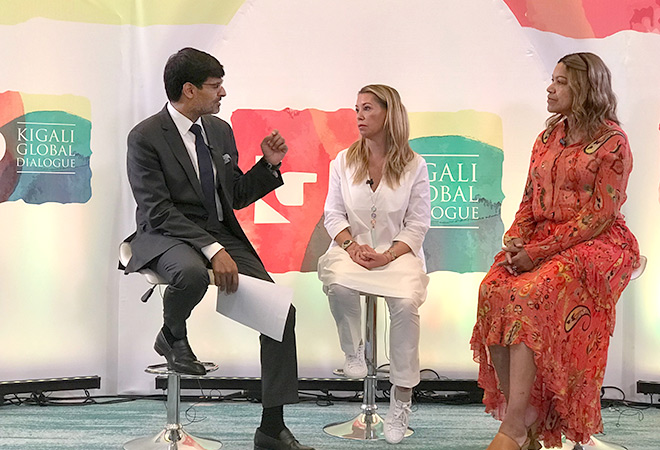
Two coffee entrepreneurs and trailblazers Daria Illy and Grace Hightower are making a powerful case that the time is ripe for unleashing woman power across coffee farms and their legacy ownership patterns. They say men are listening intently and even walking alongside women in a global effort towards getting women out of the old “traps” and boundaries that limit them from early in their lives. Illy and Hightower share their thoughts in a 30 minute conversation with Samir Saran, President, Observer Research Foundation, on the sidelines of the Kigali Global Dialogue in Kigali, the capital city of Rwanda. Illy and Hightower both have great expectations from Rwandan coffee and the country’s people and are sourcing a good chunk of coffee beans from here after having been touched by the country’s swift rise and its big dreams. From their favourite cup of coffee — “Rwandan, of course!” — to the mechanisms for women to hold their own in an increasingly “alpha” world, highlights from this “Unleashing Half the Sky” Q&A are below.


Samir Saran: When it comes down to achieving women’s leadership in the 20th century, what are the nuts and bolts we need to start working on? What does it take to drive women leadership which can create prosperity?

Daria Illy: I had a magnet on my fridge when I was a little girl and it said: “To teach is to touch a life forever.” The biggest change I have seen happening is when someone learns something new and they apply it. So, I think that real sharing, being in professional locations with the people — that’s a positive circle. Part of the change is absolutely culture.

The biggest change I have seen happening is when someone learns something new and they apply it. So, I think that real sharing, being in professional locations with the people — that’s a positive circle. Part of the change is absolutely culture.

Saran: Today teaching and learning is through personal contact — going to the field, going to the farms. There is also technology. Are we seeing technology as a catalyst for women’s learning and empowerment, giving them dreams?

Illy: We have platforms we use to diffuse the message globally. So absolutely, this helps very much. First, it helps us broaden what we are seeing. The University of Coffee has 27 seats in 27 parts of the world. We do what we can to refresh the training. We work on the web platform. It gives consistency to what we are spreading. Also, you can reach many more people. Education changes the equation but they need to get access to it. Access to education happens through positive and fortunate interaction. So, we need to reach out to them and help them grow more and more. The “we” includes foundations, institutions and governments.

Saran: What’s the ‘Grace formula’ for giving women aspirations and higher wages?

Hightower: I don’t empower women. I try and help them reveal the power that’s already there. When I heard President Kagame speak — he inspired me so much with his speaking about how the people of Rwanda wanted to be entrepreneurs. They didn’t want handouts. They wanted to create by themselves. I happened to fall into the business of coffee when I was looking for ways to make a contribution here to the people of Rwanda and I found out that coffee is one of the high producing resources. What I’ve seen is that women possess this incredible power and that’s already innately there. Personally, growing up, I knew that power is there. I didn’t know what it was at that time. Unfortunately, we women have been given roles and we fall into that trap of ‘this is what I should be doing.’ We need to take on roles that we did not know how to do — the unknown roles. Those are the ones that lead to creativity and those are the ones that lead to change. I don’t want to say ‘playing’, I want to say ‘doing’. And so, that has enabled me to work here in Rwanda — my second home — and be able to see how the women here and around the world have opened up that power and others are connecting to it. I think the timing is right. Women are very essential in making and creating the changes that are necessary for the campaign of moving forward for all.

Unfortunately, we women have been given roles and we fall into that trap of ‘this is what I should be doing.’ We need to take on roles that we did not know how to do — the unknown roles. Those are the ones that lead to creativity and those are the ones that lead to change.

Saran: I think you raised a very important point — the campaign. That campaign must include men and in this entire effort, are you beginning to see a larger number of men commit their resources and time towards that goal.

Hightower: We do live in a predominantly male dominated world but I find quite a few men who are stopping and listening to what women have to say. They are listening to their ideas. Their ideas are in alignment with what is going on naturally in the world. We cannot remain with the old ideas that were predominantly male and so many of the old ideas are not relevant anymore. I feel that men are becoming more wise and they are actually seeking out women’s ideas. I know that right now most of the companies — the Netflix, the Amazons, the studios are looking for female driven products. They are looking for female stories that are inspiring because they know these stories are real and have impact on our young people. That is going to be the tailgating. Yes, women have stepped into this role for change and men are alongside them.

Saran: Daria, would you like to tell us about your ‘half the cup’ story

Illy: More than half of the coffee is made by women and only 25 per cent are managing farms. The first day of October is International Coffee Day. Every year we celebrate with the #ThankYouForTheCoffee project. Last year, the title for International Coffee Day was ‘Women in Coffee.’ What we wanted to do is bridge the gap between education, consumers and the coffee growers. We designed a cup to have two halves. In all our shops on that day, we were serving half the cup to customers. People looked and said what’s going on? This allowed us to say what we wanted to say. More than 50 per cent of women are involved in this business. When they understand what we’re saying, they get the other half of their coffee!

Saran: The world is becoming more alpha, more insular, there are more strongmen politicians. At this time, we are also awakening to unleash the potential of half of the human population, achieving SDGs. How do you achieve this, how does this mix over a cup of coffee.

Illy: Depends on how alpha we are. The only thing we can do is keep on insisting. There’s a balance happening. We are thinking there might be a moment when some private companies might have to say something. In America, it is happening more and more. It takes a lot of courage. It is something we need to think about the future. Sometimes you manage to stay out but you have your principles, you have to do more.

Depends on how alpha we are. The only thing we can do is keep on insisting.

Hightower: More corporations will have to begin taking a stand and I speak about America. We will have to say what we disagree with and we’re going to have to say we are not going to allow what we think is wrong. I think the people also have to take on another role. Let’s face it, the last four years, we were caught sleeping. I think the awareness has been raised and we have to push the envelope. None of the changes in America would have happened if somebody hadn’t pushed the envelope. Rosa Parks, Gloria Steinem — they all pushed the envelope. It takes courage.

Saran: Finally, share with us one transformational story

Hightower: I came here six years ago and I met with the people of Rwanda. I know you hear this story all the time — you go to Africa and you come back changed but I really did feel a synergy here that I have never felt before. So, when I started the Coffee of Grace company six years ago, I was sourcing from Rwanda, from small farms. I have seen and tasted the transformation. I have seen the product improve so much. The quality is amazing. People in the West are talking about Rwanda coffee now which they weren’t before. I myself did not know Rwanda had coffee before I came here. As women have become more active in co-ops and production, it transfers to many other areas as well. They get together, they talk, they solve problems. For me, that transformation has been enormous. Back in the West, the speciality coffees that these small Rwandan farms produce has become the millennials’ go to coffee!


Transcription and photo by Nikhila Natarajan.

Standard
Uncategorized

“What the rest of the world is waking up to is a reality we have lived all the time”: Richard Sezibera

For Rwanda, it’s not about only creating wealth — safeguarding the environment is important.

Favourable Global Environment,Globalisation,Kigali Global Dialogue,Richard Sezibera

Rwanda’s foreign minister Richard Sezibera says the quality of his country’s growth is “striking” because it is “non-commodity dependent” and is the result of sound policy choices over at least a decade. Sezibera spoke with Samir Saran, President, Observer Research Foundation, on the sidelines of the Kigali Global Dialogue in Rwanda’s capital city.

“What the rest of the world is waking up to is a reality we have lived ourselves all the time and therefore we have chosen to invest in doing what we think is right for our people and building partnerships with people who understand us. We build those partnerships because we think what benefits us should also benefit others. It is not fair that we be asked to choose between partners and partnerships,” he told Samir Saran.

We bring you excerpts from this special interview that covers the wide arc of development partnerships that Rwanda and other African nations are building with the global community.


Samir Saran: Six of the 10 fastest growing economies are in Africa. Is this optimism well placed? Are there some fundamental challenges that could derail that growth story? Are we beginning to see a holistic approach?

Richard Sezibera: First of all, the growth that we are seeing in our continent is important. Quality of that growth is striking. Many of the fastest growing economies, including mine, are non-commodity dependent. Therefore, these are economies that are growing because of policy choices over many years. Certainly for my country over a decade and these choices have put in place the fundamental building blocks of growth. Investments in innovation, health, education and in critical infrastructure to sustain growth. So the optimism that you see is real. There are still major challenges. Africa is a continent of promise and prosperity potential but we still have to create wealth for the majority of our people and that is still ahead of us. There are challenges of peace, security and governance that is still an unfinished agenda. But all in all, countries have understood that we can grow and grow fast. No country is condemned to live in perpetual poverty. If my country under the leadership of President Kagame can lift itself out of the deep hole left by genocide, then any country on any continent can do well for its people. This dynamic young force that is growing up on our continent is hopeful for the future.

No country is condemned to live in perpetual poverty. If my country under the leadership of President Kagame can lift itself out of the deep hole left by genocide, then any country on any continent can do well for its people.

Saran: In President Kagame’s vision, what are the key sectors that you believe will allow Rwanda to become the service and ideas capital and innovation? What are the relationships you are investing in to help get there?

Sezibera: Thank you for your kind words. Twenty five years down the road, when you look back at 1994 and the devastation there was at that time, I can only say that President Kagame looked at what was and simply refused to see it. He chose to see what this country could be. That vision is captured in our vision 2020 and currently in our vision 2050 is a collective vision that has emanated from all Rwandans — from civil society, from local leaders, religious organisations and therefore they own it although it is executed by government. The pillars of our vision are critical. One of course is peace and security which is also an undertaking by the Rwandan people. We have made investments in health and education because we want an educated workforce that is able to create wealth. We have made investments in critical infrastructure — roads, rail, airlines and energy. We are making major investments in energy and electricity supply, agro-processing and agriculture. A number of manufacturing companies are setting up here — from textiles to automobiles. All this is being done in a manner that safeguards our environment. For us, it’s not about only creating wealth. Safeguarding our environment is important for us. Finally, ours is a vision that is based on regional and continental integration to create the value chains that our industries need.

Twenty five years down the road, when you look back at 1994 and the devastation there was at that time, I can only say that President Kagame looked at what was and simply refused to see it. He chose to see what this country could be.

Saran: Many believe we are facing a tough external environment. We are seeing reluctance around trade, fatigue around globalisation. Many of the big finance firms are working in their own geographies while consumer goods and tech move across borders. Stakeholders are becoming more partisan. How do India and Rwanda grow in such moments. How do we navigate?

Sezibera: or my country and certainly for other African countries, we have never had a favourable global environment. We have never known it. We did not have it in the 80s, we did not have it in the 90s, we don’t have it now. What the rest of the world is waking up to is a reality we have lived ourselves all the time and therefore we have chosen to invest in doing what we think is right for our people and building partnerships with people who understand us. We build those partnerships because we think what benefits us should also benefit others. It is not fair that we be asked to choose between partners and partnerships. We cannot do so. It is not fair that we be asked to be partners on other people’s agendas. No. What is important is that we have our agenda and have partners around it. We negotiate so that the partnership is mutually beneficial. Maybe the idea behind the non-alignment movement is as true today and it is was at another time. It is certainly true for us. We are aligned to our vision and agenda. Multi-alignment has always been true for us. We have to have partnerships with governments, partnerships with the private sector, with universities and research centres. For us, it has always been a world of multiple partnerships. The challenge for us has always been to get our voice heard among these multiple partnerships. 

Saran: Has that changed recently? Do you believe people are more attentive to views coming out of Rwanda and other countries? 

Sezibera: I hope so. We will not shy away from making those views known and to listening. It is a balance. The challenge we have in this world is that there are people who think they have been ordained to speak and the rest must listen. No, we think there must be a dialogue.

The challenge we have in this world is that there are people who think they have been ordained to speak and the rest must listen! No, we think there must be a dialogue.

Saran: Paul Kagame and your people have large support in India. Please share your thoughts on the bilateral.

Sezibera: India is a very important development partner for Rwanda. Not only today but even in the past. Some sectors of our industry developed because of the presence of and actions of Indian entrepreneurs. We have a very vibrant government to government relationship. You are right that President Kagame and Prime Minister (Narendra) Modi share a common vision of empowering people to develop and develop fast. More importantly, we are seeing a lot of interest from Indian entrepreneurs now.


Transcription and photo by Nikhila Natarajan.

Standard
Uncategorized

“What the rest of the world is waking up to is a reality we have lived all the time”: Richard Sezibera

For Rwanda, it’s not about only creating wealth — safeguarding the environment is important.

Favourable Global Environment,Globalisation,Kigali Global Dialogue,Richard Sezibera

Rwanda’s foreign minister Richard Sezibera says the quality of his country’s growth is “striking” because it is “non-commodity dependent” and is the result of sound policy choices over at least a decade. Sezibera spoke with Samir Saran, President, Observer Research Foundation, on the sidelines of the Kigali Global Dialogue in Rwanda’s capital city.

“What the rest of the world is waking up to is a reality we have lived ourselves all the time and therefore we have chosen to invest in doing what we think is right for our people and building partnerships with people who understand us. We build those partnerships because we think what benefits us should also benefit others. It is not fair that we be asked to choose between partners and partnerships,” he told Samir Saran.

We bring you excerpts from this special interview that covers the wide arc of development partnerships that Rwanda and other African nations are building with the global community.


Samir Saran: Six of the 10 fastest growing economies are in Africa. Is this optimism well placed? Are there some fundamental challenges that could derail that growth story? Are we beginning to see a holistic approach?

Richard Sezibera: First of all, the growth that we are seeing in our continent is important. Quality of that growth is striking. Many of the fastest growing economies, including mine, are non-commodity dependent. Therefore, these are economies that are growing because of policy choices over many years. Certainly for my country over a decade and these choices have put in place the fundamental building blocks of growth. Investments in innovation, health, education and in critical infrastructure to sustain growth. So the optimism that you see is real. There are still major challenges. Africa is a continent of promise and prosperity potential but we still have to create wealth for the majority of our people and that is still ahead of us. There are challenges of peace, security and governance that is still an unfinished agenda. But all in all, countries have understood that we can grow and grow fast. No country is condemned to live in perpetual poverty. If my country under the leadership of President Kagame can lift itself out of the deep hole left by genocide, then any country on any continent can do well for its people. This dynamic young force that is growing up on our continent is hopeful for the future.

No country is condemned to live in perpetual poverty. If my country under the leadership of President Kagame can lift itself out of the deep hole left by genocide, then any country on any continent can do well for its people.

Saran: In President Kagame’s vision, what are the key sectors that you believe will allow Rwanda to become the service and ideas capital and innovation? What are the relationships you are investing in to help get there?

Sezibera: Thank you for your kind words. Twenty five years down the road, when you look back at 1994 and the devastation there was at that time, I can only say that President Kagame looked at what was and simply refused to see it. He chose to see what this country could be. That vision is captured in our vision 2020 and currently in our vision 2050 is a collective vision that has emanated from all Rwandans — from civil society, from local leaders, religious organisations and therefore they own it although it is executed by government. The pillars of our vision are critical. One of course is peace and security which is also an undertaking by the Rwandan people. We have made investments in health and education because we want an educated workforce that is able to create wealth. We have made investments in critical infrastructure — roads, rail, airlines and energy. We are making major investments in energy and electricity supply, agro-processing and agriculture. A number of manufacturing companies are setting up here — from textiles to automobiles. All this is being done in a manner that safeguards our environment. For us, it’s not about only creating wealth. Safeguarding our environment is important for us. Finally, ours is a vision that is based on regional and continental integration to create the value chains that our industries need.

Twenty five years down the road, when you look back at 1994 and the devastation there was at that time, I can only say that President Kagame looked at what was and simply refused to see it. He chose to see what this country could be.

Saran: Many believe we are facing a tough external environment. We are seeing reluctance around trade, fatigue around globalisation. Many of the big finance firms are working in their own geographies while consumer goods and tech move across borders. Stakeholders are becoming more partisan. How do India and Rwanda grow in such moments. How do we navigate?

Sezibera: or my country and certainly for other African countries, we have never had a favourable global environment. We have never known it. We did not have it in the 80s, we did not have it in the 90s, we don’t have it now. What the rest of the world is waking up to is a reality we have lived ourselves all the time and therefore we have chosen to invest in doing what we think is right for our people and building partnerships with people who understand us. We build those partnerships because we think what benefits us should also benefit others. It is not fair that we be asked to choose between partners and partnerships. We cannot do so. It is not fair that we be asked to be partners on other people’s agendas. No. What is important is that we have our agenda and have partners around it. We negotiate so that the partnership is mutually beneficial. Maybe the idea behind the non-alignment movement is as true today and it is was at another time. It is certainly true for us. We are aligned to our vision and agenda. Multi-alignment has always been true for us. We have to have partnerships with governments, partnerships with the private sector, with universities and research centres. For us, it has always been a world of multiple partnerships. The challenge for us has always been to get our voice heard among these multiple partnerships. 

Saran: Has that changed recently? Do you believe people are more attentive to views coming out of Rwanda and other countries? 

Sezibera: I hope so. We will not shy away from making those views known and to listening. It is a balance. The challenge we have in this world is that there are people who think they have been ordained to speak and the rest must listen. No, we think there must be a dialogue.

The challenge we have in this world is that there are people who think they have been ordained to speak and the rest must listen! No, we think there must be a dialogue.

Saran: Paul Kagame and your people have large support in India. Please share your thoughts on the bilateral.

Sezibera: India is a very important development partner for Rwanda. Not only today but even in the past. Some sectors of our industry developed because of the presence of and actions of Indian entrepreneurs. We have a very vibrant government to government relationship. You are right that President Kagame and Prime Minister (Narendra) Modi share a common vision of empowering people to develop and develop fast. More importantly, we are seeing a lot of interest from Indian entrepreneurs now.


Standard