China, economy, Research, Writing

Undermining institutions, underwriting OBOR: Beijing and the crisis of global governance

This article was co-authored with Mihir Swarup Sharma.

This article is part of the series The Beijing Heist: Making Global Institutions Serve the CPC Agenda


All good things must come to an end, and so must illusions of the promised common future. A fundamental assumption long held by many in the West is that the multilateral institutions instated over the six post-War decades would serve to constrain and direct the “peaceful rise” of the People’s Republic of China (PRC). It was believed that a Beijing that was given the position it thought justified within the multilateral architecture would end up being a responsible steward of these institutions and of the global commons more broadly. The scandal at the World Bank that led to the end of the Doing Business report and index is the third time that this assumption has been proved as naïve, and, indeed, delusional.

The World Bank scandal is directly linked to the Xi Jinping regime’s growing sense of entitlement. An independent report commissioned by the Bank has revealed that its leadership— including a former senior official, Kristalina Georgieva, who is now head of the International Monetary Fund (IMF)—apparently manipulated the supposedly independent report to placate PRC officials worried about their ranking. The immediate context? Ownership shares at the Bank were going to be “re-calculated”; in other words, the PRC was going to see a big boost in its control of the institution. (Eventually, 52 countries had to reduce their voting share in the Bank to increase China’s.) It was the anticipation of Beijing’s increased power over the institution that led to this episode; it appears a careerist international bureaucracy was all too eager to please the new ownership. Many will now want to more closely examine Beijing’s position on the acrimonious selection in 2019 of a new IMF Chief from within the European bloc.

The World Bank scandal is directly linked to the Xi Jinping regime’s growing sense of entitlement. An independent report commissioned by the Bank has revealed that its leadership apparently manipulated the supposedly independent report to placate PRC officials worried about their ranking

Two other institutional pillars of global governance have already been left powerless and have faced global ridicule as a consequence of Beijing’s actions. The World Trade Organisation (WTO) has lost the trust of the world in the two decades since the PRC’s accession; many of its members, developed and developing alike, feel that the PRC has not conducted the reforms that it had promised in order to join. As a result, it has retained an advantage in global trade that the WTO has been unable to rectify, leading to the institution itself being considered worthless. And then there is the World Health Organisation (WHO), which has been seen during this pandemic as prioritising Beijing’s sensitivities over warning the world about a deadly contagion—or even properly investigating its origins. The tight control of information by the Communist Party of China (CPC) means that questions remain unanswered about the virus’ origin, yet what is certain is that the pandemic’s initial spread is in no small part due to the CPC’s machinations and missteps, and the WHO leadership’s complicity with Beijing.

It is time to accept that ceding Beijing the control of the levers of global power leads to disastrous consequences. Liberal democracies such as India and those that designed the post-War multilateral structure understand the need for independent institutions. They may chafe at the pressure such independence brings to bear on their own domestic and geopolitical actions, but appreciation of the importance of institutional strength and independence is in their DNA. This is, of course, not true for the Communist Party of China. Why should anyone expect that a system that permits no independence domestically will not consider it necessary to seize control of global institutions as well? For them, those institutions are useful that perpetuate and further the party line.

Liberal democracies such as India and those that designed the post-War multilateral structure understand the need for independent institutions.

The Ease of Doing Business report and it’s deserved demise should not worry us. Concern about what will follow next should be more widespread. That Georgieva’s name has appeared in this investigation is worrying given that the IMF, in particular, is under siege. Its previous head, Christine Lagarde, explicitly made the point that Beijing’s “One Belt, One Road” initiative risked leading to a debt explosion in the developing world that would become the IMF’s problem. Under Georgieva, the pandemic did, in fact, cause an emerging-economy debt crisis in 2020. Other state-run lenders wanted to grant some measure of relief to those countries most under pressure. The PRC’s financial institutions refused to play along, demanding that they be treated like private-sector bond-holders instead. Georgieva seemed to excuse this behaviour, saying in October 2020, “What we are also hearing from China is a recognition that they are a relatively new creditor, but they are very large creditor, and they need to mature domestically in terms of how they handle their own lenders, the coordination among them.” The problem with the PRC’s external lending is not a lack of maturity or of co-ordination. If anything, the problem is the opposite: Too much co-ordination and political control. Will future bailouts spend IMF money to save Beijing’s bad Belt-and-Road loans? In a closed-door meeting in New Delhi some summers back, an American diplomat who had just finished meeting his counterparts in Colombo explained to Indian analysts that its Chinese debt that has ravaged Sri Lanka’s balance sheet and that a IMF bailout was inevitable—as, indeed, it turned out to be.

Unless all of us recognise the danger Beijing poses to global institutions, we will wind up paying for the expansion of Chinese ownership and political control over vast geographies.

An IMF that fears Beijing’s wrath is one that will not protect its shareholders or global private capital. Lending related to the Belt and Road initiative will cause more and more crises going forward, perhaps sooner rather than later, given the effect the pandemic has had on emerging economies’ balance sheets. An IMF intimidated by one activist minority shareholder might well direct the world’s savings into bailing out the PRC’s lending.

Unless all of us recognise the danger Beijing poses to global institutions, we will wind up paying for the expansion of Chinese ownership and political control over vast geographies. This is the global equivalent of the privatisation of profits and socialisation of loss—badly designed projects will create profits, power and growth for the benefit of the CPC, and their adverse economic outcomes will be left to the world to underwrite. The US has mishandled the World Bank already; does the European Union have it in them to save the IMF?

Standard
China, COVID-19, Research, security, Writing

India’s security choices during the COVID-19 pandemic

At the start of the 2020s, India has been confronted with a massive viral spread and a relentless People’s Liberation Army (PLA) on its borders. Last year, even as India was responding to the pandemic that originated in Wuhan, it had to mobilise its forces to counter Beijing’s invasion on the Himalayan heights. Both resulted in loss of lives and both show no signs of going away. While the virus is threatening to rise again in a ‘third wave,’ China has literally dug in at high altitudes in its quest to secure real estate and territory that it believes is crucial for its Belt and Road Initiative (BRI), that provides access to a warm water port in the Arabian Sea, and that is critical to a larger project that seeks to reshape the geopolitical map of Asia. While the two nations have taken modest steps to disengage, military and diplomatic negotiations have not yielded substantive results.

In June 2021, reports emerged that China had been ramping up infrastructure along the Tibetan border. Following this, around 200,000 Indian soldiers have been deployed on the frontier, an increase of over 40 percent from 2020. For India, China poses a clear and present danger. To respond to an expansive and belligerent northern neighbour, it has to reorient its conception of its security as well as deployment of its political and diplomatic resources. This was not the case until very recently.

For India, China poses a clear and present danger. To respond to an expansive and belligerent northern neighbour, it has to reorient its conception of its security as well as deployment of its political and diplomatic resources.

Pakistan had been the major preoccupation since Independence in 1947. Its occupation of parts of the Indian state of Jammu and Kashmir, its export of terror to India as a means of waging an asymmetric war, and its nuclear proliferation had positioned it as the main threat to India’s national security. For long, China had escaped critical scrutiny despite provocative actions. The Indian security establishment was not very vocal when China tested an atomic device during President R. Venkataraman’s state visit in May 1992 — clearly intended to send a message to India. Indian Defence Minister George Fernandes’ prophetic assertion at the turn of the century that China, not Pakistan, was India’s “potential threat No. 1” was not universally shared in the strategic community in New Delhi.

In their public speeches, Chinese leaders declared their preoccupation with the welfare of their people. They took great pains to position China as a responsible power that avoided international confrontation. In hindsight, they clearly succeeded. From the ‘returns seeking’ investors in the United States to the political leaders in Europe and Asia who wanted a piece of the Chinese economic pie, all bought into this masterly conduct of statecraft. For India, the urge to keep China in good humour was also implicated by the border conflict of 1962. Relations had thawed only a quarter-century later. Prime Minister Rajiv Gandhi’s visit to Beijing in 1988 paved the way for the Sino-Indian Bilateral Peace and Tranquility Accords inked in 1993 and 1996 to stabilise the Line of Actual Control (LAC).

From the ‘returns seeking’ investors in the United States to the political leaders in Europe and Asia who wanted a piece of the Chinese economic pie, all bought into this masterly conduct of statecraft.

With stability along the boundary, trade and cultural ties between the two nations began to flourish. The boundary pacts mandated that large numbers of troops would not be amassed along the border, and that there would be no attempts to alter the status quo unilaterally. The Indian establishment believed that the border accords would be “peace for our time.” This search for fool’s gold would lead to India curtailing its multilateral naval exercises and slowing down infrastructure development in critical sectors of the India-China border. Influential voices in the Manmohan Singh government (2004-2014) believed India’s security interests would be served if it did not upset China.

Pushback came only in 2013, when transgressions by Chinese forces in Depsang were diplomatically and militarily countered. Yet, here too there was much discussion and debate in the upper echelons of government. Greater clarity was to emerge in 2014 when India, under the newly elected Prime Minister Narendra Modi, was at the receiving end of Chinese incursions in Ladakh even as a summit was under way with the visiting Xi Jinping. With two episodes in close succession, it would be fair to say that a change in India’s approach to its northern neighbour was thrust upon it.

The Indian establishment believed that the border accords would be “peace for our time.” This search for fool’s gold would lead to India curtailing its multilateral naval exercises and slowing down infrastructure development in critical sectors of the India-China border.

In recent years, India has been able to recalibrate its approach towards the Middle Kingdom even as the world order is changing. The US-India partnership has evolved rapidly. Washington has helped thwart moves by China to internationalise the issue of Jammu and Kashmir, enabled India’s entry into the international nuclear order and brought pressure on Pakistan to crack down on terrorism. The Quad grouping, where Japan and Australia join the duo to keep the Indo-Pacific region inclusive and open to all, is working on providing alternatives to the BRI and is seeking a number of resilient arrangements, including on technology supply chains. A Quad vaccine for all is on the anvil and other countries are looking to partner with the Quad on important global issues.

The ‘La Pérouse’ maritime exercises in the Bay of Bengal, with France joining the Quad members, and the Australia-France-India ministerial dialogue demonstrate that the idea and the ideals of ‘Quad Plus’ are gathering steam. The UK has floated the ‘Democracy 10,’ which includes the Quad countries, to tackle issues related to 5G and emerging technologies that may have a bearing on collective security. Whitehall’s recent assessment of its economic, security and diplomatic interests may see it engage more deeply with India in the Indo-Pacific. Old Europe is certainly finding a place at the core of India’s security calculations.

A testament to India’s recalibration is NATO Secretary General Jens Stoltenberg’s pitch, at the Raisina Dialogue 2021, to broaden cooperation. NATO views the rise of China as having huge security implications and assesses India as its partner. PM Modi’s historic Porto Summit with leaders of the EU and 27 EU member-states helped boost cooperation on terrorism and maritime security. The ‘connectivity partnership’ between the EU and India seeks to finance projects in other nations, offering an alternative to China’s BRI.

NATO views the rise of China as having huge security implications and assesses India as its partner.

Even as India strengthens and redirects its relationship with the old world, Russia remains the X factor. New Delhi’s strategic ties with Washington have become a sore point for the Kremlin. If two new poles emerge — the US and its partners and allies, and the Beijing-Moscow ‘axis ’ — India’s room for manoeuvre may be affected. India is alive to this possibility and is redoubling its efforts to work with Russia, its largest weapons supplier over the past decades. India has to convince President Putin that the bilateral relationship allows him greater latitude while dealing with his southern neighbour. Through back channels, India also has to work towards a reset between the US and Russia and to convince the EU that pushing Putin into Xi’s corner is dangerous and counterproductive. The recent Biden-Putin summit may have gone some way in making this a possibility.

A resurgent China, with its plan to establish regional hegemony in Asia even as it tries to split and dominate Europe, is Delhi’s biggest security challenge. The Indo-Pacific will define the future of the Asian Century. India has been astute in ensuring that its partners and fellow stakeholders from the Atlantic order work closely with it to navigate the choppy waters of the Indo-Pacific.


An abridged version of the above was published for the Lennart Meri Conference.

Standard
Commentaries, foreign policy, Great Power Dynamics, international affairs, Strategic Studies, USA and Canada, Writing

The unravelling of Pax Americana

The “war on terror”, launched two decades ago, epitomised the peak of America’s unipolar moment. The jets crashing into the twin towers were seen by most as an attack on the soul of globalisation, a project promoted and designed by the United States (US) and its partners in Europe. The near-universal commitment to this war, within the P-5 and outside, was a demonstration of America’s real power. That was a different time and a different world.

Since then, the US has been implicated in the global financial crisis of 2008. Its flawed domestic landscape and divided democracy have been a public spectacle for global audiences since 2016, from the swearing-in of President Donald Trump to that of President Joe Biden. Both individuals were and are legitimate leaders for only half their nation. America’s botched and self-serving response to the Covid-19 pandemic only hastened the decline of its ethical and moral positioning. Hot on the trail of these events, the hasty and bungled exit from Afghanistan is not just a political event, but part of a continuum, one that points to the momentous unravelling of Pax Americana.

The jets crashing into the twin towers were seen by most as an attack on the soul of globalisation, a project promoted and designed by the United States (US) and its partners in Europe.

It is not the US’s material power alone that has suffered; the institutions undergirding the liberal order are on shaky ground as well. The partisanship of its media and academia are visible to all. It is a nation where trolling as a way of life has replaced a broad national consensus. Morally tinged lectures about the international liberal order are likely to fall on deaf ears for those who witnessed the West’s callous indifference to billions in the developing world still in need of vaccines, or towards the thousands of Afghan interpreters who risked their lives to fight America’s war.

Those watching from capitals in Asia, gearing up for a new era of conflict and competition in the Indo-Pacific, will be even more sceptical. Some among them will be the first victims of the Taliban’s willingness to shelter and nurture terrorist groups. More importantly, the fall of Kabul will serve as a dire reminder of the fate that may befall them if they get mired in great power competition.

For instance, if one lived in Japan, going nuclear may be a sensible option. If you were a resident of an Association of Southeast Asian Nations (Asean) country, your neighbourhood bully would seem a more predictable and acceptable proposition. No spin can change this. America today is less attractive to many. This is a heavily mediated exit from a partnership and the damage is far greater than any of its other follies.

As these geographies rediscover one another, everything in between becomes a shared problem; refugee surges from countries mired in civil conflict, the climate crisis, and flows of finance, infrastructure and technology.

One could even argue that the US’s Indo-Pacific project has already faced its first significant setback. The idea that the US will now focus on China with greater intensity is naïve and suggests a poor understanding of politics. Land frontiers still matter and the US has ceded South and South-West Asia to Beijing. Chinese State media have lampooned and mocked the US’s withdrawal all week.

What role China will eventually play in Afghanistan is uncertain, but it has plans to fill the void that exists. The Chinese model is different and is based on the extraction of value from resources in the host country and providing lucre to the rulers who facilitate this. Tribes and feudal societies tend to work with this model better than the alternatives that seek to turn them into liberal nations and free markets. In the short term at least, China could well emerge as a powerful shaper of the economic and military arrangements in Af-Pak and West Asia.

This episode will have repercussions for the Quad, an ostensibly “counter-China” alliance in the Indo-Pacific. It is time to face up to some home truths.

First, for too long, policymakers in DC have relied on maps that mark the East Indian Ocean as the Indo-Pacific boundary. India’s perspective on Afghanistan, Pakistan, and West Asia has been dismissed time and again. This must change, or India will work with other arrangements to manage the threats that abound. The US must realise that dealing with the influence of China in Afghanistan and Pakistan are a core Indo-Pacific challenge. Ceding these to China defeats the Western Pacific project as well.

Countries have learnt to assess the US by what it does, not by what it says. Efforts to shape and design regions to suit their own narrow interests are likely to be resisted.

Second, even as DC learns to re-imagine the expanse of the Indo-Pacific, it must internalise that Europe and Asia are merging through the efforts of Beijing. As these geographies rediscover one another, everything in between becomes a shared problem; refugee surges from countries mired in civil conflict, the climate crisis, and flows of finance, infrastructure and technology. The US cannot afford to ignore this region if it is to remain relevant at the end of the 2020s.

Third, India will continue to assess the US as its most important partner. A declining superpower is easier to do business with. The Countering America’s Adversaries Through Sanctions Act (CATSAA) sanctions and sermons on “values” could be shrugged off more quickly. Countries have learnt to assess the US by what it does, not by what it says. Efforts to shape and design regions to suit their own narrow interests are likely to be resisted. Its reliability and trustworthiness will be measured as per its capacity to contain China’s rise without disrupting the determination of states in the region to seek growth and development on their own terms. A transactional America will now encounter transactional friends.

This commentary originally appeared in Hindustan Times.

Standard

With contributions from

Kanti Bajpai, Hoo Tiang Boon, Sujan Chinoy, Bill Emmott, Frédéric Grare, Suhasini Haidar, Quah Say Jye, Tsutomu Kikuchi, Chung Min Lee, Tanvi Madan,  Kishore Mahbubani, Kalpit A. Mankikar, Rana Mitter, C. Raja Mohan, Samir Saran Teresita Schaffer, Ayesha Siddiqa, Peter Varghese, Igor Yurgens

About the Book

In July 1971, US National Security Advisor, Henry Kissinger, made a secret visit to China to meet top Chinese leaders. This inaugurated a new phase not just in US-China relations but in contemporary history. That visit and the subsequent US-China relationship, including the US decision to invest in China’s economic rise and admit it into the World Trade Organisation, combined to firm up the foundations of China’s rise as a world power.

For more than four decades, the leadership of the two countries had a secretive pact, which worked well to each other’s benefit. The US helped power China’s economic growth in the hope that Beijing would turn a new political leaf and adopt Western practices (e.g. democracy). China grew economically and militarily, used its financial prowess to spread its influence across continents, as four generations of Chinese leaders built their nation at the expense of the US.

Half a century after Kissinger’s historic visit, the US and China are today engaged in a trade war bordering on a new Cold War. Washington is not openly talking about “de-coupling” from China, which has begun to challenge its global dominance, but it might very well be. China has already established itself as a dominant power across Eurasia. More worryingly, China is militarily and economically threatening its neighbours, including Japan, Korea, Vietnam, Taiwan, Australia, Philippines, Indonesia and India.

This collection of critical essays examines the impact, consequences and legacy of Kissinger’s first, door-opening visit to China and how it has shaped world order.

Books, China, Writing

A New Cold War: Henry Kissinger and the Rise of China

Image
Research, Writing

Big Tech and the State: The necessity of regulating tech giants

The scramble for gold on the Internet has transferred control of vast swathes of cyberspace to a very small and select group: Big Tech. This has made ‘significant social media intermediaries’ highly profitable ad businesses that have grown amid non-existent privacy and weak intermediary liability laws. They make the market, grow the market, and shape market rules. No ad business, or any business in history—not even Big Oil or Big Tobacco—has held so much power over consumers and the economy. This perverse power is, perhaps, the single biggest challenge that nations and peoples will have to grapple with. Accountable Tech must be India’s leitmotif in 2023 as it presides over the G-20, and a robust digital republic its sovereign mission as its turns 75 next year. This will need sensible politics, sophisticated policies, and a return to first principles.

Concentration of wealth is a competition issue and an economic policy question. Left unregulated, it brings about inequality in income and opportunity. But concentration of power when it comes to discourse—what is promoted, shared or suppressed—should be more worrying. Safe-harbour provisions in the United States along with self-regulation principles have allowed Big Tech to cherry pick what is to be acted on and what is to be ignored, effectively making it the arbiter of permissible speech. For example, anti-vaccine Twitter users have thrived during the pandemic, while, sometimes, less dangerous actors have had their posts labelled. In January, Angela Merkel, Chancellor of Germany, denounced the de-platforming of then US President Donald Trump by Twitter. “The right to freedom of opinion is of fundamental importance,” Merkel’s Chief Spokesperson, Steffen Seibert said, “Given that, the Chancellor considers it problematic that the President’s accounts have been permanently suspended.”

The issue here is not whether Merkel agreed or disagreed with Trump’s tweets. The question is—who censors him, how, and with what process and level of transparency? For the Chancellor and for many, Twitter cannot choose for itself when it seeks to be a provider of public goods, and when it is a private messenger eligible for intermediary protections. When governments around the world describe digital connectivity as a ‘utility’, information lines cannot be disrupted by religious, cultural or ideological filters. Like water, electricity and roads, significant social media will have to serve all, even those its management and owners disapprove of.

[Platforms] cannot choose for [themselves] when they seek to be a provider of public goods, and when they are a private messenger eligible for intermediary protections.

The instances when utilities (say electricity and water) are denied or disconnected are specific, rare and regulated. Even in the information age, only the state and its three pillars have this right. Global Big Tech is not part of this constitutional arrangement. There are checks and balances in place, with legal recourse available for all within the state and for external actors as well. Any alternative to this constitutional setup would be akin to legitimising foreign influence operations in domestic affairs. In an extreme, for a country that is almost perpetually in election mode, it would be tantamount to election interference. This may seem like hyperbole, but it is closer to the truth than we suspect. For instance, if an electoral candidate makes an incendiary speech on a physical stage, the Election Commission, law enforcement agencies and the judiciary act against him—not the private company that has set up the stage or the power utility that has provided an electricity connection to the mike. Is the online equivalent being honoured by Big Tech?

Regulation of Big Tech across democratic setups

Australia gets this. In February, it passed the News Media Bargaining Code. The code encourages intermediary tech firms to negotiate deals with media outlets, effectively mandating that Facebook and Google pay news firms for content. The law was passed after a protracted battle between the Australian government and social media firms. It escalated when Facebook removed content of certain Australian news agencies, several official government handles, emergency services, and civil society organisations from its platform. Prime Minister Scott Morrison held firm: “These actions will only confirm the concerns … about the behaviour of Big Tech companies who think they are bigger than governments and that the rules should not apply to them.”

Canada, too, is making moves to curtail the wealth and discourse monopoly currently enjoyed by Big Tech. Just this week, Canadian lawmakers passed Bill C-10, which seeks to regulate the kind of content media streaming services prioritise on their platforms. The Bill, which is yet to be passed by the Senate, aims to make digital streaming platforms at par with traditional broadcasting services; the latter are obligated to increase the visibility and “discoverability” of Canadian content, and to set aside part of their profits to support a fund that promotes original Canadian productions.

Across the pond from the Americas, the European Union is also actively working towards mitigating the risks posed by the monopoly of Big Tech. Margrethe Vestager, Vice President of the European Commission for A Europe Fit for the Digital Age, has stated that tech giants, “have the power to guide our political debates, and to protect—or undermine—our democracy.” In December 2020, Vestager and her office tabled the Digital Services Act (DSA), which seeks a systemic assessment of the varied social, economic and constitutional risks posed by the services provided by Big Tech.

The most decisive move yet has come from Poland, which has proposed a law to ‘limit’ the censorship tendencies of the tech giants. Soon after the deplatforming of Donald Trump by Twitter, Prime Minister Mateusz Morawiecki wrote on Facebook: “Algorithms or the owners of corporate giants should not decide which views are right and which are not. There can be no consent to censorship.” The new proposed law provides for a special mechanism for those whose content or profiles have been blocked/deleted by social media platforms, where they can complain directly to the platform, which is obligated to respond within 24 hours. After a review by a specially constituted “Freedom of Speech Council”, deleted content can be restored by order. If platforms do not comply, they can face a heavy fine of up to 50 million zloty (US $ 13.4 million).

Regulatory Frameworks in India

India, too, must take some tough calls. The vision of Digital India has advanced—from only four unicorn companies in 2014, India had 12 in just 2020 alone. Regulation must keep pace with this economic and social reality. It is absolutely critical that the Privacy and Data Protection (PDP) Bill, currently being examined by a Parliamentary Joint Committee be brought forth and enacted as law. Without the umbrella framework of the PDP bill, India’s regulation of Big Tech will be ad hoc, and may be misconstrued as a political instrument.

The vision of Digital India has advanced—from only four unicorn companies in 2014, India had 12 in just 2020 alone. Regulation must keep pace with this economic and social reality.

With respect to regulating intermediaries, the Indian government initiated a public consultation process in December 2018 and invited submissions from the public to the Ministry of Electronics and Information Technology. A spectrum of civic, industry and academic actors participated. The rules were notified in February 2021, specifying clear compliance requirements within three months. Yet, the reaction of Big Tech platforms has been to delay, stall and obfuscate compliance.

It is high time that the actions of these companies were subject to systematic and rigorous Parliamentary oversight; but for that to happen, legislation is needed. Indian law and policy are rooted in our Constitutional principles. Indian policies on digital governance are no different, but they now need the imprimatur of Parliament to truly be effective. And should there be questions and grievances regarding the scope and constitutionality of the law, the courts of India will be the ultimate judge.

The objective of regulatory frameworks is to safeguard public interest, even (or perhaps especially) if it involves eroding the bottomlines of powerful vested interests. To once again quote the EU Commission’s Magrethe Vestager (in an intervention at a technology policy panel at the Raisina Dialogue earlier this year), regulating Big Tech, “Is a job, not a popularity contest”.

Perhaps, the real limitation is one of our imagination. In our minds, Silicon Valley is forever a happy, sunshine place, led by geeky, long-haired wunderkinds in t-shirts and flip-flops. The reality is Big Tech’s instincts today are driven by a single-minded sense of territoriality and collective impatience for different governance systems. For them, their ‘code is law’ and it is universal. That is at the crux of it.

Standard
Research, Writing

The Global Trade Map After COVID-19: Where to for Global Companies and Investors, and Policymakers?

Co-authored with Dr. Alexis Crow

In the wake of rising protectionism over the last half decade, the sudden economic stops wrought by COVID-19, the corollary disruptions of supply chain activity, and shocks to supply and demand, commentators from across the globe have trumpeted the ‘end’ of globalisation.  Indeed, even predating the populist movements in the UK—culminating in the Brexit referendum—and in the US, resulting in the Trump era of tariffs and US withdrawal from trade agreements—some economists had forecasted a plateauing and eventual tapering of globalisation. With the shift from the old to the new economy—that is, growth in services activity and employment—experienced by many advanced economies (including the US, the UK, and the Netherlands), less goods—or volume of merchandise—are being moved around the world.

This carries with it certain implications, as the manufacturing and industrial eras associated with the production of goods have significantly boosted national incomes within domestic borders.  Additionally, competitive export of these goods to foreign markets has further contributed to both domestic as well as global economic growth.  Looking beyond goods, cross-border exchanges of services (such as travel, IT, and legal and professional services), as well as flows of finance, and exchanges of human capital have been integral components of the globalised business landscape, critical for building business, profit, and generating returns.

With the future of trade hanging in the balance, what’s in store for corporate executives and investors? For many businesses—even those with a predominantly domestic sales base—have often relied upon the process of globalisation in order to create wealth, ultimately translating into boosting economic growth and employment.  Will ongoing trade tensions—as well as reactions by governments to onshore production in the wake of the COVID-19 pandemic—actually prove to be the end of the multi-decade process of globalisation as we know it?

<object class="wp-block-file__embed" data="https://samirsaran.com/wp-content/uploads/2021/06/orf_specialreport_137_globaltradepostcovid.pdf&quot; type="application/pdf" style="width:100%;height:600px" aria-label="Embed of ORF Special Report No. 137 – The Global Trade Map after COVID-19: Where to for Global Companies and Investors, and Policymakers
ORF Special Report No. 137 – The Global Trade Map after COVID-19: Where to for Global Companies and Investors, and Policymakers
Download

Standard

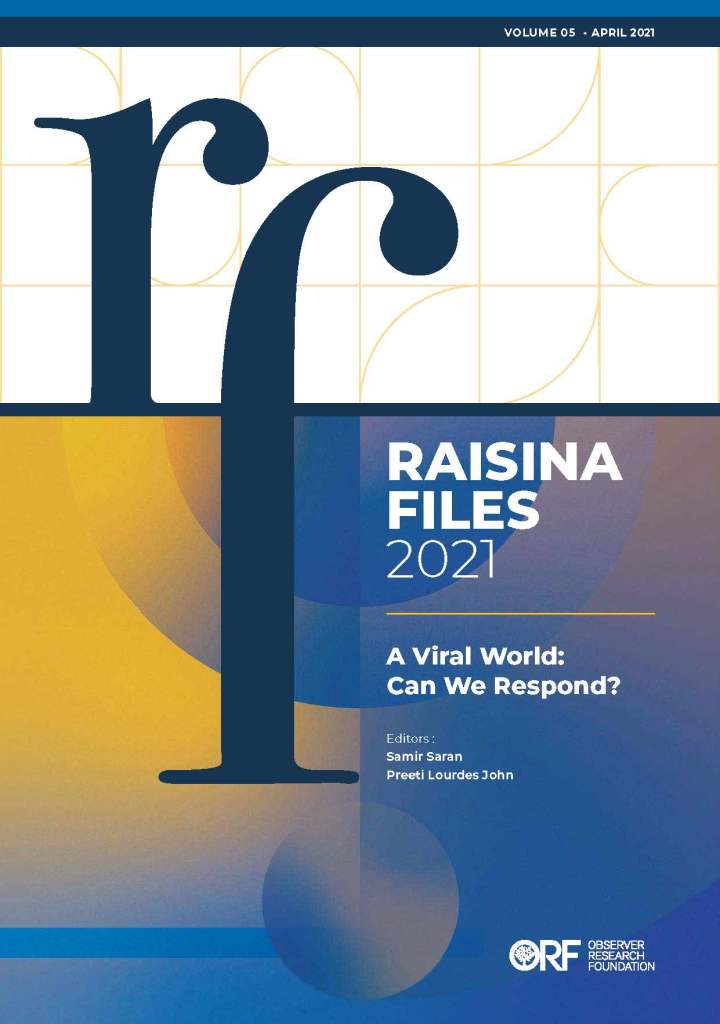
Raisina Files 2021 aims to engage with the leitmotifs of this past pandemic year, mirroring the theme of the Raisina Dialogue 2021, “#ViralWorld: Outbreaks, Outliers and Out of Control”. Within this overarching theme, we have identified five pillars and areas of discussion to critically engage with—WHOse Multilateralism? Reconstructing the UN and Beyond; Securing and Diversifying Supply Chains; Global ‘Public Bads’: Holding Actors and Nations to Account; Infodemic: Navigating a ‘No-Truth’ World in the Age of Big Brother; and, finally, the Green Stimulus: Investing in Gender, Growth and Development. Together, these five pillars of the Raisina Dialogue capture the multitude of conversations and anxieties countries are engaging and grappling with.

Raisina Files is an annual ORF publication that brings together emerging and established voices in a collection of essays on key, contemporary questions that are implicating the world and India.

In this volume

Editors: Samir Saran, Preeti Lourdes John

  • Emerging Narratives and the Future of Multilateralism | Amrita Narlikar
  • Diplomacy in a Divided World | Melissa Conley Tyler
  • Is A Cold War 2.0 Inevitable? | Velina Tchakarova
  • Trust But Verify: A Narrative Analysis Of “Trusted” Tech Supply Chains | Trisha Ray
  • Can The World Collaborate Amid Vaccine Nationalism | Shamika Ravi
  • A Nuclear Insecurity: How Can We Tame The Proliferators | Rajeswari Pillai Rajagopalan
  • De Facto Shared Sovereignty And The Rise Of Non-State Statecraft: Imperatives For Nation-States | Lydia Kostopoulus
  • Digital Biases: The Chimera Of Equality And Access | Nanjira Sambuli
  • The Infodemic: Regulating The New Public Square | Kara Frederick
  • How Finance Can Deliver Real Environmental And Climate Impact | Geraldine Ang
  • Unlocking Capital For Climate Response In The Emerging World | Kanika Chawla
  • Putting Women Front And Centre Of India’s Green Recovery Process | Shloka Nath, Isha Chawla, Shailja Mehta
  • Investing In Material Innovation Is Investing In India’s Future | Nisha Holla

Read here – https://www.orfonline.org/research/raisina-files-2021/

Books, Raisina Dialogue, Writing

Raisina Files 2021

Image

The world is in a state of disorder.

As we approach the end of the second decade of the twenty-first century, all about us is chaos. The rise of the East is viewed with scepticism and fear by the West. The international liberal order is facing a moment of crisis. With Darwinism (or the survival of the strongest and fittest) having guided the construction and management of international systems of governance for seven decades, it is no surprise that as sweeping change overtakes the world, there are no longer many takers for these arrangements. Globalization is confronted by economic nationalism. Strong leaders are exploiting the grievances of citizens (whether imagined or real) to discard global ideals and champion local interests. And the prospects of a ‘global village’, of the world coming ever closer together, seem to be in reversal. A zero-sum approach to development and the securitization of growth are creating new potential for conflict at a time when the institutions of global governance are weaker than ever before.

The New World Disorder and the Indian Imperative is a major study of this new world order. In tracing the roots of our current predicaments to the inequity of the post-war international structure, it explains the situation that obtains at present. The book identifies the new actors and ideas that will emerge from the remnants of the old dispensation to script the architecture of the twenty-first century. India, the authors argue, has a major role to play in shaping the regimes of the future given its size, growing clout, and stake in practically every major multilateral organization. India’s sustained commitment to constitutional democracy and its unique identity as a non-hegemonic global power will be central to its leadership role.

In today’s multipolar, contested, and uncertain world, India may well be the only country with the credentials and capability to script an equitable ethic for a new international order.

Books, Writing

The New World Disorder and The Indian Imperative

Image

Soon after his elevation to the post of General Secretary of the Communist Party of China, Xi Jinping rapidly consolidated power at home and expanded China’s influence in the international system. His desire to achieve the ‘China Dream’ by the middle of the century has seen him steadily erode the norm of ‘collective leadership’ at home and has made China’s presence across Eurasia and the Indo-Pacific more expansive. He has determinedly set about reshaping the world order for the benefit of his Communist Party.

Samir Saran and Akhil Deo offer a retrospective reading of how this came to be—tracing the key policy shifts that have come to define China in the Xi Jinping Era. From the creation of the Asian Infrastructure Investment Bank to the Doklam standoff, they identify pivotal decisions and events that have shaped China’s engagement with the world—and how global powers, especially India, have responded to the Middle Kingdom’s rise.

Read here – https://rupapublications.co.in/books/pax-sinica-implications-for-the-indian-dawn/

Books, China, Research, Writing

PAX SINICA: Implications for the Indian Dawn

Image

More than three years after the Paris Agreement was finalised at COP21, it is evident that the developing world is unlikely to receive even the modest amount of US$100 billion annually in climate finance by 2020. This is primarily a result of the collective failure of the developed world to meet their moral and real climate obligations that pre-date the Paris Agreement. This lack of finance for climate action is exacerbated by the fact that the international financial community—banks, asset managers, investors and capital markets—have failed to align their operations with the goals of the Paris Agreement. The involvement of international financial investors, both private and multilateral, in financing green transitions in developing countries has so far been feeble, sporadic and arbitrary. Unless these resources can be leveraged to cater to the development needs of emerging economies, there is a real possibility that the green transitions that we all seek will be incomplete and mostly underwritten by the world’s poorest citizens.

For the past two years, ORF and the MacArthur Foundation have attempted to create a new framework to ensure that the global financial community better responds to the imperatives of the Paris Agreement. Our research acknowledges that official aid and grants are insufficient to meet the burgeoning energy and infrastructure needs of emerging economies. There is no doubt that we require new financial instruments and pipelines to support sustainable development in much of the world. This publication, comprising of 11 policy essays on the subject of climate finance, discusses this objective through multiple lenses. It is a culmination of our efforts to work with a global network of experts and stakeholders to identify bottlenecks and provide new solutions to ensure that emerging economies can access finance to meet their green development goals.

Our series on financing green transitions has largely focused on India, and for good reason: It will be the first large country that must transition to a middle-income economy in a fossil fuel-constrained world. India is also constricted by the same political, regulatory and financial challenges that confront much of the developing world. Given the weak efforts of the developed world to assist the developing countries so far, India has had to chart a path largely through its own economic and financial arrangements. Therefore, an assessment of India’s capacity to now leverage international financial flows and its ability to undertake a low-carbon transition may well provide a reliable template for developing countries to emulate.

Through 11 essays, we explore three broad themes: the role of international investors and institutions; India’s own development policy choices and lessons therein for other developing countries; and the role of human capital in climate-resilient investment.

Our first set of essays analyses the behaviour and financial practises of international financial institutions, investors and credit rating organisations. In “An Incomplete Transformation”, Mihir Sharma argues that Multilateral Development Banks have failed to create bridges between private capital and clean energy/climate resilient infrastructure demands in developing countries. He calls on MDBs to adapt to developing world priorities, crowd-in private capital, and streamline operational activities in emerging economies. In “Financing Climate Resilience”, Vikrom Mathur and Aparna Roy highlight the bias of international investors towards investing mostly in mitigation efforts. Conventional wisdom in the private sector holds that the costs of adaptation and resilience should be borne by governments. Taking a different approach to the problem, Mathur and Roy offer solutions focused on commercial and business opportunities. In two pieces, “Rating Resilience” and “Ratings for Renewable Energy”, Aled Jones studies the limitations of current literature and practices relating to credit rating of infrastructure projects and renewable energy projects and proposes a more holistic framework of risk metrics for both renewable energy and climate resilient infrastructure. Finally, in “The Political Economy of Basel”, Mihir Sharma outlines how the Basel norms have been designed to respond to the interests of a select group of developed nations. He argues that by prioritising macroeconomic stability and implementing new liquidity restrictions, these actors have failed to consider adverse implications on cross-border flows, especially with regards to long-term green investments.

The next set of essays focuses on India’s domestic challenges, particularly in its infrastructure and urban development policy and its efforts to transition to a low-carbon economy. In “PPP model, regulatory oversight and private financing: Evolutionary trinity of India’s infrastructure”, Gautam Chikermane offers a comprehensive historical account of the political economy of India’s infrastructure policy, documenting the many failures that have plagued it. Given that a stable infrastructure policy will have significant implications for green investment choices, Chikermane’s study of India’s policy failures provides valuable lessons. In “Financing Urban Infrastructure for an Evolving India”, Pritika Hingorani, Sharmadha Srinivasan, and Harshita Agarwal examine the reasons for the lack of private-sector involvement in India’s climate-resilient urban infrastructure. They analyse the current regulatory regime for urban infrastructure in India and provide a set of solutions, advancing both public and private sector participation in the future. In “Moving from Growth to Development: Financing Green Investment in India”, Neha Kumar, Prashant Vaze and Sean Kidney explore new financial instruments that India can employ to finance its green infrastructure needs. They outline how India can more effectively scale its green bonds market, leverage international debt capital markets, and harness blended finance to achieve this objective. Finally, in “India and the World,” Aparajit Pandey and I outline three key structural barriers that threaten to undermine India’s rapidly growing green energy sector: the state of its distribution companies, underdeveloped financial markets and inflexible international credit and risk assessment practices. Offering case studies from India’s state and municipal level policies, we argue that India’s ability to succeed in its low-carbon transition will open new pathways for emerging economies around the world.

In our final set of essays, we examine the role of human capital in enabling greater green investment, focusing on leadership and gender. In “Pay for Sustainable Growth”, Charanjit Singh, analyses the executive pay of 31 of India’s top companies showing that by linking management compensation to short-term performance objective, companies are failing to integrate sustainability objectives into their long-term vision. The chapter proposes a restructuring of the private sector’s approach to executive compensation, focused on long-term sustainable economic growth. Lastly, in “Gender and Climate Finance,” Vidisha Mishra posits that even though women and marginalised groups are likely to be more exposed to climate change related risks, they are severely underrepresented in the investment and regulatory classes. Her essay then unpacks the opportunities and benefits of meaningfully building gender concerns into climate finance mechanisms.

Our contributors have attempted to explore the reasons behind the significant shortfall in private finance in relation to low-carbon investments. They have also collectively offered solutions, both domestic and international, with regards to the flow of finance for climate projects. The success of these solutions, however, will be predicated on some boundary conditions that developing economies and the international financial community must meet.

First, developing countries must reclaim the power grid. The large-scale subsidisation of power in the developing world has created significant distortions in energy use, pricing and policy. State-level reform in India suggests that splitting the electrical grid for agricultural and non-agricultural sectors, implementing a credible metering system and providing subsidies as direct benefits can have significant positive effects on the power sector. Without a viable grid, green investments are likely to remain unviable.

The second is to build capacity amongst international investors to understand risk and opportunity in developing states. There is generally a bias stemming from lack of knowledge (information) and capacity (human resources) to assess risks in emerging economies. This ultimately translates into an inability to understand the economic landscape of recipient countries. Further, as one of our authors has highlighted, there are few institutional attempts at gendering climate investments and finance. A lack of female representation in the investor community, especially from the developing world, invariably means that the concerns and voices of the most vulnerable are ignored as financial plans are scripted.

Third, developing countries must build innovative policy tools to leverage new financial instruments and mechanisms. Currently, regulations related to debt and equity markets restrict the flow of international capital into climate action projects. Emerging economies must co-opt their financial sector in the fight against climate change. Financial markets that allow for debt financing and locally issued green bonds for example create a diverse set of instruments that different types on investors can rely on. More ambitious measures can include the creation of a “green investment bank,” which allow the crowding in of private investment in green assets.

Finally, there is a new imperative to overhaul regulatory systems around the world, both in recipient and investing states. Vast pools of money are held by multiple categories of investors, such as pension funds and insurance companies. However, existing regulations limit the ability of fund managers to invest in climate related projects. Further, international credit rating agencies reassess the methodology for assessments of green projects in developing countries. And perhaps most importantly, there is an urgent need to review the current set of Basel Accords as well as the next iteration of Basel IV accords. The macro-prudential regulations were designed to create a more risk-free international banking system but have unintentionally stymied the ability of the financial sector to contribute to climate resilience. The banking community must acknowledge that planetary risk is the largest systemic challenge to financial stability and that mitigating such risk is the most prudential practice.

While these solutions are far from comprehensive, they address some of the most persistent structural barriers to supplying and accessing climate finance. ORF and the MacAuthur Foundation will continue to explore new ways and means to ensure that developing countries can access financing to pursue their low-carbon transitions. We will also continue to study India’s own financial, technological and governance solutions in the hope that these experiences can benefit other countries and communities. We hope that the insights presented in this book will inform academics, business leaders and policymakers in their efforts to better understand the importance of the global financial community finally signing the Paris Agreement.

Read here – orfonline.org/research/financing-green-transitions-47553/

Books, Environment, Research, Writing

Financing Green Transitions

Image