climate change, COP28, Global South, international affairs, Writing

Controversies aside, COP28 is a real chance to put Global South at centre

As the world reels from the impact of the hottest year on record in 2023, the attention of the global community turns to COP28 for solutions to the climate challenge. While the previous decades of the UN Framework Convention on Climate Change (UNFCCC) negotiations have failed to deliver effective and equitable climate action, this year’s COP in the UAE is a unique opportunity to move from empty promises to real action.

Real action on climate requires pragmatism. It would centre the specific needs of energy-poor countries in the Global South. It would recognise that the energy transition for much of the world is just that: a transition, in which legacy fuels are both rendered more efficient and used to finance the scale-up of renewables. Sermonising western COP presidencies have rarely understood the basic needs of the developing world.

While COP28 might have attracted concern for naming a president-designate who also runs a large fossil fuel company, the fact is that this is cause for optimism. Dr Sultan Al  Jaber does indeed run Abu Dhabi’s national oil company — but he also founded the renewable energy giant Masdar, which pioneered efforts to spread green capital across multiple countries and geographies. A pragmatic climate solution for the Global South would similarly prioritise the spread of enterprise, of solutions, and of technology.

Dr Al Jaber and COP28 have a hard task ahead of them. Estimates indicate that nearly all developed nations, with only two exceptions, are significantly off-course in meeting their Nationally Determined Contributions (NDCs). This stark deviation stands as the primary obstacle preventing the realisation of the Paris Climate Goals. Those most culpable for the climate crisis persist in evading their responsibilities. Responsibility for climate finance is even more important. Developing economies will require around $2 trillion annually to meet emission targets and cope with the impact of climate change. In stark contrast, the world has fixated on bickering over a meagre $100 billion annual target for financing from the developed world. We are currently fighting over bicycles when what is required is a Mercedes.

The UAE COP is well placed to establish a new pathway that places the Global South at the centre. It also comes at a time when there is already momentum around Global South led multilateral cooperation. In particular, the Indian G20 Presidency has already demonstrated the ability to build consensus around such a climate agenda. Notably, the inclusion of the Green Development Pact in the New Delhi Leaders’ Declaration creates a cohesive narrative around climate action as a catalyst for sustainable and inclusive growth. India has highlighted a few priority action areas which must now be taken forward in the coming year, and COP28 is an ideal starting point.

First, reducing cost of green capital in the developing world is crucial, as these can be nearly seven times higher than in OECD countries. The IMF estimates that emerging and developing economies (EMDEs) have accounted for 80% of global growth since 2008. However, only 25% of climate finance has flowed to these geographies. By design, the current international financial architecture prevents growth from being green. It is imperative to create a global inventory of green projects with a guarantee that each project can access capital at a similar cost. This guarantee can be facilitated by a transnational institution similar to the Multilateral Investment Guarantee Agency (MIGA). Response to a planetary crisis must not be compromised by perceived political risks.


Second, COP28 must look to institutionalise climate action as an explicit mandate for Multilateral Development Banks, aligning with the MDB reform agenda put forward during the Indian G20 Presidency. The recently expanded BRICS grouping can also be utilised to further the reform agenda. The newer capital-rich members of the grouping should be galvanised to create a line of funds for Green Transitions within the New Development Bank. This can serve as a boutique model which can increase pressure on West-controlled institutions to accelerate their efforts.

Third, progress must be made on the Global Goal on Adaptation (GGA) with a focus on identifying concrete instruments to meet the distinct adaptation finance needs of different regions, particularly for the most vulnerable communities. Furthermore, the GGA should serve as a platform to underscore the repercussions of climate change on health and gender, identifying integrated strategies to tackle these interconnected crises. The Loss and Damage Fund must also be operationalised with concrete financing commitment from the developed world.

Fourth, innovation in climate technologies in the Global South must be encouraged. In particular, green startups should be supported by creating effective knowledge sharing mechanism within the UNFCCC and establishing a social impact fund to support promising green projects.

Finally, it is crucial to diversify and make green technology value chains accessible to all. Presently, China holds disproportionate control over the raw materials and technologies vital for green energy. It is critical to break free from this monopoly and ensure that Beijing does not wield a veto over our green future. 

Source : Times of India, December 3, 2023

Standard
India, international affairs, Writing

The New Suez Moment? India’s G20 and the Tectonic Transition

The world moulded by the Delhi Summit will be one of people-focused principles, and agile, trust-based partnerships

It has been 14 years since the world’s leaders met at Pittsburgh and declared that the G20 was the world’s “premier forum for international economic co-operation”. In all these years, the G20 has broadened its horizons and extended its mandate, but it has never, till India’s presidency, offered a new vision for multilateral economic governance. This is not surprising. The Pittsburgh Summit, held in the shadow of the 2008 financial crisis, had a single-minded focus on saving a financial system distant from the streets of Mumbai or Mombasa. An organisation built for crisis management could not be expected to advance a wholly new vision for global governance.

The Pittsburgh Summit, held in the shadow of the 2008 financial crisis, had a single-minded focus on saving a financial system distant from the streets of Mumbai or Mombasa.

In recent years, the G20 has been a lukewarm affair with political leaders largely being relegated to talking heads. Since February 2022, there has been a real risk that the G20 agenda would, given its crisis management lineage, attempt to become a forum for addressing the war in Ukraine. The New Delhi Summit has not only course-corrected, but it has also given this group a new lease of life. The “bankers’ G20” has been replaced, now and forever, with a “people’s G20”.

India’s achievement in producing a consensus, and a communiqué, has rightly been hailed. The G20 may not be a politico-security forum, but as all the meetings preceding the leaders’ summit demonstrated, there was no getting around Ukraine. New Delhi and Prime Minister Modi were up to the task. The United Nations Security Council, with only five vetoes, has failed to simply reaffirm the basic values of the UN Charter. But with India’s stewardship, the G20—a body with 20 vetoes, not one—was nudged into reminding us that “all states must refrain from the threat or use of force to seek territorial acquisition against the territorial integrity and sovereignty or political independence of any state”.

The United Nations Security Council, with only five vetoes, has failed to simply reaffirm the basic values of the UN Charter.

But what is even more important than India’s ability to deliver a consensus is that India’s G20 has humanised global governance. From climate finance to women-led development, India has taken up issues that so many struggle with and championed their solutions. In an era where populism has been simply wished away as a residual by-product of elite globalisation, India has used that same channel of multilateral cooperation to try and help the world’s underserved.

Partners in democracy: The US and India

India’s leadership, and the new direction it has given the G20, should come as no surprise. The world of 2023 is vastly different from the one in 2009. And India’s ascent to global deal-making has implications for the other great powers of the world: The United States (US), China, and India’s emerging-economy peers.

The Pittsburgh Summit was hosted by the world’s only superpower. Since then, a generation has passed. Attitudes have darkened. The superpower that, with such enviable confidence, steered the Pittsburgh agenda has turned its back on internationalism. It has raised gates to trade and walls against immigrants, and it now forces its money and energy to stay home rather than travel the world.

The superpower that, with such enviable confidence, steered the Pittsburgh agenda has turned its back on internationalism.

But the global system abhors a vacuum, whether of leadership or ideas. Time fashions its own alternatives. And, so, another vast democracy has risen to shoulder responsibility. As Capitol Hill recedes, Raisina Hill has stepped in. To be sure, it seems the US is shepherding India’s rise.

It is the rare succession in power in which its new wielder is welcomed by those who came before. But India’s vision for a renewed multilateralism is one that is welcomed by the US, for it is in America’s own interest as well. The tango amongst democracies was visible to all at the G20 Summit in Delhi. President Biden made it a point to be standing next to Prime Minister Modi at any and every opportunity.

It is easy to see why. Trump’s assault on multilateralism offended the US’ oldest allies in Europe; his open contempt alienated the developing world. The US, still reeling from those four years, has been flailing to reach out to powers old and new. It appears now to have found a way.

The US will find it useful to work with India not just on new, 21st-century issues, but to manage some of its 20th-century relationships that have become more tenuous today.

This is, indeed, a Suez Moment. As, in 1956, an older power found it needed a newer one to make a difference in the world, the US today has understood that certain geographies and actors require that India play a leading role. In that sense, the Delhi Declaration presaged a tectonic transition in global affairs. Biden, at least, has concluded that India’s leadership is good for America. This will not be hard to sell back home. Some progressives in his party might carp, but India enjoys a wide spectrum of support in US politics.

The US will find it useful to work with India not just on new, 21st-century issues, but to manage some of its 20th-century relationships that have become more tenuous today. Its relationship with Saudi Arabia is an excellent example; India plays a bridging role, allowing for new agreements on infrastructure and connectivity. And India’s presence in the room allows the US, Brazil, and South Africa to have a conversation among friends.

Joe Biden is proving he can put into practice ideas from Barack Obama’s presidency that had remained merely slogans. The US is, indeed, “leading from behind” under Biden. Ten years ago, that phrase might have sounded patronising or might have been a façade for the exercise of imperial power. But today, as the world has changed, it is a real formula for effective international relations.

India’s G20 presidency: Development for all

India’s formula for multilateralism has been welcomed by emerging economies from Brazil to Egypt to South Africa. They recognise that India can be trusted to steer the ship of multilateralism in the direction of their priorities. India’s leadership is not built on solitary, hoarded power. Nor is it the sort that Delhi demonstrated in the 1950s, while navigating between two brooding superpowers. Some thought the ‘Trump slump’ in multilateralism and America’s turn inwards would doom international cooperation. Instead, the sheer volume of cooperative activity has skyrocketed, albeit of a different nature from traditional multilateralism, and with novel arrangements.

India’s formula for multilateralism has been welcomed by emerging economies from Brazil to Egypt to South Africa.

The framework that time has fashioned and India has embraced is one that relies neither on the caprices of America nor on vassalage to China. It consists of multiple informal, mutually beneficial, and purpose-driven partnerships, built on agreements between sovereign governments that are based both on principles and on centring their peoples’ needs. In a sense, these attributes mirror India’s foreign policy approach over the last few years. Over the past decade, India has pioneered a multilateralism that is built around limited-liability, flexible partnerships: From the Quad to I2U2 to BRICS.

After the Delhi Summit, the emerging world knows that India’s achievements are commensurate with the breadth of their shared aspirations. Look at the scope of the commitments taken on by the G20 under the Indian presidency—from biofuels to the reform of international development banks. There is not one that is not of great—in some cases existential—importance to the developing world. And in all these initiatives, India is either a catalyst or a driver.

Global leadership today must take on the task of reshaping the world’s economy to the benefit of those who seek to still benefit from globalisation in a new avatar. Fortuitously, IBSA (India, Brazil, South Africa) will be in the chair of the world’s most multilateral grouping for another two years. And they have supported each other admirably. Just as India aided Indonesia in the last-minute scramble for agreement at Bali last year, the emerging market democracies came together to make a Delhi consensus possible.

Global leadership today must take on the task of reshaping the world’s economy to the benefit of those who seek to still benefit from globalisation in a new avatar.

But even among these nations, India is first among equals: With the largest population, greatest economy, and highest growth rate. It also has a geography that makes it impossible to ignore. The task of leadership cannot be avoided, and India has stepped up to do its duty. India matters. And India delivered. In that sense, the Delhi G20 is the intellectual and political successor to the Pittsburgh G20.

In Pittsburgh, 14 years ago, China’s GDP was the same as India’s today. It was growing fast—a country increasingly open, reformist, and dynamic. What a difference a generation makes! Today, an unstable China, struggling with its own woes, is a source of concern for all. It is a cause of anxiety, rather than a source of strength. Few nations can look to it and expect a stalling China to power their growth stories in the coming decades.

Another generation from now, the world would have changed again, but this time thanks to India’s rise. The world moulded by the Delhi Summit will be one of people-focused principles, and agile, trust-based partnerships. It will be one in which, for the first time in human history, global governance will be directed towards the needs of the majority of the global population. India’s foreign minister, Dr S Jaishankar, said it best. This G20, he told us, was making the world ready for India and India ready for the world.

This article is an updated version of a previously published article in the World Economic Forum

Standard
G20, G20 India, Writing

Rescripting Globalisation: A Tide that Lifts All Boats

India has changed the tone and texture of the G20. What was once a summit meant merely for technocrats and policy wonks has become a people’s festival

As the world’s leaders gather in New Delhi, it is clear that India’s G20 presidency will be remembered as a historic pivot in global governance. The 2023 G20 slogan — “Vasudhaiva Kutumbakam” or “The world is one family” — exemplifies a typical Indian melding of tradition and contemporary concerns.

For a G20 summit that is about reviving, reforming, and defending globalisation, vasudhaiva kutumbakam has taken on a meaning beyond hospitality to visitors from across the world. Translated into the rallying cry of “One Earth, One Family, One Future”, it emphasises the interconnection of cultures across geographies, and, as in families, reminds us of our obligation to those left behind, those yet to benefit from globalisation.

Of the many priorities India is taking forward in its stewardship of the G20, three serve to illustrate how the concerns of the Global South have come to occupy centre stage. The first principle is the democratisation and decentralisation of the global economy. “One Earth, One Family, One Future” should be seen especially in the backdrop of recent geo-economic developments that threaten our interconnected futures. Muscular industrial policy has staged a return in geographies that were once the strongest votaries of globalisation.

The United States has passed an Inflation Reduction Act that, in its specifics and motivations, looks little different from the nativist “Make America Great Again” agenda that preceded it. The European Union is girding to introduce a carbon border tax. At best, the rest of the world sees this as an attempt to regulate external markets on European principles. At worst, it looks like open protectionism of a sort the EU has historically attacked when it comes from much poorer countries. Correcting this drift away from the pure principles of globalisation — in which all benefit, but the poor benefit the most — is a priority for the developing world.

The second is reform and restoration of global finance. Since the 2008 crisis, financial globalisation has ceased to operate properly. The purpose of finance is to take savings and deploy them in projects, sectors, and geographies where they will garner the greatest returns. Where are those projects, sectors, and geographies today? As various agencies including the International Monetary Fund estimate, over three-fourths of global growth in the coming years will be in emerging economies.

International finance is, however, still focused on serving the old trans-Atlantic geographies. Wealth creation has been disconnected from growth creation. A financial sector that indulges merely in the perverse redistribution of wealth within societies rather than in enabling global growth that raises all boats is simply unfit for purpose. This G20, under India’s presidency, and those that follow, will aim to fix development and infrastructure finance so that capital can flow to the places where it can best stimulate growth — benefiting all of us, across the world.

Third, and most important, India has changed the tone and texture of the G20. What was once a summit meant merely for technocrats and policy wonks has become a people’s festival. The people’s G20 has a purpose: To amplify the issues that matter to the billions who have been, for too long, ignored by those technocrats and wonks. Dialogue on urgent issues — food, health, jobs, adaptation to climate change — has brought hundreds of millions of Indians, and billions beyond our shores, into the ambit of the global governance discussion. From now on, every presidency will include such perspectives, regions and demographics. India’s proud contribution to the G20 is a diversity that will shake the tree of global governance.

In the past, G20 summits have been remembered for activists outside the venues, protesting against the idea of global governance itself. There is always a place for dissent. India, as a vibrant democracy, knows this better than anyone. But the only answer to such activism is the creation of a wider group that can argue against it. The people’s G20 correctly recognises that democratised global governance and a reformed globalisation can enthuse a wider group, and thereby answer the concerns of those activists who sought to disrupt previous G20s. The warm embrace given to the G20 in India by Opposition-run state governments and marginalised groups is an indicator that there is nothing political or partisan about this hope. India has found a wider, deeper and more expansive response to the malaise of global governance.

This historic turn towards the Global South marked by India’s G20 has begun to redress decades of reductionism. The Global South is no longer a pejorative. India’s G20 has reclaimed this description and shown that our self-image is of a group seeking green growth, tech-first growth, women-led growth, and inclusive growth. Scholarship from richer countries may have been dismissive of the developing world and its aspirations. But today the Global South is seen as wanting more than just handouts. India’s vibrant scholar community, India’s deft diplomacy and, indeed, India’s warm hospitality have reclaimed our identity. For the first time, the Global South is the pathfinder for a greener, digital and equitable growth. This is the developmental legacy of the people’s G20, and of India’s presidency.

Standard
Uncategorized, Writing

Samir Saran: “India no quiere verse atrapada entre el binario Estados Unidos-China”

El analista indio analiza en conversación con EL MUNDO la situación geopolítica actual, el impacto del auge de Pekín en el Indo-Pacífico y la estrecha relación de India con Rusia

Bisagra entre Oriente y Occidente, India es un actor de primer orden en el tablero geopolítico. Es ya el país más poblado del planeta, dispone del tercer mayor presupuesto de defensa, es una potencia nuclear y ha sabido mantener cierto equilibrio en sus alianzas con Moscú y Washington, al tiempo que refuerza su importancia estratégica en el Indo-Pacífico frente al auge de Pekín y estrecha lazos con otros países no alineados del llamado Sur Global.

“Nos vemos como los garantes de la seguridad y la estabilidad en la región; tenemos que ser políticamente firmes para impedir que China socave no sólo la integridad soberana de India, sino también la de nuestros vecinos”. Son palabras de Samir Saran, presidente del Observer Research Foundation (ORF), comisario del Diálogo Raisina y presidente del Consejo del Secretariado Indio del T20, sobre el estado de la seguridad en el Indo-Pacífico, en conversación con EL MUNDO en Madrid, tras participar en una mesa redonda organizada por la Fundación Consejo España-India.

“Las conversaciones”, subraya, “importan ahora más que nunca”. En su calidad de comisario del Diálogo Raisina, Saran afirma que “se ha puesto demasiado de moda ‘cancelarse’ el uno al otro” cuando discrepan distintos actores geopolíticos. Por eso, tal y como advierte el analista, Nueva Delhi no se dejará atrapar entre los binarios del orden mundial actual: “India no está en el bando de nadie”.

El orden mundial actual está marcado por el tira y afloja geopolítico entre Rusia y Occidente, con el telón de fondo de la guerra en Ucrania, la creciente rivalidad sino-estadounidense y el paso del multilateralismo a la multipolaridad. ¿Qué lugar ocupa India en este tablero mundial?

A India no le gustaría ser necesariamente una de las piezas del tablero, sino más bien uno de los artífices de la partida de ajedrez. Nos gustaría ser un país con agencia política, dispuesto a asumir la responsabilidad de ayudar a diseñar y elaborar lo que surja de este periodo de turbulencias geopolíticas que usted ha esbozado, y creo que ésta es la transformación que hemos visto en las últimas décadas. Sin embargo, India es consciente de las realidades a las que todos tenemos que encarar, en concreto el paso del multilateralismo a la multipolaridad. El primero ha funcionado bien cuando ha habido una o dos superpotencias, pero aún está por probar con cinco, seis o incluso siete centros de poder diferentes. Es decir, el multilateralismo aplicado a un mundo cada vez más multipolar es un proyecto aún por emprender. Pero cuando suceda, India quiere ser uno de los países que ayuden a crear esa arquitectura de gobernanza mundial que sea capaz de acomodar esta nueva realidad de multipolaridad.

¿Y cómo se posiciona India en un mundo multipolar?

India no quiere verse atrapada entre los binarios que nos ofrece el orden mundial actual. Queremos poder forjar el camino que mejor nos convenga -que convenga al 16% de la humanidad-, el que nos permita crear un mundo que responda a las necesidades de los millones de jóvenes indios que aspiran a mejorar su calidad de vida. Por eso, considero que India se ha puesto del lado del ‘Equipo India’.

Históricamente, India se ha escudado en una postura de “no alineación” con ningún bloque, siendo ‘la amiga de todos’. ¿Es esto viable hoy?

India no tiene reparos en denunciar las acciones políticas de nadie. Que no estemos alineados no significa que seamos neutrales. El siglo pasado, nuestro país fue miembro fundador del Movimiento de Países No Alineados, que no era algo que se pretendiera valorar como algo estratégico. Se trataba de un colectivo de países que no comprometían su capacidad de decisión en función a los ‘bandos’ a los que pertenecían. Pero hoy sí es estratégico. La “no alineación” de hoy es una postura que no sólo adoptan países individuales, sino también organizaciones internacionales, como la Unión Europea. Si el mundo avanza hacia el binario de Estados Unidos frente a China, Bruselas no quiere estar ni en el bando estadounidense ni en el chino. Quiere hacer negocios con ambos, al igual que India. Y, desde luego, India no pertenece a ningún bando. Se le puede llamar “no alineación”. Se le puede llamar “multi alineación”. Incluso se le puede llamar “alineación estratégica”, pero India no está en el bando de nadie.

¿Cómo interpreta entonces la abstención india en las votaciones del Consejo de Seguridad de la ONU?

Según algunos países, como China y el Reino Unido, al abstenernos en las votaciones del Consejo de Seguridad hemos actuado contra Rusia, pero sin “alinearnos” del todo con Occidente. Pero nuestro voto no es un mensaje a Europa ni a Estados Unidos. Nuestro voto es un mensaje a Rusia: queremos que acabe la guerra.

Pero si India realmente quisiera que acabara la guerra, no se habría abstenido en la votación…

Rusia ha sido históricamente nuestro más firme defensor en el Consejo. Cada vez que se proponía una resolución adversa contra India, los rusos la vetaban. Ahora, para un país que nos ha prestado tanto apoyo en el plano internacional, una abstención india es un voto negativo que les dice que no nos estamos de acuerdo con lo que han hecho. Y pudimos hacerlo porque no pertenecemos al ‘Campo A’ ni al ‘Campo B’. Pero, ¿es esto un reflejo de nuestra relación con Rusia? Por supuesto que no, nuestra relación con Moscú va más allá de este incidente. La gente buena hace cosas terribles, las naciones honradas a veces se comportan como villanos. Pensemos en Estados Unidos en Irak. ¿Cuántos de nuestros amigos estadounidenses votaron en contra? ¿Cuántos se abstuvieron? Tal vez uno. Todos siguieron adelante con la destrucción; siguieron adelante con una clara violación de todos los principios del derecho internacional y de las normas internacionales porque a veces los buenos países tienen un momento de locura. Pero no ‘cancelamos’ a Estados Unidos, no dejamos de hablar con ellos por lo que hicieron. Por eso, hay que entender que nuestra relación con Rusia precede a la guerra. Es mayor que el conflicto.

¿Y la relación con Rusia por el gas?

Cada Estado tiene que cuidar de su pueblo, por eso todos han mantenido relaciones con Moscú en el sector energético. No se puede culpar a los indios por comprar energía a un país al que también se la compran. La energía no es un quid pro quo. La energía no influye en mi voto en la ONU. Es una mercancía que busco. Y, por cierto, hay que dar las gracias a India. Si no compráramos nuestra energía a Rusia, los precios del petróleo se habrían disparado. Hemos hecho un servicio al resto del mundo al poder adquirirlo, refinarlo y devolvérselo para que sus coches funcionen. Al fin y al cabo, los mercados energéticos son eso: mercados. No son acuerdos gubernamentales ni tratados. Se basan en los principios de precio, acceso, demanda y oferta. A eso es a lo que hemos respondido.

India asumió la presidencia del G20 el pasado diciembre bajo el lema ‘El mundo es una sola familia’. Sin embargo, en la reunión de ministros de Asuntos Exteriores celebrada en marzo en Nueva Delhi, el titular indio no logró convencer a EEUU, Rusia y China para que emitieran una declaración conjunta sobre la guerra. ¿A qué retos se enfrenta India en lo que queda de mandato?

El mundo debería alegrarse de que el año pasado fuera Indonesia quien estuviera al frente del G20, y que este año sea India y el siguiente Brasil. Esta troika de países en desarrollo garantizará que el foro no muera. Si alguno de los miembros europeos hubiera estado al mando cuando estalló la guerra, el G20 se habría convertido sin duda en G19, G18 o incluso G17. Así que, si el foro sigue siendo solvente, será algo que estas presidencias, que casualmente están alineadas juntas, habrán conseguido. Por tanto, uno de los principales objetivos es garantizar que el G20 continúe como idea, como grupo, como foro para resolver algunos de los problemas más cruciales que se han visto eclipsados por la invasión rusa de Ucrania. Aunque no hubo una declaración conjunta, lo que sí conseguimos fue una declaración de efectos acordada entre todos los miembros. Pero si queremos ser ambiciosos en la búsqueda de soluciones tangibles sobre el clima, la tecnología y otras cuestiones financieras, tenemos que encontrar una respuesta a los dos párrafos sobre los que no llegamos a un consenso. De lo contrario, tenemos que ser lo suficientemente astutos como para darnos cuenta de que quizá necesitemos idear un nuevo formato para la resolución de conflictos, en el que tengamos un conjunto de tareas acordadas que llevar adelante y una secuencia de análisis divergentes de la situación política actual, que también podamos hacer constar, estemos de acuerdo o no.

Pekín no sólo compite por la hegemonía mundial frente a Washington, sino también por el control del Indo-Pacífico, donde India ha reivindicado su papel como proveedor de seguridad. ¿Qué percepción tiene de China?

Hace tres años, en una entrevista para un periódico indio, dije que China era a la vez un país moderno y medieval, una especie de Reino Medio, por así decirlo. Es moderno porque su patrimonio es fruto del auge de la tecnología, la fabricación y las cadenas de suministro. Sigue creyendo que es el Reino Medio y que el mundo debería girar a su alrededor, pero su mentalidad es medieval. Cree en el control estatal sobre la innovación, las empresas y sus ciudadanos. Y esa seguiría siendo una valoración justa de China hoy, tres años después. No he cambiado de opinión.

¿Es posible el diálogo con China?

China sueña con un mundo en el que sea uno de los principales centros de poder, y el único en Asia y el Indo-Pacífico, un modelo de unipolaridad que India rechaza tajantemente. Hay que impedir que China socave la integridad soberana india, pero no podemos desear que desaparezca. Tenemos que sacar músculo político para hacer frente a sus amenazas. Tenemos que desarrollar una fuerte capacidad militar para impedir que se aventuren en nuestro territorio. Pero, sobre todo, tenemos que mantener un diálogo sensato con Pekín: ha de ser una condición previa para una coexistencia sostenible.

¿Qué importancia tiene la alianza Quad para las relaciones estratégicas de India en el Indo-Pacífico?

Se subestima el impacto de esta alianza. Somos cuatro países muy distintos, cada uno con un planteamiento distinto de la política interior y exterior, pero aun así compartimos la misma valoración del balance de poder del Indo-Pacífico: China está alterando la paz. Y hemos sabido dejar de lado nuestras diferencias para tratar de contrarrestar el auge de Pekín en la región. Al manifestarse así estos cuatro actores, el Quad se ha convertido en el catalizador del surgimiento de otras agrupaciones, como AUKUS, que tratan de impulsar mecanismos de gobernanza regional. Para nosotros, el Quad representa la confirmación de un Indo-Pacífico multipolar que no está dispuesto a dejarse moldear por el modelo de unipolaridad que China ofrece.

¿El Quad busca competir directamente con China o pretende entablar relaciones y cooperar con ella?

Si consideramos los países que componen el Quad y sus respectivos acuerdos comerciales bilaterales con China, podemos ver que cada uno de ellos tiene a China entre sus tres o cuatro principales socios comerciales. Así pues, estos cuatro países son actores geopolíticos que son capaces de tomar decisiones racionales: no quieren ‘cancelar’ a China, pero tampoco van a dejarse intimidar por ella. Estas son las bases de compromiso que se han puesto sobre la mesa.

Source : July 13, 2023, EL MUNDO

https://www.elmundo.es/internacional/2023/07/13/6423317efdddff46058b45be.html
Standard
India, international affairs, Russia and Eurasia, US and canada, Writing

Partnerships Matter: That City on the Hill; A Ship Adrift; A Lighthouse in the Tempest

India is the breakout partner for the US, defying what may once have seemed an improbable relationship.

Prime Minister Narendra Modi’s first state visit to the United States (US) came at a pivotal moment for global politics. It took place as communities across continents grappled with extreme economic volatility, polarised and sometimes violent public, and a breakdown of an unwritten yet impactful consensus on the benefits and utility of globalisation and global integration.

As Air India One touched down in New York for the first leg of Mr Modi’s visit, the Russian special military operation (invasion) in Ukraine was entering a new round of bloodletting. The European Union was just one incident away from further mayhem. The US was witnessing its most vicious conflict of recent time, the Battle of Pronouns. The liberal order, so assiduously crafted over the past seven decades by the transatlantic alliance, was neither liberal nor an order; it was simply adrift.

Once a proud people whose every whim became a global fad, it was now a country divided by identity, perverse politics, and an enduring uncertainty about the future beyond 2024.

Pax Americana was now just a nostalgic musing. The country that was identified by South Block’s brains trust as India’s most consequential partner in this century, was unrecognisable. Once a proud people whose every whim became a global fad, it was now a country divided by identity, perverse politics, and an enduring uncertainty about the future beyond 2024. Elections that are celebrations of pluralism elsewhere were now viewed with trepidation and anxiety.

In the last decades of the Roman Empire, life may not have been too different. A bloated sense of virtuosity and entitlement, obsession with gender and sexuality, and condescension towards those different to you were some among the common attributes. Add to that the always present dark underbelly of American society—racism. This was now all pervasive and normalised across the political spectrum, either as nationalist fervour or ‘woke’ swag.

And American media was taking it to the industrial scale through its partisan and uninformed reportage on its own people and on others. Orientalism was justifiable as freedom of expression was somehow a divine endowment that fed its preferred echo chambers. Cancel culture was popular culture. Newspapers once again became pamphlets, and gun culture was the manifestation of a society determined to shoot itself in the foot. The Supreme Court of the United States was indicted in its collaboration to disenfranchise half its population and become part of the political circus.

The Supreme Court of the United States was indicted in its collaboration to disenfranchise half its population and become part of the political circus.

Maybe it was time for another democracy and plural society to step in. It was the right moment for the US to hear PM Modi’s assertion that “India has proved that democracies can deliver […] regardless of class, creed, religion and gender” and “there is absolutely no space for discrimination”. This assertion has weight. It comes from a man leading a nation with more diverse communities, cultures, and customs than any other on the planet. The man who is committed to carry the largest democracy forward and cognisant of the challenge of defending pluralism in a world where disorder is the favoured operating system.

The state must serve the streets, not surrender to it was the Modi proposition.

For India, despite the recent developments, America was still the best bet. A superpower in decline was easier to negotiate with and seek bargains from. A people most like its own were easier to disagree with and yet, collaborate to build a basis for the broadly similar future we would share. Of course, as it did this it would need to develop a thick skin and rebuff the commentariat from the Beltway and challenge SoCal’s technology platforms that would promote hate, cancel speech, supress dissent, and amplify irrationality depending on the politics that mattered to them.

India’s cultural and constitutional realities would need to be protected even if it meant throwing the harsh end of the rule book at some technology behemoths and meddlesome institutions cloaking themselves under thew garb of virtuosity. The challenge for India was to do both even as it set about expanding the strategic content of its partnership with the Biden team. And it had to do this while seeking to preserve its geopolitical space in a world where choosing sides was an obsession.

India’s cultural and constitutional realities would need to be protected even if it meant throwing the harsh end of the rule book at some technology behemoths and meddlesome institutions cloaking themselves under thew garb of virtuosity.

Assertiveness and confidence defined PM Modi’s body language as he strode down the steps of Air India One. A day earlier, he had announced India’s position on Moscow: “We are not neutral. We are on the side of peace”—a message to both Russia and to the ‘neocons’, who had grabbed the media space and headlines recently. He also expressed confidence about bolstering India-US cooperation at forums like the G20, the Quad, and the Indo-Pacific Economic Framework for Prosperity. On American soil, he looked every inch the global leader who had put the idea of strategic alignment with the oldest democracy on steroids. This commitment was what he brought to the White House and raised the partnership five notches higher in tandem with President Biden who, despite domestic noise, turned up with his own resolutions.

First, India and the US have elevated their technology partnership to new heights. Both leaders hailed the launch of the Initiative on Critical and Emerging Technologies in January 2023, recommitting their countries to the creation of an open, accessible, and secure technology ecosystem. Defence cooperation received a major boost with a landmark agreement for the joint production of fighter jet engines in India. In the domain of civil space exploration, NASA and ISRO will undertake a joint mission to the International Space Station in 2024. And a Semiconductor Supply Chain and Innovation Partnership has been launched to galvanise both countries’ semiconductor programmes. In each case, India is the breakout partner for the US, defying what may once have seemed an improbable relationship.

Second, the wide-ranging defence deals—that also included the joint adoption of a Defence Industrial Cooperation Roadmap and the launch of the US-India Defence Acceleration Ecosystem—are not merely commercial transactions but indicative of a definite strategic direction. The co-production of jet engines; exercises in collaborative research, testing, and prototyping; and joint def-tech innovation all have implications beyond the deals themselves. They provide international stability and fortify India’s position as a strong, progressive nation. For the US, they act as investments in the Indo-Pacific construct and in a country that is now a geopolitically robust actor.

India is the breakout partner for the US, defying what may once have seemed an improbable relationship.

In a sense, the transfer of GE F414 jet engine technology and the sale of General Atomic predator drones in a government-to-government deal constitutes strengthening the frontline of democracy in the emerging geopolitical contest against authoritarianism. These platforms will be deployed where it counts; in contrast, constructs such as AUKUS are contingency planning.

Third, the rousing reception of PM Modi’s speech at the US Congress—and the 15 odd ovations he received for his celebration of the values of democracy, the unity of cultures, women’s empowerment, sustainable development, and technological advancement—more than drowned out the axis of drivel represented by the half-dozen members of Congress who chose to boycott his address. These were ad hominem voices that revel in false reason and pandering to perverse vote-banks. Their naysaying cannot undermine the stature of an Indian Prime Minister. The applause that reverberated through Congress was a vindication of Indian leadership, and of the PM’s belief that the “[India-US] relationship is prime for a momentous future, and that future is today”.

Fourth, the massive crowds of the Indian diaspora who gathered outside the White House to welcome PM Modi represented an evolution of the human bridge between the two countries. Even as they jostled for space and waved Indian and American flags, they stood for a community that sees both New Delhi and Washington, DC as its own and that will play a catalytic role in nurturing the partnership. Our domestic debates and contests will layer and colour the bilateral relationship, even as our domestic resolve will add steel to the partnership.

The applause that reverberated through Congress was a vindication of Indian leadership, and of the PM’s belief that the “[India-US] relationship is prime for a momentous future, and that future is today”.

The fifth and final “notch” has to do with continuity. The ties between the world’s oldest and largest democracies are enduring. From President Bush to Biden, with Obama and Trump in between, and from PM Vajpayee to Modi, with Manmohan Singh in between, we have seen heads of government on both sides staunchly committed to this relationship. Across parties, this has resulted in an abiding vision of a bipartisan future.

But it is now essential as well to recognise this partnership’s vitality for world affairs, its global impact on inclusive growth and development, and ultimately, on peace and prosperity. As the joint statement by the US and India puts it, “No corner of human enterprise is untouched by the partnership between [these] two great countries, which spans the seas to the stars.” It is time to invest in a global blueprint of this concert.

The present is muddy, the future is shared, and the possibilities are limitless.

Standard
Global South, Writing

How to Reset Relations Between Europe and the Global South

It’s a fact that countries of the Global South, while not supportive of Russia’s war against Ukraine, also blame NATO and the West for its global impact. Europe needs to change its approach.

Samir Saran and Shairee Malhotra

The Russia-Ukraine war is a turning point for the European Union, as this conflict has challenged the EU’s fundamental premise on security. Yet, while the Western alliance’s—comprising the United States, Europe, and its allies—support for Ukraine has strengthened, many countries of the Global South, representing 85 percent of the world’s population and 39 percent of its GDP, have not aligned with the Western understanding and narratives about the war or with the assessments of its origins and implications.

In several United Nations resolutions that sought to reprimand Russia for its invasion of Ukraine, countries of significance across Africa, Asia, and Latin America abstained; a few countries of the Global South even voted against them. Hardly any of these countries joined the Western sanctions against Russia, laying bare a wide global divide.

The battles being fought on the ground are as critical to the EU’s future as the battle of narratives. In a sense, the larger battleground is the Global South, and the prize is the hearts and minds of its countries. It appears this gulf in perspectives is only widening. For a variety of reasons, the Kremlin’s propositions are not being dismissed by many in the Global South, and, in some cases, they have found resonance. This is despite European leaders such as the EU’s chief diplomat Josep Borrell and German Chancellor Olaf Scholz reaching out to the Global South.

The perception that the positions taken by nations of the Global South are simply a case of neutrality is rather limited. Many countries—including India, Bangladesh, Sri Lanka, Brazil, South Africa, Vietnam, Indonesia, and the United Arab Emirates—are neither anti-West nor pro-Russia, but they lack broader sympathy for Europe for a variety of reasons, despite their strong and all-encompassing ties with the continent. Attitudes are being shaped more by assessments of the past relationship with Europe than by the war.

It would be helpful to confront some of these hard truths.

Misperceptions

Berlin, Paris, and Brussels should be mindful of what defines the priorities of these countries, including their geographies, histories, interests, dependencies, conflicts, security concerns, and economic imperatives. Countries do not view the current situation from the European standpoint, but from their own circumstances and lived experiences. Even as all these factors vary for different countries in different continents, a shared reality creates underlying patterns—and colonialism is one such all-engulfing shadow.

For Europeans, contemporary history may have begun on February 24, 2022. For other parts of the world, the hostilities in Ukraine are part of a continuum of violence that has spanned decades. For example, there is India’s long-standing and occasionally violent management of the aggressive and nuclear-armed China-Pakistan axis on its borders, for which Europe seems to have no empathy. Indeed, apathy is on full display when Brussels, Berlin, and other European capitals humor Pakistan-based and backed religious radicals and insurrectionists, and privilege their trade and economic ties with China even as a belligerent Beijing seeks to redraw the political map in the Himalayas.

Memories of the Western retreat during the COVID-19 pandemic, whilst hoarding vaccines at the expense of less privileged citizens in the developing world, are still fresh. The warm reception accorded to Ukrainian refugees compared with xenophobic attitudes toward Afghan and Syrian refugees further contributed to the decline in moral standing. To make matters worse, populist white supremacist movements are now mainstreamed across the continent, even as voices from Europe sermonize to others about their democracies and societies.

The West’s long history of reckless interventions and exits in Iraq, Afghanistan, and Libya has also resulted in widespread resentment. The current war is being contextualized within the West’s own previous actions, resulting in allegations of hypocrisy and double standards. Russian President Vladimir Putin is exploiting this disillusionment. For many smaller countries that suffered centuries of collective humiliation through European colonial rule, “neutrality” is also an act of defiance and an assertion of sovereignty. This is exacerbated by the fact that former European colonial powers are yet to acknowledge and address many historical wrongs. In sum, there is a huge mismatch between Europe’s self-perception as a bastion of values and what the Global South believes.

Broadly speaking, countries in the Global South are against the war, particularly since they are the ones suffering from its disruptive impact the most. However, even if Russian actions may be more to blame, many believe European sanctions are responsible for the crisis of the three Fs—food, fuel, and fertilizers—with their take on the war being shaped by the hardships they are subjected to. With a preference for peace, many in the Global South view the West’s continued arming of Ukraine and the aggressive rhetoric of its leaders and commentariat as counterproductive. For the rest of the world, while Ukraine has been invaded by Russia, the resulting global suffering is blamed equally on Russia and NATO. That’s the hard truth.

European capitals should recognize that the Global South’s neutrality has not translated into substantial political or material support for Russia. Instead, countries such as India have provided significant humanitarian support to Ukraine and are likely to assist in reconstruction. They have publicly and privately called out Moscow, despite needing to engage with the Kremlin for their defense sector and energy needs. India is not the only one having to do this. However, European policymakers appear insensitive to these concerns that predate the current war. Europe is as much a realpolitik actor as anyone else, even if it prefers to cloak its actions in normative vocabulary. Just as the EU’s security and economic compulsions dictate its choices, the same goes for countries of the Global South.

The hierarchy of concerns goes together with the hierarchy of decision-making. For decades, countries of the Global South have called for equitable representation in multilateral institutions like the UN, which continue to be defined by the legacies of colonialism and hegemony. The failure to reform these institutions has enabled perceptions that a Western-dominated order—that perpetuates imbalances—is under attack, not global order per se.

Doing Things Differently

The reality of the Global South’s positions on the Russia-Ukraine war is complex and warrants deeper reflection. Europe should reflect deeply as to why it is confronted with such reticence while being among the most generous donors of development assistance. Despite the West’s potential to offer better alternatives and opportunities than Moscow and Beijing, it is struggling for influence in the Global South.

European capitals could be attentive to conflicts transpiring elsewhere and adopt a proactive, principled, and fair approach to them as well. Setting a good example always helps. It is also time for Europe to interact with the Global South on equal terms and abdicate its patronizing and condescending approach. All countries are independent sovereign states with agency, and “lecturing” rather than having a dialogue is unhelpful. This needs to change when it comes to matters of war and peace as much as it needs to change for trade and climate change.

There is also a sense of disappointment that plurilateral forums—such as the G20—that can work to respond to the concerns of developing countries, have been hijacked by the posturing over the war at the cost of other critical challenges. It would strengthen the partnership between the North and South if the sanctity and purpose of forums discussing the climate challenge, development concerns, and economic issues could be preserved.

Recently, in the case of Europe’s ties with India, a greater mutual understanding of strategic choices and robust dialogue has ensured continuous cooperation despite differing positions. This is a good model for others as well.

Becoming Part of the Everyday Conversation

It would be useful for Europe to enhance outreach and adopt better messaging so that the Global South does not view the war as a European issue, but rather one with global implications. A world that does not respect the UN Charter would be anarchic and would intensify security concerns everywhere. This could be particularly existential for smaller and less powerful countries, as these kinds of wars could set precedents that the great powers can get away with anything in their apparent spheres of influence.

European capitals should also throw their weight behind reforming global multilateral institutions to create a more level playing field. Countries of the Global South are emerging rapidly and demanding their rightful seats at the international table. If Brussels and Berlin want non-Western nations to play a stronger role in stabilizing the rules-based global order, they must create stakeholders that believe in such an order. In 2022, Chancellor Scholz emphasized that Berlin could not expect countries in the Global South to not aspire for affluence, but it could instead work on sharing technologies to enable countries to achieve growth in a climate-friendly manner. This laudable approach is one that must be encouraged.

Finally, if European capitals wish to push the needle of opinion in the Global South in their favor, they should engage intently with strategic communities and think tanks that play a role in shaping narratives and policy in this vast and heterogenous region. Europe needs to be part of the everyday conversation, not the demanding guest that turns up when it wants something.

Source : Internationale Politik Quarterly, June 30, 2023

Standard
climate change, Commentaries, Economy and Growth, Gender, international affairs, Sustainable Development, Writing

Think20 India: Bridging the Ingenuity Gap

India assumed its G20 Presidency in the midst of global flux. Post-pandemic recovery efforts were uncertain and uneven; the Ukraine crisis had resulted in supply-chain bottlenecks and consequent global stagflation; and the perennial onslaught of the “elephant in the room”— global warming and climate change—had only exacerbated the challenges.

While unveiling the logo and the theme, PM Modi posited the country as an architect for a forwardlooking and result-oriented agenda for the world and the G20 as an exemplar of change, a vision for sustainability and growth, and a platform engaging with all that matters to the global south. Prime Minister’s vision, of drawing on India’s age-old ethic of Vasudhaiva Kutumbakam, strongly reiterated that inclusiveness and global cooperation would undergird India’s G20 Presidency.

A framework of 4Ds delineates India’s identification of its priorities as President—the promotion of decarbonisation, digitalisation, equitable development, and the deescalation of conflict. This approach is reflected across the thematic areas of Think20 (T20) India—the G20’s official Engagement Group for think tanks—which is often referred to as the “ideas bank” of the G20. The exchange of perspectives among high-level experts, research institutions, and academics that the T20 facilitates lends analytical depth and rigor to the G20’s deliberations. The T20, thus, institutionalised what Thomas Homer-Dixon calls “ingenuity” or the “production of ideas”, and helps bridge “the ingenuity gap”, i.e. the critical gap between the demand for actionable, innovative ideas to solve complex challenges and the actual production of those ideas.

The 4Ds are closely oriented towards the achievement of the Sustainable Development Goals (SDGs). As such, these framing ideas or principles are reflected across the T20’s seven Task Forces, which deal with ‘Macroeconomics, Trade, and Livelihoods’; ‘Our Common Digital Future’; ‘LiFE, Resilience, and Values for Well-being’; ‘Clean Energy and Green Transitions’; ‘Reassessing the Global Financial Order’; ‘Accelerating SDGs’; and ‘Reformed Multilateralism’.

Constitution of Think20 Task Forces

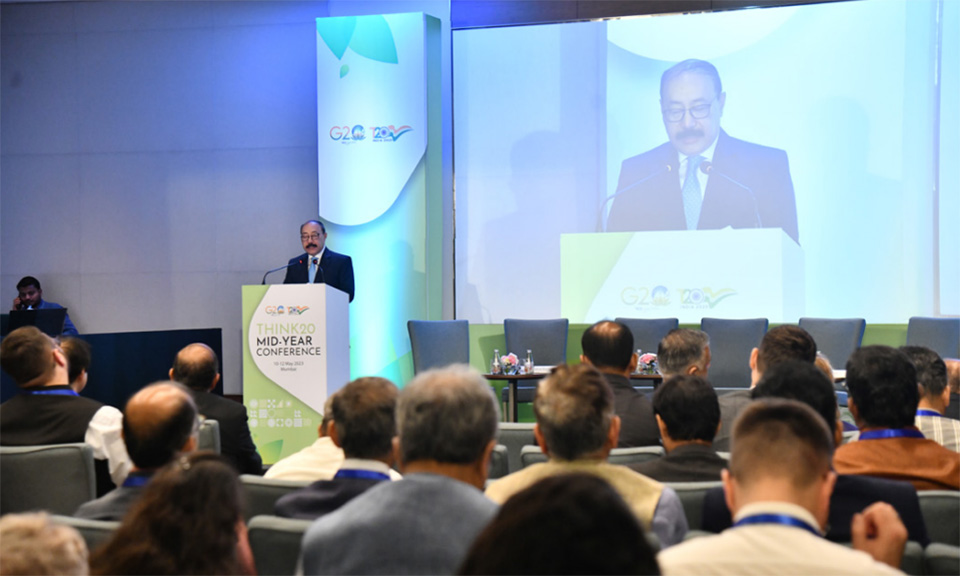
The T20 Mid-Year Conference took place in Mumbai on 10-12 May 2023. Three hundred attendees and Task Force members from across the G20 countries deliberated on the seven selected themes and took stock of the T20’s achievements thus far and the road ahead. Two particular elements of T20 India’s research and engagements stand out—its focus on mainstreaming gender and promoting gender equality, and its efforts to ensure that the African continent is an integral part of all conversations. India, being the second of four successive emerging economies to lead the G20 (Indonesia, India, Brazil, and South Africa will have been G20 Presidents between 2022 and 2025), has not only been a prominent voice of the Global South but has specifically put forth the unique developmental imperatives of the African landmass.

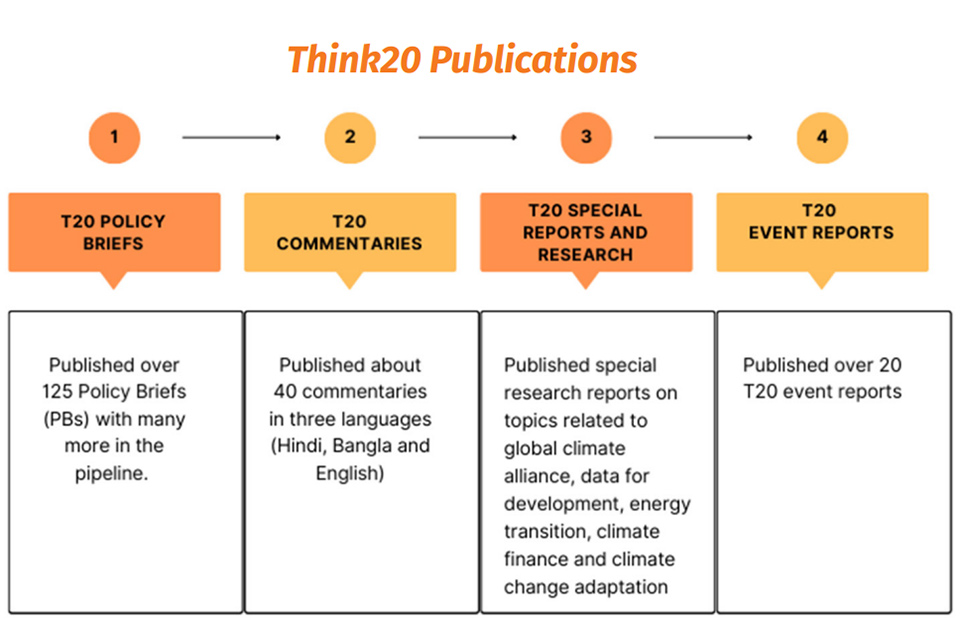
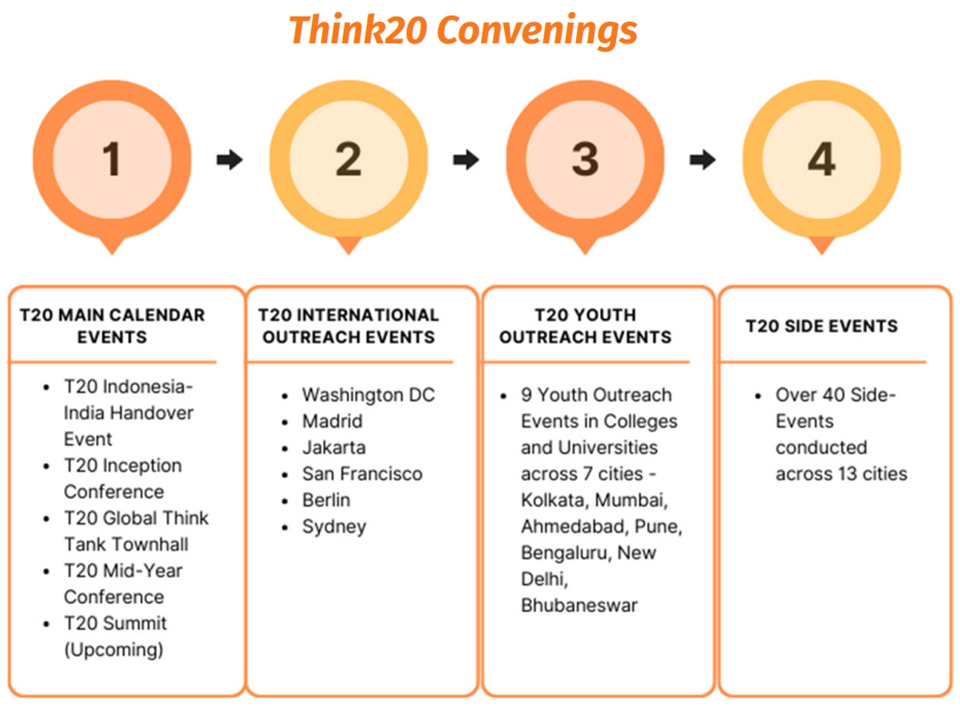
A key activity at the Mid-Year Conference was to finalise the Task Force Statements, which are vision documents about the Task Forces’ areas of engagement. The T20 Communiqué, a summary of recommendations to feed into the G20 process, is being drafted based on these statements and will be launched at the Think20 India Summit in Mysuru in August 2023. Moreover, as the term of the Indian T20 crosses its mid-point, it has already hosted over 50 events across the country and beyond and published over 125 Policy Briefs (PBs) with many more in the pipeline. These briefs are the outcome of processing raw ideas and producing them as actionable inputs.

The ethos of ‘Jan Bhagidari’ (or broad-based civic participation in governance) has underpinned the Indian Presidency’s efforts to take the G20 and its ideas to constituencies such as the youth, women, businesses, and civil society. Recognising the youth and women as essential partners in development and growth, the Mumbai Conference engaged actively with these target groups, and over 100 students from schools, colleges, and universities across Mumbai and Pune took part in the event.

The ethos of ‘Jan Bhagidari’ (or broad-based civic participation in governance) has underpinned the Indian Presidency’s efforts to take the G20 and its ideas to constituencies such as the youth, women, businesses, and civil society. Recognising the youth and women as essential partners in development and growth, the Mumbai Conference engaged actively with these target groups, and over 100 students from schools, colleges, and universities across Mumbai and Pune took part in the event.

Standard
Africa, BRICS, China, India, international affairs, Russia Civil War, USA and Canada, Writing

The United Nations Security Council is constituted to further the colonisation project

We can all agree today that this has been a very long decade; and it’s only just begun. The fabric of internationalism has been ripped in the last three years, and the ability to forge consensus on many vital questions that can enrich peace and strengthen security is at its lowest in nearly a century. There is a clear need to reform and reshape key institutions of global governance. Certainly, the United Nations Security Council (UNSC), in particular, needs an urgent overhaul.

Yet, we are all aware that the United Nations (UN) process as well the UNSC reform process are going nowhere. It is a fact that only once in the nearly eight decades of the UN’s existence has there been some semblance of reform—when the non-permanent seats of the UNSC were increased from six to 10. Since then, all efforts have largely been exercised in hollow statement-making. Tragically, these statements come with no timelines and are, of course, devoid of any content. Perhaps, this is the right time for this debate. Hence, the idea of bringing in new voices and opening this issue up for debate and discussion to the larger public—to the research community and to academia—must be lauded. We hope that the curious mix of practitioners and thinkers from the Global South can produce some breakthrough solutions that can take this debate forward.

The fabric of internationalism has been ripped in the last three years, and the ability to forge consensus on many vital questions that can enrich peace and strengthen security is at its lowest in nearly a century.

Decades of inaction have also resulted in the prevention of reforms becoming an ideal and an objective in itself. We have seen obstructive tactics, the emergence of a number of clubs and groups on this topic, and a myriad ways of stalling, delaying, and preventing progress. This, now, has become an end goal, and, perhaps, even a key responsibility area for diplomats posted to the hallowed institution that is the UN. That must change. We need to talk about progress in real terms. What should be the new format for engagement? There can be many answers to this question. What diplomats like Ambassador Ruchira Kamboj and academics like Matais Spektor say may not be the only solution. The solution may, in fact, lie in very different viewpoints and voices, and it is imperative that we hear them. Most importantly, we must all agree that status quo is not an answer.

The UN is facing a crisis of credibility as a global institution; and the lack of progress in the reform of the UNSC is going to create complete disenchantment. The future of the UN and its role is intimately linked to the progress made on this subject. Therefore, we must recalibrate our efforts as a global community and make sure that discussions on the reforms are infused with fresh voices and perspectives from geographies that are likely to contribute significantly to a stable and prosperous future. These are also the same nations that are likely to be most affected by a dysfunctional international institution.

Perspectives from the G20 and BRICS

Two recent debates we in India have been engaged in are of relevance to the conversation on institutional reform. One, of course, is courtesy the G20 presidency and its engagement groups that are working on various aspects of multilateral cooperation. Multilateral reforms is one of the most important debates happening in these groups. We are all apprised of the fact that the UNSC, the UN itself, the multilateral development banks, and the financial institutions need a complete overhaul. These institutions are no longer serving us in this particular century. The second is the aspirations of the BRICS. Under South Africa’s Presidency, there is an eagerness for and anticipation of institutions accommodating the aspirations of the African continent—a continent that is rising dramatically and rapidly.

The war is history, and so are the influence and capabilities of some of the members of this erstwhile group of victors.

We can see that different groupings are also beginning to understand and agitate this very important issue. Why is this important? Why mention the G20 and BRICS? The answer is: because we live in a deeply heterogeneous world. Some people also call it a multipolar world. It is untenable that a group of victors of a war from another century should be in charge of managing the world of today. The war is history, and so are the influence and capabilities of some of the members of this erstwhile group of victors. It is time to strengthen the A-Team and bring in voices who can serve all of us better. But beyond this particular aspect, there are three reasons for why we should be thinking about reform.

Why UNSC reform in particular

First, the current structure of the UNSC is perverse and immoral. For many in the Global South, it is a perpetuation of the colonisation project. The burden of the two World Wars was borne by the colonies, while the privileges of peace benefited the colonisers and their allies. Today, that is something that is being questioned by many; and it is increasingly going to become an important aspect of future debates as the world gets impatient with lack of progress in institutional reform.

Second, the reform is important because, currently, the UNSC is inefficient and does not serve the purpose it was installed for. In the past decades, we have seen how the will of the comity of nations has been negated by one or more of the permanent members. More recently, the crisis in Ukraine presents a classic example of the Security Council’s failure to deliver, and it is a stark reminder of why status quo is untenable. The voting patterns and the abstentions on the Ukraine conflict clearly point to the need to bring in others who can contribute to the global efforts around peace and stability.

We are struggling to reform the UNSC due to the nature of the inter-governmental negotiation (IGN) process itself.

Finally, the UNSC is undemocratic and non-representative. How can we accept a structure that shuts out Africa, Latin America, and democratic Asia, including the world’s largest democracy? The Permanent Five (P5) was configured to disproportionately include three European nations. Even having three nations in the P5 could not keep peace in the Old Continent. Clearly, here, three is a crowd. We need to reconfigure how we have structured the P5.

But this may not be the only viewpoint that is valid. There are others as well, and we must respond to and engage with them. For example, Uniting for Consensus argues that there cannot be any permanent membership of the UNSC for new members. This is a viewpoint against permanency and it must be put on the table. But, we must ask, if there is no permanency, why is it not applicable to the P5 as well? Why is it that all UN member states who want to be sitting as credible actors in the UNSC should not gain favour of 129 votes and assume a permanent role? These debates must not be cast aside or shut off. In fact, different groups and different viewpoints must be brought into the same room. And we hope that through this academic track, we can actually bring these varied perspectives together and come up with a mosaic of ideas and, thereafter, a symphony of solution.

To conclude, two points must be highlighted. First, we are struggling to reform the UNSC due to the nature of the inter-governmental negotiation (IGN) process itself. The fact that the IGN process, unlike any other in the UN, needs consensus for both process and outcomes makes it a nonstarter. In no UN negotiation is consensus a precondition for commencement. This is a fatal flaw in the way the process has been stitched together and no progress is possible unless we revisit this core element. Second, what is imperative is a concrete timeline as well. The 2024 Summit of the Future is being touted as a platform where productive discussions about UNSC reforms may finally take place. But the 2024 Summit cannot be regarded as a cure all and a one-stop-shop for everything. We must agree to a two-year timeframe, or a timeframe that others may suggest to be more viable, and we must rigorously adhere to it.

By the time the UN turns 80 in 2025, UNSC reforms must be well underway. Let us make this target a common agenda for all of us, with all our different viewpoints. Let us unite our energies to transform the UN into a multilateral institution that truly recognises the sovereign equality of all member states, and undertakes an operating systems upgrade that will bring it—with the rest of us—into the third decade of 21st century.


This article formed part of the Framing Remarks given by Samir Saran, President, ORF at the Roundtable on, “Shifting the Balance: Perspectives on the United Nations and UN Security Council Reforms from Global South Think Tanks”. 

The roundtable also saw the participation of Ruchira Kamboj, Permanent Representative of India to the United Nations; Matias Spektor, Professor of International Relations, FGV, Brazil and Visiting Scholar, Princeton University; and Gustavo de Carvalho, Senior Researcher, South Africa Institute of International Affairs, South Africa.

Standard
Cyber and Internet Governance, Cyber and Technology, European Union, India, media and internet, tech and media, USA and Canada, Writing

AI, Democracy, and the Global Order

Future historians may well mark the second half of March 2023 as the moment when the era of artificial intelligence truly began. In the space of just two weeks, the world witnessed the launch of GPT-4, Bard, Claude, Midjourney V5, Security Copilot, and many other AI tools that have surpassed almost everyone’s expectations. These new AI models’ apparent sophistication has beaten most experts’ predictions by a decade.

For centuries, breakthrough innovations – from the invention of the printing press and the steam engine to the rise of air travel and the internet – have propelled economic development, expanded access to information, and vastly improved health care and other essential services. But such transformative developments have also had negative implications, and the rapid deployment of AI tools will be no different.

AI can perform tasks that individuals are loathe to do. It can also deliver education and health care to millions of people who are neglected under existing frameworks. And it can greatly enhance research and development, potentially ushering in a new golden age of innovation. But it also can supercharge the production and dissemination of fake news; displace human labor on a large scale; and create dangerous, disruptive tools that are potentially inimical to our very existence.

Specifically, many believe that the arrival of artificial general intelligence (AGI) – an AI that can teach itself to perform any cognitive task that humans can do – will pose an existential threat to humanity. A carelessly designed AGI (or one governed by unknown “black box” processes) could carry out its tasks in ways that compromise fundamental elements of our humanity. After that, what it means to be human could come to be mediated by AGI.

A carelessly designed AGI (or one governed by unknown “black box” processes) could carry out its tasks in ways that compromise fundamental elements of our humanity.

Clearly, AI and other emerging technologies call for better governance, especially at the global level. But diplomats and international policymakers have historically treated technology as a “sectoral” matter best left to energy, finance, or defense ministries – a myopic perspective that is reminiscent of how, until recently, climate governance was viewed as the exclusive preserve of scientific and technical experts. Now, with climate debates commanding center stage, climate governance is seen as a superordinate domain that comprises many others, including foreign policy. Accordingly, today’s governance architecture aims to reflect the global nature of the issue, with all its nuances and complexities.

As discussions at the G7’s recent summit in Hiroshima suggest, technological governance will require a similar approach. After all, AI and other emerging technologies will dramatically change the sources, distribution, and projection of power around the world. They will allow for novel offensive and defensive capabilities, and create entirely new domains for collision, contest, and conflict – including in cyberspace and outer space. And they will determine what we consume, inevitably concentrating the returns from economic growth in some regions, industries, and firms, while depriving others of similar opportunities and capabilities.

Importantly, technologies such as AI will have a substantial impact on fundamental rights and freedoms, our relationships, the issues we care about, and even our most dearly held beliefs. With its feedback loops and reliance on our own data, AI models will exacerbate existing biases and strain many countries’ already tenuous social contracts.

That means our response must include numerous international accords. For example, ideally we would forge new agreements (at the level of the United Nations) to limit the use of certain technologies on the battlefield. A treaty banning lethal autonomous weapons outright would be a good start; agreements to regulate cyberspace – especially offensive actions conducted by autonomous bots – will also be necessary.

Technologies such as AI will have a substantial impact on fundamental rights and freedoms, our relationships, the issues we care about, and even our most dearly held beliefs.

New trade regulations are also imperative. Unfettered exports of certain technologies can give governments powerful tools to suppress dissent and radically augment their military capabilities. Moreover, we still need to do a much better job of ensuring a level playing field in the digital economy, including through appropriate taxation of such activities.

As G7 leaders already seem to recognize, with the stability of open societies possibly at stake, it is in democratic countries’ interest to develop a common approach to AI regulation. Governments are now acquiring unprecedented abilities to manufacture consent and manipulate opinion. When combined with massive surveillance systems, the analytical power of advanced AI tools can create technological leviathans: all-knowing states and corporations with the power to shape citizen behavior and repress it, if necessary, within and across borders. It is important not only to support UNESCO’s efforts to create a global framework for AI ethics, but also to push for a global Charter of Digital Rights.

The thematic focus of tech diplomacy implies the need for new strategies of engagement with emerging powers. For example, how Western economies approach their partnerships with the world’s largest democracy, India, could make or break the success of such diplomacy. India’s economy will probably be the world’s third largest (after the United States and China) by 2028. Its growth has been extraordinary, much of it reflecting prowess in information technology and the digital economy. More to the point, India’s views on emerging technologies matter immensely. How it regulates and supports advances in AI will determine how billions of people use it.

Engaging with India is a priority for both the US and the European Union, as evidenced by the recent US-India Initiative on Critical and Emerging Technology (iCET) and the EU-India Trade and Technology Council, which met in Brussels this month. But ensuring that these efforts succeed will require a reasonable accommodation of cultural and economic contexts and interests. Appreciating such nuances will help us achieve a prosperous and secure digital future. The alternative is an AI-generated free for all.

Standard
China, India, international affairs, Neighbourhood, Russia Civil War, Strategic Studies, Writing

The new world – shaped by self-interest

A series of far-reaching events are shaping the 21st century. The current conflict in Ukraine, while grabbing headlines and engrossing the G7 summit in Hiroshima, may not seem as pivotal if one is situated in a different part of the world. To most, this is still a festering neighbourhood conflict that Europe must manage. It does not animate lives everywhere; neither does it shape anxieties or future partnerships.

India, Africa and Latin America are not indifferent to the crisis in Europe. They simply have more pressing matters to attend to — the imperatives of nation building being the most urgent. That they now also must navigate the collateral impact of the war makes them all but an interested party.

The first lesson from global reactions to the war is geography still matters. East-West and North-South binaries may be captivating, but proximity and the neighbourhood are considerably more important. We may be hyper-globalised, but we are also more local than ever before. Social media, trends in technology and politics, and a host of other factors have bracketed us into narrow spheres of interest. Thus, while India respects Europe’s difficulties, for it the 2020s began not with Ukraine but with Chinese aggression, the virus from Wuhan and the surrender of Kabul.

Social media, trends in technology and politics, and a host of other factors have bracketed us into narrow spheres of interest.

The second lesson pertains to the UN vote condemning the Ukraine war. Of the 140 countries that voted and condemned Russia, only a fraction sanctioned Russia. Studying the list of countries that were the earliest to receive vaccines in the pandemic could prove to be productive. It might explain which countries have sanctioned Russia. It will also offer valuable lessons about globalisation, its hierarchy and therefore, its discontents. Those sanctioning Russia today are not merely the victors of World War II, but also of globalisation and development. Others are well within their rights to challenge the status quo.

It is often stated, unthinkingly, that India is on the fence. India is not on the fence — it is only standing its ground. It will choose its priorities just as every other country has done. The recent spate of visits by European leaders to China shows that value-based frameworks are untenable. Nations are driven by self-interest and in this case, the need to maintain lucrative economic relations. India is no different. Even as it confronts the Chinese on the Himalayan heights, trade continues where the economy needs it. Distance matters; interest matters even more.

The third lesson derives cumulatively from four recent events: The pandemic; the fallout of the Doha Agreement and the abandoning of Afghanistan; the Chinese aggression on India’s borders; and new sanction regimes and their impact on the loosely termed “Global South”. The Covid-19 outbreak saw the overt hijack of medical equipment and access to vaccines, and growing gaps in treatment capabilities.

Nations are driven by self-interest and in this case, the need to maintain lucrative economic relations.

Indeed, when the pandemic struck, there was no superpower, there was no great power, and there was no big power.  There were only selfish powers. Similarly, the Afghan people were betrayed and abandoned because it was expedient for higher powers to flee the country at a particular moment. And Chinese territorial incursions have provoked a range of self-serving responses from different actors otherwise keen to defend democracy.

Put bluntly, there is no moral high ground. All that remains is the ruthless pursuit of national self-interest. Two actors epitomised this approach in the 1960s and 1970s, one actor in the 1980s and 1990s, and several new voices have joined the fray in this century.

If meaningful international dialogue is to be conducted, nations must right-size some of their perceptions about each other and themselves. In this context, the tendency to frame the Global South as a possible bridge actor between competing positions has its merits. But the “Global South” is itself a deeply reductive term, which elides the group’s innate heterogeneity. Very few countries would like to be categorised as “southern” as they continue to rise and shape global systems. Five years from now, Brazil and India might bristle at such a label themselves.

The neatly packaged idea of the Global South fails to recognise that there will soon be far more decisive swings within the group than outside it. How the countries of the South organise themselves over the next decade will have a far more profound impact than the West on the global balance of power, and on the contours of the new world order. As this century progresses, an East and West will emerge within the Global North and South.

LLPs will come to constitute the geometry of politics, and countries will work together on specific issues, for specific purposes, and for specific outcomes.

Concomitantly, international engagements of the future will organise themselves around the standard operating principle of law firms — as limited liability partnerships (LLPs). LLPs will come to constitute the geometry of politics, and countries will work together on specific issues, for specific purposes, and for specific outcomes. With the transition to the new LLP ethos of geopolitics, we will not be burdened by the need to focus on anything other than the narrowly defined collaborative interest at hand, and can build relationships that are more strategic, if also more transactional. This is a gritty, realist world. We may not like it, but it’s here — and here to stay.

Standard