Commentaries, economy, Healthcare, Indian Economy, international affairs, USA and Canada

Global trade after COVID-19: From fixed capital to human capital

Co-authored with Dr. Alexis Crow

Some commentators have trumpeted the “end” of globalization in the wake of rising protectionism over the last half decade, the sudden economic stops wrought by COVID-19, and the corollary disruptions of supply chain activity around the world.

The truth, though, is that for companies and investors involved in the exchange, transmission, and sale of goods, services, technology and finance, globalization is anything but dead. Granted, the landscape has dramatically shifted since the 1990s, and executives will need to be nimble and agile in navigating the new environment, which is currently in a state of flux.

Indeed, more recent developments in the global trade environment including green frameworks, digital protocols and regional partnerships offer a glimpse not of the demise of globalization, but rather, of what global trade may look like in the post-COVID-19 era.

Globalization and its “discontents”

Globalization is defined as the process by which technology and the information and communication technology (ICT) revolution of the 1990s enabled faster transaction times and processes for exchanges of currency, capital, information, innovation, goods and people around the world.

These transmissions of commerce have been facilitated by norms, laws, regimes and treaties governing trade, such as the World Trade Organization at the global level and agreements such as ASEAN at the regional level. At a national level, the creation of free-trade zones further facilitated the ease of trade: for example, a shipping container can move through a seamless logistics corridor in the United Arab Emirates from the Port of Jebel Ali to the Dubai International Airport within four hours.

In financial services, hubs such as the City of London and latterly Singapore have attracted leading talent from across the globe to investment banking, trading, fintech and asset and wealth management, with executives and their teams using these hubs to penetrate the “spokes” of business in the EMEA (Europe, Middle East, Africa) and south/southeast Asian regions.

Unfortunately, the very same global interconnectedness that facilitated wealth creation and economic opportunities also had a dark side that manifested throughout the 1990s and 2000s. Global and transnational risks such as international terrorism (such as the attacks of 9/11), environmental degradation, cyber-attacks, pandemics, human trafficking and financial instability and financial crises ricocheted across the globe. Such risks might pop up in one jurisdiction and by the very same conduits that fostered the “bright side” of globalization easily spread across geographies.

Today, we might say we are dealing with a different shade of discontent within societies— particularly pronounced within advanced economies—for which the process of globalization is often blamed: rising domestic income inequality. While global trade has lifted billions of people out of poverty and sharply reduced inequality at a global level (such as that between China and the West, and southeast Asia and the West), income, wealth and opportunity inequality have been steadily rising within countries such as the United States, the United Kingdom and Italy. Clearly, the benefits of globalization have not been shared by all. Yet, the globalization of labour markets is but one of a number of contributing factor to rising inequality within these societies since the 1980s.

Value of world services exports by category (USD Billions)
Value of world services exports by category (USD Billions) (Image: World Trade Organisation)

Nevertheless, some leaders have found it both palatable as well as politically convenient to point the finger of blame at other countries. Rising income generation and economic advancement in Japan, for example, became a target of ire within certain circles in the United States during the late 1980s and early 1990s. More recently, some activist politicians and commentators have pointed to the economic gains made by certain groups (such as immigrant workers) as a clear causal factor for the erosion of the domestic middle class.

Rising economic nativism has taken various forms within the last few years and has in some cases been accelerated in the wake of the COVID-19 pandemic. Regardless of the underlying causes of domestic inequality and social anxiety, politicians have acted out against trade in the following ways:

  • Ructions against goods. In recent years, some countries have focused on the balance of trade in goods (or the imbalance) as a way to reduce imports or to onshore production. Tariffs became the policy tool of choice as a way of addressing such imbalances, but when implemented, have had mixed results. Data shows that efforts to boost domestic production of goods and services comes at a cost: quite literally, for the governments, companies and consumers.
  • Restrictions on mobility. Responses to the angst felt against global trade have not been limited to goods or volume of merchandise. States have also moved to restrict immigration, vowing to protect domestic workers from a perceived disadvantage. It is important to note that curtailing mobility also comes at a cost—during COVID-19 restrictions, a sharp reduction in migrant agricultural workers within OECD countries has contributed to a sharp rise in food prices, which have reached a six year high.
  • Tech bifurcation. Although countries, companies and individuals are importing and exporting more services than ever before, a bifurcation has developed between the United States and China regarding certain aspects of trade in technology. Indeed, the situation has been referred to this as a “technological Cold War” between the “two greatest powers” in the world.

While some European countries have also passed legislation to restrict inbound investment in specific targets or sectors, the EU-China Comprehensive Agreement on Investment (CAI)—signed at the end of 2020—was designed to improve laws and practices for mutual investment between China and the EU, at a federal level. Although currently on hold, the negotiations did demonstrate a willingness for both sides to convene in order to potentially step up the level of investments within their respective economies.

Three emerging paths forward

Within a turbulent geopolitical context, the shape of a post-COVID-19 trade landscape is becoming clearer, particularly regarding the digital, green and regional spaces.

  1. The digital realm

A multilateral framework is… the need of the hour to avoid any more trade wars that the pandemic-stricken world economy cannot bear.

Data protection and securing user privacy in the digitized world has been a major issue of cross-border friction. But here we are seeing concrete efforts being made. To this end, the EU General Data Protection has offered a common template that has even inspired the California Consumer Privacy Act.

This is not to say that all contentious issues have been resolved. One complicated issue has been the taxation of digital services. Although there has been an attempt by the OECD to devise a framework for digital taxation, a multilateral solution has not evolved so far. Against this backdrop, the United Kingdom, France, India and Italy among other countries have started levying taxation on digital services, with the United States taking subsequent action under Section 301 of its trade law. A multilateral framework is, therefore, the need of the hour to avoid any more trade wars that the pandemic-stricken world economy cannot bear.

The fact that there is some early convergence on contentious issues is a positive dynamic and suggests that even though an overarching framework governing the digital realm is elusive so far, consumer interest will be the guiding force in determining the nature of regulation.

  1. The green space

Increasingly, at least in the developed world, “going green” is the new industrial and growth strategy.

Climate action is the base on which economic policies of the twenty-first century are likely to be formulated—increasingly, at least in the developed world, “going green” is the new industrial and growth strategy.

To be sure, there are challenges. Recent discussions on the EU’s carbon border adjustment mechanism, essentially an emissions-related import tariff, are the first sign of movement towards a global “carbon club”, shutting out exports from countries that may not comply. But the current moment presents a historical opportunity for cooperation. As climate commitments strengthen across the globe, economies of scale have led to rapidly falling costs for green energy and technology.

  1. A region-based approach

As efforts are underway at reforming the global trading system, regional or bilateral agreements are helpful in providing building blocks for greater cohesion.

While many Western countries have been contending with populist movements in the years leading up to COVID-19, and then resurgent strokes of economic nativism in the wake the pandemic, countries in Asia signed the largest trade agreement in history—the Regional Comprehensive Economic Partnership (RCEP) in November 2020.

Effectively, RCEP incorporates some rich income Asian countries within the ASEAN community; and in a historic step, it is the first framework to include China, Japan and South Korea together within a trade agreement. While some commentators argue that RCEP is less comprehensive than other deals such as the Trans-Pacific Partnership agreement, the convening of RCEP signatories signals Asia’s continued commitment to connect “multiple factory floors” at a regional as well as a global level.

The cementing of RCEP—with the participation of some of the fastest growing economies in the world—raises the question: do regional trade agreements help or hinder the global trading landscape? With variegated standards on data privacy, green and carbon, and with countries at various stages of economic growth and employment, a global architecture might be elusive. It can therefore be argued that as efforts are underway at reforming the global trading system, regional or bilateral agreements are helpful in providing building blocks for greater cohesion.

Reaping the benefits of a global division of labour and capital

Even though the global trading architecture has taken severe knocks from both populism and the pandemic, nearly one-third of the world’s population and one-third of global GDP have recently been incorporated in a historic trade agreement.

And even amidst the “great lockdown” of 2020, the contraction of global trade in goods was less than half of that of the trough of 2009, in the wake of the global financial crisis. Moreover, an asynchronous regional recovery from COVID-19 has meant that many companies have been able to make up for the loss demand in one region (such as Europe) by the growth in demand in another region (such as China). And uneven sectoral activity, such as the working-from-home dynamic, is propelling demand for critical goods such as semiconductor chips, which is propping up export markets for countries such as South Korea. The growth of the electric vehicle industry and the commitments by governments to “build back greener” are also contributing to cross-border flows of metals and materials.

Nevertheless, as policy-makers set their priorities on rebuilding their societies, the lure—or mystique—of self-sufficiency remains strong. Indeed, the COVID-19 pandemic has caused severe losses to income for both advanced as well as emerging economies—the former experiencing a loss of 11% of income of 2019 levels, and the latter nearly double, at 20%. Yet, the way out of economic desolation is not via isolation, or constructing a fortress nation.

The way out of economic desolation is not via isolation, or constructing a fortress nation.

The way out of economic desolation is not via isolation, or constructing a fortress nation.

Laudably, within some advanced economies, COVID-19 relief measures have catalyzed the implementation of policies, including those designed to address housing affordability and access to childcare, that are meant to combat systemic income inequality. As countries transition from relief to recovery, and policy-makers weigh up prospects for bolstering domestic employment, it goes without saying that demand for many jobs within tradeable services is implicitly connected with the viability of export markets.

Thus, the ability to underpin and renew export ties with dialogue—such as that recently conducted between the US and the EU—is integral to sustainable domestic growth. Additionally, in the realm of non-tradable services, creative policies to incentivize corporate and private investment in reskilling, upskilling and learning for working are absolutely critical – in essence, segueing from investing in fixed capital to human capital. Amplifying competitiveness and improving productivity in both tradable and non-tradable sectors can also be enhanced by infrastructure spending and investment, in hard and soft sectors.

In the realm of non-tradable services, creative policies to incentivize corporate and private investment in reskilling, upskilling and learning for working are absolutely critical – in essence, segueing from investing in fixed capital to human capital.

In the realm of non-tradable services, creative policies to incentivize corporate and private investment in reskilling, upskilling and learning for working are absolutely critical – in essence, segueing from investing in fixed capital to human capital.

As countries increase investment in non-defense related R&D in sectors such as biotech and electric transport, it is important to consider that innovation is implicitly tied to immigration. In the United States, this has been the case throughout the 19th and 20th centuries, and with immigration as one causal factor of the blossoming of cutting-edge technology businesses and the growth of entrepreneurship in the country. Thus, data shows that the vitality of human capital is inherently cross-border and reliant on immigration. Recognizing this is a requisite component of any industrial, or rather, post-industrial policy, for advanced economies and for emerging and developing economies that are shifting from old to new economic growth.

Originally published https://www.weforum.org/agenda/2021/05/the-global-trade-map-after-covid-19-from-fixed-capital-to-human-capital/
Standard
China, Great Power Dynamics, Strategic Studies, USA and Canada

From Xi with love: A New Year greeting to the new POTUS

Among the more memorable lines from Albert Camus’ haunting novel, The Plague, possibly the most read and quoted book in the Year of the Pandemic, is a starkly stated fact: “Stupidity has a knack of getting its way.”

If “You are on mute” was the most common interjection during COVID-19-enforced digital conversations in the conference circuit, a close second would be the assertion, “We have to work with a rising China to make it a responsible actor.” You could voice this assertion, or a similar variant, at a think-tank discussion or official consultation in Western Europe or America and be appreciated for possessing a wise and rational mind. If you were to say it many times over with panache and flair, you could bag a serious policy job in that part of the world. Money talks; the profundity of banal wordsmiths runs marathons.

The Old World cannot ‘make’ China act in any way it tells it to.

For there are two fatal flaws in this line of thought. The first flaw has to do with “the rise of China.” This is the last decade’s conversation; outdated and irrelevant. China has already risen, and it is everything many did not wish it to be, even as they were investing in its emergence. Deal with it now by accepting this reality. The second flaw pertains to the rather misplaced assessment of Western power embedded in these seemingly highfalutin but inane assertions. The Old World cannot ‘make’ China act in any way it tells it to. In fact, the West does not even know what it wants from China besides trade and investment. A popular refrain of yesteryears was that while all countries have an army, in Pakistan, the army has a country. Today’s refrain is reflected in what someone recently said, without exaggerating: In Germany the auto industry has its own union, the European Union.

2020 was a crucial year for China. Its claim to global leadership was severely tested by its role in, and early mismanagement of, the COVID-19 pandemic. It faced pushback, including from unexpected quarters, on its deluge of misinformation and its subversion of international institutions to divert attention from its malfeasance. The pandemic was to be the moment of reckoning, when the old and new powers would come together and hold Beijing to account. Predictions that the pandemic would prove to be China’s ‘Chernobyl moment,’ however, have turned out to be hollow. China was among the few countries that weathered the public health crisis with a modicum of control. A year later, it is leveraging trade, technology and international development to capitalise on this and further consolidate its influence and power. As a new American President prepares to assume office, China has sent him a greeting card with three messages conveying the terms of Beijing’s engagement with Washington and other world capitals.

What else could explain why the EU enthusiastically rushed to conclude the EU-China Comprehensive Agreement on Investment?

The first message is that China is too big to be ignored and too wealthy to displease. This is the obvious subtext of the EU-China Comprehensive Agreement on Investment (CAI). What else could explain why the EU enthusiastically rushed to conclude this agreement? Brussels ignored the Biden transition team’s pleas to delay the agreement. It ignored China’s rogue behaviour in 2020 — a massive human rights crackdown in Hong Kong and Xinjiang, a destabilising escalation of tensions in the Himalayas, its aggressive ‘wolf warrior’ diplomacy, and the economic coercion of Australia, among others. The EU even ignored its own evolving assessments of China, with expressions like “European values,” “systematic rival,” and “strategic autonomy” proving to be meaningless phrases that are no more than an anodyne dressing for a toxic salad. The EU has not only handed Beijing a victory ahead of the transition in Washington, but it has also bolstered China’s belief that its centrality to global value chains provides it with clout beyond its own imagination.

year of the pandemic, COVID-19, pandemic, prophetic prediction, US, turbulent change, political strains, irrationality
Among the more memorable lines from Albert Camus’ haunting novel, The Plague, possibly the most read and quoted book in the Year of the Pandemic, is a starkly stated fact: “Stupidity has a knack of getting its way.” Photo illustration: Anton Petrus — Getty

The second message is that China is too big to punish. Under President Donald Trump, the US attempted to systematically choke China’s access to global technology supply chains through sanctions, export controls, and coercive diplomacy. While those efforts have had some success, China has doubled down on its efforts to indigenise the development of breakthrough technologies — an effort that has seen remarkable success during the past two decades. Now it plans to return the favour. In early January, China’s Ministry of Commerce published rules encouraging firms incorporated in China to defy sanctions and export controls, and threatened to punish those that do not. When, and not if, these rules are implemented, technology and financial firms in particular will find themselves caught between a rock and a hard place. These rules are a clear warning to the Biden Administration and to its supporters and funders from Wall Street and Silicon Valley. The Chinese Communist Party (CCP) is betting that America Inc. will prefer to devote resources to lobby Washington for a rapprochement with Beijing rather than contend with fragmentation and the attendant loss of profits.

The pandemic has accorded China the chance to offer developing nations not just infrastructure finance, but a multifaceted development opportunity — one that further entrenches China’s norms, standards and preferences.

The final message is that China is simply too big to fail. Media pundits are reading a slowdown in Belt and Road (BRI) investments as a sign that China is reconsidering the project’s utility. This is way off the mark. The institutions and mechanisms of the BRI are rapidly turning into conduits for China to deliver global public goods and will remain so even as project-funding is rationalised. State Councillor Wang Yi made three priorities explicit for 2021 in his speech at December’s Belt and Road Forum: The Heath Silk Route, the Digital Silk Route and the Green Silk Route. Each plays to China’s strengths and are crucial components of its 2021 white paper on international development cooperation. The pandemic has accorded China the chance to offer developing nations not just infrastructure finance, but a multifaceted development opportunity — one that further entrenches China’s norms, standards and preferences.

These messages should not come as a surprise to those who track Beijing. As we argued in our book Pax Sinicathese recent developments represent China’s continuing efforts to recast globalisation and international governance in its own image. The year 2021 is an important milestone for the CCP and for Chairman Xi Jinping. It marks the 100th anniversary of the founding of the CCP, the first of two centenaries central to the realisation of the ‘China Dream.’ Leading up to this point, ‘Core Leader’ Xi has consolidated his hold over the CCP, and the party has, in turn, consolidated its control over society, industry, military and every aspect of policy. Xi has already acknowledged that the path towards global leadership by 2049 — the centenary of the founding of the People’s Republic of China — will be defined by “turbulent change.” While he did not explicitly say so, external risk fuelled by geopolitical rivalry with the US and a more wary international community were likely on his mind.

China’s messages should not be interpreted as a prophetic prediction of its continued and unchallenged rise or that it is immune from political strains and irrationality.

These three messages to the world in early-2021 indicate how China is anticipating and responding to emerging realities. Yet, China’s messages should not be interpreted as a prophetic prediction of its continued and unchallenged rise or that it is immune from political strains and irrationality.

The pandemic has bookended an international order living out its last days, much like King Lear. Contrary to popular expectation, a Biden White House will not — or, cannot, if you prefer — reverse this trend. The world will still be driven by populism and fragmentation. Communities across geographies are anxious about change. Information disorder, technological and industrial developments, and ecological crises are demanding new ideas and leadership. China is the first power to have a dark but coherent proposition — one defined by techno-authoritarianism and state control.

Is there any other alternative on the table? Or will the decline of the incumbents be scripted by Beijing and its growing global constituency of cheerleaders

.

Standard
China, foreign policy, Great Power Dynamics, India, Sustainable Development, USA and Canada

If the EU fails, we can say goodbye to the liberal order

Eastern Focus: To what extent is Europe important for the future of the world order? Europeans feel like they count less and less on the world scene.

Samir Saran: Europe is, paradoxically, the single most important geography that will define the future trajectory of the global order. If Europe remains rooted in its fundamental principles – of being democratic, open, liberal, plural, supporting a transparent and open market economy, defending rule of law, the rights of individuals, freedom of speech – the world will have a chance of being liberal. If the European Union is split between the north and south, east and west and we see a large part of it deciding to give up on the Atlantic project and align with more authoritarian regimes – which is quite tempting, due to the material side attached to the choice – that will be the end of the Atlantic project. An EU that is not united in its ethics is an EU that will eventually write its own demise. How will Europe swing? Will it be an actor, or will it be acted upon?

I have the belief that post-pandemic EU, as a political actor, will see a new lease of life. A new political EU may be born as the pandemic ends. Unless that happens, I believe this is the end of the European Union itself. It is a do it or lose it moment. Unless Europe becomes strategically far more aggressive, far more expansive, aware of its role, obligations and destiny you will see an EU that fades. For me, the most important known unknown is the future of Europe. Will the EU hold? Will the 17+1 become more powerful than the EU 27? Which way will the wind blow on the continent? Will it really be the bastion of the liberal order or will the liberal order be buried in Europe?

The Indo-Pacific is the frontline for European safety

EF: We’ve been used to only existing as part of the transatlantic relationship. In the past few decades, Europe has never really seen itself as an individual actor, but rather in coordination with the US. That is something that is starting to shake now. Do you see Europe acting on its own terms, as a global actor, in the positive case in which the member states do get their act together? Are we rather going to continue to act together with the US? Or find some other partners?

SS: I suspect that with Brexit, you might see a far more cohesive EU, organised around the French military doctrine and French military posture. With an absent UK, I have the feeling that the political cohesion of the EU will increase and that the EU will be far more coordinated in its approach to the geostrategic and geopolitical questions. France realises that by itself, without the size of the EU, it might not be a significant actor. A French military presence will be compelling only if it acts on behalf of the EU.

Europe believed that it could change China by engaging with them, however I suspect China will change the EU before the EU changes China.

In terms of other partners, Europe has made one error. Europe believed that it could change China by engaging with them, however I suspect China will change the EU before the EU changes China. The mistake that the EU makes is that it imagines that an economic and trading partnership will create a degree of political consensus in Beijing. Nevertheless, Beijing is not interested in politics, but in controlling European markets.

What Europe should do is to consider the importance of India. If the European continent needs to retain its plural characteristics, South Asia is the frontline. What is happening today between India and China is actually a frontline debate on the future of the world order. The Himalayan standoff is just the first of the many that are likely to happen unless this one is responded to. If China is able to change the shape of Asia and recreate the hierarchical Confucian order, don’t be surprised if the fate of Europe will follow the same path. If Europe needs to feel secure in its own existence it needs to create new strong local partnerships – with India, Australia, Indonesia, Japan. The EU needs to see itself as an Indo-Pacific power. The Indo-Pacific is the frontline for European safety. If the Indo-Pacific was to go the other way, the mainland is not going to be safe.

EF: What do you think about the CEE’s role in the new emerging order? We see an increased competition for hearts and minds here. How could India help, in an environment of increased competition and active engagement of China in this space?

SS: The Central Europeans are going to be the centre of attention for many actors. China will buy their love, America will give military assurances and so on. In the near future, many actors will realise the importance of the CEE, simply because it is these countries that will decide which way Europe finally turns. In some ways they are the swing countries, the swing nations that are going to decide whether Europe remains loyal to the ideals of its past or decides to have a new path. CEE countries are in many ways the decisive countries.

CEE has two important options and two important pressures. The options: will they be able to create a consensus (between the Chinese, the Russians, the Old Europe and the new countries like India) or will they be an arena for conflict? Can we create a ‘Bucharest consensus’, where the East and the West, North and the South build a new world order and the new rules for the next 7 decades? If you play it wrong you might become the place where the powers contest, compete and create a mess.

There are also two pressures. Firstly, there is an economic divide in Europe. You are at a lower per capita income, you need to find investment funds for the infrastructure, employment, livelihoods and growth, which results in an economic pressure that needs to be tackled. Therefore, Europe will have to decide if the provenence of the money matters. Does it matter if it is red or green? Does it matter if they come from the West or the East? That is one pressure that needs consideration. How do you meet your own aspirations, while being political about it?

The other pressure is the road you want to take. How do you envisage the future? Is it going to be a future built on cheap manufacturing? Being an advanced technological society, are you going to be the rule-maker of theFourth Industrial Revolution or its rule-taker? Secondly, the nature of the economic growth that you are investing in becomes another pressure. This is the second choice that the CEE will have to make. In that sense, I believe that India becomes an actor. As we have experienced this in the past 20 years, we are one of the swing nations that could decide the nature of the world order, thus we may share this experience with you. We have also decided that we don’t want to be a low-cost manufacturing economy like China, but rather a value-creating economy, building platforms. Even if we have a small economic size, we have a billion-people digital platforms, digital cash system, AI laboratories and solutions.

What is happening today between India and China is actually a frontline debate on the future of the world order. If China is able to change the shape of Asia and recreate the hierarchical Confucian order, don’t be surprised if the fate of Europe will follow the same path.

As we move into theFourth Industrial Revolution, the tyranny of distance between Europe and India disappears. We don’t have to worry about trade links, land routes and shipping lines. Bits and bites can flow quite rapidly. As we move to the age of 3D printing, to the age of quantum computing, of big data and autonomous systems, the arena where we can cooperate becomes huge.

India gives Europe room to manoeuvre, room to choose. When it comes to choosing, besides the traditional American and Chinese propositions, there is also a third one – India, a billion-people market.

EF: Do you expect that there is going to be a shift in the EU toward reshoring and ensuring that manufacturing is not captive to Chinese interests or to Chinese belligerence?

SS: I think that we are going to see a degree of reshoring everywhere. It is not going to be only a European phenomenon. Political trust is going to become important. Political trust and value-chains are going to affect one another. Countries are going to be more comfortable with partners who are like-minded. They don’t have to agree on everything, but they should be on the same ideological and political spectrum.

There are two reasons for this. One is the pandemic that we are currently facing and in a way it exposed the fragility of globalisation as we know it. The hippie and gypsy styles of globalisation are over. I think that people are going to make far more political decisions. The second is that as we start becoming more digitalised societies, individual data and individual space are going to be essential, thus you don’t want those data sets to be shared with countries whose systems you don’t trust. Value is going to increasingly emerge through intimate industrial growth, far more intimate in character – it is going to be about the organs inside your body, it is going to be about the personal experiences, about how we live, transact, date or elect. They are all intimate value chains. The intimate value-chains will require far greater degree of thought than the mass production factories that created value in the XXth century.

The EU may be setting the format for managing our contested globalisation

EF: You mention the rising value of trust, as a currency even. In Europe, we often point out that we are an alliance based on values. But even our closest partner, the US seems to be moving in a much more transactional direction, let alone China and others. You are describing a worldview that is relying increasingly on shared values, at least some capacity to negotiate some common ground, on predictability, whereas in many ways it seems that things are moving in the opposite direction, a much more Realpolitik one. Is this something that is going to last?

SS: The pandemic has brought this trend to the fore. People are going to appreciate trust and value systems more than ever. But I think this was inevitable. If you would recall, India used to be quite dismissive of the EU, calling it “an Empire of gnomes”, with no strategic clout. But if you look at the last two years, India has started to absorb, and in a sense to propose solutions that the EU itself has implemented in the past. India came up with an investment infrastructure framework in the Indo-Pacific that should not create debt trap diplomacy, should create livelihoods, respect the environment and recognise the rights and sovereignty of the people. India came up with this when it saw that the Chinese were breaking all rules and all morality to capture industrial infrastructure spaces. The Americans under Donald Trump also came up with the Blue Dot American project for the Indo-Pacific – a framework that was based on values. Whenever you have to deal with a powerful political opponent you throw the rule book in there. If you don’t want to go to war with them, you will have to manage them through a framework of laws, rules and regulations. The value systems are a very political choice. They are practices and choices enshrined in our constitutions and foundational documents. Therefore, dismissing values and norms as being less political or less muscular is wrong. The EU, “the empire of gnomes” that was much criticised for the first two decades as weak and not geopolitical enough, may well become an example for other countries. If it remains solvent, a vibrant union, and if it is not salami-sliced by the Chinese in the next decade, the EU may well be setting the format for managing our contested globalisation.

This pandemic is the first global crisis where Captain America is missing

EF: How does India see the future of the Quad? Usually the Quad is associated with a certain vision of the Indo – Pacific, free from coercion and open to unhindered navigation and overflight. Are we going to see the emergence of a more formal geopolitical alignment or even an alliance to support a certain vision about Asia?

SS: The Quad is going to acquire greater importance in the coming years. It is going to expand beyond its original 4 members. We’ve already seen South Korea and the Philippines joining the discussion recently. We are going to see greater emphasis by all members doing a number of manoeuvres, projects and initiatives together. The next 5 years will be the age of the Quad. The pandemic started this process. I see three areas where the Quad can be absolutely essential.

One is in delivering global public goods, keeping the sea lines open and uncontested so that trade, energy and people can move with a degree of safety and stability. In a sense, I see the Quad replacing the Pax Americana that was underwriting stability in certain parts of the world.

The second area is going to be around infrastructure and investments in certain parts of the world. I see the Quad grouping many initiatives that will allow for big investments in countries which currently have only one option – China. The Quad will be able to spawn a whole new area of financial, infrastructure and technology instruments closer to the needs of Asians, South Asian, East African, West Asians including the Pacific Islands. The Quad will be the basis of this kind of relationships in the upcoming years.

Thirdly and most importantly, the role of the Quad will be to ensure that we won’t reach a stage where we have to reject the Chinese. None of us wants a ‘No China’ world, because all of us benefit from China’s growth and economic activities. Many of us have concluded that the only way to keep the Chinese honest in their engagements, economical or political, is to be able to put together a collective front in front of them, not negotiate individually. The EU has done that longer than anyone else and that’s why the Chinese don’t like the EU and apply a ‘divide and conquer’ methodology to get more favourable deals. The Quad is in many ways an expression of that reality, as well of that the middle powers in Asia and Pacific (Indonesia, Australia and Japan) will have to work together, sometimes without the Americans, to negotiate new terms of trade and new energy, or technological arrangements. The Quad in many ways is also the ‘make China responsible’ arrangement, an accountability framework which will keep the Chinese honest and responsible actors in the global system.

The next 5 years will be the age of the Quad. The Quad in many ways is also the ‘make China responsible’ arrangement, an accountability framework which will keep the Chinese honest and responsible actors in the global system.

EF: Do you also see this trend extending into the political sphere in a kind of collective endeavour both in Asia (through the Quad) and in the West (starting with Europe perhaps) to build a new kind of world order? Do you feel that this ‘middle powers concert’ is one possible way to go? Or do you believe that we are going to be disappointed, as we were by the BRICs, when some of the members drowned in their own domestic problems? 

SS: We are part of a world that doesn’t have any superpowers. The last superpower was America, and that ended with the financial crisis ten years ago. Ever since, we have been literally in a world which had quasi-superpowers like the US, to some extent Russia, the Chinese, but there was no real hegemon that could punish people for bad behaviour and reward people for good behaviour.

Some of the most interested actors in the Indo-Pacific in the last two to three years happened to be the UK and France. A few years ago, they sensed that if they want to be relevant in the future world order, as it is built and as it emerges, they need to be present in the debates that are unfolding in this part of the world. Both partnered with India – to do military manoeuvres, to create maritime domain awareness stations, to invest in infrastructure and to create clearly the beginnings of a new order that might emerge from here. We will have to create these coalitions to be able to get things done.

The pandemic tells us something which is also quite tragic. Ever since I was born I have never witnessed a global crisis that did not have America as a response leader. This pandemic is the first global crisis where Captain America is missing. What makes it even more complicated is that the successor to Captain America has caused the crisis. Hence, you have the old power, which is absent and engrossed in its own domestic realities, and the new power that has been irresponsible and has put us in this position. Both the previous incumbent and the new contender don’t have the capacity to take action in this world by themselves. This tells us that building a coalition of middle powers is absolutely essential. It is not a luxury, it is not a choice. This is something concerning our own existential reasons that we must invest in.

EF: Do you see this coalition of middle powers as some sort of a ’league of democracies’? It is a concept that was previously advanced by John McCain and now Joe Biden is embracing as his overarching framework for foreign policy. Do you see the potential for creating this league of democracies as some sort of manager and defender of the liberal international order?

SS: I think it is inevitable. Technology is so intimate that we are not going to trust our data with folks we have a suspicion about. Thus, it is this reality that makes this coalition of democracies and like-minded countries inevitable. Even if we may never call it that, it is going to become that. We are going to notice countries engaging in these intimate industries with others who are similar, who are like-minded, who have similar worldviews. Still, this process may take longer than we have. We do not have the luxury of time, because we are going to be destroyed, divided, decimated and sliced in the meantime.

A few countries will have to take leadership – either the French, the UK, the EU itself, or India, or all of them. Until there is an agreement on a big vision for the new world order we must agree to an interim arrangement and have to create a bridging mechanism that takes us from the turmoil of the first two decades of this century to a more stable second half of the century. We don’t want to go through two world wars in order to achieve this unity, as we did in the past century. We need to have some other mechanisms that will prevent conflict, but preserve ethics.

In this context the EU-India and the CEE-India projects are essential. It is us who have the most at stake, because our future is on the line. The more the world is in turmoil, the less we will be able to grow sustainably. It is our interest to create and invest in institutions and informal institutions that could preserve a degree of values and allow for stability.

Such a coalition reuniting countries from Central Europe, Western Europe and from Asia (such as India, Australia, Japan) will normalise the behaviour of both America and China. I do not think that they behaved responsibly in the last few years – one because of its democratic insanity, and the second because of its absolutist medieval mindset. Along these lines, you have democratic failure at one end and a despotic emergence at the other end. We need to ensure that democracy will survive and that the middle powers will be able to normalise this moment.

EF: What is Russia’s role in all this? Is Russia going to be on our side? Or is it going to be on China’s – considering that sometimes they seem to, although their agendas perhaps align only when it is opportune for both of them?

SS: Russia has an odd reality. It is a country that has a very modest GDP (the second smallest within the BRICs) but it is also a country that is possibly the second most powerful military force in the world. A big military actor with a very small economic size. This is creates a policy asymmetry in Moscow. It has very little stakes in global economic stability or global economic progress, but it has huge clout in the political consequences of developments around the world. The Russians have somehow to be mainstreamed into our economic future. Unless Russia is going to have an active role in the Fourth Industrial Revolution or have real benefits, their economy will stay in the 20th century and therefore their politics is going to reflect a 20th century mindset. If they are included in the economic policies of the future, their politics will evolve too. It is not an easy transition. Nevertheless I would argue that the Russians have to be given more room in European thinking so that they don’t feel boxed into the Chinese corner. The last thing that we should be thinking of is giving Russia no option but to partner with the Chinese. Perhaps the immediate neighbours (the CEE) will not be open to a partnership, taking into account their political history. But countries like India would be able to offer space for manoeuvre. In that sense, India could be a market, a consumer, an investor in the Russian economic future and the CEE-India partnership could become important. Can we together play a role in normalising that relationship? Can we give the Russians an option other than China? If Russia’s economic future is linked to ours, it doesn’t have to be in the Chinese corner. The Russians are not the Chinese. The Chinese take hegemony to a whole new level; the Russians have this odd asymmetry that defines their place in the world. This asymmetry should be addressed with new economic possibilities and incentives.

The rise of the Middle Kingdom

EF: We’ve been discussing how to react to a world that is increasingly defined by China. But what are China’s plans? What does China want? 

SS: I do not know their plans, but I can tell you how I see China’s emergence, from New Delhi. I define it through what I call the 3M framework.

Firstly, I see them increasingly becoming the Middle Kingdom. Chinese exceptionalism is defined in those terms. They believe they have a special place in the world – between heaven and earth. They will continue to defy the global rules and they will not allow the global pressures to alter their national behaviour or domestic choices.  So we will see the first M, the Middle Kingdom, emerge more strongly in the years ahead.

This pandemic is the first global crisis where Captain America is missing. What makes it even more complicated is that the successor to Captain America has caused the crisis.

Secondly, this Middle Kingdom will make use of modern tools. They see Modernity as a tool, not as an experience. In that sense they use it to strengthen the Middle Kingdom, not to reform and evolve. Such tools include digital platforms, the control of media and a modern army with modern weapons to control and dominate.

Thirdly, the final M deals with a Medieval mindset. They are a Middle Kingdom with Modern tools and a Medieval mindset that believes in a hierarchical world. We are a world which has moved away from the hierarchies of the past. The world is more flat, people have equal relationships. The Chinese don’t see it like that. They see a hierarchical world, where countries must pay tribute to them. They sometimes use the Belt and Road Initiative to create the tribute system or the debt trap diplomacy to buy sovereignty. Likewise, they use other tools to ensure the subordination of the countries they deal with.

These three Ms are defining the China of today.


This interview appeared in The Eastern Focus

Standard
climate change, foreign policy, India, Strategic Studies, Sustainable Development, USA and Canada

US-India Partnership for a Green Future

Climate change is one of the most formidable challenges for this young century. As the World Economic Forum’s The Global Risks Report 2020 makes clear, failure to mitigate and adapt to climate change is the single most impactful and second-most likely risk facing the international community over the next 10 years. How effectively governments, businesses and societies can work together to make a tangible impact on this global challenge will determine the future of our planet.

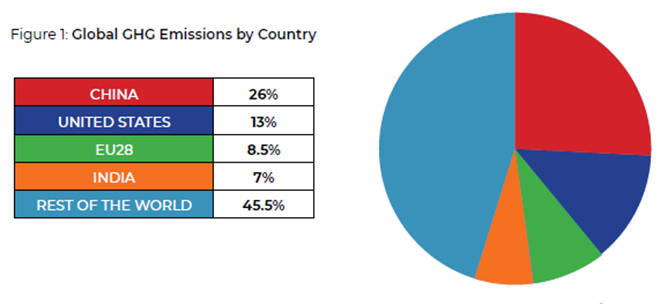
As shown in Figure 1, the United States (US) and India contribute almost 20 percent of global greenhouse gas (GHG) emissions. Although the two countries differ markedly in both per capita emissions and incomes, India and the US must take concrete action according to their capabilities to develop solutions that can boost economic growth and mitigate the catastrophic consequences of climate change. The best way to achieve these twin goals is to invest in infrastructure for a resilient and low-carbon future; cooperate in key areas that produce relevant knowledge; foster innovation exchange; strengthen technical assistance bilaterally and for others; and catalyse capital investments for energy access, energy efficiecy, and renewable technologies.

Source: 2019 Emissions Gap Report, United Nations Environment Programme

Both the US and India have taken important strides together to advance their strategic partnership in the domain of climate action and policy. However, existing efforts continue to rely mainly on an incremental approach to tackling climate change. Such measures are welcome but insufficient. As the world grapples with the COVID-19 pandemic, we are reminded of the human and economic costs associated with weak international cooperation, delayed action, and the lack of investments in important infrastructure and capabilities. Climate-induced disasters may make the current pandemic look meek, and the world could ignore this risk at its own peril. Thus, it is vital for India and the US to double down on efforts to drive structural change, hurdle institutional barriers, and overcome the inertia inhibiting green growth and development.

In line with these goals, the Observer Research Foundation (ORF) and The Asia Group (TAG) convened a joint roundtable in October 2019 to advance recommendations to strengthen the US–India partnership for a green future with a special focus on climate mitigation, renewable energy, and climate financing. Across these topics, it is clear that both countries face a number of complex and overlapping challenges and opportunities. Even as recent policy efforts have strengthened each country’s capacity to tackle these challenges, this report seeks to identify policy recommendations to support this progress.

Standard
big tech, Commentaries, Health care, media and internet, tech and media, USA and Canada

Revisiting Orientalism: Pandemic, politics, and the perceptions industry

The reordering of global power relations with the emergence of the East has begun to alter the West’s imagination, narratives and processes of self-identification. One discernible and strengthening trend arising from this changing political landscape is the increasing deployment of reductive stereotypes in the Western media, reminiscent of the colonial era when the West appropriated to itself the “burden of civilising the savage” East.

This effort to devalue, deplore and defame the East is now a recurrent theme and, perhaps, is an attempt to define oneself as distinct from the “other” in these troubled times. More insidiously, it is also deployed as a method of control and as a projection of a superior agency for achieving definitive economic and political goals. Simply put, the West seeks to tower above all by diminishing the East.

With its increasing economic influence (the pandemic notwithstanding), greater presence in world affairs, and an emerging and louder identity (with passionate supporters and detractors), India’s actions and policies have come under close and often critical scrutiny in powerful sections of the liberal media in the Atlantic system. This, by itself, is both natural and unsurprising.

What is disturbing is the near universal, vicious and negative portrayal of a land that is proud of its democratic politics (just as many other nations are), with a loud, disruptive and often aggressive media, and mobilisations led by communities that have toppled governments and, sometimes, catalysed perverse outcomes. It is a far from perfect, largely low-income country, with its fragilities debated with gusto at home and judged at the hustings repeatedly. What is curious about the naked aggression of the liberal Western media is its visible conflation of the domestic debates of their land with those in foreign lands; their sense of loss of their old place and space and the externalisation of grievance onto the “outsider”; and, their weaponisation of differences in much the same manner as their far Right counterparts.

Many a time, this “reduced” portrayal of India or other lands may be just journalistic or editorial carelessness. When it does happen, it must be called out and now is a good time to engage with this trend. The distasteful grammar, and gloomy imagery that dominates Western coverage on India says less about the country under the scanner and more about the malaise within media organisations as they move from editorial and ownership structures of the past to the digital and decentralised realities of today. The ugly underbelly of a section of the media continues to reveal itself as it engages with India and its efforts in coping with the Covid-19 pandemic.

Over the last two months, organisations such as the BBCthe Atlantic , the Washington Post and the New York Times, among others, have run series of reductive commentaries on the state of India’s preparedness and its capacity to deal with the Covid-19 pandemic. If we are being honest, they are being biased and blasé about it.

From alarmist commentaries (one report hypothesised that half of India could be infected!) and ridiculing the capacity and agency of the government, to deriving vicarious delight by focusing on well-known social inequities, their reporting has been “misery porn” with the spotlight being on India’s vulnerabilities and shortcomings in the fight against the pandemic. These are embellished through a cleverly selected presentation of events and facts; compelling images of poverty, denial, and deprivation; and, an overdose of virtue showboating.

The recurring portrayal of marginalised communities and migrants lacking economic, social, and political agency is presented as distinct from the values of esteem, equality and harmony, which form the bedrock of a “civilised” society. This narrative deliberately ignores the universal acceptance of these “ideals” to meet its singular objective — the perpetuation of a needless discourse of discord instead of a more worthwhile debate on the failure of globalisation and the extant economic models, something which is on stark display around the world.

This media narrative on India is perhaps not meant to only highlight inequality within the country because inequality is all prevalent around the world, more dazzlingly so in the West. It appears to be an attempt to distance a country and its mainstream from the civilised “self” which resides in the moral and emancipated world of publishers, editors and reporters. India and its large population are being painted as the proverbial “other” even as New York, the beacon of Western civilisation, is being scorched by the scourge.

Incidentally, and expectedly, many of these reports have been penned by native authors. This old trick affords plausible deniability to the publications against any allegations of White bias or racism, which is still resplendent in each of these reports. Nobel Laureate professor Amartya Sen and renowned pan-Africanist and political philosopher Frantz Fanon have argued how centuries of colonial subjugation and cultural infantalisation have left deep imprints on the self-image of the colonised, with the natives often viewing themselves and their cultures through the coloniser’s prism of prejudice. This phenomenon is one of colonialism’s most dehumanising byproducts and has now achieved viral potency alongside the pandemic.

Literary critic and linguist Namvar Singh, in his essay Decolonising the Indian Mind, alluded to this desperate urge that resides within Indian English-language writers to be accepted and understood by Western audiences as being part of their own identity continuum. The absurdity of the writings are, therefore, astounding. Just how absurd can be guessed from the assertion that a country with a per capita income of $2,000 must have the governance infrastructure and attributes similar to those with multiple times the resources and capacity — the leitmotif of much that is published on India. What is often forgotten in the “one village” discourse perpetuated by this class is that this village never was and never will be. This pandemic is the story of “millions of villages” seeking their own salvation as the “global ethic” promoted by the liberal media was the first victim of, and culprit-in-chief for, the pandemic and its heavy toll.

For a nation the size of a continent with many inherent challenges, India’s response has been bold and feeble at the same time, just as it has been universal and differentiated. While states such as Kerala and some others appear to have contained the crises well, other states with more complex and complicated politics are battling to keep this virus in check. There are shortcomings galore but most importantly, there is resolute intent across society and politics to fight the pandemic. States are adopting different models — unique to their local situation — drawing heavily from aspects as diverse as their specific cultural practices, topography, information systems and technology, along with government intervention.

Arguably, some states in India have outperformed some of the developed nations. A fair and balanced reportage should have presented these myriad experiences in combating the novel coronavirus, rather than just those narratives that build stereotypes and biases. In fact, the odd positive story out of India has the focused objective of establishing chaos and disorder as the norm — the outlier province with West-like predisposition, the snake-charmer and the bazaar magician, the bandar and the bandarlog, and other such notions lurk among words and between lines. This is reminiscent of the debates in 19th-century Britain with its praise of some quaint developments in India and its resolute determination to tame the East.

Celebrated political thinker Edward Said situated this impulse in the colonial domination of the non-West by the West, and the attendant perceptions of superiority that accompanied such domination. He argued that the West was able to manage, and even produce, the non-West by projecting itself as progressive, rational, civil and humanistic as opposed to the non-West. This reductive narrative was a purposeful one, created to morally justify the colonial enterprise and legitimise the civilising mission which was the “White man’s burden”.

This civilising purpose perpetuated through literature, popular culture and politics for over two centuries has not only informed and influenced the trajectory of colonial politics and popular Western imagination, but has also become embedded as the indisputable truth, forever colouring Western understanding of the Orient.

Starting with James Mill’s influential History of British India (1817) to Katherine Mayo’s Mother India (1927), diminished narratives on native agency, Professor Amartya Sen argues, have informed the views of generations of the Western intellectual and political elite, from Alexander Duff to Theodore Roosevelt and beyond. Works such as Rudyard Kipling’s White Man’s Burden, whom George Orwell called the “prophet of British Imperialism”, are considered reflective of this seemingly benign ethnocentric trajectory of colonial discourse.

French Jewish thinker Emmanuel Levinas traces this bias to the West’s philosophical bearing, where identity is sought in the indurate logic of the self, rather than the expression of self in relation to difference. This predisposition manifests in a skewed representation of non-Western experiences. It is the cornerstone of the age-old identity debates that have troubled and defined human interactions. The sense of “Us versus Them”, or our superior agency versus theirs, proliferates the reports around Covid-19. The articles in the New York Times deploy a lack of empathy to create the “identity distance”. The Atlantic deploys lack of agency as a missing virtue, and social inequity defines the coverage of the BBC and the Washington Post in this instance. Unfortunately, the pandemic has a different tale to narrate.

A study of infection patterns in New York, for instance, presents vivid glimpses of elite depredations. The Black and marginalised communities have been significantly more affected than the rest, with one report assessing that Black Americans were thrice as likely to die from the infection than their White compatriots. The virus has indubitably driven a wedge between the economic haves and have-nots in the US, with significantly higher than average infections and deaths even among caregivers, who are people of colour, than their White counterparts. This isn’t very different from the Indian experience where the more impoverished are facing the fury of the pandemic.

Universally, and without exception, catastrophic events such as the raging pandemic tend to disproportionately affect the economically and socially marginalised more. In India, struggling migrants seek a path back to their hamlets. In the US, the rich and powerful escape to the Hamptons. This is an identity discourse of another variety that poses the same question for all humanity on the form and format of our economic agenda and priorities.

Colonial biases and stereotypes form an intractable part of the Western subconscious. However, the representation also needs to be viewed within a grander scheme. Beyond the articulation of the reductive occidental logic, it also offers a convenient moment for some to mobilise the newly dispossessed intelligentsia against the new nationalist urge that is shaping India’s political and economic discourse.

The story of the media reportage on India’s response to Covid-19 is, perhaps, not about the country’s efforts and its successes and failures. It is a narrative of perverse politics where the increasingly under threat elite opinion makers — the post-colonial custodians of virtue — are expressing (through their media) their contempt for those who do not see their path as either divine or preordained. This is political coverage, not one on the pandemic, and it has been scripted with the ink of exclusion.


This commentary originally appeared in Newslaundry.

Standard
Great Power Dynamics, India, Indian Froeign Policy, Strategic Studies, USA and Canada

India in vanguard of new order: Raisina 2019

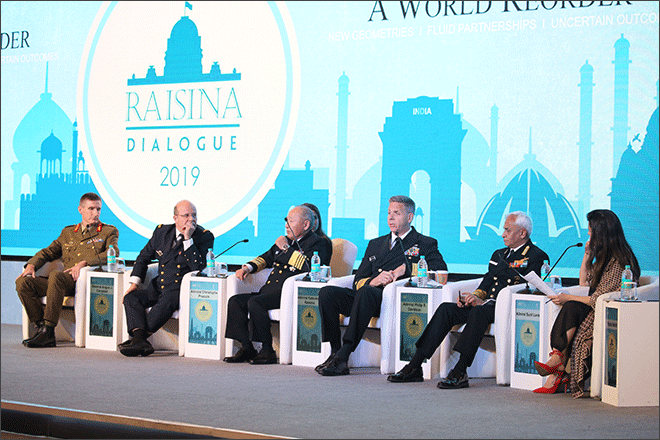
This year’s Raisina Dialogue looked ahead of the disruptions that have agitated global politics for the past few years and interrogated what they mean for an emerging world order. As the international system rapidly drifts away from the moorings of its Atlantic origin, its future will be decided by the complex interactions among new actors, voices and demands. After a period of relative unipolarity at the turn of the century, we are entering a world that is not only multipolar but also ‘multiconceptual’.

Why multiconceptual? For one thing, the concentration of economic wealth is “relentlessly shifting eastwards,” as noted by Mark Sedwill, the UK’s National Security Adviser. This transformation will certainly create new ‘poles’ of power—India and China chief among them. It will simultaneously diminish the influence of extant powers. Spain’s Minister for Foreign Affairs Joseph Borell alluded to this reality when he called on Europe to “influence or be influenced”.

Beyond the diffusion of economic power, the world is also grappling with an explosion of new actors, values and interests—from powerhouse cities to powerful multinationals and networked civil society groups.

This global complexity is straining the ability of the international community to adapt and respond to the momentous social and economic transformations that are currently underway. Every year, dire warnings about the impact of climate change pass by unheeded. The global economy is being increasingly driven by digitisation and associated technologies, with returns accruing mainly to owners of capital. Economic opportunities and jobs for millions, on the other hand, are being lost to automation. Meanwhile, our institutions of governance are struggling to address tensions of inequality and identity.

Around the world societies are responding by taking solace in national solutions and populist prescriptions that promise to put local concerns ahead of global ones. Perhaps it is only natural that a period of geopolitical flux should coincide with a renewed emphasis on the power and authority of the state. The consequences of this trend for international norms and institutions, however, are dire. “The insecurity felt by millions will weaken respect for international law and institutions, human rights and the principles of collective security,” warned Norwegian Prime Minister Erna Solberg as she inaugurated the 2019 Raisina Dialogue.

Quad plus one, Quad, Indo-Pacific, Raisina, Raisina Dialogue

More worryingly, the perception of exclusion reduces our collective capacity to arrive at a consensus. And in a world that is more interdependent—and more fragile—than ever before, finding solutions requires more, not less, international cooperation. How can multilateralism, then, be made relevant in a multiconceptual world?

To start with, we certainly require a new international framework to capture the diversity of reality, views and voices that exist today. Minister for External Affairs Sushma Swaraj said as much when she suggested that key public policy questions be asked in “villages and small towns, to school classrooms, and to vernacular media outlets.” She was alluding to the fact that the international system requires a new consensus which is more inclusive and diverse. It also requires a new ethos defined by the common interests and urges of the many, rather than the shared objectives and strategies of a few.

Second, the international community requires a new ‘new deal’. This is true both domestically and for global governance. The Washington Consensus is no longer relevant in the fourth industrial revolution. The twin forces of globalisation and technological change will create new winners even as they leave many behind. Designing inclusive economic models will require new policies capable of balancing sovereign compulsions and global interdependence. They will also require unlikely partnerships at the global level. There is no reason, for example, that the NATO and the SCO cannot have influential conversations on the Indo-Pacific or Afghanistan or, for that matter, the BRICS and the G7 cannot harmonise their diverse economic models and expectations from a global trading regime.

Raisina Dialogue, Raisina 2019, Showstopeer, Samir Saran
Source: PhotoLabs@ORF

Third, new coalitions and partnerships must emerge. French Secretary-General for European and Foreign Affairs Maurice Gourdault-Montagne said “issues based alliances will proliferate if the international order continues to fragment.” However, such coalitions, especially between those with shared values and interests, have a role to play in supporting the international order in its period of transition. Australian Minister for Foreign Affairs Marise Payne saw such potential in India, a country with which Australia could support a “rules-based order”. Such coalitions must be able to cut across geographies, issues and interests.

Fourth, global governance must account for new actors. Over 60 per cent of the world’s GDP is now generated in cities. The market capitalisation of the largest technology companies far exceeds the GDP of even significant countries. By this reckoning, Apple is bigger than Saudi Arabia. Solutions to big-ticket challenges like climate change and the future of work may well emerge from these networks of power and other key voices like think tanks and civil society organisations. Instituting new mechanisms for dialogue between such actors can create more effective global feedback loops.

Fifth, international institutions must reclaim some legitimacy. In the middle of the 20th century, the organising principle of ‘one country-one vote’ in international affairs resonated with many post-colonial societies. While global institutions have rarely proved truly democratic, it is evident that the key to legitimacy is a real distribution of decision making authority amongst stakeholders. India’s Foreign Secretary Vijay Gokhale warned that the “tussle between unilateralism and multilateralism” would continue unless international steering mechanisms are able to better capture today’s global realities.

Sixth, the international community must embrace informality. Formal global institutions can often be ineffective in responding to challenges that are sudden and complex. Informal coalitions and governance models, on the other hand, can summon the human and technological capital that is required to collaborate at scale. The global climate change agenda, for instance, is being quietly led by coalitions of cities from the global north and the global south. They are rapidly scaling and transferring innovation, ideas, resources and capital.

Seventh, the innocent appreciation of technology being benevolent and beneficial has changed the world over. Technology is now both a tool and an actor that can dramatically enhance quality of life and radically destabilise societies and nations. Foreign Secretary Gokhale captured the essence of this juxtaposition by suggesting that the rapid development of social sciences alongside science and technology is a prerequisite for ensuring that innovation benefits humankind. A new ethic of human engagement awaits discovery.

Last, though not the least, it is worth noting that securing geopolitical stability and protecting multilateralism will certainly require new stewardship. It is increasingly likely that in the coming years India will be a prime candidate for this role, even if only because India is a microcosm of the world at large. Rapid technological advances, a booming labour force and the imperative to develop in a resource-constrained world will define the ‘India story’ and, in turn, impact the future of billions in the developing world. Thus India presents a unique opportunity as an arena to resolve many of the world’s contradictions.

Raisina, Raisina Dialogue, Raisina 2019, Anwar Ibrahim, Malaysia
Source: PhotoLabs@ORF

India is a post-colonial state that has emerged as a vocal proponent of a liberal, rules-based international order. It is located at the intersection of Eurasia and the Indo-Pacific, two regions that will define the 21st century. And it has always been willing to navigate complexity by seeking shared objectives. Very few countries, for example, can claim to engage with powers like Russia and China while embracing a strategic partnership with the US. As Minister Swaraj noted in her address, “India’s engagement with the world is rooted in its civilisational ethos: co-existence, pluralism, openness, dialogue and democratic values.”

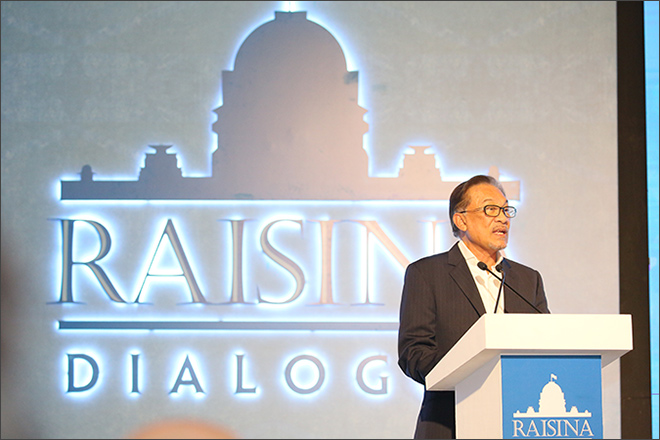
It is for this very reason that Dato Seri Anwar Ibrahim described India as “an enigma.” In many ways, the annual Raisina Dialogue is an attempt to deconstruct what makes it so and why this is relevant to the world. The feedback we have received from world leaders in the fields of politics, industry, media and civil society makes it clear that India’s choices matter more than ever before. Increasingly, the conversations that take place at the Raisina Dialogue are not only teasing out an Indian consensus on world affairs but a larger consensus capable of shaping a less unstable, more predictable world reorder.

Standard