The political and cultural arrangements states and communities arrive at will be heavily implicated by the one major transition Foreign Secretary S. Jaishankar identified: that a rule based order is no longer limited to the developed world.
L to R: Maurice Gourdault-Montagne, Secretary-General, Ministry of Europe and Foreign Affairs, France; General (Retd.) David H. Petraeus, US Army, Retired; S. Jaishankar, Foreign Secretary, India; Samir Saran, Vice President, ORF | Photolabs@ORF
‘Managing Disruptive Transitions’ was the theme this year at the Raisina Dialogue, and while more than a few disruptions were discussed over the past week, India’s Foreign Secretary S. Jaishankar articulated four key ones: the rise of China; the current churning in United States global posture and Asia strategy; “non-market” economics; and terrorism from governed spaces.
While India’s top diplomat exhibited customary refrain, General David Petraeus was more candid in his assessment about the last two trends, “let’s be clear who we’re talking about: China.”
India’s Foreign Secretary articulated four key ones [disruptions]: the rise of China; the current churning in United States global posture and Asia strategy; “non-market” economics; and terrorism from governed spaces.
First, the normalisation of state capitalism and the rise of non-market economies threaten to upend traditional understandings of economic relations. Complete control over industry by the party-state, and utilisation of markets to maximise state power and legitimacy with disregard for corporate independence form the essence of “capitalism with Chinese characteristics.”
For some time now, China has attempted to leverage this model to script a relationship of dependency with smaller nations, while it has used coercive economics with larger ones. 2017 was testament to this new normal: Across Asia, Africa, Latin America and even in parts of Europe, smaller economies are now straddled with high levels of debt payable to Beijing’s state-owned enterprises. Countries like the United States, Germany and Japan, on the other hand, must now contend with China’s targeted and state-led or promoted investments in sensitive high technology sectors.
The advent of non-market economics and the rise of the Beijing Consensus may mark the end of a golden age of entrepreneurship, and the free flow of ideas and technology which flourished under transparent free markets for nearly three decades. Beijing’s opaque and distorted whole-of-government approach to market power will likely have ripple effects as China’s economy makes its way towards nearly US $20 trillion by 2030. Along the way, this transition will undoubtedly influence the economic choices of smaller states that are heavily dependent on Beijing, with destabilising consequences for the world economy.
Second, terrorism emanating from and protected by governed spaces will imperil global peace and security. To some extent, conventional military power and diplomacy can address the threats originating from ungoverned spaces. When states use terrorism as an instrument of state policy, especially under a nuclear umbrella or the protection of sophisticated firepower, a comprehensive approach towards regional and global security becomes arduous.
When states use terrorism as an instrument of state policy, especially under a nuclear umbrella or the protection of sophisticated firepower, a comprehensive approach towards regional and global security becomes arduous.
Again, the fact that China seeks to curry favour with such states — as it has with Pakistan —and intends to build parochial relationships with these actors significantly muddies the waters. More importantly, China believes that through some complex political formulation, it will be able to strike a deal with non-state groups. In fact, where responsible powers see adversity and risk, China sees an opportunity — its connectivity projects pass through some of the most unstable regions in the world.
Without dedicated and targeted policing measures, which Beijing is reluctant to undertake, such projects will ultimately make it easier for terrorists and other criminal groups to expand their outreach, find new avenues for rent-seeking, create insidious partnerships and recruit additional members. China’s subjugation of morality for petty self-serving geopolitical gain will create a new — conceivably malicious — dynamic in the fight against radicalisation and terror.
In these trying and chaotic times, perhaps Israeli Prime Minister Benjamin Netanyahu’s statement at the Raisina Dialogue that states must choose between hard power and soft power was more prophetic than intended. While Netanyahu was clear in his support for the former, many states around the world will struggle to find a suitable balance between the two. At the same time, countries will have to defend another aspect of power that the Prime Minister identified — one that binds India and Israel to each other and their strongest partners: democratic values.
China’s subjugation of morality for petty self-serving geopolitical gain will create a new — conceivably malicious — dynamic in the fight against radicalisation and terror.
The political and cultural arrangements states and communities arrive at will be heavily implicated by the one major transition the Foreign Secretary identified: that a rule based order is no longer limited to the developed world. The shifting balance of power, from the Atlantic system to the Indo-Pacific, will determine the future of the 21st century. “The old order is expressing its limitations through both policy and posture,” said External Affairs Minister Sushma Swaraj, capturing the essence of this evolution. “The new order, however, is far from being clear,” she cautioned.
The Indo-Pacific will be ground zero for the economic, political and cultural disruptions that are shaping a new world order and will determine if it will be defined by democracy or autocracy. By foreign policy design and inadvertent geopolitical trends, India will form the lynchpin of this transition.
This brings us to what is perhaps the most prescient observation the Foreign Secretary articulated: that one part of the answer to many of these disruptions lies with India. A vibrant democracy, a flourishing multicultural society, a rapidly growing economy and increasingly confident on the global high table, the choices India will make implicate the future of our world. The remaining answers will be found in the partnerships it choses, the success of its economic journey and the narrative it ultimately frames around its rise.
Indeed, former Swedish Prime Minister Carl Bildt’s tweet perfectly sums up the ethos of the Raisina Dialogue, organised by the Ministry of External Affairs and Observer Research Foundation: “Bringing the debates of the world to India — and the perspectives of India to the world.” The conversations that take place at this Dialogue play an important role in shaping India’s narrative and, as the Foreign Secretary rightly believes, will ultimately complete the answer to the many predicaments that afflict the world.
To ride the next wave of innovation, India needs its own strategy. Its agenda for 2018 should be to leverage the hundreds of millions it brought online in recent years and the 1,500 million GB of monthly data consumption that now powers a Digital India.
China’s National Development and Reform Commission recently announced subsidies to 56 artificial intelligence and robotics companies in line with its goal to become an “innovation nation” by 2020. Over the past three decades, Beijing has sought and aggressively pursued technology-led global dominance.
If high-impact Chinese academic publications formed 1% of the top Scopus citations in 1997, today they are at 20%. Once synonymous with knock-off goods, China now inspires Silicon Valley to mimic even its on-demand bike rental services. But its digital economy is a testament to well-worn 20th century statecraft. Protectionism has meant Chinese payment services like TenPay and AliPay have over 800 million users and a combined market share of nearly 90%. The microblogging site Sina Weibo has 500 million Chinese users — more than Twitter’s global user base. The story repeats itself in search (Baidu), local ecommerce (Alibaba, JD.com), local commutes (Didi Dache, Kaundi Dache) and travel and accommodation (Ctrip, Tujia). Notables at the receiving end include Google, Twitter, Walmart, Amazon, Wiki, Facebook, Netflix, YouTube, Uber and Airbnb.
Data is the new oil; but our aim should be wealth creation beyond mere ancillary benefits of this ‘oil’, such as affordable connectivity.
In 1803, French economist Jean-Baptiste Say said supply creates its own demand. Beijing has vindicated his theories. Tapping into its vast internet user base, China created services that cater to its citizens’ needs, concurrently generating massive data to fuel innovation.
To ride the next wave of innovation, India needs its own strategy. Its agenda for 2018 should be to leverage the hundreds of millions it brought online in recent years and the 1,500 million GB of monthly data consumption that now powers a Digital India.
Data is the new oil; but our aim should be wealth creation beyond mere ancillary benefits of this ‘oil’, such as affordable connectivity. We must reconsider the ecosystem of data extraction from India, not merely figure out how its benefits can trickle down to citizens.
India will enter the ten-trillion-dollar club as the first economy to mature during the Fourth Industrial Revolution (4IR). The first three waves — led by Britain, the US and finally China — featured wealth creation within one’s own geographies, aided by global resources and labour. This focus on local prosperity and capacity won’t change. What will be unique to the Indian story, however, is its regulatory ecosystem around data — the 4IR’s raw material.
Global trading rules, which China stayed away from till the 21st century, require India to be expansive in its digital integration and in traditional offline trade. But as the Washington Consensus develops fatigue, India must infuse energy into a new globalisation project. India should offer its own developmental model that addresses key concerns on cross-border data transfer — one promoting the free flow of information globally while ensuring local value creation from data.
The Aadhaar database, among the largest global public repositories of information, can jump-start a new wave of startups and services that rely on authentication. The challenge will be in launching Indian innovation into the outside world. WhatsApp’s integration with the Unified Payments Interface this year suggests that the world is indeed ready to welcome first-rate Indian products. WhatsApp integration will drive the creation and adoption of UPI-based applications and similar products based around Aadhaar-enabled systems. Still, the story is only half-complete. UPI may have become the backbone of payments innovation but real success will come when an Indian platform can emerge on the scale of a WhatsApp or Sina Weibo.
As the Washington Consensus develops fatigue, India must infuse energy into a new globalisation project. India should offer its own developmental model that addresses key concerns on cross-border data transfer — one promoting the free flow of information globally while ensuring local value creation from data.
How do we create global Indian technology giants? It isn’t just about access to data, or obsessing over where it’s located. What we need is data refineries, not data wells — an Indian tech ecosystem that doesn’t only create and extract data, but also transforms it into higher-level products with global worth. If we do not do this, others will.
China forced global tech giants to play by their rules or forgo their market. India can’t mimic such heavy-handedness, but must have the same end: that value created by Indians is largely created forIndians and mostly enriches India. China’s provinces took the lead in creating tech giants; Alibaba and the others emerged from provincial capitals like Hangzhou to challenge the world. Ours is a continent-sized economy, and we need to think of our 29 states as 29 different ecosystems now bound together by far-reaching reforms like the GST — and each ecosystem must have a unique strategy to incubate world-beating innovation.
This must form a pivot for both the upcoming budgetary allocations and the data protection Bill that is being developed. The Bill must not just bolster privacy but also redefine India’s trade posture in a world where data fuels economies. If done right, this can foster local innovation – birthing new vernacular-language technologies that are transformative. If done wrong, it can disincentivise innovation and overseas investments.
The moment is now, and we must seize it in 2018: China’s digital protectionism and a US retreat can be analogous to Indian victory in Globalisation 4.0 – if, that is, we discover the regulatory sweet spot that brings home to India the largest chunk of online value creation, and creates a mature Indian platform economy.
An edited version of this article appeared in The Economic Times.
Cyber (in)security, 2017 has proven, is a great leveler. From the individual tweeting on her cellphone, to the corner storekeeper who relies on digital payments, to the multibillion-dollar corporation and the most technologically advanced nations — no stakeholder has been found immune from harm. The woes of the world may be the same, but India’s government, businesses and civil society cannot escape the reality that the country’s digital spaces are uniquely vulnerable.
India is at once a bustling digital democracy and a budding digital economy. The national imperative to keep its networks open while coming down on malicious actors is easier proclaimed than addressed. But if this unique, finely balanced model can be created and sustained, it will be a shining example for democracies and emerging markets alike. For what it is worth, 2017 illustrated the difficulties ahead for policy planners.
The potential of cyber space is a factor of the trust that it commands from users, businesses and governments. Unfortunately, malicious agents — both state and non-state — have shown themselves increasingly capable of disrupting core infrastructure and services, and undermining that trust. By some estimates, cyber crimes are expected to cost upwards of $2 trillion by 2019. The risks, however, cannot simply be measured financially. The loss of personal information, corporate reputation and national security are immeasurably more valuable.
The potential of cyber space is a factor of the trust that it commands from users, businesses and governments. Unfortunately, malicious agents — both state and non-state — have shown themselves increasingly capable of disrupting core infrastructure and services, and undermining that trust.
2017 has been a tumultuous year for both technological advances as well as the means to disrupt them. Nations around the world are now waking up to the fact that ‘protection’ of their information systems is a national priority, both for their economies as well as their democratic institutions. For democracies attuned to the free flow of information — taking both the good and bad in their stride — this is a particularly vexing problem. Is information to be controlled and vetted?
Vulnerability within consumer devices, malicious bots, artificial intelligence and information warfare were some of the most important issues confronting cyber space in 2017. However, the cyber risk landscape is dynamic and responds rapidly to new technologies and new security measures. Considering that millions of new users are coming online every year, it is useful to take stock of this changing threat landscape and examine some developing trends which can benefit conversations on cyber security.
The promise of cyberspace is immense; can India’s security architecture keep up? | Photo: Kickstarter
One of the most promising developments in cyber space is the growing interconnectivity of digital networks, and with it, communities. The internet of things (IoT) — a network of physical devices and objects designed to collect and exchange data — is perhaps the fastest growing field of technology in the 21st century. Be it moisture sensors to help farmers water their crops, or blood pressure monitoring devices placed in pacemakers, IoT has the potential to revolutionise our daily lives. Their impending ubiquity, however, makes it difficult to measure the inherent risks. As we race towards 50 billion IoT devices by 2020, each of these devices will collect vast amounts of data on our daily habits, activities, and lives. With every new IoT device, our digital footprint is set to exponentially increase — creating an ever-expanding number of entry points for hackers and cyber criminals.
In July 2017, hackers attempted to steal sensitive data from a North American casino by hacking into its internet connected fish tank. The compromised tank was then used as a gateway into other systems in the casino. The device was an unsuspecting vulnerability in the casino’s system, and is representative of the larger risks the IoT ecosystem faces.
The Internet of things (IoT) — a network of physical devices and objects designed to collect and exchange data — is perhaps the fastest growing field of technology in the 21st century.. Their impending ubiquity, however, makes it difficult to measure the inherent risks.
A 2015 report by the United States Federal Trade Commission found that fewer than 10,000 households using home-automation services were generating 150 million discrete data points every day, i.e, one data point every six seconds. Worryingly, the data collected from these devices — from ‘smart’ wristbands to TVs — are not always secured. Most IoT manufacturers place little emphasis on device security, and very few industry standards have been developed so far to tackle this problem.
A team of researchers from Microsoft and the University of Michigan discovered multiple vulnerabilities in Samsung’s ‘smart home’ platform. The most noteworthy of which involved them taking control of smart locks and smoke detectors connected to the network. The significance of this cannot be overstated — if hijacked by malicious hackers or criminals, these technologies can catalyse man-made disasters and bring entire cities to their knees.
These unsecured devices can also be used in an aggregated manner to attack critical internet, or public, infrastructure. In October 2016, Dyn — a domain name management product suite — suffered a massive denial of service attack. Interestingly, criminals used over 100,000 seemingly innocuous devices, such as printers, cameras and baby monitors to rapidly scale the attack. They were coordinated through the ‘Mirai’ Botnet, a freely distributed malware, used to infect the IoT devices.
By some estimates, the market size for IoT products and services in India is expected to reach around $9 billion by 2020. Apart from consumer markets, much of this growth will be spurred on by government initiatives that intend to integrate IoT devices with the smart cities mission and other infrastructure initiatives. This puts New Delhi in a vulnerable position; without an adequate cyber security framework, cities become prime targets for malicious actors, considering the damage inflicted can be rapidly scaled in terms of intensity and scope.
Source: McKinsey Global Institute
If the risks inherent in the proliferation of an IoT ecosystem offer any lessons, it is that the ubiquity of networked systems brings with it multiple vulnerabilities. The future of cyber crime is likely to be characterised both by large data breaches or sophisticated network attacks, as well as digital ‘pick-pocketing’ — millions of small value transactions that can cause disproportionately serious damage without raising suspicion. A series of aggregated, relatively low-value and distributed cyber crimes may in fact present a substantially more difficult challenge to regulators and law enforcement agencies than a single, sophisticated cyber attack.
Advance fee fraud, which contributes to billions of dollars stolen every year, is the classic example of low-level activity that goes undetected and remains undeterred. Coupled with the fact that the average time to detect a breach or fraudulent activity can take several weeks, the financial costs of such crimes can be staggering. In 2016, a criminal gang called the ‘Lazarus Group’ developed a software to manipulate the SWIFT system — which is commonly used for international financial transfers. By targeting banks with lower security, the group successfully initiated fraudulent transfer requests across multiple jurisdictions. Reports indicate that US$ 81 million went unrecovered from the Bangladesh National Bank, $10 million was lost from a Ukrainian bank, and a bank in Ecuador suffered losses up to $12 million, among several other such incidents around the world.
Just in 2016, Tesco Bank in the United Kingdom reported that cyber criminals stole up to 2.5 million pounds from over 9,000 customers. In 2016, Indian banks suffered a financial breach that affected 3.2 million debit cards. These digital pickpockets are not only harder to identify but the damage caused is nearly impossible to restitute. A pattern of attacks is not readily apparent in these circumstances, wasting crucial response time necessary for responding to these breaches. Further, many countries still lack the resources to devote time to smaller crimes.
For developing countries like India that are coming online on a wave of cheap and unsecured mobile devices, the implications are grave. This assumes added significance in light of the Aadhaar platform that seeks to improve government services, foster financial inclusion and build a digital economy. While the data in transit might be secure, the infrastructure and application layer of the ecosystem—which includes mobile handsets and services such as PayTM — continue to remain vulnerable. This is compounded by the fact that India’s supply chains reside abroad, which makes it difficult to ensure system-wide compliance with security requirements.
Already, news reports have highlighted instances of personal data leaks and attempted unauthorised authentication. While the biometric database might continue to remain secure, a new wave of sophisticated digital pickpockets are likely to find vulnerabilities to use against individual low value targets that are more attractive compared to heavily secured ‘fat cats’. The most vulnerable are likely to be the poorest, whose relative lack of digital skills and access to law enforcement capacity make them susceptible to such attacks.
A commonality between the insecurity represented by IoT and digital pocketing is that the vulnerability resides not just in the technology, but also in the human beings operating them. From forgetting to change default passwords on their thermostats to leaving access codes on a post-it note, the stage at which humans interact with machines represents a lucrative point of intrusion.
Source: 2013 Norton Report
Cyber crimes for financial gain, however, comprise only one side of the coin. Increasingly, more and more of our lives are lived online; our thoughts and actions affected by developments in the digital realm. The man-machine integration is near the cusp of completion, where every single action leaves a digital footprint. As Chief Justice Roberts of the US Supreme Court said, “modern cell phones… are now such a pervasive and insistent part of daily life that the proverbial visitor from Mars might conclude they were an important feature of human anatomy.”
Technology is fast evolving from a mere tool to an extension of our own selves — when we communicate online and store our thoughts on the cloud, we are not mere chefs wielding knives, we are authors, scripting our own private biographies. Over the past decade, scientists have been exploring the possibility of linking the human brain to computers — converting neurological impulses into code. It is only now that technological businesses like Tesla are foraying into this space, attempting a convergence of ‘biological intelligence with technological intelligence’, hinting at the commercial value in the hitherto untapped human data.
Currently, the law sees individuals and the technologies they use as two distinct entities. However, if we erode protections for our technological tools, we also encroach upon the private spaces of individuals. As this becomes viable in the next decade, how will our legal institutions seek to build distinctions between what we think and what we store online? If legal warrants can compel the divulgence of the contents of our hard drives, can the same warrants be used to divulge our thoughts? When centuries worth of legal scholarship around privacy has been navigating us towards increased control over our information, the challenge of tomorrow will be to remain private and yet connected.
Currently, the law sees individuals and the technologies they use as two distinct entities. However, if we erode protections for our technological tools, we also encroach upon the private spaces of individuals.
These same technologies will also pose constitutional challenges in India. For example, the Indian Constitution prohibits self-incrimination during criminal trial. Time and again the Supreme Court has interpreted this to protect the privacy of mental processes. Once these processes are ‘on the cloud’, will they be treated as private thoughts or merely records of thoughts to be used as documentary evidence?
Traditionally, Indian policy has been slow to evolve in the face of rapidly changing technology. The ill-fated National Encryption Policy of 2015, for example, unduly prioritised law enforcement imperatives against civil liberties and higher security standards. Once the line between the biological and technological blur, India will require new frameworks to ensure the integrity of such sensitive systems and protect the privacy and other fundamental rights of the individual.
Additionally, the direct threat from new technology is a fact that cannot be ignored. As artificial intelligence capabilities continue to grow in the near future, the likelihood of automated and autonomous attacks is on the rise. Data theft and network penetration represent only the least damaging scenarios. Former United States President Barack Obama has even gone on to say that a sophisticated machine learning algorithm could potentially steal nuclear codes.
The 2016 Dyn attack was orchestrated by real humans, who used bots to execute attacks when they saw fit. Many believe that we are inching closer to an AI powered botnet attack, which is likely to be even more devastating. The US’ Defence Advanced Research Projects Agency recently conducted a ‘Cyber Grand Challenge’, which pitted algorithms against each other to search for network vulnerabilities and patch them. Many have already warned that these techniques will be used to exploit vulnerabilities instead of fixing them.
According to Darktrace, a company which specialises in AI cyber security, countries like India are fertile testing ground for such attacks considering the lack of effective security architecture. In fact, the company reports that, already, a low-level attack took place in November 2017, which used malware that could learn as it was spreading, and altered its methods to stay in the system for as long as possible. Already, India struggles with conventional cyber attacks. The scale and intensity of new AI powered attacks could potentially cripple critical infrastructure and services.
It is unsurprising that Microsoft has called for a ‘Digital Geneva convention’ in order to establish the rules of the game when it comes to cyber space. Unfortunately, it is unclear if nation states have the necessary political will to undertake such actions. Previous attempts such as the United Nations Group of Governmental Experts on cyber norms for peaceful use of ICTs ended in a deadlock, with countries disagreeing on whether norms of non-interference would compromise their state sovereignty.
It is unsurprising that Microsoft has called for a ‘Digital Geneva convention’ in order to establish the rules of the game when it comes to cyber space. Unfortunately, it is unclear if nation states have the necessary political will to undertake such actions.
In the future, these questions can be rendered redundant with the advances in machine learning. A sophisticated automated system capable of propagating without human intervention raises a troubling question — who is in control? Already states are debating rules for ‘Lethal Autonomous Weapons Systems’ — AI systems that will be able to make life or death decisions in war.
This has raised complex questions around laws of war and human ethics. India, as chair of the Group of Governmental Experts Meeting on Autonomous Weapons, has already deliberated on many of these questions in November 2017. Where does the liability lie for machines that function outside human control? Which principles of international law provide protection against these attacks? These important questions beg resolution today; whether a consensus on the use and development of these weapons is possible, remains to be seen.
While many of these developments pose security challenges to individuals and businesses, the past year witnessed an event many thought was never attainable through technology — the subversion of democratic processes. Even today, the precise scope of Russia’s ‘influence operations’ on elections in the United States and Western Europe is unclear. What is certain, however, is that Russia deftly manipulated the electoral process and social media in some cases to achieve its desired outcomes.
Hacking into the US Democratic National Committee’s e-mail system was only the tip of the iceberg. The wave of leaks which followed damaged Hillary Clinton’s presidential prospects by throwing the Democratic Party into disarray and fueling the popular anti-establishment mood against her. Equally significant was Russia’s disruptive use of social media. The medium itself represents liberal values on and of the internet — an open and inclusive platform capable of bringing communities together. By inserting fake news and generating manipulated trends, Russia successfully undermined these values by polarising the American electorate.
For decades, Russia and other authoritarian regimes were haunted by the spectre of ‘colour revolutions’ at their doorstep. America’s creative use of information technology and civil society resistance towards the end of the 20th century represented ‘asymmetric operations’ against communist regimes. To Russia, an enfeebled economy, cyber operations represented the perfect counter force — difficult to anticipate and difficult to trace but easy to execute across oceans. The digital disruptions of tomorrow seem eerily similar to the colour revolutions of the past.
Although the interference with American presidential elections has gained the most attention, to Russia, this is not new. Over the past five years, it has perfected these techniques in Eastern Europe — in states like Ukraine, Georgia and even Germany. Most countries in the EU states are bracing for similar operations during their own elections — with France having successfully taken somewhat controversial countermeasures such as banning TV and creating phony email accounts and fake documents to misdirect Russian hackers.
Speaking at CyFy 2017 — Observer Research Foundation’s annual conference on technology, security and society — several panellists highlighted that Russian motivations are likely multifaceted. For one thing, they seek to undermine democratic processes in order to legitimise their own political systems. On the other hand, they also seek to disrupt the current forms of cyber governance, testing the limits to which conflict in cyber space is permissible.
India’s primary geopolitical rival, China, has already developed the tools necessary to carry out such operations. After years of perfecting cyber espionage and other such techniques, even against powerful countries such as the United States, the likelihood that China will attempt to influence India’s democratic institutions must not be dismissed. As a democracy, India will have to toe a fine line between preserving the free flow of information and preventing malicious actors from manipulating that information.
China, however, is not the only threat. Considering Pakistan’s weaker conventional military prowess, what is to stop it from using asymmetric methods of cyber warfare? The implications of these events are dire. For one thing, revisionist regimes now have a reliable template to emulate in other parts of the world. That such actions require limited financial and technical resources dramatically reduce the costs of destabilising perceived rivals. Our traditional political and military structures no longer seem capable of keeping up with the deluge of attacks that rely on misinformation and propaganda.
These methods are no longer constrained by traditional paradigms of power. In the 20th century, military capability was determined by the size of a state’s army, navy or air force. That Russia, a one-and-a-half trillion-dollar faltering economy, subverted institutions in America, an eighteen trillion-dollar superpower, only goes to show how effective ‘influence operations’ can be.
A democracy thrives on trust in government institutions and even in media. By undermining the integrity of this relationship, Russia successfully fueled polarisation and disaffection amongst the American public, thereby subverting the very basis of democratic norms and values. By all accounts, this was its ultimate objective. That other liberal democracies in Europe are bracing for similar events only serves to highlight the efficacy of these malicious methods.
These developments have thrown up critical questions around managing this upheaval. What structures and institutions must we build and empower to tackle these threats? The idea that causing disruptions through ICT activities is not a resource intensive exercise is only half true. It is steeped in western presumptions of power — that the one with the money and the muscle wins the war. The truth though is that both cyber defence and cyber offence need significant allocation of resources — not just in the institutions that emerged as a result of the teetering post-Cold War stability.
For a country like India, which still does not possess a coherent national cyber security architecture, responding to new asymmetric threats such as influence operations will be a difficult challenge. Such operations rely on political, ethnic and religious faultiness — which are abundant in India — to polarise individuals. Already, ‘fake news’ spread through WhatsApp forwards and social media has led to real instances of violence along these very lines. This year alone, for example, fake rumours about violence against Hindus in Myanmar helped fuel anger against a wave of Rohingya Muslim refugees.
Sprawling cyber commands and advanced weaponry will not address the asymmetric capability of hundreds of internet trolls glued to computer screens with the single-minded aim of falsifying news, spreading propaganda and subverting democratic institutions. It can be contained by building capacity at the grassroots — by scripting and consolidating narratives to counter untruths and empowering communities to detect and disregard falsehoods.
Sprawling cyber commands and advanced weaponry will not address the asymmetric capability of hundreds of internet trolls glued to computer screens with the single-minded aim of falsifying news, spreading propaganda and subverting democratic institutions. It can be contained by building capacity at the grassroots.
Taken together, these risks exemplify the double-edged nature of cyber space. While the internet has emerged as a vehicle for transformation, its development has come with significant costs. Today, a wide array of malicious actors — be it states or rogue individuals — threaten to disrupt and dismantle the internet’s core infrastructure and values. Unfortunately, these threats are non-traditional, dynamic and dispersed, and large cyber defence institutions are limited in their ability to tackle them. Instead, the individual is likely to be front and centre in facing these challenges. We need to reimagine the role of the individual, who is at once a target and a trustee on the internet.
Accordingly, to tackle these threats, New Delhi will have to recalibrate its policy response. For one thing, building cyber capacity at the local law enforcement level is a must — a decentralised threat requires a decentralised response. Apart from building a new cadre of cyber security specialists, the Indian police force must build the capability to detect petty cyber crimes, and to analyse how these threats aggregate and cause systemic damage. Additionally, new institutional mechanisms must be put into place to build trust between individuals, businesses and the state. Victims of cyber crimes, especially low-value crimes, are currently reluctant to share information with the government. They must be able to have faith that the state will address their loss, and provide timely access to justice.
Second, new regulatory frameworks in India must incorporate ‘security by design’ amongst commercial products and services. A 2016 report by the Ministry of Finance on digital payments suggested a hierarchical approach to cyber security based on the systemic risk posed by different infrastructure layers and applications. This is a model that deserves replicating across networks — vulnerability must be addressed at its root. For example, some legislators in the United States have introduced a bill that will require devices to conform to specified industry standards and prohibits vendors from supplying devices that have default passwords or that possess known security vulnerabilities. India must be proactive in setting its own standards and norms for digital products, even as new platforms and networks continue developing in the market.
Third, India must invest in diplomacy. First, in areas like the UN GGE, as chair of the group on autonomous weapons, India is in a position to direct the conversation on norms, technologies and regimes to favour its interests. Simultaneously, India must also cultivate relationships with cyber powers like the United States, Israel and the EU, that can help in developing cyber security products and law enforcement training. And lastly, to reform international information sharing policies between countries and tech companies, considering that most Indian data is stored abroad.
Fourth, developing new technologies in India must be treated as a national security imperative. The government must fund research into emerging technologies, their impact on society and their implications for geopolitics. The new AI arms race between America and China is taking place in universities and think tanks, with generous aid from the government. Accordingly, these same powers will have the authority to shape how such innovations will reorganise society. To avoid being relegated in global politics, the effort to develop new technologies and to shape the norms which govern their use, must be catalysed by the Indian state.
Fifth, as a democracy, India must create institutions which are capable of bringing together local communities in order to create awareness about fake news and malicious propaganda. For example, the EU now has a ‘specialized strategic communications unit’, which brings to light influence operations by foreign actors. Additionally, the United States has recently listed election institutions as critical information infrastructure; a move which India should also consider in order to better prevent politically motivated hacking into party accounts and other such malicious efforts.
For a country that aspires to be a truly digital economy, India must internalise that the security of its ICT infrastructure is not a post facto consideration but a precondition for growth. At the same time, the over-securitisation of cyber governance can often lead to undermining rights which, in turn, negates the country’s values as a free and democratic nation. The right answer ultimately rests on a fine balance between an ambitious aspiration of what Digital India will be tomorrow and a realistic assessment of what India’s capabilities are today.
‘India has both the capacity and the moral authority to shape a global digital economy’
ndia is fast becoming the indispensable nation of cyberspace. The Indian market could decide the future of many technology giants. As such, she can be seen as a policy pioneer.
In November, Ajit Pai, Chairman of the US Federal Communication Commission, announced the rollback of the Obama-era rules on net neutrality. As the historic architect of the internet and arbiter of its values of openness and freedom, the US appears to be ceding its normative influence over the medium.
Meanwhile, the EU’s misgivings about US technology corporations have driven it to enact a new data protection regime that sets its own highly restrictive standards on digital markets, content regulation and privacy. This is par for the course for a community that is looking increasingly inward, and no longer sees itself as a model for other countries.
Farther east, China has outright rejected the West’s open model for the internet and has outlined a vision to become a cyber superpower premised on state sovereignty and control.
Thanks to such developments, leadership in cyberspace is contested and a new global regime will follow the model that best balances several competing priorities. With a 450 million strong – and growing – online population, India is capable of exercising considerable heft in shaping the future of the internet. India’s multiple identities only add to this weight: as the world’s largest democracy, it commands the legitimacy to shape an open and free internet; while its role as a developing country ensures it will account for what matters to the global south, such as affordable access, local content generation and platform security.
Two recent events have further bolstered India’s leadership in cyberspace claim. The first was the Telecom Regulatory Authority of India’s (TRAI) recommendation that access to the internet must not be restricted by discriminatory measures from service providers. Even though some rough edges remain, such as the role of the proposed multi-stakeholder ‘advisory’ body and the regulation of Over the Top Services, the TRAI has done well to endorse the principle of net neutrality in its proposals to the Department of Telecommunications.
Despite increasing convergence with the US on information technology issues, New Delhi was not swayed by America’s deliberations. Instead, the TRAI chose to endorse a pragmatic model that would balance commercial imperatives against consumer interest. In this process, it has also given New Delhi the ability to claim moral leadership over the principles that define the internet.
The second development was the publication of the Ministry of Electronics and Information Technology’s consultation paper for a Data Protection Framework for India. Prompted by the Supreme Court’s verdict in the Puttaswamy case, the Indian government is now working to protect individual privacy in the digital world. While the final law will undoubtedly generate debate, the report notably makes it clear that India will balance civil liberties, security and data-led innovation.
No country has yet managed to strike a perfect balance. In countries like China, privacy has been subsumed in favour of national security. In democracies like the US, social media platforms have been left vulnerable to foreign influence; and in the EU, stringent data protection laws might stifle innovation. If India can fine-tune its own design for a data-driven economy while protecting the rights and security of its citizens, it will have created a prototype that is at once unique, and yet replicable.
Both these developments highlight something significant: India is carving out its own unique position in cyberspace, one that is likely to be emulated by emerging markets. With multiple institutions – from courts to political leadership to civil society – actively contributing to a diversity of opinion, the shape of an Indian consensus on cyberspace is slowly emerging. The Digital India initiative could culminate in a distinctive offering that will not only invigorate India’s economy but also serve as a model for other countries, including the industrialized West.
The internet is provoking new debate about the emerging social contract between citizens, businesses and the state. These debates will eventually find their way into international norms and regimes. To prevent the emergence of a “splinternet” and to preserve the democratic nature of cyberspace, India must proactively tell its own digital story.
India already has a rich history of safeguarding the global commons by blending idealism with pragmatism. Speaking at the Paris Conference in 2015, Prime Minister Modi recognized that more than 300 million Indians do not have access to energy. Despite this, India was determined to ensure that access does not come at the cost of the environment. This determination, said Modi, was “guided by our belief that people and planet are inseparable; that human well-being and nature are indivisible.”
India’s position on cyberspace is equally progressive. As things stand, India has both the capacity and the moral authority to shape a global digital economy. At the Global Conference on Cyber Space in New Delhi, Prime Minister Modi believed that the internet validates the ancient and inclusive Indian philosophy of “Vasudhaiva Kutumbakam” – the world is one family. “Through technology, we are able to give meaning to this expression, and indeed to the best of democratic values,” he continued.
A democratic, innovative and secure cyberspace is consistent with both India’s ancient moral values and its modern economic imperatives. India’s recent policy actions on net neutrality and data protection are a step in the right direction. New Delhi must now craft a narrative around India’s digital economy that appeals to the rest of the world.
Liberal fundamentalism is now at war with unbridled street anger, whose revisionist purpose and impatience have exhibited a dangerous capacity to self-destruct.
PROLOGUE:In April of 2016, UC Berkeley cancelled Milo Yiannopoulos’ planned speech in response to campus protests. For an institution that prides itself on its long and stellar liberal legacy — the centerpiece of which is the freedom to hold and express a view, irrespective of its political persuasion — the Rubicon was silently crossed.
The appeal of liberalism lies in its capacity to accommodate difference, to resist the instinctive urge to reduce the ‘other’ to fit the prisms of the ‘self’, and to recognise their independent and distinct agency. This lends it the unique capacity to account for the ambivalent nature of truth, to recognise and accept the many greys of reality and allow for the creation of assimilative and syncretic spaces.
Liberal, pluralist approaches have formed the basis for modern societies, where diverse opinions, preferences and choices make up a grand social and political canvas.
Ideologies, however, possess a fundamental contradiction: they are seldom ever practised as idealised. Participation in the liberal public sphere was compromised by the inability to widen access and agency beyond a select few with economic means and social ‘status’. The poor, racial and ethnic minorities and even women remained excluded from its ambit.
Key conversations that organised politics, economics and social norms thus largely remained an elite discussion, which despite their apparent differences, shared common class interests and presumptions around morality. This convergence of interests shaped the public discourse. It trickled down to the society through one-way, mass-oriented technologies of print and broadcast media, owned and controlled by this class, informed by their thinking and influenced by their sensibilities. The discourse thus remained incestuous and public consensus often imaginary and contrived.
The inherent flaw in this model was its contrariness to the liberal dictum. It left out large swathes of people who were constrained by the economics of access and politics of acceptance. The liberal public sphere has thus always remained contested and illiberal in its practice.
The domination of a Western cultural-technological narrative, mostly at the cost of indigenous ethos in non-Western settings, meant that it soon became an ideal that was either imposed upon or embraced by societies with sometimes-different social evolutions. This then became another reason of discord in many localities, where existing socio-economic exclusions were reinforced through elite discourse. The marginalised were now also voiceless.
Then came the Internet and social media, which dramatically altered the social canvas. It mainstreamed the marginal.
The ever-reducing cost of the internet sees more users getting online each day, increasing the reach of the medium and the consequent amplification of multiple messages. The ease and simplicity of engagement afforded by social media’s two-way communication architecture has proven the most disruptive.
Breaking from the past, where power simply came to be concentrated with a new elite, and subjugating those not fortunate enough to be a part of it, the new order has dispersed discursive power.
Without the shackles of previous structures, the internet has allowed large sections of society, hitherto outside the public sphere, to organise themselves, script their own narratives and shape their own democracy. The significant lowering of the barriers of entry, allowed, for the first time, meaningful mass participation in public discourse. Attempts to control and regulate access have had limited impact at best, as the medium forever brings forth new methods to circumvent control, and new pathways to agitate, constantly altering ways to propagate and receive ideas.
While the dominant and the marginal have constantly renegotiated their power equations throughout history, what distinguishes the new dynamic is its participative nature. It has levelled class differences. That too at an unprecedented pace. Breaking from the past, where power simply came to be concentrated with a new elite, and subjugating those not fortunate enough to be a part of it, the new order has dispersed discursive power.
The newcomers with digital ‘megaphones’ are not bound by old class structures. Instead, deeply aggrieved by their long exclusion, they have set about recasting the public sphere by challenging class presumptions and breaching the boundaries that define it. For their anger is deeper, their hate more potent, and their victimhood more tragic.
Their revenge and redemption lies in dismantling old structures and antiquated arenas that set the rules of social behaviour and public debate. They have successfully challenged, and in several cases, even usurped established political systems, catapulting into power the marginal, whose project now is to legitimise their world-view and consolidate their new-found power and authority. They sought to recast institutions of state and society in the mould of their truths and beliefs. In many instances, these truths and beliefs were defined not by substantive new ethics but being in contest with the normative.
The new wave was responsible for several populist mass movements in the last decade. The Tunisian Revolution, Arab Spring or the 2011 pro-democracy protests in China constitute resistance at the bleeding edge of this change. On the other hand, the coming to power of populist governments on a fierce anti-establishment plank in the US, India, Indonesia, the Philippines and elsewhere through a process of democratic transition constitutes resistance at the soft edge. Nevertheless, at their core, they share similar objectives and use similar approaches, which combine aggressive street dissent and internet activism. Arising from their disillusionment, the objective of the new stakeholders has mostly gravitated to dismantle what existed while seldom possessing a meaningful alternate blueprint.
The newcomers with digital ‘megaphones’ are not bound by old class structures. Instead, deeply aggrieved by their long exclusion, they have set about recasting the public sphereby challenging class presumptions and breaching the boundaries that define it.
In How the Mind Works, Steven Pinker says that binary logic helps one to quickly choose: between fight or flight, between one moral position and another. This lends it a near hypnotic capacity in public discourses where attention spans are notoriously short and competitive appeal relies more on rhetoric than meaning. Diminished in influence and capacity to influence political change, the old elite’s response has situated itself in exploiting this pernicious blindside of mass psyche.
They have sought to oversimplify the discourse by obfuscating inherent subtleties and ambiguities that inform reality, reducing the conversation to binary labels built around reciprocal determination: ‘fake news’; our liberalism versus their illiberalism; our accommodativeness versus their intolerance, our goodness versus their evil. This simplistic binary logic is easier to perpetuate as it does not ensnare the ‘plebs’ in complex subtleties.
Their project relies on reducing newcomers through selective representations made up of half-truths, lumpenising, and denial of agency, in a colonial intellectualism redux. In the manifest, their new narrative is built upon the twin pillars of condescension and fear.
They seek to entangle the newcomers in discussions alien to them, using a mix of provocation and patronage. Their anxiety and uncertain response in new settings is used to contrast this seemingly inferior agency with superior experiences of the ‘self’. The ‘different’ approach of the ‘other’ then becomes the rationale of the politics of disdain, of their boorishness, and lesser agency.
This is captured by the new energy infused into and fear perpetuated through the ‘fake news’ narrative. Framed as a novelty, the liberal elites accuse the newcomers of resorting to it, thereby diminishing the quality of debate and political response. This approach is reductive as it dismisses the real and perceived grievances attached to these narratives. Belittling them as ‘fake’ provides the perfect alibi to ignore accumulated hurt and anger.
And then the hypocrisy. Is ‘fake news’ new? Can we discount its historical role in political and public discourse, and its use by elites who hitherto dominated the public sphere, in furthering their interests and sustaining class dominance? From that standpoint, it at best constitutes a borrowed institutional practice by the new stakeholders.
William Hazlitt once said: ‘Just as much as we see in others we have in ourselves.’ In resorting to labels and framing their discourse through a narrow binary logic, in resorting to the politics of fear and denial of the other’s ‘otherness’, the old elite reveal their Janus face. In seeking to create a counter narrative which is morally absolutist, where the only just choice on offer is theirs, they have become the same as the abhorred other of their imagination — fundamentalist, polarising and dangerous, and every bit as regressive and illiberal.
This clash between the old and the new is for the crown jewels of acquisition, ownership and retention of public influence and space. The ethic at the core of this struggle is power.
Liberal fundamentalism is now at war with unbridled street anger, whose revisionist purpose and impatience have exhibited a dangerous capacity to self-destruct.
Away from this contest for the zeitpolitik, then, participants in the new public sphere, old and new alike, need to arrive at an entente cordiale built upon the vast grounds they share. The only fair redemption is in moving away from binaries, to adopting a syncretic approach that is above the politics of difference; in charting new pathways that are inclusive and representative of mainstream and marginal interests. Such space exists, but between arrogance of the ‘self’ and anger for the ‘other’.
EPILOGUE:In August of 2016, armed French policemen walked up to a woman at a beach in Nice. The woman, in a burkini, was made to remove some of her clothes and ticketed for failing to upkeep ‘secularism and good morals’.
This commentary originally appeared in Open Magazine.
Over the years, many observers have expressed skepticism about the BRICS (Brazil, Russia, India, China and South Africa) initiative – and skeptics within the BRICS member states perhaps outnumber those outside.
The reason is a clear lack of traditional logic behind the coming together of these countries. They are dispersed geographically, their economies are in different stages of development and there is a fair degree of ideological dissonance between them. And unlike other economic associations, BRICS does not seek to set up any common political or security architecture.
However, this should not obfuscate the fact that the purpose of BRICS was clear from its inception: to form a convenient and pragmatic 21st-century relationship that pools the influence of its members in order to achieve objectives agreed to by all five countries. In a multipolar world in which economic and political power is rapidly diffusing, the BRICS nations seek to influence and shape the norms of global governance, which have been fashioned by the Atlantic system in the past. BRICS, then, is a coming together of nation states at a particular geopolitical moment to achieve a set of goals.
Each member of BRICS also has their own reason to sustain this plurilateral movement. Russia sees BRICS as a geopolitical counterweight to the eastward expansion of the Atlantic system. For South Africa, BRICS is a means to legitimize its role as a gateway to and powerhouse of the African continent. BRICS allows Brazil to collaborate in the shaping of the Asian century, despite its geographical location. China participates in the forum because it recognizes BRICS as an important vehicle for fashioning governance systems in which its political influence is commensurate to its growing economic heft. Finally, for India, BRICS is a useful bridge between its rising status as a leading power and its erstwhile identity as the leader of the developing world.
How do the BRICS nations sit within the global economy?
Image: BRICS Summit 2015
The first decade of BRICS
BRICS’ first decade saw each of the members laying down groundwork for cooperation, from identifying areas of convergence on political issues to improving economic ties. The level of engagement between its members, ranging from high-level summit and ministerial meetings to various working groups and conferences, has only deepened over that time.
Today there is a fair degree of cooperation on issues such as trade, infrastructure finance, urbanisation and climate change. Moreover, the five members have made modest progress in people-to-people connections. Platforms such as the BRICS Academic Forum and Business Council have proved to be useful in improving their understanding of each other’s industry, academia and government.
Undoubtedly, the two most notable achievements of the BRICS have been the institutionalization of the New Development Bank (NDB) and the Contingency Reserve Arrangement.
The importance of these institutions cannot be understated. For one thing, they mark a shift from political rhetoric to delivering concrete results, alleviating some of the skepticism surrounding the BRICS initiative. More importantly, they represent a partial fulfilment of BRICS’ core raison d’être: to offer credible alternatives to the Atlantic system of global governance.
While such institutions are unlikely to ever replace the IMF or the World Bank, they represent a fundamentally different governance paradigm. By giving equal voting rights to its founding members and improving reliance on local currencies, the BRICS members are attempting to create a new, non-Bretton Woods template for the developing world to emulate.
The end of innocence
Despite achieving a moderate level of success over the last decade, two recent events have brought the divergence between the BRICS members into sharp focus.
The first is the recent military standoff between India and China on the Doklam plateau, which has effectively brought to an end the naive notion that a comfortable political relationship is always possible amongst the BRICS members. The second is China’s efforts at creating a ‘BRICS plus’ model, a thinly veiled attempt to co-opt nation states, which are integral to its Belt and Road Initiative, into a broader political arrangement.
Both of these events highlight how the foundational principles of BRICS – respect for sovereign equality and pluralism in global governance – are liable to be tested as the five member countries pursue their own national agendas.
However, instead of derailing the BRICS project, these developments are likely to inject a level of pragmatism into the initiative. While BRICS itself is unlikely to form the lynchpin of foreign policy for any of its members, it will continue to be an important instrument in their toolkit.
Essentially, the BRICS members are now likely to realise that the group itself is a ‘limited purpose partnership’ in which political barriers will always limit the partnership’s full economic potential.
The next decade?
If BRICS is to remain relevant over the next decade, each of its members must make a realistic assessment of the initiative’s opportunities and inherent limitations.
BRICS did well in its first decade to identify issues of common interests and to create platforms to address these issues. However, new political realities require the BRICS nations to recalibrate their approach and to recommit to their founding ethos.
For one, they must reaffirm their commitment to a multipolar world that allows for sovereign equality and democratic decision-making. Only by doing so can they address the asymmetry of power within the group and in global governance generally. Only this approach will strengthen multilateralism.
Second, they must build on the success of the NDB and invest in additional BRICS institutions. It will be useful for BRICS to develop an institutional research wing, along the lines of the OECD, which can offer solutions distinct from western-led knowledge paradigms and which is better suited to the developing world.
Third, they should consider a BRICS-led effort to meet their commitments under the Paris Agreement on climate change and the UN’s sustainable development goals. This could include, for example, setting up a BRICS energy alliance and an energy policy institution. Similarly, the NDB in partnership with other development finance institutions could be a potent vehicle to finance progress towards the sustainable development goals amongst the BRICS members.
Fourth, the BRICS nations can also consider expanding the remit of their cooperation to address emerging areas of global governance such as outer space, the oceans and the internet.
Finally, the BRICS members must encourage direct interactions between their constituents. In the digital age, seamless conversations amongst people, business and academia can foster relationships, which are more likely to cement the future of this alliance than any government efforts.
For the first decade of its existence, the group was powered by a top-down approach with large investments of political capital. The second decade must ride on the energy and entrepreneurship of the citizens and communities that reside within the BRICS countries.
In many parts of the world, tensions offline are now mirrored online. In the manner of a Wachowskis movie, machines influence both realities and the perception of such realities, often expressed online. The challenge for those seeking to “govern” or “regulate” cyberspace, then, is the umbilical connection between digital networks and their offline effects. How do you cut the cord? One or another way of regulating cyberspace today may have unintended consequences for all facets of economic life, social engagements and political discourse. Many governments, acknowledging this problem, have tried to regulate the effects of technology, rather than the technologies themselves. This year’s edition of Digital Debates explores, in twelve engaging pieces, how this process of “cyber-“ regulation has been influenced by watershed political and military events, upending the role of state and non-state actors as traditionally understood.
The year 2017 was tumultuous for politics, economics, and international relations. While the global community was still coming to terms with the United Kingdom’s decision to exit the European Union, the American public voted for Donald Trump, who may be described as the unlikeliest yet of candidates to have contested the US presidency. President Trump ran a campaign that many had considered antithetical to the soul of America—the free flow of capital and people. By most indications, Trump is determined to reshape American foreign policy, global governance institutions, international trade and security.
President Trump’s ascent to the White House — and indeed, the manner in which this was made possible — gives the international community an opportunity to reflect on the questions that are confronting cyberspace. Three developments are noteworthy, foremost of which was the shadow cast by Russia on the US presidential campaign. In an operation previously unheard of in American shores, Russia hacked into the Democratic National Committee’s database and selectively leaked information that would eventually damage contender Hilary Clinton’s efforts and favour Donald Trump. With this act, Russia showed the world how influence operations and information warfare can disrupt even the most entrenched democratic processes. It also signalled the brazenness of new technologies; nothing is sacrosanct.
Elina Noor, in ‘Reconsidering cyber security’ and Sean Kanuck, in ‘Hacking democracy’write about Russia’s influence campaign in 2016 aimed at the US presidential elections, noting how attacks in the future will continue to affect integrity of information infrastructures.
The second issue deserving of attention was Hilary Clinton’s reliance on Artificial Intelligence (AI) and Big Data to make decisions during her campaign. For instance, confident in her team’s analytical model which predicted that it was not necessary to spend time on the ground in Michigan and Wisconsin, Clinton failed to address what might have been a key constituency. Analysts say this oversight contributed to her loss.
A third focal point was the role of social media: in his campaign, Trump relied heavily on Twitter and Facebook to reach out to his audience, effectively bypassing the traditional media of print and television. Importantly, through algorithmic tailoring and personalised news feeds, social media was also responsible for creating what is called “information echo chambers” and polarising voters in the process.
Since assuming office, Donald Trump has worked to influence the US’ digital policies and the government’s role in cyberspace. Trump’s withdrawal from the Trans-Pacific Partnership (TPP), which would have represented approximately 40 percent of global GDP and 25 percent of world exports, has imperiled the US’ influence over digital norms. These norms would arguably have improved e-commerce and standardised internet rights amongst its member states. Similarly, Trump’s nationalist leanings have created uncertainty over America’s immigration policy; for one, he is adamant to institute changes in the US’ H1-B Visa programme to limit the number of foreign employees in the US’ technology industries.
Along the same line, Trump has also signed a bill repealing the US’ Internet Service Provider privacy rules, which currently impose limits on how ISPs can use and sell customer data. Defenders of civil liberties believe it is a blow to the people’s privacy rights. Further, Trump’s appointment of one of the fiercest critics of the open-internet norm, Ajit Pai, as head of the Federal Communications Commission (FCC) has challenged the principles of net neutrality which were laid out only two years ago under Tom Wheeler’s Open Internet Order.
Another stakeholder in the ongoing conversation on cyberspace is China. As American hegemony continues to wane, China is offering alternatives and is working relentlessly to ensure that it has a role in defining the future of cyberspace. Tomorrow’s digital trade and the flow of bits and bytes may well be very different from the model envisaged by the creators of the internet.
In the first half of 2017, China announced its ambitious blueprint to connect Asia through a series of rail, road, port and energy infrastructure projects. Even before that, it was already at an advanced stage of being a key player in the manufacture of global digital goods. According to McKinsey, China is the world’s largest e-commerce market, accounting for more than 40 percent of the value of e-commerce transactions worldwide. Mobile payments in China amount to approximately 50 times that of the US, fuelled by the widespread adoption of e-wallets across its cities. One in three of the world’s 262 unicorns are Chinese, making up 43 percent of the global value of these companies. In 2015, the Chinese government signed off on its “Made in China 2025” and “Internet Plus” initiatives that aim to digitise China’s economy by integrating artificial intelligence, robotics, and digital services into manufacturing processes.
As part of its efforts to take the lead in the digital arena, China is making it clear that the retreat of the Atlantic powers will be complemented by Chinese propositions on digital commons. A March 2015 white paper setting out the vision for the Belt and Road Initiative (BRI) called for growth in digital trade and the expansion of communications networks to develop “an information silk road.” State-owned Chinese telecommunication companies are increasingly investing in Asian countries to develop digital infrastructure; even private players like ZTE are investing in fiber optic cables in countries like Afghanistan.
In 2016, China released its first ever “National Cyberspace Security Strategy” to set out its positions on cyberspace development and security. Interestingly, the strategy sees cyber security as “the nation’s new territory for sovereignty.” At the 2016 World Internet Conference in Wuzhen, President Xi Jingping declared, “We should respect the right of individual countries to independently choose their own path of cyberspace development, model of cyberspace regulation and Internet public policies.”
In characterising the internet as a fundamental domain of state control, China is challenging the long-held assumptions and principles that have governed the internet and have allowed it to proliferate over the past few decades.
The US’ apparent withdrawal from international engagement in cyberspace and China’s economic and political advance may well rewrite the rules of digital trade and openness in ways not envisaged by the internet’s inventors. Neither of these two actors, however, will unilaterally script this new story, given that the effects of digital networks in economic and social activity are now widespread and diffused. From the very beginning, the evolution of technology has defied prediction and delineation. As it becomes more ingrained in human life, technology itself will rewrite traditional notions of ethics and social contract. This new ‘machine conscience’ will result in fresh challenges for policymakers and technologists alike.
The rapid pace of innovation in AI is heralding a world that is keen on moving from governing through data to being governed by data. While these developments will have transformational effects on the economy, they will also challenge the basis of human autonomy and ethics. Hillary Clinton’s reliance on algorithmic decision-making during the US presidential elections has already offered us a glimpse into the inherent weaknesses of this new paradigm. As algorithms pervade every aspect of people’s lives, they will determine most personal choices. However, it is worrying that these developments are taking place at a time when it is still unclear how machines will replicate the social values and norms that human beings instinctively understand. This fear has prompted a fierce debate over the regulation of autonomous weapons, which are designed to be capable of making life-and-death decisions. Today, speculation is rife on what the future will look like when people’s decisions are, as one commentator put it, “more mathematical than inspirational.”
A future that is scripted through code, and not norms, may be cause for concern. As Vidisha Mishra and Madhulika Srikumar caution in ‘Gender bias in artificial intelligence’, algorithms written by humans should not reflect human biases and inequities. Instead, technology should be developed to empower, engage and enlighten. In ‘Vulnerability, dependency, and profitability in a digital universe’, Urvashi Aneja writes that people’s ever-increasing dependency on technology seems “unwise”, given the vulnerability of information infrastructures.
As the incumbent powers grapple with the changing dynamics of technology, emerging economies are gearing up to leverage it for the next billion users. Regulators are tackling the challenge of improving connectivity to harness the transformative potential of the internet. In ‘The Importance of the open internet in driving internet adoption and growth’, Michael Khoo and Peter Lovelock argue that governments in Asia need to ensure favourable market conditions and foster an open-internet environment that is non-discriminatory, neutral, and accessible. Similarly, Amelia Andersdotter, in ‘Has the time come for less red-tape in Indian telecom?’, looks at the role of regulation in facilitating adoption. The piece describes the introduction (and eventual removal) of licence and registration requirements for public WiFi in Italy and the lessons that India might learn from that strategy.
In this respect, a parallel transformation that is equally significant is India’s digital payments explosion. Digital transactions in India have quadrupled in the past year, spurred in part by the demonetisation of 86 percent the country’s currency and, in part, from the impetus provided by the Aadhaar initiative. The Aadhaar platform that sought to increase access and assist in the provision of subsidies has mass-sourced efficiencies, cut down the cost of transacting online, and moved bigger populations into the mainstream, formal economy than any other policy in recent history.
The success in the adoption of the Aadhaar ecosystem can serve as a model for other emerging economies struggling with efficient delivery of services. Coupled with open application programming interface layers that allow private companies to utilise its biometric database in a secure manner, the Aadhaar ecosystem offers a unique model that has the potential to catalyse growth and innovation in digital economies around the world.
In turn, these developments have had the cascading effect of strengthening civil liberties and improving the security of cyberspace. In August this year, a nine-judge bench of the Indian Supreme Court unanimously ruled that privacy is a fundamental right under the Constitution, harmonising over 60 years of conflicting pronouncements and granting the strongest possible protections to people’s right to privacy. In fact, the Court has made specific references to informational privacy and the need to complement the right to privacy with strong data protection laws.
The Indian government, for its part, has established a 10-member expert committee to review existing data protection rules. These recommendations—likely to be tabled in the parliament later this year—can have the effect of modernising privacy protections and bringing them in line with international standards.
Governments in emerging economies should now go a step forward and make significant investments in newer technologies to give an additional spurt to their governance mechanism. Blockchain is one such technology. Originally seen as a financial innovation, blockchain’s potential is now being recognised in a wide array of industries such as land rights, defence, art, precious jewels, and music. This technology has the potential to address even more complex issues such as checking the proliferation of nuclear stockpiles. In ‘Licence in chains: Could media content be licensed through blockchains?’, Meghna Bal explores how this innovation could be used to facilitate a more transparent licensing scheme for artistic copyrights, allowing the industry to manage the challenges that come with large copyright societies.
In ‘Challenges for a new economy: the Fourth Industrial Revolution’, Logan Finucan describes how the so-called “Fourth Industrial Revolution” (4IR) will bring significant progress in productivity, such as in the use of advanced robotics and manufacturing techniques, the Internet of Things (IoT) and machine-to-machine (M2M) connections on a massive scale, autonomous vehicles, and new industrial materials, all powered by artificial intelligence (AI) and pervasive big data analytics. Meanwhile, in ‘Applications and policy considerations for AI in cyber security and public services’, Ryan Johnson and Seha Yatim ponder the question of how to manage the complex interrelationships between these new technologies, as well as the disruption they are likely to cause.
As economies increasingly rely on new technologies, it will be critical for them to ensure the stability of cyberspace and the integrity of their networks. This will require cross-sectoral cooperation – including that with the private sector – fostered by mutual trust. Three contributions in this volume ponder the issues related to the interaction between the private and public spheres in administering security over the internet. Chelsey Slack, in ‘Tempering national and international tensions in cyberspace’,provides an outline of the global discourse on security in cyberspace and highlights the need for cooperation among different actors. In ‘The hybridisation of cyber security governance’, Dennis Broeders identifies the emergence of cyber security assemblages – made up of government agencies, transnational corporations and cyber security companies. Finally, Nikolas Ott and Hugo Zylberberg argue in ‘Addressing international security challenges while avoiding internet fragmentation’ for interoperable policy regulations.
In addition to cyber stability, an equally important task for states would be to manage the “real-world” effects of new technologies, which spill into offline considerations of security and prosperity. Technology is in the process of rewriting the nature of the relationship between individuals, states and businesses. Machine learning and AI will question dominant models of labour, economics and social stability. However, these very technologies have the capacity to usher in unprecedented innovation, growth and progress. As the next billion internet users emerge from Asia and Africa, governments around the world should explore technological solutions to expand the scope and effectiveness of their governance. But as the presidential elections in the United States and the rise of China indicate, there is enough evidence to guard against any positive and deterministic outcomes from technology. It is likely that new innovations are going to be political and politicised: no longer can evangelists sitting in the comfort of their offices in Silicon Valley claim to be neutral vendors of technology, selling their products for the public good. As technological effects on offline realities become more prominent, state and non-state actors must be mindful of the effects of such rapid change on social structures. While technology can, and does, magnify existing faultlines between peoples and nations, it also offers a fleeting glimpse of greater harmony between humans, machines and states. The rules that will determine the nature of this relationship are still being written. The responsibility of all stakeholders is to ensure that new technologies do not lead to the creation of a world order that is haunted by the conflicts of the past, but rather of a new social contract that abandons the shackles of inequity and promises peace and progress.
The ICT supply chain in India is only as strong as its weakest link: the end user. If the user is from rural India, with a limited understanding of the devices and transactions she accesses, her device is a point of vulnerability.
Crimes in cyberspace, by one estimate, now cost the global economy $445 billion a year. Cyber insecurity is now a global risk no different from the warming climate or forced displacement. Is such insecurity a business risk or a “public bad”? If the security of digital infrastructure is viewed as a business risk, who should mitigate it? Should states be responsible for the integrity of networks and data within their territories, failing which they will be classified as “risky” to do business in in the digital economy? Were cyber insecurity treated as a “public bad”, governments could justifiably conclude that vulnerabilities in one device or platform affect an entire ecosystem, and create a liability regime that shifts the burden on the private sector.
If the security of digital infrastructure is viewed as a business risk, who should mitigate it? Should states be responsible for the integrity of networks and data within their territories, failing which they will be classified as “risky” to do business in in the digital economy?
These issues are important to ponder as the Digital India programme and demonetisation encourage the rapid adoption of digital payments technologies. It is not only difficult to assess the “risk” of transacting in the digital economy, but also determine who such risks should be absorbed by. For instance, a high-end device may be able to offer security on the back of its tightly controlled supply chain, but what if an end user, by opening the door to a hidden exploit, compromised its operating system?
Three crucial trends will decisively influence the future of cyber security — the centralisation of data, the arrival of connected devices, and the rapid adoption of digital payments technologies. Centralised control over data can make access to databases easier and more vulnerable to attacks. The Internet of Things (IoT) ecosystem is set to explode, with more than 24 billion devices expected to be connected to the internet by 2019. The sheer scale, size and diversity of the IoT environment makes risk difficult to measure.
Perhaps the most important factor is the scale and speed at which digital payments have been adopted across the spectrum of transactions. Payment gateways work the same for all users irrespective of the volume or commodities/services transacted, but they are accessed on devices that vary greatly in their ability to protect data. How would insurers gauge the risk inherent in such a diversified market? Consider then, these key questions and conundrums.
Payment gateways work the same for all users irrespective of the volume or commodities/services transacted, but they are accessed on devices that vary greatly in their ability to protect data.
First, if cyberspace is a global commons, will the socialisation of “bad” follow the “privatisation of profits”?
Unlike the environment, the oceans or outer space, digital spaces are not discovered — they are created. Cyber insecurity has been made out to be a global threat but the fact remains that the economic gains from securing digital spaces still accrue to a few countries and corporations. Do developed markets have a common but differentiated responsibility to secure digital spaces? If it is the responsibility of all, can developing countries also get a share of the economic gains from electronic commerce?
Second, cybersecurity is a private service — how can we make it a public good?
Digital spaces are common to all, but the provision of their security is increasingly guaranteed by the private sector. This is in stark contrast to governance models in emerging markets, where the state underwrites law and order. How can the public and private sectors work together to provide this common good?
Third, India is moving towards security by identity, but many advanced economies believe security comes through anonymity. Are we on the wrong side of history?
Encryption is becoming the norm in advanced economies, as a result of which data is increasingly out of the reach of law enforcement agencies. On the other hand, India has moved towards biometric identification programmes that place a premium on identity. The “Aadhaar impulse” is driven by a requirement to target beneficiaries effectively, but without strong data protection regulations, the digital economy would be less than secure.
Fourth, if cash-based systems, ATMs and payment gateways are increasingly vulnerable to cyber-attacks, are “distributed ledger technologies” going to make governments adopt cryptocurrencies?
Blockchain and other technologies that “crowdsource” the authentication of online transactions using bitcoins are more difficult to target, because they are by their very nature, distributed ledgers. Will the increasing insecurity of the fintech ecosystem push us towards cryptocurrencies?
Fifth, cyber security is an expensive proposition in advanced economies, where the most sophisticated instruments are also assumed to be the safest. How can India apply its famed “frugal innovation” in this space, and protect the user while providing affordable access to the internet?
The ICT supply chain in India is only as strong as its weakest link: the end user. If the user is from rural India, with a limited understanding of the devices and transactions she accesses, her device is a point of vulnerability. If the device itself is “low-end”, which places a premium on cost over security, this forms a lethal mix that endangers the security of all users in the ecosystem. India cannot afford a false separation between access and security in digital spaces, as the qualitative nature of access will determine ICT security for a billion people.
Sixth, who determines the risk of transacting on the internet, and how?
If transactions in cyberspace will invariably carry an element of risk, who will guarantee them? The buyer, seller or intermediary? As in the case of shipping, will we see a form of cyber-insurance applied to cover the risk of malicious attacks online?
If transactions in cyberspace will invariably carry an element of risk, who will guarantee them? The buyer, seller or intermediary?
Developments in cyber security leads one to surmise that economies will soon be subject to a risk-assessment based on the integrity of their networks. Risk-based assessments offer predictive value and guarantees of stability to businesses, but they should not perpetuate inequities that exist offline.
Limited means to enhance cybersecurity in developing economies should not set back investments in the digital economy, which in turn create a vicious cycle rendering the overall ecosystem insecure. The international community must articulate ways in which such risks can be mitigated, and facilitate access in emerging markets to technology and finance that generate investments in cybersecurity.
सरकार को निजता के अधिकार से जुड़े हाल ही के न्यायिक फैसले को उम्मीद की किरण की तरह देखना चाहिए।
भारतीयों के निजता के मौलिक अधिकार की पुष्टि करने वाला उच्चतम न्यायालय का हाल का 547 पृष्ठ का फैसला टेक्नोलॉजी कम्पनियों के लिए किसी नई जानकारी सरीखा नहीं होना चाहिए। न्यायालय ने केवल वही संहिताबद्ध किया है, जो इंटरनेट प्लेटफॉर्म्स और कारोबार के लिए धर्मसिद्धांत रहा है: उपयोग करने वालोंकी दुनिया (यानी यूज़र्स स्पेस) उनका व्यक्तिगत स्थान है, जहां कदम रखने से पहले कम्पनियों, सरकारी या सरकार से इतर निकायों (यानी नॉट स्टेट एक्टर्स) को आवश्यक तौर पर अनुमति लेनी चाहिए।
आधार और उससे संबंधित व्यवस्था के तकनीकी स्वरूप को भी अब न्यायालय द्वारा निर्धारित किए गए कानूनी मानक के समक्ष परखा जाएगा, लेकिन सरकार को इस फैसले को उम्मीद की किरण की तरह देखना चाहिए।
इस फैसले में पर्याप्त संकेत हैं जो इस ओर इशारा करते हैं कि उच्चतम न्यायालय बायोमिट्रिक-आधारित प्रमाणित प्लेटफॉर्म को उपयुक्त मान रहा है। दरअसल, न्यायमूर्ति चंद्रचूड़ ने इस बात को रेखांकित हुए विशाल आंकड़ों के माध्यम से बेहतर शासन की संभावना बल दिया है कि यह ‘नवोन्मेष और ज्ञान के प्रसार’ को प्रोत्साहित कर सकता है और ‘समाज कल्याण से संबंधित फायदों के छितराव या अपव्यय’ पर रोक लगा सकता है।
न्यायालय का फैसला सरकार को “निजता के अनुरूप आधार” तैयार करने के लिए प्रेरित कर सकता है, लेकिन इसके लिए दूरदर्शियों और निर्माताओं द्वारा गंभीर और व्यवस्थित चिंतन किए जाने की आवश्यकता होगी। निजी क्षेत्र को भी उपभोक्ताओं को प्रस्तुत किए जा रहे उत्पादों और वचनबद्धता के मूल में “आंकड़ों की शुद्धता” और निजता को रखकर चलना होगा।
शुरूआत में, सरकार को आधार की सबसे बड़ी कमियों — उसके केंद्रीकृत डिजाइन और तादाद में बढ़ने वाले संयोजनों यानी लिंकेज के लिए उत्तरदायी ठहराया जाना चाहिए।
केंद्रीय आधारभूत आंकड़े एकल, और अक्सर अपरिवर्तनीय विफलता का आधार तैयार करते हैं। सरकार को आवश्यक तौर पर आधार के आधारभूत आंकड़ों को विकेंद्रीकृत करना चाहिए। दूसरा, आधार आवश्यक रूप से एक अनुमति-आधारित व्यवस्था होनी चाहिए, जिसमें केवल यूआईडी के आधारभूत आंकड़े से ही नहीं, बल्कि उससे जुड़ी अनेक सेवाओं में शामिल होने और उनसे बाहर जाने की स्वतंत्रता होनी चाहिए। यह आवश्यक तौर पर पारदर्शी, सुगम और उपयोग सुलभ प्रक्रिया होनी चाहिए।
“निजता के अनुरूप” आधार के साथ, सरकार न सिर्फ उच्चतम न्यायालय के फैसले का पालन करेगी, बल्कि वह विश्व की सबसे अनूठी शासन व्यवस्था प्रस्तुत करने के करीब भी होगी, यह एक ऐसा अद्भुत कार्य है, जिसे प्रौद्योगिकी की दृष्टि से उन्नत अमेरिका और चीन जैसे राष्ट्र भी कर पाने में नाकाम रहे हैं।
उदाहरण के तौर पर, इस क्षेत्र में चीन के प्रयासों को ही लीजिए। वर्ष 2015 में, चीन की सरकार ने अपनी विशाल,बड़े पैमाने पर विनिर्माण करने वाली अर्थव्यवस्था का डिजिटीकरण करने और एक डिजिटल समाज की रचना करने से संबंधित एक राष्ट्रीय परियोजना का प्रारंभ किया। इस परियोजना को ‘इंटरनेट प्लस’ का नाम दिया गया, जिसका लक्ष्य सामाजिक और आर्थिक गतिविधियों को सम्पूर्ण रूप से ‘सूचना आधारित बनाना’ (यानी उसका इंफॉर्मेशनाइजेशन करना) था तथा संग्रह किए गए आंकड़ों का उपयोग नागरिकों को बेहतर सार्वजनिक और निजी सेवाएं उपलब्ध कराने में किया जाना था। चीन के पास पूंजी या आईसीटी अवसंरचना की कोई कमी नहीं थी, लेकिन ‘इंटरनेट प्लस’ पहल ज्यादा सफल नहीं हो सकी और न ही उसे अंतरराष्ट्रीय स्तर पर ही कोई स्वीकारोक्ति ही मिल सकी। इस परियोजना को एक बुनियादी कमी का खामियाजा उठाना पड़ा : चीन को यकीन था कि व्यक्तिगत तौर पर पहचान योग्य आंकड़ों से लेकर उपयोगकर्ताओं के व्यवहार संबंधी ज्यादा जटिल पद्धतियों तक की जानकारी एकत्र करके सरकार भविष्य की आर्थिक प्रगति, उपभोग की परिपाटियों और वास्तव में सामाजिक या राजनीतिक एजेंडे के मध्यस्थ के तौर पर उभरेगी।
लेकिन डिजिटल व्यवस्था के प्रति विश्वास, जैसा कि प्रौद्योगिकी समर्थ सोशल-इंजीनियरिंग के प्रति चीन की सरकार के नाकाम प्रयासों से जाहिर होता है, केवल उन्हीं जरूरतों को पूरा करके कायम किया जा सकता है, जिनका दायरा अभिव्यक्ति, राजनीतिक संवाद और आर्थिक सचलता की आजादी की मांग तक सीमित हो। अपने संकीर्ण शासन मॉडल के कारण, चीन इंटरनेट का इस्तेमाल करने वालों के बीच ऐसा विश्वास कायम करने में विवादास्पद रूप से नाकाम रहा। इस विशाल डिजिटल परियोजना को अमल में लाने में चीन को मिली नाकामी भारत के लिए सबक है।
यदि ‘आधार’ जैसी परियोजना को सफल बनाना है, तो उसका बुनियादी दर्शन आवश्यक तौर पर दो लक्ष्यों पर आधारित होना चाहिए : पहला, इंटरनेट इस्तेमाल करने वालों की बढ़ती तादाद के बीच भारत की डिजिटल अर्थव्यवस्था के प्रति विश्वास और भरोसा बढ़ाना और दूसरा, यह सुनिश्चित करना कि डिजिटल प्लेटफॉर्म में नवोन्मेषों की परिणति आर्थिक और रोजगार के अवसरों तक पहुंच बढ़ाने में भी हो।
निजता के अनुरूप ‘आधार’ व्यक्ति और सरकार के बीच भरोसा जगाता है, सरकार को सार्वजनिक सेवाएं प्रदान करने संबंधी अपने दृष्टिकोण को नए सिरे से परिभाषित करने की इजाजत देता है। आधार इंटरफेस, जिस पर यूपीआई और अन्य नवोन्मेष निर्भर करते हैं, सामाजिक सुरक्षा का ‘विविध अर्थों वाला’ मॉडल तैयार कर सकता है, जहां समान अनुप्रयोग (यानी एप्लीकेशन्स) डिजिटल प्रमाणन, नकदी रहित हस्तांतरण (यानी कैशलेस ट्रांसफर्स), ‘सबके लिए आमदनी’ (यानी यूनिवर्सल बेसिक इनकम) के जरिए वित्तीय समावेशन, कौशल विकास और स्वास्थ्य बीमा जैसी विविध प्रकार की जरूरतों को पूरा कर सकते हैं। लेकिन शासन के ऐसे मॉडल किसी जबरदस्ती या अनिवार्यता पर आधारित नहीं होने चाहिए। यह बेहद प्रशंसनीय है कि देश के राजनीतिक वर्ग ने न्यायालय के फैसले को स्वीकार किया है, भाजपा के अमित शाह जैसे नेताओं ने ‘सुदृढ़ निजता की संरचना’ तैयार करने और उस बारे में सिफारिशें करने संबंधी श्रीकृष्ण समिति के प्रयासों के प्रति अपनी प्रतिबद्धता पुष्टि की है।
यूआईडी प्लेटफॉर्म के बारे में वर्तमान में जारी बहस से इसके प्रबंधन के लिए सरकार की जवाबदेही जैसा महत्वपूर्ण सुधार गायब है । इस उद्देश्य के लिए आधार में मुख्य निजता अधिकारी या दरअसल ‘निजता नीतिशास्त्री’ होना चाहिए, जो टेक्नोलॉजी कम्पनियों से भिन्न न हो जो सुदृढ़ स्वायत्तता के साथ शिकायतों का आकलन, निजता के संभावित उल्लंघनों का परीक्षण और पड़ताल कर सके।
आधार पर आधारित व्यवस्था, जो निजता के अनुरूप भी है और पिरामिड के आकार वाली वित्तीय संरचना की बुनियाद की निर्माता भी है, वह अन्य उभरते बाजारों को भी भारत की सहायता से इस प्लेटफॉर्म को अपनाने के लिए प्रेरित करेगी।
कम्पनियां और प्लेटफॉर्म इस बात को अवश्य स्वीकार करें कि निजता और आंकड़ों को शुद्धता के प्रति ब्लैक बॉक्स का वादा लम्बे अर्से तक पर्याप्त नहीं रहेगा। इन प्रतिबद्धताओं को आवश्यक तौर पर व्यापक पैमाने पर व्यक्त किया जाना चाहिए और उनके साथ संलग्न प्रत्येक उपयोगकर्ता तक प्रेषित किया जाना चाहिए। प्रमुख स्थानों पर उपयोगकर्ताओं (यानी यूजर्स)और नियंत्रकों के साथ संपर्क के लिए आंकड़ों की शुद्धता के निरीक्षक नियुक्त किए जाने चाहिए।
भारत की डिजिटल प्रगति की दास्तान आवश्यक तौर पर उसकी जनता द्वारा और उसकी जनता के लिए लिखी जानी चाहिए। भारत सरकार की हालांकि यहां एक महत्वपूर्ण भूमिका है — उसे नागरिकों तक विश्वनीय, किफायती और गुणात्मक इंटरनेट पहुंच उपलब्ध कराने वाले टेक्नोलॉजी प्लेटफॉर्म शुरू करने चाहिए। लेकिन सबसे महत्वपूर्ण बात यह है कि सरकार को एक ऐसा साहसिक राजनीतिक, कानूनी और दार्शनिक विवरण स्पष्ट करना चाहिए, जो देश और विदेश में, सार्वजनिक और निजी दोनों तरह के संगठनों द्वारा नवोन्मेष को प्रेरित कर सके। निजता के अनुरूप आधार के साथ, यह विवरण डिजिटल नेटवर्कस द्वारा समर्थ अधिकारप्राप्त, समावेशिता और समृद्धि में से एक हो सकता है।
इस लेख का लघु संस्करण द इकॉनोमिक टाइम्स में प्रकाशित हुआ है
As the BRICS grouping nears a decade of existence, this GP-ORF volume offers commentary from pre-eminent scholars and emerging next-generation researchers on measures that can separate and insulate the group from the vagaries of international discord. It provides area-specific insights and recommendations to promote a greater focus on key issues important to each BRICS nation and the continued institutionalisation of the grouping. The chapters cover the following themes: governance, development, energy, health, gender, security, smart cities, and the cyber sphere.
Editor’s Note | Samir Saran
BRIC’s Role in Global Governance Processes | H.H.S. Viswanathan and Shubh Soni
The Case for the New Development Bank Institute | Samir Saran and Aparajit Pandey
Rebuilding BRICS through Energy | Aparajit Pandey
Scripting a New Development Paradigm: India and the BRICS Partnership | Pulin B. Nayak
BRICS & SDGs: Prospects of Minilateral Action on a Multilateral Agenda? | Vikrom Mathur
Common Health Challenges and Prospects for Cooperation in BRICS | T.C. James
BRICS Vision for Smart Cities | Rumi Aijaz
Gendering the BRICS Agenda | Urvashi Aneja and Vidisha Mishra
The BRICS Security Agenda: Challenges Galore | Harsh V. Pant
China’s Cyber Sovereignty Vision: Can BRICS Concur? | Madhulika Srikumar




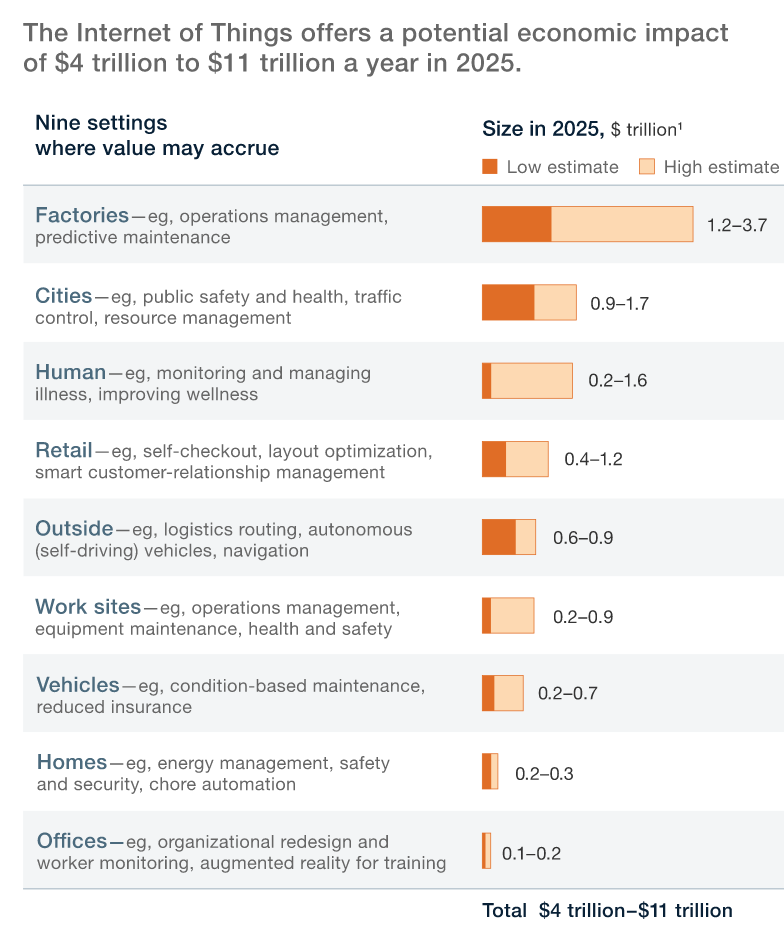
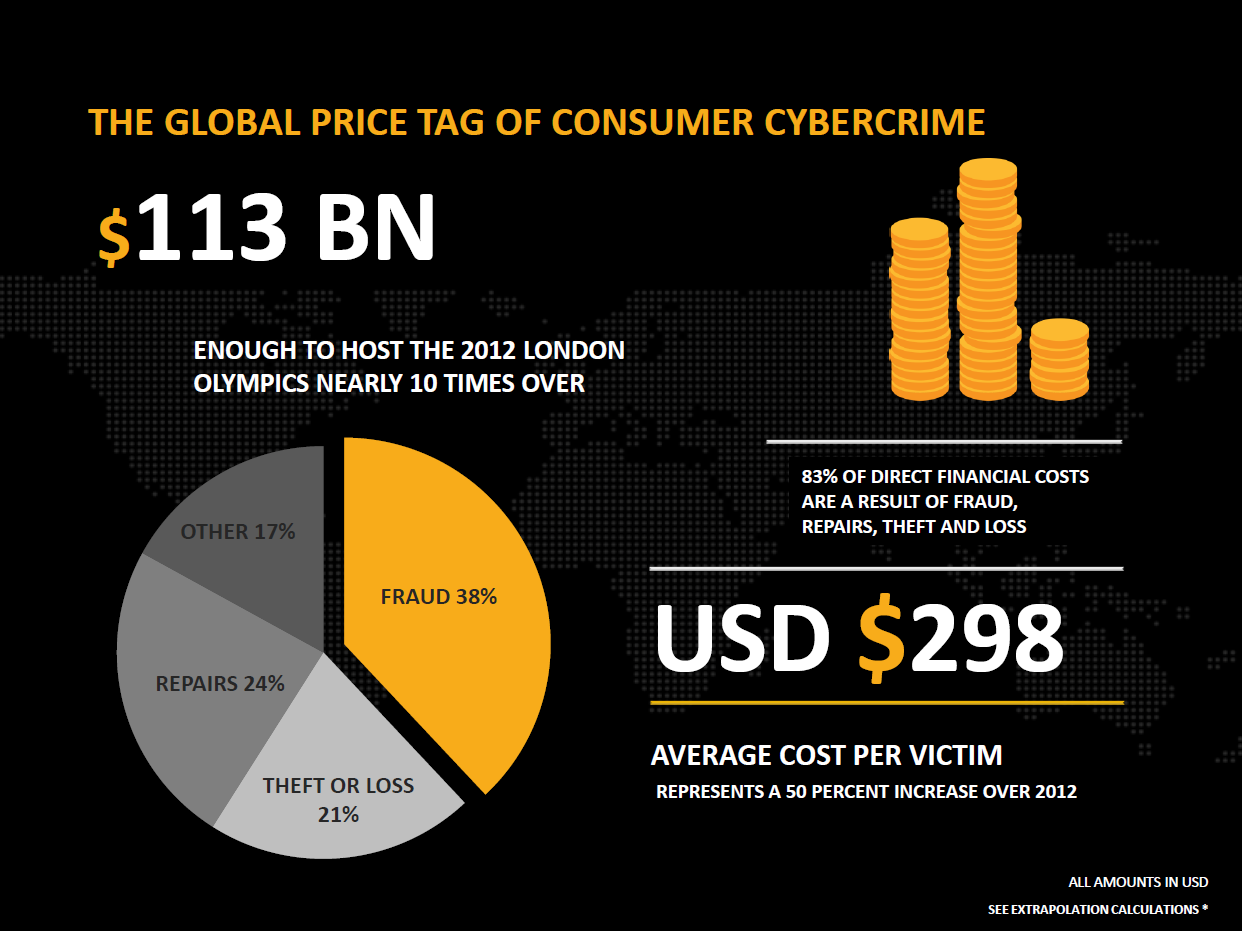




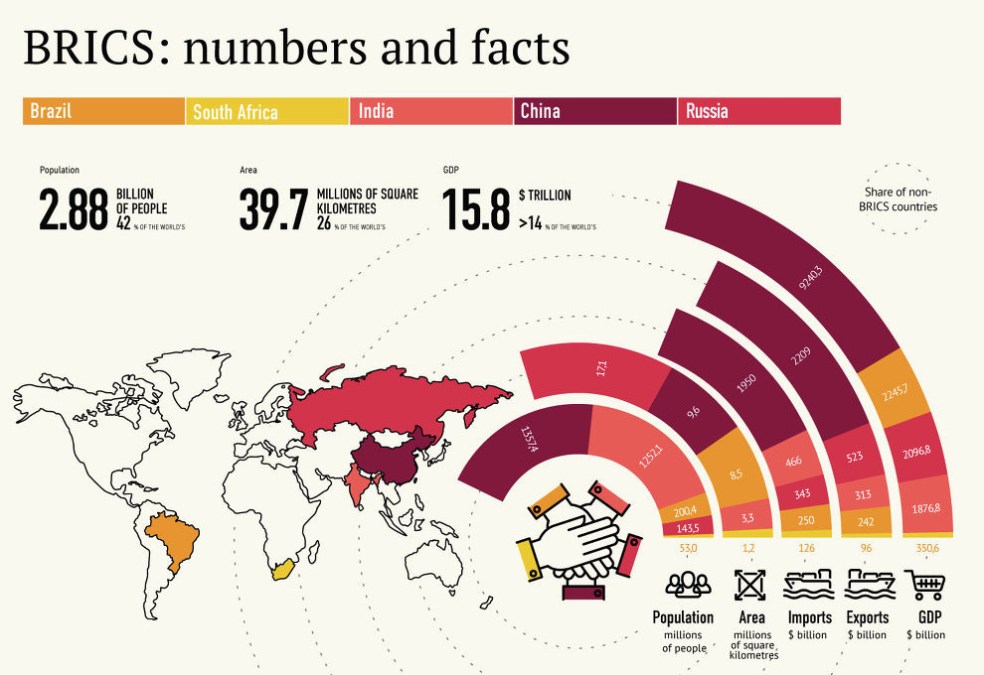


 Samir Saran