Uncategorized

Digital Debates — CyFy Journal 2018

Samir Saran| Lina Sonne

The last few years have exposed faultlines in what was once considered an integrated and seamless digital realm. These cracks have origins beyond the usual suspects. The “walls” dividing cyberspace have sprung up from within liberal democracies, throwing in question their commitment to — as the cliché goes — a “free and open” internet. The United States withdrew in 2017 from the Trans-Pacific Partnership, and in the absence of its most powerful votary, the TPP’s promises on interoperability and uninterrupted flows of digital information ring hollow. The European Union has enacted one of the most far-reaching regulatory impositions on the flow of data to and from the continent in the form of the General Data Protection Regulations and the murmurings around control of the flow of technology have gained traction in the past weeks.

The GDPR, some have argued, will have the consequence of “exporting” strong privacy laws to emerging economies, which are yet to craft data protection legislations. A more likely outcome is that these economies will wean themselves away from, or script exceptional standards to manage digital commerce with the EU. Of course, opposition to the further integration of digital networks has also emerged from cybersecurity regulations in China and Russia. India’s own experiment with the data protection bill is promising to upend some old assumptions around doing business with the largest digital democracy.

This year’s Digital Debates picks up the pervasive distrust with Big Tech and the reactive regimes that have sprung up. It also discusses the often-negative spillover effects of digital communities on the real at an unprecedented velocity, emphasising the need to extend solutions beyond the virtual. Stephanie MacLellan explores this confluence of offline and digital tools to mitigate the effect of disinformation on social order across national boundaries.

Rajeev Mantri’s “Reassessing Received Wisdom”, as promised, calls for thinking through ownership, portability and control of data more carefully – not against the background of extant theories of regulation. Specifically, he recommends reimagining competition law for the digital economy. Fittingly, KS Park, author of “Data Socialism”, moves the needle and warns against over-regulating the data market or granting ownership of data to subjects if the effect is to the detriment of realising societal benefits from data sharing.

India’s recent data protection framework is the country’s first attempt to balance some of these competing priorities – protecting a nascent but fast-growing digital economy and the rights of a billion users. Laura Sallstrom et al. argue that the Indian iteration is “GDPR-lite” – mimicking their EU counterpart but not sucessfully. Data localisation, according to the authors, was considered and discarded by Europe since it poses economic risks. An approach they advocate India must follow—being an economic beneficiary to the incidence of cross-border data flows.

Instead of localisation, India can consider an alternative mechanism such as a data sharing agreement under the rubric of the US Cloud Act in accessing electronic information held in the US – Justin Hemmings et al. have elaborated on this workaround in “Foundations of a Potential Executive Agreement between India and the US”. Finally, Sidhant Kumar writes on the day-old judgement delivered by the Indian Supreme Court holding the world’s largest unique digital identity project to be constitutional. Conscious of performing a balancing act, the Supreme Court, according to the author, favoured dogged pragmatism and not ideological dogma. All of this indicates that property rights, sovereignty and virtual territoriality continue to vex the global stakehokders and are de jeure creating a splinternet.

The world is witnessing, therefore, comprehensive attempts by states to govern data, the infrastructure that it is hosted on, the platforms that harvest it, and even the people who use it. The recent sight of Silicon Valley CEOs making a beeline to testify and placate US Senate Committees underlines the reality that governments, whether good or bad, autocratic or democratic, are fundamentally skeptical about the social, political and economic consequences of new technologies, and will always seek to manage them.

Given this climate, it should not surprise anyone that the Indian state too has pushed – not without opposition or controversy – for data localisation. The main trigger for this proposal has been the ceaseless troubles of Indian law enforcement agencies in securing data from abroad for criminal investigation or prosecution. But the idea has easily found takers from within India’s digital companies, which are keen to insulate themselves from foreign competition and create institutional architecture that can help leverage their data analytics capabilities with locally available data. Here too, the Indian state (and established players in the private sector) are pushing for certain favourable political and economic outcomes by altering the basic DNA of the internet. Time will tell whether those outcomes materialise, but the regulatory impulse is here to stay.

If regulatory decrees are to be implemented, home-grown legal and technical standards that can function as reliable and predictable metrics for businesses and digital platforms are necessary. Amber Sinha et al. drive this point home in “Reading ‘Necessity’ in India’s New Data Protection Bill”. The principle of necessity, for instance, is critical to determine if the information sought by the data fiduciary or collector is necessary for the purpose it seeks to achieve. The authors argue that while the term “necessity” is copiously used in the draft law and would be critical to its enforcement, the same principle is not well-defined in Indian jurisprudence. Anushka Kaushik reasons that technical yardsticks, specifically encryption, in the face of competing objectives of stakeholders must be the product of mutual trust and responsibility.

Securing cyberspace or safeguarding rights online is not the only prerogative of the regulator or the state in the digital economy. Governments hold the mandate of ensuring that those at the bottom of the pyramid can exercise their agency online, perhaps in ways more impactful than in the real world. As low-cost smartphones and data bring about an entire generation of first-time internet users, policymakers must strive to grant access and security in addition to rights. Lina Sonne evaluates this trend through the increasing democratisation of content production, distribution and viewership online – mobile phones have doubled up as TV screens providing entertainment on the move, bringing “primetime” to an end. Even as local language content online increases in volume, Ashwin Rangan notes that the internet is still predominantly “English”. In his contribution titled, “Breaking the Linguistic Barriers to Accessing the Internet”, he identifies the challenges to achieving a truly global internet.

Motivated by increasing inclusion, governments’ digitisation drives are determined to push digital payments. Sidharth Deb proposes that any such policy approach to increase adoption must be combined with promoting ecosystem integrity and building trust with end-users.

Just as we witness the internet being “weaponised” to serve different ends, we must be humble about the transformative potential of technology. The same tool of freedom can quickly turn into a tool of oppression, manifesting socio-economic inequalities found offline. Vidisha Mishra argues that while the flexibility of the gig economy may bring more women into the workforce, these platforms may not be empowering. Withoutaddressing structural inequalities, such as the wage gap, women stand to be disproportionately affected even after transitions in the labour market. Mihir Sharma in his contribution, “A 21-Century Social Contract”, believes that a new form of social protection must be designed to adequately address these labour transitions. He points out that the increasing individualisation of labour must be met with a 21st-century economy that can work for everybody. Amina Khairy further argues that education and skilling in STEM must increase offline to truly reap the benefits that the internet offers.

Crystal-gazing is seldom an advisable pursuit, especially to discern trends in technology policy, but two issues on the horizon bear mention. Efforts to craft technology restriction regimes have recently (re)gained momentum, although export controls are unlikely to have any meaningful effect in keeping “bad” technologies from “bad” actors. In most of the developing world, export controls are perceived as technology “denial” regimes, and only facilitate the creation of networks and communities that have a vested interest in suppressing democratic aspirations or destabilise digital and physical infrastructure. Creative and agile arrangements are required to tackle the problem of proliferation of malicious ICT tools: such an arrangement has to involve the concerns of the private sector, both from developing and advanced economies. While responses that will work are hard to fathom, it may be safe to suggest that they would be technological in essence and unlikely to work if they are premised on treaties or legislation.

And finally, developments in “intelligent” platforms and services throw up — with apologies to Donald Rumsfeld — two “known unknowns” and two “unknown unknowns”. The first “known unknown” is the effect of AI on bias. Pundits and technocrats both acknowledge that intelligent algorithms could perpetuate bias along the lines of race, gender and class. But we do not know what causal pathways of bias will look like and whether AI will simply mirror or exacerbate existing problems.

The second “known unknown” is the geopolitical consequences of differential access to AI. It is one thing to say some states will have lethal autonomous weapons and others won’t, but access to AI translates to more than just military superiority. It is also crucial to governance platforms and services. The North-South divide in technology is already grave, but will the effect of sentient machines, with their ability to disrupt supply chains, labour markets and livelihoods compound it?

The first “unknown unknown” is whether the current conversation on “ethics” in AI will eclipse a rights-based approach to developing intelligent machines. Just as the international community appears to be close to a consensus on the promotion of human rights online, the ethical “front-loading” of AI governance could well derail that conversation. Do we share universal ethics? If not, whose “ethic” does the machine represent? The developer, business or region in which it is developed?

The second “unknown unknown” is the interweaving of identity between human and machine. Reports have recently surfaced of men trying to pursue sexually laden conversations with smart assistants and even of brutalised treatment of synthetic lifelike toys. If we engage machines in any activity that involves “human” emotion, what does that make machines? More importantly, what does our engagement with them tell us about ourselves? The digital debates of today focus on how humans should govern machines — their data, infrastructure and stability. Those of tomorrow may well focus on the new identity discourse framed around our conversations with a new intelligent being albeit shaped in our image.

Digital Debates, the journal that chronicles contemporary thinking and dialogues and along with “CyFy: The India Conference on Technology, Security and Society” will continue to seek new voices, ideas, solutions and concerns.

To read the full issue, click here
Standard
Uncategorized

The Future of Work in India: Inclusion, Growth and Transformation

Samir Saran| Terri Chapman| Rakesh Kumar Sinha|Suchi Kedia|Sriram Gupta

The future of work in India is uncertain, but full of opportunities. This report attempts to answer key questions around the present and future of transformative technology in India and its impact on job creation, workplaces, employment trends and relations, and the nature of work itself.

Our research reveals that companies in India are optimistic about the future and are open to the possibilities presented by new technologies and digitisation. This optimism is likely to stimulate innovation and adoption of new technology and drive transformation, growth and progress. This report sets out a roadmap for an inclusive future of work in India that capitalises on the opportunities presented by technological disruption and digitisation. By using the opportunities at hand, India can:

  • Generate sufficient new employment opportunities for the existing and growing labour force.
  • Create decent jobs with better wages, security, protections and safety, necessary for improving individual and household welfare and well-being.
  • Ensure equal opportunities for women, youth and other marginalised communities previously unable to participate equally in the paid economy.
  • Establish an ecosystem better equipped to prepare the workforce for changing skill and educational requirements.
  • Create of an inclusive policy environment which balances the need for job creation with the interests of workers.

This report outlines findings from the Future of Work, Education and Skills Enterprise Survey. Data was collected from 774 companies in India, from micro-sized firms to those employing more than 25,000 workers. It presents findings on the pace of technological adoption and digitisation among Indian companies, and its impact on job creation, displacement and nature of work. In addition to the effects of the changing nature of jobs on wages, contracts, protections and security. Finally, the report includes recommendations on policies, programmes and action needed for India to leverage the possibilities of technological disruption, manage the associated risks, and enhance its preparedness for the future of work in the digital age.

To read the full issue, click here.


Suchi Kedia is Community Specialist, Regional Agenda — India and South Asia, World Economic Forum.

Sriram Gutta is Community Lead, Regional Agenda — India and South Asia, World Economic Forum, Geneva.

Standard
Uncategorized

Battle for South Asia 2.0

Samir Saran|Sushant Sareen

Around the turn of the century, an Indian Parliamentary committee released a rather pessimistic report on the state of India’s trade with its neighbours. Even a brief glance through the report would reveal the small minded and antiquated mercantilist approach of Indian officialdom when it comes to regional trade. For instance, almost three years after signing a free trade agreement with Sri Lanka, very little progress was visible. The reason? Stiff resistance from agricultural lobbies in India who feared that competition from Sri Lanka would drive them out of business. In the case of Bangladesh, India’s largest trading partner in the region, the story was the same. India would not concede to Bangladesh’s demands for greater market access for goods like Hilsa fish and Jamdani sarees. It was only when these countries began to talk trade with Pakistan did India pay some attention to these relationships.

Sitting in New Delhi nearly two decades later, it is hard to argue that this report has produced any new wisdom in India. The fact remains that India has failed to serve as an engine of economic prosperity for the entire subcontinent. South Asia remains one of the least integrated subregions in the world. Without benefiting from India’s markets or investments, its neighbours see India as an unattractive and increasingly unwelcome partner. And unlike two decades ago, a more ambitious power is willing to fill the void left by India: Beijing. Unsurprisingly then, India has been pushed to second place by the Chinese who are now the largest trading partners and investors in most of the region.

Even as India now attempts to renegotiate the terms of its engagement, it is clear that emerging geoeconomic and geopolitical realities are altering the course of the region.

For most of the last 70 years, the very idea of South Asia was premised on India as the agent of coherence. Its influence was not just religious, cultural and civilizational, but was also central to the political thought and economic models of South Asia.

This is no longer true today. While South Asia continues to exist as a geographical entity, its economic and political centre of gravity has inexorably shifted away from New Delhi. As a result, the old construct of South Asia is dying, if it is not dead already. And apart from India’s ineffectual statecraft in the region, two key trends have engendered this process.

First, the appeal of liberalism has considerably diminished in South Asia. Most liberal parties in the region have been reduced to the fringe because of the death or disappearance of the centre. Political parties have either moved to the extreme left or the extreme right. While the trappings of democratic governance are visible in the region, the march of illiberalism has seen most countries move away from the Grundnorm predicated on liberal democracy—whether it is jihadism and Islamism in Pakistan, single party domination in Bangladesh, an enervated democracy in Maldives (notwithstanding the results of its recent elections), or ultranationalism in Nepal. To a great extent, this Grundnorm conformed to a Nehruvian vision for the region — and India has long anchored the region’s democratic potential. That vision is now not just being challenged in India but also in its neighbourhood.

Second, China’s ambitions are eroding the very identity of South Asia. Through the Belt and Road Initiative, China is steadily erasing Asia’s colonial legacies — the arbitrary political boundaries that separate its communities. In China’s design, South Asia is but one node in a complex network of infrastructure projects which will ultimately create a Pan Eurasian system. The Middle Kingdom intends to emerge as the sole arbiter of security, development and economic growth in this supercontinent. China cannot afford to let regionalism distract from this objective — nor can it allow powers like India to carve out their own spheres of influence. For China, then, a distinct South Asian identity is purposeless. Instead, a handful of client states like Pakistan and Maldives, and a system of economic patronage with countries like Bangladesh, Nepal and Sri Lanka serve the security and economic interests of its continental ambition. The fact is that there is no space for an independent South Asian construct in China’s mental map of the world.

Since South Asia 1.0 is heading for redundancy after 70 odd years, India must work towards a South Asia 2.0 which ultimately replaces the beta version currently dominated by China.

Complaining or cribbing about China is not going to be of much help. But will competing or confronting China serve any purpose? The power differential between India and China in the economic, technological and military spheres is just too great today and for the near term.

The strategic question, then, is: How should India regain its prominence and influence in the region?

First and foremost, India needs to display strategic patience. In other words, India needs to learn from the Chinese playbook and follow Deng Xiaoping’s dictum of ‘bide your time, hide your capabilities’.

Given existing power equations, it will be impossible for India to play a sufficiently expansive role until it doubles the size of its economy from the current $2.6 trillion to over $5 trillion over the next decade. Trying to exercise influence without the necessary economic heft will only complicate relations with neighbours. It would therefore be a better idea for India to step back for now. Instead of announcing new plans for the region at this point in time, India should meet existing commitments and bide its time until the organic rise of Indian capabilities naturally enhances its role and influence in the neighbourhood.

Second, India must follow the Nehruvian dictum of non intervention in the affairs of other countries. Preaching without power and influence only invites disdain and increases the distance between neighbours.

While India must not compromise on its commitment to a rights based agenda, it must abjure the temptation to make this agenda an extension of the Anglo Saxon version of morality (or if you will, hypocrisy).

Third, India should collaborate, catalyse and become the conduit for Chinese investments across South Asia. While this may appear counterintuitive if the aim is to restore India’s preeminence in the region, it makes great strategic sense. Most of China’s investments will also create infrastructure and regulatory ecosystems that will ease integration of these economies with India’s own market. Over the next decade, when India’s economy exceeds the $5 trillion mark, these very investments will allow Indian money to reclaim influence in the region. This will work if a portion of Chinese money is also routed through Indian instruments — for example, by setting up a South Asian Development Bank (SADB) along the lines of the Asian Infrastructure Investment Bank. Only in this case, the institutional arrangement will support India’s leadership role while China will be the largest partner. The SADB idea can eventually be expanded by setting up an Indian Ocean Development Bank, which will address the development requirements of the Indian Ocean littorals.

It is time for India to step aside and let the neighbours reach their own conclusions on China.

Finally, India will need to balance its relations with the US and China. Paradoxically, both the US and China are critical partners for India to win the battle for South Asia. China’s investments in India’s markets will remain critical to Delhi’s long term economic growth; while the United States’ military capability will help India balance and manage China’s rise. On the one hand, New Delhi will have to embrace Washington as a security partner without limiting its own agency in South Asia. The US is not a very sellable brand today, and bringing the US into India’s grand strategy for South Asia may be counterproductive. On the other hand, India must accept Chinese money without acquiescing to its regional design. Indeed, India will have to ride on China’s shoulders if it is to compete with Beijing. This decision would have the best possible precedent: India must leverage Chinese ambition in much the same manner that China’s rise was supported by America’s economy. Finding this balance must be India’s priority in the coming decade.

The reality is that, despite its profound, sincere and emotional commitment to the anti-colonial impulse, New Delhi lazily assumed the focal points of geopolitics will remain the same for decades to come.

Nowhere in the world is this true and cities like Cairo and Baghdad are mere shadows of their former selves. Incubating South Asia 2.0 will require India to stop looking at the region from the imperial prism of the British Raj. New realities and not old shibboleths must guide India’s grand policy in the region. The institutional weaknesses that India inherited at the cusp of independence will need to be fixed for India to be able to blend the sophistication of its modern economy with a 5000 year old civilisational ethos. Rapid economic growth combined with a commitment to liberal democracy within and sustained efforts at regional integration must guide India’s approach. As it grows, India must take the region with her. This is easier said than done, given that some economic commitments to the region may be painful in the short run to India’s own businesses. Those measures require a large heart, bold conviction and far-sighted stewardship, which can only be the product of a forged non-partisan, political consensus.

The views expressed above belong to the author(s).

Standard
Uncategorized

Walking the tightrope between Eurasia and the Indo-Pacific

Samir Saran

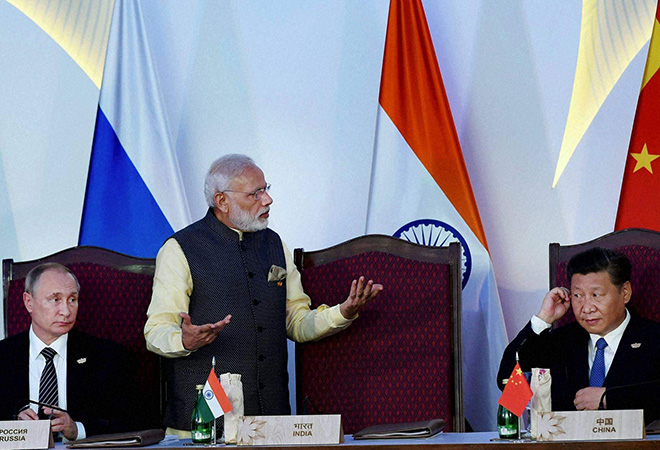
While the new Indo-Pacific construct continues to grab headlines, India’s recent diplomatic orientation points to a renewed appreciation of what American strategist Zbigniew Brzezinski called the world’s “decisive geopolitical chessboard”: Eurasia. In order to grasp the significance of this strategic space, it is useful to compare it with the dynamics of the Indo-Pacific.

 Strategic Studies, Indo-Pacific, Eurasia, Russia, NATO, BRI, dilemma, bilateral, maritime, order, Smair Saran
Source: PTI

The Indo-Pacific is a union of two maritime geographies, shaped for several decades by American presence and its grand strategy. This arrangement is now being challenged by the rise of China, with New Delhi seeking to carve out a new alignment of likeminded countries to sustain an order beneficial to its interests.

Eurasia, on the other hand, is the intersection of two continental and normative spaces: Europe and Asia. Russia is the archetypal Eurasian power; its foreign policy is shaped in equal measure by the ever-changing dynamics of both Asia and Europe, and balanced by the North Atlantic Treaty Organization. As in the Indo-Pacific, this region is also seeing new engagements spurred by China’s Belt and Road Initiative. Given this state of affairs, India renewed interest in Eurasia and its engagement with Moscow acquires further salience.

Between these two regions, however, lies a predicament for India’s foreign policy.

Even as Delhi partners with the Washington in the Indo-Pacific, the relationship breaks down in Eurasia due to key differences on the assessment of security dynamics in the region, especially in the context of India’s co-operation with Iran and Moscow.

On the other hand, India’s engagement with Eurasia is further complicated by Moscow’s partnership on connectivity projects with Beijing and an emerging Indo-Pacific nexus between the two states.

The situation is not unlike Britain’s dilemma in the late 19th century, when London sought cooperation with France to meet the continental challenge of Germany and preserve the balance of power in Europe, but opposed French efforts to assert maritime dominance in Asia. But all comparisons should end there -the first signs of British decline were evident then, and thus London’s options were limited. India, on the other hand, is ascendant.

Nevertheless, these complex triangular relationships add tension and uncertainty to the India-Russia bilateral, given that the Indo-Pacific and Eurasia are not neatly segregated strategic theatres. Partnering with Washington in the seas and with Russia on the continent is, to put it mildly, a delicate balancing act for any country. However, two realities suggest that such a state of affairs will continue to co-exist for India.

For one thing, India is a rising economic power; with estimates suggesting that it will become the world’s second largest economy in PPP terms in the 2040’s. The fact remains that a $1.6 trillion Russian economy simply cannot provide New Delhi with the investment opportunities and commercial partnerships that it requires. Washington, on the other hand, is a dynamic and global economy, well placed to facilitate India’s rise with finance and technology. America’s long standing naval presence and partnerships in the Indo-Pacific also assist India’s integration and capacity for leadership in the regional order.

Second, Delhi cannot afford this entente with Washington to compromise its security relationship with Moscow. Indeed, India is well aware that no other country will assist in building its defence capability to the extent that Russia is already doing, whether it is the lease of a nuclear-powered submarine; co-development of missile systems such as the Brahmos; or the sale of the S-400 missile defence systems. Ultimately, India will go ahead with these deals despite the threat of US sanctions because it must prioritize its security interests over American goodwill.

In Eurasia, these realities make matters difficult. Engagement with Moscow remains critical if India is to respond to intractable conflicts in Afghanistan, persistent security risks in the Middle East and Central Asia, and China’s steady westwards expansion. Such a partnership may also help prevent the Shanghai Cooperation Organization from becoming a de-facto police force for China’s Belt and Road Initiative; instead giving the forum a more legitimate and plural voice on Eurasian conversations on connectivity, finance, security and development.

Having said that, Russia’s ‘axis of convenience’ with China is more an axis of dependency; Beijing is the only country capable of sheltering Moscow from American pressure. Politically or economically, India cannot do the same—leaving Moscow with few options. And while Washington has displayed some flexibility in willing to exempt India’s defence purchases from sanctions, America’s security priorities in Eurasia are entrenched—and hostility to Russia runs deep in its foreign policy establishment. It is not fully clear yet what Washington’s red-lines are for India.

Increasingly, New Delhi is walking a tightrope between the political realities of Eurasia and the Indo-Pacific. In the Indo-Pacific, geographical, economic and political vectors are far more favourable to India.

Eurasia is a fundamentally different proposition, and India’s pivot will rest on the strength of its bilateral with Moscow. New Delhi must assess its interests in the region, communicate mutually acceptable leeway on partnerships, and re-imagine the Russia relationship for the better part for the 21st century.


This commentary originally appeared in Valdai Discussion Club.

Standard
Uncategorized

BIMSTEC कारगर हो, इसलिए BBIN को दुरुस्त कीजिए

Samir Saran

अगर BBIN पर अमल कामयाब रहता है तो भारत के पास BIMSTEC में काम करने के लिए एक मॉडल होगा।

बिम्सटेक, BIMSTEC, समीर सरन, बिम्सटेक 2018, BIMSTEC 2018, नरेंद्र मोदी, बीबीआईएन MVA, BBIN, MVA, एक्ट ईस्ट, कनेक्टिविटी, इंडिया, बांग्लादेश, Samir Saran, नेबरहुड फर्स्ट, प्रदर्शन प्रभाव, SAARC, सार्क, म्यांमार, भूटान, एमवीए, मोटर वाहन ऐग्रीमेंट
स्रोत: PTI

नेपाल में BIMSTEC समिट से पहले बेहतर होगा अगर नई दिल्ली इस बात का आकलन कर ले कि उपमहाद्वीप को जोड़ने और इसके विकास से जुड़ी उसकी पहल की स्थिति क्या है। यह तथ्य है कि सार्क और बांग्लादेश, चीन, भारत और म्यांमार (BCIM-EC) के साथ BIMSTEC भी निष्क्रिय बना हुआ है। नतीजा यह है कि दक्षिण एशिया के देशों का आपसी कारोबार बिल्कुल डूबा हुआ है और इसका ख़मियाजा सबसे ज़्यादा भारत के प्रादेशिक नेतृत्व को भुगतना पड़ रहा है।

जिस इकलौती पहल में अब तक कुछ उम्मीद की झलक दिखती है, वह भारत, बांग्लादेश, भूटान और नेपाल (BBIN) की पहल है जिसने 2015 में ऐतिहासिक मोटर वेहिकिल ऐग्रीमेंट (MVA) किया — यह क्षेत्रीय जुड़ाव का अहम बिंदु था जिससे ‘उपक्षेत्रीयता’ के उभार की एक संभावना दिखती थी। मोटर वेहिकिल ऐग्रीमेंट पर अमल के लिए भारत ने ख़ासी कूटनीति और पूंजी का निवेश किया है। फिलहाल विश्व बैंक के एक अध्ययन के मुताबिक इंट्रा-रीजनल कारोबार दुनिया भर के कारोबार का बस 5% है — जो याद दिलाता है कि क्यों दक्षिण एशिया के अलग-अलग देश इसकी जगह कारोबार के भरोसेमंद सहयोगी के तौर पर चीन की ओर मुड़ रहे हैं। दूसरी तरफ़ अगर ट्रांसपोर्ट कनेक्टिविटी मज़बूत हो और सरहदों के आरपार कारोबार की सहूलियत बढ़े तो यह कारोबार 117 फ़ीसदी बढ सकता है जो फिलहाल 23 अरब US डॉलर का है।

वाकई, BIMSTEC से भी जुड़े बस तीन देशों को जोड़ने से जो आर्थिक संभावना पैदा हुई है, उससे ज़्यादा मुखर और विस्तारित क्षेत्रीय कनेक्टिविटी के एजेंडे की संभावना समझ में आनी चाहिए। अगर भारत चाहता है कि BIMSTEC क्षेत्रीय आपसदारी के एक अहम मंच के तौर पर विकसित हो, तो इसमें BBIN की सफलता इरादे और क्षमता के प्रदर्शन के लिहाज़ से काफी अहम रहेगी। जब प्रधानमंत्री मोदी इस तैयारी में हैं कि काठमांडु में भारत के नेतृत्व वाली भूमिका का वे सिग्नल दे दें, तब मोटर वेहिकिल ऐग्रीमेंट की प्रक्रिया में भारत की भूमिका का विश्लेषण यह समझने में मददगार होगा कि इस मामले में ठहराव की क़ीमत क्या है और भारत के प्रत्यक्ष नेतृत्व के सकारात्मक नतीजे कैसे आ सकते हैं।

सबसे पहले भारत को क्षेत्रीय संपर्क के मामले में लगातार अमल दिखाते हुए अपने नेतृत्व का प्रदर्शन करने की ज़रूरत है। ऐसे समय, जब बीजिंग की रोड और बेल्ट पहल पूरे महाद्वीप में उसके रणनीतिक समीकरणों को विस्तार दे रही है, तब इस साल मई में नेपाल के साथ प्रधानमंत्री नरेंद्र मोदी ने रिश्तों की जो नई शुरुआत की है, वह इन देशों से जुड़ने के नए भारतीय रुझान को समझने के लिहाज से महत्वपूर्ण है। नेपाल दक्षिण एशिया की स्थिरता के लिए अहम है और BBIN और BIMSTEC की कनेक्टिविटी की योजनाओं से सबसे ज़्यादा फायदा उसे ही होने वाला है। इससे आसपास के बंदरगाहों तक उसकी पहुंच आसान होगी और वह नेपाल में बने सामानों का निर्यात दक्षिण एशिया में ही नहीं, उसके बाहर भी कर पाएगा। नेपाल का उदाहरण बताता है कि अगर भारत सरहदों के आरपार परिवहन को गति दे सके तो चीन के बनाए बंदरगाहों और बुनियादी ढांचों पर निर्भरता घटेगी और भारत ऐसी पहल को BIMSTEC के दूसरे देशों — बांग्लादेश, म्यांमार और थाइलैंड के साथ भी दुहरा सकता है।

यह दुर्भाग्यपूर्ण था कि भारतीय दफ़्तरशाही की प्रशासनिक रुकावटों ने एक बार फिर इस प्रक्रिया में देरी पैदा की है। मोटर वेहिकिल ऐग्रीमेंट के तहत मुसाफ़िरों और माल को ले जाने के प्रोटोकॉल पर दो साल से समीक्षा चल रही थी, मुसाफ़िरों का मामला अप्रैल 2018 में हुई आख़िरी बैठक में निबट गया था। दुर्भाग्यवश, भारत सरकार ने तय किया कि जब तक कार्गो प्रोटोकॉल पर बातचीत पूरी नहीं होती, मुसाफ़िरों के प्रोटोकॉल पर आख़िरी फ़ैसला रोका जाएगा। कार्गो प्रोटोकॉल पर बातचीत कुछ और दौर चलेगी। नई दिल्ली ने यह फ़ैसला किस तर्क से किया, यह साफ़ नहीं है, लेकिन उसके नतीजे साफ हैं — समझौते ने अपनी रफ़्तार खो दी है।

भारत सरकार ने इस गड़बड़झाले को कुछ और बढ़ा दिया जब उसने लगभग इसी समय नेपाल और बांग्लादेश को मोटर वेहिकिल ऐक्ट के त्रिदेशीय अमल पर एक ‘लेटर ऑफ एक्सचेंज’ पर दस्तख़त करने और भूटान से भी प्रति-हस्ताक्षर करने को कहा। इस अतिरिक्त समझौते के दस्तख़त में कुछ और मंज़ूरियों की ज़रूरत पड़ेगी। अनुमान लगाना मुश्किल नहीं है कि इससे कुछ और देरी बढ़ेगी।

ये देरियां अमूमन भारत के उलझे हुए क्षेत्रवाद का ही आईना हैं। MVA की ही तरह, BIMSTEC की मार्फ़त क्षेत्रीय जुड़ाव में देरी की क़ीमत आर्थिक और राजनीतिक तौर पर काफी बड़ी है। जबकि इसके सकरात्मक पक्ष भी उतने ही बड़े हैं — BIMSTEC और MVA के ज़रिए नई दिल्ली अपनी ‘ऐक्ट एशिया’ और ‘नेबरहुड फ़र्स्ट’ नीति के ढीले तार ठीक से कस सकती है।

इसी से दूसरा बिंदु निकलता है — अगर BBIN पर अमल कामयाब रहता है तो भारत के पास BIMSTEC में काम करने के लिए एक मॉडल होगा। फिलहाल BIMSTEC असमंजस में है — थाइलैंड, श्रीलंका और भूटान की प्रतिबद्धता इसमें पूरी नहीं दिख रही है। BBIN ब्लॉक के तीन देशों के बीच कारगर सड़क संपर्क दिखने का असर BIMSTEC देशों के बीच भी वांछित सहयोग का स्तर हासिल करने में प्रेरक बनेगा। चीन की बेल्ट-रोड पहल वाली दुनिया के बाद, चीन निर्मित बंदरगाहों और बुनियादी ढांचे पर निर्भरता बढ़ेगी। भारत के लिए उप-क्षेत्रीयता की धमनियों को बचाए रखना ज़रूरी है और BBIN में इस विकल्प के बीज दिखते हैं। BBIN के मंच को आधार बनाते हुए, भारत को BIMSTEC को मज़बूत करने के लिए प्रचुर मात्रा में तकनीकी, मानवीय और वित्तीय संसाधन लगाने के लिए प्रतिबद्ध और तैयार रहना चाहिए।

तीसरी बात, BIMSTEC में निजी क्षेत्र को और ज़्यादा शामिल किए जाने की ज़रूरत है। शायद BBIN की सबसे बड़ी चूक अपनी क्षेत्रीय पहल में निजी क्षेत्र को शामिल करने में भारत की नाकामी रही। मिसाल के तौर पर, कोलकाता-ढाका-अगरतल्ला और दिल्ली-कोलकाता ढाका के रूट पर जो ट्रायल रन हुआ, उससे सफर का काफी समय ही नहीं बचा, यात्रा की लागत भी क़रीब 20 फ़ीसदी घट गई। तो BBIN के संपर्क के फायदे सभी तीनों देशों के माइक्रो, छोटे और मझोले उद्यमों तक, क्षेत्रीय क़ीमत-शृंखला के निर्माण तक, और प्रयोग और उद्यमिता को बढ़ावा देने तक जाते हैं। नई दिल्ली को यह समझना होगा कि बातचीत के दौरान निजी क्षेत्र की पर्याप्त नुमाइंदगी से वे ऑपरेशनल मुद्दे सामने आएंगे जो कंपनियों की लॉजिस्टिक ज़रूरतों के लिहाज से प्रासंगिक होंगे और MVA को — और साथ ही BIMSTEC के तहत होने वाली कनेरक्टिविटी की पहल को — सच्चे अर्थों में बड़े बदलाव का वाहक बनाएंगे।

अगर भारत को दक्षिण एशिया में अपनी राजनीतिक और आर्थिक अहमियत बनाए रखनी है तो उसे इस इलाक़े को जोड़ने की प्रक्रिया का नेतृत्व करना होगा। यह हो सके, इसके लिए नई दिल्ली को अपनी अंदरूनी निर्णय प्रक्रिया और इसके तंत्र का फिर से मूल्यांकन करना होगा। मोटर वेहिकिल ऐग्रीमेंट में ग़ैरज़रूरी देरी अपने ही ऊपर चोट है — जिससे दिल्ली को खुद को बचाना होगा, चूंकि वह BIMSTEC में कहीं ज़्यादा बड़ी भूमिका अख़्तियार करने जा रही है। BBIN के मोटर वेहिकिल ऐग्रीमेंट की ही तरह, BIMSTEC भी भारत के लिए एक आर्थिक और सामाजिक-राजनीतिक अवसर है कि वह अपने पड़ोसी देशों से कुछ उलझे हुए रिश्तों को सुधार ले। प्रधानमंत्री कार्यालय को इस मामले में दख़ल देना होगा और इस इलाक़े की कनेक्टिविटी पर भारतीय नेतृत्व को नई ऊर्जा देनी होगी ताकि प्रधानमंत्री की एक अहम महत्वाकांक्षा का लक्ष्य हासिल किया जा सके।

ये लेखक के निजी विचार हैं।

Standard
Uncategorized

For BIMSTEC to work, fix BBIN firs

Samir Saran

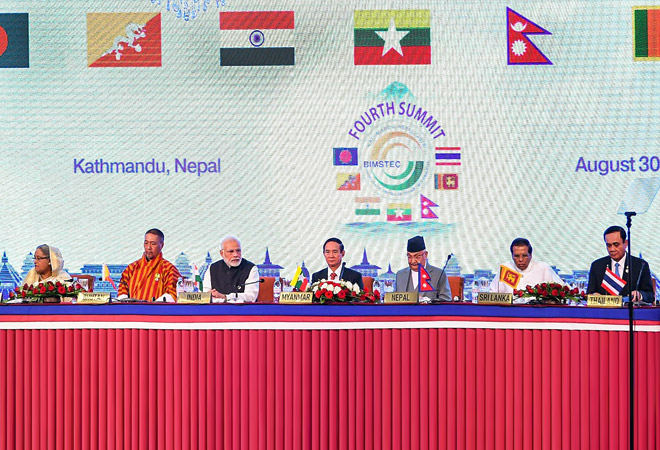
As Prime Minister Modi prepares to signal India’s leadership role in Kathmandu, an analysis of India’s role in the MVA process will prove instructive on the positive consequences of demonstrable Indian leadership and the costs of lost momentum.

बिम्सटेक, BIMSTEC, समीर सरन, बिम्सटेक 2018, BIMSTEC 2018, नरेंद्र मोदी, बीबीआईएन MVA, BBIN, MVA, एक्ट ईस्ट, कनेक्टिविटी, इंडिया, बांग्लादेश, Samir Saran, नेबरहुड फर्स्ट, प्रदर्शन प्रभाव, SAARC, सार्क, म्यांमार, भूटान, एमवीए, मोटर वाहन ऐग्रीमेंट
Source: Press Trust of India

Ahead of the BIMSTEC Summit in Nepal, New Delhi would do well to take stock of its integration and development initiatives around the sub-continent. The fact remains that BIMSTEC, along with other regional initiatives such as the South Asian Association for Regional Cooperation (SAARC) and the Bangladesh, China, India and Myanmar Economic Cooperation (BCIM-EC), has remained dysfunctional. Consequently, the intra-regional trade in South Asia has been abysmally low with Indian regional leadership being the principal collateral.

The only initiative with that appears to have shown some promise so far is the Bangladesh, Bhutan, India and Nepal (BBIN) initiative, which signed a historic Motor Vehicle Agreement (MVA) in 2015, signaling a resurgence of ‘sub-regions’ as key loci for regional integration. India has spent a fair amount of diplomatic and investment capital in enabling the MVA. At present intra-regional trade accounts for only five per cent of total trade, according to a World Bank study — a reminder of why individual countries in South Asia are turning to China as a reliable trade partner instead. On the other hand, this trade is likely to increase by 117 per cent from the current USD 23 billion if transport connectivity is strengthened and cross-border trade facilitation improved.

Indeed, the economic potential that is born from of integrating just three states, who are all a part of the BIMSTEC, should suggest the possibilities of a more articulate and expansive regional connectivity agenda. If India wants BIMSTEC to emerge as an important forum for regional integration, the success of the BBIN will go a long way towards displaying intent and capability. As Prime Minister Modi prepares to signal India’s leadership role in Kathmandu, an analysis of India’s role in the MVA process will prove instructive on the positive consequences of demonstrable Indian leadership and the costs of lost momentum.

First, India needs to demonstrate leadership in regional connectivity through consistent execution. The Prime Minister’s reset of relations with Nepal in May is crucial to understand India’s re-orientation of regional outreach at a time when Beijing’s Belt and Road Initiative is upending strategic equations across the continent. Nepal, vital to South Asian stability, stands to benefit the most from the BBIN and BIMSTEC connectivity projects. It secures access to its nearest ports and would be able to export Nepalese goods even beyond the region. The example of Nepal goes to show that if India can get the vehicles to move across borders, the reliance on Chinese built ports and infrastructure will reduce; and India can then replicate such initiatives with other BIMSTEC states such as Bangladesh, Myanmar and Thailand.


India needs to demonstrate leadership in regional connectivity through consistent execution.


It was unfortunate, then, that administrative hurdles from India’s bureaucracy have once again delayed the process. The protocol for passenger and cargo movement under the MVA were reviewed for the past two years, with the former being concluded at the last meeting in April 2018. Unfortunately, the Indian government decided to hold up finalising the passenger protocol until the cargo protocol is negotiated, which would take several further rounds of negotiations. While New Delhi’s reasons for doing so are unknown, the implications are clear — the agreement loses all forward momentum.

To add to the confusion, at about the same time the Indian government circulated a ‘letter of exchange’ to Nepal and Bangladesh to sign the three-country implementation of the MVA; and to Bhutan to counter-sign it. The signing of this additional agreement will go through another round of approvals. A further delay is not difficult to anticipate.

These delays are representative of India’s often messy regionalism. Just like the MVA, the cost of delaying the regional integration through the BIMSTEC is economically and politically high. The positives are equally great: BIMSTEC and the MVA allow New Delhi to tie up the loose ends of its ‘Act East’ and ‘Neighborhood First’ policy.

Which leads to the second point: if the BBIN is successfully executed, India has a replicable model to make BIMSTEC work. At present, BIMSTEC is in the doldrums, lacking sufficient commitment from Thailand, Sri Lanka and Bhutan. The ‘demonstration effect’ of well-functioning road connectivity between the three-nation BBIN bloc would catalyse the desired level of cooperation among the BIMSTEC countries. In a post-BRI world, reliance on Chinese-built ports and infrastructure will grow. For India, a way to preserve the arteries of sub-regionalism is essential, and BBIN represents a seed for that alternative. Building on the BBIN platform, India must be willing to commit significant financial, human and technical resources to strengthen BIMSTEC.


If the BBIN is successfully executed, India has a replicable model to make BIMSTEC work.


Third, the private sector needs to be represented more prominently in BIMSTEC. Perhaps the most glaring oversight of the BBIN was India’s failure to involve the private sector in its regional initiatives. The trial run along Kolkata-Dhaka-Agartala and Delhi-Kolkata-Dhaka routes alone, for example, reported cost savings of about 20 per cent alongside a substantial reduction in travel time. The benefits of BBIN connectivity then, would extend to the growth of micro, small and medium enterprises in all three nations, the building of regional value chains, and advancing innovation and entrepreneurship. New Delhi must realise that adequate representation from the private sector during negotiations would bring to the forefront those operational issues that are relevant to companies’ logistical need — which would make the MVA, and by extension connectivity initiatives under the BIMSTEC, truly transformational.

India must lead the integration process in South Asia if it is to retain its economic and political significance in the region. For this to happen, New Delhi must reassess its internal decision-making machinery and processes. The unnecessary delays in implementing the MVA were self-inflicted wounds — something Delhi must avoid as it prepares to take on a larger role in the BIMSTEC. Just like the BBIN MVA, the BIMSTEC is a strategic, economic and socio-political opportunity for India to recalibrate its imperfect relationship with the neighbouring countries. The Prime Minister’s Office must step in to re-energise Indian leadership on regional connectivity and deliver on one of the PM’s key ambitions.

The views expressed above belong to the author(s).

Standard
Uncategorized

70 Policies: A treatise on the evolution of India’s political economy

Samir Saran

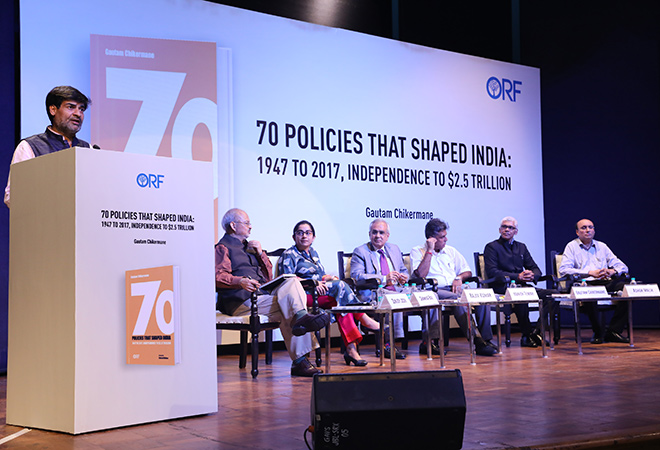
Focused primarily on the Indian economy, Gautam Chikermane’s new book, 70 Policies, also explores the impact of external influences — legal, political and administrative — on Indian policymaking. Following is the speech by ORF President during the launch of the book earlier this week.

Gautam Chikermane, 70 Policies, Indian policymaking, policies, India, Independence, economic debates, Samir Saran
Photolabs@ORF

Dr. Rajiv Kumar ji, Vice-Chairman of NITI Aayog, Sri Manish Tiwari ji, eminent lawyer and spokesperson of the Congress party, Sri Ashok Malik, Press Secretary to the President, Dr. Shamika Ravi, Mr. Sunjoy Joshi, friends, colleagues, ladies and gentlemen — on behalf of Observer Research Foundation, it is my honour and privilege to welcome you this evening.

We are here, of course, to celebrate the launch of my colleague Gautam Chikermane’s book, 70 Policies that Shaped India: 1947 to 2017, Independence to $2.5 Trillion. A very compelling chronicle of the life of India since its Independence. Let me congratulate Gautam for this publication that is both comprehensive and pithy. Writing, at its very best, is about communicating complex ideas in an accessible and comprehensible format. I believe that Gautam might have actually achieved this remarkably well with 70 Policies.

He has managed to distill some of India’s most contentious economic debates into a manuscript that can serve the needs of everyone — from government to industry to academia.

I would like to remind the audience that Gautam’s masterful work is only the latest addition to his long and illustrious career. Building on his multiple personas — as a journalist, editor, an economic pundit and author engaging with mythology and ethics, Gautam, with this, has established himself as a formidable scholar; his description of each of the 70 reforms in just 350 words deserves applause not only for his masterful prose, but also for his diligent research, reflected in the 683 citations that allow the reader to uncover the provenance of each of his interventions.

Read the book here.

Indeed, the book lets the reader decide if they’re happy with just a peek — or if they’d like to dive headfirst into the debates that have shaped India’s political economy. Only an individual with great clarity of thought could have made this possible.

Having said that, I cannot fail to point out that Gautam’s true love continues to remain the complexities and subtleties of India’s greatest epic: the Mahabharata. And I hope public policy will give him enough room to engage with that pursuit as well.

Gautam’s book provided me with some unique perspectives, three of which I would like to share by way of the introduction to the book:

First, the book very ably chronicles the evolution of India’s left of center economy policy making. It reveals to us that while the 1990s and the 2000s certainly saw a break from the orthodox central planning that bottlenecked our economy for the latter half the 20th century, India’s full embrace of the market remains hostage to the firm grip of our socialist ethos even today. Perhaps this is a reflection of who we are. Is this the New Delhi consensus?

Second, the book truly gives meaning to the words “past is prologue.” By gleaning insights from the errors of the past, it provides a clear guide for future generations of policy makers, entrepreneurs, business leaders and scholars to learn from. The book now serves as a permanent reminder that the unintended consequences of populist policy making can and will implicate India’s full potential as an economic power. A number of policies of the past remind of this.

And finally, it would be amiss to believe that the book servers merely as a chronical of our economic history. By exploring these 70 policies, whether it is the nationalisation of banks or the recently introduced GST, the reader gets a clear sense of the evolution of India’s political climate. Indeed, this book is as political as it is economic — and all its readers are better off for it. The political evolution is remarkably discernible.

Both Gautam and I hope that many of the vignettes captured in this book will continue to breed constructive introspection and help catalyze new ideas.

Of course, many of our ORF’s own initiatives will benefit immensely from a closer study of this book.

Gautam’s writing on the Jan Dhan Yojana and the Aadhaar initiative, for example, are relevant to our work of financial inclusion and the broader evolution of India’s digital economy. And his work on contemporary reforms such as the Insolvency and Bankruptcy Code and the GST will certainly inform our initiatives of India’s economic policy.

I am certain that scholars, research organisations and members of our government will similarly find that his book adds great value to their own efforts.

Ultimately, the book reminds us that while history does not repeat itself, it does rhyme. India’s once protectionist and isolationist stance is gradually giving way to a nation that is beginning to embrace the full potential of its economic growth and yet the shadows of our past create hesitancy in our progress.

It is my hope that everyone gathered here today will find learning from it as enjoyable as I have.

The views expressed above belong to the author(s).

Standard
Uncategorized

As India turns 71, what is the rising global power’s vision for the world?

Samir Saran

India requires a “consensus” — a new proposition that will not only guide its own trajectory for the better part of the 21st century, but one that appeals to communities around the world.

 India, 15 August 1947, Indian Independence, liberal democracy, Sustainable Development Goals, business, civil society, industry, economic linkages, political differences, liberal international order, rising power, political boundaries, Samir Saran, British Empire, New Delhi, global economic power, Asia
Source: Press Trust of India

Seventy-one years ago — on 15 August 1947 — India gained independence. Over the subsequent decades, the country has managed its evolution in an international system largely created and guided by the United States and its partners. While it was not easy for India to pursue independent domestic and foreign policies within this system, the American-led order was preferable to the British Empire from which New Delhi had liberated itself.


Today, this global system is under serious threat. Washington, along with capital cities across the European Union, finds itself caught in a polarising debate on the social contracts of its society — questions of domestic inequality and identity have left the US and its allies incapable of effectively championing the values of the international order. Simultaneously, the balance of global economic power has once again tipped in favour of Asia.


Within this shifting global landscape, India has the opportunity to put in place a new framework for its own security, growth and development, and that of developing countries around the world. As a rising global power, this must be India’s principle endeavour in the coming decades.

The changing international order

The extraordinary rise of countries in Asia has spawned at least two new dynamics. First, political boundaries — many of them colonial legacies — are steadily becoming more porous through economic cooperation. Markets are converging across the Eurasian landmass as well as facilitating the geo-economic “union” of the Indian and Pacific oceans. This has resulted in new integrative dynamics; as cultures, markets and communities aspire for development and new opportunities. Second, even though territorial considerations acknowledge economic linkages, political differences are still being reasserted — not just to contest the consensus of the past, but to shape a new order altogether.


Asia is coming together economically but is also threatening to grow apart politically; market-driven growth in the region sits uneasily with a diverse array of political systems.


China is, in large part, responsible for both. While offering a political vision that stands in sharp contrast to the “liberal international order,” China has been equally assertive about advancing free trade, raising new development finance, and offering a new model for development and global governance. The prospect of China using its economic clout to advance its own norms is worrying for India.

A consensus to shape a new order

Given the velocity of change underway, the challenge for India on its Independence Day is to shape an inclusive and equitable international order by the centenary of its independence. To achieve this, India must prepare to act according to its capabilities: by mid-century it must build the necessary state capacity, industrial and economic heft and strategic culture that would befit its status as a leading power. The country could present this as a model for much of the developing world to emulate, and anchor faith in the liberalism and internationalism of the world order.

India, then, requires a “consensus” — a new proposition that will not only guide its own trajectory for the better part of the 21st century, but one that appeals to communities around the world.


What then are the tenets of a “New Delhi Consensus”?

First, India must sustain and strengthen its own trajectory of rapid economic growth, and show to the world that it is capable of realising its development goals within the rubric of liberal democracy. No argument for the New Delhi Consensus can be more powerful and alluring than the economic success of India. By IMF estimates, India already accounts for 15% of global growth. Even though nearly 40% of its population live in various shades of poverty and barely a third are connected to the internet, India is still able to proportionately shoulder the world’s economic burden. Imagine the possibilities for global growth if India can meet, and even exceed, the Sustainable Development Goals (SDGs).


States in the developing world yearn for replicable templates of growth, yet they find themselves with a binary choice between Western democracy, which is ill suited for deeply plural and socially stratified societies, and autocratic systems that have little room for individual freedom.


India, on the other hand has “emerged as a bridge between the many extremes of the world,” as former Prime Minister Manmohan Singh once remarked. India’s plural and composite culture, he said, was “living proof of the possibility of a confluence of civilisations.” The global 2030 development agenda, for the most part, may as well be a story of India’s domestic economic transformation and of its defence of diversity and democracy.


Second and flowing from the above, Delhi must claim leadership over the global development agenda. It is worth pointing out that India sits at the intersection of the world’s two most dynamics regions, Eurasia and the Indo-Pacific. The largest bulk of development finance will emerge from, and be invested in, these regions. It is incumbent on India to ensure that this is not a new means to maximise political interference, but a moment to offer unfettered opportunities.

In his recent address to the Ugandan Parliament, Prime Minister Narendra Modi affirmed that “India’s development partnership will be guided by [African] priorities” — a position that contrasts sharply with the West’s evangelical focus on governance reforms and China’s economic policies in the region. India’s recipient-led partnership framework will allow states to secure development pathways that are economically sustainable and politically acceptable. India now needs to articulate its intentions and the principles that will shape international development cooperation in the days ahead.

Third, Delhi must create and protect the space for equitable and inclusive global governance. For too long, leadership in the international system was considered a free pass to monopolise the global commons. India has always bucked this trend, emerging as a leading power that has never tempered its idealism of “having an interest in peace, and a tradition of friendliness to all,” as one official put it. Whether it is on free trade, climate change or international security, India’s non-interventionist and multilateral approach is well suited to support and sustain global governance in a multipolar world: the new reality of this century.


Finally, India must incubate a new social contract between its own state, industry and civil society. At the turn of the century, former Prime Minister Atal Bihari Vajpayee lamented that India’s democratic growth was held back by three failures: of the government to heed industry voices, of industry to appreciate the objectives of government, and of both in their commitment to the common individual.

Nearly two decades later, the imperative for India to correct these failures is even greater. The spread of information communication technologies and global supply chains implies that businesses and civil society must be made equal stakeholders if India is to develop its own unique consensus. Not only will this add greater legitimacy to India’s proposition, it will also create natural and grassroots champions for the country around the world.


For the first time since the end of the Second World War, a nation state that is wary of hegemonic tendencies and identifies itself with the equitable governance of the global commons is in a position to shape the international order. India is home to one-sixth of the global population and has sustained a unique democratic ethos and a foreign policy that is defined not only by national interest but also by solidarity with the developing world.


As a leading power, India must look beyond raw indexes of economic, political and military might, and craft a consensus that is consistent with its ancient and historic view of the world.


This article originally appeared on World Economic Forum.

The views expressed above belong to the author(s).

Standard
Columns/Op-Eds, Indo-pacific, Uncategorized

India’s future as a world power depends on 4 key relationships

World Economic Forum

Original article here 

China's President Xi Jinping and India's Prime Minister Narendra Modi at the Shanghai Cooperation Organization summit in June 2018

In the 2040s, India is expected to surpass the United States (in PPP terms) and become the world’s second largest economy, behind China. Alongside this Indian emergence, the international order is undergoing significant change as well, with power increasingly diffused among states as a new, multipolar geostrategic landscape begins to emerge with fresh layers of complexities.

These developments have the potential to position India as the world’s most influential democracy in the second half of the 21st century, giving it the ability to shape the Indo-Pacific region and the dynamically evolving global order.

From the Indo-Pacific region to the world

At the Shangri-La Dialogue earlier this year, Indian Prime Minister Narendra Modi delivered a speech in which he argued that the “destiny of the world will be deeply influenced by the course of developments in the Indo-Pacific region”. This bold claim has come within the context of both growing economic opportunity and expanding strategic challenges for the region.

Sheer numbers alone elevate the importance of the Indo-Pacific and its influence across the world. It is now home to more than 65% of the world’s population who collectively produce more than 60% of global GDP. Over half the world’s trade passes through this region, and it hosts the fastest-growing armada of naval fleets along with seven nuclear powers. This region will also have a disproportionately high contribution to global growth in the decades ahead and will therefore ink the pen that scripts the new terms of trade, financial flows and investments, growth, humanitarian assistance, and peace and security.


Even as this redistribution of wealth and power propels this region to the global high table, a position it long enjoyed up to the 15th century, the multiplicity of old and emerging actors, and their varied interests within the region and beyond are spurring greater unpredictability and new anxieties. There are simply no reliable 20th-century templates to manage such a simultaneous rise of multiple actors and interests in a region. China, which was the first mover, now finds itself having to deal with the pushback to its own expansive plans, as well as with propositions from other initiatives such as the “Quad” (comprising of India, the US, Japan and Australia) that seek to steer the region’s future. There is little doubt that new pathways to a new order need to be discovered soon.

Modi’s speech at Shangri-La signalled New Delhi’s acceptance of this reality, and its willingness to embrace greater responsibility in anchoring a “rules-based democratic order” in the region. Indeed, as a rising economic power with favourable demographic conditions – in 2020, the average age in India will be 29 years old (compared to 37 in China) – India is well positioned to shape the future of the Indo-Pacific.

India’s vision for the region

India’s geostrategic vision for the Indo-Pacific is unique. It rejects pitting China against the Quadrilateral Initiative in a zero-sum competition “between free and repressive visions of world order”, as the American vision postulates. It also rejects the Chinese proposition, which creates perverse dependencies through economic statecraft and military coercion in a manner better suited to the Cold War era.

Instead, India is positioning itself to take a different path – one that does not see the world in binaries, bifurcated between partners and allies on one side, and competitors and adversaries on the other. India offers an opportunity for engagement and dialogue to all states, big and small, democratic and authoritarian, advanced or developing.

The new vision moves away from conceptions of non-alignment or strategic autonomy, tools of foreign policy that may have outlived their corresponding geopolitical utility. When Prime Minister Modi stated that “the Indo-Pacific region is not a limited club of members”, he signalled New Delhi’s intention to lead a new configuration of states, guided by communities that yearn for development, markets that require connectivity and nations that seek security.

The strategy calls for India to lead by example and show that as its capabilities rise over the coming decades, it will not abandon certain norms that reflect uniquely Asian democratic tendencies, open and transparent economic governance, and non-interventionist security paradigms.

Four steps for India to take

To put in place a vision that shapes the region and attracts others, India needs to script its own expectations from four key relationships.

First, New Delhi should define its ‘China policy’. It needs to determine what it is looking for from Beijing and make clear what it will refuse to put on the negotiating table. At Shangri-La, Modi made clear that no nation can unilaterally “shape and secure” an Indo-Pacific order. Delhi must be prepared to enforce this statement of fact as a baseline norm. An Asian ethic cannot be scripted by China alone, whether it is on infrastructure connectivity or managing security disputes. The economic prosperity of the region will be implicated by the strength of the India-China partnership.


Second, New Delhi should develop a clear policy toward the US. Thus far, New Delhi has essentially muddled through, deferring to Washington regarding policy in the region. India must answer whether it is ready, willing and able to play a larger role in defining a vision for the concert of democracies in the region and beyond. If, as Prime Modi recently indicated, the answer to all these is “yes”, New Delhi needs to put forth a more confident proposition for Washington to support. Is it now time to hand the baton over to India?

Third, New Delhi must rethink its engagement with its neighbours, particularly around two existing regional architectures. The South Asian Association for Regional Cooperation (SAARC), an eight-member union meant to advance economic and regional integration, is in tatters. The Bay of Bengal Initiative for Multi-Sectoral Technical and Economic Cooperation (BIMSTEC), a seven-member organization meant to promote economic cooperation and trade, has turned into a forum for talk rather than action. Unless India presents a clear, enticing proposition to its neighbours, it will be hard-pressed to shepherd a new strategic vision in the larger region.


Finally, Delhi must engage more vigorously with the global institutional framework. At the World Economic Forum in January, Modi warned of a “gap between the old systems of [international] institutions and the needs of many developing countries”, echoing Delhi’s age-old grievance with the Atlantic institutions and a new sense that India must help close this ‘gap’. India’s pivotal role in the Indo-Pacific will be bolstered through its co-ownership of the institutions created by the developed world and in making them work in coherence with the new institutions such as the New Development Bank and the Asian Infrastructure and Investment Bank, in which India has significant stakes.

India’s Indo-Pacific vision exemplifies its ambition of being a “leading power”. Even so, it is merely the beginning of a decadal journey, which will see India shoulder the expectations that befit the world’s largest democratic economy. To do this, Delhi must constantly reassess the dimensions of change underway, visualize the possibilities that are on offer, anticipate the attendant risks and author the new order arising out of Asia.

Author: Samir Saran, President of Observer Research Foundation.

Standard
Uncategorized

India-US relationship: Is the top-down structure sustainable?

Samir Saran

How will the US establishment come to terms with the fact that for the better part of the 21st century, India will be the larger economic partner? Has Delhi realised the potential and consequences of this shift?

 India, United States, India-US, 21st century, Washington, New Delhi, Russia, China, Trump, Modi, Narendra Modi, Donald Trump, Samir Saran
Photos: US Embassy New Delhi — Flickr/CC BY-ND 2.0

The postponement of the high level ‘2+2 dialogue’ between India and the US yet again has resulted in a flurry of commentaries, with some even suggesting a crisis in the bilateral.

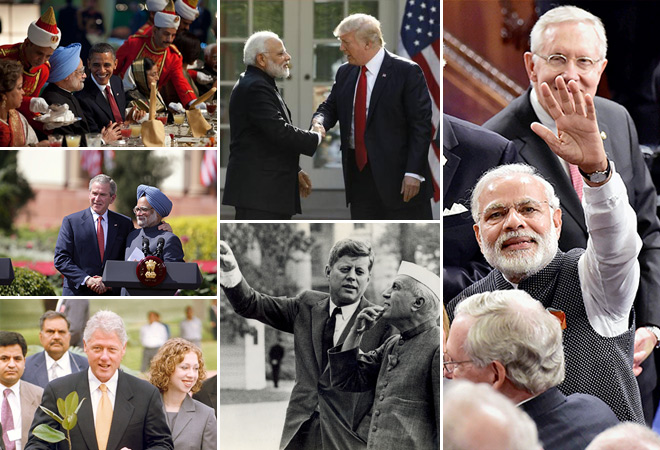
The public differences on key issues, ranging from trade, to work visas and the Iran sanctions, coupled with questions around the personal chemistry between Prime Minister Narendra Modi and US President Donald Trump have left many speculating on the future of this relationship. While this may be an over-reaction, we must use this opportunity to reflect and analyse the state of the bilateral and assess if we are indeed heading into choppy waters.

It is worth reiterating some characteristics and realities that have shaped the India-US partnership in recent decades. The transformational changes in world politics through the 1990s were important and sparked a realisation in both capitals that investing in each other was a priority. Overtime, top-level political leadership in both countries have translated this into a sustained partnership with great potential to shape regional and global affairs.


It is worth reiterating some characteristics and realities that have shaped the India-US partnership in recent decades. The transformational changes in world politics through the 1990s were important and sparked a realisation in both capitals that investing in each other was a priority.


China’s rise only accelerated this strategic partnership, especially in the Western Pacific and the Eastern Indian Ocean, leading to the conceptualisation of the ‘Indo-Pacific’ region — its importance reinforced by the rechristening of the US (Indo) Pacific Command.

Throughout this, American ambivalence to the India-Russia relationship, and a willingness by both countries to temporarily set aside differences on Pakistan, Iran and economic policy allowed them to strengthen the bilateral agenda.

Today, the assessments in Delhi and Washington DC are visibly changing — in terms of the how the world is ordered, what the new covenants must be, and indeed, in their expectations of each other. It is, therefore, necessary to consider what has changed, what remains unchanged, and what is needed now.

For one thing, there is little evidence that would suggest any dilution in the investments that both PM Modi and President Trump have made in this relationship. While enthusiasm at the political leadership level is welcome, recent events suggest that the perception of ambivalence at the top may well give bureaucracies in both countries the opportunity to revert to the old policies of the 1970s and 1980s.

Which is why Washington and New Delhi must now interrogate if such a top-down structure for this important relationship is sustainable and if the relationship needs more champions. While both countries have done well to institutionalise their relationship over the past two decades, the economic and political demands on this partnership are going to grow manifold — and it is now necessary to strengthen and expand these structures in order to sustain continuity irrespective of the prevailing political mood.


Today the assessments in Delhi and Washington DC are visibly changing — in terms of the how the world is ordered, what the new covenants must be, and indeed, in their expectations of each other. It is, therefore, necessary to consider what has changed, what remains unchanged, and what is needed now.


Second, the Russia question continues to vex the foreign policy establishment in both countries. While India’s dependence on Russia for defence products reduces, the fact is that it will remain a key security partner for many years to come. At the same time, Moscow will increasingly become an important actor for India’s political, connectivity and energy projects in Eurasia. To sustain a long-term India-US partnership, it is now time for both countries to adopt a mutually accommodative position on Russia.

The US, for its part, must be flexible and account for the important role Russia plays in India’s security objectives. New Delhi, on the other hand, must invest diplomatic energy in convincing Washington to shed its cold war mentality towards Moscow and embrace an ‘entente cordiale’ with this superpower, especially as both countries begin to recalibrate their approach to China.

President Trump’s impending summit with President Putin this July is a welcome thaw in America’s orthodox approach to Moscow — a necessary move in the long-term, considering that neither India nor the US would benefit from Russia being in the Chinese corner.

Finally, and most importantly, it is time to enquire if the US can continue to unilaterally set the priorities for this relationship — and strong-arm India into accommodating its preferred posture on key issues such as Pakistan and Iran. The fact is that India’s economic growth will see its GDP surpass the US before the middle of this century on real terms and well before in PPP terms. This reality implies that New Delhi will increasingly set its own priorities and will retain independent beneficial relationships with countries like Iran and chart its own course with its neighbours.

How will the US establishment come to terms with the fact that for the better part of the 21st century, India will be the larger economic partner? More importantly, has Delhi realised the potential and consequences of this shift?


India and the US must embrace their roles as the most consequential democracies of the 21st century. However, their current differences may well stem from adjusting to this reality.


Already at the Shangri-La Dialogue, PM Modi outlined a vision for the Indo-Pacific that was distinct from Washington’s conceptualisation. With time, India will, and must, do the same on geo-economics, trade and in its pursuit of strategic partnerships.

In the end, India and the US must embrace their roles as the most consequential democracies of the 21st century. However, their current differences may well stem from adjusting to this reality and some others. Allowing such differences to snowball will be a very expensive mistake — especially as China wastes no time in executing its own agenda for the international order.

Indeed, now more than ever, Washington will need New Delhi to balance China’s rise, given the coterminous nature of India’s rise and its own relative decline.

Capitalising on the opportunity presented by the India-US partnership will require both countries to institutionalise dialogue and identify differences capable of derailing the relationship in the long-term. Elites in Washington and Delhi must realise that a partnership of equals will require a more finely tuned calibration of their foreign policy priorities.


This commentary originally appeared on News18.

The views expressed above belong to the author(s).

Standard