Uncategorized

A new social contract for the digital age

Samir Saran| Terri Chapman|Mihir Swarup Sharma

Digital  transformations  are  rapidly  altering  the  nature  of  work,  models  of employment,    contracts,    regulations    and    protections.    Increasingly,    the responsibilities  of the state are becoming the obligations  of,  and a  business case  for,  the  private  sector.  This  devolution  of  ‘governance  responsibility’  is happening   at   a   rapid   pace.   In   many   locations,   this   coincides   with   the decentralization  of  political  power  to  local  administrations.  A  new  social contract  between  citizens,  consumers,  employees,  the  state,  and  enterprise is  needed  to  delineate  a  new  understanding  around  rights,  responsibilities and  entitlements.  As  a  step  towards  defining  such  a  contract,  we  set  out seven norms for defining these relationships in the digital age.


Attribution: Samir Saran, Terri Chapman and Mihir Sharma, “A New Social Contract for the Digital Age”, ORF Special Report No. 79, December 2018, Observer Research Foundation.

This report was first published as “A New Social Contract for the Digital Age”, in G20 Insights, 30 May 2018.


Challenge

The  disruptive  potential  of  rapid  technological  change  and  digitization  on employment,  job  creation  and  displacement,  employment  relations,  wages and inequality are immense and immeasurable.

Automation     is     challenging     predominant     conceptualizations     of     the workplace   and   workforce,   as   tablets   and   phones   replace   factories   and offices,  and  gigs  replace  full-time  jobs.  There  is  every  reason  to  suppose that,  in  a  business-as-usual  scenario,  this  trend  will  not  just  continue  but accelerate.

In  this  evolving  economic  structure,  an  individual  is  a  citizen,  but  also  a consumer, a capital-owner, an entrepreneur, an employer and an employee. The   borders   between   these   roles   are   no   longer   sharply   defined;   the traditional      relationship      between      employers      and      employees      has fundamentally  changed.  The  historic  model  of  employer-provided  social assistance  must  be  adapted  to  account  for  this  new  dynamic,  and  a  new point of provision of social protection needs to be identified.

Non-Atlantic G20 countries have extensive experience in grappling with the realities  of  informality  and  non-standard  forms  of  employment.  It  is  useful therefore  to  examine  the  contours  of  the  support  that  these  states  are attempting  to  provide  workers  as  an  approximation,  however  imperfect,  of the benefits traditionally provided by formal-sector “regular” employment.

Erstwhile responsibilities of the state are now an obligation of, and business case for, the private sector. The needs of individuals today are disparate and   heterogeneous,   and   may   no   longer   be   met   just   through   large investments  in  physical  or  social  infrastructure,  and  are  increasingly  being addressed   through   niche   solutions   best   offered   by   private   enterprises. Mediating  this  new  dimension  of  the  relationship  between  individuals  and the   private   sector   will   require   a   clear   delineation   and   devolution   of responsibilities and recourse.

At  the  same  time,  the  atomization  of  work  has  constrained  the  extent  to which  individuals  can  organize  and  make  demands.  The  collectives  and unions  that  traditionally  acted  as  arbiters  for  the  interests  of  a  substantial stakeholder   group   are   increasingly   ineffective.   Therefore,   there   is   an additional need for a new guarantor of the relationship between individuals and    the    private    sector    that    provides    for    purpose,    paychecks,    and protections.

This  new  guarantor  is  unlikely  to  be  any  single  agent,  actor,  rights  group, government  agency,  enterprise  or  regulator  as,  (a)  the  highly  amorphous emerging work landscape will demand flexibility, institutional innovation and informality,  and  (b)  swiftly-evolving  technology  will  continue  to  challenge the   capacity   of   legislation   and   laws   to   remain   meaningful.   Therefore elucidation  of  principles  and  norms  that  must  govern  the  new  operational relationships becomes compelling. These, in part and whole, must guide the plethora of relationship and laws that are defining the new workspace.

As a starting   point,   there   are   seven   norms   that   should   be   central   to governing these new relationships.

Proposal

1.  From the Job Security to Economic Security: A new ‘formality’

Digitization  is  enabling  unpredictable  transformations  in  work  across  G20 countries  and  beyond.  One  result  of  this  is  that  the  relationship  between employers and employees has fundamentally changed, and so too have the responsibilities  borne  by  employers.  While  a  future  social  contract  may  not be  able  to  credibly  promise  job  security,  it  should  be  able  to  guarantee social and economic security. That is, the financial security (paychecks), and social security (protections) that were previously provided by full-time jobs, must now be provided through alternative means.

The experiences of emerging G20 economies in contending with informality and  constructing  approximate  securities  for  the  informal  workforce  should inform such transformations in more advanced G20 economies.

Norm: A new ‘formality’ must ensure social and economic security.

Corollary: Responsibility for economic and social security must be explicitly assigned.

2.  From the Factory to the Cloud: A New Point of Provision

All  G20  states  have  some  form  of  welfare  system.  The  predominant  model for providing this is by linking benefits – whether forced saving or access to pensions   and   healthcare – to employment   status.   The   binary   between employment and unemployment is, however, quickly becoming irrelevant.

Indeed, an individual can simultaneously have a low-paying open-ended job with   employment   protection,   a   more   lucrative   part-time   job   with   no employment  protection,  and  an  entrepreneurial  venture.  Welfare  systems based  on  a  job/no-job  binary  and  the  workplace  as  the  point  of  provision are too restrictive to account for the variation and variability in employment that  are  characteristics  of  work  today.  Social  benefits  should  no  longer  be linked   to   a   specific   job   but   available   to   individuals   regardless   of   their employment status.

In  countries  such  as  India,  this  has  long  been  the  subject  of  government plans – see for example the 2006 Report on Social Security for Unorganized Workers.[i]  There  was  an  initial  attempt  to  turn  these  recommendations  into law  in  2008,  another  such  effort  is  currently  underway.[ii]  These  endeavours essentially follow the trail blazed by South Africa, which wrote rights-based social protection for all workers into its constitution in the 1990s.

Moving away from a fixation on employment status and employer-provided assistance would enable a large ‘formalization’ of workers who currently fall through   the   cracks   of   a   rigid   system   that   does   not   account   for   the complexities  and  dynamic  nature  of  work.  This  would  require  a  new  form and mechanism for the provision of rights, as well as a different, diffuse and accessible point of provision.

Norm:  Entitlements must be linked to individuals rather than to jobs.

Corollary: Entitlements, like rights, must be available to individuals regardless of their formal employment status.

3.  From Atomization to Solidarity: Constructing Co-operative Networks

Labour  unions  and  other  collectives  that  previously  provided  platforms  for organizing   and   arbitration   for   a   substantial   share   of   the   workforce   are becoming   less   important   as   the   workforce   becomes   more   atomized. Collective   organizing,   bargaining   and   mobilization   –   the   mechanisms through  which  workers  has  historically  made  demands  –  is  exceptionally difficult to exercise for fragmented contract workers and the self-employed.

Employment  status  shapes  the  extent  to  which  labour  laws  are  applicable, the  access  that  workers  have  to  labour  unions  and  to  each  other.  The individualization   of   labour   therefore   affects   the   power   of   workers,   by constraining their ability to connect and organize.

State    policy    and    private    sector    choices    should    actively    aid    in    the construction    of    cooperative    networks    rather    than    hoping    that    new technology   lets   individuals-as-workers   create   them   for   themselves.   The private sector will have to accept that, while an organized workforce is one better  able  to  bargain,  an  atomized  potential  workforce  is  one  that  will  not be able to innovate or increase productivity through learning by doing.

Norm: Enabling  mechanisms  of  solidarity  must  be  a  priority  of  the  public and private sectors.

Corollary: The  individualization  of  labour  should  not  result  in  the  loss  of mechanisms for collective bargaining.

4.  From Static to Dynamic Careers: Enabling Individual Transitions

New  forms  of  employment  may  not   meet  the   expectations  of  aspiring young  people  or  of  the  existing  workforce  that  is  being  forced  to  adapt  to changing  technology.  Young  countries  such  as  India,  where  more  than  half of the  population  is  below the  age of 25, must find  ways  of  employing and protecting  its  young  workers  –  but  will  also  need  to  find  ways  to  manage and  meet  their  expectations  and  ensure  purpose.  Similarly,  advanced  G20 economies  with  ageing  populations  may  need  to  examine  how  to  meet  or moderate  the  expectations  of  life-long  workers  who  are  being  rendered unemployed or unemployable by technological change.

One aspect of this is that the nature of employment as it pertains to the life- cycle    has    changed.    The    traditional    (and    often    preferred)    model    of employment means that we move from education into work, and then into retirement,  with  few  transitions  in  between.  The  emerging  model  looks profoundly different, in which we move in and out of education, and in and out of jobs, with an average tenure of employment of around 4.2 years.[iii]

The  job  security  of  the  previous  model  must  be  replaced  by  a  security infrastructure  defined  by  ample  learning  and  skilling  opportunities  that  can assist  individuals  in  the  transitions  inherent  in  the  new  model.  States  will have to recognize that youth populations without the purpose provided by occupational  choice  will  seek  other  and  potentially  more  divisive  forms  of identity.

Norm: The public and private sectors must play a central role in supporting lifelong learning and career transitions.

Corollary: Skilling,  upskilling  and  reskilling  efforts  must  be  both  recognized and provided by employers.

5.  From the Digital Divide to a Digital World: Universalization of Access

Internet  access  and  use  are  becoming  essential  for  exercising  one’s  full citizenship,   as   public   goods   and   services   are   gradually   being   provided online;  and  also  for  income  generation,  as  opportunities  too  are  gradually requiring   some   level   of   digital   fluency.   Without   the   universalization   of access  to  the  internet  and  devices  –  and  the  ability  to  use  them  –  the  risks of  increasing  inequality  within  and  between  G20  countries  and  beyond  are stark.

The public and private sectors must therefore ensure the universalization of access  to  the  internet  and  ensure  quality,  security  and  affordability.  The provision of access should be seen as a public good, which can be provided in co-operation with the private sector. It is the responsibility of the state to incentivize  the  private  sector,  and  to  develop  the  necessary   regulatory enablers.

Norm: The  public  and  private  sectors  must  ensure  the  universalization  of internet access and digital literacy.

Corollary: Digital  divides  in  quality,  affordability,  access  and  security  both between  advanced  and  emerging  economies  and  within  countries  must  be addressed.

6. From Subsidies to Opting In: A New Responsibility for Wage Earners

Previously,  individuals  in  many  economies  relied  on  services  such  as  health and education being provided or subsidized by their employers. Workers in informal or gig-based sectors now have to make an active choice to access such  services.  Without  effective  incentives  (as  well  as  affordable  access), there is a risk that individuals will increasingly forgo these options.

This  is  profoundly  changing  the  relationship  between  wage  earners  and their  dependents,  as  the  option  for  accessing  basic  services  can  now  be forgone.  The  obligation  of  wage  earners  has  therefore  changed:  as  the ecosystem  of  support  for  dependents  dissolves,  individuals  must  seek  out or  opt  in  to  basic  services.  This  will  be  a  challenge  both  for  advanced economies with ageing populations, and young populations alike.

Norm: The state must provide effective incentives to individuals to opt in to increasingly choice-based basic services.

Corollary: Basic  services  must  be  accessible,  affordable  and  attractive  in terms of quality.

7. From Regulation to Devolution: A New Role for the Local

Increasingly, the private sector  is charged with  activities in  the provision of public  goods  and  services  that  were  previously  the  domain  of  the  state  – especially   as   the   notion   of   “public   good”   expands.   Simultaneously,   the collective    organizing    potential    of    an    atomized    workforce    is    being constrained,    requiring    a    new    guarantor    of    the    relationship    between individuals  and  the  private  sector.  Individuals  themselves  will  participate  in the  new  economy  under  many  different  guises  –  as  entrepreneurs,  savers, investors  and  workers  –  rendering  the  management  of  these  economic interactions    complex    and    difficult    to    manage    by    detached    national regulators working in silos.

At the most basic level, greater responsibility in governing this relationship, which   is   underwritten   by   a   new   dynamic   should   be   given   to   local government,  which  is  best  positioned  to  arbitrate  the  above  relationships. Within  the  confines  of  a  national  policy  framework,  local  government  can ensure compliance, audit, provide licensing and address grievances inherent in the new relations outlined above.

Norm: Local governments  must be  empowered to  mediate  the relationship between the private sector, employees and citizens.

Corollary: Local   government   must   ensure   accountability   of   the   private sector in its area of operation, and recourse for individuals and employees.

CONCLUSION

Digital  transformations  are  redefining  models  of  employment,  employment contracts  and  relationships,  regulations  and  social  protections.  Automation is  changing  both  the  workplace  and  work  itself,  as  workplaces  shift  from factories to phones, and full-time jobs transform into gigs. This necessitates a   restructuring   of    the   dominant   model   of   employer-provided   social protection,  and  the  definition  of  a  new  point  of  provision.  Non-Atlantic experiences    in    contending    with    informality    should    be    drawn    on    in approximating   the   social   security   (protections)   and   economic   security (paychecks) normally provided by formal, full-time jobs.

The  private  sector  is  taking  on  a  more  profound  role  in  the  provision  of public   goods   and   services,   enabled   in   part   by   new   technology-driven solutions.   Simultaneously,   the   individualization   of   the   labour   force   is challenging  the  mechanisms  through  which  individuals  can  express  their needs  and  demands.  These  two  phenomena  demand  a  new  guarantor  of the  relationship  between  the  private  sector  and  individuals,  the  devolution of responsibilities, and clear recourse.

No  single  agent  is  positioned  to  provide  this  role  of  guarantor,  since  it requires   flexibility   and   innovation.   Thus   instead   of   a   structure   imposed externally  or  from  precedent,  a  new  normative  framework  for  governing these  relationships  is  needed.  The  above  norms  are  a  starting  point  in outlining a such a framework.

To read the full issue, click here.

Standard
Uncategorized

Confounding conflation of two K’s

Samir Saran| Sushant Sareen

For close to four decades now, two of the most serious challenges to the Indian state have been the Khalistan movement in Punjab and the Islamist separatist movement in Jammu and Kashmir. India has confronted and responded to these movements using both security and political options, but clearly insufficiently. While the relative resilience of these movements can partly be attributed to unrelenting attempts by Pakistan to cause harm to India, there is also a domestic dimension that endures them. Feckless administration and opportunistic politics have harmed Kashmir over the past decade and is now playing out in Punjab as well.

In recent weeks, there have been three major developments that are redefining the contours of conflict in Kashmir. The first is the video-graphed execution of a teenager by Islamist terrorists. While the brutality by terrorists is not new to Kashmir, this was the first time that ISIS-style barbarism was publicised so brazenly.

The video caused widespread revulsion in Kashmir. Even political elements that had flirted with the issue of militancy and separatism saw this as a sign of the conflict moving into a dark space beyond their control. The reaction to the execution was therefore stark in its unequivocal condemnation. Nevertheless, has a die been cast?

Outside Kashmir, the imagery of this horrific execution would have redefined the conflict, certainly for Indians in other States. The idea of an ISIS-like phenomenon establishing itself in a part of India will convince most that there is now little scope for engaging with dissenting voices in the Valley. In other words, the space for negotiations and conversations in the minds of many may be reduced to an engagement defined by the use of hard power by the security forces and the barbarism of the terrorists. Advocates of dialogue and constructive engagement will find themselves in a difficult corner.

The second development is one that cements the perception that the political system of Kashmir is dysfunctional, corrupt and farcical. And it took only two tweets to achieve this.

The first was by the three immiscible ‘coalition’ partners – the NC, the PDP and the Congress – staking claim to form a government. The second tweet was by a rival contender who not only staked a claim to form the government but also announced that since the fax machine in the governor’s office wasn’t working, he had ‘WhatsApp’d’ his letter. Within minutes of these two tweets, the governor, who was ‘unreachable’, dissolved the State Assembly. The episode encapsulated the sordid and perverse state of politics in Kashmir. Every major political party was implicated in this failure, as were the minor players, who were willing pawns in this entire game.

The larger implication is that such episodes will only buttress the conviction in significant sections of society that a political solution is unlikely in Kashmir. Political solutions require credible political leadership, and that is absent in Kashmir.

The third defining, even egregious, image is that on the decadal anniversary of 26/11 – when Mumbai was attacked by a ‘veritable arm of the ISI ’ – the Government of India, in its wisdom, laid the foundation stone of the Kartarpur corridor.

If Islamabad has heretofore tried unsuccessfully to make Kashmir the pivot of the bilateral relationship, New Delhi has now unwittingly given Pakistan’s apparatchiks an opening to cultivate a small but radical section of the overseas Sikh community. What the Indian establishment sees as a pilgrim corridor is, in the eyes of the Pakistani deep state, a potential ‘Khalistan corridor’.

The third image, in many minds, will therefore be a conflation of Khalistan with Kashmir. The ISI, which has worked tirelessly to create a compact between the Kashmiri and Sikh diaspora in the West, will seize such an opportunity with alacrity. After all, the Kartarpur opening has facilitated Pakistan’s ability to galvanise and stir trouble within a new constituency that now views Islamabad with rose-tinted glasses; as the deliverer of a cherished religious yearning.

Set against these three images unveiled in November, could one argue that India’s geopolitical and security paradigm has undergone a significant change?

Any miscalculation of the Indian side could have damaging and perhaps irreversible strategic and social consequences. In the Punjab of the 1980s, religious, political and civil society activists who opposed the Khalistanis were targeted. With the spectre of the past threatening to haunt Punjab again, can the Indian state summon the coherence and capacity to respond to a renewed problem? There is also an international dimension.

The Pakistanis have tried assiduously to incite and instigate Sikh communities in Canada, Germany, Australia, the US and the UK, with a view to forge a common front among the Kashmiri diaspora. These efforts have not received much traction.

But the Kartarpur ‘googly’ – the evocative description given by the Pakistani foreign minister to describe Imran Khan’s gambit – could bring about that ill-conceived “axis of disaffection”, creating problems for India, and ultimately Pakistan too.

Finally, there is the electoral dynamic that could unleash a transformation India can scarcely afford. The politics of polarisation in Jammu and Kashmir is leading darkly to the emergence of a Muslim Kashmir, a Hindu Jammu and a Buddhist Ladakh. One consequence of this is the demand often raised in Jammu and Ladakh for trifurcating the State. Driven almost entirely by the political playbook of different parties, this could intensify the de facto Islamification of Kashmir through the ballot, rather than the bullet. Instead of consolidating and managing different interests, democracy could well end up delivering the ethno-religious trifurcation of Jammu and Kashmir. Once the State loses the buffer that Jammu and Ladakh provide against Islamisation, by forcing the Kashmir Valley to accommodate other communities in the social, cultural and political domain, what will it mean for India’s capacity to retain Kashmir? This question can be interpreted both in alarmist and realist terms.

By opening the Kartarpur corridor, therefore, has India inadvertently walked into a Pakistani trap and allowed the potential juxtaposition of Khalistan and Kashmir? Pakistan is now presented with a chance to poison the 21st century aspirations of Indians in Jammu & Kashmir and Punjab with 20th century legacies of violence and sectarianism.

To be sure, problems in both States are owed in large part to poor governance and a squelching of legitimate, democratic demands by the Government in New Delhi. The conflation of both Ks, however, limits the agency of the Indian state to redress its own mistakes.

It is all very well to hope for the proverbial Berlin Wall between India and Pakistan to fall, but one must be careful not to be standing under the wall as it collapses.


The views expressed above belong to the author(s).

Standard
Uncategorized

India and the World Fueling a New Low-Carbon Growth Model

Samir Saran|Aparajit Pandey

This Global Governance Working Paper is a feature of the Council of Councils (CoC), an initiative of the Council on Foreign Relations. Targetting critical global problems where new, creative thinking is needed, the working papers identify new principles, rules, or institutional arrangements that can improve international cooperation by addressing long-standing or emerging global problems. The views and recommendations are the opinions of the authors only. They do not necessarily represent s consensus of the CoC members, and they are not the positions of the supporting institutions. The Council on Foreign Relations takes no institutional positions on policy issues and has no affiliation with the U.S. government.

Read the full article here.

Standard
Uncategorized

In pursuit of autonomy: AI and national strategies

Samir Saran| Nikhila Natarajan| Madhulika Srikumar

Industry leaders and politicians the world over are scrambling to lead the development and use of artificial intelligence (AI) for the power and value it accrues. However, AI promises to implicate more than just politics and economics. It poses fundamental questions on how societies and communities will be organised in the future–capable of radically transforming workforce and work-life as we know it.

While some countries are beginning to explore the competitive advantage across the full spectrum of AI deployment; others are studying the potential benefits that this predictive technology can offer. Even as governments may be unaware of what the full connotation of AI might be, they are determined to drive the debate and deployment around this new suite of technology and life. If governments are unable to foresee changes in the jobs landscape that the technology will bring about — and fail to deliver on its responsibility of providing opportunities for its people, especially the youth — they will have to bear the political backlash.

In the last 24 months alone, more than a dozen countries have devised national strategies on AI; many of these tomes run into several hundred pages. This publication examines 12 of these national strategies: the US, UK, EU, Germany, South Korea, Singapore, India, France, China, Canada, UAE and Japan.

To read the full brief, click here.

Standard
Uncategorized

Exclusive Interview: For a multipolar Eurasia, Russia must cooperate with India

Original Interview with RT can be found here


India is buying Russia’s S-400 air defence system, and only recently the USA sanctioned China for it. What can India expect now?

Given President Trump’s rather vague response on the question of exemptions for India, it is clear that the foreign policy establishment in Washington is still uncertain on how to proceed.

Having said that, India is both an attractive market for American arms dealers, and is the lynchpin of America’s ‘Free and Open Indo-Pacific’ strategy. Both weapons manufacturers and the strategic community in Washington will probably weigh in favour of India.

Whatever the near term consequences for India, therefore, Washington will be compelled to accommodate India’s interests in the long term.  

What are the military reasons for India to want to buy the S-400 from Russia at all?

The S-400 is a sophisticated anti-access/area denial missile system—a platform that no other country is likely to provide India, not even Washington. It will act as a crucial force multiplier in India’s border areas.   

In addition to signing the S-400 agreement, economic and energy policy decisions were also taken. What was discussed in detail and what was agreed?

For me, the important takeaway was Russia’s offer to allow India to participate in energy and trade projects in the Arctic. This is an emerging, if often ignored, theatre of geopolitics. There will be a race to exploit the regions commercial opportunity and to define its governance architecture. It remains to be seen what India’s response to this will be. I hope the mandarins in New Delhi see the strategic importance of being a stakeholder in this geography.

What are the geopolitical considerations of the USA be if they were to make an exception in the case of India with waiver? After all, India is one of the most important geopolitical players in the Sino-Pacific region alongside China and Russia.

In the long term, India is an invaluable partner for Washington. Indeed by mid-century, India will emerge as one of the world’s largest economies—a process that will foster a gradual and organic rise in its strategic capabilities.

Two expectations will underpin Washington’s’ choices going forward. First, that investing in India’s defense industry will help Delhi balance China’s rise in the Indo-Pacific. And second, that India will eventually be able to anchor democratic norms and free trade in Asia by its own desires and design.    

Some analysts claim that Russia is gradually beginning to change its position on the Kashmir issue because of growing cooperation with Pakistan. To what extent is this true and is there a realistic chance that India will politically prefer Russia to the US in the future?

Russia is not changing its position on Kashmir—Moscow’s courtship of Pakistan is based on two realities. First, that Pakistan will remain an interlocutor in Afghanistan, and will be important to Russia’s ambitions in Central Asia. Second, geopolitical equations in the region are changing rapidly— and just as India is reaching out to new partners, so is Moscow.  

It is too early to pass judgement on these evolving partnerships. They are often driven by near term interests and global political uncertainty. It is very unlikely, however, that Russia will upset India over a highly sensitive issue like Kashmir.  

India will not politically prefer Russia to the US—rather it must learn to work with both. In the Indo-Pacific, India’s equities lie with Washington, who’s economic and security presence can balance China’s rise. In Eurasia, Moscow will be its most important partner.

Meanwhile, the arch-enemy of India, Pakistan, is separating itself from the USA and is cooperating ever more closely with China, a close partner of Russia in turn. How does growing Russian cooperation with these two states affect the regional dynamics and decision-makings in India?

In the face of American sanctions, Russia’s only real choice is dependence on and partnership with China. While the close partnership between Moscow and Beijing certainly poses a problem for India, Moscow must also introspect on the sustainability of its arrangement.  

Russia should be anxious about being economically and militarily displaced by China in Central Asia and Eastern Europe. The fact is that if Moscow seeks a multipolar Eurasia, it will have to bring India into the arrangement or risk acquiescing to China’s design.

India is cooperating closely with the US in Afghanistan to keep the Afghan government alive against the Taliban. What role does India’s position in Afghanistan play in the talks between Putin and Modi?

While both countries agree that peace in Afghanistan is a priority, they differ over political arrangements that need to be made. Further, with the US, Russia, China, Iran and Pakistan all in the mix, the situation in the region remains complex.

With Putin, India likely reiterated its long standing position that any initiative in Afghanistan must be led by the government. India might have also pushed forward the agenda agreed upon in Sochi—of pursing joint development projects in Afghanistan with Moscow.  

Last year Russia called on India to join China’s Silk Road Project. India, however, seems to have reservations. This is mainly due to the China-Pakistan Economic Corridor (CPEC). For what geopolitical reasons does India reject a mega-infrastructure with China because of its cooperation with Pakistan?

CPEC is one amongst many objections that India has about the Belt and Road Initiative. The real issue, however, is that the BRI is a project designed, funded and executed only by China. As a key actor in the Asian century, India cannot allow China to dictate the terms of Asia’s governance.  

China must adopt a more multilateral playbook if it wants Indian support for the BRI. India and other Asian powers must have a legitimate voice in creating the rules and institutions of the region and in benefitting from the commercial and trade opportunities.   

Standard
Uncategorized

The collision of these 3 geographies is creating a new world order

Samir Saran

For the past seven decades, the world has been moulded by a strong, transatlantic relationship with the US and EU underwriting the terms of peace, stability and economic prosperity.

The success of this order has created its own existential challenge. Its rising beneficiaries in Asia and elsewhere increasingly challenge the validity of these arrangements and the efficacy of rules that have managed global affairs. While the historian John Ikenberry described the liberal world order as a “hub and spoke” model of governance, with the West at its centre, it is now clear that the peripheries of the system are developing wheels and engines of their own.

Indeed, the rise of Asia as a whole is recasting the physical and mental map of the world. Proliferating transnational relationships and new flows of finance, trade, technology, information, energy and labour have created three new strategic geographies which are already escaping the shadow of transatlantic arrangements. They essentially represent the collision of erstwhile political constructs – and their management requires new ideas, nimble institutions and fluid partnerships.

The Indo-Pacific

The first collision, which is already well underway, is the union of the Indian and Pacific Oceans. Popularly defined as the Indo-Pacific, it is a construct encouraged by the rise of China but defined in equal measure by regional actors responding to Beijing’s proposition. Maritime Asia is now larger than the US, ASEAN and China – earlier organized under the Asia-Pacific construct. Its frontier is not limited to the eastern Indian Ocean. From Nantucket to Nairobi, conversations on security, development and trade in this region will now include actors from three continents.

Eurasia

The second is the conflation of Europe and Asia into one coherent strategic system: Eurasia. This is an old idea, steeped in history, but it has a new vocabulary. The interaction of markets and communities from these once separated geographies is creating a new super-continental-sized interdependence.

Yet this interdependence is not without friction: China’s shadow looms large over Europe and its promise to underwrite the continent’s prosperity has proved too difficult to resist. Moscow, meanwhile, is exhibiting a new zeal to reclaim its place as the archetypical Eurasian player and members of NATO continue to bicker over their future role in the region. As these geopolitical tectonic plates both clash and merge, it is clear that East and West will set new terms of engagement.

The Arctic

And finally, we have the Arctic. Born as an unintended consequence of climate change, this geography will, for the first time, merge the politics of the Atlantic and the Pacific, even as it stimulates a clash between the arrangements that exist in these regions. The Northern Sea Route has been a tantalising theory; global warming is renewing it as reality. The global shipping giant Maersk, for example, completed its first voyage unassisted by ice-breakers this August (even though the company expresses scepticism about the near-term viability of the route). The emergence of this geography, however, will be far from frictionless and may well create a new distribution of wealth and power in the region.

While most Western governments currently share Maersk’s ambivalence, Moscow and China are investing heavily in building commercial infrastructure, naval capacity and military capabilities. As part of its Polar Silk Road ambitions, in fact, Beijing now actively encourages its enterprises to utilize the Northern Sea Route. Additionally, de-facto control over shipping routes in the region currently rests with Moscow, which has arrogated the power to grant shipping permits – a position that American officials have already warned might contravene the UN Convention of the Law of the Seas. In 1956, Britain went to war with Egypt to regain control of the Suez Canal; without appropriate arrangements for Arctic governance, history may well repeat itself a few latitudes north.

The collision of these three geographies will shape the 21st-century world order. Yet this process has no historical parallels. The post-war order and its predecessors were born after a revolutionary and catastrophic churn in global politics – and devastating, large-scale conflicts.

Today, this change is likely to be gradual, interdependent and evolutionary. There will be no single defining moment when a new order will be born. Instead, global politics will operate in 50 shades of grey for the foreseeable future.

As these three geographies discover themselves, then, there are five trends that deserve attention:

1. The the risk of separate cold wars across geographies. Unlike the 20th century, this tension will not be bipolar and each actor’s motivations, means and goals will differ. Whether it is the Himalayan cold war between India and China, the Arctic chill between Moscow, Europe and Washington, or the Mediterranean melee between the EU and China, multiple powers will exercise influence over these geographies and will compete at the intersection of social, commercial and military domains.

2. More “coalitions of convenience” are likely to emerge across these geographies. In an uncertain and fluid world order, issue-based partnerships may well have outsized influence over certain conversations. Russia, for example, is entering the fray in Afghanistan after nearly three decades with help from Iran and China, while India and France are cooperating on maritime security and development. China is partnering with Greenland – amid much anguish in Denmark – to cement its Arctic claims. If global institutions fail to manage emerging geographies, such coalitions will likely multiply.

3. The possibility for new institutional dialogues. Already, the EU is claiming a stake in the Indian Ocean Rim Association and ASEAN states are making overtures to the Arctic Council. These actors and organizations are transcending their 20th-century mental maps in search of new commercial and strategic opportunities. It is not entirely inconceivable that NATO and the Shanghai Cooperation Organisation (SCO), for example, might one day have a conversation on Eurasian security and connectivity.

4. The opening up of the Arctic will test the ability of powers to provide security as a public good in other parts of the world. In other words, with geostrategic conduits like the Suez Canal and the Malacca Straits possibly approaching their expiry dates, the imperative to secure Arctic sea lanes may well leave erstwhile routes bereft of powers willing to protect them. Are parts of the Indo-Pacific and Eurasia, then, destined to become ungoverned spaces – as in the Gulf of Aden – or will regional powers craft an arrangement of their own?

5. Finally, the institutional matrix will also evolve in response to these changes. It is clear that existing international institutions do not fully respond to the needs of developing countries and emerging regional powers. Which institutions, then, will be critical to these geographies? Will the Asian Infrastructure Investment Bank (AIIB) usurp the role of the World Bank in Asia or will new multilateral propositions emerge from countries like India, America and Japan? Will the UN be central to conversations on peace and security, or will regional institutions like the SCO (perhaps in a different guise) and the Arctic Council strengthen their own norms and rules?

In the 20th century, multilateral institutions were perceived to be mitigators and managers of conflict. That conventional wisdom may be turned on its head now, given that competing centres of power will, for the first time since the Peace of Westphalia, create their own institutional arrangements for exerting influence. An organization like the SCO, may, therefore, posit itself as the guardian of Eurasian stability, in contrast to an OSCE or NATO, that has hitherto played this role.

How nation states imagine the world is significant; their mental maps dictate diplomatic priorities, economic partnerships and security arrangements. The collision of new geographies is compelling states to reimagine their worldview.

In the 21st century, East and West are meaningless constructs. More important is how actors and institutions resolve the contradictions that will inevitably arise in Indo-Pacific, Eurasia and the Arctic. This is that strange and rare moment when global governance is more than the sum of its parts or individual regional configurations.


This commentary originally appeared in World Economic Forum.

Standard
Uncategorized

दक्षिण एशिया 2.0 के लिए जंग

Samir Saran| Sushant Sareen

उदारवाद का आकर्षण दक्षिण एशिया में व्यापक रूप से धूमिल पड़ चुका है। राजनीतिक पार्टियां या तो चरम वामपंथ या चरम दक्षिणपंथ की ओर बढ़ चुकी हैं।

दक्षिण एशिया, बदलती परिस्थिति, भारत, महत्वपूर्ण, समीर सरन, सुशांत सरीन, सामंजस्य, एजेंट, प्रभाव, धार्मिक, सांस्कृतिक, सभ्यतागत, राजनीतिक, भौगोलिक इकाई, आर्थिक, राजनीतिक, उदारवाद, वामपंथ, दक्षिणपंथ
फ़ोटो: Ricardo Resende/Unsplash


वर्तमान सदी के आरंभिक दौर में एक संसदीय समिति ने पड़ोसी देशों के साथ भारत के व्यापार की स्थिति के बारे में अपेक्षाकृत निराशाजनक रिपोर्ट जारी की। इस रिपोर्ट पर सरसरी निगाह डालने से ही क्षेत्रीय व्यापार के प्रश्न पर भारतीय नौकरशाही की संकीर्ण सोच और व्यापारिक बुद्धि वाला पुराना नजरिया स्पष्ट हो जाता है। उदाहरण के लिए, श्रीलंका के साथ मुक्त व्यापार समझौते पर हस्ताक्षर होने के लगभग तीन साल बाद भी इस दिशा में मामूली प्रगति ही हुई। कारण? कृषि क्षेत्र से संबंधित भारत की लॉबियों का कड़ा विरोध,जिन्हें डर था कि श्रीलंका से मिलने वाली जबरदस्त प्रतिस्पर्धा के कारण वे कारोबार से बाहर खदेड़ दिए जाएंगे। क्षेत्र में भारत के सबसे बड़े व्यापारिक साझेदार बांग्लादेश के मामले में भी ऐसा ही हुआ । भारत ने हिल्सा मछली और जमदानी साड़ियों जैसी वस्तुओं के लिए बाजार तक व्यापक पहुंच देने की बांग्लादेश की मांग स्वीकार नहीं की। इन देशों के पाकिस्तान के साथ व्यापारिक वार्ता शुरु करने के बाद ही भारत ने इन संबंधों पर गौर करना शुरु किया।

यहां तक कि अब, जबकि भारत ने अपने संबंधों की शर्तों पर नए सिरे विचार-विमर्श करने का प्रयास कर रहा है, तो भी यह स्पष्ट है कि उभरती भूआर्थिक और भू राजनीतिक वास्तविकताएं क्षेत्र की दिशा बदल रही हैं।

पिछले 70 बरसों के दौरान ज्यादातर समय दक्षिण एशिया का विचार भारत पर आधारित था, जिसे सामंजस्य का वाहक (एजेंट) माना जाता था । भारत का प्रभाव महज धार्मिक, सांस्कृतिक और सभ्यतागत ही नहीं था, बल्कि दक्षिण एशिया के राजनीतिक चिंतन और आर्थिक मॉडलों के केंद्र में भी था।

अब यह आज के दौर में सच नहीं रह गया है। यूं तो दक्षिण एशिया आज भी एक भौगोलिक इकाई की तरह मौजूद है, लेकिन इसके आर्थिक और राजनीतिक महत्व का केंद्र लगातार भारत से दूर खिसकता चला गया है। इसके परिणामस्वरूप, दक्षिण एशिया की पुरानी संरचना अगर मिटी नहीं है, तो मिट रही है। इस प्रक्रिया की शुरुआत के लिए क्षेत्र में भारत की प्रभावहीन शासनकला के अलावा, दो प्रमुख परिपाटियां भी उत्तरदायी हैं।

पहली, उदारवाद का आकर्षण दक्षिण एशिया में व्यापक रूप से धूमिल पड़ चुका है। केंद्र के समाप्त या गायब हो जाने के कारण क्षेत्र की ज्यादातर उदार पार्टियां सिकुड़ कर हाशिए पर जा चुकी हैं। राजनीतिक पार्टियां या तो चरम वामपंथ या चरम दक्षिणपंथ की ओर बढ़ चुकी हैं। क्षेत्र में जहां एक ओर लोकतांत्रिक शासन के चिन्ह अब भी दिखाई देते हैं, वहीं देशों में अनुदारवाद के दौर ने उन्हें उदारवादी लोकतंत्र की विशेषता वाले मूलभूत नियमों से दूर कर दिया है — भले ही पाकिस्तान में जेहादवाद और इस्लामवाद हो, बांग्लादेश में एक दल का वर्चस्व हो, मालदीव में ढीला लोकतंत्र हो (हाल के चुनाव के नतीजों के बावजूद),या नेपाल में कट्टर राष्ट्रवाद हो। ये मूलभूत नियम काफी हद तक, क्षेत्र के लिए नेहरुवादी विज़न के अनुरूप हैं — और भारत लम्बे अर्से तक क्षेत्र की लोकतांत्रिक सामर्थ्य का सहारा रहा है। इस विजन को अब सिर्फ भारत में ही नहीं, बल्कि उसके आस-पड़ोस में भी चुनौती मिलने लगी है।

चीन ‘बेल्ट एंड रोड इनिशिएटिव’ के जरिए एशिया की औपनिवेशिक विरासतों — समुदायों को बांटने वाली एकपक्षीय राजनीतिक सीमाओं को — निरंतर मिटा रहा है। चीन की योजना में, दक्षिण एशिया, ढांचागत परियोजनाओं के जटिल नेटवर्क की महज एक गांठ भर है, जो आखिरकार अखिल यूरेशियाई व्यवस्था का सृजन करेगी। चीन इस उपमहाद्वीप में सुरक्षा, विकास और आर्थिक विकास के अकेले निर्णयाक के तौर पर उभरना चाहता है। चीन नहीं चाहता कि क्षेत्रवाद इस उद्देश्य का ध्यान बंटाए — न ही वह भारत जैसी ताकतों को अपना प्रभाव क्षेत्र कायम करने देना चाहता है। चीन के लिए, ऐसे में किसी तरह की विशिष्ट दक्षिण एशियाई पहचान कोई मायने नहीं रखती । इसकी बजाए वह पाकिस्तान और मालदीव जैसे मुट्ठी भर ग्राहक (क्लाइंट) देशों और बांग्लादेश, नेपाल और श्रीलंका जैसे देशों के साथ आर्थिक संरक्षण की व्यवस्था से उसकी महाद्वीपीय महत्वाकांक्षा की सुरक्षा और आर्थिक हितों की पूर्ति हो सकेगी। वास्तविकता तो यह है कि चीन के मानसिक विश्व मानचित्र में स्वतंत्र दक्षिण एशियाई संरचना के लिए कोई स्थान नहीं है।


लगभग सत्तर बरस के बाद दक्षिण एशिया 1.0 बहुलता की ओर बढ़ रहा है, ऐसे में भारत को हर हाल में दक्षिण एशिया 2.0 की दिशा में प्रयास करने चाहिए, जो आखिरकार बीटा वर्जन का स्थान ले सकेगा, जिस पर वर्तमान में चीन का वर्चस्व है।


चीन की शिकायत या नकल करने से कुछ खास मदद नहीं मिलेगी। लेकिन क्या चीन से प्रतिस्पर्धा करने या उसका मुकाबला करने से कुछ हासिल होगा? आर्थिक, तकनीकी और सैन्य क्षेत्रों में चीन और भारत की ताकत के बीच फासला आज और निकट भविष्य के लिहाज से बहुत ज्यादा है।

ऐसे में सामरिक प्रश्न यह उठता है : भारत इस क्षेत्र में अपना वर्चस्व और प्रभाव कैसे दोबारा हासिल कर सकता है?


सबसे पहले, तो भारत को रणनीतिक संयम प्रदर्शित करना होगा। दूसरे शब्दों में कहें, तो भारत को चीन से सबक सीखने और तेंग शियाओपिंग के कथन ”सही समय आने तक अपनी क्षमताओं को छुपा कर रखो” का अनुसरण करने की जरूरत है।


मौजूदा सत्ता समीकरण को देखते हुए, भारत के लिए अपनी अर्थव्यवस्था का आकार दुगना करने यानी अगले दशक तक मौजूदा 2.6 ट्रिलियन डॉलर से बढ़ा कर 5 ट्रिलियन डॉलर करने तक ज्यादा व्यापक भूमिका निभा पाना नामुमकिन होगा। आवश्यक आर्थिक भार उठाए बगैर अपना प्रभाव आजमाने से सिर्फ पड़ोसियों के साथ रिश्तों में जटिलता ही आएगी। ऐसे में भारत के लिए अच्छा यही रहेगा कि वह फिलहाल कदम पीछे हटा ले। इस समय क्षेत्र के लिए नयी योजनाओं की घोषणा करने की बजाए, भारत को अपनी मौजूदा प्रतिबद्धताओं को पूरा करना चाहिए और तब तक इंतजार करना चाहिए, जब तक भारतीय क्षमताओं में मूलभूत वृद्धि स्वाभाविक तौर पर आस-पड़ोस में उसकी भूमिका और प्रभाव में इजाफा न कर दे।

दूसरा, भारत को दूसरे देशों के मामलों में हस्तक्षेप न करने के नेहरू के सिद्धांत का पालन करना चाहिए। ताकत और प्रभाव के बिना दूसरों को उपदेश देने से पड़ोसियों के साथ सिर्फ नफरत और फासले ही बढ़ेंगे।


भारत को जहां एक ओर अधिकारों पर आधारित एजेंडे के लिए अपनी प्रतिबद्धताओं से समझौता नहीं करना चाहिए, वहीं दूसरी ओर उसे इस एजेंडे को व्यापक रूप देते हुए नैतिकता का एंग्लो—सैक्सन संस्करण (या पाखंड) बनाने की लालसा त्याग देनी चाहिए।


तीसरा, भारत को दक्षिण एशिया भर में चीनी निवेश के लिए सहयोग करना चाहिए, उसे बढ़ावा देना चाहिए और उसका माध्यम बनना चाहिए। यह बात समझने में मुश्किल लग सकती है, लेकिन यदि लक्ष्य-क्षेत्र में भारत के प्रभुत्व को बहाल करना है, तो यह बहुत बड़ा सामरिक बोध है। चीन का अधिकांश निवेश बुनियादी ढांचा और विनियामक व्यवस्था भी तैयार करेगा, जो इन अर्थव्यवस्थाओं के साथ भारत के बाजार को भी जोड़ेगा। अगले दशक में, जब भारत की अर्थव्यवस्था को 5 ट्रिलियन डॉलर के निशान को पार करेगी, तो इस तरह के निवेश भारतीय मुद्रा को क्षेत्र में अपना प्रभाव बहाल करने में मदद करेंगे। ऐसा तभी हो सकेगा, जब चीन के धन के कुछ हिस्सा भारतीय माध्यमों के जरिए प्रसारित किया जाए। उदाहरण के लिए — एशियन इंफ्रास्ट्रक्चर इन्वेस्टमेंट बैंक की तर्ज पर साउथ एशियन डेवलपमेंट बैंक (एसएडीबी)की स्थापना की जाए। केवल इसी मामले में, संस्थागत व्यवस्था से भारतीय नेतृत्व को मदद मिलेगी, जबकि चीन उसका सबसे बड़ा साझेदार होगा। आखिरकार इंडियन ओशन डेवलेपमेंट बैंक की स्थापना के जरिए एसएडीबी के विचार का विस्तार किया जा सकता है, जो हिंद महासागर के तटीय देशों की विकास संबंधी जरूरतें पूरी करेगा।


वक्त आ चुका है कि भारत पीछे हटे और पड़ोसी देशों को चीन के बारे में अपने फैसले खुद लेने दें।


अंत में, भारत को अमेरिका और चीन के साथ अपने संबंधों में संतुलन कायम करने की जरूरत है। दक्षिण एशिया के लिए अपनी जंग जीतने के लिए, चीन और अमेरिका दोनों ही विरोधाभासी तरीके से भारत के लिए महत्वपूर्ण साझेदार है। भारत के दीर्घकालिक आर्थिक विकास के लिए भारतीय बाजारों में चीन का निवेश महत्वपूर्ण बना रहेगा, जबकि अमेरिका की सैन्य क्षमताएं चीन के उदय को संतुलित रखने और मैनेज करने में भारत की मदद करेंगी। एक तरफ, भारत को दक्षिण एशिया में अपने प्रतिनिधित्व को सीमित किए बिना अमेरिका को अपना सुरक्षा साझेदार बनाना होगा। अमेरिका अब ज्यादा महत्वपूर्ण ब्रांड नहीं रह गया है, ऐसे में दक्षिण एशिया से संबंधित भारत की व्यापक रणनीति के दायरे में अमेरिका को लाना प्रतिकूल भी साबित हो सकता है। वहीं दूसरी तरफ, भारत को चीन की क्षेत्रीय योजनाओं को चुपचाप स्वीकार किए बिना उसके धन को स्वीकार करना चाहिए। वास्तव में, यदि भारत को चीन से मुकाबला करना है, तो उसे चीन के ही कंधों पर सवार होना पड़ेगा। यह फैसला बेहतरीन मिसाल बन सकता है: भारत को चीन की महत्वाकांक्षाओं का लाभ उसी तरीके से उठाना चाहिए, जिस तरह चीन के उदय को अमेरिका की अर्थव्यवस्था से सहायता मिली थी। आने वाले दशकों में यही संतुलन कायम करना भारत की प्राथमिकता होनी चाहिए।


वास्तविकता तो यह है कि उपनिवेशवादी लालसा के विरोध के प्रति गहन, गंभीर और भावनात्मक प्रतिबद्धता होने के बावजूद, भारत बेपरवाही से मानता आया है कि भूराजनीति के केंद्र बिंदु आने वाले दशकों में भी यथावत रहेंगे।


दुनिया में कहीं भी ये हकीकत नहीं हैं और काहिरा और बगदाद जैसे शहर अपने अतीत की परछाइयां भर हैं। दक्षिण एशिया 2.0 बनने के लिए भारत को इस क्षेत्र को ब्रिटिश राज के साम्राज्यवादी प्रिज्म से देखना बंद करना होगा। क्षेत्र में भारत की व्यापक नीति के मार्गदर्शक पुराने नारे नहीं, बल्कि नई वास्तविकताएं होनी चाहिए। भारत को आजादी के संक्रमण काल में जो संस्थागत कमजोरियां विरासत में मिली हैं, उन्हें सुधारना होगा, ताकि वह आधुनिक अर्थव्यवस्था की जटिलताओं का 5,000 साल पुराने सभ्यतागत लोकाचारों के साथ मिश्रण कर सके। भारत का दृष्टिकोण उदारवादी लोकतंत्र के प्रति संकल्पबद्धता के साथ त्वरित आर्थिक वृद्धि और क्षेत्रीय अखंडता के निरंतर प्रयासों से मार्गदर्शित होना चाहिए। अपनी प्रगति होने पर, भारत को क्षेत्र की प्रगति पर भी ध्यान देना चाहिए।। कहना आसान है, लेकिन करना मुश्किल है, भले ही क्षेत्र के लिए भारत की ओर से व्यक्त की गई कुछ प्रतिबद्धताएं उसके अपने कारोबारों के लिए कुछ अवधि के लिए देर के लिए मुश्किलों भरी हो सकती हैं। वे उपाय करने के लिए उदार हृदय, साहसपूर्ण दृढ़ता और दूरदर्शितापूर्ण प्रबंधन की जरूरत है, जो केवल नकली पक्षपातरहित राजनीतिक सर्वसम्मति की उपज हो सकती है।

ये लेखक के निजी विचार हैं।

Standard
Uncategorized

India-Pakistan relationship is held hostage by many structural impediments

Samir Saran

It will take a very prolonged series of successful trust building before more sensitive issues like Kashmir are even discussed with any credibility.

India-Pakistan, Samir Saran, Narendra Modi, backburner, India, Pakistan, New Delhi, credibility, Kashmir, identity, UNGA, Wagah

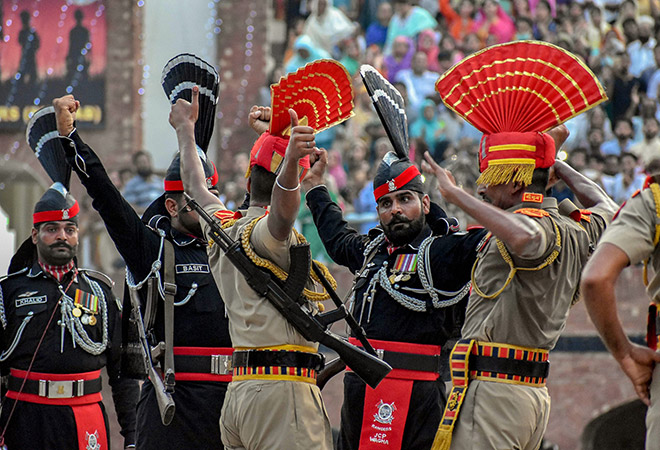
Beating retreat ceremony in the India-Pakistan border at Wagah. Photo: Press Trust of India

India and Pakistan made some significant overtures since the formation of new government in Islamabad, which rekindled hopes of peaceniks in both the countries. But the parleys proved short-lived. The battle lines are drawn again as accusations and counter-accusations fly thick and fast. This week, the foreign ministers of the two countries took their war of words to the UN General Assembly.

The following is an interview of Samir Saran with the Tehran Times.


The formation of a new government in Islamabad had rekindled hopes of peace and reconciliation between India and Pakistan, after the two sides made a series of overtures and looked interested in opening a new chapter in their bilateral ties. But, now it has again been put on the backburner. What makes this relationship so fragile?

The relationship remains fragile for structural reasons. Issues of identity and a shared sense of historical animosity have hardcoded themselves into both countries’ politics. And in today’s polarised media environment, opinions on these issues are sharper and more amplified than ever before. These factors make any true reconciliation very difficult.

Imran Khan in his victory speech said he will take two steps if India took one. And Narendra Modi had called to congratulate him on his thumping victory in Pakistan general elections. Do you think the two leaders were really sincere in improving bilateral ties?

No, it is unlikely that they were. This welcoming rhetoric is often visible when new administrations take office, but rarely lasts very long for the reasons outlined in my first response.

Everything seemed to be going as per the script until India called off foreign minister level talks on the side lines of UNGA, citing killing of policemen in Kashmir and release of stamps in Pakistan commemorating a Kashmiri militant commander. Do you think there are shadowy forces working overtime to sabotage peace process?

The Pakistani Army remains a key interlocutor in Pakistan-India relations. Their overwhelming control over most aspects of Pakistan’s political and social life is built on a hardline Islamic identity and hostility towards India. Prospects of peace with India always threaten these realities — and the Army has often attempted to sabotage any attempts at constructive outreach.

Some experts opine that PM Modi decided to call off talks since he doesn’t wish to antagonise his loyal Hindu vote bank in India ahead of next year’s general election. What is your take on it?

Talks with Pakistan are always politically sensitive in India — irrespective of which party is in power. Having said that, no administration has ever hesitated to take this risk if real and constructive outcomes were on the horizon. At this time, it is evident that there was no such possibility — and any administration in India would have rather called off talks.

Pakistan’s foreign minister Shah Mehmood Qureshi speaking at the UN accused India of “financing, facilitating and orchestrating terrorism in Pakistan,” citing the case of Kulbushan Yadav, who he called “Indian state-sponsored terrorist.” How would you react to that?

This is not new rhetoric in Pakistan, nor will it be the last time it is used. It is merely a very weak attempt to delegitimise India’s credible complaints over the extent to which terrorism has been mainstreamed in Pakistan.

The crossborder shelling and ceasefire violations continue unabated. In recent years, the violations of the ceasefire accord the two countries signed in 2003 have assumed alarming proportions. What according to you is the most important trigger for it?

Unlike 2003, the global order today is far more strained and uncertain. With Pakistan now being bankrolled by the Chinese and India preparing to take on a global leadership role, both countries are likely more confident in their strategic capability to gain the upper hand against the other.

The civil society and think tanks in both the countries, including yours, are very strong and they have been relentlessly campaigning for peace and dialogue between the two countries. Do you think the strong political will is missing to resolve outstanding issues including Kashmir?

Political will is certainly important. As I have said earlier, however, the India-Pakistan relationship is held hostage by many structural impediments. It will take a very prolonged series of successful trust building before more sensitive issues like Kashmir are even discussed with any credibility.

Russian President Vladmir Putin visited India this week for 19th India-Russia summit. How do you view prospects of India-Russia defense cooperation taking into account US sanctions?

Russia is, and will remain in the foreseeable future, India’s primary defense partner. And American sanctions are unlikely to change India’s choices. In fact, India is likely to make a strong case for exceptions from Washington’s sanctions even as it continues security cooperation with Moscow.

India is yet to take the final decision on oil trade with Iran, although reports suggest that New Delhi will seek waivers from US to continue importing oil from Tehran. Why is there so much suspense and delay?

India will continue to expand its energy and development cooperation with Tehran. Unfortunately, however, Indian firms and businesses are quite dependent on the American financial system. Therefore, while the political rhetoric makes clear that India will pursue its independent strategic interests, commercial realities are often difficult to overcome.

The views expressed above belong to the author(s).

Standard
Uncategorized

The Future of Work in India: Inclusion, Growth and Transformation

Samir Saran| Terri Chapman|Rakesh Kumar Sinha|Suchi Kedia|Sriram Gutta

The future of work in India is uncertain, but full of opportunities. This report attempts to answer key questions around the present and future of transformative technology in India and its impact on job creation, workplaces, employment trends and relations, and the nature of work itself.

Our research reveals that companies in India are optimistic about the future and are open to the possibilities presented by new technologies and digitisation. This optimism is likely to stimulate innovation and adoption of new technology and drive transformation, growth and progress. This report sets out a roadmap for an inclusive future of work in India that capitalises on the opportunities presented by technological disruption and digitisation. By using the opportunities at hand, India can:

  • Generate sufficient new employment opportunities for the existing and growing labour force.
  • Create decent jobs with better wages, security, protections and safety, necessary for improving individual and household welfare and well-being.
  • Ensure equal opportunities for women, youth and other marginalised communities previously unable to participate equally in the paid economy.
  • Establish an ecosystem better equipped to prepare the workforce for changing skill and educational requirements.
  • Create of an inclusive policy environment which balances the need for job creation with the interests of workers.

This report outlines findings from the Future of Work, Education and Skills Enterprise Survey. Data was collected from 774 companies in India, from micro-sized firms to those employing more than 25,000 workers. It presents findings on the pace of technological adoption and digitisation among Indian companies, and its impact on job creation, displacement and nature of work. In addition to the effects of the changing nature of jobs on wages, contracts, protections and security. Finally, the report includes recommendations on policies, programmes and action needed for India to leverage the possibilities of technological disruption, manage the associated risks, and enhance its preparedness for the future of work in the digital age.

To read the full issue, click here.
Standard
Uncategorized

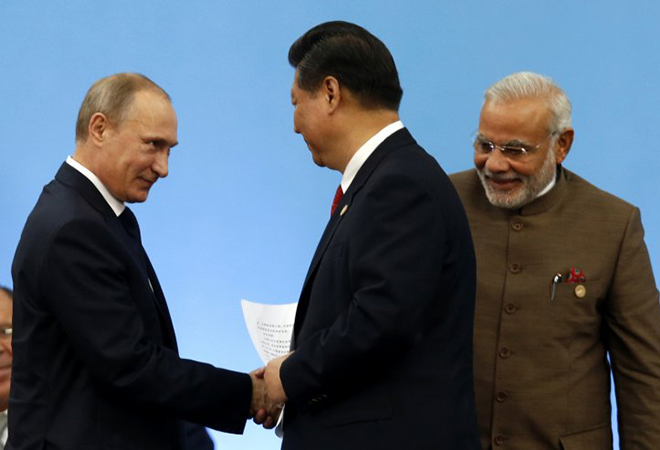
In a pluralist Asia-centric world order, Russia has a crucial role to play

Samir Saran

As Russia repositions itself as an Asian power, it has a unique role to play in the region.

Russia, Vladimir Putin, Russia, China, Asia-centric world, world, Samir Saran
File Photo

The following is a recent interview of Samir Saran with Valdai Club. Saran shares his view of the emerging Asia-centric world order and Russia’s place in it.


“Russia always identified itself as a European power, and Eurasia was a compromise,” he said on the sidelines of the Eastern Economic Forum in Vladivostok earlier in September. “It is now starting to see itself as a key actor, interlocutor and power in the Asian century.”

“Russia is a continental and maritime power simultaneously,” said Saran. “Which is why there can be no Asian order without Russia being a central part of the bargain,” he added. “There can be no Eurasian integration, and no Pacific or Arctic arrangement without Russia having an important stake in framing the rules.”

According to Saran, Russia must closely consider whether it is prepared to play this role. “Sometimes I think that Russia does not fully realize its own potential: it often sees itself as a disruptor; but not as a manager — a benefactor that must sustain and stabilize the system,” he pointed out.

“For that to happen, Russia’s economy has to grow in the coming decade to about four trillion dollars. Otherwise, Russia will be tempted to play the role of a political interrupter rather than that of a political guarantor — a responsibility it must bear if it is be a consequential actor in the 21st century. To guarantee the Asian order, Russia will have to grow its ambitions, its economy and its institutions.”

That said, the two crucial powers defining the future Asian order are China and India. The question is whether they will try to create something new or adopt existing institutions and practices. According to Saran, the answer is both. “India and China have grown exponentially in less than three decades. India still has a journey to complete — maybe another 15 years before it becomes a 10 trillion dollars economy. Still, neither are fully capable of upending the rules of international institutions altogether. They will have to, in many ways, rely on the old ones, and maybe change and reform them.”

This means that the old institutions will work in new ways. “If one looks at some of the Western institutions like the OECD, the UN, and the World Bank — many of them are operating in consonance with China’s infrastructure projects and international agenda,” Saran said. “In that sense, China’s rise has changed the very character of international institutions.”

According to Saran, the same will happen with India within the next 15 years: “Size matters, and both India and China have reached their critical point. It is impossible for the world to be stable and prosperous without these two actors having an important role in the order of things.”

However, it would be wrong to suggest that the Asian order will be dominated by a few powers. It should be more plural than the current one, Saran believes. According to him, it will take seven or eight countries for the Asian order to finally emerge. Apart from China, India, and Russia, these would include Japan, some of the ASEAN states, and possibly Iran and Saudi Arabia.

On the institutional level, “any organisation that allows the countries to talk and synthesize diverse political systems, economic models, and ideas on peace and security will work,” Saran said. But since Asians are “highly sovereign,” any such arrangement has to be democratic and plural; it must be based on the “one country-one vote” principle.

Asked if the Shanghai Cooperation Organization could serve as a prototype for such an institution, Saran said that in its current version it is a “good beginning.”

“I think that institutions like the SCO are important, but this does not mean than the SCO is the best option. If is starts serving only Shanghai, then it will lose its meaning. But if it becomes a ‘round table,’ where seven or eight large countries could sit down and discuss key questions, then it is becomes useful and meaningful,” he pointed out.

The views expressed above belong to the author(s).

Standard