

Bharatiya Janata party of Indian prime minister expected to form state governments in Maharashtra and Haryana
Original link is here
Agence France-Presse in Mumbai
The Guardian, Sunday 19 October 2014 15.03 BST

BJP celebrations in Mumbai. Photograph: Rafiq Maqbool/AP
The Indian prime minister Narendra Modi’s rightwing party claimed victory in elections in two key states on Sunday, tightening its grip on power after winning national elections in May.
The Bharatiya Janata party (BJP) was leading in Maharashtra, of which the financial hub Mumbai is the capital, beating its centre-left rival Congress party which has ruled the western state for 15 years.
“BJP will definitely form the government in Maharashtra,” the BJP’s state president, Devendra Fadnavis, told reporters in Mumbai as the vote count continued.
The BJP also won in northern Haryana, which borders New Delhi, after 10 years of Congress rule of the state. The state’s outgoing chief minister, BS Hooda, said: “Like the Congress earlier got the mandate, now the BJP got the mandate and will form the government.”
Modi campaigned doggedly for the elections held last week, and the victories are likely to encourage him to push ahead with promised reforms. He won the general election on pledges to revive the ailing economy and clean up endemic corruption, but many of the reforms have yet to be introduced.
On the eve of the state results, Modi’s government lifted controls on diesel prices, aiming to give market forces greater influence on the economy, attract investment and cut subsidies.
The victories will strengthen the party’s power in the national parliament’s upper house, crucial for the passing of contentious laws. The BJP currently lacks a majority in that chamber, whose composition is based on seats won in regional assemblies.
The Delhi-based political analyst Samir Saran said the victories “allow greater space to Modi to accelerate his reforms agenda. In many ways the results signify the continuing rejection of the brand of politics on offer from the Congress and its allies at the centre and in the states. It also is confirmation of Narendra Modi as the leader with momentum.”
The BJP is expected to fall short of an outright majority in Maharashtra and could need a partner to form government. It is expected to mend ties with its ally of 25 years in Maharashtra, the far-right Shiv Sena, after deciding to campaign alone following an acrimonious split.
“I hope that the old alliance is restored once again in a crucial state like Mahrashtra,” the BJP veteran leader LK Advani said.
The BJP had won or was leading in 120 seats in Maharashtra, in tallies on the election commission’s website, while Congress was trailing with 43 in the 288-seat state assembly. Shiv Sena was leading in 59 seats.
In Haryana, the BJP was ahead in 49 of the 90 seats up for grabs, while Congress was leading in 15.
Samir Saran and Will Poff-Webster
07 October 2014
Original link is here

Link of Global Policy Journal
Introduction
As the world prepares for the upcoming climate change negotiations in Lima in 2014 and Paris in 2015, there is an expectation that the talks be more decisive than previous attempts at consensus from Kyoto to Copenhagen. Yet the assumption that the undeniable science of climate change will by itself compel action on an issue that has thus far proved the mother of all collective action problems ignores the failures of past conferences. For Lima and Paris to succeed in achieving consensus, the issue of equitable response to the climate crisis must be creatively reimagined. Equity has been a challenge for climate consensus since the 1992 Rio Earth Summit first articulated that, “In view of the different contributions to global environmental degradation, States have common but differentiated responsibilities.”1
In meeting this challenge of articulating responsibilities for a climate that all share but only some have impacted substantially, India’s challenge is increasingly the world’s challenge. How can India acknowledge and respond to existing trends—the increasing urgency of confronting climate change, the energy-intensive process of achieving a semblance of development, and widening wealth gaps between rich and poor—while maintaining its focus on bringing its hundreds of millions of citizens out of poverty? In a larger sense, how can the world prevent climate degradation amid existing inequality and the aspiration of billions to rise out of poverty?
Maintaining equity between India and earlier developers
For India, the actualisation of differentiated responsibility remains central to any climate agreement. Developed countries and China have already undergone energy-intensive industrial development (and largely coal-fired electrification) to bring their people out of poverty, consuming much of the world’s carbon budget in the process. From Britain’s use of the steam engine in the early nineteenth century to China’s exponentially increasing coal capacity over the last decade, carbon-polluting energy has been essential to providing jobs for the millions who seek them in each successive industrial revolution.2 India’s coming industrial revolution and necessary shift to manufacturing, with twelve million new workers entering the workforce each year, cannot be avoided lest those millions lose the possibility of a better life.3 India’s economic transition, coming at a time when the world is finally moving toward a collective response to climate change, represents a great challenge to maintaining economic equity between India and previously industrializing powers. After all, the cost of access to prosperity must not be the highest for latecomers to industrialization. In other words, poverty cannot be frozen by a dateline.
India has acted to engage these contrasting priorities, by committing to a 20-25 percent reduction in carbon intensity by 2020—a natural consequence of increasing efficiency in the energy sector, but also a step to ensure the government’s promise that India’s per capita emissions will not go above those of wealthy countries.4 But equity suggests that India resist any effort to tie its energy intensity reduction to China’s, as the two countries have vastly different existing energy consumption and generation footprints. India starts from a lower polluting baseline compared to China and even to developed economies that have shed manufacturing—India’s use of energy per purchasing power parity dollar of economic output is 0.33 kg CO2, compared to China at 0.60 and developed countries like the United States at 0.48.5 The tendency to see China and India in hyphenated terms as large economies with growing emissions ignores the fundamental differences in their current contribution to climate change and to their vastly different economic and development landscapes.
Toward an Indian strategy
The need for global action against climate change has prompted diplomats in the developed world to speak of “win- win” situations—that transitioning to renewable energy will allow economies to reap the benefits of green jobs growth while reducing emissions. At least in India, this rhetoric rings false. Barring as-yet-insufficient technology, stuttering monetary transfer, or commercial funding from the developed world, coal will remain significantly cheaper than all other sources of energy through 2030 and perhaps beyond.6Renewables suffer from high variability in supply and base load restrictions on Indian power grids. Renewable energy development, which would be appealing from a simplistic “first, do no harm” perspective, collapses upon closer scrutiny: how should India assess the harm of more of its citizens remaining in poverty for every increase in marginal energy cost? The ethical aspect has a political dimension as well: India’s parliament will not countenance ratifying the Paris proposal unless it allows maximal focus on poverty alleviation. And even if it does, democracies have other ways to negate bad agreements, federalism being chief among them. While this is a matter for another study in itself, it must be noted that in the Indian context, the country must be viewed as a collection of thirty nations in a union. The Paris proposal must work for Indian states, or it will fail the ultimate test of implementation.
To negotiate action on climate change despite these challenges, India should promote a more fine-tuned form of differentiated responsibility — not just between countries, but within them as well. International debate thus far has been dominated by equity between countries, yet recent globalisation has caused increasing intra-national inequality as global inequality decreases.7 Even proposals for differentiated responsibility within federal systems, whether EU members, Chinese provinces, or American or Indian states, suffer from inadequate consideration of the far greater inequality within each of these smaller entities.8 India should solve this problem by introducing international emissions standards for large corporations. For instance, all corporations valued above $1 billion (or another suitable cut-off) should be subject to internationally binding efficiency standards, regardless of national origin. By decoupling protection of the poor from protection of wealthy corporations that reside within the same borders, India will focus its negotiating power on protecting its most vulnerable citizens, while also addressing large multinational corporations often unconstrained by state power. Allegations that India’s wealthy corporations hide behind its government’s focus on poverty would be allayed, and the world would be able to address climate change with differentiation and therefore equity—targeting those able to pay rather than the global poor. This would also compel the “rich” countries to act against the “carbon gaming” of their transnational corporations.
Market-oriented change
Such a negotiation strategy would enshrine an expanded differentiated responsibility, helping to solve equity concerns. Corporate emissions standards would nonetheless face several practical obstacles—balancing mandatory and transparent compliance with national sovereignty; preventing economic distortions that might inefficiently incentivize corporations to remain below $1 billion valuation or break into subsidiaries; and solving the larger challenge of corporate tax havens that would be ripe for exploitation under any international standards. As these are important issues for global governance to solve regardless, an equitable response to climate change can provide the impetus.
India can supplement this new proposal with more traditional methods of reducing emissions. India is leading the way in developing countries’ efforts on energy efficiency, a key opportunity for the eventual low-carbon transition—and one that remains truly “win-win” because energy saved from low-cost sources further reduces cost. In the latter part of the last decade alone, India’s Bureau of Energy Efficiency (BEE) doubled its energy savings in avoided generation capacity each year.9 New economic instruments like demand-side management hold the potential to reduce energy use by up to 25 percent, and the Bombay Stock Exchange’s GREENEX Index on energy-efficient stocks shows that the private sector is already taking action through market mechanisms to improve its energy efficiency.10 Lima and Paris can capitalize on such early beginnings to turn India’s ideas and experimentation into global systemic change.
Summing up
India’s challenge at the upcoming global climate talks is twofold. First, it is now time to look beyond the India-China hyphenation; it is unhelpful to India’s cause and situation. It is time to walk alone and seek specific exemptions or exceptions for India’s scale and diversity of realities.
Second, India needs to take leadership and identify constructive ways to move forward on climate change mitigation while not sacrificing the imperative of poverty alleviation. By the same token, the world’s challenge is to develop a holistic global framework that can manage the climate change threat in a world of differentiated responsibility.
By introducing intra-national differentiation between wealthy corporations and impoverished populations, Indian negotiators can help move the upcoming talks beyond past failures. These big corporations also account for a large carbon treasury and can be a low hanging fruit for both emissions reduction imperatives and to fashion a new sustainable business paradigm. Through leadership on this and other issues like energy efficiency, India can ensure its commitment both to the development of its citizens and the maintenance of the ecosystem.
1. “Rio Declaration on Climate and Environment,” The United Nations Conference on Environment and Development,http://www.unep.org/Documents.Multilingual/Default.asp?documentid=78&articleid=1163.
2. “China Approves Massive New Coal Capacity Despite Pollution Fears,” Reuters, http://uk.reuters.com/article/2014/01/07/china-coal-idUKL3N0K90H720140107.
3. “Why India Must Revive Its Manufacturing Sector,” The Diplomat, http://thediplomat.com/2014/02/why-india-must-revive-its-
4. “India Vows 20-25% Carbon Intensity Cuts,” The Times of India, http://timesofindia.indiatimes.com/india/India-vows-20-25- carbon-intensity-cuts/articleshow/5298030.cms; “India to Reduce Carbon Intensity by 24% by 2020,” The Guardian,http://www.theguardian.com/environment/2009/dec/02/india-carbon-intensity-target.
5. “An Assessment of India’s 2020 Carbon Intensity Target,” Grantham Institute for Climate Change,https://workspace.imperial.ac.uk/climatechange/Public/pdfs/Grantham%20Report/India_2020_Grantham%20Report%20GR4. pdf.
6. “Energy in India: The Future is Black,” The Economist, http://www.economist.com/node/21543138.
7. “Global Income Distribution: From the Fall of the Berlin Wall to the Great Recession,” Centre for Economic Policy Research,http://www.voxeu.org/article/global-income-distribution-1988.
8. “New Players on the World Stage: Chinese Provinces and Indian States,” The Brookings Institute,http://www.brookings.edu/research/essays/2013/new-players-on-the-world-stage.
9. “Verified Energy Savings with the Activities of Bureau of Energy Efficiency for the year 2009-10,” National Productivity Council,http://220.156.189.23/miscellaneous/documents/energy_saving_achieved/document/Verified%20Savings%20Report%20for%202009-10.doc.
10. “BSE S&P-Greenex,” Bombay Stock Exchange, http://www.bseindia.com/indices/DispIndex.aspx?iname=GREENX&index_Code=75&page=19D7C1A5 -BE2B-43EC-AD77- CE539070D72F; “Calibrating India’s Climate Change Response,” Courier, http://www.stanleyfoundation.org/articles.cfm?id=797.
(The writers are with Observer Research Foundation, Delhi. This paper was presented at the Council of Councils Sixth Regional Conference, September 28-30, 2014)
Courtesy : Council of Councils Sixth Regional Conference (Conference Papers: Council of Councils Ottawa Regional Conference)http://www.cfr.org/councilofcouncils/events/p33386
20:32 GMT, 9 September 2014, Mail Online India
Original Link is here
Tragedy has struck Kashmir once again.
That it is perhaps the severest since Independence is undeniable.
The human despair, spirit and resolve are all on display, and the entire country (real and virtual) seems affected by nature’s cruel intervention.
The efforts to rescue those stranded are feeble as the institutions, infrastructure and administrative resilience have been found wanting – yet precisely because of this, the courage and heroic efforts of individuals and some organisations stand out in stark contrast.

Floods: The entire country (real and virtual) seems affected by nature’s cruel intervention.
Even as the embankments built in the times of the Maharaja have been breached by ravaging waters, the unfolding tragedy and response is also about the ‘angels or demons’, depending on your take on it – Social Media and the Armed Forces.
A recent report in a leading daily had one of the most powerful men in India, its Home Secretary, observe, “I simply cannot speak to anyone in J&K.”
The last 72 hours have seen the near total collapse of the phone network, and power lines have collapsed. This has complicated coordination and rescue, because stranded people have no way of telling rescue centres of their plight.
Worse still, Delhi is cut off from the Government of J&K, while the Government of J&K is cut off from the army, which is coordinating rescue efforts.
The army is the only body there that has managed to maintain some semblance of intra-organisational communications due to satellite phones. However, it has no way of knowing the location where people are stranded, or how many and how critical their situation is, since the normal method – air reconnaissance – is difficult at best given the cloud cover and weather.
And the much-vilified social media is coming to the rescue. Even as large parts of the mobile communication infrastructure have collapsed, some wireless communication and the traditional wire line communication networks have allowed people access to social media and various messenger services, websites, and some agencies.

To the rescue: Social media has helped save the stranded
It has also allowed a degree of dissemination of situational reports, videos and distress messages, many of which have reached the army.
Whatsapp, FB messenger, Twitter and others are the most potent tools for the rescue teams in the valley today.
As a result what we have is the army using satellite phones to communicate, but basing its rescue efforts significantly on guidance from Whatsapp, Facebook and Twitter.
In that sense these have effectively replaced the search helicopter, the emergency beacon and the communications network of the valley.
For the governments at the Centre and in the state of J&K, which have frequently demonised social media, this must be a moment of revelation.
In February this year, the then Home Minister, Sushil Kumar Shinde, had vowed to “crush social media” to great applause from within his party and some others.
Yet today the home secretary cut a sorry figure, claiming “there is no means to communicate with anybody” till the 15 wireless systems he has sent to be set up in the valley come online.
Social Media, angel or demon? Let the debate begin.
The second story is that of the ‘men in green, blue and white’. Among the nation’s armed forces, they are reviled by a few liberals and a section of those in Kashmir, at the receiving end of Pakistani venom and terror, and frequently derided by the political class in the state and centre.
Yet had it not been for the army’s rescue teams and its “infrastructure of occupation,” as secessionists would call it, how many more lives would have been lost?
At a time when the democratically-elected government of J&K has failed in its civic duties in buttressing the embankments (which they should have known about anyway) and a home ministry that is fumbling in the dark, it is this supposed villain that has come out as the knight in shining armour.
It is this same “infrastructure of occupation” – helipads built on apple orchards, hospitals built on peach orchards and supply dumps built on farm land – that are now being used so effectively to rescue the stranded, treat the wounded, and provide relief supplies to the displaced.
It is this same infrastructure with its bulldozers that is being used to clear roads, and the army trucks that sustain the “occupation” that are being used to ferry in essential supplies for the “occupied”.
Given the police, local government and central government networks failed within the first few hours of the flood and the Doordarshan system which could be used as an emergency communications system also collapsed in this period, it has been the army’s communication systems that have provided the only link between J&K and the rest of the country.
It is the maligned Armed Forces Special Powers Act used to “suppress” Kashmiris, that the army is using to deliver critical supplies to the “occupied”.
And yet vultures who some in Kashmir refer to as “freedom fighters”, would rather support infiltration even at this time, then help their brethren. The IAF, let this debate end.
This is not to say that social media and the deployment of the Armed Forces are always virtuous. The use of social media for malicious purposes is proven. The use of the medium to incite and radicalise is also rampant.
Yet it is a force for good as we saw this past week.
Challenge and vilify the user, do not condemn the tool.
Similarly, the deployment of armed forces has resulted in actions that are highly avoidable. Some of their heavy-handed interventions have resulted in justifiable anger and resentment.
Here again, challenge the political mandate and policy direction from the government, not the army, which remains a force for good.
The writer is vice president at the Observer Research Foundation. His twitter handle is @samirsaran
Author and eminent scholar Dan Hahn described successful political communication as one where “some will be attracted to what is said, to the position taken by the orator. Others will be impressed by the orator’s crafting of the speech-the organisation, the word choice, or the how the language is combined.” He might as well have been describing the NaMo campaign, where the combination of a message of hope, soft ideology and communication craftsmanship was able to attract a substantial number of voters within and outside BJP’s traditional vote bank.
Assessment
The new Indian PM ran an efficient and professional campaign that was arguably even more innovative than the first Obama campaign. However, the million- dollar question is whether PM Modi will be able to institutionalise this communication expertise into a durable feature of his time in office or would he struggle, like President Obama has in recent years, to be able to communicate his initiatives and vision to large parts of the citizenry.
The first 30 days offer us a moment to reflect on the communication performance of the PM. It is a mixed bag. On the upside, we have witnessed deft public positioning, like the invitation extended to South Asian neighbours during his swearing-in ceremony or his visit to Bhutan, each appreciated as significant gestures and adding to his image as a progressive leader. We have seen the institutionalisation of social media by the Modi Cabinet to reach out to citizens.
And we now have #NaMo on twitter in person and in his official persona.
Yet, something is amiss. The PM’s persuasive presence during his campaign is now reduced to clinical digital chatter. The message therefore is incomplete and sometime unclear.
Other voices, some of dissent (rail price hike) and other incongruent, from within and outside his party are muddying the waters very early into his term in office. The communication code that he had cracked seems to have been misplaced and it is apparent that the campaign team that ably communicated PM aspirant Modi’s vision to many, is either avoiding the Delhi summers or is distracted.
During the election, candidate Modi was ahead of the curve. He was proactive and anticipated issues; he sidestepped curve balls and revelled in responding to provocations. After the elections, PM Modi has been playing catch up, been largely reactive and has failed to anticipate imminent challenges.
Vision
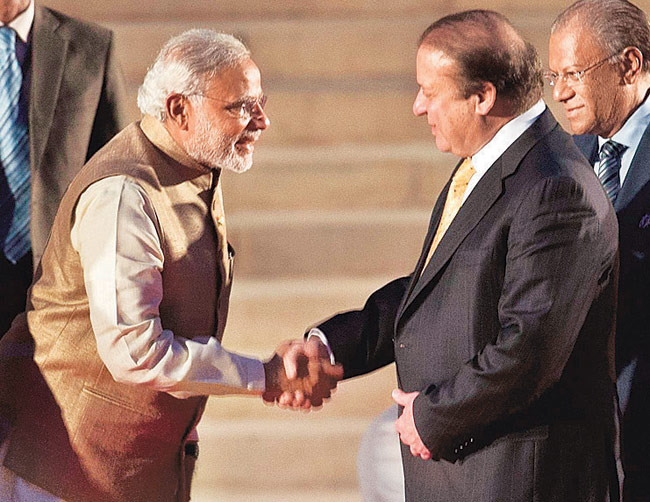
Modi has prided himself in being able to empower and use the bureaucracy in Gujarat, and now he hopes to do the same in Delhi. However, is his communication also going to be defined by the not so creative Delhi Durbar? Will slow moving bureaucratic systems do justice to a man known for his glib oratory and deft communication? Let’s take the swearing in ceremony as a case in point. The to be Indian PM invited Nawaz Sharif and other SAARC leaders (and Mauritius) for his swearingin ceremony. It was a grand spectacle that did create excitement and was largely appreciated and yet one was left with a hollow feeling the day after. We got to know what the MEA felt about it-its official statement offered standard, cut and dry and politically correct fare.
We know what every Pakistan watcher and self-styled foreign policy expert on television and on the op-ed pages thinks about it. But we still do not know what PM Modi thinks about it. What is this big-picture neighbourhood philosophy that he seems to be crafting? Or is there one? It was his show all the way, and his views and vision are still missing.
More recently, when the rapes and murders took place in Badaun and when the Muslim youth was killed in Pune, a calibrated communication response was required. While there may have been no need for the PM to react himself, a statement from the Home Minister, showing concern would have helped assuage the shrill response by civil society and the media. The government was absent on this count. PM Modi must realise that his victory is his to own alone, and so is all that goes wrong.
Revitalise
Silence is golden but there is such a thing as too much silence! These are early days and PM Modi is not really affected. Yet, a crisis could unfold at any point. That is the nature of government and systems must be in place. He has always faced a hostile media. This has not changed since his election. The honeymoon period may be shorter than anticipated and questions will be asked and the din will get louder each week.
During the election campaign, his masterstroke was bypassing media and engaging directly with people. He needs to do this while being in office as well. It will help to explain the big but potentially controversial policies he wants to pursue. Of course, he can’t do it every week or every day as he did during the campaign. As such he will need to think of a routine, and of a creative mechanism to manage public expectations and the media. The PRO cannot remain out of bounds for the media, not for the media’s sake but for the sake of the PM and for the policy line he wishes to perpetuate and guard. This is how governments work everywhere.
Twitter and other social media platforms are excellent communication tools and the PM has mastered their political potency faster than most Indian politicians.
In government, he needs to build a platform that combines social media with more traditional communications mechanisms. He needs to disrupt the lethargy of the Lutyens communication machinery by introducing some of his young campaign team into the mix and he needs to reinvent and revitalise # NaMo in his new role as PM. It was # NaMo that got him here.
The writer is Vice President & Senior Fellow at the Observer Research Foundation
PUBLISHED: 23:09 GMT, 5 March 2014 | UPDATED: 23:09 GMT, 5 March 2014, DailyMail
Original link is here
I have never been happier being an Indian, and never have I wanted to celebrate my Indian-ness more.
As democracy deepens, it liberates deeply. I can slander, I can abuse, I can defile and I can defame; no court system will catch me, no editor will moderate me, no news media will deny me space.
I am carefree in my abuse; I am careless in my accusations. I live in the gutter and I look down on the world. I love being an Indian.

“Being poor is my calling card, and poverty is my vote bank” (File picture, Kolkata)
Abuse
I can abuse the republic, I can abuse my currency, and I can abuse the founding fathers that built this nation. I can murder, plunder, kill and slaughter in broad daylight. The courts will forgive me, the executive will release me, and the country will probably celebrate me. I love being an Indian.
I don’t have to watch debates. In fact I don’t even need to allow debates. Debates are overrated. And if by chance there is some instance of a debate that overtakes me, I can either switch off the television or even better, stop the broadcast of the TV channel. I have a powerful remote control. I love being an Indian.
I embrace all religions. I use the Muslims for the votes they give me. I use the Christians for the schools they offer me. I use the Sikhs for fields of wheat they till. Minorities are manageable. Even my symbolism is selective as my incentives are effective. I love being a Hindu, a secularist, part of the overwhelming majority. I love being an Indian.
It is that thrilling season for bashing up billionaires, wealth creators and innovators. Entrepreneurs are indeed evil, corporates are the devil’s workshop and profits are the preserve of Sodom and Gomorrah. Let’s get rid of 20 years of development; let’s go back to the ’70s. I love being an Indian.
I am sympathetic to gender issues. On television, I argue for greater sensitivity, but in dark alleys, lounges and bazaars, I grope and feel my way around. In elevators I may even assault, and blame it on a right-wing conspiracy. I am thoughtful to the extent that I proscribe how the women dress and decide what they wear. I am the modern caring Indian man. I love being an Indian.
I am a global citizen. I understand the black man and the white man like no one else, and being brown allows me to be fair to both. Hence, I can describe the black man as a drug peddler and the white woman as lacking in virtue. The rule of law does not apply, as long as my bigotry is in the majority – at least within the lynch mob that always seems to follow me. I love being an Indian.
I am honest in my appraisal of diversity. I appreciate people by describing them as “chinky” or “kaaley” or “madraasi,” knowing all about their congenital group vices. I even allow them freedom and space, but outside my locality. I can thump my chest knowing that I am part of a tolerant diverse society. The world loves me and I love being an Indian.

Congress party activists celebrate the launch of the Mars Orbiter Mission (file picture)
Poverty
Being poor is my calling card and poverty is my vote bank. I love policies that make everyone poor – bringing down economic growth and raising cost of commodities has added large numbers to this tribe. Spreading misery gets me votes, and I’ve been so successful at it over these last ten years that I believe I am in contention for another ten years. I love being an Indian.
I am the new age Casanova. I can love like no one else and even romance without any need for a response from her. I can use the state apparatus to woo her. Deploy public cameras to keep her safe, request the police to track her phone and then even to drive her home. I am the new age Lothario and I love being an Indian.
I have the world’s longest written constitution. I can legislate sexuality, allow pulping of books I dislike, and the burning of paintings I find offensive. These after all, are pursuits of a bunch of small deviants. Even the courts concur with me that these handful of outliers cannot seek to be part of the grand Indian civilisation. I love being an Indian.
I show great consistency on International law. I expect other nations to respect my interpretation of global conventions in their territory, when my diplomats and citizens are under investigation. Likewise I also demand the jurisdiction of my law, when I investigate officials of other countries in my territory …and also the high seas. I am fair and predictable. I love being an Indian.
I am the world’s largest inclusive democracy and I embrace everyone – murderers, thugs and bandits – and give them a second chance at life at the temple of democracy, where the work is mostly notional. I am in attendance for 60 days out of 265 at best, and when I do sit down to work, I have a whale of a time screaming, shouting and pepper spraying.
I love my celebrity status without the indignity of a screen test. The press loves to engage with me and when I don’t know what to say – TV anchors fill in the blanks for me. I love being an Indian.
Failure
I can be a mediocre bureaucrat, a banal banker, a tired general who just couldn’t get a service extension, or the unsuccessful captain of an extinct airline, an unknown anchor or a pedantic advocate. My failings are celebrated and I can even generate a political movement fuelled by the power of failure.
I can then propagate the madness of the ‘mohallas’, prejudices of the ‘khaps’ and biases within each of us. I strike a chord, as I am generous with all that isn’t mine, and for that I am loved.
I love being an Indian.
The writer is Senior Fellow at Observer Research Foundation
ORF POLICY PERSPECTIVE, Issue # 1, FEBRUARY, 2014, OBSERVER RESEARCH FOUNDATION
ORF Faculty members Nandan Unnikrishnan, Samir Saran and Uma Purushothaman have provided inputs for this Policy Perspective.
The Russia-India-China (RIC) grouping is the only body that brings together the three largest Asian countries at a time when there is a churning in the existing security architecture in the region. But, RIC seems to have lost steam amidst the alphabet soup of
multilaterals in which the three countries are engaged, despite some efforts lately to rejuvenate the forum.
Together, Russia, India and China occupy around 50 percent of Asia’s landmass. The three countries constitute some of the largest economies in Asia. They certainly also have the largest political stakes in the region. There are a lot of potential synergies among the three countries, making a compelling case for their collaboration. Therefore, it is natural that they should have a significant say in the emerging governance architecture in their neighbourhood and be an influential voice on issues of global governance.
Given the commonality of strategic goals, the RIC forum appears to be an appropriate platform that should now identify a unique roster of issues, which would differentiate it from other multilateral organisations, like BRICS and SCO, as well as allow the three powers to specify common objectives in the region and at global forums.
The first task would be to flag important issues in which the forum should engage. This exercise needs to be ambitious as well as steeped in a degree of realism. Congruent interests must also be accommodated in this effort. The three countries need to spell out some of the nuanced yet converging positions on key issues. Keeping these twin objectives in mind, some of the potential areas of engagement at the RIC forum may include:
1. AFGHANISTAN
Afghanistan is an area of interest for the three countries. Moscow, Delhi and Beijing want Afghanistan to be stable and each of them has a significant stake in ensuring that Afghanistan is not a refuge for terrorism or a haven for terrorist organisations. This can build on previous discussions held among the three National Security Advisors trilaterally and among other officials bilaterally. The three could work on projects for the economic development of Afghanistan and integrating the country into the regional economic mainstream, making it a subset of the SAARC effort to create a common South Asian market. Afghanistan can potentially become the geographic trade bridge between South Asia and Central Asia. Towards this end, it would help if Russia is brought into SAARC as an observer. This may have the added benefit of providing a
certain equilibrium to the RIC platform.
2.COUNTER-TERRORISM AND CYBER SECURITY
There are some global issues on which prima facie the three countries should have similar positions. India, Russia, and China could pursue a dialogue on counter-terrorism issues—starting with the exchange of information. Moreover, the forum could discuss cyber-security and develop a common understanding on cyber-governance. This is important given the growing online populations as well as the rise of digital commerce in all three countries; much of the discourse on management of cyber-space currently emanates from the West. It is important that RIC maintains
the distinction between cyber-governance and cyber-security.
3. STRATEGIC DIALOGUE
RIC can take up strategic issues, including the emerging security architecture, the situation in West Asia and Central Asia. At the multilateral level, they could discuss coordinating positions within the BRICS and SCO. India should lobby within RIC to promote reforms in the United Nations, including the Security Council, and specifically get RIC to endorse India’s candidature for the Security Council. The three countries should also work towards a consensus on pushing reforms
in institutions of global governance.
4.CONVERGENCE ON CENTRAL ASIA
There are sufficient synergies between Russia, India and China in Central Asia to justify deep cooperation. The three countries have ongoing bilateral dialogues on Central Asia. They could expand this engagement by also having a trilateral dialogue on the region. RIC must work towards thwarting the rise of Islamic extremism, providing political stability in the region and extending such stability to Afghanistan. The Indian subcontinent could be connected with Russia and Central Asia by developing transportation and telecommunications links via China.
5. THE RUSSIAN FAR-EAST
RIC could develop a roadmap for joint collaboration projects in the Russian Far East, which
Moscow is keen on developing. India and China could pitch in with their respective skill and labour competencies as well as investments.
6. EXPANDED SECURITY COOPERATION
RIC countries can cooperate in non-traditional areas such as disaster management, human trafficking, and drug trafficking by developing joint guidelines on these issues. They could also
enhance their cooperation in counter-piracy and humanitarian relief in the Indian Ocean.
7. NUCLEAR COOPERATION
The nuclear non-proliferation regime is witnessing dramatic changes with the temporary deal and talks between the West and Iran. RIC needs to engage with this emerging global nuclear order. Additionally, RIC countries could look at means to enhance civil nuclear cooperation among themselves. India and Russia are already partners and China has long to mid-term plans to enter this space commercially. This would offer India and China the chance to further their claim to play a strategic role in shaping the new nuclear order. It could buttress India’s entry into the four nuclear export control regimes, i.e. the Australia Group, Wassenaar Arrangement, Missile
Technology Control Regime (MTCR) and the Nuclear Suppliers Group.
8. ENERGY COOPERATION
The three countries should discuss energy security in Asia as they form the core of much of the energy supply and demand of the world. India and China are two of the largest importers of energy and Russia is one of the largest exporters of energy. According to IEA estimates, by 2030, China is projected to consume 200 bcm of gas while India is projected to consume 116 bcm. At the same time, Russia’s gas production is expected to reach 727 bcm while Central Asia is expected to produce around 323 bcm. The three countries could discuss the creation of an Asian energy grid. This would go a long way in ensuring energy security for the region as well as allow these
countries to determine prices suitable to them.
9. TAPPING THE SOCIAL SECTOR
Russia, India and China can broaden joint research, cooperation and exchanges in education, agriculture, healthcare and science. They could also work towards a common understanding on global governance issues like maritime spaces and outer space.
10. COMMERCE AND TRADE
RIC could also discuss a multilateral currency swap arrangement on the lines of the Chiang Mai initiative. They could discuss the possibility of the establishment of a framework for enhanced cooperation among Chambers of Commerce of the three countries and improvement of the exchange of information on commercial opportunities and specific trading conditions in order to boost trade and investment. The RIC should discuss ways and means of promoting bilateral trade—using the trilateral to strengthen bilateral trade ties. Joint projects, for example, in aerospace should also be on the agenda.
The Indo-Russia relationship is one with hardly any differences at the political level. India and Russia should leverage this special relationship in order to deepen China’s integration into the RIC format.
To conclude, RIC stands at a historic moment when it can further Asian integration at a time when the region is seeking to redefine itself. RIC can also significantly influence the development of the new rules of global engagement. This moment must not be lost. To this end, the following specific suggestions may help give the RIC forum greater relevance in the near future:
• Establish an annual RIC summit level meeting;
• Start a RIC dialogue on Central Asia;
• Intensify the RIC Dialogue on Afghanistan;
• Institutionalise a Dialogue of National Security Advisors on Cyber Security and Counter Terrorism;
• Create a joint working group on energy cooperation;
• Create a joint working group on drafting joint guidelines for cooperation in disaster management in the
region.
Nandan Unnikrishnan, Vice-President & Senior Fellow Samir Saran, Vice-President & Senior Fellow Uma Purushothaman, Associate Fellow February, 2014, Observer Research Foundation
 Samir Saran