NEW DELHI — India’s long-awaited pledge for a global climate pact shows how the world’s No. 3 carbon polluter is making significant efforts to rein in the growth of emissions linked to its fast-surging demands for energy, analysts said Friday.
India vowed to reduce its emissions intensity by 33-35 percent by 2030 from 2005 levels, primarily by boosting the share of electricity generated by sources other than fossil fuels such as coal and gas to 40 percent.
That means India’s emissions will continue to grow as its economy expands, but the increase relative to economic output will be lower than it is now.
“Our every action will be cleaner than what it was earlier,” Environment Minister Prakash Javadekar told reporters Friday, insisting that Indian traditions and culture are already “at one with nature.”
India was the last of the major economies to present its offer for the U.N. climate deal that’s supposed to be adopted in December in Paris.
Javadekar said India held its submission back so it could coordinate its filing with the Indian holiday celebrating the birthday Friday of the country’s forefather, Mohandas K. Gandhi, an ardent environmentalist.
As of Friday, 146 nations accounting for 87 percent of global carbon emissions had submitted their pledges.
Environmental groups following the U.N. climate talks welcomed India’s offer.
“India now has positioned itself as a global leader in clean energy, and is poised to play an active and influential role in the international climate negotiations this December,” said Rhea Suh, president of the New York-based Natural Resources Defense Council.
Some said the carbon intensity target was conservative and projected that India would exceed it if it meets its renewable energy goals.
“This shows that key economic and infrastructure ministries have been closely engaged in formulating climate policy, which is an important break from the past,” said Navroz Dubash of the Centre for Policy Research in New Delhi.
Climate analyst Samir Saran at the Observer Research Foundation, a New Delhi think tank, also described India’s targets as ambitious and “rooted in Indian reality,” given the fact that at least 300 million citizens — a fourth of the population — still have no access to electricity at all, while hundreds of millions more make do with just a few hours a day.
India’s submission also made that point, noting that “it is estimated that more than half of India of 2030 is yet to be built.”
Prime Minister Narendra Modi has made manufacturing and job creation a key promise of his administration, and has implored foreign companies and governments, with the slogan “Make in India,” to help.
India also promised aggressive reforestation efforts, with enough new trees to absorb up to 3 billion tons of carbon dioxide by 2030, and laid out plans for adapting to changing weather and temperatures.
“This is a positive and novel Indian approach,” Saran said, adding that India was effectively sharing responsibility for taking action to protect the climate while seeking global partnerships on implementing those plans.
India plans a fivefold boost in renewable energy capacity in the next five years to 175 gigawatts, including solar power, wind, biomass and small hydropower dams.
Even with a major boost in renewable energy, India is also planning to expand coal power — the biggest source of emissions — to satisfy its energy needs. Coal-fired power plants account for about 60 percent of India’s installed power capacity.
By 2030, the government said its installed capacity from “non-fossil fuel-based energy resources” would grow to 40 percent. Currently non-fossil sources account for about 30 percent — half of it solar and wind power and the other half large hydropower and nuclear.
India said boosting its renewables would require help with transfer of clean technology and financing — two of the crunch issues before the Paris deal, which is supposed to apply to all countries but also include provisions for rich countries to help poor countries fight climate change and adapt to its consequences.
Scientists say the heat-trapping carbon emissions released by the burning of fossil fuels — coal, oil and gas — are a key driver of rising temperatures that could lead to potentially catastrophic impacts, including flooding of island nations and intensifying droughts.
China and the U.S. are the only countries with higher emissions than India. As a bloc, the 28-nation European Union’s emissions are also higher.
Like other developed countries, the U.S. and the EU committed to absolute reduction targets, while China pledged that its emissions would stop growing by 2030. India, with hundreds of millions still living in poverty, wasn’t expected to offer a peak year because its emissions are projected to increase for decades as energy demand rises along with economic growth.
Javadekar said industrialized countries should be setting even more ambitious targets than what’s been pledged so far.
“The developed world has polluted the world, but we will help even though we are suffering,” he said.
Two climate research groups this week said the pledges put forth before the Paris conference would slow global warming but projected that temperatures would still rise by between 2.7 and 3.5 degrees C (4.9 and 6.3 degrees F).
___
Ritter reported from Stockholm.
___
This report has been revised to correct quote from Javadekar.
At a discussion in Washington DC this spring, I was quizzed with a degree of annoyance on the multiple messages coming out of New Delhi with respect to India’s position on a global agreement to combat climate change. In the same discussion there was also an exasperated inquisition on why Indian needs and priorities must hold the world to ransom (as if there were a consensus) and why India imagines that it merits a special space, attention or exception in the climate arena.
The response to these two central propositions on India and climate change must of course come from the officialdom at Raisina Hills, home to Delhi’s executive offices. However, as we move down the road to COP 21 in Paris, it is crucial that any response, if formulated and then communicated (a bigger ‘if’), would need to engage with the most important climate proposition put before India by the world, and its interplay with the country’s development/growth imperatives.
Viewed from New Delhi, and after sifting through the chaff, the proposition for India’s climate change response posed by a large section of OECD countries, and certainly from the influential capitals in Europe, is fairly straightforward:
India must be the first country in the world (of size and significance) to successfully transition from a low-income, agrarian existence to a middle income, industrialised society without burning even a fraction of the fossil fuels consumed by other developed countries. China was the last country to enjoy this privilege. India will be the first that will have to cede this option and of course this may well be the new template for other developing countries to emulate.
The scale of this transition and the current economic situation in some parts of the world, alongside the complex and privately controlled innovation landscape, means that there is limited ability for the Annex 1 countries (the developed world) to offer any meaningful support in terms of financing or technology transfer. Official Development Assistance (ODA) is a small fraction of what is necessary today, and India will therefore need to mobilise domestic resources to power the non-fossil-fuel-fired Indian story.
Even as India adopts this ‘exceptional’ approach to industrialisation, and creates the necessary financial and commercial arrangements to achieve it, mostly through its own endeavors, the developed world and others want to retain the right to judge Indian performance. India will be monitored with an increasingly extensive system of compliance verification, and will be criticised for its missteps on the journey despite the novelty and scale of its undertaking.
My response to the thesis of ‘Indian exceptionalism’ therefore is that India does not seek to be an exception, but the demands imposed upon it that will require it to be exceptional. This is a truth for others to accept, and the climate reality for which India must discover creative policy. Three distinct narratives among various actors in India have so far shaped its response.
The first set of responses is from a group of people I like to call India’s ‘cold war warriors’. This group believes that no matter the contemporary political, economic and environmental reality, an alternate universe can be constructed through the mandate of the UNFCCC. These persons are the architects of the global intergovernmental processes and have faith in them. They believe that an agreement in Paris this December at COP 21, that is sensitive to Indian needs, will somehow assist in the transition required by India and will ensure that India only needs to make incremental changes to its ‘business as usual’ approach to economic growth and development. This group has ignored the changing economic system, which is increasingly disinvesting from fossil fuels politically, and in terms of financial flows and promoting green energy markets. The ‘green’ economic and market realities that will shape India’s future are seen as something that can be circumvented by creatively crafted text and clauses in a legal (read weak legal agreement) agreement in Paris. Despite 20 years of failure to achieve this ‘world of equity’ with ‘differentiated responsibility’ they continue to believe that a global agreement is the end in itself.
The second set of strategies to the proposition facing India are advanced by a group I refer to as the climate evangelists. They believe that 2050 is already upon us. Commercially viable clean energy solutions are available, and these hold the answer to both our immediate and future energy woes. The opportunities that exist in the creation of a new green economy must be grabbed with both hands. This group wants subsidies and incentives for clean energy technology, and taxes and regulation of fossil fuels. These green pioneers are sanguine that sufficient ‘push’ and ‘pull’ will deliver technology innovation and development on the requisite scale. They reject that fossil fuels are necessary as baseline sources of energy and instead insist that the technological revolution is already here, and that India must get on board or be left behind. Their argument is often a moral one: we have a moral obligation to save the earth for its own sake and for future generations – ignoring the fact that at this level of income disparity, inequality and differential access to the right to life, the planet is in fact being saved for the rich to flourish.
The third set of responses is from the group I call the climate realists. The realists understand that the global climate proposition is inherently unfair, and that India could and probably should push back against such an imposition by the developed world. However, they also recognise that no matter how hard they try to construct a ‘fairer’ agreement in Paris, the combined forces of the market, society and technology are all pointing towards a ‘greener’ transition. The political economy of climate change necessitates a transformation, and it is not necessarily in India’s interests to fight against it. Instead, the realists understand that there is an opportunity to lead in constructing a green economy. They believe that this moment can be used to reshape the tax, financial and global governance systems. They also see no contradiction in also ensuring continued flow of investments and emphasis on lifeline sources of energy for India’s poor.
Analysis shows that India does better then Germany, the United States, China and others on per capita coal dependence, with about a third of the consumption levels of the greenest among these three. It also already commits, as a proportion of its GDP, more towards renewable energy off-take than most (except Germany). It therefore does not need to defend its coal consumption. On the other hand, it must certainly be the champion to encourage ‘greener’ performance from others. The equity that it seeks lies in this. The rich must continue to invest more in renewables. This must be demanded and enforced.
Prime Minister Modi’s recent statements suggest that he may be such a realist as well. He is promoting an aggressive renewable energy thrust, while being uncompromising on the point that lifeline energy will continue to rely on coal for the foreseeable future. When he takes coal off the discursive table, he is not foreclosing the right to use coal; instead he is sharpening the focus on India’s impressive credentials around green growth. He invokes religious texts, civilisational ethos and clever political word-play as he seeks a leadership role for India in global climate policy, and sets the agenda with ambitious plans for transitioning to a new energy paradigm. The ‘house always wins’ is a golden Las Vegas adage with a lesson for global politics too: unless we see strong political leadership of the kind being displayed by Prime Minister Modi and President Obama, the house – in this case national officialdom(s) and global bureaucrats – will prevail again. They will construct a new world order with words, commas and full stops, where nothing, not even the climate, can ever change.
Out of the 7 billion people that inhabit our planet, around 2 billion, still lack access to essential medicines and 925 million are chronically undernourished. Almost a third of all yearly human deaths are due to poverty-related causes. The richest 14 per cent of the world’s population have a mean life expectancy of 84, while the poorest 34 per cent live for only 36 years on average.
This situation represents a failure in the provision of a basic human right to “standard[s] of living adequate for the health and wellbeing” of an individual and his or her family, “including food, clothing, housing and medical care and [other] social services”, as highlighted in the 1948 Universal Declaration of Human Rights; these also constitute what is commonly referred to as the right to life.
International and multilateral processes continue to obfuscate the centrality of the right to life outlined in the 1948 Charter. The year 2015 is crucial for global agreements that establish the trajectories and paradigms of development. The Millennium Development Goals (MDGs) are set to be replaced with the Sustainable Development Goals (SDGs) at the UN General Assembly in September and negotiations on a new global treaty on climate change will culminate in Paris in December. The narrative of development in the 21 century will be defined by these two agreements. While the pursuit of European styled sustainability is important, the need to secure the right to life of each human should be paramount, unconditional and non-negotiable. The well-being of the planet holds no attraction for those excluded and the ambition to save it for future generations has little appeal unless we mobilise a wider set of ‘invested’ stakeholders.
The fact that the first of the newly delineated SDGs aims to “end poverty in all its forms everywhere” is promising, but the urgency of this objective could be drowned out by the wide proliferation of goals: 17 in total – with 169 targets. More goals will not translate into more funds to meet the goals. There is also concern that such targets could be turned into pre-conditions for flow of aid, whereby poverty alleviation efforts could be shackled by a focus on factors that are coloured by ideological considerations.
Key fault lines were again revealed by the informal substantive sessions leading up to the Financing for Development (FFD) conference in Addis Ababa this year. India and the rest of G77 warned against an overwhelming emphasis on environmental goals at the cost of poverty alleviation, and highlighted the principle of ‘additionality’ — new resources required over and above current Official Development Assistance (ODA) in implementing the SDGs. Contrastingly, the developed nations underscored the importance of sustainable economic practices, domestic resource mobilisation, and new financial instruments such as commodity-based derivatives.
Ultimately, the Addis Ababa Action Agenda adopted at the conference failed to yield concrete new proposals for additional funding that can be swiftly implemented to meet the world’s multiple challenges. Put simply, there was no new money brought to the table. Instead even the previous ambition of the rich countries to commit 0.7 per cent of Gross National Income as ODA remains only a statement of intent .
Worryingly, the Addis conference once again exposed the inequities present in global decision-making processes. The India-led initiative to upgrade the UN tax committee to an intergovernmental tax body yielded only symbolic gains (rallying together of the G-77) after developed countries blocked such efforts and instead argued that the OECD was taking the lead in such efforts. Over 100 developing countries thus continue to be excluded from decision-making processes on global tax standards. It is worth noting that lost tax revenue for development financing purposes in developing countries is estimated at over USD 300 billion annually. This dwarfs the total ODA financing for 2013 which stood at USD 135 billion. The process of building the post-2015 development agenda seems to be struggling to reconcile present needs like the eradication of poverty and hunger, with more value based goals. A worrying divergence in priorities has become apparent, a divergence that threatens to manifest itself in multilateral deals that neglect the need for survival of a large proportion of the world population.The economic and social compulsions faced by the poor must come first, ahead of value frameworks that are driven by first world priorities. When more than a third of the world’s population does not live to see 40 on average, it is clear that securing the right to life for these people should be the only priority of global developmental processes. Can there ever be any shared values, if there is no agreement on the fundamental right to life?
(Samir Saran is vice-president at the Observer Research Foundation and tweets @samirsaran)
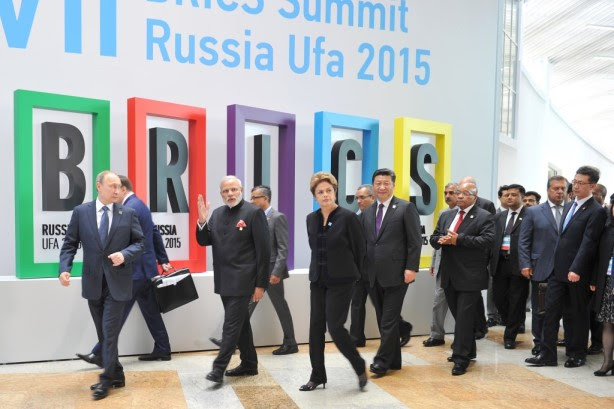
As BRICS leaders met in Ufa, Russia, for their annual meeting late last week, there were expectations and anxieties galore. The group met as tensions between Russia and NATO rose, Europe’s circus of the absurd (the Greece crisis) continued, impending global agreements on sustainable development and climate action were being negotiated, and celebrations for the 70th anniversary of the UN approached in New York. All of this at a time when the liberal international order was shown to be inept at managing radicalism, barbarism, parochialism and illiberalism across the world.
The BRICS member states are also experiencing their own specific political moments. Russia is struggling to cope up with the dynamics of the energy sector economy and is involved in an intractable conflict in its neighborhood. Brazil seems to have lost the ‘Lula mojo’ and is fighting economic and political inner demons. South Africa and its enthusiasm for being the gateway to Africa has suffered a body blow with reports of a series of fatal attacks on African migrants. India is pre-occupied with rewriting its story under the tireless outreach of Prime Minister Modi, who is exclusively focused on reshaping India’s economic trajectory. And then there is China, which is putting together the plans and institutions that might soon constitute the ‘Beijing Consensus’ that could dominate the geo-economic landscape over the next few decades.
The 77-paragraph outcomes statement from the summit was inevitably going to be a list of ideas that would cater to different expectations and aspirations of each of its members.
What BRICS means for Russia
For Russia, the political takeaways are the key. If one was to go through the list of Russian proposals on BRICS cooperation in the months leading up to the summit (some at the official level others at track II dialogues), you would detect an aspiration to create a political aggregation among the BRICS collective. These proposals included an ambitious agreement on cyber security, cooperation on outer space, peace and conflict treaties, a proposal on planetary defence, a new agreement on non-aggression and peaceful co-existence, non-proliferation arrangements around new technologies and even a new arms control and export control regime.
As Russia’s global legitimacy shrinks, the role of BRICS as a legitimising platform becomes more important for Moscow.
For many Russians, the world has moved on from the Cold War of the last century to the ‘Hot Peace’ of the current one. To them, BRICS must be a force for stability, and one that can counter what they see as the eastward expansion of the Atlantic alliance. That the official statement covers some of these Russian ideas (watered down, no doubt) is Russia’s gain.
What BRICS means for China
The import of BRICS for the Chinese is starkly different. They are in the process of resetting some key rules that have defined postwar geo-politics and geo-economics. To them, BRICS may be another platform that will institutionalise and promote those facets of global engagement that benefit China. While confrontation between Russia and NATO is something from which Beijing would wish to keep a healthy distance, China’s leaders realise that a beleaguered Russia offers them a chance to consolidate their ‘March west’ agenda, through the central Asian and Eurasian landmass and into the heart of the EU.
Still, never in their wildest dreams would China’s leaders have imagined the servility Russia is now demonstrating.
A Russia that once killed the opportunity to integrate with Western Europe because Moscow was unwilling to play anything less than ‘big brother’ now seems willing to play second fiddle to the Chinese dragon. Such was the level of kowtowing to China’s ambitions and agenda that many at the track II meetings over the past couple of months remarked that Russia had officially replaced South Africa as China’s ‘B Team’ within BRICS. One Russian proposition went so far as to suggest that the New Development Bank (NDB; a joint BRICS development bank but one which is strongly influenced by Beijing) must support and lend to the Chinese One Belt One Road initiative. This was reminiscent of the concentration of all financial flows in the past century serving to reinforce US power.
But for Beijing, BRICS could offer three key benefits vital for its national project. First, BRICS offers a truly large economic landscape on which the experiment to internationalise the Renminbi could begin. The NDB, the trade cooperation agreement and the economic cooperation pact among BRICS could facilitate this. The second key advantage has to be diversification of the Chinese product market by moving towards an eventual BRICS Free Trade Zone, seeds for which were planted in Ufa.
The final advantage of BRICS for China is the affirmation it gives to the legitimacy of the Chinese system, something no democratic bloc has accorded Beijing before. Outside the BRICS context, it’s hard to imagine Brazil, South Africa and India discussing, defending and promoting the Beijing Consensus, which is premised on everything these three democracies otherwise abhor. BRICS gives the Chinese dragon the license to drive a wedge in the liberal order.
What BRICS means for South Africa
South Africa is a BRICS anomaly; it is dwarfed in demographic and physical size by the others in the group. Yet it is this anomaly that makes the BRICS gambit so important for South Africa – effectively acting as its ticket into the big league. Pretoria has been promised a regional hub of the BRICS bank, which means South Africa will be the node for BRICS into Africa. This puts a potent tool in South African hands but also saddles it with the responsibility of reconciling its differences with other African economies and polities.
What BRICS means for Brazil
Brazil is struggling to define its role in BRICS, with its attendance reduced to the mundane. Much of this has been due to the Government being bogged down by domestic problems, leading to a loss of the momentum that President Lula had injected. For a country that is still searching for its place in the world, the Lula vision was to move Brazil from being merely ‘that big country on the left of the map’ to becoming a critical partner in the Asian century. BRICS provided it a free ride to undertake this ambitious plan. But it remains to be seen how and when Brazil will overcome its inertia.
What BRICS means for India
Finally we have India, in many ways the proverbial swing state for which BRICS could offer the flexibility it needs and without which the BRICS would not just lose its ‘I’ but also a fair part of its identity. For a country that is slowly but surely exhibiting signs of becoming part of the liberal order it once opposed, BRICS is the rhetorical, normative and tactical vehicle to affect its transition from ‘trade union leader’ to ‘global manager’.
The BRICS rubric also allows for sustained engagement with China, which could build multiple dependencies. It enables India to demonstrate muscularity on its border dispute with China while concurrently embracing it. For example, the New Development Bank and the Asian Infrastructure Investment Bank enable India to participate in Beijing’s ambitions and benefit from it (it needs huge doses of commercial loans and development finance) without being socialised into ‘Pax Sinica’.
BRICS will be beneficial for India if it opts for pragmatism over ideology and sees the Beijing Consensus as means of shaping the discourse of the ‘east’ until it is able to script one of its own. On the other hand, if Delhi chooses to play the ideological card, it will end up on the wrong end of the bargain as it did with the Washington Consensus – staying out and consequently being excluded from the mechanisms and institutions that shape global development and direct global capital.
BRICS is also the last hand India has to play with Russia, given the dwindling interdependence between the two states. India fears continental encirclement, owing to increased Russian engagement with Pakistan (visible in the diluted treatment of counter-terrorism in the BRICS outcomes statement) and what it believes is a Russian slide into China’s orbit. Consequently, it will be through the normative processes as well as the economics of the BRICS grouping that India can maintain a serious balancing play with Moscow.
Finally we must acknowledge that for all the talk of a rising democratic India being welcomed with open arms by the great powers, India’s acceptance into the Western-led global order has been lukewarm. A deeper integration into BRICS, as the outcomes statement promises, will give Delhi far greater bargaining power in negotiating its place within the global political and economic governance institutions currently dominated by the West.
Even as Washington expects India to be a net security provider in the Indo-Pacific region, the country is offering itself as a key partner in managing the cyber oceans. The US must now reciprocate.
When the Snowden revelations brought American control over global communications into sharper relief, the United States threw a curveball at the global Internet community. It proposed and backed a multi-stakeholder framework of governance to manage the critical logic layer of the Internet and offered to replace US oversight of key functions within the Internet Corporation for Assigned Names and Numbers (ICANN) to a body comprising all stakeholders. It was becoming apparent that while the net as we know it may well have been invented and seeded in the US, its continuing and overwhelming control of this common resource was untenable. But the US proposal was clever for two reasons. First, US corporations and US civil society groups (many funded by these corporates) are more than capable of managing core US interests even after Washington cedes control. Second, it was and is still quite improbable for a multi-stakeholder mechanism to replace US control of the functions of the Internet Assigned Numbers Authority ( IANA), failing which the IANA transition process would continue to remain where it was. Indeed, this was precisely the outcome which loomed large as important digital nations such as India remained at a distance from this process.
Things changed dramatically on Monday when the Indian Minister for Communication and Information Technology, Ravi Shankar Prasad, in a video address to the ICANN gathering in Buenos Aires stated that, “the internet must remain plural, must be managed through a multilayered and multistakeholder system.” He added that “its strengths will lie in partnerships between like-minded nations and stakeholders, built on a platform which supports and will sustain a future of equity and innovation and collaboration and inclusion.”
Nuances in India’s stand
Even as this announcement is studied, digested and lauded, some nuances within the text need to be discussed further. First, it is clear that even as India has opted for the multistakeholder system of global governance, it is still pushing for reform of this system to ensure it becomes more plural, equitable, geographically representative and democratic. This is something the minister’s speech clearly highlighted. It is not business as usual for India and it will certainly not be business as usual for those occupying pride of place on the governance high table. This model requires greater plurality and diverse representation that will challenge much of the group thinking that dominates this sector. Prasad was categorical in his pronouncement if the subtext of his speech is properly understood. India was not merely seeking to blindly support a system of Internet governance dominated by the Atlantic countries but was seeking an imminent rebalance towards Asia.
The second message embedded within Prasad’s speech was that India is keen to engage with all forums . The fact that the Indian minister announced the policy shift at ICANN53 is a message in itself. That he is finalising his visit to ICANN in the near future is evidence of deeper engagement with a process that India had hitherto distanced itself from. The minister also alluded to something that has exercised the mind of many Indian stakeholders, that the country must host something that can match and surpass the scale and reach of the NETMundial hosted by the Brazilians. The development agenda and the framework for the digital economy that could change the lives of the ‘next billion’ must be crafted and co-developed by this billion, in their own neighbourhoods. The minister’s assertion that India will host an international conversation that will articulate India’s own motivations and objectives to the world and make the global community a partner in this mission must be understood in this vein.
The next billion
The Indian state has both committed to transforming itself through digital means and at the same time building a global system that can accommodate and allow for such a transformation. Access, Voice and Opportunity must not be more cumbersome for the ‘next billion.’ And, this also means more responsibility for the Indian government. By opting for multistakeholderism it has just signed up for a bag full of new responsibilities. The agency of the sovereign will now have to be secured by a variety of stakeholders who may be more acceptable in certain forums. The government will have to invest in building capacity among them, building greater diversity among those who participate and ensuring greater representation of these stakeholders at key Internet governance debates globally. Without this, for India and many others, the global multistakeholder system will continue to reinforce existing disparities of the real world even in the digital world.
The third significant message within the speech was the quest of India to seek partnerships with key countries and institutions. And it is here that India will be able to carve a space significantly different from others. A space that a country of the size of India needs, the room a diverse and developing democracy must have. The needs of a billion people impose a very different set of responsibilities on a political system which must deliver to remain relevant. This was a call to those on the governance high table, particularly the United States, to respond adequately to the Indian overture. That these two countries, the largest net communities in the democratic world, must cooperate is unexceptionable, essential and inevitable. The details of this cooperation now need to be fleshed out and could be based on three key strands of association.
What the US must do
The US has long considered the free flow of information and commerce a pre-condition to a healthy global economy. India, as it digitally connects, is looking to forge the right partnerships to ensure limitless economic opportunities for its citizens. The first pillar of the India-US cyber relationship should be to ensure that their consumers and producers are able to leverage the largest English-speaking digital markets in the world. For this, they need a digital space free from encumbrances of power politics and petty policy. This would mean rationalising tax regimes, expanding Internet connectivity, settling issues of Internet jurisdiction, developing contemporary approaches to intermediary liability and operation, agreeing on data collection, data ownership and data management, privacy and freedom of expression, as well as developing an eco-system that would allow for investments in technology and infrastructure, crucial for the development of these digital markets.
A strong security partnership is the second aspect of the India-US relationship. Both countries believe strongly in the role of national governments in shepherding their societies through a host of new challenges. For both, strong nation-states lie at the centre of a multistakeholder system and, unlike European countries, neither is seeking to aggregate or dilute sovereignty. Therefore, the bilateral partnership needs to be built on a realist paradigm. From information sharing on crime, to attacks on critical infrastructure to countering terrorism, the India-US relationship can rise to become the backbone on which the Internet stands strong. For the US, this partnership should form the central ‘I’ of the Internet. For India, the US is already its chief digital interlocutor.
There should also be close collaboration on the logic layer of the Internet. Any one who understands the Internet realizes that there is a certain reality of the logic infrastructure that the Internet runs on. This is the dominance of the United States of America. Though the international community may manage ICANN or some other institutions, oversight rests with the US government alone. US courts have jurisdiction over the entities, and disputes between countries and Internet institutions are tried under US law.
Yes, WeCANN
The India-US relationship must deliver space to India on this front. Even as the all-important debate over how best to internationalise these institutions continues, the US must find ways to provide India the comfort that it seeks for its huge digital community. This could be by way of a bilateral deal around digital jurisdiction and territory, more Indian presence in the corporations involved with running the internet – the ‘i’ family – as well as the eventual and desirable location of a root server in India. The argument that “if we give this to India, China will want it too” is disingenuous. The US policy community continuously reminds India that it must not side with a Russia or China, as it is different and democratic. Yet, the very same community is quick to create equivalence of these countries with India when the latter seeks unique treatment.
Carving out a place for India, proportional to its growing weight in the global Internet eco-system is crucial. If this does not happen, the celebrations around India supporting a multistakeholder system may be short-lived. The security and political hawks will strike back and prevail and the Indian state will find comfort in the old methods of the last century. The US must see this message from Ravi Shankar Prasad as an opening, a new opportunity to meaningfully engage India.
Even as Washington expects India to be a net security provider in the Indo-Pacific region, the country is offering itself as a key partner in managing the cyber oceans. This moment must not be lost. India has responded favourably to the post-Snowden Internet governance proposition, The US must now reciprocate.
(Samir Saran is Vice President and Mahima Kaul heads the Cyber and Media intiative at Observer Research Foundation)
With the conclusion of his three-nation tour of China, Mongolia and South Korea last month, Prime Minister Narendra Modi capped a frenetic first year of diplomacy. It is becoming apparent that the emphasis on the Asian region will continue to be an imperative for the rest of his term. In this past year alone, the Indian Prime Minister has invested about twice as many days visiting the ‘east’ — Asia, the Indian Ocean Region and the Pacific — as against his ‘westward’ travels.
Is this a reinvigoration of India’s Look East policy? Does it mean relatively less importance to the West? And, what are the drivers of this policy? Barring the notable absence of West Asia from his travel schedule, it is clear that ‘Engage Asia’ has been the predominant mantra of Modi’s early days in office.
This Asian focus is decidedly different from previous efforts by Indian leaders to integrate with the neighbourhood. Those efforts were driven by the idea of demonstrating Indian leadership in a particular geography, or they were manifestations of south-south solidarity, or they were necessitated by security concerns emanating from across the border.
The current effort is something more. It is primarily aimed at completing two specific national projects, while at the same time positioning India at the helm of global affairs.
The first national project is to complete ’20th century India’: future-proofing Indian infrastructure; installing enough energy to power the nation; connecting the country with its periphery and beyond via roads, rail, ports and airports; developing manufacturing bases to employ the millions entering the job market each year; and investing in housing, agrarian and other social infrastructure that most developed economies take for granted.
Modi’s Asian thrust is designed to find partnerships, technology and funds to complete this 20th century project. The Atlantic countries do not have the financial capacity to invest in large infrastructure and energy projects. They do not have the political room to commit to carbon-intensive industrialisation. And they no longer have the wherewithal to offer 20th century inputs (equipment, energy and technology) for an insatiable India.
All of these are readily available to the east of India. Consider this: China, Japan and Korea between them have close to US$5.5 trillion in foreign exchange reserves, funds desperately needed for this 20th century project.
There is a coincidence of needs as well. Each of these economies needs to invest in new geographies. They need to generate wealth out of what are now stagnant reserves. These are countries that have successfully completed their industrialisation projects and need to find outlets for investment in the industrialisation of others. That’s why China has become the biggest provider of energy-generation equipment to India and wants to build high-speed trains here. It is why South Korea wants to build nuclear reactors and ports in India. And it is why the Japanese want to set up industrial corridors in India. Asia is also the source of most of the energy needs that are indispensable to this national project. Be it gas, uranium, coal variously sourced from Australia, Mongolia, Central Asia and the Middle East, this region offers India plenty of energy opportunities.
When Modi travels to these countries, it is tacit recognition that the response to Indian requirements carried forward from the last century reside there.
Then there is India’s ’21st century project’, driven by innovation, based on new technologies, located within digital economies and fueled by enhanced human capacity. This is the service-sector paradigm that India is already experiencing, and for which India needs high end solutions at rock bottom prices. For example, most of the 6 million new internet users India adds each month operate on handheld devices priced around the US$50-100 range on connections priced at a fraction of a dollar. Here too it is Asian countries — China, Taiwan and South Korea — that dominate the market. The expansion of this market, which will happen in tandem with the Digital India, Make in India, Skilling India and Smart Cities initiatives, will only see the market dominance of these Asian countries increase.
However, here is the poser: can India manage this Asian engagement while balancing an increasingly expansive China? This is the second element of the ‘Engage Asia’ mantra that Prime Minister Modi seeks to address.
Most Asian economies have their largest partnership with China and will always be looking over their shoulder as they define new partnerships with others. China’s soft expansionism is being driven by its economic weight and through its pursuit of creating new political and economic governance institutions, like the AIIB, that will offer it a new dimension of power. Its One Belt, One Road project seeks to redefine and recreate Asia’s geography.
In India’s sense of its own role and position in global affairs, such Chinese dominance is unacceptable. New Delhi’s running dispute over the 4000km border with China also complicates the bilateral relationship. India’s existential dilemma for the 21st century, then, is to ‘stare down the dragon while embracing it’.
This is where the US, a predominant Asian power, comes into play. It offers India two playing cards. First, it encourages others in Asia, such as South Korea and Japan, to participate in the India story in all sectors without the fear of China. In fact, this US gambit of midwifing Asian middle-power cooperation from arm’s length is a seminal arrangement for the ‘congagement‘ of China. Second, the unassailable US lead in security, defence and other high technology segments gives India a qualitative edge in its bilateral negotiations with China.
When Prime Minister Modi landed in Mongolia and South Korea on his way back from China, he was signaling that he intends to challenge the narrative of the Asian century as being a Chinese century. He was signaling that he intends to break the Chinese stranglehold in the Asian imagination of its future. He was signaling that here is an India willing to live up to expectations and take its rightful place as a major Asian power. Put simply, he was embracing the dragon while staring it down at the same time.
With the increasing integration of the internet in all aspects of global life, old tensions and concerns about national security, sovereignty and global governance, among others, are being examined in a new light. To explore these issues, the third volume of the GP-ORF Series features papers from practitioners of cyber security and internet governance across the world, including those in business, academia, civil society and government. It explores the implications of a changing digital world in four key areas of thought: India and the cyberworld, international cooperation, global internet governance, and privacy and security. The CyFy Journal Digital Debates is an integral part of ‘CyFy: The India Conference on Cyber Security and Internet Governance,’ the annual internet policy conference organised by ORF. CyFy 2014 was held from 15-17 October in New Delhi, India.
Contents
Editor’s Note
Achieving Digital Proximity and Collective Voice – Samir Saran
India and the Cyberworld
Today’s Decisions, Tomorrow’s Terrain: Strategic Directions for India in Shaping the Future of Cyberspace – Erin English and Aaron Kleiner
Cyber Security: Build-up of India’s National Force – Gabi Siboni
A Case for Leapfrogging the Digital Divide – Ankur Sarin and Kavitha Ranganathan
Data Security: Challenges and Opportunities for Indian Industry – Kamlesh Bajaj and Rahul Jain
International Cooperation
Espionage, Cyber Warfare and International Law – Fernando Crespo and Renato Flores
An Internet of the People, by the People, for the People – Karsten Geier
Protecting the Global Internet through MLAT Reform – Jonah Force Hill
Network Diplomacy in Digital Networks – Patryk Pawlak
Global Internet Governance
Sovereignty will Reshape Internet Governance – James Lewis
A Fork in the Road to the Future of Global Internet Governance: Examining the Making and Implications of the NETmundial Initiative – Parminder Jeet Singh
Evolving with our Stakeholders: ICANN’s Programme of Inclusion and Development – Yu-Chuang Kuek
Privacy and security
Security and Privacy in Mobile Health – Siddharth Verma
Security: Privacy, Transparency and Technology – Sunil Abraham, Elonnai Hickok and Tarun Krishnakumar
Looking Ahead
The Shifting Digital Pivot: Time for Smart Multilateralism – Samir Saran and Mahima Kaul
Katie Allen, Philip Oltermann, Julian Borger and Arthur Neslen in Brussels
Growth, trade, immigration, jobs, diplomacy: what would the impact be if a 2017 referendum pushed UK towards the exit?
Going it alone: some argue that freedom from EU rules would make Britain more prosperous. Photograph: Alamy
David Cameron’s electoral triumph has brought the prospect of a British withdrawal from the EU one step closer. The prime minister has vowed to reshape Britain’s ties with Europe before putting EU membership to a vote by 2017.
But what would “Brexit” – a British exit from the 28-nation EU – look like? Eurosceptics argue that withdrawal would reverse immigration, save the taxpayer billions and free Britain from an economic burden. Europhiles counter that it would lead to deep economic uncertainty and cost thousands, possibly even millions, of jobs.
Our writers have drawn on the best available expertise to assess what Brexit would mean for growth, jobs, trade, immigration and Britain’s position in the world.
The broad economy
There have been a few attempts to quantify what an exit from the EU would do to the size of the UK economy, despite the obvious pitfalls of trying to put a figure on a hypothetical situation that has a number of variables – such as what sort of trade deals are negotiated post Brexit (more of that below). Given the range of potential post-Brexit circumstances there is a broad range of estimates. Some argue the economy will suffer permanent losses on the back of weaker trade and investment. Others say freedom from the rules, as well as the costs, that come with EU membership would make Britain more prosperous.
Starting with the estimates that leaving would be a net loss to the UK economy, one analysis often cited is from researchers at the National Institute of Economic and Social Research in 2004. They found an exit from the EU would permanently reduce UK GDP by 2.25%, mainly because of lower foreign direct investment. That estimate is now old and, as the thinktank’s current head, Jonathan Portes, has pointed out, the world economy has changed considerably in the past decade.
Another analysis by economists at the Centre for Economic Performance (CEP), part of the London School of Economics, calculated the UK could suffer income falls of between 6.3% to 9.5% of GDP, similar to the loss resulting from the global financial crisis of 2008-09. That is under the researchers’ pessimistic scenario, in which the UK is not able to negotiate favourable trade terms. Under an optimistic scenario, in which the UK continues to have a free trade agreement (FTA) with the EU, losses would be 2.2% of GDP.
Overall, the authors state:
Our current assessment is that leaving the EU would be likely to impose substantial costs on the UK economy and would be a very risky gamble.
There have also been attempts to collate various pieces of research on how much a Brexit would cost, and come up with an educated guess of what is at stake. This was the approach of business group the CBI, which has lobbied for the UK to stay within a reformed EU. It said in November 2013 that by aggregating research already available it has came to a “conservative” estimate that the benefits of EU membership amount to 4-5% of GDP, or as much as £78bn a year, making each household £3,000 better off.
In between those who see a net loss or a net gain from Brexit, are those keen to stress the economic consequences could go either way. The thinktank Open Europe noted in March, for example, that an exit might boost UK GDP under certain circumstances. It said:
On the one hand, UK GDP could be 2.2% lower in 2030 if Britain leaves the EU and fails to strike a deal with the EU or reverts into protectionism. In a best-case scenario, under which the UK manages to enter into liberal trade arrangements with the EU and the rest of the world, while pursuing large-scale deregulation at home, Britain could be better off by 1.6% of GDP in 2030.
There is similarly a more nuanced analysis from economist Roger Bootle in his book, The Trouble with Europe (2014). His perspective is that the EU is not worth staying in without fundamental reform. But Bootle cautions against boiling the argument on either side down to numbers. His useful analysis on the UK money flowing to Brussels underlines that warning.
In 2012, the UK economy made payments of £16.4bn, just over 1% of GDP , to EU institutions, says Bootle. On the other hand, the UK government received a rebate on its contributions to the EU budget of £3.1bn and £0.9bn in other receipts. The private sector received £2.9bn from EU institutions. So overall, the UK paid a net £9.6bn into the EU, about 0.6% of nominal GDP. He concludes:
These are not the sort of sums on which the fate of great nations depends – nor on which momentous decisions about EU membership should be made.
The pro-Europe thinktank, the Centre for European Reform (CER), says that although the UK is a net contributor to the EU, after Brexit the country would face pressure to replace EU regional funding and agricultural subsidies with domestic spending. There would also be a dent to the public finances if immigration is cut upon exit, given migrants are large net contributors to the Treasury and rejuvenate Britain’s ageing population, according to a report by a CER commissionlast year.
Finally, there are the voices noting the costs to the UK of EU regulations.
Tim Congdon, economist and runner-up in Ukip’s 2010 leadership election, publishes an annual report for the party on what he sees as the costs of being in the EU. His latest edition again highlighted the “damage that excessive and misguided regulation is doing to British business, particularly to small- and medium-sized businesses” and concluded:
The UK is roughly 11.5% of GDP – about £185bn a year – worse off because it is a member of the EU instead of being a fully independent sovereign nation.
Jobs
The Liberal Democrat leader, Nick Clegg, has been quick in debates to reach for a jobs number when arguing for the UK to stay in the EU. He has in the past claimed that 3m jobs depend on British membership of the EU.
As the Guardian has reported previously, in a detailed reality check of Clegg and Nigel Farage’s radio debate last year, the Lib Dems said the EU safeguards British jobs because it provides access to a market of 500 million consumers and because Britain’s membership attracts foreign firms keen to be part of that market. Then like now, those politicians supporting EU membership cite business bosses who say they may take their companies out of the UK in the event of a Brexit.
Firms that have contemplated scaling back in the UK in the event of a Brexit include food maker Nestlé, car companies Hyundai and Ford, and US investment bank Goldman Sachs.
Two sectors get particular mention: the car industry and financial services.
On the first, the Society of Motor Manufacturers and Traders (SMMT) has argued Europe is fundamental to the success of the UK automotive industry, a sector employing more than 700,000 people and accounting for 3% of GDP. A report for SMMT by consultants KPMG last year argued:
The attractiveness of the UK as a place to invest and do automotive business is clearly underpinned by the UK’s influential membership of the EU.
In the broader manufacturing sector, business leaders make the case for the boost to UK businesses, and therefore employment, from EU money that funds research and development here. The manufacturers’ organisation EEF says the EU invests £11bn a year on innovation programmes, of which 15% is invested in the UK.
The Nissan Qashqai production line at the Japanese motor manufacturer’s Sunderland plant. Photograph: Christopher Thomond for the Guardian.
In financial services, 250 foreign banks employ 160,000 people in the UK, according to lobby group TheCityUK 2014.
Its chairman, Gerry Grimstone, said alongside TheCityUK reports into EU membership last year:
Our research clearly shows that leaving the EU would seriously damage economic growth and jobs in the UK. But the EU can and must be improved. It must not interfere in things which it does not need to do and it must make a better job of doing the things it has to do. We need to continue saying this loudly and clearly. London is Europe’s financial centre so there is a strong national interest in getting this right.
But a large dose of caution is needed. First, even though company bosses have raised this as an issue, there are no guarantees they would leave in droves. Second, talking about a certain number of jobs being dependent on the EU is misleading. Implying millions of jobs would simply disappear is downright mischievous.
The free market thinktank, the Institute of Economics Affairs, makes this point in its paper The EU Jobs Myth. Author Ryan Bourne comments:
Politicians who continue to claim that 3m jobs are linked to our EU membership should be publicly challenged over misuse of this assertion. Jobs are associated with trade, not membership of a political union, and there is little evidence to suggest that trade would substantially fall between British businesses and European consumers in the event the UK was outside the EU.
He also notes the UK labour market is dynamic and so would adjust:
It would adapt quickly to changed relationships with the EU. Prior to the financial crisis, the UK saw on average 4m jobs created and 3.7m jobs lost each year – showing how common substantial churn of jobs is at any given time. The annual creation and destruction of jobs is almost exactly the same scale as the estimated 3-4m jobs that are associated with exports to the EU.
Trade
This area is fraught with assumptions that are so broad as to have fuelled a chain of claims and counter-claims on what a Brexit would mean for the UK’s exports.
Nigel Farage makes the argument that by withdrawing from Europe, the UK frees itself from EU rules and regulations, and will make its way in the world as a strong, independent trading nation, looking to faster growing markets such as Brazil and India.
Those most passionately opposed to a Brexit, meanwhile, say leaving the EU would shut the UK out of its most important market (the EU) and from other markets around the world that have trade agreements with the EU (but not with the UK in isolation).
Again, the most likely outcome is somewhere in between these scenarios. Much depends on what a UK government could negotiate once outside the EU.
The latest survey of about 3,500 businesses by the British Chambers of Commerce highlights this. More than half of businesses (57%) believe that remaining a member of the EU, with more powers brought back to Westminster, would be positive. However, 28% of firms also view withdrawal combined with a formal UK-EU free trade agreement as a positive scenario. But only half that proportion, 13%, view withdrawal without such an agreement as positive. This chart sums up responses:
Business attitudes to EU options
The British Chambers of Commerce asked businesses whether various scenarios would have a positive impact on them. More than half of businesses (57%) believe that remaining a member of the EU, with more powers brought back to Westminster, would be positive. However, 28% of firms also view withdrawal combined with a formal UK-EU free trade agreement as a positive scenario. Only 13% view withdrawal without such an agreement as positive. The group received about 3,500 responses for the survey, conducted in November and December last year. Illustration: BCC
Before considering how a post-Brexit trade picture might look, it is worth getting an idea of how things stand now.
Office for National Statistics data show that goods exports to the EU were worth £147.9bn in 2014, compared with £154.6bn in 2013. Goods exports to non-EU countries were £144.9bn in 2014, down from £152.2bn in 2013.
The UK’s top six export trading partners are the US, Germany, Netherlands, France, Ireland and China, according to the latest figures [spreadsheet download]on goods exports (for the three months to the end of February 2015).
But considering only goods trade, on which figures are more readily available, overlooks the importance of services – the UK’s dominant sector. The UK’s trade in services, which covers areas such as IT and accountancy, ranks second behind the US in terms of its share of global exports, according to a report from the forecasting group EY ITEM Club.
In The Trouble with Europe, Bootle tries to assess what this all means for the UK economy. Looking at goods and services exports as well as what the UK earns on overseas investments, the proportion of total receipts from abroad that come from the EU is just over 40%, Bootle says. Although this probably exaggerates the true importance of the EU in British trade, says the economist, given distortions to the figures from factors such as UK companies exporting to ports in the EU only to re-export beyond the region.
Shipping containers at Felixstowe container port, Suffolk. Photograph: David Levene for the Guardian
On what would happen after a British exit from the EU, Bootle is quite upbeat. The UK is the rest of the EU’s largest single export market, he notes, something that increases the chance of the UK securing a free trade agreement with the EU. Failing to get such an agreement would not be disastrous, he adds.
It would place the UK in the same position as the US is currently in, along with Indian, China and Japan, all of which manage to export to the EU relatively easily.
Some argue that the UK would get a boost from re-focusing its exports on faster-growing, emerging economies outside the EU. This was the position taken by Iain Mansfield, the winner of last year’s €100,000 IEA Brexit prize (which asks entrants to submit a blueprint for Britain outside the EU). He said that after an exit, the UK should pursue free trade agreements with major trading nations, deepen its engagement with organisations such as the G8, G20 and OECD and in Europe, and secure open trade relations. Mansfield found fewer regulations, coupled with greater trade with emerging economies, could provide an overwhelmingly positive outlook for an independent Britain.
He concluded:
Although the years immediately surrounding the exit are likely to feature some degree of market uncertainty, if the right measures are taken the UK can be confident of a healthy long-term economic outlook outside the EU.
But the UK’s ability to negotiate favourable trade deals is not a given. The Centre for European Reformwarns trade costs would rise after a Brexit and the UK would have less bargaining power for trade agreements than it does as part of a bigger entity, the EU.
Business for New Europe [pdf], a coalition of business leaders pushing for the UK to stay in a reformed EU, is similarly sceptical about post-Brexit bargaining clout. It says:
There are a number of free trade agreements currently being negotiated by the EU, including with the US and Japan. The UK with 65 million consumers would not have anywhere near the negotiating power that the EU with its 500 million consumers would have.
The CBI foresees tricky negotiations if the UK wants to keep its current trading conditions after an EU exit.
The business group’s deputy director general, Katja Hall, says:
While we could negotiate trade deals with the rest of the world, we’d have to agree deals with over 50 countries from scratch just to get back to where we are now, and to do so with the clout of a market of 60 million, not 500.
Katie Allen
Immigration
Ukip’s 2015 manifesto claims leaving the EU would allow Britain to “take back control of our borders”.
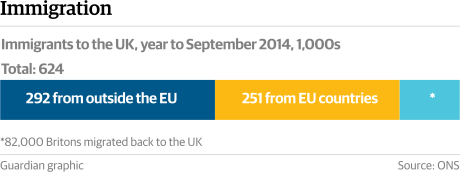
But would it? For a start, fewer people come to live and work in the UK from within the EU than from the rest of the world. 624,000 people immigrated to the UK in the year to September 2014, up from 530,000 the year before. The majority of them – 292,000, up by 49,000 – came from outside the EU and would already have been subject to complex visa restrictions. Some 251,000 people moved to Britain under the EU’s looser free movement rules, an increase of 43,000 over the previous 12 months.
Until it is clear what kind of new arrangement with the EU will replace the current terms of memberships, it is hard to say how the latter group can be “controlled”. Many experts view it as likely that British access to the single market will come at the price of a free movement arrangement similar to the one that is in place now. Norway, which is not in the EU but is a member of the European Economic Area, serves as a warning to enthusiastic “outers”: as a recent study by Open Europeshowed, in 2013 Norway was the destination of more than twice as many EU migrants per head as the UK.
Yet until such a replacement arrangement is put in place, migration in and out of the UK could theoretically be regulated purely by British national law. In such a scenario, moving to Britain would become considerably harder than it is now: EU citizens would face the same kind of long queues and border checks upon entering the UK as “third party” nationals.
UK Border Force officers check the passports of passengers arriving at Gatwick airport. Photograph: Oli Scarff/Getty Images
Border staff would need to establish whether new arrivals meet the requirements for entry, requiring proof of income, intention to return and lack of intention to work. Those planning to stay for longer would need to present proof of employment – posing as a major disincentive for those in industries with low job security, such as the arts. At universities, EU nationals would have to pay full tuition fees and would have no access to student loans.
Britain draws up its own list of countries whose citizens need a visa to enter the country. In theory, it could make poor Bulgarians and Romanians fill in lots of forms before arrival, while allowing rich French and Germans to visit the UK relatively hassle-free. The problem with this, as Steven Peers, a professor of EU law at the University of Essex, points out, is that the EU has its own joint visa list:
The general rule is that if a country like Britain were to cherrypick and discriminate against individual EU member states, the EU would at least threaten to retaliate.
Potentially, Brits would end up having to apply for visas every time they travel across the Channel. Brits already living in other EU countries such as Spain may face integration rules, such as a requirement to speak the language of the host country, before gaining long-term residency status.
Within Britain, the border between Northern Ireland and the Irish Republic would by default become the obvious “back door” for entry into the UK from the EU, and some Irish commentators have said this would inevitably lead to the introduction of stricter passport checkpoints and customs controls on one of the most politically sensitive dividing lines in the country.
Philip Oltermann
Status in Europe
A consensus holds that a Brexit would diminish the status of the UK and EU alike, by varying degrees.
If the dominant mood in Brussels remains “one of extreme irritation with Cameron, almost bordering on contempt”, as Roger Liddle argued in The Risk of Brexit – as seems inevitable – few favours will be offered.
A relatively rich offshore supplicant knocking on the doors of the single market would be ripe for caricature along the penny-pinching, antisocial and racist lines that Eurosceptic sentiment inspires.
A more optimistic scenario sees the UK overtaking Germany as the most populous country in Europe by the 2040s, and channeling transatlantic influence as one of the EU’s biggest trading and political partners. But even Tim Oliver of the Center for Transatlantic Relations at Johns Hopkins University, who advances this vision, says the UK would be a junior partner, dependent on the caprices of European institutions, trying to negotiate bilateral free trade deals from a position of weakness.
David Cameron watches while Luxembourg’s prime minister, Xavier Bettel, left, speaks with Dutch prime minister, Mark Rutte, second left, and Belgian prime minister, Charles Michel, centre, during a roundtable meeting at an EU summit in Brussels. Photograph: Geert Vanden Wijngaert/AP
The UK is one of Europe’s “Big Three” states and routinely punches above its weight – in the climate field, winning everything it wanted from the 2030, shale gas, tar sands and Hinkley debates, for example. Its size, imperial history, ceremony, financial clout and involvement in Europe over centuries bestow gravitas in Brussels. Its loss of influence, coupled with ongoing financial obligations for single market access and so forth would be stunning. Comparisons with other non-EU members such as Switzerland and Norway in this context are false and unhelpful.
But in terms of post-Brexit relations, it’s worth noting that, unlike Norway, the UK has little hard energy to export. Unlike Switzerland it has no land borders or linguistic connections with its neighbours. Unlike Iceland, it has consolidated enmities over decades of treaty negotiations. English is a lingua franca, and British music, literature and popular culture will doubtless still exert a pull on young Europeans. But with fewer opportunities to live and study there, this too may diminish over time.
David Marquand argues that a post-Brexit Britain would be a cross between a greater Norway and a greater Guernsey, abiding by EU norms without political influence to shape them. He posits “a market society, governed by a market state, presiding over a glorified tax haven and financial services hub”. With inequality, individualism and civic distrust rampant, Marquand hopes that a phoenix of post-imperial self-awareness might eventually rise from flames of national dissolution.
This perhaps neglects the degree to which the UK has succeeded in injectingderegulatory logic and free market imperatives into the corporatist heart of EU policymaking. It is fair to ask whether a UK exit would really change the austerity dynamics that underpin national standings on both sides of the channel. In an ageing continent incrementally losing its global market share and political reach, managing decline is not a purely British phenomenon.
Arthur Neslen
Position in the world
The dominant view among foreign policy analysts around the world is that a British exit from the EU would diminish rather than enhance the country’s standing and influence.
It is a view shared in Washington and Beijing, but it is not universal. Perceptions in countries such as India that have had longstanding historical – mostly colonial – relationships with the UK would be less affected, even if trade declined.
On the whole, however, voices from abroad give little comfort to the view that Britain would somehow regain a unique and resonant voice in world affairs once it breaks away from a collective European identity.
Ivo Daalder, a former US ambassador to Nato who is now president of the Chicago Council on Global Affairs, said:
The idea [the UK] could have influence in the world outside the EU is risible. Its power and effectiveness is from being a strong leader in Europe.
As seen from China, the UK is significant on its own as a financial centre. But as a world political and trading power its significance is seen as proportionate to its role in the EU.
Feng Zhongping, the assistant president of the China Institutes of Contemporary International Relations, said:
I think from China’s point of view we don’t think that the UK, or France or Germany or any single European countries can play a global role. But the EU is different. It is the biggest market, and China’s biggest trade partner. The EU is seen as a major power in the world. If the UK left, it would hurt the UK much more than the EU.
India is the most significant exception to the consensus of a lesser Britain outside the EU. For Delhi, Britain has many stronger associations than merely as an EU member, although those associations are not necessarily good ones, as Samir Saran, a political analyst from the Observer Research Foundation in Delhi, pointed out:
We have always been more comfortable dealing with countries individually than as part of a club. We don’t see the UK as part of the EU, but as a distinct identity because of its history and the Indian diaspora. So it plays a different role in the Indian psyche, a unique case. It is not always positive but it is always distinct. And some of the most strategic elements in foreign policy cannot be conducted through a club like the EU, but as part of a bilateral relationship.
The existence of a strategic relationship between the UK and India, made up of defence and hi-tech ties, is another element underlying a different approach to British identity. China, lacking those ties because of trading restrictions, is more prone to viewing the UK as little more than part of a larger European trading bloc. Washington maintains an intensely strategic relationship with the UK but has grave doubts about a British exit for other reasons. In American eyes, anything that fractures the cohesion among its allies is a bad thing.









 Samir Saran