China, European Union, Multilareism, Strategic Studies

The European Union, CAI, and the abyss

On 30 December 2020, an EU Press Release proudly declared “Leaders concluded in principle the negotiations on the EU-China Comprehensive Agreement on Investment (CAI).” The conclusion — at least of this stage of the negotiations (the agreement will still have to withstand the scrutiny of the European Parliament) — has already spawned a cottage industry of commentaries.

The great and the good, particularly from the fields of Economics and Law, are having quite a time pondering and speculating over the (rather limited) detail that is available. Academic chatter is bubbling away on a range of issues: On what the agreement could mean for issues of Level Playing Field; how the terms that the EU has secured for itself compare with the US-China Phase 1 agreement (note that even though the EU-China deal is on investment while the US-China was on trade, there are some overlaps on issues like Forced Technology Transfer); how enforceable would social and environmental clauses turn out to be that the EU is touting as a major win; and so on and so forth? But much of this punditry, while tantalisingly delicious in the technocratic safety bubble that it lives in, reminds us of Nero fiddling as Rome burns. This is not the time to be bean-counting economic gains and losses. The abyss, which the EU has been gazing so greedily into, is staring back its Medusa stare.

The abyss

There is much that is wrong with the deal, which we could point to, in both process and implications.

We could look askance upon the remarkable haste with which the European Union — normally a lumbering, complicated, and bureaucratic machine — has pushed this deal through. Or we could suggest that the Zaubertrank at work now be made the official beverage for the bureaucracy in Brussels.

We could raise an eyebrow at the fact that the final negotiations took place at what is usually expected to be the quietest time of the year: Holiday closures, understaffed newspaper offices, and tired citizens desperately trying to catch a breath or two in the period that is so sweetly described in German as “zwischen den Jahren” (the quiet time in between the years). Our raised eyebrows could perhaps rise further still if we turned our attention to the fact that people across Europe are caught in a surging second wave of the coronavirus pandemic (on the day that the deal was signed, Germany reached a new and depressing record of daily deaths due to COVID-19). And we could applaud that neither the pandemic nor the holiday despair could prevent this ‘systemic rivalry’ from being recast.

We could question not only the timing of the EU-China party, but also the choice of protagonists: In what capacity was President Macron present at this meeting? The impression that screenshots of the meeting give is that the two largest economies of Europe — Germany and France — are in the driver’s seat; all the attention that the union claims to give to representation and accountability for its remaining 25 members (to be reduced to 24 with Britain exiting on 31 December) is little more than lip-service.

We could even — if we were thus inclined — point out politely that we are not convinced by the European Commission President, Ursula von der Leyen’s, claim that the “Agreement will uphold our interests and promotes our core values. It provides us a lever to eradicate forced labour.” The clauses, at least as they are reported in the EU’s Press release, are weak. They are, in fact, so weak, that one might almost want to graffiti LOLOL (Laugh Out Loud On Labour standards) all over it, were it not for the tragic and horrendous human rights violations that are reported in Xinjiang.

We could raise all these issues, and more along such lines. But they still would not get us to the crux of a matter that is deeply political.

The abyss stares back

International trade and investment — for all the conceits that many economists and lawyers seem to have about these issues — are inherently political. And they have become even more political in the context of China’s rise: Not only because of the use and abuse of multilateral rules by non-market economies (which is what defenders of CAI tend to focus on), but also because of the fundamental difference in values that should define the goals of multilateral cooperation. Contra the inclination of technocrats to reduce values to labour and environmental standards, values include first-order principles of democracy, liberalism, pluralism, and more. And international trade and investment, especially in a world where interdependence can be weaponised, have become just too important to be left in disciplinary silos or technocratic bubbles. CAI is not “just” a matter of investment, or even standards; it is a matter that has potentially serious security implications. It begins to dramatically alter who we are as a society, community and people.

China has, perhaps, more than ever in 2020, given Europe ample evidence of these differences. It has threatened and bullied democratic Australia for having the gumption to push for an enquiry on the origins of the pandemic. Its new security law has all but abolished the promise of “one country two systems” for Hong Kong. Its adventurism in the neighbouring seas has increased. Its border conflict with India has escalated to a new level. Its increasing use of “wolf-warrior diplomacy” has even given up the pretence of sweet talk on many issues that most democracies hold dear.

Despite all these clear provocations, the EU has done little to update its strategy. It has — almost religiously — continued to repeat its mantra of 2019: It sees China as its partner, competitor, and rival. This, in fact, was nothing but fence-setting — and with the conclusion of the CAI negotiation, the EU has signalled to its own people, its allies, and indeed to China, which side of the fence it prefers.

The CAI — despite von der Leyen’s claim that it will help the EU defend multilateralism — is not multilateral at all. It is a bilateral deal with an authoritarian power that seems to have a very different understanding of multilateralism. It comes at an especially ill-opportune time. It signals to China that the EU now, not only turns a blind eye to, but actually rewards its increasingly aggressive behaviour. It suggests that the EU has scarce regard for its closest ally — the United States — which, under the incoming Biden administration, had clearly revealed that it would like to work together on China. It does not reassure other democracies — such as Australia, Japan, and India — and it also undermines the potential for alliances with like-minded players. And the deal is a slap in the face of multilateralism: It shows how, for all its talk in favour of reforming multilateralism, the EU actually attaches greater worth to a bilateral deal with a country that has contributed significantly to the breaking of the system.

In the 1990s, many were determined to embrace the “middle kingdom” and integrate it with the multilateral trading arrangement. The argument was that this would make China more like ‘us’. Tragically, many in the EU today are more like China instead. This agreement marks the move of the Union from ‘values’ to “valuations” and from ideals to trade.

Importantly, these are all choices that the EU has made. They cannot be fobbed off on China. China has simply gamed a round of Realpolitik rather effectively. Europe, in contrast, has weakened its own hand, given short shrift to its own values, and undermined the position of its friends and allies.

Standard
Diplomacy, economy, European Union, Indian Economy, international affairs, Strategic Studies

In a new world, why old Europe matters

While Covid-19 has disrupted societies, it has also brought greater clarity for individuals and nations. The European Union (EU) and the United Kingdom (UK) are two political geographies that may be experiencing this and are certainly at an inflection point. In this context, foreign secretary Harsh Vardhan Shringla’s visit to Paris, Berlin and London gains salience. That he has chosen Europe for his first Covid-19-era visit outside the neighbourhood suggests that New Delhi has sensed the importance of this moment.

At a recent event, external affairs minister, S Jaishankar, articulated why his ministry continued to invest time and energy in the relationship with Europe. He explained Europe’s importance for India’s most important imperatives — be it technology and the digital domain or becoming a green economy. The region holds the promise of long-term capital, innovation, markets and best practices.

Europe’s economic obsession following the 2008 Global Financial Crisis saw it withdraw from key political theatres. The pandemic has brought it right back to the great churning in Asia and indeed to the Indo-Pacific. The Indo-Pacific Strategies released by Germany and France and the India Strategy announced by EU are indications that the Old Continent is changing course. The UK has hinted that it is realigning its political positions. It is currently engaged in its most comprehensive integrated review of security, defence, development and foreign policies since the Cold War.

Much has been written about the divisions within EU. Economic differences, migration policies and the China factor all have a real basis and have impacted EU. These may well remain points of friction among member-states. The UK’s exit has also had consequences. Paradoxically, the events of 2020 have exposed the limits of fissiparous tendencies in EU.

There is now a disturbing realisation that China is no friend, and it is not like Europe. It drives the same vehicles and uses the same phones, but is not driven by the same values and principles. There is no convergence in world views. The perverse, even vulgar, conduct of mask diplomacy and thereafter the Wolf Warrior doctrine has been deeply disturbing to European sensibilities. Chinese foreign minister Wang Yi’s troublesome EU sojourn indicated a new European resolve to call out China, even as Beijing dug its heels in.

There is now a disturbing realisation that China is no friend, and it is not like Europe. It drives the same vehicles and uses the same phones, but is not driven by the same values and principles. There is no convergence in world views

In the UK, too, the boundaries of Brexitism are being tested. On 5G and technology choices, the UK and major EU countries are aligning positions. Global Britain is navigating new seas, but its ethical and strategic compass is keeping it firmly in the Atlantic Order. The earlier assumption at 10 Downing Street that it was possible to do business with China without being affected by its muscular politics has fallen short. The bears and bulls at the London Stock Exchange have danced for the Dragon far too long. In 2021, as it hosts G-7 — with India as a likely guest — and COP-26, the UK will realise exactly how much it remains embedded in Europe.

Shringla will find in his French, German and British interlocutors a new realism on trade. Free trade deals are not the issue they once were. The World Trade Organization (WTO) has reduced tariff barriers and the pandemic has enhanced the appreciation for non-tariff barriers. Boutique trade deals, supply chains restructuring where feasible, and enhanced linkages in health and vaccine value chains will be the focus. There will be less pressure on, and more opportunities for, India.

Shringla will find in his French, German and British interlocutors a new realism on trade. Free trade deals are not the issue they once were. The World Trade Organization (WTO) has reduced tariff barriers and the pandemic has enhanced the appreciation for non-tariff barriers

Realising the Sustainable Development Goals; battling the climate crisis through green transitions; and building a digital economy must also be on the menu. Post-Covid-19, we must build back green and build back better. In the past four years, the Paris Agreement has rested on European and Indian shoulders. It is time for Europe and India to shape a new global green deal. This EU+1 initiative should be on Shringla’s agenda as he engages with Paris and Berlin.

In London, he must create the ground for a bold UK-India announcement at COP-26 with an emphasis on a financing a framework that can catalyse green growth. India co-founded the International Solar Alliance with France and the Coalition for Disaster Resilient Infrastructure with the UK. These are critical legacies to be nurtured, more so since the United States (US) will continue to go through an existential crisis, to some degree, irrespective of what happens in early-November.

Technology is another shared frontier. Even as Europe invested in Chinese manufacturing zones, data from its banks, insurance and financial firms found safe and efficient homes in India. Trust was the operative word. And this same word will define partnerships in the Fourth Industrial Revolution. Digital partnerships between India and EU and concurrently India and the UK are inevitable and desirable. As they assess the extremes of the American and Chinese models, on technology norms, digital regulations and data privacy, India and various shades of Europeans will find their positions more aligned.

Technology is another shared frontier. Even as Europe invested in Chinese manufacturing zones, data from its banks, insurance and financial firms found safe and efficient homes in India. Trust was the operative word

With the US expected to be preoccupied till the new administration settles in by early-summer 2021, New Delhi is doing well to engage with other major Western democracies that, like India, are contributors to stability in the international system. Coming shortly after Jaishankar’s visit to Japan for the Quad talks and bilateral meetings, the foreign secretary’s trip to the heart of Old Europe is an important follow-up.

Standard
Commentaries, foreign policy, India, international affairs, Maritime Security, Strategic Studies

Britain should shed its China obsession to seize the moment in the Indo-Pacific

Post-Brexit Britain needs to move away from its China-centric policy and step up trade engagements in the region, which offers potential for win-win economic gains. London should also look to join its allies, including the US, India, Australia in the support of regional security to manage the risks posed by Beijing

 Britain, Indo-Pacific, Singapore, China-centric, Engagements, region, Australia, regional security

We are living through the Indo-Pacific Century – a moment of great opportunity in world history when the balance of power and wealth is shifting eastward for the first time in hundreds of years.

But 2020 has offered proof that this century will also be a challenging one.

First, the coronavirus pandemic has been the biggest shock to the global economy for decades. Even countries that have avoided the worst of the public health crisis have seen significant negative economic effects. The disease has served to underline how globalisation has connected all of us, for better and for worse.

Second, the pandemic has been accompanied by a more assertive China. In recent months, Chinese troops have had a bloody face-off with India along the border between the two countries in the Himalayas, while Beijing continues to aggressively press its claims in the South China Sea – all this amid its extension of control over Hong Kong through the controversial national security law.

These factors may have contributed to Britain’s decision to ban Huawei from its 5G network, as Australia did earlier. Telecommunications will play an increasingly central role in developing closer security partnerships, and Britain’s choice is a clear indication of the country’s willingness to continue to work shoulder to shoulder with the United States and its other partners. The UK is not alone in this realisation. India, the US and Japan have also banned, or are considering banning, Chinese apps.

This context prompts a vitally important question. How can Britain better partner and work with countries in a region spanning an area extending from India to Japan and reaching down to Australia and the South Pacific, to partake in the growth-led opportunities and manage the risks posed by a prosperous and expansive China?
A London think-tank, Policy Exchange, has announced an Indo-Pacific Commission that we are part of, to examine these issues. Together with other experienced policymakers from around the world, we will discuss and recommend new approaches Britain and its allies can take to further the rules-based order across this strategically important region. Naturally, for the UK, this interest also reflects a new post-Brexit awareness of the importance and potential of the Indo-Pacific, as London looks beyond the European Union to strengthen alliances and explore new markets.
Our advice to Britain, though it applies to other countries, would start with two basic ideas. First, avoid being too China-centric. As the commission’s chairman, former Canadian prime minister Stephen Harper, has observed, a focus on China alone – both its positives and negatives – would be to overlook the myriad opportunities for trade and other cooperation on political, defence and diplomatic issues with countries including Japan, India, South Korea, Australia, Indonesia and Singapore in the Indo-Pacific region. Think, for example, of the opportunities that the City of London could explore in South and Southeast Asia in financial innovation, in which it is a world leader.
Second, Britain should reimagine its place in the world order. It might have retreated from “East of Suez” more than half a century ago but this is the time to step up. As the world’s fifth-largest economy, there are potential win-win economic gains to be made in the Indo-Pacific; for example, in entering existing multilateral trade agreements, as well as bilateral agreements with Australia, India, Japan and other growing Asian economies.
Britain also remains a leader in innovation and technology, as shown by the phenomenal global success of entrepreneurs like James Dyson, whose company is now headquartered in Singapore and whose technology and products are considered a global standard for future-oriented innovation. More recently, the leadership role of the UK can be seen by the strides Oxford and Astra-Zeneca are making on a Covid-19 vaccine. Astra-Zeneca has partnered with the Pune-based Serum Institute of India, which is the largest vaccine maker in the world by volume, to manufacture 1 billion doses of this vaccine.
Britain also remains a leader in innovation and technology, as shown by the phenomenal global success of entrepreneurs like James Dyson, whose company is now headquartered in Singapore and whose technology and products are considered a global standard for future-oriented innovation
This is a precursor to the potential of partnership between Britain and the Indo-Pacific countries. This leadership – bolstered by the fact the UK is home to no fewer than six of the top 50 universities in the world – means that the country has the potential to be the knowledge lab for the Indo-Pacific economies, where many young people still see the UK as their key destination for education and business.
Just as the UK should build on existing multilateral trade agreements in the Indo-Pacific, it should also look to join its allies in the support of regional security and defence. What are the most effective ways for London to join partners and allies – notably India, Australia and Japan – to strengthen regional security through defence engagement and presence? One answer can be found in the recent news that British officials are debating whether to base one of the UK’s new aircraft carriers in the Far East, where it would conduct military activities with allies including the US and Japan.

Just as the UK should build on existing multilateral trade agreements in the Indo-Pacific, it should also look to join its allies in the support of regional security and defence

This, of course, builds on what is already happening, with Japan’s Maritime Self-Defence Force conducting trilateral exercises recently in the Philippine Sea with the Australian Defence Force and the USS Ronald Reagan Carrier Strike Group. Britain, as a permanent member of the UN Security Council – and a country with existing defence arrangements with Singapore, India, Malaysia, Australia, New Zealand and Japan – can play a role here, not least in the context of the contested South China Sea. Britain has an opportunity in the Indian Ocean as well. It should seize this new geopolitical moment and participate in the shaping of a new coalition along with India and the US.
Standard
China, India, Indian Defence, Internal Security, Strategic Studies

Celebrating Rafale, rethinking India’s national security

Indian Air Force, Media Wars

As five Dassault Rafale fighter jets – the first of 36 India agreed to purchase from France four years ago – landed at Ambala Air Force base, there was understandable celebration among civilians and those who don the military uniform in India. After all, this is the first high profile defence acquisition, barring the American assault helicopters, in decades.

The celebratory mood, however, must not hide the dark reality of India’s inept defence procurement process. The Indian Air Force, hobbled by fleet depletion and aircraft well past their fly-by-date, first communicated its desire to procure 126 Medium Multi-Role Combat Aircraft (MMRCA) to the Ministry of Defence in 2000.  After two decades, three prime ministers, four Governments, and a dizzying number of flip-flops and somersaults, the first five Rafale fighter jets finally landed in India on 29th July.

Opportunistic media hype apart, the arrival of these jets should be a moment of sombre national introspection. A nation that set out to procure 126 aircraft is able to obtain just five after two decades, that too by having to throw away piles of files that prevented any progress. This is a saga of a nation with an incompetent ‘system’.

The arrival of these jets should be a moment of sombre national introspection. A nation that set out to procure 126 aircraft is able to obtain just five after two decades, that too by having to throw away piles of files that prevented any progress

India is unprepared for the ensuing decade that will witness a world in upheaval and where national security will demand a significant share of resources and human capital. The Biblical ‘Four Horsemen’ have long symbolised the end of times. An honest enquiry into India’s national security preparedness will be defined by the four horsemen whose arrival portend the coming of the Apocalypse.

First, as the MMRCA saga shows, is India’s institutional inability to quickly arrive at a decision, which is invariably followed by inadequacy when it comes to swift execution of that decision.

The Rafale story serves as a demonstrator of the Indian state’s woeful (in)capacity – of its severe budgetary constraints; its inept (and self-serving) bureaucracy; its crusty defence establishment riddled with turf wars, ego battles and a vaulting sense of entitlement; and its incompetent political class that has spectacularly failed to rise to the defence of India by putting national security above party politics.

These stakeholders must be reminded of history’s abiding lesson: No nation has achieved its full potential without first establishing a strong national security industrial base. In recent times, India has set itself on the path to realising this goal with an overwhelming dependence on foreign powers. Even then, it has repeatedly stumbled due to procrastination by the ‘babu-neta’ combine.

Second, the inability to be honest with oneself. This is marked by the inability to read history correctly and to recognise India’s real enemy. Despite the obvious lessons New Delhi should have drawn from its defeat in 1962, it has largely privileged placating Beijing only to further fuel China’s untenable ambitions. As part of this perverse posture, India’s custodians of discourse have downplayed the bloody nose India has given China on at least two occasions last century and even the significant battlefield losses inflicted on China this summer.

India’s many dalliances with China, be it at BRICS or over the AIIB (Asian Infrastructure Investment Bank), were shaped by the romanticism of co-creating an ‘Asian Century’. That should have ended with Doklam in 2017. It was a promise China never meant to keep or maybe never even made at all.

India’s many dalliances with China, be it at BRICS or over the AIIB (Asian Infrastructure Investment Bank), were shaped by the romanticism of co-creating an ‘Asian Century’. That should have ended with Doklam in 2017.

We have hidden facts from 1962 onwards from all, and we continue to hide facts about Chinese behaviour and action even today. Since 2013, Chairman Xi has made abundantly clear his absence of interest in Asian multi-polarity. In Doklam, he shouted it through a megaphone for all the world to hear. China apologists do not hear and do not care.

They fail to assess China as an implacable neighbour and Xi as afflicted with an insatiable lust for power and territory. They ignore the China that views India as a civilisational foe and the Communist Party that seeks to undermine its neighbour’s political, economic and social architecture. Instead, these ‘experts’ crowd out other views from powerful pages, explaining Beijing’s malfeasance as a consequence of India’s sovereign decisions, internal politics and enhanced partnership with America.

What will it take for India to admit, unambiguously, that its neighbour is a long-term geopolitical rival and an existential threat? The tangential elements of this outlook are in place: India’s rejection of China’s Belt and Road Initiative and, more recently, its digital avatar. But the question is: Will such tactical moves serve as the cornerstone of a long-term strategy? Or, since the elephant in the room can no longer be ignored, is the template for Wuhan 2.0 being drafted by the blind men (and women) who have over the decades led India to its China conundrum?

Third, the inability to sense and seize an opportunity. Many countries have realized, or are beginning to, that they hedged their bets in Asia incorrectly. Their misplaced mission to socialise China into a rules-based international order having totally failed, they are now confronted by the reality of an imperial Beijing. Can New Delhi leverage this opportunity?

In 1972, China sensed America’s need to counterbalance the USSR and used that moment to sneak past the Iron Curtain. The Great Thaw was less a Henry Kissinger masterstroke and more a Mao success. The historic photograph in The Washington Post of a grinning President Richard Nixon with an inscrutable Paramount Leader Mao Zedong told the story best.

Beijing thought ahead and seized the moment, letting Washington foolishly believe it had stolen a march over China. Neither Nixon nor Kissinger could look beyond their immediate political imperative; China looked into the future, almost into the next century.

The lesson from that singular act of China was, and remains, that shadows of the past should not be allowed to precede India’s foray into a new world order. In 1971, Nixon ordered the US Seventh Fleet’s Task Force 74 into the Bay of Bengal as a nod to America’s ‘tilt’ towards Pakistan and to signal opposition to the Indo-Soviet Treaty.

But history moves in unpredictable cycles. The contrast between then and now is striking: The US has sent a carrier battle group into the region at a time when India and China are locked in a border confrontation. This time round, the group is exercising with Indian naval forces, bolstering a US-India partnership dedicated to resisting China’s coercive tactics and ensuring that the Indo-Pacific remains free and open. Clearly, 2020 is not 1971.

Asia has come a long way since the 1970s. In the retail market of the region’s geopolitics, India still commands a premium. As prospects of a two-front war become increasingly probable, can India shed its coy reluctance and operationalise arrangements that will welcome American naval presence in the Arabian Sea and the Bay of Bengal? A US frigate or two would send the signal to Rawalpindi to behave if India and China do engage militarily in the Himalayas. It would, in the medium term, also allow India and the US to manage the inevitable increase of Chinese presence in the Indian Ocean.

The first step towards this would be operationalising, even if for optical purposes, the Logistics Exchange Memorandum of Agreement by inviting US ships exercising in the region to use Indian facilities. This should further expand into the Indian Ocean with India facilitating an agreement on the Chagos Islands by leveraging its bilateral relations with Mauritius. A US presence at Diego Garcia is in India’s interest. It always was; now more than ever before.

Simultaneously, and before it’s too late, India must militarise its southern tip, the Andaman and Nicobar Islands: An air base and a naval docking facility are passé; India needs its very own Diego Garcia in its own national waters. If India does not do it now, very soon a rising crimson tide will leave it with no political room to have any choice. Far from matching China on the seas, if the Rafale saga is a pointer, Indian boats may need Chinese permission to leave the lagoons as our hardware would be weak and partnerships non-existent.

Although there is bi-partisan consensus in the US on Washington’s China policy, it is worth recalling that Joe Biden was part of an Administration that once harboured imaginations of a ‘G-2’ world. Drawing the US into the Indian Ocean and India’s seas will stymie such inclinations as well as get rid of the shadows of 1971 that lurk in some minds.

Although there is bi-partisan consensus in the US on Washington’s China policy, it is worth recalling that Joe Biden was part of an Administration that once harboured imaginations of a ‘G-2’ world

From the seas to the mountains, India must use the response to China’s hostility to its advantage – boldly, robustly and openly. For instance, the Quad can be taken beyond maritime security if India were to invite its partners for mountain exercises in the Himalayas next summer. China has militarised the Line of Actual Control (LAC). India militarising its Himalayan zone and creating special multilateral training and collaboration programmes would be an apt sovereign response.

The ongoing confrontation in Ladakh reminds us that claims over territory have to be backed up by connectivity, military presence and control. We may need to prepare for a highly militarised and un-tranquil LAC in the coming years.

As always, our commentariat will be pleading and pushing for ‘inaction’ as a policy option, in the mountains and in the seas. The underlying argument will be consistent with the ones deployed in the past – our actions must not provoke the dragon. The fact remains that China’s belligerence is not predicated on India’s actions, it flows from Beijing’s hostile and expansionist worldview.

Last, though not least, the inability to take its citizens into confidence. India is the only nation with great power ambition that has not adopted a formal and declared national security strategy. What passes for one is the frail doctrine of ‘strategic autonomy’, open to multiple subjective interpretations. Like ‘Panchsheel’, ‘Non-Alignment’ and ‘South-South Cooperation’, it is just another convenient phrase. It serves as a shield for indecisiveness, not as a lighthouse for agile decision-making.

Beyond the shrill prime time media wars that shape the foreign policy outlook of India’s voters, they largely have no metrics through which to judge the actions of their elected Government. India’s 1.3 billion citizens deserve far better. But since that awareness is denied to them, they applaud the landing of five fighter jets while awaiting another 31 on some unknown date, even as the country faces off Xi’s forces in the north and a ‘terror factory’ to its west.

Beyond the shrill prime time media wars that shape the foreign policy outlook of India’s voters, they largely have no metrics through which to judge the actions of their elected Government

The question is, should we ignore the four horsemen and continue marching straight into a geopolitical Apocalypse?

Standard
China, Commentaries, foreign policy, India, Strategic Studies, tech and media

Resisting Chinese encroachment

India must not contribute to the digital and economic rise of the same power that harms it

 Chinese encroachment, China Tech, apps, Hegemony, Xi Jinping, Huawei, Samir Saran

On June 29, the minister for electronics and information technology and law and justice, Ravi Shankar Prasad, tweeted that “For safety, security, defence, sovereignty & integrity of India and to protect data & privacy of people of India the government has banned 59 mobile apps.” After the usual partisan bluster surrounding this move subsides, India must operationalise and strengthen this momentous decision. India, its people, and its territory that are now increasingly digital, must be protected from China’s encroachment and influence.

This long-term response has to be shaped by three ideas. First, India must not contribute to the success, proliferation and performance of digital weapons that will be ranged against it. China’s tech must be recognised as one. Second, it must wean itself away from an iniquitous trade relationship that makes it dependent on a country that seeks to harm it. And, third, India needs to step out of the shadow that stunts its own economic growth, diminishes its political clout and limits its digital ambitions.

The presence of China’s hardware and platforms in India’s digital ecosystem constitutes a long-term security threat. Arriving at this conclusion requires no strenuous leap of logic. A level-headed assessment of China’s stated intentions and observable actions is enough. China has manipulated democratic means to transmit its propaganda and advertised its way to ensure suitable reportage and headlines. It has leveraged WeChat to interfere in Canadian politics, and to intercept content beyond its jurisdiction, and adopted western social media platforms to target dissidents abroad, exacerbate racial tensions in the United States (US), interfere in Taiwan’s political processes and spread disinformation about the coronavirus. China has entrenched the influence of its tech platforms in key global institutions such as the United Nations in an attempt to redraw the rules of information flows and the ethical applications of emerging technologies like facial recognition systems.

China has entrenched the influence of its tech platforms in key global institutions such as the United Nations in an attempt to redraw the rules of information flows and the ethical applications of emerging technologies like facial recognition systems.

These are fundamental to China’s great power ambitions — they assist Beijing to expand its “discourse power”, develop indigenous technologies, create lock-ins through standards and infrastructure, weaponise its economic and technological interdependence, and emerge as a technology superpower. Relations with India are inconsequential to Beijing’s imagination of the world. India has to look out for itself. This new mindset to review engagement with China tech is a vital first step to protect itself.

China will continue to gather information on Indians. More worrisome is the insidious ability of the Communist Party of China (CPC) to interfere in or influence India’s political and social spheres. During the Doklam stand-off, the security establishment discovered that the Chinese-owned UC Browser was filtering certain news on Android handsets in India to shape perceptions and outcomes — classic information warfare in the digital age. Recently, we have seen content critical of China being taken down on one of the banned apps and moderation of other incidents and images as well.

This is not unique to Chinese platforms. But far-reaching national security legislations, and subservience to a one man-led party that is inimical to India, make their continuance untenable. Indian democracy, howsoever flawed, must steer clear of the digital “tea rooms” owned by the CPC.

Will this Indian decision cause economic harm to Chinese platforms? In terms of revenues, clearly it will not. In terms of value, tremendously so. Platforms rely on network effects to scale — every additional user drives up valuations and the aggregate data that they produce feeds into other commercial and research and development activities and product development. Indian eyeballs and data should not fuel Chinese malfeasance directed against them.

Similarly, India must bar China’s telecommunications infrastructure from its 5G networks. It is time to say “No way Huawei”. Countries such as Singapore, the US, Australia and others have already signalled different degrees of intent to manage the Dragon. New Delhi’s decision should strengthen this trend and encourage others. Political trust is increasingly going to shape the direction of technology flows. India must work with its allies and partners through new initiatives such as the Global Partnership on Artificial Intelligence to compete with and contain China.

India must bar China’s telecommunications infrastructure from its 5G networks. It is time to say “No way Huawei”

India’s actions will invite consequences. China will respond using other aspects of the economic relationship. India’s dependence on electronics, pharmaceuticals and other industrial inputs are well-documented and easy pickings. China’s response could manifest itself along the Line of Actual Control or through cyber intrusions. China’s ability to impose costs must serve to motivate India.

Bilateral trade is healthy when there is a balance. With China, it is a doubled-barrelled shotgun trained between India’s eyes. It is important that we fix this now as a three trillion dollar economy. Otherwise, all our future growth will only serve to strengthen the entity which seeks to weaken us.

India’s decision has come at a time when economic activity is already under siege from the Wuhan virus and when major economies are also questioning their dependence on China. A reconfiguration of value chains is inevitable. Public opinion favours this and the short-term pain will be acceptable to many. As India restarts its pandemic-stalled economy, let us create value chains that are not of dubious origin.

Standard
China, foreign policy, India, Indian Defence, Strategic Studies

Emperor Xi reinvents Chinese Checkers: Only CPC Wins

The current violent confrontation between India and China in east Ladakh along the Line of Actual Control should come as a surprise to none. This was inevitable. An inexorable chain of events was set in motion in 2017 when New Delhi rejected Beijing’s imperial invitation to the Belt and Road Initiative (BRI) event presided over by President Xi Jinping. A second rude rebuff followed later in the summer of that year when India stood up to China’s efforts to reorganise  Himalayan political geography on the Doklam plateau. India must be prepared to strongly repel the backlash from Beijing on our mountains, in our waters and through our digital platforms.

The Indian commentariat is needlessly agonising over the drivers of the latest Chinese actions. Let us stop theorising and be bold enough to accept that China is just being itself. India has made decisions like independent nations do as an exercise of their sovereignty. To argue otherwise would be tantamount to ignoring the sum total of Beijing’s behaviour during the ‘Made in China’ pandemic: The acceleration of territorial revisionism in the South China Sea; the subjugation of Hong Kong through the stoutly contested national security law; repeated violations of Taiwanese airspace; heightened naval aggression around Japan’s Senkaku Islands; and its most recent encroachment in Nepal.

There is a pattern to this madness; a reason for this seemingly inexplicable restlessness.

In Jiang Zemin’s 2002 report to the 16th Party Congress, the Communist Party of China (CPC) presciently foresaw a 20-year “period of strategic opportunity” for China – linked to its entry into the WTO and America’s misguided interventions in the Middle East that enabled Beijing to play a deft game of Chinese Checkers — and build national power. Emperor Xi, anointed to office for life with a heavenly mandate, is now exercising that power as a counterpoise to the diminishing clout of American influence, and the weakening resolve of a wavering EU and unsure Europe. This is the moment for the Xi Dynasty (like the Mao Gang in another era) to take charge of the wheel and steer China to its centennial objective of world domination by 2049.

The new version of Chinese exceptionalism shaped and directed under Xi’s tutelage is linked to China’s past identity, largely a product of myth-making. It has willed itself into believing that it does not need to work within the matrix of international laws, rules and norms. It has decided that the time when China would “hide and bide” its motivations and capabilities is past.

The new version of Chinese exceptionalism shaped and directed under Xi’s tutelage is linked to China’s past identity, largely a product of myth-making. It has willed itself into believing that it does not need to work within the matrix of international laws, rules and norms

The CPC is now externalising the authoritarian idiosyncrasies it wields at home. Medievalism is the hallmark of Chinese external assessments. This is evident from its insatiable urge to redraw boundaries as an adventure sport and from its estimation of its population (as well as others) as mere fodder. This behaviour is exemplified in China’s ‘hostage diplomacy’ with Canada. Chen Weihua, the European Union bureau chief of the China Daily, offered an unsympathetic glimpse into how China views the issue: “People often fail to note that Meng is worth 10 Kovrig and Spavor, if not more.”

Supplementing this behaviour are two critical tools: an expansionist military and modern methods of engagement. Xi has overseen what is arguably the most wide-ranging modernisation of the People’s Liberation Army: purging it of corrupt or disloyal officials, ensuring its transition to a capable and expeditionary naval force; undertaking crucial administrative and organisational reforms; and reaffirming its absolute loyalty to the CPC and its ideology. In parallel, Xi has presided over China’s long-term efforts to securitise and weaponise global supply chains, flows of technology, finance and data, and institutions of global governance. The all-pervasive Chinese state is but an instrument for the benefit of the CPC.

Time and again India has confronted these realities at 14,000 feet above sea level and soon it may have to defend its blue waters against the rising crimson tides. At one level, Beijing is merely attempting to ‘remind’ India of Asia’s geopolitical hierarchy—that failure to kow-tow to the Middle Kingdom carries consequences. More worryingly, Beijing may have concluded from India’s history that heightened aggression along the LAC will invariably bring India to the negotiating table—that India will grant China greater political concessions, market access or economic bargains as the price for “peace and tranquillity”. The Indian state will have to dispel and disprove this Chinese assumption.

China is also using this moment to send a message to its other neighbours in the East and South China Sea. While a similar escalation in those waters by China carries the risk of drawing in American military response, the attempt to reorganise boundaries  on the Himalayas conveys the same intent. China is demonstrating to the world the limitations of decaying American power without having to actually confront it. In its neo-Confucian assessment an Indian capitulation may signal the final rites of Pax Americana. Beijing may be in for a surprise on both counts, provided countries are able to correctly assess the deeper import of recent Chinese actions.

China is also using this moment to send a message to its other neighbours in the East and South China Sea. While a similar escalation in those waters by China carries the risk of drawing in American military response, the attempt to reorganise boundaries  on the Himalayas conveys the same intent

India must begin with the daunting acknowledgement that the world’s second largest economy is its primary long-term geopolitical and geoeconomic rival. It must also internalise that it will not be able to negotiate its way into any favourable outcomes with China. While nations must talk and unofficial summits like Wuhan and Mamallapuram are important, India must have the singular purpose of investing in and developing robust political, economic, digital and military tools that should, for the short to medium-term, be able to protect territory and rebuff the northern marauders.

For too long, Delhi has been hesitant to impose costs for China’s military adventurism, preferring instead to settle matters diplomatically. In doing so, India has failed to realise that while Xi’s China is irrational, it is not an entirely unpredictable actor. It sees capitulation and a preference for negotiation as a sign of weakness. Delhi must be creative about how it imposes costs for this behaviour—creating unconventional and asymmetric options that help in ‘area denial’ operations in the Himalayas. Accelerating roads and infrastructure is one part, building emplacements is the second. The politics of ‘sharp’ presence (physical) is the only vocabulary understood in those terrains.

For too long, Delhi has been hesitant to impose costs for China’s military adventurism, preferring instead to settle matters diplomatically. In doing so, India has failed to realise that while Xi’s China is irrational, it is not an entirely unpredictable actor

The adage ‘it is the economy stupid’ has never been more relevant. Obsession with building India’s economic heft must override all other considerations. China’s rise was underwritten by its strategic co-option of globalisation. In an era where global flows of data are outstripping trade in goods, and where technology supply chains are being jealously guarded, India’s goal should be to emerge as one of the centres of the topography of digital globalisation. India did well to reject the BRI; it must now ensure that it rejects BRI’s digital avatar as well.`

The banning of Chinese goods may be important signalling but will have little impact on the northern neighbour due to the asymmetry in trade. Zealous protection of India’s digital backbone and networks (5G) and billion people plus digital platforms from Chinese encroachment and intrusion, either openly or by stealth, must be the clear-eyed strategic objective. But India cannot do this alone. And here is where its own period of strategic opportunity begins. In a powerful dissent against the Xi regime, Tsinghua University professor Xu Zhangrun laments the consequences of Beijing’s global assertiveness: “Instead of embracing a [global] community,” he writes, “China is increasingly isolating itself from it.” The challenge for India is to capture this moment – to shed (self) righteous theories of foreign policy in favour of pragmatic, even cynical, partnerships that bolster its economy, provide it with technology, arm its military and support its global ambitions.

That India is still debating Non-Alignment as a choice is a sad reflection of its inability to grasp the reality that stares it in the face, its failure to read the writing on the wall, its myopic disregard for what the future holds. When Non-Alignment was conceived it was an attempt by the leadership of the day to carve out a space for India in a world dominated by two superpowers. Does its propagation allow similar space to India now? Or does a string of strategic partnerships (not of the variety that exists in the dozens) serve India’s interests better?

That India is still debating Non-Alignment as a choice is a sad reflection of its inability to grasp the reality that stares it in the face, its failure to read the writing on the wall, its myopic disregard for what the future holds

Indeed, the time for hiding behind ‘strategic ambiguity’ is over. This stands true for New Delhi’s involvement with international institutions as well. How will India take advantage of its seat in the UN Security Council, its upcoming presidency of the G-20, its chairmanship of the WHO, its position in the Global AI Alliance, or its leadership of the International Solar Alliance? India now increasingly finds a place on the high table of global governance. Question is, can it make the most of these arenas? Can Delhi marshal its diplomatic resources to convince the international community that events in the Himalayas carry global consequences, and that silence now, only emboldens China’s perverse great power ambitions in other geographies and domains? Will New Delhi develop the appetite to call out China on Taiwan, Tibet, Xinjiang and Hong Kong in international forums? And can it incubate a discursive space that will challenge ‘wolf warrior’ propaganda?

Standard
climate change, foreign policy, India, Strategic Studies, Sustainable Development, USA and Canada

US-India Partnership for a Green Future

Climate change is one of the most formidable challenges for this young century. As the World Economic Forum’s The Global Risks Report 2020 makes clear, failure to mitigate and adapt to climate change is the single most impactful and second-most likely risk facing the international community over the next 10 years. How effectively governments, businesses and societies can work together to make a tangible impact on this global challenge will determine the future of our planet.

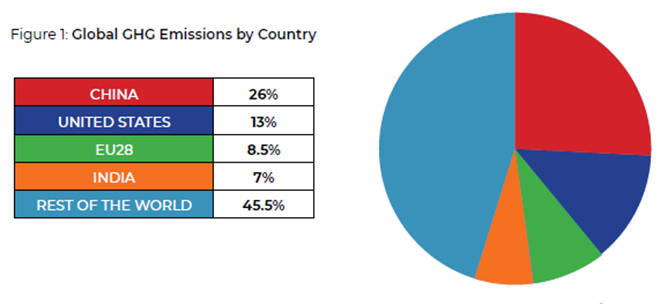
As shown in Figure 1, the United States (US) and India contribute almost 20 percent of global greenhouse gas (GHG) emissions. Although the two countries differ markedly in both per capita emissions and incomes, India and the US must take concrete action according to their capabilities to develop solutions that can boost economic growth and mitigate the catastrophic consequences of climate change. The best way to achieve these twin goals is to invest in infrastructure for a resilient and low-carbon future; cooperate in key areas that produce relevant knowledge; foster innovation exchange; strengthen technical assistance bilaterally and for others; and catalyse capital investments for energy access, energy efficiecy, and renewable technologies.

Source: 2019 Emissions Gap Report, United Nations Environment Programme

Both the US and India have taken important strides together to advance their strategic partnership in the domain of climate action and policy. However, existing efforts continue to rely mainly on an incremental approach to tackling climate change. Such measures are welcome but insufficient. As the world grapples with the COVID-19 pandemic, we are reminded of the human and economic costs associated with weak international cooperation, delayed action, and the lack of investments in important infrastructure and capabilities. Climate-induced disasters may make the current pandemic look meek, and the world could ignore this risk at its own peril. Thus, it is vital for India and the US to double down on efforts to drive structural change, hurdle institutional barriers, and overcome the inertia inhibiting green growth and development.

In line with these goals, the Observer Research Foundation (ORF) and The Asia Group (TAG) convened a joint roundtable in October 2019 to advance recommendations to strengthen the US–India partnership for a green future with a special focus on climate mitigation, renewable energy, and climate financing. Across these topics, it is clear that both countries face a number of complex and overlapping challenges and opportunities. Even as recent policy efforts have strengthened each country’s capacity to tackle these challenges, this report seeks to identify policy recommendations to support this progress.

Standard
Cyber and Internet Governance, Cyber and Technology, Cyber Security, Strategic Studies, terrorism

Technology and Terror: A new era of threat in a borderless online world

Terror requires spectacle to thrive and technology has allowed this opera of violence to find new audiences and locales.

Technology, Terror, Abu Bakr al-Baghdadi, Digital Terror, ISIS, Online Recruitment, Kabir Taneja, Samir Saran, Syria, Islamists, Do-It-Yourself, DIY, Terrorism, Kalashnikovs, Crypto currency, Western, Eastern, Christchurch, VPN

From ISIS attaching a GoPro camera to a home-made armed drone in Syria to Islamists from the Democratic Republic of Congo uploading 4K videos pledging allegiance to Abu Bakr al-Baghdadi, cyberspace and emerging technologies are facilitating terrorist activities at an unprecedented scale. The convergence of technology and terrorism represents the worst kind of feedback loop between the real and the virtual. States, meanwhile, are struggling to respond to this convergence and to balance the imperatives of national security and the freedoms afforded in cyberspace.

Given the complex structural drivers of terrorism and the trade-offs involved in regulating technology, it is imperative that policy makers first assess the real and evolving dimensions of the challenge. The popular conceptual understanding of this menace is that like war, terrorism is simply politics by other means. Whoever the actor may be, terrorism is a violent expression of alternative political values and norms for organizing societies. Motivations may vary but violence is the principal instrumentality for recruiting, propagating and financing this perverse politics. And like mainstream politics, terrorist organizations have co-opted technology as a force multiplier in achieving their objectives.

Like mainstream politics, terrorist organizations have co-opted technology as a force multiplier in achieving their objectives.

As has been suggested by many scholars, terror requires spectacle to thrive and technology has allowed this opera of violence to find new audiences and locales. The Christchurch shootings in New Zealand is perhaps the most obvious example — with the shooter streaming his actions live on social media. New communication platforms afford scale and impact at virtually no cost, a service that terrorists have used with impunity and agility over the years with deleterious consequences for communities and countries.

Some features of the internet, like end-to-end encryption and virtual private network (VPN) have made it easier than ever for terrorist organizations to find recruits and manage outreach and organization. For example, migration of pro-ISIS propaganda from likes of Facebook and Twitter to Telegram was in a large part due to encryption facility offered to all its users. Technology also allows these organizations to transcend the tyranny of geography. An organization in one country can raise funds, recruit and radicalize individuals in another part of the world with ease.

Some features of the internet, like end-to-end encryption and virtual private network (VPN) have made it easier than ever for terrorist organizations to find recruits and manage outreach and organization.

Every communication opportunity online is being exploited by these malevolent actors. From the mainstream platforms such as Facebook and Telegram to chat rooms, betting sites, porn websites and online gaming hubs. These virtual venues are fertile breeding grounds for accidental and purposeful recruits and for propagating violent narratives. The importance of ‘digital terror squads’ was emphatically asserted when, in 2016, ISIS granted its ‘media mujahids’ the same rank as those fighting for the group on the ground. This gave the online radicals pride of place that was traditionally reserved for the fighters delivering carnage on the ground. This is only one of the instances that signify just how integral, sophisticated and important cyber operations are for terrorist organizations today.

Terrorist organizations are also leapfrogging traditional hawala networks to embrace Fin-Tech as a means to finance their operations. Services like e-wallets, digital currencies, crypto-currencies and even crowd funding platforms are being leveraged to raise and launder money and finance terrorist operations. This has rendered most current practices of clamping down on terror-finance obsolete, and today more terror organizations have access to more money than ever before.

Terrorist organizations are also leapfrogging traditional hawala networks to embrace Fin-Tech as a means to finance their operations.

Amidst this worrying convergence of terrorism and technology, states have struggled to respond without threatening the infrastructure of cyberspace or the freedoms and opportunities it affords. Meanwhile, the tech platforms are having troubles of their own. The word ‘social’ in social media is under scanner, with platforms facing multiple headwinds relating to their policies on responding to terrorism, fake news and political interference among others. These platforms host billions of users even as they struggle to differentiate between their ‘social’ obligations to the digital commons and their commitments to markets and investors.

As states, platforms and grassroots organizations combat the threat of tech-enabled terrorism, it is important for them to identify certain guiding principles.

First, it is crucial that they do not unintentionally limit access to technology itself. For many states, the knee-jerk response to some of these challenges is banning access or shutting down tech-based routine operations altogether—as we recently saw in Sri Lanka. Instead, states must co-opt technology and tech-actors, which allows for better surveillance of and enforcement against terrorist activities. Legislations and notifications will have limited influence in this new battle theatre. More technology, better technology and skillful deployment of technology against malign actors is the most potent option for all to embrace and one which most governments have failed to invest in.

States must co-opt technology and tech-actors, which allows for better surveillance of and enforcement against terrorist activities.

Second, the digital commons must witness the creation of new mechanisms and institutions for international cooperation on this vital issue. The challenges of terrorism are cross border — making debates held hostage by ‘regional’ or ‘international’, ‘Western’ or ‘Eastern’ silos irrelevant. States and tech companies need to find new venues and forums to cooperate on these issues in an institutionalized manner, formally or informally.  The traditional distrust between governments and private actors is creating a cleavage that allows terror to flourish and succeed.

The digital commons must witness the creation of new mechanisms and institutions for international cooperation on this vital issue.

Third, technology companies must be more forthcoming about disclosures relating to terrorist activities on their platforms. The obsession with the performance of their shares on the bourses is perversely impacting the global effort to respond to terror. They must create internal mechanisms to share information with law enforcement on a real time basis. They must also publish regular public reports detailing the nature of terrorist activities they have identified, and steps taken to counter them. The reluctance of corporations to be transparent about the mishaps on their platforms and networks is a serious problem.

Technology companies must be more forthcoming about disclosures relating to terrorist activities on their platforms.

Fourth, states, for their part, must remember that tech is only a tool. It is not a substitute for real world and virtual policing. Often states attempt to undermine tech—for example through weaker encryption norms due to their naïve assessment that this would assist in their dispensation of duty. This only undermines utility and safety of technology for millions of benign users; while terrorist organizations will simply migrate to alternative platforms as witnessed in the recent past.

States…must remember that tech is only a tool. It is not a substitute for real world and virtual policing.

Fifth, localized capacity building both by state and tech firms is the need of the hour. While national intelligence organizations are certainly relevant, the first line of defense against tech-enabled terrorism will be local law enforcement. Unless these units are equipped with skills and technology, the terrorist will always remain a step ahead in an upcoming era of Do-It-Yourself (DIY) terrorism.

Localized capacity building both by state and tech firms is the need of the hour.

Finally, simultaneous investments in capacity for strategic communications by states and technology companies is a pivotal step. Unless good actors can combat the narrative appeal of radicalism and terror, most responses with be feeble and patchy. Either the states provide purpose and meaning to individuals, or radical groups will. The old methods of counter-terror will need to be dramatically upgraded and redesigned. The terrorists have developed a lethal cocktail of clicks and Kalashnikovs, even as citizens, states and other organizations, lag behind in recognizing and responding to this heady mix.

Simultaneous investments in capacity for strategic communications by states and technology companies is a pivotal step.

Any good policy response to tech-enabled terrorism must acknowledge that combating it requires an “all of society” approach. This first line of defense is always communities, no matter how the technology may change. Platforms for their part must work with them alongside states to increase awareness about this real and present danger and must transparently share their propositions that can help to balance the trifecta of growth, rights and security.

Standard
Bangladesh, India, Indian Froeign Policy, Neighborhood Studies, Strategic Studies

India and Bangladesh need to create a 20 year joint vision of growth and development

Bangladesh, Sheikh Hasina, Teesta Water Treaty, Rohingya crisis, India, India-Bangladesh, Narendra Modi, PM Modi

New Age: How do you assess the need for the presence of strong and meaningful political, social and other institutions in ensuring benefits of the fourth industrial revolution?

Samir Saran: We require strong institutions and forward-looking policies in which the government’s role is light and one of enablement. Innovation succeeds when we allow individuals to create solutions, devise business models and unleash value. The government’s job is to move away from being omnipresent and to nurture an ecosystem that catalyses opportunities in this new industrial age. These are largely going to be centred around how people are able to create solutions to today’s problems with a clever deployment of new technology, evolving financing arrangements and efficient delivery mechanisms.
The government would essentially play an enabling role rather than a supervisory role — of a catalyst, instead of regulators. We are in a transition when better governance would have to be the mantra for the fourth industrial revolution.

NA: Do you think that effective human rights, freedom of speech and freedom of the press are essential in creating an environment where people can adapt themselves to ever-changing technological and economic advances?

SS: Human rights, the freedom of speech and the freedom of the press should be protected irrespective of industrial or technological transformations. These essential human needs must be respected universally. I am, however, not convinced that these are base conditions for success in the fourth industrial revolution. The Chinese model tells us that you can be a controlled state; you can have disregard for certain kinds of rights, you may not support certain kinds of freedom and yet you produce robust economic models that are based on technology. That being said, the value of rights and freedom must be enshrined and cherished by all.

NA: You have mentioned the necessity of bringing in transformation in governance in preparation for the fourth industrial revolution. Is it possible to bring in effective transformation in governance without ensuring representative democracy in a country? Why?

SS: Democracy is a political choice. It is a political arrangement that people have chosen as a collective. It is not the only model. China is not a representative democracy. It is managed through a one-party system which is non-transparent and certainly non-representative and yet it has done remarkably well on the governance front. It has effectively provided its people with security, health benefits, pension, insurance and amenities such as water, electricity, roads etc. I don’t think governments are going to succeed just by being democratic. On the other hand, it does not mean that if you are not a democracy, you cannot deliver good governance. You have to view governance and democracy as two discrete yet interrelated facets of political arrangements. Although they implicate each other, they are not mutually dependent.

NA: When most of the experts give emphasis on changes in the thought process of bachelor’s students and re-skilling of professionals for multitasking, to what extent are primary and secondary education levels of education important in relation to technological changes to cater to the needs?

SS: The debate is not about the importance of foundational schooling, which is important for human minds. The question is what should be taught during this time? How should we create an educational ecosystem that is harnessing and developing abilities to allow the youth to succeed in a new technological age? These are important questions. Should we follow the old format, which privileges human capacity to assimilate and remember vast knowledge? Or should we privilege the creativity of the individual to deploy that knowledge for practical purposes. We live in a world where the internet offers each individual the ability to tap into vast pools of information. It is our capacity to use that knowledge in a manner that is unique and different that matters. I believe that in 10 years, we need to seriously rework and rethink all formats of education. Primary and secondary education will also have to respond to the demands of this age.

NA: How are cultural changes linked to the fourth industrial revolution?

SS: There are many changes. I will mention three of them. The first is the dislocation of human identity from workplaces. Earlier, people who worked on farms had specific identities. If you worked on a factory floor, you were a blue-collar worker. In a corporate office, you were a white-collar worker. Now everyone is working on a mobile. All of us are delivering goods and services using our personal devices. Now that the mobile is the office, how do we identify ourselves in a professional class system that is defined by the first industrial revolution? We need to rethink our social order. The factory and the farm are no longer very relevant in our social order. Individuals have to relocate their social identity.

The second is that technology and globalisation have enabled the aggregation and mobilisation of communities who may never have interacted otherwise. For example, there were protests in Europe against nuclear power. These are communities with large per capita income that were holding protests from ideological and ethical positions. Thousands of miles away, in a small village in Tamil Nadu, fisher folk also held protests against nuclear power. These communities belong to a very different economic stratum. Their realities were very different. In Europe, people get electricity for almost 24 hours a day, but in villages, access to electricity is erratic and uncertain. And yet the idea of protests against nuclear power appealed to both the communities. Was it the power of communications that allowed ideas to travel quickly to a different location and find appeal amongst different stakeholders? Or was it a coincidence?

The third is the emergence of a new collective identity. Consider, for example, the women’s march that happened after the election of Donald Trump. During the march, criticism of Donald Trump became the rallying point for women, religious minorities, LGBT activists and others that are marginalised from the mainstream. We begin to see a new collective emerging, courtesy the power of social media and the power of communications. In the gathering against Donald Trump, their identity was not defined by religion or gender. All of them were anti-Donald Trump. That was a single identity.
The relationship between identity formation and technologies is an evolving science. I do not think that we have sufficiently studied the implications of technology on society, on our communities and on how we engage. It is fast moving and it is very dynamic. We need to pay attention to this.

NA: Bangladesh and Indian authorities claim that the two countries have been enjoying all-weather friendship since 2009. What imbalances do you see in Bangladesh-India relations?

SS: I cannot speak for the [Indian] government. I speak as an academic. I clearly see three challenges. But these are also opportunities. The first is to completely re-conceptualise our border arrangement. There is no reason that India needs to have an eastern border that adheres to the same rigid and securitised conception of a boundary that we have on our western border. India’s eastern border is an opportunity for both of us to create arrangements that allow free movement of people, goods, ideas and culture. We have a very strong government-to-government relationship. We must now create more layers and more levels of engagement. A more porous border will help this.

The second is that both the governments are increasingly focused on internal challenges of growth and development. They serve their societies. However, If we are so self-obsessed, so inward-looking, do we have enough time, resources and capital to create a bilateral and regional architecture that is urgently needed? We must plan for the long term and create a 10- or 20-year joint vision. This must include areas of mutual importance: human development, trade and economic partnership, the maritime commons and the blue economy and the digital economy. This common long-term vision for the region and for our own individual growth and aspirations has not yet been conceptualised. We still see a rather one-sided conversation on the future of growth and development. We have to make it far more balanced. I think that India has a lot to learn from some of Bangladesh’s’ experiments in improving opportunities for women and using grass-roots communities to catalyse changes. Development processes have to be bidirectional. We have to share common experiences and create new knowledge pipelines that flow in both directions.

The third is that we must engage our youths. A half of our populations are under the age of 25. To ensure that our historic relationship is strengthened, our youths must be engaged with each other. Otherwise, they will forget our historic ties. The next two generations will not see or remember the relationship as we see it today. We will have to reinvent and rebrand our old relationship in ways that younger generations respond to. They must believe that it is worth sustaining, growing and serving. Our people-to-people ties are limited to an old-elite that are either angry with each other or romanticise. We have to unleash the power of youth to create a new constituency that believes, serves and strengthens the bilateral relationship.

NA: A good number of Bangladeshis believe that Bangladesh is the only friendly country to India in South Asia, addressing a plenty of strategic and security problems as well as extending transit and transshipment facilities connecting the north-eastern India to the mainland. Do you think India should reciprocate it? How?

SS: India should ensure that its single-most important foreign policy priority in the coming years is Bangladesh. I agree with the view that Bangladesh has truly been our friends and that India has sometimes not been as engaged as it should be. I do not think that it is the government’s fault alone. India is a country which is composed of multiple actors. We have to ensure that the corporate sector, civil society, academia and the media are more engaged with Bangladesh than they are today. From my interactions in Dhaka, it is clear that there are not enough opportunities to have conversations among the academic and strategic communities across the border. If there was a monthly conversation happening in Bangladesh with Indian visitors, we would understand each other better. Indian views cannot be represented only by its high commission and diplomats. Civil society, academia, cultural artistes and businesses need to do more and should be in this city more often. I think that we have been too obsessed with China, the United States, the European Union and Russia. We have sometimes neglected our most important friends and partners and Bangladesh is certainly on top of that list.

NA: Border killing has not stopped despite repeated assurance from the highest political level of India, and, none other than, the prime ministers, including the incumbent Narendra Modi. How do you see this?

SS: I am not in a position to comment on the security situation along the border. Having said that, we have to rethink our borders completely. I think that it is self-defeating to militarise and securitise borders with a friendly country. Borders should be a place to create economic values, not to create political tension. Friendly countries do not have rigid borders. Our security concerns along the western border are unfortunately projecting on our borders with Bangladesh. We must remove the barbed-wire fences and walls and create economic opportunities along the border. This requires political will from both the governments. But as the larger country, India must make more efforts to make it happen.

NA: Do you find anything wrong in India’s Bangladesh policy?

SS: First, India has to devote far more attention, resources and political capital into ensuring that Bangladesh is completely aware of India’s thinking on matters that implicate it. Bangladesh should never be surprised by our actions. Second, as India grows, our economic engagements must be favourable to Bangladesh. The United States has allowed India a favourable balance of trade. Our balance of trade should be in Bangladesh’s favour. As a bigger economy, we must ensure that our neighbours benefit from our growth and that we do not trap them in perverse economic dependencies. Third, India must see Bangladesh not just as a neighbour but as a partner in the Indo-Pacific. Bangladesh is a country of about 170 million people. How many countries have such a large population? Very few. Bangladesh is already nearly a $300-billion economy and will likely rank among the top 20 economies in the coming decade. Bangladesh has to be re-imagined as an important geopolitical actor that is going to be crucial for stability in the Indo-Pacific. The Quad, which includes the United States, Japan, Australia and India, is good for macro-stability. But the lasting and resilient arrangements will come out of partnership between India and Bangladesh and from engagements with Sri Lanka and through organisations such as SAARC and BIMSTEC.

NA: What actions should India take to settle disputes on shares of trans-boundary rivers, including the Teesta, at the earliest to uphold commitments made with Bangladesh at the highest political level?

SS: The next government in India must keep this on top of their agenda. They must create a favourable climate for conversations between the centre and state governments to ensure that this barrier is overcome. It must be the top priority of the new government.

NA: People in most of the neighbouring countries are unhappy about the hegemony of India, which is expected to emerge as a global power from at least strategic perspectives. Do you think that it is possible for India to achieve this fully, keeping its neighbours dissatisfied?

SS: I do not think that India is now articulating its vision in this manner. For the next 15 to 20 years, India’s priority will be to lift millions of its people out of poverty and then provide them with affordable health care and skills for new opportunities and invest in their future. If we do this correctly for the next 10 to 15 years, our goals will be achieved. The asymmetry of size always creates certain degrees of insecurity. Our problem is that many of the actions are in response to China’s rise. But our actions sometimes adversely affect smaller countries around us. We are in a unique situation where two large countries, each with billion-plus population and with 4,000 kilometres of disputed borders, are rising simultaneously. This is creating a complex political situation. Yes, sometimes our neighbours confront this complexity. We must be sensitive to it. India must go the extra mile to ensure the salience of our neighbours in our foreign policy.

NA:Do you think that the Indian government should mount pressure on Myanmar to take the Rohingyas back to their home in Rakhine State in a sustainable manner?

SS: India is very much aware of this crisis. Over a half a million people were made refugees in an already vulnerable and volatile region. It is in India’s interest that India should ensure that Myanmar and Bangladesh arrive at a fair and reasonable conclusion. I believe that India cannot play a big brother. We have to allow organic resolutions. Our governments must work together to ensure an equitable resolution to the crisis. The host country must push Myanmar to create that condition. And India must facilitate the return of the Rohingyas to Myanmar.

NA: Do you think that the perpetrators engaged in crimes against humanity against the Rohingya people in Rakhine should be brought to justice at the earliest?

SS: We should have zero tolerance towards this as people who believe in peace and pluralism. I think the global multilateral system and institutions that were responsible for preventing this from happening have failed to ensure the security of the Rohingya people. We must provide them with justice and relief.

NA: Anything you want to add?

SS: Bangladesh and India must respond to our legacy issues without losing sight of future opportunities. An India-Bangladesh relationship has a dual imperative. We must build on our past to ensure that we work towards the future together.


Standard
Bangladesh, India, Indian Froeign Policy, Neighborhood Studies, Strategic Studies

Nations make choices based on self-interest, this is true for India and Bangladesh as well

Dhaka Tribune: How do you describe the current relationship between Bangladesh and India? Do you find any irritants in the relationship? If so, what are those and how could those be overcome?

Samir Saran: Both India and Bangladesh have in recent years strived to overcome many of the legacy issues in their relationship. Today, we have an opportunity to strengthen our engagement even further. This requires the polity and people of the two countries to achieve closure on some irritants that continue to fester, especially the Teesta water sharing arrangement. New Delhi will need to make an extra effort to resolve India’s internal contradictions and move ahead with the agreement that is a real and an emotive issue for the people of Bangladesh. A fresh approach to bilateral trade relations is also needed. Bangladesh businesses and society need to see tangible gains from India’s rise and trade terms need to be more favorable to ensure equity on this front.

DT: You said on Wednesday (March 13) that the relationship between Dhaka and Delhi is at its best. Do you think that there are areas where both countries can work to further the relationship?

SS: I had remarked that the government to government relationship between the two countries were strong and robust and had achieved a new high in the recent past. I had also mentioned that for a truly sustainable and strong relationship, it is necessary to invest in creating new constituencies that can take the relationship forward. We have to ensure that our businesses, media and research institutions collaborate with greater intensity and conviction and provide a new impetus to this very important bilateral. The two countries must also support purposeful conversations on trade and infrastructure connectivity in the region, within and outside regional institutions such as the Indian Ocean Rim Association and the BIMSTEC. The common determination of the two countries to achieve the Sustainable Development Goals (SDGs) offers a possibility for them to collaborate in this journey. Our homegrown solutions can be shared with each other and also with the larger developing world. Technology sector, smart cities, rural transformations and the blue economy potential of the region, all offer new opportunities for partnership.

DT: Many people in Bangladesh tend to believe that India tries to dominate over Bangladesh and makes effort to intervene into the internal affairs of the country. Are they right? Do you think the relationship is based on mutual respect and interest?

SS: India has and always will respect equality in international relations and respect for sovereignty. It does not interfere in the internal affairs of others and has always adhered to international law and norms of state behaviour in its relationship with other countries. This is true of Bangladesh as well. When India lost a maritime dispute to Bangladesh in 2014, under a dispute resolution proceeding, it respected that verdict in contrast to some other countries in the region which have rejected such processes when they have gone against them. The relationship is certainly built on trust and mutual respect as can be seen in the process followed to resolve the border issue as well. All nations make choices based on their self-interest and this is true for India and Bangladesh as well.

DT: Do you agree with those people who suggest that if the Teesta water sharing agreement is signed, border killing is brought to zero and the trade imbalance that is heavily in favour of India are addressed, Bangladesh-India ties will be further strengthened?

SS: Without responding to the subjective allegations, let me first put on record that the India-Bangladesh ties are indeed strong. This is not to say that issues do not remain. The solutions are more often hindered because of domestic politics in India and Bangladesh, and less so for the lack of political will at the level of the leadership of the two countries. I am sure that we will see a new momentum in Delhi to address all outstanding issues after the general elections in May. I have always favoured soft borders, they should be a location that enhances commerce and value creation. Hard boundaries are a tragic consequence of old mindsets. Trade issues and Teesta water sharing arrangement must be addressed at the earliest to the satisfaction of all.

DT: What are the areas both the neighbours should work on in the coming days for the benefits of their peoples?

SS: Both India and Bangladesh seek development and economic growth for their large and young populations. We must do this at a time when new technologies are changing the way we work and live, and we must do this in a carbon constrained world. These are new challenges for both of us. With similar demographics and development outlooks, these should be the key area of cooperation going forward. On the regional front, India and Bangladesh should also now start imagining a political and economic order for the Indo-Pacific. Both countries have an interest in sustaining a rules based order in the region, both have increasing stakes in a favourable and stable external environment.

DT: There is a perception in Bangladesh that the Indian government favours Awami League. Should it be the case? Should Delhi not work with the government of the day?

SS: India and Indians respect the democratic choices of the people of Bangladesh. While Delhi will maintain good relations with all political parties, it will naturally work with the government in charge of the country. Having said this, it is time that we engage with Bangladesh and its citizens and institutions more robustly. Diplomacy today is also about engaging with individual and communities effectively.

Standard