Columns/Op-Eds, Politics / Globalisation

Engage the dragon on Balochistan

February 4, 2016, 2:38 am IST TOI

Original link is here

By Samir Saran and Abhijnan Rej

How New Delhi can counter Islamabad/ Rawalpindi’s good cop, bad cop routine

The Pathankot attack has once again confirmed that Rawalpindi – as a rational strategic actor – realises that playing “bad cop” to Islamabad’s “good cop” allows it use of a sub-conventional space to strike at India and undermine any Indian strategy on Pakistan. The shrill “talk/ don’t talk” debate in India post Pathankot is a case in point. The Indian strategic commentariat –predictably – went into overdrive with the usual liturgical analysis.

What, however, is significant this time around is how a cross-section of analysts openly advocated the need for India to acquire greater sub-conventional retaliatory capabilities. Among the pressure points that India could leverage are Balochistan’s festering separatist movements.

A year or so before Ajit Doval became national security adviser, he famously warned Pakistan that a repeat of the Mumbai 26/11attack could lead to Pakistan losing Balochistan. The Doval Doctrine – as it has now come to be known – involves what he calls a “defensive-offensive” strategy where India’s security establishment acquires a sub-conventional secondstrike capability, to be wielded as and when needed.

The Pakistan military establishment is aware that Balochistan is a natural weakness India could exploit with telling impact. In May last year, the Pakistan army’s media machinery all but accused India of fermenting secessionism there.

But here lies the twist. China – as part of the China-Pakistan Economic Corridor (CPEC) – sees the Balochistan port of Gwadar as an integral part of its One Belt, One Road (OBOR) initiative. Indeed, as former foreign secretary Shyam Saran recently wrote, Gwadar is significant precisely because it is where China’s Maritime Silk Route (“the Road”) meets its Eurasian landbased connectivity project (“the Belt”).

The geopolitical significance of Gwadar to China makes any Indian subconventional response in Balochistan exceedingly complicated. The reality is that the same Balochi rebels who want to secede from Pakistan have also opposed Chinese activities.

This was evident last March when Balochi rebels set fire to five oil tankers servicing a Chinese company. However, it is likely that unrest in that region, organic or manipulated, that hurts Chinese interests could be viewed by Beijing (or could be sold to them), as Indian provocation.

It is also inconceivable that China would sit idle if the separatists, allegedly backed by India, move from being a mere nuisance and acquire the potential to seriously jeopardise their prize – Gwadar – of the $46 billion CPEC investment. China could initiate and enhance its support for militants in the Indian northeast, or worse, encourage and abet Pakistan’s proxy warriors.

Meanwhile, an assertive US AsiaPacific re-balance in the region – in response to China’s naval activism in the South China Sea – is likely to ensure greater US control of the Malacca Strait in order to deter the Chinese from revising marine territorial borders.

China, therefore, seeks alternative routes for its energy supply and goods, which would connect the Strait of Hormuz to a port in the Arabian Sea, along with better land connectivity through the Eurasian landmass.

Even as these new realities reshape multiple arrangements in the region, the challenge for India is to ensure that Balochistan does not transform from being Pakistan’s quagmire to another thorn in the Sino-Indian relationship. India must wean China away from the Gwadar port, and CPEC in general, by offering credible alternatives.

India could fast track its commitment to the Bangladesh-China-India-Myanmar (BCIM) corridor and invite the Chinese to set up a land connectivity corridor from Kolkata to Gandhinagar, passing through Mumbai. It should also offer to partner with the Chinese to refurbish the NH-6 linking Kolkata to Mumbai.

Finally, it should get the Chinese on-board the Sagarmala initiative, and allow the Chinese to co-develop a port off the coast of Gujarat, which would link up with the Indian-Chinese land connectivity corridor running roughly parallel to the Tropic of Cancer. The financial model for this land initiative could be along the lines of what has been proposed for the Delhi-Mumbai Industrial Corridor in collaboration with Japan, and implemented through the China-led Asian Infrastructure Investment Bank in which India is the second-largest shareholder.

The land corridor would cut through central India, which means that access can be controlled at will in event of an India-China conflict, vastly diminishing its dual-use potential. The fact that China should be made a partner in servicing India’s infrastructure needs has been argued for some time; the proposed connectivity projects could help India target its infrastructure deficit.

The Kolkata-Gandhinagar land corridor could be developed into a full-fledged manufacturing hub, linking one of the most resource rich Indian states to one of the least. From the point of view of domestic politics, West Bengal state assembly elections are scheduled this year. A credible proposal for the land corridor with Chinese backing will certainly do no harm to BJP’s electoral prospects there.

Geo-economics – as defined by the scholar and former US ambassador to India, Robert Blackwill – is the theory and practice of leveraging economic tools for strategic gains. A vigorous India-China connectivity partnership that offers China what it seeks on the Arabian Sea in return for the freeing up of sub-conventional space for India and/ or to encourage good behaviour from Pakistan, is a way by which India’s geo-economic strategy would serve India’s security strategy.

Samir Saran is Vice President, Abhijnan Rej is Fellow at Observer Research Foundation

Standard
Columns/Op-Eds, Politics / Globalisation

Seizing the ‘One Belt, One Road’ opportunity

Updated: February 2, 2016 00:17 IST | Samir Saran, Ritika Passi

Original link is here

Pic new

“The ‘One Belt, One Road’ initiative of Xi Jinping’s government is likely to become the lynchpin of Chinese engagement with the world.” Picture shows Iranian President Hassan Rouhani with the Chinese President at the Sa’dabad Palace in Tehran, Iran. The two leaders signed several agreements, including on the OBOR. | AP


China’s ‘One Belt, One Road’ could potentially allow India a new track on its own attempt to integrate South Asia.

The central feature of much of the post-World War II American external engagement has been the security of its energy interests. Likewise, recent conversations with Chinese scholars, Communist Party of China members and officials indicate that the ‘One Belt, One Road’ (OBOR) initiative of Xi Jinping’s government is likely to become the lynchpin of Chinese engagement with the world. If, to understand American foreign policy of the years past, many have ‘followed the oil’, to decipher Chinese interests going forward, we may just have to ride the Belt and the Road.

At the third edition of the India-China Think-Tank Dialogue in Beijing, hosted in early January, a cross-section of Chinese scholars and officials discussed India-China relations and prospects for regional cooperation. Unlike at previous meets, this time the conversation cursorily engaged with the usual tensions in the bilateral relationship; instead, the centrepiece of all discussion was the OBOR initiative.

A Mandarin tale


Some facets of the new formulations that are giving shape to Beijing’s vision for OBOR and Asia could be discerned at this recent interaction.

The first was the novel idea of ‘entity diplomacy’. This construction argues for engaging within and across regions to secure the best interests of an entity that is necessarily larger and with interests broader than those of any sovereign. This follows from the argument of a revival of ‘continentalism’ as the Eurasian landmass deepens linkages and ‘Asia’ emerges. OBOR segues perfectly into this framework. It becomes, for the Chinese, an Asian undertaking that needs to be evaluated on the gains it accrues to the entity, i.e. Asia, as opposed to China alone. It therefore follows, from Beijing’s perspective, that Indian and other Asian nations must support and work for the OBOR initiative.

Entity diplomacy also translates into the establishment of “one economic continent”, the second theme undergirding the conversation. OBOR, then, becomes a vehicle that promotes alignment of infrastructure, trade and economic strategies. Indeed, for some Chinese speakers, India is already part of the initiative, as its own projects like Project Mausam and economic initiatives such as Make in India and Digital India complement and complete OBOR. Indian participation in the Asian Infrastructure Investment Bank and joint ownership of the New Development Bank only reaffirm India’s partnership in this Asian project for many in Beijing.

To counter popular allegations of OBOR being a “Chinese scheme”, à la the U.S. Marshall Plan, the Chinese were quick to clarify that the original project is named the Belt and Road Initiative; the ‘One’ has been an English effect that has popularised a mien of exclusivity around OBOR, to the primary advantage of China, instead of an inclusive Asian economic project.

The third formulation was that of a mutually beneficial ‘swap’ — India protecting Chinese interests in the Indian Ocean, and China securing India’s essential undertakings in their part of the waters, read the South and East China Seas. However, there was unambiguous clarity that if India cannot assume more responsibility in the Indian Ocean, China will step in.

Core conflicts

Structural challenges confront the Chinese formulations and the OBOR proposal. First, the perception, process and implementation to date do not inspire trust in OBOR as a participatory and collaborative venture. The unilateral ideation and declaration — and the simultaneous lack of transparency — further weaken any sincerity towards an Asian entity and economic unity. The Chinese participants explained that Beijing is committed to pursuing wide-ranging consultations with the 60-plus nations OBOR implicates; an ‘OBOR Think Tank’ is also being established to engage scholars from these countries.

The second poser for the Chinese is on Beijing’s appetite for committing its political capital to the project. While for obvious reasons the Chinese would not want to be seen as projecting their military and political presence along OBOR, it was clear that China is willing to underwrite security through a collaborative framework.

The third challenge deals with the success of the ‘whole’ scheme, given that the Chinese vision document lays out five layers of connectivity: policy, physical, economic, financial and human. While no developing country will turn away infrastructure development opportunities financed by the Chinese, they may not necessarily welcome a rules regime built on a Chinese ethos.

Finally, how can this initiative navigate the irreconcilable geometries of South Asia that prevent India from providing full backing to OBOR? A formal nod to the project will serve as a de-facto legitimisation to Pakistan’s rights on Pakistan-occupied Kashmir and Gilgit-Baltistan under the China-Pakistan Economic Corridor (CPEC) that is “closely related” to OBOR.

Options for India

Fundamentally, New Delhi needs to resolve for itself whether OBOR represents a threat or an opportunity. The answer undoubtedly ticks both boxes. Chinese political expansion and economic ambitions, packaged as OBOR, are two sides of the same coin. To be firm while responding to one facet, while making use of the opportunities that become available from the other, will largely depend on the institutional agency and strategic imagination India is able to bring to the table.

First and foremost, India needs to match ambition with commensurate augmentation of its capacities that allows it to be a net security provider in the Indian Ocean region. This will require New Delhi to not only overcome its chronic inability to take speedy decisions with respect to defence partnerships and procurement, but will also necessitate a sustained period of predictable economic growth; OBOR can assist in the latter.

Therefore, just as U.S. trade and economic architecture underwrote the rise of China, Chinese railways, highways, ports and other capacities can serve as catalysts and platforms for sustained Indian double-digit growth. Simultaneously, India can focus on developing last-mile connectivity in its own backyard linking to the OBOR — the slip roads to the highways, the sidetracks to the Iron Silk Roads.

Arguably, OBOR offers India another political opportunity. There seems to be a degree of Chinese eagerness to solicit Indian partnership. Can India seek reworking of the CPEC by Beijing in return for its active participation? Furthermore, for the stability of the South Asian arm of OBOR, can Beijing be motivated to become a meaningful interlocutor prompting rational behaviour from Islamabad? OBOR could potentially allow India a new track to its own attempt to integrate South Asia.

(Samir Saran is vice president and Ritika Passi is associate fellow at the Observer Research Foundation, Delhi.)


Standard
Politics / Globalisation

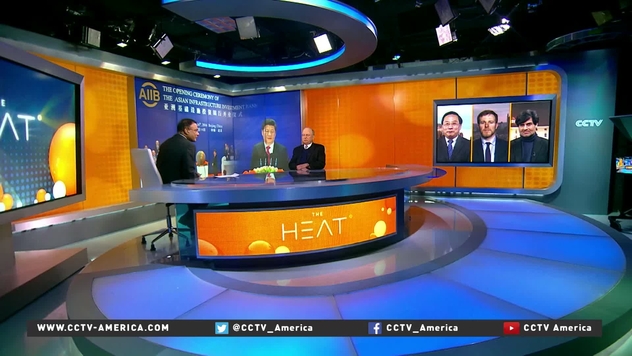
The Heat: The Asian Infrastructure Investment Bank officially opens

CCTV America, January 18, 2016

The Asian Infrastructure Investment Bank is now officially open for business. How important is the AIIB for China and the global economy?

China’s President, Xi Jinping, has called the opening of the Asian Infrastructure Investment Bank an historic moment.The formal inauguration ceremony took place in Beijing on Saturday. The new international development bank has 57 member states and is expected to lend billions of dollars over the coming years.

461

The Heat was joined by the following guests to discuss:

  • From New York is Victor Gao who is the Director of the China National Association of International Studies.
  • From London is Duncan Innes-Ker who is regional director for Asia at The Economist Intelligence Unit.
  • In the Washington, D.C. studios for CCTV America is Pieter Bottelier who is Senior Adjunct Professor of China Studies at Johns Hopkins University.
  • From New Delhi is Samir Saran who is the Senior Fellow and Vice President at the Observer Research Foundation


The Heat: The Asian Infrastructure Investment Bank officially opens

Sequence 03.00_00_59_16.Still001

http://platform.twitter.com/widgets/tweet_button.24a8e21c9032b45e8d193d263743d845.en.html#dnt=false&id=twitter-widget-1&lang=en&original_referer=http%3A%2F%2Fwww.cctv-america.com%2F2016%2F01%2F18%2Fthe-heat-the-asian-infrastructure-investment-bank-officially-opens&size=l&text=The%20Heat%3A%20The%20Asian%20Infrastructure%20Investment%20Bank%20officially%20opens%20%7C%20CCTV%20America&time=1453179450092&type=share&url=http%3A%2F%2Fwww.cctv-america.com%2F2016%2F01%2F18%2Fthe-heat-the-asian-infrastructure-investment-bank-officially-opens

The Asian Infrastructure Investment Bank is now officially open for business. How important is the AIIB for China and the global economy?

China’s President, Xi Jinping, has called the opening of the Asian Infrastructure Investment Bank an historic moment.

The formal inauguration ceremony took place in Beijing on Saturday. The new international development bank has 57 member states and is expected to lend billions of dollars over the coming years.

CCTV’s Wang Tongxuan reports from Beijing.


The Heat was joined by the following guests to discuss:

  • From New York is Victor Gao who is the Director of the China National Association of International Studies.
  • From London is Duncan Innes-Ker who is regional director for Asia at The Economist Intelligence Unit.
  • In the Washington, D.C. studios for CCTV America is Pieter Bottelier who is Senior Adjunct Professor of China Studies at Johns Hopkins University.
  • From New Delhi is Samir Saran who is the Senior Fellow and Vice President at the Observer Research Foundation.

Read more: http://www.cctv-america.com/2016/01/18/the-heat-the-asian-infrastructure-investment-bank-officially-opens#ixzz3xfDvQfeU
Watch us live anywhere at http://www.cctvamericalive.com
Follow us: @cctv_america on Twitter | CCTVAmerica on Facebook

Standard
Columns/Op-Eds, Politics / Globalisation

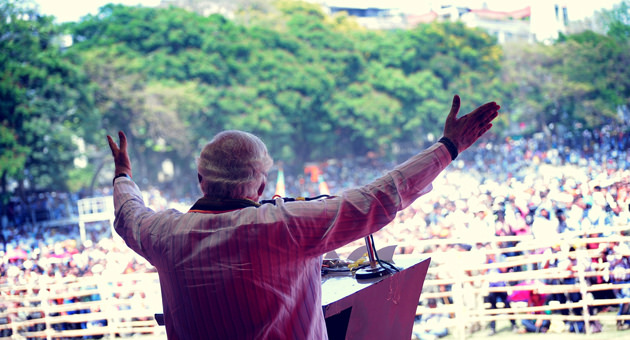
Narendra Modi shines on world stage, labours at home

‘India First’. This phrase, used liberally by the then Indian prime ministerial candidate from Gujarat, Narendra Modi, captured the imagination of many Indians because it responded to the Indian moment.

In 2013-14, Candidate Modi and his Bharatiya Janata Party (BJP) were determined to restore a semblance of pride in a population scarred by corruption scandals and government bloopers. The national shame resulting from the ghastly rape of December 2013 destroyed brand India and darkened the national mood. And the economy, India’s invincible proposition to the world for over a decade, began to head south. The nation was restless and impatient. There was a growing clamour for strong leadership.

Modi

This was the India of just over two years ago, when #NaMo began to trend on social media. This was when Candidate Modi would have sensed that he had a fair chance of winning. This was also when the ‘man of action’, the new loh purush (‘man of steel’), made his promises to an expectant nation and laid out his vision of a re-energised India.

Nearly a year later, it is a good moment to reflect on that promise.

It would be fair to say that there seem to be two Modis. The first is Prime Minster Modi on the world stage, a rock star when he’s abroad and when he receives foreign dignitaries. He is flamboyant in resetting the India narrative in Western capitals and closing in on lucrative partnerships in Asia. He has injected new dynamism in how India engages with its neighbourhood. He deploys slick messaging and leverages the Indian diaspora to create a sense of optimism. The US President waxes eloquent about him in TIME and even the Germans acknowledge the masterful conduct of the ‘Make in India’ outreach at their prestigious industrial fair.

Then there is the Prime Minister at home, with a different look and feel about him.

He is determined at one level, as he stakes his political capital on reforming the land acquisition law, and while pushing forth a slew of new initiatives like replacing the economic planning body (the Planning Commission) with a contemporary organisation. On the other hand, you sense there are some wrinkles that are yet to be ironed out. There are times when you can see him pensively watching parliamentary proceedings as the lack of majority in the upper house impedes him. There is reluctance while communicating his vision and policies, and an inability to deploy the same communication means to reach out to citizens that got him the top job in the first place.

Clearly then, as we clock in year one, there is much to be done at home for the Indian Prime Minister, if the disconnect between the external messaging and the politics at home is to be reconciled.

India’s most powerful proposition to the world remains an India that offers opportunity to Indians and to others who want to engage with it. It was on this promise of hope, domestic reform and growth that Modi was elected. His election slogans held a two-fold promise: Acche din aane wale hain (‘good days are about to come’), and na khaoonga, na khaane doonga (‘neither will I take bribes nor will I allow others to’). These slogans alluded first to a government that delivers on its promises and is sensitive to the aspirations of youth, and second to a commitment to systemic reform, with corruption a metaphor for bad governance.

Once the scale of his victory became clear, the Prime Minister’s first tweet was acche din aa gaye (‘good days have come’). Implicit in this declaration was that his election was a mandate for change and that change would be rapid, not incremental. If expectations of the new government were high, it was because Modi himself led India to expect a tectonic shift.

The Modi campaign was clever in seizing upon a rare confluence of the needs of big businesses and the bottom of the pyramid. Both needed financial-sector reforms and innovation. While at one end investable capital was needed through creative instruments, at the other end basic financial inclusion, distress loans and lifeline banking were crucial.

Big businesses sought employable human capital to scale up operations, to climb global value chains and to optimise labour productivity (a fifth of China’s). The bottom of the pyramid needed skilling initiatives, basic education, digital literacy and technical education that would allow them to participate in the modern economy and make their ‘mom and pop’ operations more profitable.

Both big business and small operations needed market access, roads, ports, energy and digital highways that would allow them to compete in the global marketplace. To deliver on these was essentially the ‘Modi Promise’.

So it was not surprising that in his early days he rolled out the ‘universal banking scheme’ (Jan Dhan Yojana), the Digital India Initiative and the ‘skilling’ initiatives alongside the ‘Make in India’ thrust. Earlier this year, in its first full budget, the Modi Government announced schemes to support micro-enterprises, innovation start-ups and a pro-industry economic orientation that was appreciated by many. The Finance Commission recommendations on federalising tax receipts and giving more to state governments was accepted. Several social sector and welfare schemes were left to the autonomous design of state governments. India was seen to be moving towards a more decentralised system that resonated with the campaign promise of ‘More Governance, Less Government.’

While the schemes and initiatives announced were on the ball, some of the tactics and processes that their success may depend upon need to be rethought and reorganised. Four in particular need attention.

First, the PM may have to oversee a more sophisticated management of parliament. BJP has to reach out to a variety of political actors in the upper house of parliament (and their own coalition partners) effectively. They are unlikely to have the numbers for a few years and the country may run out of patience before then.

The second would be to be mindful of the contradiction between seeking to expand one’s political base across the country while at the same time striving to deliver economic restructuring that responds to promises and expectations. As the political expansion takes place, policy compromises may seem tempting and could dilute the ‘Modi mandate’. Already the talk in some circles is that the real opposition the Prime Minister faces is within his party. The nationalist and insular component of the Rashtriya Swayamsewak Sangh (the parent organisation of the ruling party) is vocal in its  opposition to a number of forward-looking measures the Government may opt for, be it issue foreign investment in certain sectors, labour reform or the reorganisation of the food and agriculture sectors.

The third is the fundamental tension between the centralisation and concentration of power within the Prime Minister’s Office, and the ambition to federalise and devolve governance horizontally and vertically. The Prime Minister’s Office is already under some flak for empire building, delays and inefficiency. What worked in Gujarat may not work for India.

And finally, the PM’s core instinct to operate through the bureaucracy (or a select few among them) may preclude the possibility of lateral hiring of talent that many of his key initiatives do need. While the Chief Minister-civil servant duopoly served Modi well in Gujarat, the decision-making high table may well have to be enlarged if real change is to be effected in New Delhi.

The Government’s honeymoon is perhaps already over and realistically it has another 6 to 12 months to start putting flesh on the bare-bone schemes and ideas announced this past year. If these do not eventuate, one may well witness emptier stadiums abroad and hear shriller voices at home. Ultimately, for PM Modi to sell the Incredible India story, he will need to make India credible.

Photo by Flickr user Global Panorama.

Standard
Columns/Op-Eds, Politics / Globalisation

Six Silent Sins

When the family loyalist was summoned to the sanctum sanctorum by the “High Command” there must have been trepidation and unease in his mind. The organisation after all had just been humbled, humiliated and vanquished at the hustings. As Madam Gandhi asked A.K Antony to introspect and dig deep to find the causes of the Congress Party’s crushing defeat in the 2014 general elections, he must have recalled the string of fallen angels who preceded him, like Azazel and Lucifer. These angels were, as Milton describes them in Paradise Lost, “brighter once amidst the host of Angels, than the sun amidst the stars”. Their fault however was stepping out of line and questioning and defying god.

Clearly then, one implicit parameter for Saint Anthony (if he knows what’s good for him) was to avoid Lèse-majesté when talking of the Holy Trinity – Mother, Son and Daughter. While one has access to his report outside of the usual gossip one hears, it doesn’t exactly take a genius to figure out who and what was left out under the garb of “collective responsibility”. With a great deal of certainty, one may assume that the following seven reasons never made it into the “introspection” report.

The first reason for the loss has to be the undue influence, in party matters, of people like Mr Anthony himself. Some of them clearly irrelevant to contemporary Indian politics, many just sycophants whose raison-d-etre’ were the favourable whims of 10 Janpath, most lacking organisational credibility and legitimacy, and all, so far divorced from ground reality that their influence on party strategy was recipe for failure. Party politics was managed by the extended household of the former first family, not by those with personal political weight and credibility among the people.

By the end of his second term in office, the former Prime Minister was the second reason for what unfolded. He broke his own promises though he never broke his silence. He sold India the hope of reforms and inclusive growth – of a market oriented liberal democracy. By the end of 2009 India was back to the 80s’. All corporates were once again thieves, market based reforms were passé, licence raj had been replaced by regulator raj and corruption was rampant. The Prime Minister who reformed India in 1991 as its Finance Minister presided over a period that destroyed the country’s entrepreneurial spirit and scarred its enterprising soul.

Following from this a dated approach in responding to contemporary needs was the third reason for failure. The infatuation with ‘doles’ to the poor, as against offering ‘agency’ to them, represented a re-institutionalisation of feudal thought. India of 2014 is not the India of 2004. It is younger, low-income and seeking opportunities. What was on offer was continued state patronage and welfare schemes, which may have appealed to a poorer and older demography of the past. India today, is young and aspirational and has dreams that transcend promises of lifeline existence. The poor were the target vote-bank and the approach seemed to imply that the party would thrive because of incessant poverty.

The mediocre branding of the protagonist-in-chief, Rahul Gandhi was to be the next reason. He could not relate to the people, and his moral renunciation and episodic political participation was disingenuous. His contrived anger against corruption, his feeble remorse for the riot victims of 1984, his convoluted commitment to a progressive India and his role as an ‘outsider’ was poorly thought through and badly executed. There were limited takers for the “RaGa” proposition.

The fifth, reason would have implicated ‘Madam’ herself. Democracy seldom allows power without responsibility and even when it does, it remains a fundamentally bad equation. Maybe the Philippines could accept an Imelda Marcos, Egypt a Suzanne Mubarak and Argentina an Eva Peron, but India persistently rejected quasi-democratic authoritarian regimes that those three were. The leadership may very well have been benign. The leader may not have hoarded shoes like Imelda; or stolen money like Eva; or adopted a “country be damned, my son first” attitude like Suzanne. Yet ‘Madam’ was ultimately responsible for everything and refused to accept that this comes attached to the immense power that she enjoyed. India was fooled once, by the buffer that the Prime Minister offered, but they were not willing to be fooled a second time round.

The communication and engagement with the electorate has to be the sixth reason. Spokespersons were patronising and arrogant, hectoring and often aggressive, even as they justified by the unjustifiable. They were masters of phrase and prose and so proud of their glib talk they forgot political communication is a dialogue. They said what they wanted to, and were willing to hear only their own voices. They criticised the feedback from Social Media as being sentiments of enemies and irrelevances. Well-meaning advice was rejected as coming from those who had made a pact with the devil. The cries, the pleas and the anger were ignored. The government spoke to itself even that was with discordant voices.

The last and most important reason for the defeat is that the preceding six paragraphs will not find their way into the report. To win one needs to accept the truth – no matter how bitter. If one cannot or deliberately refuses to understand what really went wrong, one cannot fix things – expect superficially. But the fact remains that that the “high command” wishes to guard its position and that of its progeny. The fact remains that everyone in the Congress core committee wish to hide their de-facto irrelevance and that spokespersons like bad singers do not want to hear that they are bad at what they do.

So what would St Anthony’s concluding paragraph be? Presumably that the incumbent too would be “led astray” by those who surround him and their lust for power. Ultimately his conclusion would be that nobody in the congress was wrong, and all they need to do for the next ‘sonrise’ is for the current dispensation to falter, and inevitably it will.

Standard
Politics / Globalisation

US wants stable, durable relation with India: Experts

India Today, New York Global Roundtable , September 26, 2014

Original link is here 

Mr. Saran

Samir Saran, Lisa Curtis and Bruce Jones


The United States is looking for a stable and durable relation with India but a lot will depend on how both sides will align themselves on various global issues be it Ukraine, climate change or terrorism, experts said at the India Today Global Roundtable in New York on Friday.

India has the financial and diplomatic resources today to take forward its interests but Washington will want a stable relation with New Delhi, Bruce Jones, the director of Project on International Order and Strategy, Brookings Institution, said.

The US will like to see how India contributes on global issues. The nuances are tricky but a lot will depend on how New Delhi responds to Washington’s aspirations, he said.

Referring to the BRICS grouping, he said there is a lot of positivity in that initiative, for instance, the BRICS Bank project is a good move but Russia has also created problems in Ukraine and India cannot afford to overlook these issues which will cost its ties with the US.

The World Bank certainly needs a competitor; the Western model of development is pretty poor, he said, adding India’s penchant to ignore Russia’s excesses may hinder its ties with the US.

Lisa Curtis, senior research fellow at Heritage Foundation, said India being a multi-religious multi-ethnic democracy there is a lot of converging interests between India and the US.

The recent trade agreement between India and Japan is quite significant. Japan has committed $35 billion to India. Chinese President Xi Jinping’s visit, however, did not go so well due to the border tensions. The US, however, would never commit such huge sums of money. It is for the private sector to do so, she said.

Standard
Columns/Op-Eds, Non-Traditional Security, Politics / Globalisation

The European Union as a Security Actor

View from India

Bundeszentrale für politische Bildung Logo

Original link is here

Das Bild zeigt die Glastüren des Haupteingangs zum Europapalast in Straßburg, Sitz des Europarats. Die Türen sind mit Euro-Sternen verziert.

Euro-Sterne auf den Glastüren des Hauptportals zum Palais de l’Europe, Sitz des Europarats in Straßburg. (© Ulrich Baumgarten/vario images)


What is a security actor and how is it different from being a great or major power? In many ways, this question is central to understanding the lack of appreciation of the European Union (EU) as an actor in the security arena in India and certainly in some other parts of Asia. The use of the word ‘security actor’ by EU agencies and research institutes is itself perhaps a neutralisation of the phrase ‘major power’. This reveals the ambivalence of the EU to power in contemporary times, despite having given the world several great powers in the past. This ambivalence, and the hesitant Asian comprehension of the EU’s role in the security domain shape the current debate.

However, to move beyond this general understanding and to try and understand the Indian perspective on this issue, three key enquiries are essential. First, does the EU have the agency to be a security actor? Second, does it have the capability and capacity to follow through in this role? And, finally, does the EU, or a significant part thereof, see itself as a Security Actor?

Agency: Who do I call?

The EU is a great economic power and is central to the construction of any polycentric order. In spite of this, it is not viewed as a security actor. Perhaps this can in part be explained by what Henry Kissinger once famously said, in an interview with Der Spiegel, ‘Who do I call if I want to call Europe?’. While the EU now has a number of structures that deal with security its security policy has not evolved to the point where it can shape emerging international security scenarios.

The principal issue is that of integration. Collectively, it appears that the EU thinks of itself more as a civil and economic power, viewing military instruments as an option of last resort. Within the EU, France and the United Kingdom have a different approach in which use of force, or the threat of the use of force is a prominent instrument in their toolbox. Some others like Germany tend to take the opposite view and are generally more reluctant to sanction the use of force.

This can have consequences like France declaring that its permanent membership of the United Nations Security Council will remain a French seat and will not be ceded to the EU. France has also rejected the validity of a UN veto when humanitarian crises loom (as was the case in Syria)[1]. These two French positions have led to both disappointment and alarm in other members of the EU. Damagingly for the EU, the latest crisis in Europe, i.e. the occupation and annexation of the Crimean Peninsula by Russia, has only confirmed this apprehension. The lack of a coordinated EU response is disconcerting, as what we have is a set of nations individually condemning Russian actions and others staying silent.

Trade and commerce across the EU is now so integrated that it allows for similar perceptions and ideas on most macro and several micro economic policies. This allows the EU far greater cohesion and therefore, weight in trade talks. On the other hand, political approaches and realities in each member country vary dramatically. This dissonance between a cohesive economic union and a relatively divided political union has a significant impact on the perception of the EU in a continent like Asia where the realist paradigm dominates. The EU is likely to be seen as a ‘hyper-successful’ regional trading and economic arrangement, but not a unified security actor or a ‘great power’. It is also seen to be creating a large political and security bureaucracy, which churns out some strategic and security objectives, without seeking to possess the hard power elements to realise these set of goals.

Capacity: Acute Deficit

Capacity is the key element that will define the EU’s ability in the Asian theatre. In 2012, as per the International Institute of Strategic Studies’ (IISS, London) estimates, Asian defence expenditure exceeded Europe’s. Indeed within the EU, member states are increasingly hesitant to commit towards defence expenditure. Additionally, the focus of current expenditure is on capabilities that are not decisive in the Asia-Pacific theatre or suitable for hard power projection in the classic sense. There is little political and public support for defence expenditure when social spending is deemed a higher priority.

As a result, the EU’s ability to play a role in the international system is going to be far more constrained than ever before. This is perhaps evidenced by the fact that not a single European or EU action has been carried out without US support even when taking on vastly inferior militaries like those of Serbia or Libya.

This acute capacity deficit means that if the EU chooses to act by itself, it comes up against the various perceptions among the EU member states on its role as security actor. On the other hand, if it chooses to act through the agency of NATO to bypass this internal dissonance, it is fundamentally dependant on the US for capacity.

Self-View: “Empire of Norms”

The recent description of the EU being an ’empire of norms’ is another important facet of the view of the EU as a security actor.[2] It connotes a renunciation of the modes and methods of traditional empires in favour of one that leads by example and rules, largely renouncing the use of force and prioritising economic integration. In this, the EU has something to teach the world; the postmodern construction of international relations. But beyond the EU, the post 1989 sense of euphoria, has not translated into political evolution that suggest support for any such new approach to sovereign relations.

The EU firmly believes it has entered a post modern world, whereas in reality much collective action today is directed towards pre-modern situations like Afghanistan, Iraq and Libya. To use an Americanism, ‘when you don’t have dirty work to do you can be dressed in white clothes’. As a result, when the EU piggybacks on US hard power, it can well afford to play the ’empire of norms’ role. This harks back to India in the 1950s and 1960s when India was ‘preachy’[3], telling Europe to peacefully coexist with the USSR, substituting rhetoric, largely to compensate for acute structural weaknesses. Today, India and Europe have traded places and the projection of EU rhetoric is seen as a sign of weakness, borne out by the structural factors discussed earlier.

View from Asia 1: Largely favourable

Immediately after World War II, the main goal was peace and stability and hence there was the need for a specific role for the set of actors who could provide this. But in the 21st century, the narrative has changed. Economic growth and prosperity, in an age of stagnant industrial growth, is the overarching political priority of these times. Even though the world may have moved beyond the post-war quest for peace, to the singular objective of greater economic vibrancy, the EU’s role in securing this objective cannot be denied given its economic agency. However, political stability is a necessary condition for sustainable growth and economic well-being. This stability is to be created and preserved collectively by the old and new powers. Therefore in Asia, in countries such as India, there exists a largely favourable view of the EU’s role in the world. India sees a decisive security role for the EU, albeit as an agent of ‘The Asian Century’.

Following from this, if the EU is a decisive player in the contemporary context, European hard power is not necessarily viewed unfavourably and is a situation that India can negotiate well. A strong EU is good for the balance of power and stability in Eurasia and therefore favourable to India. In fact, a not so uncommon view in India is that if there is a decline in the EU’s hard power, it might contribute to flux in the balance of power in Eurasia, leading to instability. Thus, the EU is still seen as a decisive actor in the security dynamics of Asia. And a real example is the EU’s arms embargo on China, which could be said to contribute to stability in Asia.

However, in India, the EU is also seen as hypocritical in its application and espousal of rules and norms. This is sometimes inimical to the larger objective of stability and prosperity because the EU is perceived to be trying to impose normative frameworks on societies, which are not yet ready to accept them. This is not necessarily an EU-specific flaw. Every country has displayed this hypocrisy where its core interests are at stake. India itself follows a very different set of rules in its own neighbourhood than in the rest of the world. For example, India intervened decisively in 1971 in Bangladesh and for much of the 1980s and 1990s in Sri Lanka. But where its core interests are not at stake, it adopts a very different stance.

While largely hypothetical, India’s main concerns, should the EU decide to play the role of a security actor would be: where and how does the EU want to operate? Does it merely look at its periphery? Or does it seek to project out? If it operates for longer periods of time in Asia, will it be in a continental or a maritime role? Given that the naval dimension and the security dynamics of the Indian Ocean have largely driven much of India’s strategic realignment post 1990, India would almost certainly welcome EU as an offshore balancer. This is evident from the fact that India welcomed the EU-led operation Atalanta aimed at controlling piracy off the coast of East Africa. Similarly, India voiced no concerns at the build up of a formidable projection force off the proximate Myanmar coast following cyclone Nargis, and actively cooperated with US and European navies in the wake of the Boxing Day tsunami in 2004.

View from Asia 2: Geography and Sovereignty Matter

Multiple path dependencies, along with the overarching economic prosperity objective mean that the EU’s cost-benefit analysis of engaging in Asia, for example, is very different from India’s. The EU would have more to lose economically in any prolonged military engagement in Asia and therefore prefers economic tools such as sanctions. Of course geography matters not just to the EU. This is evident in how India perceived Bangladesh in 1971 and how it perceives the situation in Syria today. In the case of the former, the instability in India’s neighbourhood had a direct impact on India’s demography and security and the cost-benefit analysis of action was very different to the likely costs of EU’s action in the region. Syria, on the other hand, was more of a normative issue for India on how it balanced humanitarian intervention against a breach of the Chemical Weapons Convention (CWC); whereas Syria had a more proximate impact on Europe and subsequently on its cost-benefit analysis of action.

Lastly, in a continent like Asia that has a history of being colonised, sovereignty is an important consideration. From this perspective, the EU’s rather relaxed interpretation of sovereignty, partly used in its explanations for humanitarian interventions, can be seen as unsettling. Moreover, the selective use of sovereignty can erode the credibility of the EU as a whole. For example, defence sales such as those of the Rafale, Gripen or Eurofighter are carried out under sovereign flags and these in turn guarantee certain sovereignties to recipient countries. However, when uncomfortable decisions are taken such as the arms embargo on China, the EU is used as the shield, effectively a policy of safety in numbers.[4] This means bilateral brownie points accrue to individual sovereign constituents of the EU, without translating into advantages to the EU as a whole. However, disadvantages and the resultant negative perceptions are spread across the board and impact on the image of the collective.

Conclusion: Going Forward

Going forward, there are four central cleavages between the Indian and European worldviews.

The first has to necessarily be language and the principle source of information that shapes Indian understanding of Europe and EU. Not having a core of experts trained in European languages, a disproportionately small foreign service and a structural incapability to collect primary data[5], much analysis of Europe and the EU rests on secondary source analysis of a euro-sceptic English language press. Consequently, the nature of the EU’s decision making remains even more of a mystery to Indian audiences.

The second is that the EU (for reasons already discussed) is not viewed in India as a credible security actor. In fact, Europe’s recent humanitarian interventions are seen as creating dangerous precedents in Asia, changing the security dynamics in the region and creating fresh security challenges which the EU does not have the capability to deal with. This is where India and the EU are on a collision course. India wants Europe to be more cognisant of its hard security role. In addition, India wants the EU to be responsive to emerging security issues, which will be shaped by new specificities and geographies of conflict. Local understanding and localised responses would be in order and Europe must begin to engage from within and not from outside.

The third is with regard to global governance. European institutes tend to securitise the global commons and global public goods discourse.[6] Every economic and social service provision is being subsumed under a security discourse. This approach may be useful to galvanise public opinion in the Euro-Atlantic community; but in Asia, where societies are still evolving and discovering a balance of narratives between the political and military discourse, it could be dangerous and counterproductive. In countries like Pakistan and Bangladesh, if water, environment and trade become security narratives, discussions within and among these regional countries would essentially become zero sum games. Additionally, the preponderance of the military architecture and defence bureaucracy diminishes the role of democratic institutions and the role of civilian governments. This is counterproductive to the liberal democratic value system that EU espouses. It may appear that in order to compensate for its lack of military heft, the EU seeks to overbalance through the securitisation narratives.

Finally, the central division between the EU and India is the tyranny of grammar. Europe and the EU pursue their interests under the grammar of values, which is sought to be achieved through ideological underpinnings. India has sometimes also couched many of its strategic interests in its own grammar of ethics. Till a new language is discovered where the two can negotiate their individual interests (doing away with ideological sermonising), common ground (based on core interests of prosperity, growth and liberal market framework) will be lost to a rather unnecessary battle of perceived virtues.

Fußnoten

1.
Opinion expressed by French Foreign Minister, Laurent Fabius, 5 October 2013, »ambafrance-in.org«.
2.
Jan Zielonka, »Europe as a Global Actor: Empire by example? (PDF)«, International Affairs, 84(3), 2008.
3.
Bhaskar Roy, ‘Tharoor questions Nehruvian line’, 10 January 2010, »timesofindia.indiatimes.com«
4.
‘Tharoor for overhaul of Foreign Service Recruitment System’, 8 October 2012, »thehindubusinessline.com«
5.
For example, when Finland wishes to raise uncomfortable issues with Turkey, »finnbay.com«.
6.
See, for instance, ‘The securitisation of climate change in the European Union’, »climateandsecurity.org«

Samir Saran is vice president at the Observer Research Foundation, India’s premier public policy think tank. Besides heading the business of the foundation, he writes extensively on and researches issues such as south-south cooperation, role for BRICS, cyber governance, economic and politics of climate change and trans-boundary water governance.


Dieser Text ist unter der Creatie Commons Lizenz veröffentlicht. by-nc-nd/3.0/de/
Der Name des Autors/Rechteinhabers soll wie folgt genannt werden: byc-nd/3.0/de/ Autor: Samir Saran für bpb.de
Standard
BRICS, Columns/Op-Eds, Politics / Globalisation

Waking up to the BRICS

Opinion» Lead 

Original link is here

BRICS members should democratise the New Development Bank’s functioning if new stakeholders are included in the future. If anything, the NDB must be a template for change, not a mirror to the existing hegemony of money

In his 2001 paper titled “Building Better Global Economic BRICs”, economist Jim O’Neill of Goldman Sachs calculated that “if the 2001/2002 outlook were to be extrapolated, over the next decade, China would be “as big as Germany” and Brazil and India “not far behind Italy” on a current GDP basis. Cut to 2013; Jim O’ Neill’s expectations seem modest. Last year, China was the world’s second largest economy, Brazil ahead of Italy and India just one rank behind in terms of current GDP. In purchasing power parity (PPP) terms, all the BRIC countries were within the top 10, with China and India at second and third position respectively. BRIC, in Wall Street lingo, is an “outperformer.”

Despite the crippling financial crisis, BRIC has done better on pure economic terms than most expectations. But the acronym is today representative of much more than an investment narrative alone. With the inclusion of South Africa, BRIC became BRICS, giving a pluralist and inclusive veneer to an economic idea. This group now has a significant political dimension, as is evidenced by the increasing number of converging positions on political issues.

In a follow-up paper in 2003, titled, “Dreaming with BRICs: The Path to 2050,” Goldman Sachs claimed that by 2050, the list of the world’s largest 10 economies would look very different. It is remarkable then, that in 2014 the list already looks radically different, and it is clear that it is time to “wake up” to the BRICS.

NDB versus existing banks

In this context there were at least two concrete arrangements inked at the sixth BRICS Summit in July, which will have a large economic and political impact. These were the Contingent Reserve Arrangement and the New Development Bank (NDB). Conversations and reportage on these two were shrill, coloured and obtuse in the run-up to the Summit. It continues to follow in the same vein. Indeed the NDB is at once the most celebrated and critiqued outcome of the Fortaleza Summit. Now that we are a few weeks away from its public conception, it is time for a reality check on this widely discussed BRICS achievement.

The first reality is the NDB can neither replace nor supplant the role of the existing development banks. The NDB will not be able to compete with the reach and expanse of existing institutions such as the World Bank, which has a subscribed capital of over $223 billion. The bank borrows $30 billion annually by issuing Triple-A rated debt in international bond markets. Such easy access to capital markets on the back of high promoter creditworthiness allows the bank to have a lower cost of funds. Other development finance institutions enjoy similar financial backing. The Asian Development Bank (ADB) too has a large balance sheet, backed by 67 member nations and a subscribed capital of $162 billion.

In contrast, the NDB will require over half a decade before it can accumulate the stated capital base of $50 billion from within BRICS and another $50 billion (approximately) from other countries and institutions. Indeed, in the immediate term, only a modest $150 million has been promised by each of the BRICS countries. A contribution of $1,850 million thereafter, staggered over five to six years, will require some doing as the BRICS countries are grappling with weak balance sheets, fragile current accounts and other domestic imperatives.

Then, there are other questions that will need to be answered in the days ahead. If China is unable to dominate this institution, will it prefer to prioritise investments through its (proposed) Asian Infrastructure Investment Bank? How soon can the central banks of the member countries devise arrangements to act as depository institutions for the NDB? And, how will the NDB raise funds in different countries? What will be the currency or currencies of choice? All important posers which can be addressed if the resolve is unerring.

Development finance

The second reality is, in spite of its modest economic weight in the initial years, the NDB can change the ethos of development finance irreversibly. Rather than replacing or supplanting existing development finance institutions, the NDB will seek to supplement existing resources. In fact, the World Bank President, Jim Yong Kim, has welcomed the idea of the NDB and acknowledged its potential in infrastructure development and the global fight against poverty.

An important difference could be in the way conditions and restrictions are imposed on loan recipients. Bretton Woods Institutions such as the World Bank have been known to impose conditions for lending that create structural mismatches between project funding, demand and supply. As recently as last year, the World Bank Group decided to restrict funding for new coal plants in developing countries, deciding instead to invest greater resources in “cleaner” fuels. Of course, the World Bank would be well advised to reconsider this decision given lifeline energy needs and the energy access realities in developing countries such as India.

The NDB’s mission must be to create a business structure where borrowing countries are given greater agency in prioritising the kinds of projects they would want funded. Over a decade, this could become the demonstrator project through which the relationship between donors and recipients, lenders and borrowers, will be rewritten. Hopefully this will be in favour of developing economies and will enable the reimagining of economic pathways.

Location and ownership

The third reality — perhaps, the most debated — is that the location of the NDB is immaterial when governance and ownership is equally shared. Location has frequently been confused with ownership, skewed by our imagination of existing institutions such as the World Bank. According to its Articles of Agreement, major policy decisions at the World Bank are made through a Super Majority — 85 per cent of votes. Vote shares in turn are determined by the level of a nation’s financial contribution. With around 16 per cent voting share at the World Bank, the U.S. has a de facto veto. Conversely, BRICS, with 40 per cent of the global population and a combined GDP of $24 trillion (PPP), collectively accounts for a mere 13 per cent of the votes at the World Bank.

As such, the concentration of voting power and headquarter location in Washington DC in the case of the World Bank is merely a coincidence. Japan dominates the functioning of the ADB with a 15.7 per cent shareholding, despite the headquarters being located in the Philippines.

It is also useful to note that previous World Bank presidents have been U.S. citizens and the International Monetary Fund’s (IMF) list of managing directors is composed entirely of Europeans. Even the ADB’s presidents have been Japanese citizens, with almost all of them having served in the Finance Ministry in Tokyo. In this regard, the NDB, with its intention of rotating leadership, seeks to overhaul the existing governance framework prevalent in the international development finance institutions. Through equal shares of paid-in capital in the NDB, there is a clear intention of creating an alternative model that focusses on voting-power parity. The smallest country can negotiate at par with the biggest country.

Will BRICS create a framework that is as democratic in sharing governance space with other investors and stakeholders? This will be something to watch for as the systems and structures evolve. The notion that the NDB has been “Shanghai-ed” is perhaps a shallow understanding of this exciting new initiative.

With an equal voting share, all five countries have to be on board to move in a particular direction. Admittedly, this can be hugely inefficient and troublesome. Therefore, it is incumbent upon BRICS members to ensure that this initial at-par equity in governance does not unexpectedly allow for a super majority like gridlock, restricting decision making because of a lack of consensus. The NDB must be dynamic and lithe, much like the BRICS grouping itself. It would be useful for BRICS members to institute a professional management body for steering everyday operations of the NDB as well as all non-policy related decisions, including those dealing with project funding.

And most importantly, as discussed earlier, BRICS members should democratise the bank’s functioning if new stakeholders are included in the future. They must find ways to engage the recipients and beneficiaries in its decision-making apparatus. If anything, the NDB must be a template for change, not a mirror to the existing hegemony of money.

(Samir Saran is vice-president at the Observer Research Foundation and available at @samirsaran on Twitter.)

Standard

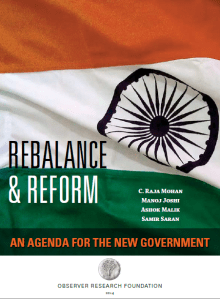
Rebalance and Reform Pic

Books / Papers, Columns/Op-Eds, In the News, Politics / Globalisation

Rebalance & Reform : An Agenda for The New Government

Image
Columns/Op-Eds, Non-Traditional Security, Politics / Globalisation

Knowing India’s nuclear credentials

Original link is here

SSAIM

The HinduThe civil nuclear deal, hinged on one clear principle that India’s military programme would irrevocably be separated from the civilian one, was based on arriving at an outcome that would benefit all parties and enhance the global order. Picture shows the Jaitapur nuclear power project site. Photo: Vivek Bendre


Manufactured Western outrage ignores the reality that under the landmark 2005 India-U.S. agreement, the IAEA has unprecedented access to Indian nuclear facilities

There has been a concerted attack on India from the usual suspects in recent days even as it was entering into negotiations to formally accede to the Nuclear Suppliers Group. As if on cue, Jane’s Intelligence Review carried out a “(non)-exposé” of an Indian military nuclear facility in Karnataka. As exposés go, it was lame even by Jane’s standards. The nature of the facility and location have been publicly available since 2010. Yet, this new “exposé” was carried by all mainstream print news outlets and predictably sensationalised with everyone feigning alarm and anxiety. This manufactured outrage culminated with a sanctimonious editorial in The New York Times that was remarkable for the sheer incoherence of its own arguments. As the designated chief of the non-proliferation ayatollahs (with blinkers) and representative of a motley anti-India group in the U.S. that is shrinking ever so rapidly, this too was on expected lines.

Assault on credentials

Nevertheless, it is important to dismantle the uneasy arguments of this concerted assault on India’s credentials. The first proposition that must be taken issue with is the propagation of a falsehood that Pakistan and its reckless build-up of nuclear stockpile is somehow driven by India’s posture. While Pakistan’s careless impulse may be a result of more than one central factor, it is important to understand that this may have a lot to do with its suspicion of American intentions. The oft-quoted argument is that Pakistan seeks to equalise the conventional mismatch with India through a misguided reliance on numbers of strategic and tactical warheads. The irrationality and illogic of this behaviour has been proven by the fact that a country like North Korea has deterred both the U.S. and South Korea with explosions that may not even have been nuclear. Pakistan’s vertical proliferation has no mooring to India’s strategic programme — only to its own paranoia. The question is what fuels this? There is no denying the fact that Pakistan was able to obtain “nuclear immunity” for its sub-conventional activities against India with even 10 warheads. It may well be the fear of the U.S. that motivates its build-up today.


New Delhi is already providing support to FMCT negotiation; its signature on the CTBT is linked to similar commitments by the U.S. and China”


One motivator is the pressure the U.S. has been applying on Pakistan (without success due to the China factor) to sign onto the Fissile Material Cut-off Treaty (FMCT), which will forever cap the Pakistani arsenal. Contrary to what the commentary would have us believe, the FMCT, instead of curbing fissile material, has demonstrably accelerated Pakistan’s programme. So much for flawed logic. The second is the fear of the American “Plan B”, which involves the seizure and confiscation of much of Pakistan’s nuclear arsenal. The former has driven Pakistan to enrich their extant stockpile of radioactive material to weapons grade at breakneck speed. The latter has ensured that Pakistan is rapidly weaponising its fissile stock, in order to disperse and complicate any such weapons seizure plans. These facts are well understood in Washington policy circles. The exposés and op-eds of the past weeks are for most just another edition of Aesop’s fables.

The second issue has to be the demonstrated lack of understanding of the reality that shaped the landmark civil nuclear agreement between the U.S. and India. This nuclear deal was based on one clear principle — that India’s military programme would irrevocably be separated from the civilian programme. This was not an optimal solution for India or for the P5, but like all international agreements it was based on arriving at an outcome that would benefit all parties and enhance the global order. International Atomic Energy Agency (IAEA) Director General Mohammed El Baradei in an op-ed in the Washington Post, specifically welcomed the deal without reservation, his rationale being “either we begin finding creative, outside-the-box solutions or the international nuclear safeguards regime will become obsolete.” This is now accepted wisdom. The IAEA has gained unprecedented access to India’s nuclear facilities. India has accepted additional protocols this June, and has strengthened its own export laws. Significantly, the same journals and reports confirm that India’s own arsenal has remained stable over the period with no increases despite the turbulence in the neighbourhood. The benefits of bringing India inside the ‘non-proliferation tent’ are therefore vast, visible and tangible.

While these editorials and reports may very well have got their facts and numbers right, the analysis is so convoluted that the facts they quote cease to be relevant. The argument goes that India needs to sign the FMCT, the CTBT, and agree to mutual weapons reduction with China and Pakistan, since it is the nuclear deal with the U.S. that has set the cat amongst the pigeons. Here then is some measure of reality. India is already providing active support to the FMCT negotiations — it is a work in progress, not yet a concrete treaty. It has been Pakistan that has been blocking the work at the conference on disarmaments negotiations.

Additionally, India’s signature on the CTBT is explicitly linked to a similar U.S. and Chinese commitment. As long as they do not ratify these two treaties, India has a voluntary unilateral moratorium on testing. What is holding up Indian accession is U.S. and Chinese accession.

Experts in Beijing claim that China’s expansion and modernisation of its nuclear forces is being driven by the ill-advised and deeply destabilising withdrawal of the U.S. from the Anti-Ballistic Missile (ABM) treaty. This has nothing whatsoever to do with India.

India, therefore, is first being made the whipping boy for the failure of the American non-proliferation lobby in their own country and then it has to accept blame for the complex relations the U.S. shares with Pakistan and China that is driving these Asian allies to increase their arsenals. Can we get real, please?

(Samir Saran is vice-president and Abhijit Iyer-Mitra is programme coordinator at the Observer Research Foundation.)


Standard