Digital India, Politics / Globalisation

If India wants to become a superpower, it has to stop trying to become the next China

Original links are : ORF and Quartz India

India is currently in the midst of two large but different endeavours.

The first is to complete the unfinished agenda of the previous decade, providing the country with the modern infrastructure, rural amenities, social services, and connectivity that any developed economy needs. And the second, the most ambitious of the two, is to create jobs, wealth, and value to accommodate a young and aspiring population, eradicate poverty, and boost GDP growth.

But these two projects are being undertaken at a time when global headwinds are deeply unfavourable. Today there are five hurdles that stand between India and its ambition to join the club of developed economies.

The first is the advent of this new age where the open, free, and democratic global trading system has become a pale shadow of its previous self. The multilateral trading system — and the preference for this kind of model — has waned considerably. It is being replaced by free trade arrangements between smaller groups of countries and regions, where a handful of stakeholders are able to decide the terms of trade.

This is coupled with a stagnation in global financial flows, because of weak growth, and the growing disquiet over globalisation, curiously enough, in the developed world. From the EU to the UK to the US, politicians are using globalisation as a convenient culprit for all that ails domestic economies and societies.

It’s against this backdrop that India has to discover new markets, new sources of funding, and new trading arrangements.

Second, the advance of technology and the expansion of the digital economy, along with robotisation, is in many ways closing the window for export-led manufacturing growth. They have significantly eroded the advantages that cheap labour typically provide for developing countries. Industrialisation, when seen through the narrow prism of manufacturing, therefore already looks improbable, if not impossible.

Manufacturing, Globalisation, Digital India, Labour

Emerging economies will be stuck with the traditional disadvantages of weak governance, cumbersome bureaucracies, quality and competence issues, fragile supply chains, and a lack of skilled labour even as they compete with machines and machine learning. Large labour pools are unlikely to provide any competitive advantage unless the labour force is reoriented, retrained, and reimagined.

That’s going to make things difficult for India. Even though the country might benefit in the next five to 10 years from weak energy prices, industries exiting China, and inflows of foreign direct investment, it’s going to get harder to compete in manufacturing.

Large labour pools are unlikely to provide any competitive advantage unless the labour force is reoriented, retrained, and reimagined.

A case in point is the relocation of textile and garment production to the developed world. This was previously a sector most sensitive to cheap labour and therefore the first to be off-shored to the developing world. Today, it’s now returning to robotised factories in the US and the EU.

Indeed, it can be argued that with 3D printing and artificial intelligence, manufacturing as we know it may be coming to an end. Whatever form that manufacturing takes in the future, we can safely assume that it will based on high competencies in design, material science, resource management, super-computing, and precision engineering, all delivered by machines or sets of machines and requiring minimal labour.

Third, energy derived from fossil fuels may no longer be a given in any new industrialisation effort. In a “climate-aware” world, it is apparent that there is a willingness to compromise with low incomes and poverty but little appetite to allow the developing world too much carbon space.

Fourth, global finance is increasingly agnostic, if not outright unfriendly, to the idea of traditional industrial growth. An IMF working paper suggests that “investors such as pension funds, insurance companies and mutual funds, and other investors such as sovereign wealth funds hold around $100 trillion in assets under management.” This study estimates the infrastructure-funding gap between $1 trillion and $1.5 trillion each year, with the deficit significantly higher in developing countries. This paper and other studies have argued that this stems from a lack of financial instruments and a lack of appetite to invest in the industrial ventures of the past. Global capital and even local commercial capital in developing countries are being crowded away from investing in infrastructure.

Fifth, innovation itself has a spatial flaw. Discovery and invention are still the preserve of the Atlantic system while consumption and absorption are witnessing greater uptake in the Asian economies and in Africa. This new innovation divide, when combined with restrictive intellectual property regimes set up for the benefit of Western corporations, is bad news for developing countries. It’s likely that they will merely transform from being labour sources, marginal consumers, and resource-rich spaces to markets for innovation, sources for the data that drives the process, and part of a value chain where the largest wealth will still be created in the old economies.

Discovery and invention are still the preserve of the Atlantic system while consumption and absorption are witnessing greater uptake in the Asian economies and in Africa.

This will ensure that their purchasing power remains low. Without large-scale, export-driven manufacturing, and without the revenues that would accrue to the owners of technology, there is a high possibility that developing countries that are not yet middle-income will remain trapped in a low-productivity, low-wage spiral.

The better way forward

So what should India do, given these five trends in global economic development?

First, India must get its own house in order. One-fifth of humanity is a market and a productive base in and of itself. But for the country to take advantage of its size, it must sign a free trade deal with itself.

Currently the 30-odd states and union territories that comprise the Republic of India are nominally a single economy. But in reality, they’re less integrated than the economies of Europe. India’s states and union territories often have sharply different regulations and incompatible tax systems. As a result, trading across state boundaries is a nightmare and India really needs to focus on creating a trade association among these regions.

As a single tax, the GST is the first step in the right direction as it will allow new manufacturing units set up under the “Make in India” programme to have access to multiple markets.

Manufacturing, Globalisation, Make in India, Labour

And there are other government policies that also fit well with this endeavour: “Digital India” knits markets together, allowing for vast e-commerce and business-to-business opportunities, and “Start-up India” gives new entrepreneurs access to the finance and incubation required for them to take advantage of these opportunities.

Secondly, the attitude towards informal employment needs to change. It’s time to stop thinking of the informal economy as a bad thing, particularly since an overwhelmingly large number of Indian workers (over 90% by some estimates) are currently employed in the sector. The government should instead focus on creating support systems that will allow for India’s vast informal workforce to become more secure, productive, and, where feasible, more entrepreneurial.

Finally, India must think big. It must consider the possibility that it will have to leapfrog over the industrialisation process itself. It must imagine itself becoming the epicentre of the robotics and AI world, much like Japan become the hub for electronics, Germany for automobiles, and China for manufacturing everything at a tenth of the cost.

To prosper in a world that is suffering from the absence of growth and the disruption of old models, India must strive to become the principal stakeholder of the digital revolution — and ensure that its teeming millions partake in it gainfully, even if informally.

This commentary originally appeared in Quartz India.

Standard
Columns/Op-Eds, Politics / Globalisation

Kashmir crippled by lazy politics, needs greater outreach

Aug 12, 2016,  Analysis,  Hindustan Times,Aug 12, 2016

Original link is here

india-kashmir-politics-files_fabe3668-5fa1-11e6-93fe-9ac2f090b545

As prime minister, it is incumbent upon Narendra Modi to expand those options and enhance that outreach. The instruments, dialogue channels and specificities are for him to choose (AFP)

Each time Kashmir erupts, as it has over the past month, a familiar set of opinions and debates comes to the fore, especially on social media and in prime time studios. The discourse is trapped between an overdone nationalism, a hyperbolic romanticism and a mutual denialism. It is important to identify the limits of what can and cannot, and what should and must be achieved in the Valley, keeping five realistic parameters in mind.

First, international appetite for experiments with self-determination is at its lowest since World War I. In recent times, interventions by global powers in Syria, Libya, Iraq and several locations in Africa have — whether militarily or politically — carved new territories and regimes. Moral and strategic arguments for and against these have been made, but there is near unanimity that such interventions have led to instability and created hotspots for radicalism, terrorism and human misery.

Why is this relevant to an understanding of Kashmir? It tells us the desire of the global community for a quasi-independent or unshackled Kashmir, as a manifestation of some libertarian notion of popular aspiration, is near zero. The opening of spaces for potentially Islamist regimes is a non-starter. This explains why, despite the ongoing turbulence, world pressure on India has been minimal. While not sacrificing cherished positions, stakeholders in the Valley have to factor this in.

The idealism of Kashmiriyat, first discredited with the cleansing of Pandits in the early 1990s and then through repeated violence against minorities in the state, is now viewed largely through the prism of “Islamiyat”. Cruel as this sounds, images of stone-pelting protestors being tear-gassed and shot today evoke less horror in the rest of India and the planet than do visuals of masked young men, dressed in black, carrying AK-47s and promoting a mix of religion and armed rebellion. In a post-9/11, post-Islamic State world, the proposition that Islamists are fighting for freedom is neither sellable nor credible.

Second, related to the first point, the backlash against unbridled self-determination is occurring just as the Westphalian system and nation-state territoriality are making a ferocious comeback across the United States, Europe and Asia. There is no patience for redrawing borders. Violence and protests in Kashmir, police action, curfew and suspension of civil liberties, constitute bad politics and poor democracy. Even so, these are seen as sovereign actions the world has left India to take, deal with and live with.

Ironically, this is a consequence of some in Kashmir wanting to “internationalise” their cause. As it happens they have done so by hitching their grievance to global jihad and locating it within an Islamist agenda. This has singularly allowed huge sovereign space for India to act against what is seen as a systemic non-negotiable.

Third, while the Westphalian comeback secures India’s autonomy in Kashmir, it also accentuates the Indian government’s obligations and responsiveness to its citizenry, disaffected or otherwise. Anti-terror crackdowns and operations in Kashmir and the decidedly imperfect democracy in the Valley are not incompatible with the idea of an efficient development state with the rule of law. China, South Korea and others have demonstrated that less-than-optimal political structures do not preclude efficient social and economic development and governance.

Without doubt India has failed in being an efficient development state in Kashmir. Exaggerated talk of the Kashmir valley being among the country’s highest per capita income regions has skewed ambition and design of projects and of human development. Poor integration of the region with key economic centres is a case in point and has allowed a de facto seclusion of the Kashmiri people and their prospects. Article 370 is not the roadblock for this; fundamentally, it is a failure of imagination. Episodically enlightened civil servants and even army commanders do display such imagination, but there is little to institutionalise their initiatives.

Fourth, this poor governance is best (or worst) manifested in the incompetence in managing protests and uprisings. Better riot-police training, more efficient crowd-control methods and upgraded gear and hardware would have resulted in lower casualties. Information management and developing counter-narratives need to be best-in-class as blanket bans on people (curfews) and conversations (media and telecom prohibitions) have deleterious consequences. On social media, separatist propaganda is sophisticated; the Indian State’s information warfare is prehistoric or at least pre-millennial.

To be fair, such renewal is necessary across India and not just in Jammu and Kashmir. It is part of a policing protocol and culture invented by the colonial state after 1857 and suitable for an “occupying” power and “subject” people, not for a government dealing with citizens. This is a challenge India faces in several states, but Kashmir is as good a place as any to invest in 21st century methods, machines and mechanisms.

Fifth, since 1947 the Indian State’s approach to its “frontiers” — whether in the Northeast or Kashmir — has similarly borrowed from the limiting and self-defeating “pacification” tactics of the Raj: bolstering and incentivising local elites and adopting select families for whom networks in Delhi matter more than popular legitimacy or a commitment to widen the sphere of formal politics. Dynasties are frowned upon nationally but over-relied on in these regions. In Kashmir, the Instrument of Accession has been replaced by the Inevitability of Succession.

This is lazy politics. After 70 years of blood and tears, sacrifice and investment, surely India needed to show more options and a greater outreach than just the Abdullahs and Sayeeds? As prime minister, it is incumbent upon Narendra Modi to expand those options and enhance that outreach. The instruments, dialogue channels and specificities are for him to choose.

Ashok Malik is distinguished fellow and Samir Saran is vice-president, Observer Research Foundation

The views expressed are personal


Standard
Columns/Op-Eds, Politics / Globalisation

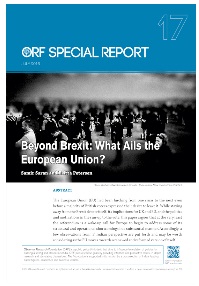
Beyond #Brexit: What Ails the European Union?

Samir Saran and Britta Petersen, Issue Briefs and Special reports, July 19, 2016, ORF

Original link is here

Untitled

The European Union (EU) had been lurching from one crisis to the next even before a majority of British voters expressed their desire to leave it. While staying away from the Brexit debate itself, its implications for UK and EU, and the politics and motivations in the run-up to the vote, this paper argues that at the very least the referendum is a wake-up call for Europe to begin to address some of its structural and operational shortcomings in a substantial manner. Accordingly, a few observations from ‘a’ Indian perspective are put forth and may be worth considering as the EU moves towards a renewed and reformed version of itself.


Standard
Columns/Op-Eds, Politics / Globalisation

The multipolar Asian century (part 2): Contestation or competition?

By Samir Saran, Senior Fellow and Vice President and Ashok Malik, Senior Fellow, both of the Observer Research Foundation. Part 1 can be found here.

In the seven decades since 1945, the US largely succeeded in scripting some significant rules that still survive, and they have guaranteed the stability of global institutions that are the bedrock of contemporary multilateralism. The UN system, the key security treaties, conventions and norms for managing common spaces, all emerged from the conversations of that era. The period since 1990 saw the triumph of the liberal order, and placed the globalisation project firmly within the Atlantic consensus.

The economic imperative to rebuild post-war Europe inevitably necessitated some of these political responses and military instruments. Superpowers became the global guarantors of predictability, whether in trade and commerce or the security domain, and by extension, of multilateralism. This task is now devolving in Asia, but in an Asia that has not been dominated by one sovereign power since the times of Genghis Khan, and an Asia that is stubbornly multipolar.

Asia needs to discover a bridge between multipolarity and multilateralism.

This is occurring at a moment when many holdover institutions are flailing, if not failing. The UN resembles not an NGO, as is often suggested, but a think tank. It offers a good platform for talking about norms and rules, but is ill-equipped to enforce any. Inaugurated in 1995, the WTO is in a premature midlife crisis. So where are the new institutions for the Asian century? Where are the important conversations taking place, and among whom? Or, is it time to face up to the harsh truth and accept that rules, actors, institutions, arrangements and ethics that may be able to serve the Asian century are yet to be discovered, born, written and even conceived?

Perhaps, it is time to pursue a new project, one that begins to create a political Asia. Like the Atlantic order needed to flourish on the basis of the Bretton Woods and UN systems, Asia needs a new management, a new board of directors and a new security architecture. At the very least, this system needs to bring three resident actors (China, Japan and India) and two regional stakeholders (the US and Russia) to the same table. Other sub-regional influencers should be drawn in as well.

The East Asia Summit, of which all these countries are members, has been suggested as a possible fulcrum of such an architecture. Yet, the East Asia Summit is insufficient to address the concerns of Central and West Asia. Is an expanded mandate for the G20 (seven Asian countries, two more if one were to include Turkey and Russia) the answer? Alternatively, is a greenfield institution inevitable?

Three possibilities — distinct, but not mutually exclusive — emerge. At the commencement of the 21st century, Asia’s politics resembles the fraught, rudderless multipolarity of the beginning of the 20th. It took 50 years and two wars for that reckless order to settle into a multilateral equilibrium. Asia has to do it better, faster and without the external stimulus of a great War. As the dowager power, the US can incubate new institutional arrangements in Asia, playing Greece to emergent Asia’s Rome, to borrow from Harold Macmillan’s description of the post-war relationship between Britain and the US.

Should the US choose to bequeath the liberal, international order to Asian forces, India will be the heir-apparent. India would not, under this circumstance, play the role of a great power — because Asia is too fractious and politically vibrant to be managed by one entity — but simply that of a ‘bridge power’. India is in a unique and catalytic position, with its ability to singularly span the geographic and ideological length of the continent. But two variables will need to be determined. Can the US find it within itself to incubate an order that may not afford it the pride of place like the trans-Atlantic system? And, can India get its act together and be alive to the opportunity it has to become the inheritor of a liberal Asia?

The second possibility for an Asian order is that it resembles the 19th century Concert of Europe, an unstable but necessary political coalition of major powers on the continent. The ‘big eight’ in Asia (China, India Japan, Saudi Arabia, Iran, Australia, Russia and America) would all be locked in a marriage of convenience, bringing their disparate interests to heel for the greater cause of shared governance. Difficult as it would be to predict the contours of this system, it would likely be focused on preventing shocks to ‘core’ governance functions in Asia, such as the preservation of the financial system, territorial and political sovereignties and inter-dependent security arrangements. Given that each major player in this system would see this as an ad hoc mechanism, its chances of devolving into a debilitating bilateral or multi-front conflict for superiority would be high — very much like the Concert that gave way to the First World War.

A third possibility could see the emergence of an Asian political architecture that does not involve the US. This system — or more precisely, a universe of subsystems — would see the regional economic and security alliances take a prominent role in managing their areas of interest. As a consequence, institutions like ASEAN, the Shanghai Cooperation Organisation, the AIIB, the Gulf Cooperation Council and the South Asian Association of Regional Cooperation will become the ‘hubs’ of governance. The US would remain distantly engaged with these sub-systems, but would be neither invested in their continuity, or affiliated to its membership.

Rather than crystal gazing these three possibilities, our objective is to gauge the political underpinnings behind an emerging Asian architecture. Very simply: will it be defined by contestation or cooperation? Can the US incubate a political order that is largely similar to existing multilateral systems or will the cost of creating disruptive institutions keep Asian countries from buying into them? And finally, can any credible pan-Asian governance institution successfully absorb — or at the very least acknowledge — the cultural, economic and social differences that characterise the continent? The quest for the Asian century is not for the Holy Grail of shared governance, but diagnosing the right means to reach a sustainable and inclusive platform.

Original link is here. 

Photo courtesy of Flickr user Studio Incendo.

Standard
Columns/Op-Eds, Politics / Globalisation

The multipolar Asian century (part 1)

­

the interpreter, 1 June 2016 12:30PM

­
­

By Samir Saran, Senior Fellow and Vice President and Ashok Malik, Senior Fellow, both of the Observer Research Foundation.

Original link is here


Since the collapse of the Soviet Union, the global political and economic architecture has been undergirded largely by one superpower, which set the stage for an unprecedented period of globalisation managed through multilateral institutions and actors. Now that unipolar moment is giving way to an era of diffused powers, with countries like the US, China and Russia each bearing considerable disruptive capacities, and each struggling to stitch together new norms and rules for these rapidly changing times.

image

This phase, the beginning of which was marked by the Global Financial Crisis of 2008 and characterised by America’s two bruising wars in Iraq and Afghanistan, has seen a vacuum emerge. Many are seeking to fill it, most determinedly China, but with a push back from countries such as Japan and India. Separately, ISIS and radical energies in the Middle East also seek to grab new space. Russia has chosen this very moment to signal its ability to muddy the Eurasian fields and intervene in the Middle East. The fact is, there is not enough room to accommodate all of these ambitions.

A median will have to be arrived at, but who will sacrifice what?

Today’s ‘multi-power’ reality is most visible in Asia and this can be attributed to the lack of a unifying political and security architecture for the Asian region (or regions). The question then arises: Will the Asian century be defined by contestation or cooperation? And how will Asian powers reconcile multipolarity and multilateralism, a process for which there are no handy 20th Century templates? The trans-Atlantic political and economic regimes that were the ‘hub’ of the liberal international order has no parallel in Asia. And the single guarantor of good behaviour (certainty and/or predictability) is clearly absent.

The quest for global or regional leadership is the quest for control of common spaces. If in the earlier centuries, territorial borders and maritime frontiers were the crown jewels, today’s common spaces have been rendered seamless by digital arenas and technology that straddles deep oceans and outer-space. What makes the Asian century unique is the differing conceptions of common spaces by major actors. Continental trade regimes and economic integration will sculpt Asia’s future, but these terms are by themselves contested. How can the competing agendas of, for instance, the Regional Comprehensive Economic Partnership, the Trans-Pacific Partnership and One Belt, One Road be reconciled?

On the digital front, is the internet of today the ‘Splinternet‘ of tomorrow? Is cyberspace the new coliseum for digital gladiators? Asian powers and every power engaged with the region is excited by the potential of the digital economy, but many perceive the virtual world through the territorialism of pre-digital politics. Can the internet be a force for collaboration or is it destined to be a contested arena within and between countries, communities and peoples? How can multilateralism sit with this new paradigm where the power of transnational corporations make the equations more complex?

To be sure, the old fault-lines remain active. The Indo-Pacific system is the world’s greatest maritime trading zone, but political ambitions, too, sail across its seas and waters. In the absence of an Asian equivalent to the Monroe Doctrine (sole power dominance in the region), sovereignty is being contested everyday on the high seas. Robust military capacities sustain these conflicts in the Indian Ocean and Pacific littorals. Will the waters of Asia connect and empower, or will they divide and devastate?

Perhaps the most significant policy question for the Asian century is ensuring the realisation of ‘human value’. How will demographic realities in Asia translate into economic, and by extension, political transformations? The region hosts the youngest as well as the most rapidly ageing populations in the world, suggesting that demography can both be a dividend and a disaster. Growth models of decades past are being rendered obsolete by technological advancements and digitisation. These cripple the notion of a demographic dividend. What are the livelihood avenues available to 21st Century Asians? Will unemployment continue to fuel the high-octane nationalist and sub-nationalist movements that Asia is witnessing? Does this detract from the ability of Asian actors to ‘sacrifice’ and ‘compromise’, something that multilateralism demands?

Asia needs to think through these pressing questions and so does the world. After all, the Asian century is not exclusive to Asia. It is as much about the rise of Asia, Asian actors and Asian institutions as it is about others who engage with the continent. Challenges and transformations in the region will define not just this continent’s century, but that of the planet.

Asia will shape the 21st Century as much as the Atlantic consensus shaped the 20th Century, or Europe, the 19th. In Part 2 of this two-part series, we will suggest some possibilities regarding the future political architecture of Asia.

Photo courtesy of Flickr user Thomas.


Standard
In the News, Politics / Globalisation

The remarkable rise of India’s think tanks

Global Government Forum

By on 26/05/2016

Original link is here

The number of think tanks feeding into India’s public debates is expanding fast. Alexandra Katz explores the rapid advances and the growing pains of this emerging policy machine

The USA is famous for the burgeoning ecosystem of lobby groups, campaigning bodies and policy networks feeding off Washington DC’s Capitol Hill, so it’s no surprise that America houses more think tanks than any other country: some 1,835, according to research by the University of Pennsylvania. The second largest number are based in the world’s most populous country: China has 435, Pennsylvania’s researchers found. And third in this list is the UK, whose 288 think tanks sit alongside a robust media, highly active voluntary sector and powerful higher education institutes within a thriving and long-established public discourse.

The UK is set to be knocked off its third-place perch, however, as the country placed fourth has 280 think tanks – and that number has grown by 30% in just two years. Its identity may surprise European and American politicians, but it shouldn’t; for India is, of course, the world’s biggest democracy as well as its second most populous nation.

Pennsylvania’s Global Go To Think Tank Index Report 2015, published earlier this year, includes a list of the world’s top 175 think tanks – and here too the Indians make a respectable showing, with the Centre for Civil Society (CCS) ranked at 79; the Institute For Defence Studies and Analyses (IDSA) coming in 104th; the Indian Council for Research on International Economic Relations (ICRIER) ranking 109th; the Energy and Resources Institute (TERI) placed 111th; the Observer Research Foundation (ORF) at 118th and Development Alternatives at 136th. Others were also praised for strong track records on research, including the Vivekananda Institute of Technology, Gateway House, the Council on Energy, Environment and Water, and the Centre for Land Warfare Studies.

The role of think tanks

Think tanks occupy an interesting space in public policy formation, sitting between the official policymakers of government, the more theoretical input of academics, and the opinionated interventions of media commentators and lobby groups. Think tanks are not objective or neutral – each has its own world view and culture, and many have close links to politicians or political parties – but they do provide a space where practical ideas can be developed and research conducted outside the partisan, high-pressure worlds of government and the privately-owned media. Their funding is often dependent on government research grants or the generosity of private businesses, and their success requires an open public debate and a hungry media ready to publicise their findings – so the health of a nation’s think tanks says something about its leaders’ openness to ideas and the quality of the public discourse.

Samir Saran, senior fellow and vice president of the Observer Research Foundation (ORF), says that while India’s economic and social policy debates have always involved non-governmental experts, the current government is particularly keen to “take on board voices from outside its corridors”. Ministers are seeking input into a range of issues, he adds, from strategic and security policies to India’s position on climate change. “Social policy making and foreign policy discussions are witnessing robust think tank participation.”

Constraints and challenges

However, he notes that the sector’s growth is bumping up against a shortage of really high-quality graduates. Manjeet Kripalani, executive director and co-founder of Mumbai-based think tank ‘Gateway House: Indian Council on Global Relations’, agrees: there are too few people studying for PhDs in fields such as foreign policy, public policy, economics, healthcare and science, she says.

Manjeet photo-min

A lack of funding is also constraining the sector’s expansion. “Long-term finance without strings attached is still in dearth. Project or event funding is more readily available, but this does not allow for capacity building and investing in longer lead-time research,” Samir Saran says – so it’s difficult to find money for projects whose outcomes won’t be seen in public policy delivery for years to come. He adds that many think tanks are still dependent on the government or international agencies for funds, so they’re very sensitive to the priorities of these two actors.

Saran sees the Indian private sector as reluctant to invest in policy research and social sciences generally, but Manjeet Kripalani is more optimistic: many businesses “see value in the output of such independent research and ideas, which are very different from the paid consultants that companies have used in the past,” she believes.

Although ministers seem open to think tanks’ ideas, says Saran, the civil service is still quite “closed” – with many officials seeing “think tanks as interlopers or their suggestions as intrusive”. is another challenge faced by think tanks in India, according to Samir Saran. Civil servants exhibit a degree of scepticism about think tanks’ ideas and suspicion around their motives, he says.

Samir Saran, senior fellow and vice president of the Observer Research Foundation (ORF)

The way forward

Certainly, Dhruva Jaishankar, fellow for foreign policy at Brookings India – established by The Brookings Institution in New Delhi a few years ago – argued recently in The Huffington Post that most think tanks could benefit from greater autonomy and transparency. Those institutions affiliated with the government tent to become risk-averse, bureaucratic and status conscious, he said, adding that people would be able to judge the findings of privately-funded organisations more fairly if they were more transparent about their sources of funding.

Jaishankar suggested a number of measures that could make Indian think tanks more effective. These included giving research priority over their work convening events and discussions, and focusing on quality over quantity. He and other experts point out that on top of everything, the research work conducted by think tanks should be more carefully shaped around practical applications, guiding policymaking in the present and future rather than simply analyzing the past.

According to Manjeet Kripalani, there’s a lack of public understanding of the role that think tanks can play and the difference between consultants and think tanks. She argues for more public outreach and education: “The Indian government is already reaching out to think tanks, and seeking ideas from them. It remains now for the public to participate in this institution-building, so that the ideas generated from within these institutions can be understood and beneficial for them.”

As this fast-growing think tank ecosystem becomes more established alongside India’s political and media establishments, their input into policymaking and their influence in the public debate will continue to grow. Ultimately, the outcome should – says Samir Saran – be a more effective government: “Think tanks can add tremendous value to not just the policies that are made, but also the process of policymaking and the framework of policy implementation.”


Leading the boom

Within India’s glowing constellation of think tanks, these are some of the biggest and most influential.

The government-affiliated Indian Council of World Affairs (ICWA) and Institute for Defence Studies and Analyses (IDSA), one of India’s oldest think tanks, focus on strategic issues such as foreign policy and defense, national and international security.

The National Council of Applied Economic Research (NCAER) started in 1956 as a public-private partnership, and remains the largest and oldest policy research institute dedicated to supporting India’s economic development through applied economic research.

Another leading government economic policy think tank, the Indian Council for Research on International Economic Relations (ICRIER), focuses on areas such as macro-economic management, trade openness, financial sector liberalisation and regulation, WTO-related issues and regional economic cooperation.

The Centre for Civil Society (CCS) which has been ranked India’s top think tank for several years in a row in the Global Go-To Think Tank Rankings, is a social sciences research and advocacy organization that advances social change through public policy. Focusing on education for all, law, liberty and livelihood, good governance and communities, it promotes choice and accountability across the private and public sectors.

The Centre for Policy Research (CPR), established in 1973 in Delhi, is known for its influence within government, academia and the media. It ranked 38 out of the 100 Top Social Policy Think Tanks listed in the Global Go-To Think Tank Index Report 2015. CPR focuses on areas including economic policy analysis, environmental law and governance, law, regulation, urbanisation, international relations and security.

Founded in 1990 with the support of Reliance Industries, India’s largest business conglomerate, the Observer Research Foundation (ORF) is today one of the leading think tanks providing non-partisan research across government, business, academia and civil society. Previously focusing mainly on internal economic issues, today its mandate extends to security and strategy, economy and development, governance, environment, energy and resources.

The majority of Indian think tanks are located in Delhi. However, a few globally-minded organizations have emerged outside the capital in recent years. These include Gateway House: Indian Council on Global Relations in Mumbai and Takshashila Institution in Bangalore.

Founded in 2009, Gateway House emerged as one of the leading privately-managed foreign policy think tanks, providing research in a niche area of scholarship: the intersection between geo-economics and geopolitics. It tries to create bridges between business and foreign policy, debating India’s role in global affairs and giving the country a global voice.

For up to date government news and international best practice follow us on Twitter @globegov

See also:

The hat-trick: how to achieve savings, better services and public policy goals

India on track to electrify every village by 2018

Top Indian educationalist urges focus on universities, power supplies and high-tech manufacturing

Indian law links 1bn-strong ID database to benefits claims

India’s banking scheme draws in 200m new customers

Satellite night signal project could help India’s government spread electricity

Australia’s chief scientist calls for increased investment in renewable energy

World Bank appoints first female country director in Philippines

About Alexandra Katz

Originally from St Petersburg, Russia, Alexandra Katz is based in Mumbai, India. She has more than 10 years of experience as a reporter and editor, and specialises in business, sustainable development, policymaking and social issues. She previously worked in Russia and Bangladesh, and recently completed her second Master’s degree in Political Science at the University of Mumbai

Standard
Columns/Op-Eds, Politics / Globalisation

EU needs a reality check

Original link is here

The  Hindu, April 28, 2016

Patchy integration

The first of the two most visible weaknesses of the project has to be that this strong collective of European nations has achieved only patchy social integration within its members. The states have been open to economic migrants and welcoming distressed populations from across the world’s conflict zones in the past (most recently from West Asia). The Gastarbeiter model adopted by several of them in the 1960s and 1970s may have addressed short-run labour problems but may not have been as efficient in assimilating newcomers into their society. Arguably, an immediate consequence of this is the emergence and consolidation of radical Islamism and its twin, racist-right-wing politics. As such, liberal EU is now grappling with two illiberal ideologies

The second is in the economic sphere — the touchstone of the European integration project. The EU finds itself caught in the inevitable confusion that comes from being a monetary union without being a fiscal union. The periodic eruption of the Greek tragedy fundamentally arises from this cleavage.

But besides these, there are essentially four issues that dilute what the EU could potentially offer. To begin with, as a brand, it is behind its time. While smaller countries and developing regions of the world are seeking new collectives and the weight of these larger aggregations to reform the global order, the EU and the European project are seen and presented as status quo-ist, primarily concerned with perpetuating entrenched interests. From reforms of key Bretton Woods institutions like the International Monetary Fund to that of the UN Security Council, European powers are seen to want more of the same. While some European powers do realise that this posture may not be sustainable in the long run — witness their enthusiasm for the China-led Asian Infrastructure Investment Bank — they are either unwilling or unable to upend the existing global governance order and allow it to be refashioned according to the realities of the 21st century.

Too Atlantic-centric

The second issue seems to be Europe’s conception of the map — and its place in the extant geography of the world. Europe must realise that its future is to a large extent coupled to that of Asia’s and Africa’s. Instead of a serious institutional push towards building a common future with the powers that will shape these two regions, Europe and the EU have functionally de-hyphenated themselves from both. For example, Paris consults Washington for guidance on its Syria policy, but not New Delhi, from which it may have obtained more sage advice. It is not hard to get an impression that Europe’s penchant with trans-Atlanticism is a sentimental anachronism. Such attitudes also reinforce the impression that Europe is too busy consolidating the old boys’ club to realise that the geopolitical centre of gravity is inexorably moving eastwards. Obsessed with the Atlantic Order, Europe is near absent in the great debates of the Indo-Pacific.

Europeans could, defensively, justify this trans-Atlantic orientation in the name of values, except that the tyranny of values — whether it is as self-proclaimed champions of human rights, or of liberal non-invasive multiculturalism — has cost Europe tremendously in recent years in real political terms. Europe’s promotion of norms was driven by self-interest in the past. A world remade in its own image was a self-serving agenda from the colonial era to the Cold War, with tangible material benefits. What Europe has engaged in since is promotion of self-determined values and norms divorced from immediate political interests. This has led to the establishment of a tremendously inelastic value system that seeks to enforce conformity on those who see the world differently. Arguably Europe’s problems with integrating minorities in its national mainstream are one though not the only consequence of this social inelasticity.

All of these problems are compounded by the fact that Brand EU has a serious marketing problem. Brussels has made very little effort to engage the world beyond the borders of Europe in any meaningful way, and to great consequence. At a meeting between European and Indian scholars last year, both sides bemoaned the lack of communication initiated by the European side. EU public diplomacy has been fairly ineffective in large parts of Asia and Africa, with the consequence that the many positive messages that the EU could communicate to countries and regions to its east have been muted, to be crowded out by narratives emerging from eurosceptics in Britain and the U.S. instead. Therefore, the EU in India seems to be in the news mostly for the wrong reasons. It is time Europe took a hard look at its messaging, the medium, and at the concrete steps it needs to take to establish and reinvent itself among people it would need the most in the coming years.

Samir Saran is Vice-President at the Observer Research Foundation, Delhi.

Standard
BRICS, Politics / Globalisation

Building new alliances with BRICS

Original link is here

“India should not hesitate to join or create other BRICS initiatives that may have strategic implications for global trade, finance, cyberspace, and the larger economic system.” Picture shows Prime Minister Narendra Modi and other leaders at a BRICS summit in Russia. — FILE PHOTO: PTI


The grouping creates space for India to move the contemporary international order towards alternative models of development and governance

India’s assumption of the presidency of BRICS (the Brazil-Russia-India-China-South Africa grouping) last month comes at a time when many are questioning the group’s raison d’être. The economic health of the group is patchy and the contemporary political trajectories of its members are, to put it mildly, pulling in different directions.

The decision to form BRICS was based neither on the attractiveness of the economies of these countries nor on a cozy ideological confluence. To understand the need for this group to exist is to understand the need for flexibility mechanisms to achieve larger geo-economic goals. There is a need for New Delhi to take a long view on the purpose of BRICS and the space it creates for India within the contemporary international order.

Three expansive experiments

This order, as it exists today, is the result of three expansive post-World War II experiments. One was Pax Americana. It was built around the Washington Consensus, the simultaneous expansion of U.S. military might and of military alliances like NATO (North Atlantic Treaty Organisation); the creation of institutions like the World Bank and the International Monetary Fund, serving an Atlantic economic order; and finally the consequent expansion and consolidation of markets and market-led globalisation that undermined and crushed the alternatives.

The second experiment was the creation of the European Union (EU). With a collective desire to avoid the war and destruction witnessed in the first half of the 20th century, Europe’s leaders quickly realised that deeper economic integration and mutual interdependence was the best guarantor of regional stability. The European project was different from the American one. It saw no need to expand its military might, having already closely integrated its security interests with that of the U.S. It became a collective that was — as European leaders are wont to remind us in moments of crisis — primarily a convergence of shared values. Arguably, the greatest successes of the EU were its ability to be able to softly prise out Ukraine and other former satellites of the Soviet behemoth from the Russian sphere of influence, and a renewed vision for Europe that went beyond “Mitteleuropa”. However, with the ongoing refugee crisis, growing entente with China, and the inevitable policy confusion that comes with being a monetary union without being a fiscal union, the European liberal project is seeking better days.

The third and most recent experiment is the emergence of the Chinese global play and the efforts to put together a new world order defined by state control and underwritten by state capitalism. China is also expanding its military might as it seeks to be a Pacific and Asian power. Through initiatives like the “One Belt, One Road”, it is vastly expanding its market access, and selectively drawing in countries that would simultaneously serve China’s strategic as well as economic interests. China is also creating new institutions like the Asian Infrastructure Investment Bank (AIIB) and the New Development Bank (NDB), where India has significant stakes. However, the Chinese creation of new institutions is offset by its seemingly unyielding belief that the current rules-based global order is neither fair nor sacrosanct, and a new rule-framing moment is upon the world.

How BRICS lends heft

One may argue that India’s strategic interest must be in the continued existence of an open economic order and, as a rising power, liberal internationalism serves its interests best. Put differently, India could potentially (as its gross domestic product rises in the decades ahead) be the inheritor of the liberal international project for the very same realpolitik reasons as the U.S., and must seek to contribute to it through supporting institutions that serve it even as they cater to India’s national interests. But for this, it needs space within the old order to respond to its unique development and specific needs. It also needs to acquire weight within these institutions that would allow it to reshape the old establishment to work for new stakeholders and respond to contemporary realities. India cannot do this by itself. Given its fiscal and geopolitical constraints, it must engage with all stakeholders who could aid in this endeavour. India’s involvement with BRICS — and the NDB — should be read in this context.

Here, it is important to clarify what BRICS ultimately is: it is not a trading bloc or an economic union per se. Nor is it a political coalition — given the divergent geopolitical trajectories of each country. Brazil, India and South Africa broadly orient themselves towards the liberal end of the political spectrum, China pursues a trajectory that will, sooner than later, put it on a collision course with the U.S., even as it leverages the Atlantic economies in the medium term for its economic growth. And finally, Russia has once again begun to be perceived by NATO as an all-out threat, and not just a “frenemy”. From an Indian perspective, BRICS is a strategic geo-economic alliance that seeks to move the narrative emerging from the Bretton Woods institutions towards alternative models of development and governance — through the sheer weight of the incongruent collective. BRICS helps create new instruments for global relevance and influence for each of its members, and is itself one. Viewed through this prism, the development of BRICS institutions and the effectiveness of the NDB is what will define the success of the coalition in the coming years. For India, the success of the NDB and the AIIB may also ironically allow it a greater role in the institutions established in the middle of the last century.

BRICS should be an integral part of India’s grand strategy, and a vehicle in India’s journey from being a norm taker to a norm shaper. The bloc offers New Delhi greater bargaining space as India seeks to gain more prominence in institutions of global governance, and shape them in the liberal international tradition with a southern ethos. For instance, India trades more with the global South than the global North. It is the only member of BRICS that is likely to foster an open and rule-based economic architecture with the global South. It is uniquely poised to do so, thanks to New Delhi’s leadership role among the G77 and G33 groupings at the World Trade Organisation and the UN. Actions taken by India in its own developmental interests have the unintended consequence of strengthening the plurilateral economic agenda because it has scrupulously (on most occasions) adhered to the norms of the Washington Consensus. BRICS gives India the room to continue being an important player in the liberal international order while being part of a group which, for the old guard, could potentially emerge as the single most important reason for its dramatic reform.

As with the AIIB, India should not hesitate to join or create other BRICS initiatives that may have strategic implications for global trade, finance, cyberspace, and the larger economic system. Indeed, the U.S. and other European powers should encourage it. Since it does not strive to create disruptive norms, India is the best bet that the international community has to “slingshot” past the illiberal impulses in geopolitics. The Atlantic powers need to recognise that India’s role within BRICS is a bulwark against such impulses, and encourage its leadership in similar plurilateral forums.

(Samir Saran is Vice-President and Abhijnan Rej is Fellow at the Observer Research Foundation.)

Standard
Columns/Op-Eds, Politics / Globalisation

#Raisina Files: Seeking a sense of balance in a tilted, multipolar and technicolour world

Mar 1, 2016 16:33 IST

Original link is here

By Samir Saran and Abhijnan Rej

Introduction

Futurists often hedge their prognoses with Yogi Berra’s dictum that prediction is difficult, especially when it comes to the future. And yet, when it comes to drawing the broad contours of how the future would look like in the medium-run, all one needs to do is revisit yesterday’s news. The past year saw five meta-narratives emerge around ‘asymmetries’ between means and abilities, ‘multiplicities’ of malign and benign norms, and glaring ‘contradictions’ between aspirations and capabilities. This is true — in equal measures — both at home and abroad.

If predicting the future is a difficult exercise, doing so for Asia is doubly so. Looking at the continent, one sees certain centrifugal forces dominate the centripetal forces that would promote status quo ante when it comes to continuity of norms and practices. These forces correspond to five meta-trends — the consolidation of geopolitical asymmetries; the rise of big economies that are poor in per capita terms and weak states with demographics which are double-edged swords; competing models of globalisation; the continued tug of war between the pre-modern and post-modern; and economic growth trajectories in which the fruits of innovation do not translate into rise in purchasing power.


The era of dangerous asymmetries

Asia is home to states that have significant military capabilities, but very limited stakes in the liberal international order. Such states cultivate hard military power — and the consequent ability to upend the geostrategic status quo — but have very little ability (and desire) to shape the collective economic order. From the global governance perspective, the challenge, therefore, is to discover means by which these ‘military-maximalist’ states can be integrated further into international processes.

Consider this. On one hand, out of the nine nuclear powers in the world, six are Asian, including Russia. On the other hand, Asia’s share of global gross domestic product (GDP, computed at purchasing power parity levels) is only 35.6 percent, Russia included. The Russian atomic arsenal is actually bigger than that of the United States (US, at 7,500 weapons against 7,200) but its GDP is a small fraction of the US GDP.

China has the world’s largest military but it has only 3.8 percent of voting shares at the International Monetary Fund. Pakistan’s nuclear arsenal can be put to apocalyptic use, and yet it remains a non-starter as a responsible player in global governance. Then there is North Korea, a nuclear power with absolutely zero stakes in global governance.

This asymmetry — between military capability and limited global governance stakes — becomes more pronounced as one traverses Asia from the North to the South and from the West to the East. To integrate these states into an open world order, it becomes an imperative to further empower the few initiatives in which these states have a stake. For example, Russia has been enthusiastic about Brics (acronym for association of Brazil, Russia, India, China, South Africa) since it perceives the grouping as a balancing coalition. Irrespective of its perceptions, however, empowering Brics does increase Russia’s involvement in the global governance architecture.

Big, poor, young and (in)capable: The rise of testosterone politics

Two of the largest Asian economies, China and India, are poor in per capita terms, the middle-income tag notwithstanding. This tyranny of arithmetic is compounded by the fact that such big economies with relatively poor populations are also growing at the fastest rates. Such states also face significant demographic challenges in terms of growing old and young populations and gender imbalance.

Traditionally, big economies that were also rich in per capita terms assumed significant responsibilities in managing global crises. Today’s ‘big and poor’ Asian countries are unable to respond similarly due to their understandable ‘domestic development-first’ agendas.

Demographics would continue to limit the commitments that these ‘big and poor’ states can make to their own populations as well. The United Nations estimates that by 2050, India will have 300 million elderly, more than the current population of the US, while its median age will be 37. This means that the Indian state will have to provide for substantial young and old populations by then. How we design our institutional mechanisms today — from pensions to skilling, from social sector redesign to incentivising market forces to play a greater role in what has been the province of the state — will determine and foil the crowding-out of the old by the young in the future.

If the rise of the young and the old is one challenge, gender imbalance is the other. China’s preference for male children — a deep-seated Asian prejudice — has led to 118 boys for every 100 girls (against the global average of 103 to 107). India’s gender imbalance now stands as the worst in recorded history — 93 girls to every 100 boys. This imbalance points to the rise of testosterone politics, where the voices and imperatives of men will crowd out those of women. They also point to the possibility of deep structural changes in the very fabric of Asian societies.

The multiverse of Globalisation

Between the fall of the Berlin Wall in 1989 and the destruction of the New York World Trade Centre in 2001, there was broad consensus that Fukuyama’s Last Man having arrived and overseen the end of Hegelian history, Globalisation (with an uppercase ‘G’) was the magic bullet that would lift billions out of poverty and be the vanguard of liberal internationalism. Things have not turned out to be as simple: What Asia is seeing now are multiple globalisations, characterised by exclusion of the Other.

At the same time, the world is witnessing the rise of a Middle-Kingdom version of globalisation, promoted by China. In this version, China’s ‘opening outwards’ will create a physical web of land and sea routes linking inner China to Europe, cutting through the Asian heartland and the seas. Through its One Belt, One Road (OBOR) initiative, China seeks to export a model of authoritarianism at home and part of global value chains. The US-led Trans-Pacific Partnership (TPP), signed in 2015, is a reactive geoeconomic rebalance to OBOR, which seeks to homogenise trade and remake economic activity in the member-states in its own image. Both OBOR — and the partial policy connectivity support, the Regional Comprehensive Economic Partnership (RCEP) will provide it — and the TPP are similar in their exclusionary nature: The US is absent in RCEP, China in the TPP.

Which universe would India choose to inhabit? Would it actively participate in the US-led one, as a “Western power”? (1) Would it be co-opted into China’s vision? Or would it — through the dent of soft power and influence — create its own? The forthcoming years will see answers emerging.

Digital engagements, feudal mindsets

The state is back. The patriot is back. The misogynist is back. One of the paradoxical features of the social media explosion is that it consolidates the obnoxious and the obsolete instead of transplanting us into a virtual classless international utopia as it was billed.

One of the reasons behind this is premature de-industrialisation that promoted a leapfrogging from the pre-modern to the post-modern. Whether it is the use of matrimonial sites in India to arrange marriages according to class and caste lines, or the remarkable efficacy of Twitter as free advertising for the Islamic State, social media has consolidated old prejudices instead of upending them.

Authoritarian states have learned — àpres China — that the best way to contain the challenges of social media is by selective and tailored access. The Chinese are happy with Weibo because it offers the surrogacy of experience; the Communist Party of China exists, because of its total control over it.

These bring up an important point. Karl Popper famously identified ideologies such as Marxism as enemies of open societies; could the cult of the Digital — in the sense of being a pawn of constricting mindsets — be another one?

Fissuring of the link between innovation and consumption

That innovation is key to economic growth is now recognised. The role of technology innovation in increasing individual purchasing power and consumption, however, is becoming weaker than ever, thanks to the ever-important role of global value chains. Simply put, the fruits of innovation, originating in advanced economies, are not contributing to the upliftment of consumers of high-end technology, mostly in poor countries in the global South.

The Fordist model of industrial organisation was such that the fruits of innovation — the assembly line, to begin with — translated to higher incomes for workers, which in turn made them consumers of the very products they were manufacturing. This virtuous cycle promoted higher standards of living and incentivised continuous innovation. The breakdown of this cycle necessitates course-correction for the current technology and intellectual property rights regimes.

Conclusion

The five meta-trends identified here can be situated within five crises of global governance the world faces today.(2) These crises are of legitimacy — of international institutions and even national governments failing to deliver lifeline support to their populations; of sovereignty — the ongoing clash between the state and the world; of the collective — the push-and-pull of aggregation and devolution; of identity — where globalisation, instead of dissolving identities, consolidates it; and finally, of representation — where the global South finds itself with a disproportionately small voice in the global governance architecture. The crises of legitimacy and the collective have led to multiplicities of globalisation. The crises of identity have led to the hijacking of information and communication technology to promote global extremism à la the Islamic State. The crisis of sovereignty is reflected by the unenviable choices members of mega-free trade agreements such as the TPP face. Finally, the crisis of legitimacy points to nations that have great power to harm the international order without fulfilling their basic domestic obligations.

One needs to watch how these crises are resolved in the coming years — if at all — to determine Asia’s, and the world’s, trajectory.

——-

Other references

(1) C Raja Mohan, “India and the Balance of Power,” Foreign Affairs, July/August 2006, 18
(2) Samir Saran, “The Global Crisis of Governance: India’s Options in a Polycentric World” (Lecture at the Nehru Memorial Library, 7 October, 2015)

This is part of a series of special essays brought to you by Firstpost ahead of the #Raisina Dialogue that begins in New Delhi on Tuesday. #Raisina is India’s first MEA sponsored global conclave on geopolitics and geoeconomics, Firstpost is the media partner.

Standard