NEW
Global Times | Samir Saran and Abhijit Iyer-Mitra
Published on May 20, 2013 22:18

Original Link is here

In a significant act of political signaling and foresight, Chinese Premier Li Keqiang chose India as his first ever overseas destination after taking charge of the premiership.

He arrived in New Delhi on Sunday evening and held meetings with Indian Prime Minister Manmohan Singh first. He also met Singh’s cabinet colleagues and flew to Mumbai and met with Indian industrial leaders.

This visit is important in more ways than one. At the purely bilateral level, an excruciating border episode was just recently brought to a close.

On a global level, the two countries are dealing with a once-in-a-century churning in the architecture of global governance, while at the same time trying to shake of the lethargy that both economies have fallen prey to.

For the first time in many centuries, this continent has the wherewithal to define itself on its own terms. Capitals in Asia will lead the process of shaping the Asian project.

China and India must be partners in this effort, and to get there they need to deal with the hard questions, as the time for sweet talk is now over.

We need to start having brutally frank conversations on our legacy problems and on the more recent challenges.

The parroting of old staid positions and whispering of diplomatic sweet nothings will yield little and allow others to intervene and impose.

It is time for the two countries to grow up and resolve the disputed border. And even as this resolution is discovered, progress on the bilateral relationship must be insulated from this process.

For this to happen, political leadership in both countries will have to demonstrate courage to make their respective security establishments toe the line.

Economic integration is not and will never be the answer to this political poser alone. It can provide the motivation for seeking a resolution, but it is not the answer by itself.

In fact, it can now be argued that the political discord and public perception in both countries are limiting greater economic integration.

Trade shows signs of plateauing, with Chinese firms struggling for access to all projects in India, be they shipyards, roads or telecommunications, despite some early and spectacular inroads.

The two countries now need to realize that they are confronted with the political moment that has been deferred and delayed but cannot be denied. Strong and purposeful measures must be crafted.

There must be a bold statement on the border issue that no matter what the differences, incidents like that in Ladakh recently will not happen again.

While the border management pact recently offered by China may not be the answer, an equitable arrangement that prevents any troop movements remotely close to each other’s claimed territory must be worked upon.

This conversation cannot be delayed. And the process of arriving at this accord needs to be a lot more transparent. Opaque political discussions lead nowhere, and public opinion must be built and sought.

China’s engagement with India must transform from one that is largely seen as transactional, such as the selling and buying of goods and commodities, and more recently functioning as a lender, to one of being a long-term investor and stakeholder in the Indian economy.

Chinese money, businesses and investments must bet on India and be located in this country.

This cannot happen however until businesses and people in China begin to perceive India as a friendly destination, an outcome equally determined by Indian attitudes to China.

India for its part must seriously consider identifying special industrial zones that Chinese firms can develop as centers of large manufacturing and R&D.

There must be a complete, honest and meaningful revamp of the current visa regime. The level of visits is abysmal, and security considerations cannot determine the level of engagement between the two countries destined to be the largest trading partners in a decade or so.

Finally, the two must bilaterally develop a substantial conversation on the cutting edge of global governance issues, including issues of the global commons like climate change, water, health and medicine, and Asian security architecture, as well as issues of space and proliferation, of rules and mechanisms of economic governance, and on new arenas of maritime and ocean governance.

This dialogue must help discover common ground that the two countries can articulate and put forth for the consideration of the global community.

Such articulation will be the first step toward an Asian century. Ultimately a political Asia will be born when New Delhi and Beijing can assume parentage of this Asian geography that until now has only seen many guardians.

Samir Saran is a vice president and Abhijit Iyer-Mitra a program coordinator at the Observer Research Foundation, New Delhi. opinion@globaltimes.com.cn


Columns/Op-Eds, In the News, Politics / Globalisation, Uncategorized

Time for hard questions on Sino-Indian relationship’s future

Image

http://carnegietsinghua.org/2013/03/21/u.s.-rebalancing-to-asia-view-from-india/g0upU.S. Rebalancing to Asia: A View From India

Original Link is here

Faced with the limitations of economic relations without political integration, Asian states have begun to reevaluate their prior relations and coalition structures to meet the demands imposed by U.S. rebalancing within Asia. Nowhere is truer than in the nuclear arena, where China, India, and the United States face questions over their ability to redefine their partnerships and the global nuclear order. Samir Saran, vice president and senior researcher at the Observer Research Foundation in New Delhi, spoke in the twentieth session of the “China-South Asia Dialogues” seminar series for senior experts. This was followed by presentations by three Tsinghua University master’s degree students: Mao Keji from China, John McGowan from the United States, and Ece Duygulu from Turkey. The students’ presentations were part of the “China and South Asia’s Future” seminar series for rising scholars. Carnegie’s Lora Saalman moderated.

Rebalancing Within Asia

Saran noted that while the United States is often seen as rebalancing “to” Asia, much of this reorientation has actually occurred “within” Asia. Even as Washington seeks to redefine the role that it will play, regional powers have begun to delineate their own identity, he asserted. In doing so, economic integration has begun to “reach its limits” in the face of unresolved political tensions and obstacles. Without addressing political integration and rebalancing among regional players, Saran suggested that an integration project designed and implemented by Asians themselves would be difficult to achieve.

•U.S. Regional Role:

Saran asserted that one of the driving motives behind U.S. rebalancing within Asia has been China’s reluctance to enter into a G2 construct, under which Washington and Beijing would serve as the primary players. Rather than resulting in comity or competition in a bipolar order, Beijing and Washington are both jockeying for their own national interests, said Saran. However, he added, the United States maintains a strong isolationist streak that could result in significant drawdowns in how it engages the region and guarantees its security. In the face of this uncertainty, Saran maintained that regional players would be best served by coordinated political integration fashioned by capitals in the region.

•India’s and China’s Regional Roles:

The futures of China and India are inextricably linked, Saran said. Chinese refusal to sign onto the bilateral U.S.-China agenda, coupled with the fact that Washington has already made its unsuccessful play for a G2 construct, means that Beijing is in the driver’s seat. As a result, he maintained that the U.S. pivot to Asia will ironically be “made in China.” In looking further afield for energy stores and cooperation, Beijing and New Delhi will also be faced with the need to guarantee passage throughout the Indo-Pacific, Saran added. Beyond the bilateral, he noted that engagement at multilateral forums has proven to be most viable for China and India, since it obviates confronting mutual tensions. Enhancing Cooperation

•India’s Role in Security:

Saran noted that preoccupation with traditional security misses the economic fallout and necessity of integrating political, economic, and military solutions, particularly when faced with new territorial disputes, piracy, drug running, and other asymmetrical threats. To this end, Saran asserted that India has a role to play. However, when it comes to territorial disputes in the East China Sea and South China Sea, he remained reluctant to predict a role for New Delhi. When asked about ties between New Delhi and Tokyo by one of the Chinese participants, Saran responded that Japan and India have similar interests, which become all the more evident in the context of China’s regional rise.

•Identity Crisis:

One of the Chinese participants spoke of allegations of China’s aggressiveness when it comes to its neighbors and suggested that this was tied to internal shifts in how China defines itself. He questioned whether India is undergoing a similar case of self-reevaluation. Saran responded that part of Beijing’s crisis of perception comes from the fact that despite its growth and creation of regional dependencies through donations and economic benevolence to its surrounding countries, it has not changed its behavior towards these countries. Similarly, given New Delhi’s growth, it seeks accommodation on its desire to be a “global manager.” Unlike China, however, he noted that India has global aspirations, but continues to be bogged down by domestic issues. A Chinese expert added that he felt China and India have more in common with each other than with the United States, advocating increased interaction and exchange to build strategic mutual trust.

•Mutual Respect:

A Chinese participant queried what measures would increase China’s respect for and willingness to cooperate with India. Saran responded that people-to-people contact, expanded media interaction, and investments leading to greater integration between Beijing and Delhi on all levels are key. Mao, McGowan, and Duygulu offered their takes on how this dynamic has played out in the nuclear sphere, with India’s pursuit of a nuclear capability to solidify its status and respect from countries such as China. A Chinese expert noted that when it comes to multilaterally binding arms control treaties, India still has a role to play, particularly with the Comprehensive Test-Ban Treaty (CTBT). Saran responded that trust must be mutual; as such, India’s signing of treaties like the CTBT will be dependent upon the actions of China and its decision whether or not to ratify them.

•Demographic Pressures:

Much like “China’s Dream,” Saran cited “India’s Promise,” asserting that Beijing is waking up to New Delhi’s potential over the next ten to fifteen years. However, he cautioned that while demographic windfalls may shore up India’s production capacity in the short term, they are likely to pressure New Delhi to meet the employment demands of a young and disenfranchised population. As these numbers soar, Saran further predicted that the long-term implications of caring for the elderly would threaten the sustainability of India’s economic growth. Despite such pressures and the recent decline in Sino-Indian trade, Saran maintained that the two countries share common aspirations and challenges. More than simply reacting to U.S. rebalancing within Asia, Beijing and New Delhi should conduct their own regional recalibration, Saran concluded.

BRICS, In the News, Politics / Globalisation

U.S. Rebalancing to Asia: A View From India

Image
BRICS, In the News

India, South Africa and the IBSA-BRICS equations of 2013: Francis A. Kornegay responds to Samir Saran

New Delhi, 2nd of January 2013
Please find here the original link.

For South Africa and India, 2013 promises to be a year of “Chinese interesting times” in navigating the IBSA-BRICS equation at a pivotal juncture for both groupings. The BRICS forum convenes in Africa in March with South Africa hosting the 5th Leaders’ Meeting in Durban. Later in the year, in October, India will host the 6th IBSA summit marking the 10th anniversary of the Brasilia Declaration which launched this troika. Meanwhile, the fact that South Africa’s hosting of BRICS will reflect a special Afrocentric twist in its thematic emphasis on ‘BRICS and Africa’ has drawn a sharp reaction from one of India’s leading civil society BRICS intellectuals, Samir Saran. And this is a good thing.
More often than not the coterie of academics and intellectuals networking the BRICS and IBSA confabs skirt around contradictions amongst ourselves which might upset individual and collective apple carts known as ‘polite company.’ This is by avoiding candidly expressing some of what is eating us.
In as much as this reticence tends to be at the expense of genuinely edifying intellectual discourse advancing mutual understanding, Samir Saran has done a much needed service in raising ‘The Africa Question’ in Indian media. And SAFPI has done a great service in disseminating this ‘question’ throughout its African network.
Saran, senior fellow and Vice-President of the Observer Research Foundation (ORF), the think-tank that did the initial spade work on BRICS for its founding summit in Russia in 2009, penned an op-ed in the December 12th edition of The Indian Express voicing exception with South Africa taking upon itself the “onerous task of discovering and representing a unified African voice.”
In the process of arguing this point, Saran demonstrates why it is critical that intellectual as well as governing elites of the five countries really make an effort to get to know one another in more depth, where we are all respectively coming from – and really get a handle on what BRICS is all about apart from, as seems to be suggested, simply a collectivity of national interests converging on reforming global governance generally, global economic governance in particular.
From Saran’s vantage point there are several flaws in South Africa’s approach to BRICS:
* Presumptuously taking it upon itself to speak on behalf of all of Africa;
* Misunderstands why it has been included in BRICS which is not to be a ‘proxy’ for Africa but, as an emerging power with a unique perspective, to add value to BRICS by itself;
* It’s misunderstanding reflects a lack of appreciation for the objective of BRICS which is to convey a counter-narrative on global governance to that of the West and to collectively leverage their individual weights in engaging western incumbents at “the global high table.”
Now presumptuous as it might seem for SA to take it upon itself to speak on behalf of Africa, the same question could be posed about who anointed BRICS countries to engage the West at this hierarchical ‘ global high table’ and on whose behalf? Their own individual behalf separately and collectively without regard for the interests of other emerging and developing economies?
And to what purpose if global governance is not about how various and sundry national interests are to be coordinated and if possible harmonized in a manner acknowledging how global economic integration has eroded the prerogatives of national sovereignty? No country is an island in today’s world, least of all in its own region.
Some countries are more capacitated than others within their regions to articulate aspirations that are transnational even though there may be (indeed are) national jealousies about the capacity of given regional powers to convey a regional agenda which, in concert with other regional agendas, may add up to a continental agenda. It is not for nothing that, in southern Africa there is a SADC to which South Africa belongs or a Mercosur to which Brazil belongs which, in turn, feed into the respective continental agendas of the African Union and the Union of South American Nations. The same might apply to India within the South Asian Association of Regional Cooperation though it is often pointed out that India aspires to escape its region in ascending to ‘the high table.’
No, no one anoints these members of IBSA as well as BRICS to represent them at the ‘global high table.’ Yet there is an unspoken if often grudging understanding that by default, South Africa, Brazil and India are better placed than their neighbors to engage at a global governance level which includes other emerging powers within the G20: Indonesia, Turkey, South Korea, Saudi Arabia, Mexico, Argentina.
Now honing in specifically on South Africa, what pray tell informs this “unique perspective” for adding value to BRICS if this uniqueness is not informed by an African identity on a continent saddled by history with a unique set of problems at a time when all of the BRICS countries are scrambling to avail themselves of Africa’s resources? This question strikes at the very heart of what constitutes ‘The Africa Question’ in a manner in which South Asia cannot compare, saddled by history as India and South Asia are with their own unique challenges which, again, ought to inform a South Asian regional sensibility underpinning efforts to come to terms with those challenges.
Now perhaps India is so big, constituting a subcontinental region in itself that some of its sons and daughters may not be able to appreciate a transnational vocation to the same degree that applies to South Africa within Africa. Be that as it may, the national sovereignty that Indians are so attached to simply does not work for South Africa in its relations within a fragmented Africa where national sovereignty is the essence of the continent’s weakness; a weakness that South Africa along with other AU members must work to overcome.
This is a contemporary and historical circumstance compelling a pan-Africanist perspective and agenda for any country on the continent that aspires to continental leadership as does South Africa. This what SA brings to BRICS which is widely understood if not appreciated by some.
South Africa, within its African context, therefore stands apart from other BRICS whose perspectives are informed by what might be termed ‘big country sovereignty’ which is tantamount to continental sovereignty. This is what Africa aspires to and informs South Africa’s African and BRICS agendas. This is a perspective informed by the realities of global economic integration which dictates a pan-African future as the only scenario that makes sense for South Africa and Africa – which by the way does not mandate a ‘united African voice’ as such.
Unless BRICS as individual countries and as a collective begin to more consciously approach global governance from the vantagepoint of making economic integration work within their respective continents and regions, its long-term role as a revisionist actor in the politics of the global economy may be limited. Indeed, this is a challenge facing the IBSA countries within BRICS as it relates to their trilateral relations as the Brasilia Declaration approaches its 10 anniversary in 2013. Thus, whereas Saran asks if BRICS should not also concern itself with South Asian “tensions and imperatives” and those exercising China regarding the South China Sea, as South Africa wants to do regarding Africa, in a qualified sense, the answer is ‘yes.’
BRICS should concern itself with these and other regions in which its members are embedded where issues of transnational economic governance arise having a direct bearing on regional and continental integration. This is what South Africa’s African agenda relating to its hosting of BRICS is intended to address and Tshwane-Pretoria would open itself to major criticism from elsewhere on the continent if this was not its intent. Other BRICS members may not share the urgency of this imperative regarding their regions and continents as does South Africa regarding Africa.
The urgent need for Africa to overcome its fragmentation through advancing an integrationist agenda cannot be contested and if other members of BRICS cannot be sensitive to this special predicament facing the continent and South Africa’s need to address it within the context of BRICS then this raises serious questions about the raison d’etre of South Africa’s membership in this grouping if pure ‘national interest’ narrowly defined is the be all and end all of BRICS. BRICS’ relevance for Africa and the individual agendas of BRICS members in Africa would consequently come under question.
Regional and continental integration and, indeed, inter-regional cooperation are even more explicit in IBSA given the geostrategic architecture of this grouping in two respects: the economic potential of the Mercosur-SACU-India preferential trade talks, difficult as they are; and the added dimension of security community-building in the Indian and South Atlantic oceans.
If New Delhi fails to hone in on strengthening this southern sea lanes comparative strategic advantage in its hosting of the IBSA summit later in 2013 (while also chairing the Indian Ocean Rim-Association for Regional Cooperation) this trilateral grouping could face declining multilateral utility. This would be in spite of India’s strongly held position, with China hovering in the background, of IBSA maintaining its autonomy and identity viz-a-viz BRICS.
2013 therefore should tell a lot about how important IBSA is in New Delhi’s strategic calculus regarding BRICS as it cannot avoid the demand of showing leadership on the occasion of the 10th anniversary of the Brasilia Declaration. Will it show the vision and political will to jointly take IBSA to another level with South Africa and Brazil?
As central as its building on IBSAMAR is to a re-energizing of IBSA, Indian Ocean-South Atlantic maritime cooperation is by no means the only challenge facing India in its hosting of the troika’s summit.
Here are few other considerations for the three governments:
* Given the elaborate sectoral working group agenda of IBSA and its uneven achievement together with its business, parliamentary and academic forums plus the geostrategic maritime cooperation potential of IBSAMAR, should not this troika contemplate a more formalized structure in the form of a secretariat, perhaps situated in Brasilia? Otherwise, there is a certain superficiality to IBSA and its initiatives which, compared to BRICS, may more and more take on little more than purely symbolic imaging with the real substance of India, Brazil and South Africa residing in BRICS where the leadership edge significantly resides with Sino-Russia.
* Can the three governments continue their south-south tokenism via the IBSA Development Fund run by UNDP’s South-South Joint Cooperation Unit with the prospect of the BRICS development bank coming on stream? Could they not negotiate some complementary synergy between the development fund under IBSA and the development bank under BRICS and up the funding level? Additionally, given the pressing developmental needs in all three countries, could not the development fund house a grassroots development ‘window’ or facility for small-scale income-generating community-level projects in the three countries?
* Why did India and Brazil reportedly shoot down a South African proposal that IBSA establish a working group on women/gender instead of addressing gender and status of women’s issues at a purely forum level? Given the epidemic of violence against women in South Africa as well as India and how the matrix of issues surrounding law enforcement, the judiciary and general vulnerability and brutalizing of women were exposed in India at the end of 2012, will New Delhi revisit the more substantive working group versus the superficiality of a forum for gender and women when it hosts the summit in 2013?
Finally, the structure of the parliamentary forum in particular deviates from the original concept of such an IBSA structure tied as it is under the ministerial focal points of all three governments. The original intent was that it would operate more autonomously like the SADC Parliamentary Forum as one step removed from an actual legislative body. Given the 10th anniversary crossroad challenges facing an IBSA in need of reinvigorating, should not the status of the parliamentary forum be revisited as well and how it would interact with the various sectoral working groups?
All said, as some in India ponder South Africa’s commitment to interrogating the BRICS-Africa connection while reflecting on what New Delhi will make of its own hosting of IBSA, there are a raft of issues on the table for the IBSA-BRICS civil society and academic constituencies to grapple with as they try to influence the direction in which these two groupings will develop.
The question we should ask ourselves is whether we are up to it, whether we are able to move from being arm chair theorists into the agenda-setting real world of action!
* This rejoinder to Samir Saran’s analysis, ‘The Africa question’, was commissioned from Dr Kornegay by SAFPI.

Standard
In the News, Water / Climate

Samir Saran in MINT discussion on “Making sense of sustainability”

Mint conclave on the ways to promote sustainability in business
New Delhi, 16th of July 2012
Please find here the original link to the article

New Delhi: Ravi Narain, managing director and chief executive of National Stock Exchange of India Ltd; Rajat Kathuria, economist and in-coming director, Icrier; Sivasubramanian Ramann, executive director of Securities and Exchange Board of India (Sebi); Seema Arora, executive director at CII-ITC Centre of Excellence for Sustainable Development; and Samir Saran, vice-president at Observer Research Foundation, were the panellists who took part in a Mint debate on sustainable development. The panellists discussed the ways to promote sustainability in business. Mint’s deputy managing editor Anil Padmanabhan moderated the discussion. Edited excerpts:

Padmanabhan: Sustainability is not possible without inclusion. Environment has to be seen holistically. Is there a business case for sustainability?

(Left) Ravi Narain, Managing director and CEO, NSE and Seema Arora, Executive director, CIIITC Centre of Excellence. Photos: Pradeep Gaur/Mint

(Left) Ravi Narain, Managing director and CEO, NSE and Seema Arora, Executive director, CIIITC Centre of Excellence. Photos: Pradeep Gaur/Mint

Arora: There is certainly a case for sustainability. As the minister (M. Veerappa Moily) said, it is not that business has to do it for anyone else. Business has to do it for its own survival. And that’s how we advocate it. That’s why mainstreaming sustainability into corporate decision-making. Sustainability here includes social and governance issues. Corporates need to look at it from this lens as well as from long-term perspective. Typically businesses look at it from short-term lens because they are driven by certain rewards they get. For this movement to actually succeed, that reward mechanism has to have a long-term lens. This is what we are trying to do with different stakeholders. Coming back to your question, there is certainly a business case, that is why we see many corporates already doing it. They are creating value for themselves and their stakeholders.

Saran: I am not sure about there being a business case for sustainability because there is no agreement on how we define sustainability. You saw Rio +20, there was no agreement among various nations on what sustainability is. But governance is something that can be measured. We have tried to create a method where we measure energy and emissions. We see these two as a proxy for governance. Any company with good governance will be efficient with its fuel consumption.

Padmanabhan: If we look at the guidelines laid by the (ministry of corporate affairs) ministry, they are more holistic.

Saran: Here again, we have to separate sustainability from social enterprise. If you were to tag your social ventures as corporate social responsibility, CSR, then I think you are confusing the cost of employee with CSR and that’s not right. That’s what most of the companies do. They try to project workforce infrastructure development as giving back to larger society. I think, these two have to be segregated. Up to the 90s, companies were hiding that they were making profit. Because the companies were projecting themselves as not profitable, they didn’t have to do much for others. Post 90s, profit became the mantra and then inclusion didn’t matter. And until 2007-08, it was the mantra. Only in 2009, social inclusion was introduced in the budget by UPA (United Progressive Alliance). The issue is, social transformation and growth are not linked.

From Left to Right: Samir Saran, VP, Observer Research Foundation; Rajat Kathuria, Economist, Icrier and Sivasubramanian Ramann, Executive director, Sebi

From Left to Right: Samir Saran, VP, Observer Research Foundation; Rajat Kathuria, Economist, Icrier and Sivasubramanian Ramann, Executive director, Sebi

Narain: There is a very clear business case, but it is not explicit enough. The so called enlightened businesses see it as a business case, but it is not out there in all our faces. We need to help bring out the cases of successful businesses who managed to see it as a business case and that has the ability to move it forward. There is empirical and anecdotal evidence that companies can get a premium if they are able to demonstrate good governance. It gets fuzzier when you come to non-governance part of sustainability. That’s about markets and investors. The other half is funders. I think the banks need to do a lot more to align their interests with corporates in making a business case.

Padmanabhan: As a regulator, how do you see it?

Ramann: I agree there is a business case in this whole move towards sustainability. If inputs are costed correctly, that is where a company is going to go forward, and make the best of whatever inputs are available and discard the expensive one and take on what is cheaper. We should bring that out more clearly.

Padmanabhan: You mean include the environment and social cost in the price?

Ramann: We are talking about moving ahead, looking clearly ahead at cost, which is real. One good thing that happened was the BSE green index. So, why not put out a simple number on which companies could be graded. That would certainly be good step forward.

Kathuria: One of the classic reasons for market failure has been that the externalities. It is not the inability but the complete dissociation from firms’ point of view to include those costs, those externalities into cost of production, which gives rise to market failure issue. The question is how to get firms to do that. There are two ways, one is voluntarily, or force companies to include those costs and therefore get the desirable results. The world is experimenting with carbon credits and standard for environmental sustainability and jury is still out there. But the problem is market failure and addressing that market failure, culture is also important. Do we have the culture of compliance in our country or not. So getting the firms to do it is a long road ahead. One of the ways in which compliance happens is through a strong institutional structure. Nor are we that sanguine about market any more, that the market is going to lead to the outcomes that are desirable, neither is the world. The way, to get the market to achieve the desirable outcome, is the institution structure that has sound enforcement and the right market incentives.

Padmanabhan: Samir you said growth and social inclusion are delinked at this point of time. Do you think these incentives can be a bridge?

Saran: I am not a believer in carrots. I think sometimes sticks are needed too. Now, I am not saying that should be done. The Greenex is a good way of doing it, you are listing good performers. Then, like Ravi (Narain) mentioned, hopefully we can ensure that funds flow to these performers. What is not happening today is that you are creating institutions and standards, but funds are not necessarily being driven to those performers in that framework. I completely agree with Ravi, unless bankers start backing good performers, good governance and social practices, you are not going to see companies either hurt enough or incentivize enough to change.

Padmanabhan: It is clear that we need incentive structure. Now the big debate is whether you follow stick approach or a carrot approach.

Arora: In our country pressures and dilemmas are completely different at the moment. I don’t think we can say that this is the only route by which we will get the results we really want. Also, culture has to play a major role here in a way we change the behaviour and the way industry responds to certain things. There is certainly a case in providing some kind of incentives for good performances. They could be different types of incentives, market-based incentives, financial incentives or recognitional incentives, we can start and experiment with. The important point is the entire ecosystem at this moment is rewarding corporate performance on quarterly performance. If that is going to be the main metrics, then obviously the ecosystem is not rewarding anything else the corporates do in terms of value creation on sustainability. So, the system has to work together to make that happen. We need to bring consumers on to the table. We need to have mix of incentives and gradually move to disincentives. But we are not mature enough to start immediately with it.

Ravi: Can we ask every institutional investors to put out in public domain what their assessment is for each corporate they have invested in, on their ESG (Environment, Social and Corporate) view, ESG action and sustainability.

Padmanabhan: Raman, as a regulator, can the disclosure be expanded to include these?

Raman: Most certainly. The facts is the initiative of ministry of corporate affairs has given the way forward for regulators like us. And it is something that is probably going to come out soon on how to get companies to make better disclosures. It is active work in progress, be it a listing agreement or any other form, the companies will be bound legally to bring out disclosure with regards to ESG.

Padmanabhan: What can be the collaborative mechanism that can be put in place, which will incentivise whether through carrot or stick, or its combination.

Rajat: It can’t be either carrot or stick approach. It has to be both. What works better is a carrot approach. A stick approach would work well in trying to establish culture of compliance if you have credible enforcement. Unless you are going to be able to enforce standards on whether environment or carbon, the stick approach is going to be difficult. But it can’t be either-or approach. Some good case studies show that carrot approach is a good approach, but a stick, enforcement and penalizing the non compliers is going to create compliance culture in the future.

moulishree.s@livemint.com

Standard
In the News

Samir featured in the Financial Express: “Watch the Green Ticker”

New Delhi, 29th of May 2012
Please find here the link to the original article and the website of g-Trade.

When you are investing in a company next time, just do not go for cash-rich companies. Rather choose the corporates that are ‘green’ efficient. And there is help too, to guide you make this decision. Three months back, Bombay Stock Exchange(BSE) along with g-Trade, a privately held company in India, had come up with a Green Index called Greenex. This is India’s first carbon-efficient live index listing the top 20 companies which are carbon efficient. As of now, only the carbon emission of top 100 BSE companies is assessed by this partnership and the index is created. But the aspirations of Samir Saran, founder and CEO, g-Trade are high. “We are in the process of creating a similar index across BSE 500 companies in the next six months,” he says.

The idea of creating something like Greenex came to Saran while he was studying in Cambridge and working on a project on energy efficiency. “I knew that we needed to reduce carbon emission intensity in our country and corporates will have to do this first. Thus, this was the best way to measure how environmentally efficient companies are and how they can improve themselves,” he says.

Now, the fact sheet: India is fourth largest carbon emitter in the world, behind China, USA and Russia. The European Union put together would be above Russia. Japan is after India. And to add on, Indian corporates (business and industry as a whole) contribute almost two-thirds of carbon emissions, other major contributors are transport, agriculture and waste sectors.

Saran spent 16 years in the energy sector. For a long time, he was working with Reliance Industries in the policy space especially with oil and gas and petrochemical sector. He feels that the corporate behaviour towards climate and environment of top corporates needs to be checked. “The main issue is that we need to manage emissions. Emission efficient and carbon efficient companies will manage the growth of our economy. And investment towards these companies should be encouraged. They should be given priority over companies that are less efficient by investors.” Even the government has committed voluntarily to improve the emission intensity of the country’s economy (GHG emissions/GDP) by 20-25% during 2005-2020.

Usually large companies come out with reports of disclosure of their carbon emissions under Form A of The Companies Act. The Companies (Disclosure of Particulars in the Report of Board of Directors) Rules, 1988 mandates a company to disclose, in its Director’s report, the energy conservation, technology absorption, foreign exchange earnings and outgo.

Form A does not include sectors like retail and supply chain. The government has identified the high energy industries and included it for disclosures by companies. It does not include new industries which have come up.

It also does not include all energy intensive sectors like electric utilities and oil and gas exploration and production firms. Saran says, “To derive a meaningful emission, we have derived our index by giving 50% weight-age to emission intensity and 50% to financial performance.”

Green effect on the balance sheet

Companies that are low on emission intensity (GHG/revenue) also generally perform well on financials—mainly due to their lower energy costs, better operational controls, better resource management, better general sensitivity, and better market image. This is a global trend. “Companies that have less carbon emissions are more efficient and are likely to succeed in the future,” says Saran.

Sample this: IDFC, a financial services company, being least efficient in the low emission intensity group, has underperformed the BSE Sensex by 31% between January 2010 and January 2012. The Green Index does not include big names like Reliance Industries, Oil and Natural Gas Corporation (ONGC), cigarette maker ITC and even IT companies like Wipro and Infosys. However, the names topped in the list are BHEL, GAIL, DLF and L&T.

Companies must realise that there are many benefits to be on the Green Index. Saran says that based on this index, banks would lend to green efficient companies on better interest rates. It would also help the insurance sector in giving pension funds. In the west, insurance funds and pension funds usually invest in green stocks only. This trend could also be followed in India. And in Europe, this kind of an index was developed 11 years ago called FTSE4good. This means that our country still has a lot to catch up!

But, what would make revenues for g-Trade? Saran is clear on this front too. “Some companies want us to create a customised index for them so that they know where can they invest. We also come out with exhaustive reports where we inform lenders and investors that where should they invest in India. This will help in foreign investment in India. We create structured products for big hedge funds etc who want to invest in different countries.”

Let us hope the Indian companies get green rich and realise that they will be incentivised on their efforts to reduce carbon emissions.

Standard
BRICS, In the News

Discussion with Open Magazine on BRICS: “Not just a talk shop”

29th of March, 2012
Please find here the link to the original article.

It may be an idiosyncratic club, but should it therefore be written off? As leaders of BRICS—Brazil, Russia, India, China and South Africa—gather in New Delhi for a summit to prove that their five-member group is something ‘solid’ (a word Indian PM Manmohan Singh has used in an Indo-Pak context), rather than just another talk shop, critics across the world have not been able to hide their derision. The interests of these countries are far too divergent, they mutter, to result in anything that could matter.

For exponents of the idea, however, the five represent not just a fifth of global output, but also a dynamic geo-economic bloc on the ascendant. It owes its name to a 2001 Goldman Sachs report that projected a world economy under BRIC domination (South Africa was admitted only in 2010) within half a century. Today, it is a club more than a clever acronym, and one with an agenda too. “[The group] seeks political dialogue towards a more democratic multipolar order,” says senior Indian bureaucrat Sudhir Vyas, adding that the global power shift currently underway calls for “corresponding transformations in global governance”.

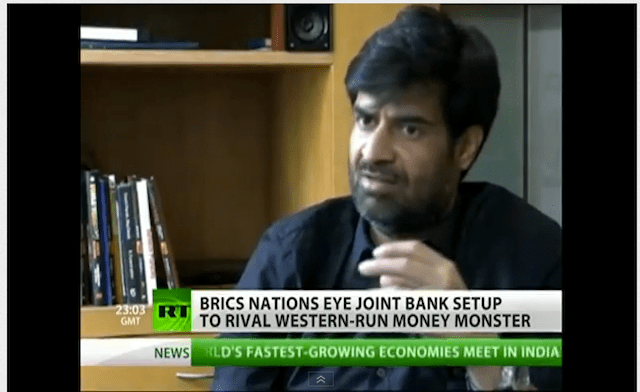
The buzzword at the Delhi summit is cooperation. Says Bipul Chatterjee of Consumer Unity & Trust Society: “These leaders are likely to float the idea of a development bank to be capitalised by BRICS, or perhaps all developing nations, to fund the development aspirations of the poor world.” This aim has its origin in Manmohan Singh’s 2010 suggestion that the world’s surplus savings be funnelled into emerging economies short of capital for investment in infrastructure and other public utility projects. Says Samir Saran, a BRICS expert with the Observer Research Foundation: “The proposed bank could tap these savings by creating sovereign guaranteed debt instruments to leverage more money for these economies.”

The other area of mutual interest is trade. As a booster, of help would be an agreement among the five countries’ central banks to grant one another access to loans in local currencies. Saran says the BRICS platform would “offer the five ‘R’s: rupee, rouble, renminbi, rand and real” for trade payments as part of a test settlement mechanism, “before internationalising these currencies”. The goal here is to reduce dependence on the US dollar as an international means of exchange.

Sceptics do not see much coming of it. Yet, it is worth noting that the five have managed to get this far as a club without letting bilateral bickering get in the way. This in itself is commendable. Perhaps BRICS bashers should wait a while before writing it off.

Standard
BRICS, In the News

Samir on Russia TV: Interview on BRICS Summit, New Delhi.

http://www.youtube.com/watch?feature=player_embedded&v=wmS11HnNbk0#!

The BRICS countries’ leaders are preparing for their annual meeting. These countries make up 42 percent of the world’s population and a quarter of its landmass. They are also responsible for 20 percent of the Global GDP and
own a whopping 75 percent of the foreign reserve worldwide. In these tough times for world economics these countries are trying to find a solution for the situation.

Standard
In the News, Water / Climate

De-securitise global climate change talks

Please find here the link to the original article.

Connecting climate change with security will defeat democracy in developing nations, said climate experts at a roundtable conference in New Delhi.

New Delhi: Linking climate change and conflict is not new. Even in the 70s, Western scholars like Richard Falk and Lester Brown started talking about the relation between environment and security. Environmental refugees and, wars over depleting resources became a common topic to talk about in the post Cold War period. It was an initiation to securitise climate change and other environmental issues.

Scholar Ole Waever had said, “Something becomes successfully securitised when it is cast as an existential threat that justifies an extraordinary (usually military) response.” On and off, climate change is being observed as a bigger threat to security than nondemocratic regimes, relative power and a conflict-ridden history, that can act as an ‘excuse’ for military response, fear experts.

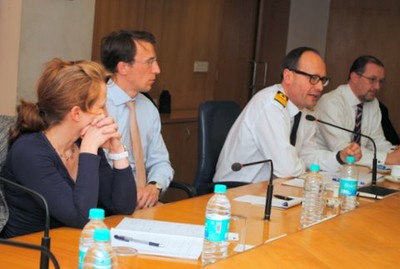
Climate change is a serious issue that requires consideration to ensure water, energy and food security, particularly in the South Asian region, but it should not be seen as a basis that will lead to security dilemmas, asserted panellists at a roundtable discussion, ‘India’s vulnerability to climate change: The security implication’, organised by the Observer Research Foundation (ORF) on February 15, 2012 in New Delhi.

“We live in globalised world. We are interconnected. What happens in one part affects us,” said Admiral Neil Morisetti, UK envoy on Climate and Energy Security. He cited the growing perception of ‘climate change as a stress multiplier’ amongst the Western world and endorsed the idea of incorporating international perspectives on climate issues in the national security strategies.

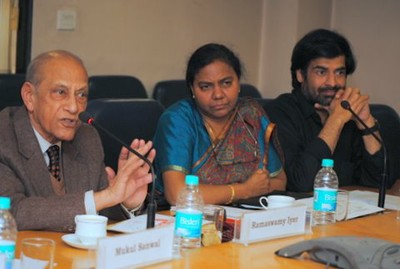
Highlighting the reasons behind the success of the Indus Water Treaty between India and Pakistan, Ramaswamy Iyer, Former Secretary, Ministry of Water Resources said, “Despite wars, nothing has happened to the Indus Water Treaty because it’s a simple treaty and has been insulated from political and military interferences.” Citing examples from the treaty, Iyer denounced the idea of securitisation of climate change and the implications of giving a ‘security angle’ to key issues related to environment and natural resources management.

“Melting ice is not as big a problem for India, as sinking rivers is,” said Mukul Sanwal, former coordinator UNFCCC. Sanwal presented a different perspective over traditional ways of evaluating climate change impacts. According to him, elements of societal change, growing Asian markets and changing trade routes should be taken into account while carrying out climate change assessments. He also emphasised that climate change might encourage countries for greater cooperation rather than act as a threat multiplier.

Samir Saran, Vice President, ORF, recommended that in order to disconnect security and climate change, research and development on climate change should not be carried out with defence institutions. He added that additional grants to security divisions are unnecessary when it comes to tackling climate change. Developing nations already have a strong military presence and securitising environmental issues would defeat democracy in such regions. Therefore, de-securitisation of climate change is imperative for peaceful relations between the countries.

Standard
In the News, Water / Climate

BSE-GREENEX to Promote Green Investments in India: Think to Sustain Website

Please find here the link to the original article.

The BSE-GREENEX is designed to promote ‘green’ investing mindset among investors and assesses corporate on quantitative metrics for carbon performance.

Mumbai – Indian markets witnessed the launch of the first-ever live carbon index, BSE-GREENEX, at the hands of Dr. (Shri) M. Veerappa Moily, Hon’ble Minister of Corporate Affairs, Government of India at BSE on February 22.

BSE Ltd. (Formerly Bombay Stock Exchange Ltd.) in association with gTrade (supported by GIZ) and promoted byFederal Republic of GermanyObserver Research Foundation and IIM Ahmedabad)  has constructed BSE-GREENEX – designed specifically to promote green investing, with emphasis on financial performance and long term viability of companies. It is based upon purely quantitative and objective performance signals to assess carbon performance. BSE-GREENEX includes top 20 companies based on greenhouse gas numbers, free float market capitalization and turnover.

In keeping with BSE’s efforts to create fund friendly Indices, it is the third Index which is calculated based on the capping methodology. This Index will be helpful to asset managers for creation of various products, to help investors to invest in the green theme of India. BSE-GREENEX is expected to have a feedback effect on companies’ reputation. It will help the Government to gauge policy implementation and acceptance with regard to energy usage and efficiency measures, as the market follows an efficient signaling mechanism which adjusts positively or negatively to any news/policy shifts.

At the launch ceremony at BSE, Dr. (Shri) M. Veerappa Moily, Hon’ble Minister of Corporate Affairs, said, “It is my belief that companies and investors in developing countries like India, need to recognize the value created by corporations through the efficient and sensible use of energy. The Ministry of Corporate Affairs has been very active in this regard. I am delighted to be here at the launch of BSE-GREENEX that lists companies that are able to marry financial performance and carbon efficiency. I feel that this Index’s objectivity will be its strength and the differentiator.”

Shri Madhu Kannan, MD & CEO, BSE, stated, “India is in a unique position to create a low-carbon green economy. So far India has focused on the fiscal aspect of economic growth. Now, it’s time we think about the environmental aspects of growth also. I am delighted that BSE in keeping with its tradition of innovation is today launching a carbon index – the ‘BSE-GREENEX. BSE will continue to contribute in full measure towards the Ministry of Corporate Affairs efforts of green and sustainable development in India Inc.”

Shri Rajiv Agarwal, whole time member, SEBI (Securities and Exchange Board of India)Shri Sunjoy Joshi, Director, ORF (Observer Research Foundation), Prof. (Shri) Amit Garg, IIM Ahmedabad and Shri Samir Saran, Chairman, gTrade, were also present at the launch and spoke on the subject.


For more information about the Index, do check the following link:

Source: BSE.

Standard