Category Archives: G 20
Why India is key to 21st century multilateralism
Four watershed events since 2020 — a short period, but with apologies to Lenin, decades have happened in this time — have established India’s credentials as one of the last major bulwarks of a rules-based order, open and fair trade and economic arrangements, and the rule of law. These are critical elements if we are to build a new world order that is balanced, inclusive and fair.
The first event was the capitulation of western powers in Afghanistan. The triumph of the Taliban was not a victory by just war but the defeat of a people by deceit. Liberals around the world were kept in the dark as a Faustian bargain was struck by major powers that sought expediency over ethical diplomacy. Today, American supporters of the infamous Doha Agreement — ironically called the Agreement for Bringing Peace to Afghanistan — express concern about Afghan women. Their hypocrisy is naked and jarring. The Doha deal could never have turned out any differently. India kept a principled distance from that pernicious deal. Appreciating fully the true nature of a prospective Taliban regime, it continued to seek an elected and pluralist government in Kabul. India was a lone voice. Yet it did not compromise. Today, India continues to support the people of Afghanistan without recognising the regime that tyrannises it.
American supporters of the infamous Doha Agreement — ironically called the Agreement for Bringing Peace to Afghanistan — express concern about Afghan women.
The second is the war in Ukraine. The measures and countermeasures by Russia and Ukraine have resulted in bloodshed and mayhem, ultimately perpetuating the conflict. India’s position of principled independence, while advocating cessation of violence and pursuit of diplomacy, is recognised as the only meaningful way forward. The Indian stance has resonated across the G20 and beyond. The G20 Bali Leaders’ Declaration echoes Prime Minister (PM) Narendra Modi’s approach when it speaks of the “need to uphold ….. the multilateral system that safeguards peace and stability”, the importance of “peaceful resolutions of conflicts”, and the vital role of “diplomacy and dialogue”. Furthermore, India has consistently argued for respect for sovereignty and investigation of crimes against humanity, including those possibly committed by the Russian army.
Third, in the technology domain, India has long championed an open, free and fair digital order. However, with the United States (US) pressing for narrow benefits for Silicon Valley in the past decade, India was reluctant to endorse instruments that sought free data flow without sufficient accountability from actors responsible for storing and transporting such data. Much to the US’s chagrin, India appeared to restrict cross-border data flows, sought regulation of non-personal data and contested monopolies, and restricted cartelisation attempts of the US’s payments and e-commerce companies. It made no secret of its distrust. Having dispelled coercive pressure to enter into digital handshakes on unfavourable terms or sovereign commitments on a future digital services tax, India has now eased its stand on data localisation. The reason: There is no longer any pressure from the US because even domestic actors in America want greater regulation and accountability from Big Tech. India is exploring sharing data with “trusted geographies” while seeking surgical data protection for specific sectors. An inclusive, equitable internet remains a core priority.
With the United States (US) pressing for narrow benefits for Silicon Valley in the past decade, India was reluctant to endorse instruments that sought free data flow without sufficient accountability from actors responsible for storing and transporting such data.
The year 2021 signalled India’s fourth landmark moment. At the 26th round of the Conference of the Parties (COP26), India demonstrated extraordinary commitment to the planet by announcing its goal of reaching net-zero by 2070. It voluntarily imposed on itself a timeline for climate action, although its emissions per capita were well under two tonnes – about one-eighth those of the US. PM Modi’s Panchamrita road map for 2070 includes interim targets for boosting non-fossil energy capacity, using renewables, and reducing carbon emissions and the economy’s carbon intensity. PM Modi also later launched India’s LiFE (Lifestyle for Environment) Mission. He emerged as one the earliest world leaders to state candidly that climate action would require changes to individual lifestyles, taking steps to initiate those changes. By contrast, an international survey of 10 countries, including the US, the United Kingdom, France and Germany — published to coincide with COP26 — found few citizens willing to make significant lifestyle sacrifices. In fact, 46% of respondents believed there was no real need for them to do so. Take the facile but heated domestic debate around a potential ban on gas stoves in the US. Even as US diplomats have long championed “clean cookstoves” for the developing world, it appears there is little interest in following good climate practices at home.
India’s natural influence as a democracy and sincere interlocutor that can engage the political spectrum of nations gives it unique moral authority. Indeed, 21st century multilateralism needs more Indias. The G20 — with its mix of developing and developed countries — offers the perfect platform for India to infuse partner nations with foundational ideas. The world has much to learn on putting humanity first, adopting a pro-planet orientation, promoting peace, and placing equity and inclusion at the heart of internationalism. With its ethos of One Earth, One Family, One Future, India could show the way.
India will prioritise data for development at G20
At the G20 Leaders’ Summit in Bali last month, Prime Minister (PM) Narendra Modi pledged that the principle of “data for development” will be integral to India’s G20 presidency. New Delhi’s commitment to this principle and its vision of strengthening it through international cooperation are already apparent. The first side event of the G20 Development Working Group under the Indian presidency, held in Mumbai on Tuesday, addressed the theme “Data for development: The role of the G20 in advancing the 2030 Agenda”. Amitabh Kant, India’s G20 Sherpa, emphasised that the country’s strategic use of data for governance and public service delivery in its aspirational districts, for instance, has, in three years, wrought a transformation that would otherwise have taken six decades. Data has also powered India’s pandemic response, innovations in education, health care, and food security, and enabled digital financial inclusion at a near-population scale.
As a group composed of developed and developing nations, the G20 presents a microcosm of what a concerted global effort to achieve Sustainable Development Goals (SDGs) might resemble. If the G20is to help accelerate progress towards SDGs, it must vigorously pursue two kinds of data-driven interventions: Rejuvenating legacy datasets using Artificial Intelligence (AI) and Big Data analytics, thus converting data to intelligence; and using cutting-edge emerging tech — including drones, geospatial mapping, and AI — to generate futuristic new datasets.
The country is about to launch a major data initiative as a part of which it will share anonymised data sets collected under the National Data Governance Framework with the AI ecosystem, and the research and startup communities.
In both areas, India has much to offer the world. The country is about to launch a major data initiative as a part of which it will share anonymised data sets collected under the National Data Governance Framework with the AI ecosystem, and the research and startup communities. This vast database will be used to train AI models, catalyse innovation, and craft more effective policy and on-ground solutions. In May, NITI Aayog launched the groundbreaking National Data and Analytics Platform to democratise access to public government data by making datasets accessible and interoperable, and providing accompanying tools for analytics and visualisation. Each of these initiatives builds upon the PM’s vision of a Digital India characterised by a digitally empowered society and tech-enabled knowledge economy.
The creation of entirely new datasets is also exploding in India. Drones are scanning the country’s terrain in minute detail, and this aerial footage is being combined with other kinds of data to create extraordinarily detailed maps. Data generated by drones is also revolutionising agriculture and helping transform existing cities into smart cities. The World Economic Forum estimates that the new data economy resulting from drones could boost India’s Gross Domestic Product by $100 billion and create nearly half a million jobs in the coming years.
Indeed, India is rapidly emerging as a world leader in the geospatial sector. Addressing the United Nations World Geospatial Information Congress in Hyderabad in October, PM Modi emphasised that geospatial technology is a “tool for inclusion” that has been “driving progress” and established itself as an enabler across development sectors. In fact, this is a space in which India has already begun to support its South Asian neighbours with communications and connectivity.
Across nations, data must be emancipated from its current silos, and progressively larger volumes of data must be made public and easily discoverable.
As India and its G20 partners forge collaborations centred on data for development, they should adhere to certain core principles. Across nations, data must be emancipated from its current silos, and progressively larger volumes of data must be made public and easily discoverable. To be used effectively, data must be simple, high-quality, and offered in real-time. A culture of experimentation and innovation must be fostered around data operations, and countries must invest in tools for analysing datasets in creative ways. To enhance outcomes, constructive competition could be promoted among stakeholders in the data ecosystem.
Two crucial tasks lie before the G20. Its members will have to try and arrive at a common understanding of sensitive and non-sensitive data, and to reflect on frameworks that could help share data across borders. There is an in-principle consensus that open repositories should be built where nations can store public-value data. But a prudent balance will need to be struck between the imperatives of data sovereignty and protection, and the notion of a data commons that could benefit the global community. Ultimately, the G20’s data regulations should embed the norm of reciprocity — nations should be able to share and benefit from development data.
A culture of experimentation and innovation must be fostered around data operations, and countries must invest in tools for analysing datasets in creative ways.
As 2030 nears, the Indian presidency could be an inflection point for the G20’s deliberations around data for development. Since 2019, the theme’s importance has been consistently reaffirmed by G20 leaders, and the recent Japanese, Saudi Arabian, Italian and Indonesian presidencies have all recognised that the wealth of data produced by digitalisation must be harnessed. But government-to-government dialogue must increasingly be supplemented by systematic engagements with the private sector, civil society, women and young people, if data-led empowerment is to be mainstreamed. This is a key element India could underscore in the G20 playbook, thus shaping past achievements and present priorities into what could become a part of the grouping’s legacy to the world.
Thinking Progress: Making ‘G20’ Fit for 2020s
With India’s presidency of the G20 commencing, it would be an understatement to suggest India would be at the helm of the most powerful plurilateral group at a very crucial moment in world history. Certitudes and certainties are words from the past. Ideology, geography, and demography are implicating and being acted upon by technological innovation, climate action, and economic volatility. Weaponisation of everything is the norm, as discord has replaced dialogue. This is the landscape confronting India’s Presidency, and this is where India may be the lighthouse in the tempest.
India is a civilisation that celebrates heterogeneity, shaped by multiple histories and incubated over millennia by a rich kaleidoscope of cultures. Over the past 75 years, it has demonstrated a remarkable ability to accommodate and even thrive amidst differences. The adage, “unity in diversity”, is a truism for India, irrespective of the noise on social media platforms. This is an exemplar of what the world needs most today. If multilateralism is to work, G20 countries must work harder to make that happen, and strengthen dialogue within and with others. The ‘India Way’ will assist in this. As Prime Minister Narendra Modi reminded us in his monthly radio broadcast for November, “India must utilise the opportunity of G20 leadership by focusing on global good and welfare.”
India is a civilisation that celebrates heterogeneity, shaped by multiple histories and incubated over millennia by a rich kaleidoscope of cultures.
The Think20 and its Task Forces for G20 Engagement
The Think20 is a group of think tanks and scholars that form the “Ideas Hub” of the G20. This is an official engagement group, which supports the Sherpa Track and provides inputs to the G20 Leaders for their consideration. At a moment of global economic churn, it is an imperative to define a common G20 assessment and response framework to assist communities and countries in distress. Appropriately, a specially constituted Think20 task force will examine the relationship between trade and investment policy and global supply chains, and how national macroeconomic policies impact them. The task force will focus on the need for better monetary policy synchronisation with fiscal policies within and among nations. It will offer ideas on how to protect supply chains and trade from the negative impact of unilateral decisions that some countries have undertaken. As such, it will offer ideas and proposals to safeguard and catalyse jobs and livelihoods.
These discussions are happening against the backdrop of hyper digitalisation and the fourth industrial revolution. A Think20 task force will focus exclusively on Digital Public Infrastructure and its importance. It will examine accountable, affordable, and equitable digital evolution across sectors and find ways to make digital supply chains more resilient and decentralised. The purpose of this group of experts from various G20 countries is to discuss means to promote inclusive entrepreneurship, jobs, and livelihoods; social protection; and financial inclusion in the digital domain.
The task force will focus on the need for better monetary policy synchronisation with fiscal policies within and among nations.
Any such endeavour must consider planetary considerations and be part of the larger green transition. This will entail making transition financing more urgent and inclusive, and catalysing proliferation of key technologies and new energy solutions. A related task force will assess and discuss the role and reform of Multilateral Development Banks, the shape of innovative financial instruments and tools, and means to unlock the full potential of global private capital in emerging and developing countries. It will highlight an actionable outcome for the G20 to assist in these endeavours.
Macro-economic policies, trade and investment, and, indeed, green transitions and digitalisation must all have one core objective – the service of all humans and lifeforms, and of Planet Earth. Agenda 2030, and the quest to achieve the Sustainable Development Goals (SDGs), must now form part of the G20 as the presidency passes from Indonesia to India, and then to Brazil and South Africa. The G-20 has done reasonably well to protect banks and financial institutions; its challenge now is to serve “people and planet”.
A Think20 task force will focus on just this aspect. SDGs took a beating courtesy the pandemic and conflicts in various geographies. Changing climate and erratic weather patterns have added an additional burden. We are all acutely aware of the importance of societal resilience; and science, innovation, and technology facilitation for SDGs remain necessary means of implementation. These will form the crux of the G20 and T20 work during the year, in addition to emphasis on water security, promoting holistic outcomes in health and nutrition, gender-led development models and growth outcomes, and protecting biodiversity.
The task forces themselves will have more than 100 experts across themes and sectors, and will also see a vibrant pan-Indian participation from nearly 40 institutions across the country.
All of these will be attended to by a talent pool that ensures larger participation from G20 countries that were under-represented in past discussions. Voices from emerging geographies will take centre-stage. The task forces themselves will have more than 100 experts across themes and sectors, and will also see a vibrant pan-Indian participation from nearly 40 institutions across the country. A Global Advisory Committee will be established. It will include Think20 Chairs of past presidencies and distinguished think tank experts from upcoming presidencies. This group of elders will share its experiences and ambitions with the India-led process. In the end, the intellectual aggregation during India’s presidency will be qualitatively and quantitatively different from any previous year. With luck and effort, India would have changed the G20 lexicon and made it ready for the 2020s.
*Dr Samir Saran, President, Observer Research Foundation and Chair of Think-20 Secretariat
India leads: Two to Tango with in 2023
It is a busy season on Raisina Hill as India assumes stewardship of the Shanghai Cooperation Organisation (SCO) and takes charge of the Group of Twenty (G20) in December. Leading these two plurilateral groups will be complex and challenging. The groupings have divergent goals, purposes, and memberships even as they grapple with Covid-19’s disruptive impact on the global economy and conflicts during and after the pandemic. India will need to ensure that the concerns of developing countries are not relegated to the margins by the European conflict.
At the heart of the endeavour lies the challenge of dialogue and conversations with all, even as a subset of like-minded countries invest in frameworks that respond to decadal objectives. “Talk to all and work more with some” will have to be India’s mantra for 2023 as it has a rare opportunity to make two distinct agendas align with its own.
At SCO, China’s dominant position is inescapable, and it overwhelms the preferences and perspectives of others. Here, India and Russia may share a common imperative to balance China and make SCO focus on a broader policy and development agenda. As Prime Minister (PM) Narendra Modi pointed out during the SCO summit last month, this is not the time for war. Moving away from conflict to attend to the frailties of the economy may be beneficial for SCO and less contentious too. Many in the group are uncomfortable with the Russia-Ukraine conflict and would rather see this group focus on the development and human challenges the region is saddled with. India will have to reset the playing board skillfully. If China is playing “go”, and Russia is playing “roulette”, New Delhi will need to play smart chess.
Many in the group are uncomfortable with the Russia-Ukraine conflict and would rather see this group focus on the development and human challenges the region is saddled with.
However, the nature of SCO and its purpose will ensure that politics takes centre-stage. In Samarkand, the Indian PM showed the way. Niceties need to be dropped, and hard questions must be posed, including on sovereignty, the expansionist tendencies of some countries, including China, and terrorism emanating from Pakistan.
Simultaneously, India must inject its growth imperative around technology, sustainability and green transitions into discussions and state its concerns over cyber security, online malfeasance, and white elephant infrastructure projects, among others. At SCO, India would do well to initiate debates on these issues, irrespective of the outcomes, and create space for discussions that may not have Beijing’s blessings.
Diplomacy sometimes misconstrues the role of the host country to imply benign or agnostic participation. India, however, must maintain its determination to have an assertive foreign policy that seeks to shape and steer conversations towards the outcomes it desires.
All of this cannot be starkly divergent from India’s G20 agenda. There needs to be a bridge linking what we aim to achieve through SCO and G20, although the methods and formulations used in each forum may differ. G20 requires a different type and style of hosting. India can leverage its experience to communicate with all actors involved and curate conversations that cater to diverse constituencies. “Sabka Saath, Sabka Vikas, Sabka Vishwas and Sabka Prayas” (inclusive development for all, everyone’s trust and efforts) is an all-encompassing Indian approach that fits G20.
India can leverage its experience to communicate with all actors involved and curate conversations that cater to diverse constituencies.
Here, India will need to ensure that the clouds of war that loom over Europe do not pour down on its presidency. India must make it clear to its western partners that it will view any attempt to reduce the impact of its G20 presidency seriously. At the same time, New Delhi must make clear to Moscow that steps towards de-escalation are essential from its end.
External factors will inevitably distract the grouping from anything that is discussed within it. The agenda that is engaged with and outcomes delivered at G20 may be bold (unlikely) or sub-optimal (more probable). However, thanks to G20’s structure, global action will always be evolutionary. India’s efforts must draw from Indonesia and deliver to Brazil and then South Africa.
PM Modi’s reiteration of the importance of “democracy, diplomacy, and dialogue” at the SCO Summit is a message that the G20 leaders should also remember as they prepare to engage at the upcoming G20 Summit in Indonesia and beyond. G20’s ability to navigate through economic and social crises should not become hostage to regional or bilateral politics.
India must make a clear and robust case to address larger goals in the spirit of cooperation. It must focus precisely on what it wants to achieve from each working group at G20 and aim to create a legacy and a futureoriented architecture, which will lend continuity to what it incubates.
What will India’s G20 presidency focus on?
India’s presidency must leave the grouping with the agility and energy to respond to new realities, and it must create a future-ready multilateralism through a novel and robust institutional architecture
India takes over the presidency of the group in December. To live up to the potential of this opportunity, it must choose a policy direction to focus on continuity, incorporate green and digital transitions, and recognise the realities of a post-pandemic world
India’s presidency of the G20 grouping next year — arguably the sole remaining effective forum for global governance — presents an enormous opportunity to accelerate sustainable growth within India, in the emerging world, and beyond.
For India’s presidency to live up to this potential, it must recognise the constraints of the grouping and the crises — from the pandemic to the Ukraine war — that it must confront. But there should also be a clear understanding of the levers that a G20 president has to affect global policy action.
Next year, the troika of the preceding, current, and succeeding presidents will be three developing countries: Indonesia, India, and Brazil. This fortuitous alignment must inform India’s strategy as it designs its G20 agenda.
Three broad principles should underline India’s planning. First, it must recognise the value of the emerging-world troika and choose policy directions that emphasise continuity. Second, it must incorporate the concerns of its dual development transitions — green and digital — into the G20’s agenda. And third, it must recognise the realities of the post-pandemic world and prioritise action on those sectors that have, since 2020, been revealed to be under-capitalised.
India’s agenda must resonate beyond the one year it holds the presidency. This requires it to set its priorities alongside those of the two other members of the troika. The G20 under Indonesia has articulated three priority issues — global health architecture, digital transformation, and sustainable energy transition. Reinterpreting these will be key to building continuity, and, thus, sustained action. It is also important to keep in mind that having too many priorities is the same as having none at all. Indeed, India must prevent the G20 from suffering — as other multilateral forums such as the World Trade Organization do — from an over-expansion of its mandate.
Two major transformations will define our economies and societies going forward: Digital transition and green transition. Both are key to addressing the development challenge as well. These transitions are the meeting point of geopolitical and youth aspirations that will dictate our political, economic and social well-being.
On the digital front, India, to a large extent, has been a first mover. India’s youth aspirations are digital-first; the government has responded, and the digital economy is at the centre of its aim for a $5-trillion economy by the second half of the 2020s. The Observer Research Foundation’s youth survey on tech policy found that 83% of respondents want India to adopt a policy that prioritises its domestic technology industry. At the same time, 80% welcome greater cooperation with international partners on technology.
Clearly, a fine balance is needed where technological multilateralism does not come at the cost of developing countries’ needs. The Think Tank 20 (T20) engagement process has identified the internet as a basic right and technology access as vital to reducing inequalities. Cooperation at the G20 would be a good testing ground for pioneering tech regulation that balances the interests of the private sector with sovereignty and the security needs of States, and the growth demands of the economy.
India’s G20 must also recognise the unprecedented, carbon-constrained nature of future growth. Arguments for a green transition can no longer be limited to the moral high ground of saving the planet. A commitment on sustainable consumption must be placed front and centre. International financial regulation and the mandates of multilateral development banks must also ensure that adequate finance incentivises a business case for rapid change with adequate global flows subpoenaed for the developing world. Can the Indian presidency help to architect this new global arrangement?
A third focus must necessarily be the post-pandemic world order. Covid-19 has proved that health, nutrition, and livelihoods all remain fragile despite commitments made under Agenda 2030. The United Nations has warned that the Covid crisis could result in a lost decade for development. It has sharpened inequalities and widened development gaps. The United Nations International Children’s Emergency Fund has also cautioned that the pandemic could lead to a “lost generation” of children in terms of education, nutrition, and overall well-being. These conversations have become more complex due to the crisis in Ukraine. The weaponisation of trade and the international banking system during this war has exacerbated uncertainties. The surge in prices of energy and essential staple foods has added a disturbing dimension to an already stressed economic recovery. By putting nutrition, food security, and health at the heart of its G20 agenda, India can ensure the success of the Decade of Action on Sustainable Development. The clincher will be to facilitate greater funding towards these efforts.
India’s presidency is an opportunity to reinvigorate, reinvent and re-centre the multilateral order. The G20 cannot be distracted or undermined by the bilateral relations of specific members, even as we acknowledge the gravity of the humanitarian crisis that is unfolding in Europe. India must leave the G20 with the agility and energy to respond to new realities, and it must create a future-ready multilateralism through a novel and robust institutional architecture.
Global Perspectives: G20 Leaders Summit
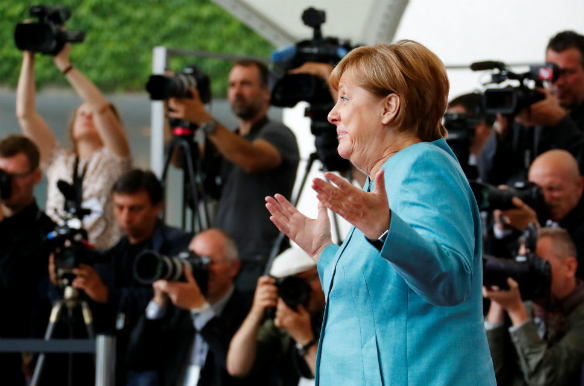
German Chancellor Angela Merkel reacts as she receives guests at the Chancellery in Berlin, Germany, June 29, 2017. (Fabrizio Bensch/Reuters)
Editors note: This global perspectives roundup is a new feature of the Council of Councils initiative, gathering opinions from global experts on major international developments. In this edition, Council of Councils members offer their perspectives on the upcoming G20 leaders summit, which will be held in Hamburg, Germany, on July 7–8.
Tom Bernes, Centre for International Governance Innovation (Canada)
The upcoming G20 summit in Hamburg, Germany, will face new challenges as U.S. President Donald J. Trump makes his first appearance. The forum, which has been promoted by national leaders as their primary platform for international economic cooperation, will have to contend with a U.S. president whose stated policy objective of “America First” stands in direct contrast to the central objective of the G20. A look at the history of the G20 summit speaks to the belief of its members that answers to global challenges must be found through active collaboration. This is likely to be tested in Hamburg. As was witnessed at the G7 and NATO summits in May, surprises are likely.
Since its initial success in forging a response to the global economic crisis of 2008, the G20 has struggled to clearly define a medium-term program that resonates with the global community. Some observers have even questioned whether the G20 can continue to serve as a useful forum that engages the world’s most important leaders.
“Some observers have even questioned whether the G20 can continue to serve as a useful forum that engages the world’s most important leaders.”
Two of the major accomplishments of the G20 will draw close scrutiny in Hamburg as the United States has directly challenged them. The first is the issue of climate change: following U.S.-China leadership, the G20 has supported the Paris Agreement. The United States announced in June its intention to withdraw. The second is the issue of protectionism, which the G20 at every meeting has pledged to resist. Again, the United States has expressed its opposition to such a pledge and imminent decisions by the Trump administration on steel and aluminum risk setting off a trade war. Yet another area of potential concern are the reforms embraced by the G20 to secure greater global financial stability. U.S. decision to roll back much of the Dodd-Frank regulations established after the 2008 financial crisis puts at risk the gains made since the crisis shook the world economy.
How will leaders respond to these issues in Hamburg? A forceful rejection of U.S. positions by the other members of the G20 could give renewed vigor to their efforts to promote a more resilient, sustainable, and equitable global economy. But it would also lead to increased tensions with the United States. Will the G20 gain new momentum through a renewed sense of purpose in response to (and in opposition to) the new U.S. attitude, or will it see a decline in relevance by papering over these fundamental differences?
Sunjoy Joshi and Samir Saran, Observer Research Foundation (India)
Despite the evident geopolitical shifts across the world and the political churn among its member nations, the G20 remains one of the most relevant organizations in the architecture of global governance. Recent global developments both provide an opportunity and pose a challenge for the body if it is to remain influential.
The G20’s most important task is to ensure that it stays true to its core mandate, maintaining global financial stability and managing structural reforms in an inextricably integrated world. The G20 was premised on and motivated by the realization that the “one country, one vote” approach of the United Nations is not the most effective way to respond to critical problems requiring real-time responses. The credit crisis of 2007–2008 demonstrated that certain international challenges need to be addressed efficiently and speedily, which, in effect, catalyzed the institutional preeminence of the G20.
At a time when many members of the G20 are finding themselves trapped by domestic compulsions that are forcing them to rethink the G20’s core mandate, the G20’s temptation to maintain its relevance by anchoring itself in a different agenda needs to be resisted.
The global economy is hardly out of the woods. The G20 is a special-purpose policy forum that was created to respond to globally catastrophic problems by nations that have capacity and wherewithal. This is hardly the time for the G20 to expand its membership by conjuring up new partnerships, such as with African countries. Expanding the group’s partnerships at this juncture would just create another G77—and for what purpose?
“This is hardly the time for the G20 to expand its membership by conjuring up new partnerships, such as with African countries.”
It is also time to recognize that some of the fundamental structural challenges that the G20 is attempting to address cannot be adequately treated unless certain micro-issues are addressed as well. These micro-issues, such as the ongoing transformation in global energy systems, cyberstabilty of financial structures, and the implication of technology on employment and jobs, among others, do need to be on the table, but the temptation to make all issues of global concern a part of the G20 agenda must be resisted. This would only dilute the ability of the G20 to serve its founding purpose. Matters better brought up at the UN General Assembly and/or at other multilateral institutions should not be under the purview of this group.
The G20 should instead narrow its scope to sectors that implicate the global financial and trading systems and additionally only focus on those issues that concern politically disruptive global trends.
The G20 is at a crossroads. It should choose the path that will allow it stay relevant to the core purpose for which its members first came together.
Steven Blockmans and Daniel Gros, Centre for European Policy Studies (Belgium)
Leaders meeting at the G20 summit in Hamburg will try to build on the outcome of the recent G7 summit in Taormina, Italy, and seek agreement on three baskets of issues: economic priorities, including growth, trade, digitalization, jobs, finance, taxation, and corruption; sustainability priorities, including development, climate, energy, health, and gender; and security priorities, including counterterrorism, migration, and refugee flows.
The G20 summit is of particular importance to German Chancellor Angela Merkel, who, as chair, will get a last chance to shine on the international stage ahead of the German federal elections in September. But a success is not guaranteed, especially for the second basket, given President Donald J. Trump’s withdrawal of the United States from the historic Paris Agreement on climate change. A statement by the other nineteen G20 leaders of their unwavering commitment to the Paris accord seems possible and would be welcome. Unfortunately, reaching consensus on the first and third baskets will also not be easy given the U.S. retreat from its historical multilateral approach toward trade and Russian—and, to some extent, Chinese—intransigence on cybersecurity, corruption, and the rule of law.
This summit will also provide a test of whether Brexit ushers in a new role for the United Kingdom on the global stage. U.S. bilateralism might, on the surface, enhance the UK’s global role, since it is a trusted partner of the United States. But U.S. unilateralism is rendering multilateral venues like the G20 less suitable to serve brexiting Britain’s aims to go global. Moreover, the twenty-seven members of the EU (EU27) will carefully monitor the extent to which the UK, still a member, remains loyal to EU positions.
“But U.S. unilateralism is rendering multilateral venues like the G20 less suitable to serve brexiting Britain’s aims to go global.”
The Hamburg summit provides an opportunity for Merkel and her newfound partner, French President Emmanuel Macron, to position the EU27 as a reference point for those that want to invest in effective multilateralism. In a volatile world, stability and predictability are a premium that Chancellor Merkel and the other standard-bearers of the rules-based EU can provide. How much their leadership can make the Hamburg summit a success is an open question that will shape not just the future of the G20, but also the role of the EU and Germany in the world.
Ye Yu, Shanghai Institutes for International Studies (China)
Since its participation in the first G20 summit in 2008, China’s concerns about the forum and global governance have expanded from procedural issues to more substantive ones: the push for equality among members, the redistribution of voting power in international financial institutions, and comprehensive challenges confronting globalization, such as climate change and extremism.
China would like to see G20 countries work together to contain anti-globalization sentiment. A global alliance against the United States is not the best option. Instead, China expects the G20 to pull the United States back toward seeking an enlightened self-interest rather than pursuing an “America First” stance at the cost of all other countries. As the Economist noted, Trump’s economic policies are narrow-minded, out-of-date, takes for granted that “fair trade” means reducing manufacturing deficits, and ignores the destructive challenges the world will confront as artificial intelligence technology advances. The G20 should convey a more comprehensive message about the trends of globalization and shape the public discourse about the limitations of protectionist trade measures.
“China expects the G20 to pull the United States back toward seeking an enlightened self-interest rather than pursuing an “America First” stance at the cost of all other countries.”
China would also like to see G20 members be more supportive of its initiative to spur momentum of globalization. Encouraged by its huge success in launching the Asian Infrastructure Investment Bank (AIIB) in 2013 and hosting the 2016 G20 summit, China is more confident and willing to exhibit a more constructive role in global governance, though not by itself. China started the Belt and Road Initiative in 2013, along with the AIIB, to offer an alternative approach to globalization. Unlike a top-down approach to negotiating trade liberalization, the Belt and Road Initiative puts a renewed focus on regional and global infrastructure connectivity. China emphasizes the openness of the initiative and calls for all countries to participate according to their own development strategies. Infrastructure has been a G20 priority for quite a few years, but China would like to see more concrete cooperation on projects and less suspicion about its intentions.
Elizabeth Sidiropoulos, South African Institute of International Affairs (South Africa)
This year Germany has made Africa the focus of its G20 presidency. Its anchor initiative is the Compact with Africa, which aims to bring together international financial institutions, bilateral partners, and African countries to create an enabling environment for private investment. Already seven African countries have signed up: Côte d’Ivoire, Ethiopia, Ghana, Morocco, Rwanda, Senegal, and Tunisia. Driven by the German Finance Ministry, this initiative has received the G20 finance ministers’ political backing in Baden-Baden in March this year.
While this G20 commitment to Africa should be seen in a positive light, concerns have been raised in South Africa about the extent to which it may compete with rather than complement Africa’s own continental initiatives. In addition, its policy prescriptions may be critiqued for their focus on orthodox approaches to economic development, which have not always had the desired results. It is also regarded as shifting responsibility for development assistance from the public to the private sector. Nevertheless, if the G20’s political backing is able to leverage private investment in the countries that have decided to join, this will be an important step in the direction toward creating productive economies that are able to provide decent livelihoods for their citizens.
“While this G20 commitment to Africa should be seen in a positive light, concerns have been raised in South Africa about the extent to which it may compete with rather than complement Africa’s own continental initiatives.”
But G20 issues not specific to Africa are of equal import to the continent. An unequivocal commitment to open trade, although there has been backsliding on protectionist measures for some years, will be crucial for Africa, especially as it tries to build up its manufacturing capacity. Inclusive growth cannot be achieved with closed economies.
Germany has also focused on the need for a framework of norms and standards on the digital economy and e-commerce. However, this may have the unintended consequence of placing greater burdens on African states, making it even more difficult for them to bridge the digital divide. Often, the solutions more so reflect the conditions of the industrialized world and do not sufficiently consider unintended consequences in developing countries. This is the challenge for G20 developing countries as the dynamics among the G7 change. The G20 by its nature is not inclusive; it can, however, build legitimacy provided its leadership in setting agendas and norms reflects not only industrialized countries’ realities, but also those of emerging and developing economies.
Sook Jong Lee, East Asia Institute (South Korea)
The G20 summit in Hamburg is a timely venue for major country leaders to show their commitment to the liberal international order. Following the global disturbance caused by Brexit, U.S. President Donald J. Trump’s “America First” foreign policy has the potential to weaken global governance. Trump’s revival of protectionist trade measures, reduced willingness to support collective security, and decision to withdraw the United States from the Paris Agreement on climate are threatening the open and liberal order. Now is the time for other major countries to provide additional leadership in response to numerous transnational challenges, including peace and security, terrorism, refugees, and environmental problems.
“Now is the time for other major countries to provide additional leadership in response to numerous transnational challenges, including peace and security, terrorism, refugees, and environmental problems.”
Against this backdrop, German Chancellor Angela Merkel is committed to seizing the opportunity by hosting the summit, with hopes to strengthen the world economy and enhance its stability and resilience through multilateral cooperation. The fifteen agenda items that fall under the broader goals of building a resilient economy, improving sustainability, and assuming responsibility for physical and human security are all worthy of serious attention and require collective effort to make meaningful progress. Chinese President Xi Jinping is expected to assume a greater role by filling the gap left by U.S. retrenchment. French President Emmanuel Macron will likely bring a spirit of liberal progressivism aligned with the current G20 goal of promoting inclusive and sustainable growth. For this summit to prove successful, it is crucial for leaders to demonstrate their solidarity and willingness to combat economic and sociopolitical threats together. At the same time, leaders should develop resilient, cooperative frameworks that can provide members with greater flexibility when weighing domestic policy options.
With seven Asian countries in the G20, China, India, and Japan are expected to increase their roles by assuming responsibilities in line with their respective comparative advantages. Middle powers like South Korea and Indonesia can also promote G20 goals by incorporating them into their regional multilateral initiatives. Asian countries have been relatively insulated from the rise of extreme populism and believe that their futures lie in a more open and interconnected world. Asian members should contribute more to the G20 to further strengthen the forum.
The G20 was created to make economic global governance more democratic and effective. Major states should now assume more responsibility in making the world safer, as well as more economically inclusive and politically harmonious. Each member country must remember that they owe their power and international standing not only to national achievements, but to the global community as a whole. Since no single country can replace the United States, which has provided public goods for the last quarter century, all G20 member should assume their share of the responsibility to manage global challenges.
Fyodor Lukyanov, Council on Foreign and Defense Policy (Russia)
Despite clear political differences among its members, the G20 has been able to send a positive message of global cooperation since its creation twenty years ago. The G20 was founded in the aftermath of the Asian financial crisis and upgraded following the 2008 global financial crisis, and the fact that twenty of the most powerful economies came together to seek solutions to instability had its intended effect.
The global economy faces acute problems of a purely political nature. It was feared in 2008 that protectionism would be the spontaneous reaction of several governments; it is now the deliberate and official policy of the most powerful member of G20, the United States. Although one can argue that the Trump administration is not consistent in its claims and deeds, it is vocal and consistent on economic issues. If the United States proclaims “America First,” it is just matter of time until the rest of the world will turn to more mercantilist thinking as well.
It remains an open question the extent to which member states will be able to agree on anything at the upcoming summit. G20 summits have always been overshadowed by various crises, but the number of controversies in which member states are now involved is remarkable. Recent escalation in the Gulf has added another nuance to the already bleak picture. There is a chance that this G20 will have an impact that is the opposite of what its 2008 iteration had: it could be a disappointing demonstration of disagreement on all fronts. Germany, which is deeply committed to good governance, will no doubt do its best to refocus G20 commitment on global cooperation—particularly the Paris Agreement—but Chancellor Angela Merkel has no magic wand.
“It remains an open question the extent to which member states will be able to agree on anything at the upcoming summit.”
While Russia hasn’t been the biggest promoter of free trade and openness, it is now concerned by looming protectionism and would like to keep a moderately liberal global economic system in place. Moscow will also use this opportunity to communicate with the many international leaders in attendance. Most public attention will be given to the prospective meeting between Presidents Vladimir Putin and Donald J. Trump, but no positive outcome is expected. Trump will be unable to move on U.S.-Russian relations, even if he would like to, because Russia’s policy remains toxic in U.S. domestic politics. His handshake with Putin, though, will no doubt cause another political tsunami in Washington, which will further undermine their prospects for interaction.
Heribert Dieter, German Institute for International and Security Affairs (Germany)
The G20 set high targets for itself in the early stages of the 2008 global economic and financial crisis, but, despite grand declarations, it has achieved relatively little. Risks in the financial markets have risen rather than fallen, and the G20 countries have no coherent strategy. For now, the United States continues to take a unilateral approach, not taking into account the preferences of other G20 states. The European Union is pursuing its own financial policy, which it has not coordinated with those of the other G20 countries.
The early, resolute G20 announcements were followed by only half-hearted attempts to regulate financial markets more strictly. In the midst of the crisis, expectations arose that there would be coordinated international supervision of financial markets. That concept has not been implemented. Today, G20 governments are unable to agree on common rules. Hopes for a new global financial architecture have been shattered.
There are many reasons why the G20 has not succeeded in providing a common set of financial rules. The preferences of G20 countries are divergent; therefore, the group has been unable to accomplish its core mission.
Equally poor has been the performance of the G20 in promoting a liberal regime for international trade. The declarations of earlier summits were never matched by a liberal trade policy among the G20’s members. Many important economies demonstrated a robust interest in trade that was “fair” rather than “free.” A spirit of protectionism characterized the trade policy of some G20 countries, and the advent of the Trump administration has made the departure from an open multilateral trading system more visible than before. Discrimination and protectionism are once again features of the trade policies of G20 countries.
The Hamburg summit will not result in any major agreement on joint economic policies. For the time being, G20 governments differ on fundamental issues of global governance. Neither on finance nor trade, let alone climate change, will Hamburg deliver any significant improvement over the status quo. Worse, there might be open conflict over protectionist measures the Trump government might implement.
“For the time being, G20 governments differ on fundamental issues of global governance. Neither on finance nor trade, let alone climate change, will Hamburg deliver any significant improvement over the status quo.”
At the same time, the position of Germany, the host, has been severely weakened by the failure of the Merkel government to acknowledge the harms Germany’s enormous current account surpluses has had on other economies. Berlin’s unwillingness to implement measures that would reduce the surplus—for instance, a temporary tax cut—undermines the credibility of its calls for enlightened multilateral cooperation.
Yasushi Kudo, Genron NPO
The arrival of President Donald J. Trump’s administration is expected to limit the ability of the G20 to address global issues through international cooperation. President Trump’s avowed “America First” policy and his preference for bilateral deals will continue to undermine the raison d’etre of the G20, which supports multilateralism by sharing the burden of leadership among its member countries. In addition, overt and covert moves by superpowers to bolster their influence by making use of the fragile international environment are likely to erode the foundation of the established frameworks that have hitherto sustained the world order.
“The arrival of President Donald J. Trump’s administration is expected to limit the ability of the G20 to address global issues through international cooperation.”
German Chancellor Angela Merkel apparently intends to make “open markets, and free, fair, sustainable, and inclusive trade” a key focus of the summit this year. Given the instability of the international order, it may not be meaningless for the leaders of the world’s major economies to come together for dialogue and impress upon the world that they are making continuous efforts for the common good. Regrettably, there is no other positive meaning to be found in the present state of the G20, and this year’s summit will likely achieve nothing substantial. As shown by the wording of the communiqué issued at the G7 summit in Italy in May, the G20 will be another political show that uses ambiguous rhetoric to conceal instability and potential confrontations.
That said, the G20 forum remains important. Globalization, the maintenance of a liberal international order, and multilateral cooperation are of vital importance to the common interests of the world. At a time when there is a desperate need to rectify inequalities and instability, the role of the G20 will be much larger than before. Such being the case, it is becoming necessary to solidify cooperation among G7 members and other democratic states that share fundamental values in order to ensure that the G20 can continue to carry out its role.
The presence of the G7, whose members share the universal values of freedom, democracy, and international cooperation based on multilateralism, is vital for the reinforcement of global governance and the preservation of a liberal international order. Moreover, the G7-initiated global economic governance and international financial system form the foundations of global governance. Unified G7 attempts to take initiative in this area in the long term may hold the key to maintaining global stability. Indeed, the significance of the G7 democracies’ concerted endeavors to strengthen global governance should not be underestimated.
Original link is here
 Samir Saran