Category Archives: Economy and Growth
Think20 India: Bridging the Ingenuity Gap
India assumed its G20 Presidency in the midst of global flux. Post-pandemic recovery efforts were uncertain and uneven; the Ukraine crisis had resulted in supply-chain bottlenecks and consequent global stagflation; and the perennial onslaught of the “elephant in the room”— global warming and climate change—had only exacerbated the challenges.
While unveiling the logo and the theme, PM Modi posited the country as an architect for a forwardlooking and result-oriented agenda for the world and the G20 as an exemplar of change, a vision for sustainability and growth, and a platform engaging with all that matters to the global south. Prime Minister’s vision, of drawing on India’s age-old ethic of Vasudhaiva Kutumbakam, strongly reiterated that inclusiveness and global cooperation would undergird India’s G20 Presidency.
A framework of 4Ds delineates India’s identification of its priorities as President—the promotion of decarbonisation, digitalisation, equitable development, and the deescalation of conflict. This approach is reflected across the thematic areas of Think20 (T20) India—the G20’s official Engagement Group for think tanks—which is often referred to as the “ideas bank” of the G20. The exchange of perspectives among high-level experts, research institutions, and academics that the T20 facilitates lends analytical depth and rigor to the G20’s deliberations. The T20, thus, institutionalised what Thomas Homer-Dixon calls “ingenuity” or the “production of ideas”, and helps bridge “the ingenuity gap”, i.e. the critical gap between the demand for actionable, innovative ideas to solve complex challenges and the actual production of those ideas.
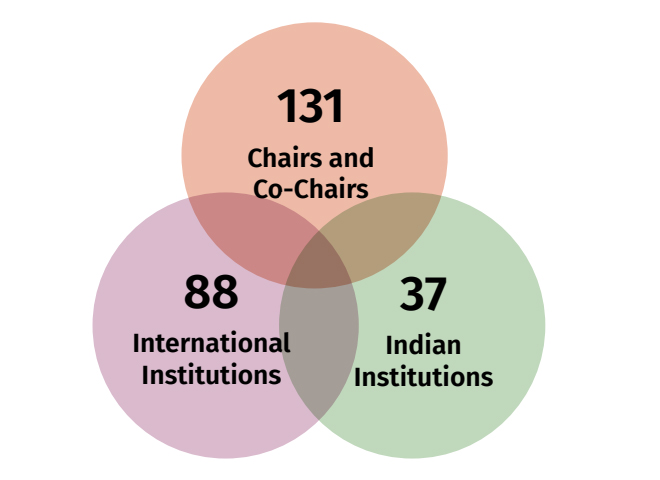
The 4Ds are closely oriented towards the achievement of the Sustainable Development Goals (SDGs). As such, these framing ideas or principles are reflected across the T20’s seven Task Forces, which deal with ‘Macroeconomics, Trade, and Livelihoods’; ‘Our Common Digital Future’; ‘LiFE, Resilience, and Values for Well-being’; ‘Clean Energy and Green Transitions’; ‘Reassessing the Global Financial Order’; ‘Accelerating SDGs’; and ‘Reformed Multilateralism’.
Constitution of Think20 Task Forces
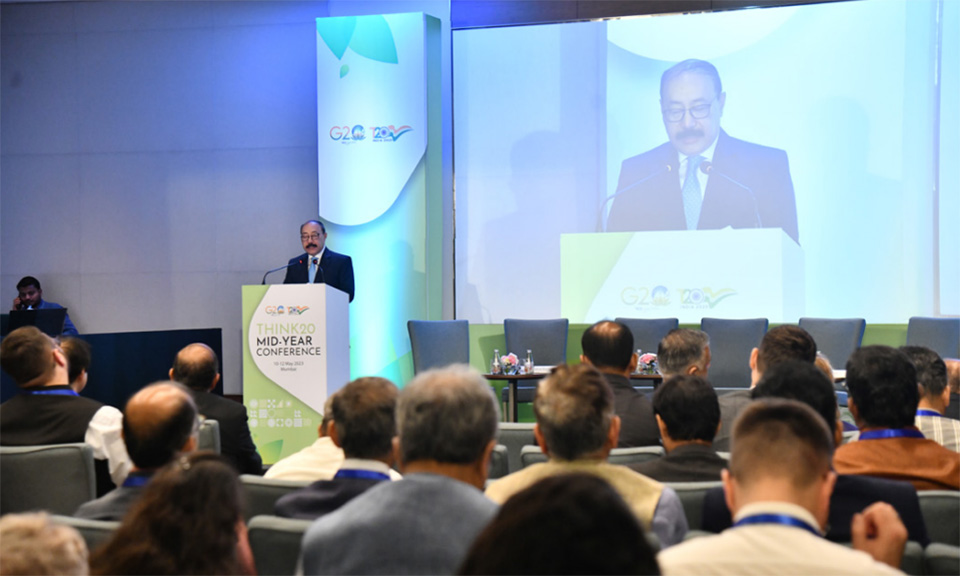
The T20 Mid-Year Conference took place in Mumbai on 10-12 May 2023. Three hundred attendees and Task Force members from across the G20 countries deliberated on the seven selected themes and took stock of the T20’s achievements thus far and the road ahead. Two particular elements of T20 India’s research and engagements stand out—its focus on mainstreaming gender and promoting gender equality, and its efforts to ensure that the African continent is an integral part of all conversations. India, being the second of four successive emerging economies to lead the G20 (Indonesia, India, Brazil, and South Africa will have been G20 Presidents between 2022 and 2025), has not only been a prominent voice of the Global South but has specifically put forth the unique developmental imperatives of the African landmass.
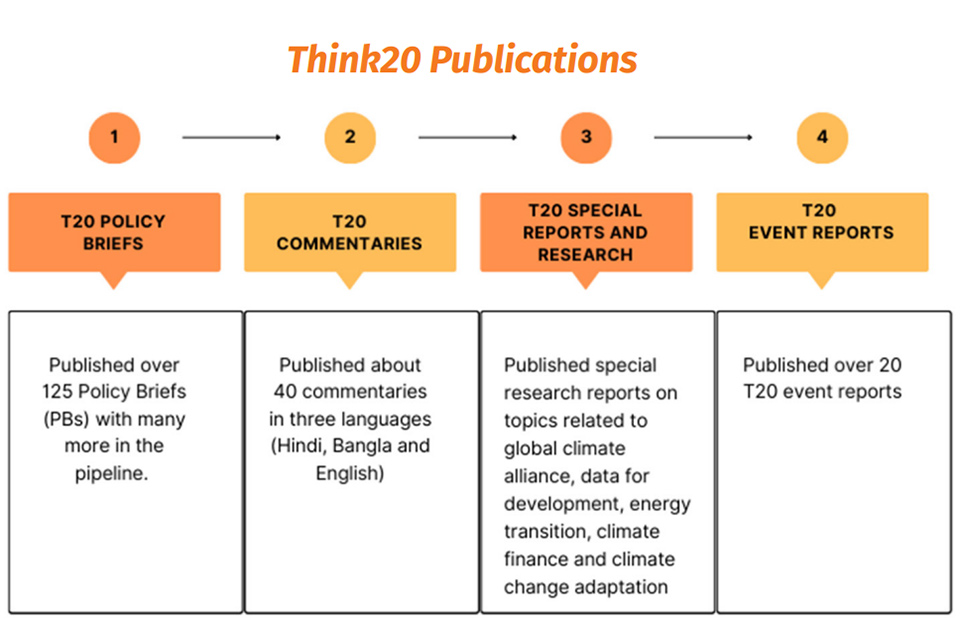
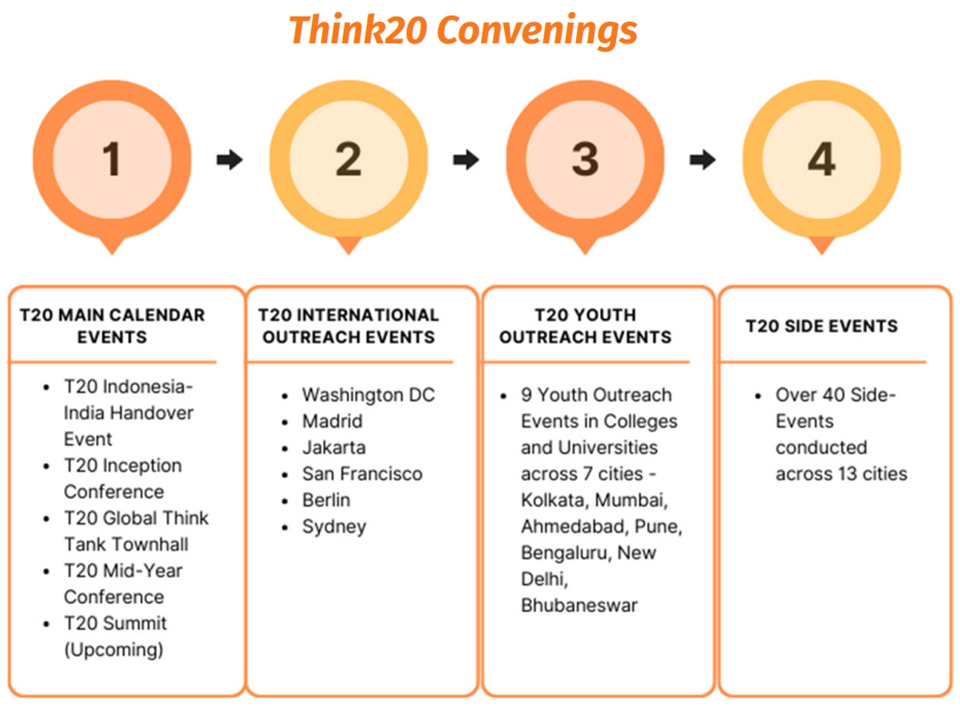
A key activity at the Mid-Year Conference was to finalise the Task Force Statements, which are vision documents about the Task Forces’ areas of engagement. The T20 Communiqué, a summary of recommendations to feed into the G20 process, is being drafted based on these statements and will be launched at the Think20 India Summit in Mysuru in August 2023. Moreover, as the term of the Indian T20 crosses its mid-point, it has already hosted over 50 events across the country and beyond and published over 125 Policy Briefs (PBs) with many more in the pipeline. These briefs are the outcome of processing raw ideas and producing them as actionable inputs.
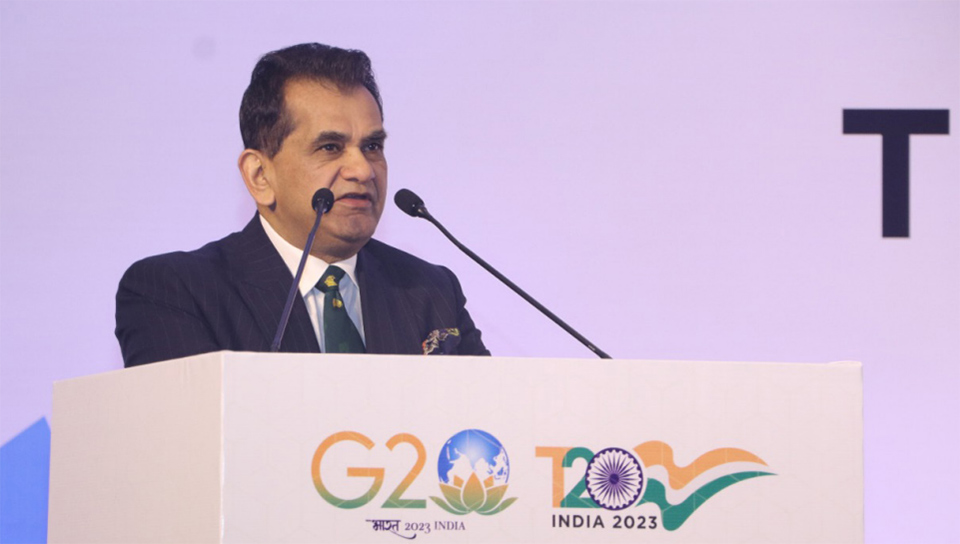
The ethos of ‘Jan Bhagidari’ (or broad-based civic participation in governance) has underpinned the Indian Presidency’s efforts to take the G20 and its ideas to constituencies such as the youth, women, businesses, and civil society. Recognising the youth and women as essential partners in development and growth, the Mumbai Conference engaged actively with these target groups, and over 100 students from schools, colleges, and universities across Mumbai and Pune took part in the event.
The ethos of ‘Jan Bhagidari’ (or broad-based civic participation in governance) has underpinned the Indian Presidency’s efforts to take the G20 and its ideas to constituencies such as the youth, women, businesses, and civil society. Recognising the youth and women as essential partners in development and growth, the Mumbai Conference engaged actively with these target groups, and over 100 students from schools, colleges, and universities across Mumbai and Pune took part in the event.
By the global ball and value chain
While MNCs are choosing well-established regional supply chain in East and Southeast Asia for now, India must look to the futu
Of the many ways the post-Covid world will look different, the rapid confluence of trade, technology and national security will rank high among them. The US’s assertion in the 2017 National Security Strategy (NSS) that ‘economic security is national security,’ EU Commission President Ursula von der Leyen’s call this February for ‘tech sovereignty’, and China’s focus on ‘self-reliance’ in strategic technologies portend a new age for geo-economics. All three areas have acquired a sharper edge in the middle of the pandemic.
India must signal to its citizens, businesses and the international community how it plans to respond to this moment being shaped by three developments. First, the weaponisation of economics and trade, a trend prevalent among partners and rivals alike. Second, the measurement of national power will now be based on the ability to control global digital flows comprising technology, information, human capital and finance. Can India be an influential actor?
The decoupling of supply chains due to the sharpening US-China trade war makes this an imperative. GoI seems to have sensed this moment and is attempting to seize it.
And third, old industrial tools like import substitution and market restrictions will need radical repurposing for these times. Can India devise a new mantra compatible with the latest version of globalisation? All of this translates into one layered question: How can India first attract large investments, then grow and develop its technology sector, and finally share and export ‘Digital India’ to other geographies?
This will be based on India’s ability to manufacture for, and service, the growing digital markets, as well as shape the norms, rules, standards and topography of global physical and digital supply chains. The decoupling of supply chains due to the sharpening US-China trade war makes this an imperative. GoI seems to have sensed this moment and is attempting to seize it.
Dislocations in trade and technology are an opportunity to attract global investors. India has done poorly in the past. A September 2019 Nomura report suggested that of the 56 companies relocating out of China, only three have opted for India. Nevertheless, decoupling is a long-term process. While MNCs are choosing well-established regional supply chain in East and Southeast Asia for now, India must look to the future.
Beijing’s economic statecraft underpins its efforts to shape the world in its own image through territorial aggression, debt-trap diplomacy and institutional capture.
In this regard, India’s decision to announce three interrelated schemes on production-linked incentive (PLI) for manufacturing of components and semiconductors, and electronics manufacturing clusters, is important. These replace the earlier ‘merchant export from India’ scheme, and align India’s support for its nascent electronics industry with WTO rules. This new regime for manufacturing and export is designed specifically to draw in large global manufacturers like Apple and Samsung, facilitating the relocation of a part of their production base and downstream suppliers to India.
The ability of just a few global investors to help India integrate into global supply chains (GSCs) should not be underestimated. For example, the market value of the hardware Apple produces in China was nearly $220 billion in FY2019, of which it exported $185 billion, dwarfing India’s total electronics exports of $8.8 billion in the same year. Apple has over 800 production facilities globally, over 300 of which are based in China. Even minor relocations of these value chains to India will be beneficial. The reported relocation of certain processes to India by Apple contractors Wistron and Foxconn, among the largest and most sophisticated Taiwanese electronics manufacturers, will bring with them their own secondary supply chains.
Such opportunities will multiply for India — such as the Britain-proposed ‘D10 alliance’ (a club of 10 democracies) on 5G and emerging technologies — begin to reorganise patterns of trade to favour nations ‘politically trustworthy’. The logic driving disengagement with China on crucial supply chains is obvious. Beijing’s economic statecraft underpins its efforts to shape the world in its own image through territorial aggression, debt-trap diplomacy and institutional capture. Part of India’s response to this reality will be political muscularity along the border and in the oceans. The other, more durable, response will be an obsessive nurturing and growth of the economy.
These ventures are also a litmus test for GoI’s resolve for reform.
This must be dictated by a strategy that enhances India’s ability to integrate into the production and manufacturing of strategic technologies, to secure value from global data flows, and to grow Indian platforms and digital propositions for the world. Growing and new investments from US blue-chip tech giants like Apple and Facebook into India’s manufacturing base and digital platforms augur well.
But these ventures are also a litmus test for GoI’s resolve for reform. In 1982, GoI’s integration of Suzuki into the domestic market for automobiles spawned a new wave of investments into this sector making it one of the world’s most competitive. As the realignment of supply chains accelerates post-Covid-19, investors from around the world will be closely watching the performance of these major global corporations in India before making their own decision.
 Samir Saran