Category Archives: Cyber Security
Amid changing post-pandemic realities, India needs to be swift in identifying partners whom it can trust
We will see the rise of a New World Order driven by national interest, reliability of partners, and of course, economic factors. India has to use a “Gated Globalisation” framework to negotiate this change.

The COVID-19 vaccines are coming. And along with this sanjivani comes a new age of geopolitics. The vaccines are varied, with different pricing points and affordability. Nations have secured their vaccine supplies from countries and companies they trust, often by forging new alliances. The scepticism over the vaccines from China and Russia shows that trust is the operating word in the post-pandemic era — and it is not limited to the choice of vaccines.
As we enter the third decade of the 21st century, a multipolar world awaits us. The US and China — rivals for the top slot till the pandemic hit the world — will now have to contend with traditional and rising powers like the UK, France, India and Brazil. Each country will engage with others selectively, not in every arena. We will see the rise of a New World Order driven by national interest, reliability of partners, and of course, economic factors. India has to use a “Gated Globalisation” framework to negotiate this change.
The security landscape will continue to drive partnerships, but these will no longer be omnibus alliances. India is locked in a confrontation with China in the Himalayas. The US and its traditional allies are ramping up their presence in the Western Pacific. A new Great Game is underway in the Indo-Pacific where the Quad is emerging. The Middle East is in a deep churn as Israel and Arabs discover Abrahamic commonalities. Europe is caught in a struggle to retain its values amid the diversity it has acquired over the years.
The Gated Globalisation framework requires that India should protect its interests in these unsettled times. Strong fences are necessary, but so is the creation of new partnerships (like the Quad) based on trust and common interests. Gated Globalisation has no place for parlour games like “non-alignment”; it will test the tensile strength of “strategic autonomy”. The need for a new coalition was felt after Doklam and has become a necessity post-Ladakh: India needs friends in deed.
The Gated Globalisation framework requires that India should protect its interests in these unsettled times. Strong fences are necessary, but so is the creation of new partnerships (like the Quad) based on trust and common interests
Beyond security, like everybody else, India has to make partnership choices on trade, capital flows and the movement of labour. The WTO’s multilateral trading arrangements have frayed beyond repair. Whether it is RCEP in the Indo-Pacific, the new version of NAFTA called USMCA, or the reconfigured EU, countries will have to decide whether they belong inside these gated trading arrangements. India has chosen to stay out of RCEP and the UK has left the EU.
By imposing restrictions on trade with China, India faces restrictions on capital flows. But this does not preclude enhanced capital flows from new partners. To prevent inflow of illicit funds, India has barred capital from poorly-regulated jurisdictions. India’s capital account for investment is largely open while its current account is carefully managed. Similarly, while restricting debt flows, India is open for equity flows from friendly countries. Other nations have similar policies. By managing capital flows in this manner, countries have enabled tighter financial relationships within their gated communities while shutting out those who are inimical to their interests.
India’s global diaspora is now over 30 million and sends more through remittances ($80 billion per year) than foreign capital inflows. The pandemic-enforced work-from-home may see the creation of new pools of skilled workers, living in virtual gated communities, further enhancing income from jobs physically located elsewhere. Moreover, the Indian diaspora is now increasingly impacting policy in countries like the US, UK and Australia where it has contributed politicians and technocrats, innovators and influencers, billionaires and cricket captains.
The pandemic-enforced work-from-home may see the creation of new pools of skilled workers, living in virtual gated communities, further enhancing income from jobs physically located elsewhere
Finally, technology flows and standards will also define gated communities. The internet is already split between China and everyone else. The Great Firewall of China has shut out many of the big tech players like Google, Facebook and Netflix. Instead, China has its Baidu, Alibaba and Tencent. With the advent of 5G technology, this split will get deeper and wider over issues of trust and integrity.
The EU-crafted General Data Protection Regulation (GDPR) is an excellent example of Gated Globalisation. The EU has set the terms of engagement; those who do not comply will be kept out. The Indian law on data protection that is currently being discussed follows a similar sovereign route. However, it remains to be seen whether these norms can checkmate China’s massive digital surveillance apparatus.
There are other emerging arenas that will likely become the focus of big power competition. China has moved in all possible directions to develop its global strategies. It has linked its national security interests with its Belt-and-Road Initiative and its debt programmes. It is offering a package deal of 5G technology with new telecom networks. China has learnt well from the US.
Amid these rapidly changing post-pandemic realities, India has to be swift in identifying partners whom it can trust and who will help protect and further its national interests. Ambiguity, lethargy and posturing will not do.
On the Cusp of Digital History: Nine Lessons for the Future

s we step into a year of uncertainties after a disruptive year of the pandemic, there is only one universal certitude: 2021 will witness the increasing adoption of technology as innovation gathers extraordinary speed. Clearly, our digital future is exciting, but it is hazy too. There are galactic black holes; and even that which is visible is overwhelming.
Despite acknowledging the need for critical discourse, our pace of enquiry, examination and action has been lethargic and out of step with the motivations of coders hardwiring our future through soft interventions. They are changing economies, societies, politics and, indeed, the very nature of humanity at an astonishing speed and with far-reaching consequences.
Nations that effectively respond to the advent of the Digital Era will be in the vanguard of the Fourth Industrial Revolution and will emerge stronger as the 21st century approaches high noon. Others will suffer the adverse consequences of the coming digital disruptions.
At the turn of the decade, Delhi hosted a stellar set of thinkers and speakers at the annual CyFy conference organised by the Observer Research Foundation, which focused on technology, security and society. Here are nine takeaways from the debates and discussions that threw up a kaleidoscope of scintillating ideas.
1. CHINA’S DIGITAL VICTORY PARADE

hat the US accomplished in the 20th century, China has set out to achieve in the 21st. The first takeaway from the CyFy debates is that China’s surge will continue, and it will profoundly change the world order. The US and its partners are witnessing the inexorable rise of an authoritarian digital power with the COVID-19 pandemic emboldening
THE US AND ITS PARTNERS ARE WITNESSING THE INEXORABLE RISE OF AN AUTHORITARIAN DIGITAL POWER… CHINA’S SURGE WILL CONTINUE, AND IT WILL PROFOUNDLY CHANGE THE WORLD ORDER.
Beijing to tighten its surveillance and suppression networks—bolstered by big data, facial recognition, et al.
The China Electronics Technology Group Corporation (CETC), a defence contractor, for instance, pitches such future applications as detecting ‘abnormal behaviour’ on surveillance cameras or among online streamers. These applications intimate such detections to law enforcement agencies.[i] Several regimes around the world are attracted to these Chinese offerings, which enable them to control their citizens.
Meanwhile, the old Atlantic Consensus is in total disarray. Europe is intent upon carving out its niche in emerging technologies while promoting new technology champions to challenge American tech dominance. After taking over the European Union presidency, Germany has called for the expansion of digital sovereignty as the leitmotif of EU’s digital policy.[ii] A new Digital Services Act may fundamentally alter intermediary liability and mark a new milestone in digital rights and freedoms.[iii]
Across the Atlantic, the US has made its fear of China Tech apparent but is yet to initiate a coherent effort to build an influential digital alliance as a sustained response to China’s relentless digital expansionism. Which brings us to the central geopolitical question: Can the US and Atlantic nations, currently marred by divisions and domestic disquiet, get their act together to respond to this emergence? Authoritarian tech is at the gates: Does the West have the resolve to respond? Will a new Administration in Washington, DC herald a new and meaningful approach? Or will America continue to turn inwards?
China will not offer any negotiated space. Beijing’s offer will be binary, so will be the outcomes. It is, therefore, imperative for a club of technology-savvy countries to come together if liberalism is to be preserved in our digital century.
2. END OF MULTILATERALISM AND THE RISE OF CLUBS OF STATES

o say that the international order is failing and floundering is not to state anything startlingly new; it’s only to underscore the bleakness of the global reality. However, like the proverbial silver lining, there is a degree of optimism around the role and centrality of smaller groupings. Regional partnerships, alliances of democracies, and plurilateral arrangements between nations with focused engagements and specific purpose platforms are seen to be important in these turbulent times. This is best exemplified by Australia, India and Japan—who with an eye towards China and propelled by their shared interest in a free, fair, inclusive, non-discriminatory and transparent trade regime—are banding together for a Supply Chain Resilience Initiative.[iv]
These small groupings, built around shared but limited objectives, are dying multilateralism’s lifeline. The Year of the Pandemic and its resultant disruptions have left the world with few options. One of them is to begin rebuilding multilateralism with smaller groups of countries with aligned interests. Hopefully, over time, this will lead to an efficient, inclusive international order.
India, Japan and Australia have taken on the responsibility abdicated by the US of building a resilient, vibrant, secure technology network in the Indo-Pacific. The role of the EU, ASEAN (more difficult due to deep divisions) and democracies in the Indo-Pacific in defending and strengthening norms and laws associated with technology and politics was elaborated loudly and clearly at CyFy.
States matter and the leadership of individual nations will have to drive the global arrangements that will best serve this century. While dialogue with geopolitical adversaries remains critical, meaningless consensus-driven multilateral approaches are not viable in a world fundamentally fractured along political, economic and ideological fault lines. We need action, not pious declarations. Given the pace at which emerging technologies are evolving, organisations like the UN are too slow, unwieldy and politically compromised to have any significant impact.
3. GLITCH IN GLOBALISATION

n the post-COVID-19 era, globalisation as we have known it will be in tatters, yet decoupling will be more difficult than before. There is a simplistic assumption that you can decouple your digital world from the real world. This is not so. If you exclude entities from your digital platforms, it will be difficult to sustain traditional trade in goods and services with them. Commerce and connectivity of the future will have a different texture.
As economic growth, national identities and digital technologies collide, “Gated Globalisation” will be the new mantra. With interdependence no longer fashionable, supply chains will be shaped by rising national security concerns. Increasingly, cross-border flows of data, human capital and emerging technologies are viewed as vulnerabilities. A focus on autonomy and indigenous capabilities has accompanied growing incidents of cross-border cyber operations and cyberattacks.
Commerce may be conditioned on norms along the lines of what the General Data Protection Regulation (GDPR) seeks to do with the digital economy. The Blue Dot Network and supply chain initiatives may all end up creating layers of permissions and permits that will create toll plazas on digital freeways. The digital domain was built on the assumption of hyper interconnectedness. Will it be able to grow with mushrooming policy barriers?
4. UNCHARTED TERRITORY: BETWEEN TECHNOLOGY AND STATE
new and fascinating dynamic is rapidly emerging between democracies and technologies, raising an interesting question: If a democratic state tames technologies, can democracy survive? This question has been posed by Marietje Schaake, the International Policy Director at the Stanford Cyber Policy Center.[v] Technology is being co-opted into a ‘techno-nationalist’ narrative: The melding of a country’s national interest with its technological capabilities while excluding ‘others’. This techno-nationalist narrative often emanates from tech giants who are increasingly speaking in the state’s protectionist language. Mark Zuckerberg’s written statement ahead of US Congressional anti-trust hearings was couched in the language of protecting the core American values of openness and fairness, as opposed
IF A DEMOCRATIC STATE TAMES TECHNOLOGIES, CAN DEMOCRACY SURVIVE? THE COROLLARY TO THAT IS EQUALLY TRUE AND PROMPTS ANOTHER QUESTION: CAN DEMOCRACIES SURVIVE IF THEY DO NOT REGULATE TECHNOLOGIES?
to China’s (authoritarian) vision.[vi]
The corollary to that is equally true and prompts another question: Can democracies survive if they do not regulate technologies? The isolating and polarising effects of social media, for instance, have already resulted in a slew of analysts chanting the dirge for democracy.[vii] The answers to these questions are unclear, but it is certainly true that the protection of the public sphere, the integrity of political regimes, and the robustness of conversations must be common aspirations should we want democracy to survive and strengthen.
Be it regulations, education, incentives, ethics or norms, we will have to dig deeper into our toolbox to come up with answers that would allow this to happen. Currently, the negative impacts of technology on our evolving and fractured societies are threatening to overwhelm its promise and potential. Can a new regulatory compact emerge that negotiates the digital ethics for corporations, communities and governments? This decade will witness an unspoken contest over writing this new code of ethics. It remains to be seen whose code will prevail and, more importantly, for what purpose.
5. UNACCOUNTABLE TECH AND CORPORATE BOARDROOMS
e cannot overlook the changes that the relationship between big companies, technology and societies has undergone. If successive anti-trust actions in the US, EU, Australia, India and elsewhere are any indication,[viii] accountable boardrooms are now an expectation and will soon be a reality; the shape it will take will be defined by the debates taking place around the world. We can be certain that in the coming years, corporate governance is not going to be the same.
Large companies, having dominance and influence, will need to be more responsive to the communities they serve. The blueprint of new corporate governance cannot but be influenced by the needs of the locality; the nature of the framework will have to be contextual and culturally sensitive. Since mammoth corporations determine our very agency and choice, it is part of their fiduciary duty to ensure that the interests of the company and the community are ethically aligned.
Outside corporate boardrooms, we cannot ignore the role of coders or programmers in Bengaluru, Silicon Valley, Tel Aviv and other tech hubs. As we become increasingly reliant on software, can we let coders be the new cowboys of the Wild West without any accountability? As we get further entangled in the intricate web of algorithms, it has become clear that we need to demystify them. No more black box responses, no more unaccountable algorithms. What we need are programmers who are held responsible for the impact their codes make on people’s lives. We need algorithms that are not only transparent but also seen to be so.
6. THE PANDEMIC & DIGITAL SOCIETIES
he pandemic has made us reassess our approach to life and behaviour. We consume, we communicate, and we integrate using technology. Nearly a year on, COVID-19 has not only furthered technology’s invasion of our lives but also brought to the fore new realities, especially regarding privacy. The deepening concern over privacy is intertwined with the change in the ownership of data. The pandemic provided the pretext to alter the role played by big corporations and the control of the state over technological devices, products and services.[ix]
The digitalisation of our day-to-day lives may enable an unprecedented level of personalised oversight over individual behaviour. In its mildest form, this can be ‘libertarian paternalism’, a nudging predicated on the belief that individual choices are rarely made on the basis of complete information and are instead a product of psychological biases. At the other end of the spectrum, the ‘gamification’ of citizenship under this new paradigm would be the ultimate realisation of the Hobbesian social contract, whereby the Leviathan would be entrenched in every aspect of citizens’ lives.
In order to retain the ownership of data and individual autonomy, all these changes must be accompanied by the strengthening of our resolve to defend individual choice, freedom and rights by formulating adequate laws that would ensure that the values we create serve us, the people.
7. REWRITING THE SOCIAL CONTRACT
he world needs a new social contract—a digital social contract. The pandemic has thrown the old workplace order into a state of flux, thereby, reopening the debate surrounding the provision of the three Ps: Paycheck, protection and purpose to individuals. The equivalent of 475 million full-time jobs vanished in the second quarter of 2020[x] and many others found themselves without health insurance and other benefits typically linked to work contracts at the greatest time of their need. To ‘build back better’, the new order is being shaped by new terms of contract and employment, concepts of social protection and minimum wage for all, and the altered role of the state, big tech and individuals. The global shift towards virtual workspaces also provides an opportunity to induct a more diverse work force, especially individuals from historically marginalised communities. However, we need to take note of the challenges that might accompany these changes—such as ensuring safe, inclusive digital workspaces, keeping pace with ever-changing technology, meeting the demand for human skills, and coping with the displacement of jobs. As we move to a more ‘virtual first’ work environment, we need to make sure that nobody is left behind.
Meaningful engagement with vulnerable communities necessarily involves outreach by governments as well as large technology firms, both of whom have benefited from the data of these communities. It is, therefore, the responsibility of both to build bridges with the communities that would be most vulnerable to the disruptive impact of the technologies they build and benefit from. We must take advantage of this moment to forge technology that will be in service of humanity—taking ‘people-centered innovation’ from a buzzword to actual practice.
8. OUTLASTING THE VIRUS: INFODEMIC AND I
n intense battle is being waged against the Infodemic, which is running parallel to the battle against the Pandemic. Misinformation, the darkest shade of grey in the Chrome Age, is now being used to destabilise businesses and political systems, and dissolve the social cohesion shared by individuals. “Misinformation costs lives”,[xi] and the Infodemic has led to uncountable preventable deaths.
NO SINGLE AGENT CAN EVER ENSURE THE INTEGRITY OF THE GLOBAL INFORMATION SYSTEM. THE ANSWER, THEREFORE, LIES IN THE COMING TOGETHER OF ALL THE THREE IMPORTANT ACTORS—THE STATE, BIG TECH AND THE PUBLIC.
No amount of digital distancing is helping curb the spread of fake news. This emergence of a highly polarised information system should be effectively countered by a new guarantor of the public domain. No single agent can ever ensure the integrity of the global information system. The answer, therefore, lies in the coming together of all the three important actors—the state, big tech and the public.
The state should help denounce disinformation and simultaneously promote high quality content. Big tech can devise algorithms to filter out such misinformation, curtail the financial incentive acquired through it and display a higher sense of responsibility. Indeed, if platforms can display the same energy and responsiveness they did during the US elections in other jurisdictions, we may have some hope for a tenable solution.
Finally, the public should expand their information base by incorporating different sources of information, reading before posting on social media, and exposing and reporting fake news. It is only through the realisation of collective responsibility that we can hope to find a ‘vaccine’ for the Infodemic.
9. #TECHFORGOOD – A RAY OF HOPE
n a gloomy landscape of various shades of grey, we are at last beginning to see some light and some white. The emergence of a technology moment where communities are beginning to find their voices and change the course of their future, provides a glimmer of hope. Across the world, especially in Asia and Africa, people are discovering, nurturing and shaping new aspirations and goals for themselves by using technology. The African Union highlighted the need to diversify, develop and assert ownership over its digital society and economy.[xii] Community data has transformed from a fringe idea to a mainstream policy debate, receiving a nod, for instance, in India’s Non-Personal Data Governance Framework.[xiii]
Even as the pandemic upended our lives, we saw governments deploying technology for the greater social good; we saw businesses respond to it with extreme ingenuity; and we also saw women seizing this moment and retaining agency.
The post-pandemic era offers us an opportunity to build a more diverse and inclusive digital order. We can, and must, redefine diversity and support minorities and women to play a key role as a new world emerges from the debris of the war on COVID-19. The world today once again stands on the cusp of history. It cannot afford to fail in laying a new foundation which is free of the of the frailties of the past.
Technology and Terror: A new era of threat in a borderless online world
Terror requires spectacle to thrive and technology has allowed this opera of violence to find new audiences and locales.

From ISIS attaching a GoPro camera to a home-made armed drone in Syria to Islamists from the Democratic Republic of Congo uploading 4K videos pledging allegiance to Abu Bakr al-Baghdadi, cyberspace and emerging technologies are facilitating terrorist activities at an unprecedented scale. The convergence of technology and terrorism represents the worst kind of feedback loop between the real and the virtual. States, meanwhile, are struggling to respond to this convergence and to balance the imperatives of national security and the freedoms afforded in cyberspace.
Given the complex structural drivers of terrorism and the trade-offs involved in regulating technology, it is imperative that policy makers first assess the real and evolving dimensions of the challenge. The popular conceptual understanding of this menace is that like war, terrorism is simply politics by other means. Whoever the actor may be, terrorism is a violent expression of alternative political values and norms for organizing societies. Motivations may vary but violence is the principal instrumentality for recruiting, propagating and financing this perverse politics. And like mainstream politics, terrorist organizations have co-opted technology as a force multiplier in achieving their objectives.
Like mainstream politics, terrorist organizations have co-opted technology as a force multiplier in achieving their objectives.
As has been suggested by many scholars, terror requires spectacle to thrive and technology has allowed this opera of violence to find new audiences and locales. The Christchurch shootings in New Zealand is perhaps the most obvious example — with the shooter streaming his actions live on social media. New communication platforms afford scale and impact at virtually no cost, a service that terrorists have used with impunity and agility over the years with deleterious consequences for communities and countries.
Some features of the internet, like end-to-end encryption and virtual private network (VPN) have made it easier than ever for terrorist organizations to find recruits and manage outreach and organization. For example, migration of pro-ISIS propaganda from likes of Facebook and Twitter to Telegram was in a large part due to encryption facility offered to all its users. Technology also allows these organizations to transcend the tyranny of geography. An organization in one country can raise funds, recruit and radicalize individuals in another part of the world with ease.
Some features of the internet, like end-to-end encryption and virtual private network (VPN) have made it easier than ever for terrorist organizations to find recruits and manage outreach and organization.
Every communication opportunity online is being exploited by these malevolent actors. From the mainstream platforms such as Facebook and Telegram to chat rooms, betting sites, porn websites and online gaming hubs. These virtual venues are fertile breeding grounds for accidental and purposeful recruits and for propagating violent narratives. The importance of ‘digital terror squads’ was emphatically asserted when, in 2016, ISIS granted its ‘media mujahids’ the same rank as those fighting for the group on the ground. This gave the online radicals pride of place that was traditionally reserved for the fighters delivering carnage on the ground. This is only one of the instances that signify just how integral, sophisticated and important cyber operations are for terrorist organizations today.
Terrorist organizations are also leapfrogging traditional hawala networks to embrace Fin-Tech as a means to finance their operations. Services like e-wallets, digital currencies, crypto-currencies and even crowd funding platforms are being leveraged to raise and launder money and finance terrorist operations. This has rendered most current practices of clamping down on terror-finance obsolete, and today more terror organizations have access to more money than ever before.
Terrorist organizations are also leapfrogging traditional hawala networks to embrace Fin-Tech as a means to finance their operations.
Amidst this worrying convergence of terrorism and technology, states have struggled to respond without threatening the infrastructure of cyberspace or the freedoms and opportunities it affords. Meanwhile, the tech platforms are having troubles of their own. The word ‘social’ in social media is under scanner, with platforms facing multiple headwinds relating to their policies on responding to terrorism, fake news and political interference among others. These platforms host billions of users even as they struggle to differentiate between their ‘social’ obligations to the digital commons and their commitments to markets and investors.
As states, platforms and grassroots organizations combat the threat of tech-enabled terrorism, it is important for them to identify certain guiding principles.
First, it is crucial that they do not unintentionally limit access to technology itself. For many states, the knee-jerk response to some of these challenges is banning access or shutting down tech-based routine operations altogether—as we recently saw in Sri Lanka. Instead, states must co-opt technology and tech-actors, which allows for better surveillance of and enforcement against terrorist activities. Legislations and notifications will have limited influence in this new battle theatre. More technology, better technology and skillful deployment of technology against malign actors is the most potent option for all to embrace and one which most governments have failed to invest in.
States must co-opt technology and tech-actors, which allows for better surveillance of and enforcement against terrorist activities.
Second, the digital commons must witness the creation of new mechanisms and institutions for international cooperation on this vital issue. The challenges of terrorism are cross border — making debates held hostage by ‘regional’ or ‘international’, ‘Western’ or ‘Eastern’ silos irrelevant. States and tech companies need to find new venues and forums to cooperate on these issues in an institutionalized manner, formally or informally. The traditional distrust between governments and private actors is creating a cleavage that allows terror to flourish and succeed.
The digital commons must witness the creation of new mechanisms and institutions for international cooperation on this vital issue.
Third, technology companies must be more forthcoming about disclosures relating to terrorist activities on their platforms. The obsession with the performance of their shares on the bourses is perversely impacting the global effort to respond to terror. They must create internal mechanisms to share information with law enforcement on a real time basis. They must also publish regular public reports detailing the nature of terrorist activities they have identified, and steps taken to counter them. The reluctance of corporations to be transparent about the mishaps on their platforms and networks is a serious problem.
Technology companies must be more forthcoming about disclosures relating to terrorist activities on their platforms.
Fourth, states, for their part, must remember that tech is only a tool. It is not a substitute for real world and virtual policing. Often states attempt to undermine tech—for example through weaker encryption norms due to their naïve assessment that this would assist in their dispensation of duty. This only undermines utility and safety of technology for millions of benign users; while terrorist organizations will simply migrate to alternative platforms as witnessed in the recent past.
States…must remember that tech is only a tool. It is not a substitute for real world and virtual policing.
Fifth, localized capacity building both by state and tech firms is the need of the hour. While national intelligence organizations are certainly relevant, the first line of defense against tech-enabled terrorism will be local law enforcement. Unless these units are equipped with skills and technology, the terrorist will always remain a step ahead in an upcoming era of Do-It-Yourself (DIY) terrorism.
Localized capacity building both by state and tech firms is the need of the hour.
Finally, simultaneous investments in capacity for strategic communications by states and technology companies is a pivotal step. Unless good actors can combat the narrative appeal of radicalism and terror, most responses with be feeble and patchy. Either the states provide purpose and meaning to individuals, or radical groups will. The old methods of counter-terror will need to be dramatically upgraded and redesigned. The terrorists have developed a lethal cocktail of clicks and Kalashnikovs, even as citizens, states and other organizations, lag behind in recognizing and responding to this heady mix.
Simultaneous investments in capacity for strategic communications by states and technology companies is a pivotal step.
Any good policy response to tech-enabled terrorism must acknowledge that combating it requires an “all of society” approach. This first line of defense is always communities, no matter how the technology may change. Platforms for their part must work with them alongside states to increase awareness about this real and present danger and must transparently share their propositions that can help to balance the trifecta of growth, rights and security.
AI has a gender problem. Here’s what to do about it
World Economic Forum, 16th April 2018
Original here
Three of the fastest-growing applications of artificial intelligence (AI) today are a manifestation of patriarchal stereotypes – the booming sexbots industry, the proliferation of autonomous weapon systems, and the increasing popularity of mostly female-voiced virtual assistants and carers. The machines of tomorrow are likely to be either misogynistic, violent or servile.
Sophia, the first robot to be granted citizenship, has called for women’s rights in Saudi Arabia and declared her desire to have a child all in the span of one month. Other robots are mere receptacles for abuse.

The Guardian in 2017 reported that the sex tech industry, including smart sex toys and virtual-reality porn, is estimated to be worth a whopping $30 billion. This is just the beginning. The industry is well on its way to launch female sex robots with custom-made genitals and even heating systems, all in the quest to create a satisfying sexual experience.
The advent of sexually obedient machines – which are designed to never say no – is problematic not just because of the presumption that women can be replaced, but because the creators and users largely tend to be heterosexual men. The news of a sex robot being molested, broken and soiled at an electronics festival in Austria last year should hardly come as a surprise.
While one could argue that the use of sexbots could reduce the abuse and rape of women in real life, it is undeniable that these machines are created to serve some men’s perverse needs. The machine represents a new wave of objectification, one that could potentially exacerbate violence against actual women.
The arrival of lethal autonomous weapon systems (LAWS) or “killer robots”, on the other hand, threatens to de-humanize both the male and female victims of war.
On the one hand, autonomous weapons could reduce the number of humans involved in combat and even decrease casualties. Killer robots could ultimately bring down the human cost of wars. On the other hand, they could downplay the human consequences of combat — and indeed, violence itself — and lower the threshold for armed conflict.
Several states are calling for a pre-emptive ban of killer robots, afraid that they might lead to an AI arms race, one that could raise the risk of a violent clash. Should machines be allowed to make life and death decisions? Or should this choice stay in the hands of humans, however fallible they may be?
Finally, the development of voice assistants and Internet of Things (IoT) devices for the care of children and senior citizens is a market that is expected to expand rapidly in the next decade. The presumption that machines cannot invoke the emotional intelligence that care workers possess is increasingly being challenged with the emergence of smart tracking devices and health monitors that can observe and predict behaviour.
These innovations no doubt share their underlying technology with other voice-driven platforms such as virtual assistants – platforms often designed to mimic servility and subservience. It is no coincidence that voice assistants are often designed to sound and act feminine – take Apple’s Siri (in its original avatar) and Amazon’s Alexa. The more recent development of a ‘male’ option for voice assistants does not change the overall picture of male dominance and female servitude in AI.

Robots are expected to replace workers around the world.
When chatbots and voice assistants are fed on a diet of data assembled by male coders, machines perpetuate inequities found in the real world. This can have unintended consequences.
Given the general uncertainty surrounding the impact of AI on the real world, the responsibility of creators as well as broader communities merits all the more attention.
Today, machines reflect regressive, patriarchal ideas that have proven to be harmful to society. If this continues, technology may no longer usher us into a post-gender world. In fact, like all bad doctrines that have held communities back, biased codes may just institutionalize damaging behaviour.
Perhaps the involvement of more women and marginalized communities in the creation of AI agents could deliver the equity that we desire in future machines, and prevent the development of more patriarchal technology. If the machine is patriarchal, do we remove the more systemic condition of patriarchy or reduce reliance on the machine altogether? Both are easier said than done.
To build an equitable world, which will be inhabited by women, men and machines, the global community needs to script norms around the fundamental purpose, principles of design and ethics of deployment of AI, today.
Autonomous systems cannot be driven by technological determinism that plagues Silicon Valley – instead their design should be shaped by multiethnic, multicultural and multi-gendered ethos. AI and its evolution, more importantly, needs to serve much larger constituencies with access to benefits being universally available.
The administration of AI applications cannot be left to the market alone. Experience tells us that the market often fails and is regularly compromised by perversion and greed. History teaches us that when governments control, constrain and constrict innovation, they produce aberrant outcomes that are far from ideal. Norms developed by communities, instead, provide a workaround. We must promote norms that manage these technologies, make it available to those who need it most, and ensure a gendered development of this space led by a multistakeholder community that includes voices from outside the Atlantic consensus.
Authors
Samir Saran, Vice-President, Observer Research Foundation (ORF)
Madhulika Srikumar, Junior Fellow, Observer Research Foundation
New technologies are radically transforming our idea of community – and subsequently statehood. How will future states look like? And how should they look like? Disaster researcher Malka Older, author of the highly acclaimed cyberpunk thrillers “Infomocracy” and “Null States” will discuss digital governance with Shoshana Zuboff. Since the early 1980s Zuboff’s career has been devoted to the study of the rise of the digital, its individual, organizational, and social consequences. She coined the term “commercial surveillance” and is now working on her book “Master or Slave? The Fight for the Soul of Our Information Civilization”. This final discussion about new forms of digitalized governance and its impact on the individual will be moderated by one of the world’s leading experts on cyber security Samir Saran, Vice President of the Observer Research Foundation in Delhi.
Integrated Solutions for Multifaceted Challenges Role of Technology
original link is here
Opportunity knocks, Aadhaar enters
Economic Times, August 29, 2017
Original link is here
The Supreme Court’s verdict affirming the fundamental right to privacy should not come as news to technology companies. The court merely codifies what should have been an article of faith for Internet platforms and businesses: the user’s space is private, into which companies, governments or non-state actors must first knock to enter.
The technical architecture of Aadhaar and its associated ecosystem, too, will now be tested before a legal standard determined by the court. But GoI should see this judgment for what it is: a silver lining. The verdict bears enough hints to suggest the court sees the merits in a biometrics-driven authentication platform.
In fact, Justice DY Chandrachud impresses upon the possibility of better governance through big data, highlighting that it could encourage “innovation and the spread of knowledge”, and prevent “the dissipation of social welfare benefits”. The court’s words should spur GoI to create a ‘privacy-compliant Aadhaar’.
But this requires systematic thinking on the part of its architects. The private sector, too, will have to put ‘data integrity’ and privacy at the core of their consumer offerings and engagement.

For starters, GoI must account for Aadhaar’s biggest shortcomings — its centralised design and proliferating linkages. A central data base creates a single, and often irreversible, point of failure. GoI must decentralise the Aadhaar database.
Second, Aadhaar must be a permission-based system with the freedom to opt-in or out, not just from the (unique identification (UID) database but from the many services linked to it. This must be a transparent, accessible and user-friendly process.
With a ‘privacy-compliant’ Aadhaar, GoI would not merely be adhering to the Supreme Court verdict, but also be on the verge of offering the world’s most unique governance ecosystem. Take Beijing’s efforts, for instance.
In 2015, the Chinese government unveiled a national project to digitise its large, manufacturing-intensive economy and to create a digital society. The ‘Internet-plus’ initiative aimed for the complete ‘informationisation’ of social and economic activity, and harvest the data collected to better provide public and private services to citizens.
China has no dearth of capital or ICT infrastructure. But the ‘Internet plus’ initiative has struggled to take off in any significant way. The project suffered from a fundamental flaw: Beijing believed by gathering information — from personally identifiable data to more complex patterns of user behaviour — the State would emerge as the arbiter of future economic growth, consumption patterns and, indeed, social or political agendas.
If a project like Aadhaar is to succeed, its underlying philosophy must be premised on two goals: first, to increase trust and confidence in India’s digital economy among its booming constituency of Internet users; and second, to ensure that innovations in digital platforms also result in increased access to economic and employment opportunities.
A privacy-compliant Aadhaar creates trust between the individual and the State, allowing the government to redefine its approach to delivering public services. The Aadhaar interface, that the Unified Payments Interface (UPI) and other innovations rely on, could well generate a ‘polysemic’ model of social security, where the same suite of applications cater to multiple needs such as digital authentication, cashless transfers, financial inclusion through a Universal Basic Income, skills development and health insurance.
But such governance models should not be based on a relationship of coercion or compulsion. It is heartening that India’s political class has embraced the court verdict.
A key reform missing in current debates about the UID platform is GoI’s accountability for its management. Aadhaar, to this end, should have a chief privacy officer who will be able to assess complaints, audit and investigate potential breaches of privacy with robust autonomy.
A privacy-compliant Aadhaar, with a bottom-of-the-pyramid financial architecture, would inspire confidence in other emerging markets to also adopt the platform, with Indian assistance. Companies and platforms must internalise that promise of black box commitments towards privacy and data-integrity may no longer suffice. These commitments must be articulated at the level of the board, and communicated to each user that engages with them. Overseers of data integrity must be appointed to engage with users and regulators in major localities.
The writer is Commissioner, Global Commission on the Stability of cyberspace
A global agenda for digital economies
The G20 must foster linkages between traditional financial institutions, first-generation Internet users and the informal sources of their livelihood
Livemint, May 3, 2017
Original link is here
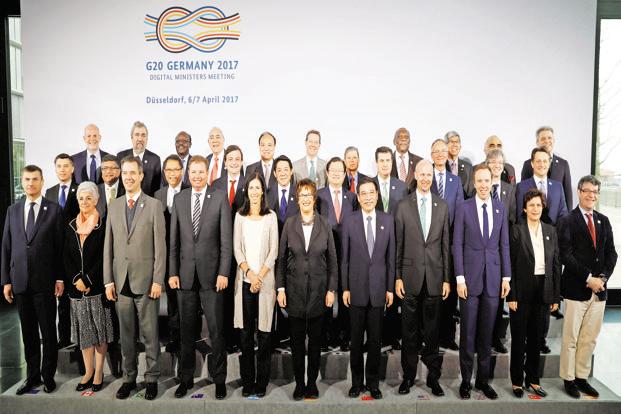
The G20 is responsible for ensuring that digital supply chains are not fragmented in this era of ‘de-globalization’. Photo: Reuters
Last month, Germany convened the first-ever G20 “digital ministers” meeting, indicating how the future of connected societies and economies is now firmly at the top of the global agenda. In the run- up to the ministerial meeting, a T20 task force comprising think tanks and academia, of which this author was co-chair, was constituted to offer recommendations that would strengthen digital economies and manage the “digitalization” of traditional sectors. A prominent concern outlined by this group related to the threat to global financial systems because of greater interconnectivity and the creation of novel, untested architectures to manage payment processes. No country is more affected by the weaknesses in digital payments systems, global and domestic, than India, which is tackling the twin challenge of Internet adoption and expansive digitalization.
The future of global financial systems is tied to the security of the digital networks that sustain them. A recent report by UK-based insurance company Hiscox suggests cyberattacks cost the global economy nearly $450 billion. Whether in platforms like the UN group of governmental experts on information security, or through traditional trade agreements, the international community has struggled to offer a collective response to threats faced by the digital economy. The G20 digital ministers meeting is, therefore, a step in the right direction to give this issue the political visibility it needs.
The meeting resulted in the creation of a working group on the digital economy to articulate rules of operation for businesses, governments and users transacting on the Internet. The larger mandate of this working group is the creation of a strategy for securing the global digital economy. India should contribute to the working group’s findings, as its digital economy is qualitatively and quantitatively different from those of the advanced industrialized nations.
The working group will have to address concerns around security, digital access and international trade. Cybersecurity, traditionally understood, has come to mean the integrity of platforms, digital networks and devices. But the G20 should assess whether cybersecurity is a business objective or a means towards the larger goal of promoting digital access and financial inclusion. Should it be the latter, any ecosystem design should ensure affordability and affordable security for users at the bottom of the pyramid. The working group should also articulate policies for the digital economy that can be emulated in developing countries outside the G20. And finally, the G20 is responsible for ensuring that digital supply chains are not fragmented in this era of “de-globalization”. This is a real threat, and as the recent communique from the G20 finance ministers’ meeting suggests, the group was unable to defend the virtues of an open trading system.
The availability of digital infrastructure is not the holy grail for emerging markets. Even if the last user in the developing world were to be provided affordable and uninterrupted Internet access—a challenge in itself—her digital consumption would ride on the skills available, cybersecurity awareness, and the level of inclusion offered by technological platforms developed in advanced economies. Scholars Urvashi Aneja and Vidisha Mishra at the Observer Research Foundation make the case for a G20-wide “digital skills upliftment strategy” that can improve labour participation and competitive capacities for women and marginalized communities.
Yet another concern that the working group should address is the impact of “digitalization” on traditional industrial sectors. Here too, India like others in the developing world, is in the cross hairs of pervasive automation and the use of “intelligent” technologies. Automation will affect manufacturing jobs, and economists like Ester Faia suggest that it poses a risk to the service sector as well. Faia’s analysis, submitted as a working paper to the T20 group, also shows that the financial services sector, considered a safe haven in times of economic transition, has a 90% probability of automation in certain countries. A services-driven economy like India, therefore, must manage this disruptive transition and potential loss of jobs effectively.
How the shift to automated supply chains will affect the country’s urban demographic is also a question worthy of the Indian policymakers’ attention. For instance, as industrial supply chains become digitized, highly skilled jobs have clustered around certain urban centres with a technological focus—San Francisco, Phoenix and Munich, to name a few. Similarly, traditional manufacturing centres like Detroit and Liverpool have seen jobs plummet because of automation. Unpredictable employment trends alongside the current problems of unplanned urbanization will challenge economies within and outside the G20. This in turn will give rise to new domestic political dynamics that may sometimes clash with the G20’s stated objective of promoting globalization.
How can the G20 manage the tailwinds of such disruptive automation and “digitalization”? Carl Frey of the Oxford Martin School suggests that this disruption should be countered by policies that enable urban mobility and create a wide social safety net, such as one for national relocation support. There are discussions in India and in Silicon Valley about providing a universal basic income to manage this new dynamic. But can conservative financial institutions that thrive on old notions of risk as it relates to lending and banking adapt to such policies? The G20, through national and transnational policies, has always engaged with the formal economy. Its best shot at managing disruptive digital forces may ironically lie in embracing the informal sector via technology. Digital platforms will allow governments to provide social benefits to constituencies that formal financial instruments have been traditionally blind to, provided the G20 fosters linkages between the trifecta of traditional financial institutions, first-generation Internet users and the informal sources of their livelihood.
Samir Saran is vice-president at the Observer Research Foundation and was co-chair of the T-20 task force on the digital economy.
 Samir Saran