Columns/Op-Eds, Non-Traditional Security, Politics / Globalisation

The European Union as a Security Actor

View from India

Bundeszentrale für politische Bildung Logo

Original link is here

Das Bild zeigt die Glastüren des Haupteingangs zum Europapalast in Straßburg, Sitz des Europarats. Die Türen sind mit Euro-Sternen verziert.

Euro-Sterne auf den Glastüren des Hauptportals zum Palais de l’Europe, Sitz des Europarats in Straßburg. (© Ulrich Baumgarten/vario images)


What is a security actor and how is it different from being a great or major power? In many ways, this question is central to understanding the lack of appreciation of the European Union (EU) as an actor in the security arena in India and certainly in some other parts of Asia. The use of the word ‘security actor’ by EU agencies and research institutes is itself perhaps a neutralisation of the phrase ‘major power’. This reveals the ambivalence of the EU to power in contemporary times, despite having given the world several great powers in the past. This ambivalence, and the hesitant Asian comprehension of the EU’s role in the security domain shape the current debate.

However, to move beyond this general understanding and to try and understand the Indian perspective on this issue, three key enquiries are essential. First, does the EU have the agency to be a security actor? Second, does it have the capability and capacity to follow through in this role? And, finally, does the EU, or a significant part thereof, see itself as a Security Actor?

Agency: Who do I call?

The EU is a great economic power and is central to the construction of any polycentric order. In spite of this, it is not viewed as a security actor. Perhaps this can in part be explained by what Henry Kissinger once famously said, in an interview with Der Spiegel, ‘Who do I call if I want to call Europe?’. While the EU now has a number of structures that deal with security its security policy has not evolved to the point where it can shape emerging international security scenarios.

The principal issue is that of integration. Collectively, it appears that the EU thinks of itself more as a civil and economic power, viewing military instruments as an option of last resort. Within the EU, France and the United Kingdom have a different approach in which use of force, or the threat of the use of force is a prominent instrument in their toolbox. Some others like Germany tend to take the opposite view and are generally more reluctant to sanction the use of force.

This can have consequences like France declaring that its permanent membership of the United Nations Security Council will remain a French seat and will not be ceded to the EU. France has also rejected the validity of a UN veto when humanitarian crises loom (as was the case in Syria)[1]. These two French positions have led to both disappointment and alarm in other members of the EU. Damagingly for the EU, the latest crisis in Europe, i.e. the occupation and annexation of the Crimean Peninsula by Russia, has only confirmed this apprehension. The lack of a coordinated EU response is disconcerting, as what we have is a set of nations individually condemning Russian actions and others staying silent.

Trade and commerce across the EU is now so integrated that it allows for similar perceptions and ideas on most macro and several micro economic policies. This allows the EU far greater cohesion and therefore, weight in trade talks. On the other hand, political approaches and realities in each member country vary dramatically. This dissonance between a cohesive economic union and a relatively divided political union has a significant impact on the perception of the EU in a continent like Asia where the realist paradigm dominates. The EU is likely to be seen as a ‘hyper-successful’ regional trading and economic arrangement, but not a unified security actor or a ‘great power’. It is also seen to be creating a large political and security bureaucracy, which churns out some strategic and security objectives, without seeking to possess the hard power elements to realise these set of goals.

Capacity: Acute Deficit

Capacity is the key element that will define the EU’s ability in the Asian theatre. In 2012, as per the International Institute of Strategic Studies’ (IISS, London) estimates, Asian defence expenditure exceeded Europe’s. Indeed within the EU, member states are increasingly hesitant to commit towards defence expenditure. Additionally, the focus of current expenditure is on capabilities that are not decisive in the Asia-Pacific theatre or suitable for hard power projection in the classic sense. There is little political and public support for defence expenditure when social spending is deemed a higher priority.

As a result, the EU’s ability to play a role in the international system is going to be far more constrained than ever before. This is perhaps evidenced by the fact that not a single European or EU action has been carried out without US support even when taking on vastly inferior militaries like those of Serbia or Libya.

This acute capacity deficit means that if the EU chooses to act by itself, it comes up against the various perceptions among the EU member states on its role as security actor. On the other hand, if it chooses to act through the agency of NATO to bypass this internal dissonance, it is fundamentally dependant on the US for capacity.

Self-View: “Empire of Norms”

The recent description of the EU being an ’empire of norms’ is another important facet of the view of the EU as a security actor.[2] It connotes a renunciation of the modes and methods of traditional empires in favour of one that leads by example and rules, largely renouncing the use of force and prioritising economic integration. In this, the EU has something to teach the world; the postmodern construction of international relations. But beyond the EU, the post 1989 sense of euphoria, has not translated into political evolution that suggest support for any such new approach to sovereign relations.

The EU firmly believes it has entered a post modern world, whereas in reality much collective action today is directed towards pre-modern situations like Afghanistan, Iraq and Libya. To use an Americanism, ‘when you don’t have dirty work to do you can be dressed in white clothes’. As a result, when the EU piggybacks on US hard power, it can well afford to play the ’empire of norms’ role. This harks back to India in the 1950s and 1960s when India was ‘preachy’[3], telling Europe to peacefully coexist with the USSR, substituting rhetoric, largely to compensate for acute structural weaknesses. Today, India and Europe have traded places and the projection of EU rhetoric is seen as a sign of weakness, borne out by the structural factors discussed earlier.

View from Asia 1: Largely favourable

Immediately after World War II, the main goal was peace and stability and hence there was the need for a specific role for the set of actors who could provide this. But in the 21st century, the narrative has changed. Economic growth and prosperity, in an age of stagnant industrial growth, is the overarching political priority of these times. Even though the world may have moved beyond the post-war quest for peace, to the singular objective of greater economic vibrancy, the EU’s role in securing this objective cannot be denied given its economic agency. However, political stability is a necessary condition for sustainable growth and economic well-being. This stability is to be created and preserved collectively by the old and new powers. Therefore in Asia, in countries such as India, there exists a largely favourable view of the EU’s role in the world. India sees a decisive security role for the EU, albeit as an agent of ‘The Asian Century’.

Following from this, if the EU is a decisive player in the contemporary context, European hard power is not necessarily viewed unfavourably and is a situation that India can negotiate well. A strong EU is good for the balance of power and stability in Eurasia and therefore favourable to India. In fact, a not so uncommon view in India is that if there is a decline in the EU’s hard power, it might contribute to flux in the balance of power in Eurasia, leading to instability. Thus, the EU is still seen as a decisive actor in the security dynamics of Asia. And a real example is the EU’s arms embargo on China, which could be said to contribute to stability in Asia.

However, in India, the EU is also seen as hypocritical in its application and espousal of rules and norms. This is sometimes inimical to the larger objective of stability and prosperity because the EU is perceived to be trying to impose normative frameworks on societies, which are not yet ready to accept them. This is not necessarily an EU-specific flaw. Every country has displayed this hypocrisy where its core interests are at stake. India itself follows a very different set of rules in its own neighbourhood than in the rest of the world. For example, India intervened decisively in 1971 in Bangladesh and for much of the 1980s and 1990s in Sri Lanka. But where its core interests are not at stake, it adopts a very different stance.

While largely hypothetical, India’s main concerns, should the EU decide to play the role of a security actor would be: where and how does the EU want to operate? Does it merely look at its periphery? Or does it seek to project out? If it operates for longer periods of time in Asia, will it be in a continental or a maritime role? Given that the naval dimension and the security dynamics of the Indian Ocean have largely driven much of India’s strategic realignment post 1990, India would almost certainly welcome EU as an offshore balancer. This is evident from the fact that India welcomed the EU-led operation Atalanta aimed at controlling piracy off the coast of East Africa. Similarly, India voiced no concerns at the build up of a formidable projection force off the proximate Myanmar coast following cyclone Nargis, and actively cooperated with US and European navies in the wake of the Boxing Day tsunami in 2004.

View from Asia 2: Geography and Sovereignty Matter

Multiple path dependencies, along with the overarching economic prosperity objective mean that the EU’s cost-benefit analysis of engaging in Asia, for example, is very different from India’s. The EU would have more to lose economically in any prolonged military engagement in Asia and therefore prefers economic tools such as sanctions. Of course geography matters not just to the EU. This is evident in how India perceived Bangladesh in 1971 and how it perceives the situation in Syria today. In the case of the former, the instability in India’s neighbourhood had a direct impact on India’s demography and security and the cost-benefit analysis of action was very different to the likely costs of EU’s action in the region. Syria, on the other hand, was more of a normative issue for India on how it balanced humanitarian intervention against a breach of the Chemical Weapons Convention (CWC); whereas Syria had a more proximate impact on Europe and subsequently on its cost-benefit analysis of action.

Lastly, in a continent like Asia that has a history of being colonised, sovereignty is an important consideration. From this perspective, the EU’s rather relaxed interpretation of sovereignty, partly used in its explanations for humanitarian interventions, can be seen as unsettling. Moreover, the selective use of sovereignty can erode the credibility of the EU as a whole. For example, defence sales such as those of the Rafale, Gripen or Eurofighter are carried out under sovereign flags and these in turn guarantee certain sovereignties to recipient countries. However, when uncomfortable decisions are taken such as the arms embargo on China, the EU is used as the shield, effectively a policy of safety in numbers.[4] This means bilateral brownie points accrue to individual sovereign constituents of the EU, without translating into advantages to the EU as a whole. However, disadvantages and the resultant negative perceptions are spread across the board and impact on the image of the collective.

Conclusion: Going Forward

Going forward, there are four central cleavages between the Indian and European worldviews.

The first has to necessarily be language and the principle source of information that shapes Indian understanding of Europe and EU. Not having a core of experts trained in European languages, a disproportionately small foreign service and a structural incapability to collect primary data[5], much analysis of Europe and the EU rests on secondary source analysis of a euro-sceptic English language press. Consequently, the nature of the EU’s decision making remains even more of a mystery to Indian audiences.

The second is that the EU (for reasons already discussed) is not viewed in India as a credible security actor. In fact, Europe’s recent humanitarian interventions are seen as creating dangerous precedents in Asia, changing the security dynamics in the region and creating fresh security challenges which the EU does not have the capability to deal with. This is where India and the EU are on a collision course. India wants Europe to be more cognisant of its hard security role. In addition, India wants the EU to be responsive to emerging security issues, which will be shaped by new specificities and geographies of conflict. Local understanding and localised responses would be in order and Europe must begin to engage from within and not from outside.

The third is with regard to global governance. European institutes tend to securitise the global commons and global public goods discourse.[6] Every economic and social service provision is being subsumed under a security discourse. This approach may be useful to galvanise public opinion in the Euro-Atlantic community; but in Asia, where societies are still evolving and discovering a balance of narratives between the political and military discourse, it could be dangerous and counterproductive. In countries like Pakistan and Bangladesh, if water, environment and trade become security narratives, discussions within and among these regional countries would essentially become zero sum games. Additionally, the preponderance of the military architecture and defence bureaucracy diminishes the role of democratic institutions and the role of civilian governments. This is counterproductive to the liberal democratic value system that EU espouses. It may appear that in order to compensate for its lack of military heft, the EU seeks to overbalance through the securitisation narratives.

Finally, the central division between the EU and India is the tyranny of grammar. Europe and the EU pursue their interests under the grammar of values, which is sought to be achieved through ideological underpinnings. India has sometimes also couched many of its strategic interests in its own grammar of ethics. Till a new language is discovered where the two can negotiate their individual interests (doing away with ideological sermonising), common ground (based on core interests of prosperity, growth and liberal market framework) will be lost to a rather unnecessary battle of perceived virtues.

Fußnoten

1.
Opinion expressed by French Foreign Minister, Laurent Fabius, 5 October 2013, »ambafrance-in.org«.
2.
Jan Zielonka, »Europe as a Global Actor: Empire by example? (PDF)«, International Affairs, 84(3), 2008.
3.
Bhaskar Roy, ‘Tharoor questions Nehruvian line’, 10 January 2010, »timesofindia.indiatimes.com«
4.
‘Tharoor for overhaul of Foreign Service Recruitment System’, 8 October 2012, »thehindubusinessline.com«
5.
For example, when Finland wishes to raise uncomfortable issues with Turkey, »finnbay.com«.
6.
See, for instance, ‘The securitisation of climate change in the European Union’, »climateandsecurity.org«

Samir Saran is vice president at the Observer Research Foundation, India’s premier public policy think tank. Besides heading the business of the foundation, he writes extensively on and researches issues such as south-south cooperation, role for BRICS, cyber governance, economic and politics of climate change and trans-boundary water governance.


Dieser Text ist unter der Creatie Commons Lizenz veröffentlicht. by-nc-nd/3.0/de/
Der Name des Autors/Rechteinhabers soll wie folgt genannt werden: byc-nd/3.0/de/ Autor: Samir Saran für bpb.de
Standard
BRICS, Columns/Op-Eds, Politics / Globalisation

Waking up to the BRICS

Opinion» Lead 

Original link is here

BRICS members should democratise the New Development Bank’s functioning if new stakeholders are included in the future. If anything, the NDB must be a template for change, not a mirror to the existing hegemony of money

In his 2001 paper titled “Building Better Global Economic BRICs”, economist Jim O’Neill of Goldman Sachs calculated that “if the 2001/2002 outlook were to be extrapolated, over the next decade, China would be “as big as Germany” and Brazil and India “not far behind Italy” on a current GDP basis. Cut to 2013; Jim O’ Neill’s expectations seem modest. Last year, China was the world’s second largest economy, Brazil ahead of Italy and India just one rank behind in terms of current GDP. In purchasing power parity (PPP) terms, all the BRIC countries were within the top 10, with China and India at second and third position respectively. BRIC, in Wall Street lingo, is an “outperformer.”

Despite the crippling financial crisis, BRIC has done better on pure economic terms than most expectations. But the acronym is today representative of much more than an investment narrative alone. With the inclusion of South Africa, BRIC became BRICS, giving a pluralist and inclusive veneer to an economic idea. This group now has a significant political dimension, as is evidenced by the increasing number of converging positions on political issues.

In a follow-up paper in 2003, titled, “Dreaming with BRICs: The Path to 2050,” Goldman Sachs claimed that by 2050, the list of the world’s largest 10 economies would look very different. It is remarkable then, that in 2014 the list already looks radically different, and it is clear that it is time to “wake up” to the BRICS.

NDB versus existing banks

In this context there were at least two concrete arrangements inked at the sixth BRICS Summit in July, which will have a large economic and political impact. These were the Contingent Reserve Arrangement and the New Development Bank (NDB). Conversations and reportage on these two were shrill, coloured and obtuse in the run-up to the Summit. It continues to follow in the same vein. Indeed the NDB is at once the most celebrated and critiqued outcome of the Fortaleza Summit. Now that we are a few weeks away from its public conception, it is time for a reality check on this widely discussed BRICS achievement.

The first reality is the NDB can neither replace nor supplant the role of the existing development banks. The NDB will not be able to compete with the reach and expanse of existing institutions such as the World Bank, which has a subscribed capital of over $223 billion. The bank borrows $30 billion annually by issuing Triple-A rated debt in international bond markets. Such easy access to capital markets on the back of high promoter creditworthiness allows the bank to have a lower cost of funds. Other development finance institutions enjoy similar financial backing. The Asian Development Bank (ADB) too has a large balance sheet, backed by 67 member nations and a subscribed capital of $162 billion.

In contrast, the NDB will require over half a decade before it can accumulate the stated capital base of $50 billion from within BRICS and another $50 billion (approximately) from other countries and institutions. Indeed, in the immediate term, only a modest $150 million has been promised by each of the BRICS countries. A contribution of $1,850 million thereafter, staggered over five to six years, will require some doing as the BRICS countries are grappling with weak balance sheets, fragile current accounts and other domestic imperatives.

Then, there are other questions that will need to be answered in the days ahead. If China is unable to dominate this institution, will it prefer to prioritise investments through its (proposed) Asian Infrastructure Investment Bank? How soon can the central banks of the member countries devise arrangements to act as depository institutions for the NDB? And, how will the NDB raise funds in different countries? What will be the currency or currencies of choice? All important posers which can be addressed if the resolve is unerring.

Development finance

The second reality is, in spite of its modest economic weight in the initial years, the NDB can change the ethos of development finance irreversibly. Rather than replacing or supplanting existing development finance institutions, the NDB will seek to supplement existing resources. In fact, the World Bank President, Jim Yong Kim, has welcomed the idea of the NDB and acknowledged its potential in infrastructure development and the global fight against poverty.

An important difference could be in the way conditions and restrictions are imposed on loan recipients. Bretton Woods Institutions such as the World Bank have been known to impose conditions for lending that create structural mismatches between project funding, demand and supply. As recently as last year, the World Bank Group decided to restrict funding for new coal plants in developing countries, deciding instead to invest greater resources in “cleaner” fuels. Of course, the World Bank would be well advised to reconsider this decision given lifeline energy needs and the energy access realities in developing countries such as India.

The NDB’s mission must be to create a business structure where borrowing countries are given greater agency in prioritising the kinds of projects they would want funded. Over a decade, this could become the demonstrator project through which the relationship between donors and recipients, lenders and borrowers, will be rewritten. Hopefully this will be in favour of developing economies and will enable the reimagining of economic pathways.

Location and ownership

The third reality — perhaps, the most debated — is that the location of the NDB is immaterial when governance and ownership is equally shared. Location has frequently been confused with ownership, skewed by our imagination of existing institutions such as the World Bank. According to its Articles of Agreement, major policy decisions at the World Bank are made through a Super Majority — 85 per cent of votes. Vote shares in turn are determined by the level of a nation’s financial contribution. With around 16 per cent voting share at the World Bank, the U.S. has a de facto veto. Conversely, BRICS, with 40 per cent of the global population and a combined GDP of $24 trillion (PPP), collectively accounts for a mere 13 per cent of the votes at the World Bank.

As such, the concentration of voting power and headquarter location in Washington DC in the case of the World Bank is merely a coincidence. Japan dominates the functioning of the ADB with a 15.7 per cent shareholding, despite the headquarters being located in the Philippines.

It is also useful to note that previous World Bank presidents have been U.S. citizens and the International Monetary Fund’s (IMF) list of managing directors is composed entirely of Europeans. Even the ADB’s presidents have been Japanese citizens, with almost all of them having served in the Finance Ministry in Tokyo. In this regard, the NDB, with its intention of rotating leadership, seeks to overhaul the existing governance framework prevalent in the international development finance institutions. Through equal shares of paid-in capital in the NDB, there is a clear intention of creating an alternative model that focusses on voting-power parity. The smallest country can negotiate at par with the biggest country.

Will BRICS create a framework that is as democratic in sharing governance space with other investors and stakeholders? This will be something to watch for as the systems and structures evolve. The notion that the NDB has been “Shanghai-ed” is perhaps a shallow understanding of this exciting new initiative.

With an equal voting share, all five countries have to be on board to move in a particular direction. Admittedly, this can be hugely inefficient and troublesome. Therefore, it is incumbent upon BRICS members to ensure that this initial at-par equity in governance does not unexpectedly allow for a super majority like gridlock, restricting decision making because of a lack of consensus. The NDB must be dynamic and lithe, much like the BRICS grouping itself. It would be useful for BRICS members to institute a professional management body for steering everyday operations of the NDB as well as all non-policy related decisions, including those dealing with project funding.

And most importantly, as discussed earlier, BRICS members should democratise the bank’s functioning if new stakeholders are included in the future. They must find ways to engage the recipients and beneficiaries in its decision-making apparatus. If anything, the NDB must be a template for change, not a mirror to the existing hegemony of money.

(Samir Saran is vice-president at the Observer Research Foundation and available at @samirsaran on Twitter.)

Standard

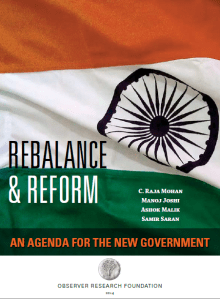
Rebalance and Reform Pic

Books / Papers, Columns/Op-Eds, In the News, Politics / Globalisation

Rebalance & Reform : An Agenda for The New Government

Image
Columns/Op-Eds, Water / Climate

Calibrating India’s Climate-Change Response

Original link is here

SP

A street in New Delhi, India with crisscrossing power lines shows one of the dilemmas facing the Indian government in its struggle to provide reliable electricity.
(Stanley Foundation/Amy Bakke)


India and other developing countries have consistently ­emphasized the notion of equity in the climate-change debate, advocating a “common but differentiated responsibility”—the principle that all states are obligated to address global environmental degradation, but not equally so.

This approach, however, is fast reaching its structural limitation since a number of countries, including some in the G-77 and the Alliance of Small Island States, are indulging Western lobbies that seek to dilute it and have already hinted at accepting a compromise.

Without the full support of developing countries including China, which is clearly distancing itself from the G-77 narrative, India will shortly find itself isolated without enough political weight to continue pushing for the common-­but-differentiated approach. It has to rethink its equity-centric narrative without risking being politically outmaneuvered in multilateral discussions.

The narrative will need to be both progressive and inclusive, with a focus on accommodating fundamental realities in the implementation framework of the United Nations Framework Convention on Climate Change (UNFCCC), such as the fast rates of urbanization in the developing world, which will inevitably lead to changes in consumption and production patterns.

India should adopt a fresh approach to better align its domestic and multilateral commitments before 2015, when a large part of the world negotiates a global response to climate change under the auspices of the UNFCCC. Careful calibration by India’s new government, which was elected in May 2014, requires a series of actions: the articulation of a viable normative framework within which to place its climate-change response, the provision of modern commercial energy, enabling efficiency gains in large companies through market mechanisms, and investment in adaptation.

LOW-HANGING FRUIT
Despite a sustained thrust for energy access by previous Indian governments, elaborate planning has unraveled through poor implementation. Around 300 million Indians still do not have access to electricity, and millions more merely have notional access. While the electrification of a number of new areas has proceeded, the quality of electricity—essentially the number of hours in a day that grid power is available—remains highly variable. Moreover, the new government has to enable an energy transition not just to cater to the nominal needs of so-called light-bulb electrification, but also to enhance industrial competitiveness. For this, it will need to relentlessly pursue all viable energy options.

Although India’s energy basket is coal dominated, India does not produce enough of the material to sustain domestic consumption, and even if its development can be accelerated, domestic coal consumption will peak in a couple of decades. In the years ahead, coal imports will add a new degree of fragility to India’s fiscal stability. Even as the government renews attempts to overhaul the coal sector, development of natural gas supply chains—new port infrastructure for liquefied gas as well as pipelines connected to massive gas fields in nearby regions such as West and Central Asia—offers an unparalleled opportunity to scale up power generation. Additionally, unlocking domestic gas potential will also need some bold political leadership as it involves creating market-based pricing mechanisms to attract domestic and foreign investment. Indeed, gas has the potential to become India’s bridge fuel until other alternative energy sources can be mainstreamed.

While gas presents an opportunity for the medium term, reaping the low-hanging fruit must be an immediate priority of the new government. Creating the right market conditions can enable efficiency gains in large companies. Simply through demand-side management, energy consumption in the industrial sector can see efficiency improvements of up to 25 percent. Moreover, greater operational efficiency has virtually unlimited potential. Substantial energy savings are possible if financial-incentive mechanisms that employ market forces and reward such efficiency gains are promoted. Templates for such financial instruments already exist, such as the Bombay Stock Exchange’s GREENEX index, which tracks energy-efficiency performance of listed stocks. There is great equity in ensuring that the big corporations in India achieve energy and resource efficiency levels consistent with global best practices. It will also bolster India’s global position as it seeks equity while engaging with the richer and more-developed countries.

Perhaps the most critical area for India’s response to climate change must be adaptation. It needs to invest in actions against the imminent threats posed by climate change irrespective of how the global discourse progresses. Investments must be made through innovative channels, using a mixture of capacity-building programs, awareness campaigns, traditional solutions, and new technologies. A good example of an appropriate adaptation response would be to look at areas such as the financial engineering of insurance products to protect farmers from erratic weather patterns.

TOWARD 2015
It is already clear that the new government is likely to rely on sustained economic growth as the primary instrument for responding and adapting to climate change. This, of course, has its own set of implications for India’s emissions, which are likely to increase before stabilizing in the long term. The twin objective for the government in New Delhi must be to peak India’s emissions as quickly as possible and to keep the peaking emissions as low as possible.

Therefore, at home, India will largely need to focus on rapidly building up generation capacity, using efficient coal-mining and combustion processes, exploiting opportunities that natural gas offers, and investing in green technologies and efficiency gains. At the global level, India must ensure that the 2015 negotiations do not impede its ability to offer a better life to its people or make the cost of the provision of lifeline services too steep. Both agendas must be pursued simultaneously.

Samir Saran is a senior fellow and vice president at the Observer Research Foundation. He has diverse experience in the Indian private sector and was actively engaged with regulators and policymakers during the 1990s as India undertook economic reforms. Saran held various senior positions at Reliance Industries, India’s largest business conglomerate. An electrical engineer by training, he has a master’s degree from the London School of Economics and Political Science and has been a fellow at the University of Cambridge.

Standard
Columns/Op-Eds, Non-Traditional Security, Politics / Globalisation

Knowing India’s nuclear credentials

Original link is here

SSAIM

The HinduThe civil nuclear deal, hinged on one clear principle that India’s military programme would irrevocably be separated from the civilian one, was based on arriving at an outcome that would benefit all parties and enhance the global order. Picture shows the Jaitapur nuclear power project site. Photo: Vivek Bendre


Manufactured Western outrage ignores the reality that under the landmark 2005 India-U.S. agreement, the IAEA has unprecedented access to Indian nuclear facilities

There has been a concerted attack on India from the usual suspects in recent days even as it was entering into negotiations to formally accede to the Nuclear Suppliers Group. As if on cue, Jane’s Intelligence Review carried out a “(non)-exposé” of an Indian military nuclear facility in Karnataka. As exposés go, it was lame even by Jane’s standards. The nature of the facility and location have been publicly available since 2010. Yet, this new “exposé” was carried by all mainstream print news outlets and predictably sensationalised with everyone feigning alarm and anxiety. This manufactured outrage culminated with a sanctimonious editorial in The New York Times that was remarkable for the sheer incoherence of its own arguments. As the designated chief of the non-proliferation ayatollahs (with blinkers) and representative of a motley anti-India group in the U.S. that is shrinking ever so rapidly, this too was on expected lines.

Assault on credentials

Nevertheless, it is important to dismantle the uneasy arguments of this concerted assault on India’s credentials. The first proposition that must be taken issue with is the propagation of a falsehood that Pakistan and its reckless build-up of nuclear stockpile is somehow driven by India’s posture. While Pakistan’s careless impulse may be a result of more than one central factor, it is important to understand that this may have a lot to do with its suspicion of American intentions. The oft-quoted argument is that Pakistan seeks to equalise the conventional mismatch with India through a misguided reliance on numbers of strategic and tactical warheads. The irrationality and illogic of this behaviour has been proven by the fact that a country like North Korea has deterred both the U.S. and South Korea with explosions that may not even have been nuclear. Pakistan’s vertical proliferation has no mooring to India’s strategic programme — only to its own paranoia. The question is what fuels this? There is no denying the fact that Pakistan was able to obtain “nuclear immunity” for its sub-conventional activities against India with even 10 warheads. It may well be the fear of the U.S. that motivates its build-up today.


New Delhi is already providing support to FMCT negotiation; its signature on the CTBT is linked to similar commitments by the U.S. and China”


One motivator is the pressure the U.S. has been applying on Pakistan (without success due to the China factor) to sign onto the Fissile Material Cut-off Treaty (FMCT), which will forever cap the Pakistani arsenal. Contrary to what the commentary would have us believe, the FMCT, instead of curbing fissile material, has demonstrably accelerated Pakistan’s programme. So much for flawed logic. The second is the fear of the American “Plan B”, which involves the seizure and confiscation of much of Pakistan’s nuclear arsenal. The former has driven Pakistan to enrich their extant stockpile of radioactive material to weapons grade at breakneck speed. The latter has ensured that Pakistan is rapidly weaponising its fissile stock, in order to disperse and complicate any such weapons seizure plans. These facts are well understood in Washington policy circles. The exposés and op-eds of the past weeks are for most just another edition of Aesop’s fables.

The second issue has to be the demonstrated lack of understanding of the reality that shaped the landmark civil nuclear agreement between the U.S. and India. This nuclear deal was based on one clear principle — that India’s military programme would irrevocably be separated from the civilian programme. This was not an optimal solution for India or for the P5, but like all international agreements it was based on arriving at an outcome that would benefit all parties and enhance the global order. International Atomic Energy Agency (IAEA) Director General Mohammed El Baradei in an op-ed in the Washington Post, specifically welcomed the deal without reservation, his rationale being “either we begin finding creative, outside-the-box solutions or the international nuclear safeguards regime will become obsolete.” This is now accepted wisdom. The IAEA has gained unprecedented access to India’s nuclear facilities. India has accepted additional protocols this June, and has strengthened its own export laws. Significantly, the same journals and reports confirm that India’s own arsenal has remained stable over the period with no increases despite the turbulence in the neighbourhood. The benefits of bringing India inside the ‘non-proliferation tent’ are therefore vast, visible and tangible.

While these editorials and reports may very well have got their facts and numbers right, the analysis is so convoluted that the facts they quote cease to be relevant. The argument goes that India needs to sign the FMCT, the CTBT, and agree to mutual weapons reduction with China and Pakistan, since it is the nuclear deal with the U.S. that has set the cat amongst the pigeons. Here then is some measure of reality. India is already providing active support to the FMCT negotiations — it is a work in progress, not yet a concrete treaty. It has been Pakistan that has been blocking the work at the conference on disarmaments negotiations.

Additionally, India’s signature on the CTBT is explicitly linked to a similar U.S. and Chinese commitment. As long as they do not ratify these two treaties, India has a voluntary unilateral moratorium on testing. What is holding up Indian accession is U.S. and Chinese accession.

Experts in Beijing claim that China’s expansion and modernisation of its nuclear forces is being driven by the ill-advised and deeply destabilising withdrawal of the U.S. from the Anti-Ballistic Missile (ABM) treaty. This has nothing whatsoever to do with India.

India, therefore, is first being made the whipping boy for the failure of the American non-proliferation lobby in their own country and then it has to accept blame for the complex relations the U.S. shares with Pakistan and China that is driving these Asian allies to increase their arsenals. Can we get real, please?

(Samir Saran is vice-president and Abhijit Iyer-Mitra is programme coordinator at the Observer Research Foundation.)


Standard
BRICS, Columns/Op-Eds, In the News, Politics / Globalisation

First Xi-Modi meeting finds common ground

Global Times | July 20, 2014 19:33

Original Link

When India and China meet, the world watches” were the words Chinese President Xi Jinping used to capture the interest generated by his first meeting with India’s new Prime Minister Narendra Modi.

Whether the world was watching or not, the public in both countries keenly followed the first interaction between the two Asian leaders on the sidelines of the BRICS summit in the Brazilian town of Fortaleza.

The meeting passed the initial hurdle of establishing camaraderie between the two leaders. The images and videos that have found their way across the news and social media portrayed a favorable body language and easy chemistry. That the meeting, slated for 40 minutes, lasted nearly twice as long also signals the importance both leaders attached to this engagement.

The meeting can be captured in two words: pragmatic optimism.

That Modi chose to address the contentious border issue in his very first meeting demonstrated a sense of political realism. The Indian leader understood that such a vital element of the partnership cannot be swept under the carpet, even as the BRICS summit itself was gearing up to announce some very positive outcomes.

That Xi also chose to underscore the need for finding an early solution demonstrates their acknowledgement of the negative implications of this lingering border dispute on the larger relationship.

Both countries surely realize that any further economic integration will inevitably hit the political wall if an early solution to this legacy dispute is not discovered.

While it may seem an onerous task, a degree of progress has already been made.

During the previous decade, a great deal of effort has been invested by the empowered special representatives to discover a mutually acceptable and creative solution. In fact, those in the know suggest that it is not impossible to finalize a settlement. What was lacking was the political leadership capable of implementing the same.

With two strong leaders, there exists a golden opportunity to move beyond the border defense cooperation agreement signed last year to one that is conclusive and sustainable.

However, the serious nature of the conversations around the border issue did not deter the two strong leaders from making a strong and optimistic case for deeper economic cooperation and coordination.

The leaders discussed an enhanced role for China in the Indian economic story. The new Indian leadership seems ready to invite large Chinese investments in industrial parks, infrastructure and other key sectors of the economy. At the same time, India seeks reciprocity from China by allowing more efficient and larger market access to Indian goods and services.

Both of these measures would help balance the current large trade deficit in favor of China.

The convergence in the positions of the two countries on most global economic and political governance issues helped the BRICS arrive at an acceptable framework for the new development bank and contingent reserve arrangement. This growing proximity was specifically established when Xi invited India to the APEC summit later this year.

These are early days for Xi and Modi. There are plenty of hurdles that will need to be managed. There is a whole universe of professional naysayers on both sides and in other parts of the world that will exploit negative developments.

Both leaders will have to carry along their security and strategic establishments with them; not the easiest groups to handle. They also have to manage and guide the public mood in favor of more robust ties with each other.

The recent interaction emphasized people-to-people relations and tourism, and perhaps that is one of the ways to do this.

But the crucial factor that can help transform this bilateral is Modi himself. For the first time, the Chinese will interact with an Indian leader who can be politically strong in safeguarding India’s sovereign interests, while at the same time being very welcoming in embracing China economically.

The author is vice president and senior fellow with Observer Research Foundation in Delhi. opinion@globaltimes.com.cn


Standard
BRICS, Columns/Op-Eds, In the News, Politics / Globalisation

BRICS needs doses of steroids to prosper

Original link is here

By Samir Saran & Vivan Sharan Source:Global Times
BRICS.jpeg

Illustration: Liu Rui/GT

The political leaders of BRICS member countries are facing pivotal national moments.

Brazilian President Dilma Rousseff is simultaneously navigating her socialist and internationalist moment, after a face-off with the Americans on the NSA spying saga. She has reasserted Brazil’s propositional role in the global order by hosting the ambitious NETmundial – Global Multistakeholder Meeting on the Future of Internet Governance.

Russian President Vladimir Putin’s European misadventures have gotten him embroiled in a controversial international debate on sovereignty, while his country’s economy struggles to overcome structural flaws.

On the back of a decisive popular mandate, the new Indian Prime Minister Narendra Modi faces tough regional challenges, even as he tries to revive industrial output and create jobs.

Chinese President Xi Jinping is in charge of an administration which has courted altercations on various fronts while in search of a new and sustainable model for economic growth.

And recently re-elected South African President Jacob Zuma has to contend with both a weak political mandate and rising socioeconomic inequity, while attempting to reconcile differences with African neighbors.

Each of the BRICS leaders is faced with significant challenges. How useful will coordination and cooperation at the BRICS platform be for each of them? The BRICS platform itself will first need doses of steroids if it is to remain viable.

This past year has been quite unsettling for those interested and invested in BRICS. Economic growth of the member countries has been below par. The external economic environment has not been favorable either.

The promise of BRICS is based on new economic and political opportunities. The group is lean and lithe by design and therefore has the right ingredients to make for a 21st century cooperation and coordination platform. Both these characteristics were on display when the group met in India in 2012, where a number of forward-looking economic and political decisions were made. However, neither critical decision-making nor effective implementation has been on display over the last year. Relating to this, there are five concerns that must be addressed at this year’s BRICS summit.

First of all, the focus of the previous summit was clearly on African issues. The eThekwini Declaration in 2013 focuses on unlocking Africa’s potential, regional integration for Africa’s growth and the New Partnership for Africa’s Development. With the continued moderation of growth rates, the grouping must prioritize domestic economic imperatives and close commercial ties rather than narrowly focus on a single region or use the platform for regional grandstanding.

The second concern follows directly from the first. BRICS members have large stakes in the international system and share the common aspiration of becoming global agenda-setters. Indeed, they must not continue to be passive recipients of rules and standards in vital areas such as global trade and investment.

Third, the new areas of cooperation listed in last year’s declaration outlining areas for immediate collaboration are strikingly vague. As a result of myopic drafting, a rather counter-productive role reversal has taken place. The interactions between non-government stakeholders have started to lag behind inter-governmental interactions.

Governments have limited vocabulary and dynamism compared with the private sector and civil society and intra-BRICS cooperation must be unfettered and creative. An example is the BRICS Exchange Alliance, a market-led initiative to integrate financial trading platforms. Such concrete efforts must be replicated rather than endlessly expand the list of issues to cooperate on for the sake of seeming ambitious.

The fourth concern relates to the veritable silence on BRICS engagements in the world media following the high-profile summit last year. Perception-building must take greater precedence at this summit. This must be aided by the timely dissemination of information on actions such as the setting up of the Contingency Reserve Fund and a BRICS-led development bank.

And finally, perhaps the most critical issue for the five BRICS leaders, who will meet at the sunny shores of Fortaleza, will be practical goal-setting. This will be an exercise in planning and coordination to maintain continuity as well as honing in on objectives for the long term. If there is an opportunity to be seized in cross-leveraging political and economic ties, it will be in the coming years.

Samir Saran is a vice president and Vivan Sharan is an associate fellow at Observer Research Foundation, Delhi. opinion@globaltimes.com.cn

Standard
BRICS, Columns/Op-Eds, In the News, Politics / Globalisation

BRICS of a new world

Opinion, July 12, 2014

Original link is here

Pic 1

BRICS must mitigate the systemic risks posed by imbalances in the global economic system, perpetuated by Western central banks. (Source: Reuters photo)


The Fortaleza summit should address the undermining of the multilateral trading system.

Prime Minister Narendra Modi’s first major foreign visit, to the BRICS summit in Fortaleza, Brazil, is in the news for a variety of reasons. But there is little discussion on what is at stake and the possible takeaways for BRICS, and particularly India.

This is a crucial moment for the world, faced with a central European face-off, the long tail of the financial crisis, trouble in the western Pacific, a stalemate on trade and environment, new contests in cyberspace and outer space and a new irrationality in the Middle East. BRICS, particularly India, are vulnerable to downward spirals in any of these areas. India must seek to first protect and then promote its interests at this platform. The new prime minister is the right man for this task and there are five key areas he must navigate.

The first is the big-ticket BRICS-led development bank, proposed at the New Delhi summit in 2012. While China has clear ambitions, a worse outcome would be to allow the creation of a Chinese version of the Asian Development Bank. The new bank must follow a one-country-one-vote formula, and allow other states and institutions to invest capital in return for a minority controlling stake and returns commensurate to their investments. BRICS members must walk the talk on the “equity and fairness” they seek from the West. By allowing each BRICS country equal weight in ownership of the bank, they would demonstrably craft a model for other IFIs to emulate.

The second area is global trade and investment. Through the proposed Transatlantic Trade and Investment Partnership (TTIP) and the Trans-Pacific Partnership (TPP), developed economies are seeking to redirect trade and investment flows. They will do so by instituting new rules, standards and tariffs, and by gradually dismantling the multilateral system (WTO) that India and others believe to be essential. BRICS must seek to counter the negative externalities from such mega free trade arrangements (FTAs). While it is expected that BRICS will announce export guarantees and agreements on innovation and banking, the members must also commission academic assessments of the impact of imminent mega FTAs and coping strategies.

Third, BRICS must mitigate the systemic risks posed by the imbalances in the global economic system, perpetuated by the central banks of advanced economies. BRICS leaders are expected to launch a foreign exchange reserve fund of $100 billion as a hedging mechanism. This will resemble the Chiang Mai Initiative, put in place by Asean+3 after the Asian financial crisis of the late 1990s. It is essentially a pooling arrangement, with China contributing $41 billion, Brazil, Russia and India $18 billion, and South Africa $5 billion. Indeed, Modi would do well to suggest that BRICS take a principled position on recent policy decisions by Western central banks, already suspected to be fuelling new asset class bubbles.

Fourth, over the years, political content in the outcome statement has increased dramatically. BRICS states will need to discover common approaches on political developments in different regions. In particular, the stability of southwest Asia is critical to India, and as the US withdraws from Afghanistan, there is bound to be a jostle for political capital. Can BRICS catalyse the RIC (Russia, India and China) into discovering a basis for meaningful cooperation in the region? Here, the bilateral meetings on the sidelines will be vital. Similarly, Russian expectations on collective support for its position on Ukraine will need to be delicately managed.

The fifth area pertains to cyber governance and cybersecurity. There are clear differences in the positions of BRICS members. Russia has passed a bill requiring all technology companies to store personal user data on domestic servers. This closely mirrors developments in China that ensure local data storage and government control. Meanwhile, the Brazilians, who hosted the “Net Mundial”, have positioned themselves alongside the US and EU, favouring a multi-stakeholder framework. India sees a greater “state” role as it seeks to connect its “next billion” to the internet. There is an opportunity to recognise these cleavages, and develop a calibrated approach for discovering common digital ground. That each BRICS member has either the US or EU as its most important economic partner in the digital world may help.

The Fortaleza summit will represent the reboot of BRICS. This is a different world altogether, with the Brazilians seemingly reasserting a “Lulaesque” style of external engagement, the Russians defiant and petulant at the same time, the Chinese testing the geographical limits of their economic and political ambitions, and the South Africans seemingly wedded to their regional aspirations. Prime Minister Modi has the biggest political mandate among his BRICS counterparts, and also the weight of the largest expectations.

The writer is vice president, Observer Research Foundation. Views are personal

Standard
Columns/Op-Eds, In the News, Politics / Globalisation

The #NaMo wave has yet to translate into effective governance

Original link is here

Published: 22:50 GMT, 30 June 2014, MailOnline India, Mail Today

Author and eminent scholar Dan Hahn described successful political communication as something where “some will be attracted to what is said, to the position taken by the orator. Others will be impressed by the orator’s crafting of the speech – the organisation, the word choice, or the how the language is combined.”

He might as well have been describing the #NaMo campaign, where the combination of a message of hope, soft ideology and communication craftsmanship has attracted a substantial number of voters within and outside BJP’s traditional vote bank.

Assessment

The new Indian PM ran an efficient and professional campaign that was arguably even more innovative than the first Obama campaign.

Pic 1
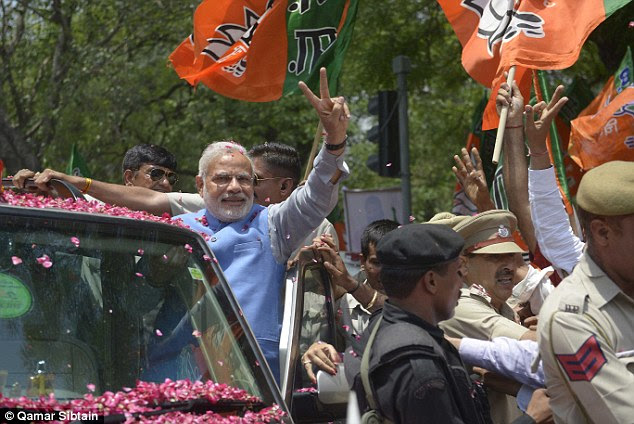
Moving forward: Prime Minister Narendra Modi (left) invited his Pakistani counterpart Nawaz Sharif (right) to his swearing-in ceremony, a move which characterised the forward thinking nature of his election campaign. The momentum has yet to translate into major institutional changes
_____________________________________________________________________________________________________________

However, the million-dollar question is whether PM Modi will be able to institutionalise this communication expertise into a durable feature of his time in office, or if he will struggle, as President Obama has in recent years, to communicate his initiatives and vision to large parts of the citizenry.

The first 30 days offer us a moment to reflect on the communication performance of the PM. It is a mixed bag.
……………………………………………………………………………………………..

More…
R Prasad on… No Modi honeymoon
RAISINA TATTLE: Good news for the Gandhis
The Gopal fiasco was a failure by the Supreme Court, the PM and the President
…………………………………………………………………………………………………

On the upside, we have witnessed deft public positioning, like the invitation extended to South Asian neighbours during his swearing-in ceremony or his visit to Bhutan – each appreciated as significant gestures and adding to his image as a progressive leader.

We have seen the institutionalisation of social media by the Modi Cabinet to reach out to citizens. And we now have #NaMo on twitter in person and in his official persona.

Yet, something is amiss. The PM’s persuasive presence during his campaign is now reduced to clinical digital chatter.

The message, therefore, is incomplete and sometimes unclear. Other voices, some of dissent (rail price hike) and other incongruent, from within and outside his party are muddying the waters very early into his term in office.

The communication code that he had cracked seems to have been misplaced and it is apparent that the campaign team that ably communicated PM aspirant Modi’s vision to many, is either avoiding the Delhi summers or is distracted.

During the election, candidate Modi was ahead of the curve. He was proactive and anticipated issues; he sidestepped curve balls and revelled in responding to provocations.

After the elections, PM Modi has been playing catch up, been largely reactive, and has failed to anticipate imminent challenges.

Vision

Modi has prided himself in being able to empower and use the bureaucracy in Gujarat, and now he hopes to do the same in Delhi.

However, is his communication also going to be defined by the not-so-creative Delhi Durbar? Will slow-moving bureaucratic systems do justice to a man known for his glib oratory skills and deft communication?

Let’s take the swearing-in ceremony as a case in point.

The soon-to-be Indian PM invited Nawaz Sharif and other SAARC leaders (and Mauritius) for his swearing-in ceremony. It was a grand spectacle that did create excitement and was largely appreciated, and yet one was left with a hollow feeling the day after.

Pic 2

Groundbreaking: The new Indian PM ran an efficient and professional campaign that was arguably even more innovative than the first Obama campaign
________________________________________________________________________________________________________________

We got to know what the MEA felt about it – its official statement offered standard, cut and dry and politically correct fare.

We know what every Pakistan watcher and self-styled foreign policy expert on television and on the op-ed pages thinks about it. But we still do not know what PM Modi thinks about it.

What is this big-picture neighbourhood philosophy that he seems to be crafting? Or is there one? It was his show all the way, and his views and vision are still missing.

More recently, when the rapes and murders took place in Badaun and when the Muslim youth was killed in Pune, a calibrated communication response was required.

While there may have been no need for the PM to react himself, a statement from the Home Minister, showing concern, would have helped assuage the shrill response by civil society and the media.

The government was absent on this count.

PM Modi must realise that his victory is his to own alone, and so is all that goes wrong.

Revitalise

Silence is golden, but there is such a thing as too much silence. These are early days and PM Modi is not really affected. Yet, a crisis could unfold at any point. That is the nature of government, and systems must be in place.

Modi has always faced a hostile media. This has not changed since his election. The honeymoon period may be shorter than anticipated and questions will be asked, and the din will get louder each week.

During the election campaign, his masterstroke was bypassing media and engaging directly with people. He needs to do this while being in office as well.

It will help to explain the big but potentially controversial policies he wants to pursue.

Of course, he can’t do it every week or every day as he did during the campaign.As such he will need to think of a routine, and of a creative mechanism to manage public expectations and the media.

The PRO cannot remain out of bounds for the media, not for the media’s sake but for the sake of the PM and for the policy line he wishes to perpetuate and guard.

Pic 3
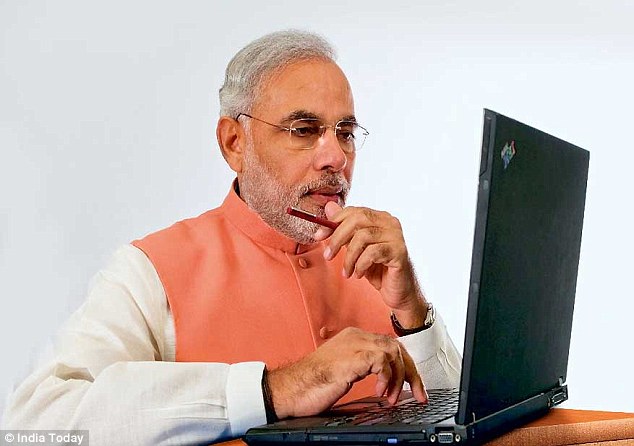
In power: The PM’s persuasive presence during his campaign is now reduced to clinical digital chatter
_________________________________________________________________________________________________________

This is how governments work everywhere. Twitter and other social media platforms are excellent communication tools and the PM has mastered their political potency faster than most Indian politicians.

In government, he needs to build a platform that combines social media with more traditional communications mechanisms.

He needs to disrupt the lethargy of the Lutyens communication machinery by introducing some of his young campaign team into the mix, and he needs to reinvent and revitalise #NaMo in his new role as PM.

It was #NaMo that got him here.

The writer is Vice-President and Senior Fellow at the Observer Research Foundation

Standard
Columns/Op-Eds, In the News, Politics / Globalisation

Modi must re-establish the power of the Executive at the Centre

PUBLISHED: 21:46 GMT, 4 June 2014, Mail Online India, Mail Today

Original Link is here

article-2648697-1E7918D000000578-35_306x423
Task ahead: Prime Minister will have to clear an economic landscape that has been cluttered with debris from the previous ten years


NaMo 282.0 is in an unenviable position. The astonishing majority he singularly scripted for the BJP and its allies surprised most, including his party and perhaps even himself.

This mandate also disappointed a number of others. The Congress for one must now surely realise that “poverty pornography” and “pseudo-secular” positioning have now reached their sell-by date.

The BJP’s allies will also have seen the writing on the wall – that they will be able to secure a ministerial berth at the centre, but will neither have a veto over the BJP leader nor will their tantrums affect the political trajectory of this government.

And finally, some within the BJP would recognise this mandate as a vote against the factions within the party that were gleefully awaiting a fractured verdict, which would in turn have allowed them some weight over the PM and the PMO.

Reassertion

Nonetheless, this is an unenviable position to be in for the Prime Minister. This huge mandate comes with commensurate expectations.

With little by way of a fail-safe or escape route #NaMo ran the campaign on the promise of better days or “achche din” and that is exactly what most of us will be seeking from him.

The most obvious task before Modi will be to revive India’s growth narrative. This narrative is as central to the millions living in poverty in this country as it is to the entrepreneurial class that is competing with the world.


More…
Technology will help PM Modi achieve many of his objectives and help the BJP govern
RAISINA TATTLE: Rahul visits BJP HQ for Munde


The message to domestic and global audiences has to be both clear and simple; India is back and it is open for business.

To achieve this, the Prime Minister will be required to navigate a complex policy terrain. He will have to clear an economic landscape that has been cluttered with debris from the previous ten years.

And most importantly, he will now have to clear the most important real estate that had been lost to others over the past decade – the policy space of the ‘Executive’.

This real estate, the policy domain of the executive, will need to be reclaimed from a number of encroachers including crony capitalists, regulators, legal institutions, activist groups and the media itself.

A nebulous National Advisory Council that seemed only created to develop unsustainable schemes and undermine the PMO; a revertal to failed “fabian socialist ideology” where profit was pariah and corporates were criminals; a weak central leadership unable to combat and act against corruption; and a central cabinet where every Minister thought of himself or herself as a Prime Minister, resulted in rampant rent-seeking, policy-gaming, and a fragile executive.

#NaMo’s first set of actions will have to be to reassert the primacy of the executive. There are three balancing acts required:

Control

Due to the perverse environment of the past years, citizens and media had goaded, invited and encouraged the intervention of the Judiciary into the policy space.

The institution of last resort became the first port of call for remedying everything that seemed to be going wrong.

Some termed it judicial activism, others commended this decisiveness to protect national interest.

Whatever the description, nature abhors a vacuum and when the executive leadership was weak and feeble, another had to step in.

The new dispensation at the Centre will have to delicately rebalance this role. Instead of deciding the fairness and legality of some of the constitutional challenges of a growing nation, the judiciary has been forced to cross the rubicon and into the policy space reserved for the elected.

#NaMo will have to reverse this trend and make decisions his predecessor could not have, and the judiciary need not have.

His second step would be to limit the power of the new gatekeepers – the regulators. Between 1947 and 1990 India’s economic policy was governed by “License Raj”, which has now transitioned to “Regulator Raj”.

In the financial sector alone, India has at least four different regulators. Policy is now dependent on clearance by bodies originally intended for creating a friendly and/or stable economic condition.

For example, the mandate of the Comptroller and Auditor General of India (CAG) is to audit the expenditure and receipts of the government and not to dictate how it should be spending or allocating resources.

While interventions may have been necessary when an emboldened cabinet was free to make decisions, without a strong executive chaperone, the role of the regulator now must return to the original mandate.

We have reached the ridiculous stage when a regulator will soon decide which fighter jet India should procure and at what price.

The accountant must be consigned to the accounts book.

Recalibration

Finally, #NaMo will also have to wrestle policy decisions out of the hands of the media panels at primetime.

Less than 10% per cent of homes with TV sets, watch news and less than ten per cent of those homes watch English news.

Yet, anchors and media personalities claim to speak for the nation. With the previous dispensation these media maharajas could sway government decisions – forcing the discarding of an ordinance for instance and they could challenge executive decisions, including mundane transfers and postings.


article-2648697-1E71044500000578-425_634x446

The PM’s mandate comes with a long list of development expectations


Babus of all ranks leaked files to the media, disgruntled elements used the media to create controversy and soon the primetime panel was the ‘durbar’ of choice to undermine, scuttle and challenge executive decisions.


This role of recalibration of the media may be the toughest of tasks for the new executive. But the Prime Minister has the mandate.


He also has the experience of managing many of these institutions while he was Chief Minister of Gujarat. And if he can reignite the economy he will also have the authority to wrestle back the executive space.


The writer is senior fellow and vice president at the Observer Research Foundation


Standard