BRICS, Columns/Op-Eds

Article in “Russia & India Report”: BRICS and eurozone crisis


by Samir Saran and Vivan Sharan
November 2nd, 2011
Please find here the original article

The rise of the BRICS nations as new epicentres of economic activity in the rapidly evolving world order has been simultaneously accompanied by a steady decline in the relative economic strength of many of the member countries of the eurozone.

The single currency union has become essentially a two-faced beast. A North–South divide in economic fortunes is clearly visible within Europe (and the irony of this is probably lost on most Europeans). It is time for the leaders of this grouping to recognise the fact that the major rebalancing and recalibrating actions that are urgently needed within the economic and monetary union must also address the concerns of external creditor nations such as those within the BRICS grouping.

After much introspection and procrastination, the European leaders managed to pass a controversial but necessary deal on Greek debt. The deal, which calls for a “voluntary” cut on a nominal 50 percent of private sector investments of over 450 financial firms to reduce total debt burden in the economy by 100 billion euros, is a desperate attempt by policymakers to stymie the relentless bouts of selling pressures on Greek debt.  Although given the circumstances, it was extremely important for the eurozone to signal some form of cohesive multi-stakeholder action to the financial markets, the deal is built upon ambiguous foundations.

The private sector has voluntarily decided to take these ‘haircuts’ and at the same time banks have agreed to increase capital reserves to 9% to shield against an imminent market collapse in Greece. This translates into tremendous pressures on banking institutions, without much positive effect on the bond markets, with Greek bonds still yielding unprecedented rates of interest. It is clear that the projected reduction of Greek debt to GDP ratio from 160% now to 120% in 2020 is not impressing bond traders.

The European leaders have announced that they seek to increase the size of the European Financial Stability Fund (EFSF) from its current capacity of 440 billion euros to over a trillion euros.  It is not clear how they intend to do this, and whether a trillion euros (approx.) is the amount they consider to be sufficient to counter the effects of possible contagious sovereign debt defaults and banking crises in member countries. While these leaders attempt to keep kicking the can down the road with respect to how they manage the myriad financial crises that are evolving in southern Europe, it has become increasingly clear that the problem is too big to be handled without outside help.

The Chief Financial Officer of the EFSF recently told a Brazilian newspaper that his colleagues are “pleased” to see BRICS countries starting to invest in the EFSF. The composition of the investments into the EFSF is not public, and therefore there is no real way of knowing how much each of the BRICS nations have contributed to the fund so far. The EFSF was originally set up to raise money for the Portuguese and Irish bailout packages through the disbursal of loans. Although the Fund has nearly risk-free credit ratings by all the major rating agencies (AAA by Standards and Poor’s and Fitch, and Aaa by Moody’s), it can be argued that investing in Greece’s sovereign debt is a far riskier proposition for creditors to the Fund.

Many of the BRICS nations are already heavily invested in the euro. The central banks of China and India hold approximately 25% and 20% in eurozone bonds respectively and are therefore not likely to spend much more of their international reserves buying into a now suspect currency. However, much like Brazil, which is allegedly considering investing into euro debt via its Sovereign Wealth Fund (which allows greater risk taking) rather than purchasing debt through its international reserves, the economies of China, India and Russia could soon follow suit.

Given the volumes of trade between the euro zone members and each of the aforementioned nations (China surpassed the U.S as E.U’s largest trade partner in July) along with hefty direct investment flowing both ways, it is certainly not in the interest of any of the stakeholders – to let the euro collapse. The involvement of countries like China, with immense amounts of liquidity, does not fail to inspire market confidence as was seen last year in July, when China announced that it would purchase a billion euros in Spanish debt. The bond auction was oversubscribed and lead to a turnaround in market confidence in Spanish debt even though China only committed 400 million euros.

Keeping in mind their leveraged bargaining position in current circumstances, the BRICS nations should coordinate their positions and assert themselves while negotiating investments in eurozone debt. Although the BRICS nations have a diverse set of agendas and priorities, it is not hard to see a future where there is greater coordination within the nations in the grouping, especially between geographical neighbours Russia, China and India, in order to deepen global financial integration and reverse the Western narratives that have dominated the larger economic realm for the past century.

At the Sanya BRICS summit in April, the leaders put on record that the “international financial crisis has exposed the inadequacies and deficiencies of the existing monetary and financial system” and that the BRICS nations support “the reform and improvement” of this system. In order to support the troubled European economies, the BRICS countries need to devise a formal set of pre-conditions for granting bilateral loans and investing in various bailout funds. Perhaps these could be centred on some basic premises such as further trade liberalization, increased access to intellectual property and perhaps they can even be self-righteous enough to demand more friendly immigration laws.

The Europeans will no doubt be faced with some hard choices. They have to be careful to juggle two contradictory imperatives – that of enlarging existing regulatory capacities in order to strengthen and deepen European fiscal, monetary and political integration, while at the same time accepting the inevitable growing interdependence with external nations.

If the evolving debt crisis in the eurozone is viewed through a deterministic prism, it becomes immediately apparent that panaceas such as debt write downs only offer short term relief to the markets as long as structural imbalances persist. In light of this, the Europeans will be hard pressed to look for a multipronged approach to dealing with the existing problems of their southern peripheral nations.

The glory days of Western credit and forced fiscal reforms in Asia and other ‘south’ countries are far behind us, with hegemonic Bretton Woods era relics such as the International Monetary Fund struggling to find its ‘traditional’ relevance within the new political and economic realities. Although it is in no way certain that the balance of power will completely shift towards the emerging or recently emerged nations such as those in the BRICS, as they are grappling with internal problems of their own, one can be relatively certain that the growing degrees of independence – both from Western policies and from Western demand —  will provide the perfect platform for increasing economic leverage through investments in equity and debt as well as direct investments. Europe has few options left but to align economic expectations with those of the BRICS. The question that still looms large is whether there is enough political unity and substance in the grouping (BRICS and other emerging nations) to make the right kind of bargains.

Standard
BRICS, Columns/Op-Eds

Samir writes in Russia & India Report on ‘Evolving an Asian Trading Region’

September 26, 2011.
by Samir Saran and Nandan Unnikrishnan. Both are Vice President(s) at the Observer Research Foundation, New Delhi.
Find here the original article.

It’s time economics replaced politics as the key driving force of the Russia-China-India (RIC) trilateral. The Big 3 of Asia has a major opportunity to create and drive an Asian Trading Region.

At a recent interaction in Moscow with scholars and editors, there was an interesting discussion on finding ways to significantly increase the economic interaction between Russia and India and, more specifically, change the nature of the G2G-driven bilateral trade. Our suggestion was spontaneous and to some outlandish. We suggested that for a paradigm shift in our trade volumes (less than $ 10 bn dollars currently) the two countries would need to work for an Asian Trading Region shaped and steered by Russia, India and China. Until then we (Russia and India) would remain prisoners of perceptions and perceived geographical distance.

It was apparent that this idea did not resonate well with many experts in the room. However, it did spark an interesting round of debate and many have subsequently written in with their own ideas on a trading zone or region in Asia. We still argue that the only sensible architecture would need to be fundamentally driven by and emerge out of the RIC arrangement. Even though the RIC was conceptualized as a club of the Big 3 in Asia and had more political overtones than economic reality, the vocabulary of cooperation emanating from previous RIC forum allows enough leeway to work towards the formation of an Asian Economic Zone beginning with an Asian Trading Region largely driven by Russia, India and China.

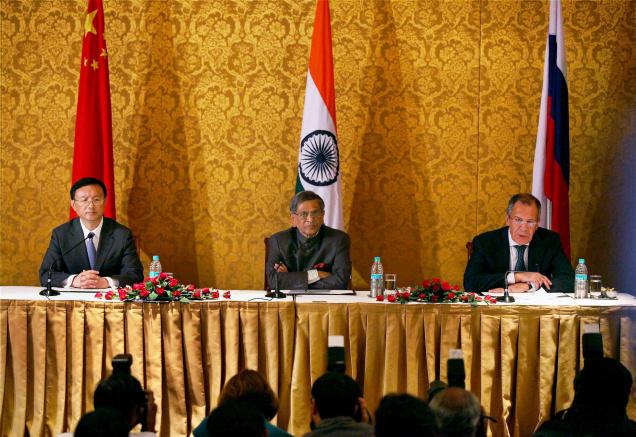
The then Russian Prime Minister Evgeny Primakov first voiced the idea of a Russia-India-China (RIC) Trilateral Forum publicly in December 1998 during a trip to India.The motivation was generally believed to be a desire to create a countervailing influence to the US, which at the time had unprecedented dominance in the international system. The fact that Russia, India and China saw the US as their primary interlocutor at the bilateral level did not appear to be an impediment at the time. However, despite regular Track II interactions between the three countries, it took four years for the first official interaction between the three – a meeting between Foreign Ministers on the sidelines of the United Nations General Assembly (UNGA) in 2002. The first RIC standalone meeting of the foreign ministers took place only in June 2005. Thereafter, on the sidelines of the G8 meeting in St Petersburg in July 2006, President Valadimir Putin, President Hu Jintao and Prime Minister Manmohan Singh had a tripartite meeting. From 2007 onwards, the foreign ministers are conducting regular annual meetings.

During this period, the motivations driving the three countries in the RIC underwent a change. If Primakov’s fear in 1998 was a hegemonic U.S., by 2005 Russia was more concerned about China and its possible duopoly with the U.S. – the G2 scenario. Therefore, Russia was keen to support multilateral initiatives, which involved China, but kept the US out. RIC fitted the bill perfectly. China also appeared to be keen on such a formation as it realized its increasing influence and envisioned RIC as a group dominated by China. India’s motivation perhaps was not to upset the Russians. It was also the age of clublateralism and therefore the RIC was an opportunity to get into an influential circle. Some hesitation, if any, was probably because these were the heady days of Indo-U.S. friendship.

Today the situation has changed again. The uni-polar moment of the U.S.A. is evidently over. A multi-polar or polycentric world is emerging. China has emerged as an alternate power centre and no longer requires props like the RIC. It is following an assertive foreign policy that relies more on promoting bilateral relations with the established and emerging powers. Similarly, Russia is now less nervous about the emergence of a G-2. It is enjoying the “reset” in its relations with the US and has become a little more wary about China’s spectacular rise in stature. Moscow, like New Delhi, also realises that its efforts to restructure and modernise its economy will succeed only if it able to convince the West to buy into this effort. While China-India trade is at historic highs (at over $ 60 billion), India is also focusing on developing its ties with the US and the 27-nation European Union. RIC appears stymied by the proliferation of groupings like the SCO, BRIC, and BASIC and does not as yet offer a unique ‘agenda’ to differentiate it. And most importantly, the three countries consider the US much more important than any other bilateral or multilateral relationship. Therefore, the “glue” that held the RIC together is drying up.

This inevitably affects prospects for RIC. The lack of interest and expectation from this format has led to little of any substance emerging from the interactions, despite identifying early on a vast arena for mutual cooperation such as terrorism, drug trafficking, climate change, agriculture, disaster management and relief, health and medicine, information technologies, pharmaceuticals, infrastructure and energy. Given this backdrop, is RIC now irrelevant? Is it time to bury this body? The answer has to be an unequivocal “NO”. So can regional trade and economics be that ‘glue’. Russia and India, through their own recent policy announcements, have recognized the arrival of the yuan as a global currency and it is likely that in the coming months India also decided to denominate some of its reserves in the currency of our Northern neighbour. Russia is already engaged in yuan based trade and maintains a stock of this currency. That over $ 130 billion of trade takes place between India and China, China and Russia and Russia in India also places weight of volume behind the grouping.  Irrespective of political ambitions and differences there is no denying the growth of economic interactions and the only limit to the economic story is politics. Can RIC be the political response to an economic arrangement?

RIC appears to be the only format which can help to create a truly Asian Trading Region, an idea that must be pursued based on the remarkable shift of global trade to within the region. The contiguous land mass, the size of the three economies and the growing levels of consumption, each provide a basis to make this trading region viable and worth investing in. The energy and transport corridors may be the place to start. While China’s rapid advances in the energy landscape in Asia can appear intimidating, it can also be seen as an opportunity to respond to the Chinese dynamism and be a part of the project. Would India consider providing access to the Indian Ocean to China? And through China for Russia? Would this create a dependency that could serve India’s interests? Would it be beneficial to open land and pipeline routes to Central Asia and Russia through China? Would these not create mutual dependencies between the two countries that would offset some of the key imbalances that exist today? India helps de-risk China its current hydrocarbon and trade flows through the Indian Ocean, while China offers alternatives to routes that would require India to traverse Afghanistan and Pakistan. At the opportune time can Russia and China be a part of the IPI and TAPI? Can China extend pipelines from Central Asia and Russia to India? With increased volumes of trade, the pipelines become viable in spite of the distance. The participation of all the three countries in these pan-continent pipelines also reduces the political risk that these large trans-national project invariably face.

The biggest gainer would, however, be Russia. They would have a market for their resources outside of the EU and China. As the demand in West Asia is released in the next 10 years due to growing commercialization of green technologies and production of shale and frontier gas in US and East Europe, Russia would increasingly depend on the growing demand from China and India. Without a cooperative arrangement or transport infrastructure, large volumes of Russian resources may have only one buyer – China.

Russia and China have already established significant cooperation in the area of energy. It is time that India becomes part of this equation and the three countries start the process of developing an Asian Gas Grid. The first steps could be modest. Russia could ship some of its piped gas landing in China through the Chinese eastern board to India, a step both symbolic and political and a harbinger of Asian tri-lateral trade. Over the years it could result in the grid that a former Indian petroleum minister strongly advocated and a gas market in the region that could evolve its own price and commercial dynamics. The next stage could involve jointly owned SEZs in Russia’s Far East with each of the countries within the SEZ enjoying privileges of home country. This could also be the experiment to test the free movement of men, material and ideas across Asia.

Standard
Columns/Op-Eds, Politics / Globalisation

Samir writes on NetIndian: G-20 was promising, but short on substance

India, 2009
Link to original website 

US President Barack Obama came to London with a mission. His primary goal was to ensure the participation of other countries in the US effort to pump money into the globaleconomy. His intentions were announced beforehand during his frequent media interactions. There had also been protests from the EU, led by France and Germany, who had rightly asserted that the institution of robust regulations in the global financial system must precede any further efforts to sustain the old world financial order by injecting funds through bailouts and stimuli. However, in the end Obama had his way, aided to a large extent by the emerging economies led by the Asian giants. While India eagerly supported the Americanline, the Chinese clearly lacked original voice, enmeshed as they are in the ‘Made in America’ mire.

The pre-summit dinner witnessed ‘Obamaspeak’ that was followed by the complementary and supportive remarks of the Indian Prime Minister, a noted economist and a credible voice of the Third World. These initial views seemed omnipresent in the final communiqué that was circulated at the conclusion of the summit. While Dr Manmohan Singh’s suggestions on protectionism, regulation and surveillance, IMF reforms and credit flows were a part of the final G-20 declaration, even he would be the first to admit (as he did at a press conference later), these key aspects formed part of the Rhetoric or future promise, even as the US endeavour to ensure global participation in the bail out efforts and recapitalization of institutions formed the substance of the agreement.

The Committee of 20 has agreed to infuse capital into the IMF without any immediate reform in its constitution and operations. The current $250 billion at the disposal of IMF would be increased by $500 billion. Japan and EU have agreed to provide $100 billion of additional funds while China will contribute $40 billion. The IMF will also increase the amount available to each country by way of Special Drawing Rights (SDR) by $250 billion. This allows distressed economies to literally print additional currency and convert it to tradable notes in extreme circumstances. There is also a suggestion that IMF would deploy more effective surveillance; hopefully implying it will watch the West as closely as it does the developing world. However, in the absence of regulations and regulatory authority it remains to be seen if this surveillance would amount to much. The world was expecting a reform of the IMF to be initiated and an urgent change in its governance; these measures have been relegated to the list of future efforts and promises.

The other major disappointment was the lack of progress in instituting a global financial regulator. As a consolation the G-20 agreed to strengthen the Financial Stability Forum and enlarge its membership to include India, China and Brazil (and have rechristened it as the Financial Stability Board). Though it aspires to serve as a watchdog and advise national regulators on activities of individual companies/organizations, the lack of defined powers will clearly undermine its ability to serve the role of a global regulator that is so urgently needed.

President Obama had unequivocally sought the participation of EU, India and China (read funding from) on the rescue efforts through government bailouts. His intention to get commitments from these countries was thwarted by the French and German governments. British Premier, Gordon Brown, though stitched together a compromise that restated the $ 5 trillion stimulus already announced by countries along with the possibility of further bail-outs in future if needed. Though this aspect was meant to be at the core of any G-20 resolution, it remains unresolved primarily due to the ‘Regulation Versus Stimulus’ divide between the US and continental Europe.

The Indian position has also supported the need for regulation though the conviction of its position will be tested in the days ahead. India needs to integrate with the global financial systems in order to access capital that it urgently needs. It is important that India argue for the early establishment of a supra-regulator so that the global risks to its banks and institutions are minimized.

India and other countries have also agreed to participate in recapitalizing financial institutions on the belief and with the stated intention of reviving global credit flows and have also agreed to jointly agree to the treatment of ‘toxic assets’. In fact  treatment of ‘toxic asset’ in the declaration does not cut any new ground and the responsibility for the same still rests with local governments though a commonality in the mechanics is proposed. One of the great impediments for bank credit is the presence of these bad loans. Unless these bad loans are purged from the balance sheets it remains to be seen if banks could resume regular lending again and this important challenge still remains unaddressed.

President Obama made it clear at a post-summit press conference that his primary mandate is to servethe American citizens and this was evident in the discussion on protectionism and its articulation in the summit agreement. While the wordings have asked countries to desist from protectionist tendencies (trade barriers) till 2010 (12 months), there is skepticism as 17 nations have already breached trade practices since November last, when a similar agreement had been endorsed. The suggestion of this 12 month time-frame itself is suspect. Why should any time-frame be mentioned and why should not all trade at all time respect the WTO arrangements? Wouldn’t this special emphasis on a time period actually encourage countries such as the US to operate outside of the WTO claiming special circumstances? This summit will also strengthen Obama’s hand as he defends his position on the issue of executive salaries and bonuses at home. New rules and best practices agreed to by the G-20 crack down on the multi-million dollar cash bonuses doled out as reward for risky investment and trading calls.

In conclusion it would seem that the while the current crisis may see the end of the ‘Washington Consensus’, the overwhelming dominance of President Obama at the summit underscores that Washington would firmly remain the architect and the driver of the new world order through, and on the other side of, this crisis. The outcome of this summit can be summed up as ‘No Stimulus and No Regulation’ declaration, though with plenty of promises on both fronts.

The author is Vice-President-Development and Outreach at the Observer Research Foundation (ORF) in New Delhi. His area of expertise is Regulation/Policy, Corporate Communications and Media Studies. An electrical engineer by training, Mr Saran is a Masters in Media Studies from the London School of Economics. Frpm 1994 onwards he has had a rich and diverse experience in the Indian private sector and was actively engaged with regulators and policy-makers during the 1990s as India undertook economic reforms. Since October 2008, Mr Saran is developing and implementing the outreach and development programmes at ORF. His current projects are in the domain of “globalisation” and include studies on Islam, Radicalisation, Climate Change and the Global Financial Crisis. He continues to contribute in various fora on regulatory aspects and on the political economy. The views expressed in this article are his own.


Standard
Columns/Op-Eds, Non-Traditional Security, Politics / Globalisation

Column in The Economic Times: When the US dismembered Pakistan, 2009

by Samir Saran
February 27,2009
in: The Economic Times

The formal capitulation of the Pakistani government to the Taliban and the ‘liberation’ of the Swat valley evoked divided responses from within the region and outside. While voices emanating from India are concerned with this dangerous development, the US foreign policy team has predictably hedged its position and has begun testing the ‘Good Taliban-Bad Taliban’ dictum. The division of Pakistan has unfortunately legitimised the rule and role of two institutions in the politics of Pakistan; its religious extremists and its army and can be seen as a consequence of the US engagement with Pakistan post 9/11. To understand this situation and the initial US response, we must deconstruct the ‘war on terror’ policy of the US and analyse one of its key components: the engagement of the US with its ally Gen Pervez Musharraf. This engagement was political as it had the effect of demoralising the democratic presence in Pakistan.

It was also sociological as it redefined the western understanding of Pakistan and altered the space and voice available to the moderates and liberals. This engagement was articulated by the ‘Us vs Them’ foreign policy of the US, a description of the age-old identity discourse between the ‘self’ and the ‘other’. The description of the Muslim as the ‘other’ by the west (‘self’) is an area of historical interest. Much of the discussion establishes the act of describing the Muslims, as a means by which the west (and its media) seeks to define, assimilate and control them and is a result of the urge to create the identity of the ‘other’ through its own interpretative prisms.

This process not only fails to comprehend the ‘other’ in their entirety but diminishes their significance in any engagement. This practice is a political tool that has been consistently deployed in the past. The ‘secular wars’ or colonising endeavours of the western world were represented as a ‘solemn duty’, and as a British parliamentarian of yore put it, as a burden of the white man to civilise the east. The boundaries of this orientalist discussion, post 9/11 have been redefined and comprise of two dominant narratives, that of ‘Islamophobia’ on the one hand and the ‘war on terror’ on the other. Islamophobia arises from a lack of understanding and tolerance of the ‘other’. The ‘war on terror’ rhetoric of the US extends the understanding of the ‘other’ to that of ‘evil’ and justifies violence and war as the preferred means of engagement.

In its effort to punish the ‘evildoers’ (al Qaida), the US needed to depend on a Muslim ‘other’. The Pakistan army and Musharraf became its key ally. Their complicity in supporting global terror networks and the fundamentalist regime in Afghanistan were well known. However, strategic compulsions made it necessary to have them on board. The co-option of a Muslim and a dictator – an ‘other’ twice over – was an interesting challenge for the Bush administration. While it required the administration to discount the evil that Musharraf represented, something it has consistently done in its engagement with Muslim despots and royalty, it had to more importantly sell this unholy alliance to its own people, who were reeling under the ferocity of the 9/11 attacks.

Ironically, it was the military credentials of Musharraf that helped the US to achieve this. It was perhaps the only institution in the Islamic state that could be understood by the west from within the “irrational religiosity” the country was imagined to be. The development of the ‘western’ identity for Musharraf involved constructing him as a ‘moderate Muslim’ who shared the aspirations and virtues of the west (‘self’) and thereafter, justifying support for his dictatorial credentials. Co-option was achieved by projecting desirable qualities readily understood as virtues by the US citizens as attributes of Musharraf. Articles in newspapers across the political spectrum constructed the identity of Musharraf as a moderate, secular and progressive leader with zero tolerance for terrorism. Images of Musharraf lovingly playing with his pet dog struck a chord with western audiences.

Alongside this aggrandisement of the dictator, Pakistan, its civil society, their social and religious practices were subject to reductive portrayal by the western media. The description of the political and religious elements of Pakistan society was constructed around terms like corrupt, weak, fanatics, violent and backward. Their protests were irrational and did not deserve considered response. Many times anti-US demonstrations in Pakistan were presented as expressions of religious extremism and barbarism that pervaded the Pakistani society and what the good General was fighting against. The army rule was thus projected as an important component of Pakistan’s stability and Musharraf as the saviour leading his people towards modernity and peace.

By doing so, a dictator with strong extreme Islamist credentials – the stereotypical ‘other’ – was now imagined as the western ‘self’ while his countrymen, including the moderate and liberal citizens, were reduced to an irrationality whose voices and rights could be ignored. This denial of space and voice to the democratic forces allowed the spectacular rise of the Taliban, who now claim to speak for the ‘other’ who do not wear the uniform.

Standard
Columns/Op-Eds, Water / Climate

Column in The Financial Express: Climate’s Holy Trinity, 2010

by Samir Saran
May 13, 2010
in: The Financial Express

Over the last decade, climate narratives have been shaping social, political and economic beliefs—resulting in climate ideologies spread not dissimilar to religion. Like most religions, these frameworks have their share of rigidities, with each having discovered the ‘chosen path’ that offers a righteous response and lacks reflexivity. Interestingly a ruling by a UK court in November 2009 drew parallels between an individual’s views on climate change to his religious and philosophical beliefs.

The challenge of arriving at a common understanding of climate change and a common response to it is, therefore, akin to discovering a common religion for humanity. If climate is a religion, its holy script is dominated by the description of the holy trinity of finance, technology and equity. Equity remains in the realm of the spiritual; and concrete proposals towards a world that shares prosperity are confined to classrooms and social scientists even as the economists and technologists work to carve the new world.

Nonetheless, responses from each nation or a grouping seek to address these three central features in their arguments. The EU, for instance, believes that the European Trading Scheme and a carbon price would curtail emissions and serve the purpose of equity by redistributing capital through flow of funds from the developed world to the emerging and developing economies. The flaw with this is that the redistribution of wealth is only among entities located in different geographies with complex ownerships that could put the IPL team structures to shame. Critics portray this as a transaction among elites and the cost of adaptation, poverty alleviation and other development challenges remain at the periphery. And this is where the conflict lies, in the belief system of the EU and the imagination of its populace that it is the liberal market framework that offers the most efficient mechanism for redistributing wealth, historical evidence notwithstanding. The framework for allotting emission allowances and the trading of these alongside external carbon credits would need serious overhaul even if they were to have a nominal impact. Perhaps the proposal to auction EUA post 2013 would also enable national governments in the EU to commit some of the proceeds towards the adaptation challenges, state of their economies permitting.

The emerging and developing economies, however, make the case for direct fund transfers into their own treasuries that have historically (in most cases) been shown as incompetent in delivering development and governance to the millions they seek to serve. Do they have capacities to make use of the large cash transfers they so seek? And would they be better served in incentivising regulated markets and evolving state-centric capitalist frameworks for the same purpose? The cause of equity would be served only if the emerging world is able to receive funds from the complex maze of overseas funding mechanism and then enhance internal efficiency of delivery arrangements.

Technology continues to vex the global debate on climate and perhaps is the real non-negotiable, if global agreements and accords that emerge from climate conventions and summits are the frame for analysis. Over the last two decades, the language in these international documents has remained ambiguous on technology and the only certainty is that equity as an argument is not compelling for ceding intellectual property for the developed world. Pronouncements from President Obama and policies and legislations in the UK and EU clearly position green technology and high-tech industries as the basis for re-industrialisation as well as economic revival. The lavish incentive packages for low carbon business and research and the sheer subordination of policy making to corporate interests in this sector demonstrate the desire of the OECD economies to lead the race to the top in this low carbon game. The odds would have truly been stacked in their favour but for the economic meltdown.

The institutes of higher education, research and development in the developed world continue to lend them a distinct edge. They also benefit from a steady stream of the brightest minds from Asia, Latin America and Africa, who after acquiring basic education assist in furthering the research in these institutes for want of similar professional opportunities at home. Thus, even in this post-colonial world, the West continues to benefit from the resource provisions of its former colonies. Thus large pool of human talent backed by unmatched funding assists these countries to incubate innovation and invention, the two pillars of the new economy.

Much of the developing world is still caught up in the semantics surrounding technology transfer. For its sake, it must resist the temptation of being lured into conditional (indirectly priced) technology handouts and post-its-prime technology transfers. It must also realise, as the Chinese have come to realise recently that intellectual property vis-à-vis climate is not a rigid defined product but is more about tacit human knowledge. The centrality of human resources needs to be over-emphasised here. In the last 5 years, Chinese efforts to attract overseas Chinese back to its industrial and research institutes have gained momentum. Through landmark programmes such as the ‘Thousand talents programme’ it is rightly pricing and attracting human intellect located overseas.

It is also determined to tap into the Chinese diasporas that are part of the research and technology industry. Their policy initiative ‘Chinese serving China’ seeks to reverse the traditional flow of knowledge to western shores. The results of these initiatives are bearing fruit and there are reports that tens of thousands of non-resident Chinese have returned home; the process no doubt aided by the financial crisis and shortage of research funding in the US and EU. But the key learning here is that the Chinese are pricing the human capital right and offering salaries far in excess of their business as usual salary structures. They, unlike India, have realised that human resource is at the core of the IPR chain and they are now unwilling to reduce talent and merit to a UGC prescribed salary handout that India seeks to attract and retain talent with. A recent management reports has cautioned that US hegemony in scientific innovation can no longer be taken for granted. China will be investing over half a trillion dollars on green technology research in the next decade and furthermore has committed to deploy 2.5% of their GDP annually by 2012 towards R&D in line with the OECD levels. As a part of the economic stimulus China deployed $221 bn towards the green economy as against $112 bn by the US. Though much of this was for rail transport and water infrastructure, significant efficiency innovations and applications were in the mix as well.

India is committing to increase its outlay for research and is looking to be at par with OECD standards in a decade. However, outlays alone would not help. The systems that feed into the research agenda would need to be overhauled as well. Both China and India would need to improve the quality and spread of education, health of the population, social indicators and infrastructure will all need to be best in class if the environment for innovation needs to be created. There is great equity in this endeavour. Else we can live the dictum that constraint incubates innovation and hope for the ‘Slumdog Millionaires’.

Please find here the link to the original page.

Standard
Columns/Op-Eds, Water / Climate

Interview: India blinked at the Cancun Climate Summit.


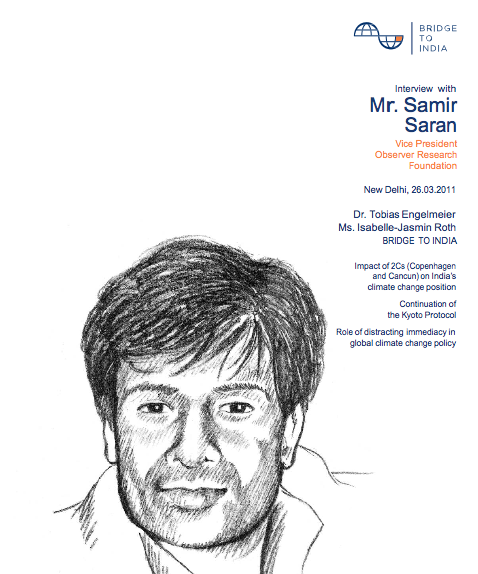
The Indian negotiating team, led by Environment Minister Jairam Ramesh shifted India’s position at the Cancun Conference on climate change, said Samir Saran, Vice President, Observer Research Foundation, in an interview to a website, bridgetoindia.com.

Asked whether India blinked at Cancun and the Indian Minister significantly shifted from India’s long-standing position that the developed economies take full responsibility for climate change by indicating that India would also take on binding emission targets, Samir Saran said “Yes, India blinked. Regrettably! I may add. Given that India has undertaken to contribute to the effort to limit temperature rise to a two-degree- limit, it may have opened itself to international pressure that will seek to both curb its’ emissions or direct its development pattern”.

He said this was not only unfair, given that Indians emit only a fraction of what the citizens of developed countries do, but it seemed part of a larger effort to weaken the obligations and commitments that the Annex 1 countries had undertaken after two decades of global negotiations and concerted efforts by the least developed countries and India. Samir Saran said the Minister and his team have not only shifted India’s negotiating position but have arguably undone the efforts of the past in an instant. “I hope we can salvage it,” he added.

He said the entire international climate debate is actually about national interests and power politics. “Take China, for example, now that they have built an industry that can export technology and the products needed for low carbon growth, such as renewable energies, there are signs that they are ready to support a more universal emission reduction regime. And perhaps that prompted India to play the part it did.. the fear of being alone… which, I believe, is greatly overstated. Perhaps there is no harm in being alone once in a while,” he said.

“But sadly, while we all understand that climate change is a great and grave risk and that there is an urgent need to reduce emissions by those best able to, international negotiations today remain hostage to power politics and national interest increasingly understood by the economic gains for respective national businesses,” Samir Saran told the publication.

For complete text of the interview, click here 

Standard
Columns/Op-Eds, Non-Traditional Security

Mumbai Attacks 2008: A Call to Look Within.

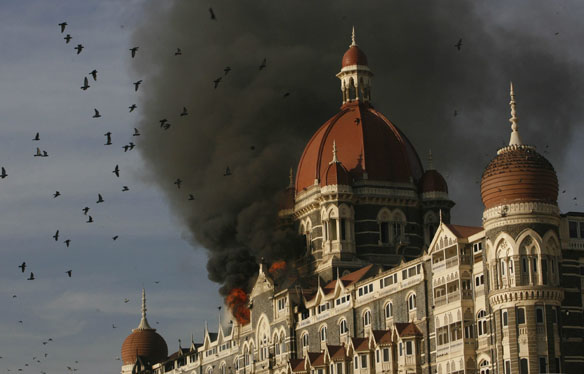
Over the past two decades India has demonstrated remarkable consistency in the irrational and incoherent response of its policy makers, people and sections of its mass media to dramatic and outrageous terrorist violence inflicted on the country. The most recent episode, witnessed in Mumbai on November 26 has also been followed by a typical though distinctly more pronounced response from all quarters. Much of the public debate following these terrorist attack has focussed on internal security systems (or the lack thereof) and the effort to punish the perpetrators. The public sphere including the media and academic dialogue seem to be preoccupied with ways to bring in line the truant Pakistan.

This approach has failed consistently and the outcome is unlikely to be any different this time around too. The major flaw with placing the blame entirely on Pakistan is the premise that Pakistan or its proxy warriors could have executed any of these outrageous acts in the absence of serious internal vulnerabilities. Though some of these vulnerabilities are acknowledged by many after the Mumbai attacks, they remain limited to the domain dealing with foreign policy, internal security and intelligence gathering.

Even now there is complete silence on a most crucial aspect that we must recognise; Indian Nationals collaborated with the Pakistani perpetrators in planning and executing this barbaric incident. The law enforcement agencies and the politicians are yet to provide us any clue on the identity of the perpetrators who were killed and on the countless others who helped in the various stages of this act. India, its media and its polity have not even attempted to articulate this dimension in their prescription for preventing these events from occurring again. The increasing presence of radicals in India, in this case those who justify violence in the name of Islam, is a clear and present danger and must be halted if any degree of success is to be achieved in India’s endeavour to tackle the menace of terrorism. It is imperative that Islamic radicalism be recognised as such and then efforts be made to prevent its spread. It is equally important to enact policies that resolve conditions that aid the spread of this violent radicalism.

This reluctance to look within, it may be argued, is due to the inherent predisposition of nations and societies to externalise such incidents. The US and much of the western world has frequently treated terrorist violence as a distant third world phenomenon attributing its cause and origin to the ‘impoverished and backward regions’ of Afghanistan, Pakistan and the Middle-East. This propensity of the western world is a legacy of the colonial/orientalist discourse. It also prevents societies from looking within and engaging with shortcomings in their own socio-political landscape. This is evident from the alacrity with which the West categorises its Muslim citizenry as ‘Moderate and Progressive’ while denouncing the Muslim perpetrators (even when they are from their own populace) as ‘Islamic Terrorists’ motivated and created in alien societies devoid of freedom and liberty. To admit to the existence of discontent and outrage amongst its own Muslim population would be to admit to shortcomings within their own brand of liberal pluralism.

India, its government and people, have responded to the Mumbai attacks and other terrorist action in the past in much the same manner. The origin of these violent incidents have been distanced from within and located entirely in the ‘fundamentalist and undemocratic’ Pakistan. This is simplistic and dangerous. The sophistication, planning and increasing frequency of terror violence in India demonstrates strong local support for this radical Islamist ideology that propagates violence. Irrespective of the existence, contours and construct of a global Jihadi network, it is irrefutable that social conditions do exist within India that create disaffection and hopelessness and allow this population within the Indian Muslim community to be lured to the ideology that many today term ‘Radical Islam’. The existence of SIMI and their violent brand of political agitation confirm to this growth of radicalism in the local Muslim community. The participation of home grown terrorists from educated and middle class backgrounds points to the presence of this radicalism in all strata of society and within the urban mainstream of India.

Radical Islam is not a primeval phenomenon, nor is it unsophisticated. It is now a post-modern ideology able to attract a diverse demography. It also makes use of modern media and communication platforms and positions itself effectively as an alternative and preferred form of habitation for persons seeking an outlet and release from their existing social reality. This presence of Radical Islam demands two specific investigations that India must undertake if it is to effectively respond to its dangerous proliferation. The first must involve an honest study of political, economic and sociological factors that shape anxieties of the Indian Muslim today. This would help in identifying vulnerable sections and vulnerabilities in our systems that may be exploited. The second investigation must construct how Radical Islam offers its ideology to the Indian Muslims as a relief from their current anxieties. It should understand the substantive messages that are communicated by the supporters of this ideology that address the current day issues of the Indian Muslims across the social spectrum.

An understanding of these vulnerabilities and the messages may offer a point of departure for the policy makers and civil society and help to develop a response comprising of both, security and socio-economic dimensions. This would aid policies and processes that would not only make India safer but also enhance its democratic depth.

January 2009.
Link to ORF website.

Standard