Category Archives: China
COP27: India can’t be expected to pay for climate sins of the West
The 27th Conference of Parties — COP27 — is once again the subject of enormous expectations. Will countries meeting in Sharm el-Sheikh in Egypt be able to go beyond talk? Climate disasters are reaching unprecedented levels. And the impact has disproportionately fallen on low and middle-income countries like India. According to a UNDRR report, the proportion of climate-related natural disasters between 2000-2019 almost doubled from the previous two decades. Such disasters claimed 1.23 million lives and levied an economic cost of $2.97 trillion. Eight of the top 10 countries hit by these disaster events were developing countries from Asia.
Most global action revolves around efforts to “mitigate” climate change by reducing the volume of carbon emissions. Too little attention is paid to the developing countries’ need for “adaptation” to the effects of the carbon that is already in the atmosphere.
As with much else in the climate debate, this is deeply revealing of western hypocrisy. It is argued that climate change is so real and urgent that difficult, expensive action must be taken on mitigation, so as to cut emissions. Fair enough — but what about the real and urgent problems that people and economies are suffering due to emissions that have already happened? These emissions cannot be prevented or mitigated. Communities need support in adapting to them. Adaptation — including ‘loss and damage’ accounting for the overall effects of climate change — must be at the centre of all climate negotiations.
Too little attention is paid to the developing countries’ need for “adaptation” to the effects of the carbon that is already in the atmosphere.
It is a truth that all accept but few wish to acknowledge: there is a direct relationship between overall well-being and carbon emissions. The growth trajectories of advanced economies have been achieved by exploiting the world’s carbon budgets. The developed world’s depletion of global atmospheric commons has led to extreme climatic events across the planet. Climate change is already upon us due to industrialisation in Europe and North America in the past, and in China more recently. Countries that have contributed the least towards historical global emissions — countries that are still developing and poor — are left to fend for themselves. Global poverty has underwritten the riches of the developed world.
Climate finance contributions from the Global North have been insignificant and incommensurate with the transition costs for emerging economies. Developing countries will require at least $1 trillion in energy infrastructure alone by 2030, and up to $6 trillion across all sectors annually by 2050 to mitigate climate change. In addition, annual climate adaptation costs in these economies could reach $300 billion by 2030 and as much as $500 billion by 2050. Further, developing countries are likely to face $290-580 billion in annual “residual damages” by 2030 and over $1 trillion in damages by 2050 from the impact of climate change that cannot be prevented by adaptation measures. There is hardly any acknowledgement, let alone support, for this crisis.
The debate on Loss and Damage (L&D) is mired in ambiguity. It was only in 2013, at COP19, that Loss and Damage became officially recognised. It was later included as the distinct Article 8 of the Paris Agreement at COP21, with no reference, however, to finance or equity. The segregation of L&D and adaptation was viewed as a geopolitical gambit to separate the Alliance of Small Island States (AOSIS) from other emerging economies. This deprived large developing countries of climate finance and technology by conflating them with developed nations. Since global climate funds are constrained, it has been argued that opening a window for L&D would impact finance for adaptation and mitigation, and reduce the ability of larger emerging economies like India to tackle climate change.
The segregation of L&D and adaptation was viewed as a geopolitical gambit to separate the Alliance of Small Island States (AOSIS) from other emerging economies.
The conclusion is unavoidable: L&D financing must emerge as an independent stream in climate negotiations. Instituting special arrangements for strengthening L&D finance, independent from mitigation and adaptation, is particularly vital.
India’s climate action will be constrained by its development imperatives. Despite ambitious Nationally Determined Contributions (NDCs) commitments, the realisation of India’s climate goals is strongly linked to the availability and quality of capital at its disposal. India needs about $2.5 trillion till 2030 for NDCs. Currently, the tracked green finance in India represents approximately 25% of the total required across sectors for mitigation alone. Adaptation flows are even more pitiful. Given India is among the most vulnerable to climate change, adaptation clearly needs more resources. But these demands are unlikely to be met by global adaptation funds, which are limited and expected to prioritise small and fragile island states. Therefore, it stands to reason that India privileges adaptation to support its communities and people from its own domestic budgets. Mitigation actions must, then, be backed by international finance flows. India — and indeed no developing country — can do both. It cannot be expected to pay for its future as well as pay for Europe and America’s past.
COP27 is an opportunity to voice the Global South’s collective demands and reconcile various channels of climate financing. The international community must respond. Else the developing world will find itself preaching to the parish of the prejudiced.
BRICS Academic Forum 2022 | Opening Plenary
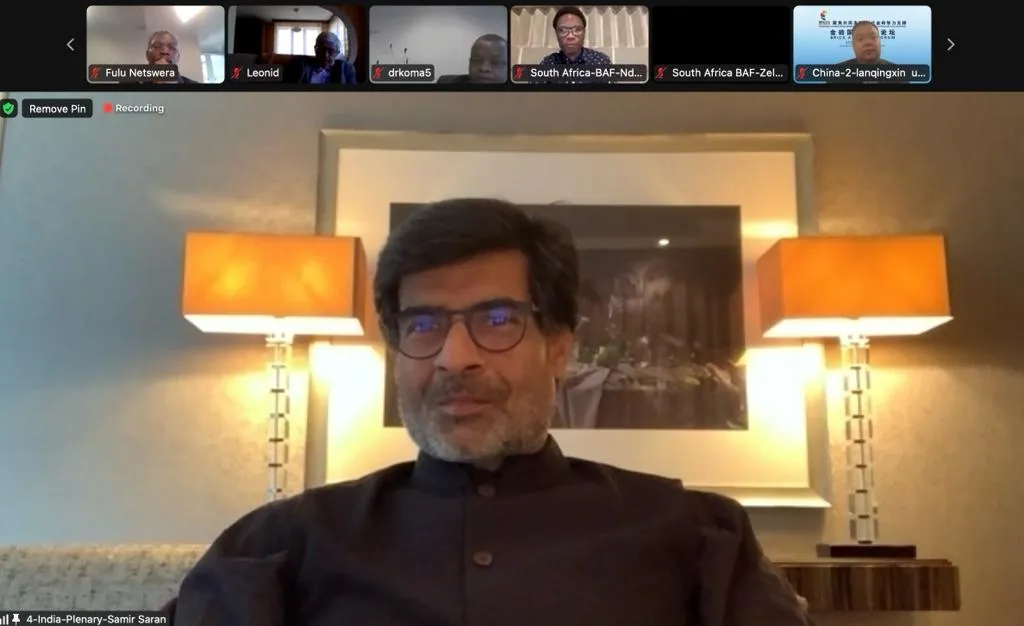
Remarks by Dr Samir Saran at the Opening Plenary session of the BRICS Academic Forum 2022
It is a pleasure to be back again and be a part of the academic forum that has continued to raise important issues for intra BRICS cooperation and indeed, for the challenges that confront our world.
We are meeting today at an important moment—a moment that will be recorded and studied by future generations. It is important that all of us rise to the challenges that confront us and be creative in discovering solutions. Three major trends are seeking our attention and indeed, resolution.
First, global politics has been upended by the political actions in Asia and Europe. Conflicts, contests, and careless power projection have jeopardised stability, peace, and prosperity for all. Can we discover a new geostrategic balance and what role can BRICS play?
As we emerge from the pandemic—or at least begin to learn to live with it—what are the lessons that we have learnt? Will new development and growth models emerge, and will BRICS and other actors invest in what is most important for humankind?
And finally, we are experiencing the digitalisation of everything. Technology is having an impact on our economy, our politics, our societies, and indeed our individual behaviours, choices, and assessments of the world we live in.
New Politics, Green and Inclusive Growth, and our Common Digital Future beckons us. At the Indian presidency of the BRICS last year, we coined three words—Continuity, Consolidation, and Consensus. These remain relevant even as China steers the group and must continue to define the BRICS agenda.
We have to work together to overcome the contested politics of today. We must be contributors to stability in world affairs. We should reject actions as a group and as individual nations that can create further instability or exacerbate current tensions.
BRICS was always meant to be a grouping that would offer an alternative path to one prescribed by the Atlantic Order. We must continue to strive to do this. Unipolarity must give way to multipolarity. Bipolarity is not an option.
Three key elements will shape the path that BRICS and others must pave.
First, as the political assumptions of the 20th century may no longer be sufficient or valid for a more complex world, we must work together to script a multilateralism that is fit for purpose. It must reflect current realities, the aspirations of different geographies, and a governance structure that is plural, transparent, and accessible. The old hegemony of the Atlantic Order must not be replaced by a new hegemony from another region.
BRICS must continue—individually and collectively—to remain inclusive in shaping the multilateral system. This system must deliver on economic and trade growth. It must find new ways of catalysing financial flows for infrastructure and aspirational needs of multiple geographies. Multilateralism for this century will require new anchors and champions. BRICS can play that role, provided all members are committed to it.
Second, future growth and our economic needs will have to cater to our planetary responsibility. Green transitions must not simply be a buzzword, but the policy design for all. BRICS must work—both within and with others—to put together a template to invest toward a green planet. We have to rethink mobility, urban spaces, consumption, and our lifestyles. We must also work to protect those who are already being burdened by the deleterious consequences of global warming, rising sea levels, and harsh weather conditions.
Thirdly, we have to embrace technology and not allow it to become the new arena for zero-sum politics. The world must see technology as a digital public good and it must serve all of humanity equitably. The rules for this digital future are yet to be written. These rules must not be written only by the western hemisphere. In the absence of such agreed rules, sovereign arrangements must prevail over those written by the boardrooms. BRICS can share experiences and learnings from our individual journeys and offer to the world examples and methods of managing our common digital future. We must ensure that countries, within and outside, do not weaponise technology or game the digital public square.
It is impossible for BRICS to attain its full potential and contribute to global affairs unless each member is committed to the BRICS project and the thinking that led to its creation—peaceful co-existence, within the group and with others, being the primary ethos.
 Samir Saran