Uncategorized

“What the rest of the world is waking up to is a reality we have lived all the time”: Richard Sezibera

For Rwanda, it’s not about only creating wealth — safeguarding the environment is important.
Favourable Global Environment,Globalisation,Kigali Global Dialogue,Richard Sezibera

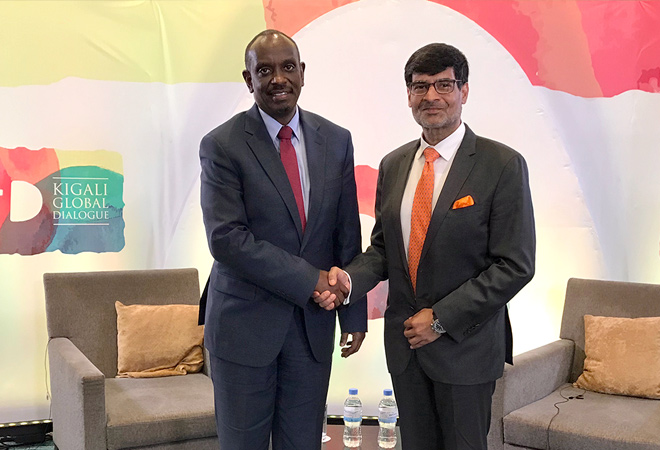
Rwanda’s foreign minister Richard Sezibera says the quality of his country’s growth is “striking” because it is “non-commodity dependent” and is the result of sound policy choices over at least a decade. Sezibera spoke with Samir Saran, President, Observer Research Foundation, on the sidelines of the Kigali Global Dialogue in Rwanda’s capital city.

“What the rest of the world is waking up to is a reality we have lived ourselves all the time and therefore we have chosen to invest in doing what we think is right for our people and building partnerships with people who understand us. We build those partnerships because we think what benefits us should also benefit others. It is not fair that we be asked to choose between partners and partnerships,” he told Samir Saran.

We bring you excerpts from this special interview that covers the wide arc of development partnerships that Rwanda and other African nations are building with the global community.


Samir Saran: Six of the 10 fastest growing economies are in Africa. Is this optimism well placed? Are there some fundamental challenges that could derail that growth story? Are we beginning to see a holistic approach?

Richard Sezibera: First of all, the growth that we are seeing in our continent is important. Quality of that growth is striking. Many of the fastest growing economies, including mine, are non-commodity dependent. Therefore, these are economies that are growing because of policy choices over many years. Certainly for my country over a decade and these choices have put in place the fundamental building blocks of growth. Investments in innovation, health, education and in critical infrastructure to sustain growth. So the optimism that you see is real. There are still major challenges. Africa is a continent of promise and prosperity potential but we still have to create wealth for the majority of our people and that is still ahead of us. There are challenges of peace, security and governance that is still an unfinished agenda. But all in all, countries have understood that we can grow and grow fast. No country is condemned to live in perpetual poverty. If my country under the leadership of President Kagame can lift itself out of the deep hole left by genocide, then any country on any continent can do well for its people. This dynamic young force that is growing up on our continent is hopeful for the future.

No country is condemned to live in perpetual poverty. If my country under the leadership of President Kagame can lift itself out of the deep hole left by genocide, then any country on any continent can do well for its people.

Saran: In President Kagame’s vision, what are the key sectors that you believe will allow Rwanda to become the service and ideas capital and innovation? What are the relationships you are investing in to help get there?

Sezibera: Thank you for your kind words. Twenty five years down the road, when you look back at 1994 and the devastation there was at that time, I can only say that President Kagame looked at what was and simply refused to see it. He chose to see what this country could be. That vision is captured in our vision 2020 and currently in our vision 2050 is a collective vision that has emanated from all Rwandans — from civil society, from local leaders, religious organisations and therefore they own it although it is executed by government. The pillars of our vision are critical. One of course is peace and security which is also an undertaking by the Rwandan people. We have made investments in health and education because we want an educated workforce that is able to create wealth. We have made investments in critical infrastructure — roads, rail, airlines and energy. We are making major investments in energy and electricity supply, agro-processing and agriculture. A number of manufacturing companies are setting up here — from textiles to automobiles. All this is being done in a manner that safeguards our environment. For us, it’s not about only creating wealth. Safeguarding our environment is important for us. Finally, ours is a vision that is based on regional and continental integration to create the value chains that our industries need.

Twenty five years down the road, when you look back at 1994 and the devastation there was at that time, I can only say that President Kagame looked at what was and simply refused to see it. He chose to see what this country could be.

Saran: Many believe we are facing a tough external environment. We are seeing reluctance around trade, fatigue around globalisation. Many of the big finance firms are working in their own geographies while consumer goods and tech move across borders. Stakeholders are becoming more partisan. How do India and Rwanda grow in such moments. How do we navigate?

Sezibera: or my country and certainly for other African countries, we have never had a favourable global environment. We have never known it. We did not have it in the 80s, we did not have it in the 90s, we don’t have it now. What the rest of the world is waking up to is a reality we have lived ourselves all the time and therefore we have chosen to invest in doing what we think is right for our people and building partnerships with people who understand us. We build those partnerships because we think what benefits us should also benefit others. It is not fair that we be asked to choose between partners and partnerships. We cannot do so. It is not fair that we be asked to be partners on other people’s agendas. No. What is important is that we have our agenda and have partners around it. We negotiate so that the partnership is mutually beneficial. Maybe the idea behind the non-alignment movement is as true today and it is was at another time. It is certainly true for us. We are aligned to our vision and agenda. Multi-alignment has always been true for us. We have to have partnerships with governments, partnerships with the private sector, with universities and research centres. For us, it has always been a world of multiple partnerships. The challenge for us has always been to get our voice heard among these multiple partnerships. 

Saran: Has that changed recently? Do you believe people are more attentive to views coming out of Rwanda and other countries? 

Sezibera: I hope so. We will not shy away from making those views known and to listening. It is a balance. The challenge we have in this world is that there are people who think they have been ordained to speak and the rest must listen. No, we think there must be a dialogue.

The challenge we have in this world is that there are people who think they have been ordained to speak and the rest must listen! No, we think there must be a dialogue.

Saran: Paul Kagame and your people have large support in India. Please share your thoughts on the bilateral.

Sezibera: India is a very important development partner for Rwanda. Not only today but even in the past. Some sectors of our industry developed because of the presence of and actions of Indian entrepreneurs. We have a very vibrant government to government relationship. You are right that President Kagame and Prime Minister (Narendra) Modi share a common vision of empowering people to develop and develop fast. More importantly, we are seeing a lot of interest from Indian entrepreneurs now.



Standard
Uncategorized

“Not many nations get a second chance at democracy”: Mohamed Nasheed

“We will have to renegotiate loans with China, they have to understand it is not commercial,” said Mohamed Nasheed.

China, GMR, Mohamed Nasheed, China loans, Narendra Modi, Maldives, renewable energy, solar, climate change, Ibrahim Mohamed Solih, India, Indian Ocean, Africa, Kigali, Rwanda, Kigali Global Dialogue, Observer Research Foundation, Samir Saran

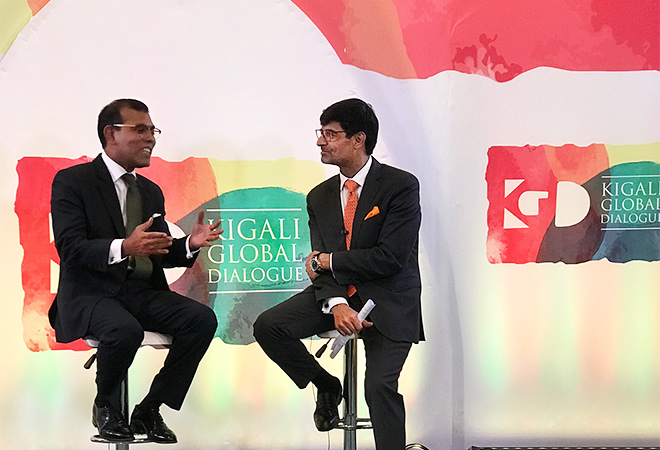
Former President of Maldives and current speaker of his country’s parliament Mohamed Nasheed at a fireside during the Kigali Global Dialogue in Kigali, Rwanda, praised India’s partnership in Maldives’ development, pushed back against China’s high cost “commercial” involvement and made a stirring case for political and institutional leadership in renewable energy planning. A leading voice on climate change leadership, Nasheed is pushing the international community to “do the sums” and assess the impact of climate change not as an ethical or moral issue but as one which has fundamental implications of economic viability.

Speaking extensively on a hot button issue, Nasheed revealed that India’s GMR company submitted a $77 million quotation for the Male-Hulhumale bridge but the project went to China’s CCCC company which has sunk Maldives into a $300 million debt for this project alone. Maldives owes “various Chinese companies” over $3.4 billion and will double down on renegotiating the debt, Nasheed said.

Nasheed spoke with Samir Saran, President, Observer Research Foundation. We bring you excerpts from the interview.


Samir Saran: How do you view the recent politics of Maldives? Do you fear things may turn ugly again?

President Mohamed Nasheed: Not many nations get a second chance on democracy. In 2008, we were able to amend our Constitution and have our first multiparty elections. But then in 2012, we lost it to a coup. Then we had this 5-7 years of authoritarian rule. In 2013, we again had elections but those elections were stolen but we conceded that and we did not want to raise the confrontation and discontent any further. We feared that if we did that (confrontation), the risk of civil conflict would rise. We stayed back and we wanted another election. I wasn’t able to contest because the government wouldn’t allow me to contest. Our parliamentary leader Ibrahim Mohamed Solih contested and we won with a massive mandate. After that we had parliamentary elections. Your question is, are we going to vote again? Can we stabilise? I think we will stabilise. I also think our development partners, especially India, do understand what’s going on in the Maldives and therefore they would also keep an eye on the situation. Most recently India has assisted in our development a lot. Recently, when our President visited your country, India has pledged $1.4 billion of assistance. So, that is going to go a long way. We think the future is bright.

Most recently, India has assisted in our development a lot. Recently, when our President visited your country, India has pledged $1.4 billion of assistance. So, that is going to go a long way. We think the future is bright.

Saran: There’s a second significant partner you have engaged with — China. I invoke them because they too have invested in infrastructure projects the Maldives. They too have invested in the Maldives, they are significant economic actors anywhere in the world, they have a big treasury to disburse loans and assistance and aid. How do you assess your relationship with these two emerging actors with the ability to shape development agendas?

Nasheed: Everyone must understand that we are an Indian Ocean country. India is just a few miles away from our northernmost island. We read the same books, we watch the same films, we eat the same food, we listen to the same music, we are the same people! People to people contact and dialogue between India and the Maldives runs far back than any other countries. Also because of geography, we are right next to you, so everyone must understand our relationship with someone else cannot be at the expense of our relationship with India. We are trying to tell everybody that yes, we want to have friends, we want to have good relations but please don’t try and suggest that that relation should be at the expense of something else. Once China understands that, and I think they will understand that, we will have far more stability in the Indian ocean. The Maldives does not want to be sandwiched in between hostilities between any two countries. In terms of contribution from China, much of it was commercial loans from commercial banks and most of the projects were priced very high. They came in, they did the work and sent us a bill. It’s not the loan interest rate as such, but the (high) costing itself. For instance, for the (Male- Hulhumale) bridge, GMR gave us a quotation for $77 million and the Chinese gave us a bill for $300 million. What we are seeing is that in other countries, they are asking for equity and with that we relinquish both land and sovereignty.

For the (Male- Hulhumale) bridge, GMR gave us a quotation for $77 million and the Chinese gave us a bill for $300 million. What we are seeing is that in other countries, they are asking for equity and with that we relinquish both land and sovereignty.

Saran: Your country, although the per capita income is many times that of India, your economic size is small. How does a country of Maldives’ size manage this Chinese debt diplomacy as it were. Will you need help from others to get out of this? What is the plan?

Nasheed: First, we have to save. We owe about $3.4 billion to various Chinese companies. Come next year, 2020, we will need to spend 15% of our budget to pay 15% for education and 15% for health. I can’t see how our development can be that rapid and that amount of growth to have that amount of saving. So, we will have to renegotiate. China must understand that this is not commercial. 

Saran: Has the new Government reached out to China?

Nasheed: Yes, the foreign minister has visited China. This is not commercial. What happened between the Chinese EXIM bank and the Chinese state owned enterprises is not commercial and therefore we must not go into commercial arbitration. I believe China will understand that we cannot handle this.

Saran: How has your appraisal of India’s engagement with Maldives been? Do you have a sense that India should have done more or do you think they have got the balance right?

Everyone must understand that we are an Indian Ocean country. India is just a few miles away from our northernmost island. We read the same books, we watch the same films, we eat the same food, we listen to the same music, we are the same people!

Nasheed: They have got it right. I have been very critical but after seeing everything, what I know is that they have struck the right balance. Indian diplomats are clever and they have done an excellent job. Hats off.

Saran: Now, moving to climate change without getting into its politics. The reality is that sea waters are rising. Some parts (of the globe) are getting warmer, some parts are getting colder. Bio-diversity is shrinking, plants are dying, the earth is scorched. You have been ahead of the world in terms of climate change leadership. You hosted your first cabinet meaning under water to shock the world into understanding the urgency of climate change. That was 10 years ago. Has the global governance mechanism failed to respond and create a viable framework to respond to perhaps the most significant challenge of our times?

Nasheed: Has the UN failed? If we take climate change as an ethical issue or a human rights issue, it is very difficult to go forward. But once we start seeing it as an economic issue and its economic viability, then things look very different. The economic viability of renewable energy and low carbon development is not because of UNFCCC. The power purchasing agreements in Germany and solar panels in China meant that these things were available to everybody. Now, in any given situation, solar is cheaper than coal. The business case for solar is strong. India became the largest installation base for solar last year. But India has invested a lot in coal (stock) and we (Maldives) have invested a lot in diesel. Many countries are in this problem. The electricity departments are unwilling to get into power purchase agreements for renewable energy because they are already locked in. We need to get into some arrangement to buy off or retire these old plants. If the World Bank and the financial institutions can find a mechanism to buy out existing coal plants and existing diesel and then decommission them.

The World Bank and the IMF have not even done the sums. They have not thought about retiring and decommissioning a coal plant.

Saran: Let’s go back to the international financial system. Unfortunately for countries such as India and Maldives and some others, while we may be loud voices and a big market, the decisions are still being made in New York and London…

Nasheed: The World Bank and the IMF have not even done the sums. They have not thought about retiring and decommissioning a coal plant. Instead of spending their money on new plants even if it is renewable, it will be better for them to buy existing plants and decommission them and allow the market to come up with a viable economic solution.

Saran: In many countries of the world, this could work but energy access is still a mirage in many places. It is incumbent on the state to provide that public utility. If you were to take a 100 million debt from a country, your monetary policy will go for a toss because your GDP size is so small. So, for these countries even getting international loans at discounted prices is very hard.

Nasheed: Look, in Africa, there are no plants. They did not have phones. Now, you have more communication happening with new technology. Fortunately, most of Africa is not powered by coal plants because they are not powered at all. So, the new plants when they come up, it should must be renewable. If they do the sums, if they come up with these pledges and these kinds of views and ideas and policies and run elections based on that…

Fossil fuel is Victorian technology. It’s cumbersome, it’s old, it’s obsolete. You don’t touch it, it’s unviable.

Saran: Is it time for people like you to mobilise political leaders around the world and come up with a climate manifesto?

Nasheed: It is the Planet B manifesto. For the 2018 elections in the mountains, that’s exactly what we did. Everything was environmentally sustainable. When people lose elections, the losers would be thinking of a manifesto for the next election. That’s the time to go and tell them — look you’ve been trying to sell this old idea and there are no buyers anymore. The minute you come up with something new, you can promise jobs, health centres, transport, education, schools, everything — but in renewables. Fossil fuel is a Victorian technology. It’s cumbersome, it’s old, it’s obsolete. You don’t touch it, it’s unviable.

Standard
Uncategorized

India, UK and the dawn of the Afro-Asian Century

As we approach the third decade of the 21st century, it is unmistakable that Asia now has a twin – Africa. Even as economists and political pundits alike contest and celebrate the Asian Century, it would be erroneous to ignore the promise that a full one-fifth of humanity that is young, aspirational and innovative holds.

Africa is unarguably already the new growth engine of the world. It is now at the vanguard of tackling the most fundamental development challenges of our time—from lifting millions out of poverty in an increasingly fossil fuel constrained world, to creating new enterprises and opportunities for a young and aspirational workforce. And like Asia, Africa is home to the youngest and fastest growing economies. It is evident that the rise and the leadership of these twin geographies will define global growth and prosperity. The Afro-Asian century is indeed upon us.

Africa has taken command of its own destiny at a time when the global balance of power is irrevocably shifting. These global transformations will create new opportunities to forge beneficial coalitions and partnerships. The troika comprising of the UK, India and Africa must use this moment to carve a new relationship and cement an old accord. The UK, for one, seeks new purpose: finding its place in the world outside the confines of the European Union. “Global Britain” is now its new agenda. Simultaneously, India’s footprint has moved beyond South Asia and the Indian Ocean, and its aspirations and hunger for partnerships necessitate a recalibration of its engagement with Africa. A realisation has dawned on Raisina Hill that India’s partnership with the continent will determine its economic prosperity and national security.

The convergence of interests between the communities, markets and states of Africa, the UK and India will script the entwined futures of the three geographies.

A convergence of Interests

Trade expansion, responding to climate change, and technology-led growth are the areas where the interests and stated ambitions of all three geographies converge.

Africa has emerged as a trading giant, with significant implications for the global arrangements. The African Continental Free Trade (AfCFTA), which came into effect on 30 May, has created one of the world’s largest free trade zones. It has brought together the commercial potential of a billion individuals —with the AfCFTA now valued at over $2 trillion. London, meanwhile, remains the financial capital of the world, despite the looming shadow of Brexit. India, for its part, is already contributing to 15 per cent of global GDP growth—and its share will only get larger. As Africa shapes new trade arrangements, India pushes for reform at the World Trade Organisation (WTO), and Britain searches for new partners, all three geographies can discover solutions and pathways to their ambitions in the other.

Beyond trade, sustainability forms the core of their respective development agendas, and all three regions are at the forefront of combating climate change. The UK continues to lead the Atlantic green transition, with the potential to reach near-zero greenhouse gas emissions by 2050. India is responding with its own propositions. Home to the International Solar Alliance, it is currently the second largest solar power market in the world. The upward revision of its solar capacity target for 2022 from 20 GW to 175 GW speaks to the success of India’s efforts. As Britain and India discover solutions and pathways for sustainable growth, Africa has a hunger that the two satisfy. Energy poverty costs the continent two to four GDP percentage points per year, and Africa needs innovative solutions to meet the energy demands of the 600 million people who remain off-grid. A partnership between the three geographies has the potential to cater to the energy and development demands of this large cohort of the human population.

Finally, all three seek to leverage the technologies of the 4IR to create economic opportunity and pathways for social mobility. Enterprises in the Fourth Industrial Revolution will be driven by the energy of the young. With its mature regulatory ecosystem, Britain can supply the services and the institutions that cater to start-ups and gig economy; while India and Africa, powered by ideas and the human zeal, can provide solutions that truly cater to the bottom of the pyramid and export solutions to the developed world as well. This presents us with a unique opportunity to co-design policy in an age of disruption and to address some of the most pertinent challenges of the Fourth Industrial Revolution—harnessing women’s potential and providing protections (social and physical), purpose and paychecks.

New Economic Diplomacy

At a time when challenges transcend state boundaries, building multi-stakeholder partnerships and responses is crucial. ORF is excited to help catalyse new conversations across these three geographies through the Centre for New Economic Diplomacy (CNED). The CNED is a policy research platform committed to building communities and strengthening transnational partnerships to respond to challenges and opportunities that confront the global community. Over the past six months, the Centre has successfully curated platforms to facilitate the cross-pollination of ideas, debates and solutions across geographies. On the sidelines of the United Nations Environment Assembly, the CNED hosted the first India and Africa Partnership for Sustainability conference in Nairobi, Kenya. This platform brought together over 40 stakeholders from over 11 countries to coordinate responses to climate change and the broader SDG agenda. Following its success, CNED launched the Global Programme for Women’s leadership in New Delhi, a seven-day programme that brought together over 100 young women from India, Africa and the Bay of Bengal communities in an effort to build a trans-continental network of future leaders.

A conciliation with history

The CNED is not merely a community of experts. It is an effort that seeks to capture the realities that will define global growth in the decades to come. The traditional North-South and East-West divides are remnants of days past, which were harsh, brutal and inequitable. The success and failure of international regimes, global governance, and globalisation itself have been implicated by these conceptualisations. Escaping these realities requires embracing new relationships that are driven by mutual respect and collaboration—in formats that discard the geographical constructs of the 20th century. An India-UK-Africa relationship possesses the strongest potential to catalyse a new arrangement and perhaps a new global ethic—one that allows us to leapfrog old limitations. This is a poignant partnership, which will help shed artificial distinctions constructed by human greed and allow these three vital regions to contribute to a new world order.

We are delighted to collaborate with the India-UK week to bring our partners from Africa and India to help shape and redefine the most important trilateral engagement of our time.

Standard
Uncategorized

In India we trust’ would be good US policy

Pompeo, New Delhi, mission, inequities, bilateral, democracies, data localisation, missile defence, trump administration, consensus, global affairs, washington, transformation, industrialisation, geoplitical, superiority, Silicon valley, Industrial Revolution, prosperity, leading power

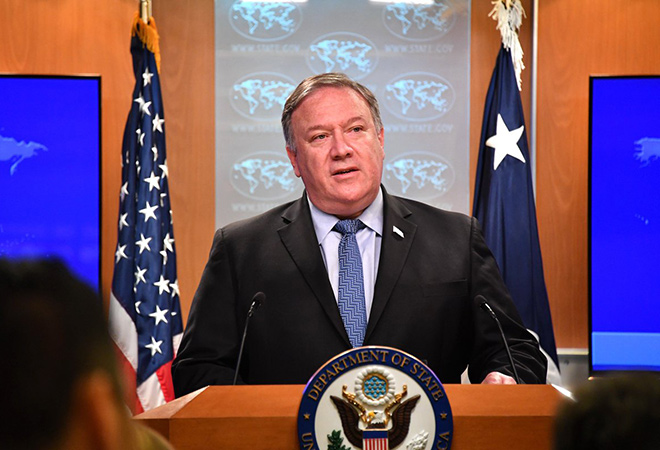
US Secretary of State Mike Pompeo is visiting New Delhi with a mission: to correct perceived economic and strategic inequities in bilateral relations between the world’s oldest and largest democracies.

Three issues, in particular, stand out: India’s recent data localisation measures; the purchase of Russia’s S-400 missile defence system; and, oil trade with Iran. The Trump Administration’s usual negotiating idiosyncrasies—unilateral economic measures and sanctions to use later as bargaining chips—have already preceded the visit.

Underlying these tactics, however, is a widely held consensus in Washington DC to support efforts that restore ‘American leadership’ over global affairs. While the American strategic community may argue over the Trump Administration’s ham-handed methods, the end goal is the same. The thinking is born amidst the lengthening shadow of China’s rise, digital transformation of industrialisation and the global economy, and America’s increasing self-doubt over the continued dominance of its global position and the resilience of the world order it has shaped between the fall of the Berlin Wall and the rise of the Great Wall of China.

India, it appears, is caught in the headwinds of America’s geopolitical and geoeconomic reorientation. Unfortunately, the US is unwittingly undermining its relationship with India while trying to win the zero-sum race for ideological, economical, technological and military superiority.

At a sectoral level, the US is basing its strategy on two faulty premises. The first is economic. The US believes that Silicon Valley possesses the capacity and is vested with the legitimacy to underwrite India’s digital industrialisation.

This line of thinking ignores years of history in industrial development and American geoeconomic partnerships. A strong domestic industry and globally competitive corporations enabled American allies in Europe and East Asia to industrialise. The US, for its part, was a financier and a consumer market. With its recent policies on data governance and security, New Delhi is ensuring that Indian industry and governance propositions will dictate its development and growth during the Fourth Industrial Revolution.

Like with the electronic, automobile and aeronautical industries in Europe or Japan, India will design bias into its industrial policy to incubate its own domestic giants for the digital age. It will also protect its ability to provide security and guarantee the rights of its citizens in cyberspace—an area where American tech companies have certainly been found wanting. Rather than fight the inevitable, the US should partner with India to create an equitable, competitive and secure global regime for cyberspace—especially at a time when the risks of fragmentation are real.

The second faulty premise is strategic. The US is overestimating its long-term ability to dictate India’s relationship with its partners—especially Iran and Russia.

The US is being typically sanctimonious while seeking to dictate to India the terms of engagement with others. When Washington has maintained promiscuous defence relationships with several partners in West Asia and the extended Middle East, including with Pakistan, why expect India to act differently? India will maintain multiple defence and strategic partnerships based on its national security requirements.

More important, the US is ignoring the reorientation of geographies. The 21st century will be defined, in part, by the merger of Asia and Europe into the Eurasian supercontinent. India will be a crucial node in this arrangement, as it will in the Indo-Pacific maritime system.

In Eurasia, New Delhi must partner with Moscow and states like Iran to create order and opportunity for itself. This is India’s long-term prerogative and cannot be held hostage to America’s short-term impulses. It is arguably in the US’ interest to follow India’s lead in the governance of this region, given its integration with Eurasian actors and institutions.

In Eurasia, New Delhi must partner with Moscow and states like Iran to create order and opportunity for itself. This is India’s long-term prerogative and cannot be held hostage to America’s short-term impulses. It is arguably in the US’ interest to follow India’s lead in the governance of this region, given its integration with Eurasian actors and institutions.

The friction in both the economic and defence sectors is a product of faulty ‘big picture’ thinking about the India-US bilateral relationship. In the post-War period, America’s partners have all been dwarfed by its economic might and military capability. The Americans are keenly aware of this. For their own prosperity and security, they crave for a liberal order under American leadership. My friend Michael Fullilove of the Lowy Institute once paraphrased Winston Churchill to justify that “the US-led world order is the worst form of world order, except all those other forms that have been tried.”

This is not necessarily true for India.

A country of India’s size cannot emerge as a ‘leading power’ in a world order tailored to protect and promote the interests of one country. Think about the prospect in absolute quantitative terms. Should India try and ‘fit’ itself into the worldview of a country that has three times it’s land and one-third its population?

What’s more, India’s economy may well surpass that of the US’ in size by the middle of this century. Look at it another way: America will, for the first time in over a century, be the smaller economic actor in a partnership. And unlike with Japan, Korea, Australia or the EU, the US will not be a guarantor of Indian security. Why, then, does Washington assume that its existing partnership templates will work with India?

Of course, there is a lesson in all of this for New Delhi. For too long, Indian policymakers have allowed ‘strategic ambiguity’ to guide foreign policy choices. In a rapidly fluctuating world order, this is bound to end in disaster. India must make clear what role it seeks in the international order and decide upon the means to achieve them.

The government of the day, arriving as it has on the back of a phenomenal election victory, must shape the imagination of Indians as to their place in the world. There are certainly many aspects of the world order that India will support, notably, liberal norms and rules-based trade and security. Nevertheless, it will not be hostage to a ‘US-led’ order. India will continue to push for a greater distribution and devolution of decision-making powers.

Rather than undermine India’s long-term ambitions, it is in America’s interest to recognise India as a co-sponsor and co-guarantor of the liberal order it incubated. This will necessarily involve trade-offs and compromises by both states. But that is expected of a relationship that carries the potential to define the course of the 21st century.

Standard
big tech, Cyber and Internet Governance, media and internet

Collapsing frontiers: Between the real and the virtual

CyFy Africa 2019, CyFy Africa, Africa, Samir Saran, innovation, security, society, Morrocco

We are delighted to announce the second edition of CyFy Africa: The Conference on Technology, Innovation and Society. In 2013, we felt that emerging economies needed to have a voice and a platform to discuss the key issues agitating cyberspace. This gave birth to CyFy India. Eight editions and two continents later, we are very excited by the dynamism of this community and the conversations that have made CyFy a premier forum for all things digital.

Indeed, it was the overwhelmingly positive response to the first edition of CyFy Africa in 2018 that gave us the energy and enthusiasm to make this conference an annual affair. We are happy that we have more speakers, institutions and partners this year than we did in the previous year–and they have all contributed to the strength and diversity of our agenda.

It is not a stretch to say that cyberspace and emerging technologies are the most important drivers of change today. However, they are operating in a vacuum—international institutions have failed to provide governance propositions for cyberspace. Domestic regimes have not fared better. Around the world, there are some very polarising debates about data protection frameworks, human rights regimes and security policies. CyFy India began as an endeavour to find a consensus on these questions. Bringing this platform to Africa allows us to continue engaging in these debates with a wider community of stakeholders.

It is, however, a misnomer to think of CyFy as a technology conference alone—even though it may say so on the banner. Today, conversations on technology are as much discussions on human and social behaviour, about the management of organisations and states and even the governance of the international system as a whole. A discussion about technology encompasses conflict and compassion, trade and diplomacy, and war and peace. Today, the feedback loops between the real and the virtual are palpable and our agenda for CyFy Africa captures this phenomenon.

And there is a good reason for this: CyFy also represents a search for a new social contract. All new technologies disrupt existing relationships between citizen, community, business and state. Responses driven by fear and anxiety—which we see a lot of—will invariably lead to suboptimal outcomes. We remain—perhaps naively—a community of optimists. Our goal is to use technology to improve livelihoods, spur new innovation and to create resilient, free and secure societies.

Of course, creating such societies requires partnership and dialogue—which is hard to come by in a generation that focuses on the “I”. Our objective with CyFy Africa is to reach out; to create new possibilities for the transfer off ideas, knowledge and solutions. We seek to create omnidirectional flows that transcend 20th century divides of North, South, East and West. We want to see technology valleys emerge from new communities and societies that are capable of providing innovations and solutions to all.

Here in Africa, and back in India, we see a burning desire to do this—to not only leapfrog constraints and obstacles, but to change lives around the world. CyFy seeks to give voice to this optimism for technology. Lazy incumbencies must give way to new actors, voices and propositions. In an age of disruption, we have tried to bring together the disrupters; the innovators and entrepreneurs that are shaping a new world all together.

Now that we have everyone gathered here in the beautiful city of Tangier, Morocco, we hope that the conversations you all take part in over next three days will fulfil these objectives. We would like to see new partnerships and engagements between individuals and institutions who may never have otherwise met. Above all, we hope that CyFy Africa becomes a platform for consensus building, located as it is at the intersection of continents and cultures.

Standard
Elections, India, Modi 2.0, Political Economy, Verdict 2019

Narendra Modi and his soaring popularity

Prime Minister Modi contested the recent parliamentary election with at least half-a-dozen prime ministerial aspirants representing the opposition vying for his chair. That he swept the polls with the entire opposition ranged against him clearly demonstrates his credibility among the masses across regions. In sharp contrast, his opponents lacked credibility and came across as unreliable, if not unfit, for the Prime Minister’s office.

Modi, BJP, Mandate 2019, Elections 2019, Verdict 2019

Q: Did Narendra Modi become more credible? How did his party manage to stay in power?

A: Prime Minister Modi contested the recent parliamentary election with at least half-a-dozen prime ministerial aspirants representing the opposition vying for his chair. That he swept the polls with the entire opposition ranged against him clearly demonstrates his credibility among the masses across regions. In sharp contrast, his opponents lacked credibility and came across as unreliable, if not unfit, for the Prime Minister’s office.

The BJP alone has won 303 of the 542 seats. Its allies in the NDA won another 50, pushing the total tally to 353 seats. The Congress, the principal challenger to PM Modi and BJP, failed to win even 10 per cent of the total seats required to be designated as the main opposition party. The size and scale of ‘Mandate Modi’ can be imagined from the fact that over 67% of India’s 900 million eligible voters participated in this election.

Although BJP is the winner in this election, Modi is the victor: it is his soaring popularity, reminiscent of the popularity of Jawaharlal Nehru and Indira Gandhi, that unleashed a massive wave of support. The BJP rode that wave to retain power. It was a single issue election. That issue was Modi. Nothing else mattered. Performance and promises of his government, including on key issues like the economy, were brushed aside along with identity politics which the Opposition had heavily relied upon to stage a comeback to the political centre-stage.

Q: Why did the recent conflict with Pakistan not affect the popularity of the Prime Minister?

A: The terrorist attack at Pulwama in Jammu & Kashmir in which a large number of security forces personnel were killed, and the subsequent retaliatory airstrikes on targets inside Pakistani territory by India, actually worked to Modi’s advantage. It arguably stoked nationalist and patriotic fervour on a significant scale. Modi was seen as a leader who would not hesitate to strike back at Pakistan, unlike his predecessors who sought accommodation over anger. Usual election issues like jobs and the state of the economy were buried in the fervour of nationalism across classes and among the masses.

What was significant in PM Modi’s decision to strike Pakistan was to call the extremist state’s bluff that allowed it to believe it enjoyed immunity from conventional strikes due to its nuclear weapons. The Modi decision has opened up the conventional space to respond to terror emanating from across the border.

Q: How will Modi’s victory affect the position of the Muslim minority?

A: India’s Muslims will remain secure and an integral part of what constitutes India, as will all other minority communities. In his first term Modi’s government has ensured a quantum leap in the allocation of funds for minority welfare schemes that directly impact their lives, more so the millennials. By proactively seeking to protect Muslim women from discriminatory practices like “triple talaq’ Modi may have also struck a chord among them. Most of India’s Muslims are integral to India’s aspirational middle classes. For them, bettering their lives is most important.

PM Modi’s recent speech top his party colleagues would also have sent the message that his government is seeking to work for all Indians.

Q: How will the Russia-India relations develop?

A: The state of the relationship is robust and my assessment is that it will only get better. There will be no disruptive change in Modi’s foreign policy agenda which evolved between 2014 and 2019. One of the hallmarks of this period were the deepening of ties between the two nations and the growing personal chemistry between President Putin and Prime Minister Modi.

Standard
Uncategorized

Indian exceptionalism and realistic responses to climate change

Samir Saran

At a discussion in Washington DC this spring, I was quizzed with a degree of annoyance on the multiple messages coming out of New Delhi with respect to India’s position on a global agreement to combat climate change. In the same discussion there was also an exasperated inquisition on why Indian needs and priorities must hold the world to ransom (as if there were a consensus) and why India imagines that it merits a special space, attention or exception in the climate arena.

The response to these two central propositions on India and climate change must of course come from the officialdom at Raisina Hills, home to Delhi’s executive offices. However, as we move down the road to COP 21 in Paris, it is crucial that any response, if formulated and then communicated (a bigger ‘if’), would need to engage with the most important climate proposition put before India by the world, and its interplay with the country’s development/growth imperatives.

Viewed from New Delhi, and after sifting through the chaff, the proposition for India’s climate change response posed by a large section of OECD countries, and certainly from the influential capitals in Europe, is fairly straightforward:

1. India must be the first country in the world (of size and significance) to successfully transition from a low-income, agrarian existence to a middle income, industrialised society without burning even a fraction of the fossil fuels consumed by other developed countries. China was the last country to enjoy this privilege. India will be the first that will have to cede this option and of course this may well be the new template for other developing countries to emulate.

2. The scale of this transition and the current economic situation in some parts of the world, alongside the complex and privately controlled innovation landscape, means that there is limited ability for the Annex 1 countries (the developed world) to offer any meaningful support in terms of financing or technology transfer. Official Development Assistance (ODA) is a small fraction of what is necessary today, and India will therefore need to mobilise domestic resources to power the non-fossil-fuel-fired Indian story.

3. Even as India adopts this ‘exceptional’ approach to industrialisation, and creates the necessary financial and commercial arrangements to achieve it, mostly through its own endeavors, the developed world and others want to retain the right to judge Indian performance. India will be monitored with an increasingly extensive system of compliance verification, and will be criticised for its missteps on the journey despite the novelty and scale of its undertaking.

My response to the thesis of ‘Indian exceptionalism’ therefore is that India does not seek to be an exception, but the demands imposed upon it that will require it to be exceptional. This is a truth for others to accept, and the climate reality for which India must discover creative policy. Three distinct narratives among various actors in India have so far shaped its response.

The first set of responses is from a group of people I like to call India’s ‘cold war warriors’. This group believes that no matter the contemporary political, economic and environmental reality, an alternate universe can be constructed through the mandate of the UNFCCC. These persons are the architects of the global intergovernmental processes and have faith in them. They believe that an agreement in Paris this December at COP 21, that is sensitive to Indian needs, will somehow assist in the transition required by India and will ensure that India only needs to make incremental changes to its ‘business as usual’ approach to economic growth and development. This group has ignored the changing economic system, which is increasingly disinvesting from fossil fuels politically, and in terms of financial flows and promoting green energy markets. The ‘green’ economic and market realities that will shape India’s future are seen as something that can be circumvented by creatively crafted text and clauses in a legal (read weak legal agreement) agreement in Paris. Despite 20 years of failure to achieve this ‘world of equity’ with ‘differentiated responsibility’ they continue to believe that a global agreement is the end in itself.

The second set of strategies to the proposition facing India are advanced by a group I refer to as the climate evangelists. They believe that 2050 is already upon us. Commercially viable clean energy solutions are available, and these hold the answer to both our immediate and future energy woes. The opportunities that exist in the creation of a new green economy must be grabbed with both hands. This group wants subsidies and incentives for clean energy technology, and taxes and regulation of fossil fuels. These green pioneers are sanguine that sufficient ‘push’ and ‘pull’ will deliver technology innovation and development on the requisite scale. They reject that fossil fuels are necessary as baseline sources of energy and instead insist that the technological revolution is already here, and that India must get on board or be left behind. Their argument is often a moral one: we have a moral obligation to save the earth for its own sake and for future generations – ignoring the fact that at this level of income disparity, inequality and differential access to the right to life, the planet is in fact being saved for the rich to flourish.

The third set of responses is from the group I call the climate realists. The realists understand that the global climate proposition is inherently unfair, and that India could and probably should push back against such an imposition by the developed world. However, they also recognise that no matter how hard they try to construct a ‘fairer’ agreement in Paris, the combined forces of the market, society and technology are all pointing towards a ‘greener’ transition. The political economy of climate change necessitates a transformation, and it is not necessarily in India’s interests to fight against it. Instead, the realists understand that there is an opportunity to lead in constructing a green economy. They believe that this moment can be used to reshape the tax, financial and global governance systems. They also see no contradiction in also ensuring continued flow of investments and emphasis on lifeline sources of energy for India’s poor.

Analysis shows that India does better than Germany, the United States, China and others on per capita coal dependence, with about a third of the consumption levels of the greenest among these three. It also already commits, as a proportion of its GDP, more towards renewable energy off-take than most (except Germany). It therefore does not need to defend its coal consumption. On the other hand, it must certainly be the champion to encourage ‘greener’ performance from others. The equity that it seeks lies in this. The rich must continue to invest more in renewables. This must be demanded and enforced.

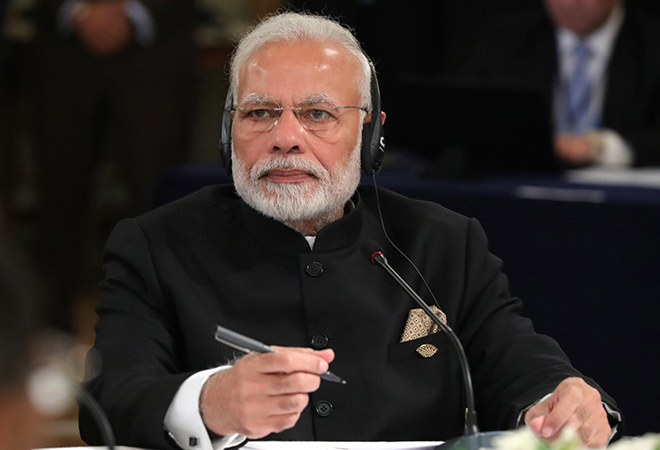
Prime Minister Modi’s recent statements suggest that he may be such a realist as well. He is promoting an aggressive renewable energy thrust, while being uncompromising on the point that lifeline energy will continue to rely on coal for the foreseeable future. When he takes coal off the discursive table, he is not foreclosing the right to use coal; instead he is sharpening the focus on India’s impressive credentials around green growth. He invokes religious texts, civilisational ethos and clever political word-play as he seeks a leadership role for India in global climate policy, and sets the agenda with ambitious plans for transitioning to a new energy paradigm. The ‘house always wins’ is a golden Las Vegas adage with a lesson for global politics too: unless we see strong political leadership of the kind being displayed by Prime Minister Modi and President Obama, the house – in this case national officialdom(s) and global bureaucrats – will prevail again. They will construct a new world order with words, commas and full stops, where nothing, not even the climate, can ever change.

Courtesy: lowyinterpreter.org

Standard
Eurasian Sudies, Great Power Dynamics, India-Russia, Indian Froeign Policy, international affairs, Quad, RIC, Russia Civil War, SCO

The US approach to the Russian federation will not determine the interaction of New Delhi and Moscow

India has been one of just few countries that’s managed to buy Russian weapons and avoid US sanctions. Nevertheless, anti-Russian sanctions sometimes serve as discouraging factor in Russian economic ties with other countries including China. Will India succeed in balancing between US and Russia, or the threat of sanctions will leave its mark on Russia- India cooperation?

Samir Saran: The sanctions on Russia are unilateral sanctions outside the UN system. While I do not speak for the government, India is unlikely to allow such sanctions to hurt its core relationships and objectives. Russia is India’s most important partner and US approach to Russia will not determine India’s engagement with Moscow. Our defence partnership and business relationships are vital and India will strive hard to ensure that these grow and strengthen. The US understands India’s views and concerns. The past year has seen the defence partnership with Russia grow stronger and I am confident that this will be the case in the future as well.

IzvAbout two years ago India joined the Shanghai Cooperation Organisation. So far, has the country felt any bonuses from participating in this organisation? Did membership in this club change anything for India?

SS: In my view these are early days for India at this club. India is currently settling in and is still finding its way about. The SCO if reimagined and designed can potentially have an important role to play in the Asian Century. It can be a group with Russia – India – China (RIC) at its core, from which contours of a political union in Asia can emerge. This will require major efforts and India will need to partner with Russia to make this happen. While the current impact of this membership is minimal, the potential of SCO to contribute to the future growth and stability of the region and continent (if developed appropriately) is immense.

IzvIn one of the interviews you suggested that the two crucial powers defining the future Asian Order are China and India. Though, to be sustainable the Asian order would need more players, including Russia. What role can Russia play in the region and in Asia? And from an Indian perspective where does Russia belong, East to the West?

SS: India sees Russia as a Eurasian power that straddles Europe and Asia. India also appreciates Russia’s role in the Asian continent and its leadership of the Asian century. An Asian order will be incomplete and impossible without a central role of and for Russia. Without doubt Moscow understands geopolitics and strategy better than most in the world and it is the single most decisive actor in that sense. Russia has to reconcile with its Asian identity and embrace the continent more robustly. There are signs that this is happening.

IzvIndia, just like Russia has been a supporter of a multipolar world. In the this context, is the US push for the quadrilateral alliance comprising Australia, India, Japan and the US an attempt to disrupt this multipolar order? Beyond the general talk about the need for the largest democracies to unite, does the Quad have any substance?

SS: The Quad is an outcome of a multipolar world, where many countries are creating multiple coalitions that serve specific purpose and interests. The Quad is not incompatible with any other plurilateral or multilateral arrangement nor with the idea of dispersed power centres collaborating on specific issues. Quad is in its infancy and will require more political investments from the four capitals if it is to be a significant institution.

Izv: This week India will be preoccupied with the Parliamentary elections with outcome being far from predetermined. Can we say that Russia is an weather friend and partner for India regardless of which party will be in power? Or there are some nuances?

SS: Yes – A strong Russian relationship is a multi-party consensus. And irrespective of which party assumes power in India, the bilateral will continue to receive highest consideration.

Interview originally appeared in Izvestia

Standard
Uncategorized

चुनाव 2019: विकृत होती बहस और सोशल मीडिया का दुरूपयोग

Samir Saran|Bedavyasa Mohanty

ऐसे में जब भारत डेढ़ महीने तक चलने वाले असहमतियों और ध्रुव्रीकरण से भरपूर आम चुनावों की ओर बढ़ रहा है, तो क्या हमारा देश लोकतंत्र की इस सबसे पवित्र प्रक्रिया के लिए खतरा बन चुकी फेक न्यूज (फर्जी समाचार), गलत सूचना और देश के भीतर तथा बाहर से संचालित हो रही चुनावों को प्रभावित करने की कार्रवाइयों के बारे में सतर्क हो चुका है? शीर्षतम सोशल मीडिया कम्पनियों के प्रमुखों की बैठक बुलाने सहित निर्वाचन आयोग की ओर से हाल ही में उठाए गए कदम स्वागत योग्य हैं, लेकिन इतना ही काफी नहीं है। हालां​कि इन कम्पनियों के बीच स्वेच्छापूर्ण नीति संहिता का होना महत्वपूर्ण है, लेकिन महज अनुचित राजनीतिक विज्ञापनों को हटाने और निर्वाचन आयोग के साथ ज्यादा कुशलता से सम्पर्क स्थापित करने भर से ही इस चुनौती से पूरी तरह निपटा नहीं जा सकता। इतने विलम्ब से किए जा रहे उपायों के बूते पर चुनाव में हस्तक्षेप के कई तरह खतरों के टल जाने की संभावना नहीं है, ये खतरे या तो कई महीने पहले ही अस्तित्व में आ चुके हैं या फिर भारत तेजी से बिगड़ती चुनाव व्यवस्था का नतीजा हैं।

आंकड़ों का संग्रह, फेक न्यूज, घेरकर मारने वाली भीड़ और राजनीति

2018 में, भारत में बच्चे चुराने के आरोप में 30 से ज्यादा व्यक्तियों की भीड़ ने पीट-पीटकर हत्या कर दी। इन हिंसक गतिविधियों की शुरुआत होने की वजह उन वीडियो और तस्वीरों के जरिए छेड़ी गई मुहिम थी, जिनमें लोगों को शिकार की तलाश में उनके आसपास घूम रहे बच्चे चुराने वालों और मानव अंगों की खरीद-फरोख्त करने वालों के प्रति आगाह किया गया था। इनमें, भारत में भीड़ की हिंसा की ज्यादातर अन्य घटनाओं की ही तरह अक्सर घुमंतु जनजातियों या धार्मिक और सांस्कृतिक गुटों को निशाना बनाया गया, पुराने मतभेदों का फायदा उठाया गया और नई दरारों के बीज बोए गए। ऐसा मालूम पड़ता है कि अब इस मुहिम की दूसरी पुनरावृत्ति जारी है और पहली बार की ही तरह यह भी सांप्रदायिक आंतरिक भाव ग्रहण करते हुए आगामी आम चुनावों को सीधे तौर प्रभावित कर सकती है।

कुछ खास लागों के समूहों में अविश्वास उत्पन्न करने के लिए इन अभियानों की समन्वयकारी प्रकृति और संदेशों का निर्माण (संदर्भ और भूगोलों के द्वारा) ही उन्हें इंटरनेट पर अफवाहें फैलाने वाले अन्य अभियानों से अलग करता है। अन्य संदेश, जो वर्तमान में तैयार किए जा रहे हैं, वे मुख्यत: चुनाव से संबंधित विषयवस्तु वाले हैं और सामाजिक मतभेदों की खाई को और ज्यादा चौड़ा करने की पद्धति का ही पालन करने वाले जान पड़ते हैं। यही पद्धति गले में क्रॉस पहनकर चुनाव प्रचार करती प्रियंका गांधी वाली फेक न्यूज से लेकर, राहुल गांधी की चुनावी रैली के दौरान पाकिस्तानी झंडे लहराने की झूठी तस्वीरे दिखाने तक में परिलक्षित हुई है। इसी तरह, प्रधानमंत्री नरेन्द्र मोदी को खराब और भयावह रोशनी में दिखाते हुए फर्जी सूचना फैलाने वाले व्हॉटएप्प संदेश भी सोशल मीडिया पर घूम रहे हैं। विडम्बना तो यह है कि कांग्रेस और भाजपा दोनों ही पार्टियां व्हाट्सएप्प ग्रुप्स और टेक्स्ट मैसेजिस के जरिए लक्षित संदेश त्वरित गति से प्रसारित करने के लिए उन पर तेजी से निर्भर होती जा रही हैं। बुरा चाहने वालों ने भी अपने मंसूबों को पूरा करने के लिए इन्हीं माध्यमों को चुना है।

इस तरह की मैसेजिंग के लिए डिजिटल माध्यम महत्वपूर्ण है। इनके जैसे हाइपर-टार्गेटेड अभियान टेलीविजन और रेडियो जैसे परम्परागत मीडिया पर शायद ही कभी मुमकिन हो। 

इस तरह की मैसेजिंग के लिए डिजिटल माध्यम महत्वपूर्ण है। इनके जैसे हाइपर-टार्गेटेड अभियान टेलीविजन और रेडियो जैसे परम्परागत मीडिया पर शायद ही कभी मुमकिन हो। सोशल मीडिया राजनीतिक दलों को अपने संदेश प्राप्तकर्ताओं के मुताबिक विविध तरह की पहचान गढ़ने की इजाजत देता है: शहरी शिक्षित लोगों के लिए विकास, ग्रामीण गरीबों के लिए परोपकारिता और राष्ट्रवादी जोश से भरपूर लोगों के लिए रक्षक की पहचान वाले संदेश बनाए जाते हैं। आंकड़ों के संग्रह और प्रसार के तरीके तैयार होते ही, अन्य कर्ताओं द्वारा हानि पहुंचाने के लिए इनका इस्तेमाल किया जाना एक तरह से निश्चित हो जाता है। उदाहरण के लिए, रूस के बारे में ऐसा मशहूर है उसने 2016 में अमेरिका में राष्ट्रपति पद के चुनाव के दौरान पहले से ही विभाजित मतदाताओं को और ज्यादा बांटने के लिए नस्ल और अप्रवासन से संबंधित भड़काऊ संदेश फैलाने के लिए फेसबुक के हाइपर-टार्गेटेड विज्ञापनों का इस्तेमाल किया था।

इंटरनेट पर सोशल मीडिया अभियान जिस गति और दूरी को कवर करने में सक्षम होते हैं, उसने उन्हें स्टेट और नॉन-स्टेट एक्टर्स दोनों की ‘जरूरत’ बना दिया है। जर्मन चुनाव से ऐन पहले मतदाताओं को प्रभावित करने वाली इन कार्रवाइयों ने कुख्यात रूप से गुप्त राजनीतक रैलियों का आयोजन मुमकिन बनाया, जिनका समन्वय दूर-दराज के इलाकों से सोशल मीडिया के जरिए किया गया। इसलिए साइबरस्पेस में प्रभावित करने वाली इन कार्रवाइयों का असर अब केवल आभासी नहीं रह गया है, बल्कि वास्तविक दुनिया में उनके बहुत अचल और ठोस परिणाम सामने आ रहे हैं।

भारतीय, यूरोपीय और अमेरिकी अनुभव समान और लगातार चलने वाली इस गाथा के अंग हैं,जो तीनों को उत्तरदायी ठहराती है। पहचान और निजी जानकारी से फायदा उठाने का प्रयास करने वाला पूंजीवादी मॉडल भी सूचनाओं के संग्रहों और निजी आंकड़ों को पाने के अपार अवसरों की पेशकश करेगा, ताकि उनका इस्तेमाल व्यक्तियों, समुदायों और देशों के खिलाफ किया जा सके। दूसरा, इन आंकड़ों को तैयार और प्रॉसेस करने की सुगमता (और कम लागत) तथा इनका इस्तेमाल करने के इच्छुक स्टार्टअप्स, कार्पोरेशन्स और देशों — सभी को इन तक समान रूप से पहुंच प्राप्त है। आंकड़ों की व्यवस्था (या उनका अभाव) इस अति-संयोजित यानी हाइपर-कनेक्टिड और अति-अस्थिर दुनिया में राष्ट्रीय सुरक्षा के लिए अकेला सबसे बड़ा खतरा है। तीसरा, इन सभी क्षेत्रों में राजनीतिक दल चुनाव प्रचार के लिए महत्वपूर्ण माने जाने वाले व्यक्तिगत सूचना आधार तैयार करने में शामिल रहे हैं। सोशल मीडिया के विवेकपूर्ण इस्तेमाल और नागरिक सम्पर्क (और सूचना) पर आधारित प्रसिद्ध ‘ओबामा अभियान’ से लेकर अत्याधुनिक ‘मोदी अभियान’ तक, जिसमें मतदाताओं के साथ निजी सम्पर्क कायम करने के लिए संचार के पुराने चैनलों को दरकिनार किया गया, इन दोनों और अन्य नेताओं ने नागरिकों और उनकी प्राथमिकताओं से संबंधित आंकड़ों का विशाल ​संग्रह तैयार किया। आंकड़ों के इन संग्रहों को कौन नियंत्रित करता है? ये कितने सुरक्षित हैं? और क्या अब समय आ चुका है कि नियंत्रक यह सुनिश्चित करने के लिए इसमें हस्तक्षेप करे कि बाहरी व्यक्तियों या किसी कुख्यात ‘घर के भेदी’ द्वारा इन आंकड़ों का इस्तेमाल राष्ट्र के खिलाफ नहीं किया जा सके।

फेसबुक, ट्विटर, एल्गोरिथ्म्स और ईश्वर: कमान किसके हाथ में?

इस समय इन प्रभावित करने वाली कार्रवाइयों के निशाने पर लोकतांत्रिक संस्थाएं हैं — मेनस्ट्रीम मीडिया और नियामक एजेंसियों जैसी संस्थाओं की विश्वसनीयता के बारे में शक के बीज बोए जा रहे हैं। अक्सर ऐसे बाहरी हस्तक्षेप के संकेतों की देशों के बीच तत्काल बिना सोच विचार किए प्रतिक्रिया होती है। उदाहरण के लिए, व्हाट्सएप्प पर फैलाई गई अफवाहों की वजह से होने वाली हत्याओं के कारण भारत सरकार ने 2018 के अंत में मध्यवर्ती उत्तरदायित्व कानूनों में संशोधनों का प्रस्ताव पेश किया था। अन्य बातों के अलावा ये संशोधन मध्यवर्तियों (या संचार सेवा प्रदाताओं) को अपनी प्रणालियों की ट्रेसेबिलिटी-संदेश को मौलिक रूप से भेजने वाले की पहचान करने की योग्यता शुरू करने का दायित्व सौंपते हैं। एंड-टू-एंड एंक्रिप्शन की क्षमता से युक्त प्लेटफार्म्स के लिए तकनीकी रूप से ऐसा कर पाना लगभग असम्भव है। इसलिए इस कानून का पालन करने के लिए कम्पनियों के लिए यह आवश्यक होगा कि वे अपनी सेवाओ से एंक्रिप्शन हटाएं, मौलिक रूप से वे अपने प्लेटफॉर्म्स की निष्ठा से समझौता करें, जिस पर उपयोगकर्ता भरोसा करते हैं।

टेक्नोलॉजी कम्पनियों ने जिस आत्म-नियंत्रण संबंधी संहिता को अब अपनाया है, उसमें उन्हें यह तय करने की स्वतंत्रता दी गई है कि कौन सा राजनीतिक विज्ञापन आपत्तिजनक करार दिए जाने के योग्य है।

टेक्नोलॉजी कम्पनियों ने जिस आत्म-नियंत्रण संबंधी संहिता को अब अपनाया है, उसमें उन्हें यह तय करने की स्वतंत्रता दी गई है कि कौन सा राजनीतिक विज्ञापन आपत्तिजनक करार दिए जाने के योग्य है। यह बात खासतौर पर चिंताजनक इसलिए है, क्योंकि कथित उदार पूर्वाग्रहों और अनावश्यक रूप से दमघोंटू रूढ़िवादी विचारों को आश्रय देने के लिए ट्विटर और फेसबुक जैसे सोशल मीडिया प्लेटफॉर्म्स की पहले से ही नियंत्रकों द्वारा समीक्षा की जा रही है। इस तरह इन प्लेटफॉर्म्स को ज्यादा व्यक्तिपरक अधिकार देने से, ऐसे संगठनों को निर्णायक की भूमिका मिल जाती है, जिनका सृजन लोकतांत्रिक रूप से नहीं किया गया है और जिनकी भारत जैसे देशों में नागरिकों और नीति निर्माताओं के प्रति जवाबदेही भी सीमित है। जहां एक ओर ज्यादातर लोग ‘घृणा फैलाने वाले भाषण’ के हर तरह के स्वरूप के खिलाफ है, वहीं फेसबुक और ट्विटर को सेंसर की भूमिका निभाने का मौका देना हम सभी के लिए चिंता की बात है।

प्रभावित करने वाली कार्रवाइयों के खतरों की प्रतिक्रिया के रूप में इन कदमों को संस्थागत रूप प्रदान करना मूलभूत रूप से भारत के संविधान द्वारा प्रदान की गई स्वतंत्रताओं के मूल को प्रभावहीन बनाने की चेतावनी देता है। इसकी बजाए जवाबी कथानक तैयार करके दुष्प्रचार को नष्ट करने वाले लचीले और दीर्घकालिक समाधान तलाशने प्रयासों पर ध्यान देना चाहिए। तथ्यों की जांच करने वालों, आधिकारिक माध्यमों और मेनस्ट्रीम मीडिया के बीच व्यापक तालमेल से दुष्प्रचार के अनेक स्रोतों को नाकाम किया जा सकता है। कम्पनियां पहले से ऐसे रास्ते तलाशने में जुटी हैं, जिनमें कृत्रिम आसूचना के माध्यम से फेक न्यूज अभियानों की पहचान की जा सके तथा उनकी गतिशीलता कम की जा सके। हालांकि इससे कोई जादुई चमत्कार होने की संभावना नहीं है, लेकिन इस प्रक्रिया को स्वचालित बनाने से इस दुर्भावनापूर्ण विषयवस्तु के प्रसार को काफी हद तक रोका जा सकता है। ऐसे नियमों के निर्धारण पर विनियामक रूप से ध्यान देना चाहिए, जो एल्गोरिथ्म्स के प्रचालन में निष्पक्षता, जवाबदेही और पारदर्शिता सुनिश्चित करने के लिए उनको नियंत्रित कर सकें। आने वाले दिनों में, पूरे डिजिटल क्षेत्र में सबसे महत्वपूर्ण बहस एल्गोरिथ्म्स से संबंधित जवाबदेही को लेकर होगी।

मैं तुम्हारे लोकतंत्र के प्रति लालसा रखता हूं

भारत और उसका लोकतंत्र, उसके क्षेत्र में सभी से अलग-थलग प्रकार का है। पश्चिम और उत्तर के उसके दो पड़ोसी केवल भारतीय अनुभव और संस्था का पतन देखने को लालायित हैं। लोकतांत्रिक भारत, उनके राष्ट्रों, जनता और समुदायों के रूप में उनकी स्थायी नाकामी है। आर्थिक स्तर पर कठोर परिश्रम,विद्वेषपूर्ण राजनीति और सीमा पार से फैलाया जा रहा आतंकवाद भारत को बहुलवादी और लोकतांत्रिक राजनीति के पथ से हटाने में असमर्थ रहे हैं। हालांकि हाल की घटनाओं ने साबित कर दिया है कि खुलेपन और बहुलवाद ऐसे कारक नहीं हैं, कि उनके महत्व की अनदेखी की जाए।

दो प्रवृत्तियों/वास्तविकताओं का मूल्यांकन बेहद गंभीरता के साथ किया जाना चाहिए। पहली, यह तकनीकी युग ऐसी अभूतपूर्व रफ्तार और पहुंच के साथ हस्तक्षेप करने की इजाजत देता है, जिस पर चुनाव की रक्षा करने वाली पुरानी संस्थाओं और राष्ट्र को संचालित करने के लिए डिज़ाइन नहीं किया गया है। सक्रिय होने वाले उपकरण (प्रौद्योगिकियां और कॉर्पोरेट) अब राष्ट्र द्वारा नियंत्रित या स्वीकृत नहीं होंगे। छोटे और कमजोर राष्ट्रों को लागत और अपेक्षाकृत सुगमता इस विकल्प की ओर आकर्षित करती है। और, मतदाताओं का पक्ष जीतने के लिए इस्तेमाल किए जाने वाले आंकड़ों के संग्रह स्वयं लोकतंत्र पर हमला करने के लिए इस्तेमाल किए जा सकते हैं। डिजिटल परिचालन की सबसे खतरनाक विशेषता दरअसल हस्तक्षेप करना या परिणामों को आकार देना नहीं है; यह केवल ऐसी धारणा बनाता है कि हस्तक्षेप करने से परिणाम विकृत हुआ — इस रणनीति का इस्तेमाल शीत युद्ध के दौरान पूर्व सोवियत संघ द्वारा लक्षित राष्ट्र के आत्मा को हतोत्साहित करने के लिए किया गया। इस पर प्रतिक्रिया वास्तविक और सामाजिक, वास्तविक और कथित दोनों तरह की होने की जरूरत होगी।

दूसरी और उपरोक्त से संबंधित ‘सर्वेलान्स कैपिटलिज़म’ (यानी लोगों की गतिविधियों और व्यवहारों की निगरानी के आधार पर जुटाये गए आंकड़ों का मुद्रीकरण) पर बढ़ती बहस तथा देशों और जनता पर पड़ने वाला इसका प्रभाव है। हालांकि इस विकृत ‘डेटा मर्केंटिलिज्म’ में कई तरह की प्रतिक्रियाएं सामने आती हैं, भारत जैसे देशों में हम सार्वजनिक सम्पर्क की रूपरेखा के बारे में निर्णय लेने का जिम्मा कार्पोरेशन्स और मीडिया प्लेटफार्मों को सौंप रहे हैं। उपयोगकर्ता का संपर्क और विज्ञापन राजस्व बढ़ाने के लिए डिज़ाइन किए गए एल्गोरिथ्म्स अब ऐसी राजनीतिक भाषा को सीमित करने के लिए इस्तेमाल में लाए जा रहे हैं, जिन्हें ये कम्पनियां आपत्तिजनक मानती हैं — और इस प्रक्रिया में ‘सर्वेलान्स डेमोक्रेसी’ का सृजन हो रहा है।

उपयोगकर्ता का संपर्क और विज्ञापन राजस्व बढ़ाने के लिए डिज़ाइन किए गए एल्गोरिथ्म्स अब ऐसी राजनीतिक भाषा को सीमित करने के लिए इस्तेमाल में लाए जा रहे हैं, जिन्हें ये कम्पनियां आपत्तिजनक मानती हैं — और इस प्रक्रिया में ‘सर्वेलान्स डेमोक्रेसी’ का सृजन हो रहा है।

भारत, उसकी राजनीतिक पार्टियों, उसके कार्पोरेट्स और उसके क्षेत्रों में काम करने वालों और सबसे ज्यादा उसकी जनता को सतर्क रहने, मिलकर काम करने तथा इस चुनौ​ती से निपटने की जरूरत है, यह एक ऐसी वास्तविकता है, जो रोजाना घटित हो रही है। इनमें से हर एक ने सोच-विचार कर और अनजाने में चुनावों की राजनीतिक अर्थव्यवस्था को विकृत करने में योगदान दिया है और जब तक इनमें से हर एक पक्ष भारत के खजाने की सबसे महत्वपूर्ण परिसम्पत्ति के साथ अपने संबंध को फिर से निर्धारित नहीं करेगा, लोकतंत्र की मृत्यु और ह्रास के पीछे ‘किसी अंदरूनी व्यक्ति की सहायता’ होगी।बेशक इसके पीछे हाथ, ऐसा करने वाले और इससे लाभ उठाने वाले का आईपी ऐड्रेस कहीं और का हो।

ये लेखक के निजी विचार हैं।

Standard
Elections 2019, Fake News, India, Media Studies, Misinformation, tech and media, Whatsupp

Subverting election 2019: International actors and the inside job

Samir Saran|Bedavyasa Mohanty

As India heads into a month-and-a-half long divisive and polarised general election, has the country woken up to the threat that fake news, misinformation and influence operations, conducted from within and outside, pose to this most sacred of democratic processes? Recent steps taken by the Election Commission, including the convening of top social media companies, are welcome but insufficient. While a voluntary code of ethics amongst these companies is important, the dimensions of the challenge cannot be adequately responded to by just taking down inappropriate political advertisements and establishing more efficient lines of communication with the Election Commission. It is unlikely that these 25th hour measures will address the multiple threats of election interference that have either been commissioned months in advance or are a product of the increasingly perverse election eco-system of India.

Datasets, Fake News, Lynchmobs and Politics

In 2018, over 30 individuals were lynched by mobs in India over suspicions that they were child-lifters. The trigger for these acts of violence was a campaign of doctored videos and images warning people of child-lifters and organ-harvesters prowling in their neighbourhood. These, like most other instances of mob violence in India, have often targeted nomadic tribes or religious and cultural groups, exploiting old cleavages and uncovering new fissures. A second iteration of the campaign now appears to be underway, and much like the first it could take on communal undertones with direct implications for the upcoming general election.

What distinguishes these campaigns from the rumour-mongering pervasive over the internet is their coordinated nature and the tailoring of the messages (by context and geographies) to create paranoia among certain groups of people. Other, more election-specific content that is currently being generated, also seems to follow the same pattern – driving a deeper wedge into pre-existing social divides. This has manifested in the form of fake news ranging from Priyanka Gandhi wearing a cross around her neck while campaigning, to false images of the Pakistani flag being waved at Rahul Gandhi’s election rally. Similarly, WhatsApp messages spreading fake information painting Indian Prime Minister Narendra Modi in poor and sinister light are also circulating in the social media space. Ironically, as both Congress and BJP increasingly depend on targeted messaging through WhatsApp groups and text messaging, malevolent actors have also found these same mediums useful for their purpose.

The digital medium is critical for this form of messaging. Hyper-targeted campaigns such as these can hardly be conducted over traditional media like television and radio.

The digital medium is critical for this form of messaging. Hyper-targeted campaigns such as these
can hardly be conducted over traditional media like television and radio. Social media allows political parties to build a multiplicity of identities depending on the recipient of their messages: a message of growth for the urban educated, a party of benevolence for the rural poor or a defender of identity for those with an elevated nationalist fervor. Once these data sets and dissemination pathways are created it is only a matter of time before other actors are able to leverage it for subversion. Russia, for instance, famously used Facebook’s hyper-targeted ads during the US presidential election in 2016 to spread inflammatory messages spun around race and immigration to further divide an already polarized voter base.

The speed and distance that social media campaigns are able to cover over the internet have made them a ‘must have’ in the toolkits of both state and non-state actors. Notoriously, influence operations in the run-up to the German election were able to orchestrate political rallies that were coordinated remotely over social media. The effect of influence operations in cyberspace, therefore, is no longer confined to the virtual; rather, they have very real and tangible consequences in the physical world.

The Indian, European and American experience is part of a common and continuing saga that incriminates three actors. The model of capitalism that seeks to create value from identity and personal information will also offer abundant opportunity for the same information sets and personal data to be used against individuals, communities and countries. Second, the ease (and low cost) and process of building and accessing these databases is the same for startups, corporations and countries wanting to leverage them. Data administration (or the lack of) is the single biggest national security threat in a hyper-connected and hyper-volatile world. Third, political parties in all these geographies are implicated in helping create a personal information base, which they have found vital for electioneering. From the legendary ‘Obama Campaign‘ based on sophisticated use of social media and citizen engagement (and information) to the highly sophisticated ‘Modi Campaign‘ which bypassed old communication channels to create a personal line to the voter, both of these and others have built huge databases of citizens and their preferences. Who regulates these databases? How safe are these? And is it time for a regulator to intervene to ensure these are not used against the state by external actors or by the proverbial ‘inside man’.

Facebook, Twitter, Algorithms and God: Who is in charge?

Today, the targets of influence operations are democratic structures – seeding doubts over the credibility of institutions such as the mainstream media and regulatory agencies. Far too often, signs of such external interference elicit a knee-jerk reaction among states. For example, in response to the cases of lynching caused by rumors that were spread over WhatsApp, the Indian government in late-2018 proposed amendments to intermediary liability laws. Among other things, the amendments impose an obligation on intermediaries (or communication service providers) to introduce traceability to their systems – the ability to identify the original sender of the message. For platforms that are designed with complete end-to-end encryption, this is a near technical impossibility. Compliance with the law, therefore, would require companies to roll back encryption over their services, fundamentally compromising the integrity of the platforms that users rely on.

The self-regulatory code that the technology companies have now adopted gives them a wide latitude in determining what qualifies as objectionable political advertising.

The self-regulatory code that the technology companies have now adopted gives them a wide
latitude in determining what qualifies as objectionable political advertising. This is especially concerning when social media platforms like Twitter and Facebook are already under review by regulators for allegedly harboring a liberal bias and unduly stifling conservative voices. More subjective power to the platforms, therefore, assigns an adjudicatory role to an organisation that is not democratically created and has limited accountability to citizens and policymakers in countries such as India. While most  would argue against ‘hate speech’ in all its manifestations, letting Facebook and Twitter play the role of the censor should worry us all.

Institutionalizing these reactionary responses to the dangers of influence operations threatens to whittle away at the core of the freedoms guaranteed by the Constitution of India. Instead, efforts should be focused on creating resilient and long-term solutions like creating counter-narrative mechanisms that can dispel disinformation. Close coordination between fact-checkers, official channels and the mainstream media can render many sources of disinformation unviable. Companies are already exploring ways in which identification and flagging of coordinated fake news campaigns can be done by artificial intelligence. While this is unlikely to be a silver bullet, automating the process can significantly arrest the spread of malicious content. Regulatory attention should be paid to determining the rules that should govern the algorithms to ensure fairness, accountability and transparency in their operation. In the coming days, algorithmic accountability will be the single most Important debate across the digital sector.

iCovet your Democracy

India and its democracy is an outlier in the region that it resides in. Our two special neighbours to the west and the north would like nothing more than to see the demise of this Indian experience and institution. Democratic India is their enduring failure as states, peoples and communities. Economic travails, perverse politics and terrorism infused across the borders has been unable to deter Indians from the path of plural and democratic politics. Openness and pluralism, however, are not things that we should take for granted as recents developments have proven.

Two trends/realities should be evaluated with utmost seriousness. First, this technological age allows interference with an unprecedented velocity and reach which old institutions protecting elections and the state are not designed to operate on. The instruments (technologies and corporates) that will be active are no longer regulated or sanctioned by the state. The cost and relative ease allows smaller and weaker states to be attracted to this option. And, the data sets used to win voter favour can be deployed to attack democracy itself. The most dangerous feature of digital operations is not to actually interfere or shape outcomes; it is to only create a perception that the outcome was perverted by interventions – a tactic used by the former Soviet Union during the Cold War to demoralise the psyche of the target nation. Response to this will need to be both real and social, actual and perceived.

Second and related to the above is the growing debate on ‘surveillance capitalism’ and its impact on countries and peoples. Even as this perverse ‘data mercantilism’ evokes a variety of responses, in countries such as India we are witnessing a ceding of space to corporations and media platforms to arbitrate the contours of public engagement. The algorithms designed to amplify user engagement and ad revenues are now deployed to restrict political speech that these companies find objectionable – creating a ‘surveillance democracy’ in the process.

The algorithms designed to amplify user engagement and ad revenues are now deployed to restrict political speech that these companies find objectionable – creating a ‘surveillance democracy’ in the process.

The Indian state, its political parties, its corporates and those operating in its territories and most of all its people need to wake up, work together and respond to this huge challenge, a reality that is now playing out on a daily basis. Each of these actors has contributed knowingly and ignorantly to the perverse political economy of elections and unless each resets their engagement with this most important asset in India’s treasury, the death and diminishing of democracy will be an ‘Inside Job’ even as the hand, handler and beneficiary may well be just another IP address.

The views expressed above belong to the author(s).

Standard