Global South, Writing

How to Reset Relations Between Europe and the Global South

It’s a fact that countries of the Global South, while not supportive of Russia’s war against Ukraine, also blame NATO and the West for its global impact. Europe needs to change its approach.

Samir Saran and Shairee Malhotra

The Russia-Ukraine war is a turning point for the European Union, as this conflict has challenged the EU’s fundamental premise on security. Yet, while the Western alliance’s—comprising the United States, Europe, and its allies—support for Ukraine has strengthened, many countries of the Global South, representing 85 percent of the world’s population and 39 percent of its GDP, have not aligned with the Western understanding and narratives about the war or with the assessments of its origins and implications.

In several United Nations resolutions that sought to reprimand Russia for its invasion of Ukraine, countries of significance across Africa, Asia, and Latin America abstained; a few countries of the Global South even voted against them. Hardly any of these countries joined the Western sanctions against Russia, laying bare a wide global divide.

The battles being fought on the ground are as critical to the EU’s future as the battle of narratives. In a sense, the larger battleground is the Global South, and the prize is the hearts and minds of its countries. It appears this gulf in perspectives is only widening. For a variety of reasons, the Kremlin’s propositions are not being dismissed by many in the Global South, and, in some cases, they have found resonance. This is despite European leaders such as the EU’s chief diplomat Josep Borrell and German Chancellor Olaf Scholz reaching out to the Global South.

The perception that the positions taken by nations of the Global South are simply a case of neutrality is rather limited. Many countries—including India, Bangladesh, Sri Lanka, Brazil, South Africa, Vietnam, Indonesia, and the United Arab Emirates—are neither anti-West nor pro-Russia, but they lack broader sympathy for Europe for a variety of reasons, despite their strong and all-encompassing ties with the continent. Attitudes are being shaped more by assessments of the past relationship with Europe than by the war.

It would be helpful to confront some of these hard truths.

Misperceptions

Berlin, Paris, and Brussels should be mindful of what defines the priorities of these countries, including their geographies, histories, interests, dependencies, conflicts, security concerns, and economic imperatives. Countries do not view the current situation from the European standpoint, but from their own circumstances and lived experiences. Even as all these factors vary for different countries in different continents, a shared reality creates underlying patterns—and colonialism is one such all-engulfing shadow.

For Europeans, contemporary history may have begun on February 24, 2022. For other parts of the world, the hostilities in Ukraine are part of a continuum of violence that has spanned decades. For example, there is India’s long-standing and occasionally violent management of the aggressive and nuclear-armed China-Pakistan axis on its borders, for which Europe seems to have no empathy. Indeed, apathy is on full display when Brussels, Berlin, and other European capitals humor Pakistan-based and backed religious radicals and insurrectionists, and privilege their trade and economic ties with China even as a belligerent Beijing seeks to redraw the political map in the Himalayas.

Memories of the Western retreat during the COVID-19 pandemic, whilst hoarding vaccines at the expense of less privileged citizens in the developing world, are still fresh. The warm reception accorded to Ukrainian refugees compared with xenophobic attitudes toward Afghan and Syrian refugees further contributed to the decline in moral standing. To make matters worse, populist white supremacist movements are now mainstreamed across the continent, even as voices from Europe sermonize to others about their democracies and societies.

The West’s long history of reckless interventions and exits in Iraq, Afghanistan, and Libya has also resulted in widespread resentment. The current war is being contextualized within the West’s own previous actions, resulting in allegations of hypocrisy and double standards. Russian President Vladimir Putin is exploiting this disillusionment. For many smaller countries that suffered centuries of collective humiliation through European colonial rule, “neutrality” is also an act of defiance and an assertion of sovereignty. This is exacerbated by the fact that former European colonial powers are yet to acknowledge and address many historical wrongs. In sum, there is a huge mismatch between Europe’s self-perception as a bastion of values and what the Global South believes.

Broadly speaking, countries in the Global South are against the war, particularly since they are the ones suffering from its disruptive impact the most. However, even if Russian actions may be more to blame, many believe European sanctions are responsible for the crisis of the three Fs—food, fuel, and fertilizers—with their take on the war being shaped by the hardships they are subjected to. With a preference for peace, many in the Global South view the West’s continued arming of Ukraine and the aggressive rhetoric of its leaders and commentariat as counterproductive. For the rest of the world, while Ukraine has been invaded by Russia, the resulting global suffering is blamed equally on Russia and NATO. That’s the hard truth.

European capitals should recognize that the Global South’s neutrality has not translated into substantial political or material support for Russia. Instead, countries such as India have provided significant humanitarian support to Ukraine and are likely to assist in reconstruction. They have publicly and privately called out Moscow, despite needing to engage with the Kremlin for their defense sector and energy needs. India is not the only one having to do this. However, European policymakers appear insensitive to these concerns that predate the current war. Europe is as much a realpolitik actor as anyone else, even if it prefers to cloak its actions in normative vocabulary. Just as the EU’s security and economic compulsions dictate its choices, the same goes for countries of the Global South.

The hierarchy of concerns goes together with the hierarchy of decision-making. For decades, countries of the Global South have called for equitable representation in multilateral institutions like the UN, which continue to be defined by the legacies of colonialism and hegemony. The failure to reform these institutions has enabled perceptions that a Western-dominated order—that perpetuates imbalances—is under attack, not global order per se.

Doing Things Differently

The reality of the Global South’s positions on the Russia-Ukraine war is complex and warrants deeper reflection. Europe should reflect deeply as to why it is confronted with such reticence while being among the most generous donors of development assistance. Despite the West’s potential to offer better alternatives and opportunities than Moscow and Beijing, it is struggling for influence in the Global South.

European capitals could be attentive to conflicts transpiring elsewhere and adopt a proactive, principled, and fair approach to them as well. Setting a good example always helps. It is also time for Europe to interact with the Global South on equal terms and abdicate its patronizing and condescending approach. All countries are independent sovereign states with agency, and “lecturing” rather than having a dialogue is unhelpful. This needs to change when it comes to matters of war and peace as much as it needs to change for trade and climate change.

There is also a sense of disappointment that plurilateral forums—such as the G20—that can work to respond to the concerns of developing countries, have been hijacked by the posturing over the war at the cost of other critical challenges. It would strengthen the partnership between the North and South if the sanctity and purpose of forums discussing the climate challenge, development concerns, and economic issues could be preserved.

Recently, in the case of Europe’s ties with India, a greater mutual understanding of strategic choices and robust dialogue has ensured continuous cooperation despite differing positions. This is a good model for others as well.

Becoming Part of the Everyday Conversation

It would be useful for Europe to enhance outreach and adopt better messaging so that the Global South does not view the war as a European issue, but rather one with global implications. A world that does not respect the UN Charter would be anarchic and would intensify security concerns everywhere. This could be particularly existential for smaller and less powerful countries, as these kinds of wars could set precedents that the great powers can get away with anything in their apparent spheres of influence.

European capitals should also throw their weight behind reforming global multilateral institutions to create a more level playing field. Countries of the Global South are emerging rapidly and demanding their rightful seats at the international table. If Brussels and Berlin want non-Western nations to play a stronger role in stabilizing the rules-based global order, they must create stakeholders that believe in such an order. In 2022, Chancellor Scholz emphasized that Berlin could not expect countries in the Global South to not aspire for affluence, but it could instead work on sharing technologies to enable countries to achieve growth in a climate-friendly manner. This laudable approach is one that must be encouraged.

Finally, if European capitals wish to push the needle of opinion in the Global South in their favor, they should engage intently with strategic communities and think tanks that play a role in shaping narratives and policy in this vast and heterogenous region. Europe needs to be part of the everyday conversation, not the demanding guest that turns up when it wants something.

Source : Internationale Politik Quarterly, June 30, 2023
Standard
India, international affairs, Strategic Studies, USA and Canada

India and the U.S. can together make tech more accessible to all

The growing partnership between India and the United States has the potential to shape both the global technology landscape and 21st-century geopolitics. The two democracies must ensure that technological advances work toward a more secure and prosperous world. There is already momentum: The U.S.-India initiative on Critical and Emerging Technologies (iCET), announced last year, made strides to strengthen the connections between the U.S. and Indian innovation ecosystems in January. As Indian Prime Minister Narendra Modi meets U.S. President Joe Biden in Washington this month, now is the moment to aim even higher.

Modi and Biden should convene a strategic technology partnership that cements high-level support for deepening cooperation in both the public and private sectors on innovation between India and the United States. That demands enhancing people-to-people connections, collaborating on expanding secure technology infrastructure around the world, developing standards of governance for new technologies, and engaging jointly with the global south on a democratic vision for the future.

Today, the shape of that future looks uncertain, and techno-authoritarians are on the march. It will take the collective strength of the democracies anchoring the Indo-Pacific region to chart a different course. To do so, they must unleash market forces that align with their strategic objectives. India and the United States need to sensitize investors, target large pools of available capital, and ensure that their ambitions never lack investments. India and the United States can together ensure tech opportunities are made broadly accessible.

Modi and Biden should convene a strategic technology partnership that cements high-level support for deepening cooperation in both the public and private sectors on innovation between India and the United States.

Amid growing technology competition, the United States remains a leader while India has leapt forward as an innovation powerhouse. Both countries have robust, educated workforces: The United States leads in producing Ph.Ds. in science and engineering, while India is ahead in terms of graduates with bachelor’s degrees in those subjects. India’s entrepreneurial environment is also blossoming. In 2021, the number of Indian unicorns—start-ups valued at more than $1 billion—increased from 40 to 108. The same year, Indian deep tech ventures—those that portend a large impact but require significant time and capital to reach markets—raised around $2.65 billion. In domains such as the commercial space sector, India is becoming a key global player. New Delhi is a capable partner for Washington in the entire innovation chain, from research and development to production.

Both countries recognize the opportunity presented by emerging technologies and seem willing to work together to seize it. In February, the Modi government announced that investments in new technologies, particularly in digital infrastructure, will underpin India’s path to become a developed nation by 2047. And in the United States, public and private sector interests are converging on a tech-focused approach to the future, starting with the CHIPS and Science Act. The countries have cooperated on smart city planning and defense technology transfers. On the latter, their defense technology partnership appears poised for significant elevation, given reports that the United States will allow General Electric to produce military jet engines—one of Washington’s most closely guarded secrets—in India.

A strategic partnership between India and the United States, focused on technology, will further the countries’ shared talent advantage. The two workforces are already interwoven, especially in the technology sector. In 2021, Indians accounted for 74 percent of all of U.S. H1-B visa allotments, and Indian employees have spurred innovation at many U.S. tech firms—to say nothing of the Indian Americans leading two of the largest companies in the world. A strategic partnership could focus on identifying opportunities and removing hurdles for people-to-people flows.

A first order of business for such a partnership could be to address the U.S. visa backlogs for Indian applicants, both workers and visitors. Creating programs to strengthen investor and entrepreneurial relationships between India and the United States should be another priority; doing so would deepen connections between private enterprises. The education technology sector offers promising opportunities in this regard. As U.S. edtech firms seek to gain a greater share of the Indian online learning market, India’s edtech firms are increasingly going global and entrenching themselves in the U.S. market and elsewhere. India and the United States should tap into this environment of constructive competition and collaboration.

As U.S. edtech firms seek to gain a greater share of the Indian online learning market, India’s edtech firms are increasingly going global and entrenching themselves in the U.S. market and elsewhere.

Next, a strategic technology partnership would invest in expanding the global infrastructure to support the digital world, particularly in the global south. Collaboration in this sphere could run the gamut: joint research and testing on beneficial disruptive technologies, manufacturing hardware, and even pooling funds for large-scale investments. India and the United States must also work together with their partners to highlight that in a world of increasing geopolitical, health, and climate risks, resilient supply chains will be an essential element of cooperation going forward. This year, India’s G-20 presidency offers a platform to further this discussion; green development, inclusive growth, and technological transformation are at the heart of New Delhi’s G-20 agenda.

India and the United States each bring a necessary piece of digital infrastructure to the table. For its part, India is a leader in testing Open-Radio Access Networks (O-RAN) as a pathway to 5G coverage. U.S. policymakers are enthusiastic about O-RAN as an alternative to traditional network models, where Chinese multinational Huawei has emerged as a leading global player. And as growing U.S. private sector interest in India as a manufacturing location illustrates, the potential to build a supply chain ecosystem with India as a hub is increasingly plausible. Following the recent India-U.S. Commercial Dialogue, the two countries signed a memorandum of understanding to set up a semiconductor supply chain and innovation partnership, which aims to promote supply chain resilience and diversification.

A strategic technology partnership between India and the United States should also prioritize developing the standards and principles that govern the technologies of the future. Defining such standards is critical in lowering the costs and barriers for Indian and U.S. tech companies to counter competitors operating from authoritarian states. The two countries will need to work with standards-setting bodies to define how they want emerging technologies to operate in the interests of democracies. Here, the iCET is already taking important steps on academic and industry collaboration. A strategic partnership could build on these efforts and coordinate further resources toward new private sector collaborations.

The two countries will need to work with standards-setting bodies to define how they want emerging technologies to operate in the interests of democracies.

India and the United States must also work together to mitigate the challenges of emerging technologies. Technology cannot be divorced from its implications for human rights, national security, and information ecosystems necessary for functional democracy. This will be vital in 2024, when both India and the United States hold elections. Standards must hold actors to democratic norms (and constitutional laws). As the reach of digital authoritarianism grows, it is more important that networks are hosted by reliable telecommunications vendors that provide secure services and are headquartered in states that operate under the rule of law, such as those preferred by the U.S. and Indian governments.

Finally, the two countries should form a strategic partnership that aims to engage with the global south on how technology can promote shared security, prosperity, and resilience. India has worked to function as a bridge to the wider global south, including in digital infrastructure. A joint approach that unites a competitive package of technologies with a shared U.S.-Indian vision for open societies could serve to extend a hand to nontraditional partners during a key geopolitical moment.

A U.S.-India strategic technology partnership can set a positive trajectory for a tech-driven century. As technology developments transform national security, economic prosperity, and social relations, a transformational partnership between New Delhi and Washington will ensure that these advances arc toward the values of democratic societies.

Standard
climate change, Commentaries, Economy and Growth, Gender, international affairs, Sustainable Development, Writing

Think20 India: Bridging the Ingenuity Gap

India assumed its G20 Presidency in the midst of global flux. Post-pandemic recovery efforts were uncertain and uneven; the Ukraine crisis had resulted in supply-chain bottlenecks and consequent global stagflation; and the perennial onslaught of the “elephant in the room”— global warming and climate change—had only exacerbated the challenges.

While unveiling the logo and the theme, PM Modi posited the country as an architect for a forwardlooking and result-oriented agenda for the world and the G20 as an exemplar of change, a vision for sustainability and growth, and a platform engaging with all that matters to the global south. Prime Minister’s vision, of drawing on India’s age-old ethic of Vasudhaiva Kutumbakam, strongly reiterated that inclusiveness and global cooperation would undergird India’s G20 Presidency.

A framework of 4Ds delineates India’s identification of its priorities as President—the promotion of decarbonisation, digitalisation, equitable development, and the deescalation of conflict. This approach is reflected across the thematic areas of Think20 (T20) India—the G20’s official Engagement Group for think tanks—which is often referred to as the “ideas bank” of the G20. The exchange of perspectives among high-level experts, research institutions, and academics that the T20 facilitates lends analytical depth and rigor to the G20’s deliberations. The T20, thus, institutionalised what Thomas Homer-Dixon calls “ingenuity” or the “production of ideas”, and helps bridge “the ingenuity gap”, i.e. the critical gap between the demand for actionable, innovative ideas to solve complex challenges and the actual production of those ideas.

The 4Ds are closely oriented towards the achievement of the Sustainable Development Goals (SDGs). As such, these framing ideas or principles are reflected across the T20’s seven Task Forces, which deal with ‘Macroeconomics, Trade, and Livelihoods’; ‘Our Common Digital Future’; ‘LiFE, Resilience, and Values for Well-being’; ‘Clean Energy and Green Transitions’; ‘Reassessing the Global Financial Order’; ‘Accelerating SDGs’; and ‘Reformed Multilateralism’.

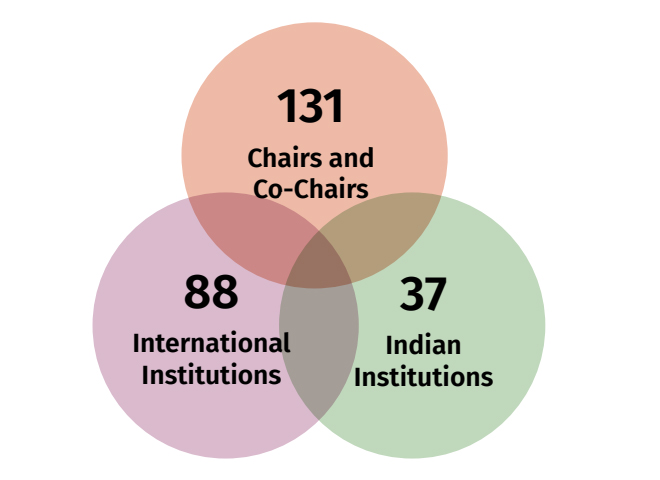
Constitution of Think20 Task Forces

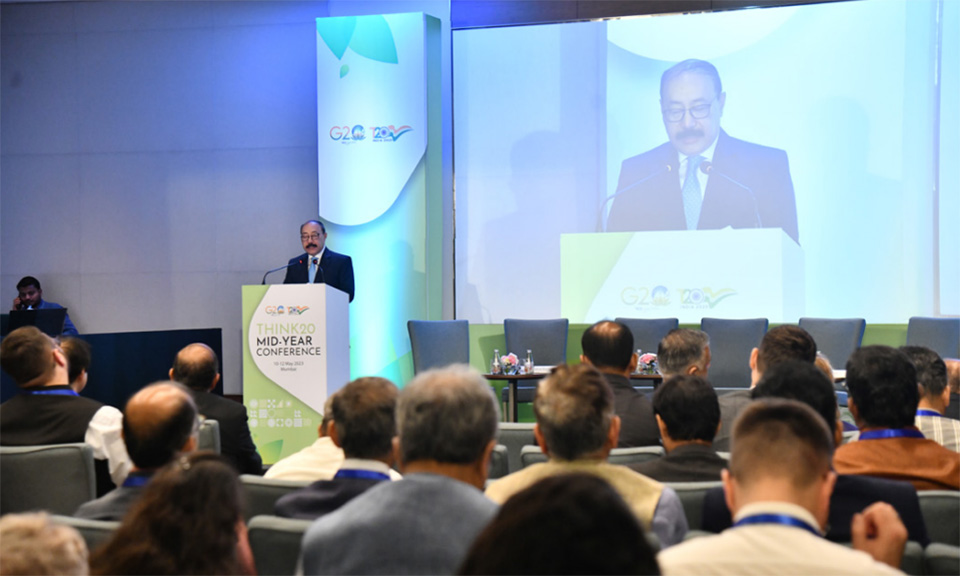
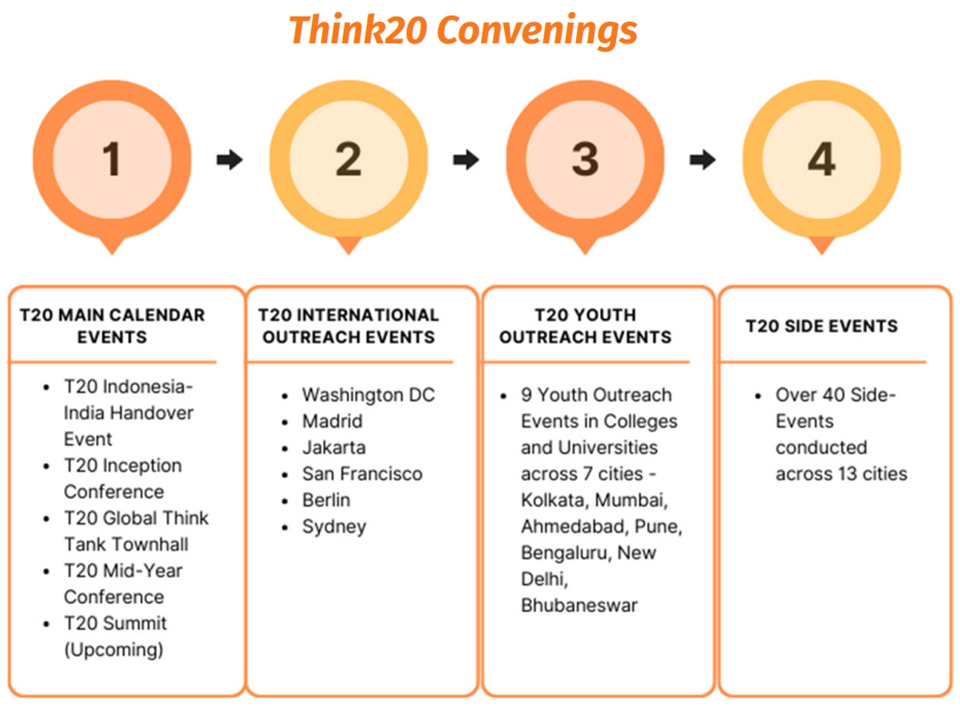
The T20 Mid-Year Conference took place in Mumbai on 10-12 May 2023. Three hundred attendees and Task Force members from across the G20 countries deliberated on the seven selected themes and took stock of the T20’s achievements thus far and the road ahead. Two particular elements of T20 India’s research and engagements stand out—its focus on mainstreaming gender and promoting gender equality, and its efforts to ensure that the African continent is an integral part of all conversations. India, being the second of four successive emerging economies to lead the G20 (Indonesia, India, Brazil, and South Africa will have been G20 Presidents between 2022 and 2025), has not only been a prominent voice of the Global South but has specifically put forth the unique developmental imperatives of the African landmass.

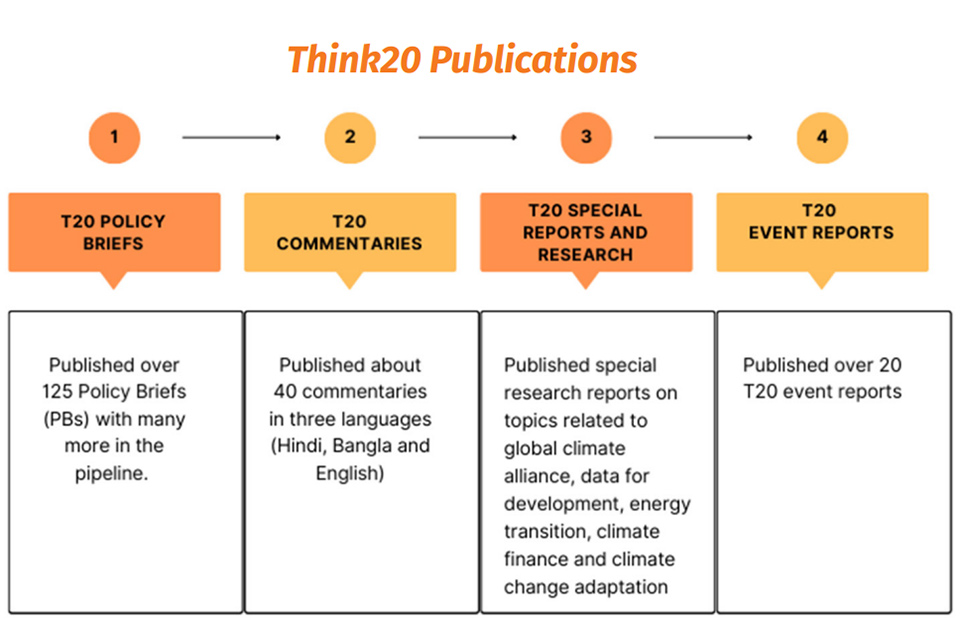
A key activity at the Mid-Year Conference was to finalise the Task Force Statements, which are vision documents about the Task Forces’ areas of engagement. The T20 Communiqué, a summary of recommendations to feed into the G20 process, is being drafted based on these statements and will be launched at the Think20 India Summit in Mysuru in August 2023. Moreover, as the term of the Indian T20 crosses its mid-point, it has already hosted over 50 events across the country and beyond and published over 125 Policy Briefs (PBs) with many more in the pipeline. These briefs are the outcome of processing raw ideas and producing them as actionable inputs.

The ethos of ‘Jan Bhagidari’ (or broad-based civic participation in governance) has underpinned the Indian Presidency’s efforts to take the G20 and its ideas to constituencies such as the youth, women, businesses, and civil society. Recognising the youth and women as essential partners in development and growth, the Mumbai Conference engaged actively with these target groups, and over 100 students from schools, colleges, and universities across Mumbai and Pune took part in the event.

The ethos of ‘Jan Bhagidari’ (or broad-based civic participation in governance) has underpinned the Indian Presidency’s efforts to take the G20 and its ideas to constituencies such as the youth, women, businesses, and civil society. Recognising the youth and women as essential partners in development and growth, the Mumbai Conference engaged actively with these target groups, and over 100 students from schools, colleges, and universities across Mumbai and Pune took part in the event.

Standard
Africa, BRICS, China, India, international affairs, Russia Civil War, USA and Canada, Writing

The United Nations Security Council is constituted to further the colonisation project

We can all agree today that this has been a very long decade; and it’s only just begun. The fabric of internationalism has been ripped in the last three years, and the ability to forge consensus on many vital questions that can enrich peace and strengthen security is at its lowest in nearly a century. There is a clear need to reform and reshape key institutions of global governance. Certainly, the United Nations Security Council (UNSC), in particular, needs an urgent overhaul.

Yet, we are all aware that the United Nations (UN) process as well the UNSC reform process are going nowhere. It is a fact that only once in the nearly eight decades of the UN’s existence has there been some semblance of reform—when the non-permanent seats of the UNSC were increased from six to 10. Since then, all efforts have largely been exercised in hollow statement-making. Tragically, these statements come with no timelines and are, of course, devoid of any content. Perhaps, this is the right time for this debate. Hence, the idea of bringing in new voices and opening this issue up for debate and discussion to the larger public—to the research community and to academia—must be lauded. We hope that the curious mix of practitioners and thinkers from the Global South can produce some breakthrough solutions that can take this debate forward.

The fabric of internationalism has been ripped in the last three years, and the ability to forge consensus on many vital questions that can enrich peace and strengthen security is at its lowest in nearly a century.

Decades of inaction have also resulted in the prevention of reforms becoming an ideal and an objective in itself. We have seen obstructive tactics, the emergence of a number of clubs and groups on this topic, and a myriad ways of stalling, delaying, and preventing progress. This, now, has become an end goal, and, perhaps, even a key responsibility area for diplomats posted to the hallowed institution that is the UN. That must change. We need to talk about progress in real terms. What should be the new format for engagement? There can be many answers to this question. What diplomats like Ambassador Ruchira Kamboj and academics like Matais Spektor say may not be the only solution. The solution may, in fact, lie in very different viewpoints and voices, and it is imperative that we hear them. Most importantly, we must all agree that status quo is not an answer.

The UN is facing a crisis of credibility as a global institution; and the lack of progress in the reform of the UNSC is going to create complete disenchantment. The future of the UN and its role is intimately linked to the progress made on this subject. Therefore, we must recalibrate our efforts as a global community and make sure that discussions on the reforms are infused with fresh voices and perspectives from geographies that are likely to contribute significantly to a stable and prosperous future. These are also the same nations that are likely to be most affected by a dysfunctional international institution.

Perspectives from the G20 and BRICS

Two recent debates we in India have been engaged in are of relevance to the conversation on institutional reform. One, of course, is courtesy the G20 presidency and its engagement groups that are working on various aspects of multilateral cooperation. Multilateral reforms is one of the most important debates happening in these groups. We are all apprised of the fact that the UNSC, the UN itself, the multilateral development banks, and the financial institutions need a complete overhaul. These institutions are no longer serving us in this particular century. The second is the aspirations of the BRICS. Under South Africa’s Presidency, there is an eagerness for and anticipation of institutions accommodating the aspirations of the African continent—a continent that is rising dramatically and rapidly.

The war is history, and so are the influence and capabilities of some of the members of this erstwhile group of victors.

We can see that different groupings are also beginning to understand and agitate this very important issue. Why is this important? Why mention the G20 and BRICS? The answer is: because we live in a deeply heterogeneous world. Some people also call it a multipolar world. It is untenable that a group of victors of a war from another century should be in charge of managing the world of today. The war is history, and so are the influence and capabilities of some of the members of this erstwhile group of victors. It is time to strengthen the A-Team and bring in voices who can serve all of us better. But beyond this particular aspect, there are three reasons for why we should be thinking about reform.

Why UNSC reform in particular

First, the current structure of the UNSC is perverse and immoral. For many in the Global South, it is a perpetuation of the colonisation project. The burden of the two World Wars was borne by the colonies, while the privileges of peace benefited the colonisers and their allies. Today, that is something that is being questioned by many; and it is increasingly going to become an important aspect of future debates as the world gets impatient with lack of progress in institutional reform.

Second, the reform is important because, currently, the UNSC is inefficient and does not serve the purpose it was installed for. In the past decades, we have seen how the will of the comity of nations has been negated by one or more of the permanent members. More recently, the crisis in Ukraine presents a classic example of the Security Council’s failure to deliver, and it is a stark reminder of why status quo is untenable. The voting patterns and the abstentions on the Ukraine conflict clearly point to the need to bring in others who can contribute to the global efforts around peace and stability.

We are struggling to reform the UNSC due to the nature of the inter-governmental negotiation (IGN) process itself.

Finally, the UNSC is undemocratic and non-representative. How can we accept a structure that shuts out Africa, Latin America, and democratic Asia, including the world’s largest democracy? The Permanent Five (P5) was configured to disproportionately include three European nations. Even having three nations in the P5 could not keep peace in the Old Continent. Clearly, here, three is a crowd. We need to reconfigure how we have structured the P5.

But this may not be the only viewpoint that is valid. There are others as well, and we must respond to and engage with them. For example, Uniting for Consensus argues that there cannot be any permanent membership of the UNSC for new members. This is a viewpoint against permanency and it must be put on the table. But, we must ask, if there is no permanency, why is it not applicable to the P5 as well? Why is it that all UN member states who want to be sitting as credible actors in the UNSC should not gain favour of 129 votes and assume a permanent role? These debates must not be cast aside or shut off. In fact, different groups and different viewpoints must be brought into the same room. And we hope that through this academic track, we can actually bring these varied perspectives together and come up with a mosaic of ideas and, thereafter, a symphony of solution.

To conclude, two points must be highlighted. First, we are struggling to reform the UNSC due to the nature of the inter-governmental negotiation (IGN) process itself. The fact that the IGN process, unlike any other in the UN, needs consensus for both process and outcomes makes it a nonstarter. In no UN negotiation is consensus a precondition for commencement. This is a fatal flaw in the way the process has been stitched together and no progress is possible unless we revisit this core element. Second, what is imperative is a concrete timeline as well. The 2024 Summit of the Future is being touted as a platform where productive discussions about UNSC reforms may finally take place. But the 2024 Summit cannot be regarded as a cure all and a one-stop-shop for everything. We must agree to a two-year timeframe, or a timeframe that others may suggest to be more viable, and we must rigorously adhere to it.

By the time the UN turns 80 in 2025, UNSC reforms must be well underway. Let us make this target a common agenda for all of us, with all our different viewpoints. Let us unite our energies to transform the UN into a multilateral institution that truly recognises the sovereign equality of all member states, and undertakes an operating systems upgrade that will bring it—with the rest of us—into the third decade of 21st century.


This article formed part of the Framing Remarks given by Samir Saran, President, ORF at the Roundtable on, “Shifting the Balance: Perspectives on the United Nations and UN Security Council Reforms from Global South Think Tanks”. 

The roundtable also saw the participation of Ruchira Kamboj, Permanent Representative of India to the United Nations; Matias Spektor, Professor of International Relations, FGV, Brazil and Visiting Scholar, Princeton University; and Gustavo de Carvalho, Senior Researcher, South Africa Institute of International Affairs, South Africa.

Standard